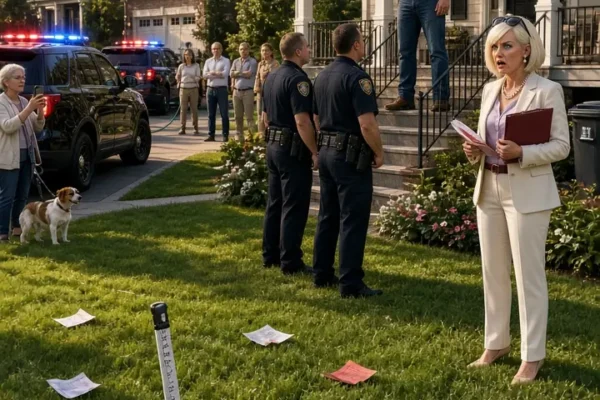
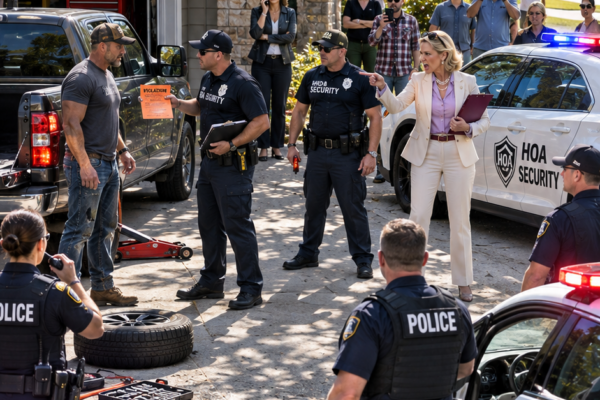
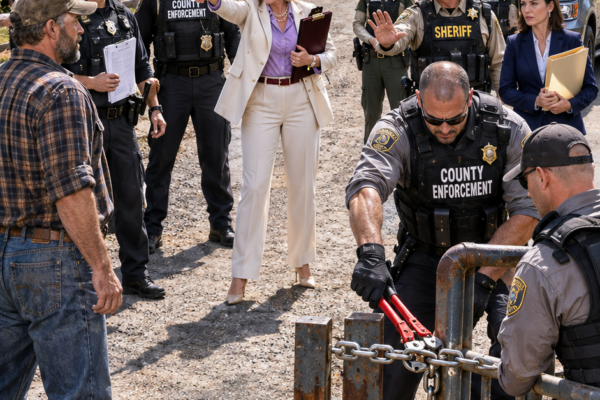
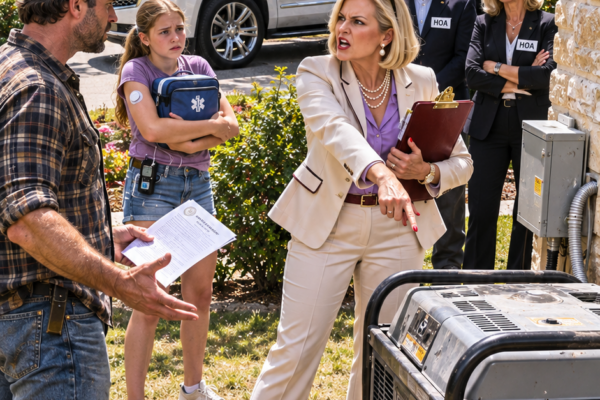
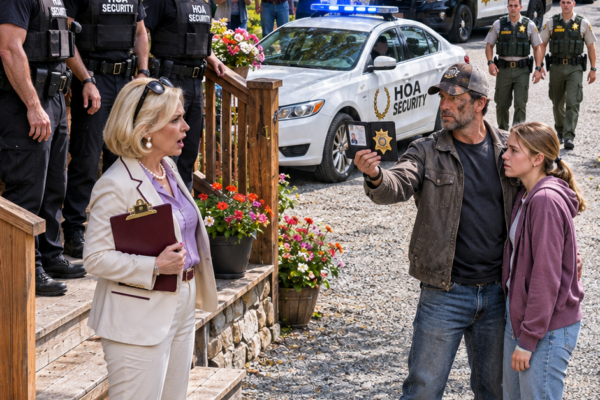
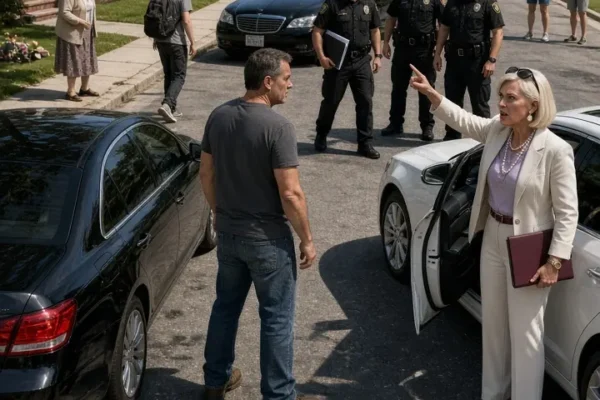
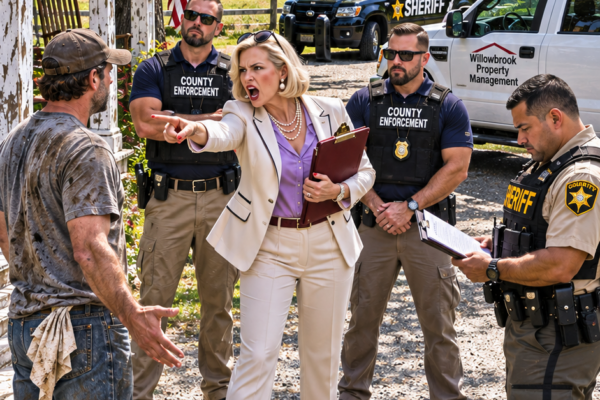
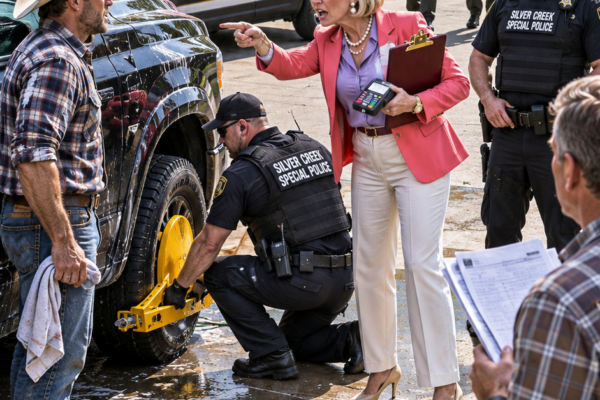
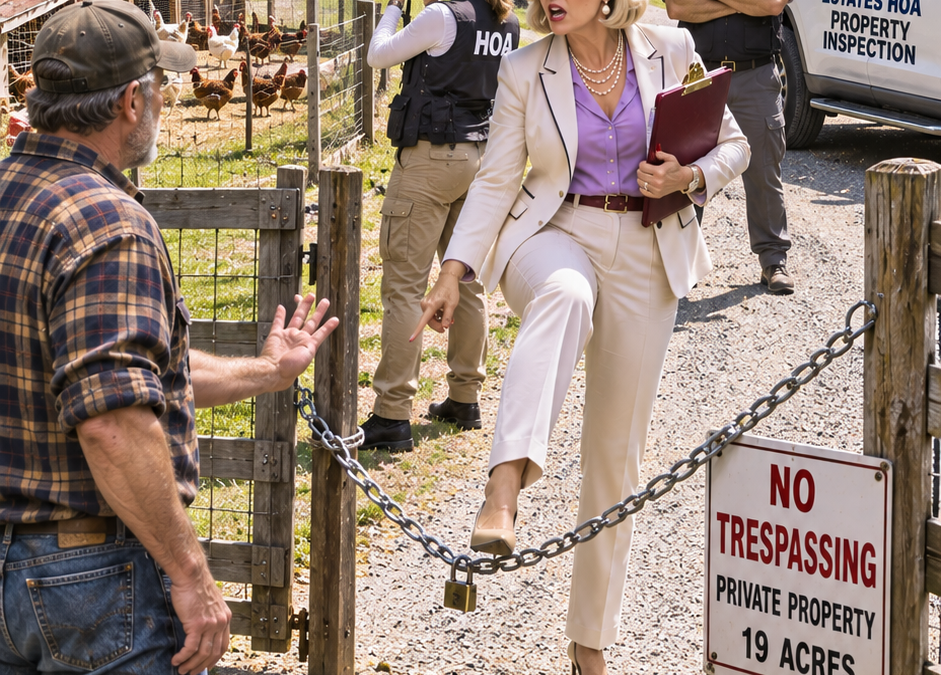
“OPEN THAT GATE, OR THE COUNTY WILL FORCE YOU TO COMPLY!” HOA Karen Declared Before Stepping Over My Chain and Sending a Photographer Across My 19-Acre Virginia Property. She Claimed a Forgotten Boundary Agreement Gave Her Authority Over My Land, My Barn, and Even My Eleven Chickens. What Sandra Voss Didn’t Know Was That I Had Spent Thirty-Two Years Investigating People Who Used Fake Documents to Intimidate Others…
part2
“Yes.”
“Did they identify themselves as county employees?”
“No. They represent a nearby homeowners association.”
“Are they claiming the county authorized their inspection?”
I looked at Sandra.
“She’s suggesting that her association has authority over my property and works with your office.”
The man on the telephone introduced himself as Gary Lent, a county code enforcement officer.
He asked me to repeat the reference number.
I did.
“That’s not one of ours,” he said. “And there’s no inspection scheduled for your address.”
Sandra stepped closer.
“Give me the phone. I’ll explain the situation.”
I ignored her.
“Thank you, Mr. Lent.”
“If they’re on your property without permission, you should contact the sheriff’s office regarding that issue. We haven’t sent anybody out there.”
“I appreciate your help.”
I ended the call.
Emily looked at Sandra.
“You told me this was coordinated with the county.”
Sandra’s expression hardened.
“It is a community compliance matter.”
“But you said—”
“Emily, please.”
I held up the notice.
“The county didn’t issue this. They haven’t scheduled an inspection. And your association has no recorded authority over my land.”
Sandra straightened her lanyard.
“You’re deliberately misrepresenting what we’re doing.”
“Then explain it.”
She didn’t.
Instead, she began talking about vegetation management, exterior storage, neighborhood appearance, and the importance of maintaining consistent standards throughout the area.
I let her finish.
“Are you leaving?”
She stared at me.
“You’re making a serious mistake.”
“Perhaps. But I’m making it on my own property.”
Dale climbed out of his pickup. He remained near the entrance, watching.
Emily returned her camera to its bag.
“I think we should go, Sandra.”
Sandra looked at her as though she’d just committed an act of betrayal.
Then she turned toward my shed.
“We’ll be returning with the appropriate authorities.”
“If they have lawful business here, I’ll be happy to speak with them.”
She held out her hand.
“The inspection notice.”
“I’m keeping it.”
“That’s association property.”
“It was delivered to me.”
She looked at the paper for another moment, then walked away.
Emily followed.
When they reached the chain, Sandra lifted her leg over it without acknowledging Dale.
He watched them return to the white Buick.
Neither woman looked back.
The car disappeared down the county road toward Ridgemont Estates.
Dale walked up my driveway.
“What was that all about?”
“She thinks she’s my HOA president.”
He looked around my nineteen acres.
“Out here?”
“Apparently.”
He laughed.
“That’s a pretty ambitious HOA.”
I smiled.
Then I looked down at the inspection notice.
The humor disappeared.
I had spent thirty-two years examining documents that people used to make other people believe things.
Invoices.
Applications.
Affidavits.
Financial statements.
Official-looking authorizations.
Some were legitimate.
Some contained innocent errors.
Others had been deliberately constructed to exploit the fact that most people didn’t know what a legitimate document should look like.
Sandra’s notice belonged somewhere in that territory.
I didn’t yet know precisely where.
But I intended to find out.
“Dale, would you mind writing down what you saw?”
He looked surprised.
“You think it’s going to get serious?”
“I think it’s already serious enough.”
He nodded.
“Come over this afternoon. I’ll have something ready.”
I thanked him and went inside.
My coffee was cold.
One of my chickens was standing outside the kitchen window, pecking at the glass.
I poured the coffee down the sink and made another pot.
Then I opened the second drawer of my filing cabinet.
There was already a folder bearing Sandra’s name.
I added the inspection notice.
And for the first time since retiring from federal law enforcement, I started preparing an incident file.
My name is Frank Decka.
I was sixty-three when Sandra decided my property belonged under her authority.
I’d lived on those nineteen acres in rural Virginia for fourteen years.
I hadn’t grown up farming. I hadn’t inherited generations of agricultural knowledge, and I certainly hadn’t spent my childhood dreaming about chickens.
The property entered my life during a particularly difficult October.
My career had ended.
My wife, Margaret, was gone.
And the house we’d shared for most of our marriage had become a collection of rooms I no longer knew how to occupy.
Margaret’s gardening gloves remained beside the back door.
Her favorite coffee mug sat in the cabinet.
There was still a grocery list attached to the refrigerator in her handwriting.
I couldn’t bring myself to throw it away.
Every evening, I returned to a house that was exactly as she had left it.
Every morning, I woke expecting to hear her moving around the kitchen.
Eventually, my daughter, Rebecca, persuaded me to look at other properties.
“You don’t have to buy anything, Dad. Just look.”
I agreed.
A real estate agent showed me several houses in town.
They were perfectly respectable.
Fresh paint.
New appliances.
Small yards.
Neighbors close enough to hear one another sneeze.
I wasn’t interested.
Then, on a Thursday afternoon, she took me to the old Delman property.
Nineteen acres at the end of a gravel driveway, surrounded by trees.
The house needed work.
The well pump was unreliable.
Two outbuildings had seen better decades.
A broken fence leaned toward the road.
But when I stood outside, all I heard was wind moving through the branches.
The October sunlight came through the trees at an angle that turned everything gold.
For the first time in months, I could imagine waking up somewhere without immediately remembering what I’d lost.
I made an offer that afternoon.
Rebecca thought I’d lost my mind.
“Dad, you don’t know anything about maintaining nineteen acres.”
“I’ll learn.”
“And the well?”
“I’ll learn about that too.”
“What about the fence?”
“Rebecca.”
She stopped.
I looked toward the trees.
“I think I need something to do.”
She understood.
The purchase closed after the ordinary title and inspection procedures.
I obtained a boundary and easement survey.
I learned how the shared approach and county road arrangements worked.
I made sure I understood the recorded restrictions affecting my property.
Then I started making mistakes.
My first attempt at repairing the fence took twice as long as it should have.
My second attempt was considerably better.
I learned about well pumps after paying someone to replace mine.
I learned about drainage after putting a small garden in precisely the wrong location.
I learned that zucchini plants possessed an almost supernatural ability to produce more food than one person could reasonably consume.
And I learned that chickens were capable of developing surprisingly complicated opinions.
The eleven chickens arrived through my former neighbor, Bert.
He was moving to Sarasota and couldn’t take them.
“Just keep them for a couple of weeks, Frank.”
That was three years before Sandra’s inspection.
Bert never returned.
The chickens stayed.
I named only one of them.
Agnes.
She was aggressive, suspicious of strangers, and determined to inspect everything I carried outside.
Looking back, I probably should have introduced her to Sandra.
They had a considerable amount in common.
My life was simple.
I maintained my property.
Paid my taxes.
Kept my equipment in working condition.
Shared vegetables and eggs with neighbors.
Visited Rebecca and my grandchildren whenever I could.
In 2019, I obtained the necessary county approval to build a storage shed on the southern portion of my land.
I built most of it myself.
The permit went into my filing cabinet.
So did the inspection records.
I kept documentation for everything that mattered.
Not because I expected somebody to challenge me.
Because old habits rarely disappear simply because a man retires.
My career had been in federal law enforcement.
Over thirty-two years, I’d worked on investigations involving financial misconduct, fraudulent representations, and misuse of positions of trust.
I eventually supervised personnel responsible for examining complex cases.
The work taught me patience.
It also taught me that the loudest person in a room wasn’t necessarily the person with the strongest evidence.
Sometimes, the person speaking most confidently was simply hoping nobody would ask for a supporting document.
I encountered Sandra Voss for the first time at a county road maintenance meeting.
That was eighteen months before she crossed my chain.
Ridgemont Estates was a subdivision located roughly six-tenths of a mile down the road from my entrance.
Its residents shared several ordinary concerns with people living nearby.
Road maintenance.
Drainage.
Traffic.
Occasional fallen trees.
There was nothing unusual about discussing those matters together.
Sandra arrived early.
She sat in the front row with a carefully organized binder and asked several reasonable questions about maintenance schedules.
After the meeting, she introduced herself.
“Sandra Voss. President of Ridgemont Estates.”
“Frank Decka.”
“How long have you lived out here?”
“About twelve years.”
“Which property?”
“The old Delman parcel.”
Her expression changed slightly.
“The nineteen-acre tract?”
“That’s right.”
She nodded.
“We’ve been looking at the properties along that corridor.”
“What corridor?”
“The area surrounding our community.”
I glanced toward the county road.
“It’s a public road.”
“Of course. But we’re interested in maintaining consistent standards.”
I didn’t particularly care what standards Ridgemont maintained inside its own development.
As long as its residents didn’t throw rubbish into my ditch or damage my fence, we had no disagreement.
“Well, good luck with that,” I said.
She smiled.
“I’m sure we’ll be speaking again.”
She was right.
Unfortunately.
The next communication was a handwritten note attached to my mailbox post.
It informed me that my fence color didn’t comply with Ridgemont Estates’ community appearance standards.
I stood beside the road reading it.
Then I looked at the fence.
Dark green.
Painted the same color for years.
I had never received a complaint about it.
There was no signature, but the language sounded familiar.
Quarterly review.
Community standards.
Shared appearance.
I carried the note inside and placed it in a folder.
I didn’t respond.
For several months, nothing happened.
Then the first certified letter arrived.
It was a Tuesday morning in March.
I signed for the envelope and brought it to my kitchen table.
The association’s name appeared in the upper corner.
Inside was a two-page letter signed by Sandra Voss.
She informed me that following a review of community boundary documentation, my property had been identified as falling under Ridgemont Estates’ jurisdiction.
The supposed basis was something she called a legacy boundary agreement.
According to Sandra, that agreement dated to the original subdivision filing.
She listed three violations.
Excessive fence height.
Unauthorized exterior storage.
Unmanaged vegetation along a shared corridor.
She requested written acknowledgment within thirty days and invited me to arrange a compliance review.
I read the letter twice.
Then I opened the drawer containing my property documents.
The historical deed describing the Delman tract had been recorded in 1986.
My own conveyance followed many years later.
Ridgemont Estates’ original subdivision documents dated to 2001.
I retrieved the relevant recorded plat and the declaration of covenants, conditions, and restrictions.
The subdivision boundary ended well before my property began.
Approximately 340 feet separated the nearest recorded association boundary from my property line.
There were intervening properties.
There was no shared HOA corridor.
And I couldn’t find any recorded instrument supporting Sandra’s legacy agreement.
I wrote a response that afternoon.
It wasn’t angry.
I identified my parcel number, the relevant deed book and page, the historical recording date, and the location of the nearest recorded association boundary.
I requested the document number for the agreement she claimed applied to my property.
I specifically stated that I did not recognize any association enforcement authority over my land.
Then I sent the response by certified mail.
Sixteen days passed.
Sandra’s second letter arrived.
It repeated the same allegations.
This time, there was an additional sentence warning that continued noncooperation could result in referral to the county for code enforcement review.
She hadn’t answered my question.
Not one word concerning the document number.
I placed both letters beside each other on my kitchen table.
Same unsupported claim.
Same three categories.
New deadline.
Additional threat.
I had seen that pattern before.
When someone couldn’t establish authority through evidence, they sometimes attempted to establish it through repetition.
I replied once more.
I stated that I did not consent to an inspection.
Then I requested the recorded agreement again.
Twelve days later, the inspection notice arrived.
It looked more elaborate than the previous correspondence.
There was an official-looking heading, a bold reference number, an inspection window, and a paragraph describing procedures for exterior property review.
Sandra had scheduled a visit.
She hadn’t requested one.
There was a difference.
I preserved the envelope and the document.
Then I waited.
I wasn’t expecting her to step over the chain.
I thought even Sandra might recognize what a no-trespassing sign meant.
Apparently, she didn’t.
And now I had footage proving it.
After Sandra left, I retrieved the recordings from my security cameras.
One camera covered the entrance.
Another faced the driveway and the front of the house.
The entrance recording clearly showed Sandra approaching the chain, stepping across it, and continuing toward my home.
Emily followed several seconds later.
The second recording captured much of our conversation.
I watched Sandra direct Emily toward my shed.
I heard myself instruct both women to leave.
I heard Sandra’s reference to the legacy boundary agreement.
And I heard her claim that the association worked closely with county officials.
I saved the original files and made separate working copies.
Then I wrote an incident summary while the details were fresh.
Arrival time.
Vehicle description.
Individuals involved.
Statements made.
Instructions to leave.
Departure.
Dale’s presence.
County employee contacted.
I didn’t include speculation about Sandra’s motives.
There was no need.
The facts were sufficient.
That afternoon, Dale gave me his written statement.
He had included the approximate time, the location of Sandra’s vehicle, and what he remembered hearing.
At the bottom, he had signed his name.
“Is that what you needed?”
“Exactly.”
He looked toward the driveway.
“I don’t understand why somebody would go to all this trouble over your fence.”
“Neither do I.”
He leaned closer.
“You reckon she’s trying to get the county involved?”
“She already tried.”
He shook his head.
“Some people need a hobby.”
“I’ve got eleven chickens. She’s welcome to borrow one.”
He laughed.
After Dale left, I called the sheriff’s non-emergency number.
I reported the unauthorized entry and explained that I had supporting recordings and a witness.
A deputy arranged to obtain the relevant information.
I provided Sandra’s name, the association’s address, the vehicle registration information visible in the recording, and copies of the notices.
I wasn’t asking anyone to immediately arrest her.
I wanted the incident properly documented.
If this continued, the next deputy who received a complaint wouldn’t be starting from nothing.
Then I called Paul Greer.
Paul was a real estate attorney I’d consulted shortly after purchasing the property.
We hadn’t spoken in nine years.
He remembered me immediately.
“Frank Decka. You still having trouble with that old fence?”
“No. Somebody’s having trouble understanding where it is.”
I explained what had happened.
Paul listened without interrupting.
When I finished, he asked me to send the correspondence and the recorded property documents.
I did.
He called back later that afternoon.
“From what I’m seeing, there’s no basis for their claim.”
“That’s what I thought.”
“But I want to obtain the full recorded history before making that conclusion final.”
“Fair enough.”
He asked whether Sandra had attempted to enter any building.
“No.”
“Did she remain after being told to leave?”
“Long enough to argue.”
“Do you have that on video?”
“Yes.”
He sighed.
“Of course you do.”
I smiled.
“Some habits die hard.”
Paul recommended preparing a formal cease-and-desist demand and directing it to Sandra individually and the association’s board.
He also intended to request additional records concerning the alleged boundary agreement.
I authorized the work.
Two days later, Gary Lent called at 8:40 in the morning.
“Mr. Decka?”
“Good morning.”
“We have some complaints concerning your property.”
I set down my coffee.
“Submitted by whom?”
“A Sandra Voss.”
That was quick.
“What are the complaints?”
He read the first one.
Vegetation allegedly encroaching onto the county road easement.
The second concerned an unpermitted exterior structure.
The third alleged that I was maintaining livestock contrary to applicable county agricultural requirements.
I listened carefully.
Then I asked him to wait.
I retrieved three folders from my cabinet.
“Let’s start with the structure.”
“All right.”
“Storage shed, southern portion of the property. County approval dated April fourteenth, 2019.”
I read him the permit number.
He typed.
“Hold on.”
I waited.
A few seconds later, he spoke again.
“Okay. I’ve located it.”
“Would you like the inspection information?”
“Yes, please.”
I provided it.
Then we discussed the chickens.
My small flock was documented under the applicable local arrangements, and I had retained the relevant correspondence and current registration information.
I supplied those details too.
Finally, I opened the boundary survey.
The survey identified the recorded road easement and property lines.
The tree line Sandra had complained about sat well inside my property and did not interfere with the established easement.
I gave Gary the surveyor’s name and the recording information.
He stopped typing.
“Mr. Decka, these complaints don’t appear to have much foundation.”
“I would agree.”
“I’ll need to verify a few things before closing them.”
“Of course.”
He remained silent for a moment.
Then he said, “We’ve received complaints from that association address before.”
“Against properties outside Ridgemont?”
“Some of them, yes.”
“Similar complaints?”
“Similar categories.”
I sat straighter.
“Would you be willing to document that in your review, to the extent it’s appropriate?”
“I’ll make sure the relevant history is considered.”
“Thank you.”
After we hung up, I wrote down the time of the call and the substance of our conversation.
Then I called Paul.
“She’s submitted three county complaints.”
He sounded unsurprised.
“Send me what you have.”
“I think there’s something else going on.”
“What makes you say that?”
“The code officer mentioned similar complaints concerning neighboring properties.”
Paul paused.
“Let’s not get ahead of the evidence.”
“I’m not.”
“Good. I’ll include the new information in our correspondence.”
That afternoon, Gary visited my property.
He arrived in a marked county vehicle and stopped outside my entrance.
He called before coming through.
I opened the gate and invited him in.
The contrast between his behavior and Sandra’s was almost comical.
He identified himself.
Explained the purpose of his visit.
Confirmed the areas he needed to examine.
And asked whether I had any questions.
We started at the shed.
He compared its location with the county records.
Then he examined the vegetation near the road.
Finally, he looked at the chicken enclosure.
Agnes approached the fence.
She studied his boots with considerable suspicion.
Gary smiled.
“That’s quite a flock.”
“They were supposed to be temporary.”
“How long?”
“Three years.”
He laughed.
“Sounds about right.”
He finished his review without identifying a condition that required corrective action.
As we walked toward his vehicle, he looked down the road toward Ridgemont.
“Have you had other disagreements with those people?”
“Just the association president.”
“Are you a member?”
“No.”
He shook his head.
“Then I don’t understand why she’s so interested in your shed.”
“Apparently, my shed is threatening regional stability.”
He laughed again.
Before leaving, he promised to complete the complaint reviews and notify me of their disposition.
I thanked him.
Then I went back inside and opened Sandra’s folder.
Three allegations.
Three supporting records.
One unnecessary visit from a county employee who undoubtedly had better things to do.
I wondered what would’ve happened if I hadn’t kept the permit.
Or if my survey had been lost.
Or if I’d been frightened by the first official telephone call and agreed to do whatever Sandra requested.
I suspected I was beginning to understand why she had selected me.
I lived alone.
I was retired.
My property sat outside the subdivision, but close enough that an unfamiliar person might assume there was some connection.
And I didn’t have a family member living with me who might immediately question the notices.
Sandra knew none of the details of my former career.
I’d never mentioned it at the road meeting.
Most people around here knew me as the older man with the vegetable garden and a collection of noisy chickens.
That suited me.
But it may also have suited Sandra.
Paul completed the cease-and-desist letter four days later.
I drove into town to review it.
His office occupied the second floor of an old brick building beside a bakery.
The staircase creaked.
The reception area smelled faintly of coffee and printer toner.
Paul handed me three pages.
“Read it carefully.”
I did.
The letter addressed the unauthorized entry, the unsupported inspection notice, the subsequent complaints, and the association’s repeated misrepresentation of its boundaries.
It cited the relevant records.
It identified the evidence we’d preserved.
And it demanded that Sandra and Ridgemont cease enforcement activity directed at my property without a legitimate legal basis.
Paul had also completed his search for the alleged legacy boundary agreement.
He had found nothing supporting Sandra’s claim.
“Maybe she’ll produce something we haven’t seen,” he said.
“Do you think she will?”
“No.”
He folded his glasses.
“But I prefer giving people the opportunity to prove me wrong.”
The letter requested preservation of relevant association records, including correspondence, inspection authorizations, board minutes, and communications concerning my property.
It also notified the board of potential civil liability arising from the conduct of its representatives.
Whether other directors knew about Sandra’s actions remained unresolved.
Paul wasn’t going to accuse them without evidence.
But after receiving the letter, they couldn’t claim they hadn’t been informed of the problem.
I approved it.
He sent copies by certified mail to Sandra and the association’s registered address.
Forty-one hours later, my telephone rang.
“Mr. Decka? My name is Robert Haith. I’m the treasurer of Ridgemont Estates.”
“Good morning.”
He sounded like a man reading from carefully prepared notes.
“I’m calling concerning the letter our board received from your attorney.”
“Yes.”
“I want you to understand that the board did not direct Sandra to enter your property.”
I waited.
“We were unaware that she had scheduled an inspection.”
“Okay.”
“And we certainly haven’t voted to establish enforcement authority over your parcel.”
“That’s useful to know.”
He hesitated.
“Would you be willing to speak with us directly?”
“Possibly.”
“We need to review what happened.”
“I suggest you do.”
He exhaled.
“I apologize for the circumstances.”
“Thank you.”
Afterward, I noted the call and sent Paul a summary.
The following morning, another board member contacted me.
Carol Ashby, the secretary.
Her account was remarkably similar.
She said she hadn’t seen the inspection notice before Sandra sent it.
She hadn’t approved the county complaints.
And the board intended to hold an emergency session.
I thanked her.
Then I asked a question.
“Does your association have a compliance department?”
She sounded confused.
“A department?”
“Yes. Sandra told me her compliance department generated the inspection reference number.”
There was a pause.
“We have an architectural review committee.”
“Does it inspect neighboring properties?”
“No.”
“Does it assign official inspection numbers?”
“Not that I’m aware of.”
“Interesting.”
Carol asked whether I could provide a copy of the notice.
I directed her to Paul.
She agreed to contact him.
When the conversation ended, I sat back in my chair.
The association was beginning to separate itself from Sandra’s conduct.
I’d seen similar situations during my former career.
An individual accumulated authority inside an organization.
Other people stopped questioning routine decisions.
Then something happened that created a genuine risk.
Suddenly, everyone wanted to know precisely which decisions had been authorized.
The distinction mattered.
But it didn’t automatically absolve an organization of everything done in its name.
And I wanted more than assurances over the telephone.
I wanted a permanent record.
The following afternoon, Emily came to my house.
She arrived alone.
She parked outside the chain, walked to the sign, and called out from there.
“Mr. Decka?”
I stepped onto my porch.
“Yes?”
“It’s Emily. I was here with Sandra.”
“I remember.”
“Would it be okay if we talked?”
I walked down and opened the entrance.
She looked nervous.
She couldn’t have been much older than my daughter.
She explained that she worked part-time photographing properties for real estate agents and local businesses.
Sandra had hired her to photograph several locations for what she described as a compliance documentation project.
“She told me the owners had been notified and that we were authorized to do exterior inspections.”
“Did she show you any signed permissions?”
“No.”
“Any recorded agreements?”
“No.”
Emily looked toward the shed.
“I thought she knew what she was doing.”
“That happens.”
She handed me a business card.
“I wanted to apologize. I shouldn’t have followed her across that chain.”
I appreciated the apology.
“Did you take any photographs?”
“A few. Before you told me to stop.”
“Did Sandra receive them?”
“Yes.”
“Have you retained the original files?”
She nodded.
“Keep them. Don’t delete anything connected to the visit.”
She looked worried.
“Am I in trouble?”
“I can’t answer that for you. I’ve reported the incident. If somebody contacts you, tell the truth and get your own legal advice if you need it.”
She nodded again.
Then she mentioned something else.
Sandra had given her a printed list of addresses for possible future inspections.
My property was one of them.
Several other addresses were located along the county road outside Ridgemont Estates.
Emily didn’t know whether those properties belonged to the association.
But she remembered seeing the words legacy corridor review beside their names.
I asked whether she would be comfortable providing that information to the investigating deputy.
“Yes.”
“Then that’s what you should do.”
She thanked me.
As she left, I stood beside the chain for a long time.
My property wasn’t necessarily Sandra’s only target.
And whatever she called her legacy corridor might cover considerably more land than I’d realized.
Paul obtained the original development records from the county.
Among them were preliminary planning drawings showing an ambitious expansion of Ridgemont Estates that had never been completed.
The developer had once contemplated acquiring additional land along the county road.
Several nearby parcels appeared in a lightly shaded area identified for possible future development.
My nineteen acres were included.
So were properties belonging to people who had never joined the association.
The distinction between the planning drawings and the recorded subdivision plat was obvious.
One showed what the developer hoped to accomplish.
The other showed what actually existed.
Paul called me into his office and spread both maps across his desk.
“Look familiar?”
I pointed toward the shaded area.
“The legacy corridor.”
“That’s my suspicion.”
“She’s treating an abandoned development proposal as a recorded boundary agreement?”
“Possibly. Or she’s using it to justify something she already wanted to do.”
He placed a ruler along the relevant boundary.
“Either way, this drawing didn’t annex your property.”
I studied the names of the surrounding parcels.
One belonged to Howard Briggs.
I knew him casually.
He maintained a small equipment repair business and lived near the eastern end of Ridgemont.
Another belonged to a retired teacher named Elena Marsh.
I had occasionally seen her tending flowers beside the road.
Neither property appeared inside the recorded association boundary.
“Do you think they’ve received notices?”
Paul looked at me.
“We don’t know yet.”
I nodded.
He was right.
I wasn’t going to start knocking on doors and announcing conclusions that hadn’t been established.
But I provided the relevant planning records and information from Emily to the investigating deputy.
Then I prepared for the board meeting.
Robert invited me to the Ridgemont clubhouse on Thursday evening.
Paul offered to accompany me.
“Do you want me there?”
“I don’t think it’s necessary.”
“Don’t make any binding agreements without letting me review them.”
“I won’t.”
He smiled.
“Somehow, I think Sandra’s going to have an unpleasant evening.”
“I’d settle for a productive one.”
That night, I sat at my kitchen table organizing the documents.
I selected only what mattered.
The original deed records.
My current ownership documents.
The recorded association declaration and plat.
The preliminary expansion drawings.
Sandra’s correspondence.
My responses.
The certified delivery receipts.
The inspection notice.
The sheriff’s incident report information.
Gary’s complaint review.
Dale’s statement.
Photographs and video stills.
Paul’s letter.
I put everything in chronological order.
Then I rehearsed what I intended to say.
Eleven minutes.
I timed it because I had no intention of spending an hour explaining something the recorded documents established in a matter of seconds.
Before leaving for the clubhouse, I received a call from Rebecca.
“How’s your chicken farm?”
“Still operational.”
“And you?”
“Going to a meeting.”
“What kind of meeting?”
“Homeowners association.”
She laughed.
“Since when do you live in an HOA?”
“Exactly.”
I explained the situation.
She stopped laughing when I described Sandra entering the property.
“Dad, why didn’t you tell me earlier?”
“It didn’t seem necessary.”
“You live out there alone.”
“I’m aware.”
“What if she sends somebody more aggressive next time?”
I looked at the folder.
“That’s why I’m addressing it.”
Rebecca sighed.
“Promise you’ll call me if anything else happens.”
“I promise.”
She remained quiet for a moment.
“Mom would’ve hated this woman.”
I laughed.
“Yes, she would.”
“She probably would’ve offered her coffee before destroying her entire argument.”
“That sounds about right.”
After we hung up, I looked at Margaret’s photograph.
She had always been better than I was at making difficult people feel comfortable.
Not because she agreed with them.
Because she recognized that people often became easier to reason with when they stopped feeling threatened.
I wondered how she would have handled Sandra.
Then I picked up my folder and drove to Ridgemont.
The clubhouse was a large building with artificial stone columns, immaculate landscaping, and a brass plaque listing the original board members.
Inside, the meeting room contained beige carpeting, fluorescent lighting, and a long folding table.
Six board members were present, including Sandra.
Robert stood when I entered.
“Mr. Decka. Thank you for coming.”
“Thank you for inviting me.”
Carol sat beside him.
An older gentleman introduced himself as Dennis Porter.
Another director, Cynthia Bell, offered me a chair.
I declined.
“If you don’t mind, I’d prefer to stand while I go through the documents.”
“Of course,” Robert said.
Sandra sat at the far end of the table.
Her clipboard rested beside a glass of water.
She hadn’t greeted me.
I set down my folder.
“I’ll begin with the recorded property boundaries.”
Sandra immediately interrupted.
“Before we get started, I’d like to clarify that this situation has been blown considerably out of proportion.”
Robert turned toward her.
“Sandra, we’ll give Mr. Decka an opportunity to speak first.”
She looked irritated.
“I think it’s important that he understands the context.”
I opened the folder.
“That’s why I brought the records.”
Dennis smiled slightly.
Sandra noticed.
She didn’t smile back.
I distributed copies of the recorded deed and subdivision plat.
“The historical description of the Delman parcel was recorded in 1986. Ridgemont Estates’ original subdivision declaration was recorded in 2001.”
I pointed toward the map.
“This is your recorded boundary. This is my property line. Approximately 340 feet separate them at the nearest relevant points.”
Carol leaned forward.
“There’s another parcel between them.”
“Correct.”
Robert examined the map.
“Sandra, is this the boundary we’ve been using?”
She shook her head.
“That doesn’t reflect the legacy agreement.”
I took out her first letter.
“Then let’s discuss that agreement.”
She reached toward her clipboard.
“The developer intended to include those properties in the larger community.”
“I’m aware.”
I placed the preliminary planning drawing on the table.
“Is this what you’re referring to?”
She stared at it.
For a moment, nobody spoke.
Finally, she nodded.
“That’s part of the historical community plan.”
“It’s a proposed expansion.”
“It established the intended boundaries.”
“Intended boundaries aren’t recorded ownership restrictions.”
Dennis looked at Sandra.
“Did the developer actually acquire those parcels?”
She hesitated.
“Not all of them.”
“Did the owners sign annexation documents?”
“The development process was complicated.”
Robert removed his glasses.
“Sandra, did anybody record an agreement covering Frank’s property?”
She looked toward me.
“Mr. Decka has been extraordinarily uncooperative.”
I slid my certified letter across the table.
“This is my response to your initial communication. I requested the recording information. Twice.”
Carol read it.
Then she looked at Sandra.
“Why didn’t you answer him?”
Sandra folded her arms.
“Because the matter was still under review.”
“Then why were you conducting an inspection?”
“Because that’s how we verify compliance.”
Robert closed his binder.
“With what?”
Sandra looked startled.
He continued.
“What rules was he supposed to be complying with?”
“Our community standards.”
“But he’s not a member.”
“He lives within the legacy corridor.”
I pointed toward the planning drawing.
“That shaded area doesn’t establish an HOA.”
Cynthia picked up the recorded declaration.
“She’s right about the original expansion plan. I remember seeing something similar when we bought our house.”
She looked at Sandra.
“But I always understood that the expansion never happened.”
Sandra didn’t respond.
I moved to the inspection notice.
Its reference number was printed in bold near the top.
“Who generated this?”
Sandra answered quickly.
“I did.”
“On behalf of which committee?”
“The association.”
Carol shook her head.
“We’ve never adopted this inspection form.”
Sandra turned toward her.
“It’s an administrative document.”
“Did the board approve inspections outside the membership list?”
“No formal approval was necessary.”
Robert looked at her.
“Why not?”
“Because the board has delegated compliance responsibilities to me.”
He shook his head.
“Not over properties outside our jurisdiction.”
I produced a still image from the entrance camera.
Sandra was halfway across the chain.
The no-trespassing sign was visible beside her.
“This was taken on the morning of the inspection.”
Dennis studied the photograph.
“Was that chain closed?”
“Yes.”
“Did she call you before entering?”
“No.”
Sandra leaned toward him.
“He received advance notice.”
I turned to her.
“I explicitly declined permission.”
She opened her mouth.
Then closed it.
Carol looked down at my written response.
“He did.”
I continued through the documents.
The witness statement.
The sheriff’s report information.
The county complaints.
The permit for the shed.
The documentation concerning the chickens.
The boundary survey.
I explained that Gary Lent had visited and verified the relevant conditions.
There was no need for Sandra to conduct an independent inspection.
She had no responsibility for enforcing county requirements.
And the complaints had consumed public resources without establishing any violation.
When I finished, I looked toward Robert.
“That’s the factual history.”
He nodded.
“Thank you.”
Sandra shook her head.
“This is unbelievable. I’ve been trying to maintain the appearance of this community for six years.”
I closed the folder.
“Your community ends before my property begins.”
She pointed toward the planning drawing.
“Do you understand how much effort went into that development?”
“I’m sure it was considerable.”
“We can’t allow nearby properties to deteriorate simply because their owners don’t want to follow reasonable standards.”
Dennis looked at her.
“His property hasn’t deteriorated.”
Sandra turned sharply.
“You haven’t inspected it.”
“Neither should you have.”
The room went quiet.
Robert asked what I wanted from the association.
I gave him three proposed resolutions.
First, a written acknowledgment, approved by the board, that my parcel was outside Ridgemont Estates’ recorded boundaries and that the association claimed no enforcement authority over it.
Paul would arrange for the acknowledgment to be retained with my property records and recorded if an appropriate recording mechanism was available.
Second, a written apology acknowledging that the inspection had lacked authorization and that the entry onto my property had been improper.
Third, a policy requiring verification of jurisdiction before any enforcement activity, and documented permission or another valid legal basis before representatives entered property outside the association’s membership.
I wasn’t demanding control of the association.
I wasn’t demanding that Sandra surrender her house.
I wasn’t asking the residents to compensate me for some imaginary financial catastrophe.
I wanted the unauthorized conduct stopped, documented, and prevented from happening again.
Robert examined the proposals.
“They seem reasonable.”
Sandra stared at him.
“You’re actually considering this?”
“Yes.”
“He’s threatening the association!”
Carol answered before I could.
“No, Sandra. His attorney is warning us about something you’ve done in our name.”
Sandra looked around the table.
Nobody supported her.
I gathered my folder.
“I’ll wait outside while you discuss it.”
Robert thanked me.
I walked into the hallway and took a seat near a vending machine.
Through the closed door, I could hear voices.
Not the words.
Just their rising and falling volume.
Once, Sandra raised her voice enough that I recognized it immediately.
Then everything became quieter.
Nine minutes after I left the room, Robert emerged.
He carried my proposed resolutions.
“The board approved all three.”
I stood.
“Thank you.”
“We’ll have our attorney prepare the formal acknowledgment.”
“I appreciate that.”
“And Frank, speaking personally, I’m sorry you had to come here.”
He extended his hand.
I shook it.
“Let’s make sure nobody else has to.”
I walked through the meeting room on my way out.
Carol was collecting papers.
Dennis gave me a nod.
Sandra remained seated.
Her clipboard was closed.
She didn’t look up.
I went outside.
The parking lot lights illuminated the carefully trimmed shrubs around the entrance.
It was about eight thirty.
I unlocked my truck.
Then the clubhouse door opened behind me.
“Mr. Decka.”
Sandra.
I turned around.
She stopped several feet away.
No clipboard.
No lanyard.
Just a woman standing beneath a parking lot light.
“Why did you have to make this such a big thing?”
I leaned against my truck.
“Because it was a big thing.”
“I was trying to maintain standards.”
“You sent me documents claiming authority you couldn’t establish. Then you entered my property after I denied permission.”
She shook her head.
“You could’ve handled this privately.”
“I wrote to you twice.”
“You didn’t cooperate.”
“I asked for a document number.”
She looked toward the road.
“I didn’t think you’d take it this far.”
I considered her words.
That was the first completely believable thing she’d said all evening.
“I didn’t take it anywhere, Sandra. I responded to what you did.”
She stared at me.
For several seconds, neither of us spoke.
Then she asked, “What did you do before you retired?”
I looked at her.
“Federal law enforcement.”
Her expression changed.
“How long?”
“Thirty-two years.”
She glanced toward the folder in my truck.
“That’s why you kept all those records?”
“No.”
She looked puzzled.
“I kept them because they mattered. Anybody could have done the same thing.”
She didn’t answer.
I opened my truck door.
“Drive safely, Sandra.”
I left.
I believed the association had finally addressed the immediate problem.
What I hadn’t realized was that the investigation had already moved beyond my nineteen acres.
Three weeks after the board meeting, Deputy Sykes called me.
He had been assigned to follow up on my original incident report.
“Mr. Decka, do you have a few minutes?”
“Of course.”
“We’ve identified two other property owners who received similar inspection notices.”
I set down my coffee.
“Outside the association?”
“Yes.”
“Did either of them permit an inspection?”
“Both did.”
He explained that investigators had obtained additional information concerning Sandra’s inspection activities. They had identified documents using the same formatting, numbering system, and references to community boundary authority.
The notices had targeted different properties and cited different violations.
But the underlying claim was the same.
That the association had enforcement authority where no recorded basis for it had been established.
“Did they pay anything?” I asked.
“Yes.”
I waited.
“One paid three hundred forty dollars. The other paid five hundred ten.”
Eight hundred fifty dollars.
I wrote down the number.
Deputy Sykes couldn’t share every detail of the investigation. However, he asked whether I recognized the names Elena Marsh and Howard Briggs.
I did.
Both lived near Ridgemont.
Neither belonged to its recorded subdivision.
“The information you submitted helped us identify these other complaints,” he said.
“Are they being refunded?”
“The association’s attorney is reviewing the payments. There are arrangements being made.”
“Good.”
He thanked me for cooperating and asked me to retain my original evidence.
I assured him I would.
After we hung up, I sat at the kitchen table.
Eight hundred fifty dollars.
During my federal career, I’d seen financial cases involving sums large enough to require several pages of spreadsheets.
I’d examined transactions worth more than everything I owned.
Yet that relatively small number bothered me considerably.
Perhaps because I could picture the people involved.
Elena, standing beside her flower beds.
Howard, repairing somebody’s lawn mower in his workshop.
Ordinary people who had apparently received official-looking notices and assumed somebody had legitimate authority to send them.
Sandra hadn’t invented an elaborate financial instrument or constructed a sophisticated international operation.
She’d printed a letter.
Added a number.
Included a deadline.
And two people had paid.
I wondered how they’d felt while doing it.
I received my answer several days later when Elena called.
Robert had given her my contact information with my permission.
“Mr. Decka?”
“Speaking.”
“My name’s Elena Marsh. I live north of your property.”
“Of course. How are you?”
“Well, I’ve been told something rather embarrassing.”
“What’s that?”
“Apparently, I don’t belong to the homeowners association.”
I smiled.
“Neither do I.”
She laughed nervously.
“I suppose you knew that.”
“I did.”
“I didn’t.”
There was a pause.
She explained that in 2021, Sandra had sent her a notice concerning a fence and vegetation near the roadside.
The document described the violations in formal language and included a reference number.
Elena assumed she had overlooked something when reviewing her property documents.
She allowed Sandra to inspect the fence.
Then she received an assessment for $340.
“I paid it,” she said quietly.
“I understand.”
“I taught school for thirty-four years. You’d think I’d have enough sense to ask questions.”
“You had every reason to expect somebody representing an established organization would be truthful about their authority.”
“But I should’ve checked.”
“Perhaps. That doesn’t make you responsible for their conduct.”
She was silent.
Then she asked whether I’d ever received a similar notice.
I told her what had happened.
When I described Sandra stepping over my chain, Elena interrupted.
“She did that here too!”
“Did you tell her she couldn’t come in?”
“No. I thought she was allowed.”
Her voice grew quieter.
“She walked around my house taking notes. I followed her, apologizing for the weeds.”
I closed my eyes.
A seventy-one-year-old retired teacher had walked behind a stranger on her own land, apologizing for vegetation the stranger possessed no established right to regulate.
That was what $340 represented.
Not just money.
The unnecessary surrender of somebody’s confidence in her own home.
“Have they contacted you about returning the payment?” I asked.
“Yes. They said they’re processing it.”
“Make sure you receive written confirmation.”
“I will.”
Before ending the call, she asked whether she could visit sometime.
I told her she was welcome.
The following Sunday, she arrived carrying a homemade apple cake.
We sat on my porch.
She showed me copies of the documents Sandra had sent her.
They were almost identical to mine.
Different reference numbers.
Different alleged violations.
Same invented explanation of the association’s authority.
I helped her organize the copies so she could provide them to her own advisers and the investigators.
When we finished, she looked toward my garden.
“That’s a lovely place you’ve got here.”
“Thank you.”
“Do you really have eleven chickens?”
“Unless Agnes has recruited somebody.”
She laughed.
Before leaving, she accepted a dozen eggs and more zucchini than she’d intended to take home.
A week later, Howard Briggs stopped by.
His experience had been slightly different.
Sandra had accused him of unauthorized exterior storage.
There were machinery parts beside his workshop, and she claimed they violated Ridgemont’s appearance standards.
Howard had questioned whether he belonged to the association.
Sandra responded that his property was subject to historical development obligations.
She offered no supporting recording information.
He paid $510 after receiving a warning about escalating enforcement.
“I thought they might put something against my title,” he told me.
“Did you speak to an attorney?”
“No. I figured that would cost more than the fine.”
I nodded.
That was another part of the problem.
For many people, paying a questionable demand appeared less expensive than challenging it.
Sandra’s authority didn’t have to withstand a courtroom examination if nobody could afford to bring it there.
Howard pointed toward my folder.
“Did you really keep every letter?”
“Every one.”
He smiled.
“I ought to start doing that.”
“Wouldn’t hurt.”
He told me the association had agreed to refund his payment.
He’d also received written confirmation that his property wasn’t subject to its enforcement procedures.
“Funny thing,” he said. “I feel better about that letter than the money.”
I understood exactly what he meant.
The money corrected one consequence.
The acknowledgment addressed the uncertainty that had made the payment possible.
Meanwhile, Robert and Carol continued reviewing the association’s records with independent counsel.
They identified the account into which Elena’s and Howard’s payments had been deposited.
It was maintained under the association’s name, but the supporting documentation was inadequate.
Sandra had authorized the assessments without establishing jurisdiction over either property.
Both payments were traced.
Both owners eventually received full refunds.
The board authorized a broader audit of its enforcement history and financial records.
Every address that had received violation correspondence was to be checked against the recorded declaration and amendments.
Every questionable payment would be reviewed.
Every inspection practice would be evaluated.
Robert told me that this was the first comprehensive review of its kind in the association’s twenty-two-year history.
“Probably overdue,” I said.
“That’s putting it mildly.”
The audit also revealed something particularly embarrassing.
Several years earlier, an association attorney had warned the board that preliminary development maps couldn’t establish membership rights over outside properties.
Sandra had received a copy of that correspondence.
The minutes showed that she’d been present when the warning was discussed.
That didn’t establish every aspect of her intent.
But it made her repeated reliance on the proposed expansion boundary considerably harder to explain.
The board suspended her enforcement responsibilities while the review continued.
Six weeks after our meeting, she resigned.
Robert called to inform me.
“It was a mutual decision.”
“I see.”
“We believe it’s the appropriate outcome.”
“I hope the association is able to move forward.”
“We’re trying.”
I didn’t ask whether Sandra had been pressured to resign.
It didn’t matter much to me.
Her position was gone.
Her inspection program had ended.
And the board was finally examining the documents upon which its authority depended.
The criminal investigation and any decisions arising from it remained matters for the relevant authorities. I cooperated whenever information was requested, but I didn’t spend my days trying to influence the outcome or demanding a particular punishment.
I had already seen what mattered most to me.
The unauthorized inspections had stopped.
The other owners had been identified.
Their money had been returned.
The association was correcting its records.
And Sandra could no longer use its office to continue doing what she’d been doing.
Gary Lent called shortly afterward.
“Mr. Decka, I wanted to let you know we’ve formally closed all three complaints concerning your property.”
“Thank you.”
“No violations requiring action were established.”
“Will that be reflected in the records?”
“Yes.”
“I appreciate it.”
He sounded tired.
I asked whether the association had submitted any further complaints concerning my land.
“Not since our visit.”
“Good.”
He laughed quietly.
“How are the chickens?”
“Uncooperative, but otherwise healthy.”
“Glad to hear it.”
After our conversation, I requested the available written confirmation of the complaint dispositions.
Those documents went into my folder too.
Paul finalized the property acknowledgment with the association’s counsel.
It identified my parcel and confirmed that Ridgemont Estates claimed no jurisdiction over it based on the documents reviewed.
The association agreed to stop issuing violation notices and assessments directed at my property.
It also agreed that its representatives wouldn’t conduct unauthorized inspections there.
I reviewed the final wording carefully.
Then Paul arranged for the documents to be maintained appropriately with my property records.
The written apology arrived separately.
Sandra signed it.
It was brief and formal.
She acknowledged that the inspection hadn’t been authorized and that my property did not fall within the association’s recorded boundaries.
She apologized for entering without my permission.
There was no personal note.
No explanation.
No suggestion that she regretted what she’d done to Elena or Howard.
I hadn’t expected one.
I read it twice.
Then I filed it.
Two other board members sent handwritten letters expressing their regret.
Those felt different.
One explained that she’d trusted Sandra to handle enforcement matters and hadn’t asked enough questions.
The other apologized for allowing an association office to become a source of intimidation for people outside the community.
I appreciated both letters.
I wrote brief replies thanking them.
Holding an organization accountable didn’t require treating every person associated with it as equally responsible.
Some had failed to pay attention.
Others had trusted somebody they shouldn’t have.
What mattered now was whether they were willing to correct those failures.
Robert invited me to another board meeting several months later.
This time, the subject was proposed changes to their enforcement policies.
I attended because Elena and Howard had been invited too.
The room felt different.
The table was arranged in an open rectangle instead of a straight line facing the audience.
Residents were provided copies of the proposed procedures.
Independent counsel explained the importance of verifying membership and recorded authority.
He discussed entry onto private property, complaint documentation, financial controls, and the appropriate limits of an association’s powers.
Nobody objected when he emphasized that HOA officers were not government inspectors.
Nobody suggested that a proposed development map could replace recorded restrictions.
When the discussion ended, Robert asked whether Elena wanted to say anything.
She stood slowly.
“I lived in my house for twenty-seven years before somebody told me my fence was against the rules.”
The room became quiet.
“I believed her because she seemed to know what she was talking about. I don’t want anybody else to feel as foolish as I felt afterward.”
Robert shook his head.
“You shouldn’t feel foolish.”
She smiled slightly.
“I’m beginning to understand that.”
Howard spoke next.
He suggested that future notices clearly identify the relevant recorded declaration and provide a straightforward way for property owners to question the association’s authority.
The board incorporated that principle into its revised procedures.
Then Robert turned toward me.
“Frank?”
I hadn’t prepared a speech.
I looked around the room.
“People shouldn’t need professional experience investigating documents to determine whether a letter demanding money is legitimate.”
Several residents nodded.
“Your association has genuine responsibilities. You maintain shared facilities. You manage a budget. You have obligations to your members.”
I pointed toward the proposed procedures.
“Those responsibilities are important enough without inventing new ones outside your boundaries.”
Nobody argued.
For once, the meeting ended with everyone apparently understanding the same thing.
I drove home afterward and found Agnes standing beside the chicken enclosure.
She looked offended that dinner was late.
I fed the flock.
Then I went inside and made myself a sandwich.
Life was returning to the scale I preferred.
Nineteen acres.
Eleven chickens.
One vegetable garden.
And no compliance department.
The only significant physical change I made to my property was replacing the chain across my entrance.
I decided a proper steel gate would be more practical.
Dale helped me with the installation.
We spent most of a Saturday working on it.
The weather was warm.
The ground was stubborn.
And Dale had brought a radio that played country music at a volume he apparently considered reasonable.
When we finished, he stood back and admired the gate.
“Think she’ll step over that one?”
“I doubt it.”
He laughed.
“Should’ve installed this years ago.”
“Probably.”
We retained the original no-trespassing sign.
Its red lettering was slightly faded, but it remained perfectly readable.
I had installed it myself three summers earlier.
There was nothing wrong with it.
The person who ignored it had been the problem.
Dale collected his tools.
Before leaving, he pointed toward the mailbox.
“You ought to paint that fence a different color.”
“Why?”
“Just for fun.”
I shook my head.
“I like it green.”
He grinned.
“Can’t argue with that.”
Rebecca visited the following weekend with my grandchildren.
They collected eggs, chased each other around the garden, and complained that Agnes wouldn’t let them pet her.
My granddaughter, Sophie, examined the new gate.
“Grandpa, why did you get that?”
“To keep the property secure.”
“Are there bad people out here?”
I considered my answer.
“Mostly good people. But it’s useful to know where you’re welcome.”
She thought about that.
Then she asked whether she could help paint the old wooden fence near the garden.
I told her she could.
We spent the afternoon doing it together.
She got more paint on her clothes than on the fence.
Rebecca laughed when she saw us.
“You’re going to have to buy her a new shirt.”
“I’ll survive.”
Later, while the children played, Rebecca and I sat on the porch.
She looked across the property.
“Do you ever regret moving out here?”
“Not for a second.”
“Even after all this?”
“Especially after all this.”
She smiled.
“Mom would’ve liked this place.”
I looked toward the garden.
“I think so too.”
For years, I’d imagined Margaret walking among the tomato plants, telling me I’d planted too many.
I imagined her sitting beneath the trees with a book.
I imagined her laughing at my attempts to persuade Agnes to behave like a normal chicken.
This property had given me somewhere to build a life after losing her.
Sandra had never known that.
To her, it was a parcel identification number on a proposed expansion map.
To me, it was the place where I’d learned how to live again.
That’s why the confrontation had mattered.
Not because I particularly enjoyed being right.
Not because I wanted to prove that my former career made me smarter than an HOA president.
Because I didn’t want the peace I’d spent fourteen years rebuilding to depend on the permission of somebody who lived six-tenths of a mile away.
By the following spring, the vegetables were growing well.
Elena occasionally stopped for eggs.
Howard helped me repair an old lawn tractor.
Robert waved whenever he passed my entrance.
Sometimes he stopped to discuss ordinary road maintenance questions.
The association and the surrounding property owners were finally dealing with one another as neighbors.
Not as regulators and subjects.
Sandra never contacted me again.
I heard that she’d sold her house in Ridgemont, but I didn’t know where she’d gone.
I didn’t investigate.
My interest in her ended when her involvement in my life ended.
The folder remained in the second drawer of my filing cabinet.
The handwritten note about my fence paint sat near the front.
Behind it were the certified letters, inspection notice, photographs, witness statement, official reports, board resolutions, and apologies.
Every document represented a stage in a dispute that should never have existed.
I occasionally opened the drawer when I needed another property record.
Whenever I saw Sandra’s folder, I thought about Elena’s $340 and Howard’s $510.
I didn’t think about the eleven-minute presentation or Sandra discovering what I’d done for a living.
Those moments had been satisfying.
But they weren’t the most important part.
The most important part was that two people who’d been embarrassed to question an official-looking demand had discovered they hadn’t done anything wrong.
Their property rights hadn’t changed.
Their understanding of those rights had.
One morning, nearly a year after Sandra crossed my chain, Elena stopped at my entrance.
She held a small cardboard box.
I opened the gate.
“What’s that?”
“Some flower bulbs. I had extras.”
I accepted them.
“Thank you.”
She looked at the gate.
Then at the old sign.
“May I come in?”
“Of course.”
She smiled.
We walked toward the garden together.
That simple question struck me.
Nobody had been forbidden from visiting.
Nobody had been denied friendship.
Nobody had been prevented from asking for help.
The only thing I’d ever demanded was that people recognize the difference between an invitation and an entitlement.
Elena stayed for coffee.
We planted several of the bulbs beside the porch.
When she left, I gave her another dozen eggs.
Then I returned to my chair.
The morning sunlight filtered through the trees exactly as it had on that October afternoon when I first saw the property.
My coffee was still warm.
Agnes wandered beneath the kitchen window.
The shed stood where I’d built it in 2019.
The fence was still dark green.
Nothing about my property had needed Sandra’s correction.
At the end of the driveway, the steel gate remained closed.
For thirty-two years, I’d investigated people who confused the appearance of authority with the possession of it.
Retirement hadn’t changed what I’d learned.
A title didn’t establish jurisdiction.
An official-looking document didn’t establish truth.
And somebody’s silence didn’t establish consent.
I took another sip of coffee.
Then I looked across the nineteen acres that had been mine before Sandra arrived, remained mine throughout the dispute, and would still be mine long after everybody forgot her inspection notice.
I hadn’t moved there to fight.
I’d moved there to live.
Now, finally, I could return to doing exactly that.
The gate stayed closed.
The garden kept growing.
And nobody came to inspect my chickens.