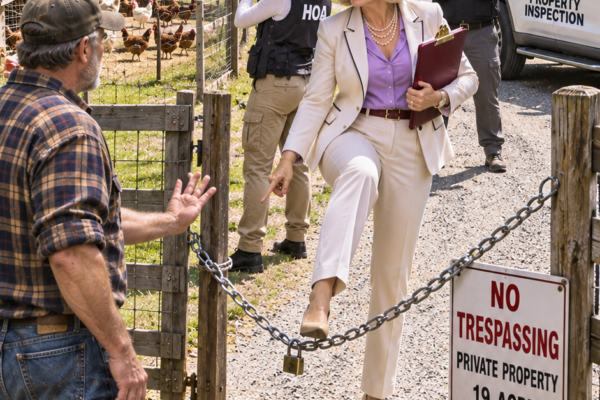
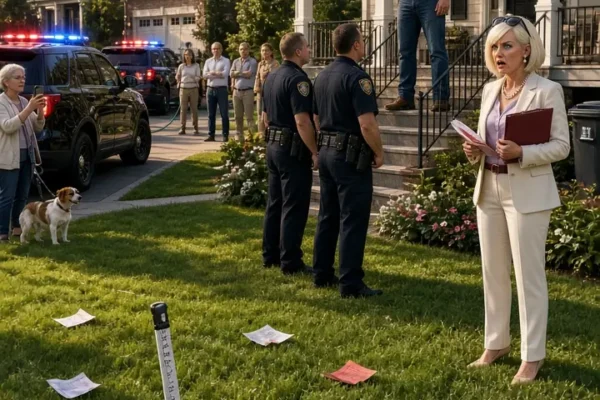
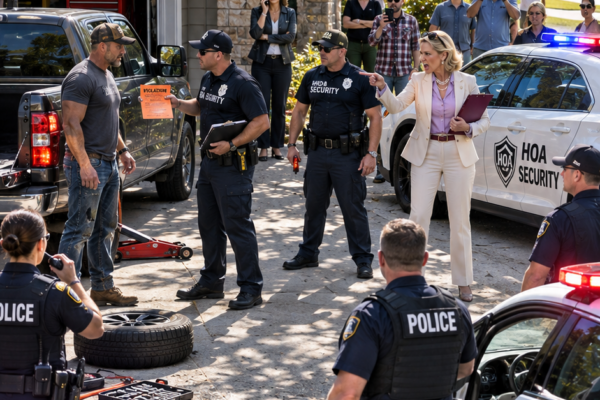
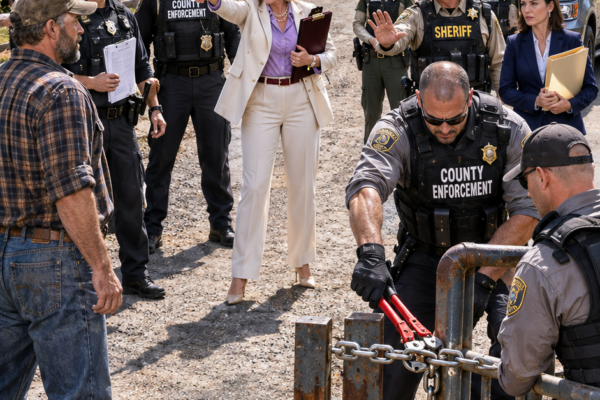
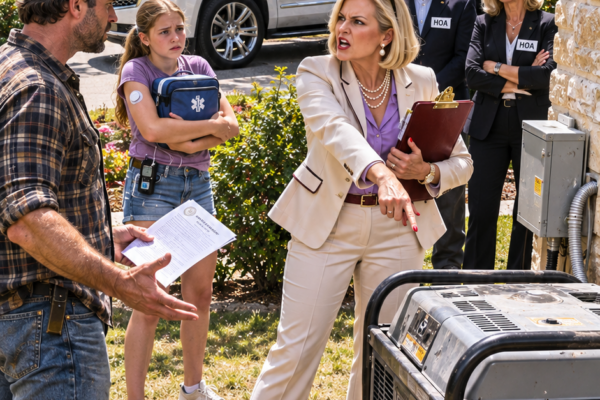
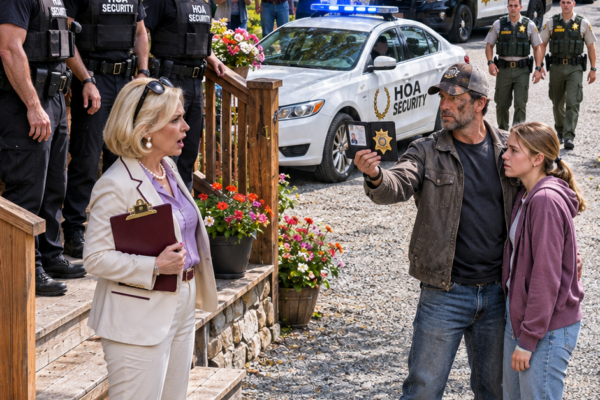
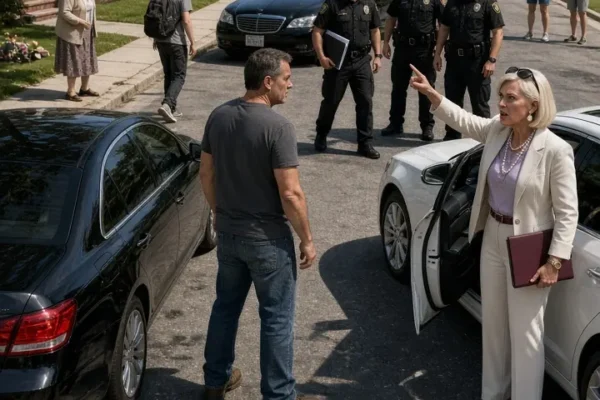
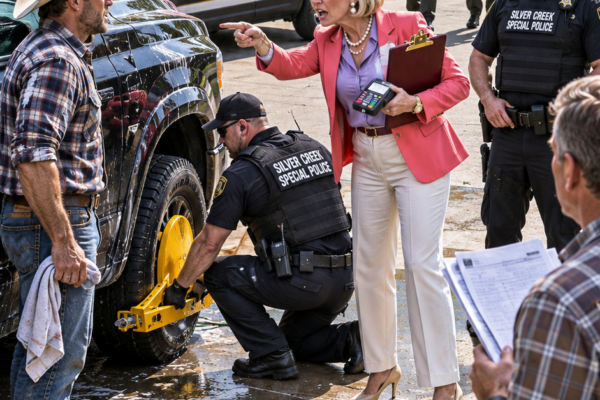
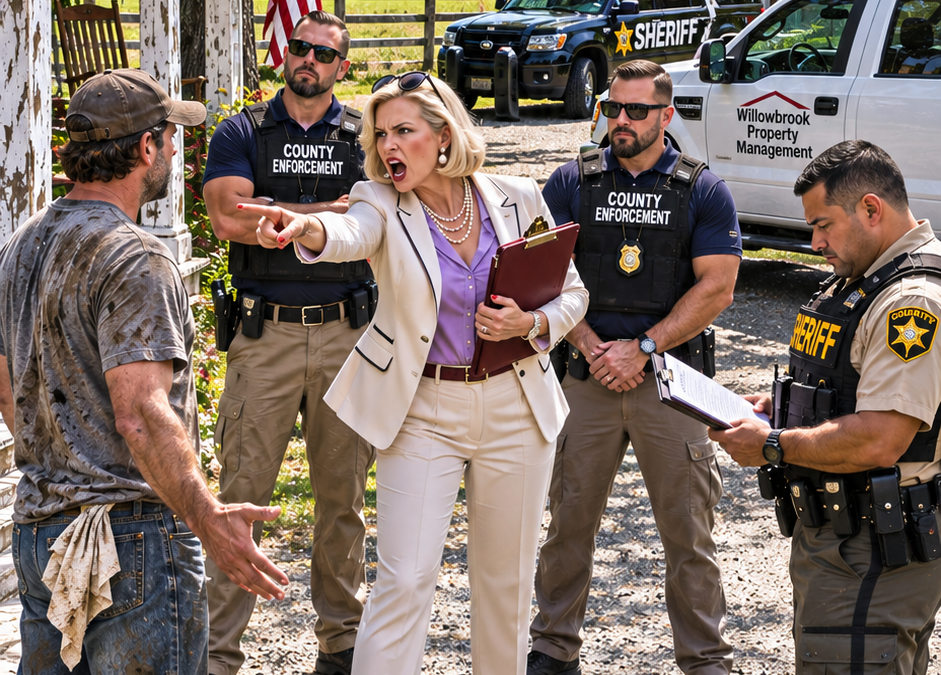
“Pay the $3,200, or My Officers Will Take You Away in Handcuffs!” HOA Karen Threatened After Claiming My Grandmother’s Farmhouse Belonged to Her Neighborhood. I Had Never Joined Her Association, but She Sent Two Fake County Officers to My Door Anyway. When a Real Sheriff’s Deputy Arrived and Ran Their License Plate, He Asked Me One Question About the Building Where Her HOA Operated…
part2
I followed his gaze.
The Willowbrook office stood less than two hundred yards from my workshop, its brick exterior partially visible through the trees.
I’d passed it dozens of times without giving it much thought.
“Why do you ask?”
Martinez held up the registration information.
“The management company operates out of that building. There’s something unusual about the address in the county system.”
“Unusual how?”
“It appears to be associated with your original property parcel.”
I looked at him.
“Are you telling me their office is on my land?”
“I’m telling you to hire a surveyor before drawing that conclusion.”
Behind us, Delilah interrupted.
“That building has absolutely nothing to do with this!”
Martinez turned.
“Then you shouldn’t mind if Mr. Kellerman checks.”
She opened her mouth.
Closed it.
Then looked toward the two men she’d introduced as county officers.
Both were standing beside their pickup, suddenly interested in their shoes.
Martinez requested another deputy and began examining their credentials.
The men eventually admitted they were employees of a private company contracted by Willowbrook Property Management.
Neither possessed government enforcement authority.
Their paperwork contained misleading references to county regulations and penalties.
The deputies documented the encounter and took further action as appropriate while the incident was investigated.
Delilah insisted the entire situation was a misunderstanding.
“They were simply delivering compliance information.”
Martinez held up one of the badges.
“Why does this say county enforcement?”
She looked at the taller man.
“He must have misunderstood his instructions.”
The man stared at her.
“You told us to wear those!”
Delilah’s face went white.
I almost felt sorry for him.
Almost.
Before leaving, Martinez gave me an incident number and advised me to preserve the security footage and paperwork.
Delilah climbed into her Escalade without saying goodbye.
For the first time since meeting her, I watched her leave my property without issuing another threat.
I should’ve enjoyed the moment.
Instead, I couldn’t stop looking at the brick office through the trees.
Something about Martinez’s question bothered me.
My grandmother’s land.
Their building.
And a woman willing to impersonate government authority over three thousand dollars in association fees.
Those things didn’t belong together.
Unless the money wasn’t what she was really after.
Six months earlier, I’d moved into the farmhouse with a truckload of tools and considerably more grief than furniture.
My wife, Sarah, had died of cancer two years before.
We’d been married for twenty-three years.
I’d spent most of those years believing we’d eventually grow old together, complain about our knees, and argue over which grandchildren deserved the biggest Christmas presents.
Cancer changed that plan.
After the funeral, our house felt like a museum dedicated to a life I couldn’t get back.
Her coffee mug remained in the cupboard.
Her coat hung beside the door.
Sometimes I still caught myself turning toward the passenger seat when something funny happened while I was driving.
Then my grandmother Rose passed away.
She left me her farmhouse in Millbrook County, along with its 3.2 acres, an old barn, and the workshop where I’d learned to repair engines as a teenager.
The property had been in our family since 1945.
Grandma raised chickens, grew vegetables, and maintained the stone house with the kind of stubborn determination that apparently ran in our family.
She never had much money.
But she always had enough tomatoes to feed half the county.
I remembered spending summer afternoons beneath the oak trees while she worked in her garden.
Whenever I broke something in the workshop, she’d offer the same advice.
“Marcus, anything worth keeping is worth fixing.”
I thought moving back might help me fix myself.
For the first few months, it did.
I rebuilt an old motorcycle engine.
Repaired the barn doors.
Restored several pieces of furniture.
Occasionally, neighbors brought over their vehicles, and I’d help them diagnose whatever problem they couldn’t figure out.
I was a mechanic by trade.
Working with my hands gave my mind somewhere useful to go.
Unfortunately, the landscape surrounding Grandma’s farm had changed dramatically.
Five years earlier, developers had purchased much of the neighboring land and constructed Willowbrook Estates.
Two hundred houses.
Matching mailboxes.
Manicured lawns.
A private swimming pool and recreation center.
The development surrounded most of my property, but Grandma had never sold her land or joined its association.
She’d refused several invitations.
I found the letters among her records.
One contained a handwritten note in her unmistakable handwriting.
I already know how to take care of my own yard.
That was Grandma.
Delilah Hutchcraft became HOA president shortly after the neighborhood’s establishment.
She was forty-seven, drove a white Cadillac Escalade, and possessed the remarkable ability to turn a friendly greeting into an administrative warning.
Our first encounter occurred while I was working beneath the hood of my pickup.
She introduced herself.
Then she handed me a stack of violation notices.
Apparently, my grass was inconsistent with neighborhood expectations.
My truck was classified as an unauthorized commercial vehicle.
My barn was an unapproved accessory structure.
My gravel driveway required aesthetic improvements.
And I owed $3,200 in accumulated association charges.
I initially assumed she’d confused my address with someone else’s.
“I’m not part of Willowbrook.”
Her smile remained fixed.
“Your property falls within our residential development area.”
“It’s been here since 1945.”
“The county rezoned the surrounding land.”
“Rezoning doesn’t make me a member of your organization.”
She tilted her head.
“Our legal advisers disagree.”
“Then I’d like to see their explanation.”
Instead, she gave me thirty days to pay.
When I refused, two men appeared claiming to represent county enforcement.
When I questioned them, she returned with threats of arrest.
And now a real deputy was suggesting I investigate the ownership of her office.
That afternoon, I carried every property document Grandma had left me into the kitchen.
The dining table disappeared beneath deeds, surveys, tax statements, easement records, and decades of correspondence.
Sarah had worked in the county assessor’s office before becoming ill.
She’d taught me the importance of distinguishing tax maps from actual ownership records.
“Just because a line appears on a computer screen doesn’t mean somebody has established a legal boundary,” she used to say.
I could almost hear her voice as I examined the old documents.
The original deed contained measurements extending toward a particular bend in Miller’s Creek.
A survey from the 1990s showed a slightly different alignment along the southern boundary.
The association’s subdivision plat contained another variation.
I wasn’t qualified to resolve those discrepancies.
But I knew enough to recognize that they required professional attention.
The following morning, I contacted Peterson Land Surveying.
The owner, Thomas Peterson, listened carefully.
“Has anyone recently conducted a boundary survey?”
“Not since before the development was built, as far as I know.”
“And there’s a building near the disputed line?”
“Yes.”
He paused.
“Don’t remove anything. Don’t install new markers. Let us establish what’s actually there.”
I hired him.
Then I called David Blackwood, a property attorney with thirty years of experience.
David operated from a modest brick office downtown.
His waiting room contained more legal books than furniture.
He read Delilah’s demand letter, examined my deed, and reviewed the photographs of the fake enforcement badges.
“Marcus, we have two separate issues.”
“Only two?”
He smiled.
“Two starting points. Whether the association has authority over your property, and whether its representatives have engaged in unlawful conduct.”
He requested additional records concerning Willowbrook’s recorded declaration.
Nothing we had found established that my parcel was subject to it.
David prepared a formal demand disputing the assessments and instructing the association to stop entering my property without permission.
He also advised me to install security cameras.
I already had several.
I added coverage around the workshop, driveway, and barn.
I hoped I’d never need the recordings.
Unfortunately, Delilah was about to provide enough material to justify every penny I’d spent.
Her first response to David’s letter was a neighborhood smear campaign.
An emergency community meeting appeared on the residents’ social media page.
PROTECTING OUR INVESTMENTS FROM HOSTILE PROPERTY OWNERS.
Although she didn’t identify me in the headline, the attached photograph showed my barn.
That evening, Mrs. Patterson arrived carrying a plate of snickerdoodles.
She was seventy-eight and had lived in the area long before Willowbrook existed.
Grandma Rose had considered her one of her closest friends.
“Marcus, honey, that woman’s telling people you’re opening a junkyard.”
I looked toward the workshop.
One pickup stood inside.
An old motorcycle rested on a workbench.
“A very small junkyard, apparently.”
Mrs. Patterson didn’t laugh.
“She’s frightening people.”
“About what?”
“Noise. Chemicals. Property values. She’s saying your place might become an industrial facility.”
I sighed.
“I’m fixing engines, not building a refinery.”
“I know that.”
She pointed toward the surrounding houses.
“But some of these folks don’t.”
I asked whether she’d help me explain the property’s history.
Her eyes brightened.
“Give me an hour.”
She returned with photographs dating back decades.
Grandma beside her vegetable garden.
The farmhouse before the paved roads.
The old barn surrounded by farmland.
One photograph showed Sarah and me standing beside Grandma’s porch shortly after our wedding.
I hadn’t seen it in years.
I held it longer than the others.
Mrs. Patterson touched my arm.
“She’d be proud of you, honey.”
I swallowed.
“Which one?”
“Both of them.”
The next HOA meeting included an announced public comment session concerning neighborhood development.
Several residents requested that I be allowed to address the allegations involving my property.
Delilah reluctantly permitted it.
I arrived carrying historical photographs and copies of my deed.
Approximately forty residents were seated inside the recreation center.
Delilah stood at the front.
“Mr. Kellerman, you’ll have three minutes.”
“That’s plenty.”
I displayed a photograph of Grandma’s farmhouse taken in 1968.
“This property existed long before Willowbrook Estates. My family maintained it independently for decades.”
Several residents leaned forward.
I showed another photograph.
“My grandmother raised vegetables here. She didn’t belong to an association, and neither do I.”
Delilah interrupted.
“The historical existence of your property doesn’t exempt you from current regulations.”
“I’m happy to comply with applicable county regulations.”
“And association standards.”
“Not unless you can establish that my property is subject to them.”
A man in the second row raised his hand.
“Did he actually sign anything?”
Delilah ignored him.
I continued.
“I understand people have been told I’m planning to open a salvage yard. That’s false. I’m a mechanic who maintains a private workshop.”
A woman near the door asked whether my workshop was licensed for its permitted uses.
I explained the arrangements and offered to provide relevant information through the proper channels.
Most residents seemed satisfied.
Delilah wasn’t.
She accused me of disrupting the meeting and ended my speaking time.
As I walked out, several homeowners approached.
One asked whether I could look at an old lawn mower.
Another wanted to know whether the oak trees had always been there.
For the first time, some of them saw me as something other than the dangerous outsider Delilah had described.
That probably infuriated her more than my refusal to pay.
The following day, she filed a harassment complaint.
Deputy Martinez reviewed the circumstances and spoke with available witnesses.
No charges resulted against me.
David preserved the complaint with the other records.
Then he received a certified letter from an attorney representing the HOA.
It accused me of interfering with association business, damaging community property through negligent tree maintenance, and obstructing legitimate enforcement operations.
Apparently, Grandma’s oak trees were dropping leaves onto a nearby sidewalk.
I called my insurance agent.
“Jim, do trees generally require permission to produce leaves?”
He laughed.
“Not that I’m aware of.”
I explained the allegations.
He advised me to document the condition of the trees and arrange an appropriate assessment if necessary.
I did.
I wasn’t going to ignore a legitimate maintenance issue simply because Delilah had raised it.
A qualified arborist examined the trees and found no immediate hazard requiring the removal Delilah demanded.
Another accusation disappeared beneath an ordinary professional report.
Then Peterson’s survey crew arrived.
They spent most of a Tuesday locating historical monuments, comparing recorded descriptions, and measuring the property.
I brought them coffee.
Around noon, Thomas called me toward the southern boundary.
He stood near a flagged marker overlooking the HOA office.
“Marcus, have a look.”
He showed me the preliminary boundary alignment on his tablet.
The line passed directly beneath the building.
I stared at it.
“Is that right?”
“We’ve reconciled the recorded descriptions with the controlling monuments. Your older survey appears to contain a significant discrepancy.”
“How significant?”
“Approximately thirty feet along this portion.”
I looked at the brick office.
“How much of that building?”
“Roughly half.”
For several seconds, I didn’t speak.
The office contained Delilah’s administrative headquarters, several meeting rooms, and the management company’s records.
Every threatening letter she’d sent me had originated from that address.
And half of it stood on land my family owned.
“Are you absolutely certain?”
Thomas nodded.
“We’ll complete our final verification and prepare a signed survey.”
I called David immediately.
He listened.
Then he said four words.
“Don’t touch that building.”
“I wasn’t planning to.”
“Good. This isn’t an opportunity for self-help eviction. We establish your rights through the proper legal process.”
I looked toward Delilah’s Escalade parked outside the office.
“What if she knew?”
“Then we’ll find out.”
Over the next several days, the completed survey arrived, along with additional county records.
The findings supported Thomas’s preliminary assessment.
There was no recorded transfer conveying the disputed strip to Willowbrook.
No relevant easement permitting construction of the office.
No documented agreement from Grandma authorizing occupation of her land.
David requested the building’s construction and permitting records.
Those raised additional questions.
The site plan submitted during development showed a boundary inconsistent with the original recorded descriptions.
Some required approvals were incomplete or couldn’t immediately be located.
The county began reviewing the discrepancies.
I had expected Delilah to become cautious once she learned a professional survey had been conducted.
Instead, she showed up in my driveway and claimed ownership of that too.
“This access route constitutes HOA common property,” she announced.
I was sitting on the porch drinking coffee.
“Since when?”
“Since the development was approved.”
“Show me the recorded document.”
“It’s an established access arrangement.”
“Not according to my deed.”
She took photographs of my truck.
Then she informed me the association would be replacing my mailbox.
I assumed she was bluffing.
Twenty minutes later, a landscaping truck arrived.
Two workers began dismantling the mailbox Grandma had maintained for nearly forty years.
I ran outside.
“STOP!”
The supervisor looked up.
“Association work order.”
“That’s my mailbox.”
Delilah stood beside the truck.
“It fails our appearance standards.”
“You don’t have authority over it.”
She smiled.
“We’ll install an approved replacement.”
I documented the incident and contacted the sheriff’s office and postal authorities.
The workers stopped after their supervisor reviewed the ownership dispute and my explicit objection.
But Grandma’s old wooden mailbox post had already been damaged.
I examined it after they left.
The wood was worn.
The paint had faded.
Grandma’s house number remained visible beneath several layers of weathering.
I could’ve repaired it.
Instead, I decided to preserve the original post inside the barn.
Then I purchased a solid replacement mailbox that met applicable delivery requirements.
I attached a small brass plaque to its side.
KELLERMAN — EST. 1945.
Mrs. Patterson saw me installing it.
“That’s a beautiful mailbox.”
“Thanks.”
“Think Delilah will approve?”
“I neglected to ask.”
She laughed.
The mailbox was supposed to be a small symbolic victory.
A reminder that I wasn’t surrendering control over my home.
One week later, I walked outside and discovered all four tires on my work truck had been slashed.
The visible security cameras had also been damaged.
I stood beside the driver’s door, looking at the ruined tires.
Then I went inside and reviewed the surviving recordings.
At 2:47 a.m., three people had entered the driveway.
Two men approached my truck.
A woman remained nearby, gesturing toward the vehicle and cameras.
The additional camera coverage provided a much clearer view than the damaged units.
I recognized Delilah.
Her face was visible as she turned beneath an exterior light.
I watched the recording twice.
Then I called Martinez.
He arrived with another deputy and documented the scene.
“Don’t edit the files,” he told me.
“I’ve preserved the originals.”
“Good.”
He watched the footage.
His expression hardened.
“She’s going to have a difficult time explaining this.”
My insurance company sent an adjuster named Rodriguez.
He examined the damage and asked about my dispute with Willowbrook.
When I explained it, he stopped writing.
“Have you heard about other property damage incidents around here?”
“Not specifically.”
He said the insurer had identified several suspicious claims involving properties connected to the same management company.
He couldn’t discuss other policyholders’ confidential details.
But he referred my case to the appropriate investigative personnel.
The following morning, Detective Anthony Williams contacted me.
He worked with the county’s financial crimes investigators.
“Mr. Kellerman, we’d like to discuss your HOA complaint.”
“Which part?”
There was a pause.
“Apparently, there are several parts.”
“You could say that.”
At his office, Williams explained that investigators had already been examining suspected financial irregularities associated with Willowbrook Property Management.
My recordings appeared relevant to certain incidents under review.
He asked whether I’d been pressured to sell my property.
“Not directly.”
“Any threats concerning the continued use of your house?”
“Plenty.”
He wrote something down.
Then he asked about the survey.
I showed him the completed report.
He studied the office building’s location.
“Who owns the building?”
“I assumed the association.”
“Have you checked?”
“No.”
He closed his notebook.
“You might want your attorney to look into that.”
Apparently, investigators enjoyed asking questions that ruined perfectly good afternoons.
I left his office and called David.
Before I reached home, I received another call.
This one came from the utility company.
My electricity had been disconnected pending a safety review.
I stared at my phone.
“What safety review?”
The representative explained that complaints had been submitted alleging unauthorized electrical connections and account problems.
I checked my payment records.
Every bill was current.
I requested a supervisor and provided the relevant documentation.
The utility eventually determined that there was no established basis for continuing the interruption and restored service after completing its review.
The experience left me without electricity for several hours.
My workshop equipment stopped.
Food in the refrigerator began warming.
And I lost most of a working day.
David obtained the available correspondence associated with the incident through appropriate requests.
Once again, the management company appeared in the records.
Delilah wasn’t simply trying to collect money.
She was making ordinary life difficult enough that leaving might eventually seem easier than staying.
And now I knew why.
The answer arrived in an envelope carried by a frightened man named Jake Morrison.
Jake was Willowbrook’s treasurer.
He called me one afternoon and asked whether we could meet at a diner on Highway 9.
I arrived first.
He sat across from me and ordered coffee he barely touched.
“Marcus, I need to tell you something.”
“Okay.”
“I’m probably going to lose my position over this.”
“Then tell me why you’re doing it.”
He looked down.
“Because my kids live here.”
He opened a manila envelope.
Inside were financial summaries, invoices, and copies of relevant association records.
One landscaping contract totaled fifty thousand dollars.
Jake couldn’t identify corresponding work of comparable value.
Another series of payments involved thirty thousand dollars in purported legal consulting.
Several descriptions were vague.
Some invoices lacked supporting documentation.
“Who’s approving these?” I asked.
“Delilah.”
“Isn’t that supposed to involve the board?”
“Yes.”
“Does it?”
“Not always.”
He pointed toward a list of recurring payments.
COMMUNITY MANAGEMENT SOLUTIONS LLC.
Monthly office rent: $4,200.
I looked up.
“She’s renting the office?”
“The HOA is.”
“From whom?”
Jake swallowed.
“Her.”
I stared at him.
He explained that Community Management Solutions was controlled by Delilah through a business arrangement that had never been adequately disclosed to the membership.
The company claimed an ownership interest in the office building.
Willowbrook paid it rent.
“Four thousand two hundred dollars every month?” I asked.
He nodded.
“For three years?”
“Approximately.”
I calculated it in my head.
More than a hundred and fifty thousand dollars in rental payments alone.
And approximately half the building occupied my family’s land.
Grandma’s land.
Land I was paying property taxes on.
Jake continued.
“There are other companies. Landscaping. Security. Consulting. Several are connected to her relatives.”
I looked through the records.
“Have these been independently reviewed?”
“No.”
“Then don’t make copies available to just anybody. We need to preserve the evidence properly.”
He nodded.
“I want to report it.”
“Then I’ll put you in touch with David and the investigators.”
For the first time since he’d sat down, Jake looked relieved.
I drove home thinking about the families in Willowbrook.
Two hundred households paying dues for landscaping, security, maintenance, and community administration.
How many knew their president was collecting rent through her own company?
How many understood that the building itself occupied somebody else’s land?
How many had paid special assessments believing the association genuinely needed their money?
I parked beside the farmhouse.
Through the trees, I could see Delilah’s Escalade outside the office.
She’d been demanding $3,200 from me while collecting $4,200 a month from her own neighbors.
The absurdity would’ve been funny if the numbers hadn’t been so ugly.
David retained Rebecca Torres, a forensic accountant experienced in reviewing property management records.
Jake supplied information through appropriate legal channels.
Rebecca began tracing transactions, identifying potential conflicts of interest, and comparing invoices with available contracts and evidence of completed services.
Her initial findings suggested approximately $180,000 in questionable expenditures.
That amount grew as additional records were examined.
Not every related-party transaction was automatically fraudulent.
A family-owned company could legitimately provide services.
An association could lawfully lease office space from a disclosed interested party under appropriate arrangements.
But payments required proper authorization, accurate documentation, and honest accounting.
Much of that was missing.
Several vendors appeared to have received inflated payments.
Others couldn’t substantiate the services described in their invoices.
One supposed consulting company shared an address with a business operated by Delilah’s adult son.
A landscaping contractor was associated with her brother-in-law.
The security company employing the fake officers was connected to another relative.
Meanwhile, insurance investigators were examining claims concerning purported damage to association property.
Some payments appeared unsupported by evidence of completed repairs.
The suspected losses associated with that portion of the investigation approached $45,000.
David warned me not to combine every figure into a single dramatic accusation.
Some transactions overlapped.
Some required additional examination.
What mattered was establishing the actual losses.
I appreciated that.
I’d spent my career repairing machinery.
If an engine had three problems, identifying them accurately was considerably more useful than announcing it had exploded.
The county auditor, Patricia Paulson, contacted David about the property assessment discrepancies.
We attended a meeting at her office.
She displayed historical parcel records and the construction information associated with the office.
The disputed strip had never been legally separated from my property.
The county’s treatment of the improvements required correction.
Potential additional tax obligations were being examined.
She also identified similar assessment irregularities involving other properties connected to the same management company.
I left the meeting with a growing sense of anger.
Grandma had paid her taxes every year.
She’d maintained that property through decades of rising costs.
And someone had constructed a building partly on her land, collected rent, and avoided properly resolving the corresponding ownership and assessment issues.
Then they’d threatened her grandson with foreclosure for refusing to join their association.
I called David that evening.
“I don’t just want my land back.”
He waited.
“I want those homeowners to know what happened to their money.”
“That’s going to complicate things.”
“I understand.”
“We could potentially resolve your property dispute separately.”
“I know.”
“Are you certain?”
I looked toward Grandma’s empty vegetable garden.
I remembered something she’d said when I was fourteen and reluctant to help an elderly neighbor repair his fence.
“Doing the right thing costs something, Marcus. That’s how you know it matters.”
I smiled at the memory.
“I’m certain.”
David filed a civil action seeking a judicial determination of the disputed property rights and appropriate relief for the unauthorized occupation.
The association and other interested parties would have an opportunity to respond.
There was no magical thirty-day process automatically handing me a building.
There were pleadings, evidence, deadlines, and competing claims that needed resolution.
But we finally had a clear legal path.
I also met Sarah Paulson, an investigative reporter for the county newspaper.
She’d been examining complaints involving residential management companies.
After obtaining public records and interviewing residents, she’d become interested in Willowbrook.
Our first conversation took place inside my workshop.
She carried a notebook and asked more questions than anybody I’d met in years.
“How did the dispute begin?”
“Three thousand two hundred dollars in association fees.”
“And you’ve never been a member?”
“Correct.”
“Who commissioned the survey?”
“I did.”
“Can the surveyor explain his conclusions independently?”
“Absolutely.”
She nodded.
“Good.”
She never asked me to exaggerate anything.
She didn’t promise to destroy Delilah in the newspaper.
She wanted documents.
Dates.
Independent confirmation.
When I mentioned my late wife had worked for the county assessor, she set down her pen.
“I’m sorry.”
“Thank you.”
She gave me a moment before continuing.
I appreciated that more than she probably realized.
Over the following weeks, Sarah interviewed former Willowbrook employees, residents, and contractors.
Rebecca continued the financial review.
David pursued the civil case.
Detective Williams and other investigators conducted their own inquiries.
Mrs. Patterson supplied historical photographs and testimony concerning the property’s former use.
One photograph showed Grandma’s vegetable garden occupying part of the area where the HOA office now stood.
Mrs. Patterson pointed toward a row of tomato plants.
“That’s where Delilah parks.”
I studied Grandma’s smiling face.
“Of course it is.”
She shook her head.
“Rose would’ve had a few words for that woman.”
“I imagine so.”
Meanwhile, Delilah began contacting people who’d provided information.
Jake received threats concerning an old deck addition at his house.
According to him, she suggested she’d report potential permit problems unless he stopped cooperating.
I told him to address any legitimate permit issue through the proper county procedures.
David helped him obtain independent legal advice.
Then the threatening correspondence was preserved.
Delilah’s campaign against me continued too.
A new legal demand arrived from a company calling itself Henderson and Associates Legal Services.
It threatened damages exceeding half a million dollars unless I stopped interfering with Willowbrook.
David couldn’t verify that the purported law firm existed.
Its listed address was a commercial mailbox.
The letter contained no reliable information identifying an attorney responsible for it.
He forwarded the material to the investigators.
“She’s losing control,” he told me.
“I noticed.”
“Don’t assume that makes her harmless.”
He was right.
Three nights later, my cameras recorded two people entering the area beside my workshop.
I reported the incident immediately.
Investigators subsequently discovered materials that appeared to have been placed there without my knowledge.
The labels raised potential environmental concerns.
I didn’t handle the materials myself.
Qualified personnel examined and removed them.
The surveillance recordings contradicted the allegation that I’d stored the items there.
A fabricated complaint concerning illegal dumping followed shortly afterward.
The appropriate county officials investigated and found no basis for attributing the placement to me.
Detective Williams was particularly interested in the relationship between the complaint and the unauthorized entry.
It was becoming clear that someone wanted to manufacture a regulatory problem serious enough to interfere with my use of the property.
I stood outside the workshop after the materials had been removed.
For the first time, I considered selling.
Not because I believed Delilah was right.
Because I was exhausted.
I’d moved to Grandma’s farmhouse to escape the worst period of my life.
Instead, I’d acquired attorneys, damaged vehicles, security recordings, and enough paperwork to occupy a small filing cabinet.
Every unfamiliar noise made me look outside.
Every phone notification interrupted whatever I was doing.
I missed Sarah.
I missed the way she’d recognize when I was becoming overwhelmed and tell me to stop working for an evening.
I went inside and found our wedding photograph.
For a long time, I sat at the kitchen table looking at it.
Then someone knocked.
Mrs. Patterson stood outside holding a casserole.
“I figured you hadn’t eaten.”
She was right.
We sat together.
I admitted I was tired.
She nodded.
“Of course you are.”
“Maybe I should’ve stayed away.”
“From your own home?”
I didn’t answer.
She looked around the kitchen.
“Your grandmother wanted you here.”
“I know.”
“She didn’t leave you this place so you could spend every day worrying.”
“I know that too.”
Mrs. Patterson placed her hand over mine.
“Then don’t let that woman decide what the rest of your life looks like.”
We ate dinner.
For once, we didn’t discuss evidence.
She told me stories about Grandma.
About the time a goat escaped from a neighboring farm and ate half her laundry.
About a summer storm that flooded the old road.
About Sarah bringing Grandma flowers even when nobody had asked her to visit.
By the time Mrs. Patterson left, I felt something resembling myself again.
I wasn’t going to sell.
But I wasn’t going to spend the rest of my life living inside a corruption investigation either.
I wanted the case handled properly.
Then I wanted my home back.
Delilah apparently had a different idea.
On Thursday afternoon, I returned from helping a customer at his garage and found my kitchen window damaged.
The front door was unlocked.
I stopped outside and called the sheriff’s office.
Then I heard a familiar voice from inside.
“Marcus? We need to talk.”
Delilah appeared near the doorway.
She held a cream-colored envelope.
I remained outside.
“What are you doing in my house?”
“Trying to resolve this ridiculous situation.”
“Get out.”
“Just listen.”
She removed a check from the envelope.
Fifty thousand dollars.
I stared at it.
“This covers your property concerns, your legal expenses, and any inconvenience you’ve experienced.”
“Did you force that window open?”
“We can repair it.”
“That’s not an answer.”
She held the check toward me.
“Fifty thousand dollars, Marcus.”
I didn’t take it.
“All you have to do is withdraw your legal claims and agree to confidentiality.”
“What about the other homeowners?”
Her face tightened.
“That’s association business.”
“What about the money paid to your companies?”
“Legitimate administrative expenses.”
“And the building?”
She hesitated.
“The building situation can be adjusted.”
“Adjusted?”
“Relocated, if necessary.”
I looked at her.
“So you acknowledge there’s a problem with its location?”
“I’m acknowledging that we can reach a reasonable agreement.”
She stepped toward me.
“You’re a mechanic. Think about what this money could do for you.”
I glanced at the check.
She was right about one thing.
Fifty thousand dollars would have been useful.
The farmhouse needed repairs.
My truck had been damaged.
My legal expenses were accumulating.
But I couldn’t accept a payment intended to make legitimate concerns disappear.
And even if I settled my civil claims, I had no power to terminate a criminal investigation.
“Have your lawyer contact David.”
Her expression changed.
“You really are determined to ruin everything.”
“No. I want you out of my house.”
She walked past me.
As she approached her Escalade, she turned.
“You’ll regret refusing this.”
The deputies arrived shortly afterward.
I provided my account and the available security recordings.
David preserved the evidence concerning the proposed payment and unauthorized entry.
The offer itself wasn’t automatically a crime merely because it involved settlement money.
But its circumstances, the entry into my house, the accompanying threats, and the broader investigation raised serious concerns.
Delilah had wanted a private resolution.
Instead, she’d created another documented encounter.
Two days later, I was served with a temporary protective order.
Delilah had alleged that I’d threatened violence during our confrontation.
The order restricted contact pending a hearing.
I complied immediately.
David filed the appropriate response.
At the hearing, he presented the recordings and photographs documenting the circumstances of her visit.
Delilah claimed I’d invited her inside.
The available footage contradicted her account.
She said I’d approached her aggressively.
The recording showed me remaining outside the doorway.
The judge examined the evidence.
“Mrs. Hutchcraft, did you enter his residence without permission?”
Delilah looked toward her attorney.
“I was attempting to resolve a civil disagreement.”
“That wasn’t my question.”
She hesitated.
The petition was ultimately dismissed.
The court also addressed the unsupported allegations and awarded appropriate expenses under the circumstances of the proceeding.
Outside the courthouse, David looked at me.
“She keeps choosing forums where somebody can ask her for evidence.”
I shook my head.
“You’d think she’d stop.”
“Apparently not.”
That evening, anonymous flyers appeared throughout Willowbrook.
DANGEROUS INDIVIDUAL THREATENS COMMUNITY SAFETY.
A photograph showed me working beneath the hood of my truck.
The accompanying text described me as an unstable widower planning to convert residential property into an industrial operation.
I read that word twice.
Widower.
She’d finally reached into the most painful part of my life and turned it into another enforcement tactic.
I folded the flyer and placed it inside my evidence folder.
Then I went outside and took down the copy attached to my gate.
Three neighbors approached while I was working.
One brought groceries.
Another offered to help repair the damaged window.
The third asked whether I’d be willing to show him the survey.
Delilah’s propaganda was no longer producing the response she’d expected.
People were beginning to recognize the pattern.
Every time somebody questioned her finances, she attacked that person’s character.
Jake told me residents had started requesting independent financial information.
Several wanted a special membership meeting.
The board’s remaining directors were divided.
Some supported an independent review.
Others feared the potential consequences of discovering what had occurred.
Delilah responded by proposing dissolution of the existing association.
She claimed it would resolve the neighborhood’s legal difficulties and allow residents to establish a fresh organization.
David explained that dissolving a corporation wouldn’t erase existing debts, civil claims, or individual criminal liability.
Jake preserved the proposal and the related communications.
The residents called their own special meeting through the procedures available under the governing documents.
Delilah wouldn’t be able to control the entire agenda.
For the first time, the homeowners would hear directly from the people examining their records.
Unfortunately, the night before the meeting, I woke to the sound of breaking glass.
A moment later, my phone displayed a fire alert from the workshop.
I ran toward the rear door.
Through the window, I saw flames inside the tool storage area.
Smoke was already spreading.
I called emergency services, stayed clear of the building, and waited for the firefighters.
Those minutes felt like hours.
The workshop contained tools I’d accumulated over thirty years.
Some had belonged to my father.
Others had belonged to Grandma’s husband.
Sarah had given me my favorite socket set for our tenth wedding anniversary.
I watched flames illuminate the barn wall and felt helpless.
The volunteer fire department arrived and contained the fire before it consumed the entire structure.
Several thousand dollars’ worth of equipment was destroyed.
The damage could’ve been much worse.
Investigators subsequently determined that the fire had been deliberately started.
The security recordings showed two individuals approaching the building before the incident.
Detective Williams recognized similarities to earlier footage, though identifying the people involved required further investigation.
Several records had been stored inside a fire-resistant safe.
Fortunately, the investigators and attorneys already possessed preserved copies.
The fire hadn’t destroyed the evidence.
It had added to it.
I stood outside the workshop after sunrise.
Water dripped from the damaged roof.
The air smelled of burned wood and ruined equipment.
Mrs. Patterson arrived before I’d finished speaking with the investigators.
She looked at the workshop.
Then at me.
“Oh, honey.”
I didn’t say anything.
She hugged me.
For a few seconds, I couldn’t hold myself together.
I’d lost my wife.
I’d lost my grandmother.
And now somebody had deliberately damaged the place where I’d been trying to rebuild my life.
Mrs. Patterson stayed until I was ready to speak.
Later that morning, Jake arrived with several neighbors.
They offered assistance with cleanup once the scene was released.
One man brought replacement hand tools.
Another offered temporary use of his garage.
A teenage boy showed up carrying a toolbox.
“Dad said you might need these.”
I looked inside.
Basic sockets.
Screwdrivers.
A pair of pliers.
Probably everything he owned.
I handed it back gently.
“Keep them, kid. You’re going to need them.”
He smiled.
“Then can I help?”
“Absolutely.”
That afternoon, my attorney received another settlement proposal.
Delilah’s representatives offered one hundred thousand dollars, cooperation concerning the building’s ownership, and her resignation from the association.
The proposal also sought extensive confidentiality and resolution of my private claims.
I read the summary.
Then I asked David about restitution for the homeowners.
“Nothing definitive,” he replied.
“And the criminal case?”
“She wants cooperation in resolving the situation quietly. We’ve made it clear you can’t bargain away the government’s authority.”
I looked toward my damaged workshop.
“Reject it.”
“Marcus, this is a substantial offer.”
“I understand.”
“We can negotiate compensation without interfering with the investigation.”
“I’m willing to negotiate my property claims. I’m not willing to help conceal what happened to everybody else.”
David nodded.
“That’s a reasonable distinction.”
The special membership meeting began that evening.
The recreation center was filled to its permitted capacity.
Additional residents listened from an arranged overflow area.
Sarah Paulson attended with her newspaper photographer.
Several county officials were present to observe matters relevant to their responsibilities.
Jake had arranged for the homeowners to receive summaries of the issues under review without distributing confidential records indiscriminately.
I sat beside David and Mrs. Patterson.
Delilah entered wearing a navy suit.
Her usual smile was gone.
She placed her folder on the board’s table.
“This meeting will address association business only.”
Jake stood.
“That’s exactly why we’re here.”
She glared at him.
“You’re no longer authorized to distribute financial information.”
“The members have requested an independent accounting.”
“Those matters are confidential.”
A homeowner named Michael raised his hand.
“Confidential from the people paying for them?”
Several residents applauded.
Delilah demanded order.
Jake began presenting the financial concerns.
He explained the recurring office lease payments and the company’s relationship to Delilah.
A woman in the front row looked stunned.
“Wait. We’ve been paying rent to you?”
Delilah adjusted her microphone.
“The company provides essential administrative facilities.”
“Do you own the company?”
“I have business interests.”
“How much have we paid it?”
Jake displayed the relevant totals.
The room erupted.
People began asking questions about special assessments, maintenance expenses, and security contracts.
Delilah struck the table with her pen.
“YOU WILL LET ME FINISH!”
Mrs. Patterson leaned toward me.
“She’s not enjoying democracy very much.”
I nearly laughed.
David addressed the residents during the portion of the meeting concerning my property.
He displayed the certified survey prepared by Peterson Land Surveying.
The original parcel description appeared beside the disputed development drawing.
Thomas Peterson attended to explain his findings.
He identified the controlling boundary and the area occupied by the office building.
A red line crossed directly beneath its southern portion.
The residents stared at the drawing.
One man stood.
“Are you saying we don’t own all the land under our office?”
Thomas explained that the survey established the location of the boundary, while the ownership dispute and remedies were being addressed through the legal proceedings.
David confirmed that no instrument authorizing the encroachment had been identified.
Delilah jumped to her feet.
“That survey is completely inaccurate!”
Thomas looked at her.
“Which measurement are you disputing?”
“The entire thing.”
“Do you have a competing survey?”
She didn’t answer.
A woman called from the second row.
“Why didn’t we get a survey before building it?”
That question silenced the room.
Delilah looked toward her attorney.
He advised her not to discuss the pending litigation.
Unfortunately for her, the residents had already seen enough to understand the problem.
Jake continued with the financial review.
He described questionable expenditures involving companies associated with Delilah’s relatives.
He explained the discrepancies identified by Rebecca.
She was careful to distinguish verified payments from transactions still requiring investigation.
The evidence was considerably more persuasive than a dramatic accusation.
Residents recognized the company names.
They remembered the special assessments.
They recalled promised repairs that never occurred.
One homeowner stood holding an old newsletter.
“You told us this money was for replacing the pool equipment.”
Another raised a contract summary.
“My son worked for that landscaping company. They never performed half this work.”
Delilah looked around frantically.
“These are ordinary business arrangements!”
Mrs. Patterson stood.
“Ordinary for whom?”
Delilah stared at her.
“You don’t understand association management.”
“Then explain it in English.”
The room laughed.
Delilah’s expression hardened.
“This entire campaign has been organized by a bitter widower who can’t accept community standards!”
My stomach tightened.
Mrs. Patterson stepped into the aisle.
“Delilah Hutchcraft, that man lost his wife and came here looking for peace.”
The laughter stopped.
“He didn’t ask you for anything. He didn’t use your swimming pool. He didn’t demand your landscaping services. And he certainly didn’t give you permission to build on his grandmother’s land.”
Delilah attempted to interrupt.
Mrs. Patterson raised her hand.
“I’m not finished.”
Nobody moved.
“I knew Rose Kellerman for most of my life. I’ve eaten tomatoes grown on the very ground where you park your Cadillac.”
She pointed toward the survey.
“That family has been paying taxes and taking care of that land since before half of you were born.”
Several residents began applauding.
Mrs. Patterson looked directly at Delilah.
“And you had the nerve to send fake county officers to his house.”
The applause grew louder.
I looked down.
I’d prepared for arguments about property records.
I hadn’t prepared for someone defending Sarah’s memory and Grandma’s legacy in front of an entire room.
Then Jake asked the question Delilah had been avoiding all evening.
“Will you authorize the independent review of every company you’ve paid using association funds?”
She turned toward him.
“You’re fired.”
Jake shook his head.
“That’s not how elected board positions work.”
“You’ve betrayed this organization!”
“No. I’ve finally started doing my job.”
People stood.
Some demanded her resignation.
Others called for the immediate preservation of the financial records.
The remaining board members requested a recess.
Before the meeting could continue, the doors opened.
Detective Williams entered alongside Deputy Martinez and additional officers.
I’d known investigators were examining serious allegations.
I hadn’t known when they intended to act.
Williams approached the board’s table.
“Delilah Hutchcraft?”
She looked at him.
“What now?”
He informed her that she was being arrested pursuant to a warrant.
Her attorney stood immediately.
The officers handled the arrest while explaining the necessary information.
The room fell silent.
Delilah looked toward me.
“Marcus!”
I remained seated.
“You planned this!”
I shook my head.
The investigators had made their own decisions.
I had supplied evidence.
That was all.
She turned toward Jake.
“After everything I’ve done for you!”
He looked at her.
“That’s what we’re trying to understand.”
The officers escorted her toward the exit.
For years, she’d entered rooms expecting people to obey her.
Now she walked past the same homeowners without a clipboard, without her confident smile, and without anyone rushing to defend her authority.
When the doors closed, Mrs. Patterson sat down.
She took my hand.
“Rose would’ve enjoyed that.”
I swallowed.
“Yeah.”
Then I looked at the survey still displayed on the screen.
The red boundary line hadn’t moved.
Neither had the facts.
Delilah had spent months trying to make everybody believe she controlled both.
The criminal proceedings continued for more than a year.
Investigators examined the suspected fraudulent payments, false representations, insurance claims, property damage, and efforts to interfere with witnesses and evidence.
Some allegations were established.
Others required separate proceedings involving different participants.
The individuals responsible for the workshop fire were identified through the investigation and faced consequences appropriate to their conduct.
Delilah eventually entered a negotiated guilty plea covering specified financial crimes and other established offenses.
She received an eighteen-month prison sentence in connection with the resolved financial case, together with substantial restitution obligations.
The combined restitution orders arising from the related proceedings totaled approximately $247,000.
Recovery took time.
Not every dollar was immediately available.
But the homeowners finally had a legitimate path toward reclaiming losses.
Delilah also lost her ability to direct Willowbrook’s operations, and restrictions arising from the legal resolutions prevented her from returning to property management roles covered by those orders.
Jake was elected to lead the association during its restructuring.
An independent accounting review was completed.
Questionable contracts were terminated or addressed through appropriate legal arrangements.
New vendors were selected through competitive proposals.
The association separated its finances from the private business interests that had previously controlled so much of its spending.
The civil case involving my property ended through a negotiated resolution supported by the survey and ownership records.
The disputed boundary was formally recognized.
The unsupported claims of association authority over my farmhouse were withdrawn.
The $3,200 assessment disappeared.
So did every purported violation attached to it.
The agreement provided compensation for the unauthorized occupation, documented damages, and negotiated legal expenses.
Arrangements concerning the building’s ownership and remaining interests were resolved through the necessary recorded instruments and agreements.
I could finally decide what happened to the structure that had been partly constructed on Grandma’s land.
Several neighbors expected me to demand its removal.
I considered it.
I imagined the brick walls coming down and Grandma’s vegetable garden returning to its original location.
It would’ve been satisfying.
But during a meeting with Jake, I realized the building could serve a better purpose.
“What if we keep it?” I asked.
He looked surprised.
“You’d allow that?”
“Under a legitimate agreement.”
He leaned forward.
“What would you want?”
“Transparent finances. Proper maintenance. Insurance. And no more pretending you own something you don’t.”
He laughed.
“That’s reasonable.”
David helped arrange an agreement permitting the restructured association to use the building under clearly documented terms.
I didn’t surrender ownership of my land.
I didn’t join the HOA.
I simply allowed the neighbors to use a facility that could benefit the community instead of being demolished because one person had abused it.
Part of the office became a meeting space.
Another room hosted occasional legal information clinics organized by qualified volunteers.
Local instructors offered basic computer classes for older residents.
The financial reports were made available through the appropriate membership channels.
Mrs. Patterson organized a small historical display featuring photographs of the original farms.
She insisted on including Grandma’s vegetable garden.
“People ought to know what was here before all those matching mailboxes.”
I agreed.
Outside, we established a new garden in an approved area near the building.
Mrs. Patterson planted tomatoes.
Jake brought his children.
Several residents contributed tools and seedlings.
Where Delilah’s Escalade had once been parked, people now argued about whether cucumbers needed more sunlight.
It was a considerable improvement.
The repairs to my workshop took several months.
Insurance proceeds, negotiated compensation, and help from neighbors made the restoration possible.
I replaced damaged electrical equipment through qualified professionals.
Rebuilt the storage area.
Repaired the windows.
And installed a new workbench beneath the same old oak beams.
The teenage boy who’d offered me his tools returned one Saturday.
His name was Caleb.
He wanted to learn how engines worked.
I showed him how to inspect an old lawn mower safely.
Then another teenager joined him.
Within a few weeks, I had several young people visiting with their parents’ permission for informal lessons.
We started with basic maintenance.
Checking fluid levels.
Identifying worn components.
Understanding why safety procedures mattered.
The workshop that had once been my private refuge became somewhere I could share what I knew.
One evening, Caleb successfully diagnosed a problem with an old engine.
He looked at me.
“I actually fixed it.”
“You did.”
His grin reminded me of myself at sixteen.
Grandma would’ve enjoyed seeing him.
Sarah would’ve too.
Speaking of Sarah, the investigative reporter continued visiting long after the criminal proceedings had ended.
At first, we discussed the case.
Then we began talking about other things.
Books.
Old houses.
Her terrible attempts at growing vegetables.
My inability to make coffee without producing something resembling industrial solvent.
I discovered she was funny when she wasn’t asking difficult questions.
She discovered I could occasionally talk about something other than engines and property records.
One afternoon, she helped me sort through photographs for Mrs. Patterson’s historical display.
She stopped at my wedding photograph.
“Your wife was beautiful.”
I smiled.
“She was.”
Sarah placed the photograph carefully beside the others.
She never acted as though my memories were something she needed to compete with.
That mattered.
I’d spent years believing that moving forward might somehow mean leaving my wife behind.
Eventually, I understood that remembering someone and allowing yourself to live again weren’t opposing choices.
Sarah and I began dating after her work concerning the case had concluded.
Our relationship developed quietly.
There were no dramatic announcements.
Just dinners, long conversations, and evenings spent sitting beneath Grandma’s oak trees.
For the first time since losing my wife, I found myself looking forward to tomorrow without feeling guilty about it.
The neighborhood changed in quieter ways too.
Willowbrook’s legitimate maintenance expenses declined substantially after the questionable contracts were replaced.
Residents received clearer explanations of their dues.
The new board invited questions rather than threatening people who asked them.
Jake sometimes stopped by my workshop with financial statements.
“Want to look at these?”
“Absolutely not.”
He laughed.
“I figured you’d say that.”
“You’ve got an accountant. Let her do her job.”
“Fair enough.”
I meant it.
I hadn’t fought Delilah because I wanted to become another neighborhood administrator.
I wanted to repair engines.
Grow vegetables.
Enjoy my home.
And occasionally spend an afternoon doing absolutely nothing.
Several months later, Martinez stopped by while I was installing a rebuilt carburetor.
He looked around the restored workshop.
“Looks good.”
“Thanks.”
“Any more county enforcement officers?”
“Only the real ones.”
He laughed.
Then he noticed the replacement mailbox outside.
“Kellerman, 1945.”
“That’s right.”
He nodded toward the former HOA office.
“Quite a difference over there.”
“People seem happier.”
“Turns out most folks don’t enjoy being threatened.”
“Who knew?”
We talked for several minutes before he returned to his cruiser.
Watching him drive away reminded me of that first morning.
The fake badges.
Delilah’s demand for $3,200.
The question he’d asked about the office building.
At the time, I’d thought discovering the encroachment would be the solution to my problem.
Instead, it had been the beginning of a much larger one.
But eventually, we’d reached the other side.
Two years after Delilah first appeared on my porch, I asked Sarah to marry me.
We were standing beside Grandma’s garden.
Nothing elaborate.
No crowd.
No photographer hiding behind a tree.
Just the two of us.
She said yes.
Mrs. Patterson claimed she’d known it would happen for months.
“Neither of you was particularly subtle.”
I laughed.
“Apparently not.”
We planned a small wedding at the farmhouse.
Jake volunteered to organize the tables.
Several neighbors offered food.
Caleb and the other teenagers helped clean the barn.
The same building where I’d once stored documents concerning financial fraud was decorated with flowers and warm lights.
On the morning of the wedding, I stepped outside before everyone arrived.
The oak trees moved gently in the breeze.
Children were playing near the community garden.
I could hear Jake laughing somewhere beyond the driveway.
My workshop doors stood open.
Everything I’d fought to protect remained exactly where it belonged.
I walked toward the mailbox.
The brass plaque had developed a slight patina.
KELLERMAN — EST. 1945.
I touched it.
Then I looked back at the stone farmhouse.
I thought about Grandma.
About my wife.
About all the people who’d helped me when giving up would’ve been easier.
Delilah had believed grief made me vulnerable enough to control.
She’d seen an aging farmhouse, a widowed mechanic, and a man who probably couldn’t afford a prolonged legal fight.
What she hadn’t seen was the history beneath her feet.
The recorded boundaries.
The neighbors who remembered.
The people who would eventually refuse to remain silent.
And the grandmother who’d taught me that anything worth keeping was worth fixing.
Sarah called from the porch.
“Marcus, everybody’s waiting!”
I smiled.
“Coming!”
As I walked toward the house, Mrs. Patterson handed me a ripe tomato from the community garden.
“First one of the season.”
I held it carefully.
Grandma used to give me the first tomato every summer.
I’d forgotten how much that little tradition meant.
I looked toward the office building.
People were gathering outside it, carrying flowers, food, and folding chairs toward the barn.
Nobody was collecting unauthorized fees.
Nobody was wearing a fake badge.
Nobody was frightened of the woman who used to park there.
The ground that had once been stolen was growing something good again.
I placed the tomato on Grandma’s kitchen windowsill.
Then I went outside to marry the woman waiting for me beneath the oak trees.
For the first time in years, I wasn’t trying to repair the past.
I was ready to enjoy the future.