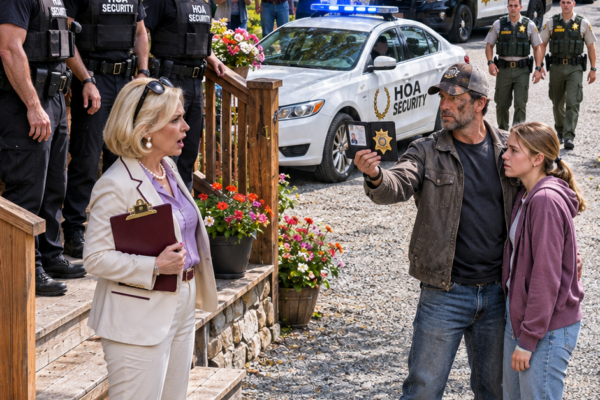
“Hold Him Down! That Boy Isn’t Going Anywhere Until His Father Learns to Respect Our Rules!” HOA Karen Sent Three Men Wearing Fake Police Uniforms to Detain My Sixteen-Year-Old Son Over an Argument at the Community Pool. One Pinned Him to the Pavement While Another Reached for a Knife. She Thought I Was Away From Home—She Never Bothered to Find Out Why I Had Retired From the Navy…
part2
Everything happened quickly.
The knife fell onto the pavement during the confrontation.
The man who’d been restraining Ethan lost his grip, allowing my son to scramble away.
I pulled Ethan behind me.
“Get to Mrs. Henderson’s porch.”
“Dad—”
“Go.”
He obeyed.
The man holding the baton lunged toward me.
There was a brief struggle before he went down and the baton slid across the road.
The third man attempted to intervene.
Within moments, all three had stopped advancing.
I backed away.
I wasn’t interested in punishing anyone.
My son was no longer being restrained.
The immediate threat had ended.
That was what mattered.
“CALL THE POLICE!” I shouted toward the gathering neighbors.
“Already did!” Mrs. Henderson answered.
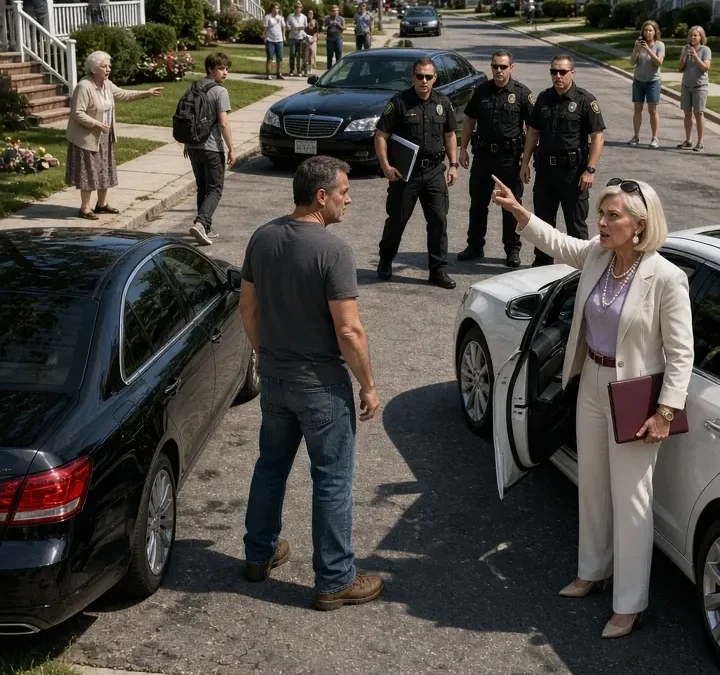
Karen stood beside her Lexus with her mouth open.
Her binder hung loosely from one hand.
“What have you done?”
I looked at her.
“What have I done?”
She pointed toward the men.
“You assaulted my officers!”
“They’re not officers.”
“They were carrying out an authorized disciplinary procedure!”
I pointed toward Ethan.
“He’s a child.”
“He was ordered to cooperate!”
“By you?”
“By the association!”
One of the men attempted to stand.
I moved farther away, keeping Ethan and the neighbors clear of the confrontation.
Sirens sounded in the distance.
Karen’s expression changed.
For the first time that afternoon, she looked uncertain.
She hurried toward the man who’d been holding the baton.
“Tell them he attacked you.”
He stared at her.
“Karen—”
“Tell them!”
Several neighbors heard her.
Several phones recorded her.
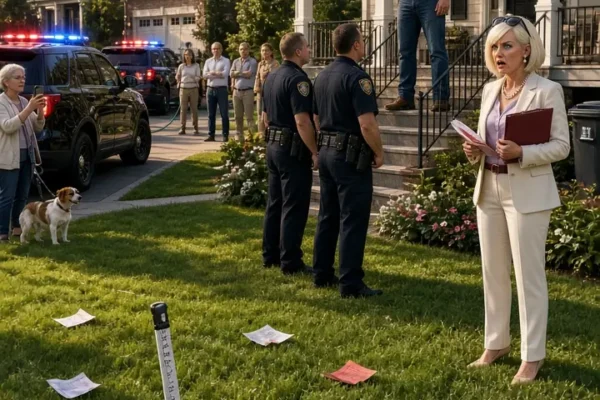
Then three genuine police cruisers turned onto our street.
I raised my empty hands and followed the responding officers’ instructions.
“I’m the boy’s father. Those men were restraining him.”
An officer directed me away from the others.
Another approached Ethan.
My son was shaking.
There were abrasions on his hands, dirt across his cheek, and red marks around his wrists.
Mrs. Henderson stood beside him.
“He was riding his bicycle,” she told the officer. “They grabbed him. I saw everything.”
Karen hurried forward.
“Officer, this man attacked three authorized enforcement personnel!”
The officer looked toward the black uniforms.
“Which law enforcement agency are they employed by?”
“The homeowners association.”
“Are they sworn officers?”
“They have enforcement authority under Section 19A.”
“That’s not what I asked.”
Karen opened her binder.
“You need to read our bylaws.”
The officer didn’t take it.
“Ma’am, please step back.”
She looked offended.
“I’M THE PRESIDENT!”
He repeated his instruction.
This time, she obeyed.
Paramedics arrived shortly afterward.
They examined Ethan and the three men.
Officers secured the knife and baton as evidence.
Statements were collected separately.
Neighbors offered recordings showing what had happened before my arrival, during the confrontation, and afterward.
The officers didn’t simply take my word for what had occurred.
They investigated.
That distinction would become important.
When I was finally allowed to approach Ethan, he grabbed me so tightly that I could feel his entire body trembling.
“I didn’t do anything, Dad.”
“I know.”
“They just grabbed me.”
“I know, buddy.”
“I told them to stop.”
His voice broke.
I wrapped my arms around him.
“You’re safe now.”
He buried his face against my shoulder.
For a moment, he wasn’t sixteen.
He was the little boy who used to climb into my bed during thunderstorms.
And I wasn’t a retired Navy SEAL.
I was just his father.
A father who’d spent twenty-two years preparing for dangerous situations and still felt completely unprepared for this one.
The men were taken into custody or transported for medical evaluation under police supervision.
Karen remained at the scene while officers investigated her role.
She continued insisting that she had acted within her authority.
I couldn’t understand how someone could stand ten feet from an injured teenager and still believe the important issue was obedience to her clipboard.
But that was Karen Whitmore.
And this nightmare had started with something as ordinary as a summer afternoon at the swimming pool.
My name was Cole Bennett.
I was forty-eight years old when Ethan and I moved into Cedar Ridge Estates.
I’d retired from the Navy the previous year.
After decades of deployments, training schedules, and missed birthdays, I wanted something simple.
A comfortable home.
A quiet neighborhood.
Time with my family.
My wife, Rachel, had died four years earlier following a long illness.
Ethan had been twelve.
We’d both struggled afterward, though neither of us particularly liked discussing it.
He became quieter.
I became busier.
For a while, we seemed to manage our grief by pretending that keeping ourselves occupied was the same thing as moving forward.
Eventually, I realized that the remaining years of his childhood were slipping away.
I retired.
Sold our old house.
And purchased a three-bedroom home in Cedar Ridge.
It had a spacious garage, mature oak trees, and a community pool within cycling distance.
Ethan loved it immediately.
“Can I have the bedroom overlooking the backyard?”
“It’s yours.”
“Can we get a basketball hoop?”
“Probably.”
“Can we get a dog?”
“Let’s unpack first.”
He laughed.
Three weeks later, we adopted an elderly golden retriever named Scout.
Apparently, I was better at resisting interrogation than resisting my son’s requests.
For the first few months, Cedar Ridge was exactly what we’d hoped it would be.
Ethan made friends at school.
He helped Mrs. Henderson carry groceries when her arthritis became troublesome.
He mowed Mr. Wallace’s lawn during the older man’s recovery from surgery.
He refused payment both times.
When neighbors asked about him, I tried not to sound excessively proud.
Usually, I failed.
Ethan wasn’t perfect.
He occasionally forgot his homework.
His bedroom looked like a clothing store after an earthquake.
He could spend forty minutes in the shower and somehow still leave his socks beside the bathroom sink.
But he was a good kid.
Rachel would’ve been proud of him.
Then we met Karen Whitmore.
I’d seen her name on association newsletters before meeting her in person.
She was the Cedar Ridge HOA president.
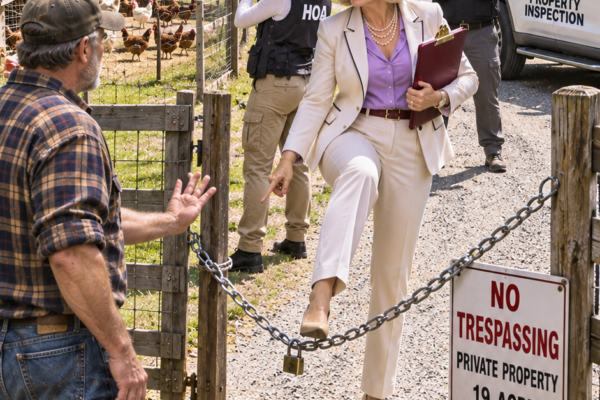
A woman in her early fifties with an immaculate blonde bob, expensive handbags, and the remarkable ability to turn a friendly greeting into an inspection.
Our first conversation concerned my trash cans.
“Mr. Bennett, containers must be removed from public view immediately following collection.”
I looked toward the garbage truck still working its way down the street.
“It’s Tuesday morning.”
“Yes.”
“They haven’t finished collecting.”
“That doesn’t change the standard.”
I smiled.
“I’ll bring them inside when they’re emptied.”
She made a note on her clipboard.
Then she examined my porch.
“Your exterior lighting is also rather warm.”
“Thank you.”
“That wasn’t a compliment.”
I looked at the light fixture.
“It’s a light bulb.”
“The approved color temperature is intended to maintain visual consistency.”
“Send me the rule.”
She stared at me.
Most people apparently didn’t ask her to identify the rules she cited.
Eventually, she walked away.
I checked the governing documents that evening.
The trash collection provision existed, though Karen’s interpretation was considerably stricter than the actual wording.
There was no specific regulation concerning the color temperature of my porch lights.
I sent a polite email requesting clarification.
She never answered.
At the time, I considered it a minor annoyance.
I’d dealt with far worse people than an HOA president who took light bulbs personally.
I had no idea how dangerous her obsession with authority would become.
The trouble began on the first Saturday of summer vacation.
Ethan rode his bicycle to the community pool shortly after lunch.
He planned to meet several friends.
At four fifteen, he returned home earlier than expected.
His shirt was wet.
One knee was scraped.
Scout greeted him at the door.
I looked up from the kitchen counter.
“What happened?”
“Nothing.”
“That’s an interesting scrape for nothing.”
Ethan opened the refrigerator.
“Just some stupid argument.”
“With whom?”
“Tyler Whitmore.”
Karen’s son.
Tyler was seventeen and attended the same high school.
I’d met him twice.
He seemed like a reasonably ordinary teenager, although he had apparently inherited his mother’s belief that rules applied differently to members of their family.
“What was the argument about?”
“The diving area.”
Ethan explained that Tyler had been trying to impress several friends by shoving younger kids near the edge of the pool.
When Ethan told him to stop, Tyler shoved him.
Ethan pushed back.
A lifeguard separated them.
Nobody was seriously injured.
Both boys were told to leave for the afternoon.
“Did you hit him?”
“No.”
“Did you threaten him?”
“No.”
“Could you have walked away?”
Ethan hesitated.
“Probably.”
I nodded.
“Next time, do that.”
He looked relieved.
“Am I grounded?”
“Not unless I find out you’ve lied to me.”
“I haven’t.”
“Okay.”
I handed him a towel.
“Clean that scrape.”
As far as I was concerned, it was an ordinary teenage disagreement requiring an ordinary conversation.
I intended to speak with the pool manager and establish whether anything else needed addressing.
Karen had an entirely different idea.
The following morning, a notice appeared on our front door.
It was taped directly beneath the doorbell.
CEDAR RIDGE HOMEOWNERS ASSOCIATION.
YOUTH CONDUCT BYLAW 19A.
MANDATORY DISCIPLINARY HOLD PENDING REVIEW.
I read it three times.
Then I laughed.
Ethan walked into the hallway.
“What’s funny?”
I handed him the notice.
He frowned.
“What’s a disciplinary hold?”
“Excellent question.”
“Am I banned from the pool?”
“Possibly. Let’s find out.”
The notice went considerably further than a temporary suspension of pool privileges.
It demanded that Ethan appear before an association disciplinary committee.
It referred to corrective supervision, mandatory behavioral assessment, and possible residential restrictions.
Failure to cooperate could supposedly result in enforcement action against both Ethan and me.
I opened the association’s governing documents.
There were provisions governing pool access.
There were rules concerning disruptive behavior in common areas.
There was nothing resembling Section 19A.
I called Karen.
She answered with remarkable enthusiasm.
“Mr. Bennett, I’m glad you’re finally taking this seriously.”
“I’m looking at a disciplinary notice concerning Ethan.”
“Yes.”
“Could you send me the rule supporting it?”
“It’s an emergency youth protection measure.”
“Was it adopted by the board?”
“The committee has reviewed the incident.”
“Which committee?”
“The youth conduct committee.”
“Who’s on it?”
“That information is confidential.”
I looked toward Ethan, who was eating cereal.
“Karen, your son and mine had an argument at the pool. If both boys need to apologize, we can arrange that.”
“My son was the victim.”
“That’s not what Ethan says.”
“Your son’s account is irrelevant.”
“Then whose account are you using?”
“Tyler’s.”
I waited.
She continued.
“Ethan will report for corrective custody on Wednesday at four.”
“Absolutely not.”
“Attendance is mandatory.”
“No, it isn’t.”
“Mr. Bennett, your refusal to cooperate will be documented.”
“Please document that I do not authorize you or anyone working for the HOA to take custody of my child.”
She hung up.
I contacted the pool manager.
Her name was Melissa Grant.
She confirmed that a disagreement had occurred.
Both boys had participated.
The lifeguard’s report indicated that Tyler initiated physical contact.
Ethan had pushed him away.
Melissa considered the matter resolved through the temporary removal of both teenagers from the pool.
“Has anyone instructed you to change the report?” I asked.
She became quiet.
“Why?”
“Karen’s claiming Ethan was solely responsible.”
Melissa sighed.
“She asked me to reconsider the wording.”
“Did you?”
“No.”
“Could I request a copy of the report concerning Ethan?”
She explained the appropriate process.
I submitted the request.
Then I spoke with Ethan.
“The pool manager confirmed what you told me.”
He nodded.
“Tyler’s been telling everybody I’m getting kicked out.”
“Of school?”
“The neighborhood.”
I stared at him.
“Where’d he hear that?”
“His mom, probably.”
I sat beside him.
“Listen carefully. You are not getting kicked out of your home because of an argument at a swimming pool.”
“Okay.”
“And if anyone from the HOA asks you to go somewhere with them, you come straight to me.”
He looked confused.
“Why would they do that?”
“I don’t expect them to. But I want you to know.”
He nodded.
I thought the conversation was sufficient.
I couldn’t imagine that a private homeowners association would actually attempt to take physical custody of a teenager.
That was the first thing Karen taught me.
Never underestimate how far someone will go after convincing herself that she cannot be wrong.
On Wednesday, Ethan received a second notice.
It was addressed directly to him.
FAILURE TO APPEAR FOR CORRECTIVE CUSTODY.
I hadn’t taken him to the purported hearing.
Instead, we’d gone to a movie.
The new document demanded a $250 penalty for parental negligence.
Another $100 was assessed for obstruction of an association disciplinary procedure.
I photographed the notices and contacted an attorney.
Daniel Foster was a civil litigation lawyer who’d helped several military families with property disputes.
He reviewed the association documents.
Then he looked at me over his glasses.
“Corrective custody?”
“That’s what she calls it.”
“Are we talking about an after-school detention program?”
“No. She wants my son to report to her.”
He shook his head.
“That’s not a legitimate HOA enforcement remedy.”
“That’s what I figured.”
He explained that the association might have lawful procedures for restricting access to certain amenities following established rules.
It could not grant itself governmental powers over children.
Nor could Karen simply invent fines for refusing to surrender parental authority.
We sent a formal demand challenging the penalties and requesting the adopted rule, board minutes, and other records supposedly supporting the disciplinary program.
We expressly prohibited unauthorized contact with Ethan.
I also sent copies to the association’s management company.
Their response arrived several days later.
The company stated that it was reviewing the matter with the board.
Karen sent her own response separately.
Mr. Bennett’s military background does not exempt his household from residential obligations.
I stared at the sentence.
Apparently, somebody had told her I was retired military.
I doubted she knew much more than that.
My service wasn’t a secret.
But I didn’t introduce myself to neighbors by reciting my qualifications.
I certainly didn’t consider them a reason to receive special treatment.
Daniel suggested that I keep the discussion focused on the documents.
I agreed.
Then three men appeared in Cedar Ridge.
The first time I noticed them, they were standing near the community entrance.
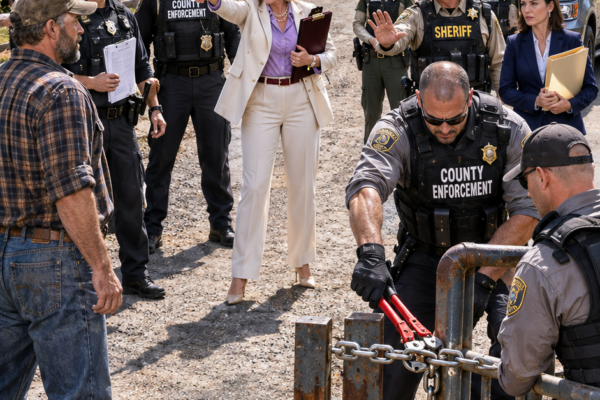
They wore black shirts marked HOA ENFORCEMENT.
Two carried radios.
All three wore heavy belts containing various pieces of equipment.
They didn’t look like conventional security personnel.
They looked like men attempting to resemble something more authoritative than they were.
I noticed them again the next afternoon.
One stood outside the Henderson residence.
Another examined vehicles parked beside the clubhouse.
The third walked along the sidewalk near my property.
I approached him.
“Can I help you?”
He turned.
“Routine compliance patrol.”
“Who employs you?”
“Cedar Ridge.”
“Are you licensed security personnel?”
“I’m not required to discuss that.”
“Then are you representing a government agency?”
“No.”
I pointed toward the lettering on his shirt.
“Make sure you’re not implying otherwise.”
He frowned.
“Are you Cole Bennett?”
“Yes.”
“Your son’s got an outstanding disciplinary matter.”
My expression changed.
“Do not approach my son.”
“That’s above my pay grade.”
“Then tell whoever pays you.”
I went inside and documented the encounter.
Daniel contacted the management company again.
This time, we received a considerably more troubling response.
The management company had not hired the men.
Karen had contracted with them directly, supposedly under an emergency enforcement initiative.
The board had not yet received a complete copy of the agreement.
I called the sheriff’s nonemergency number and reported the encounters.
A deputy took the information.
At that point, we had threatening notices and suspicious behavior.
We didn’t yet have evidence that anyone had physically attempted to take Ethan.
The deputy advised me to report any direct threats or attempts to enter the property.
He also encouraged me to preserve the documents.
I did.
But I couldn’t shake the feeling that Karen’s enforcement program wasn’t simply an exaggerated response to a pool argument.
There was something else happening in Cedar Ridge.
I discovered what it was when Mrs. Henderson invited me over for dinner.
Her name was Margaret.
She was sixty-nine, widowed, and remarkably knowledgeable about everything occurring within a three-block radius of her kitchen.
She served homemade lasagna.
Then she placed a folder beside my plate.
“Ethan’s not the first.”
I looked at her.
“First what?”
“Child Karen’s gone after.”
Inside were copies of notices concerning her grandson, Jacob.
Jacob was fourteen.
He occasionally stayed with her during school vacations.
Karen had fined Margaret because Jacob rode his skateboard through the neighborhood.
Another notice demanded that he attend an association behavioral review.
“Did you take him?”
“His mother said absolutely not.”
“What happened?”
“Karen suspended my pool access.”
Margaret looked embarrassed.
“I paid the fines.”
“How much?”
“Four hundred dollars.”
She brought out more letters.
One concerned her granddaughter drawing on the sidewalk with chalk.
Another described an incident involving children’s bicycles.
Karen’s enforcement policies appeared to contain an unusual number of provisions targeting minors.
“Where are these rules coming from?” I asked.
Margaret shrugged.
“They show up in newsletters.”
“Does the board vote on them?”
“Karen says they do.”
She leaned forward.
“Cole, people are afraid of her.”
“Why?”
“Because she keeps threatening their houses.”
She explained that several families had received substantial penalties.
Some were struggling financially.
One had moved after repeated conflicts involving their children.
Karen described them in a newsletter as a household incompatible with Cedar Ridge’s community culture.
I remembered Ethan helping Margaret carry groceries.
I couldn’t imagine anybody describing him as incompatible with a community.
Then again, Karen’s version of community seemed to involve everyone agreeing with her.
Margaret showed me something else.
A payment receipt issued by Cedar Ridge Community Safety Services.
It concerned the disciplinary notices involving Jacob.
The company name didn’t appear in any of the association’s original documents.
I photographed it with her permission.
“Would you be comfortable speaking with Daniel?”
“Yes.”
She looked toward a photograph of her grandchildren.
“I wish I’d said something earlier.”
“You’re saying something now.”
She smiled.
Then she pushed my plate toward me.
“Eat before it gets cold.”
I did.
For the first time since Rachel’s death, somebody reminded me of her particular combination of kindness and absolute refusal to accept an argument about dinner.
It made me miss her.
It also made me understand why protecting this neighborhood mattered.
Ethan and I had finally found somewhere that felt like home.
I wasn’t prepared to let Karen turn it into another place we needed to escape.
Over the next week, several neighbors provided similar accounts.
A father named Luis Ramirez showed me a notice concerning his eleven-year-old son’s soccer ball.
A mother named Jessica Lee had received a warning about her daughter’s birthday party.
Mr. Wallace showed me correspondence concerning his grandson’s visits.
The grandchildren weren’t damaging property.
They weren’t threatening residents.
They were simply doing things children did.
Running.
Playing.
Occasionally making noise.
Karen had begun treating childhood itself as an enforcement problem.
Then Luis showed me a receipt for something called a juvenile compliance assessment.
The charge was $175.
“Did anybody actually assess your son?” I asked.
“No.”
“Did you receive any services?”
“No.”
“Then why did you pay?”
He looked toward his living room.
“Because they threatened to file a lien.”
That was the pattern.
Invent a violation.
Demand payment.
Threaten escalation.
And rely on parents being too worried about their children or their homes to challenge the demand.
Daniel helped organize the documents.
We requested an independent review of the association’s financial and enforcement records.
Several legitimate association members signed the request.
Karen responded by circulating an email accusing me of organizing a disruptive campaign.
She described the neighborhood’s youth conduct initiative as essential to preventing dangerous behavior.
She didn’t mention the pool manager’s report.
She didn’t mention her son’s role in the original incident.
And she certainly didn’t mention the absence of a properly adopted Section 19A.
The email ended with a warning.
Parents who obstruct corrective measures may be subject to enhanced enforcement.
I forwarded it to Daniel.
Then I drove to the grocery store with Ethan.
I needed an hour in which our lives didn’t revolve around Karen Whitmore.
Unfortunately, Ethan had already begun changing his behavior.
He stopped visiting the community pool.
Stopped riding his bicycle past the clubhouse.
Stopped inviting friends over.
One evening, I found him sitting in the garage beside his bicycle.
“What’s up?”
“Nothing.”
I sat on the workbench.
“You’ve been saying that a lot lately.”
He shrugged.
“Tyler’s telling everyone his mom’s going to have me arrested.”
“That’s not happening.”
“People believe him.”
I studied his face.
“Your friends?”
“Some.”
He looked down.
“I don’t want to make things worse.”
That bothered me.
Ethan had spent most of his life trying to make other people’s lives easier.
After his mother died, he’d started helping around the house without being asked.
Sometimes I worried that he’d become too accustomed to managing other people’s feelings.
Now Karen had convinced him that simply going outside might create another problem for me.
“Listen,” I said. “You shouldn’t have pushed Tyler. We talked about that.”
“I know.”
“But that doesn’t give anybody the right to frighten you or put their hands on you.”
He nodded.
“And you don’t have to spend your summer hiding in this garage.”
“What if she keeps sending those guys?”
“Then we report it.”
He looked at me.
“Dad, what if she’s really allowed to?”
“She isn’t.”
I said it confidently.
Because I believed it.
But there was an important difference between what someone was allowed to do and what someone might actually attempt.
A difference we would discover three days later.
The day before the attack, I received a call from a board member named Susan Marshall.
She asked whether we could meet privately.
We met at a coffee shop outside Cedar Ridge.
Susan brought a laptop and several printed documents.
“I need you to understand something,” she said. “I never approved anything involving your son.”
“Did the board?”
“Not that I’m aware of.”
She showed me the minutes from a recent emergency meeting.
Karen had proposed expanding neighborhood security services following what she described as escalating juvenile misconduct.
The board authorized a limited expenditure for additional patrols around the pool and clubhouse.
Nothing in the approved motion involved physical detention.
Nothing established a disciplinary committee.
Nothing allowed contractors to enter private homes or seize children.
Susan opened another document.
It was an invoice from a company called Sentinel Residential Compliance.
The amount was $4,800.
The description read:
Specialized community enforcement services.
“That’s who hired the men?” I asked.
“Apparently.”
“Who owns the company?”
Susan looked uncomfortable.
“Karen’s brother-in-law.”
I sat back.
“Was that disclosed before the vote?”
“No.”
She opened another invoice.
Then another.
The association had paid for compliance-related services on several occasions.
The total exceeded $18,000.
Susan couldn’t identify what legitimate services justified much of that spending.
“I’ve requested the full contract,” she said. “Karen keeps telling me it’s confidential.”
“Confidential from the board paying for it?”
“Exactly.”
She looked exhausted.
“I joined because I wanted the playground repaired. Somehow, I’m sitting here discussing people pretending to be police officers.”
I gave her Daniel’s contact information and encouraged her to seek independent advice.
We needed to establish what had happened without compromising the integrity of the records.
Before leaving, she handed me one final document.
A proposed amendment titled Youth Conduct and Corrective Intervention.
At the bottom appeared an approval date.
The date was two days after Ethan’s supposed original violation.
I pointed toward it.
“This rule didn’t even exist when she accused him of breaking it.”
Susan nodded.
“And it still hasn’t been adopted.”
There it was.
The clearest evidence yet.
Karen hadn’t merely misinterpreted a rule.
She had attempted to create one specifically to justify her actions after the pool incident.
I sent the documents to Daniel.
He prepared another written demand and began discussing emergency civil protection if Karen continued threatening physical intervention.
I also updated the deputy handling my earlier complaint.
I told Ethan to remain away from the contractors and contact me if approached.
He promised he would.
Unfortunately, the following afternoon, the contractors approached him before he had an opportunity to do either.
The next time I saw Susan was at the hospital.
She arrived while Ethan was being examined.
Her eyes were red.
“Cole, I’m so sorry.”
I stood.
“Did you know they were planning this?”
“No.”
She looked toward the examination room.
“I would’ve called the police.”
I believed her.
Susan had brought something with her.
A printed email Karen had sent to the board shortly before the incident.
It described Ethan as an unresolved disciplinary subject.
It announced that the contractors would be instructed to complete an intervention that afternoon.
The other board members had received the email.
At least two had objected.
Karen replied that she possessed emergency discretion and would proceed.
Susan had been at work when the messages arrived.
By the time she saw them, police were already on our street.
I looked at the timestamps.
The final message had been sent twenty-seven minutes before Ethan was grabbed.
I handed the document back.
“Give the original electronic records to the investigators.”
She nodded.
“Of course.”
Then she asked how Ethan was doing.
“Physically, they think he’ll recover.”
“And otherwise?”
I looked through the examination room window.
My son was sitting on the edge of the bed while a nurse cleaned his abrasions.
“I don’t know yet.”
The medical examination established bruising, abrasions, and soft tissue injuries.
Fortunately, there were no fractures or serious internal injuries.
The doctor explained what symptoms we should monitor and arranged appropriate follow-up care.
Ethan barely spoke during the drive home.
Scout greeted us at the door.
Usually, Ethan would immediately kneel to pet him.
That evening, he walked straight upstairs.
I gave him some space.
Then I knocked on his bedroom door.
“Come in.”
He was sitting on his bed.
His bicycle helmet lay beside him.
“I left my bike in the street.”
“Mr. Wallace brought it into our garage.”
“Oh.”
I sat beside him.
For several minutes, neither of us spoke.
Then Ethan asked, “Did I do something wrong?”
“No.”
“I tried to get away when they grabbed me.”
“Of course you did.”
“They said that made me guilty.”
I felt anger rising again.
I pushed it aside.
My son didn’t need to manage my emotions on top of his own.
“Ethan, somebody claiming to have authority doesn’t automatically have it.”
He swallowed.
“I thought they were going to take me somewhere.”
“That’s why the police are investigating.”
“Where?”
“I don’t know.”
He looked down at his hands.
“What if you hadn’t been home?”
I wished I could give him a reassuring answer.
I couldn’t.
Instead, I put my arm around him.
“I’m glad I was.”
He nodded.
Then leaned against me.
We stayed there until Scout wandered into the room and climbed onto the bed despite being strictly prohibited from doing so.
Neither of us told him to get down.
The following morning, a detective named Maria Torres arrived at our house.
She specialized in cases involving violent offenses and vulnerable victims.
She explained that Ethan would be interviewed in an appropriate setting and that we should avoid repeatedly asking him to recount the incident.
His own recollection needed to be preserved accurately.
I provided my statement.
Then she showed me still images taken from several neighbors’ videos.
One captured Ethan riding his bicycle along the street.
Another showed the three men approaching him.
A third showed the moment they restrained him.
I had only witnessed the final portion of the incident.
Seeing how it started was worse than I’d expected.
Ethan hadn’t threatened anyone.
He hadn’t been damaging property.
He had attempted to leave after being told to accompany the men.
They stopped him.
One seized his bicycle.
Another grabbed him.
Then they forced him down.
I stared at the images.
Detective Torres gave me a moment.
“Mr. Bennett, we’re examining the conduct of everyone involved.”
“I understand.”
“That includes your actions during the confrontation.”
“I understand that, too.”
I didn’t expect my military background to exempt me from investigation.
The officers needed to determine whether my actions were consistent with protecting Ethan from the immediate threat.
They needed to evaluate the recordings, witness statements, and injuries.
I cooperated.
The videos showed me repeatedly demanding Ethan’s release.
They showed the continuing restraint and the presence of the weapons.
They also showed me disengaging once Ethan was safe and the men stopped advancing.
That evidence mattered.
I hadn’t gone outside seeking a fight.
I had gone outside because my child was being harmed.
After reviewing the evidence, the authorities ultimately determined that criminal charges against me were not warranted.
But that conclusion came through investigation.
Not through a police officer simply shaking my hand because I’d served in the military.
The three contractors had considerably more difficult circumstances to explain.
Their names were Travis Rourke, Mitch Dalton, and Eric Vance.
Travis had been carrying the knife.
Mitch held the baton.
Eric had pinned Ethan to the pavement.
None was a sworn law enforcement officer.
Their professional credentials and the nature of their security work became additional subjects of investigation.
The three men initially claimed that Karen had provided written authorization for their actions.
One insisted that they believed the homeowners association possessed some form of delegated disciplinary authority.
Detective Torres later told me they had produced a document signed by Karen.
It was titled Minor Custodial Intervention Authorization.
My son’s name appeared at the top.
His address.
His age.
A photograph apparently taken from a neighborhood event.
The document instructed the contractors to bring him to the clubhouse for a compulsory disciplinary review.
There was even a space for recording whether parental consent had been obtained.
That section contained two words.
Consent waived.
I stared at the copy Daniel received through the legal process.
“Who waived it?”
He looked at the signature.
“Apparently, Karen.”
I laughed once.
There was nothing funny about it.
A private citizen had signed a document purporting to cancel my authority as Ethan’s father.
Then she’d handed it to three men willing to act on it.
Daniel closed the folder.
“We’re seeking a protective order.”
“Good.”
“And the association needs to terminate these arrangements immediately.”
“Can they?”
“They can certainly stop spending homeowners’ money on them.”
The association’s insurer was notified.
Independent counsel became involved.
Susan and several other board members called for an emergency meeting.
Karen objected.
She argued that terminating the contractors would send the wrong message concerning resident accountability.
Susan sent a brief response.
An injured child is the wrong message.
The meeting went ahead.
I didn’t attend.
I was home with Ethan.
Daniel represented our interests where appropriate, and Susan later provided a summary.
The board suspended the enforcement contract.
It withdrew the purported youth detention measures.
It authorized an independent financial review.
It also began the process of removing Karen from her officer position.
For the first time, she could no longer issue instructions without confronting other people’s objections.
She responded by claiming that the board had been intimidated by a violent former military member.
That accusation appeared on social media before the end of the evening.
Several residents forwarded screenshots to me.
Karen described the confrontation as an attack on community safety officers performing legitimate duties.
She called Ethan an aggressive juvenile.
She suggested that my military training made me unsuitable for residential life.
I read the post once.
Then closed it.
Daniel had already advised against public arguments.
I wasn’t going to defend my son by turning his traumatic experience into an online spectacle.
But Ethan saw the post.
Someone from school sent it to him.
He came downstairs holding his phone.
“Dad, she’s saying I attacked them first.”
“I know.”
“Everybody’s going to think I did.”
“No. There are recordings.”
He shook his head.
“You don’t understand.”
I waited.
“People share stuff without checking whether it’s true.”
He was right.
I’d spent years working in environments where inaccurate information could have serious consequences.
But teenage social circles operated at a speed I couldn’t always comprehend.
One rumor could travel through an entire school before the person involved had finished breakfast.
We discussed the situation with the school administration.
They agreed to address harassment and protect Ethan’s privacy appropriately.
I also arranged for him to speak with a counselor experienced in adolescent trauma.
He resisted at first.
“I’m not crazy, Dad.”
“Neither am I.”
He looked at me.
“You talked to somebody?”
“Several times during my career.”
“Really?”
“Really.”
He thought about that.
“Did it help?”
“Yes.”
He agreed to try.
I was proud of him.
Not because he was pretending the incident hadn’t frightened him.
Because he was willing to admit that it had.
That required more courage than Karen would ever understand.
Karen’s financial problems began surfacing three weeks after the attack.
The independent accountant hired by the association discovered that payments to Sentinel Residential Compliance had increased substantially during Karen’s presidency.
Some invoices described routine patrols.
Others listed behavioral consultations, administrative interventions, and special collection services.
Several lacked supporting work records.
The accountant identified additional payments to businesses associated with Karen’s relatives.
Then Susan discovered that certain fines collected from parents had been deposited into an account that wasn’t part of the association’s normal operating system.
She called Daniel.
Daniel contacted the appropriate investigators.
The financial review expanded.
What had initially appeared to be a reckless enforcement program began revealing possible financial misconduct.
Karen’s brother-in-law, Howard Whitmore, had registered the compliance company shortly before receiving its first association contract.
According to evidence later established through the investigation, Karen had helped arrange work for the company while failing to disclose her financial interest in some of its activities.
The contractors received payment for collection visits.
Additional compensation was available for what Karen described as successful interventions.
There were invoices referencing children by household account numbers.
My son’s number appeared on one.
I sat in Daniel’s office looking at the document.
“Someone was getting paid to grab Ethan?”
“That’s what the investigators are examining.”
I pushed the paper away.
For weeks, I’d assumed Karen’s motivation was primarily personal.
Her son had lost an argument.
She wanted to punish mine.
But the financial records suggested that her disciplinary program had served another purpose.
Every invented violation generated potential revenue.
Every frightened parent represented another collection opportunity.
And the more aggressive the enforcement became, the more services her brother-in-law’s company could supposedly provide.
Karen had created the problem.
Then paid people connected to her family to solve it.
Using our money.
One afternoon, Detective Torres contacted me about another development.
Investigators had obtained communications involving Karen and the contractors.
Among them was a message from Karen concerning Ethan.
His father believes he can ignore our instructions. Bring the boy in regardless of whether he agrees.
One of the contractors had asked what they should do if Ethan refused.
Karen’s response was preserved.
You are authorized to restrain him if necessary.
Another message followed.
Make sure the neighbors understand we’re serious.
That was the sentence I couldn’t stop thinking about.
Ethan hadn’t merely been the subject of some ridiculous disciplinary process.
He had been intended as an example.
Karen wanted other parents to see what could happen when somebody challenged her.
Unfortunately for her, the neighbors had seen exactly that.
And they’d recorded it.
Margaret Henderson’s video became particularly important.
She had started recording when she noticed the men stopping Ethan.
Her footage showed the initial encounter and captured their claims of HOA authority.
Mr. Wallace had recorded from his driveway.
Jessica Lee’s doorbell camera captured a portion of Karen’s arrival.
Together, the recordings established a remarkably consistent timeline.
The fake officers couldn’t plausibly claim Ethan had launched an unprovoked attack.
Karen couldn’t plausibly claim she had arrived merely to observe an unrelated disturbance.
Her own voice was preserved.
Her own instructions appeared in electronic communications.
Her own signature appeared on the purported custody authorization.
Every document she’d created to demonstrate her power had become evidence of how she’d abused it.
Then came the membership meeting.
The clubhouse was packed.
Parents brought folders.
Residents who’d previously avoided association meetings arrived early.
Margaret carried her receipts in a yellow envelope.
Luis brought copies of the notices concerning his son.
Susan sat beside the independent association attorney.
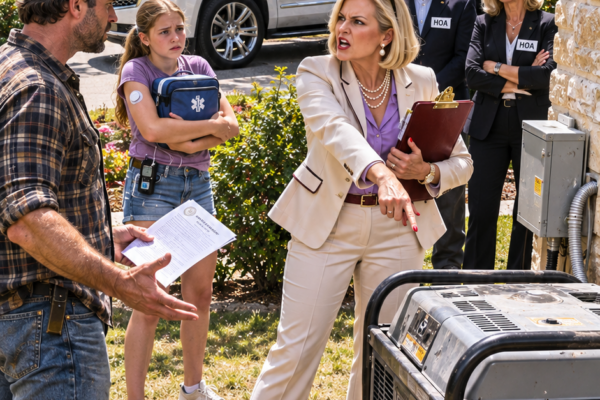
Karen arrived wearing a white blazer and carrying her familiar binder.
She looked toward the empty chair reserved for the president.
Then she looked at Susan.
“Why are you sitting there?”
“The board has asked me to conduct the meeting.”
“I’m still president.”
“The membership has business to consider.”
Karen sat down reluctantly.
I attended without Ethan.
He was spending the evening with a school friend.
Before I left, he’d asked whether he needed to come.
“No.”
“Good.”
That was enough.
He’d already given the investigators what they needed.
He didn’t owe the neighborhood another performance.
The association attorney began by explaining the scope of the financial and governance review.
Susan presented the original board authorization for additional security.
Then she displayed the purported youth conduct amendment.
The adoption records were missing.
The dates didn’t match Karen’s representations.
Several board members confirmed that they had never voted to approve corrective custody.
Karen interrupted.
“This was an emergency measure.”
Luis raised his hand.
“An emergency involving children’s bicycles?”
A few residents laughed.
Karen ignored him.
Susan continued.
“The association also made substantial payments to a company controlled by a relative of Mrs. Whitmore.”
Karen stood.
“That relationship is irrelevant.”
The accountant responded.
“It’s relevant to financial disclosure and contract approval.”
“I provided the board with professional recommendations.”
“Did you disclose your financial interest?”
Karen looked toward her attorney.
He advised her quietly.
She sat down.
Then Margaret approached the microphone.
She held up her yellow envelope.
“You charged me four hundred dollars because my grandson rode a skateboard.”
Karen sighed.
“Mrs. Henderson, that matter was resolved.”
“Because I paid you.”
“You were in violation.”
“Of what?”
Karen opened her binder.
Margaret shook her head.
“No. Not another paper you printed yourself. Show me the actual rule.”
Nobody spoke.
For a woman who’d spent years quietly surrendering money because she feared losing her home, Margaret sounded remarkably strong.
Karen searched through the binder.
She didn’t find what she needed.
Then Jessica spoke.
“My daughter used to have birthday parties at the clubhouse.”
Karen looked up.
“She hasn’t wanted one there for two years. She’s afraid you’ll come and count her friends.”
Another parent described being threatened over his son’s soccer practice.
Mr. Wallace explained how the contractors had approached his grandson.
One by one, residents presented experiences that had previously been treated as isolated disagreements.
Then it was my turn.
I stood.
Karen looked directly at me.
“This entire campaign started because your son assaulted mine.”
I placed the lifeguard’s original incident report on the table.
“Your son initiated physical contact.”
She glanced away.
“That’s disputed.”
“Both boys were removed from the pool for the afternoon. The pool manager considered the incident resolved.”
“Your child needed consequences.”
“He received consequences at home.”
I held up the purported custody authorization.
“Explain this.”
Karen looked at the document.
“That’s been misrepresented.”
“Is that your signature?”
She said nothing.
“Did you authorize three men to take my son without my consent?”
Her attorney advised her not to answer questions relating to the criminal investigation.
I didn’t press further.
Instead, I placed the document back on the table.
Then I addressed the residents.
“Ethan isn’t here tonight because he’s sixteen years old. He should be thinking about school, spending time with his friends, and enjoying his summer. He shouldn’t have to sit in a room full of adults explaining why nobody had the right to pin him to the pavement.”
The room became silent.
“That’s all I have to say.”
I returned to my seat.
Karen looked around.
She appeared to be searching for somebody willing to defend her.
Nobody did.
The meeting proceeded under the applicable association procedures.
The board’s leadership changes were confirmed.
The membership approved measures replacing the directors responsible for the enforcement program through the required voting process.
Karen lost her position.
Her brother-in-law’s contract remained terminated.
The association authorized further cooperation with investigators and the independent financial review.
When the results were announced, Karen collected her binder.
“You’re destroying this neighborhood.”
Susan shook her head.
“No, Karen. We’re repairing it.”
Karen walked out.
For once, nobody followed her.
The criminal case continued for months.
Authorities obtained additional records.
The contractors gave conflicting accounts of their instructions.
Eventually, one agreed to cooperate.
His account helped investigators establish that the men understood they were performing private enforcement work, not exercising lawful police authority.
The supposed detention of Ethan had been planned in advance.
The intended destination was the clubhouse.
The involvement of weapons and the physical restraint of a minor made the incident considerably more serious than the administrative dispute Karen continued describing.
Investigators examined whether other families had experienced similar conduct.
Additional victims came forward.
Some described threats.
Others described aggressive collection encounters.
Several had received documents resembling the purported authorization used against Ethan.
The financial investigation continued separately.
It examined diverted payments, questionable contracts, and the use of association resources for private benefit.
Karen eventually faced criminal charges arising from her role in arranging the unlawful detention and participating in the related misconduct.
Howard faced separate proceedings concerning his involvement.
The defendants were entitled to legal representation.
They could challenge the evidence.
The prosecution had to establish its case.
There were hearings, motions, negotiations, and months when it seemed as though nothing was happening.
Ethan occasionally asked about the progress.
I told him what I knew.
I didn’t promise outcomes before they occurred.
And I made sure his life wasn’t put on hold while the legal process continued.
He returned to school.
Resumed helping Margaret with her groceries.
Started playing basketball with friends.
He even returned to the community pool after the new board reviewed its access policies and ensured the old enforcement program had ended.
The first time he went back, he asked whether I’d accompany him.
“Absolutely.”
We walked there together.
He stood beside the entrance for a moment.
Then he noticed several friends waving from the water.
“I’m good, Dad.”
“You sure?”
“Yeah.”
I watched him walk inside.
He turned around.
“You can go home.”
I smiled.
“Have fun.”
I walked back alone.
For the first time in months, being told by my son that he didn’t need me felt like a victory.
The criminal proceedings eventually reached their conclusions.
Travis received a ten-year prison sentence for the offenses established against him.
Mitch received seven years.
Eric received five.
Their individual sentences reflected their conduct, applicable charges, and the circumstances considered by the court.
Karen pleaded guilty to charges arising from her role in organizing the unlawful detention and associated misconduct.
She received a four-year prison sentence.
Financial penalties and restitution obligations were imposed as part of the criminal proceedings.
Separate civil claims involving the harm to Ethan, improper enforcement, and financial misconduct were resolved through settlements and other appropriate recovery processes.
Our family’s civil resolution included compensation for medical expenses, counseling, legal costs, and the documented harm Ethan had experienced.
Other affected homeowners received refunds or compensation based on their circumstances.
The association ultimately recovered substantial amounts connected to improper expenditures.
Karen’s total financial liability across the relevant proceedings exceeded $50,000.
It took considerably longer than a single dramatic afternoon.
Real justice usually did.
At Karen’s sentencing, I accompanied Ethan to the courthouse.
He’d decided that he wanted to provide a victim impact statement.
I told him he didn’t have to.
“I know,” he answered.
“But I want to.”
He had written it himself.
When his opportunity came, he stood beside the prosecutor.
His hands shook slightly.
Then he began reading.
“Before this happened, I liked riding my bike around my neighborhood. I liked helping people. I thought adults were supposed to make kids feel safe.”
He paused.
“I know not every adult is like the people who hurt me. My neighbors proved that.”
Margaret was sitting behind me.
She started crying.
Ethan continued.
“I don’t want to be afraid of people wearing uniforms. My dad wore one for most of his life. He taught me that uniforms are supposed to represent responsibility.”
He looked down at his paper.
“I just hope nobody else has to feel what I felt that day.”
Then he returned to his seat.
I put my hand on his shoulder.
He looked at me.
“Was that okay?”
I nodded.
“More than okay.”
I glanced toward Karen.
She was seated beside her attorney.
Her hair wasn’t styled as elaborately as usual.
There was no clipboard.
No binder of imaginary rules.
She had been given opportunities to address the court and acknowledge what had happened.
Her attorney spoke on her behalf.
Karen herself eventually expressed regret for the harm caused.
I couldn’t know whether she genuinely understood the suffering she’d created or merely regretted its consequences.
And I no longer needed to know.
Her influence over my son’s life was finished.
That was enough.
Outside the courthouse, Ethan asked if we could get lunch.
“Anywhere you want.”
“Burgers?”
“Sounds good.”
We sat in a booth beside the window.
He ordered an enormous meal and finished most of my fries.
For nearly an hour, we talked about baseball, school, and whether Scout needed a new dog bed.
Not once did he mention Karen.
I didn’t either.
Cedar Ridge changed substantially under its reorganized board.
Susan became president.
The association retained its legitimate responsibilities for maintaining common property and administering valid covenants.
But the unauthorized disciplinary program was eliminated.
Unsupported fines were withdrawn.
Residents received clear procedures for hearings and appeals.
Contracts required proper review and disclosure of potential conflicts.
The association adopted safeguards concerning interactions with minors.
Children’s safety concerns would be addressed through parents, appropriate facility staff, and public authorities when necessary.
Nobody would be operating a private disciplinary force.
Margaret volunteered to help organize community activities.
Luis arranged a neighborhood soccer event.
Jessica helped revive the annual children’s summer party.
For the first time in years, residents seemed more interested in enjoying the common areas than regulating one another’s enjoyment.
Even Tyler changed.
One afternoon, he appeared outside my house.
He stood beside the driveway looking uncomfortable.
“Mr. Bennett?”
“Tyler.”
“Is Ethan home?”
I called Ethan outside.
Tyler stared at his shoes.
“I wanted to apologize.”
Ethan waited.
“I started the thing at the pool.”
He swallowed.
“I told my mom you attacked me because I didn’t want to get in trouble.”
Ethan looked at him.
Tyler’s voice became quieter.
“I didn’t think she’d do all that.”
I believed him.
He was a teenager who’d lied to avoid consequences.
That didn’t make him responsible for every decision his mother made afterward.
But acknowledging his own part mattered.
Ethan thought for a moment.
Then said, “You should’ve told the truth.”
“I know.”
“People got hurt.”
Tyler nodded.
“I’m sorry.”
Ethan accepted the apology.
They didn’t suddenly become close friends.
They didn’t need to.
They simply stopped being enemies.
Watching that conversation, I realized that two teenagers had accomplished in five minutes what Karen had refused to do for months.
Admit a mistake.
Accept responsibility.
Move forward.
The following summer, Ethan volunteered to assist with swimming lessons for younger children at the community pool.
He wasn’t an instructor yet.
He helped the qualified staff organize equipment and supervise activities appropriately.
Margaret sent me a photograph of him carrying a stack of brightly colored flotation boards.
He was smiling.
That photograph meant more to me than any court document.
The boy Karen had labeled a delinquent was helping children feel comfortable in the water.
One Saturday evening, Ethan and I sat on our front porch.
Scout lay between our chairs.
A basketball bounced somewhere down the street.
Children rode bicycles beneath the oak trees.
Margaret waved from her garden.
Ethan looked toward the section of pavement where the three men had restrained him.
For months, he had avoided looking directly at that spot.
Now he watched a little boy ride across it on a blue bicycle.
“Dad?”
“Yeah?”
“Remember when I asked what would’ve happened if you weren’t home?”
“I remember.”
He took a moment.
“I think I know now.”
I looked at him.
“Mrs. Henderson would’ve called the police. Mr. Wallace would’ve helped. Everybody was recording.”
He glanced toward their houses.
“I wasn’t actually alone.”
I felt my throat tighten.
“No, son.”
I put my hand on his shoulder.
“You weren’t.”
He leaned back in his chair.
I thought about the years I’d spent in uniform.
The places I’d been.
The responsibilities I’d carried.
I’d once believed that protecting my family meant being strong enough to confront anything that threatened them.
But Ethan had reminded me that strength wasn’t something one person needed to possess alone.
Sometimes it was an elderly neighbor refusing to look away.
Sometimes it was a frightened board member preserving an important email.
Sometimes it was a sixteen-year-old boy telling the truth in a courtroom despite the tremor in his hands.
The sun disappeared behind the rooftops.
Ethan stood and retrieved his bicycle from the garage.
“Going somewhere?”
“Just around the neighborhood.”
“Be home before dark.”
“Got it.”
He fastened his helmet.
Then rode down the driveway.
I watched him pass Margaret’s house.
She waved.
He waved back.
A moment later, he crossed the same stretch of pavement where Karen’s fake officers had once tried to take his freedom away.
This time, nobody stopped him.
Nobody shouted orders.
Nobody reached for a weapon.
My son kept riding.
And I stayed on the porch, smiling as he disappeared around the corner.