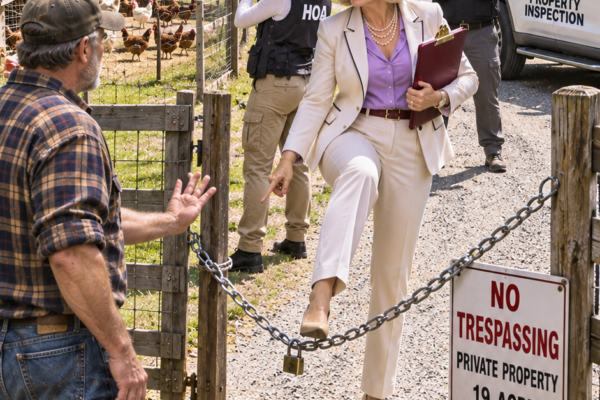
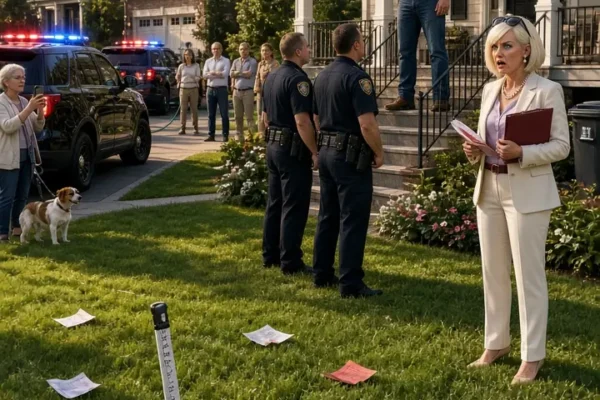
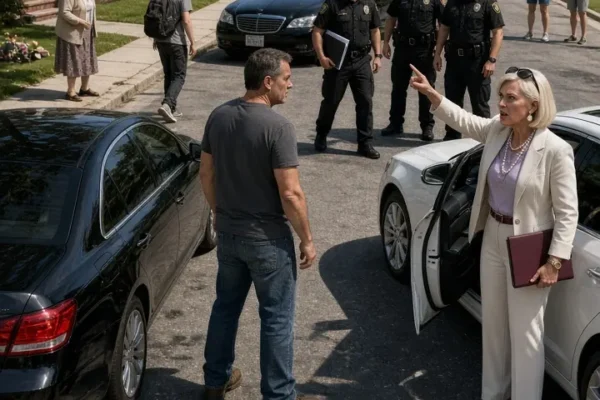
“PUT YOUR HANDS BEHIND YOUR BACK, YOUNG LADY—YOU’RE UNDER ARREST!” HOA Karen Ordered Her Fake Security Officers to Handcuff My 17-Year-Old Daughter on the Front Porch of Our Own Lakeside Cabin. She Claimed a Recent Board Vote Gave Her the Power to Detain Residents Who Disobeyed Her Rules. Then I Pulled Into the Driveway, Opened My Federal Identification Wallet, and Asked Who Had Authorized the Arrest…
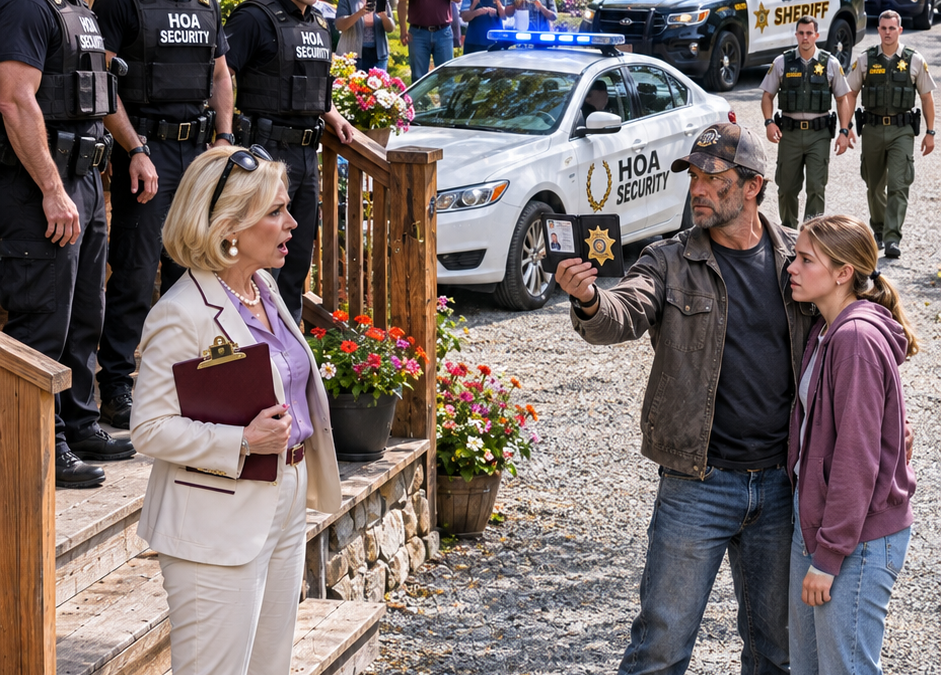
part2
Sheriff Daniel Mercer stopped his cruiser behind the white sedan.
A second county vehicle followed.
Arthur immediately lowered the plastic restraints.
“There’s been a misunderstanding,” he announced.
I looked at Emma.
“Come here, sweetheart.”
She hurried down the steps and stood beside me.
Her hands were shaking.
“Did anybody touch you?”
“He grabbed my wrist.”
I looked at Arthur.
He took a step backward.
“I was attempting to establish control of the situation.”
“Don’t say another word to me.”
Sheriff Mercer approached.
I’d worked with him on several federal cases, but this wasn’t one of them.
This was my daughter.
My home.
And a local incident that needed an independent investigation.
“Tom,” he said. “Everybody safe?”
“Emma’s with me. She says that man grabbed her wrist.”
Mercer nodded.
“Let us take it from here.”
“Absolutely.”
I closed my identification wallet.
Then I stepped aside.
Susan immediately rushed toward the sheriff.
“Officer, thank goodness you’re here. This homeowner is interfering with a lawful detention.”
Mercer looked at her.
“A lawful detention?”
“Yes.”
“Of whom?”
“His daughter.”
“Why?”
“Trespassing on association property.”
Mercer glanced toward the cabin.
“Who owns this residence?”
Susan hesitated.
“Mr. Vance.”
“And the young lady lives here?”
“She hasn’t obtained her community identification card.”
The sheriff stared at her.
For several seconds, he appeared to be waiting for the rest of her explanation.
There wasn’t one.
He turned toward Arthur.
“Are you a sworn law enforcement officer?”
Arthur shook his head.
“I’m certified in community security.”
“That’s not what I asked.”
“No, sir.”
“Were you attempting to detain this young lady?”
Arthur looked toward Susan.
“She authorized it.”
Mercer followed his gaze.
“Mrs. Higgins, did you direct these men to take a minor into custody?”
“We established a detention protocol at our last board meeting.”
“A what?”
“A detention protocol.”
The deputy standing beside Mercer stopped writing and looked up.
Susan continued.
“It’s necessary to ensure cooperation with community safety standards.”
Mercer held up one hand.
“Ma’am, stop.”
He turned toward his deputy.
“Separate everyone. Get individual statements.”
Susan’s eyes widened.
“I’m the association president!”
“I understand.”
“These are my security officers!”
“I understand that too.”
“Then why are you questioning us?”
“Because your security officers don’t get to arrest people based on an HOA vote.”
Arthur looked down at the plastic restraints in his hand.
The deputy asked him to place them on the hood of the sedan.
He complied immediately.
Susan started to object.
Mercer interrupted her.
“Right now, I’d like everyone to stop talking over one another.”
He looked toward me.
“Can Emma wait inside with you while we establish what happened?”
I nodded.
We went into the cabin.
Emma sat at the kitchen table.
I poured her a glass of water.
She reached for it with both hands.
For the first time since I’d arrived, I had a chance to look at her properly.
Her cheeks were flushed.
Her eyes were wet.
A faint red mark was visible near her wrist.
I felt something inside my chest tighten.
I’d spent twenty years in the United States Marshals Service.
I’d transported dangerous fugitives.
Protected federal judges.
Helped relocate witnesses whose lives were in genuine danger.
I’d seen fear in hundreds of faces.
But seeing it on my daughter’s face was different.
“Dad?”
“Yeah?”
“Can they actually arrest me?”
I sat beside her.
“Not for what you were doing.”
“They kept saying they had permission.”
“They didn’t have permission to do that.”
She stared at her wrist.
“I told them you owned the cabin.”
“I know.”
“I told them my name.”
“I know.”
“They wouldn’t listen.”
Her voice cracked.
I moved my chair closer.
She leaned against me.
And for the next few minutes, I wasn’t a federal marshal.
I wasn’t responsible for a district.
I wasn’t supervising deputies or reviewing threat assessments.
I was a father trying to comfort his frightened kid.
Everything else could wait.
Outside, Susan’s voice rose several times.
The deputies continued interviewing the men separately.
Eventually, Sheriff Mercer knocked.
“Can I speak with Emma?”
She looked at me.
I nodded.
“You can tell him exactly what happened.”
Mercer sat across from her.
His voice was calm.
He asked her to explain the events in her own words.
She described the men arriving.
Their demand for identification.
Susan’s insistence that she was trespassing.
Arthur grabbing her wrist when she attempted to retreat inside.
She explained that she’d told them repeatedly she was an authorized occupant of the cabin.
Then she described the plastic restraints.
Mercer didn’t interrupt.
When she finished, he asked several clarifying questions.
“Did they tell you where they intended to take you?”
“The lodge office.”
“Were you free to go inside your cabin?”
“They said I couldn’t.”
“Did you believe they would physically stop you?”
Emma nodded.
“Yes.”
Mercer closed his notebook.
“Thank you, Emma.”
She looked at him.
“Am I in trouble?”
“No.”
Her shoulders relaxed.
Mercer turned toward me.
“Do you have the original camera recordings?”
“Yes.”
“We’ll need them.”
“I’ll make them available.”
“Good. We’re going to document everything and consult the prosecutor.”
I appreciated that.
No promises about charges.
No theatrical announcements.
Just the work.
When we returned outside, Arthur was sitting beside one of the county vehicles.
The other two men were being interviewed separately.
Susan stood near the sedan.
She pointed at me as soon as I appeared.
“He should have disclosed his occupation!”
I stopped.
“What?”
“If we’d known he was a federal officer, we could have handled this differently!”
Emma stared at her.
Mercer slowly turned.
“Mrs. Higgins, his occupation has nothing to do with whether your conduct was lawful.”
Susan blinked.
“But he concealed relevant information!”
“I bought a cabin,” I said. “I didn’t apply for a government security clearance.”
“You deliberately allowed us to misunderstand your position!”
“My daughter told you who she was.”
Susan ignored Emma.
“We wouldn’t have escalated if we’d known!”
That was when I understood something important.
Susan wasn’t apologizing for trying to handcuff a child.
She was upset because she’d chosen the wrong child.
Mercer directed Susan back toward the deputy.
Then he asked me to stay clear while they finished their work.
I returned inside with Emma.
By the time the deputies completed their initial investigation, the three men had been identified, their relevant equipment documented, and the recordings requested for evidence.
Arthur was taken into custody based on the circumstances established by the responding officers.
The remaining men’s involvement would be examined individually.
Susan was informed that her conduct was under investigation.
She left with a deputy after further discussion.
The white sedan remained until arrangements were made to remove it.
Its blue light bar was still attached to the roof.
Emma stood beside the window.
“Dad?”
“Yeah?”
“Can we go home?”
Technically, we were home.
But I understood what she meant.
Two months earlier, I’d purchased Cabin 14 because I wanted to give us somewhere that felt safe.
Now she wanted to leave it.
I couldn’t blame her.
We packed our overnight bags.
Before leaving, I stood on the porch and looked at the spot where Arthur had attempted to restrain her.
Susan had taken something from us that afternoon.
Something more important than money.
She’d taken away our ability to relax.
And getting it back was going to require considerably more than a letter from the association.
I was forty-seven when I bought the cabin at Silver Lake.
I’d been widowed for nearly four years.
My wife, Laura, had died after a long illness, leaving behind a house full of memories and a thirteen-year-old daughter who suddenly needed me in ways I wasn’t entirely prepared to understand.
I’d always considered myself a competent man.
Give me a security problem, a difficult investigation, or a complicated operational schedule, and I knew where to begin.
Give me a grieving teenager who wanted her mother back, and I felt completely unqualified.
Emma and I learned together.
Some evenings, we talked.
Other evenings, we ate dinner in silence.
I burned more meals than I cared to admit.
She became surprisingly good at making scrambled eggs.
We found routines that worked for us.
But my job consumed a considerable portion of my life.
Even when I wasn’t working, my phone was rarely far away.
There were personnel matters, courthouse security concerns, administrative responsibilities, and operational issues that didn’t respect weekends.
Laura used to joke that I needed somewhere without cell service.
I’d tell her that sounded like a logistical nightmare.
She’d smile.
“That sounds like a vacation, Thomas.”
After she died, I occasionally looked at properties outside the city.
Not expensive vacation homes.
Just somewhere Emma and I could spend time together without the constant reminders of hospital appointments, work schedules, and everything we’d lost.
Then I found Cedar Cove Retreat.
A gated lakeside community surrounded by pine forest.
Cabin 14 was a weathered A-frame with a stone fireplace, a narrow wooden staircase, and windows overlooking Silver Lake.
The kitchen was outdated.
The roof needed maintenance.
The front porch creaked.
Emma loved it immediately.
“Dad, this looks like somewhere Mom would’ve made us take Christmas pictures.”
I laughed.
“She’d have made us wear matching sweaters.”
“Those horrible red ones?”
“Probably.”
Emma walked down toward the water.
Then she turned.
“Can we really get it?”
We could.
So we did.
The property belonged to a homeowners association formally known as the Cedar Cove Retreat Property Owners Association.
I reviewed the governing documents before closing.
Most of the provisions were ordinary.
Architectural restrictions.
Parking arrangements.
Maintenance assessments.
Shared access to recreational facilities.
Rules governing docks, boats, and community property.
Nothing suggested the association maintained its own police force.
I paid the assessments.
Signed the appropriate ownership paperwork.
Listed Emma as an authorized household member.
And spent our first weekend repairing a loose section of porch railing.
The next morning, I made pancakes in a cast-iron skillet Laura had given me years earlier.
Emma examined the first one.
“Is that supposed to be a circle?”
“It’s rustic.”
“It’s burnt.”
“Rustically burnt.”
She laughed.
That became our Saturday routine.
Pancakes.
Fishing.
Coffee for me.
Hot chocolate for her.
Sometimes Emma brought textbooks and studied on the dock.
Sometimes we did absolutely nothing.
For the first time in years, I looked forward to weekends without feeling guilty about enjoying them.
Then I met Susan Higgins beside the community dumpster.
She appeared while I was throwing away a bag of trash.
“Mr. Vance?”
I turned.
“Yes?”
“I’m Susan Higgins. Association president.”
She offered her hand.
I shook it.
“Nice to meet you.”
“I also chair architectural review, community security, and social activities.”
“Sounds busy.”
“We take community standards very seriously.”
“Good to know.”
She examined my pickup.
“Have you received your resident vehicle sticker?”
“It’s in the glove compartment.”
“It should be displayed.”
“Okay.”
“And your daughter?”
“What about her?”
“She’ll need to be registered for amenity access.”
“She was listed on the ownership paperwork.”
“Yes, but we’re developing additional procedures.”
I nodded.
“Send me the information.”
She smiled.
“We expect all new owners to attend our next meeting.”
“I’ll attend if I’m available.”
“Attendance is mandatory.”
I looked at her.
“Is it?”
Her smile tightened.
“We strongly encourage participation.”
“That’s different.”
She didn’t answer.
Instead, she handed me a business card.
I put it in my pocket.
At the time, I considered Susan little more than an overly enthusiastic association president.
I’d dealt with difficult personalities throughout my career.
A woman concerned about windshield stickers didn’t register as particularly threatening.
That was my first mistake.
The second was assuming that an adult given a modest amount of responsibility would recognize where that responsibility ended.
Susan didn’t.
The first violation notice concerned Emma’s parking.
She had positioned her car at a slight angle within our gravel parking area.
The tires remained entirely inside the designated space.
Nevertheless, Susan informed me that the vehicle wasn’t properly centered.
Emma read the email over my shoulder.
“Do they want me to use a ruler?”
“Apparently.”
“Should I report myself to the FBI?”
“Let’s not overwhelm them.”
I deleted nothing, but I didn’t bother disputing the warning.
It didn’t carry a penalty.
The next notice concerned firewood.
Our stack was visible from the gravel road.
Susan claimed it diminished the community’s rustic aesthetic.
I found that especially amusing.
We lived in a wooden cabin surrounded by trees.
The visible presence of wood seemed unavoidable.
I moved two pieces that were sticking out from the stack and went back to my coffee.
Then came the newsletter announcing the creation of the Cedar Cove Community Safety Task Force.
The photograph showed three middle-aged men wearing matching polo shirts and baseball caps.
Each had a shiny metal badge attached to his chest.
Emma zoomed in on the picture.
“Dad, they made their own police department.”
“They made a neighborhood watch.”
“Look at those badges!”
“I see them.”
“Do they get little police cars?”
“Don’t encourage them.”
She laughed.
I read the accompanying announcement.
The stated objective was preventing unauthorized access to community amenities and discouraging inappropriate conduct around the lake.
There had reportedly been complaints about teenagers gathering near the docks, unauthorized guests using the swimming area, and noise during evening hours.
None of that was particularly unusual in a recreational community.
But one phrase caught my attention.
Task force members will conduct direct enforcement activities as authorized by the board.
I sent Susan a short email asking what those activities involved.
She replied that the volunteers would identify residents, issue compliance reminders, document incidents, and refer serious matters to the association.
Reasonable enough, depending on how they went about it.
I responded that volunteers should avoid representing themselves as law enforcement or attempting to physically intervene in ordinary association disputes.
Susan thanked me for my feedback.
Then she added that the board had consulted experienced security personnel and was comfortable with the proposed arrangement.
I saved the correspondence.
And went back to work.
A week later, Arthur Brooks confronted Emma on the community fishing dock.
I learned about it when she called me from the cabin.
“Dad, one of the pretend cops told me I couldn’t use the dock.”
“Why?”
“He wanted an ID card.”
“Did you tell him which cabin we own?”
“Obviously.”
She explained that she’d been studying biology with her friend Mia when Arthur approached them.
Both girls had textbooks spread across the dock.
Neither was fishing.
Neither was swimming.
They were simply enjoying the afternoon.
Arthur demanded to know whether they were renters.
Emma told him I owned Cabin 14.
Mia explained that she was Emma’s guest.
Arthur insisted that residents needed association-issued identification cards.
The cards hadn’t even been distributed yet.
He wrote something on his clipboard and instructed them to leave.
Emma refused.
Eventually, Arthur walked away.
Two days later, I received an official-looking incident report.
UNIDENTIFIED FEMALES OCCUPYING COMMON PROPERTY.
It alleged refusal to provide identification and possible unauthorized use of recreational facilities.
I read the document during my lunch break.
The description of the unidentified female included Emma’s first name and cabin number.
Apparently, they’d identified her sufficiently to describe her as unidentified.
I replied.
Emma Vance is my seventeen-year-old daughter and is listed as an authorized household member in the association’s records. Her guest was permitted under the existing rules. Please direct any legitimate concerns to me and refrain from unnecessary confrontations with my daughter.
Susan answered within an hour.
She insisted that security volunteers couldn’t be expected to accept verbal claims of residency.
She also announced that the association would soon vote on expanded enforcement procedures.
I requested a copy of the proposed procedures.
She didn’t provide them.
Instead, she encouraged me to attend the upcoming meeting.
Unfortunately, I was scheduled to attend a professional obligation that evening.
I notified the management company.
Then I sent Susan another request for the proposed policy and reminded her that Emma had every right to use the amenities available to our household.
I didn’t receive a response.
What I didn’t know was that Susan had already begun discussing detention procedures with her volunteers.
She’d apparently convinced herself that owning common property gave the association the right to physically remove anyone she considered noncompliant.
That wasn’t the way it worked.
But Susan had spent years chairing committees.
And when enough people agreed with her in a meeting room, she seemed to stop distinguishing between a board decision and an actual law.
The afternoon of the confrontation, I was attending a briefing downtown when Emma texted me.
Those security guys are here again.
I asked what they wanted.
Her response came immediately.
They say I’m trespassing.
I stared at the message.
You’re at our cabin?
Yes.
Then my phone displayed a notification from the cabin’s doorbell camera.
I opened the live feed.
Three men stood on my porch.
Arthur was closest to the doorway.
One of the others wore a tactical-style vest.
Susan stood behind them.
I heard her tell Emma that unsupervised minors were prohibited from certain association facilities without approved identification.
Emma pointed toward the cabin.
“This isn’t a facility. It’s my house.”
Susan responded that her refusal to cooperate had escalated the matter.
Then Arthur reached toward the restraints attached to his vest.
I left the briefing room immediately.
I contacted local emergency dispatch and explained that my minor daughter was being threatened with unlawful detention at our residence.
I also notified my agency’s operations personnel about the situation so they knew why I was leaving.
My deputy, Mark Evans, offered to coordinate with the sheriff’s office.
I asked him to ensure the responding authorities understood that I was involved personally, not directing a federal operation.
I drove to the lake.
The entire way, I wanted nothing more than to reach Emma.
Fortunately, the deputies were already responding.
By the time I pulled into the driveway, Arthur was standing close enough to my daughter that I could see the fear on her face.
Everything else followed.
The badge.
The sheriff.
The interviews.
And Emma sitting at our kitchen table asking whether she’d done something wrong.
That question bothered me more than anything Susan had said.
Because children should be able to trust that adults won’t manufacture authority simply to frighten them.
Emma hadn’t broken a law.
She hadn’t damaged property.
She hadn’t threatened anyone.
She’d defended her right to stand on her father’s porch.
And four adults had decided that made her a problem requiring restraints.
The morning after the incident, I called an attorney named Rebecca Lawson.
She specialized in civil litigation and property disputes.
We’d met years earlier through a professional acquaintance.
When I explained what had happened, she asked me to send the association’s governing documents and the relevant correspondence.
Then she asked how Emma was doing.
“She’s embarrassed,” I said.
“Embarrassed?”
“She thinks she caused trouble.”
Rebecca was quiet for a moment.
“Make sure she understands that reporting what happened wasn’t the problem.”
“I’ve been trying.”
“Keep trying.”
We discussed the immediate priorities.
Preserving evidence.
Preventing further unwanted contact.
Establishing Emma’s rights as an authorized occupant.
Obtaining the policies Susan claimed to have adopted.
And keeping the civil dispute separate from the criminal investigation.
I had already informed my supervisors that the incident involved my family.
I wasn’t going to direct investigative resources toward my neighbors or use my official position to influence charging decisions.
The sheriff’s office and the appropriate prosecutor would handle those matters.
Rebecca would represent us in the private dispute.
I made that distinction clear because Susan had already started telling residents that I’d threatened to use federal authority against the association.
Her first email appeared on Sunday evening.
She described the confrontation as an unfortunate misunderstanding involving a resident’s daughter and community safety volunteers.
According to Susan, I’d arrived unexpectedly, displayed government credentials, and intimidated personnel who were attempting to perform authorized duties.
There was no mention of the plastic restraints.
No mention of Arthur grabbing Emma’s wrist.
No mention of the repeated threats to take her into custody.
The email concluded with a warning that Cedar Cove would not tolerate homeowners using outside influence to avoid its rules.
I forwarded it to Rebecca.
She responded shortly afterward.
Preserve this. Do not engage directly.
Emma read the email while we were eating dinner.
Her expression changed.
“She’s making it sound like I did something.”
“I know.”
“Everyone’s going to believe her.”
“Not everyone.”
“But she’s the president.”
I put down my fork.
“Being president doesn’t make her version of events true.”
Emma looked away.
“I don’t want everyone staring at me when I go back.”
I understood.
At seventeen, being publicly associated with a controversy could feel worse than the controversy itself.
Especially when you’d done nothing wrong.
“Then we won’t go back until you’re comfortable.”
She nodded.
But I could tell she wasn’t convinced that Cedar Cove would ever feel comfortable again.
The following morning, Rebecca sent a formal demand to the association.
She requested preservation of the task force’s policies, training materials, incident reports, purchase records, communications, and recordings concerning Emma.
She also demanded that association personnel cease approaching my daughter about the disputed allegations.
The management company’s response arrived the next day.
It stated that all task force activities involving physical intervention had been suspended pending review.
That was a useful first step.
Then Rebecca received something considerably more interesting.
A letter from the association’s own attorney.
He explained that his office had not reviewed or approved any procedure authorizing volunteers to detain residents.
He was requesting the relevant records from the board.
I called Rebecca.
“Susan told me they had adopted new enforcement authority.”
“Yes.”
“Did they?”
“That’s what we’re finding out.”
The association attorney’s letter suggested that whatever Susan had been relying on wasn’t a legally reviewed enforcement policy.
But we still needed to understand where it came from.
The answer arrived three days later.
Richard Lee, the association’s vice president, called me.
“Tom, can we meet?”
“About what?”
“The security committee.”
“Rebecca needs to be involved if we’re discussing the dispute.”
“I understand.”
Richard sounded exhausted.
“I think there’s something you should see.”
Rebecca arranged a meeting at her office.
Richard arrived carrying a binder and a flash drive.
He looked nothing like the confident board member I’d seen in the community newsletter.
He sat down.
Removed his glasses.
Then rubbed both eyes.
“I should’ve stopped this before it happened.”
Rebecca opened her notebook.
“Tell us what happened.”
Richard explained that Susan had proposed the task force after receiving several complaints about unauthorized visitors.
Initially, the board intended the group to observe and report problems.
But Susan wanted more direct involvement.
She had become frustrated because volunteers couldn’t immediately compel people to follow her instructions.
She argued that community ownership gave the association broader enforcement rights than ordinary public property rules.
Richard opened the binder.
Inside was a document titled FIELD DETENTION AND COMPLIANCE PROCEDURES.
I stared at it.
The language was amateurish, but the intent was unmistakable.
Susan had attempted to establish a private process for holding individuals who refused to comply with volunteer instructions.
Rebecca examined the document.
“Who prepared this?”
“Susan.”
“Was it reviewed by counsel?”
“No.”
“Was it formally adopted?”
Richard hesitated.
“The board voted to expand the security committee’s authority.”
“Did the motion specifically approve this document?”
“No.”
He retrieved the meeting minutes.
The actual resolution concerned increased patrols, identification checks, and reporting procedures.
It did not expressly authorize custodial detention.
Susan had subsequently distributed her own interpretation to the volunteers.
I looked at Richard.
“Did you know about this?”
“Not until after the vote.”
“Did you object?”
“I told her it seemed excessive.”
“And?”
“She said we were protected because Cedar Cove was private property.”
I leaned back.
Richard continued.
“I thought she meant asking somebody to remain while the sheriff was called. I didn’t know they’d bought restraints.”
Rebecca looked at another page.
“Who paid for the equipment?”
“The association.”
He opened the financial records.
Uniforms.
Badges.
Vehicle equipment.
Portable radios.
Administrative supplies.
Thousands of dollars.
I examined the invoices.
Several purchases had been approved directly by Susan under the committee’s operating budget.
Others had been reimbursed after the equipment was acquired.
The descriptions were vague enough that someone reviewing only the monthly financial summary might not understand what had actually been purchased.
But the supporting receipts made it obvious.
The association had financed a group of volunteers who increasingly resembled a private enforcement unit.
And Susan had told them they possessed authority that the board hadn’t actually granted.
Richard looked at me.
“Tom, I never wanted anything like this.”
I thought about Emma’s wrist.
“Then why didn’t you stop it?”
He didn’t answer immediately.
Finally, he said, “Because arguing with Susan was exhausting.”
That was probably the most truthful thing anyone from the board had told me.
Unfortunately, their exhaustion had become my daughter’s problem.
Rebecca asked Richard to arrange for the original records to be preserved through the association’s attorney.
He agreed.
Then he provided another document.
An incident report involving a fifteen-year-old boy.
Two weeks before Emma’s confrontation, the boy had been questioned near the swimming area.
Arthur had threatened to hold him until his parents arrived.
His mother had complained in writing.
Susan responded that the task force had operated appropriately.
There was a second report.
A nineteen-year-old college student accused of being an unauthorized guest.
Then a third involving a seventy-year-old homeowner who refused to display an identification card while walking his dog.
I looked up.
“How many people has she done this to?”
Richard shook his head.
“We’re still finding out.”
That changed the scope of everything.
Emma hadn’t been the first person targeted.
She was simply the first whose father had arrived while Susan was trying to put the policy into practice.
The following Saturday, I met several Cedar Cove homeowners at a coffee shop near the lake.
Rebecca had suggested that residents with relevant experiences document them independently rather than compare details before speaking with investigators.
So we didn’t conduct a group interview.
We discussed the association’s governance and what people wanted to happen next.
Among them was a woman named Margaret Ellis.
She owned Cabin 22 and had lived in Cedar Cove for fourteen years.
Her grandson, Tyler, was the fifteen-year-old mentioned in the incident report.
“He won’t go swimming anymore,” she told me.
I looked at her.
“Because of Arthur?”
She nodded.
“He was waiting for me near the beach. Arthur told him he looked suspicious.”
Margaret had arrived before the situation escalated further.
When she complained, Susan accused her of undermining the volunteers.
Another homeowner, George Miller, was the retired man mentioned in the dog-walking report.
He shook his head when the subject came up.
“I was wearing slippers and carrying a bag of dog treats. Apparently, that makes me a security risk.”
Someone laughed.
George didn’t.
“He followed me all the way back to my cabin.”
Then a young couple described being confronted by the patrol while carrying groceries into their vacation home.
They’d forgotten their new windshield decal.
The volunteers demanded proof that they were entitled to enter the community.
Susan had subsequently assessed an administrative fee for the incident.
The couple paid it.
Not because the amount was substantial.
Because they were tired of arguing.
By the end of the afternoon, I understood why Susan had become so confident.
Most residents had responded to her demands by complying, complaining privately, or avoiding the common areas.
Very few had challenged her openly.
She’d mistaken their exhaustion for consent.
Margaret looked across the table at me.
“What are we supposed to do now?”
“Start with the board.”
“She’s the president.”
“She’s also accountable to the membership.”
George reached into his jacket and withdrew a copy of the bylaws.
“I’ve been reading these.”
He opened the relevant pages.
The governing documents permitted homeowners to request a special meeting and consider removing directors under specified procedures.
Margaret smiled.
“Then I think it’s time we had a meeting.”
Richard subsequently informed residents that the board would convene a special session addressing the security committee and its conduct.
The association’s attorney would attend.
An independent administrator would oversee any membership votes requiring formal procedures.
Susan immediately objected.
She claimed that discussing the task force while a criminal investigation was underway could expose the association to unnecessary liability.
The other directors disagreed.
They’d finally recognized that doing nothing created its own risks.
Meanwhile, the sheriff’s investigation continued.
Arthur and the other volunteers provided information through their respective attorneys.
The investigators obtained copies of the task force’s communications and incident recordings.
Emma provided a further statement with appropriate support.
I didn’t ask Mercer for privileged updates.
When information relevant to us became available, we received it through ordinary channels.
That was frustrating sometimes.
I was accustomed to knowing what was happening in an investigation.
Now I was standing on the other side of the process.
Waiting.
Answering questions.
Trusting other people to do their jobs.
It gave me a renewed appreciation for the uncertainty families experienced when cases affected them personally.
One afternoon, Emma came home from school carrying her biology textbook.
She dropped it onto the kitchen counter.
“Can we go to the cabin this weekend?”
I looked at her.
“Are you sure?”
“Yeah.”
“We don’t have to.”
“I know.”
She opened the refrigerator.
Then she said something I hadn’t expected.
“I don’t want her to get the cabin too.”
I understood immediately.
We’d purchased that place because it reminded us of Laura.
Susan hadn’t taken our ownership.
But she’d made Emma afraid to enjoy it.
My daughter wasn’t willing to let that become permanent.
So we went back.
The following morning, I made pancakes.
Emma looked through the kitchen window toward the gravel driveway.
Then she looked at me.
“Do you think they’ll come back?”
“The patrol’s suspended.”
“What about Susan?”
“If anybody comes here without permission and starts threatening you, we’ll deal with it appropriately.”
She nodded.
Then she pointed toward the skillet.
“Your pancake’s on fire.”
It wasn’t actually on fire.
But it was heading in that direction.
I turned down the burner.
Emma laughed.
For the first time since the confrontation, the cabin sounded like ours again.
We spent the afternoon repairing a loose board near the dock.
Emma sat beside me holding a container of screws.
“Mom would’ve hated Susan.”
I almost laughed.
“Your mother tried to get along with everybody.”
“Exactly. Susan would’ve made that impossible.”
I smiled.
Laura had been kinder than me in many ways.
But she had a remarkably low tolerance for anyone mistreating children.
“I think your mom would’ve had a few things to say.”
Emma handed me another screw.
“Probably would’ve brought snacks to the meeting, though.”
“Definitely.”
We continued working.
The lake was calm.
A boat passed in the distance.
Nobody approached us.
Nobody demanded an identification card.
And for an hour, the only thing I had to worry about was whether I’d purchased enough screws.
The special association meeting took place two weeks after the incident.
It was held inside Cedar Cove Lodge, a large timber building overlooking Silver Lake.
Usually, association meetings attracted perhaps fifteen homeowners.
That evening, people were standing outside the doors before they opened.
Richard told me nearly every cabin had a representative present.
Emma asked to accompany me.
“You don’t have to speak,” I told her.
“I know.”
“If you want to leave, we’ll leave.”
“Okay.”
She put on her jacket.
Then we walked to the lodge.
The association banner hung behind the front table.
Richard occupied the center seat.
Susan sat three rows back, accompanied by her attorney.
The board had already removed her from committee leadership and suspended her officer responsibilities while the relevant issues were addressed.
She remained a director until the membership could consider further action through the required process.
Her burgundy clipboard was nowhere to be seen.
When we entered, several neighbors approached Emma.
Margaret apologized for what had happened.
George told her she was welcome to fish with him whenever she wanted.
Emma thanked them.
I noticed her shoulders gradually relax.
Richard called the meeting to order.
His hands trembled slightly as he adjusted the microphone.
“I want to begin by acknowledging that serious mistakes have been made.”
Someone near the back called out.
“Mistakes?”
Richard swallowed.
“Serious failures.”
That was more accurate.
He explained that the board had approved an expanded security committee without adequately defining its authority or reviewing its activities.
Susan interrupted from the audience.
“The committee was operating under established association policy!”
Richard looked toward the attorney.
The attorney opened a folder.
“The association’s governing documents do not confer general law enforcement powers on volunteers.”
Susan stood.
“We own the common property!”
“That ownership does not create the police authority described in the detention procedures.”
She held up a printed document.
“We have the right to remove trespassers!”
The attorney nodded.
“Property owners have lawful remedies concerning trespassing. That does not establish that an authorized resident’s daughter is a trespasser, nor does it automatically authorize physical detention.”
Several people applauded.
Susan looked furious.
Richard continued.
“We have reviewed the original motion concerning the task force.”
He displayed the approved resolution.
Patrols.
Documentation.
Identification requests.
Referral of concerns.
Then he displayed Susan’s separate field procedures.
“The language concerning custody and physical restraint was not expressly approved in this motion.”
Susan shook her head.
“You knew what expanded enforcement meant!”
Richard looked at her.
“I should have asked more questions.”
“Yes, you should have!”
“I should have stopped the committee when concerns were raised.”
She appeared momentarily satisfied.
Then Richard continued.
“But that doesn’t mean you were entitled to create detention powers that the board never granted.”
The room became quiet.
A homeowner named Leonard Price stood.
“Who decided these volunteers needed badges?”
Susan answered immediately.
“Professional identification helps establish credibility.”
Leonard frowned.
“With whom?”
“With residents and visitors.”
“Were they supposed to look like police officers?”
“Of course not.”
Richard displayed a photograph of the equipment purchased for the patrol.
The uniforms.
The badges.
The light-equipped sedan.
The restraints.
Leonard looked at the photograph.
“Then what exactly were you trying to accomplish?”
Susan didn’t answer.
Margaret raised her hand.
She described the confrontation involving Tyler.
She explained how she’d complained and received a response defending Arthur’s conduct.
Then she held up the correspondence.
“You told me I was interfering with necessary security measures.”
Susan folded her arms.
“Your grandson refused to cooperate.”
“He was fifteen.”
“He was old enough to follow instructions.”
Margaret’s expression hardened.
“He was waiting for his grandmother.”
George spoke next.
He described being followed to his cabin.
The young couple explained their disputed administrative fee.
Another resident brought a written complaint involving a volunteer who’d attempted to photograph identification documents without adequately explaining why.
For every complaint, Susan offered a justification.
Security.
Compliance.
Safety.
Community standards.
The same four concepts appeared repeatedly, regardless of the circumstances.
Eventually, Richard asked Emma whether she wanted to address the membership.
I hadn’t expected him to ask.
Neither had she.
She looked at me.
“You don’t have to,” I whispered.
She stared at the front table for a moment.
Then she stood.
“I want to.”
I remained seated while my daughter walked toward the microphone.
She looked nervous.
Her sleeves were pulled over her hands.
Richard adjusted the microphone to her height.
Emma took a breath.
“I didn’t know there was going to be a meeting about me.”
A few residents smiled sympathetically.
“I just want to say what happened.”
She looked toward Susan.
“You knew my name.”
Susan shifted in her chair.
“You knew my dad owned the cabin. I’d already told your security people where I lived.”
Emma paused.
“I wasn’t trying to break into somebody’s house. I wasn’t hurting anybody. I was sitting on my own porch.”
Her voice grew steadier.
“When I tried to go inside, Arthur said I couldn’t. He grabbed my wrist. Then you told him to put the handcuffs on me.”
Susan stood.
“That is not an accurate description of—”
Her attorney touched her arm.
She sat back down.
Emma continued.
“I kept telling you that you couldn’t arrest me.”
She looked around the room.
“And then I started wondering whether I was wrong.”
That sentence silenced everyone.
Emma swallowed.
“I thought maybe you actually could. And I was scared.”
Margaret wiped her eyes.
George looked down.
Emma took another breath.
“My mom died when I was thirteen. My dad bought the cabin so we could have somewhere nice to spend time together.”
I felt my throat tighten.
“We just wanted to fish and make pancakes and hang out.”
She looked directly at Susan.
“I don’t understand why that bothered you so much.”
Nobody spoke.
Susan stared at the floor.
Emma stepped away from the microphone.
When she reached my seat, I stood and hugged her.
“You okay?” I whispered.
She nodded against my shoulder.
“Yeah.”
I was proud of her.
Not because she’d embarrassed Susan.
Because she’d spoken honestly about something that frightened her.
And she’d done it without hiding behind anyone else’s authority.
The meeting continued.
Richard invited me to address the distinction between association enforcement and law enforcement.
I agreed, with one clarification.
I wasn’t appearing as a representative of the federal government.
I was speaking as a homeowner and father who happened to have extensive professional experience with the subject.
I walked to the microphone.
“For twenty years, I’ve worked in an agency with actual law enforcement authority.”
I looked around the room.
“That authority comes from law. It comes with limitations, training, supervision, and accountability.”
I pointed toward the photograph of the patrol equipment.
“It doesn’t come from buying a badge.”
A few residents nodded.
“It doesn’t come from wearing a vest or putting lights on your car.”
Susan kept her eyes on the floor.
“And it certainly doesn’t come from voting at an association meeting.”
Richard listened without moving.
I continued.
“You can maintain common property. You can establish lawful rules. You can notify homeowners of legitimate violations and provide appropriate procedures for resolving them.”
I glanced at Emma.
“But when you physically restrain somebody because they won’t obey a volunteer’s instructions, you’re dealing with an entirely different set of responsibilities and consequences.”
George raised his hand.
“What if there really is a criminal trespasser?”
“Contact the appropriate authorities. Nobody is suggesting the association should ignore genuine threats.”
I looked toward the board.
“But you don’t need a detention program to manage a fishing dock.”
That drew several laughs.
I waited until the room quieted.
“This place is called Cedar Cove Retreat.”
I gestured toward the windows.
“It’s supposed to be a retreat. Not a low-budget police state.”
The room erupted in applause.
Susan didn’t move.
I returned to Emma.
She leaned toward me.
“Nice speech, Dad.”
“Thanks.”
“Little dramatic.”
“Runs in the family.”
She smiled.
And for a moment, everything felt considerably lighter.
Richard introduced a motion to dissolve the Community Safety Task Force.
All remaining patrol activities would cease.
Association-issued badges, uniforms, radios, vehicle equipment, and other relevant property would be returned through an orderly process, subject to the investigators’ instructions concerning evidence.
The motion passed.
The board then approved an independent review of the security program’s expenditures and all associated enforcement actions.
Residents who’d received penalties through the disputed program would have an opportunity to request review.
The association would also obtain professional advice before adopting future security arrangements.
No volunteer would be authorized to operate as a substitute police officer.
Then came the membership proceedings concerning Susan’s removal.
The proper notices had been issued.
Voting eligibility had been verified.
Susan was permitted to address the homeowners before the ballots were distributed.
She walked to the microphone.
For the first time that evening, the room became completely silent without anyone requesting order.
“I have dedicated countless hours to protecting Cedar Cove.”
She looked around.
“Before I became president, we had unauthorized visitors, excessive noise, and inadequate enforcement.”
She turned toward me.
“I never intended for any homeowner or family member to experience distress.”
Emma looked down at her hands.
Susan continued.
“Unfortunately, certain individuals have chosen to interpret legitimate community safety efforts in the worst possible light.”
George shook his head.
Margaret sighed.
Susan spent another several minutes discussing the importance of property values and consistent enforcement.
Not once did she directly apologize to Emma.
When she finished, Richard thanked her.
Then the voting began.
I watched homeowners mark their ballots.
Some had lived in Cedar Cove for decades.
Others had purchased their properties recently.
Several had supported Susan during previous elections.
The independent administrator collected the ballots and supervised the count.
The result was announced shortly before nine.
An overwhelming majority supported Susan’s removal.
She was no longer a director.
She no longer controlled the association’s committees.
And she no longer possessed access to the funds she’d used to finance her volunteers.
Susan looked toward Richard.
“You’re making a terrible mistake.”
Richard folded his hands.
“The members have made their decision.”
“You won’t be able to maintain order!”
Margaret spoke from the front row.
“We managed before you.”
Susan collected her handbag.
Her attorney followed her toward the exit.
I expected her to say something else.
She didn’t.
The lodge door closed behind them.
Emma squeezed my hand.
“Can we go home now?”
“Absolutely.”
As we walked outside, I noticed several task force uniforms piled on a table near the management office.
One of the baseball caps lay upside down.
CEDAR COVE SECURITY.
Emma pointed at it.
“Think they’ll have a yard sale?”
I laughed.
“I hope not.”
We walked back to the cabin beneath the stars.
The following morning, the lake was covered in a thin layer of mist.
Emma made the pancakes.
They were considerably better than mine.
I told her she’d been officially appointed breakfast enforcement officer.
She threatened to fine me for excessive syrup.
For once, the word didn’t bother either of us.
But the legal consequences of Susan’s conduct were still unfolding.
The investigation had established that Arthur physically interfered with Emma’s attempt to retreat into the cabin.
The original recordings documented his statements concerning arrest and custody.
The accompanying volunteers’ actions were evaluated separately.
One had attempted to discourage Arthur from escalating the confrontation.
The other had participated more actively.
Those distinctions mattered.
Nobody should have faced criminal consequences simply because he’d been standing beside someone accused of wrongdoing.
The prosecutor needed evidence establishing each person’s actual conduct.
Susan’s role was particularly significant.
She’d designed the disputed procedures.
Approved relevant equipment purchases.
Directed the confrontation.
And instructed Arthur to apply restraints after Emma repeatedly identified herself.
The investigation also uncovered communications between Susan and Arthur from before the incident.
According to the records eventually disclosed during the proceedings, Arthur had expressed concerns about confronting Emma without her parent present.
Susan insisted that the association needed to establish its authority over unsupervised minors.
She characterized Emma’s earlier refusal to leave the dock as a challenge to the task force’s credibility.
The instructions she gave Arthur were not an impulsive reaction on my porch.
They were connected to a dispute she’d been pursuing for weeks.
Rebecca showed me copies of the relevant materials when we were permitted to review them.
One message particularly bothered me.
Her father has been dismissive of our authority. Direct intervention may be necessary before he understands that compliance is not optional.
I read it twice.
Then I placed the page on Rebecca’s desk.
“She used Emma to get to me.”
Rebecca nodded.
“The communications support concerns about her motive.”
I thought about every time I’d dismissed Susan’s warnings as ridiculous neighborhood politics.
Every joke I’d made about the badges.
Every conversation where I’d told Emma not to worry.
I wished I’d recognized the escalation sooner.
Rebecca watched my expression.
“Thomas, her decisions remain her responsibility.”
“I know.”
But knowing that didn’t immediately make me feel better.
The civil case developed alongside the criminal proceedings.
Rebecca represented Emma and me in seeking appropriate relief for the harm caused by the attempted detention and the association’s conduct.
She requested enforceable protections against further harassment and interference with our property rights.
We also sought compensation for documented expenses and other legally recoverable damages.
The association retained separate counsel.
Its new leadership made clear that it did not intend to defend an unauthorized detention program.
The independent review concluded that significant governance failures had contributed to the incident.
The board had approved spending without adequate oversight.
Complaints had not been escalated appropriately.
Volunteers had received insufficient guidance about the limits of their responsibilities.
Susan had represented her own interpretations as established association policy.
Richard accepted responsibility for his failure to intervene sooner.
He didn’t attempt to blame everything on Arthur.
And he didn’t claim that replacing Susan automatically resolved every problem.
He understood that Cedar Cove needed procedures that would protect residents even if another difficult person eventually joined the board.
Several months after the incident, Arthur entered a guilty plea concerning offenses supported by the evidence of his conduct.
The resolution included court-imposed penalties, supervision, and restrictions concerning further security activities.
The other volunteers faced consequences appropriate to their individual involvement.
One cooperated with the investigation and provided records establishing how Susan had directed the patrol.
He later sent a written apology through his attorney.
He acknowledged that he should have intervened when Arthur prevented Emma from returning inside.
Emma read it.
Then handed it back to me.
“At least he admitted it.”
I nodded.
“He did.”
Susan’s case took longer.
Her attorney initially argued that she’d misunderstood the scope of private security authority and believed the board’s vote permitted the actions taken by the volunteers.
The prosecutor had the governing documents, the actual board resolution, the unauthorized procedures, the prior complaints, and Susan’s recorded instructions.
Eventually, Susan agreed to a negotiated guilty plea concerning her participation in the unlawful attempted restraint and related conduct.
The sentencing hearing took place on a Thursday morning.
Emma wanted to attend.
I asked whether she was certain.
She nodded.
“I want to know it’s finished.”
We sat together in the courtroom gallery.
Susan entered wearing a dark gray blazer.
She looked older than she had on my porch.
Her hair wasn’t as carefully arranged.
She sat beside her attorney and avoided looking toward us.
The judge reviewed the plea agreement and confirmed Susan’s understanding of the offenses and potential consequences.
Then the prosecutor described the conduct established by the investigation.
When the recording of Susan’s instructions was played, Emma reached for my hand.
I held it.
The judge subsequently invited victim statements.
Emma had prepared a short one.
She walked to the designated position with a folded piece of paper.
Her voice was quiet.
“I used to think the cabin was the safest place in the world.”
Susan looked up.
Emma continued.
“After what happened, every time somebody knocked, I wondered whether I was going to be in trouble again.”
She unfolded the paper.
“I know now that I didn’t do anything wrong.”
She looked toward the judge.
“I hope nobody else has to feel like that because somebody decided they had the right to arrest them.”
Then she returned to her seat.
I squeezed her hand again.
Susan’s attorney addressed the court concerning her background and acceptance of the plea.
Susan herself was given an opportunity to speak.
She stood.
“I recognize that I exceeded the authority available to the association.”
Her voice trembled.
“I regret the distress caused to Mr. Vance and his daughter.”
Emma remained still.
Susan continued.
“I believed I was acting in the community’s best interests.”
The judge looked at her.
“Your belief does not excuse the conduct to which you’ve pleaded guilty.”
Susan lowered her head.
“No, Your Honor.”
The sentence included a suspended period of incarceration, probation, financial penalties, substantial community service, and enforceable restrictions concerning contact with Emma and participation in activities resembling the unauthorized security program.
The court also addressed the applicable financial obligations arising from the offense.
Susan was required to comply with the conditions of her sentence.
Failure to do so could bring further consequences.
The restrictions had defined legal terms and durations.
They weren’t rules she could reinterpret during a committee meeting.
When the judge finished, Susan stood beside her attorney.
For a moment, she turned toward the gallery.
Her eyes met mine.
Then Emma’s.
I didn’t smile.
I didn’t nod.
I simply watched her turn away.
Outside the courthouse, Emma took a deep breath.
“That’s it?”
“For this part, yes.”
She looked up at the sky.
“Can we get lunch?”
“Anywhere you want.”
“Pancakes.”
“It’s one in the afternoon.”
“And?”
I laughed.
“Pancakes it is.”
We found a little diner on the way home.
Emma ordered an enormous stack with blueberries and whipped cream.
I ordered coffee and a sandwich.
She looked at my plate.
“That’s disappointing.”
“Some of us eat normal food.”
She pushed the syrup toward me.
“Your loss.”
We talked about school.
College applications.
Her friends.
A movie she wanted to see.
We didn’t discuss Susan again that afternoon.
And that was probably the best indication that the hearing had given Emma what she’d wanted.
An ending.
The civil dispute concluded through a written settlement later that year.
The association formally confirmed Emma’s status as an authorized household member.
All disputed penalties and incident designations arising from the task force’s actions against us were withdrawn.
The agreement established protections against further unauthorized interference with our use of the cabin and common amenities.
It also provided compensation for documented losses, appropriate damages, and legal expenses.
The settlement wasn’t an admission that associations could never regulate recreational facilities.
Cedar Cove retained legitimate rules concerning safety, access, maintenance, and guests.
But those rules would be administered through lawful, clearly documented procedures.
No homeowner’s child would be treated as a suspect merely because she didn’t have a recently introduced identification card.
Other affected homeowners received appropriate refunds or account corrections after their individual complaints were reviewed.
Margaret told me Tyler had finally returned to the swimming area.
George resumed his morning walks without carrying ownership paperwork in his pocket.
The young couple received reimbursement for their unsupported administrative charge.
Richard circulated the independent financial review.
It established that thousands of dollars had been spent on the security program without adequate oversight.
Some expenditures were ordinary supplies.
Others were unnecessary or inconsistent with the program originally approved.
The board addressed disputed expenses through the appropriate financial and legal processes.
It also adopted controls requiring documented approval for significant purchases and professional review of proposed enforcement policies.
The task force’s remaining equipment was disposed of appropriately after authorities no longer needed it.
The association replaced the old security program with a modest arrangement emphasizing observation, assistance, and reporting.
During exceptionally busy holiday weekends, it could arrange professional security services through properly qualified providers.
Any actual law enforcement matter would be referred to the responsible authorities.
Nobody needed to pretend that Cedar Cove was a separate jurisdiction.
Richard occasionally asked whether I’d review a proposed safety policy.
I generally directed him toward the association’s attorney and qualified security professionals.
I’d been involved enough.
I hadn’t purchased the cabin because I wanted another position involving meetings, administrative responsibilities, and people arguing over authority.
I already had a full-time job.
What I wanted was a place to teach my daughter how to fish without getting a hook stuck in her jacket.
And perhaps improve my pancakes.
Susan remained away from our cabin in accordance with the relevant restrictions.
She eventually listed her property for sale.
I learned about it when Emma noticed the real estate sign beside the road.
“She’s moving?”
“Looks like it.”
Emma considered that.
“Good.”
Then she added, “I hope she doesn’t do this to anybody else.”
I hoped the same thing.
We didn’t watch the moving truck.
We didn’t organize a celebration.
We were out on the lake that weekend.
There were better ways to spend our time.
The following summer, Emma graduated from high school.
She’d been accepted into the university she’d wanted to attend.
On graduation morning, I stood in my bedroom holding a photograph of Laura.
In it, she was sitting beside a lake with Emma on her lap.
Emma was six.
Her hair was tangled from swimming.
Laura was laughing at something outside the frame.
I wished she’d been there to see our daughter cross the stage.
I wished she could have seen the remarkable young woman Emma had become.
That evening, we drove to Cedar Cove.
Mia joined us.
Margaret brought a homemade cake.
Richard stopped by with a congratulations card.
George gave Emma an old fishing lure he’d carried for years.
“Guaranteed to catch something,” he told her.
Emma examined it.
“Fish?”
“Occasionally.”
Everybody laughed.
We ate dinner on the porch.
The sun disappeared behind the pine trees.
Someone played music quietly from a nearby cabin.
Children chased one another along the path toward the lodge.
Nobody followed them with a clipboard.
Nobody demanded that they produce identification.
The association had become ordinary again.
And ordinary was exactly what we’d wanted.
Later, after the guests went home, Emma and I walked down to the dock.
She sat on the edge and let her feet hang above the water.
“Dad?”
“Yeah?”
“Do you remember when those guys showed up?”
I looked at her.
“Of course.”
“I think I was more scared because they kept saying everything so confidently.”
I nodded.
“People can sound certain about things they’re completely wrong about.”
She looked across the lake.
“When you got there, I knew it was going to be okay.”
My throat tightened.
“I wish I’d been there sooner.”
“You got there.”
She smiled.
“That’s what mattered.”
We sat quietly for several minutes.
Then she leaned against my shoulder.
“Mom would’ve loved this place.”
“Yeah.”
I looked toward Cabin 14.
The windows glowed warmly.
The porch light illuminated the wooden steps.
A stack of firewood remained perfectly visible from the road.
I’d stopped moving it whenever Susan complained.
Nobody had mentioned it since.
Emma stood.
“Race you back?”
“I’m forty-eight.”
“Sounds like an excuse.”
She started running.
I followed at a considerably more dignified pace.
She reached the porch first.
Obviously.
The next morning, someone knocked on the cabin door shortly after seven.
Emma was still asleep upstairs.
I was making coffee.
For a second, the sound reminded me of Arthur and the three figures on the porch.
Then I heard George.
“Tom! You awake?”
I opened the door.
He stood there holding two fishing rods.
“Trout are biting.”
“Give me ten minutes.”
He grinned.
“Bring the kid.”
I looked toward the stairs.
“She’ll be down.”
George walked toward the lake.
I closed the door and returned to the kitchen.
On the wall beside the refrigerator hung Emma’s graduation photograph.
Laura’s old cast-iron skillet sat on the stove.
My federal identification wallet remained upstairs, exactly where I’d left it the night before.
I didn’t need it.
Not here.
Not to let my daughter sit on a dock.
Not to invite friends over.
Not to enjoy the cabin we’d purchased together.
Susan had believed my occupation was the reason she shouldn’t have tried to arrest Emma.
She’d never understood the most important part.
She shouldn’t have done it to anybody’s daughter.
Whether that child’s father was a federal marshal, a mechanic, a schoolteacher, or a man without a single influential friend in the world.
The answer would have been the same.
I poured another cup of coffee.
Upstairs, Emma shouted that she couldn’t find her fishing hat.
I told her it was hanging beside the front door.
A moment later, she came downstairs wearing Laura’s old flannel shirt.
“Ready, Dad?”
“Ready.”
We stepped onto the porch.
The boards creaked beneath our feet.
Silver Lake shimmered through the trees.
George was waiting at the dock.
Emma hurried ahead of me.
I locked the cabin door, slipped the keys into my pocket, and followed her toward the water.
No security patrol.
No plastic handcuffs.
No woman with a clipboard telling my daughter where she was allowed to stand.
Just a father, his daughter, and a quiet morning on the lake.
Exactly what I’d bought Cabin 14 for.