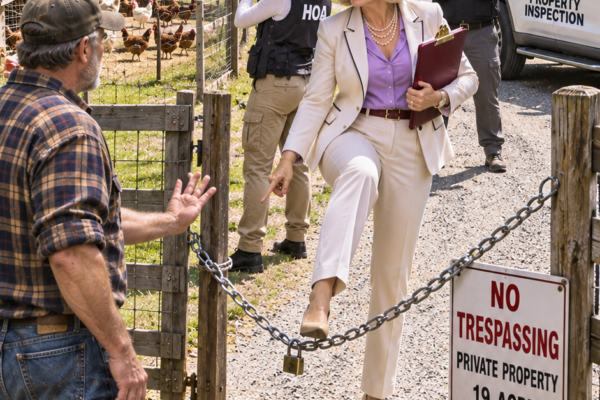
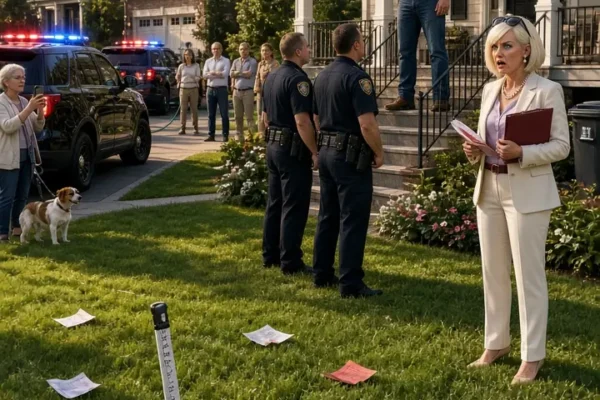
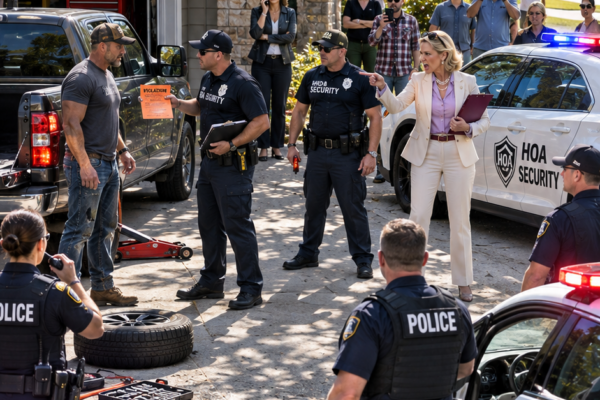
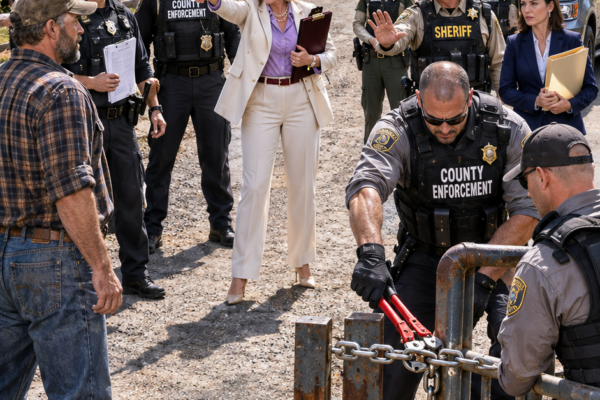
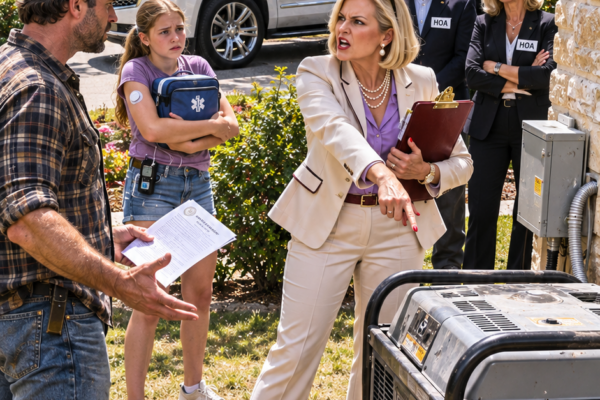
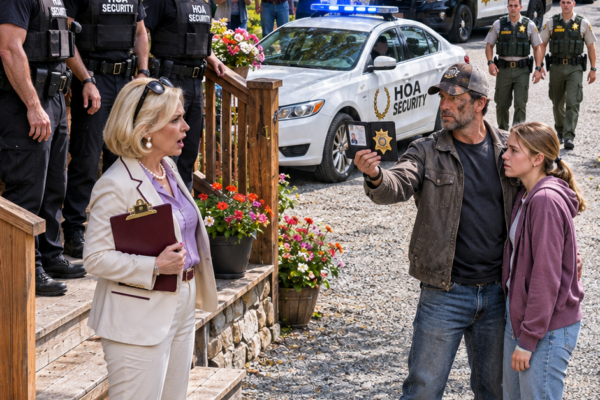
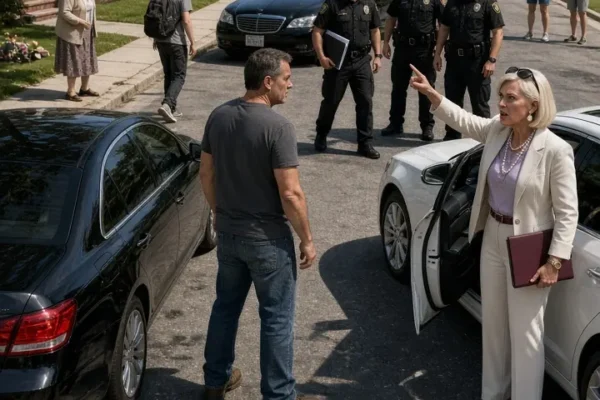
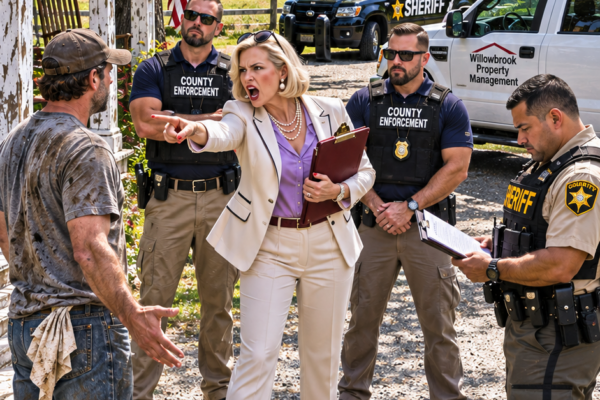
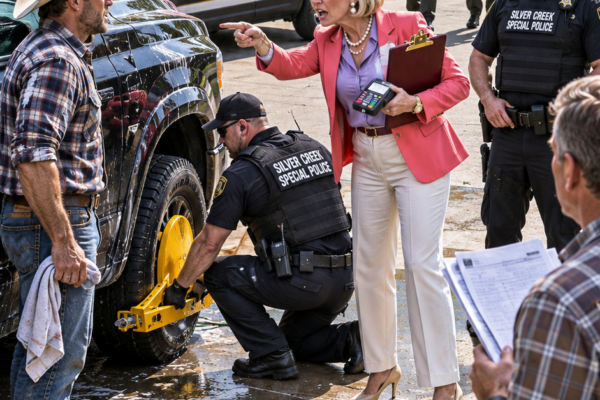
“STEP ASIDE, OLD MAN. WE HAVE AUTHORITY TO USE THIS ROAD!” HOA President Victor Harmon Sent Fake Police Officers Across My 80-Acre Texas Ranch After I Refused His $4.5 Million Offer. For Months, They Ignored My No-Trespassing Signs and Drove Past My Late Wife’s Grave. Then Two Security Vehicles Returned to My Entrance, Their Emergency Lights Flashing, and the Driver Refused to Stop…
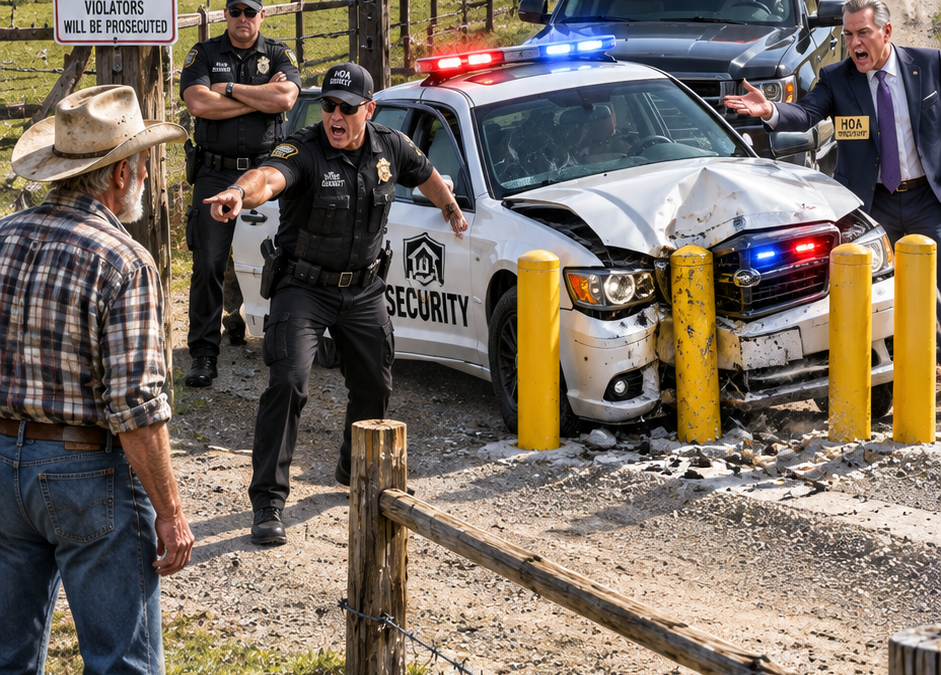
part2
The sound echoed across the pasture.
The sedan stopped abruptly.
Its hood buckled upward, and the windshield cracked.
Behind it, Victor’s SUV braked too late and struck the rear of the car.
For several seconds, both vehicles remained motionless.
Their emergency lights continued flashing.
I lowered my phone.
“There’s been a collision,” I told the dispatcher.
“Are you injured?”
“No.”
“Can you see the occupants?”
“Two in the sedan. One in the SUV.”
“Stay clear of the vehicles. Medical personnel are being dispatched.”
Derek opened his door.
He climbed out slowly, holding his forehead.
Tommy emerged from the passenger side, looking dazed.
Victor stumbled from his SUV.
His expensive golf shirt was covered in dust.
He stared at the sedan.
Then at the yellow bollards.
Then at me.
“WHAT HAVE YOU DONE?”
I remained beside the barn.
“An ambulance is coming.”
Derek started walking toward me.
“You set us up!”
“Stay back.”
“You could’ve killed us!”
“I told you to stop.”
He pointed toward the damaged car.
“That’s an official security vehicle!”
“It’s on private property.”
“We have authority!”
There it was again.
The same word he’d used the first time we met.
Authority.
As though repeating it often enough would make it real.
Victor hurried toward him.
“Derek, don’t say anything.”
Derek turned.
“He put those things there deliberately!”
Victor looked at my phone.
His expression changed.
“Stop recording.”
“No.”
“I’m telling you to stop!”
“And I’m telling you to stay away from me.”
Tommy sat down near the vehicle.
He appeared dizzy.
I informed the dispatcher.
She told me medical personnel were getting close.
Several vehicles stopped along County Road 12.
Neighbors emerged from Ridgewood Estates.
One woman raised her phone.
Another stood with both hands over her mouth.
Victor suddenly seemed more concerned about the gathering crowd than the collision.
“Everybody needs to leave!” he shouted.
Nobody listened.
Linda Morales appeared among the residents.
She looked at the damaged vehicles and shook her head.
Then we heard sirens.
Real sirens.
A county sheriff’s cruiser approached from the west.
Two additional cruisers followed.
Sheriff Ray Caldwell stepped out of the first vehicle.
He looked at the wreckage.
Then at me.
“Earl, you all right?”
“I’m fine.”
He nodded and directed his attention toward the injured men.
Paramedics arrived shortly afterward.
Derek continued insisting that I had attacked them.
Ray didn’t argue.
He allowed the medical personnel to work while his deputies secured the area.
Once Derek was medically assessed, a deputy requested his identification.
Derek produced a laminated security credential.
Ray examined the badge attached to his uniform.
“What agency issued this?”
“Ridgewood Security.”
“Are you a commissioned peace officer?”
Derek hesitated.
“We perform law enforcement functions for the association.”
“That wasn’t my question.”
Victor stepped forward.
“These gentlemen are authorized representatives of a private security organization.”
Ray turned toward him.
“Then why are they using emergency lights and ordering property owners to obey them?”
Victor adjusted his collar.
“There appears to have been a misunderstanding.”
I nearly laughed.
A misunderstanding.
Seventeen unauthorized crossings.
Months of intimidation.
Threats against my property.
And two damaged vehicles sitting in front of clearly marked barriers.
Apparently, all of that was a misunderstanding.
Ray instructed Victor to wait beside his vehicle while deputies interviewed the witnesses separately.
An investigator photographed the entrance.
The warning signs.
The damaged sedan.
The surrounding property.
My phone contained the recording of the confrontation.
The security cameras contained additional footage.
I offered copies.
Ray looked toward another deputy.
“Preserve everything.”
Victor finally turned toward me.
“This isn’t finished, Earl.”
I looked at the crumpled hood of his security car.
“Then I suggest you get comfortable with paperwork.”
He didn’t answer.
For months, he had expected me to surrender because fighting him would be inconvenient.
He was about to discover that inconvenience was something I’d spent sixty-two years learning to live with.
My grandfather bought the ranch in 1947.
Eighty acres of Texas Hill Country.
Rocky ground.
Cedar trees.
A narrow creek.
Enough pasture to support a modest cattle operation if the weather cooperated.
He’d spent fifteen years working in the oil fields before he could afford it.
He built the first barn himself.
My grandmother helped him fence the property while raising three children.
My father inherited the place and gradually improved it.
He expanded the house, established better water systems, and taught me how to repair equipment long before I was old enough to drive legally.
I grew up believing the ranch was enormous.
When I was seven, walking from the house to the eastern ridge felt like crossing an entire country.
By seventeen, I knew every corner.
By thirty, I could identify most of its fence posts in the dark.
By sixty-two, I couldn’t imagine living anywhere else.
Not because it was particularly valuable.
Although Victor certainly thought it was.
Because it contained nearly everything that mattered to me.
Especially Helen.
We met at a county fair when I was twenty-three.
She was selling homemade pies to raise money for a local school program.
I bought an apple pie.
Then another.
Then stood beside her table trying to invent a reason to stay.
Eventually, she looked at me.
“Are you planning to eat all those yourself?”
“Depends.”
“On what?”
“Whether you’d have dinner with me.”
She laughed.
A year later, we were married.
Helen loved the ranch more than I did some days.
She planted flowers beside the house, restored my grandmother’s kitchen cabinets, and somehow convinced the rocky garden behind the barn to produce tomatoes.
She also possessed an extraordinary ability to identify when I was being stubborn for absolutely no useful reason.
Whenever I insisted I could repair something without assistance, she’d stand nearby holding the proper tool.
“Ready to stop making this difficult?”
Usually, I was.
We spent thirty-five years together.
There were good years.
Drought years.
Years when cattle prices barely covered expenses.
Years when we wondered how we’d afford another equipment repair.
We always managed.
Our children grew up and moved away.
The house became quieter.
We talked about traveling.
Then Helen became sick.
Cancer changed our plans.
During her final months, we often sat on the eastern ridge overlooking the pasture.
There was an old live oak near the highest point.
We had placed a wooden bench beneath it.
One evening, Helen leaned against my shoulder.
“When it’s my time, I’d like to stay here.”
I knew what she meant.
We discussed it with our family and consulted the necessary local authorities and professionals about establishing a lawful private burial site.
Eventually, everything was arranged.
Helen chose the location herself.
I promised that she would remain there.
And that, when my time came, I wanted to be buried beside her.
Four years after losing her, I still took my coffee to that hill every morning.
Sometimes I talked.
Sometimes I just watched the cattle.
I never considered those visits particularly sad.
They were part of my day.
Like checking the water troughs or feeding the horses.
Helen belonged there.
So did I.
Which explained why Victor Harmon’s offers meant very little to me.
Even when the numbers became ridiculous.
Ridgewood Estates first appeared along my southern boundary five years earlier.
A development company purchased three hundred acres of neighboring land.
Construction began almost immediately.
Within eighteen months, the pasture had become a subdivision containing approximately two hundred forty homes.
There was a clubhouse, a swimming pool, landscaped entrances, and a network of private roads.
I didn’t object.
People needed somewhere to live.
My only concern was maintaining the boundary between their development and my ranch.
Initially, that arrangement worked.
Several residents waved whenever they drove past.
A few stopped to ask whether I sold fresh eggs.
One family occasionally purchased firewood.
I had no complaints.
Then Victor Harmon came knocking.
He introduced himself as the developer and president of the association.
He wore a tailored jacket despite the Texas heat.
Under one arm was a leather folder.
“Mr. Dawson, I’ve been admiring your property.”
“Thank you.”
“Have you considered selling?”
“No.”
He smiled.
“I haven’t mentioned the price.”
“Doesn’t matter.”
“Three point two million dollars.”
I looked at him.
He clearly expected a different reaction.
“That’s generous,” I said. “But I’m not selling.”
He opened the folder anyway.
Inside was a proposal showing my ranch incorporated into a second development phase.
Streets crossed my pastures.
Residential lots occupied the hillside.
A proposed recreational facility sat uncomfortably close to Helen’s burial site.
I closed the folder.
“No.”
Victor blinked.
“You should at least review the proposal.”
“I’ve reviewed enough.”
“Perhaps you’d like to discuss it with your family.”
“They know I’m not selling.”
He left his business card.
I threw it into a kitchen drawer.
Six months later, he returned.
This time, the offer was $3.8 million.
I declined.
The third offer reached $4.5 million.
He presented it while standing beside my front gate.
“Earl, you’re sitting on an extraordinary retirement opportunity.”
“I’m already where I want to retire.”
He gestured toward my pasture.
“This land could provide homes for hundreds of families.”
“It already provides a home for mine.”
“Surely you recognize the broader economic potential.”
“I recognize that you’re trying to buy something I don’t want to sell.”
His smile tightened.
“At some point, refusing becomes selfish.”
I stared at him.
“Excuse me?”
“You’re preventing necessary growth.”
“Buy somewhere else.”
“It’s not that simple.”
“Neither is burying your wife. But I managed.”
That stopped him briefly.
I explained that Helen was buried on the property and that I had no intention of disturbing her resting place.
Victor glanced toward the ridge.
“Those matters can be handled professionally.”
I felt my jaw tighten.
“What matters?”
“Relocation arrangements.”
“Get off my property.”
“Earl—”
“Now.”
He closed his folder.
For a moment, I saw the irritation beneath his practiced smile.
Then he nodded.
“I’m sure we’ll speak again.”
“We won’t be discussing a sale.”
He returned to his vehicle.
I watched him drive away.
That was in March.
The unauthorized vehicles began appearing in April.
The first was a white sedan equipped with a light bar.
It entered through my front gate while I was working near the equipment shed.
I assumed it belonged to a law enforcement agency.
Perhaps somebody was investigating something near the eastern boundary.
Before I could reach my truck, it disappeared through an old opening near the far fence line.
Three days later, it returned.
Same vehicle.
Same route.
This time, I waved.
The driver didn’t stop.
Instead, he passed close enough to cover me in dust.
I noticed the dark uniform.
The badge.
The lights mounted on the roof.
But I couldn’t identify a department.
I called the sheriff’s non-emergency number and asked whether officers had been operating near my property.
The dispatcher couldn’t locate any recent assignments involving my address.
She suggested reporting the vehicle if it returned.
I did.
Over the following weeks, its appearances became more frequent.
Early mornings.
Late afternoons.
Occasionally after dark.
The drivers began using their flashing lights while crossing the pasture.
My cattle scattered whenever they approached.
Fresh tire tracks appeared in areas where vehicles had no legitimate reason to travel.
I repaired several damaged sections of fencing.
Then I installed no-trespassing signs.
The car drove past them.
I installed two trail cameras.
One of the uniformed men waved at a camera during his next crossing.
That irritated me considerably.
Not because he was clever.
Because he knew exactly what he was doing.
During the sixth incident, I was standing near my equipment shed when the sedan stopped beside the entrance.
Two men got out.
The taller one was Derek Sloan.
The shorter was Tommy Vance.
I didn’t know their names at the time.
Derek approached me.
“Sir, step aside.”
“Who are you?”
“We’re conducting official business.”
“What kind of business?”
He ignored the question.
“This route needs to remain clear.”
“It’s my pasture.”
“We have authorization.”
“From whom?”
He gave me a long look.
“Mr. Dawson, move aside before this becomes a problem.”
I hadn’t told him my name.
That detail bothered me immediately.
I stepped back rather than risk a confrontation.
They returned to their vehicle and crossed my property again.
As they passed, I noticed a small sticker near the rear bumper.
RIDGEWOOD SECURITY SERVICES.
That evening, I contacted the sheriff’s office again.
I described the vehicle, uniforms, badges, and repeated claims of authority.
The dispatcher checked the available records.
“Mr. Dawson, those don’t sound like our personnel.”
“Could they belong to another department?”
“Did they identify themselves as police officers?”
I thought about it.
“No. They said they had authority.”
“Please preserve any recordings you have. We’ll document the report.”
I hung up and reviewed my camera footage.
The badges contained the words SECURITY ENFORCEMENT.
There was no recognizable police department name on the sedan.
The uniforms were designed to resemble law enforcement attire, but that appearance didn’t establish any actual police authority.
I’d spent twelve years serving on the county planning board.
I understood the difference between public authority and private property management.
Yet I’d initially stepped aside because a stranger wore something that looked official.
That realization embarrassed me.
It also made me wonder how many other people had done exactly the same thing.
The next morning, I drove to Ridgewood’s clubhouse.
Victor maintained an office on its second floor.
His receptionist asked whether I had an appointment.
“No. I’m here about your security vehicles.”
She called him.
A minute later, Victor appeared wearing a golf shirt and his familiar smile.
“Mr. Dawson. What brings you here?”
“Your security guards have been driving across my ranch.”
He nodded thoughtfully.
“Perhaps there’s been a misunderstanding.”
“Six times?”
“Our personnel occasionally patrol the community perimeter.”
“Your community ends at my fence.”
“I’m sure we can clarify that.”
“Please tell them to stop.”
He tilted his head.
“You know, these boundary issues would disappear if you reconsidered our offer.”
I stared at him.
“Are you suggesting I sell my property to stop your people from trespassing?”
“I’m suggesting a practical solution.”
“I’ve already given you one.”
“Which is?”
“Keep your employees off my land.”
He smiled.
“Of course.”
I left believing I had at least made my position unmistakably clear.
The following night, at 11:43, flashing lights illuminated my bedroom ceiling.
I heard an engine pass the house.
By the time I reached the window, the sedan was crossing the pasture.
I stood there watching its taillights disappear.
Victor hadn’t misunderstood anything.
He simply didn’t care.
And soon, he began trying to convince everyone else that I was the problem.
The first person who treated me differently was Larry at the feed store.
I’d known him for twenty years.
His daughter used to help Helen sell pies at church fundraisers.
Normally, we talked for ten minutes whenever I purchased supplies.
That morning, he barely looked at me.
He rang up my order and handed me the receipt.
“How’s your daughter doing?” I asked.
“Fine.”
“Wedding plans coming along?”
“Yeah.”
He turned toward the next customer.
I carried my supplies to the truck, wondering whether I’d offended him somehow.
Then I noticed similar behavior at the diner.
A man I’d known since high school suddenly became very interested in his newspaper when I approached.
Two women stopped talking when I entered.
I didn’t understand it.
Until Linda Morales stopped beside my gate.
Linda lived in Ridgewood Estates.
She’d occasionally walked along the public road and stopped to talk about my cattle.
That afternoon, she remained inside her car.
“Mr. Dawson, can I tell you something?”
“Sure.”
She looked toward the development entrance.
“Victor’s been talking about you at board meetings.”
“What about me?”
“He says you’re preventing emergency access through the area.”
I frowned.
“What emergency access?”
“Something about a historical route connecting the development to County Road Twelve.”
“There’s no such route.”
She nodded.
“I figured.”
“What else?”
She looked uncomfortable.
“He’s been describing you as unstable. Hostile toward the community. He’s encouraged people to report your livestock operation to the county.”
I leaned against the gate.
“Report it for what?”
“Noise. Odors. Environmental concerns.”
“It’s a cattle ranch.”
“I know.”
Linda explained that Victor’s presentation had included photographs of my fence, my pasture, and several pieces of farm equipment.
He had described them as evidence that the property was poorly managed and obstructing regional growth.
Some residents believed him.
Others simply didn’t want to challenge the association president.
“Do you believe any of it?” I asked.
She shook her head.
“My father raised cattle. Your place looks better than his ever did.”
I smiled.
“Thank you.”
She hesitated before driving away.
“Please be careful, Mr. Dawson.”
I watched her car disappear.
That was the moment I understood Victor wasn’t merely sending security guards across my land.
He was preparing a public explanation for why I shouldn’t have the right to keep it.
The county complaints began the following week.
An environmental health employee contacted me concerning alleged improper waste management.
I cooperated with the inspection.
He found no violation requiring action.
Another complaint alleged that my livestock fencing interfered with community drainage.
A county representative reviewed the relevant conditions and found no basis for the allegation.
A third concerned excessive machinery noise.
My tractor was older than half the houses in Ridgewood.
It had somehow become a public nuisance only after Victor failed to purchase the property.
I requested copies of the resulting reports.
Then I placed them in a folder alongside my security footage.
I didn’t confront the residents who submitted complaints.
Some may have genuinely believed what they’d been told.
My problem was with the man encouraging them.
Then the cameras recorded something that made the whole situation feel considerably more personal.
The sedan stopped in my pasture.
One of the guards climbed out, walked toward an old fence post, and urinated against it.
He looked directly at the camera.
Smiled.
Then returned to the vehicle.
I watched the footage at my kitchen table.
That fence post had been installed by my father.
I remembered helping him carry it from the truck when I was fourteen.
It wasn’t particularly valuable.
Replacing it would cost less than a restaurant dinner.
But watching someone deliberately disrespect it because he believed I was powerless affected me more than I expected.
I closed the laptop.
Then opened it again.
I saved the recording.
I wasn’t going to give him the reaction he wanted.
Instead, I contacted the county records office.
I also checked the available state business records concerning Ridgewood Security Services.
The company had been organized approximately eighteen months earlier.
Its listed business address was the Ridgewood clubhouse.
The records identified Victor Harmon in connection with its management.
I obtained copies.
Then I requested the original subdivision plans.
I’d reviewed portions of them during my years on the planning board, although I hadn’t participated in every approval associated with Ridgewood.
The original development had two designated access connections.
Neither required crossing my ranch.
A later conceptual plan showed a possible future connection across my southern pasture.
But it was labeled as subject to land acquisition and further approval.
Victor had never acquired the land.
The proposed connection had never become an established right of passage.
I printed the drawings.
Then I drove back to his office.
This time, I carried my own folder.
Victor greeted me with the same polished expression.
“Earl. Good to see you.”
“Is Ridgewood Security your company?”
He gestured toward a chair.
“Please, sit down.”
“I’d rather stand.”
He nodded.
“Yes, we’re associated with its operations.”
“Why are your employees driving through my ranch?”
“As I explained, they’re conducting perimeter patrols.”
I placed the approved site plan on his desk.
“Show me where the perimeter crosses my pasture.”
He glanced at it.
“Development conditions have evolved.”
“Has my deed changed?”
“No.”
“Have I granted an easement?”
He leaned back.
“Your property happens to lie between our eastern development area and a convenient public road.”
“That doesn’t make it yours.”
He sighed.
“Earl, you’re making this unnecessarily complicated.”
“I’m asking you to respect a fence.”
“And I’m asking you to consider the bigger picture.”
I looked at the conceptual expansion map hanging behind his desk.
My eighty acres had already been divided into streets and future lots.
“Does that picture include digging up my wife’s grave?”
His expression tightened.
“Any necessary arrangements would be handled in accordance with applicable requirements.”
I stared at him.
“You’ve actually planned for that?”
He didn’t answer directly.
Instead, he stood and walked toward the window.
“Four and a half million dollars would solve all your problems.”
“My biggest problem is standing in front of me.”
He turned.
For the first time, the smile was gone.
“You can’t stop progress forever.”
“Watch me.”
I collected my documents.
As I reached the door, he spoke again.
“You could spend the rest of your life fighting this, Earl.”
I stopped.
“Is that a threat?”
“It’s advice.”
I left without answering.
That evening, I called Ray Caldwell.
Ray and I had known each other since high school.
We played football together until a knee injury ended his season.
He eventually went into law enforcement.
I stayed on the ranch.
We remained friends.
He arrived after work and sat at my kitchen table.
I showed him the recordings.
He watched quietly.
The unauthorized crossings.
The flashing lights.
The uniforms.
The encounter near my entrance.
Finally, the man disrespecting my fence post.
Ray leaned back.
“Those aren’t county deputies.”
“I know.”
“Have you filed a formal complaint with all of this material?”
“I’ve reported several incidents. I haven’t submitted the entire collection yet.”
“Do that.”
“Can you stop them?”
“We can investigate. But I need you to understand something.”
He folded his hands.
“You and I have known each other a long time. That doesn’t mean I can skip procedures because you’re my friend.”
“I wouldn’t ask you to.”
“Good. I’ll make sure this goes through the appropriate investigators. They’ll need evidence that establishes what these men actually did and what authority they claimed.”
I pointed toward the screen.
“They’ve been pretending to be cops.”
“The footage raises serious concerns. Their uniforms alone aren’t enough to determine every possible charge.”
I nodded.
“Meanwhile, can I secure my property?”
“Of course. Just make sure whatever you do is lawful and safe.”
He looked toward the front window.
“And Earl?”
“Yeah?”
“Don’t try to catch them yourself.”
“I wasn’t planning to.”
“I’m serious. Let the evidence do the work.”
After he left, I sat alone in the kitchen.
Helen’s photograph stood beside the window.
I looked at it.
“Well, sweetheart. This is getting expensive.”
The following morning, I called Marcus Morgan.
Marcus had handled several legal matters for our family over the years.
He’d helped administer my father’s estate.
He’d resolved an old fence-line dispute without either neighbor having to sell a truck to pay legal fees.
He was seventy-one, wore reading glasses held together by an alarming amount of tape, and possessed an impressive tolerance for stubborn ranchers.
He listened to my account without interrupting.
When I finished, he looked at the documents.
“Earl, this is more than a simple boundary disagreement.”
“That’s what I’ve been saying.”
He examined the business records.
“First, we’ll prepare a formal demand directing Harmon and his security company to stop unauthorized entry.”
“Already asked him twice.”
“Now we’ll make it a documented legal demand.”
“Then what?”
“We consider injunctive relief and damages. We also make the relevant referrals concerning the security operation.”
I looked at the pictures of my pasture.
“What can I do before another vehicle comes through?”
“Secure your entrances.”
“With another fence?”
“Possibly. Have a qualified contractor evaluate it.”
He explained that any physical security improvements needed to be obvious, properly situated on my land, and designed to prevent entry rather than injure anyone.
We also needed to preserve legitimate emergency access and avoid interfering with County Road 12.
“You’re protecting property,” he said. “You’re not trying to punish a driver.”
“I understand.”
“Good. Because if somebody gets hurt, a warning sign doesn’t automatically eliminate every question about liability.”
That was important.
I didn’t want somebody injured on my ranch.
I wanted them to stop coming onto it.
Marcus arranged for a licensed surveyor to verify the relevant boundaries.
A security contractor then evaluated the entrances.
The existing driveway would remain available to authorized vehicles through a controlled gate.
The vulnerable portion of the entrance used by Victor’s patrols would be secured with clearly visible bollards.
Nothing concealed.
Nothing disguised.
The design included appropriate warning notices and visibility considerations.
We coordinated the access arrangements with the relevant emergency services.
The installation cost me approximately $2,800.
I paid it without complaint.
I’d spent more than that repairing agricultural equipment.
Protecting my home’s entrance seemed equally worthwhile.
Marcus sent formal notices to Victor, the security company, and the association’s management office.
The notices prohibited further unauthorized entry.
They also explained that physical access controls were being installed.
We retained delivery confirmations.
Tuesday morning, a contractor’s flatbed arrived.
Three workers unloaded the equipment.
The foreman inspected the ruts running across my property.
“Somebody’s been using this as a road?”
“Without permission.”
He shook his head.
“People sure get comfortable spending other folks’ money.”
By early afternoon, the work was complete.
Six bright yellow bollards stood at the unauthorized vehicle approach.
The controlled gate remained available for legitimate access.
The warning signs were impossible to miss under ordinary conditions.
I walked along the fence line with the foreman.
He showed me the completed work and provided the installation documentation.
“Looks good,” I said.
“Should help keep unwanted vehicles out.”
“That’ll be a refreshing change.”
I photographed the completed entrance.
Then I filed the contractor’s paperwork with Marcus.
For the first time in months, I went to bed without worrying that somebody might drive past my bedroom during the night.
Five days passed without another intrusion.
Then seven.
I started believing Victor had finally taken the warning seriously.
I should have known better.
Linda returned on the eighth day.
This time, she walked to my porch.
She looked worried.
“Mr. Dawson, can we talk?”
“Come on up.”
I offered her coffee.
She declined.
“There was another board meeting.”
I waited.
“Victor spent most of it talking about your entrance.”
“Did he mention that it’s private property?”
She gave me a tired smile.
“He called the barriers illegal.”
“Did he explain why?”
“He said you were blocking an established emergency route.”
I retrieved the approved site plan.
“Here. Look at this.”
She studied it.
“Where’s the route he’s talking about?”
I pointed toward the proposed future connection.
“It’s a concept. Not an approved right of access. Never was.”
She sat down.
“He told us the county had already recognized it.”
“Then ask him for the document.”
Linda rubbed her forehead.
“That’s the problem. Nobody can get him to show us anything.”
She explained that Victor had become increasingly aggressive toward board members who questioned his expansion plans.
He claimed investors expected Phase Two to proceed.
He accused residents who opposed the expansion of threatening property values.
At the previous meeting, he’d announced plans to conduct a security assessment of my entrance over the weekend.
“Security assessment?”
“That’s what he called it.”
“What exactly does that involve?”
“I don’t know.”
She looked toward the yellow barriers.
“But he sounded angry.”
I called Marcus after she left.
He advised notifying the investigating deputies, retaining the information, and avoiding direct confrontation.
I followed his advice.
I spent the rest of the week doing ordinary ranch work.
Replacing fence boards.
Checking the cattle.
Cleaning a water trough.
On Friday evening, I carried my coffee to Helen’s hill.
The sun dropped behind the western ridge.
I looked at her headstone.
“I wish you’d met this fellow, sweetheart.”
I smiled.
“You would’ve had him figured out in five minutes.”
Helen had never been especially impressed by men who talked about money.
Once, a salesman tried convincing her to purchase an expensive water filtration system by telling her that ordinary households couldn’t understand the technical details.
She asked him three questions he couldn’t answer.
Then offered him a glass of water before showing him the door.
I could almost hear what she would’ve said to Victor.
Something short.
Something polite.
Something devastating.
I finished my coffee and returned to the house.
The following afternoon, the motion alert sounded on my phone.
It was 2:17.
The white sedan appeared on the screen.
Behind it was Victor’s black SUV.
I notified dispatch and moved to a safe position beside my barn.
I hoped the men would see the closed approach and leave.
Instead, Derek got out, demanded that I remove the barriers, and eventually returned to the sedan.
Victor encouraged him to proceed.
The recording captured my warnings.
Then the vehicles collided.
Standing beside the barn after the crash, I felt something I hadn’t anticipated.
Not satisfaction.
Not victory.
Fear.
The kind that arrives when you realize a situation you’ve tried to prevent has happened anyway.
I had wanted those men to turn around.
I had wanted Victor to read the notice, look at the signs, and finally accept that my property wasn’t his.
Instead, his employees had been injured.
His vehicles were damaged.
And investigators were standing in my driveway collecting evidence.
I looked toward Helen’s hill.
For months, I had promised myself that protecting this ranch wouldn’t change the person I was.
Now I needed to make sure I kept that promise too.
The paramedics transported Derek and Tommy for further assessment.
Victor declined transportation after being examined.
The deputies continued documenting the collision.
Ray explained that the separate allegations concerning impersonation, trespass, and coercion would require further investigation.
Nobody was going to settle the entire case beside a wrecked sedan.
Victor remained long enough to provide the information requested by deputies.
He insisted the entrance was a community access route.
He also claimed he hadn’t known about the newly installed barriers.
An investigator asked whether his organization had received formal notice.
Victor said he would need to consult his records.
I already knew what those records contained.
The signed delivery receipt was sitting in Marcus’s office.
By sunset, tow trucks had removed both vehicles.
The entrance was secured again.
The investigators instructed me to leave the affected area undisturbed until they completed the necessary documentation.
I agreed.
Linda approached as the last cruiser prepared to leave.
“Are you okay?”
“Yeah.”
She looked at the scrape on one of the yellow posts.
“I can’t believe they actually did that.”
“Neither can I.”
She stood quietly for a moment.
Then she said, “I think I’m ready to put something in writing.”
That was the first real break in the case.
And it had nothing to do with the strength of the steel.
Linda met with the investigating deputy two days later.
She provided a written statement describing Victor’s remarks during association meetings.
She also supplied copies of several presentations distributed to residents.
One contained a photograph of my ranch entrance beneath the heading:
OBSTRUCTION OF COMMUNITY SAFETY ACCESS.
Another described my refusal to sell as a threat to Ridgewood’s long-term financial stability.
Neither presentation disclosed that the proposed access route required land acquisition.
Marcus examined the documents.
“Has Harmon been telling residents they already possess access rights?”
“That’s what Linda says.”
“Then we need the underlying records.”
We filed a civil action seeking to stop further unauthorized entry and recover damages associated with the repeated intrusions.
Marcus also requested a declaration resolving the association’s claimed access rights.
Victor’s attorneys responded aggressively.
They alleged that my property improvements interfered with historical access.
They claimed I had installed an unreasonable obstruction.
They demanded compensation for the damaged vehicles.
Their correspondence described the collision as the foreseeable result of my conduct.
Marcus read their demand.
Then looked at me.
“Did you invite them onto your property?”
“No.”
“Did you conceal the barriers?”
“No.”
“Did you tell them to proceed?”
“I told them to stop.”
“Good.”
He returned to the documents.
“We’ll let the evidence establish the circumstances.”
Meanwhile, the sheriff’s investigators obtained assistance from the Texas Rangers in examining the broader allegations surrounding the security company.
Because of Ray’s longstanding friendship with me, he stepped back from direct involvement in the substantive investigation.
I respected that decision.
I wanted a result nobody could reasonably attribute to personal favoritism.
Investigators interviewed Derek and Tommy after their medical treatment.
Both men initially maintained that they’d been conducting legitimate private security patrols.
They claimed Victor had provided authority to use the route.
However, investigators couldn’t identify an instrument granting Ridgewood that access.
Nor could Victor produce a legitimate basis for his employees to exercise police powers over me.
The recordings of their conduct became particularly important.
Their repeated orders that I step aside.
Their claims of official authority.
Their use of flashing emergency lights.
Their refusal to identify any actual law enforcement agency.
The investigators considered the combined circumstances rather than treating a uniform or badge as conclusive evidence on its own.
Then they obtained communications associated with the security company’s operations.
Those records changed the direction of the investigation.
Tommy was the first to cooperate through his attorney.
He explained that Victor had instructed the guards to establish a regular presence across my ranch.
The objective wasn’t merely to shorten a patrol route.
Victor wanted me to become accustomed to the idea that Ridgewood controlled access across the property.
According to Tommy, the repeated crossings were intended to demonstrate that resisting the development would be difficult.
Investigators sought independent evidence corroborating his account.
They found it in assignment records, vehicle histories, and communications concerning the proposed expansion.
One message from Victor referred to my continued refusal to negotiate.
Another instructed the guards to maintain pressure concerning access.
A third discussed complaints that might encourage me to reconsider my position.
But the most damaging document wasn’t a message to the guards.
It was a financing presentation.
I learned about it after Marcus received relevant material during the civil proceedings.
The presentation described Phase Two as an anticipated expansion comprising hundreds of additional residential lots.
The financial projections depended on acquiring my ranch and establishing a new connection to County Road 12.
Victor had represented the acquisition as being close to completion.
It wasn’t.
I’d never signed a purchase agreement.
Never accepted a deposit.
Never granted an option.
Never agreed to an easement.
Marcus placed a copy of the presentation on his desk.
“According to this, he was already discussing financing based on an acquisition that hadn’t happened.”
I looked at the projected development boundary.
All eighty acres were included.
“That’s why he couldn’t leave me alone.”
“That’s certainly consistent with the evidence we’re seeing.”
I turned another page.
Then stopped.
A proposed road curved across the eastern hillside.
Beside it was a shaded area marked for future residential development.
Helen’s grave fell within that area.
I stared at the drawing.
Marcus noticed.
“What’s wrong?”
I touched the map.
“She’s right there.”
He looked at me.
Then understood.
He quietly closed the presentation.
For several minutes, neither of us spoke.
Victor had talked about community growth.
Better housing.
Economic development.
Higher property values.
But beneath all those polished phrases was a business arrangement that depended on me surrendering the place where my wife was buried.
He knew how much that place meant to me.
I’d told him directly.
And he’d treated it as another obstacle to be removed.
I went home and spent the evening repairing the garden fence.
It didn’t need much attention.
I just needed something to do with my hands.
The first significant civil hearing took place several weeks later.
Victor arrived with two attorneys.
He wore an expensive charcoal suit and carried himself with the confidence I’d come to recognize.
Marcus and I sat across the aisle.
The judge began by examining the competing claims concerning access.
Victor’s attorney argued that Ridgewood’s development plans contemplated a connection across my property.
Marcus presented the original approved plan.
Then the subsequent conceptual drawings.
Then my certified deed.
Then the survey and easement records.
The judge examined the documents.
“Where is the recorded instrument granting the association access across Mr. Dawson’s property?”
Victor’s attorney explained that the route had been contemplated during planning discussions.
“That isn’t what I asked.”
He referred to historical use.
Marcus stood.
“The alleged historical use identified by the opposing party consists substantially of the unauthorized entries underlying this lawsuit.”
The judge looked toward Victor’s attorney.
“Do you have evidence of a legally established access right?”
He requested additional time to present his client’s position.
The judge considered the immediate circumstances.
There was no final determination concerning every potential property claim that morning.
However, the court issued temporary restrictions preventing Victor and the relevant security representatives from entering my property without authorization while the litigation continued.
The order also prohibited interference with my lawful possession of the ranch.
Victor looked toward me.
I expected another threat.
Instead, he whispered something to his attorney.
Outside the courtroom, Marcus shook my hand.
“That’s meaningful progress.”
“Can I finally leave the house without wondering who’s driving across the pasture?”
“The order gives you additional protection. Keep documenting anything that happens.”
I nodded.
A court order wasn’t a magic shield.
But it was considerably more useful than Victor’s clipboard.
The next blow to his position came from Ridgewood’s own homeowners.
They had started asking questions about the security company.
How much were they paying?
Who approved its contracts?
Why were patrols being conducted beyond the subdivision?
And why had two vehicles funded through arrangements associated with their community been involved in a collision on a neighboring ranch?
Linda and several other residents requested association records.
They organized a properly noticed special meeting.
Victor attempted to persuade the board that the questions should be postponed until the litigation ended.
The other directors refused.
An independent financial review was authorized.
What it revealed shocked even the people who’d supported Victor’s expansion plans.
Association funds had been used for security-related expenditures extending beyond ordinary community protection.
Certain payments lacked sufficient documentation.
The board had never expressly authorized a campaign against me.
Victor had treated the distinction between his development business and the homeowners association as little more than an accounting inconvenience.
Residents were furious.
Linda called me after the initial findings were discussed.
“You should’ve heard the questions tonight.”
“I’m guessing Victor didn’t enjoy them.”
“He barely stayed twenty minutes.”
She explained that one homeowner had asked whether their annual assessments were supposed to finance efforts to acquire somebody else’s ranch.
Victor described the expenditures as investments in community security.
Another resident asked whether protecting the neighborhood required intimidating an elderly landowner.
Victor ended the discussion.
But he couldn’t end the investigation.
For years, Ridgewood’s residents had assumed that questioning him might threaten their own property values.
Now they understood that his decisions were creating precisely the financial risks he’d claimed to prevent.
They removed him from the association’s leadership through the applicable voting procedures.
An independent board took over.
Ridgewood’s contract with the security company was terminated.
The company also faced regulatory proceedings concerning its operations and personnel.
Eventually, it ceased doing business.
The criminal cases proceeded separately.
Derek and Tommy faced state charges arising from their conduct, including allegations involving impersonation of public authority and unlawful entry.
Their defenses initially emphasized that they had been following instructions from their employer.
That explanation didn’t erase their individual responsibility.
The evidence established that they had received repeated warnings and deliberately continued entering my property while asserting authority they didn’t possess.
Both ultimately accepted plea agreements.
Derek received an eighteen-month period of confinement.
Tommy received fourteen months, with his cooperation considered in the disposition of his case.
Additional supervision conditions and professional licensing consequences followed.
Their injuries from the collision were treated independently of their criminal conduct.
Both recovered.
I was relieved about that.
Whatever they’d done, I had never wanted their families to receive the kind of telephone call nobody should have to receive.
Victor’s case took longer.
He hadn’t personally worn one of the uniforms.
He hadn’t issued every threat himself.
His attorneys attempted to separate his business decisions from the guards’ conduct.
But the communications, financial records, employee testimony, and documented instructions provided evidence of his own involvement.
Eventually, he entered a negotiated plea concerning his role in the unlawful intimidation campaign.
The court imposed five years of supervised probation, financial penalties, and restitution obligations.
Restrictions connected to the security operation also formed part of the resolution.
He avoided prison.
When Marcus told me, I was disappointed.
“After everything he did?”
Marcus nodded.
“I understand.”
“Those men went to prison.”
“Their conduct and the negotiated outcomes were different.”
I walked toward his office window.
For months, Victor had used money and influence to make me feel as though my ownership was conditional.
Part of me wanted to see him experience the same helplessness.
But that wasn’t what I’d hired Marcus to accomplish.
I wanted the trespassing stopped.
I wanted the false claims withdrawn.
I wanted my property restored.
And I wanted Helen left alone.
Those were the things worth measuring.
Our civil case concluded shortly afterward.
The final resolution recognized that Ridgewood had no established right to use the disputed route across my ranch.
The unauthorized access restrictions became permanent against the parties covered by the judgment.
The claims against me concerning the vehicle collision were resolved and withdrawn.
Through the settlement, I recovered compensation for documented property damage, agreed legal expenses, and other established losses.
I didn’t become wealthy.
I didn’t acquire Ridgewood Estates.
I didn’t demand control of its roads or clubhouse.
I simply regained the quiet I’d enjoyed before Victor decided eighty acres of somebody else’s land belonged in his business plan.
Marcus helped me review the recorded documentation concerning Helen’s burial site as well.
We took additional steps to clarify the site’s location and preserve its protection through appropriate estate planning arrangements.
My children participated in those discussions.
I wanted them to understand my wishes.
And I wanted the necessary records to be clear enough that nobody would someday have to reconstruct my intentions from an old conversation.
My daughter, Claire, visited one weekend after we completed the arrangements.
We walked to the eastern ridge.
She placed flowers beside her mother’s headstone.
“Dad, you could’ve called us sooner.”
“I know.”
“You didn’t have to handle everything alone.”
“I wasn’t entirely alone.”
She looked toward the house.
“Mom would’ve said exactly the same thing.”
I laughed.
“Probably with considerably less patience.”
Claire smiled.
Then took my arm.
We stood there beneath the live oak for a long time.
The pasture looked peaceful.
For once, the silence wasn’t interrupted by the engine of an unauthorized vehicle.
Several days later, Linda visited with Ridgewood’s new board president.
His name was Robert Ellis.
He carried a modest folder.
No architectural renderings.
No purchase proposal.
No photographs accusing me of obstructing progress.
He introduced himself and apologized for the association’s role in the dispute.
“We’d like to establish a better relationship with our neighbors.”
“Sounds reasonable.”
“We’ve abandoned the proposed expansion involving your property.”
“Even better.”
He handed me a letter confirming the association’s position.
It acknowledged the documented property boundaries and clarified that its contractors weren’t authorized to enter my ranch without permission.
I read it.
Then shook his hand.
“That’s all I wanted in the first place.”
Linda smiled.
Robert glanced toward the barn.
“Would you mind if I asked where you buy your fence posts?”
I laughed.
“Now that’s a question I don’t mind answering.”
We talked for nearly half an hour.
About fencing.
Water conservation.
The county road.
The deer that wandered between properties.
Ordinary neighbors discussing ordinary problems.
Nobody mentioned buying my land.
Victor eventually sold his house in Ridgewood Estates.
I heard he’d moved away from the area.
I didn’t investigate where.
I didn’t need to know.
His development company had lost the proposed expansion, and its financial arrangements became considerably more complicated after the investigations and withdrawals of interested investors.
That was his business.
My business was eighty acres of Texas Hill Country and a herd of cattle that seemed completely unimpressed by everything I’d accomplished.
The physical repairs took several months.
A contractor restored the damaged entrance.
I replaced broken fence boards.
Filled the ruts across the pasture.
Repaired the old fence post that Derek had treated with such contempt.
I considered replacing it entirely.
Then decided to keep it.
My father had put it there.
It remained perfectly capable of doing its job.
One morning, Larry from the feed store stopped beside my truck while I was loading supplies.
“Earl, got a minute?”
“Sure.”
He looked uncomfortable.
“I owe you an apology.”
I waited.
“I heard some things about you. From people at Ridgewood.”
“I figured.”
“I should’ve known better.”
I placed the last bag in the truck.
“You’ve known me twenty years, Larry.”
“That’s what bothers me.”
He shook his head.
“I’m sorry.”
I accepted his apology.
Then asked about his daughter’s wedding.
His face brightened.
He took out his phone and showed me photographs.
We talked for ten minutes.
Just like we used to.
The six yellow bollards remained at my entrance.
People occasionally asked why I kept them after the dispute ended.
My answer was simple.
They served a legitimate purpose.
The ranch still needed protection from unauthorized vehicle access.
But I wanted them to represent something more than the worst afternoon of that summer.
So the following spring, while performing routine maintenance, I added a small blue letter to each post without covering its reflective markings.
H.
Six little letters.
All identical.
My son noticed them during a visit.
“What’s the H for, Dad?”
I glanced toward the eastern ridge.
He followed my gaze.
Then smiled.
“Mom.”
“That’s right.”
He rested his hand on my shoulder.
“She’d be proud of you.”
I looked at the repaired entrance.
“I hope she’d appreciate the paint job.”
He laughed.
We finished our work and went inside for lunch.
That evening, I carried two cups of coffee to the hill.
One was mine.
The other I placed on the bench beside Helen’s headstone.
An old habit.
A small gesture.
Something that didn’t need explaining.
I told her about the new board president.
About Larry’s daughter.
About our children.
About the calf born near the creek the previous morning.
Then I looked across the ranch.
There were no survey crews.
No security patrols.
No unfamiliar tire tracks.
Only grass moving beneath the evening breeze.
“I kept my promise, sweetheart.”
I sat there until sunset.
A week later, a vehicle stopped near my entrance.
The driver lowered his window.
“Excuse me, sir. Is this the road to Ridgewood Estates?”
I pointed toward the public road.
“Keep going south. Their entrance is around the bend.”
He thanked me.
Then looked at the warning signs.
“Nice place you’ve got here.”
“Thank you.”
He drove away.
No argument.
No demand for access.
No flashing lights.
Just a stranger who asked a question and respected the answer.
I finished my coffee.
The morning sun touched the six yellow posts, illuminating the little blue letters.
Beyond them, the county road continued toward Ridgewood.
Behind them stood my grandfather’s barn, my father’s fences, my home, and the hill where Helen rested.
Victor had offered me $4.5 million for all of it.
He’d believed that if money couldn’t persuade me, intimidation eventually would.
He never understood that I wasn’t holding out for a better price.
There had never been a price.
I walked back toward the house, stopped beside the entrance, and closed my gate.
Then I carried my coffee up the hill.
Helen was waiting.