PART 2: Single Mom’s Pigs Kept Digging Up Blue Stones—Then the Sheriff Ordered Everyone Off Her Land
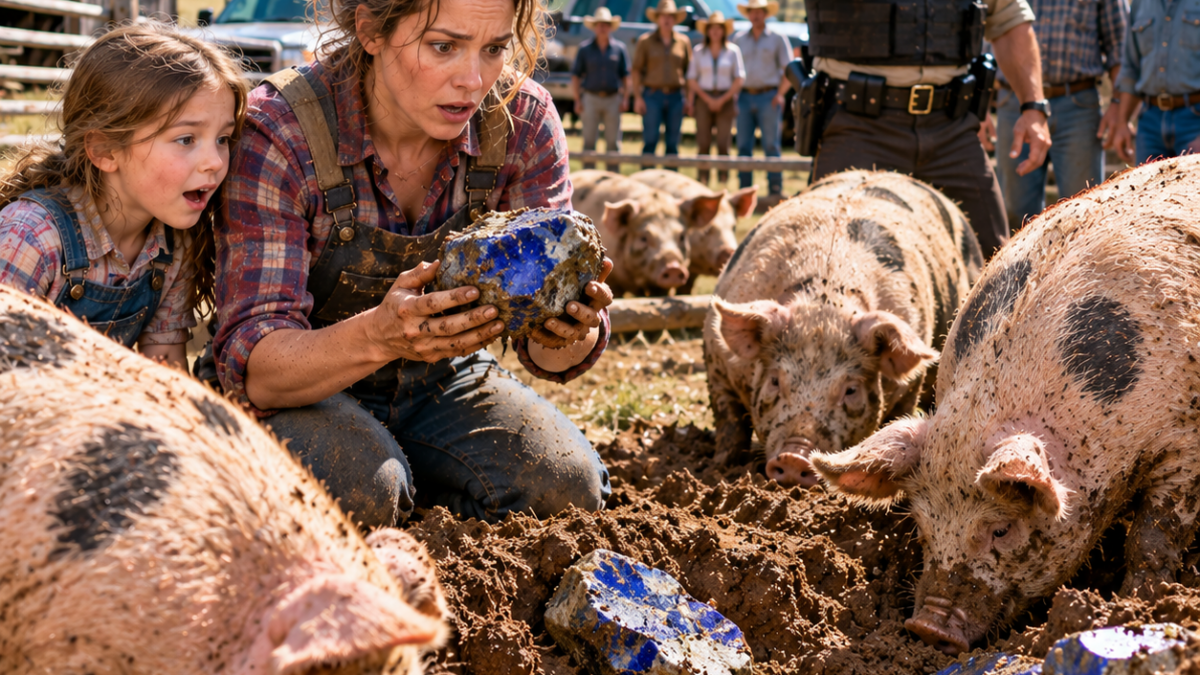
The first blue stone came up under my oldest sow’s snout after four days of March rain, and by the time Mabel had rooted up seventeen of them from the north corner of my pasture, strangers were stopping along my fence to take pictures of ground that had been called worthless for as long as I could remember.
Within forty-eight hours of a mining company offering me eighty-five thousand dollars for all nineteen acres, the price doubled, my north fence was cut with bolt cutters, and a truck with no plates began idling beyond the tree line after midnight while my hogs screamed into the dark.
By Friday morning six patrol cars, an emergency vehicle, and an ambulance were climbing Pell Ridge Road toward my house, and when Sheriff Wade Harlan stepped into my pasture and ordered every person off my land immediately, I thought the Blackthorns had finally found a legal way to take the farm without buying it.
My name is Laurel Whitcomb. I was thirty-eight, widowed, and still eleven years away from paying off the note on the farm my father had left me outside Briar Hollow, Missouri.
Dean, my husband, had been killed six years earlier when a loaded log truck crossed the center line outside Mercy Falls. The insurance covered his burial and the back taxes. After that, there was only me, twenty-three hogs, a crooked barn, a shrinking pond, and enough cured sausage and smoked chops to keep a farmers-market table alive if nothing expensive broke.
Something expensive was always breaking.
That morning, though, it was Mabel making trouble.
She was nine years old, scarred through the left ear, stubborn enough to outlive animals twice as sensible, and completely absorbed in a patch of rain-softened ground beside my north fence.
“Get out of there.”
Mabel ignored me.
I shoved her shoulder with my knee.
She grunted, moved six inches, and immediately started rooting again.
That was when I saw the stones.
They were blue in a way rock around Briar Hollow was not supposed to be blue—deep, almost electric, like a gas flame caught inside gray stone.
I picked up three.
Heavy.
Cool.
Powdery where the surface had weathered.
My first thought was bottle glass.
My second was decorative rock.
My third came ten minutes later, when I walked down the rain-cut gully and found the rusted end of an iron pipe wider than my forearm disappearing straight into the hillside.
The next day four hogs were digging there.
By noon, blue fragments were scattered through the red clay.
Then a black pickup stopped on the county road.
A man got out.
He raised his phone.
Took pictures of my north pasture.
Never looked at the house.
Then he drove away.
The truck came back the following afternoon.
That was when I stopped calling it curiosity.
At Hollis Feed and Supply, I emptied my coat pockets onto the counter while looking for my wallet.
An older man at the end of the aisle froze.
“May I see that?”
His name was Everett Sloan, retired from the state geological survey.
He held one stone to the window.
Scratched it with his thumbnail.
Then stopped talking.
“What?”
“Probably azurite.”
“Is that valuable?”
“Blue means copper. Copper does not mean money.”
He set the stone down carefully.
“Where did you find this?”
“My pasture.”
His eyes lifted.
“Any old mine work there?”
“No.”
Then I thought of the pipe.
“Maybe.”
Everett wrote his number on a seed packet.
“Don’t dig.”
“I wasn’t planning to.”
“Keep the hogs off that corner.”
“Why?”
“And don’t tell people what these look like.”
I stared at him.
“Why?”
He did not answer.
I got home just after three.
A silver sedan turned into my drive before I had finished unloading feed.
The man who stepped out wore a suit too clean for Pell Ridge and introduced himself as a land-acquisition representative for Blackthorn Mineral Holdings.
He offered me eighty-five thousand dollars for the house, barn, pond, and all nineteen acres.
I laughed.
He did not.
Two days later, Vivian Blackthorn came herself.
One hundred seventy thousand.
Cash.
Confidentiality clause.
Closing in three weeks.
“What changed in forty-eight hours?” I asked.
“Markets move.”
“Land doesn’t.”
Her smile tightened.
She called my place a hog pen with a mortgage and told me not to mistake blue rocks for treasure.
I pointed toward the gate.
“If this place is worthless, you wouldn’t be standing here doubling the price.”
For one second her pleasant expression vanished.
She turned toward her car.
I stayed where I was.
That was why I heard her make the call.
“We have to hold that parcel,” she said, “before the old report turns up.”
PART 2
I did not move until Vivian’s taillights disappeared behind the trees.
Then I went inside and locked the kitchen door.
That sounds foolish now.
A locked kitchen door would not stop a mining company, a lawyer, or anybody determined enough to cut a fence.
But when you are scared and do not yet know what you are scared of, you start with locks.
I wrote Vivian’s sentence on the back of an electric bill.
Before the old report turns up.
I underlined report three times.
Then I called Everett.
He answered on the second ring.
“I need you to come back.”
“What happened?”
“Blackthorn offered me one hundred seventy thousand.”
Silence.
“For nineteen acres?”
“Yes.”
“How much was the first offer?”
“Eighty-five.”
“How many days between them?”
“Two.”
“And you told them about the stones?”
“No.”
“Did you tell anybody besides me?”
“No.”
Another pause.
“What exactly did they say?”
I told him.
Including the phone call.
Everett did not sound surprised.
That frightened me more than if he had.
“I’ll come tomorrow.”
“Why not tonight?”
“Because I need records.”
“What records?”
“I don’t know yet.”
Then he said something I would hear many times over the next year.
“Do not touch that ground.”
I fenced Mabel and six other hogs out of the north corner before sunset.
They were furious.
Mabel stood at the temporary wire and grunted at me as if I had personally outlawed mud.
“Find another hobby.”
She stared.
“You started this.”
She stared harder.
“Fine. I started it.”
That night, headlights slowed twice on Pell Ridge Road.
At 12:16, I heard an engine beyond the trees.
No headlights.
Just idle.
I turned off the kitchen light and stood behind the curtain.
A dark truck sat near the north tree line.
I could not see plates.
I could not see a face.
After six minutes, it rolled away.
I called the sheriff’s office.
The dispatcher asked whether anyone had entered my property.
“Not that I saw.”
“Any threats?”
“No.”
“Damage?”
“Not tonight.”
She told me a deputy would pass through.
I knew what that meant.
Nothing illegal had happened yet.
I went to bed with Dean’s old twelve-gauge beside the dresser.
I did not load it.
I am grateful for that.
Fear and guns are a bad combination when you are already jumping at shadows.
By Saturday morning, half of Briar Hollow knew about the blue stones.
I still do not know exactly how.
Maybe someone at the feed store talked.
Maybe the Blackthorn representative did.
Maybe the men stopping along the road already knew something.
In a town that size, secrets do not travel.
They reproduce.
At the farmers market, one man asked whether I planned to retire once I sold my sapphires.
“They’re not sapphires.”
“That’s not what I heard.”
“What did you hear?”
“That your hogs found a deposit.”
“A deposit of what?”
He grinned.
“You tell me.”
By lunchtime, the story involved gemstones.
By Sunday, somebody added a buried railroad shipment.
Monday morning, a local online page posted a photograph of my property taken from the road.
HOG FARMER MAY BE SITTING ON MILLIONS.
I nearly threw my phone into the sink.
Then someone knocked.
Two high-school boys.
Both sixteen or seventeen.
Mud to their knees.
One held a garden trowel.
The other had a flashlight.
They had crossed my north fence.
I marched them to the road.
“You ever come back here without permission, I call your parents before I call the sheriff.”
The taller one looked embarrassed.
“We weren’t stealing.”
“You were digging on land that isn’t yours.”
“We thought—”
“That is the problem.”
They left.
The next morning, I bought two NO TRESPASSING signs I could not afford.
Vivian did nothing to stop the rumors.
She did something smarter.
She used them.
The county paper quoted her describing “unpermitted prospecting activity” and “potential hazards associated with public speculation.”
She never said my name.
She did not need to.
By Wednesday, a commissioner was telling people the simplest solution might be a voluntary sale to a company equipped to secure the property.
Voluntary.
That word made me laugh when I heard it.
Then Tuesday morning I found forty feet of my north fence cut.
Not broken.
Cut.
Clean.
The wire was rolled backward.
Someone had driven a bright orange survey stake eleven paces inside my property.
I photographed everything before touching it.
Dean taught me that.
He used to say if something looks wrong, take the picture before you fix the wrong.
I called the sheriff.
Deputy Moran came.
Young man.
Polite.
He photographed the stake.
“What’s the code?”
“No idea.”
“Blackthorn?”
“I have no proof.”
He looked at me.
“I didn’t ask if you had proof.”
I appreciated that.
He bagged a clipped piece of wire.
Filed a vandalism report.
That night the hogs exploded around midnight.
If you have never heard twenty-three hogs panic at once, there is no good way to describe it.
It sounds mechanical.
Metal gates.
Screaming.
Heavy bodies hitting boards.
I ran outside with a flashlight.
The north fence hung open.
Three hogs were gone.
A young barrow had opened his flank on loose wire.
Not deep enough to kill him.
Deep enough to make me shake.
I spent four hours searching the tree line.
Found one hog in the ditch.
Another beside the old stock pond.
The third came back by himself after dawn.
I stitched the barrow with Graham Bellamy, my veterinarian, holding the flashlight because his assistant had not arrived yet.
“Somebody cut this?”
“The fence?”
“Yes.”
“Looks like it.”
He glanced toward me.
“You okay?”
“Perfect.”
“You look terrible.”
“Thank you.”
“I’m a doctor.”
“Animal doctor.”
“People are animals with billing problems.”
Despite myself, I laughed.
It lasted about two seconds.
Then I started crying.
Not dramatic crying.
Just tears falling while I held a flashlight over a pig’s side.
Graham kept working.
He did not mention it.
That kindness almost made it worse.
Everett came Thursday.
Cardboard tube.
Ancient rubber boots.
Pocketknife.
No wasted words.
He knelt beside the rusted pipe and scraped it.
Then walked the exposed soil.
Took photographs.
Measured.
Finally he opened the cardboard tube over my truck’s tailgate.
A geological map from the 1950s.
He weighted the corners with stones.
“What am I looking at?”
“Old prospect workings.”
“Blackthorn?”
“Not yet.”
He pointed northeast.
“Copper exploration happened here before World War II.”
“Did they find anything?”
“Not much anyone wanted.”
“Then why does Blackthorn care?”
“I don’t know.”
He traced tiny symbols.
“Adit.”
“What?”
“Horizontal mine opening.”
“Like a tunnel.”
“Yes.”
Another mark.
“Shaft.”
Then a dashed line.
“Haulage drift.”
The line moved southwest.
Crossed a creek.
Crossed the ridge.
And pointed directly toward my farm.
Then stopped.
Not at a geological boundary.
Not at a property line.
Just stopped in blank paper.
Everett tapped it.
“That bothers me.”
“Why?”
“Tunnels don’t stop because the map ran out of courage.”
I looked at him.
“You think somebody removed the rest?”
“I think the copy at the state archive ends the same way.”
“So?”
“So I need the original source material.”
He chipped a sample from the exposed blue material.
Bagged it.
Labeled date and location.
“What if it’s copper ore?”
“Then you still do not touch it.”
“What if it’s worth money?”
“Laurel.”
He looked at me over his glasses.
“Bright rocks make people stupid.”
I folded my arms.
“I’ve been called worse this week.”
“I’m serious.”
“So am I.”
Everett lowered his voice.
“If that is old mine waste, the money is not the question.”
“What is?”
“What else was in the rock.”
I did not sleep well after that.
Around one in the morning, I climbed into the attic.
My father, Hollis Whitcomb, distrusted banks, courthouses, computers, and anything described as convenient.
He kept paper.
Four boxes under the eaves.
I had not opened them since his funeral.
Rubber bands broke when I touched them.
Tax maps.
Old deeds.
Fence receipts.
Well permits.
Letters.
I found the original plat.
Then an older survey.
Then an unmarked manila envelope.
Inside were photographs.
The first three meant nothing.
Hillside.
Men.
A pickup.
Then I reached the fourth.
Dad.
Twenty-five years younger.
Standing beside a timber-framed hole in a hillside.
He wore the feed cap I remembered from childhood.
Above the opening was a metal plate.
Stamped symbol.
Number.
My hands started shaking.
I carried the photograph downstairs.
Put it beside Everett’s map.
The symbol above the opening matched the symbol at the cut-off end of the tunnel line.
Exactly.
Dad had known about the tunnel.
Not as a rumor.
He had stood in front of it.
The next morning, I drove to Blackthorn Mineral Holdings.
Four-story limestone building in Mercy Falls.
Family name carved above the door.
I wore jeans because they were clean.
That was as dressed-up as I intended to get.
“I want to see Sterling Blackthorn.”
The receptionist looked at me.
“Do you have an appointment?”
“No.”
“May I ask the purpose?”
“His daughter is trying to buy my farm.”
That worked.
Eleven minutes later, I was upstairs.
Sterling Blackthorn was fifty-six.
Silver temples.
Quiet voice.
One of those men who made courtesy feel like a negotiating tactic.
He shook my hand.
“Laurel. I knew your father.”
“Apparently not as well as I need you to.”
He offered coffee.
I refused.
I placed the photograph on his desk.
Then the old map.
His eyes went to the photograph first.
Only for a second.
I noticed.
“What is this?”
“You tell me.”
He leaned back.
“Old mining work.”
“Where?”
“These hills are full of it.”
“This one runs toward my pasture.”
“So the map suggests.”
“The end is missing.”
“So?”
“My father stood there.”
Sterling looked at the photograph.
“I’m sorry, what exactly are you asking me?”
“Why does your company suddenly want nineteen acres you’ve called worthless for eleven years?”
His smile remained.
“We’re consolidating for future aggregate operations.”
“That answer cost eighty-five thousand two weeks ago.”
He did not move.
“Now it costs one seventy.”
“Markets move.”
“Your daughter said that.”
“She’s correct.”
“My fence was cut.”
“I’m sorry to hear that.”
“Survey stake appeared inside my line.”
“That would concern me too.”
“Truck at midnight.”
“Call the sheriff.”
“I did.”
He folded his hands.
“I cannot answer for vandalism.”
“What about that tunnel?”
“Laurel, the Blackthorn family has bought and sold mining interests throughout this county for generations.”
“So?”
“So a map older than either of us is not something I can responsibly interpret across a desk.”
“Your company interpreted my land value pretty fast.”
For the first time, his mouth flattened.
Then he relaxed.
“Since you came here, I’m prepared to resolve this.”
He wrote a number.
Two hundred fifty thousand dollars.
My pulse jumped.
That was more than ten years of good farm income.
Enough to pay the note.
Enough to move.
Enough to start over.
“Relocation assistance for livestock,” he added.
“You really want my hogs comfortable.”
“I want a clean transaction.”
“What happens if I say no?”
“Nothing.”
“You go away?”
“We pursue other parcels.”
“You stop calling?”
He smiled.
“I cannot promise my acquisition staff will never contact you.”
I stood.
“No.”
He did not blink.
“Take a day.”
“No.”
“A week.”
“No.”
“You’re making this emotional.”
“Maybe.”
I gathered the map.
He stood.
At the door, he said:
“I sincerely hope the coming season is kind to your operation.”
The words were polite.
Something about them felt like weather moving in.
Friday, my meat distributor called.
They had bought finished hogs from me for nine years.
“We’re suspending intake temporarily.”
“Why?”
“Water-quality concern.”
“What concern?”
“A report came in.”
“What report?”
“I don’t know.”
“My water tested clean last fall.”
“I know.”
“So?”
“We need clarification.”
“From who?”
Long pause.
“I can’t say.”
“You can’t or won’t?”
“Laurel.”
His voice softened.
“I’m sorry.”
I hung up.
Monday, my feed supplier changed my terms.
Cash up front.
He sounded miserable.
“Did I miss a payment?”
“No.”
“Then why?”
“Management review.”
“What management?”
“Laurel.”
That was all he said.
Tuesday, the bank called.
Wednesday, county environmental inspection.
The inspector checked manure storage.
Drainage.
Creek setback.
Water.
When he finished, he closed the clipboard.
“I’m not citing you.”
“Complaint?”
“Yes.”
“Who?”
“I don’t receive that part.”
“Anything wrong?”
“Nothing I saw.”
Two days later, a photograph of his county truck beside my hog barn appeared online.
The caption asked whether environmental regulators had discovered hazards at the Whitcomb property.
That was when I understood the shape of the pressure.
Nobody had to close me.
They only had to make everybody nervous enough that I could not operate.
The town meeting came Thursday.
Nearly ninety people.
Vivian at the front.
Projector.
Maps.
Renderings.
Blackthorn proposed an aggregate and reclamation project.
Access road.
Jobs.
Tax base.
Two hundred forty positions over six years.
Briar Hollow had lost jobs for decades.
People wanted to believe her.
I understood that.
Then Vivian set the clicker down.
“We also have to acknowledge obstacles.”
I knew before she continued.
“One property owner on Pell Ridge has unfortunately allowed a private land matter to become public speculation.”
My face burned.
“Treasure hunters have entered the area.”
People looked toward me.
“There have been regulatory complaints.”
That was a lie shaped from truths.
“Potential environmental concerns.”
Another look.
“And a project capable of bringing real investment to four hundred families is being delayed while those issues remain unresolved.”
I stood.
“I didn’t invite anybody onto my land.”
Vivian turned.
“Laurel, I didn’t name you.”
“You didn’t have to.”
The commissioner raised a hand.
“Please.”
I held up Dad’s photograph.
“There’s an old mine tunnel on a state map.”
Somebody sighed.
“It runs toward my property and disappears.”
“Laurel—”
“My father stood at that tunnel.”
A laugh came from the back.
Not cruel.
Worse.
Dismissive.
The commissioner spoke gently.
“This hearing concerns development planning, not rocks found by livestock.”
I looked around.
People I had known since school.
Some embarrassed.
Some annoyed.
Some simply tired.
I sat.
Vivian continued.
Driving home, I understood how people lose fights before anyone officially decides them.
They become the unreasonable person in the room.
At the kitchen table waited my feed bill.
Two thousand four hundred dollars.
Past due.
I sharpened a pencil.
Did the math.
To survive until June, I needed to sell nine hogs.
Nine meant losing breeding stock.
No breeding stock meant I did not have a farm.
I had a mortgaged house with a barn behind it.
I turned the bill facedown.
Everett came the next evening.
Thermos.
Map tube.
He sat without asking.
“I found your father.”
My hand stopped around my coffee.
“What does that mean?”
“State archive.”
He slid a copy toward me.
Dad’s name.
Hollis Whitcomb.
Written request for groundwater testing.
Filed the spring I turned fourteen.
He reported discoloration in a spring.
Dead fish downstream.
Buried material of unknown origin near his ground.
State assigned an inspector.
Then—
Nothing.
The file ended.
“No results?”
“No.”
“Closure?”
“No.”
“What happened?”
“I don’t know.”
Everett tapped another date.
“Eleven months later, Blackthorn acquired mineral interests across the northeast quarter.”
I sat very still.
For years, I thought Dad stayed because he was stubborn.
He hated town.
Hated moving.
Hated giving up anything his own father touched.
Now another possibility opened.
“He knew.”
“He knew enough to ask.”
“And nobody answered.”
Everett nodded.
That night I brought every paper down from the attic.
Two days later, an envelope appeared in my mailbox.
No stamp.
No return address.
My name misspelled.
Four photocopied pages.
Harrow and Blackthorn Extraction.
1960s.
Production records.
Disposal tonnage.
Southwest Storage Area.
Then handwritten in blue ink:
THEY SEALED THE TUNNEL. THEY NEVER CLEANED THE WASTE.
I drove to Everett’s house.
He read the pages.
“Could be fake.”
“You think they are?”
“I think we prove everything before we believe anything.”
That was why I trusted him.
No excitement.
No victory.
Proof.
He had also gotten the lab report.
The blue stones were azurite and malachite.
Weathered copper minerals.
Worth almost nothing.
I laughed.
Everett stared.
“What?”
“All those people think I found treasure.”
“You didn’t.”
“Good.”
“Why good?”
“Because I’m starting to hate treasure.”
Then I saw the second page.
Soil results.
Lead.
Arsenic.
Three of five samples high enough to warrant formal assessment.
My laugh stopped.
“The hogs?”
“We don’t know exposure.”
“The pond?”
“We don’t know.”
“My well?”
“Different location.”
“You said don’t know a lot.”
“Because I don’t.”
I thought of meat I had sold.
Animals I had raised.
Dean drinking from the kitchen tap.
Dad.
Me.
Everett seemed to read the panic on my face.
“Do not jump ahead of evidence.”
“What if I poisoned people?”
“We have no evidence you did.”
“What if—”
“Laurel.”
His voice hardened.
“That is exactly how powerful people win. They make you terrified enough to accuse yourself before the facts arrive.”
I shut my mouth.
He gave me a name.
Graham Voss.
Mineral-rights lawyer.
Office above a hardware store.
Graham told me no within four minutes.
“This is sixty-thousand-dollar litigation before anybody gets creative.”
“I don’t have six thousand.”
“I know.”
“Six hundred.”
“I know.”
“So that’s it?”
“I didn’t say that.”
“You said you can’t take it.”
“I can’t take a case built on blue rocks and a rumor.”
Everett placed the map on his desk.
Then the photograph.
Then the anonymous pages.
Then the laboratory report.
Graham stopped looking at his clock.
Twenty minutes later, he locked his office door.
“Start over.”
So I did.
He spent two weeks reconstructing property records.
Harrow and Blackthorn Extraction.
Dissolution.
Asset sale.
Holding company.
Merger.
Eventually Blackthorn Mineral Holdings.
The company did own severed mineral rights beneath parts of my land.
That scared me.
“Can they mine under me?”
“Maybe, depending on the instrument.”
“Can they drive a rig through my hog lot?”
“No.”
“Vivian says they have access.”
“She can say she owns the moon. Bring me the document.”
Then Graham found the closure records.
Or the lack of them.
Sealed haulage drift.
Southwest disposal area.
No final closure certification.
No documented inspection for decades.
Then the acquisition file.
Liability schedule.
Southwest Storage Area.
Same wording as the anonymous pages.
Graham leaned back.
“They knew the designation.”
“Sterling told me he couldn’t speak to old workings.”
“That was carefully phrased.”
“You mean he lied.”
“I mean I prefer lies I can prove.”
He pointed at the schedule.
“This helps.”
Suddenly the rumors made sense.
As long as everybody thought Blackthorn wanted my farm because of valuable rocks, their behavior looked greedy but ordinary.
A mining company sees money underground.
Tries to buy land.
Nothing surprising.
But if the blue material was worthless waste—
Then they were not buying treasure.
They were buying evidence.
Graham sent a litigation-hold letter.
Every Blackthorn document tied to Pell Ridge had to be preserved.
Then he filed a state environmental complaint.
Lab results.
Maps.
Missing certification.
Dad’s request.
Everett personally drove the original samples and copies to Jefferson City.
Three days later, he called.
“Come outside.”
He was standing at my north fence with current aerial photography.
Old contour maps.
Tracing paper.
Pencils.
He had reconstructed the haulage drift.
“Here.”
His pencil line crossed the northeast hillside.
Then my boundary.
Then—
My pasture.
I stared.
“How deep?”
“Estimate? Thirty to fifty feet.”
“Under the hogs?”
“Yes.”
“Under me?”
“Yes.”
“You’re sure?”
“Sure enough that I want an engineer.”
I looked at the ground.
Same grass.
Same mud.
Same place I had walked thousands of times.
“What happens to an old tunnel?”
“Depends.”
“Everett.”
“Timbers rot.”
I looked at him.
“Roof takes water.”
“How long?”
“Could last decades.”
“It has.”
“Yes.”
“Then?”
He did not answer immediately.
“Then one day it doesn’t.”
Friday morning, I woke before dawn to a sound beneath the house.
Not loud.
A low settling noise.
Like a heavy door closing far away.
I pulled boots over bare feet and went outside.
Mabel was at the north corner.
Of course.
I ran toward her.
Forty feet inside the fence, the pasture had changed shape.
Twelve feet across.
A shallow depression.
Maybe four or five inches.
Grass intact.
That was what scared me.
Nothing had broken.
The whole piece of ground had simply bowed downward.
“Mabel!”
She kept sniffing.
I slapped her flank.
“Move!”
She squealed and trotted off.
I drove every hog out of the north pasture.
Closed the gate.
Called Everett at 6:15.
He arrived before 6:40.
Survey level.
Steel probe.
He measured center.
Rim.
Measured again.
Then pushed the probe through the turf.
It dropped.
No resistance.
His face went gray.
“Go inside.”
“What?”
“Call your lawyer.”
“You’re scaring me.”
“Good.”
He made two calls from my kitchen.
State.
County emergency management.
He used the word subsidence four times.
We were still sitting there when trucks came up my road.
Not county vehicles.
Blackthorn.
White crew cab.
Drill rig.
Two more trucks.
Six men in high-visibility vests.
Vivian walked behind them.
My stomach turned.
“What are you doing?”
“Exploratory borings.”
“Not today.”
“We have rights under the mineral estate.”
“The ground is sinking.”
She looked toward the pasture.
“I would appreciate it if you didn’t invent geological emergencies to obstruct lawful access.”
I stared.
“You think I pushed the ground down?”
“Where is the written notice?” Everett asked.
Vivian looked at him.
“And you are?”
“Everett Sloan.”
Something in her face changed.
Small.
Recognition.
“Retired state survey.”
“Geological survey.”
“Where’s your permit?” he asked.
“Our counsel has the appropriate documentation.”
“Bond?”
“Mr. Sloan—”
“Show it.”
Two workers were already lifting wire.
One stepped through.
I moved.
No plan.
Just anger.
“You get off my land.”
The foreman raised both hands.
“Ma’am, I’m working.”
“No.”
“Vivian?”
She pointed.
“Proceed.”
That was when the sirens came.
One.
Then several.
Six patrol cars.
County emergency vehicle.
State pickup.
Ambulance.
Sheriff Wade Harlan stepped from the first cruiser.
I had seen him at Blackthorn charity dinners.
Golf fundraiser.
Library gala.
His photograph beside Sterling in the paper.
My heart sank.
Of course.
Of course they had called him.
He walked into the pasture.
Raised his radio.
Then shouted:
“Everybody off this ground. Right now.”
Vivian started.
“Sheriff—”
“Off.”
One of the drilling crew looked at her.
She gestured angrily.
I snapped.
“You don’t get to throw me off my own land.”
Wade turned.
“Laurel—”
“No.”
“Listen.”
“You listen. They cut my fence, send people out here, destroy my business, and now you show up with six cars to clear the way?”
His jaw tightened.
I kept going.
Years of fear came out all at once.
I accused him of protecting Blackthorn.
Of letting money buy the county.
Of waiting until the rich people wanted something before remembering where Pell Ridge was.
People stared.
Wade let me finish.
Then, very quietly:
“I am ordering Blackthorn off too.”
I stopped.
“What?”
“I have a state geologist’s report and an emergency engineer assessment received at four this morning.”
He pointed.
“Walk with me.”
I almost refused.
Then he pointed eleven feet left of the depression.
A crack.
Dark.
Clean edged.
Forty feet long.
It had not been there when Everett arrived.
My mouth went dry.
Wade turned toward Vivian.
“Your crew goes behind the vehicles.”
“We have access rights.”
“You currently have the right to stand where I tell you and not die.”
The drill foreman did not wait.
He ordered his men back.
Deputies stretched tape across the drive.
We stood behind the fence.
Four minutes.
Maybe less.
Nobody spoke.
Wind moved through the valley.
A radio hissed.
Then the north pasture broke.
The sound hit first.
A deep crack.
Not explosive.
Heavy.
Like wet timber tearing apart underground.
The bowed section dropped.
Soil slid inward.
Dust erupted.
I grabbed the fence.
Thirty feet of pasture disappeared.
Where Mabel had rooted.
Where I had walked.
Where Dad had repaired fence.
Where Dean and I once stood arguing about whether to move the hog lot.
Gone.
A hole yawned in the slope.
Deep enough that the bottom remained dark under morning sun.
Along one wall stood squared black timbers.
Mine supports.
Still upright.
Holding nothing.
Nobody said a word.
Behind us, Mabel screamed from the barn lot because breakfast was late.
That sound broke me.
I started shaking so hard Wade put one hand beneath my elbow.
I pulled away.
Then stopped.
“Sorry.”
“For earlier?”
“For all of it.”
He looked into the hole.
“You can yell at me later.”
“What happens now?”
“Nobody touches anything.”
That emergency order saved more than my life.
It froze the site.
No drilling.
No excavation.
No fill.
No truck carrying anything away.
Every person entering had to be logged.
State investigators took control of the collapse perimeter.
Blackthorn’s own crew became witnesses.
By afternoon, technicians were photographing spoil along the eastern edge.
At 4:20, someone called Everett.
We were standing outside the tape.
He moved closer but stayed behind the boundary.
A technician had uncovered a rusted metal plate.
Raised letters.
HARROW & BLACKTHORN EXTRACTION.
Portal designation.
Six-digit registry number.
Everett closed his eyes briefly.
“What?”
He looked at me.
“That number.”
“What about it?”
“I’ve seen it.”
“Where?”
“The liability schedule.”
The document Blackthorn had acquired with its old mineral interests.
The document Sterling’s company possessed.
The record tied directly to the tunnel under my pasture.
By Monday, Graham’s office looked like somebody had detonated a paper mill.
The collapse changed everything.
Records that had been “difficult to locate” suddenly appeared.
State investigators opened a formal case.
Environmental teams sampled soil, groundwater, creek sediment, hog areas, the pond, and my well.
I barely slept waiting for those results.
The first good news came from Graham.
“Your household well is outside the affected shallow pathway.”
I sat down.
“What about the hogs?”
“Still testing.”
“What about meat I sold?”
“No evidence of exposure at a level requiring recall.”
“Are you sure?”
“As sure as the agency is prepared to say right now.”
I cried after that call.
Then came worse news.
The contaminated waste footprint extended farther than we first thought.
Not through the whole farm.
Mostly north.
The pasture could not be used.
At least not for a long time.
I moved animals south.
Reduced numbers.
Borrowed panels.
Spent money I did not have.
But for the first time, Blackthorn could no longer blame uncertainty on me.
The state had the site.
And Blackthorn’s preserved records began talking.
Graham obtained the acquisition file.
Liability schedule.
Initialed by two Blackthorn directors.
SEALED DRIFT.
SOUTHWEST STORAGE AREA.
KNOWN CONDITION.
UNQUANTIFIED EXPOSURE.
Then internal communications.
One stopped me cold.
Sent by Vivian eleven days before she first came to my farm.
Accelerate surface acquisition along north ridge before any third-party assessment becomes part of public record.
I read it three times.
“She knew.”
Graham lifted one finger.
“She knew enough to write that.”
“Same thing.”
“In court, words matter.”
“She knew.”
“Yes.”
“What about Sterling?”
“Working on it.”
The hearing was scheduled for June.
County courthouse in Mercy Falls.
Hot Tuesday.
Not enough chairs.
People stood along the walls.
The same town that had laughed when I tried to talk about a mine tunnel now arrived early.
Sterling brought three attorneys.
Vivian sat beside them.
She looked different.
Not humbled.
Tired.
That made her more human than I wanted.
Graham sat beside me.
Everett behind us.
Sheriff Wade near the aisle.
I asked Graham:
“What happens if we lose?”
“We don’t lose everything today.”
“That’s lawyer language.”
“Yes.”
“Translate.”
“Today is one battle.”
“I’m tired of battles.”
“I know.”
Sterling testified first.
Calm.
Generous.
Four generations in the valley.
Jobs.
Taxes.
Community investment.
Old mine workings predated him.
Complex ownership history.
Then he turned toward me without looking directly at me.
The Whitcomb property, he suggested, had suffered from years of marginal agricultural economics.
No one objected to that sentence.
He continued.
A struggling operation had found itself at the center of a historical environmental issue and, understandably, was seeking someone to blame.
My fingernails dug into my palm.
Graham whispered:
“Let him.”
“He’s lying.”
“Let him finish.”
Sterling described Blackthorn as a responsible successor working cooperatively with regulators.
Then he said he had no prior specific knowledge that the old haulage drift crossed my surface property.
Graham wrote something.
“What?”
“Nothing.”
“Tell me.”
“Later.”
Sterling finished.
Graham stood.
No speech.
First image on the screen:
1950s archive map.
Tunnel line severed before my parcel.
Second image:
Original state-source version.
Same tunnel.
Line continued.
Across what became my north pasture.
People leaned forward.
Third:
Missing closure certification.
Fourth:
Dad’s groundwater request.
Fifth:
Lab results.
Lead.
Arsenic.
Sixth:
Blackthorn liability schedule.
Southwest Storage Area.
Sealed drift registry number.
Seventh:
Photograph of Dad beside the portal.
Eighth:
Metal plate recovered from the collapse.
Same registry number.
Graham let it remain on the screen.
Nobody spoke.
Then Everett testified.
Nineteen minutes.
He explained azurite.
Malachite.
Weathered dolomite.
Copper-bearing waste.
“What was the market value of the blue stones?”
“Essentially nothing.”
A murmur moved through the room.
Graham asked:
“Then why were they important?”
Everett looked toward me.
“Because they appeared where decades of assumptions said no mine waste should be near the surface.”
“Were they treasure?”
“No.”
“What were they?”
“Evidence.”
That one word landed harder than any dramatic speech.
Then Graham displayed Vivian’s message.
Accelerate surface acquisition along north ridge before any third-party assessment becomes part of public record.
Vivian’s attorney objected.
Context.
Privilege.
Incomplete communication.
The hearing officer allowed questioning within limits.
Graham faced her.
“Did you write this?”
“Yes.”
“Eleven days before visiting Ms. Whitcomb?”
“Yes.”
“Why?”
“Routine acquisition planning.”
“What third-party assessment were you concerned about?”
Vivian hesitated.
“My concern was general development exposure.”
“That was not my question.”
Her lawyer objected.
Overruled.
Graham asked again.
“What assessment?”
“I don’t recall.”
He placed another document on the screen.
Internal email chain.
The subject line referenced Pell Ridge historical liabilities.
Vivian stood before her attorney could stop her.
“This is absurd.”
The room changed.
She had been controlled all morning.
Now she was angry.
“No one told me there was an unstable tunnel beneath her hog lot.”
Her lawyer reached for her arm.
Too late.
Graham did not speak.
Sterling looked at the table.
Every person in that room had just heard Vivian say no one told me.
Eleven minutes earlier, Sterling had testified there was no specific prior knowledge to tell.
Graham waited.
Silence became evidence.
The hearing officer looked at Sterling.
“Mr. Blackthorn, do you wish to clarify?”
Sterling said nothing.
“Mr. Blackthorn?”
He looked at his attorney.
Then at Vivian.
“No.”
That was the moment their control broke.
Not when the ground collapsed.
Not when the plate came out.
There.
A father looking at a table because his daughter had said one sentence nobody prepared.
Graham closed later that afternoon.
He did not call Blackthorn evil.
I appreciated that.
He said the issue was simpler.
I had never agreed to sell.
Blackthorn’s severed mineral interest did not automatically authorize cut fences, unbonded drilling activity, or unrestricted access over unstable ground.
Any historic access claimed by the company would have to be proven.
Any environmental obligations attached to the old workings would have to be addressed.
And any claim that Blackthorn did not know the Southwest Storage Area existed had to be reconciled with its own acquisition schedule.
“The recorded title matters,” Graham said.
“The preservation record matters.”
“The liability schedule matters.”
Then he looked toward Sterling.
“And the fact that an ordinary landowner lacked the money to litigate sixty years of mining history does not make that history disappear.”
I sat perfectly still.
Months earlier, Vivian had called my farm a hog pen with a recorded title.
Now that recorded title was one of the things stopping her family from simply taking control.
The rulings did not arrive dramatically.
There was no gavel slam.
No arrest.
No Blackthorn empire collapsing before dinner.
Real consequences came in letters.
Orders.
Deadlines.
Investigations.
Blackthorn Mineral Holdings became the primary responsible party for most of the historical remediation costs as successor to the operation.
The state required stabilization of the collapse.
Two hundred feet of old drift were grouted.
Contaminated waste had to be excavated or contained under an approved remediation plan.
Monitoring wells went in.
The north pasture was fenced permanently.
The legal fight over access ended with restrictions far tighter than anything Blackthorn had tried to claim that April morning.
Then came the civil case.
My losses were documented.
Distributor suspension.
Emergency animal relocation.
Fence damage.
Lost production.
Veterinary expense.
Lost pasture use.
Property disruption.
Legal expenses.
Graham made sure every number was supported.
“That’s it?” I asked when I saw the settlement demand.
“What did you expect?”
“More anger.”
“Anger is free.”
He tapped the spreadsheet.
“Damages require receipts.”
We settled.
Not for a fantasy fortune.
Enough.
Enough to clear the farm note.
Enough to pay the feed supplier every dollar, including interest he offered to waive.
I refused.
“You didn’t cause this.”
He looked embarrassed.
“You don’t have to pay interest.”
“I owed interest.”
“Laurel.”
“Take it.”
He did.
The settlement paid to relocate the barn and lagoon farther south.
Repair fences.
Build a safer handling lot.
Replace lost breeding stock.
Create a reserve I had never had before.
The first time I saw the mortgage balance at zero, I stared at the bank statement until the numbers blurred.
Dean should have seen it.
Dad should have seen it.
Instead I sat alone at the same kitchen table where I had once calculated selling nine hogs just to survive until June.
I put my hand flat on the wood.
“Paid.”
The room gave me nothing back.
That was okay.
Sterling resigned while regulatory and corporate reviews continued.
He did not go to prison.
Vivian did not either.
People asked me whether that disappointed me.
Not really.
What happened to them was quieter.
Sterling’s signature disappeared from company statements.
Vivian faced professional and corporate consequences tied to acquisition conduct and the messages investigators recovered.
Blackthorn kept operating.
The limestone building kept the family name.
But in Briar Hollow, something changed.
Before, when a Blackthorn spoke, everyone else started by assuming they were the serious person in the room.
Afterward, people asked to see the paperwork.
That was a bigger loss than a fine.
The town changed toward me too.
Not all at once.
Nobody organized an apology.
Thank God.
I would have hated that.
Instead, Wade Harlan appeared one Saturday with a post driver.
Behind him came Deputy Moran.
Then Hollis Feed sent a flatbed with wire.
Three men who had sat in the town meeting while someone laughed at me arrived with shovels.
One said:
“Where do you want these posts?”
That was his apology.
I pointed.
“South fence.”
We worked.
Nobody discussed Vivian.
Nobody discussed the hearing.
At lunch, one man handed me a sandwich.
I took it.
That was enough.
Sheriff Wade stayed until almost dark.
I finally said:
“I owe you something.”
He kept driving a staple.
“No.”
“Yes.”
“You yelled at me because you thought I was throwing you off your land for Blackthorn.”
“You remember all of it?”
“Hard to forget.”
“I said you were bought.”
“You did.”
“I’m sorry.”
He nodded.
Then:
“You were scared.”
“That doesn’t make it okay.”
“No.”
He hammered again.
“But it explains it.”
I looked toward the fenced north pasture.
“You saved our lives.”
“The engineer saved them.”
“You made people listen.”
“That’s my job.”
“You’re terrible at accepting gratitude.”
“So I’ve been told.”
The remediation took the rest of that year and most of the next.
Machines came.
But this time they entered with permits.
Monitors.
Bonds.
Agency staff.
Surveyed boundaries.
Every load documented.
The irony was hard to miss.
Blackthorn had once tried to control the property before anybody could investigate.
Now every movement on that same ground generated paperwork.
The blue waste was not all removed.
Some areas were stabilized and capped because excavation would have created greater risk.
The collapse zone remained fenced.
Probably always would.
At first that bothered me.
I wanted my whole farm back.
Then Everett said:
“The ground doesn’t care about satisfying endings.”
I looked at him.
“That’s depressing.”
“It’s geology.”
“Same thing.”
He smiled.
The farm shrank operationally for a while.
Then stabilized.
I built new paddocks south.
Changed drainage.
Moved the animals.
The hog business never became large.
I did not want it to.
Twenty-three animals had once stood between me and losing everything.
Afterward, I ran fewer breeding sows and sold more directly.
Lower volume.
Better margin.
Less debt.
Graham called that risk management.
I called it sleeping.
One winter afternoon, while sorting the last of Dad’s boxes, I found an envelope stuck inside the fourth carton.
My name.
His handwriting.
Laurel.
I sat on the floor before opening it.
Dad had never been good at saying important things out loud.
The letter proved he was not much better on paper.
It began with practical instructions about the north fence.
Then:
I do not know for certain what is under that pasture.
I stopped.
Kept reading.
He wrote that he had asked the state once.
Received silence.
Asked Blackthorn indirectly.
Received politeness.
He said silence from people who could afford lawyers was sometimes its own kind of answer.
He kept the map.
Photographs.
Copies.
Not because he knew he could win anything.
Because he did not want me facing powerful people someday with nothing in my hands.
I read that paragraph until I could no longer see the page clearly.
For years, I had been angry at him.
Not constantly.
Quietly.
Why keep nineteen poor acres when life could have been easier somewhere else?
Why die with a mortgage still attached?
Why leave me a farm that smelled like hogs every south wind and required work before sunrise?
I thought stubbornness had trapped him.
Maybe some of it had.
But he had also understood something I did not.
The farm was not only a house.
It was a position.
As long as our name remained on the deed, the evidence under that pasture belonged to someone Blackthorn could not erase with an internal file.
Dad had not left me a fortune.
He left me standing ground.
And ammunition.
Paper.
Photographs.
A deed.
A question nobody had answered.
I folded the letter.
Then cried harder than I had at his funeral.
Grief is strange.
Sometimes you mourn a person only after finally understanding what they were trying to do.
Everett stopped by the following week.
I showed him the letter.
He read it.
Handed it back.
“Hollis was difficult.”
“That’s your response?”
“He was.”
“He was protecting me.”
“Both things can be true.”
I laughed.
That sounded exactly like Everett.
“Did you know?”
“About the letter?”
“About Dad investigating.”
“Some.”
“How much?”
“He asked me questions.”
“When?”
“Years ago.”
“And you never told me.”
“He told me not to.”
I stared.
“You listen to dead men better than living women?”
“Sometimes.”
I threw a dish towel at him.
He caught it.
“What did he ask?”
“Mine waste. Groundwater. Old maps.”
“Did he know about the tunnel?”
“I think he suspected.”
“The photograph.”
“Yes.”
“Why didn’t he fight?”
Everett looked toward the window.
“Money.”
Simple.
Brutal.
“Your father would’ve needed experts.”
“Like you.”
“Yes.”
“Lawyers.”
“Yes.”
“Testing.”
“Yes.”
“He didn’t have it.”
“No.”
“So he waited.”
“He preserved.”
That word felt kinder.
By the following March, redbuds opened along the fence.
New barn.
New lot.
New wire.
The north corner sat beyond warning signs.
Quiet.
Green again.
Danger can look beautiful once grass returns.
I carried a feed bucket toward the trough.
Mabel was there.
Older.
Fatter.
Still irritating.
She shoved her snout into soft ground beside the water.
I stopped.
“Mabel.”
She rooted harder.
“Absolutely not.”
She found a root.
Nothing blue.
Nothing strange.
Just a root.
I laughed.
Actually laughed.
She looked offended.
I tossed her an apple.
She caught it badly and dropped it.
Then ate it out of mud.
I had kept none of the blue stones.
People found that surprising.
“Not one?”
“No.”
“You didn’t want a souvenir?”
“They’re contaminated mine waste.”
“Still.”
“No.”
The samples belonged with the state.
Labeled.
Recorded.
Useful.
On my kitchen shelf instead sat Dad’s photograph.
Him in a feed cap beside the timbered portal.
Next to it, under glass, the old map Everett had found.
The tunnel line no longer ended mysteriously.
A newer overlay showed the full path.
Straight beneath my north pasture.
For years the most dangerous thing on my property had been invisible because everyone who mattered found it easier not to look.
Then a nine-year-old sow went hunting for roots.
That was all Mabel did.
She did not expose corruption.
She did not understand geology.
She did not save me intentionally.
She dug.
I noticed.
Everett asked questions.
Graham followed records.
Wade enforced an emergency order.
Investigators preserved evidence.
Dad had kept paper before any of us knew we would need it.
That was the truth.
No single hero.
No magical stone.
No hidden fortune.
The blue rocks were almost worthless.
But they came from a place somebody had spent decades insisting did not matter.
That made them priceless in a different way.
A year after the settlement, Vivian came back to Pell Ridge.
I saw her car.
Almost called Wade.
Then she stopped at the gate and stayed outside.
I walked down.
She looked older.
Not dramatically.
Just tired around the eyes.
“What do you want?”
“To talk.”
“About?”
“My father.”
“No.”
She flinched.
I surprised myself.
Then she nodded.
“Fair.”
She started toward her car.
“Vivian.”
She turned.
“What were you told?”
She looked toward the north pasture.
“When?”
“Before you came here.”
Long silence.
“Enough.”
“That isn’t an answer.”
“No.”
She folded her arms.
“I was told there were historical liabilities.”
“Tunnel?”
“Not specifically.”
“Waste?”
“I knew there had been disposal activity.”
“And you tried to buy me out before assessment.”
“Yes.”
I appreciated the word because it came without decoration.
“Why?”
“Because if Blackthorn owned the surface, remediation would be easier to control.”
“For who?”
“The company.”
“There.”
She looked at me.
“What?”
“That is the first straight answer you ever gave me.”
Her mouth tightened.
“I thought the property acquisition was legal.”
“Maybe parts of it were.”
“I thought buying you out would solve the problem.”
“For you.”
“Yes.”
“What about me?”
She looked down.
“That was the part I didn’t spend enough time on.”
I wanted anger.
I had carried plenty.
Instead, I felt tired.
“You called my farm a hog pen.”
“I remember.”
“You made an entire town believe I was standing between them and jobs.”
“I remember.”
“You knew enough to know I wasn’t imagining something.”
“Yes.”
“Then why?”
Her voice dropped.
“Because I wanted my father to believe I could finish what he gave me.”
That answer stopped me.
Not because it excused her.
Because I understood it.
Two daughters.
Two fathers.
Two inheritances.
Mine had left me evidence.
Hers had left her an institution she believed she had to protect.
Understanding is not forgiveness.
But it changed the shape of my anger.
“Did you cut my fence?”
“No.”
“Send the truck?”
“No.”
“Survey stake?”
“I authorized a preliminary boundary review. I did not authorize trespass.”
“Convenient.”
“Yes.”
“Do you know who cut the fence?”
“No.”
I believed she might actually not know.
Some questions stayed unanswered.
I learned to live with that.
Before leaving, Vivian looked at the house.
“You could have taken two hundred fifty thousand and walked away.”
“I know.”
“Do you ever wish you had?”
I thought about the collapse.
Debt.
Hogs moved in the dark.
Lawyer bills.
Public humiliation.
Dad’s letter.
The mortgage stamped PAID.
“No.”
She nodded.
“I thought you’d say that.”
She left.
We never spoke again.
Sterling never came.
Years later, Graham told me the corporate case had become part of how lawyers taught successor environmental liability.
I told him that sounded miserable.
He said law school usually was.
The town recovered faster than I expected.
Blackthorn’s big development plan shrank.
It did not vanish.
Some aggregate work moved forward on land that was actually suitable.
Jobs came.
Not two hundred forty.
Still jobs.
That mattered because the story was never simple enough for me to cheer when people lost work.
The company paid for cleanup because the record put responsibility there.
That was enough.
Briar Hollow did not need Blackthorn destroyed.
It needed Blackthorn accountable.
There is a difference.
The strongest revenge I ever got came at a county meeting two years later.
Not from me.
A new company wanted a zoning change.
Their representative stood up.
Promised jobs.
Tax revenue.
Responsible stewardship.
A commissioner asked:
“Can you provide historical environmental records before we move this forward?”
The representative looked surprised.
“Of course.”
Another commissioner said:
“And the closure documentation.”
I sat in the back.
Nobody looked at me.
Nobody needed to.
That was when I knew something had really changed.
The serious people in the room were no longer automatically the people wearing suits.
Paper had to speak too.
Mabel lived to eleven.
By then her left ear drooped more.
She moved slower.
Still rooted every inch she could reach.
One January morning, she did not get up.
Graham Bellamy came.
He examined her.
Then looked at me.
“She’s old, Laurel.”
“I know.”
“You want me to—”
“Yes.”
I sat beside her.
Hand on her shoulder.
She grunted once.
Annoyed to the end.
I laughed through tears.
“Of course.”
Afterward, I buried her south of the barn.
Far from the north pasture.
Wade came with a county backhoe operator on his day off.
He pretended that was normal.
I pretended I believed him.
I did not put up a grand marker.
Just a flat stone.
MABEL.
That was enough.
People still occasionally asked whether I should have kept one of the blue stones beside her grave.
No.
Mabel deserved an apple tree, not mine waste.
I planted one.
It took three years to fruit.
The first apple was ugly.
Small.
Worm hole.
I laughed when I saw it.
Dean would have laughed too.
Dad definitely would have complained that I had planted it six feet too far east.
Life after a big fight becomes ordinary faster than anyone tells you.
Feed still costs money.
Hogs still break gates.
Roofs still leak.
Markets still drop right after you have animals ready.
I still woke before five.
Still hauled water when pipes froze.
Still swore at equipment.
The difference was the bank no longer owned the next eleven years of my sleep.
That mattered.
I kept a reserve account.
Not large.
Enough.
The first time it covered a broken freezer without me calculating which animal had to be sold, I sat in my truck and smiled.
That was wealth.
Not the blue stones.
Not the settlement number reporters wanted.
Room.
Time.
Choice.
Everett became a regular visitor.
He claimed it was because the remediation monitoring interested him.
I told him it was because I fed him.
Both were true.
At seventy-three, he still walked the north fence once a year with agency staff.
One spring, he stood beside the posted area.
“Stable.”
“You sound disappointed.”
“I like data.”
“Stable is data.”
“Fair.”
I looked at the grass.
“Ever think what happens if Mabel doesn’t dig there?”
“All the time.”
“Would it still collapse?”
“Yes.”
“When?”
He shrugged.
“Could’ve been that week.”
“Could’ve been years.”
“Yes.”
“Could someone have died?”
“Yes.”
I looked at the farmhouse.
“Dad knew enough to be scared.”
“Yes.”
“Not enough to know this.”
“No.”
The ground had been waiting.
Not maliciously.
Ground does not care.
Rain entered old workings.
Timbers weakened.
Loads changed.
Eventually the roof failed.
Mabel did not cause it.
Blackthorn did not cause the collapse that morning.
What Blackthorn had done was inherit a known problem and spend decades treating uncertainty as a cheaper option than finding out.
That was enough.
There is a particular kind of danger created by not knowing something because knowing it might cost money.
I saw that differently after Pell Ridge.
People think secrets are always hidden actively.
Sometimes all anybody has to do is stop asking.
A file gets incomplete.
An inspector retires.
A company changes names.
A map is copied without the last line.
A landowner dies.
A new generation assumes the old paperwork no longer matters.
Then sixty years pass.
Grass grows.
Hogs graze.
Children grow up.
Everyone forgets why one patch of ground should never have been ordinary.
Until it isn’t.
The old photograph of Dad faded slightly even behind glass.
I had it copied.
June Bellamy at the library helped preserve the original.
One afternoon she looked at it.
“Hollis ever tell you where this was?”
“No.”
“You think he wanted you to find it?”
“I don’t know.”
“That bothers you?”
“Used to.”
“And now?”
I looked at his face in the photograph.
“No.”
Some things parents do are not puzzles designed for their children.
Dad may have simply run out of time.
Or courage.
Or money.
Maybe he planned to tell me next year.
Maybe he never found the right words.
The letter said enough.
I do not want my daughter facing those people with nothing in her hands.
I had no daughter.
That line still felt like he had written it to every version of me that came after him.
Child.
Wife.
Widow.
Farmer.
Woman in a courtroom.
He had not protected me from the fight.
Nobody could.
He had made sure I could enter it carrying something besides fear.
The town stopped calling me the blue-stone hog woman eventually.
Mostly.
Wade never did.
Everett absolutely did whenever he wanted to annoy me.
One Saturday at the farmers market, a little girl pointed to a photograph on my table.
Mabel rooting near the trough.
Her mother apologized.
“Is that the pig?”
“Yes.”
“The one that found treasure?”
The girl’s eyes widened.
I looked at her mother.
Then back at the child.
“She found rocks.”
“Blue rocks.”
“Yes.”
“Were they diamonds?”
“No.”
“Were you rich?”
“No.”
“Then why was it treasure?”
Her mother started to interrupt.
I thought about it.
“Because it showed us where to look.”
The girl seemed disappointed.
Fair.
Children prefer diamonds.
So do adults.
But that became the answer I liked.
The stones showed us where to look.
That was all evidence ever does.
It does not guarantee justice.
It points.
Somebody still has to follow.
Everett followed geology.
Graham followed ownership.
Wade followed safety.
The state followed liability.
I followed Dad.
Blackthorn’s own documents did the rest.
Years later, I drove through Mercy Falls and stopped at a light beside the Blackthorn building.
Same carved name.
Different executive listed downstairs.
For a moment, I remembered Sterling walking me to the elevator.
Two hundred fifty thousand dollars.
Thirty-day closing.
He had assumed the number would eventually exceed my attachment to the farm.
Maybe, under different circumstances, he would have been right.
I had almost sold after Dean died.
Nobody knew that.
One winter after his funeral, I drove past a little house closer to town.
Two bedrooms.
No barn.
No debt if I sold.
I sat in the truck outside it for almost an hour.
I imagined sleeping until six.
Working a normal job.
Buying pork instead of raising it.
No fences.
No frozen lines.
No animals screaming at two in the morning.
I wanted that life badly for one hour.
Then went home.
I used to think choosing the farm made me brave.
Now I think I was simply not ready to leave.
Later, when Blackthorn came, the decision changed.
Selling would not only mean leaving.
It would mean giving the people most responsible for the hidden problem full control over the place where the evidence had surfaced.
That I could not do.
Not once I knew.
The light changed.
A driver honked behind me.
I laughed.
Kept going.
I never became anti-mining.
That surprised people.
Briar Hollow existed partly because people had pulled stone, timber, and ore out of these hills for generations.
Everett taught me geology.
Graham taught me property law.
What happened on Pell Ridge was not proof that all mining was evil.
It was proof that obligations do not vanish because operations end.
If you make a hole, somebody owns the consequences.
If you bury waste, somebody inherits it.
If you buy the company that bought the company that made the mess, sometimes you buy the mess too.
Sterling wanted the profitable part of history without the expensive part.
The law did not let him have only one.
That was satisfying.
Very satisfying.
On the fifth anniversary of the collapse, Wade stopped by.
No uniform.
He had retired.
Brought coffee.
We sat on my porch.
“You still mad at me?”
“Yes.”
He smiled.
“For what now?”
“You’re drinking my coffee.”
“You invited me.”
“Details.”
He looked toward the north pasture.
“County still monitoring?”
“Quarterly.”
“Good.”
“Stable.”
“Good.”
We were quiet.
Then he said:
“You know what I remember most?”
“The collapse.”
“No.”
“What?”
“You yelling at me.”
I groaned.
“I apologized.”
“I know.”
“I was scared.”
“I know.”
“You looked like you were going to arrest me.”
“I was considering it.”
I stared.
He laughed.
“Not really.”
“That is not funny.”
“It is now.”
I shook my head.
“What do you remember?”
I thought.
“Your face when the ground went.”
He nodded.
“Yeah.”
“You knew?”
“No.”
“You expected it?”
“No.”
“Then why evacuate so many people?”
“State engineer said worst case could be sudden surface failure.”
“And Blackthorn still rolled in a drill rig.”
Wade looked toward the trees.
“I don’t think their crew knew.”
“Vivian?”
“I don’t know.”
Neither of us had learned everything.
That remained true.
I stopped needing every answer.
I knew enough.
One morning the following March, rain came.
Not hard.
Steady.
The kind that darkens fence posts and makes redbud flowers look brighter.
I walked to the new gate carrying a bucket.
A younger sow worked the dirt beside the trough.
For half a second, my whole body tightened.
Then I saw what she had.
A walnut.
Old.
Black.
She cracked it in her teeth.
I laughed.
The north corner beyond the posted fence remained still.
Green grass.
Monitoring cap.
Warning sign.
History underneath.
I looked back at the kitchen window.
Dad’s photograph sat inside.
Map beside it.
Mortgage papers in a drawer marked PAID.
The farm was not prettier.
Porch still sagged west.
Kitchen window still stuck.
The pond still shrank every August.
And on a south wind, my place still smelled exactly like twenty hogs.
Vivian had once said it would be worth something decent when somebody finally flattened it.
Nobody flattened it.
That became one of my favorite facts.
I did not keep the farm because it turned out to contain treasure.
It didn’t.
I kept it after discovering that what lay beneath it could have destroyed the place.
And somehow that made ownership mean more, not less.
The smallest thing on my farm had started the whole chain.
An old sow.
Notched ear.
Bad manners.
Looking for something edible in soft dirt.
She turned up blue waste.
The blue waste led to the pipe.
The pipe led to the map.
The map led to Dad.
Dad led to the old state file.
The old file led to the disposal records.
The records led to liability.
The liability led to the truth.
None of it had been planned.
All of it had been there.
Waiting for someone to notice.
I opened the gate.
Fed the hogs.
Then stood for a moment listening to rain touch the barn roof.
Years earlier, I thought being ordered off my own land meant I had lost it.
Instead, that emergency order was the first moment the ground stopped belonging to whoever could afford the strongest story.
The sheriff put everyone behind the same tape.
Me.
Vivian.
Blackthorn.
The drill crew.
The state.
Then the earth itself opened and showed us what the paperwork had been trying not to say.
After that, nobody needed to believe me.
They only had to look.
That was enough.
[END OF STORY]




