She Was Too Weak to Swim and Pregnant in the Middle of Floodwater—Then We Heard One Last Splash
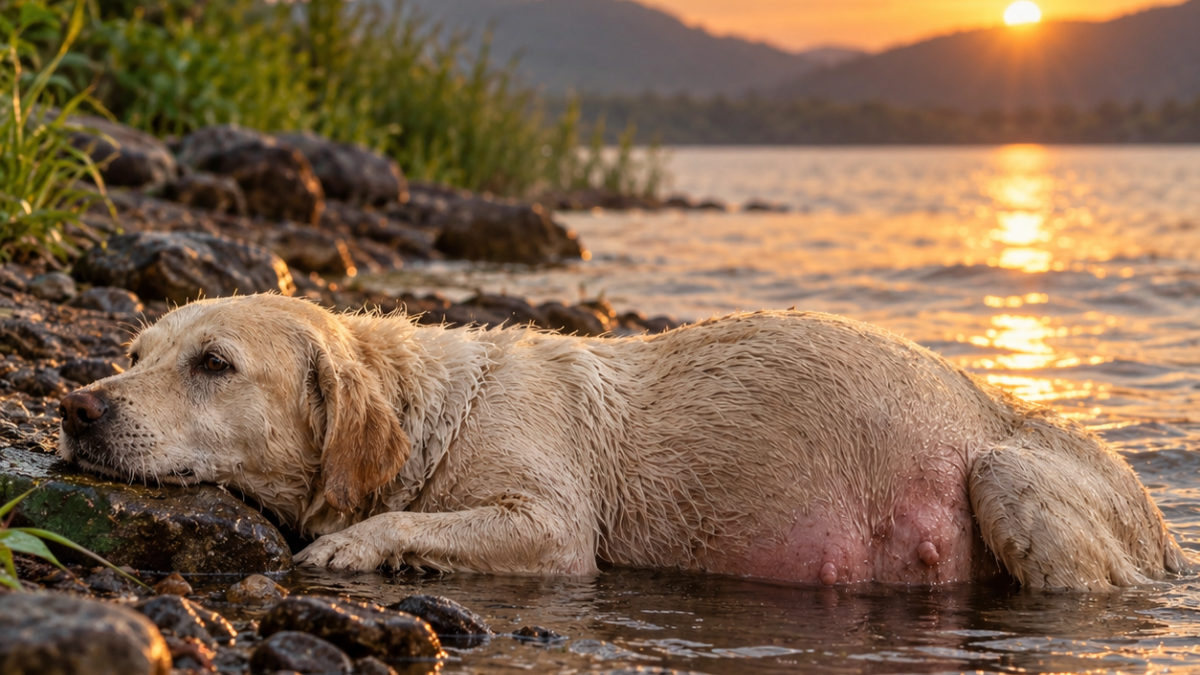
By the time we spotted her in the middle of the floodwater, the pregnant dog had stopped trying to save herself and was curled on a barely exposed slab of concrete as if she had already accepted that nobody was coming.
She was shaking, soaked to the skin, and so exhausted that when our boat reached her, she didn’t even lift her head—only one ear moved at the sound of our voices.
But when the veterinarian later examined what was hidden beneath her wet fur, we realized she hadn’t ended up out there by accident, and someone was going to have a very difficult time explaining why.
My name is Caleb Morgan, and that morning I wasn’t looking for a dog.
I was looking for debris.
Three days of storms had pushed the Black River over its banks and flooded thousands of acres of low farmland outside our county. Roads disappeared under brown water. Fences collapsed. Pieces of sheds, tree limbs, trash cans, hay bales, and sometimes whole sections of porch floated into places they had no business being.
I volunteered with the county emergency-response team whenever flooding got bad enough to require boats.
That morning, my partner, Luis Ortega, and I had been sent downstream to check an abandoned livestock property because a neighbor believed two goats might still be trapped there.
We found no goats.
We found half a barn.
A refrigerator.
Three propane tanks.
And then Luis suddenly pointed toward something near the old bridge pilings.
“Caleb.”
“What?”
“There.”
At first, I saw nothing except gray water and the top of a submerged concrete structure.
Maybe an old irrigation platform.
Maybe part of the washed-out riverbank.
Then the shape moved.
Barely.
I cut the engine.
We drifted closer.
Luis stood.
“That’s a dog.”
My stomach tightened.
She was lying on a slab no wider than a kitchen table, maybe six inches above the water. One side had already disappeared beneath the current.
She was tan with a dark muzzle, some kind of Shepherd mix, although at that moment she looked more like a bundle of wet rope than an animal.
Her fur clung to every bone.
Her sides rose slowly.
Too slowly.
“Hey!” I called.
No response.
Luis shouted.
“Girl!”
One ear twitched.
That was all.
I restarted the motor and eased the boat toward her.
The current fought us.
Branches bumped the hull.
The dog didn’t move.
When we got within fifteen feet, I saw something else.
Her belly.
Round.
Low.
Too large for the rest of her skeletal body.
“Oh, hell.”
Luis saw it too.
“She’s pregnant.”
We got alongside the slab.
I stepped forward carefully.
Normally, a frightened dog surrounded by water can be dangerous. Even gentle animals bite when they’re trapped.
This one didn’t.
She didn’t have enough energy.
I reached toward her neck.
Nothing.
Touched her shoulder.
Nothing.
Then I slid one arm beneath her chest.
She made a sound.
Not a growl.
Not a bark.
A tiny, exhausted whimper.
“Easy.”
I lifted.
Luis supported her hindquarters.
The moment we got her into the boat, she collapsed against the floorboards.
I wrapped a thermal blanket around her.
Her body was colder than it should have been.
Her lips were pale.
And when I touched her collar, my fingers stopped.
There was no identification tag.
But around her neck, beneath the soaking fur, was a narrow nylon rope.
Not tied like a leash.
Cut.
Frayed at one end.
Luis stared.
“What is that?”
I didn’t answer.
There was something knotted into the remaining end.
A small metal clip.
Heavy-duty.
The kind you’d attach to something much heavier than a dog collar.
Luis crouched.
“You think she was tied to something?”
“I don’t know.”
The dog opened her eyes.
Brown.
Clouded with exhaustion.
She looked at me for maybe two seconds.
Then her head dropped into my lap.
I put one hand against her swollen belly.
Something moved beneath my palm.
A puppy.
Then another movement.
I swallowed.
“Stay with me.”
Luis grabbed the radio.
“County Rescue Seven to dispatch. We have one canine, severe exposure, heavily pregnant, possible intentional restraint. We need veterinary intake immediately.”
Static.
Then:
“Copy Rescue Seven. Nearest available clinic is Riverbend Emergency Animal Hospital. Approximately twenty-three minutes from the south ramp.”
I looked down at the dog.
Her breathing had become shallow.
Luis said:
“Caleb.”
I saw it.
Blood.
Just a faint reddish line beneath her tail.
Not much.
But enough.
“She’s going into labor.”
The dog didn’t know us.
Didn’t know where she was.
Didn’t know whether the hands lifting her were safe.
Yet as the boat turned toward shore, she slowly moved one front paw across the floor and rested it against my wrist.
Then something beneath the blanket shifted again.
Harder this time.
PART 2
I have spent years working flood rescues, and one thing I’ve learned is that emergencies don’t care whether you’re ready.
Sometimes they wait until you’re trained, equipped, and standing beside the right people.
Other times they put a half-dead pregnant dog in the bottom of a rescue boat and ask you to figure it out while the nearest veterinarian is almost half an hour away.
Luis looked at me.
“She’s contracting.”
“I know.”
“Do you know anything about delivering puppies?”
“No.”
“Great.”
“You?”
“My sister had one litter when I was twelve.”
“That does not count.”
“It counts more than zero.”
The dog tightened beneath the blanket.
Her back legs stretched.
Then relaxed.
I touched her neck.
“Easy, girl.”
She looked at me.
I had no idea what her name was.
No idea where she’d come from.
No idea why a cut rope remained attached to her collar.
All I knew was that she was dangerously thin, soaked from river water, and carrying lives her body barely had enough strength to support.
Luis radioed again.
“Tell Riverbend we’re coming hot.”
Dispatch answered.
“They’re ready.”
The boat hit the south ramp ten minutes later.
A rescue truck was waiting.
We didn’t bother transferring her into a crate.
I climbed into the back holding her while Luis drove.
Every bump made her tense.
I could feel movement beneath my hand.
The puppies were active.
That was good.
At least I told myself it was.
The reddish discharge increased.
“Come on.”
Her head rested against my thigh.
“You didn’t survive that river to quit in my truck.”
Luis shouted from the front:
“You talking to her or yourself?”
“Drive.”
## 1
Riverbend Emergency Animal Hospital had a team waiting at the door.
Dr. Maya Henderson met us with two technicians and a rolling stretcher.
The moment she saw the dog, her expression sharpened.
“How long in the water?”
“Unknown.”
“Found on submerged concrete platform.”
“Conscious the whole time?”
“Barely.”
“Pregnant?”
“Very.”
She looked at the bleeding.
“And labor.”
They moved quickly.
Temperature dangerously low.
Severe dehydration.
Low blood pressure.
Body condition barely above emaciated.
Her gums were pale.
But fetal heartbeats were present.
Eight.
Maybe nine.
The ultrasound technician counted twice.
“Eight clear.”
Dr. Henderson frowned.
“Possibly a ninth behind the others.”
Luis stood beside me.
“Can she deliver?”
The veterinarian looked at the dog.
“She may have to.”
“What does that mean?”
“Anesthesia right now would be risky.”
“C-section?”
“Possible if necessary. But if labor progresses normally, natural delivery may be safer.”
I stared at the monitor.
Tiny moving shapes.
Eight heartbeats.
Maybe nine.
The dog shivered beneath warmed blankets.
Dr. Henderson placed fluids.
Calcium.
Glucose.
Pain management safe for pregnancy.
She examined the cut rope.
“What happened here?”
“Don’t know.”
“This looks recent.”
Luis said:
“Could’ve snagged in flood debris.”
Dr. Henderson studied it.
“Could.”
I heard the doubt.
“You don’t think so?”
She pointed.
The nylon wasn’t torn randomly.
There was a clean compression point.
Something had been attached.
Something had pulled until the rope failed or was cut.
“Photograph it before removing anything,” I said.
Dr. Henderson looked at me.
“Already did.”
Smart woman.
## 2
We had to notify animal control because of the possible cruelty evidence.
Officer Denise Marshall arrived within forty minutes.
By then, the dog was warmer.
Still weak.
Still laboring.
Still nameless.
Denise had been working cruelty investigations almost fifteen years.
She examined the collar and rope.
Then asked:
“Where exactly?”
I gave her coordinates.
“Anybody nearby?”
“No.”
“Properties upstream?”
“Several.”
“Bridges?”
“Old county bridge half mile north.”
“Public access?”
“Boat ramp two miles south.”
She wrote everything down.
Then:
“Any marks on the dog?”
Dr. Henderson answered.
“Older bruising over the ribs. Some abrasions. There’s also a friction line around the neck beneath the collar.”
“What kind?”
“Consistent with prolonged pulling against restraint.”
Denise looked at me.
I didn’t like what that suggested.
Neither did she.
## 3
The first puppy arrived at 2:17 p.m.
A little male.
Dark brown with black ears.
For one terrifying moment, he didn’t move.
A technician rubbed him with a warm towel.
Nothing.
Again.
Then a tiny cough.
Then a squeak.
Everyone exhaled.
The mother lifted her head.
Weakly.
The technician brought the puppy close.
She sniffed him.
Then something changed in her face.
I know that’s a strange thing to say about a dog.
But it did.
Until that moment, she’d looked empty.
Exhausted.
Present only because her body hadn’t stopped.
Then she smelled that puppy.
Her eyes sharpened.
She licked his head.
Once.
Then again.
The puppy rooted toward her belly.
Dr. Henderson smiled.
“There she is.”
Twenty-eight minutes later, the second arrived.
Female.
Cream-colored.
Strong.
Third.
Black.
Fourth.
Tan.
The hours blurred.
Luis went for coffee.
Denise left to inspect the flood site.
I stayed.
I don’t know why.
Nobody had asked me to.
I had reports to finish.
A truck to return.
A soaked uniform.
But every time I considered leaving, the dog looked toward me when another contraction came.
Maybe she recognized my smell from the boat.
Maybe I was simply familiar in a room full of strangers.
Either way, I stayed.
At 5:41 p.m., puppy number eight arrived.
Tiny.
Female.
Not breathing.
Dr. Henderson worked on her.
Thirty seconds.
One minute.
I watched the mother.
She tried to stand.
Couldn’t.
The technician blocked her gently.
Then—
a squeak.
The tiniest sound.
The mother lifted her head.
Dr. Henderson smiled.
“Eight.”
The X-ray showed no ninth.
All eight alive.
Against every reasonable expectation.
## 4
The mother barely had milk.
That was the next problem.
Her body had spent everything surviving.
There wasn’t enough nutrition left to produce what eight newborn puppies needed.
So Riverbend set up supplemental feeding.
Every two hours.
Around the clock.
The mother remained beside them.
We started calling her Marina because Luis said:
“She came out of the water.”
I told him it sounded too obvious.
He replied:
“Creek was already taken by your other story.”
I ignored him.
Marina stayed.
The name stuck.
## 5
The next morning, animal control found the first major piece of evidence.
Not at the concrete platform.
At the bridge.
There was a security camera on a nearby flood-control station, installed because people kept dumping trash over the rail.
Footage from the night before we found Marina showed a pickup truck stopping at 11:36 p.m.
Dark blue.
Older Chevrolet.
One person got out.
Opened the tailgate.
Something moved.
The camera angle wasn’t ideal.
But you could see a dog.
Pregnant.
Thin.
The person attached something to the dog.
Then walked her toward the edge.
Denise showed me the footage privately.
My hands went cold.
“Did they throw her?”
“No.”
That was almost worse.
The person lowered Marina down a service embankment toward the flooded access area.
Not directly into deep water.
But into a place already surrounded by rising water.
The rope attached to her collar appeared to be clipped to a concrete utility post.
Then the person left.
By morning, water had risen more than three feet.
The post was submerged.
Marina had apparently fought until the rope either broke or tore free.
Then swam.
Pregnant.
Starving.
In floodwater.
Until she reached the concrete slab where we found her.
Luis watched the footage once.
Then walked outside.
I understood.
## 6
The truck’s license plate wasn’t readable.
But the rear window had a decal.
White lettering.
**Hollow Creek Farm & Kennels**
Denise knew the name.
Small breeding operation fifteen miles upriver.
Mostly Shepherd mixes and livestock guardians.
Owner:
Raymond Talbot.
I had driven past the property dozens of times.
Never thought much about it.
Denise requested records.
County licensing showed three breeding females registered.
One was listed as:
**Mara — tan shepherd mix — 3 years old.**
Photograph attached.
Marina.
Same black muzzle.
Same white spot under the left front paw.
Same notch in the right ear.
I stared at the page.
“Her name was Mara.”
Denise nodded.
“Looks like it.”
I suddenly hated that we’d renamed her.
Like we’d erased something.
Then Dr. Henderson said:
“If Mara was the name tied to what happened before, maybe Marina can be the name she gets to keep after.”
I looked at the dog.
She was asleep with eight puppies against her.
Marina.
Okay.
## 7
Talbot denied everything.
Of course.
Said Mara had escaped three weeks earlier.
Hadn’t reported her missing.
Hadn’t posted.
Hadn’t contacted shelters.
Why?
“Busy.”
Had she been pregnant?
“Yes.”
By which male?
“Don’t know.”
Planned breeding?
“No.”
Worth of puppies?
“Probably not much.”
Was the truck on the bridge his?
“Lots of blue Chevys.”
Did his vehicle have the Hollow Creek decal?
“Yes.”
Who else drove it?
His wife.
His adult son.
Two farmhands.
Could someone have taken Mara without permission?
“Possible.”
Convenient.
Very convenient.
## 8
Then one of the farmhands came forward.
His name was Jason Price.
Twenty-two.
Worked part-time.
He contacted Denise after hearing Marina had survived.
“I didn’t know he actually did it.”
“Who?”
“Mr. Talbot.”
“What did you think he did?”
Jason looked sick.
“He said he was getting rid of her.”
Denise asked:
“Why?”
Jason hesitated.
“She got bred by the wrong dog.”
There it was again.
The commercial logic.
Mara had been intended for a planned litter with a purebred German Shepherd.
Instead, an unregistered farm mutt got into the run.
The resulting puppies would have little sale value.
Jason said Talbot was furious.
“He said feeding her through pregnancy would cost more than the pups were worth.”
“Did you hear him say that?”
“Yes.”
“Exact words?”
Jason swallowed.
“I’m not feeding nine mouths for free.”
Denise wrote it down.
## 9
Jason also had text messages.
Talbot:
**Need Mara gone before pups drop.**
Jason:
**Shelter?**
Talbot:
**They’ll ask questions.**
Jason:
**I can call rescue.**
Talbot:
**No. Handle it.**
Jason refused.
Talbot told him not to come back.
Two days later, Mara disappeared.
That alone didn’t prove Talbot left her at the flooded bridge.
But it destroyed the escape story.
## 10
Marina didn’t know any of this.
She was learning something more important:
Food came back.
Every four hours, a bowl arrived.
Every time, she ate too fast.
By day three, Dr. Henderson had to use a slow feeder.
Marina looked personally offended.
“She thinks we’re cheating her,” I said.
The vet laughed.
“She’ll learn.”
The puppies began gaining weight.
Barely.
But gaining.
The tiny female we’d nearly lost became our biggest concern.
Luis named her Hope.
I refused to argue.
Hope was half the size of her brothers.
Needed supplemental bottle feeding.
Marina watched every feeding.
At first, she tried to take Hope back immediately.
Then she learned the bottle meant food.
Within a week, she’d nudge Hope toward the technician when feeding time came.
Smart dog.
## 11
The case picked up when Denise obtained a warrant for Hollow Creek.
The front of the property looked acceptable.
Clean enough.
Fenced.
Dog houses.
Food.
But behind the equipment barn, they found something different.
Three small chain runs.
Mud.
No shade.
Old feces.
One pregnant female with no clean water.
Another dog with an untreated ear infection.
Nothing near Marina’s condition.
But enough to show neglect wasn’t unusual.
Then officers found Marina’s old kennel.
Her name written on the gate:
**MARA**
Inside:
A cut piece of nylon rope.
Same diameter.
Same color.
The loose end matched the fragment still attached to Marina’s collar.
Forensic comparison later found the fibers consistent.
Not absolute proof they were once the same rope.
But close.
Very close.
## 12
Talbot changed his story.
Mara hadn’t escaped.
Someone stole her.
Maybe Jason.
Jason’s phone records and workplace camera showed him at his second job the night Marina was taken to the bridge.
Then Talbot suggested his son.
His son provided dashcam footage from another city.
Then his wife.
She had been visiting her sister.
Every alternative collapsed.
Eventually, the only person without an alibi was Raymond Talbot.
## 13
But one thing still bothered Denise.
The bridge footage didn’t show a clear face.
Circumstantial evidence was strong.
Maybe enough.
She wanted better.
Then I remembered something.
Flood-control cameras.
The station beside the bridge recorded not only video.
Vehicle transponders.
County contractors used radio tags to access restricted gates.
Talbot’s farm had county grazing permits on nearby land.
His truck carried a registered gate tag.
At 11:31 p.m., the system logged:
**HOLLOW CREEK VEHICLE 02**
Five minutes before the truck appeared on camera.
At 11:58, it logged the same tag leaving.
That was much better.
## 14
By the second week, Marina stood without help.
Her weight remained low.
But her eyes were different.
She greeted me at the kennel door.
Not exuberantly.
One tail wag.
Then two.
Luis noticed.
“She likes you.”
“She likes food.”
“You don’t bring food.”
“Exactly.”
He smiled.
“She likes you.”
I pretended not to care.
## 15
The eight puppies opened their eyes.
That changed everything.
Suddenly the maternity room became chaos.
Crawling.
Whining.
Falling over each other.
Hope remained smallest but determined.
She climbed over littermates twice her size to reach Marina.
The others were named:
Duke.
Rosie.
Bear.
Pepper.
Finn.
Scout.
Molly.
And Hope.
Eight.
Every name made them more real.
More impossible to dismiss as “worthless.”
## 16
The local news got the story after charges were filed.
They showed footage of the floodwater.
Not the worst veterinary images.
Thank God.
Then a photograph of Marina with her litter.
Within forty-eight hours, the shelter received hundreds of adoption inquiries.
Talbot saw that too.
And suddenly, the puppies had value.
He hired an attorney.
Then claimed ownership.
## 17
I thought Denise was joking when she called.
“He wants what?”
“The puppies.”
“After trying to kill their mother?”
“His attorney says the criminal allegations are disputed.”
“They have the bridge tag.”
“I know.”
“The text messages.”
“I know.”
“The rope.”
“I know.”
“He wants the puppies?”
“Yes.”
“Why?”
Denise sighed.
“Property rights.”
I laughed.
Not because it was funny.
Because anger sometimes has nowhere else to go.
## 18
Talbot’s attorney sent formal notice to the county, claiming Marina and the litter were breeding assets belonging to Hollow Creek Farm & Kennels.
They estimated the potential value at:
**$6,000–$10,000**
I read that number twice.
The same litter Talbot supposedly didn’t want to feed because they weren’t worth anything.
Now:
Ten thousand dollars.
The news story had made people interested.
Interest had created perceived value.
Suddenly Talbot cared.
## 19
Then he made it worse.
He posted online.
**My dog and puppies were illegally taken from me during the flood.**
A lie.
He claimed rescuers had “stolen” Marina.
Said the dog had wandered off.
Said he had spent weeks searching.
No missing reports.
No flyers.
No calls.
No proof.
Comments divided.
Some people believed him.
That’s how the internet works.
Confidence often travels faster than evidence.
## 20
Then someone sent us a screenshot.
Before Marina disappeared, Talbot had posted privately in a breeder group:
**Accidental litter coming. Probably dumping whole situation. Not wasting feed.**
A reply:
**Take her to the county shelter.**
Talbot:
**They’ll chip her back to me and charge surrender fees.**
Another person:
**Then what are you doing?**
Talbot:
**I’ll handle it.**
Date:
Two days before the bridge footage.
His attorney stopped returning media calls.
## 21
The civil ownership hearing became the first true showdown.
I testified.
So did Luis.
Dr. Henderson.
Jason.
Denise.
The county attorney showed:
The bridge video.
Vehicle transponder log.
Texts.
Rope.
Veterinary evidence.
Breeding records.
Talbot sat beside his attorney.
Calm at first.
Then the judge asked him directly:
“Mr. Talbot, did you believe these puppies had commercial value before their rescue?”
Talbot hesitated.
“Not much.”
“And now?”
“They’re my property.”
“That was not my question.”
Silence.
The judge repeated:
“Did their value change?”
Talbot’s attorney stood.
“Your Honor—”
“Sit down.”
The courtroom went quiet.
Talbot said:
“People want them now.”
There it was.
Not love.
Not attachment.
Demand.
The judge looked at him for a long time.
Then:
“People wanting them now does not rewrite what you did when you believed nobody would.”
Ownership was denied pending criminal disposition.
Marina and the puppies remained under protective custody.
## 22
Talbot was furious.
Outside the courthouse, he approached me.
Too close.
“You think you’re some kind of hero?”
“No.”
“You took my dog.”
“I pulled her out of floodwater.”
“She was mine.”
I looked at him.
“Then why was she tied to a post in rising water?”
His jaw tightened.
“You don’t know what happened.”
“I know she nearly died.”
“She was a bad breeding dog.”
I stared.
He realized what he’d said.
Too late.
“What does that mean?”
“Nothing.”
“You just called her a bad breeding dog.”
He turned away.
My phone was recording.
Not secretly.
Visible.
I held it in my hand.
Talbot saw.
“Delete that.”
“No.”
He stepped toward me.
Luis moved between us.
“Back up.”
Talbot left.
The video went to Denise.
## 23
Marina came home with me as a foster after three weeks.
Temporary.
Yes.
Again.
My house wasn’t prepared.
Puppies were still too young to separate, so the entire family came.
Eight puppies.
One mother.
My quiet home ceased to exist.
I slept in the living room for the first week because Marina paced whenever I went upstairs.
She checked the front door.
Windows.
Hallway.
Then returned to the puppies.
It wasn’t separation anxiety exactly.
It was vigilance.
She had learned being left alone could end badly.
So I taught her repetition.
Leave room.
Return.
Walk outside.
Return.
Go to work.
Return.
Every time.
Trust accumulated.
## 24
The puppies became mobile.
Then impossible.
Scout chewed a chair leg.
Bear fell asleep in the water dish.
Rosie discovered stairs before anyone wanted her to.
Finn stole socks.
Pepper screamed whenever someone picked up another puppy.
Hope remained tiny but became the boss.
Luis visited and sat on the floor.
Eight puppies attacked him.
Marina watched.
Relaxed.
Then lay down.
That was the first time I saw her sleep while strangers played with her babies.
## 25
At six weeks, Marina started playing.
Not with puppies.
With me.
I threw a soft ball toward the wall.
It bounced.
Marina’s head followed.
Then she ran.
Actually ran.
Not fast.
But joyful.
She grabbed the ball.
Looked confused.
Then brought it back halfway.
Dropped it.
Luis said:
“Again.”
I did.
This time she ran faster.
That moment hit me harder than the rescue.
Because survival is not the same as living.
Playing was living.
## 26
The criminal hearing took place when the puppies were seven weeks old.
Talbot accepted a plea after prosecutors added evidence-tampering and false-report issues related to his changing stories.
The final agreement included:
Animal-cruelty convictions.
Abandonment.
Restitution.
Substantial fines.
Probation.
Mandatory animal-welfare education.
A prohibition on commercial breeding for several years.
Strict limits on animal ownership.
County inspection authority.
Surrender of remaining breeding animals beyond a permitted number.
And permanent forfeiture of Marina and her litter.
Not prison.
Some people wanted prison.
I understood.
But the breeding restriction mattered more to me.
He couldn’t replace Marina with another female the next morning.
That was real protection.
## 27
At sentencing, Talbot tried to explain.
Flood damage.
Business pressure.
Feed costs.
Unexpected litter.
Financial trouble.
The judge listened.
Then said:
“You had alternatives.”
Shelter.
Rescue.
Veterinary surrender.
Rehoming.
Calling animal control.
Calling neighbors.
Calling literally anyone.
Instead, he chose a flooded area.
A rope.
Night.
Silence.
The judge said:
“You did not make a financial decision. You transferred the cost of your decision to an animal incapable of escaping it.”
That line stayed with me.
## 28
Talbot also had to reimburse the county and rescue network for part of Marina’s medical care.
The number was much higher than what he claimed feeding her litter would have cost.
Luis whispered:
“That feels poetic.”
I agreed.
## 29
But the best part came later.
Hollow Creek Farm’s breeding license was revoked.
The kennel area had to be closed.
Several dogs were transferred to approved homes.
One older female went to Jason.
He renamed her June.
Another went to a former customer.
Two were adopted through rescue.
No more litters.
No more spreadsheets deciding which lives were profitable.
At least not there.
## 30
The eight puppies were adopted after full medical clearance.
We screened hard.
No impulse adopters.
No breeders.
No outdoor-only homes.
Hope went to Dr. Henderson.
Of course.
“She almost died in my hands,” the vet said.
“So now she owns your house?”
“Apparently.”
Bear went to a family with three teenagers.
Rosie to a retired couple.
Finn to a police dispatcher.
Pepper to a teacher.
Scout to a firefighter.
Molly to Luis’s sister.
Duke to a farmer who had previously adopted senior dogs.
Every one of them went home.
## 31
Marina received applications too.
Lots.
But I rejected one after another.
Not because I was being unreasonable.
At least I told myself that.
One wanted her for breeding.
Absolutely not.
One had no fence and planned to keep her outside.
No.
One family seemed wonderful but worked twelve-hour shifts.
She had suffered enough isolation.
No.
Then Dr. Henderson looked at me.
“You know what you’re doing.”
“What?”
“Rejecting everybody.”
“For reasons.”
“Some good.”
“All good.”
“Caleb.”
“What?”
“She already lives with you.”
I looked at Marina asleep beside the couch.
“No.”
Dr. Henderson laughed.
“Okay.”
## 32
I lasted nine days.
Then signed the adoption papers.
Marina Morgan.
Luis brought a cake.
For humans.
Because Marina couldn’t eat chocolate.
He wrote on it:
**TEMPORARY**
with a line through the word.
I hated him.
## 33
Marina’s first year was about learning ordinary things.
Car rides didn’t always end at water.
Ropes didn’t always restrain.
Nighttime wasn’t always dangerous.
Being alone for an hour didn’t mean abandonment.
Food came back.
Doors reopened.
People returned.
She loved blankets.
Hated heavy rain.
Would not go near deep water for months.
Then one summer afternoon, we visited a quiet lake.
Not floodwater.
Still.
Warm.
I didn’t lead her in.
Didn’t ask.
She stood at the edge.
Sniffed.
Stepped back.
Then forward.
One paw into shallow water.
Another.
She stayed ten seconds.
Then left.
That was enough.
## 34
The next summer, she waded up to her belly.
Never swam.
Didn’t need to.
Healing isn’t proving fear wrong by forcing someone through it.
It’s giving them control over how close they go.
## 35
The puppies reunited every year for the first five years.
Not all at once every time.
But enough.
Hope remained smallest.
Also bossiest.
Bear became enormous.
Scout developed an obsession with tennis balls.
Molly slept upside down.
Duke liked children.
Pepper still screamed when ignored.
Marina tolerated all of them.
Then eventually started leaving the room when reunions became too loud.
Motherhood had limits.
## 36
Talbot disappeared from our lives.
Mostly.
Two years after sentencing, he filed a petition to reduce the animal-ownership restriction.
Denied.
Why?
Inspection records found an unregistered intact female on his property.
He claimed she belonged to a cousin.
The cousin couldn’t prove it.
The judge extended monitoring.
Luis called me.
“You hear?”
“Yes.”
“Justice is patient.”
Apparently.
## 37
Years passed.
Marina became one of those dogs everyone in my neighborhood knew.
Kids called her “River Dog.”
I hated that name at first.
Then accepted it.
She attended county safety events.
Not as a mascot for trauma.
As a calm dog who liked children.
We never used graphic rescue photos around kids.
Just:
This is Marina.
She survived floodwater.
Now she’s here.
Simple.
## 38
She helped one little boy overcome his fear of dogs.
He sat ten feet away.
Then eight.
Then five.
Marina didn’t approach until he held out a hand.
She always understood distance.
Maybe because nobody had respected hers before.
## 39
The county emergency team changed procedures because of Marina.
Flood-response checklists added animal rescue equipment.
Slip leads.
Crates.
Thermal blankets.
Portable bowls.
Microchip scanners.
Emergency contacts for veterinary clinics.
Again:
Boring systems.
Good systems.
The next flood season, we rescued three dogs, four cats, and two goats faster because we had better equipment.
Marina’s story had consequences beyond court.
## 40
One of the most satisfying came from restitution.
Part of Talbot’s payments went into a county emergency animal-care fund.
That fund later paid for formula and neonatal supplies during another flood rescue.
I remember seeing the invoice.
Heating pads.
Milk replacer.
Portable incubator.
I laughed quietly.
Money from the man who didn’t want to feed one unwanted litter ended up feeding unwanted litters anyway.
That was justice I could appreciate.
## 41
Marina aged slowly.
Gray around the muzzle.
Stiffer hips.
Still hated storms.
On heavy-rain nights, she slept beside my bed.
Never on it.
Always close enough for one paw to touch the frame.
Sometimes thunder woke her.
I’d put my hand down.
She’d press her head beneath it.
No words.
Just contact.
## 42
When she was nine, a new flood hit the county.
Not as bad.
But serious.
I had to deploy.
For the first time, leaving her during a flood terrified me.
Luis noticed.
“She’ll be fine.”
“I know.”
“You’ve got a sitter.”
“I know.”
“She has three beds.”
“I know.”
“Air-conditioning.”
“I know.”
“More food than you.”
“Correct.”
I still hesitated.
Marina watched me pack.
Then walked to her bed.
Lay down.
She didn’t panic.
Didn’t block the door.
Didn’t follow.
She knew.
I would leave.
Then return.
That may have been the proudest moment of our life together.
## 43
I returned eighteen hours later.
Marina met me at the door.
Tail moving.
No frenzy.
Just certainty.
Like:
Of course you came back.
Trust had replaced fear.
## 44
At eleven, Marina developed arthritis.
Medication helped.
Shorter walks.
Ramps.
Non-slip rugs.
At twelve, kidney disease.
Manageable.
At thirteen, her appetite became inconsistent.
Dr. Henderson was still practicing.
She examined Marina.
“We’re entering the part nobody likes.”
I stared.
“I don’t know what you’re talking about.”
“Caleb.”
“No.”
She let me have that denial for a while.
Good veterinarian.
## 45
Marina had good months after that.
More than expected.
Chicken.
Warm sun.
Slow walks.
Puppy reunions became too much, so Hope visited alone.
Hope was gray too.
The two lay beside each other.
Mother and daughter.
Neither knowing anything about commercial value.
Good.
## 46
Then one morning, Marina couldn’t stand.
I helped her.
She tried.
Front legs up.
Back legs failed.
Dr. Henderson came to the house.
Not clinic.
We both knew.
Marina lay on her favorite blanket.
Rain outside.
Of course.
But she wasn’t afraid.
The windows were closed.
House warm.
I sat beside her.
She put one paw on my wrist.
Same gesture as the boat.
Thirteen years collapsed into one second.
## 47
I laughed and cried at the same time.
“You remember that?”
Her eyes stayed on me.
“You grabbed me on the boat.”
Luis came too.
He stood in the doorway.
Tried not to cry.
Failed.
“Worst flood rescue ever,” he said.
“Agreed.”
“Best dog.”
“Also agreed.”
## 48
Before the medication, I touched Marina’s belly.
Flat now.
Old.
No puppies moving beneath my palm.
All eight had lived.
All eight had homes.
All eight had grown old enough to become somebody’s everyday problem.
That mattered.
## 49
I whispered:
“You kept them alive.”
She breathed slowly.
“You didn’t have to.”
My voice broke.
“But you did.”
Dr. Henderson touched my shoulder.
I bent closer.
“You can stop swimming now.”
That was the last thing I said.
Marina died with her paw against my wrist.
Dry.
Warm.
Home.
## 50
I kept her ashes.
Not at the river.
Never at the bridge.
The floodwater had tried to take her.
It didn’t deserve her remains.
I placed the urn beside a photograph of Marina lying upside down on my couch, all four legs open, completely ridiculous.
That’s how I wanted to remember her.
Not wet.
Not starving.
Not pregnant.
Not afraid.
Safe enough to sleep badly.
## 51
The county later demolished the old bridge.
Flood damage.
When I heard, I felt nothing.
Then relief.
No memorial.
No plaque.
No tragedy tourism.
Good.
The concrete platform disappeared too.
The river reclaimed it.
## 52
But the emergency animal-care fund remained.
So did the rescue procedures.
So did the laws Talbot’s case helped strengthen.
Commercial breeders in the county now had clearer transfer and medical-record requirements.
Stricter reporting for abandoned breeding animals.
Not perfect.
Better.
## 53
People ask whether Talbot ever apologized.
Not to me.
I heard he left the county years later.
Worked construction.
Never reopened a kennel.
Fine.
He became unimportant.
That’s one of the most satisfying endings.
The person who hurt an animal becomes a footnote.
The animal’s life becomes the story.
## 54
If you want revenge, I can give you the version people like.
Talbot tried to avoid paying for one accidental litter.
Instead, he lost his breeding license.
Paid fines.
Paid restitution.
Lost his claim to Marina.
Lost every puppy.
Lost the business reputation attached to Hollow Creek.
His money funded emergency care for other unwanted litters.
The dogs he thought had no value became beloved family pets.
The mother he left surrounded by floodwater lived thirteen more years.
Yes.
That’s satisfying.
## 55
But it still isn’t the part I treasure most.
## 56
The part I treasure is Marina leaving food in her bowl.
The first time it happened, I panicked.
Called Dr. Henderson.
“She’s not eating everything.”
“How much did she eat?”
“Most.”
“Then she’s full.”
“She never leaves food.”
“Caleb.”
“What?”
“She knows more is coming.”
I stood in my kitchen holding the phone.
That sentence destroyed me.
## 57
The starving dog who once swallowed water from our hands because she believed it might be taken away had become secure enough to leave dinner unfinished.
That’s healing.
Not dramatic.
Not viral.
Real.
## 58
Another:
The first time rain started and she didn’t hide.
She simply looked out the window.
Then went back to sleep.
No headline.
Huge victory.
## 59
Another:
The first time I closed the front door behind me and watched through the camera.
Marina didn’t pace.
Didn’t bark.
Didn’t panic.
She slept.
Because she knew I would return.
That’s the revenge I prefer.
Someone taught her humans leave.
We taught her some come back.
## 60
People sometimes say Marina survived because she was a mother.
Maybe.
Pregnancy may have pushed her to keep fighting.
The puppies probably gave her a reason to move.
But I don’t like saying she lived “for them” as though her own life wasn’t enough.
Marina deserved rescue even if she’d been alone.
Her life had value independent of motherhood.
That’s important.
## 61
Still, I will never forget what happened after we lifted her into the boat.
Her body was done.
Everything in her said rest.
Then one puppy moved beneath my hand.
Marina opened her eyes.
Maybe instinct.
Maybe love.
Maybe biology.
Maybe all three.
She stayed.
## 62
Eight puppies.
Eight lives branching out from one exhausted dog refusing to disappear beneath brown water.
Hope became a veterinarian’s shadow.
Bear slept in a teenager’s bed.
Scout rode in a fire truck during community events.
Molly grew up with Luis’s nieces.
Pepper helped a teacher through a divorce.
Finn became obsessed with sprinklers.
Rosie slept beside an elderly man recovering from surgery.
Duke followed children around a farm.
Talbot saw “no value.”
Look at all that value.
None of it fit on a price tag.
## 63
That’s the limitation of people who measure life only by profit.
They calculate what can be sold.
Not what can be shared.
They see feed costs.
Not mornings.
Not loyalty.
Not comfort.
Not ridiculous sleeping positions.
Not fifteen thousand tiny moments nobody can monetize.
## 64
Marina gave me thousands of those moments.
She hated the vacuum.
Loved cheese.
Preferred women to men at first.
Eventually trusted everyone except one mail carrier for reasons nobody understood.
She stole grilled chicken once.
Only once because she was very efficient.
She snored.
She sighed dramatically when I worked too late.
She knew the word “walk” and every spelling of it.
W-A-L-K didn’t fool her.
Neither did “outside.”
Smart dog.
## 65
That’s who she was.
Not “pregnant flood dog.”
Marina.
A whole animal.
A whole life.
## 66
The viral photograph people kept sharing showed her in the boat wrapped in silver thermal material.
Eyes closed.
My hand on her shoulder.
I hated that picture eventually.
Not because it was bad.
Because people thought it was the story.
It wasn’t.
It was page one.
## 67
The real story was thirteen years long.
Nobody could fit that in one image.
## 68
One Christmas, I photographed Marina asleep beside the tree.
No trauma visible.
No flood.
No puppies.
Just dog.
I sent it to Luis.
He replied:
**Better rescue photo.**
Exactly.
## 69
After Marina died, I stopped volunteering for animal flood rescue for almost a year.
Not intentionally.
I was tired.
Then another storm came.
Dispatch called.
“You available?”
I almost said no.
Then looked at Marina’s photograph.
“Yeah.”
## 70
That day we rescued a cat from a roof.
Two dogs from a porch.
No dramatic stories.
Everyone safe.
Perfect.
I prefer boring rescues now.
## 71
No investigation.
No criminal charges.
No villain.
Just water.
Animals.
People helping.
Good.
## 72
The county emergency trailer now carries a laminated checklist.
At the bottom:
**Animal handling equipment inventory**
Slip leads.
Crates.
Blankets.
Bowls.
Scanner.
Formula.
Neonatal kit.
I know why that list exists.
Most new volunteers don’t.
They don’t need to.
Systems are successful when the origin story becomes unnecessary.
## 73
Hope lived the longest of the litter.
Fourteen.
Dr. Henderson called me when she died.
We cried.
Eight puppies had eventually become eight old dogs.
That’s a sentence I never expected to say on the day Marina gave birth.
Old.
What a beautiful outcome.
## 74
Talbot once wanted to avoid paying for their first meals.
They lived long enough to eat tens of thousands.
I like that too.
## 75
After Hope died, Dr. Henderson sent me a photograph from the first night.
Marina in the hospital.
Eight newborn puppies.
I hadn’t seen it in years.
I stared.
Then noticed something.
My hand was visible at the edge.
Resting on Marina’s blanket.
She had one paw touching my fingers.
Again.
Always that paw.
## 76
I printed it.
Put it beside the later couch photograph.
Beginning.
Middle.
No need for the end.
I remembered it.
## 77
If I could return to that flood morning, I would tell myself not to focus so much on the rope.
Or the bridge.
Or whoever did it.
Not yet.
First:
Warm the dog.
Water.
Vet.
Puppies.
Then evidence.
Then justice.
That order matters.
## 78
Anger wanted me to find Talbot immediately.
Care required me to keep Marina alive.
Care won.
Good.
## 79
Because if you chase punishment before preserving the life, you misunderstand the purpose.
Justice serves the living.
Not the other way around.
## 80
Marina taught me that.
Without saying a word.
## 81
The last time I passed the old Hollow Creek property, the kennel buildings were gone.
New owner.
Hay field.
No dogs.
Nothing remarkable.
I slowed.
Then kept driving.
No need to stop.
## 82
The river was calm that day.
Blue.
Almost beautiful.
I used to hate it after Marina.
Then I realized water hadn’t hurt her.
A person had.
Floodwater was just the setting.
Important distinction.
## 83
Same with ropes.
Same with bridges.
Objects aren’t cruel.
Choices are.
## 84
That matters because people love symbols.
They want to blame the place.
The storm.
The business.
The economy.
Stress.
But Talbot had options.
He chose.
That’s why consequences belonged to him.
## 85
Marina had choices taken away.
We spent the rest of her life giving them back.
Where to sleep.
When to eat.
Whether to go outside.
Whether to enter water.
Who touched her.
Whether to stay beside me.
She usually stayed.
Not because she had to.
Because she wanted to.
That’s love.
## 86
The morning after she died, I woke at 5:30.
Automatically reached for the leash.
Nothing there.
The house felt wrong.
Too still.
I sat on the kitchen floor.
No dramatic revelation.
Just grief.
## 87
Then I noticed her bowl.
A few pieces of kibble remained.
The last meal she’d eaten.
She hadn’t finished.
Years earlier, that would have terrified me.
Now it felt like proof.
She had lived long enough to stop believing food disappeared.
I left the bowl there all day.
Then washed it.
Eventually donated it to the emergency trailer.
Another dog drinks from it now, maybe.
Good.
## 88
That’s how I like memory.
Useful.
Not frozen.
## 89
Marina’s collar remains with me.
Not the original.
Animal control kept that as evidence until the case closed, then destroyed it.
Good.
I kept her later red collar.
Worn.
Name tag scratched.
**MARINA
CALEB MORGAN**
That’s the name that matters.
## 90
She belonged nowhere the night she reached the flooded platform.
Years later, her tag had an address.
Phone number.
Home.
A simple circle of metal.
More powerful than any court order.
## 91
People often ask whether I think she knew I saved her.
Maybe.
But by the end, I think the bigger truth was that she no longer cared.
I wasn’t “the rescuer.”
I was the man who forgot to share cheese.
The man who took too long putting on shoes.
The man whose couch she owned.
Much better role.
## 92
Rescue should become ordinary.
If the animal spends the rest of life worshiping the rescuer, something is wrong with our storytelling.
Marina became entitled.
Demanding.
Comfortable.
That’s success.
## 93
She once refused to get into my truck because the seat was wet.
A dog who nearly died in floodwater looked at rain on a truck seat and decided:
Absolutely not.
I laughed until my stomach hurt.
Standards.
She had standards.
## 94
That may be my favorite memory.
Not heroic.
Just spoiled.
## 95
So when people ask me about the revenge ending, I tell them this:
Raymond Talbot wanted Marina gone because feeding her and eight mixed-breed puppies wasn’t worth the money.
He tied her where rising water could finish the problem.
She broke free.
Swam.
Survived.
Led us nowhere because she didn’t need to—her babies were still inside her.
She gave birth to eight living puppies.
The law took away his claim to every one of them.
His kennel closed.
His money helped fund rescue supplies.
His breeding restrictions stopped replacement litters.
And thirteen years later, Marina died in a warm house with her paw on the wrist of the man who pulled her out of the river.
If you need revenge, that’s plenty.
## 96
But her real victory came long before death.
It happened every ordinary morning she woke without fear.
Every unfinished meal.
Every nap during rain.
Every time the front door closed and she knew it would open again.
Every time she chose to stay.
## 97
That’s what Talbot could never take back.
He controlled one night.
Marina got the next thirteen years.
Thirteen years beat one night.
Every time.
## 98
The flood carried away fences, sheds, livestock equipment, pieces of roads, and half a bridge.
It almost carried Marina too.
But somehow, she ended up on six inches of concrete with enough life left to lift one ear when we shouted.
That’s how close it was.
One ear.
One breath.
One paw.
One boat.
## 99
I don’t call that destiny.
I call it timing.
And responsibility.
We happened to see her.
Then we had to decide what seeing required.
That’s the part that matters.
## 100
On that first day, after we wrapped her in the thermal blanket, Marina stopped fighting the water.
She didn’t need to anymore.
For the first time in who knows how long, someone else was carrying the weight.
She rested her paw on my wrist.
Eight puppies moved beneath my hand.
The boat turned toward shore.
Behind us, the flooded concrete slab disappeared under brown water.
If we’d come later, there might have been nothing left.
But we didn’t.
We came when one tiny piece of her still wanted to live.
Maybe for the puppies.
Maybe for herself.
Maybe simply because living things fight until they can’t.
Whatever the reason, she held on.
And once we lifted her into that boat, she never had to hold on alone again.
That is the part of the story I remember most.
Not the man who tried to get rid of her.
Not the court.
Not the money.
Not even the flood.
I remember a soaked dog with almost no strength left resting one paw against me while eight unborn puppies moved beneath a silver blanket.
She had no idea what came next.
Neither did I.
But thirteen years later, I can tell you exactly what came next.
Food.
Warmth.
Eight births.
Eight homes.
Justice.
A red collar.
A couch.
Rain she no longer feared.
A life long enough to become ordinary.
And finally, when her body was old and tired for reasons that had nothing to do with cruelty, a peaceful ending in the place she knew was hers.
The man who left her in floodwater tried to decide how her story ended.
He failed.
Marina decided the rest simply by surviving long enough for people who loved her to take over.
And in the end, that was more satisfying than revenge could ever have been.
EXPANDED ENDING
If you need revenge in this story, I suppose I can give you the version people usually want.
Raymond Talbot had looked at Marina’s swollen belly and seen eight mouths he didn’t want to feed.
He had looked at an exhausted pregnant dog and calculated the cost of food, veterinary care, and time.
Then he had decided that leaving her tied beside rising floodwater was cheaper.
For a while, I hated him enough to want the consequences to be spectacular.
I wanted him to lose everything.
I wanted him to know fear.
I wanted him to understand what it felt like to have no control over what happened next.
But as the years passed, I realized something Marina understood long before I did.
The best revenge wasn’t making Talbot suffer the way she had suffered.
It was making sure he never got to decide what her life was worth again.
And he didn’t.
The court took Marina from him permanently.
It took every one of her puppies too.
His breeding license was revoked.
His kennel operation closed.
He paid fines and restitution that cost far more than the food he had once complained about buying.
His name remained attached to the cruelty case in public records.
And when he later tried to reduce the restrictions that prevented him from breeding animals again, the judge refused.
But even that wasn’t the part that satisfied me most.
The part I remembered was a county invoice I saw two years later.
There had been another flood.
Not as severe as the one that nearly killed Marina, but bad enough to force several families from their homes.
Animal control rescued two pregnant dogs, four cats, and a litter of neonatal puppies whose mother had disappeared.
The emergency animal-care fund paid for incubator supplies, formula, warming pads, veterinary exams, and temporary foster care.
Some of that money had come from Talbot’s restitution.
I stared at the invoice longer than I needed to.
Luis was standing beside me.
“What?”
I handed him the paper.
He read it.
Then looked at me.
“Oh.”
“Yeah.”
For several seconds neither of us said anything.
Then Luis smiled.
“So the guy who didn’t want to pay to feed one litter…”
“Ended up paying to feed several.”
Luis nodded slowly.
“I like that.”
“So do I.”
That was the kind of justice I could live with.
Not violence.
Not revenge for the pleasure of watching somebody hurt.
Just consequences redirected toward the exact thing a person once refused to do.
Talbot had tried to save money by abandoning life.
His money ended up preserving life anyway.
Marina knew none of this.
Of course she didn’t.
She was busy becoming increasingly spoiled.
By the time she had lived with me three years, the starving dog I had lifted from floodwater had developed opinions about breakfast.
Strong opinions.
She liked chicken mixed into her food.
She liked scrambled egg.
She loved cheese, which she wasn’t supposed to get very often.
She disliked carrots with such intensity that if I mixed one into her meal, she would somehow eat around it and leave the orange piece in the center of the bowl like evidence in a crime scene.
The first time she did that, I laughed.
Then I stopped.
Because there it was again.
Choice.
A dog who had once swallowed water from our hands as though somebody might take it away had become secure enough to reject food she didn’t like.
People underestimate how powerful that is.
When Marina first came to my house, every bowl was an emergency.
She didn’t eat.
She inhaled.
Her body tensed the moment food appeared.
If I moved toward her while she was eating, she protected the bowl with her shoulders.
Not aggressively.
Fearfully.
As if she believed I might change my mind and take it away.
I never did.
Breakfast.
Dinner.
Breakfast.
Dinner.
Again.
Again.
Again.
Weeks became months.
One evening, she ate half her dinner and walked away.
I panicked.
Actually panicked.
I called Dr. Henderson.
“She’s not eating.”
“How much did she eat?”
“About half.”
“Any vomiting?”
“No.”
“Diarrhea?”
“No.”
“Energy normal?”
“Yes.”
“Then maybe she’s full.”
I remember standing in my kitchen, phone pressed to my ear.
“Marina doesn’t leave food.”
Dr. Henderson was quiet for a moment.
Then she said:
“Maybe she knows there will be another meal.”
I couldn’t answer.
I looked toward the living room.
Marina had climbed onto the couch and was asleep.
Her half-full bowl sat untouched in the kitchen.
It was one of the happiest things I’d ever seen.
Security sometimes looks like abundance.
Sometimes it looks like walking away from something because you know it will still exist later.
The same thing happened with water.
With beds.
With me.
At first, if I left a room, Marina followed.
Kitchen.
Bathroom.
Garage.
Bedroom.
If I walked outside without her, she’d wait at the door until I returned.
If I drove away, the camera showed her pacing.
Then one day, maybe two years after the flood, I checked the camera during a grocery run.
Marina was sleeping.
Not waiting at the window.
Not pacing.
Not staring at the door.
Sleeping on her back.
I watched that video in a supermarket parking lot for almost five minutes.
Anyone walking past probably thought I had lost my mind.
Maybe I had.
Because I was sitting in a truck crying over a dog taking a nap.
But I understood what it meant.
She finally believed return existed.
Someone had once left her beside rising water and never intended to come back.
I had spent two years proving that leaving a house wasn’t always abandonment.
Sometimes a door closed.
And opened again.
Sometimes footsteps disappeared.
And returned.
Sometimes a truck drove away.
And came back before dinner.
Trust was not something I taught Marina in one emotional moment.
It was evidence.
Hundreds of ordinary repetitions.
And once she had enough evidence, she rested.
The puppies grew up the same way.
All eight survived.
That sentence still feels almost impossible.
Hope, the tiny female we thought we would lose, became the longest-lived of the litter.
Dr. Henderson adopted her and spoiled her shamelessly.
Hope slept under the veterinarian’s desk at the clinic for years, greeting frightened children and ignoring almost every adult unless they carried treats.
Bear grew into a massive ninety-pound dog who thought he belonged in people’s laps.
His family sent me pictures every Christmas.
In every photograph, Bear was stretched across three teenagers as if he weighed twelve pounds.
Scout became obsessed with tennis balls.
His firefighter owner kept a bucket of them beside the back door because Scout refused to go outside unless one came with him.
Pepper lived with a teacher named Melissa and developed a strange habit of sitting beside her whenever she graded papers.
Melissa once told me she went through a difficult divorce and spent several months crying at her kitchen table after work.
Pepper sat there every night.
Didn’t fix anything.
Didn’t need to.
Finn loved sprinklers.
Rosie followed an older man named George everywhere after he recovered from heart surgery.
Duke became the unofficial babysitter for three children on a farm.
Molly grew old with Luis’s sister.
Eight puppies.
Eight lives.
Eight households with routines, annoyances, favorite foods, medical bills, holidays, birthdays, and people who couldn’t imagine their homes without them.
Talbot had once referred to that litter as something not worth feeding.
That may be the clearest example I’ve ever seen of how limited a price tag can be.
How do you put a number on Pepper sitting beside a woman during the hardest year of her life?
How do you price the sound of children laughing while Duke chases them through a field?
What was Bear worth when one of the teenagers who grew up with him left for college and cried into his fur before getting into the car?
What was Hope worth to Dr. Henderson when her own husband died years later and Hope slept against her every night afterward?
None of those things existed yet when Talbot made his calculation.
That’s the problem with deciding the value of a living being based only on what you can see in one difficult moment.
You don’t know what is still ahead.
Marina’s future had looked almost empty when I found her.
She was too tired to stand.
Too cold to shiver properly.
Pregnant.
Bleeding.
Surrounded by floodwater.
And yet what lay ahead was thirteen years.
Think about that.
Thirteen winters.
Thirteen summers.
Thousands of breakfasts.
Thousands of nights.
Hundreds of walks.
Vet visits.
Car rides.
Storms.
Visitors.
Cheese stolen from my plate.
Arguments over the couch.
There was one winter when Marina discovered the heat vent beside my kitchen cabinets and decided it belonged to her.
Every morning she lay across it.
If I needed something from the cabinet, I had to negotiate.
“Move.”
Nothing.
“Marina.”
She would open one eye.
“Move.”
Nothing.
I would push gently against her shoulder.
She would make a dramatic sigh, stand, move exactly two feet, and stare at me as though I had ruined her life.
A dog who had once nearly frozen in floodwater had become angry because I interrupted her personal heating system.
That was victory.
I wish people could understand how much joy there is in watching a rescued animal become inconvenient.
At first, everyone wants them to be grateful.
Quiet.
Sweet.
Perfect.
But the best day is often when they stop acting like they have to earn the right to stay.
Marina became demanding.
She barked if dinner was late.
She pushed her head under my hand when she wanted attention.
She stole my place on the couch.
She refused to go outside when the rain was too heavy.
She once looked out the open back door during a storm, looked at me, and walked away.
I laughed so hard I had to sit down.
This was a dog who had almost drowned.
Now rain hit the porch and Marina essentially said:
No, thank you.
I can wait.
Choice again.
Always choice.
I never forced her into deep water.
People suggested it.
“Maybe swimming would help her overcome the trauma.”
I hated that idea.
Marina didn’t need to prove anything.
She didn’t owe anybody a dramatic scene where she conquered her fear.
The first summer after her rescue, I took her near a quiet lake.
She approached the shoreline.
Stopped.
Sniffed.
Backed away.
I said:
“Okay.”
We left.
The next year, she put one paw in.
Then two.
Later, she waded to her knees.
Eventually, she would walk into calm water up to her belly.
She never swam willingly.
That was fine.
Healing isn’t turning every fear into a hobby.
Sometimes healing means having permission to say no.
Years passed.
Her muzzle grew gray.
Her run became a trot.
Then a walk.
Then a slow walk with many stops.
I added rugs when her paws began slipping on the floor.
Built a ramp when stairs became uncomfortable.
Started joint medication.
Then kidney medication.
Then more blood tests than either of us liked.
Dr. Henderson joked that Marina had reached the age where every birthday came with another prescription.
I didn’t laugh much.
Growing old frightened me because it felt like losing her in slow motion.
Then Dr. Henderson reminded me:
“You wanted her to live.”
“Yes.”
“This is what living long enough looks like.”
That changed how I saw it.
Gray fur wasn’t a tragedy.
Arthritis wasn’t unfair.
Those things had nothing to do with Talbot.
Nothing to do with the flood.
They were ordinary.
Marina had earned ordinary.
When she was twelve, I took her to one final litter reunion.
Only four of the puppies were still alive then.
Hope.
Bear.
Pepper.
Duke.
They were old dogs too.
Gray faces.
Stiff joints.
No one ran.
They sniffed one another.
Wandered around the yard.
Lay in the sun.
Marina eventually moved away from the group and slept beneath a tree.
I sat beside her.
Luis joined us.
“Remember when they were born?”
I laughed.
“I remember not knowing what the hell we were doing.”
“You still don’t.”
“Correct.”
We watched Hope steal a treat from Dr. Henderson.
Luis said:
“Talbot said they weren’t worth feeding.”
“I remember.”
“Think he knows they’re still alive?”
“I don’t care.”
And I meant it.
That was when I realized Raymond Talbot had finally become irrelevant.
For years, his name had followed Marina’s story.
Articles always mentioned him.
People always asked:
“What happened to the man who did it?”
Eventually, I stopped wanting to answer.
Because Marina had become so much larger than the crime.
That should be the goal.
The person who caused suffering should not remain the most important person forever.
He got his consequences.
After that, he became background.
Marina stayed central.
When she was thirteen, the bad days began to outnumber the good.
She slept more.
Sometimes ignored breakfast.
Her kidneys worsened.
I began watching her too closely.
Every breath.
Every step.
Every unfinished bowl.
Dr. Henderson came to the house one afternoon and found me sitting beside Marina’s bed.
“You’re counting.”
“What?”
“Good days and bad days.”
I looked away.
“Yes.”
“That’s okay.”
“I don’t want to wait too long.”
“I know.”
“I don’t want to do it too soon either.”
“I know.”
“How do I know?”
Dr. Henderson looked at Marina.
“You know her.”
That answer irritated me.
It was also the only correct one.
The final morning came after a night of rain.
Marina had always been unsettled by heavy storms, but that night she slept through most of it.
Around five, I heard her trying to stand.
I found her beside the bed.
Front legs straight.
Back legs failing beneath her.
I helped her.
She leaned against me.
She tried again.
Couldn’t.
Then she looked at me.
Not panicked.
Tired.
That was the difference.
I called Dr. Henderson.
She arrived after sunrise.
Luis came too.
Marina was on her favorite blanket beside the window.
The rain had stopped.
Morning light came through the glass.
I sat on the floor.
Marina put one paw against my wrist.
Exactly where she’d touched me in the rescue boat.
For a moment, I wasn’t in my house anymore.
I was back on brown floodwater.
Silver thermal blanket.
Boat rocking beneath us.
Eight unborn puppies moving beneath my palm.
A dog who had almost no strength left resting one paw against a stranger because she had no other option.
I looked at that same paw now.
Nails gray with age.
Fur white around the toes.
Thirteen years between those two moments.
I started crying before I could stop myself.
Luis looked away.
Dr. Henderson sat quietly.
“You remember that boat?” I asked Marina.
Her eyes remained on me.
“You were freezing.”
Her breathing was slow.
“You looked terrible.”
Luis laughed through tears.
“Excellent bedside manner.”
“Shut up.”
Marina’s tail moved once.
I touched the side of her face.
The old rope scar around her neck had faded years ago.
You had to know where to look.
“You know what happened to your babies?”
Of course she didn’t understand the question.
I told her anyway.
“Hope made it.”
Her ears moved.
“Bear too.”
I swallowed.
“They all made it.”
My voice broke.
“All eight.”
There are moments when you know you’re speaking more for yourself than the animal.
That was one.
But I needed to say it.
Because when I first held Marina in that boat, everything had felt uncertain.
Her life.
The puppies.
Everything.
Now there was an answer.
Eight puppies born.
Eight puppies raised.
Eight homes.
Eight lives allowed to continue because their mother had held on a little longer.
“You did it,” I whispered.
Dr. Henderson prepared the first medication.
Marina didn’t flinch.
I kept my hand under her paw.
Luis crouched beside us.
He scratched behind her ear.
“Good girl.”
Marina relaxed.
Her head became heavier against the blanket.
Outside, water dripped from the roof.
Nothing threatening about it.
Just rain leaving.
Dr. Henderson waited.
No rush.
That’s another thing I appreciated.
Marina’s last moments belonged to Marina.
Not a schedule.
Not a clinic queue.
Not an emergency.
For once, nothing was urgent.
I leaned closer.
“You don’t have to swim anymore.”
That sentence came out before I planned it.
Maybe I’d been carrying it for thirteen years.
“You don’t have to keep fighting.”
Her eyes were almost closed.
“You kept them alive.”
I rubbed her paw.
“You kept yourself alive.”
My throat tightened.
“That’s enough.”
Dr. Henderson gave the final medication.
Marina took one breath.
Then another.
Then there was a pause.
A long one.
And she was gone.
No floodwater.
No rope.
No stranger abandoning her.
No fear.
Warm house.
Favorite blanket.
People who knew her.
Her paw still touching the wrist she’d first touched thirteen years earlier.
I sat there until the sunlight moved across the floor.
Afterward, people asked what I did with her ashes.
Not the river.
Never the river.
Not the bridge.
Not the concrete slab.
Those places did not deserve to own the ending.
I kept Marina at home.
Her urn sits beside a photograph that would mean nothing to anyone else.
She’s lying upside down on my couch.
Her head hanging over the edge.
Mouth slightly open.
One back leg pressed against a cushion.
Completely undignified.
That’s the photograph I chose.
Not the rescue photo.
Not Marina wrapped in silver emergency blankets.
Not the first veterinary photograph showing every rib.
That was what happened to her.
It wasn’t who she became.
She became a dog who refused carrots.
A dog who hated heavy rain.
A dog who stole cheese.
A dog who slept through my departures because she knew I came back.
A dog who lived long enough for gray fur to cover the face that once rested against my lap in a rescue boat.
That is why, when people ask me whether the ending was satisfying, I always say yes.
Painfully, completely yes.
Because a satisfying ending doesn’t mean nobody dies.
Everything living eventually does.
A satisfying ending means the cruelest moment wasn’t allowed to become the final one.
Raymond Talbot tried to choose Marina’s last chapter when she was young.
He chose a flooded road.
A rope.
Darkness.
Isolation.
He expected water and exhaustion to finish what he started.
But Marina survived long enough to take the ending away from him.
She didn’t survive because the universe guaranteed justice.
She survived because we happened to find her, because veterinarians fought for her, because people documented evidence, because a farmhand spoke up, because a judge listened, because eight puppies kept breathing, and because day after day someone filled a bowl and came home again.
That’s less magical than fate.
I think it’s more meaningful.
Her life after the flood was built by choices.
Good choices answering a terrible one.
And if you still want to call something revenge, call it this:
Talbot believed feeding Marina and her puppies was a waste of money.
His restitution later fed other abandoned animals.
He believed the puppies had no value.
All eight became irreplaceable to eight different families.
He tried to abandon Marina anonymously.
His actions became part of a public court record.
He wanted to make one inconvenient dog disappear.
Instead, that dog’s case changed county rescue procedures.
He believed one terrible night would end the problem.
Marina lived another thirteen years.
Thirteen years.
I come back to that number every time.
One night versus thirteen years.
One man’s decision versus thousands of mornings.
One rope versus a red collar with my phone number engraved on it.
One flooded concrete slab versus a couch Marina believed belonged entirely to her.
One unfinished attempt to erase a life versus an old dog leaving food in her bowl because she knew breakfast would come again.
That is not just survival.
That is victory.
And the last time Marina closed her eyes, she wasn’t exhausted from swimming.
She wasn’t wondering whether anyone was coming.
She wasn’t protecting unborn puppies inside a starving body.
She knew exactly where she was.
Home.
She knew whose hand was beneath her paw.
Mine.
She knew the rain outside could not reach her.
She knew she had eaten that morning, and if she’d wanted more, there would have been more.
She knew nothing about court cases, restitution, breeding licenses, or revenge.
Thank God.
All she knew was safety.
And after what had been done to her, safety was enough.
More than enough.
Sometimes, even now, when heavy rain starts at night, I wake automatically.
For a second I expect to hear Marina moving beside the bed.
I reach down.
Nothing.
Then I remember.
The grief still hurts.
But underneath it is something quieter.
Relief.
She never had to be afraid of floodwater again.
She never had to wonder whether somebody was coming back.
She never had another litter.
Never had to earn money for anyone.
Never had to prove she was useful.
She simply lived.
And when her life finally ended, it ended because she was old.
Not because somebody decided she wasn’t worth the cost.
That’s the ending Talbot never got to choose.
That’s the ending the flood never got to take.
That’s the ending Marina earned simply by holding on long enough for one rescue boat to reach her.
When I remember that morning now, I don’t picture the water first.
I picture her paw.
Wet.
Cold.
Weak.
Resting on my wrist.
Then I picture the same paw thirteen years later.
Warm.
Gray.
Still there.
Everything important happened between those two touches.
Eight puppies.
Justice.
Trust.
Food.
Rain.
Home.
Old age.
Love.
And that is why I no longer tell people Marina was the pregnant dog we rescued from the flood.
I tell them she was my dog.
Because in the end, the flood was only where I found her.
It was never where she belonged.
THE END


