PART 2: We Pulled a “Puppy” Out of Wet Cement—Then Its Face Appeared Under the Gray Crust and the Entire Jobsite Went Silent
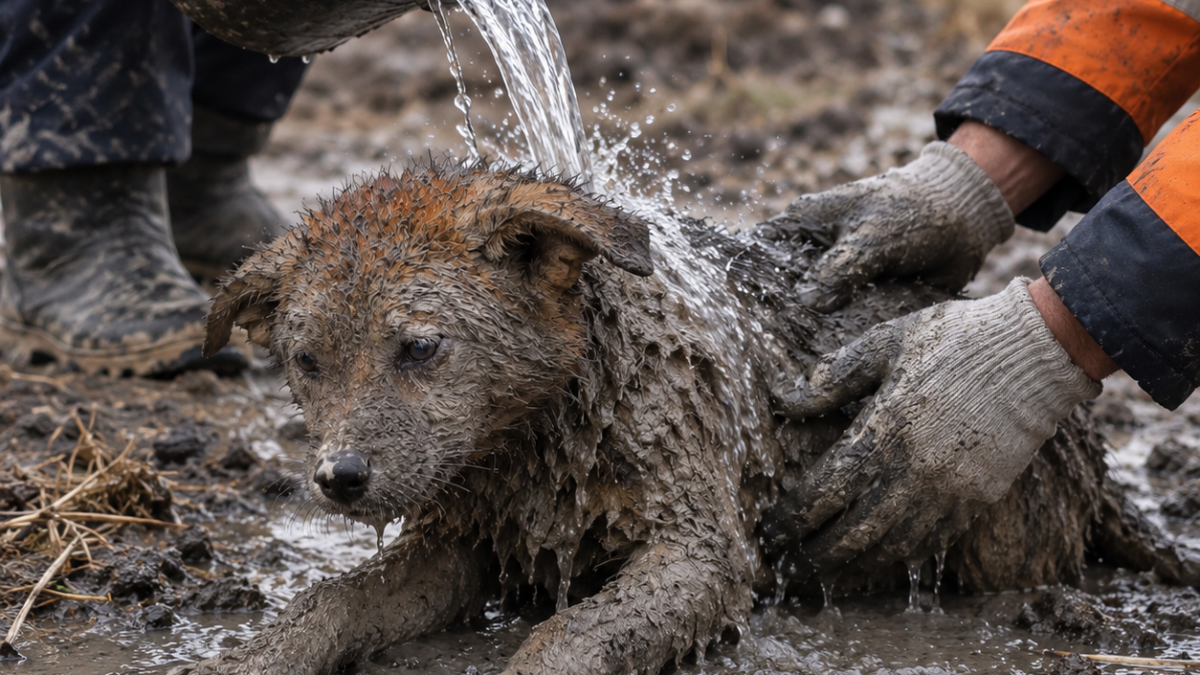
PART 2
I looked up from the box.
“What do you mean?”
Bill motioned toward the northern fence.
“Come look.”
“I am not leaving him.”
Tommy immediately said, “I’ll stay.”
That surprised me.
Two hours earlier, Tommy had been making jokes about whether the kitten would eventually eat him.
Now he sat down beside the box like a nervous father.
“Fine.”
I followed Bill outside.
Behind the stack of drainage pipe, near a section of temporary fencing, lay the remains of a wooden transport crate. One side panel had cracked away. A strip of dark canvas hung from a nail, and there were reddish hairs caught along the broken edge.
Not gray.
Not concrete.
Fur.
Bill pointed toward the mud.
Tire tracks.
Wide.
Deep.
A vehicle had entered through the service gate sometime after the rain started and before dawn.
“Security logs?”
“I checked. Nobody authorized.”
I crouched near the crate.
A metal plate had been screwed to one corner.
Most of the label had been torn away.
One small section remained.
Three printed letters.
**WLD**
Underneath, half a serial number.
I looked at Bill.
“You thinking what I’m thinking?”
“I hope not.”
—
The county wildlife team arrived twenty minutes later.
Three people.
Officer Lena Ortiz from state wildlife enforcement.
A wildlife veterinarian named Dr. Naomi Hale.
And a rehabilitation technician named Marcus Greene.
Naomi entered the break shack carrying a medical case.
The moment she saw the kitten, her expression changed from professional concern to urgency.
“How long has he been here?”
“About two hours.”
“You washed him?”
“Warm water. No solvents.”
“Good.”
She put on gloves.
“Anybody scrub?”
“No.”
“Good.”
She examined him quickly.
Male.
Approximately ten to twelve weeks old.
Severely hypothermic.
Dehydrated.
Chemical irritation along the paws and lower abdomen from wet cement.
Possible corneal exposure.
Possible aspiration.
And one front leg wasn’t moving correctly.
“Broken?” I asked.
“Maybe soft tissue. Maybe fracture.”
“Is he going to live?”
Naomi looked at me.
Wildlife veterinarians apparently use the same terrible word as every other doctor.
“Maybe.”
I hated her instantly.
Then she added:
“But the fact that he’s alert is very good.”
I hated her slightly less.
—
The kitten hissed when Marcus tried to move him.
For some reason that made me feel better.
“That’s right,” I said.
Naomi glanced at me.
“You want a wild animal to threaten us?”
“I want him to have enough energy to be rude.”
Marcus laughed.
“Fair.”
They transferred him into a padded wildlife carrier.
Before the door closed, the kitten looked toward me.
I know animals don’t create human stories the way we do.
I know that.
But I swear he looked confused.
Like he couldn’t understand why the warm hands were disappearing.
I touched the top of the carrier.
“You’re not dying today.”
Lena looked at me.
“You named him?”
“No.”
Tommy said from behind us:
“Ash.”
Everyone looked at him.
He shrugged.
“He was gray when we found him.”
I hated how perfect it was.
“Ash,” Naomi said.
The kitten hissed.
“Apparently he objects.”
“Too late.”
—
Lena inspected the broken crate.
Then the tire tracks.
Then our site access system.
“This project has cameras?”
Bill nodded.
“Sixteen.”
“Night recording?”
“Motion activated.”
“Show me.”
The north camera covered the service road.
Another faced the material storage yard.
A third partially covered the concrete foundation area.
We went into the site office.
Bill pulled up the overnight recordings.
For the first twenty minutes, nothing.
Rain.
Wind.
One raccoon.
Then at 2:14 a.m., headlights appeared.
A white cargo van entered through the north service gate.
Bill paused.
“Gate should’ve been locked.”
“Was it?” Lena asked.
“Yes.”
“Who has keys?”
“Foremen. Security. Some subcontractors.”
“How many people?”
“Maybe twelve.”
The van drove slowly onto the property.
No company logo.
Rear plates difficult to read through rain.
At 2:17, it stopped outside camera range behind the drainage materials.
Two men got out.
One wore a hood.
The other wore a reflective construction jacket.
I leaned forward.
“That’s one of ours.”
Bill’s face hardened.
“Maybe.”
The men unloaded two long wooden crates.
Not one.
Two.
One crate moved.
Hard.
Something inside hit the side.
Tommy whispered:
“Jesus.”
The man in the reflective jacket kicked the crate.
I felt my jaw lock.
They carried both crates behind the material stacks.
At 2:24, one man reappeared running.
Then the second.
Something large crossed behind them.
Fast.
A blur of reddish brown.
One of the men shouted.
The microphone barely caught it.
Then another shape appeared.
Smaller.
The kitten.
Ash.
He ran the wrong direction.
Straight toward the open foundation area.
The video lost him.
Thirty seconds later, one man chased after the adult animal.
The other stood near the van.
Then a crash sounded off camera.
A scream.
Not human.
A wild cat.
The man near the van shouted:
“Forget it!”
Both men returned.
They loaded one crate back into the van.
Not two.
At 2:31, they drove away.
Nobody went looking for Ash.
Nobody checked the foundation pit.
Nobody called wildlife authorities.
They simply left.
—
Lena replayed the footage.
“Adult lynx?”
Marcus nodded.
“Almost certainly.”
“Mother?” I asked.
Naomi answered:
“Possibly.”
My chest tightened.
“So she’s out there.”
“Maybe.”
That word again.
“Stop saying maybe.”
Naomi looked at me.
“Wildlife doesn’t become certain because we’re emotionally invested.”
I knew she was right.
Still annoying.
—
Lena zoomed the image of the man wearing reflective gear.
The face wasn’t clear.
But the jacket was distinctive.
Orange shell.
Black shoulders.
A patch near the chest.
I knew that patch.
So did Bill.
**Rourke Site Services.**
They handled temporary earthwork and nighttime equipment relocation for the project.
Bill’s face darkened.
“Caleb Rourke.”
“Owner?” Lena asked.
“Owner’s son. Operations supervisor.”
“You sure?”
“No.”
“Good answer.”
But we both were.
Caleb wore that same expensive jacket every time he came on site.
—
Lena immediately told us not to contact him.
“Why?”
“Because if this involves illegal wildlife transport, I don’t want anyone warning him.”
Bill crossed his arms.
“You think they’re trafficking animals?”
“I don’t know yet.”
“Why bring lynx here?”
“Could be temporary concealment. Could be transfer. Could be something else.”
I pointed toward the paused video.
“People don’t transport wild cats in homemade crates at two in the morning because they’re taking them to church.”
Lena looked at me.
“Also fair.”
—
The second crate bothered me.
One had broken.
One left.
What was inside the other?
Another animal?
Another lynx?
Something worse?
Lena didn’t speculate.
She requested the original video files.
Access records.
Employee lists.
Subcontractor contacts.
Vehicle logs.
Then she walked the entire north property line with Marcus.
They found tracks.
Large feline paw prints in mud.
One set.
Adult.
The animal had crossed beneath a gap in the temporary fencing and moved toward a wooded drainage corridor.
There was blood on one broken wire.
Not much.
But enough.
“She’s injured,” I said.
Marcus crouched.
“Could be superficial.”
“Could be worse.”
“Yes.”
Finally someone stopped saying maybe.
—
We worked that day.
Or pretended to.
Nobody was normal.
Every sound near the woods made someone look up.
By lunch, the entire crew knew there might be an injured mother lynx somewhere beyond the fence.
Bill called a safety stand-down.
“Nobody enters the wooded drainage alone. Nobody approaches any wildlife. Nobody leaves food. Nobody tries to be a hero. You see something, call me.”
Tommy raised his hand.
“What if she comes looking for Ash?”
“Call me.”
“Can we tell her where he went?”
Everyone stared at him.
He shrugged.
“Just asking.”
—
At 3:40 that afternoon, Naomi called me.
I don’t know how she got my number.
Probably Bill.
“Ash is stable.”
I sat down on a steel beam.
“Stable means?”
“Temperature normalizing. Oxygen levels acceptable. X-rays show a small fracture in the left radius, but it’s aligned.”
“Eyes?”
“Irritated, no obvious permanent damage yet.”
“Burns?”
“Superficial to moderate. We’re flushing and treating.”
“Will he live?”
Pause.
“I think he has a very good chance.”
I closed my eyes.
“Thank you.”
“Don’t thank me yet.”
There she was again.
“Naomi.”
“Yes?”
“Do you enjoy ruining moments?”
“Occupational hazard.”
—
That night, I couldn’t sleep.
My house was too quiet.
My wife, Diane, had died eighteen months earlier from ovarian cancer. Since then, I’d become good at working longer than necessary. Construction sites have noise. Grinders. Hammers. Engines. Men yelling. Home had none of that.
I sat at my kitchen table thinking about a wild kitten in an oxygen cage.
Diane would have laughed at me.
She loved cats.
Not lynx specifically.
Anything with whiskers.
She used to feed a three-legged stray behind our garage until it moved inside and eventually took over half our bed.
That cat died two years before she did.
I had sworn I would never have another animal.
Too much losing.
Yet there I was at midnight searching the internet for information about lynx rehabilitation.
I learned one thing quickly:
The goal is not to make them love people.
The goal is to make them wild enough to leave.
For some reason, that hurt.
—
At 1:17 a.m., my phone rang.
Bill.
“Ray.”
“What?”
“Security alarm at the site.”
I was standing before he finished.
“Where?”
“North trailer.”
“Police?”
“On the way.”
I grabbed my coat.
—
When I reached the construction site, two sheriff’s vehicles were already outside the gate.
Lena was there too.
Apparently wildlife officers don’t sleep.
One window in the site office had been broken.
Inside, drawers were open.
The computer used for security footage had been pulled from the desk.
But whoever entered hadn’t gotten far.
The server was locked in a cabinet bolted to the floor.
And Bill had already given Lena the original files.
“What did they take?” I asked.
Bill checked.
“Nothing obvious.”
Lena looked at the broken window.
“They weren’t here for tools.”
“You think video.”
“Yes.”
I stared toward Rourke’s equipment yard across the project.
“Caleb.”
“Don’t.”
“I didn’t say I was going over there.”
“Your face did.”
Apparently everyone had opinions about my face.
—
Security cameras near the front entrance captured a man entering on foot at 12:49.
Dark clothes.
Baseball cap.
Face partially hidden.
He knew where cameras were.
Avoided most.
But he missed one.
A camera mounted inside the equipment cage.
It captured his left hand.
A heavy silver ring.
Square black stone.
I had seen that ring before.
Caleb wore it constantly.
Bill said nothing.
He just showed Lena a company photograph from a safety meeting.
Caleb.
Same ring.
—
Now the case moved faster.
A judge authorized search warrants for Rourke Site Services’ yard, Caleb’s home, and specific vehicles tied to the overnight visit.
The white van was found inside a locked maintenance building.
Freshly washed.
Rear plate partially removed.
Inside, officers found straw.
Animal hair.
Sedative syringes.
Two sets of heavy gloves.
And a false-bottom compartment beneath the cargo floor.
Lena later told me that was the moment the investigation stopped being about one abandoned wild animal and became something much larger.
—
The second crate was found too.
Empty.
But not clean.
Biological traces indicated it had recently held another animal.
A large bird feather was recovered.
Later identified as belonging to a protected raptor.
Not legal to possess without authorization.
Caleb had none.
—
His father, Dean Rourke, claimed ignorance.
Maybe he was telling the truth.
Company records showed Caleb had been using one maintenance building privately.
Several after-hours fuel purchases.
Cash withdrawals.
Messages with people listed only by initials.
Wildlife enforcement brought in federal investigators because protected species may have crossed state lines.
Our quiet construction site suddenly had law enforcement vehicles everywhere.
The younger guys loved it.
Bill hated it.
I just wanted to know about the mother lynx.
—
Three trail cameras were placed in the wooded corridor.
Wildlife officers used scent and remote observation, not food bait initially, because they didn’t want to draw the animal toward construction.
First night:
Nothing.
Second:
A fox.
Third:
At 4:12 a.m., there she was.
Adult female lynx.
Thin.
Mud along one side.
A dark line around her neck.
She moved with a limp.
But alive.
Marcus showed us the image.
Tommy actually cheered.
I nearly did.
“Can you catch her?”
“We’ll try.”
“Bring Ash?”
“No.”
“Why?”
“Too early. If she’s injured or highly stressed, forcing contact could hurt both.”
I hated how much sense wildlife people made.
—
The next camera image changed everything again.
The female wasn’t alone.
At 4:19, another small lynx appeared.
A kitten.
Larger than Ash.
Maybe a sibling.
It followed her closely.
I stared at the picture.
“Another baby.”
Marcus nodded.
“Likely littermate.”
“Then why was Ash in the crate?”
“Maybe both were.”
“So this one escaped too.”
“Possibly.”
“Can we stop saying—”
“Ray.”
“Fine.”
—
The female’s neck injury concerned Naomi.
The dark line looked like a wire wound.
Possibly from the transport crate.
Possibly older.
Her limp worsened between camera visits.
They decided to capture.
Humane cage traps large enough for lynx were positioned along her route.
Remote alarms attached.
Everyone waited.
First night, no entry.
Second night, she approached but wouldn’t enter.
Third night, the sibling kitten went inside briefly and backed out.
Fourth night, nothing.
Then the weather turned.
Heavy snow forecast.
Naomi worried about the injured paw.
“We can’t wait forever.”
“What happens?”
“If necessary, remote darting by an authorized wildlife veterinarian.”
“Risky?”
“Everything is risky.”
I hated her answers because they were honest.
—
Ash, meanwhile, improved rapidly.
His eyes cleared.
The fracture began healing.
The cement burns scabbed and then softened.
He ate on his own.
And, according to Naomi, he had become “appropriately hostile.”
“Meaning?”
“He hates us.”
“Good.”
“You’re learning.”
I was allowed to see him once through one-way glass.
No touching.
No talking.
No letting him associate me with food.
He was larger already.
Standing on all four legs.
Spotted coat clean.
Tufted ears high.
He looked nothing like the gray lump we’d found.
I put my hand against the glass.
He didn’t notice.
Good.
That was the point.
Still hurt.
—
Caleb was arrested six days after the search.
Charges initially included illegal possession and transport of protected wildlife, animal cruelty, evidence tampering, and related offenses. More would come later.
The man with him in the video was identified as Travis Boone, a licensed exotic-animal transporter who had lost his permit the previous year.
That answered part of the mystery.
Caleb wasn’t just hiding animals.
He was part of a network moving illegally captured wildlife to private buyers.
Lynx.
Raptors.
Foxes.
At least one small bear cub investigators were still trying to locate.
Some were destined for unlicensed private collections.
Some were being moved across state lines under false paperwork.
Some probably died before reaching anyone.
I felt sick reading that.
—
How had they gotten the mother and kittens?
Investigators found messages.
A trapper in another county had captured the female accidentally in a large box trap while targeting nuisance coyotes.
Instead of reporting and releasing her as required, he contacted Travis.
Why?
Money.
The female had two kittens nearby.
Travis and Caleb returned that night.
They captured both kittens.
The mother fought.
They sedated her.
Loaded all three.
That explained the blood.
The neck wound.
The terror in the crate.
—
They planned to hold the animals temporarily in one of Rourke’s locked maintenance buildings until a buyer from another state arrived.
But a surprise inspection by company insurance personnel was scheduled the next morning.
Caleb panicked.
He moved the crates to our construction site at night, knowing he had access and believing nobody would be there.
When the mother broke the crate, everything collapsed.
She escaped.
One kitten followed.
Ash ran toward the concrete.
They abandoned him.
Not because they didn’t see him fall.
They heard it.
A recovered audio file from Caleb’s phone contained Travis saying:
“Kid went in the pour.”
Caleb answered:
“Leave it.”
Two words.
Leave it.
—
I heard the recording once.
Only once.
I went outside afterward and stood beside the same foundation pit.
The concrete had hardened by then.
Men were installing anchors.
Ordinary work.
I imagined Ash inside wet cement.
Clawing.
Coughing.
Climbing.
While two men drove away because going back for him risked exposing what they’d done.
My hands started shaking.
Not fear.
Anger.
Bill came over.
“You okay?”
“No.”
“Good.”
I looked at him.
“Good?”
“I’d be worried if you were.”
—
The mother lynx was captured that night.
The alarm went off at 2:06 a.m.
Naomi and Marcus reached the trap within thirty minutes.
She was frantic but alive.
The sibling kitten stayed nearby, crying from the trees.
They sedated the mother, treated the wound, examined the leg.
Deep paw laceration.
Infection beginning.
Neck abrasion.
Dehydration.
But no broken bones.
Once she was moved to the rehabilitation facility, wildlife staff set another trap for the sibling.
The kitten entered less than three hours later.
Family complete.
Almost.
Ash was housed separately at first while disease testing and health evaluation continued.
Then, two days later, Naomi called me.
“You want to see something?”
“Yes.”
“Come to the center.”
—
I stood behind one-way glass with Tommy, Bill, and three other crew members.
We were instructed to be silent.
The rehabilitation enclosure was large.
Logs.
Brush.
Platforms.
Covered hiding areas.
The mother entered first.
Still limping slightly.
The older sibling was already beside her.
Then a sliding interior door opened.
Ash appeared.
He froze.
The mother froze.
For a second, nothing happened.
Then she made a sound.
Low.
Not loud.
Ash answered.
He ran.
Straight toward her.
The mother dropped her front half to meet him.
Ash pushed underneath her chest.
The sibling joined.
Three bodies tangled together.
The mother licked Ash’s face.
His ears.
His head.
Again.
Again.
Again.
Tommy started crying.
Quietly.
I looked at him.
He whispered:
“Shut up.”
“I didn’t say anything.”
“You were going to.”
I wasn’t.
I was crying too.
—
Naomi stood behind us.
“Now comes the difficult part.”
“What difficult part?”
“We have to make sure they can return to the wild.”
“They’re together.”
“That helps.”
“So release them.”
“Not yet.”
Her patience with me had improved only slightly.
“Ash’s fracture needs more time. Mother needs to regain strength. The kittens need hunting development. And all three need minimal human contact.”
“How long?”
“Months.”
I hated waiting.
Apparently life didn’t care.
—
The construction company made changes immediately.
Every open concrete excavation had to be covered or ramped overnight.
Temporary fencing was reinforced at wildlife corridors rather than blindly blocking them.
Site crews got wildlife-response training.
No one fed wild animals.
No one approached.
We installed escape planks in certain deep utility pits.
Bill called it “Ash protocol.”
Corporate called it something much longer and less memorable.
Everyone called it Ash protocol anyway.
—
The Rourke subcontract was terminated.
Dean Rourke tried to argue his company shouldn’t be punished for Caleb’s personal crimes.
Corporate disagreed.
Evidence showed company vehicles, fuel cards, storage space, and access credentials had been used repeatedly.
Maybe Dean truly hadn’t known.
But his controls had been nonexistent.
The contract was worth more than a million dollars.
Gone.
The company later entered bankruptcy after insurers withdrew coverage and other clients cancelled work.
I didn’t celebrate workers losing jobs.
That part wasn’t satisfying.
Most had done nothing wrong.
Several were hired by other subcontractors.
Bill helped some.
So did I.
Consequences should land as close as possible to the people who earned them.
Life isn’t always that precise.
—
Caleb’s father came to our site once after the contract termination.
He stood outside the gate.
Wanted to talk to Bill.
I was nearby.
He looked older than I remembered.
“Ray.”
I said nothing.
“Did you know?”
“Know what?”
“What Caleb was doing.”
“No.”
“You think I did?”
“I don’t know.”
He rubbed his face.
“I built that company thirty-two years.”
I believed him.
“One idiot kid destroys everything.”
Caleb was thirty-seven.
I didn’t point that out.
Dean looked toward the foundation.
“They’re saying he left that animal in concrete.”
“Yes.”
He closed his eyes.
“I raised him better.”
Maybe.
Maybe not.
Sometimes people become what we didn’t teach.
Sometimes they reveal what we ignored.
I didn’t know enough to judge Dean’s entire life.
So I said the only thing I knew.
“He had time to go back.”
Dean looked at me.
“He didn’t.”
No answer.
Then he walked away.
—
Investigators eventually recovered more animals connected to the network.
Two foxes from a private property.
Three raptors.
A young black bear kept illegally in a reinforced shed more than two hundred miles away.
Several animals could be rehabilitated.
Some couldn’t.
One eagle had a wing injury too severe for release and went to an accredited sanctuary.
A fox died before officers arrived.
That one stayed with me.
Not every story gets Ash’s ending.
That’s why Ash’s ending had to matter.
—
Travis Boone pleaded guilty first.
He gave investigators names in exchange for a reduced sentence.
People criticized that.
I understood why.
But his information broke the network.
Four additional arrests followed.
A buyer who had been purchasing wild cats for a private collection lost every animal in his possession and faced separate charges.
Permits were investigated.
Money seized.
Vehicles seized.
Records opened.
A chain that had operated quietly for years became visible.
All because one crate broke.
One kitten ran the wrong direction.
One construction crew noticed something moving.
—
Caleb refused a plea at first.
He insisted he had never intended to injure Ash.
His attorney argued the kitten’s fall into concrete was accidental.
Technically, it was.
The prosecutor agreed.
Then added:
Leaving him there wasn’t.
Transporting him illegally wasn’t.
Trying to destroy security evidence wasn’t.
The intent didn’t need to be “I want this kitten in concrete.”
The choices before and after mattered.
That distinction became the center of the case.
—
I testified almost eleven months after we found Ash.
Courtrooms are less dramatic than television.
Long waits.
Paperwork.
Objections.
People shuffling documents.
Then suddenly someone plays a video of a terrified wild animal and the room changes.
The prosecutor asked:
“What did you first believe the animal was?”
“A puppy.”
“And after washing the face?”
“A lynx kitten.”
“What condition?”
“Cold. Covered in concrete. Barely moving.”
“Did he appear able to escape without help?”
“No.”
“What did you do?”
“We washed him. Warmed him. Called wildlife rescue.”
“Did the defendant return to help?”
“No.”
“Did anyone associated with him call?”
“No.”
Then they played the security footage.
White van.
Crates.
Mother escaping.
Ash running.
Men leaving.
I looked at Caleb.
He stared at the table.
—
His attorney asked:
“Mr. Coleman, you’re not a wildlife expert, correct?”
“Correct.”
“You cannot tell the court what Mr. Rourke saw in darkness during heavy rain.”
“No.”
“You cannot know whether he realized the kitten fell into wet concrete.”
“Not from my own eyes.”
“Exactly.”
Then the prosecutor played the recovered audio.
**Kid went in the pour.**
**Leave it.**
Silence.
Caleb’s attorney stopped asking me questions.
—
Naomi testified about the injuries.
Chemical burns.
Hypothermia.
Fracture.
Eye irritation.
Risk of respiratory complications.
“Was the animal likely to survive without intervention?”
She answered carefully.
“Not for long.”
That sentence bothered me for days.
Not for long.
If Tommy had arrived twenty minutes later?
If it had been colder?
If Ash had inhaled more cement?
If we had assumed he was dead?
Don’t live in ifs, Diane used to tell me.
Ifs don’t build anything.
Action does.
—
Lena testified about the trafficking network.
The permit violations.
Messages.
False documentation.
The attempted evidence destruction.
By then the case was no longer a weird story about a lynx on a construction site.
It was organized wildlife crime.
Money.
Concealment.
Transport.
Buyers.
The scale shocked the jury.
It shocked us too.
—
Caleb eventually changed his plea before the final phase of trial.
Guilty to multiple wildlife trafficking and unlawful possession counts, evidence tampering, animal-cruelty-related charges, and associated offenses.
The sentence included incarceration, significant fines, forfeiture of vehicles and equipment linked to trafficking, a long prohibition on possessing regulated wildlife, and restitution directed toward rehabilitation and enforcement costs.
Was it enough?
Ask ten people, get ten answers.
I wanted him to hear the mother lynx calling for Ash every night he spent locked up.
Life doesn’t work that way.
The law deals in statutes.
Not emotional symmetry.
Still, he lost the network.
Lost the money.
Lost the vehicles.
Lost his career.
Lost access to the animals he’d treated as merchandise.
And most importantly, the operation stopped.
That mattered.
—
At sentencing, the judge asked Caleb whether he wished to speak.
He stood.
For the first time, he looked directly at me.
Then away.
“I never wanted that kitten to get hurt.”
My jaw tightened.
He continued:
“I know nobody believes that.”
The judge said:
“Intent to cause one particular injury is not the only form of responsibility.”
Caleb swallowed.
“I panicked.”
“Why?”
“Because what we were doing was illegal.”
There it was.
No accident.
No misunderstanding.
Fear of being caught.
The judge asked:
“And your response to that fear was?”
Caleb looked down.
“Leave.”
“Leaving an injured animal behind.”
“Yes.”
The judge paused.
“An animal was nearly killed not because you lacked options, Mr. Rourke, but because helping it would have exposed you.”
Silence.
Then:
“That distinction is important.”
Yes.
It was.
—
Part of the forfeited money went into a regional wildlife rehabilitation fund.
I learned that months later.
Naomi called.
“Want to know what Caleb’s truck paid for?”
“That sounds promising.”
“New isolation enclosures.”
I laughed.
“Seriously?”
“Partly.”
“Good.”
“You’re enjoying this.”
“A little.”
“Petty.”
“Very.”
—
The wildlife center expanded one rehabilitation pen using restitution money from the case.
Tommy proposed naming it the Rourke Memorial Enclosure.
Naomi threatened to ban him from the property.
We compromised.
No names.
Better.
Ash didn’t need Caleb attached to another part of his life.
—
By spring, Ash was almost unrecognizable.
Long-legged.
Powerful.
Nearly adult-sized.
The cement scars were hidden beneath thick fur.
The fracture healed.
His eyesight tested normal.
He hunted live prey in controlled rewilding exercises.
Not something I needed to watch.
“He’s good?” I asked.
Naomi smiled.
“Very.”
“Too friendly with people?”
“No.”
“Does he remember us?”
“Probably not in the way you mean.”
That hurt.
Then I remembered the point.
“Good.”
She nodded.
“Exactly.”
—
The mother recovered too.
Her paw healed with a slight stiffness that didn’t prevent hunting.
The sibling kitten—female—developed normally.
The family remained together longer than typical because rehabilitation staff believed the stress of capture and separation made maintaining the social unit beneficial until release.
Eventually the kittens became more independent.
Wild.
Correct.
—
Release day came fourteen months after we found Ash.
I was invited.
So were Bill and Tommy.
Only because we’d been part of the rescue.
No public event.
No media circus.
No crowd.
Wildlife release locations are intentionally protected.
We drove for hours into forest country.
Snow still clung to shaded ground.
Pines.
Rock.
Silence.
Real silence.
Not the empty kind at home.
The full kind.
Wind.
Birds.
Branches.
Life you couldn’t see.
Three transport crates sat in the back of wildlife vehicles.
Mother.
Female sibling.
Ash.
I stood near the road.
Hands in my jacket.
Same old welding jacket I’d worn the morning we found him.
Clean now.
Mostly.
—
Naomi came beside me.
“You ready?”
“No.”
“Good.”
“Why is that good?”
“Means you understand.”
“What?”
“This isn’t about getting something back.”
She looked toward the crates.
“It’s about letting go.”
I disliked her wisdom almost as much as her maybe.
—
The mother was released first.
Door lifted remotely.
She stayed inside for several seconds.
Then stepped out.
Low.
Cautious.
She smelled the air.
Looked toward the forest.
And vanished.
Not ran.
Vanished.
One moment there.
Next moment absorbed by trees.
The sibling followed.
Paused longer.
Then disappeared in the same direction.
Ash was last.
My chest hurt.
The crate door opened.
Nothing.
Tommy whispered:
“Come on, buddy.”
Naomi shot him a look.
“Sorry.”
We waited.
Then two tufted ears appeared.
Ash stepped out.
He was beautiful.
No other word.
Strong.
Spotted.
Winter coat thick around his face.
He looked nothing like the creature in wet concrete.
He took three steps.
Stopped.
Turned his head.
For one foolish second, I thought he looked toward us.
Probably not.
Probably listening.
Probably smelling.
Still, I held my breath.
Then he walked into the forest.
No hesitation.
Gone.
—
Tommy cried again.
I didn’t mention it.
He didn’t mention me crying.
Construction code.
—
On the drive home, nobody talked much.
Bill finally said:
“Feels weird.”
“Yeah.”
“We spent a year trying to keep him alive and the goal was for him to disappear.”
I looked through the window at the trees.
“That’s wildlife.”
Tommy said:
“Still rude.”
I laughed.
—
The next Monday, work resumed.
Buildings don’t care about emotional milestones.
Steel arrived late.
Concrete inspector complained about anchor placement.
Tommy lost a drill.
Bill yelled.
Normal.
But something had changed.
The northern edge of the project included a permanent wildlife corridor now.
The developer originally resisted.
Cost.
Land.
Schedule.
Then the trafficking case attracted attention.
Suddenly environmental design became very popular.
Funny how that works.
The final site plan included protected drainage, lower-impact fencing, covered retention structures, and a wooded passage connecting habitat beyond the property.
Part genuine improvement.
Part public relations.
I didn’t care.
Animals don’t inspect motives.
They use corridors.
—
Two years later, the commerce center opened.
Glass.
Steel.
Parking lots.
Landscaping.
If you walked through it, you’d never know a wild kitten nearly disappeared under a foundation there.
Except for one thing.
Near the employee courtyard stood a small bronze plaque.
I argued against it.
Corporate insisted.
It didn’t mention trafficking.
Didn’t mention Caleb.
Just:
**THE ASH WILDLIFE CORRIDOR**
**Created in recognition of the wildlife that shared this land before we did.**
Tommy loved it.
Bill pretended not to.
I touched it once.
Then went home.
—
I retired the following year.
Officially.
My knees celebrated.
My bank account was less enthusiastic.
Naomi asked whether I wanted to volunteer at the rehabilitation center.
I laughed.
“You want me near wild animals?”
“Maintenance.”
“Oh.”
“We have fences. Gates. Welding.”
That made more sense.
So once a week, I drove out.
Fixed hinges.
Repaired feeding chutes.
Built transport crate frames.
Never handled animals.
Never tried.
Sometimes I caught glimpses through barriers.
Owls.
Foxes.
A bobcat.
Once a bear cub.
Every case had a story.
Most I never learned.
Probably better.
—
One afternoon, a young volunteer asked:
“You’re the guy who found Ash?”
“No.”
“Didn’t you rescue him?”
“We found him.”
“Same thing.”
“No.”
He looked confused.
I pointed toward the veterinary wing.
“Naomi rescued him.”
Then toward the forest.
“His mother rescued part of him.”
Then at the welded enclosure door.
“People like us just happened to be standing where help was needed.”
The volunteer nodded like I’d said something wise.
I hadn’t.
I’d just gotten older.
—
Three years after release, Naomi called me.
“Come by.”
“Why?”
“Just come.”
“Have you learned nothing about phone communication?”
“Ray.”
Fine.
I drove out.
She met me in the office holding a printed photograph.
Trail camera image.
Snowy ridge.
Night.
A lynx walking across the frame.
Adult male.
Right ear carried a tiny notch near the edge.
“Could be Ash,” she said.
I stared.
“Could be?”
“No certainty.”
“Naomi.”
She laughed.
“Sorry. But yes, based on release area, age, markings, and ear notch, we’re reasonably confident.”
The animal looked enormous.
Healthy.
Thick winter coat.
I touched the edge of the paper.
“He made it.”
“At least to the date of this image.”
“You really cannot just let anyone have a moment.”
“Apparently not.”
—
I kept a copy.
It sits on my kitchen wall.
Not the rescue photo.
Not Ash covered in cement.
The wild photo.
A lynx crossing snow alone.
That’s the version I want.
—
The trafficking investigation continued long after Caleb’s sentencing.
Several people received convictions.
A buyer lost permits permanently.
Two businesses paid civil penalties.
Wildlife agencies created better cross-state reporting for suspicious exotic-animal transport.
Temporary construction sites near habitat received new guidance on documenting unauthorized nighttime access.
Boring stuff.
Important stuff.
The kind of changes nobody shares on social media because forms aren’t emotional.
Forms prevent repeats.
That’s good enough.
—
Travis Boone served time too.
He later testified in another wildlife case.
People argued whether that meant he had changed.
I don’t know.
I didn’t need to know.
Change is between the person and what they do afterward.
Forgiveness wasn’t required from me.
Ash certainly wasn’t waiting for an apology.
—
Caleb eventually wrote a letter.
Not to me.
To the rehabilitation center.
Naomi showed me because my name was mentioned.
He said he had completed part of his sentence and joined a prison conservation work program.
I almost laughed at the irony.
The letter wasn’t dramatic.
He admitted he had told himself transporting animals was different from hurting them.
He said the concrete incident destroyed that lie.
One sentence stood out:
**I kept saying I never injured the lynx because I wasn’t the one who pushed him into the pit, but I understand now that when I chose my own safety over pulling him out, I became responsible for what happened next.**
I read it twice.
Naomi asked:
“What do you think?”
“Good sentence.”
“Do you forgive him?”
“Not my job.”
She nodded.
Correct answer.
—
I don’t know what happened to Caleb after that.
Not really.
I heard he was released eventually under supervision.
He couldn’t work in wildlife transport.
Couldn’t possess regulated wildlife.
His family’s company never recovered.
Maybe he built another life.
I hope he didn’t hurt anything else.
That’s enough interest from me.
—
People often want revenge stories to end with the bad man destroyed.
I understand.
Anger likes symmetry.
Ash nearly died, so part of me wanted Caleb to lose everything.
But years changed my thinking.
Caleb’s suffering did not heal Ash’s leg.
It did not remove cement from his eyes.
It did not return the mother’s lost days.
What mattered was stopping the system that allowed profit to turn wild animals into cargo.
That happened.
What mattered was the mother surviving.
That happened.
The sibling surviving.
That happened.
Ash walking back into the forest.
That happened.
Anything beyond that is paperwork.
Useful paperwork.
But still paperwork.
—
The real revenge happened on release day.
Two men had placed a wild family in crates because they believed ownership was something you could manufacture with locks, drugs, cash, and false permits.
They believed a lynx was worth what a buyer would pay.
Then the crates opened.
The mother walked away.
Her daughter walked away.
Ash walked away.
Nobody owned them.
Nobody sold them.
Nobody got to decide their price.
That was the most complete answer possible.
—
I think about the construction morning more often than I admit.
The cold.
Tommy calling my name.
That gray shape.
How close I came to saying:
“Call animal control,” and walking back to work.
Not because I didn’t care.
Because construction teaches you to compartmentalize.
My job.
Not my job.
My problem.
Not my problem.
But sometimes something lands directly in front of you and makes those categories meaningless.
A living creature covered in cement is everybody’s problem until somebody helps.
—
There’s one detail I never told the reporters.
After Ash left for the wildlife center that first day, I went into the break shack alone.
His cardboard box was empty.
My jacket was still inside.
Wet.
Gray streaks of cement across the sleeve.
A few reddish hairs stuck to the fabric.
I picked it up.
And I cried.
Hard.
For maybe thirty seconds.
Then Tommy walked in.
He froze.
I pointed at him.
“You saw nothing.”
He nodded immediately.
“Absolutely nothing.”
Good kid.
—
I still have that jacket.
Diane would say that’s disgusting.
She’s probably right.
The concrete stains never fully came out.
One sleeve has tiny claw marks.
I should throw it away.
I won’t.
Not because Ash needed me.
He doesn’t.
Because sometimes I need proof that I was there when something almost ended and didn’t.
—
One winter, years after release, I drove near the protected forest with Naomi for a rehabilitation project.
Not to find Ash.
We weren’t allowed to seek him out.
That’s not how wildlife release works.
But snow covered the road, and near one crossing we saw tracks.
Lynx.
Large.
Fresh.
Naomi stopped the truck.
We got out.
I looked at the prints.
“Could be him?”
She smiled.
“Could be.”
For once I didn’t argue.
Could be was enough.
—
We stood there maybe a minute.
Then wind started filling the tracks with loose snow.
Soon they’d disappear.
I used to think disappearance meant loss.
Diane disappearing from my life.
The old cat dying.
Ash vanishing into trees.
But not everything that disappears is gone in the same way.
Some things leave because that’s what healing looks like.
A wild animal disappearing into a forest is not abandonment.
It’s success.
Took me a while to learn that.
—
The site where we found him changed owners eventually.
The commerce center still stands.
Ash Corridor still cuts along the north edge.
Employees occasionally report wildlife cameras catching deer, foxes, coyotes, once a bobcat.
No lynx.
Wrong habitat for permanent residence anyway.
That’s fine.
Ash was never supposed to stay where we found him.
He was supposed to leave.
—
Tommy became a foreman.
God help everyone.
He now makes new workers attend wildlife safety briefings personally.
If someone complains, he tells them:
“One day you might think you’re washing a puppy.”
Nobody understands.
Then he tells the story.
Probably exaggerates his role.
Young men become old men eventually.
We all rewrite ourselves a little.
—
Bill retired to Arizona.
No snow.
No lynx.
He sends photos of golf courses.
I dislike him for this.
Every anniversary of the rescue, he texts:
**Concrete clear?**
I reply:
**Still clear.**
That’s our entire emotional communication.
Construction men are sophisticated.
—
Naomi still works.
She has more gray hair.
Still says maybe too often.
Still correct about almost everything.
I find this irritating.
The rehabilitation center has helped hundreds of animals since Ash.
Some returned to the wild.
Some went to accredited sanctuaries because injuries made release impossible.
Some died.
That part remains.
Rescue is not magic.
You don’t get happy endings because you care enough.
You get chances.
Sometimes they’re enough.
Ash got one.
—
The mother was photographed twice after release.
Once with the female sibling the first year.
Then alone.
Normal.
Young lynx disperse.
No one knows exactly how long she lived.
Wild animals don’t provide updates.
I used to want them.
Now I don’t.
Privacy is part of freedom.
—
The sibling was later photographed nearly twenty miles from the release zone.
Healthy.
Hunting.
No evidence she remained dependent on people.
Another victory nobody could hug.
Good.
—
Ash’s last confirmed image came five years after release.
Same ear notch.
Male lynx moving through snow at dawn.
Older.
Strong.
Alive.
Naomi sent it without commentary.
For once.
I stared at the photograph for a long time.
Then printed it.
It replaced the earlier image on my wall.
—
Sometimes visitors ask about it.
“Beautiful cat.”
“Yeah.”
“Zoo?”
“No.”
“Where’d you take that?”
“I didn’t.”
Usually I leave it there.
Not every story needs retelling.
But if they ask enough, I tell them.
The gray animal.
The concrete.
The ears.
The crate.
The mother.
The court.
The forest.
By the end, they usually say:
“That’s unbelievable.”
I answer:
“No.”
The unbelievable part would have been if nobody noticed.
Everything else happened because people did.
—
I am sixty-two now.
Retired.
Still weld twice a week because apparently I don’t understand retirement.
I volunteer.
I cook badly.
I still talk to Diane sometimes when the house gets quiet.
I tell her about Ash.
Not because I think she can hear.
Because forty years of talking to one person teaches your mouth habits your brain can’t easily stop.
I imagine she’d say:
“You always pretended not to like cats.”
Technically, I still don’t.
Domestic cats shed on furniture.
Lynx leave.
Much more considerate.
—
The strangest thing is that people often call me the man who rescued a lynx.
I correct them when I can.
Ash rescued himself first.
He climbed out of that concrete.
Think about that.
Ten weeks old.
Cold.
Terrified.
Chemical slurry hardening into his fur.
One leg fractured.
And he climbed.
We only found him after he’d already done the impossible part.
All we did was notice.
Maybe that’s why I called him a fighter before I knew what he was.
Some things are obvious under any amount of cement.
—
If I could go back to that morning, I would change almost nothing.
Maybe call wildlife rescue thirty seconds earlier.
Use better towels.
Stop Tommy from trying to feed milk before we knew what species we had.
But mostly, I’d tell myself one thing.
Don’t worry about whether he remembers you.
That question bothered me for years.
Did Ash remember the warm break shack?
My jacket?
My voice?
Did he recognize anything on release day?
Probably not.
And now I understand that’s perfect.
Wild animals don’t owe rescuers gratitude.
Survival isn’t a contract.
We don’t help so they will love us.
We help so eventually they don’t need us.
—
That may be the biggest thing Ash taught me.
Diane needed me at the end of her life, and I would have given anything to keep being needed forever.
But love doesn’t always mean holding on.
Sometimes it means doing everything you can and still opening the door.
Naomi knew that.
Ash definitely did.
I had to learn.
—
The day the security footage first showed Caleb driving onto our site, I wanted punishment.
The day Ash walked into the forest, I wanted freedom.
Freedom won.
That is the ending I prefer.
—
The company eventually removed the small bronze plaque from the courtyard during renovation.
Corporate called and asked whether I wanted it.
I said yes.
It sits in my garage now.
**THE ASH WILDLIFE CORRIDOR.**
Scratched.
Weathered.
A little ugly.
Perfect.
Beneath it, on a shelf, is my old welding jacket.
Gray concrete stains.
Tiny claw marks.
Two objects from a morning when we thought we had found a dying puppy.
—
We were wrong about almost everything.
Wrong species.
Wrong reason he was there.
Wrong assumption that the fall was the whole story.
Wrong belief that one wild kitten was the only victim.
But we were right about one thing from the beginning.
He was alive.
And as long as he was alive, what happened next still mattered.
—
Caleb had looked at a kitten trapped in concrete and said:
**Leave it.**
That was his choice.
Ours was different.
We stopped work.
We brought water.
We wrapped a jacket around something we didn’t understand.
We called people who did understand.
Wildlife officers followed tire tracks.
A veterinarian stayed up nights.
A judge signed warrants.
A frightened witness talked.
An injured mother survived.
Three lynx walked back into the forest.
That is how cruelty loses.
Not because one heroic person arrives.
Because enough people refuse to keep walking.
—
If you want the revenge part, here it is.
The men who tried to turn wild animals into merchandise lost the animals, the money, the vehicles, the operation, and their freedom for a time.
The subcontractor who used our site as a hiding place lost his business connection.
The equipment bought to move contraband helped fund wildlife restitution after seizure.
The construction site they thought would hide evidence became the reason the evidence survived on sixteen cameras.
The kitten they abandoned because saving him might expose them became the animal whose case exposed the entire network.
And the mother they trapped for money walked out of a crate and disappeared into a forest where none of them could ever claim her again.
That’s enough.
—
But the part I carry with me isn’t Caleb.
It’s not court.
It’s not the network.
It’s one tiny swallow from a bottle cap.
Ash covered in gray concrete, wrapped in my work jacket, too weak to stand.
I said:
“Come on, little fighter.”
He swallowed.
Once.
That was the beginning.
Years later, a trail camera showed a full-grown lynx crossing a snowy ridge alone.
That was the ending.
Everything between those two moments was people doing what people should have done in the first place.
Help the living thing in front of you.
Tell the truth about how it got there.
Make sure the people who caused the harm can’t keep doing it.
Then, when the time comes, open the door.
And let it go.


