PART 2: We Came to Adopt a Pit Bull—Then Rosie Took One Step Toward Us and Changed Everything
PART 2
The words stopped me.
“What do you mean?”
The volunteer, whose name was Megan, glanced toward Rosie before answering.
Rosie still had her head in my partner Daniel’s lap.
Her eyes were half-closed now.
Not asleep.
Just resting.
Megan lowered her voice.
“The neglect case isn’t completely closed.”
I felt Daniel’s hand stop moving against Rosie’s neck.
“What happened?” he asked.
Megan sat on the opposite side of the kennel.
“When animal control found her, she was tied behind an abandoned rental property. The house had been vacant for months, but someone had apparently been using the backyard.”
“For what?”
“We don’t know everything.”
That answer bothered me immediately.
“What do you know?”
Megan hesitated.
“She had no water when they found her. The temperature that afternoon was over one hundred degrees. Her collar was too tight, and the tether was wrapped around a metal post so many times she could barely reach the shade.”
Daniel looked down at Rosie.
His jaw tightened.
“Was she alone?”
“Yes.”
“How long?”
“No one could prove exactly.”
I felt anger rising.
“Who did she belong to?”
“There was a person connected to the property, but ownership became complicated. The man animal control interviewed claimed Rosie wasn’t his.”
I stared at her.
“Then whose was she?”
“That’s what investigators were trying to establish.”
Daniel’s voice became quiet.
“Someone tied her there.”
“Yes.”
“And then just walked away?”
Megan nodded.
Rosie shifted slightly.
Daniel immediately softened his voice again.
“Sorry, sweetheart.”
She rested her chin more heavily in his lap.
Megan continued.
“The good news is she’s legally cleared for adoption. No one can come reclaim her.”
That mattered.
I hadn’t realized until she said it how afraid I was of hearing the opposite.
“So if we adopt her,” I said, “she’s ours?”
“Yes.”
I looked at Daniel.
“Then we’re still taking her.”
He nodded.
“Absolutely.”
Megan smiled.
“I thought you might.”
The paperwork took almost an hour.
Normally, I’m the kind of person who reads every line of a contract.
That day, I kept losing my place because I couldn’t stop looking through the glass into the meet-and-greet room.
Rosie was lying on a blanket.
She hadn’t returned to the corner.
That felt important.
Every few minutes, she looked toward the door.
Toward us.
As if checking whether we were still there.
Daniel noticed too.
“She thinks we’re leaving.”
“We are leaving.”
“With her.”
“I know.”
I signed the final page.
Megan gathered the papers.
“Her medical records are in this folder. She’s vaccinated, spayed, microchipped. She had some skin issues when she came in, but those have improved.”
“Anything else?”
“Watch her around loud noises. Don’t force interactions. Give her somewhere to retreat.”
“We can do that.”
“And food.”
“What about it?”
“She sometimes eats too quickly if she thinks someone might take it.”
My chest tightened again.
“Resource guarding?”
“No aggression. More like panic. She learned food isn’t guaranteed.”
Daniel looked at me.
We had already bought a slow-feeder bowl.
Now I was grateful.
Megan handed me the leash.
Rosie saw it and froze.
Not the excited freeze of a dog ready to go outside.
A complete body lock.
Her head lowered.
Her tail tucked.
Megan stopped.
“That’s one of her triggers.”
“The leash?”
“Not exactly. Anything tightening around her neck.”
Of course.
The tether.
The collar.
The post.
I crouched several feet away.
“Rosie.”
She didn’t look at me.
Megan brought over a soft harness.
“This usually goes better.”
She placed it on the floor.
No one touched Rosie.
We waited.
After a minute, Rosie smelled it.
Then she stepped over it.
Megan gave her a treat.
We repeated the process slowly.
Five minutes later, the harness was on.
No pulling.
No tightening around her neck.
Rosie stood.
Still nervous.
But not frozen.
When the shelter door opened, she stopped again.
Outside waited the parking lot.
Sunlight.
Cars.
Movement.
Open space.
Daniel stepped through first.
I waited beside Rosie.
“You don’t have to rush.”
She looked at the doorway.
Then at me.
One step.
Pause.
Another.
The moment she crossed outside, she blinked in the light.
For the first time, I saw her entire face clearly.
She was younger than she had looked inside.
Maybe three years old.
Maybe less.
Fear had aged her.
We walked slowly toward the car.
Rosie stayed close to my leg but didn’t touch it.
At the open back door, she stopped.
“No pressure,” Daniel said.
We placed her blanket on the seat.
Rosie smelled it.
One front paw went up.
Then back down.
I waited.
She tried again.
This time, both front paws.
Daniel supported her gently from behind without lifting.
Rosie climbed in.
I sat beside her.
Daniel drove.
For the first ten minutes, nobody spoke.
Rosie stayed curled against the far side of the seat.
Her eyes moved constantly.
Car.
Window.
Me.
Back to the window.
At a stoplight, sunlight came through the glass.
It crossed her face.
Rosie blinked.
Then, slowly, she leaned toward it.
Her eyes closed.
Just for a second.
Daniel saw it in the mirror.
“You see that?”
“Yeah.”
“She likes the sun.”
I smiled.
“The blanket at home.”
“The window.”
“We got one thing right.”
Rosie opened her eyes again.
But she didn’t move away from the warmth.
When we reached the house, I expected another difficult threshold.
Instead, Rosie stepped out of the car and followed us to the porch.
At the front door, she stopped.
Daniel opened it.
Rosie looked inside.
New smells.
New space.
No barking dogs.
No metal kennels.
No strangers walking past.
Just silence.
I went in first.
Daniel stayed behind her.
Rosie stepped across the threshold.
That was the first time she entered our home.
She smelled the hallway.
Then the rug.
Then the couch.
She froze when the refrigerator motor clicked on.
I waited.
She relaxed.
The toy basket interested her for about three seconds.
Then she ignored it.
The kitchen bowls got a longer inspection.
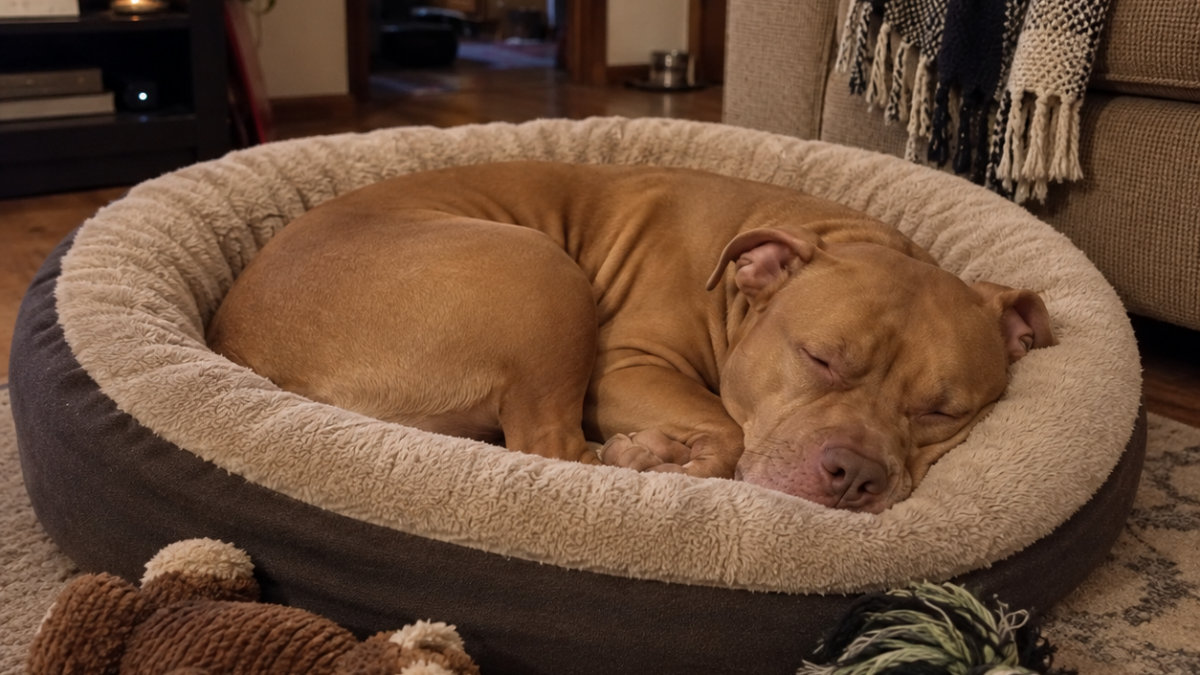
The dog bed by the window stopped her completely.
Sunlight stretched across it exactly as I had imagined.
Rosie walked toward it.
Slowly.
She smelled the edge.
Circled once.
Then lowered herself down.
Her body sank into the padding.
She looked at us.
Daniel whispered, “Look at her.”
“I know.”
Rosie rested her head.
Her eyes stayed open.
We backed away.
No touching.
No celebration.
No crowding.
For almost an hour, she lay there.
Every time one of us moved, her eyes opened wider.
If Daniel stood, she watched.
If I crossed the room, she followed me with her gaze.
But she stayed on the bed.
That was enough.
That evening, we offered dinner.
Rosie approached the bowl.
Stopped.
Looked at us.
I moved farther away.
She ate.
Fast.
Too fast.
Halfway through, I wanted to slow her down.
Daniel stopped me.
“Let her finish.”
“She’ll make herself sick.”
“Not tonight.”
He was right.
The next meal, we could use the slow feeder.
Tonight, she needed to learn something simpler.
Food appeared.
Food remained.
Nobody took it away.
Rosie licked the bowl.
Then licked it again.
Then stood staring.
Daniel looked at me.
“She’s still hungry.”
Megan had given us precise feeding instructions.
We followed them.
No guilt-based overfeeding.
No emotional mistakes.
Still, watching Rosie check an empty bowl felt terrible.
“She’ll get breakfast,” I whispered.
Rosie looked at me.
“Tomorrow morning.”
Her ears shifted.
“You don’t believe me yet.”
That night, we left the bedroom door open.
Rosie’s bed stayed by the living room window.
At midnight, I woke and heard something.
Not barking.
Not whining.
Soft footsteps.
I sat up.
Rosie stood in the hallway.
She saw me move and froze.
“It’s okay.”
She remained there.
I patted the floor beside the bed.
Not asking her to come.
Just showing her I saw her.
Rosie took two steps.
Then stopped again.
Daniel woke.
“What’s wrong?”
“Nothing.”
He looked toward the hallway.
“Oh.”
Rosie stood there for nearly a minute.
Then turned around and returned to the living room.
Daniel smiled.
“She checked on us.”
“I think so.”
The next morning, Rosie was back in her bed by the window.
Sunlight covered half of her body.
I walked into the kitchen.
Her eyes opened.
The food bag rustled.
Rosie stood immediately.
Breakfast.
Promise kept.
When I placed the bowl down, she stared.
Then ate.
Again too quickly.
Afterward, she licked the bowl.
Then looked at me.
I crouched several feet away.
“See?”
She watched.
“Food comes back.”
That sentence became part of our routine.
Food comes back.
I come back.
Daniel comes back.
The bed stays.
The door opens.
The door does not lock you outside.
No one grabs your collar.
No one yells because you are afraid.
Trust was not a feeling we could demand.
It had to become evidence.
Day after day.
By the third morning, Rosie had learned the breakfast schedule.
At 6:25, she sat near the kitchen.
At 6:30, she stared at us.
Daniel laughed.
“She’s already management.”
“Good.”
At 6:32, she gave one tiny whine.
I nearly dropped the scoop.
“Did you hear that?”
Daniel looked offended.
“Of course I heard it.”
Rosie’s ears moved.
I poured the food.
“Complaining already.”
It was the first vocal sound we had heard from her.
Not fear.
Not distress.
An opinion.
We celebrated quietly after she ate.
The first week passed in small milestones.
Rosie stopped flinching when we moved across the room.
She learned the sound of the dishwasher.
She discovered that the vacuum cleaner was unacceptable.
She began sleeping deeper.
Not fully relaxed.
But better.
Sometimes her legs twitched during dreams.
Sometimes she woke suddenly and looked around.
Then saw us.
Settled again.
The first time she touched one of the toys happened on day six.
It was a stuffed fox.
Rosie smelled it.
Pushed it with her nose.
The fox squeaked.
Rosie jumped backward.
Daniel laughed before he could stop himself.
Rosie looked at him.
“I’m sorry.”
He immediately covered his mouth.
Rosie stared at the fox.
Approached again.
Squeak.
This time she stayed.
She bit the toy gently.
Squeak.
Her ears lifted.
She bit again.
Squeak.
Five minutes later, the fox was in her bed.
By the end of the week, she carried it from room to room.
We named it Mr. Fox.
Yes, it was ridiculous.
No, we did not care.
The first tail wag came on day eight.
Daniel was making eggs.
A tiny piece fell.
Rosie saw it.
Daniel picked it up.
“Can she have this?”
“Plain?”
“Yes.”
“Tiny piece.”
He handed it to her.
Rosie ate.
Then her tail moved.
Not much.
One soft sweep.
Daniel froze.
“Do it again.”
I laughed.
“She’s not a machine.”
He offered another tiny piece.
Tail.
Again.
Daniel looked like someone had handed him a winning lottery ticket.
“We got a wag.”
“We got bribery.”
“I’ll take it.”
Soon Rosie followed Daniel into the kitchen every morning.
Then she started following me into the office.
At first, she stayed in the doorway.
Then beside the desk.
Then under the desk.
One afternoon, I felt something touch my ankle.
Rosie had rested her chin on my foot.
I stopped typing.
She looked up.
“You okay?”
Tail tap.
I didn’t move for twenty minutes because I was afraid to ruin it.
By the second week, Rosie had discovered the couch.
Not sitting on it.
Standing beside it.
Watching us.
Daniel patted the cushion.
She backed away.
He stopped immediately.
“Too much.”
The next night, she approached again.
No invitation this time.
She placed two front paws on the cushion.
Then jumped off.
Progress.
Three days later, she climbed all the way up.
Stood.
Turned twice.
Lay at the far end.
Daniel and I pretended nothing happened.
We watched television.
Rosie watched us.
Twenty minutes later, her eyes closed.
An hour after that, she was asleep.
Real sleep.
On the couch.
With people.
I whispered, “Don’t move.”
Daniel whispered back, “My leg is numb.”
“I don’t care.”
“I haven’t felt my foot in fifteen minutes.”
“Worth it.”
He stayed.
The shelter called the next morning.
Megan.
“How’s my girl?”
“Terrible.”
Silence.
Then I laughed.
“She owns the couch.”
Megan exhaled.
“You scared me.”
“She has a toy.”
“Really?”
“A fox.”
“She playing?”
“Sort of.”
“Sleeping?”
“Better.”
“Eating?”
“As though we may never feed her again.”
“That takes time.”
“I know.”
There was a pause.
Then Megan said, “I’m glad she got you.”
I looked under the desk.
Rosie was asleep on my foot.
“We got her too.”
That was when the legal case came back into our lives.
Two days later, an animal control investigator called.
Officer Elena Ramirez.
“I’m contacting you regarding Rosie’s neglect case.”
I sat straighter.
“Is something wrong?”
“No. Rosie is legally yours.”
I relaxed slightly.
“What do you need?”
“We’re preparing the final report. The prosecutor may move forward against the person connected to the property.”
“You found him?”
“We know who had access.”
“Was he her owner?”
“We have evidence he had been keeping her there.”
My hand tightened around the phone.
“What kind of evidence?”
“Witness statements. Photographs from earlier dates. Messages.”
I looked toward Rosie.
She was lying in sunlight.
“Messages saying what?”
“I can’t discuss everything before charges are filed.”
“Did he know she was tied there?”
“Yes.”
The answer came too quickly for comfort.
“He knew?”
“Yes.”
“During the heatwave?”
“We believe so.”
My anger became immediate.
“Then why wasn’t he arrested the day you found her?”
“Because knowing something happened and proving criminal responsibility are different things.”
“He tied her there.”
“We are building the case.”
I stood and started pacing.
“Rosie almost died.”
“I know.”
“She has scars on her neck.”
“I know.”
“She still freezes when something tightens around her.”
“I know.”
Officer Ramirez’s voice remained calm.
“That is why I need you not to contact anyone involved.”
I stopped.
“I wasn’t planning to.”
“Good.”
She sounded as though she didn’t fully believe me.
“We may need updated photographs showing her current condition.”
“For court?”
“Possibly.”
I looked at Rosie again.
The thought of her becoming evidence bothered me.
“She’s not a prop.”
“No.”
“Her recovery doesn’t erase what happened.”
“Exactly.”
That answer surprised me.
Ramirez continued.
“We document before and after because condition matters. But the charge is about what happened to her then.”
I sat down again.
“What happens if he’s convicted?”
“Penalties depend on the charges and the judge. We’re also seeking an animal-ownership restriction.”
That mattered more than I expected.
“No more dogs?”
“That’s the goal.”
I looked at Rosie.
She had rolled partly onto her side.
Mr. Fox rested beside her.
“Good.”
After the call, I told Daniel.
He became quiet.
Then angry.
More visibly than me.
“He knew she was there?”
“Apparently.”
Daniel walked to the window.
“During that heat?”
“Yes.”
He looked at Rosie.
Her eyes opened.
Daniel softened instantly.
He sat on the floor beside her bed.
Didn’t touch her.
Just sat.
Rosie lifted her head.
After a moment, she moved closer.
Pressed her shoulder against his knee.
Daniel looked at me.
“That’s what gets me.”
“What?”
“She still wants people.”
His voice broke slightly.
“After someone did that, she still wants us.”
I sat beside them.
Rosie looked between us.
We stayed there for a long time.
That night, I thought about revenge.
Real revenge.
The ugly kind.
I imagined the person who left Rosie tied in that yard feeling fear.
Helplessness.
Heat.
Thirst.
I hated myself a little for thinking it.
Then Rosie came into the bedroom.
She stood at the side of the bed.
For the first time, she put her chin on the mattress.
Daniel opened one eye.
“Hi.”
Rosie stared.
He patted the mattress once.
She didn’t move.
We waited.
Rosie stepped away.
Then returned.
She placed one paw up.
Then another.
Climbed onto the bed.
Walked between us.
Turned around.
Collapsed.
Her head landed across my stomach.
Daniel whispered, “Well.”
I laughed quietly.
“This is new.”
Rosie sighed.
Deep.
Relaxed.
Within minutes, she was asleep.
I looked at her.
The revenge fantasy disappeared.
Not completely.
But enough.
Because whatever happened to the person who neglected her, Rosie was here.
Warm.
Fed.
Between two people rearranging themselves because neither wanted to wake her.
That was not justice.
But it was better than revenge.
Still, I wanted accountability.
And eventually, we got it.
Before that happened, Rosie had other battles.
The first was the leash.
She loved the yard.
She did not love leaving the property.
Whenever we approached the sidewalk, she stopped.
Cars scared her.
Trucks terrified her.
Loud voices made her lower herself.
We worked with a trainer named Claire.
Claire specialized in fearful dogs.
The first thing she told us was simple.
“Stop trying to make her brave.”
I frowned.
“What do you mean?”
“Bravery is the result. Safety is the work.”
Claire sat on our porch while Rosie watched through the glass.
“Your job isn’t to prove the sidewalk is safe by dragging her onto it.”
“We don’t drag her.”
“Good.”
“So what do we do?”
“Let Rosie collect evidence.”
The phrase reminded me of Officer Ramirez.
Evidence.
Trust as evidence.
Food comes back.
People return.
Doors open.
No one grabs.
Claire continued.
“Go to the edge of the yard. If Rosie wants to stop there, stop.”
“For how long?”
“As long as necessary.”
“What if it takes months?”
“Then it takes months.”
That answer frustrated me.
It also worked.
Week one, driveway.
Week two, mailbox.
Week three, the neighbor’s hedge.
Then one day Rosie walked half a block.
No panic.
No shaking.
Half a block became one block.
One block became three.
The first time a delivery truck passed us, Rosie tried to retreat.
I moved with her.
Created distance.
She recovered.
Claire smiled.
“That’s progress.”
“She ran away.”
“She communicated.”
That changed how I saw fear.
Rosie didn’t fail when she backed away.
She told us what she needed.
We listened.
Months passed.
Her world expanded.
Slowly.
She discovered the park.
At first, only from the parking lot.
Then the entrance.
Then a bench.
Then the grass.
The first time she rolled in grass, Daniel shouted.
I nearly killed him.
Rosie jumped.
He covered his mouth.
“Sorry.”
She stared at him.
Then rolled again.
We laughed quietly.
The scars around her neck faded beneath new fur.
Her coat became glossy.
She gained healthy muscle.
Her eyes changed most.
At the shelter, they had always looked prepared for something bad.
At home, they became curious.
Demanding, even.
She learned the sound of the treat drawer.
Learned that Daniel dropped more food than I did.
Learned that if she stared at me while I was cooking, I would eventually tell her to stop.
Learned that telling her to stop did not mean punishment.
That mattered too.
One afternoon, I raised my voice at the television during a football game.
Rosie disappeared.
Instantly.
One second she was beside the couch.
The next, gone.
I found her under the dining table.
My stomach dropped.
“Rosie.”
She looked away.
I sat on the floor.
“I’m sorry.”
No movement.
Daniel came in.
“What happened?”
“I yelled.”
“At her?”
“No. At the game.”
He looked under the table.
“Oh.”
I felt terrible.
“I forgot.”
Daniel shook his head.
“You’re allowed to exist too.”
“She thought—”
“I know.”
We stayed nearby.
Didn’t reach.
Didn’t coax.
After ten minutes, Rosie crawled out.
She approached me.
Stopped.
I waited.
She placed her head against my shoulder.
I closed my eyes.
“Sorry.”
Her tail tapped once.
That moment taught me another thing.
Trust doesn’t mean never triggering old fear.
It means fear happens and repair follows.
You apologize.
You slow down.
You prove the relationship survived the mistake.
The next week, I yelled at the television again.
Rosie startled.
But she did not hide.
She looked at me.
I said, “Football.”
Daniel laughed.
Rosie sighed.
Progress.
Four months after adoption, the court notice arrived.
The man connected to the abandoned property had been charged.
His name was Kevin Mercer.
I read it three times.
Suddenly the story had a person.
I hated that.
An anonymous villain is easy.
A name makes anger specific.
Officer Ramirez called.
“You may be asked for a statement about Rosie’s recovery.”
“Do you need me in court?”
“Possibly.”
“What exactly is he charged with?”
She explained.
Failure to provide adequate water and shelter.
Unlawful tethering.
Neglect resulting in physical injury.
Abandonment.
There were other administrative violations related to dogs previously kept at the property.
“Other dogs?”
My voice sharpened.
“There had been complaints before Rosie.”
“What happened to them?”
“Some were rehomed. Records are incomplete.”
“So she wasn’t the first?”
“I can’t say that definitively.”
“But probably.”
“I can’t say.”
I understood why she had to speak carefully.
I did not like it.
“Can he ever own another dog?”
“That’s part of what the prosecutor is asking the court to restrict.”
Daniel overheard enough of the call to understand.
Afterward he said, “I want to go.”
“To court?”
“Yes.”
“You don’t have to.”
“I want him to see her.”
I looked at Rosie.
She was trying to pull stuffing from Mr. Fox.
“I don’t.”
Daniel looked surprised.
“Why?”
“Because she doesn’t owe him that.”
He sat down.
I continued.
“I don’t want her walking into a room full of strangers so someone can see what he almost destroyed.”
“That’s not what I meant.”
“I know.”
I took his hand.
“Her recovery is hers.”
He nodded slowly.
“You’re right.”
The court did not require Rosie.
Thank God.
We attended without her.
The morning of the hearing, I felt sick.
Not scared.
Angry.
Kevin Mercer looked ordinary.
That was almost insulting.
No dramatic villain.
No hard face.
No expression that explained anything.
Just a man in a button-down shirt sitting beside an attorney.
I stared at him and thought:
You knew.
You knew she was tied there.
You knew the temperature.
You knew she had no water.
You knew.
The prosecutor presented photographs.
The abandoned yard.
The post.
The tether.
The empty water container.
Rosie’s raw neck.
Her body condition.
One photograph showed the small patch of shade she had been able to reach.
I looked away.
Daniel squeezed my hand.
Then came witness testimony.
A neighbor had seen Mercer visit the property.
More than once.
Another witness had heard Rosie barking for days, then heard nothing.
That detail almost broke me.
Barking.
Then nothing.
Not because she was okay.
Because she had become too weak.
An animal control officer testified about finding her.
Temperature at the time: 101 degrees.
Surface temperature near the tether: much higher.
No usable water.
No food.
The tether tangled.
Rosie lethargic.
Panting.
Gums dry.
Skin irritated beneath collar.
Mercer’s attorney argued that another person had been caring for the dog.
Responsibility was unclear.
The property was abandoned.
Mercer had personal problems.
He had assumed someone else was providing water.
Assumed.
I hated that word.
The prosecutor introduced messages.
That changed everything.
One message sent to Mercer days before Rosie was found read:
Dog’s still out back. It’s too hot. You need to do something.
His reply:
I’ll handle it.
Two days later:
Seriously, she has no shade.
His reply:
She’s fine.
My nails dug into my palm.
She’s fine.
Daniel whispered, “Don’t.”
“I’m not doing anything.”
“You’re bleeding.”
I looked down.
I had broken skin.
I relaxed my hand.
The final message was from the morning Rosie was rescued.
Animal control is at the property.
Mercer had not replied.
For months, I had imagined some complicated explanation.
Maybe he didn’t know.
Maybe someone else had tied her.
Maybe everything had gone wrong quickly.
Those messages stripped away every excuse I had reluctantly considered.
He knew enough.
That was enough.
The judge eventually found him guilty on multiple counts.
At sentencing, Mercer stood.
He apologized.
Not to us.
Not exactly.
He said he had been going through a difficult period.
He had lost work.
Lost housing.
Had been drinking.
He said Rosie had originally belonged to a former girlfriend.
He said he had agreed to care for her temporarily.
Temporarily.
That word hit me strangely.
He had agreed to take responsibility for Rosie.
Then treated temporary care as disposable.
I thought about how different our own “temporary” decisions had become.
The judge asked him a simple question.
“Why didn’t you surrender the dog?”
Mercer stared down.
“I thought I could handle it.”
“Why didn’t you provide water?”
Silence.
“I don’t know.”
“Why didn’t you respond when told the animal was in danger?”
Mercer’s voice became smaller.
“I was overwhelmed.”
The judge leaned forward.
“Being overwhelmed explains why you failed to act. It does not excuse leaving a dependent animal without basic care.”
That sentence settled something inside me.
Explanation is not absolution.
Mercer received probation, community service, fines, restitution, mandatory counseling, and a multi-year prohibition against owning or keeping animals.
Some people might have wanted more.
Part of me did.
I wanted a punishment that somehow equaled every terrified minute Rosie spent tied in that heat.
No sentence could do that.
No jail term could put water in a bowl retroactively.
No fine could erase the scars.
No courtroom could give Rosie back the version of herself that trusted people before all of this happened.
Outside the courthouse, Daniel was quiet.
“You okay?”
“No.”
“Me neither.”
We walked toward the car.
Halfway there, Officer Ramirez caught up.
“He can’t legally keep animals now.”
“For years?”
“Yes.”
“Good.”
She studied my face.
“Still not enough?”
I looked toward the courthouse.
“I thought I’d feel better.”
“Most people do.”
“Do they?”
“They think sentencing is going to feel like closure.”
“And?”
“Sometimes it just feels like paperwork catching up to pain.”
I looked at her.
“That’s depressing.”
“It’s also useful.”
“How?”
“Because the goal isn’t to make him suffer as much as Rosie suffered.”
I knew.
Still, I let her continue.
“The goal is to stop the next Rosie.”
That did make me feel better.
A little.
When we reached home, Rosie was with Megan, who had agreed to stay with her while we attended court.
The second the door opened, Rosie ran toward us.
Ran.
No hesitation.
No crouching.
Tail whipping.
Mr. Fox in her mouth.
She reached Daniel first.
Then me.
Dropped the toy.
Climbed halfway into my lap.
I laughed through tears.
Megan stood in the kitchen.
“How’d it go?”
I looked at Rosie.
“He can’t own animals.”
Megan nodded.
“Good.”
“That’s all I care about.”
It wasn’t exactly true.
But it became true over time.
The legal case faded.
Rosie’s life grew.
One year after adoption, she was almost unrecognizable.
Not physically.
She still had the caramel coat.
White paws.
Amber eyes.
But the way she carried herself had changed.
At the shelter, Rosie had tried to disappear.
At home, she took up space.
A lot of it.
She stretched diagonally across the couch.
Slept in doorways.
Blocked the kitchen when dinner was late.
Stole Daniel’s socks.
Barked at squirrels.
Demanded the sunny side of the room.
She had become inconvenient.
That delighted me.
A dog who believes she is allowed to inconvenience you believes she belongs.
On her first adoption anniversary, Megan visited.
Rosie heard her voice at the door.
Tail wag.
Megan stepped inside.
Rosie approached.
Smelled her.
Then leaned against her legs.
Megan covered her mouth.
“Oh my God.”
“You okay?”
“She never did this at the shelter.”
Rosie pushed harder against her.
Megan crouched.
“Hi, baby.”
Rosie licked her face.
Megan started crying.
Daniel handed her a tissue.
“Everybody cries around this dog.”
“Shut up.”
“I’m serious.”
Megan laughed through tears.
“She used to flatten herself against the wall when I entered.”
I looked at Rosie.
She was trying to climb into Megan’s lap.
“She’s gotten pushy.”
“Good.”
That became another word I learned to love.
Pushy.
Demanding.
Stubborn.
Nosy.
All the qualities frightened rescue dogs have to earn.
One morning, Rosie woke us at 5:45.
Not because she needed to go outside.
Because breakfast was usually at six.
She stood beside the bed.
Stared.
I opened one eye.
“No.”
Tail wag.
“Too early.”
One soft whine.
Daniel pulled the blanket over his head.
“Your dog.”
“Our dog.”
“She likes you more.”
“That’s false.”
Rosie placed one paw on the mattress.
I laughed.
“Extortion.”
At 5:52, we gave up.
Rosie ate.
Victory.
By eighteen months, she loved the car.
The same dog who had curled silently in the back seat on the first ride now jumped in before the door fully opened.
She knew car rides meant park.
Hiking trail.
Megan’s house.
Veterinarian, unfortunately.
The vet was her least favorite.
Not because she feared the doctor.
Because thermometers offended her.
At one appointment, Dr. Shah tried to take her temperature.
Rosie sat down.
He repositioned.
She sat harder.
“I think she’s declining consent.”
I laughed.
Dr. Shah smiled.
“She has strong boundaries.”
“Very.”
Eventually they got the job done.
Rosie stared at him afterward as if documenting a formal complaint.
He gave her cheese.
Complaint withdrawn.
Her bloodwork was perfect.
Weight perfect.
Skin healthy.
No chronic issues from the original heat exposure.
Dr. Shah rubbed the fur around her neck.
“The scar tissue is softer.”
I touched the area.
The old band was barely visible now.
“It used to be obvious.”
“She’s healed well.”
I looked at Rosie.
“Yeah.”
But some scars existed where no one could see.
Thunderstorms remained difficult.
Raised voices still unsettled her.
The smell of hot asphalt on summer days made her hesitant.
Metal chains terrified her.
Once, at a hardware store, someone dropped a chain nearby.
Rosie hit the floor.
Instantly.
People turned.
I crouched beside her.
“It’s okay.”
She trembled.
Daniel moved between her and the sound.
We left.
Outside, Rosie needed almost ten minutes before she could walk normally.
That night, I cried in the shower.
Not because Rosie was failing.
Because healing had limits.
You can build years of safety.
One sound can still open an old door in the brain.
But the important thing happened afterward.
Rosie came home.
Ate dinner.
Carried Mr. Fox to the couch.
Slept between us.
The trigger had not taken her life back.
That was healing too.
Not forgetting.
Recovering faster.
Knowing where safety lives.
Two years after adoption, we moved into a house with a larger yard.
Rosie hated moving day.
Boxes appeared.
Furniture disappeared.
Her anxiety returned.
She followed us constantly.
When Daniel carried her bed toward the truck, Rosie panicked.
She grabbed the edge in her mouth and pulled backward.
Daniel immediately set it down.
“Okay.”
Rosie stood over the bed.
Tail tucked.
I sat beside her.
“It’s coming.”
She watched me.
“We’re all going.”
I knew words were not enough.
So we changed the moving plan.
Rosie and I drove to the new house first.
Her bed came with us.
Mr. Fox.
Bowls.
Blanket.
Treats.
I set everything in the new living room.
Then we waited.
Rosie smelled the walls.
Walked through every room.
Found the large window.
Sunlight.
Of course.
She stood in it.
I smiled.
“Apparently we have a requirement.”
Daniel arrived later with the truck.
Rosie ran to the door when she heard his voice.
No shaking.
No hiding.
Because this time, change did not mean abandonment.
It meant the whole family moved.
Together.
The new yard changed her.
She ran.
Really ran.
Not the cautious short bursts we had seen before.
Full speed.
Around trees.
Across grass.
Back to us.
At first, her own freedom seemed to surprise her.
She would sprint twenty yards.
Stop.
Look back.
Then run again.
I wondered whether some part of her still expected the tether to stop her.
It never did.
One afternoon, she found a sunny patch near the fence.
She lay down.
Closed her eyes.
I stood at the kitchen window watching.
Heat had once meant danger.
Now sunlight meant choice.
She could lie there.
She could move.
She could go inside.
Water waited ten feet away.
The door was open.
That distinction mattered more than I could explain.
Sometimes justice is not the opposite suffering.
Sometimes justice is choice restored.
By year three, Rosie had a new fear.
The mail carrier.
Not the person.
The rolling mail cart.
Rosie hated the wheels.
Every afternoon, she barked from the window.
The first time, I laughed.
“Who are you?”
She barked again.
“Where was this confidence at the shelter?”
Tail high.
Bark.
Our formerly silent dog had opinions about federal mail delivery.
Daniel started calling her Neighborhood Security.
The mail carrier eventually met her in the yard.
Rosie approached carefully.
Received a biscuit.
The rolling cart remained evil.
The human became acceptable.
Progress.
That year, something happened that brought the old case back unexpectedly.
Officer Ramirez called.
I hadn’t heard from her in almost two years.
“How’s Rosie?”
I smiled.
“Bossy.”
“Excellent.”
“What’s up?”
She paused.
“Kevin Mercer violated the animal-ownership restriction.”
My stomach tightened.
“What?”
“A neighbor reported a dog at his residence.”
Anger came back so fast it surprised me.
“What kind of dog?”
“Adult mixed breed.”
“Condition?”
“Good.”
That mattered.
“Is the dog safe?”
“Yes. Removed temporarily while the violation is handled.”
“He knew he couldn’t have one.”
“Yes.”
“What happens now?”
“Court will decide.”
I felt old revenge waking up.
“He shouldn’t ever be allowed near another animal.”
Ramirez was quiet.
Then she said, “That’s why the order exists.”
The violation hearing happened quickly.
We did not attend.
I realized I didn’t need to.
Rosie was not part of it.
The court extended the restriction and imposed additional penalties.
The dog was legally transferred to a relative who had already been caring for it and passed the required checks.
No new neglect.
No new Rosie.
That mattered more than punishing Mercer.
When Ramirez gave me the update, I thanked her.
Then I deleted the case number from my phone.
For the first time, I did not want to know anything else about him.
His story had taken enough space.
Rosie deserved the rest.
By year four, Mr. Fox was gone.
Not peacefully.
Rosie had finally discovered the pleasure of destruction.
We came home to find white stuffing everywhere.
Rosie sat in the center.
One piece stuck to her nose.
Daniel stared.
“No.”
Rosie wagged.
“You murdered him.”
More wagging.
I picked up the empty fabric shell.
“Four years of friendship.”
Rosie sneezed.
Stuffing flew.
We laughed until we cried.
The next day, we bought another fox.
Rosie destroyed that one in two weeks.
Apparently healing included violence against stuffed woodland creatures.
We accepted it.
One morning, a neighborhood child named Emma asked if Rosie could come to her school’s reading event.
I hesitated.
A room full of children?
Noise?
Movement?
Rosie had come far.
Still.
We consulted Claire.
“Does Rosie enjoy children?”
“Calm ones.”
“Does she enjoy unfamiliar indoor spaces?”
“Sometimes.”
“Then don’t decide based on what would make a good story.”
That was classic Claire.
“What do you mean?”
“Test whether Rosie likes it.”
So we visited the empty school first.
After hours.
Rosie walked the hallway.
Smelled classrooms.
Jumped at the bell.
Recovered.
Second visit, two teachers.
Third visit, three children.
Rosie chose to approach.
Lay down.
Accepted gentle petting.
The actual event was carefully controlled.
Six kids.
Quiet room.
No crowding.
One boy sat on the floor reading.
Rosie lay beside him.
Halfway through the book, she rested her head on his shoe.
The boy stopped.
Whispered, “She likes me.”
I smiled.
“Looks like it.”
Afterward, his mother approached.
“She’s a pit bull?”
“Yes.”
“I’ve always been nervous around them.”
Rosie was standing beside me.
The mother looked embarrassed.
“I’m sorry.”
“You don’t have to apologize to me.”
She crouched slightly but did not reach.
Rosie approached.
Smelled her hand.
Then walked away.
The woman laughed.
“I guess she has better things to do.”
“She usually does.”
That moment reminded me of our own first visit.
We had arrived with expectations too.
Maybe different ones.
Still expectations.
Rosie had taught us to replace them with observation.
What is the dog actually doing?
What is she actually feeling?
What does she actually need?
Not what do we assume?
That was a better way to meet animals.
Possibly people too.
On Rosie’s fifth adoption anniversary, we drove back to the shelter.
Not because she needed to.
Because Megan was retiring from full-time rescue work.
She asked if Rosie could visit.
We went after closing to keep the building quiet.
The hallway had changed.
New paint.
New kennel doors.
But the smell was similar.
The sounds.
Rosie stepped inside.
Her body changed.
Tail lower.
Pace slower.
I felt guilty instantly.
“Maybe this was a mistake.”
Megan crouched at the end of the hallway.
“Rosie.”
Rosie looked up.
She recognized the voice.
Tail.
One wag.
Then another.
She walked toward Megan.
Slowly at first.
Then faster.
Megan sat on the floor.
Rosie reached her.
Climbed straight into her lap.
Seventy pounds of dog.
Megan laughed and cried.
“Oh, sweetheart.”
Daniel leaned against the wall.
I looked toward the old kennel area.
“Which one was hers?”
Megan pointed.
The kennel was empty.
The thin gray blanket was gone.
The corner looked ordinary.
For years, I had pictured Rosie there whenever I thought about the shelter.
Small.
Curled.
Trying to disappear.
Now Rosie stood in the hallway blocking traffic because she wanted Megan’s attention.
I smiled.
“Good.”
Daniel looked at me.
“What?”
“I’m glad it’s empty.”
Before we left, Rosie walked past the kennel.
She smelled the door.
Paused.
Then kept going.
No dramatic reaction.
No recognition we could identify.
Just forward.
I liked that.
We humans are obsessed with symbolic moments.
Animals often just keep walking.
On the drive home, Rosie sat upright in the back seat.
Window cracked slightly.
Nose moving.
No blanket wrapped around her.
No cautious eyes.
She loved car rides now.
Daniel looked in the mirror.
“Remember the first drive?”
“Yeah.”
“She barely moved.”
“I know.”
Rosie looked out the window.
Sunset crossed her face.
She leaned into it.
Exactly as she had the first day.
I felt my throat tighten.
“Some things stay.”
Daniel smiled.
“The good ones.”
That night, Rosie slept near the window.
We had moved her bed several times over the years.
She always returned to sunlight.
By the sixth year, white hair appeared around her muzzle.
I objected.
“You’re not old.”
Rosie sneezed.
“Stop.”
Daniel laughed.
“She’s aging.”
“No.”
“Biologically—”
“No.”
The veterinarian agreed with Daniel.
Traitor.
Mild arthritis.
Nothing serious.
We added joint supplements.
A lower bed.
Ramps.
More rugs.
Shorter hikes.
Rosie adjusted.
She always did.
Her favorite activity became lying on the porch while we drank coffee.
Sometimes neighbors stopped.
Rosie watched.
Some people asked to pet.
Some didn’t.
Some still saw a pit bull before they saw Rosie.
I no longer felt obligated to fix that every time.
Rosie was not public property.
She didn’t owe strangers an education.
Her life was enough.
One afternoon, a man walking past stopped.
“That dog friendly?”
I looked at Rosie.
Rosie looked at him.
“Usually. She chooses.”
He laughed.
“Fair.”
He held out a hand loosely.
Rosie walked over.
Sniffed.
Accepted one chest scratch.
Then returned to her bed.
The man smiled.
“She knows what she wants.”
“Yes.”
That might have been the greatest transformation.
Rosie knew what she wanted.
Food on time.
Sunlight.
Walks.
Distance from fireworks.
No metal chains.
Daniel’s side of the couch.
The soft blue blanket.
Peanut butter after medication.
No rain.
Absolutely no rain.
She had preferences.
She expected them to matter.
That expectation came from belonging.
One summer afternoon, temperatures climbed above one hundred degrees.
We kept Rosie inside.
Air conditioning.
Water.
Short bathroom breaks.
At noon, she stood by the patio door.
“No.”
Tail wag.
“It’s too hot.”
She stared.
“You’re not going out there.”
Whine.
Daniel called from the kitchen.
“She needs to pee.”
“She went twenty minutes ago.”
Rosie stared harder.
I opened the door.
Heat poured in.
Rosie stepped onto the shaded patio.
Smelled the air.
Then immediately turned around.
Back inside.
I laughed.
“Good decision.”
She drank water.
Walked to the living room.
Lay beneath the fan.
I stood there watching her.
Heatwave.
The word still carried history.
But this time, heat was outside a door she could leave.
Water was full.
Shade was everywhere.
Humans were paying attention.
The past could not repeat itself accidentally.
We would not let it.
That was another form of accountability.
Not legal.
Personal.
Rosie’s history made us careful.
Not fearful.
Careful.
At seven years with us, Daniel developed pneumonia.
Nothing catastrophic.
Still, he was sick for almost two weeks.
Rosie became his nurse.
She stayed beside the couch.
Followed him to the bathroom.
Ignored me completely when I called her for a walk unless Daniel came too.
“You’ve chosen,” I told her.
Tail wag.
“You have betrayed me.”
She rested her head on Daniel’s leg.
He smiled weakly.
“She loves me more.”
“I’m aware.”
One night, his fever rose.
I sat beside him checking the thermometer.
Rosie paced.
Finally, she climbed onto the couch.
Pressed her chest against his.
Daniel placed one hand on her back.
Her body relaxed.
I watched them.
The dog we once worried would never trust touch was now offering it.
Not because anyone trained her.
Because attachment had become instinct.
Care had become reciprocal.
That moved me more than anything else.
We adopted Rosie thinking we were giving her a home.
Years later, home was something she gave back.
When one of us was sick.
Sad.
Overwhelmed.
Rosie appeared.
Sometimes she leaned.
Sometimes she sat near us.
Sometimes she brought a destroyed toy.
She never solved anything.
She stayed.
That was enough.
On the eighth anniversary of the day we met Rosie, Megan sent me the first shelter photograph.
I had never seen it.
Rosie in the kennel.
Thin gray blanket.
Body curled tight.
Eyes up.
Wall behind her.
I stared for a long time.
Daniel came beside me.
“What’s that?”
I showed him.
He stopped.
“Oh.”
Rosie was asleep across the room.
Old now.
Gray muzzle.
Healthy weight.
One hind leg twitching in a dream.
Daniel looked from the photograph to the dog.
“Doesn’t look like her.”
“It is.”
“You know what I mean.”
I did.
The body was the same.
The expression wasn’t.
In the photograph, Rosie looked like she was asking the world not to notice her.
Now she snored.
Loudly.
Across the center of the room.
Taking up maximum space.
I laughed.
Daniel looked at me.
“What?”
“Nothing.”
Rosie snored again.
“Actually, everything.”
I saved the photograph.
But I didn’t frame it.
I didn’t want the worst day of her life hanging on our wall.
The photos we displayed were different.
Rosie running through snow.
Rosie asleep upside down on the couch.
Rosie with Megan.
Rosie at the beach.
Rosie wearing a ridiculous birthday hat she hated.
Rosie and Daniel in the yard.
Rosie with Mr. Fox Number Three.
Rosie standing in sunlight.
Those were her life.
The shelter photo was history.
History matters.
It doesn’t need to dominate.
One morning, Rosie refused breakfast.
That had never happened.
My heart dropped.
The vet saw her immediately.
Bloodwork.
Imaging.
Exam.
Nothing catastrophic.
Stomach upset.
Maybe age.
Maybe something she ate in the yard.
She received medication and fluids.
By evening, she wanted chicken.
I nearly cried.
Daniel laughed.
“You’re ridiculous.”
“She didn’t eat breakfast.”
“One meal.”
“Rosie does not miss meals.”
Rosie stared at the chicken.
“See?”
We followed veterinary instructions.
Small portions.
Rosie recovered.
But the scare reminded us that time was moving.
I hated that.
Rescue stories often end with “forever home.”
Forever is emotionally true.
Biologically, it isn’t.
Dogs give us their whole lives.
We only get part of ours with them.
As Rosie aged, I became more aware of every ordinary thing.
The sound of her nails on the floor.
The weight of her head against my leg.
The way she sighed before sleep.
The morning sun across caramel fur.
The small scar on her front leg.
The old rough patch beneath her neck.
Daniel sometimes caught me staring.
“Stop.”
“What?”
“You’re doing the sad thing.”
“I’m not.”
“You are.”
“I’m appreciating.”
“That’s suspiciously close.”
He was right.
I had to remind myself not to grieve Rosie while she was still here.
She didn’t.
Rosie worried about dinner.
The present was enough for her.
So I tried to follow.
Walk.
Sun.
Nap.
Dinner.
Couch.
One day at a time.
At nine years together, Megan visited again.
She moved more slowly now.
So did Rosie.
Megan sat on the floor with difficulty.
Rosie walked over.
Pressed her head into Megan’s lap.
Same gesture as the day we met her.
Megan froze.
Then smiled.
“She remembers.”
“Maybe.”
“No. She does.”
I didn’t argue.
Megan scratched behind Rosie’s ears.
“Do you know what I thought when you two sat in that kennel?”
“What?”
“That you were going to leave.”
I was surprised.
“Really?”
“Most people did.”
Rosie’s eyes closed.
Megan continued.
“They wanted immediate affection. They wanted a dog who made them feel chosen right away.”
“We almost expected that too.”
“But you sat down.”
Daniel smiled.
“We didn’t know what else to do.”
“That was it.”
“What?”
“You stopped asking her to perform.”
I looked at Rosie.
That felt true.
Our relationship started when we stopped expecting her to convince us.
No wag required.
No kiss.
No enthusiastic greeting.
She was allowed to be afraid.
And somehow, that made room for courage.
Later that evening, after Megan left, Rosie went to the front window.
The sun was low.
She lay down.
I sat beside her.
“You know, you were terrible at adoption marketing.”
One ear moved.
“No enthusiasm.”
Tail tap.
“No presentation skills.”
Another tap.
“You barely looked at us.”
Rosie turned her head.
I smiled.
“Lucky for you.”
She rested her chin on my leg.
We sat in the fading sunlight.
I thought about Mercer.
For the first time in years.
Not because I missed the anger.
Because I realized how small he had become.
Once, he occupied so much space in my mind.
The person who knew.
The person who failed.
The man in court.
The messages.
She’s fine.
Now he was barely part of Rosie’s story.
That might have been the greatest revenge after all.
He had once controlled her entire world with a tether.
Where she could move.
Whether she reached shade.
Whether she had water.
Whether she was safe.
Years later, his name meant almost nothing inside the life Rosie built.
He was not the center.
He didn’t deserve to be.
The center was Rosie.
The dog who moved from a corner.
The dog who took two steps.
The dog who placed her head in Daniel’s lap.
The dog who came home.
The dog who learned breakfast returns.
The dog who discovered squeaky toys.
The dog who ran across grass.
The dog who hated mail carts.
The dog who became a nurse when Daniel was sick.
The dog who aged in a house full of sunlight.
Mercer’s punishment had mattered.
The ownership ban mattered.
The court record mattered.
The fact that another dog was protected years later mattered.
But Rosie’s real victory was becoming too large a life to be defined by what he had done.
That is what healing should do when it can.
Not erase the past.
Reduce its authority.
On the tenth anniversary of Rosie’s adoption, we did nothing dramatic.
She couldn’t handle long outings anymore.
Her arthritis was worse.
Her hearing had softened.
We gave her breakfast.
A short walk.
Her favorite blanket.
A small dog-safe treat.
Then we opened the curtains.
Sunlight filled the living room.
Rosie walked slowly toward it.
Same place.
Different house.
Different decade.
She lowered herself onto the rug.
Daniel sat on one side.
I sat on the other.
Rosie rested between us.
He rubbed her chest.
“You remember the first day?”
“Every second.”
“She walked to me.”
“I know.”
“You were jealous.”
“I absolutely was.”
He laughed.
Rosie’s tail moved.
Still.
After all these years.
I touched the thin scar around her neck.
Almost invisible.
“You know what I remember most?”
Daniel looked at me.
“What?”
“The first night.”
“Her sleeping?”
“Yes.”
Rosie’s breathing was slow.
Peaceful.
“The way she finally slept.”
Daniel nodded.
“She was exhausted.”
“Not just tired.”
I looked down at her.
“She stopped waiting for something bad.”
That was the first miracle.
Not the adoption paperwork.
Not the court case.
Not the first run.
Sleep.
A body deciding it was safe enough to become defenseless.
Years later, Rosie still slept deeply.
Sometimes upside down.
Sometimes snoring.
Sometimes kicking in dreams.
Every peaceful nap was an answer to the frightened dog in the kennel.
You can rest.
Nothing is coming.
You do not have to watch the door.
No one is leaving you outside.
No one is tying you anywhere.
You are home.
That afternoon, Rosie woke.
Looked at us.
Slowly stood.
Then walked to the kitchen.
Daniel checked the clock.
“Dinner’s in forty minutes.”
Rosie stared.
He looked at me.
“She’s early.”
“She’s always early.”
Rosie whined.
I laughed.
“The shelter said she barely moved.”
Daniel stood.
“People change.”
“So do dogs.”
He prepared dinner.
Rosie waited beside him.
Tail moving.
I watched.
There was something perfect about an old dog demanding food.
Once, she had no reason to expect the next meal.
Now she complained when it was late.
That was not greed.
That was faith.
Faith that tomorrow’s breakfast would come too.
After dinner, Rosie returned to the living room.
She climbed onto her bed with difficulty.
I helped rearrange the blanket.
She looked offended.
“Sorry.”
She circled.
Lay down.
Daniel turned off the overhead light.
Only the lamp remained.
Rosie sighed.
I sat nearby.
Ten years earlier, we had gone to a shelter believing we were choosing a dog.
That was how I described it then.
We’re going to pick a dog.
I don’t say that anymore.
We met Rosie.
That’s different.
She wasn’t an item in a kennel.
Not a breed label.
Not a neglect case.
Not a project.
Not a lesson.
She was Rosie.
Afraid.
Complicated.
Gentle.
Stubborn.
Funny.
Demanding.
Quiet until she wasn’t.
Strong without needing to look brave.
And when she took those first steps across the kennel, she didn’t prove she deserved us.
She gave us the opportunity to deserve her.
That took years.
Maybe it took the rest of her life.
And if I could return to that first afternoon and speak to the person sitting on the concrete floor, I would tell myself one thing.
Do not mistake fear for emptiness.
There is an entire dog inside that silence.
You just have to give her time.
She will bark at the mail.
Destroy stuffed foxes.
Wake you before breakfast.
Steal your place on the couch.
Make you spend ridiculous money on orthopedic beds.
Terrify you every time she skips a meal.
Teach you more about patience than you wanted to learn.
And one day, long after the shelter smell is gone from her fur, you will barely remember what the house felt like before she lived in it.
Rosie had been overlooked for nearly four months because she wouldn’t run to the kennel door.
Families wanted a sign.
A wag.
A kiss.
Excitement.
Rosie had none to give yet.
She was surviving.
That should have been enough.
I am grateful we sat down long enough to see it.
The revenge people sometimes ask about came too.
The man responsible faced consequences.
He lost the right to keep animals.
When he broke that order, the system stepped in again.
No second dog had to become Rosie.
That mattered.
But the revenge I remember is quieter.
Rosie sleeping in sunlight.
Rosie drinking from a full bowl.
Rosie choosing when to go outside.
Rosie walking away when she wanted space.
Rosie coming closer when she wanted touch.
Rosie growing old.
Growing old might have been the greatest victory.
Neglect nearly stole that from her.
It didn’t.
She got gray hair.
Arthritis.
Slower mornings.
Longer naps.
Vet appointments.
Birthday treats.
Ten years of ordinary life.
There is something beautiful about an animal surviving long enough to become old.
Especially when someone once treated her future as disposable.
One evening, near the end of summer, Rosie was lying by the front window.
The same angle of sunlight covered her face.
I sat beside her.
Her eyes were mostly closed.
Daniel came in carrying laundry.
“She okay?”
“Perfect.”
He looked at her.
“She’s snoring.”
“Exactly.”
He put the basket down.
Rosie opened one eye.
“You see?” I whispered.
Daniel smiled.
“Still checking.”
Rosie closed the eye.
No fear.
Just irritation at being disturbed.
I laughed.
That was how I wanted to remember her.
Not the shelter.
Not the tether.
Not the courtroom.
An old pit bull annoyed because two humans would not stop admiring her nap.
The first day, Rosie put her head in Daniel’s lap as if she were exhausted from being afraid.
Years later, she still did it.
Only now there was no trembling.
She did it because she liked him.
Because she knew he would stay.
Because she knew his lap belonged partly to her.
She had moved from asking for safety to expecting love.
That is a long distance.
Longer than the few feet across that kennel.
And Rosie crossed it one careful step at a time.
The day we adopted her, I thought we were bringing home a frightened pit bull who needed a second chance.
I was wrong about one thing.
Rosie did not need us to give her value.
She already had it.
What she needed was enough safety to remember.
Enough time to learn that a hand could reach toward her without hurting.
That a leash could lead somewhere good.
That a door could close with her inside a home instead of outside one.
That a bowl could empty because she ate everything, not because no one filled it.
That sunlight could mean comfort instead of dangerous heat.
That people could leave the room and return.
That people could make mistakes and repair them.
That love did not always disappear.
We were lucky enough to watch her learn.
And she was patient enough to teach us too.
If I had to choose one image from Rosie’s entire life, it would not be the courtroom victory.
Not the day she ran.
Not even the moment she first came toward us.
It would be that first night.
The house dark.
Everything quiet.
Rosie asleep on the bed beside the window.
Her breathing slow.
Her paws relaxed.
The muscles around her eyes finally soft.
Because that was the moment something changed before any of us fully understood it.
A dog who had spent months trying to disappear allowed herself to be seen sleeping.
No guarding.
No watching.
No corner.
No wall pressed against her back.
Just a bed.
A blanket.
Sunlight waiting for morning.
And two people nearby who had already decided she would never have to face another night alone.
Rosie did not know that yet.
But eventually she did.
We proved it with breakfast.
With walks.
With medicine.
With apologies.
With quiet.
With years.
Thousands of ordinary promises kept.
That was how trust returned.
Not with one grand rescue.
With repetition.
Home, repeated until she believed it.
Safety, repeated until her body relaxed.
Love, repeated until expectation replaced fear.
By the time Rosie grew old, she no longer looked toward us after every sudden sound.
She did not check whether the bowl would disappear.
She did not hide when visitors entered.
She did not press herself against walls.
She stretched across the middle of rooms.
She took the sunny spot.
She barked when dinner was late.
She fell asleep before we did.
That was the ending.
Not just that Rosie survived.
She stopped living like survival was her only job.
And on the nights when I watched her sleep, I often thought about the first sentence Megan told us at the shelter.
“She’s been here nearly four months.”
Four months of people walking past.
Four months of waiting.
Four months of being too scared to market herself properly to strangers.
Then one afternoon, we sat down.
Rosie moved one paw.
Then another.
Then stood.
Then crossed the kennel.
Then put her head in Daniel’s lap.
That tiny act changed three lives.
Hers.
His.
Mine.
If she had stayed in the corner another ten minutes, we still would have taken her.
I know that now.
But I am grateful she came.
Not because she needed to prove anything.
Because that first step became the beginning of thousands.
Across the kennel.
Into the car.
Through our front door.
Across the living room.
Onto the couch.
Around the block.
Through the park.
Across a new yard.
Into classrooms.
Back through the shelter doors years later.
And eventually, slowly, into old age.
Every step said the same thing.
I am still here.
And every time, we had the privilege of answering:
So are we.
Rosie had spent the beginning of her story tied somewhere she could not leave.
She spent the rest of it choosing where to go.
And every night, no matter how far she wandered through the house, she chose to come back to us.
That was more than enough.
Welcome home, Rosie.
You never had to earn it.
You only had to stay long enough to believe it.




