PART 2: They Thr3w a Pregnant Pit Bull From a Moving SUV—Three Weeks Later, I Found Her in the Same Ditch With Five Puppies
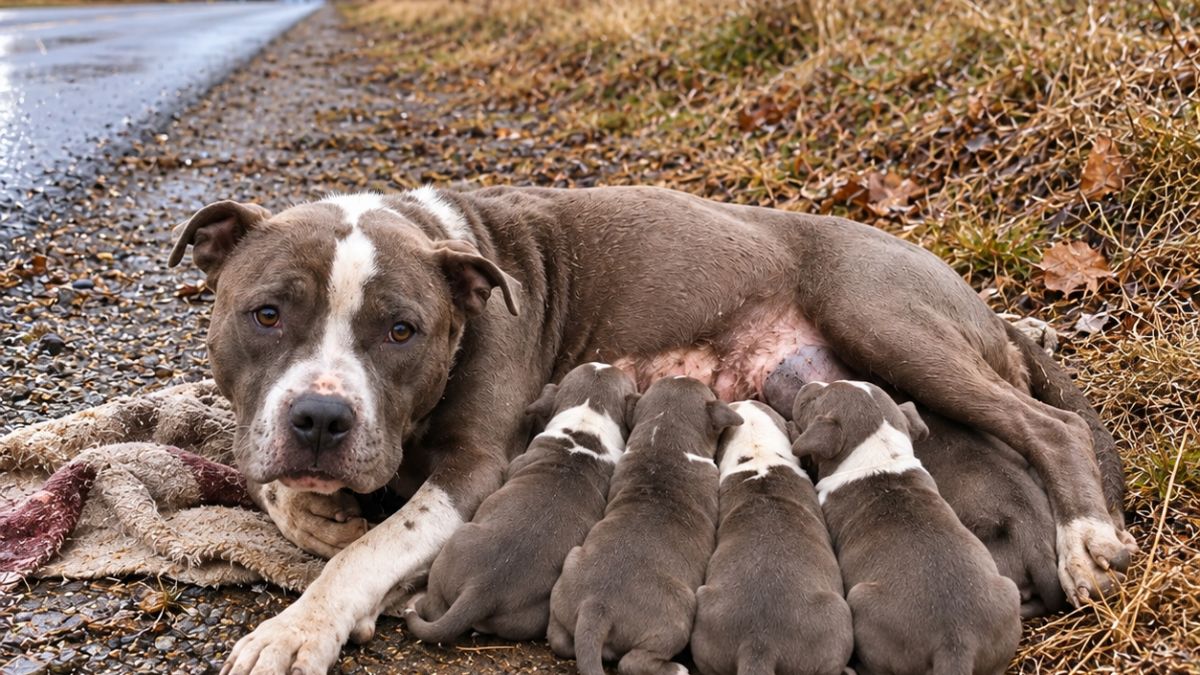
PART 2
The rescue crew moved carefully because we didn’t yet know the full extent of her injuries.
Every time we shifted the stretcher, the dog’s body tightened.
She never snapped.
Never growled.
She simply stared toward the heated crate where the puppies had been placed.
The smallest one was crying.
I watched her ears move.
Then her head lifted half an inch.
“Easy.”
One of the shelter technicians, Maria Santos, placed her hand near the dog’s shoulder.
“They’re right there, Mama.”
The dog’s eye moved toward Maria.
“They’re safe.”
The dog lowered her head again.
I climbed the embankment beside the stretcher.
It took four of us.
Mud pulled at our boots.
Wind cut across the ditch.
By the time we reached the road, I was sweating beneath my jacket despite the freezing temperature.
The truck driver who had first reported the dog three weeks earlier had left his name with deputies.
At that moment, I didn’t know anything about him.
I didn’t know he had searched for her.
I didn’t know he had spent days thinking she died somewhere in that ditch.
All I knew was that this dog had survived long enough to produce five warm puppies while looking like death herself.
Animal control loaded the puppies into one vehicle.
The mother went in another.
I started to return to my utility truck.
Maria called after me.
“You coming?”
I looked at her.
“To the clinic.”
“I’m working.”
She looked toward the stretcher.
Then back at me.
“So were we.”
I called my supervisor.
“I found an injured dog.”
“You found what?”
“Long story.”
“You finishing the pole inspection?”
“Eventually.”
There was a pause.
“Is this an emergency?”
I looked through the open vehicle door.
The pit bull’s head was turned toward the puppy crate in the other truck.
“Yes.”
Another pause.
“Go.”
I drove behind them.
The emergency veterinary clinic was twenty-seven miles away.
Roads were still damaged from flooding.
The entire drive, I kept thinking about what the dispatcher had said.
Thrown from a moving vehicle.
Pregnant.
Three weeks ago.
And somehow back in the same ditch.
At the clinic, the doors opened before we even parked.
Dr. Elise Warren met us with two technicians and a rolling gurney.
“Puppies first.”
The crate went one direction.
Mother another.
I stood in the hallway feeling useless.
Maria checked paperwork.
One animal-control officer called the sheriff’s department.
Another photographed the dog’s condition before treatment changed anything.
A technician asked me:
“Owner?”
“No.”
“Name?”
“No.”
“How long have you had her?”
“I found her an hour ago.”
She looked at my muddy uniform.
“Of course you did.”
The next hour felt endless.
Then Elise came into the waiting room.
She removed her gloves.
I stood.
“How bad?”
She exhaled.
“Bad.”
“Can she live?”
“Yes.”
The answer came fast enough that my knees nearly gave out.
“But?”
“But recovery is going to be difficult.”
“What’s broken?”
“Pelvis fractured in two places. Several ribs have healed or are beginning to heal from earlier trauma. There is significant soft-tissue damage along the abdomen and hindquarters. One rear limb has reduced neurological function.”
“Paralyzed?”
“Not completely. I need more imaging.”
“What about her face?”
“Deep infection around the left eye and cheek. Could be secondary to trauma.”
“Can you save the eye?”
“Too early.”
“And the puppies?”
“All five are stable.”
I closed my eyes.
“All?”
“Yes.”
“They’re healthy?”
“Considering the circumstances, remarkably.”
She sat.
Then her expression changed.
“There’s something else.”
“What?”
“She is severely emaciated.”
“I saw.”
“More than you realize. Based on her frame, I estimate she has lost close to forty-five percent of ideal body mass.”
I stared.
“How is that possible?”
“Pregnancy and nursing are metabolically expensive. She’s been using everything she has.”
Elise tapped the chart.
“Her protein is low. She’s anemic. Dehydrated. Infection markers are elevated.”
“She fed five puppies through that?”
“She fed them with herself.”
I frowned.
“What does that mean?”
“Her body began consuming its own reserves. Fat first. Then muscle.”
I looked toward the treatment room.
“So every pound they gained…”
“Came from somewhere.”
That sentence stayed with me.
Five puppies growing.
One mother disappearing.
Elise continued.
“She should not have been able to do this for long.”
“But she did.”
“Yes.”
“Why?”
The doctor looked at me.
“You want the scientific answer or the emotional one?”
“Both.”
“Biologically, maternal behavior is powerful. Hormonal drive after birth can override pain and self-preservation.”
“And emotional?”
Elise glanced through the window.
“She didn’t quit.”
I sat down.
The sheriff’s deputy arrived twenty minutes later.
Deputy Michael Hayes.
He had handled the original witness call.
“You found her?”
“Yes.”
“In the same ditch?”
“Exactly.”
He rubbed one hand over his face.
“I thought we’d never know.”
“What happened?”
Michael opened his notebook.
“February twenty-third. About 4:40 p.m. Truck driver heading east. Dark SUV westbound. Passenger door opens near the bend. Witness sees dog pushed out.”
“Speed?”
“Witness estimated thirty-five to forty.”
“Did he get a plate?”
“Partial.”
My head came up.
“You have part of the plate?”
“Three characters. Maybe four.”
“Vehicle?”
“Older dark SUV. Possibly Chevy or GMC.”
“What happened after?”
“He stopped. Searched approximately half an hour. Couldn’t find her. Called it in.”
“Why didn’t anyone search again?”
“We did.”
I stopped.
Michael’s expression hardened.
“Animal control and one deputy searched next morning. Nothing.”
“She was there.”
“Maybe deeper in the brush. Maybe moved temporarily.”
I looked at the floor.
“She came back.”
“What?”
“The veterinarian thinks she gave birth less than two weeks ago. She was thrown out three weeks ago.”
Michael understood.
“She could have left the ditch, scavenged, then returned.”
“Because of the puppies.”
He nodded slowly.
“That would explain why no one saw her.”
Anger began rising.
Not explosive.
Cold.
“Can you find the SUV?”
“We’re going to try.”
“You have partial plate.”
“And a rough vehicle description from one witness.”
“There must be cameras.”
“This is rural Kansas, Daniel. Not every county road has surveillance.”
“Gas stations?”
“We checked several last time.”
“And?”
“No useful match.”
I hated how calm he sounded.
“You’re just going to let whoever did this disappear?”
Michael looked at me.
“No.”
Something in his tone stopped me.
“I’m going to build a case I can prove.”
He pointed toward the clinic.
“And right now, her medical records are evidence.”
That became the beginning of the investigation.
The dog went into surgery two days later.
Not immediately.
Elise wanted her stabilized first.
Fluids.
Antibiotics.
Pain control.
Careful nutrition.
The puppies were placed with a foster experienced in neonatal care, but they still spent supervised time near their mother whenever the medical team believed it was safe.
The mother noticed every absence.
Every return.
The first night they separated the puppies completely so she could rest, she refused food.
Second night, same.
Third.
Maria stayed after her shift.
I had returned to the clinic after work.
By then I had started visiting without admitting to myself why.
Maria sat outside the kennel with a container of boiled chicken.
“You try.”
“Me?”
“She knows you.”
“She met me in a ditch.”
“Exactly.”
I sat on the floor.
The dog stared.
The infected eye was swollen nearly shut.
The other followed me.
“Hey.”
Nothing.
“I’m not eating your chicken for you.”
Maria laughed quietly.
I held out a piece.
No response.
Another.
“Your kids are safe.”
Her ears moved.
“They’re noisy.”
One paw shifted.
“Very rude.”
Maria whispered:
“Keep talking.”
“They have heated blankets.”
Another ear movement.
“One of them screams every time somebody picks him up. I’m calling him Mike.”
Maria frowned.
“Why?”
“Sounds like my supervisor.”
She covered a laugh.
The dog looked between us.
I placed the chicken closer.
She sniffed.
Then ate.
One piece.
Another.
Another.
Maria whispered:
“There.”
I fed her until Elise stopped me.
“Small amounts.”
“She’s starving.”
“And her body is fragile.”
“I know.”
“You know now.”
That was the first night she ate willingly.
Afterward, she slept almost twenty hours.
Maria found her name that week.
Grace.
I thought it was too sentimental.
Then I saw the medical staff use it.
“Grace needs her medication.”
“Grace is eating.”
“Grace’s puppies are gaining.”
And somehow it fit.
Not because she had been graceful.
She hadn’t.
She had been thrown from a moving car, crawled through mud, given birth under brush, and nearly starved.
There was nothing elegant about survival.
But grace can mean something given when it wasn’t earned.
A second chance.
A soft hand.
A life that arrives after someone else decides you don’t deserve one.
The name stayed.
Her surgery lasted nearly four hours.
The orthopedic surgeon reopened sections of the pelvis that had begun healing incorrectly.
Plates.
Pins.
Careful reconstruction.
The rear leg remained uncertain.
The eye worsened.
Infection had damaged surrounding tissue.
Despite aggressive treatment, the left eye eventually had to be removed.
I was there the morning Elise told us.
“Will it hurt her?”
“Not after recovery.”
“Will she adapt?”
“She already has.”
I looked at Grace.
She had been seeing mostly through one eye since before we found her.
“What else does she lose?”
Elise looked at me.
“That’s enough, Daniel.”
I knew she meant stop counting losses.
Hard habit.
The puppies grew fast.
Five little pit bull mixes with thick necks and ridiculous paws.
The foster gave them temporary names.
Bean.
Scout.
Rosie.
Otis.
Milo.
Grace eventually accepted seeing them through supervised visits.
The first time the entire litter returned after her surgery, she tried standing too quickly.
Her rear end buckled.
I caught her.
“Easy.”
She ignored me.
Her nose went straight to the puppies.
Sniff.
Lick.
Count.
Again.
The puppies climbed over her.
One stepped directly on her healing incision.
Grace didn’t react.
I moved him.
“Your mother has limits.”
The puppy bit my finger.
“Apparently you don’t.”
By six weeks, all five puppies were ready for adoption.
Applications flooded in after the local newspaper ran a story.
“Mother Dog Found With Five Puppies After Apparent Roadside Abandonment.”
I hated the attention.
Grace hated cameras.
But the article helped.
All five puppies found screened homes.
Good homes.
Veterinary references.
Contracts.
Spay and neuter requirements.
No backyard breeding.
No impulse pickups.
Grace watched them leave one by one.
She searched after the first.
Less after the second.
By the fifth, she seemed tired.
Maybe motherhood had finally become something she was allowed to finish.
The day Milo left, Grace slept for nine hours.
No pacing.
No whining.
Just sleep.
That should have been the peaceful chapter.
Then Michael called.
“We found the SUV.”
I stood so fast my chair hit the wall.
“What?”
“Possible match.”
“Where?”
“Registered forty miles west.”
“Owner?”
“Not giving you the name yet.”
“Michael.”
“Daniel.”
“How sure?”
“Vehicle matches year range and damage pattern. Partial plate fits.”
“What damage?”
“The truck driver remembered a dented rear quarter panel.”
“And?”
“This SUV has one.”
I gripped the phone.
“Who owns it?”
“I’m not telling you until we confirm more.”
I hated him.
He was right.
Two days later, Michael called again.
“Come to the sheriff’s office.”
“Why?”
“Because if I tell you over the phone, you’ll ask fifty questions.”
“That is fair.”
The SUV belonged to a man named Travis Holt.
Forty-three.
Lived outside a neighboring town.
Worked seasonal construction.
Two prior citations for loose dogs.
No serious animal-cruelty conviction.
The vehicle matched.
Still not enough.
Then the truck driver identified it as consistent with what he had seen.
Still not enough.
A gas station camera showed the SUV traveling west shortly before the incident.
Later footage showed it traveling east.
Passenger visible.
Two people inside.
Michael pulled a still image.
“Recognize her?”
A woman.
Dark hair.
Late thirties maybe.
“No.”
“Travis’s girlfriend, Kelly Mason.”
“Which one threw Grace?”
“Witness says passenger door.”
“Kelly.”
“Maybe.”
“Maybe?”
“Passenger could have been Travis at another point. We need proof.”
I stared at him.
“You know what happened.”
“I know what I suspect.”
“Same difference.”
“In court, enormous difference.”
The investigation turned slowly.
Kelly denied everything.
Then said the dog had escaped.
Then said they had given her away.
Then claimed the SUV had been loaned to someone.
Travis said Grace was not their dog.
Then old social-media photographs surfaced.
Grace in their backyard.
Grace wearing a red collar.
Grace beside an outdoor kennel.
Grace pregnant months earlier.
Another photo showed a previous litter.
Then another.
Not her first pregnancy.
A neighbor told deputies Grace had “puppies all the time.”
“How many litters?” I asked Michael.
“At least three we can document.”
“What happened to them?”
“Sold.”
There it was again.
Profit.
The sheriff’s office found old online advertisements.
“Pitbull pups ready soon.”
“Strong bloodline.”
“Good family dogs.”
Cash price.
No medical records for Grace.
No evidence of veterinary reproductive care.
Then came the message that changed everything.
Kelly’s sister contacted investigators.
She had received texts.
One from Kelly two days before Grace disappeared:
“Travis says the gray female is useless after this litter.”
Another:
“Hip looks weird and she’s getting sick.”
Another from the day of the incident:
“We got rid of her.”
Michael showed me the screenshot.
My hands started shaking.
I read it again.
“We got rid of her.”
No emotion.
No explanation.
Three words.
“What did her sister respond?”
“‘She’s pregnant.’”
“And?”
Kelly:
“That’s why I feel bad.”
Nothing after.
I looked at Michael.
“Charge them.”
“We are submitting the case.”
“That’s not the same.”
“It’s the process.”
I stood.
“That dog nursed five puppies with a shattered pelvis.”
“I know.”
“She lost an eye.”
“I know.”
“She almost starved.”
“I know.”
“And they wrote ‘got rid of her.’”
Michael closed the file.
“Which is why I need this case clean.”
I sat back down.
He was right.
Again.
I hated it.
The prosecutor filed animal abandonment and cruelty-related charges several weeks later.
Travis and Kelly both entered not-guilty pleas initially.
Defense attorneys attacked the identification.
Questioned whether the dog in the ditch was the same dog shown in old photographs.
Questioned whether injuries came from the vehicle incident or something later.
Questioned witness reliability.
Questioned the exact speed.
That part enraged me.
Thirty-five?
Forty?
As though there were a morally acceptable speed at which to throw a pregnant dog from a moving vehicle.
Elise became one of the strongest witnesses.
She explained the fractures.
The age of healing.
The pattern consistent with significant blunt-force trauma occurring roughly within the time window described by the witness.
She never exaggerated.
Never said the SUV caused every injury with absolute certainty.
She didn’t need to.
The timeline spoke loudly enough.
The truck driver testified too.
His name was Samuel Price.
I met him outside court.
He was in his sixties.
Tall.
Gray mustache.
He looked nervous.
“You’re Daniel?”
“Yes.”
“You found her?”
“Yes.”
Samuel swallowed.
“I looked.”
“I know.”
“I should’ve stayed longer.”
“No.”
“I left.”
“You called.”
“I left.”
“She was hidden.”
He looked down.
“I keep seeing her hit the road.”
I didn’t know what to say.
So I told him the truth.
“Her puppies lived.”
He looked at me.
“All?”
“All five.”
His eyes filled.
“And her?”
“Alive.”
That almost brought him down.
He sat on the courthouse bench.
Covered his face.
“I thought she was dead.”
“She almost was.”
“I’m sorry.”
“For what?”
“For not finding her.”
I sat beside him.
“You gave deputies the report.”
“Wasn’t enough.”
“It became enough.”
He looked at me.
“You mean that?”
“Yes.”
Without Samuel, there would have been no vehicle description.
No timeline.
No partial plate.
No criminal case.
Grace had needed several people.
Samuel.
Me.
Maria.
Elise.
The surgical team.
Fosters.
Animal control.
Deputies.
Prosecutors.
Rescue rarely belongs to one hero.
It is a chain.
The trial never reached a dramatic jury verdict.
Faced with witness testimony, video evidence, messages, veterinary findings, and old photographs proving prior ownership, Travis and Kelly eventually entered plea agreements.
The exact legal outcome was less cinematic than people wanted.
Fines.
Restitution toward Grace’s medical expenses.
Probation.
Animal-ownership restrictions for a defined period.
No immediate ability to breed dogs.
Formal convictions on the resolved counts.
No heroic judge screaming.
No handcuffs in front of cheering crowds.
Still, consequences.
Real ones.
The morning of sentencing, Kelly looked toward me in the hallway.
Grace wasn’t there.
She had no reason to be.
Kelly approached anyway.
“You’re the utility guy.”
“Daniel.”
“You found her.”
“Yes.”
“She’s alive?”
I stared.
“You didn’t know?”
“I saw the article.”
“Then you knew.”
Kelly looked away.
“I didn’t throw her.”
“Passenger door.”
“Travis pushed her over me.”
That was the first time she said it that way.
“Did you stop him?”
She said nothing.
“Did you call anyone?”
Nothing.
“Did you go back?”
Her eyes filled.
“I wanted to.”
“But?”
“He said she’d be fine.”
I laughed once.
She flinched.
“Fine?”
“I know.”
“No. I don’t think you do.”
She wiped her face.
“You think I don’t feel bad?”
I looked at her.
“Grace does not need your guilt.”
That surprised both of us.
Because I had spent months wanting guilt.
Regret.
Pain.
I wanted whoever did it to wake up remembering.
But standing there, I realized Grace’s life could not depend on whether Kelly suffered enough.
The legal consequences mattered because they protected animals.
Kelly’s emotions did not.
I said:
“She has a chance now.”
Kelly whispered:
“Can I see her?”
“No.”
The answer came immediately.
Not out of revenge.
Protection.
Grace startled violently at slamming car doors.
Panicked near dark SUVs.
Shook when unfamiliar people approached her from the blind side.
She did not need a reunion.
She did not owe anyone closure.
Kelly nodded.
“Okay.”
I walked away.
Travis never spoke to me.
That was fine.
The legal case ended.
Grace’s recovery didn’t.
She spent three months in the shelter medical wing.
Then four.
Her rear leg never regained full function.
She could walk.
Eventually trot.
But always with a hitch in the gait.
The reconstructed hip stiffened in cold weather.
We managed pain.
Physical therapy helped.
Hydrotherapy helped even more.
The first session was terrible.
Grace hated water.
She froze at the edge of the therapy pool.
Maria stood inside.
“Come on.”
Grace backed away.
I stood behind.
“She thinks you’re insane.”
Maria pointed at me.
“You get in.”
“No.”
“Then stop criticizing.”
I rolled up my pants.
Got in.
Cold.
Grace stared.
I held out chicken.
“Your standards are low.”
She stepped closer.
One paw into the water.
Then another.
Eventually we supported her body while she moved her rear legs.
The weak limb twitched.
Then pushed.
Tiny movement.
Maria smiled.
“She’s using it.”
Grace looked betrayed.
“You can hate us later,” I said.
Week after week, strength returned.
Not normal.
Better.
That became our goal.
Not perfect.
Better.
The local newspaper ran another story.
That was how Frank and Ellen Miller found her.
Retired couple.
Late sixties.
Lived on five quiet acres outside town.
They already had an older rescue pit bull named Hank.
Three legs.
I laughed when they told me.
“You collect damaged dogs?”
Frank shook his head.
“Hank would object to that description.”
Ellen smiled.
“We collect dogs who need ramps.”
That was more accurate.
They visited Grace.
She ignored them.
Good.
Frank sat on the floor.
Ellen brought no food.
Also good.
Hank came on the second visit.
He limped toward Grace.
Grace limped toward him.
They sniffed.
Then stood beside each other like two exhausted employees at the end of a shift.
Frank whispered:
“That’s it.”
“What?”
“They understand.”
I rolled my eyes.
“Don’t make it poetic.”
“Too late.”
The home visit was perfect.
Ramps.
Non-slip rugs.
Fenced yard.
Large windows.
Soft beds.
A wood stove.
No busy road nearby.
No loud household.
Ellen had already asked Elise for Grace’s full medical needs before we approved them.
Pain medication.
Future arthritis.
Possible nerve changes.
Eye care for the remaining eye.
Weight monitoring.
They didn’t flinch.
“What happens if she needs more surgery?” I asked.
Frank said:
“Then we pay for more surgery.”
“What if it’s expensive?”
“I’m retired, not dead.”
I laughed.
He reminded me of Robert from another case. Different life, same stubborn old-man energy.
Adoption day came eight months after I found Grace.
Maria cried.
Elise cried.
I did not.
That is my official position.
Grace wore a wide padded harness.
Ellen held the leash.
Frank opened the back of their SUV.
Grace stopped.
Everything in her body changed.
Tail down.
Breathing faster.
Rear leg shaking.
Dark SUV.
I hadn’t considered that.
“Stop.”
Frank did.
Ellen knelt.
“No hurry.”
Grace stared at the open door.
I felt sick.
Of course.
The vehicle itself had become part of the trauma.
“We can use my truck,” I said.
“No,” Ellen answered gently.
“We need to teach her this one ends differently.”
I looked at Elise.
She nodded.
“Slow.”
We spent forty minutes in the parking lot.
Food near the vehicle.
Then on the bumper.
No pulling.
No forcing.
Hank jumped in.
Grace watched.
Hank lay down.
Grace took one step.
Then another.
Front paws on the bumper.
Back down.
Again.
Finally she climbed in.
She immediately turned.
Wanted out.
Ellen left the door open.
Grace could leave.
She didn’t.
Hank remained beside her.
Frank sat on the edge.
Five minutes.
Ten.
Grace lay down.
I exhaled.
“That’s enough for today.”
Frank smiled.
“She’s going home.”
They drove slowly.
I followed.
Not because I distrusted them.
Because I couldn’t help myself.
At their house, Grace exited carefully.
Looked around.
Hank walked toward the porch.
Grace followed.
No ditch.
No asphalt.
No door opening while the vehicle moved.
Car stopped.
Door opened.
She got out safely.
That distinction became part of her healing.
For months, Frank and Ellen practiced short drives.
Around the block.
Home.
Two miles.
Home.
Veterinarian.
Home.
Every ride ended somewhere safe.
Grace never loved cars.
She tolerated them.
That was enough.
At home, she discovered the window.
Huge front window facing a meadow.
Sunlight crossed the hardwood every morning.
Grace found that spot on day one.
She lay down.
Frank sent me a photograph.
Gray-and-white dog.
One eye.
Scars.
Weak rear leg tucked slightly.
Sun across her face.
Message:
SHE FOUND HER OFFICE.
That became her place.
Every morning.
Sun.
Hank nearby.
Ellen reading.
Frank drinking coffee.
Grace asleep.
The first time I visited, she heard my truck.
Came to the door.
Slow.
Limping.
Then faster.
Tail moving.
“Grace!”
She pressed against me.
I knelt.
Her body felt completely different.
Muscle over ribs.
Healthy weight.
Soft coat.
Scars still there.
Always would be.
But scars no longer described the whole dog.
Frank laughed.
“She likes you more.”
“I found her.”
“You abandoned her here.”
“Correct.”
Grace licked my face.
Ellen said:
“She still waits for Hank to eat.”
“What?”
“At breakfast. She won’t start until he does.”
That made sense.
Motherhood had trained her to let others take first.
Or maybe starvation had.
Either way, the habit remained.
Hank ate.
Grace ate.
Every day.
Then something happened one spring morning.
Hank died.
Old age.
Cancer.
Fast decline.
Grace searched.
Room to room.
Window.
Porch.
Yard.
Car.
Frank called me.
“She won’t eat.”
I drove out.
Grace was lying near Hank’s bed.
I sat.
“Hey.”
Her head lifted.
“Yeah.”
I scratched her neck.
“I know.”
We left Hank’s blanket.
Grace slept on it for weeks.
Eventually she ate.
Eventually she stopped searching.
Grief is not only human.
But she remained changed.
Quieter.
More attached to Frank.
Then, six months later, the Millers adopted another senior pit bull.
Three-legged again?
No.
This one had four.
Frank joked they were improving.
Her name was Daisy.
Grace ignored her for two days.
Third day, they shared the sunspot.
That was approval.
Years passed.
Grace aged.
The leg worsened.
Arthritis.
Pain medication.
Joint injections.
More rugs.
More ramps.
The remaining eye developed cataract changes.
Ellen added night-lights.
Grace still startled at car doors.
Less dramatically.
But enough.
One afternoon, I accidentally slammed my truck door outside.
Grace bolted from the porch.
My stomach dropped.
“Grace!”
She stopped.
Looked back.
Frank walked out.
“Easy, girl.”
She stared at the truck.
Then at me.
I crouched.
“Sorry.”
Grace came back.
Slowly.
Tail low.
She sniffed my hand.
Then leaned against my leg.
That was progress.
Fear.
Then recovery.
Not fearlessness.
At around eleven or twelve, she stopped running entirely.
Walks became shorter.
But she still loved the meadow.
Frank built a low platform beneath the window so she could lie comfortably with her hip supported.
She spent hours there.
Sometimes I visited and she barely got up.
I would sit beside her.
She would place her head on my boot.
“That ditch feels like another dog,” I told her once.
Frank overheard.
“What?”
“The dog I found.”
He nodded.
“She is.”
“No.”
I looked at Grace.
“She’s the same dog. Just with more life after it.”
That distinction mattered.
We do animals a disservice when we split them into “before” and “after” as though the suffering disappears.
Grace carried that ditch.
The shattered pelvis.
The car-door sounds.
The missing eye.
The limp.
But she also carried sunlight.
Hank.
Daisy.
Chicken.
Warm rugs.
Frank’s ridiculous baby voice.
Ellen’s hand on her shoulder.
Thousands of mornings after the worst one.
Healing did not delete.
It outnumbered.
Samuel, the truck driver, visited once.
I arranged it with Frank.
He arrived nervous.
Grace was on the porch.
Samuel stopped twenty feet away.
“That’s her?”
“Yes.”
He covered his mouth.
Grace stood.
Limped toward him.
Samuel knelt.
“I’m sorry.”
Grace sniffed.
He cried before she even touched him.
“I’m so sorry I couldn’t find you.”
Grace pushed her nose against his hand.
Samuel broke.
Frank looked away.
Ellen cried.
I stared at the yard.
Samuel whispered:
“You made it.”
Grace licked his fingers.
That visit healed something in him too.
He later told me he had stopped taking County Route 18 because passing the ditch made him sick.
After seeing Grace, he drove it again.
“I don’t see her hitting the road anymore.”
“What do you see?”
“Her on the porch.”
Good.
That is what new memories can do.
Eventually Grace’s story stopped appearing in newspapers.
Good.
The internet moved on.
Good.
She became local history.
Then simply the Millers’ dog.
Better.
When people visited, Frank didn’t introduce her as “the dog thrown from the car.”
He said:
“This is Grace.”
Perfect.
At fourteen—best estimate—her health declined.
Kidneys first.
Then heart.
Elise had retired by then, but another veterinarian, Dr. Patel, managed her care.
Fluids.
Medication.
Diet.
Pain control.
Grace tolerated all of it if chicken appeared afterward.
Some things never change.
One winter morning, Frank called.
“Daniel.”
I knew from his voice.
“What happened?”
“She fell.”
I drove over.
Grace was on her bed beneath the window.
Couldn’t stand.
Not from the old leg.
Whole body weakness.
The clinic ran bloodwork.
Kidney failure advanced.
Heart strain.
Severe arthritis.
Options existed.
Hospitalization.
IV treatment.
Maybe days.
Maybe weeks.
No cure.
Frank asked me:
“What would you do?”
Why do people ask the finder?
As though touching an animal first gives you authority over the last day.
It doesn’t.
I sat beside Grace.
Her eye followed me.
Tail moved once.
I rubbed her chest.
“She fought when she had something to fight for.”
Frank’s face broke.
“And now?”
“She doesn’t have to prove it again.”
Ellen cried.
They chose home euthanasia.
Two days later.
The final morning was sunny.
Of course it was.
Grace lay in her window spot.
Daisy beside her.
Frank cooked chicken.
Grace ate three pieces.
Refused the fourth.
He laughed through tears.
“Leaving food now?”
Grace closed her eye.
I sat on the floor.
The veterinarian arrived at noon.
Grace knew something.
Maybe not what.
She was tired.
Frank lay beside her.
Ellen held her paw.
I sat near her head.
Before sedation, I whispered:
“You remember the ditch?”
Ridiculous question.
I hoped she didn’t.
I changed it.
“Never mind.”
Her eye looked at me.
“You don’t have to.”
Frank rubbed her shoulder.
“You kept five babies alive.”
Ellen said:
“They all had families.”
That was true.
Every puppy.
Adults now.
Some gray.
One adopter still sent Christmas pictures.
Five lives.
Because Grace refused to quit.
I leaned closer.
“They don’t need you now.”
Her breathing slowed even before medication.
“You did it.”
The first sedative went in.
Grace relaxed.
No trembling.
No panic.
I thought about the ditch.
One paw over five puppies.
Even while slipping in and out of consciousness.
Always touching them.
Now her paws rested loose.
Empty.
Nothing to protect.
Nothing to carry.
Frank whispered:
“You’re home.”
Her eye closed.
Ellen kissed her forehead.
The final medication stopped her heart quietly.
The dog who had once been thrown from a moving vehicle died because three people loved her too much to make her keep hurting.
That difference meant everything.
Afterward, Frank gave me one of Grace’s old harnesses.
I didn’t want it.
I took it anyway.
It hung in my garage for years.
Not as a shrine.
Just there.
Sometimes I saw it while grabbing tools.
Remembered.
The county eventually widened Route 18.
The ditch changed.
Drainage improved.
Brush cleared.
The exact place where I found Grace disappeared under new grading.
At first that bothered me.
Then I realized it was fitting.
The ditch didn’t deserve to become a monument.
Grace’s life was bigger than that place.
The better memorial was five adult dogs sleeping in five homes.
Samuel driving the road without guilt.
Maria still fostering neonatal litters.
The Millers adopting another old pit bull after Grace died.
Me stopping when I see something move where it shouldn’t.
That is legacy.
Not a plaque.
Behavior.
Years later, a new utility worker rode with me while I trained him.
We passed the rebuilt section of Route 18.
He pointed.
“Wasn’t there some famous dog story out here?”
I looked toward the embankment.
“Yeah.”
“The one with puppies?”
“Yeah.”
“Did she live?”
I smiled.
“A long time.”
He nodded.
“Good.”
That was enough.
People love sacrifice stories because sacrifice makes sense of suffering.
Mother nearly dies.
Babies live.
Everyone cries.
But Grace was more than sacrifice.
She was also stubborn.
Suspicious.
Terrible in cars.
Obsessed with chicken.
She hated wet grass.
Loved sunlight.
Snored.
Stole Daisy’s bed even though Daisy was smaller.
Once ate half a pumpkin pie off Frank’s counter.
That was Grace too.
Maybe especially that.
The woman who threw her away—or the man who ordered it, or both—became court records.
Names in a file.
Probation terms.
Penalties.
They mattered because consequences protect future animals.
But they did not own the ending.
Grace did.
Her puppies did.
The Millers did.
That is the revenge I believe in.
Not returning violence.
Not fantasizing about someone being thrown from a car because they did it to a dog.
That creates nothing.
The better reversal is taking everything they tried to erase and giving it a future.
They treated Grace like something disposable.
She became irreplaceable.
They left her on asphalt.
She died on a soft bed.
They drove away.
People came back.
Again.
Again.
Again.
They broke her pelvis.
She learned to walk.
They left her pregnant.
Five puppies grew up.
They abandoned her in a ditch.
She got a window full of morning sun.
They gave her one terrible afternoon.
They did not get the years after it.
That is the part people forget when they talk about revenge.
Sometimes the person who hurts an animal loses most completely when the animal’s life becomes too full to contain them anymore.
Grace did not spend her final years hating.
Dogs are lucky that way.
She spent them sleeping.
Eating.
Limping through a meadow.
Lying beside old dogs.
Pressing her head into Frank’s knee.
Watching snow.
Feeling sunlight.
And every ordinary day was a quiet refusal to let one act of cruelty become the definition of her life.
The puppies lived.
All five.
That alone would have been enough.
But Grace lived too.
Long enough to become old.
Long enough to develop arthritis on top of an injury that once should have killed her.
Long enough to lose friends.
Long enough to make new ones.
Long enough for the scars to become something people stopped noticing first.
That is what I remember now.
Not a dying dog in a ditch.
Not first.
I remember an old gray-and-white pit bull lying beneath a window.
One eye closed.
Back leg stretched awkwardly because the hip never moved quite right.
Sun on her coat.
Chicken smell from the kitchen.
Frank complaining because Grace had stolen Daisy’s bed again.
Ellen laughing.
A normal house.
A normal morning.
A dog who should have died three weeks after being thrown away becoming old enough that nobody remembered her age exactly.
If you ask me what sacrifice looks like, yes, I remember that ditch.
A starving mother wrapping one paw around five puppies while her body consumed itself to produce milk.
But if you ask me what justice looks like, I remember everything after.
Grace walking out of the clinic.
Grace entering Frank and Ellen’s home.
Grace surviving car rides.
Grace sleeping beside Hank.
Grace meeting Samuel.
Grace becoming gray.
Grace dying surrounded by people who stayed.
The ditch was where I found her.
It was never where her story belonged.
And the people who threw her away gave up the right to decide how it ended the moment that SUV disappeared down the highway.
Grace decided the rest simply by surviving long enough for better people to arrive.





