PART 2: They Left Her Chained to a Tree for Years—Then I Bought the Property and Found Out Who Put Her There
PART 2
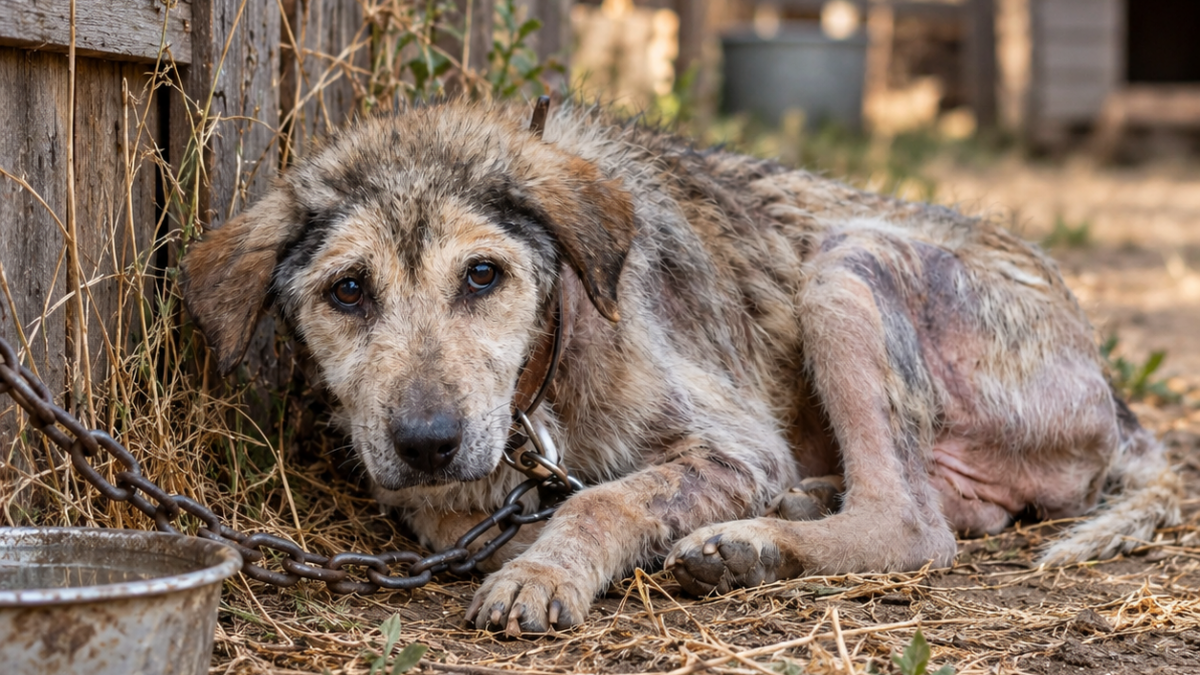
The animal control officer who stepped out of the county truck was a woman in her forties named Maria Lopez.
She had been doing the job for sixteen years.
I knew that because I asked later.
At that moment, all I noticed was the way her expression changed when she saw the dog.
Professionals learn to control their faces.
Veterinary workers do too.
You have to.
You can’t fall apart every time something terrible comes through the door.
But sometimes the body reacts before training catches up.
Maria stopped walking.
Her jaw tightened.
“How long has she been like this?”
“I don’t know.”
“You bought the property?”
“Closed yesterday.”
“Anyone living here?”
“Not according to the sale documents.”
She looked toward the house.
“Previous owner?”
“Estate sale.”
Maria crouched beside me.
The dog watched her but didn’t move.
“Hey, mama.”
The dog’s ear flicked.
Maria studied the chain.
“This isn’t recent.”
“No.”
“Not even close.”
She stood and followed the chain around the tree.
Some of the links were buried beneath roots.
She kicked dirt away.
“Jesus.”
“What?”
“Look.”
Beneath one section of chain, the soil had compacted into a deep groove around the trunk.
Grass had grown over parts of it.
The chain had been there for years.
Maria looked at me.
“Did your realtor tell you about a dog?”
“No.”
“Nothing in the disclosure?”
“Nothing.”
She sighed.
“Okay. We’re documenting everything before we cut her loose.”
My instinct was to argue.
Get her off the chain now.
But Maria was right.
If someone had done this deliberately, every photograph mattered.
She photographed the bowls.
The chain.
The collar.
The sores.
The bare circle of dirt around the tree.
Then she called another officer.
While we waited, I sat beside the dog.
“Do you have a name?”
Her head rested between her paws.
I tried common ones.
“Lucy?”
Nothing.
“Daisy?”
One ear moved, but probably at my voice.
“Maggie?”
No response.
“Rosie?”
Her eyes shifted.
I tried again.
“Rosie?”
The dog’s head lifted.
Maria looked over.
“Do that again.”
“Rosie.”
This time the tail moved.
Weakly.
But clearly.
Maria and I looked at each other.
“That’s her name,” I whispered.
Maria’s expression hardened.
“Then somebody knows her.”
—
Cutting the chain took a bolt cutter and nearly ten minutes.
The collar was worse.
It had stiffened around Rosie’s neck so badly that we couldn’t remove it safely in the yard.
We slid a blanket beneath her and lifted her onto a stretcher.
She cried once.
A thin, frightened sound.
“I’m sorry,” I kept saying.
“I’m sorry, Rosie. We’re getting you out.”
When we carried her toward the truck, something strange happened.
She twisted her head and looked back at the tree.
Not at the house.
At the tree.
The place that had been her entire world.
The circle in the dirt.
The chain.
The bowls.
I wondered if she understood she was leaving.
I hoped she did.
—
At the veterinary clinic, Dr. Evan Cole took one look at her and cleared the examination room.
Rosie weighed thirty-eight pounds.
For her frame, she should have weighed at least sixty.
Her temperature was low.
She had severe dehydration, anemia, flea infestation, skin infection, pressure sores, overgrown nails, arthritis, and a wound beneath the collar that had become infected.
Her teeth were worn down.
Several were broken.
Her ears were full of infection.
Her hips were painful.
One hind leg showed signs of an old untreated fracture.
Then the bloodwork came back.
Dr. Cole stared at the screen.
“What?”
I knew that look.
“Her kidneys?”
“Surprisingly decent.”
“Liver?”
“Elevated but not disastrous.”
“So?”
“Heartworm positive.”
I closed my eyes.
Of course.
He continued.
“She’s also got signs of chronic starvation.”
I looked through the glass.
Rosie lay beneath warmed blankets.
The collar was gone.
The skin underneath was raw and bleeding in places.
“How old?”
“At least ten.”
“Could she be older?”
“Possibly twelve.”
“Can she survive treatment?”
Dr. Cole didn’t answer immediately.
“That depends on what you mean by survive.”
I looked at him.
“Don’t do that.”
“Do what?”
“Give me the veterinarian answer.”
He exhaled.
“Claire, she’s extremely compromised. We have to stabilize her before we even discuss heartworm treatment. She could crash from refeeding if we move too fast. She could develop complications from the infection. Her body has been surviving on almost nothing.”
“Will she make it through tonight?”
“Probably.”
“Probably?”
“That’s the best I can give you.”
I stared at Rosie.
She was watching me.
“Then I’ll take probably.”
—
Maria returned that afternoon.
She had already started asking questions.
“You said the property came through an estate?”
“Yes.”
“Owner was a man named Harold Whitmore.”
I nodded.
“I saw the name at closing.”
“He died three years ago.”
“That matches what I was told.”
Maria opened her notebook.
“His son inherited the place.”
“Then why was it sold through probate?”
“Debt issues.”
“Do we know the son’s name?”
“Daniel Whitmore.”
Something about the way she said it made me look at her.
“What?”
“He’s known.”
“For what?”
“Property disputes. Complaints. Nothing major criminally.”
“Animals?”
“Not officially.”
“Unofficially?”
She hesitated.
“That’s what I’m trying to find out.”
I looked through the treatment-room window.
“Rosie reacted to her name.”
“I know.”
“So someone around here knew her.”
“Yes.”
“Can we ask the neighbors?”
“Already started.”
“And?”
Maria looked at me.
“Claire, this may get ugly.”
“How ugly?”
“We found someone who remembers her.”
My stomach tightened.
“How long?”
“At least six years.”
The room went quiet.
“Six?”
“That’s what he says.”
I looked at Rosie.
“No.”
Maria’s face was grim.
“He says she was already chained there when he moved into the house next door.”
“Six years ago?”
“Yes.”
I sat down.
My legs suddenly felt unreliable.
“You’re telling me she’s been under that tree for six years?”
“I’m telling you that’s what one witness says.”
“Why didn’t he call anyone?”
Maria didn’t answer.
She didn’t have to.
People had reasons.
Fear.
Indifference.
Not wanting trouble.
Believing someone else would act.
None of those reasons mattered to Rosie.
—
The neighbor’s name was Frank Dorsey.
He lived two houses down.
Seventy-three years old.
Retired mechanic.
He came to the clinic the next day.
The moment he saw Rosie through the glass, his eyes filled.
“That’s her.”
“You knew her?”
He nodded.
“Harold called her Rosie.”
“How long was she chained there?”
Frank looked down.
“Long time.”
“How long?”
“Maybe seven years.”
I stared at him.
“You said six yesterday.”
“I moved there seven years ago. She was young then. Maybe three or four.”
My voice sharpened.
“And she was already chained?”
“Most of the time.”
“Most?”
“At first Harold would take her into the shed during winter.”
“Then?”
“Stopped.”
“Why?”
Frank rubbed his hands together.
“Harold got sick.”
“So his son took over?”
“Daniel started coming around.”
I leaned forward.
“What was he like with her?”
Frank didn’t answer.
“Mr. Dorsey.”
“Not good.”
“Define not good.”
“He didn’t like dogs.”
“Then why keep her?”
“She wasn’t his dog.”
“Whose was she?”
Frank looked toward Rosie.
“Harold’s wife.”
That surprised me.
“His wife?”
“Eleanor. Sweet woman. Loved that dog.”
“Where is she?”
“Died eight years ago.”
I understood before he finished.
“Rosie was hers.”
Frank nodded.
“When Eleanor died, Harold kept Rosie inside for a while. Then Daniel started telling him the dog was dirty. Too much work. Said she belonged outside.”
“And Harold let him?”
“Harold wasn’t well.”
“That’s not an answer.”
Frank looked ashamed.
“No.”
It wasn’t.
“Did Daniel chain her?”
“I saw him do it.”
Maria, standing near the door, stopped writing.
“When?”
“About six years ago.”
“Describe it.”
Frank swallowed.
“He took her from the back porch. Put a heavy chain on her collar. Wrapped it around the oak.”
“Did she resist?”
“She kept trying to follow him back to the house.”
Something inside me cracked.
“What happened?”
“He kicked dirt at her and shut the door.”
I looked away.
Rosie was sleeping.
I could see her chest rising under the blanket.
“Did you ever call animal control?”
Frank’s voice dropped.
“Once.”
Maria looked up.
“When?”
“Maybe five years ago.”
“Who responded?”
“Nobody.”
Maria frowned.
“Are you sure?”
“I called. They said they’d send someone.”
She wrote the date range down.
“Did you call again?”
“No.”
“Why not?”
Frank’s eyes moved to mine.
“Daniel came over the next day.”
The room went still.
“What did he say?”
“He asked if I’d been making trouble.”
I felt cold.
“How did he know?”
“I don’t know.”
“Did he threaten you?”
“Not exactly.”
“What did he say?”
Frank hesitated.
Then:
“He said people should mind their own property if they wanted to keep it peaceful.”
Maria’s jaw tightened.
“Did you interpret that as a threat?”
“At the time? Yes.”
I wanted to be angry at Frank.
Part of me was.
But then I looked at his hands.
They were trembling.
He had lived beside that family for years.
He was old.
Alone.
Scared.
Still, Rosie’s suffering had continued.
I couldn’t forgive it yet.
Maybe later.
—
The second witness was worse.
Her name was Teresa Ward.
She had delivered groceries to Harold during the last two years of his life.
“I used to bring scraps for Rosie.”
“Scraps?”
“Chicken. Rice. Whatever I had.”
“Why didn’t Harold feed her?”
“He thought Daniel did.”
My stomach turned.
“What?”
Teresa nodded.
“Harold was nearly blind toward the end. Couldn’t walk well. Daniel told him Rosie was being fed.”
“Was she?”
“Sometimes.”
“How often?”
“Not enough.”
“Did Harold know?”
“I don’t think so.”
I looked at Maria.
“So Daniel told his father he was caring for Rosie.”
“That’s what she’s saying.”
Teresa started crying.
“I should’ve done more.”
“Did you see Daniel mistreat her?”
“Once.”
“What happened?”
“He was spraying the back porch with a hose. Rosie kept barking.”
“Why?”
“I think she was thirsty.”
My stomach clenched.
“What did he do?”
“He sprayed her.”
“With water?”
“Hard.”
“For how long?”
“Until she stopped barking.”
I closed my eyes.
“And you didn’t call?”
“I did.”
My eyes opened.
“You called animal control too?”
“Twice.”
Maria looked stunned now.
“What years?”
Teresa gave approximate dates.
Maria wrote quickly.
“Did anyone respond?”
“Once.”
“What happened?”
“A truck came.”
“Did they inspect Rosie?”
“I don’t know. Daniel was there. The officer stayed maybe ten minutes.”
Maria’s face went hard.
“Do you remember the officer?”
“No.”
“But the truck left?”
“Yes.”
“And Rosie stayed chained?”
“Yes.”
That opened another problem.
A serious one.
—
Maria spent the next week digging through old animal-control records.
What she found made everyone angrier.
There had been complaints.
Four.
Not one.
Four.
One anonymous.
One from Frank.
Two from Teresa.
The first three had been coded as “welfare concern—unable to verify.”
The fourth had been closed as “animal appears to have shelter/water.”
No photographs.
No veterinary assessment.
No follow-up.
The officer assigned to the last complaint had retired two years earlier.
His notes contained one sentence.
**Owner states dog is elderly but cared for. No action.**
Owner.
Daniel Whitmore.
Maria printed the report.
“Someone believed him.”
“Or didn’t want to look closer.”
She stared at the page.
“Either way, Rosie paid for it.”
—
Rosie stayed at the clinic for nine days.
On day three, she stood without help.
Only for six seconds.
But she stood.
I cried.
On day four, she ate from my hand.
On day five, she wagged her tail hard enough to move her whole body.
On day six, she growled at a male custodian who walked into the room wearing heavy work boots.
I noticed.
So did Dr. Cole.
“Trauma response?”
“Likely.”
The man backed away.
Rosie shook.
I sat beside her until she calmed down.
“Was Daniel a big guy?”
I asked Maria later.
“Six-one. Heavy boots in most photos.”
I filed that away.
On day seven, Rosie’s hair started coming loose in clumps as we cleaned the mats.
Underneath were scars.
Not one or two.
Several.
One long scar across her shoulder.
A round scar near her hip.
Another along her side.
Dr. Cole photographed everything.
“Could these be from the chain?”
“Some.”
“And the others?”
“Hard to say.”
I knew what that meant.
No proof.
Not yet.
—
On day ten, Rosie came home with me.
Not to the house.
I still wasn’t ready to bring her back there.
I rented a small cottage twenty minutes away while renovations began.
Technically, Rosie was under protective custody while animal control investigated.
Practically, she had already chosen my rug.
The first night, I made her a bed beside my couch.
She ignored it.
Instead, she slept on the floor beside the front door.
I tried moving the bed.
She moved away.
At two in the morning, I woke and found her sitting upright, staring at the door.
“Rosie?”
She didn’t look at me.
I got up.
Sat beside her.
Her breathing was fast.
“Nobody’s coming.”
She kept staring.
“You’re safe.”
I don’t know if she believed me.
I wasn’t sure she knew what safe meant.
So I stayed beside her until sunrise.
—
Her first real walk lasted twenty-three feet.
She stepped onto grass and froze.
Not dirt.
Grass.
Soft green grass.
Her nose lowered.
She sniffed.
Then took another step.
And another.
The leash remained loose.
When a bird flew from a nearby bush, Rosie flinched, then watched it.
I let her stand there as long as she wanted.
Twenty minutes later, she lay down in the grass.
Sun on her back.
Eyes half closed.
No chain.
I took a photograph.
That became the first image of Rosie I loved.
Not because she looked healthy.
She didn’t.
Not yet.
But because she looked free.
—
Three weeks after I found her, Daniel Whitmore came to the property.
I was meeting a contractor when a black pickup pulled into the driveway.
Frank, across the road, immediately stepped onto his porch.
He knew the truck.
So did Maria when I sent her the plate later.
Daniel got out.
Tall.
Broad shoulders.
Work boots.
Rosie’s reaction to men in heavy boots suddenly made more sense.
He looked at me.
“You Claire Bennett?”
“Yes.”
“This is private property.”
“My property.”
His jaw moved.
“Used to be ours.”
“Used to be.”
He glanced toward the backyard.
“Where’s the dog?”
Every muscle in my body tightened.
“Why?”
“Rosie.”
Hearing her name from him made me angry in a way I didn’t expect.
“You know her.”
“Of course I know her.”
“Interesting.”
“What’s that supposed to mean?”
“Animal control’s been trying to contact you.”
His face changed.
Barely.
But I saw it.
“I’ve been busy.”
“For three weeks?”
“I don’t answer unknown numbers.”
I folded my arms.
“What do you want?”
“She belongs to my family.”
I laughed once.
Not because anything was funny.
“You chained her to a tree.”
“That’s not what happened.”
“Really?”
“My father owned her.”
“Your mother did.”
He stared at me.
So he hadn’t expected me to know that.
“Rosie stayed with the property.”
“Animals aren’t fixtures.”
“You bought the land as-is.”
“She wasn’t listed in the sale.”
“You want money?”
I stared at him.
“What?”
“Is that what this is? You find an old dog, make a big emotional thing out of it, then come after me?”
“You think I want money?”
“Everybody wants something.”
I stepped closer.
“I want you to explain why a dog your mother loved ended up chained under a tree until she nearly starved to death.”
His expression hardened.
“Careful.”
“No.”
“You don’t know my family.”
“I know enough.”
“My father was sick.”
“And Rosie?”
“She was old.”
“She wasn’t old six years ago.”
Silence.
“Frank saw you chain her.”
His eyes flicked toward the neighbor’s house.
That was his mistake.
He had just confirmed Frank mattered.
“You talked to that old man?”
“Yes.”
“He’s confused.”
“Teresa isn’t.”
His face tightened again.
I knew I had him.
“Leave.”
Daniel laughed.
“This town talks.”
“Good.”
“You’re new here.”
“Also true.”
“You don’t understand how things work.”
“I understand one thing perfectly.”
“What?”
“Rosie isn’t going back to you.”
His face changed.
Not anger at first.
Something closer to insult.
As if I had denied him property.
“You don’t make that decision.”
“Neither do you.”
He stepped toward me.
The contractor moved closer.
Daniel noticed.
He stopped.
Then smiled.
Cold.
“Let’s see what the law says.”
I looked him directly in the eye.
“Let’s.”
—
The next morning, Daniel filed a claim demanding Rosie’s return.
That changed everything.
Until then, animal control had been investigating neglect.
Now he had formally asserted ownership.
Maria called me.
“Do not panic.”
“I’m not panicking.”
“You sound like you’re about to bite someone.”
“Occupational hazard.”
“Claire.”
“Fine.”
“His attorney claims Rosie is family property that was accidentally left at the estate.”
“Accidentally?”
“I know.”
“For years?”
“I know.”
“What does that mean legally?”
“It means a judge may have to determine ownership while the cruelty case proceeds.”
“Could they give her back?”
A pause.
“Temporarily, unlikely.”
“Not good enough.”
“Claire.”
“Maria, she shakes when men wearing his kind of boots walk into a room.”
“I know.”
“She sleeps by the door.”
“I know.”
“She has scars.”
“I know.”
“I will not hand her to him.”
“I am not asking you to.”
I sat down.
“What do we need?”
“Evidence.”
“Then let’s get it.”
—
Eleanor Whitmore had died eight years earlier.
Her obituary mentioned Rosie.
That was unusual.
One sentence read:
**Eleanor’s constant companion, Rosie, rarely left her side.**
I found old social-media photographs through the local library’s archived community page.
Eleanor and Rosie at a Christmas parade.
Eleanor and Rosie at a charity walk.
Eleanor sitting on the porch with Rosie’s head in her lap.
Rosie looked completely different.
Thick golden coat.
Healthy weight.
Bright eyes.
Red collar.
Then came a photograph taken the year after Eleanor died.
Harold on the porch.
Rosie chained in the background.
Then another.
Two years later.
Rosie thinner.
Chain still there.
Another.
Three years later.
Same tree.
Same chain.
The years were visible in photographs nobody had taken for her.
Birthday parties.
Family gatherings.
A graduation next door.
Rosie happened to be in the background.
Always the tree.
Always the dirt circle.
Always the chain.
Maria built a timeline.
It was devastating.
—
Then we found Eleanor’s will.
Not the estate documents from Harold’s death.
Her own.
And there was a paragraph about Rosie.
I read it in Howard Mills’s law office, the attorney who had handled Eleanor’s estate.
“If my husband survives me, I ask that he continue caring for Rosie in our home. If Harold becomes unable to care for her, I ask that Rosie be placed with my sister Margaret or another suitable home. Under no circumstances do I want her permanently chained outdoors.”
I read the last sentence twice.
Then again.
Under no circumstances.
Permanently chained outdoors.
Daniel had known.
Howard looked miserable.
“I remember discussing it with Harold.”
“Did Daniel know?”
“He was present.”
“You’re sure?”
“Yes.”
“Why didn’t anyone enforce it?”
“Because it wasn’t a legally structured pet trust. It was an instruction in the will.”
“So worthless?”
“Not worthless morally.”
“Legally?”
“Limited.”
I laughed bitterly.
“Rosie spent years on a chain because the sentence wasn’t drafted strongly enough.”
Howard looked down.
“That’s one way to put it.”
—
Margaret was still alive.
Eleanor’s sister.
Seventy-nine.
Living in Arizona.
When I called, she didn’t speak for several seconds after hearing Rosie’s name.
Then she said:
“She’s alive?”
I closed my eyes.
“Yes.”
“Oh my God.”
Her voice broke.
“I thought she died.”
“Who told you?”
“Daniel.”
There it was.
“When?”
“Years ago.”
“What exactly did he say?”
“He said Rosie got sick after Eleanor died. Said Harold had her put down.”
I looked at Maria.
She was listening on speaker.
“Did Harold tell you that?”
“No.”
“Did you ever ask?”
“I called him once. Daniel answered. Said his father wasn’t doing well.”
Margaret started crying.
“Eleanor made me promise.”
“What promise?”
“That I’d take Rosie if Harold couldn’t manage.”
I swallowed.
“Would you have?”
“Immediately.”
That answer hurt more than anything.
Rosie had not lacked options.
She had lacked one honest person.
—
Margaret mailed us letters.
Photographs.
Emails.
One message from Eleanor to Daniel was especially important.
**Please don’t leave Rosie outside all day. She is frightened of storms and needs to be with people.**
Daniel had replied:
**I know, Mom. Stop worrying.**
Another:
**If anything happens to me, Margaret will take Rosie if Dad cannot handle her.**
Daniel:
**Understood.**
Proof.
He knew.
—
Then Frank found something.
He had an old security camera system.
Most recordings had been overwritten years ago.
But his son had saved several clips from a summer when they suspected teenagers were stealing tools from his garage.
Rosie appeared in the background.
One clip showed Daniel walking toward the tree.
Rosie stood.
Her tail wagged.
She moved toward him.
He carried a bowl.
At first, I thought food.
Then he poured the contents onto the ground.
Water.
Rosie rushed toward it.
The bowl was empty.
He laughed.
Even without sound, I could see it.
Then he walked away.
Rosie licked the wet dirt.
I had to stop the video.
“I can’t.”
Maria paused it.
My hands were shaking.
“This is cruelty.”
“Yes.”
“Can you charge him?”
“We’re getting closer.”
Another clip was worse.
Daniel dragged Rosie by the chain.
She resisted.
He pulled harder.
She fell.
He continued pulling.
Frank’s son had saved the clip because Daniel had briefly crossed onto their property while doing it.
He had never realized what else the footage captured.
Now we had video.
Not enough for everything.
Enough for something.
—
Daniel’s attorney contacted mine.
By then, I had hired Sarah Kim.
“He wants a settlement.”
I stared at her.
“Over Rosie?”
“Yes.”
“What’s he offering?”
“He’ll withdraw ownership claims if you sign a mutual non-disparagement agreement.”
I laughed.
“Meaning?”
“You stop speaking publicly about him or the case.”
“And he gives up the dog he abused.”
“Essentially.”
“No.”
“Claire.”
“No.”
“Think before you answer.”
“I did.”
“This could guarantee Rosie stays with you.”
“At the price of silence.”
“Yes.”
“No.”
Sarah leaned back.
“You understand there is litigation risk.”
“I understand.”
“You could spend thousands.”
“I know.”
“You may not recover legal costs.”
“I know.”
“Then why refuse?”
I looked at Rosie lying beside my desk.
Her coat was growing back.
Slowly.
She had gained nine pounds.
“Because silence is how she ended up under that tree.”
Sarah didn’t answer.
“Frank was scared.”
“Yes.”
“Teresa called and nothing happened.”
“Yes.”
“Margaret believed a lie.”
“Yes.”
“Everybody accepted silence somewhere.”
I looked back at her.
“I won’t.”
Sarah closed the folder.
“Then we fight.”
—
Rosie’s recovery became part of the case.
At forty-seven pounds, she could walk a quarter mile.
At fifty-one, she barked for the first time.
I was washing dishes.
A delivery driver approached the cottage.
Rosie stood.
“Bwoof.”
I turned.
She looked surprised.
I laughed.
“Was that you?”
She barked again.
Louder.
Her tail wagged.
I sat on the floor and hugged her carefully.
“You found your voice.”
She licked my cheek.
That night, I cried.
Not because of sadness.
Because for months, everything about Rosie’s story had been what was taken from her.
Weight.
Health.
Years.
Safety.
Trust.
Now something had come back.
Her voice.
—
The heartworm treatment was difficult.
Dangerous.
Dr. Cole warned me repeatedly.
“Strict rest.”
“I know.”
“No excitement.”
“She’s a senior dog with arthritis.”
“She’s also decided she likes squirrels.”
That was new.
Rosie had discovered squirrels three weeks earlier and apparently considered them a personal insult.
For the first time, keeping her calm was difficult.
That was a problem I was grateful to have.
During treatment, she became sick.
High fever.
Weakness.
For twelve hours, I thought I was losing her.
I sat on the clinic floor beside her.
“Don’t you dare.”
Dr. Cole glanced at me.
“Very scientific.”
“Shut up.”
Rosie’s eyes opened.
I touched her face.
“You survived Daniel.”
Her tail moved.
“You survived the tree.”
Another tiny movement.
“You are not dying because of a worm.”
Dr. Cole smiled despite himself.
“Strong medical reasoning.”
I pointed at him.
“Not now.”
Rosie recovered.
Three months later, her heartworm test was negative.
I framed the result.
—
Daniel’s criminal charges were filed two weeks after that.
Felony animal cruelty wasn’t available under the exact facts and state statute involved, but multiple neglect and cruelty counts were.
Fraud also entered the case.
That surprised me.
Harold’s bank records showed regular withdrawals labeled for “dog care” during his final years.
A hundred dollars here.
Two hundred there.
Daniel had told his father he was purchasing food, flea medication, veterinary care.
There were no corresponding veterinary records.
No food receipts.
No medication.
Instead, the money appeared to have gone into Daniel’s own account.
Not huge sums.
But enough to establish a pattern.
He hadn’t simply failed to care for Rosie.
He had been paid to.
—
Then came the property issue.
During renovations, my contractor found a locked metal box in the shed.
Legally, because it had been left as part of an estate property sale, my attorney told me not to open it until the seller’s representative was notified.
We handled it properly.
The executor came.
Sarah came.
Maria came.
Inside were old documents.
Harold’s notebooks.
Receipts.
Letters.
And a small stack of photographs.
One notebook entry changed everything.
Harold’s handwriting was shaky.
**Danny says Rosie is doing fine outside and that the vet says she’s healthy for her age. I cannot get out there myself anymore. I miss having her inside. Eleanor would be angry.**
Another:
**Asked Danny to bring Rosie in. He says she bites now. I don’t believe him.**
Another:
**Margaret called. Danny told me not to worry her.**
Another:
**Gave Danny $150 for Rosie’s medicine. Hope it helps her skin.**
Rosie had not received medicine.
Her skin disease had progressed untreated.
I read the entry again.
Eleanor would be angry.
“She should be,” I whispered.
—
The notebook became evidence.
Daniel changed his story again.
First, Rosie was his father’s dog and he had little involvement.
Then he admitted feeding her occasionally.
Then video showed him handling her.
Then records showed Harold giving him money for her care.
Then Eleanor’s emails proved he knew Margaret was willing to take her.
Then Margaret testified Daniel had lied and said Rosie was dead.
His defense became weaker every month.
So he tried intimidation.
Not against me.
Against Frank.
—
Frank called at 11:30 one night.
“Claire.”
His voice was shaking.
“What happened?”
“Someone broke my garage window.”
I sat up.
“Call the police.”
“I did.”
“Are you okay?”
“Yes.”
“Anything stolen?”
“No.”
That was worse.
“Did you see anyone?”
“No.”
The next morning, there was spray paint on Frank’s fence.
**MIND YOUR BUSINESS**
Maria stared at it.
“So much for subtle.”
“Can you prove Daniel did it?”
“No.”
“Do you think he did?”
She looked at me.
“Yes.”
That didn’t satisfy me.
But proof mattered.
It always did.
A neighbor’s doorbell camera captured a truck.
Black.
No clear plate.
Same model as Daniel’s.
Still not enough.
Then Daniel called Frank.
That was enough.
Frank recorded it.
Daniel didn’t threaten him directly.
He was smarter than that.
He said:
“You’ve got a quiet life, Frank. You’re too old to get dragged through court.”
Frank replied:
“I’m already in court.”
Daniel laughed.
“Things happen when people stick their noses where they don’t belong.”
The prosecutor loved that recording.
Daniel’s attorney did not.
Witness intimidation was suddenly part of the conversation.
The case had stopped being about an old dog in a backyard.
Now Daniel was creating new evidence against himself.
—
The civil hearing over Rosie’s ownership came first.
I was terrified.
Not because I believed Daniel deserved her.
Because courtrooms reduce emotional reality to rules.
Ownership.
Title.
Intent.
Transfer.
Evidence.
Rosie could not sit before the judge and explain what happened.
So we did it for her.
Margaret testified by video.
Frank testified.
Teresa testified.
Howard Mills testified about Eleanor’s will.
Dr. Cole testified about Rosie’s medical condition.
Maria presented the scene photographs.
Then the judge watched the footage of Daniel pouring out water.
The room went silent.
Daniel stared at the table.
His attorney objected to relevance.
The judge overruled.
Then came the chain.
Maria had preserved it as evidence.
She brought part of it into court.
Heavy.
Rusty.
Mud still embedded between links.
The judge looked at it for a long time.
Finally, she asked Daniel directly:
“How long was this dog restrained to that tree?”
His attorney stood.
“Your Honor—”
“I’m asking because Mr. Whitmore asserts ownership.”
Daniel looked up.
“Off and on.”
“How many years?”
“I don’t know.”
“Three?”
Silence.
“Five?”
His lawyer whispered something.
Daniel answered:
“Maybe.”
The judge’s expression changed.
“Mr. Whitmore, you are asking this court to return an elderly animal to your custody after acknowledging she was chained outdoors on property under your control for approximately five years?”
“She had shade.”
I felt Sarah’s hand touch my arm.
She knew I was about to react.
The judge stared at Daniel.
“Shade.”
“Yes.”
That single word destroyed him.
He didn’t say food.
Water.
Shelter.
Veterinary care.
Companionship.
He said shade.
The judge denied his ownership claim.
Not temporarily.
Completely.
Rosie was legally released from any Whitmore claim and transferred into my permanent custody.
I cried before the judge finished speaking.
Sarah squeezed my shoulder.
Outside the courthouse, Maria hugged me.
“She’s yours.”
I laughed through tears.
“No.”
“What?”
“She was never his.”
Maria smiled.
“Fair.”
—
I drove home.
Rosie was waiting with Dr. Cole’s wife, who had watched her during court.
When I opened the door, Rosie stood.
Her tail began moving.
Slowly at first.
Then faster.
I dropped to my knees.
“You’re staying.”
She walked toward me.
“No more paperwork.”
She licked my face.
“No more lawyers.”
Another lick.
“You’re home.”
Rosie pressed her whole body against mine.
For the first time since I found her, she leaned without hesitation.
Full weight.
Full trust.
I buried my face in her new golden fur.
“We won.”
—
The criminal case took another five months.
Daniel tried to plead down.
The prosecutor refused the first offer.
Then more evidence appeared.
A former girlfriend contacted Maria.
She had seen Rosie years earlier.
“Daniel hated that dog.”
“Why?”
“Because his mother loved her.”
That motive surprised me.
“Jealousy?”
“Control.”
The girlfriend explained that after Eleanor died, Daniel became obsessed with clearing out things that reminded Harold of her.
Furniture.
Clothes.
Photographs.
Rosie.
“Harold wouldn’t let him get rid of the dog.”
“So Daniel chained her outside.”
“That’s what he told me.”
My stomach turned.
“He admitted it?”
“He said, ‘Old man wants the stupid dog, he can look at her through the window.'”
The statement was hearsay in some contexts but useful to investigators.
Then she provided texts.
Old backups.
One message from Daniel:
**Dad keeps asking about Rosie. Told him she bites now so he stops asking me to bring her in.**
Another:
**Margaret keeps calling. I told her dog died. Easier.**
I stared at the screen.
Easier.
Six years of Rosie’s life reduced to that word.
Easier.
—
The prosecutor showed me the plea offer before finalizing it.
“He’s willing to plead guilty to two cruelty counts, neglect, fraud-related theft, and witness tampering.”
“Jail?”
“Yes.”
“How much?”
“Possibly eighteen months, with part suspended.”
I wanted more.
I admitted that.
The prosecutor nodded.
“Victims usually do.”
“Rosie suffered for years.”
“I know.”
“Eighteen months is nothing.”
“I know.”
“He lied to his father.”
“I know.”
“He lied to Margaret.”
“I know.”
“He took money.”
“I know.”
“He threatened Frank.”
“I know.”
I looked away.
“Then why?”
“Because trials are uncertain. Pleas create certainty.”
I hated that answer.
But I understood it.
“What else?”
“Probation. Restitution. Ban on owning animals. Community service. Court-ordered counseling.”
“Permanent ban?”
“We’re asking for ten years under what we can get.”
“Not enough.”
“No.”
“Can we make him pay Rosie’s medical costs?”
“Yes.”
I looked at the estimate.
Thousands.
“Send it to a senior-dog rescue.”
The prosecutor looked surprised.
“You paid most of those costs.”
“I know.”
“You could recover them.”
“I don’t want his money.”
“Claire—”
“I want it to help dogs like Rosie.”
She studied me.
Then nodded.
“I’ll see what can be structured.”
—
At sentencing, Daniel looked different.
Not remorseful.
Tired.
Smaller.
His attorney gave the usual speech.
Stress.
Family conflict.
Financial pressure.
Poor judgment.
Then Daniel spoke.
“I regret the situation with the dog.”
The judge interrupted.
“Her name is Rosie.”
Daniel looked annoyed.
That was enough to tell me his regret was shallow.
“Rosie,” he corrected.
“I regret what happened.”
The judge leaned forward.
“What happened, Mr. Whitmore?”
Silence.
“What happened to Rosie?”
“She was neglected.”
“By whom?”
His jaw tightened.
“By me.”
The courtroom was silent.
The judge continued.
“For how long?”
Daniel looked at his attorney.
His attorney looked straight ahead.
“Years.”
I closed my eyes.
There it was.
Finally.
Not misunderstanding.
Not old age.
Not family property.
Years.
The judge sentenced him.
Fourteen months in county custody.
Additional suspended time.
Three years supervised probation.
Restitution.
A ten-year ban on owning, keeping, or residing with animals.
Mandatory counseling.
The witness-tampering charge brought additional restrictions.
He also had to repay money taken from Harold under the pretense of caring for Rosie.
It wasn’t equal to what Rosie suffered.
Nothing could be.
But it was real.
Before Daniel was taken away, he turned toward me.
For one second, our eyes met.
I expected hatred.
Instead, he looked defeated.
Good.
Not because I wanted to destroy him.
Because for years, Rosie had been the powerless one.
Now the truth had more power than he did.
—
Outside the courthouse, reporters waited again.
I avoided most of them.
One asked:
“Do you feel like you got revenge?”
I stopped.
The word bothered me.
At first.
Then I thought about it.
“I don’t think Rosie needed revenge.”
The reporter waited.
“She needed somebody to stop pretending what happened to her didn’t matter.”
“Are you satisfied with the sentence?”
“No sentence gives her those years back.”
“So what would satisfy you?”
I looked toward my truck.
Rosie wasn’t there.
I didn’t bring her to court.
That place belonged to Daniel’s consequences.
Not her future.
“I’ll be satisfied when she forgets the sound of a chain.”
Then I left.
—
Rosie changed after the case ended.
Maybe I changed too.
For months, every part of our lives had been tied to investigation.
Photos.
Statements.
Court dates.
Medical reports.
Evidence.
Suddenly, there was nothing left to prove.
We could just live.
Rosie discovered couches.
This became a problem.
The first time she climbed onto mine, she looked at me as if waiting to be punished.
I pretended not to notice.
She stayed.
Ten minutes later, she lowered her head.
Twenty minutes later, she fell asleep.
The next morning, she tried again.
Within a week, the couch belonged to her.
Then she discovered blankets.
Soft ones.
She dug at them in circles.
Turned three times.
Collapsed dramatically.
I bought her four.
She preferred mine.
—
She hated rain.
The first storm after she came home permanently sent her into panic.
Thunder cracked.
Rosie ran to the back door.
Then stopped.
She stared outside.
Her body trembled.
I understood.
For years, rain had meant staying under the tree.
No shelter.
No choice.
I sat on the floor.
“Come here.”
She didn’t.
Another thunderclap.
She flinched.
I moved toward the hallway.
“Rosie.”
Slowly, she followed.
I took her into my bedroom.
Closed the curtains.
Turned on a fan.
Sat beside the bed.
She paced.
Then crawled beneath the blanket.
All eighty pounds of her eventually.
By then she’d gained healthy weight.
I laughed.
“You know you’re not small.”
She pushed closer.
That night, we slept with the lights on.
Every storm after that got easier.
Not easy.
Easier.
—
A year after I found her, I finally moved into the renovated house.
The same property.
The same land.
The same tree.
I had avoided bringing Rosie there.
I didn’t know whether it would help or hurt.
Dr. Cole said:
“Let her choose.”
So I did.
I parked fifty feet away.
Opened the truck door.
Rosie stepped down.
Her nose lifted.
She knew.
Immediately.
Her body became rigid.
I knelt.
“We can leave.”
She stared toward the backyard.
“We don’t have to do this.”
She took one step.
Then another.
Toward the tree.
My chest tightened.
“Rosie.”
She kept walking.
Slowly.
When we reached the backyard, she stopped at the edge of the old dirt circle.
The chain was gone.
I had removed every piece.
The grass had begun growing back.
But the tree remained.
Rosie stared at it.
For nearly a minute, nothing moved.
Then she walked forward.
I stayed behind.
She sniffed the trunk.
The ground.
The spot where her water bowl had been.
Then she looked back at me.
I held my breath.
Rosie lifted one leg.
And peed on the tree.
I laughed so hard I nearly fell over.
“That’s my girl.”
She trotted back toward me.
Tail high.
The first time I’d ever seen it like that.
Maybe dogs understand symbolism.
Maybe they don’t.
I didn’t care.
It was perfect.
—
I made one change to that part of the yard.
I built a covered pavilion beside the tree.
Not a kennel.
Not a chain area.
A shaded open space with benches, water fountains, dog beds, and a fenced play yard.
Then I applied for permits.
Insurance.
Nonprofit status.
A year later, we opened **Rosie’s Place**.
A foster and recovery program for senior and neglected dogs.
The first resident was a thirteen-year-old beagle named Chester.
He had been surrendered after his owner died.
The second was a blind shepherd mix named Ruby.
Then Max.
Then Hazel.
Then Duke.
Rosie greeted every one.
At first, I worried older dogs might overwhelm her.
Instead, she became calm around them.
Gentle.
She would lie near frightened newcomers without touching them.
Just there.
Present.
Exactly what I had done for her the first day.
Dr. Cole noticed.
“She’s copying you.”
I shook my head.
“No.”
“What?”
“I’m copying her.”
—
Frank volunteered twice a week.
That surprised me.
One afternoon, he sat beneath the tree while Rosie slept beside him.
“I still feel guilty.”
I looked at him.
“I know.”
“I should’ve done more.”
“Yes.”
He looked surprised.
Maybe he expected comfort.
I continued.
“But you’re doing more now.”
He nodded.
“I was scared of Daniel.”
“I know.”
“That’s not an excuse.”
“No.”
Rosie opened her eyes.
Frank touched the grass.
“I can’t change those years.”
“No.”
He looked toward the foster dogs.
“But maybe I can make the next ones better.”
“That’s the point.”
Rosie stood.
Walked toward him.
And placed her head on his knee.
Frank cried.
I pretended not to notice.
—
Teresa became our food coordinator.
Margaret moved back east the following year.
The first time she met Rosie in person, I worried Rosie wouldn’t remember anything connected to Eleanor.
Margaret stepped into the yard.
She looked so much like her sister that I noticed immediately.
Same eyes.
Same voice.
She whispered:
“Rosie girl.”
Rosie froze.
Margaret covered her mouth.
“Rosie.”
The dog’s ears lifted.
Then something extraordinary happened.
Rosie walked toward her.
Not quickly.
But directly.
Margaret dropped to her knees.
Rosie sniffed her face.
Her hands.
Then pressed against her chest.
Margaret wrapped both arms around her.
“Oh, Eleanor.”
She sobbed into Rosie’s fur.
“I’m sorry.”
I turned away.
Some grief belongs partly to the past.
That moment wasn’t mine.
—
Margaret gave Rosie’s Place twenty thousand dollars.
Money Eleanor had left her.
I refused at first.
She insisted.
“My sister asked me to protect Rosie.”
“You didn’t know.”
“Exactly.”
She looked around the property.
“Let me do it now.”
We used the money to build a medical room.
A plaque beside the door read:
**THE ELEANOR WHITMORE SENIOR CARE ROOM**
**For every old dog still waiting to be remembered.**
I wondered what Daniel would think if he ever saw it.
His mother’s name.
Rosie’s sanctuary.
The property he once controlled.
Everything transformed into the opposite of what he had created.
That was the closest thing to revenge I ever needed.
—
Daniel was released after serving most of his sentence.
I found out because Maria called.
“Just warning you.”
“Is he allowed near me?”
“No. Protective order remains.”
“Near the property?”
“No.”
“Near Rosie?”
“Absolutely not.”
I looked at Rosie sleeping in the sun.
“Good.”
“Claire.”
“Yeah?”
“Don’t engage if he tries.”
“I won’t.”
I meant it.
Mostly.
—
Three weeks later, someone left an envelope in my mailbox.
No return address.
Inside was a photograph.
Old.
Eleanor sitting beneath the oak tree.
Rosie was a puppy in her lap.
On the back:
**She loved that dog more than anything. Thought you should have this.**
No signature.
I suspected Margaret.
She swore it wasn’t her.
Frank denied it.
Teresa too.
Then Maria told me Daniel’s truck had been seen in town the previous week.
I stared at the photograph.
“Do you think he sent it?”
“Maybe.”
“Why?”
“People get complicated after jail.”
I didn’t know whether it was apology.
Guilt.
Manipulation.
Or nothing.
I framed the photograph anyway.
Not for Daniel.
For Rosie.
For Eleanor.
—
Rosie lived three more years after the case ended.
Three.
Not enough.
More than I once thought we’d have.
She became famous locally.
Not because I wanted that.
Because people told her story.
Schools collected dog food for Rosie’s Place.
A local contractor donated fencing.
A retired veterinarian volunteered twice a month.
Families came looking specifically for senior dogs.
People who once said, “I could never adopt an old dog, it would hurt too much,” started saying, “Maybe the point isn’t how long we get.”
Rosie changed people.
She had spent years unable to leave a circle beneath one tree.
Then somehow her story traveled farther than any of us.
—
At fourteen or fifteen—maybe older—her hips worsened.
Then her kidneys.
Dr. Cole adjusted medication.
I built ramps.
Soft flooring.
Raised bowls.
Rosie accepted all accommodations with the dignity of a queen.
She also became stubborn.
If she didn’t want to walk, she sat.
Eighty pounds.
Immovable.
“Rosie.”
Nothing.
“We have an appointment.”
Blank stare.
“Chicken?”
Immediate standing.
“You’re a criminal.”
Tail wag.
—
Her favorite thing became evening rounds.
Every night, I walked through Rosie’s Place checking the foster dogs.
Rosie came with me.
Slowly.
Chester had been adopted long ago.
Ruby too.
New dogs filled the spaces.
Rosie would stop at each kennel.
Sniff.
Sometimes lie down near the nervous ones.
One dog, a terrified old mastiff named Bear, refused to eat for two days.
Rosie lay outside his enclosure.
That evening, Bear ate.
I watched through the camera.
Rosie didn’t touch his food.
Didn’t bark.
Didn’t move.
She just stayed.
I thought about the first night at the cottage.
Rosie by the door.
Me beside her until sunrise.
Maybe safety is sometimes just another living thing refusing to leave.
—
Then came the morning Rosie couldn’t stand.
I knew before I called Dr. Cole.
He came to the house.
Examined her.
Bloodwork.
Pain response.
Breathing.
Finally, he sat beside me.
“Claire.”
“No.”
He didn’t continue.
“No.”
Rosie rested her head on my leg.
“Give me something.”
“There isn’t anything left that fixes this.”
“Fluids.”
“Temporary.”
“New medication.”
“She’s already on everything appropriate.”
“Surgery?”
“For what?”
I hated him in that moment.
Because he was asking me to accept the truth.
I looked at Rosie.
Her eyes were tired.
The same eyes I had seen beneath the tree years earlier.
But different.
Back then, they had contained resignation.
Now they contained trust.
That was almost harder.
“Is she suffering?”
“Yes.”
I closed my eyes.
“Can we do it here?”
“Yes.”
“Outside?”
Dr. Cole understood immediately.
“Where?”
I looked toward the oak.
—
We carried Rosie’s bed beneath the tree.
Not in the old dirt circle.
There was no dirt circle anymore.
Grass covered everything.
Wildflowers grew near the fence.
The pavilion stood nearby.
Dogs barked in the distance.
Rosie’s Place was alive.
Margaret came.
Frank.
Teresa.
Maria.
Dr. Cole.
A few staff members.
I didn’t want a crowd, but Rosie had built one.
She had built a family.
We placed her bed in the shade.
Sunlight moved through the leaves.
Rosie sniffed the air.
Her tail moved once.
I lay beside her.
“Remember this tree?”
She looked at me.
“I hated it for a long time.”
I touched her face.
“Then you took it back.”
Rosie breathed slowly.
“You know what you did?”
Her ears shifted.
“You made this place yours.”
Margaret knelt beside us.
“Eleanor would be so proud.”
Rosie looked toward her.
Frank was crying.
“I should’ve saved you sooner.”
I reached across Rosie and touched his hand.
“We’re here now.”
Rosie’s breathing changed.
Dr. Cole looked at me.
I nodded.
Not yet.
One more minute.
I pressed my forehead against hers.
“The first time I saw you, you couldn’t stand.”
Rosie exhaled.
“You still put your paw on my shoe.”
My voice broke.
“Do you remember?”
Her tail moved.
Maybe coincidence.
I chose to believe otherwise.
“I thought I was buying land.”
I laughed through tears.
“Turns out I was buying your tree.”
Maria wiped her eyes.
I continued.
“You don’t belong to this place anymore.”
Rosie’s eyes stayed on mine.
“This place belongs to you.”
Then I nodded to Dr. Cole.
He gave the first injection.
Rosie’s body relaxed.
I kept talking.
“No more chain.”
Her breathing slowed.
“No more empty bowl.”
Margaret sobbed quietly.
“No more rain.”
Rosie’s eyes closed.
“No more waiting for someone to come.”
I held her paw.
“I’m here.”
Dr. Cole gave the final medication.
Rosie took one soft breath.
Then another.
Then none.
I pressed my face into her fur.
“You were worth stopping for.”
—
We buried Rosie’s ashes beneath the oak.
Not all of them.
I kept a small urn in the house.
But most went beneath the tree.
We placed a stone there.
Not large.
Simple.
It read:
**ROSIE**
**FOR YEARS, SHE WAS CHAINED HERE.**
**NOW THIS IS WHERE OTHERS COME TO BE FREE.**
Below that:
**SHE WAS NEVER FORGOTTEN AGAIN.**
—
Rosie’s Place continued.
I almost closed it after she died.
For two weeks, I couldn’t walk beneath the oak.
Then a call came from animal control.
An old female shepherd.
Twelve years old.
Found chained behind a trailer.
Maria didn’t ask.
She just said:
“Claire.”
I knew.
“No.”
Silence.
“Maria.”
“She’s at county.”
“I can’t.”
“I know.”
“I’m not ready.”
“I know.”
“I mean it.”
“Okay.”
She hung up.
I lasted three hours.
Then I drove to the shelter.
The shepherd was lying in the back of a kennel.
Thin.
Scared.
A worn collar around her neck.
I sat outside.
She looked at me.
Not hopeful.
Not yet.
Just tired.
Exactly like Rosie.
I started crying before I even touched the latch.
The shelter worker asked:
“Are you okay?”
“Yeah.”
I wiped my face.
“What’s her name?”
“We don’t know.”
I looked at the old dog.
“Then we’ll figure it out.”
—
We named her Grace.
She came to Rosie’s Place the next day.
Her kennel was near the oak.
The first night, she cried.
I slept on the pavilion floor beside her.
At two in the morning, Grace put one paw through the kennel opening.
I placed my hand beneath it.
And suddenly I was back at the beginning.
Rosie’s paw on my shoe.
The dirt.
The chain.
That look.
Are you going to leave too?
No.
Not this time.
Not ever again.
—
Years later, people still ask me about Daniel.
Some want to know whether he ever apologized.
No.
Not directly.
Some ask whether I wish his sentence had been longer.
Yes.
Sometimes.
Others ask whether I hate him.
I don’t know anymore.
Hatred requires attention.
Daniel stopped deserving mine.
The most satisfying part was never watching him lose in court.
It wasn’t seeing the handcuffs.
It wasn’t the restitution.
It wasn’t the judge telling him he had failed a living creature.
It was what happened afterward.
Daniel had chained Rosie beneath that tree because he wanted her out of sight.
Now the tree stands in the center of a rescue sanctuary.
He lied that Rosie was dead.
Her name is on the gate.
He tried to erase her.
Hundreds of people know her story.
He took money meant for her care.
That money helped build kennels.
He made her suffering invisible.
Now every dog rescued there is proof that someone saw.
He tried to make one old dog disappear.
Instead, she became impossible to forget.
That’s a better ending than revenge.
But if you want to call it revenge, I won’t argue.
—
Rosie’s Place has now helped more than two hundred senior and neglected dogs.
Two hundred.
Some stayed a day.
Some stayed months.
Some died with us.
Some went to families.
Every one mattered.
Frank lived long enough to see adoption number one hundred.
We took a photograph of him beneath the oak.
He held the sign.
**100 FREE.**
He cried.
So did I.
Teresa still brings food.
Margaret sends Christmas cards.
Maria retired from animal control and volunteers on Tuesdays.
Dr. Cole still tells me my dogs are too fat.
He is usually right.
Grace lived four years with me.
She died on the couch.
Spoiled.
Warm.
Loved.
Exactly as she deserved.
—
Sometimes, early in the morning, before volunteers arrive, I sit beneath Rosie’s tree.
The chain groove is gone.
Grass erased it years ago.
If you didn’t know the story, you’d never guess.
That’s strange to me.
Places heal faster than memories.
But maybe that’s good.
The earth doesn’t insist on carrying scars forever.
We do enough of that ourselves.
I sit there with coffee.
Dogs sleeping nearby.
Sun coming through branches.
And I think about the morning I first arrived.
I had been worried about the roof.
The septic system.
The cost of fencing.
Whether I’d made a terrible financial decision.
Then I heard a sound behind the house.
A weak little moan.
I followed it.
And my entire life changed.
—
I used to believe rescue was about saving animals from bad people.
It isn’t that simple.
Sometimes the bad person is obvious.
Sometimes it’s Daniel.
Sometimes it’s the neighbor who was too scared.
Sometimes it’s the official who didn’t look closely enough.
Sometimes it’s the stranger who assumes someone else will call.
Sometimes it’s all of us.
The chain around Rosie’s neck wasn’t made only of metal.
It was made of years of people looking away.
That is why one person looking directly at her mattered so much.
Not because I was special.
I wasn’t.
I was simply the next person who had a choice.
Walk away.
Or stop.
That’s all.
—
I still have the first photograph Maria took.
Rosie beneath the tree.
Thin.
Dirty.
Eyes exhausted.
I rarely look at it.
Beside it, I keep another.
Rosie three years later.
Same tree.
Healthy coat.
Gray around the muzzle.
Standing in the grass with her head high.
Behind her is the sign for Rosie’s Place.
Her tail is wagging.
That photograph is the real ending.
Not court.
Not prison.
Not punishment.
Freedom.
—
If Rosie could have understood everything that happened after we cut that chain, I don’t think she would’ve cared about Daniel’s sentence.
Dogs don’t live in verdicts.
They live in moments.
A bowl that stays full.
A door that opens.
A hand that doesn’t hit.
A blanket.
Grass.
A person who comes back.
Rosie’s victory was simple.
For the final years of her life, she never wondered whether water was coming.
Never wondered whether she’d eat.
Never wondered whether rain meant shivering all night beneath a tree.
Never had to pull against a chain.
Never had to earn kindness.
She slept indoors.
She barked at squirrels.
She stole my blankets.
She learned thunderstorms ended.
She learned people could return.
She learned being old didn’t mean being disposable.
And, at the very end, she learned something I wish she’d known from the beginning.
She was never too much trouble.
She was never worthless.
She was never unwanted.
She was loved.
—
The oak still stands.
Every spring, leaves cover its branches.
Every summer, dogs sleep beneath it.
No chains.
Never chains.
Only beds.
Water.
Shade.
Freedom.
Sometimes a new rescue arrives and refuses to step onto the grass.
Sometimes they flatten themselves when a hand moves too fast.
Sometimes they stare at the gate as if expecting someone cruel to return.
We don’t rush them.
We sit.
We wait.
We let them choose.
And when they finally come closer, I always think of Rosie.
The old dog everyone had decided was already finished.
The dog who survived years tied to one tree.
The dog who was supposed to disappear quietly.
She didn’t.
She lived long enough to see her prison become a sanctuary.
Long enough to see the man who abandoned her lose the right to ever touch her again.
Long enough to sleep on a couch.
Long enough to become family.
Long enough to change mine.
I went to that property because I thought I had bought five acres and an abandoned house.
What I really bought was the place where one forgotten dog was still waiting for someone to notice.
I noticed.
And once I did, there was no going back.
Rosie had spent years tied to that tree.
But in the end, the chain didn’t define her.
The moment it broke did.




