PART 2: They Left Eva to Di3 Beside the Road—Eight Months Later, She Walked Back Into the Life They Thought She’d Never Have
PART 2
I was standing in the hospital hallway when my phone rang.
The number belonged to the investigator handling Eva’s case.
I stepped away from the treatment room.
“You found someone?”
“We believe we found the owner.”
For several seconds, I said nothing.
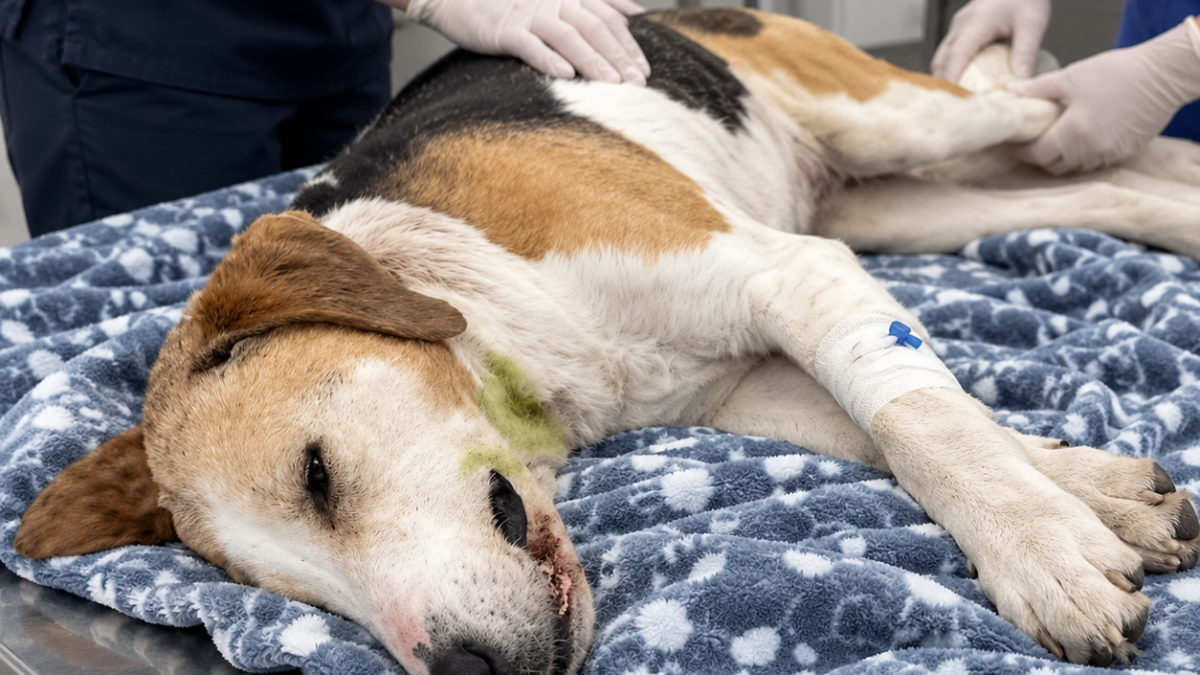
Behind the glass door, Eva was sleeping beneath a light blanket.
The veterinarian had positioned her carefully because she still struggled to control her head and body. One of the technicians had folded a towel beneath her chin so she wouldn’t have to fight gravity while resting.
I looked at that tiny act of kindness while listening to the investigator.
The contrast made my stomach tighten.
“What did he say?”
The investigator paused.
“He confirmed she belonged to him.”
I closed my eyes.
Part of me had hoped the collar would lead to someone who had been searching desperately for her.
Maybe Eva had wandered away.
Maybe there had been an accident.
Maybe some terrible misunderstanding had placed a beloved dog on that roadside while her family spent sleepless nights trying to find her.
Those possibilities disappeared with the investigator’s next words.
“He said she had been sick for a while.”
“How long?”
“We’re still establishing the timeline.”
“And he didn’t take her to a veterinarian?”
“Not that we’ve been able to confirm.”
I lowered my voice.
“How did she end up on the road?”
There was another silence.
“He admitted taking her there.”
The hallway suddenly felt too narrow.
I had been involved in rescue long enough to hear things that stayed with me after I went home.
Still, some sentences never became easier.
“You’re telling me he drove an elderly, sick dog who could barely move to that road and left her there?”
“That’s what we’re investigating.”
I looked through the door again.
Eva was exactly where I had left her.
Sleeping.
Breathing.
Alive.
“Does he know she survived?”
“Yes.”
“What did he say?”
The investigator hesitated.
“He sounded surprised.”
That word stayed with me.
Surprised.
Not relieved.
Not grateful.
Surprised.
As though survival had been the unexpected outcome.
I thanked him for the update and ended the call.
For a minute, I remained alone in the hallway.
Anger came first.
The hot, immediate kind.
I pictured that roadside.
I pictured Eva being placed there.
I imagined a vehicle disappearing while an old dog lay in the dirt with a brain injury, tumors, an infected ear, and a body weakened by prolonged neglect.
I wanted answers.
I wanted consequences.
Mostly, though, I wanted Eva to reach a point where none of it mattered to her anymore.
The door opened behind me.
Dr. Harris stepped into the hall.
He had been overseeing much of Eva’s neurological care.
“You okay?”
“They found the owner.”
His face changed.
“What happened?”
“He admitted leaving her.”
Dr. Harris looked through the window.
For a moment neither of us spoke.
Then he said something I would remember months later.
“Then our job stays the same.”
I looked at him.
He nodded toward Eva.
“We make sure what happened before doesn’t decide what happens next.”
That became our rule.
The investigation belonged to the authorities.
Eva belonged to the work in front of us.
Keeping her alive.
Treating the infection.
Managing the neurological damage.
Evaluating the tumors.
Helping her eat.
And eventually, if her brain and body allowed it, helping her stand again.
During those first days, progress was measured in things most people would never celebrate.
Eva swallowed without assistance.
Eva kept food down.
Eva tracked movement with her eyes.
Eva lifted her head slightly longer than she had the day before.
Eva slept through the night without becoming distressed.
Those were victories.
Tiny victories, maybe.
But when you have carried a dog off a roadside because she cannot lift her own head, you learn not to insult small victories.
On the tenth day, I walked into the rehabilitation room and found two technicians standing beside Eva.
One had a hand beneath her chest.
The other supported her hips.
“What’s happening?”
The younger technician smiled.
“She keeps trying.”
“Trying what?”
“To stand.”
I stopped.
Eva’s paws were positioned beneath her.
Her legs trembled so violently they looked almost disconnected from the rest of her body.
Her head tilted slightly.
Her eyes moved from one person to another.
“All right, Eva,” the therapist said gently. “No hurry.”
They reduced their support.
For half a second, Eva carried some of her own weight.
Then her legs folded.
The therapist caught her immediately.
Nobody looked disappointed.
Eva didn’t know enough to be disappointed either.
She simply lay there, breathing hard.
Then, after less than a minute, she tried to push herself up again.
I laughed.
It escaped before I could stop it.
The therapist looked at me.
“What?”
“That’s the first stubborn thing I’ve seen her do.”
She smiled.
“Good. She’s going to need stubborn.”
The brain injury had affected Eva’s balance and coordination.
Standing wasn’t simply a matter of rebuilding weak muscles.
Her body and brain had to learn to cooperate again.
Imagine stepping onto a floor that suddenly tilts beneath you.
Now imagine not understanding why.
That appeared to be Eva’s world.
When she stood, her body sometimes leaned sharply.
When she tried to move a paw, she placed it in the wrong direction.
If she turned her head too quickly, she lost balance.
Some days she appeared more alert.
Other days she seemed exhausted after only minutes of work.
But Eva wanted to move.
Once we discovered that, everything changed.
The rehabilitation team began with supported standing.
A sling beneath her abdomen kept her from falling.
One person guided her front legs while another controlled her hindquarters.
At first, taking a single deliberate step required the concentration of everyone in the room.
“Left.”
“Good.”
“Now right.”
“Easy.”
“Hold her.”
Eva’s paws scraped against the mat.
She stumbled sideways.
The sling tightened.
We reset her.
Again.
Again.
Again.
There were days when she managed three steps.
There were days when she could not manage one.
On difficult mornings, I sat with her afterward.
She would rest her head against my leg while I rubbed the side of her neck.
“You’re allowed to be tired,” I told her.
I don’t know whether dogs understand words in moments like that.
I know they understand presence.
For most of Eva’s recent life, someone had apparently looked at her growing problems and decided she was becoming too much.
Now every person around her operated according to the opposite belief.
If she needed more time, we gave her more time.
If eating took twenty minutes, someone stayed twenty minutes.
If walking six feet required three people, three people walked six feet with her.
Her ear infection began responding to treatment.
That mattered more than we expected.
Balance depends heavily on the inner structures of the ear, and Eva had been battling a severe infection on top of neurological trauma.
As inflammation decreased, she became more comfortable.
She shook her head less.
She slept more peacefully.
And one afternoon, while I was changing the blanket in her recovery area, I heard a sound behind me.
Tap.
I turned.
Eva’s tail had moved against the side of the kennel.
I froze.
“Did you just wag at me?”
Tap.
I leaned closer.
“Eva?”
Tap. Tap.
I called the technician.
“You need to see this.”
She hurried over.
“What happened?”
I pointed.
“Talk to her.”
The technician crouched.
“Hi, pretty girl.”
Eva’s tail moved.
The technician put both hands over her mouth.
People imagine rescue workers becoming hardened.
We do, in certain ways.
You have to.
If every difficult case destroys you, you cannot keep doing the work.
But certain moments break straight through whatever armor you have built.
That tail wag was one of them.
It wasn’t dramatic.
Eva didn’t jump up.
She didn’t run.
She didn’t suddenly become healthy.
She simply realized that the people approaching her might bring something good.
And she responded.
Trust was returning before strength.
A few days later, investigators requested the veterinary documentation.
Photographs.
MRI findings.
The written assessment of the head injury.
Records concerning the tumors, ear infection, body condition, and mobility problems.
I signed the forms required from the rescue side and handed over everything we could legally provide.
The investigator noticed me watching him place the documents into a folder.
“You want to ask something,” he said.
“I do.”
“Go ahead.”
“Is anything actually going to happen?”
He studied me.
I think he had heard the question before.
“In cases like this, we have to document what we can prove.”
“I know.”
“We can prove abandonment if the evidence supports his admission and the other facts.”
“What about what happened to her head?”
“That is harder.”
“Because Eva can’t tell us.”
“Exactly.”
I hated that answer.
Not because it was wrong.
Because it was true.
The MRI showed trauma.
The doctors could explain what kind of injury might produce it.
But suspicion was not proof of exactly who had caused it or how.
I folded my arms.
“So he can say he doesn’t know.”
“He can say many things. Our job is to compare what he says with evidence.”
“And the neglect?”
“We’re documenting her condition and treatment history.”
I looked toward the rehabilitation room.
“I don’t want this turned into something people shrug at because she’s old.”
The investigator’s expression hardened slightly.
“Neither do I.”
That was enough.
For then.
Eva’s case moved forward quietly.
There were no dramatic television cameras in the hallway.
No crowd demanding instant justice.
Real investigations are often slower and less satisfying than anger wants them to be.
Statements are taken.
Records are collected.
Timelines are compared.
Veterinarians are asked to explain findings in precise language.
People who want simple answers become frustrated.
But precision matters when consequences depend on what can be established.
While authorities built their case, Eva built herself.
Week three brought her first major breakthrough.
We had moved her rehabilitation session to a larger room.
The therapist placed Eva in her support harness.
I stood several feet away holding a small piece of chicken.
By then, chicken had become Eva’s greatest motivation.
The therapist laughed whenever I brought it.
“You know you’re bribing her.”
“I prefer positive reinforcement.”
“You’re bribing her.”
Eva stared at my hand.
I crouched.
“Come get it.”
The therapist loosened the harness slightly.
Eva shifted one front paw.
Then another.
Her back legs followed awkwardly.
She swayed.
We all held our breath.
“Easy, Eva.”
She took another step.
Her head wobbled.
Her right shoulder dipped.
The therapist moved closer but didn’t touch her.
Eva corrected herself.
One more step.
Then another.
She reached me after six steps.
Six.
To anyone else, it would have looked like an old dog barely walking across a room.
To us, it felt like watching somebody cross an ocean.
I gave her the chicken.
“You earned that.”
Her tail tapped against my wrist.
The therapist wiped her eyes.
“I hate when they do this.”
“Do what?”
“Make me cry at work.”
Eva did not understand what she had accomplished.
She only knew there was chicken.
Maybe that was better.
Recovery became her normal.
No expectations.
No embarrassment.
No memory of what other dogs could do more easily.
Just the next attempt.
Over the following weeks, her personality began emerging.
Eva liked warm blankets but hated having them tucked tightly around her hind legs.
She loved chicken, tolerated prescription food, and considered carrots a personal insult.
She disliked the sound of metal bowls scraping against tile.
She enjoyed sunlight.
She adored having the base of her ears scratched once the infection stopped hurting.
And she had a habit of watching the door whenever someone left the room.
That habit troubled me.
At first, I thought it was simple curiosity.
Then I noticed how tense she became when footsteps disappeared down the hallway.
If I walked away while she was awake, her eyes followed until I vanished.
Sometimes she tried to rise.
I began telling her where I was going.
“I’m getting your food.”
“I’m changing your water.”
“I’ll be right back.”
It felt ridiculous.
Until I realized she relaxed when I returned.
One afternoon I sat beside her and said, “Did you watch him drive away too?”
The words left my mouth before I could stop them.
Eva rested her chin on my shoe.
I wished immediately that I hadn’t asked.
There were things I would never know.
What had her life been like before she became sick?
Had she once slept on somebody’s couch?
Had she chased balls?
Had someone called her a good girl?
When had she stopped being a companion and started being treated like a burden?
When had her owner first noticed the tumors?
When had the ear infection begun?
How long had Eva lived in discomfort while the people responsible for her did nothing?
And on that final day, had she believed she was going for help?
Had she willingly climbed into the vehicle?
Had she recognized the road?
Had she waited after the engine disappeared?
Questions can become a kind of cruelty when there are no answers.
So I stopped asking Eva about her past.
Instead, we started giving her a future.
A foster volunteer named Claire became involved during Eva’s second month.
Claire was in her late fifties and had fostered senior dogs for years.
She came to the hospital first just to meet Eva.
“I’m not promising anything,” she told me.
“That is exactly what every foster says before they fall in love.”
“I have boundaries.”
“Sure.”
“I do.”
Eva was lying on a padded mat when Claire entered.
She approached slowly.
“Hello, sweetheart.”
Eva raised her head.
That alone still amazed me.
Claire sat on the floor instead of reaching over her.
For several minutes, she did nothing.
Eva watched her.
Then Eva crawled forward awkwardly and placed one paw on Claire’s knee.
Claire looked at me.
“No.”
I smiled.
“You have boundaries.”
“This is manipulation.”
“By a dog who can barely walk?”
“She knows exactly what she’s doing.”
By the end of the visit, Eva had fallen asleep with her chin on Claire’s leg.
Two weeks later, once the veterinary team believed she was stable enough for a home environment between appointments, Eva went to Claire’s house.
We made the transition carefully.
Rugs covered the slippery floors.
Baby gates blocked the staircase.
Her bed had low sides.
Food and water were elevated to make eating easier.
Claire learned how to use the support harness.
She learned Eva’s medication schedule.
She learned the exercises.
She learned how to help Eva regain balance without doing all the work for her.
The first evening, Claire sent me a photograph.
Eva was asleep on a thick bed beside the couch.
The message beneath it said:
“She watched the front door for twenty minutes. Then she finally put her head down.”
The next morning:
“She slept all night.”
The third day:
“She barked at the mailman.”
I called immediately.
“She barked?”
“One bark.”
“You’re sure?”
“It was very judgmental.”
I laughed so loudly another volunteer looked over.
Eva had found her voice.
Claire’s house became where the real transformation accelerated.
Hospitals save lives.
Homes teach animals what life feels like.
Eva discovered grass again.
At first, outdoor walks were therapy sessions.
Claire used the harness while Eva practiced placing her feet correctly.
Five yards.
Rest.
Another five.
Sometimes Eva circled accidentally because neurological damage made straight lines difficult.
Sometimes she stumbled into Claire’s legs.
Sometimes she sat down suddenly and refused to continue.
Claire would kneel beside her.
“All right. We wait.”
No pulling.
No frustration.
No punishment.
They waited.
Then Eva usually stood again.
By the third month, she could cross most of the backyard with minimal support.
By the fourth, the harness was often there only for safety.
Her muscles had started returning.
Her coat looked healthier.
Her eyes were brighter.
She still had medical problems that required monitoring.
Recovery did not erase age.
It did not erase tumors.
It did not magically undo the damage caused by neglect.
But Eva no longer looked like a dog disappearing from the world.
She looked interested in it.
One Saturday morning, Claire called me.
“Can you come over?”
My heart immediately dropped.
“What’s wrong?”
“Nothing.”
“Claire.”
“Just come over.”
I drove there expecting a problem.
She met me at the gate.
“You scared me.”
“Sorry.”
“What happened?”
She pointed toward the backyard.
“Watch.”
Eva stood near the porch.
No harness.
No one touching her.
Claire called her.
“Eva!”
Eva turned.
There was still a slight tilt to her head.
There probably always would be.
Then she began walking.
Slowly.
Carefully.
One paw.
Another.
A slight wobble.
Correction.
Keep going.
She crossed the yard by herself.
Halfway to us, she stopped to sniff something in the grass.
I started laughing.
Claire did too.
“She got distracted.”
“That’s perfect.”
Eva continued investigating the grass as though walking independently were completely unremarkable.
I crouched.
“Eva.”
She looked up.
Then came toward me.
When she reached us, I put both arms around her.
The first day I had met that dog, her head had fallen into my hand because she didn’t have enough strength to hold it up.
Now she was standing against me, impatiently trying to smell the treat pouch on my waist.
I pressed my forehead against hers.
“You have no idea what you’re doing to us, do you?”
Her tail wagged.
The investigation was still moving.
That created a strange emotional split.
Every week Eva improved.
Every few weeks, I received another call reminding me why she had needed rescue in the first place.
The owner had been interviewed more than once.
His explanation changed in small ways.
Eva had become sick.
Eva had become difficult to care for.
He claimed he didn’t know how serious some of her conditions were.
He said he believed someone would find her.
That final statement infuriated Claire when I repeated it.
“He believed somebody would find her?”
“Yes.”
“He left a dog who couldn’t stand beside a road and hoped a stranger would solve it?”
“That’s essentially the claim.”
Claire looked across the room.
Eva was asleep in a patch of sunlight.
“There are shelters.”
“I know.”
“Veterinary clinics.”
“I know.”
“Rescues.”
“I know.”
“He could have called somebody.”
“Yes.”
“He could have asked for help.”
“Yes.”
“He could have surrendered her.”
“Yes.”
Claire’s voice cracked.
“He had choices.”
That was the heart of it.
He had choices.
People facing financial hardship sometimes cannot afford extensive veterinary care.
People become overwhelmed.
People make mistakes.
Rescue workers see those realities constantly.
And many organizations will work with someone trying to help an animal.
There is an enormous difference between saying, “I can’t manage this alone,” and leaving a helpless animal beside a road.
Eva’s owner had not been charged because he was poor.
He had not been investigated because his dog became old.
The issue was what he had allegedly chosen to do when she became vulnerable.
The legal process eventually moved forward.
The evidence of abandonment was strong.
Veterinary records documented Eva’s condition when she arrived.
The investigation established ownership.
There were statements concerning how she reached the roadside.
And Eva’s collar, the small object I had noticed before anything else, became part of the evidence connecting her former life to where she was found.
The brain injury remained complicated.
The veterinarian could testify about trauma.
He could describe the clot.
He could explain why Eva’s neurological signs were consistent with the findings on the MRI.
But he could not honestly say who had caused the injury without additional evidence.
And nobody asked him to pretend certainty where there was none.
That mattered to me.
Justice built on exaggeration isn’t justice.
The known facts were bad enough.
Several months after Eva’s rescue, I attended one of the hearings connected to the case.
Claire came with me.
Eva stayed home.
She had an important appointment with a stuffed toy and a sunny window.
The courthouse was smaller than people imagine courtrooms from television.
No dramatic music.
No shouting crowd.
Just wooden benches, fluorescent lights, attorneys organizing papers, and people waiting for their names to be called.
When Eva’s former owner entered, I recognized him from photographs in the investigative file.
Claire stiffened beside me.
“Is that him?”
“Yes.”
She looked forward again.
“I thought I’d feel something bigger.”
“What do you feel?”
“Mostly sad.”
I understood.
He looked ordinary.
That is often unsettling.
We want people connected to terrible decisions to look obviously different from us.
Usually, they don’t.
They look like people standing in line at grocery stores.
People mowing lawns.
People sitting in court.
When the case was called, the prosecutor summarized the documented facts.
Eva had belonged to the defendant.
She had been ill.
Her medical needs had gone substantially untreated.
She had been transported away from the property.
She had been left beside a public road in a condition where she could not safely care for herself.
She had been found severely debilitated.
The prosecutor did not need dramatic language.
Facts have their own weight when laid down one after another.
The defense attorney spoke about the owner’s circumstances.
He described poor judgment.
He said there had been no intention for Eva to suffer further.
Claire’s hand tightened around the edge of the bench.
I leaned toward her.
“Stay calm.”
She whispered, “I am calm.”
“You’re bending the bench.”
She slowly released her grip.
Then came the moment that had been bothering me since that phone call months before.
The prosecutor referred to the owner’s reaction after investigators informed him that Eva had survived.
He had expressed surprise.
The word sounded colder inside a courtroom.
The judge looked toward him.
“You were surprised the animal lived?”
The owner shifted.
His attorney spoke quietly to him.
Then he answered.
“She was in really bad shape.”
The judge waited.
Nobody needed to say the obvious part aloud.
She had been in really bad shape when she was left there.
The consequences were ultimately less theatrical than some people would have wanted, but they were real.
The abandonment and neglect findings carried legal penalties.
Financial restitution was ordered toward portions of Eva’s documented care.
Restrictions were placed on future animal ownership for a period determined through the case.
There were fines and additional conditions.
More important to me, the official record no longer described Eva as simply an old dog found beside a road.
It described what had been done.
When we walked outside afterward, Claire stopped at the courthouse steps.
“That’s it?”
“For today.”
“I expected to feel better.”
I nodded.
“Court doesn’t undo anything.”
“No.”
“Eva does.”
Claire looked at me.
“What?”
“Every time she gets up.”
That finally made her smile.
We drove directly to Claire’s house.
Eva met us in the living room.
By then, she had developed a strange little gait that was entirely hers.
Her front half moved with determination.
Her back half sometimes seemed half a beat behind.
When she became excited, the mismatch grew worse.
She spotted Claire.
Her tail started.
Then she spotted me.
Her entire body joined the celebration.
“Careful,” Claire warned.
Eva ignored her.
She hurried across the rug, stumbled, corrected herself, and continued.
I knelt.
“There’s my girl.”
She pushed her face against my chest.
Claire dropped her purse onto a chair.
“Well, Eva, we went to court for you.”
Eva sniffed my jacket.
Claire laughed.
“She does not care.”
“Nope.”
“She should care a little.”
“She has better priorities.”
Eva found a crumb in my pocket.
There it was.
The best revenge I could imagine.
Not suffering.
Not hatred.
Not destruction.
Life.
A dog somebody had apparently expected not to survive was too busy looking for snacks to care that we had just spent hours discussing her past.
Months five and six brought more changes.
The rehabilitation therapist reduced Eva’s formal sessions.
Instead of relearning basic standing, she began working on endurance and confidence.
Different surfaces.
Gentle inclines.
Controlled turns.
Stepping over low obstacles.
We celebrated the first time she climbed a shallow step without assistance.
Then she climbed it again because she assumed another piece of chicken was involved.
Her world expanded.
Claire began taking her on short walks beyond the yard.
At first they went only three houses down.
Eva stopped constantly.
Not from exhaustion.
To smell.
A mailbox post could hold her attention for thirty seconds.
A bush required full investigation.
A fallen leaf became an event.
Claire called me after their first walk around the block.
“It took forty-three minutes.”
“How big is your block?”
“Not forty-three minutes big.”
“Did she get tired?”
“No. She investigated every blade of grass individually.”
“That sounds healthy.”
“It’s extremely inefficient.”
I could hear the pride in her voice.
Eva was not simply walking.
She was exploring.
There is a difference.
Walking is mechanical.
Exploring means the world has become interesting.
One afternoon, I joined them at a quiet park.
We chose a time when there were few dogs around because Eva could still become unsteady if startled.
Claire opened the car door.
Eva stood behind the small ramp we used to help her descend.
“Come on.”
Eva walked down slowly.
Her paws reached the pavement.
She looked around.
Trees.
Grass.
Wind.
Birds.
Distant voices.
Her nose began moving.
Then she walked toward the grass.
I followed several feet behind.
Watching her from that distance triggered a memory so sharp that I stopped.
The roadside.
The motionless body.
The collar.
The food dish held beneath her face.
Those few seconds when she had tried to lift her head and failed.
I took out my phone.
Claire glanced back.
“You taking pictures?”
“Video.”
“Get her good side.”
“At this point every side is her good side.”
Eva continued forward.
She stumbled once near the edge of the path.
My body automatically moved toward her.
Claire raised a hand.
“Wait.”
Eva stood still.
Her legs trembled.
Then she corrected her stance.
One paw moved.
Then another.
She recovered without us.
Claire looked at me.
“That’s what the therapist told me. Give her a chance to solve it before helping.”
It was difficult.
Rescue creates an instinct to catch.
Rehabilitation sometimes requires the courage not to catch too quickly.
Eva needed help.
But she also needed independence.
So we followed.
Close enough if she fell.
Far enough that she could discover she might not.
By month seven, strangers who met Eva for the first time often did not understand the significance of what they were seeing.
They saw an older dog with a slight head tilt and unusual gait.
They noticed some scars.
They saw gray around her muzzle.
They might have thought she had simply aged.
Then we showed them the first photographs.
People usually became quiet.
“That’s the same dog?”
“Yes.”
“She couldn’t stand?”
“She couldn’t hold her head up.”
One visitor stared at the image for a long time.
Then she looked at Eva, who was walking around the adoption room sniffing chairs.
“How?”
I knew what she meant.
There was no simple answer.
Medicine.
Nutrition.
Neurological rehabilitation.
Treatment for infection.
Pain management.
Time.
Money.
Volunteers.
Veterinarians.
Technicians.
Foster care.
Patience.
And something inside Eva that kept choosing the next step.
People love the phrase “will to live.”
I use it carefully.
Animals who die despite treatment did not somehow fail to want life enough.
Bodies have limits.
Disease has limits.
Trauma has limits.
Eva was fortunate that her injuries, serious as they were, still left room for recovery.
But within that room, she worked.
Again and again.
That part belonged to her.
During the eighth month after her rescue, Claire called me early one morning.
By then, receiving calls from her no longer frightened me the way they once had.
“What did she do now?”
Claire laughed.
“How do you know she did something?”
“Because you only call this early when Eva has done something.”
“We went on our walk.”
“Okay.”
“She ran.”
I sat up straighter.
“What?”
“Not far.”
“Claire.”
“It was more of a trot.”
“Claire.”
“Maybe an enthusiastic shuffle.”
“You said ran.”
“Fine. She ran.”
I was already reaching for my keys.
“Where are you?”
“Near the little field behind the library.”
“I’m coming.”
When I arrived, Claire and Eva were near a line of trees.
The morning was cool.
Sunlight came through the branches in long strips across the grass.
Eva was standing several yards away with her nose buried near the roots of a tree.
Her leash hung loose in Claire’s hand.
I walked toward them quietly.
Eva heard me.
Her head came up.
For one second, we simply looked at each other.
Then her tail started moving.
She turned.
And she came toward me.
Not perfectly.
Not like a young dog.
Not like nothing had ever happened.
She came with that crooked, determined gait we had learned to love.
Then, halfway across the grass, she became excited.
Her pace quickened.
Her back legs pushed.
Her ears moved.
And for several steps, Eva ran.
I could barely see her through my tears.
“Look at you!”
Claire was crying too.
Eva reached me and nearly lost her balance from the force of her own enthusiasm.
I dropped to my knees.
She pressed against me.
I held her carefully around the shoulders.
Eight months earlier, I had supported that same head in my palm because Eva could not hold it up herself.
Now she pulled away from me because a smell in the grass was more interesting.
I let her go.
That might sound strange.
After everything, you would think I wanted to hold her forever.
But the whole point had been to reach a day when she didn’t need holding.
Eva wandered toward the trees.
She stopped at a patch of leaves.
Then moved toward a bench.
Then turned toward Claire.
Everything interested her.
Everything was worth investigating.
Her world had become large again.
Claire came to stand beside me.
“You know what I’ve been thinking?”
“What?”
“I don’t want to foster her anymore.”
I looked at her.
For half a second, she kept a perfectly straight face.
Then she smiled.
“I want to adopt her.”
“You lasted longer than I expected.”
“Do not ruin this.”
“I told you the first day.”
“You told me nothing.”
“You said you had boundaries.”
“I still have boundaries.”
Eva wandered directly between us and leaned against Claire’s leg.
I pointed downward.
“Clearly.”
Claire knelt and cupped Eva’s face.
“You want to stay with me, old girl?”
Eva licked her chin.
“I think that’s legally binding,” I said.
The adoption became official not long afterward.
There was paperwork.
A final medical review.
Continued monitoring plans.
Eva would always be a senior dog with a complicated history.
She might need additional treatment.
Her tumors required veterinary management.
Her joints would never become young again.
Her neurological deficits might never disappear completely.
Claire knew all of it.
She signed anyway.
At the bottom of the adoption paperwork, there was a line asking why she wanted to adopt the animal.
Claire stared at it for a moment.
Then wrote:
“Because she already chose home.”
I had to look away.
The final part of Eva’s story did not happen in a courtroom.
It did not happen in the hospital.
It happened on an ordinary afternoon several weeks later.
I visited Claire’s house with one of the technicians who had cared for Eva during her first days.
We brought an old photograph.
In it, Eva was lying on the hospital mat.
Thin.
Exhausted.
Unable to stand.
The technician held the photograph while watching the dog in front of us.
Eva was in the backyard.
She had discovered something fascinating along the fence.
Probably nothing.
That didn’t matter.
She walked from one side of the yard to the other.
Stopped.
Sniffed.
Turned.
Walked again.
The technician wiped her cheek.
“I remember feeding her with her head supported.”
“I know.”
“I thought we might lose her.”
“So did I.”
Claire came outside carrying Eva’s water bowl.
“She’s demanding dinner early.”
“Good.”
Eva noticed the bowl and immediately abandoned her fence investigation.
She trotted toward Claire.
The technician laughed.
“That dog?”
“That dog.”
Eva reached the porch.
She lifted her head.
High.
Steady enough to look directly at us.
Her face was alert.
Her eyes were bright.
Her tail swept back and forth.
The collar around her neck was different now.
Claire had bought it after the adoption.
Soft material.
A little name tag.
On one side:
EVA.
On the other:
CLAIRE’S NUMBER.
Not because anyone expected her to disappear.
Because this time, the collar represented somebody determined to make sure she always came home.
I sometimes think about the first collar.
The one she wore beside the road.
For months I saw it only as evidence of betrayal.
Proof that Eva had belonged to someone who knew she existed and still left her helpless.
Eventually, I began seeing it differently.
That collar also made her traceable.
It helped investigators connect her to her past.
It became part of the evidence that ensured her abandonment did not vanish into an anonymous roadside story.
Something meant to show ownership ended up helping prove responsibility.
There was a strange justice in that.
But the real justice was outside in Claire’s yard.
Eva walking.
Eva eating.
Eva barking at delivery drivers.
Eva stealing the best part of the couch.
Eva taking forty-three minutes to walk around a block because every bush required inspection.
Eva leaning into hands that reached for her without fear.
Eva discovering that when someone opened a car door now, the ride ended at a park, a clinic where people loved her, or the house she returned to afterward.
Not a roadside.
Never again a roadside.
A few months after the legal case concluded, the investigator called one final time.
There was no major update.
The conditions of the case were in place.
The file was essentially complete.
Before hanging up, he asked, “How’s the dog?”
I smiled.
“She’s doing well.”
“Walking?”
“All over the place.”
He laughed.
“Good.”
Then he grew quiet.
“I remember telling the owner she survived.”
“So do I.”
“He really didn’t expect that.”
I looked through Claire’s kitchen window.
Eva was outside, standing beneath a tree.
The breeze moved her ears.
She lifted her face toward it.
“I’m glad he was wrong,” I said.
After we ended the call, I went outside.
Eva saw me and started toward the porch.
She stumbled slightly.
Recovered.
Kept coming.
There was something important in that.
Recovery had never meant pretending nothing had happened.
Eva still carried evidence of her past.
Her gait told the story.
Her medical records told the story.
Her age told the story.
The tilt of her head told part of it.
Survival does not require erasing scars.
Sometimes survival means scars stop deciding where you are allowed to go.
Eva climbed the shallow step onto the porch.
She walked to me and lowered her forehead against my knee.
I scratched behind her ear.
“You’re supposed to be exploring.”
Her tail moved.
Claire opened the back door.
“Dinner.”
Eva immediately abandoned me.
I laughed as she hurried inside.
“Loyalty means nothing to you, does it?”
Claire filled her bowl.
Eva stood beside her.
Waiting.
Head up.
That detail still caught me every time.
Head up.
The thing she had been unable to do.
The first impossible task.
Now so ordinary that Eva didn’t know anyone was watching.
Claire placed the bowl down.
Eva began eating without assistance.
No hand beneath her chin.
No towel supporting her neck.
No hospital team standing around.
Just an old dog having dinner in her own kitchen.
Later that evening, Eva settled onto her bed.
Claire sat beside her.
I was getting ready to leave when she called my name.
“Come look.”
I walked back.
Eva had fallen asleep.
One paw stretched across Claire’s foot.
“She does that every night,” Claire said.
“So you can’t leave?”
“That’s my theory.”
I smiled.
“Smart dog.”
Claire looked at her.
“She used to watch the door whenever I walked away.”
“I remember.”
“Now she doesn’t.”
That hit me harder than I expected.
Because walking again was only part of Eva’s recovery.
Healing an infection was part of it.
Treating physical injuries was part of it.
Getting stronger was part of it.
But somewhere during those eight months, something else had changed.
Eva stopped expecting people to disappear.
She had learned the difference between somebody walking out of a room and somebody leaving her behind.
One meant they were coming back.
The other had happened only once.
And once was enough.
I reached down and touched her gently.
“Good night, Eva.”
Her eyes remained closed.
Her tail tapped once against the bed.
On my drive home, I passed a long stretch of road.
Not the same one where we had found her.
Still, for a second, I pictured that first afternoon.
A thin body in the dirt.
Cars passing.
A collar.
A dog too weak to move.
I remembered supporting Eva’s head while she tried to eat.
I remembered wondering whether she would survive the night.
I remembered the MRI.
The blood clot.
The infection.
The tumors.
The first terrible phone call.
The owner’s surprise.
Then I pictured Eva running those imperfect few steps through the grass eight months later.
That was the answer to everything.
Not because her survival erased what happened.
It didn’t.
Not because the legal consequences could return the months or years when she should have been cared for.
They couldn’t.
Not because every wound disappeared.
Some never would.
But the person who abandoned Eva made one terrible calculation.
He looked at an old, sick, helpless dog and apparently believed her story was nearly over.
He was wrong.
The roadside was not Eva’s ending.
It became the place her second life began.
And if there was any revenge worth celebrating, it wasn’t cruelty returned for cruelty.
It was this:
Eva lived long enough to learn that hands could heal instead of hurt.
She lived long enough to stand.
She lived long enough to walk.
She lived long enough to explore.
She lived long enough to have someone worry when she took too long sniffing a bush.
She lived long enough to become impatient for dinner.
She lived long enough to sleep without watching the door.
She lived long enough to belong to someone who understood that getting old did not make her disposable.
Months later, I visited again on a bright afternoon.
Claire and Eva were already outside.
Eva had grown stronger still.
The old wobble remained when she moved too quickly, but she understood her body now.
She knew how to compensate.
She knew when to slow down.
She knew where the ground changed beneath her paws.
Claire unclipped her leash inside the fenced yard.
Eva walked away from us.
Not toward food.
Not toward a person.
Just toward something she wanted to investigate.
She stopped beneath the sunlight.
Raised her head.
And looked around.
For several seconds, I did nothing but watch.
The first time I met Eva, she could lift that head only briefly before it fell again.
Now she held it high because there were things worth seeing.
Birds moved through the branches.
Leaves shifted in the wind.
Somewhere beyond the fence, another dog barked.
Eva listened.
Then she walked toward the sound.
Claire stood beside me.
“You’re crying again.”
“No.”
“You absolutely are.”
“Dust.”
“There is no dust.”
I wiped my face.
“Leave me alone.”
She laughed.
Eva turned toward us.
Her mouth opened slightly in the relaxed expression we had come to recognize.
Her face looked completely different from the dog in the first photographs.
Not younger.
That wasn’t the miracle.
Eva was still old.
Her gray muzzle remained.
Her body carried its history.
What had changed was the life inside her face.
Curiosity had replaced emptiness.
Expectation had replaced resignation.
When I called her name, she came.
Slowly at first.
Then faster.
A little crooked.
A little unsteady.
Perfectly Eva.
I crouched as she reached me.
She pressed into my hands.
I looked into those bright eyes and remembered the question I had asked myself beside the road.
Would she survive?
Eight months later, Eva had answered it herself.
She didn’t answer with a miracle cure.
She didn’t answer by becoming young again.
She answered one painful, stubborn, beautiful step at a time.
And the dog who once couldn’t hold her own head up walked past me into the sunshine like she had somewhere important to go.
This time, she did.
Home.
The man who abandoned Eva had made one terrible calculation.
He looked at an old, sick dog who could barely lift her own head and decided her story was almost over.
Eight months later, Eva proved him wrong.
Not in a courtroom.
Not with anger.
Not with some dramatic act of revenge.
She proved him wrong by walking.
By eating.
By sleeping without fear.
By waking up every morning expecting something good to happen.
And eventually, by learning that when someone she loved walked out the door, they were coming back.
That became the ending I never expected when I first found her beside that road.
A few weeks after Eva’s adoption became official, I visited Claire’s house on a cool Saturday morning.
I had seen Eva regularly throughout her recovery, but this visit felt different.
There were no medical forms in my hand.
No rehabilitation schedule.
No medication checklist to discuss.
For the first time since I had met her, I was simply visiting a dog in her home.
Claire opened the front door before I could knock.
“You’re late.”
I looked at my watch.
“By three minutes.”
“Eva has been waiting.”
“Eva cannot read a clock.”
Claire stepped aside.
“Tell her that.”
Eva stood in the hallway.
The sight of her stopped me.
She wore a soft blue collar with a silver tag hanging from it.
Her gray muzzle made her age obvious, and the slight tilt of her head remained. Her back legs still moved with that familiar fraction-of-a-second delay when she became excited.
But she was standing.
Completely on her own.
Her eyes met mine.
Her tail began swinging.
“Hey, old girl.”
Eva started toward me.
For the first few steps, she walked carefully.
Then she recognized my voice completely.
Her pace increased.
“Easy,” Claire warned.
Eva ignored her.
She hurried across the rug, lost her balance for half a second, recovered, and kept coming.
I crouched just before she reached me.
She pushed her head against my chest so hard I nearly fell backward.
I laughed and wrapped my arms around her.
“There you are.”
Her tail thumped against the wall.
Claire leaned against the doorway.
“You know she doesn’t greet me like that.”
“You see her every day.”
“Still insulting.”
Eva pulled away from me and began investigating my pockets.
“She remembers where the chicken comes from.”
“That’s your entire relationship.”
I pulled out a small treat.
Eva sat.
Not gracefully.
Her back legs slid slightly to one side before she corrected herself.
But she sat.
I stared at her.
Claire smiled.
“She learned that two days ago.”
“Eva.”
Her ears lifted.
“You’re showing off now.”
I gave her the treat.
Eight months earlier, I had held food beneath her mouth because she couldn’t keep her head raised long enough to eat.
Now she was performing tricks for payment.
That difference was almost impossible to understand unless you had seen the beginning.
Claire poured coffee while Eva followed us into the kitchen.
That had become one of her favorite habits.
She followed Claire everywhere.
Bathroom.
Kitchen.
Laundry room.
Backyard.
If Claire disappeared behind a door, Eva usually positioned herself outside it until she returned.
But the panic was gone.
That mattered.
In the early months, Eva had watched doors with an intensity that made my chest hurt.
Whenever someone walked away, her entire body became tense.
She would try to rise.
Sometimes she would whine.
Sometimes she stared at the doorway long after the person had disappeared.
We could never know exactly what she remembered from the day she had been abandoned.
But her behavior told us enough.
Leaving meant something dangerous to her.
At Claire’s house, she slowly learned another meaning.
Leaving could mean Claire was checking the mailbox.
Leaving could mean she was getting groceries.
Leaving could mean she had walked into another room.
And people came back.
Again.
Again.
Again.
Trust was built through repetition.
Claire placed my coffee on the table.
“She did something yesterday.”
The tone of her voice made me suspicious.
“What?”
“I went to the store.”
“And?”
“When I came home, she was asleep.”
I waited.
“That’s it?”
Claire stared at me.
“You don’t understand.”
Then I did.
Eva had not been waiting at the door.
She had not spent the entire time listening for Claire’s return.
She had felt safe enough to sleep.
I looked down.
Eva was lying beneath the kitchen table with her paws stretched in front of her.
“She knew you were coming back.”
Claire nodded.
“That’s what I think.”
For some reason, that nearly broke me more than watching Eva walk again.
Physical recovery can be measured.
Body weight.
Blood tests.
Muscle strength.
Distance walked.
Neurological responses.
Trust cannot.
There is no number for the moment an abandoned animal finally believes abandonment will not happen twice.
We sat quietly for a while.
Then Claire said, “Come outside.”
Eva heard the word before I moved.
She stood immediately.
“Apparently she knows that one,” I said.
“She knows ‘outside,’ ‘dinner,’ ‘chicken,’ and somehow understands the sound of a cheese wrapper from three rooms away.”
“Excellent rehabilitation.”
“We focus on practical skills.”
Claire opened the back door.
Eva stepped onto the porch.
Months earlier, that single step had required preparation.
Now she paused, judged the distance, and climbed down.
No harness.
No hands supporting her.
Just Eva.
The yard was fenced, and Claire had made small changes to keep it safe for her.
Uneven holes had been filled.
A nonslip mat covered the porch.
A shallow ramp ran beside the steps in case Eva became tired.
But that morning, she ignored the ramp.
She walked directly into the grass.
Her nose lowered.
The serious work began.
Every smell required investigation.
I watched her move along the fence.
Her gait was still imperfect.
It probably always would be.
The brain injury had left its mark.
But Eva had learned how to work with the body she had now.
When she began drifting slightly to one side, she adjusted.
When her back paw landed awkwardly, she stopped and repositioned it.
Her body had become familiar territory again.
Claire stood beside me.
“You know what the neighbors call her?”
“What?”
“The mayor.”
I laughed.
“Why?”
“Because she has to inspect everything.”
Eva stopped beside a tree.
“See?”
She smelled one side.
Moved around the trunk.
Smelled the other.
Then stood completely still, staring upward.
A squirrel sat on a branch.
Eva’s ears lifted.
For a few seconds, I saw something in her face that had nothing to do with rescue.
Nothing to do with injury.
Nothing to do with neglect.
She was simply a dog looking at a squirrel.
That ordinary moment felt like a miracle.
Eva barked once.
The squirrel disappeared.
Eva seemed deeply satisfied with herself.
Claire folded her arms.
“Excellent. Now she thinks she controls wildlife.”
“She’s earned some confidence.”
Eva turned and saw us watching.
Then she started toward us.
Halfway across the yard, Claire said, “Watch.”
She took three quick steps backward.
“Eva!”
Eva became excited.
Her walking changed.
Her front legs moved faster.
Her back legs followed.
For several seconds, she was not walking anymore.
She was running.
Crooked.
Awkward.
Beautiful.
I felt my eyes burn.
Claire looked at me.
“Don’t start.”
“I’m not.”
“You’re crying.”
“The sun is in my eyes.”
“It’s behind you.”
“Mind your business.”
Eva reached us and pushed against Claire’s knees.
Claire bent down.
“There’s my girl.”
I looked away toward the trees.
The first time I had seen Eva, I had wondered whether she would live through the night.
Now someone was complaining that she ran too fast.
If that wasn’t victory, I didn’t know what was.
The legal case against Eva’s former owner had concluded by then.
The penalties had been decided.
The documentation of neglect and abandonment was part of the official record.
Restitution had been ordered toward some of her veterinary expenses.
Restrictions had been placed on his ability to own animals for the period established by the court.
For months, I had imagined that resolution would make me feel something enormous.
Triumph.
Relief.
Maybe even satisfaction.
Instead, when the legal process ended, I mostly felt tired.
A court can establish responsibility.
It can impose consequences.
It can create a record so that what happened is not erased or minimized.
Those things matter.
But no judge can give a dog back the days she spent sick without care.
No fine can remove fear from an animal’s memory.
No sentence can reverse the moment someone drove away.
Only time and kindness could repair what was repairable.
The rest became part of Eva.
One evening, the investigator who had handled much of the case called me.
“I heard the adoption went through.”
“It did.”
“How is she?”
I looked across Claire’s living room.
Eva was sleeping upside down on a dog bed, one hind leg hanging over the edge.
“She seems devastated.”
He laughed.
“Walking okay?”
“Better every week.”
There was a pause.
Then he said, “I still remember his reaction when we told him she lived.”
“So do I.”
“He genuinely seemed surprised.”
I looked at Eva.
Her chest rose slowly beneath the blanket.
“That might be the part I’ll remember most.”
“Why?”
“Because he was wrong.”
The investigator was quiet.
Then he said, “Yeah.”
After we hung up, I sat beside Eva.
She opened one eye.
“Don’t get up.”
She closed it again.
I ran my hand along her shoulder.
For months, people had called Eva’s survival a miracle.
I understood why.
But I had become careful with that word.
Miracles sound effortless.
Eva’s recovery was anything but effortless.
Veterinarians treated infection and neurological damage.
Technicians supported her body when her legs failed.
Volunteers cleaned bedding.
People measured medications.
Claire woke up in the middle of the night when Eva became restless.
Rehabilitation therapists repeated the same movements hundreds of times.
Eva fell.
Eva rested.
Eva tried again.
There was nothing effortless about it.
What looked miraculous from the outside had been built from thousands of ordinary acts of care.
A bowl held at the right height.
A hand beneath a chest.
A nonslip mat.
Medication given on schedule.
Five more steps.
A quiet voice saying, “Try again.”
That was how Eva came back.
Not all at once.
Piece by piece.
Several months later, Claire organized a small gathering at her house.
Nothing formal.
A few members of the veterinary staff.
Two volunteers.
The rehabilitation therapist.
The woman who had first called about the dog beside the road.
She had never met Eva after the rescue.
When she arrived, she stood near the front door looking nervous.
“I don’t know if I should be here.”
“You absolutely should.”
“I only made a phone call.”
“You made the phone call that gave her a chance.”
Eva walked into the room.
The woman covered her mouth.
“Oh my God.”
Eva approached her.
“Is that really her?”
“Yes.”
The woman crouched slowly.
Eva sniffed her hands.
Then, without hesitation, leaned against her.
The woman began crying.
“I thought she was dying.”
“So did we.”
“I went home that night and kept thinking I should have found her sooner.”
I shook my head.
“You found her when you found her.”
“But maybe—”
“No.”
She looked at me.
“You stopped your car. You called. You stayed until we arrived. That matters.”
Eva pushed her nose under the woman’s hand, demanding attention.
The woman laughed through her tears.
“She looks happy.”
“She is.”
That was perhaps the greatest transformation.
Eva was not merely alive.
She was happy.
She had preferences.
She had routines.
She had expectations.
At exactly five-thirty every afternoon, she began staring at Claire because dinner happened at six and apparently thirty minutes of psychological pressure was necessary.
She loved sunny spots.
She hated rain.
She stole socks but never chewed them.
She carried them to her bed and slept beside them.
She had developed a personal feud with one specific delivery truck.
She tolerated baths with the expression of someone filing a formal complaint.
She loved riding in the car now.
That last part took time.
The first few trips after foster placement had been difficult.
The moment Claire opened a car door, Eva froze.
She would lean backward.
Sometimes she trembled.
So Claire changed the routine.
The first trip was around the block.
Then home.
The next ended at a quiet park.
Then home.
Another ended at the rehabilitation center, where people she recognized greeted her with treats.
Then home.
Slowly, a car stopped meaning disappearance.
It meant adventure.
And always, eventually, home.
One afternoon I rode with them.
Eva sat secured in the back seat.
Her nose pointed toward the open window.
Not far enough out to be unsafe.
Just enough to catch the air.
Claire watched her through the mirror.
“Remember when she wouldn’t get in?”
“I remember.”
“Now she gets mad if I leave without her.”
We drove to the same small park where I had first watched Eva cross the grass on her own.
Claire opened the back door.
Eva waited for the ramp.
Then walked down.
Her paws touched the pavement.
She immediately headed toward the path.
“Apparently we’re following her,” I said.
“We always are.”
Eva moved slowly.
There was no hurry.
She stopped at nearly every tree.
A child on a bicycle passed at a distance.
Two dogs walked across the far side of the park.
A breeze moved through the grass.
Everything Eva almost never experienced had become routine.
I watched her face.
Alive.
Alert.
Curious.
The face of a dog who expected tomorrow.
Near the end of the path stood a wooden bench.
Claire and I sat while Eva investigated the grass nearby.
After several minutes, she walked back and rested at our feet.
Claire scratched behind her ear.
“Do you ever think about the person who left her?”
“Sometimes.”
“I used to.”
“Not anymore?”
Claire shook her head.
“I realized something.”
“What?”
“If I keep thinking about him every time I look at Eva, then he still gets to be part of every good moment.”
I looked at her.
“That’s fair.”
“This is her life now. Not his.”
Eva lifted her head at the sound of her name.
Claire smiled.
“See?”
That changed something for me.
For months, I had defined Eva partly through what had happened to her.
The abandoned dog.
The neglected dog.
The dog with the brain injury.
The dog who almost died.
All of those things were true.
But they were becoming incomplete.
Eva was also the dog who loved chicken.
The dog who bullied squirrels.
The dog who slept with stolen socks.
The dog who took forever on walks because every smell mattered.
The dog who finally stopped watching the door.
Trauma was part of her story.
It was no longer the title.
Near sunset, we began walking back toward the car.
Eva moved ahead of us.
Her shadow stretched across the path.
I watched those four legs carrying her.
Not perfectly.
But carrying her.
At the car, she stopped and looked back at me.
“What?”
Her tail moved.
Claire laughed.
“She wants you to hurry.”
“I remember when we had to wait for her.”
“Now she waits for us.”
I followed.
Before getting into the car, I crouched beside Eva.
She looked at me.
Her head tilted slightly.
Gray around her muzzle.
Scars hidden beneath fur.
Years visible in her eyes.
I touched her collar.
The old collar she had worn on the roadside had become evidence.
This one meant something else.
Eva.
Claire’s phone number.
Home.
“You know something?” I whispered.
Eva sniffed my face.
“The person who left you thought he was deciding how your story ended.”
Her tail moved.
“He wasn’t.”
She licked my chin.
I laughed.
“All right. Enough.”
We drove home with Eva watching the world through the window.
When we arrived, she walked through Claire’s front door without hesitation.
No fear.
No uncertainty.
She knew exactly where she was.
Claire removed her collar and placed it on the table.
Eva went directly to her water bowl.
Then she checked the kitchen.
Nothing edible appeared.
She looked offended.
“It’s not dinner yet,” Claire told her.
Eva stared.
“Don’t start.”
The staring continued.
I laughed.
“This is the dog we were worried wouldn’t survive?”
Claire looked at Eva.
“Apparently we created a monster.”
Eva wagged her tail.
That evening, just before I left, she climbed onto her bed.
Claire dimmed the lamp.
Eva circled twice before lying down.
I watched her head lower onto the pillow.
Eight months before, she had been unable to hold that head up.
Now she lowered it because she was tired from a day spent walking through a park.
There was a difference between collapse and rest.
Eva finally knew it.
Claire walked me to the door.
“Drive safely.”
“I will.”
I looked back.
Eva had already closed her eyes.
She didn’t lift her head when the door opened.
She didn’t panic when I stepped outside.
She didn’t try to follow.
She knew this house.
She knew Claire.
She knew morning would come.
And she knew the people she loved would still be there when it did.
I stood on the porch for another second.
Then I understood what Eva’s real revenge had been.
It wasn’t that her former owner faced consequences, although accountability mattered.
It wasn’t that people learned what had happened.
It wasn’t even that she survived when someone apparently expected her not to.
Her revenge was that abandonment did not get the final word.
Neglect did not define every day that followed.
Fear did not become permanent.
Someone had treated Eva as though her age made her disposable.
She found a person who considered every additional day with her a gift.
Someone had left her beside a road because caring for her had become inconvenient.
Now Claire rearranged rugs, schedules, furniture, and entire afternoons just to make Eva’s world easier.
Someone had driven away and expected never to see her again.
Now Eva could watch a door close without wondering whether love had disappeared behind it.
That was the victory.
Months later, I visited one final time before the anniversary of Eva’s rescue.
Claire was in the backyard.
Eva stood beneath the same tree where she often searched for squirrels.
I called her.
“Eva!”
She turned.
For an instant, she stood perfectly still.
Then she started toward me.
One step.
Another.
Faster now.
That crooked little run.
I crouched.
She came straight into my arms.
Behind her, sunlight covered the yard.
I remembered dirt beside a road.
I remembered a dog whose head fell into my hand.
I remembered thinking we might be too late.
I held Eva’s face gently.
Her eyes were bright.
She pulled away because something behind me smelled interesting.
And I laughed.
“Go on, then.”
Eva walked past me.
Head high.
Tail moving.
No one carrying her.
No one supporting her.
No one leaving her behind.
Just Eva, walking toward whatever came next.
And for the first time, I realized I no longer needed to know how her story would end.
Because she had already received the ending that mattered most.
She had survived long enough to stop merely surviving.
She was living.
And every evening, when Claire opened the door and called her name, Eva knew exactly where she was going.
Home.


