PART 2: They Laughed When I Bought Two Old Oxen—Then the Spring Floods Stranded Every Tractor in the Valley
PART 2
The first week with oxen nearly cured me of every romantic thought I had ever entertained about old farming.
There was nothing graceful about it.
I mixed up commands.
I pulled when I should have stepped aside.
I stood in the wrong place.
I gave Amos too much room and Gideon not enough.
The first furrow I cut looked like somebody had tried to write cursive during an earthquake.
Earl Dobbins sat on an overturned bucket at the end of the field and watched me ruin perfectly good soil for twenty minutes.
Finally I stopped.
“You could say something.”
“I could.”
“Are you going to?”
“You haven’t asked the right question.”
I wiped sweat off my forehead.
“What am I doing wrong?”
“Almost everything.”
“Helpful.”
He pointed.
“You’re trying to steer them like a machine.”
“They’re pulling a plow.”
“That isn’t what I said.”
I looked at Amos and Gideon.
Both stood quietly.
Earl walked over.
“Say it once.”
“What?”
“The command.”
“I do.”
“No. You say it six times because you don’t believe they heard the first one.”
I opened my mouth.
Closed it.
He was right.
Earl took the line.
“Gee.”
Amos shifted.
Gideon followed.
The team turned smoothly.
No shouting.
No jerking.
No drama.
Earl handed the line back.
“They know the work.”
“I don’t.”
“Exactly.”
That irritated me.
Mostly because it was true.
Wade Harlan modified the plow for me.
He had known me since high school and fixed almost every mechanical thing I had ever broken.
He shortened the beam.
Welded a new clevis.
Cut down the cultivator frame so it would fit my bed spacing.
He complained the entire time.
“Should’ve fixed the tractor.”
“For sixty-eight hundred?”
“It’s a tractor.”
“And they’re oxen.”
“That is unfortunately true.”
“You laughing too?”
“No.”
He looked toward Amos and Gideon.
“I’m worried.”
“Why?”
“Because slow is fine until slow makes you miss a planting window.”
“I know.”
“Do you?”
“Yes.”
He sighed.
“Then I’m worried professionally.”
That was Wade’s way of being kind.
By the end of the second week, I had worked a little more than two acres.
Slow.
Painfully slow.
But straight.
Better than I expected.
And something else had started happening.
Gideon stopped.
Not often.
Three times in one week.
Always along the lane above the old fence line.
The first time, I assumed stubbornness.
“Come up.”
Nothing.
“Gideon.”
He set his feet.
Amos stopped beside him.
I moved forward.
The ground looked dry.
Hard crust.
No standing water.
I remembered Earl.
They will tell you first.
So instead of pushing them, I got a length of rebar.
I pressed it into the soil.
The first four inches resisted.
Then the rod dropped almost to my knuckles.
Under the dry crust, the earth was pudding.
I stared.
Had I driven my tractor onto that spot, I would have buried it.
I wrote it down that evening.
DATE.
LOCATION.
GROUND LOOKED DRY.
SOFT BELOW FOUR INCHES.
GIDEON STOPPED.
That notebook became important.
At first I thought I was recording training.
Eventually I realized I was recording soil.
March nineteenth changed everything.
The forecast called for six inches of rain over ten days.
Possibly more.
Willow Creek was already high after a wet February.
That afternoon, I drove east toward town and saw Van Alstine crews moving onto the river bottoms.
Three tractors.
Huge tillage rigs.
They were running the lowest ground in the valley.
I slowed.
The forecast had not changed.
Yet there they were.
Wade saw it too.
He shook his head.
“Preston’s chasing the processor contract.”
“How much ground?”
“Over a thousand acres left.”
“That deep profile is wet.”
“I know.”
“He knows.”
“I know.”
“Then why?”
“Because calendars don’t care about soil.”
That answer stayed with me.
The rain came two days early.
Soft at first.
Steady.
I worked the high beds behind my house for ninety minutes.
Then the plow started smearing.
Not turning.
Smearing.
I stopped.
That was harder than it sounds.
I was behind.
My April lettuce order depended on beds being ready now.
Every instinct said keep going.
But wet clay does not forgive urgency.
You work it too wet, you destroy structure.
Then you spend seasons trying to repair what one afternoon compressed.
I unhitched.
Gave Amos and Gideon hay.
Then spent the rest of the day repairing a tile outlet with a shovel.
Across the valley, Preston kept running tractors.
Later, I learned Grant Van Alstine—his son and operations manager—had warned him.
Grant pulled a soil core from their bottom land.
Four inches looked workable.
At ten inches, it smeared between his fingers like putty.
Grant put the sample on the shop bench.
“Dad, we should stop.”
Preston looked at it.
“How many acres left?”
“Eleven hundred.”
“Days?”
“Not enough.”
“Then we run.”
Grant told me this months later.
At the time, I only saw the result.
Thursday afternoon, Preston’s newest tractor sank.
Not a little.
To the axles.
It had a heated seat, satellite guidance, automated steering, and probably cost more than my farm.
None of that mattered when four tires were sitting in saturated clay.
They chained another tractor to it.
Then another.
Four hours later, they finally got it out.
The extraction left trenches deep enough to bury a dog.
I stopped on the ridge road and watched.
For two minutes.
I had expected satisfaction.
After all the jokes, maybe I thought watching a half-million-dollar machine sink would feel like justice.
It did not.
Dale Pruitt was driving one of those tractors.
I knew his wife.
His four kids.
The seasonal crew standing in the rain got paid by the day.
If Van Alstine missed planting, people lost work.
The processor lost supply.
June’s grocery store lost produce.
The valley suffered.
I drove home.
Revenge felt less entertaining when you could name everyone caught underneath it.
Rain stopped Saturday morning.
By afternoon, my high ground carried weight.
I yoked Amos and Gideon to a cart loaded with fence posts and drain tile.
At the second bend, Gideon stopped.
Same as before.
I waited.
The lane looked solid.
Gravel crown.
No mud.
I pushed rebar down ten feet ahead.
It disappeared almost effortlessly.
I backed the team.
Took another route through the hayfield edge.
That ground held.
That evening, I opened my notebook.
Three earlier stops.
Now a fourth.
I drew rough lines between them.
Something was happening beneath ground that looked firm.
The rain returned Saturday night.
Hard.
Four and a half inches between midnight and six.
I woke at two to hail on metal roofing.
Then heard Willow Creek.
A river in flood does not always roar like a movie.
Sometimes it makes a low continuous sound.
Deep.
Like distant machinery.
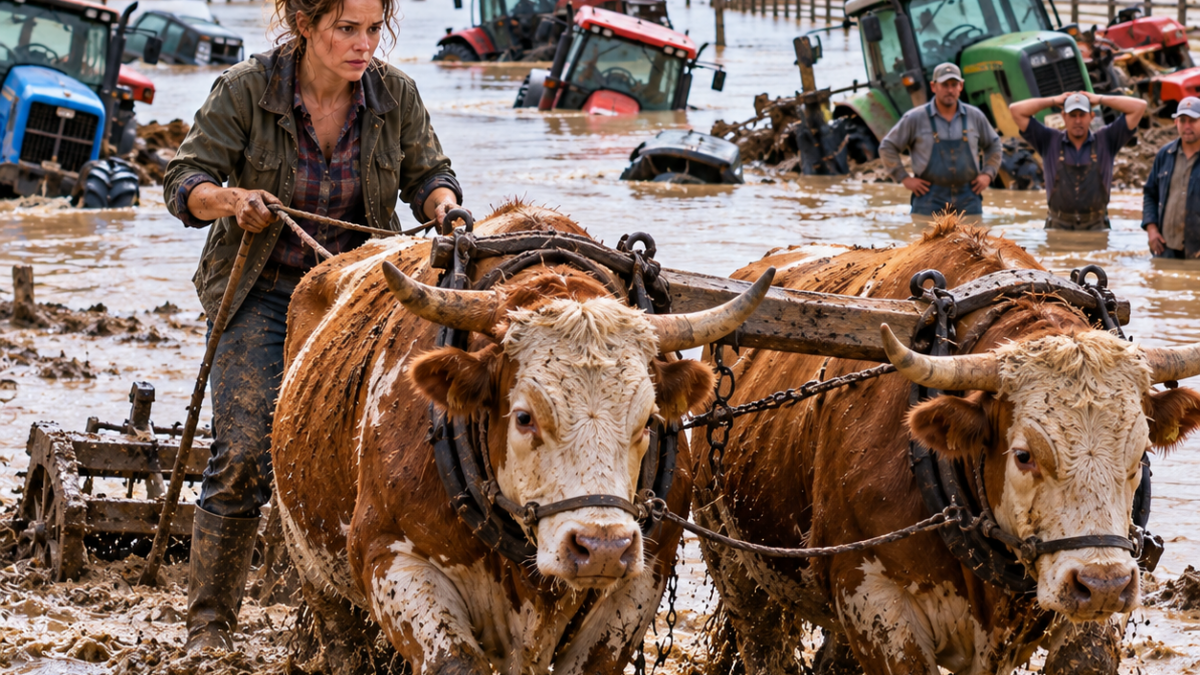
At dawn, brown water had spread across the bottoms.
No wave.
No wall.
Just water where fields had been.
Fence posts floated.
A blue plastic barrel turned slowly in a current crossing what had been bean ground.
My own losses arrived fast.
Forty feet of creek fence down.
Feed-shed roof split.
Upper hay wet.
Four low beds underwater.
Two thousand lettuce transplants gone.
I stood looking at them.
“Okay.”
That was all I said.
Because grief about vegetables does not repair fence.
I got the team.
Checked feet.
Harness.
Yoke.
Then started hauling.
Not through standing water.
Never that.
I walked every route first.
Ridge lane.
Hayfield edge.
Gravel above the barn.
Amos and Gideon did not perform miracles.
That mattered.
They were not stronger than tractors.
They could pull about what a small tractor might on good ground.
Less on bad ground.
What they had was different.
Their weight spread through eight hooves.
They could turn in narrow places.
Step around soft spots.
Use an eight-foot gate.
Move beside trees.
Stop instantly.
Adjust every foot independently.
A tractor has wheels.
An ox has decisions.
By Sunday afternoon, I had moved fence posts, pulled wet hay from the shed, carried blocks to the upper garden, hauled tools, and dragged a tarp over the feed roof.
Monday morning, Wade drove in.
He found me coming down the ridge with a cart.
He watched Amos and Gideon pass.
The lane under them was wet enough that his own tractor would not cross.
“I left my skid steer at Pruitt’s.”
“What happened?”
“Can’t get it out.”
“Tow it?”
“Lowboy can’t get in.”
He looked toward the oxen.
Then at me.
“How much would you charge?”
“For what?”
“Hauling.”
I laughed.
“You serious?”
“Yes.”
“What kind?”
“Whatever people need moved where wheels can’t go.”
I thought about it.
For about a day.
People began calling before I decided.
June Bellamy needed seedling flats moved across a saturated yard to her high tunnel.
The church camp needed propane bottles hauled down a lane destroyed by truck ruts.
A woman on Clayfield Road had twelve goats stranded beyond mud and had carried hay by hand for three days.
I helped.
Not everyone.
I learned to say no.
Standing water?
No.
Steep side slope?
No.
More than four hours continuous work?
No.
More weight than I considered safe?
No.
Wade said forty dollars an hour was too cheap.
“You’re providing specialty access.”
“I’m walking beside cows.”
“Oxen.”
“Same accountant category.”
“Charge more.”
“I’ll think about it.”
I didn’t.
Not yet.
Wednesday evening, a gray pickup arrived.
Grant Van Alstine got out.
He held a rolled map.
I knew immediately.
He looked at Amos and Gideon grazing.
Then at me.
“Mrs. Whitcomb.”
“Laurel.”
“Right.”
He hesitated.
“I need to ask you something.”
I waited.
“And I understand exactly how this is going to sound.”
“That makes one of us.”
He spread an aerial map over his hood.
Two thousand acres.
Van Alstine home section.
His finger tapped a wedge-shaped seventy-acre area at higher elevation.
“Hollis Rise.”
“What about it?”
“Only ground we have dry enough to plant.”
“Then plant it.”
“We can’t reach it.”
He showed me.
Main route crossed six hundred feet of flooded bottom.
The second route was an old south lane between fence and drop-off.
Eleven feet wide.
First hundred yards saturated.
“A loaded cart will bury itself.”
“Probably.”
“We need seed up there.”
I stared at him.
“You’re asking for Amos and Gideon.”
“Yes.”
I let the silence work.
Grant looked embarrassed.
Good.
“I know what my father said.”
“I remember.”
“I was there.”
“I remember that too.”
He nodded.
“We need eight, maybe ten trips. Seed. Fertilizer. Walk-behind equipment.”
“What about the drill?”
“Impossible.”
I studied the map.
“I walk the route first.”
“Fine.”
“If it’s unsafe, I say no.”
“Fine.”
“I decide weight.”
“Yes.”
“Not Preston.”
Grant smiled slightly.
“I expected that.”
He rolled the map.
Then looked at the oxen.
“They’re not slow, are they?”
“They’re exactly as fast as they are.”
That night Preston came himself.
Clean boots.
Even after a flood.
Some men have supernatural footwear.
He looked at the broken shed.
Down fence.
Hay spread under tarps.
Then at me.
“One twenty-five an hour.”
I almost smiled.
“For what?”
“Three days.”
“You’re bidding against your son?”
“I’m making it worth your time.”
“It isn’t about hourly rate.”
“Everything is about rate.”
“No.”
I pointed toward Gideon.
“He’s eleven.”
“So?”
“Old shoulder injury.”
“He looks fine.”
“He is fine.”
“Then what’s the problem?”
“My team has worked ten straight days on wet ground.”
Preston frowned.
“They’re animals.”
“Yes.”
“That’s what they’re for.”
I folded my arms.
“That sentence is why Earl didn’t sell them to you.”
His jaw moved.
“I have eleven people sitting because I can’t plant.”
“I know.”
“They don’t get paid if we don’t plant.”
“That isn’t their fault.”
“No.”
“It isn’t Amos’s either.”
He stared at me.
I counted conditions on my fingers.
“Four hours a day.”
His face tightened.
“Six.”
“Four.”
“We don’t have time.”
“Then don’t hire me.”
He went still.
“Six hundred pounds a trip.”
“That’s absurd.”
“That’s my limit.”
“We could double that.”
“No.”
“Those animals weigh—”
“I know what they weigh.”
“Laurel.”
“I stop when I say stop.”
He looked toward Grant.
Grant said nothing.
“And you pay your crew their full day whether we finish or not.”
Preston’s eyes narrowed.
“That’s between me and my employees.”
“Then hire someone else.”
Long silence.
A truck passed on the road.
Gideon shifted his weight in the paddock.
“Fine,” Preston said.
No handshake.
Good enough.
Wade, Grant, and I walked the south lane that afternoon.
Soil probe every fifteen feet.
Orange flags.
Two stretches would not carry anything.
One shoulder had slipped.
I rerouted one hundred yards entirely through a fence gap and along sod beside a waterway.
Ground never plowed.
Dense roots.
Firm.
Wade removed four fence panels.
Friday morning, we started.
Six hundred pounds.
Seed bags.
Rubber-tired cart.
Up.
Unload.
Rest.
Down empty.
Repeat.
Nothing heroic.
No cheering.
No dramatic music.
Just work.
Grant reorganized everything around what we could actually move.
Two walk-behind seeders.
Hand spreader.
More labor.
Less machinery.
Preston visited on the second morning.
He watched men unloading bags.
“This is painfully inefficient.”
Grant turned.
“Doing something inefficiently is still better than doing nothing perfectly.”
Preston looked at him.
Nobody spoke.
I liked Grant slightly more after that.
Second afternoon.
Seventh trip.
Gideon stopped.
Flat ground.
No obvious soft soil.
At first I thought he had sensed another weak spot.
Then I noticed his stance.
Weight shifted away from one side.
Head lower.
Breathing different.
I unhooked immediately.
“Laurel?”
Grant came down.
“We’re done.”
“We have four loads.”
“We’re done.”
“We have two hours of light.”
“Tomorrow.”
I walked Gideon down toward shade.
Preston came up the lane fast.
“What happened?”
“Gideon’s done.”
“He stopped?”
“Yes.”
“Why?”
“Because he told me.”
Preston stared.
“You’re stopping over that?”
I ran my hand down Gideon’s near foreleg.
No obvious heat.
But fatigue.
Enough.
“There are four loads sitting down there.”
“I know.”
“Men waiting.”
“Pay them.”
His face hardened.
“I’m not paying people to stand because your cow got tired.”
“Ox.”
“You know what I mean.”
I looked up.
“I spent eleven years keeping my farm alive with whatever I could do myself.”
The whole crew had become quiet.
“I’m not handing you the last two things I own because you planted in mud in March.”
Nobody moved.
Preston looked at me.
Then at Gideon.
Then up the hill where men waited.
He turned around.
Walked away.
His truck left ten minutes later.
I thought that was the end of the day.
Then Grant stayed.
After everyone else left, he came to my tailgate carrying a photocopy.
“I found something.”
“What?”
“I was looking for old tile maps.”
He unfolded a journal page.
1938.
Tight handwritten script.
Orin Hollis.
Wettest spring since 1927.
One line had been underlined.
Hauled seed to the rise by ridge road with the red team, two loads. No wheel will carry below. Ridge road wants brush cut again this fall.
I read it twice.
Grant pulled out another page.
Another year.
Same reference.
Ridge road.
Team.
Wet spring.
Another.
“You had a road.”
Grant shook his head.
“Not me.”
He laid an old plat beside a current map.
Thin dotted line.
County road to Hollis Rise.
Nearly a mile along natural high ground.
Gates at old fence lines.
A deliberate wet-weather route.
“Where is it now?”
Grant looked toward the big field.
“My father removed most of it.”
“When?”
“2006.”
“Why?”
“Field consolidation.”
I stared.
“He bladed a ridge flat.”
“Part.”
“Removed gates.”
“Yes.”
“Plowed the access road into the field.”
“Yes.”
“Why?”
“To let the planter run straight.”
I sat on the tailgate.
All spring, people had been talking about equipment.
Horsepower.
Tire width.
Four-wheel drive.
Tracks.
GPS.
But sixty years earlier, farmers had built something more basic.
A way around.
Grant looked at me.
“He didn’t cause the flood.”
“No.”
“He didn’t create the rain.”
“No.”
“He just removed the alternative.”
That was exactly it.
The next morning, Grant, Wade, and I walked the old route.
Two and a half hours.
Probe.
Map.
Elevation.
Brush.
Part of the ridge had been plowed into saturated field.
Gone.
But north of an old fence corner, nearly half a mile remained.
Eight to ten feet wide.
Brush-grown.
Firm.
Never worth farming.
Which was why it survived.
The road could not carry a loaded semi.
Could not carry Preston’s largest tractor.
Could not carry a grain cart.
It could carry Amos.
Gideon.
Six hundred pounds.
Any day the animals could safely stand on it.
I stood on that ridge and understood what I had really bought for $1,200.
Not strength.
Not nostalgia.
An option.
Every farmer in the valley had spent generations replacing older systems with faster ones.
Mostly for good reason.
Tractors were better at most work.
Then everyone threw away the backup.
One wet spring arrived.
The modern system became temporarily useless.
Nothing remained underneath it.
Except two old oxen nobody wanted.
Monday morning, I went to Preston.
Not publicly.
That mattered to me.
Humiliation makes people defensive.
I did not need an enemy.
I needed a road.
I put the 1938 plat beside the current map on his hood.
He stared.
Long time.
“My father talked about Ridge Road.”
“You thought he meant Route 42.”
“Yes.”
“Earl hauled here as a boy.”
Preston looked north.
“I removed this.”
“Most of it.”
“2006.”
“Yes.”
He rolled the map halfway.
Stopped.
“Grant told me February was too wet.”
Grant stood near the fender.
He looked surprised.
Preston continued.
“He told me again in March.”
Grant looked down.
“I want that said out loud.”
No one answered.
Preston looked at his son.
“I should’ve listened.”
Not an apology.
Not transformation.
Just truth.
I respected it.
“I’ll keep hauling.”
Preston nodded.
“Same terms?”
“Same terms.”
“Four hours.”
“Yes.”
“Your weights.”
“Yes.”
“You stop.”
“Yes.”
“My people get full day.”
“Yes.”
“Done.”
They planted Hollis Rise in nine days.
Eleven workers.
Two walk-behind seeders.
Hand spreader.
Amos.
Gideon.
The reopened portion of a road almost nobody remembered.
On the final evening, the last cart came down empty.
Grant shook my hand.
Preston did not.
He nodded.
I was too tired to care.
I got home after dark.
Walked to my lower garden with a flashlight.
The floodwater had finally dropped.
I already knew four beds were gone.
Then the beam reached another.
Yellow roots.
Slick soil.
Rot.
Another.
Another.
Seven of eleven beds destroyed.
I counted twice.
Numbers remained numbers.
My April order to June Bellamy was four hundred pounds of greens per week for six weeks.
My honest capacity was now less than half.
I sat at my kitchen table.
The old tractor repair invoice still lay there.
Expired now.
I added my hauling income.
$3,160 from Van Alstine.
Eight hundred and change from other work.
Enough to repair fence.
Replace wet hay.
Fix roof damage.
Buy replacement seed.
Not enough to erase the season.
But enough to keep me even.
After a flood, even is not nothing.
I drove into town.
June was behind the register.
“I’m short.”
“How short?”
“Half.”
“When?”
“Late.”
“How late?”
“Possibly end of May.”
She folded her arms.
I told her everything.
Beds.
Flood.
Hauling.
Van Alstine.
Oxen.
All of it.
When I finished, she said:
“I’d think less of you if you let the valley lose a processor contract just to prove Preston wrong.”
I blinked.
“That isn’t what I expected.”
“What did you expect?”
“You to be angry.”
“I’m a grocer.”
She picked up a pen.
“I’m angry about empty shelves.”
“I can’t fill them.”
“I know.”
She wrote something.
“I’ll put up a sign.”
“What sign?”
LOCAL GREENS DELAYED BY WILLOW CREEK FLOOD.
“They’ll wait.”
“People don’t wait.”
“My people do.”
I almost cried.
Didn’t.
June made three calls.
She belonged to a small buying group.
Six stores.
Two restaurants.
They had tried for years to coordinate seasonal supply.
Two weeks later, I sat at a folding table behind her store.
New agreement.
Lower price per pound than my old deal.
But guaranteed minimum.
Flexible harvest windows.
No penalty because spring arrived wrong.
Not wealth.
Stability.
I signed.
Saturday after floodwater dropped, Wade arrived at seven.
Post driver in his truck.
Dale Pruitt behind him.
Then two Van Alstine seasonal workers.
“What’s this?”
Wade looked at the down fence.
“Fence.”
“I can see that.”
“Then stop asking questions.”
Dale smiled.
“We got paid four days standing around.”
“So?”
“So we’re working Saturday.”
“Preston send you?”
“No.”
That mattered.
They replaced forty feet before noon.
Wade repaired the tile outlet properly.
Rodent guard.
Splash pad.
No invoice.
I argued.
He took two dozen eggs and pickled beans.
“Paid.”
“That’s not payment.”
“It is today.”
Preston’s check arrived on the fifteenth.
Full amount.
No deductions.
No argument.
That surprised me more than anything.
Grant came a week later with a soil probe and level.
“We’re reopening Ridge Road.”
“How much?”
“Quarter mile this summer.”
“Your father approve?”
“He told me to map it.”
I smiled.
“Progress.”
“Don’t tell him I said that.”
By August, they had cleared brush.
Graveled the worst hundred feet.
Installed two gates.
Created a written wet-weather access plan.
Their insurance company loved it.
Preston hated the phrase “contingency route.”
Grant used it every chance he got.
At the county agricultural meeting in June, Preston stood.
Basement.
Bad coffee.
Folding chairs.
Maybe thirty people.
He spoke forty seconds.
“I lost approximately three hundred acres of planting this spring.”
Room quiet.
“My operations manager warned me twice that the profile was too wet.”
Grant sat near the wall.
Preston continued.
“I overruled him.”
A few people shifted.
“The only part of my home section planted on schedule got planted because Laurel Whitcomb brought seed up a road I removed in 2006 using a yoke of oxen I laughed at in March.”
He stopped.
No apology.
No praise.
No dramatic revelation.
Just fact.
Then someone asked about nitrogen prices.
Meeting continued.
That was perfect.
Earl came in July.
His sister drove.
Doctor had taken his keys.
He walked slowly to the paddock.
Amos approached.
Gideon stayed back.
Earl checked shoulders.
Feet.
Weight.
“How many hours?”
“Usually two to four.”
“Consecutive?”
“No.”
“Good.”
“Hard days?”
“Four maximum.”
“Good.”
“Rest day?”
“At least one.”
He nodded.
That was approval.
I wanted more.
“Say something nice.”
“No.”
“Earl.”
“They’re fat.”
“That’s nice?”
“Very.”
He looked at Gideon.
“If you ever want a younger pair, I know a breeder in Tennessee.”
“I’d want you to help pick.”
Earl’s face changed.
Barely.
“I’d want to.”
We left it there.
I did not turn ox work into an empire.
I did not start a company.
No magazine wrote about me.
No investors arrived.
That was never the point.
I still hired skid steers for trenches.
Still hired tractors for hay.
Still borrowed machinery when machinery was right.
The oxen did work that suited them.
Cultivating.
Compost.
Posts.
Crates.
Wet shoulder seasons.
Tight spaces.
Ground where heavy wheels caused damage.
The tractor was not my enemy.
That summer, I finally repaired mine.
Not the full $6,800 job.
Wade found a used pump.
Rebuilt another component.
Welded a housing the shop said was not worth welding.
Total:
$2,900 plus parts I already owned.
I stood beside him.
“So suddenly it is worth welding.”
“It wasn’t worth welding for them.”
“Difference?”
“They charge shop rate.”
“You don’t?”
“I charge emotional damage.”
“You’ve been collecting for years.”
“Exactly.”
The tractor started.
Smoked.
Shook.
Then settled.
I smiled.
Amos and Gideon watched from their paddock.
“Jealous?”
Wade looked at me.
“Please don’t become one of those people who talks to livestock like coworkers.”
“They’re better coworkers than you.”
“Unbelievable.”
The repaired tractor worked dry ground.
Baled hay.
Pulled the spreader.
Exactly what it was good at.
The team worked beds.
Hauling.
Wet margins.
Exactly what they were good at.
That became the lesson.
Not old versus new.
Not oxen versus tractors.
Options versus dependency.
Preston visited in September.
No offer.
No jokes.
He found me stacking squash crates.
“I need to ask something.”
“Again?”
“About soil.”
I stared.
“That’s new.”
He ignored it.
“Gideon stops before soft spots.”
“Sometimes.”
“How?”
“I don’t know.”
“Smell?”
“Feel.”
“Through hooves?”
“Probably.”
“Could it be trained?”
I laughed.
“What?”
“Can people learn what he notices?”
“People have been doing that for thousands of years.”
“You know what I mean.”
I considered.
“Walk your ground.”
“We do.”
“Get out of the cab.”
His mouth tightened.
I continued.
“Carry a probe.”
“We have sensors.”
“Use those too.”
He nodded.
“What else?”
“Stop treating a field as uniform.”
He looked surprised.
“It isn’t.”
“I know.”
“No. You know academically.”
I pointed.
“Gideon doesn’t care what the map says. If twelve feet of lane is bad, he stops at twelve feet.”
Preston looked toward the paddock.
“Grant says I think too big.”
“He’s right.”
“You’re enjoying this conversation.”
“Immensely.”
He almost smiled.
Then became serious.
“Why did you help us?”
That question had waited months.
I put down the crate.
“Your workers.”
“What?”
“Dale. Everybody.”
I looked at him.
“If you lost planting, they lost money. June lost produce. Town lost work.”
“That wasn’t your problem.”
“It became everybody’s problem.”
He nodded slowly.
“You could’ve made me pay more.”
“I did okay.”
“You could’ve embarrassed me.”
“You handled that yourself.”
That actually made him laugh.
Short.
Real.
“Fair.”
He walked away.
The following spring was wet again.
Not flood wet.
Just persistent.
The Ridge Road reopened early.
Van Alstine used small utility tractors on upper sections where ground carried them.
Kept large equipment out.
Stored seed on high ground before forecast storms.
Grant had changed logistics.
Preston had changed slightly too.
He listened longer.
Not always.
Enough.
One March morning, a farm-supply clerk called.
“You coming in?”
“Eventually.”
“Thought you’d want to hear this.”
“What?”
“Preston’s giving a soil meeting.”
I laughed.
“What soil meeting?”
“Wet-ground planning.”
“You’re lying.”
“No.”
“Does he have oxen?”
“Not yet.”
I hung up smiling.
Revenge can be strange.
I had once imagined what it would feel like to make Preston admit he was wrong.
Turns out hearing he had scheduled a meeting about wet-weather contingency planning felt better.
Because admission is temporary.
Changed behavior lasts.
The market agreement June arranged grew.
Slowly.
The next year, I added two more acres.
Not nineteen.
Two.
I could handle eleven well.
That mattered.
June teased me.
“You could expand.”
“I am.”
“More.”
“No.”
“Why?”
“Because I learned from Preston.”
She laughed.
“That might be the meanest thing you’ve ever said.”
“Scale isn’t automatically security.”
“True.”
“I want margin.”
“Also true.”
“If rain comes, I want options.”
June nodded.
“That sounds expensive.”
“So is losing everything.”
Amos turned twelve.
Gideon thirteen.
I reduced heavy work.
Earl warned me.
“Older team can work.”
“I know.”
“Don’t retire them too early.”
“I won’t.”
“But don’t ask youth from old legs.”
“I know.”
He nodded.
Then coughed for too long.
His health worsened that winter.
He died in February.
His sister called.
I sat at the kitchen table holding the phone after she hung up.
The hickory yoke hung in the shed.
His hand marks still visible where years of use had darkened the wood.
At the funeral, I stood near the back.
Afterward, his sister gave me an envelope.
Inside was one sheet.
Earl’s handwriting.
Amos—steady left.
Gideon—watch shoulder.
Don’t overload downhill.
Young team contact: Tennessee number below.
Then:
You learned to listen. That’s the part that matters.
I cried in my truck.
Not because it was poetic.
Earl would have hated poetry.
Because it sounded exactly like him.
The next spring, I bought two young calves from the Tennessee breeder.
Not oxen yet.
Potential.
I named them Earl and Dobbins.
Wade said that was ridiculous.
I told him to mind his welding.
Training young cattle made me understand how much Amos and Gideon had given me.
They had arrived finished.
Patient.
Tolerant of mistakes.
The calves were none of those things.
One stepped on me.
One ate a glove.
Both considered commands optional.
I started again.
Language.
Position.
Timing.
Trust.
Slow work.
Preston visited once while I trained them.
He stood outside the paddock.
“You bought more.”
“You sound concerned.”
“I’m wondering whether this is contagious.”
“Extremely.”
He looked at the calves.
“What do those cost?”
“Less than one tire on your big tractor.”
He laughed.
“Everything costs less than those tires.”
“Maybe that’s your problem.”
He watched for a while.
Then said:
“Grant wants to keep part of the ridge road permanently grassed.”
“Smart.”
“I argued.”
“Of course.”
“He won.”
“Even smarter.”
Preston leaned against the fence.
“I used to think unused ground was waste.”
“And now?”
“I think some unused ground is infrastructure.”
That sentence might have been the best apology he ever gave me.
We did not become friends.
But we became neighbors.
Actual neighbors.
Which is harder.
Friends choose one another.
Neighbors must keep functioning after arguments.
During another wet spring, Preston called before sunrise.
“County culvert washed.”
“Which road?”
“Clayfield.”
“Anyone trapped?”
“Mrs. Harlan’s place.”
Wade’s mother.
“What does she need?”
“Medication delivery.”
“Standing water?”
“No. Mud.”
“I’ll check.”
No joke.
No insult.
No rate negotiation.
Just information.
I took Amos and Gideon.
They were older now.
We moved carefully.
Delivered medicine.
Returned.
Preston paid me anyway.
I tried refusing.
He said:
“Don’t make this sentimental.”
I took the check.
Fair.
Years passed.
Amos died first.
Fourteen.
I found him lying beneath the run-in shed one winter morning.
Gideon stood nearby.
That silence was different from every other silence I had known from him.
I sat beside Amos.
Hand on his neck.
He had been old at the auction.
Unwanted.
Worth twelve hundred dollars only because nobody else bid.
He had helped save my planting.
Helped neighbors.
Helped keep a processor contract alive.
Taught me more about ground than most equipment manuals.
But in the end, he was just an old animal whose body stopped.
No legend.
No miracle.
I buried him on high ground above the creek.
Gideon worked lightly one more season.
Never yoked alone for heavy work.
Mostly training beside the younger pair.
He became something like a teacher.
Stand.
Wait.
Walk.
The calves copied him.
Animals learn from animals in ways people cannot replace.
When Gideon died two years later, I buried him beside Amos.
Wade helped.
Preston sent a skid steer.
No charge.
I stood looking at the two mounds afterward.
June beside me.
“Worth it?”
“What?”
“Twelve hundred dollars.”
I laughed through tears.
“Terrible investment.”
“Obviously.”
“They ate constantly.”
“Parasites.”
“Vet bills.”
“Freeloaders.”
I nodded.
“Best money I ever spent.”
The younger team eventually became reliable.
Different personalities.
Different stride.
Different mistakes.
They never became Amos and Gideon.
I stopped expecting them to.
One morning in June, years after the flood, I worked the squash beds for two hours.
Then unhooked.
East of me, Van Alstine’s tractor crossed eight hundred acres in a straight line.
Satellite steering.
Wide implement.
Beautiful machine.
It would accomplish in a day what my team could not finish in weeks.
I watched it.
No resentment.
No competition.
A tractor is excellent at being a tractor.
An ox is excellent at being an ox.
A ridge is excellent at staying above water if somebody does not blade it flat.
Most problems begin when we demand one tool answer every question.
The old Ridge Road remained.
Van Alstine maintained it.
Brush cut.
Gravel in weak places.
Gates.
Signs.
WET WEATHER ACCESS.
The first time I saw that sign, I stopped my truck.
Took a picture.
Sent it to Grant.
He replied:
Don’t send this to Dad.
I did.
Preston replied fifteen minutes later:
I hate both of you.
That made my week.
At a county meeting later that year, a young farmer presented a drainage plan.
He wanted to consolidate several fields.
Remove two fence lines.
Straighten access.
Preston raised his hand.
“Where is your wet-weather route?”
The young man looked confused.
“My what?”
Preston pointed toward me.
“Ask her.”
Everyone turned.
I laughed.
“You started this.”
“I learned.”
That was true.
The best revenge is not always watching somebody fail.
Sometimes it is watching them teach the lesson they once mocked you for knowing.
My farm remained small.
Twenty-eight acres.
Eleven in active production eventually.
A little more some years.
Less others.
No investors.
No massive expansion.
I paid off the well.
Then the tractor.
Then most of the farm note.
June’s buying group gave me predictable income.
Not glamorous.
Predictable.
Predictable is beautiful when you have lived without it.
I kept Earl’s original yoke hanging under cover.
By then, I had newer equipment.
But the old hickory remained.
Dark from decades of hands and shoulders.
Every spring I rubbed it with oil.
Wade teased me.
“You know you can buy a new one.”
“I have one.”
“That thing belongs in a museum.”
“So do you.”
“Cruel.”
“Accurate.”
He grinned.
Then repaired another implement I had broken.
One April morning, a group of high-school agriculture students came out.
Their teacher wanted to demonstrate draft power.
The kids arrived expecting novelty.
Phones out.
One boy asked:
“Why would anybody use oxen now?”
Good question.
I pointed at a tractor parked beside the barn.
“That tractor can do more work in one hour than this team can do in half a day.”
The boy frowned.
“So why?”
“Because that isn’t always the job.”
I walked them to the ridge lane.
Showed soil.
Drainage.
Hoof pressure.
Wheel ruts.
Talked about soil compaction.
Access.
Redundancy.
A girl asked:
“So the oxen are better?”
“No.”
“Then tractors are better.”
“No.”
She looked annoyed.
“Which is it?”
I smiled.
“Better for what?”
That was the question.
Always.
Better for what ground?
What weather?
What load?
What distance?
What deadline?
What damage can you afford?
What backup do you have?
The valley had once answered every question with horsepower.
The flood exposed the cost.
That did not mean we should answer every question with oxen.
It meant we should stop throwing away options just because the newest tool works faster most of the time.
Preston came to that student demonstration.
Not invited.
He stood in back.
Afterward, one boy recognized him.
“Were you the guy who laughed?”
Preston looked at me.
I looked away because I was enjoying myself too much.
“Yes.”
The students laughed.
He raised one hand.
“In my defense, they looked ridiculous.”
I turned.
“Your tractor looked worse buried to the axles.”
More laughter.
Preston nodded.
“That is also true.”
The boy asked:
“What did you learn?”
Preston considered.
Then said:
“That efficiency can make you fragile if you remove everything inefficient.”
The teacher wrote it down.
I stared at him.
“That’s good.”
“Don’t sound surprised.”
“I am surprised.”
He walked away smiling.
The flood became local history.
Not huge history.
No national disaster.
No lives lost.
Just one spring everybody remembered.
People said:
The year Willow Creek took the bottoms.
The year Preston buried the big Deere.
The year Laurel hauled seed with oxen.
Stories simplified.
They always do.
What I remembered was messier.
Lettuce dying underwater.
Wet hay.
Sore feet.
Gideon breathing wrong.
My fear that I had wasted $1,200 when I could least afford it.
The embarrassment of walking oxen through town.
The anger of hearing people laugh.
The temptation to work them too hard once people suddenly needed them.
That last part mattered most.
Being mocked makes revenge seductive.
When Preston needed me, I had leverage.
For once.
I could have punished him.
Charged triple.
Worked the team until midnight.
Made a show of his dependence.
Instead, Earl’s voice stayed in my head.
A machine runs till it breaks.
These will tell you first.
The animals did not care about my pride.
Gideon stopped.
I stopped.
That decision probably saved his shoulder.
Maybe more.
It also forced Preston to accept something money could not override.
A limit.
That may have been the most important reversal of all.
For years, Preston believed every problem could be solved by adding scale.
More acres.
More machinery.
More credit.
More labor.
Then one wet spring, the answer was:
Four hours.
Six hundred pounds.
No more.
And he had to live inside those limits.
The world did not end.
His crop got planted.
His workers got paid.
He learned.
So did I.
I learned that saying no does not mean refusing help.
Sometimes the strongest help comes with boundaries.
I learned that being useful does not obligate you to destroy yourself.
That lesson went beyond oxen.
I had spent years treating my own body like Preston treated his ground.
Push.
More.
Finish.
Ignore warning signs.
After that spring, I changed.
Not dramatically.
I still worked too much.
But sometimes when my back tightened or exhaustion made every problem feel personal, I thought of Gideon stopping on flat ground.
I stopped too.
A person can learn from an ox if she is desperate enough.
One autumn evening, I walked Ridge Road alone.
Van Alstine had graveled the lowest section.
Grass covered the shoulders.
Old gate posts still stood in places.
I imagined Orin Hollis in 1938.
Red team.
Wet spring.
Seed hauled by hand.
Men cutting brush every fall because they understood a simple thing.
Bottom ground gives.
Bottom ground takes.
Keep another way.
Then tractors improved.
Roads improved.
Drainage improved.
Everybody forgot.
Preston did what rational farmers did.
Remove fences.
Straighten rows.
Increase efficiency.
On ordinary years, he was right.
That is what made the story useful.
The mistake was not modernization.
The mistake was erasing memory.
The old farmers built Ridge Road because they had already paid for the lesson.
When the road disappeared, the lesson disappeared too.
Until the flood charged us again.
I stopped where the ridge overlooked the river bottom.
Down below, fields stretched wide.
Modern.
Straight.
Productive.
Beautiful.
The route beneath my boots was narrow.
Inefficient.
Awkward.
Essential.
Both belonged.
That was the answer.
Years later, after Preston retired, Grant took over most Van Alstine operations.
He kept Ridge Road.
Expanded drainage monitoring.
Reduced early field traffic.
And once, to everyone’s shock, bought a pair of draft horses.
Not for main-field work.
For a forestry project on wet creek margins.
Preston called me.
“You did this.”
“I absolutely did not.”
“He bought horses.”
“Good horses?”
“That is not the point.”
“What’s the point?”
“My son has become impractical.”
I laughed.
“Maybe he likes options.”
Preston groaned.
“I should’ve never repeated that sentence.”
“You’ll be hearing it until you die.”
“I know.”
That became our relationship.
Not friendship.
Not quite.
A long-running argument with mutual evidence.
The farm account eventually held more than eleven thousand dollars.
The first time it crossed fifty, I stared at the number.
Then closed the banking app.
No celebration.
No new truck.
No giant tractor.
I ordered drainage tile.
Bought better seed storage.
Built reserve.
Replaced fencing.
Bought insurance.
Options.
Everywhere I could afford them.
June retired from the market.
Her niece took over.
The buying group continued.
Wade’s hair went gray.
Mine did too.
The younger ox team aged.
Another team came after them.
I never became an evangelist.
People sometimes visited expecting me to tell them tractors were evil.
I disappointed them.
I loved tractors.
Especially when mine started.
Machines save labor.
Labor matters.
Soil health matters.
Animal welfare matters.
Time matters.
Money matters.
A good farmer does not worship tools.
She chooses.
One spring, a reporter asked me:
“Did the oxen save Briar Glen?”
“No.”
“But they saved the planting.”
“Part.”
“Would Preston have lost the contract without them?”
“Maybe.”
“So they saved it.”
I shook my head.
“The workers saved it. Grant reorganized it. The old ridge saved it. The weather gave us a window.”
“But the oxen made access possible.”
“Yes.”
“Then why resist saying they saved it?”
“Because that turns the lesson into a miracle.”
She paused.
“What’s the lesson?”
“We had another option because I happened to own something everyone thought was obsolete.”
“That sounds like the story.”
“No.”
I looked toward the field.
“The story is that the valley used to have options too. We erased them.”
That made her quiet.
She used that line.
I didn’t mind.
By the time I was sixty, Amos and Gideon had been gone many years.
The original yoke still hung in the shed.
Ridge Road still existed.
Preston was mostly retired.
Grant ran the operation.
On a wet March morning, I drove toward town.
Rain had fallen three days.
Fields glossy.
Tractors parked.
Not because everyone was trapped.
Because people had learned to wait.
At Van Alstine’s home section, small loads of seed already sat on Hollis Rise.
Moved there earlier during dry weather.
Prepared.
No emergency.
No old oxen required.
I pulled over.
Grant’s truck stopped beside me.
Window down.
“Everything okay?”
“Yeah.”
I pointed toward the rise.
“You staged early.”
“Forecast.”
“Look at you.”
He smiled.
“Dad says planning is cheaper than humiliation.”
“That sounds like him now.”
“Definitely now.”
“How is he?”
“Annoying.”
“Good.”
Grant looked toward the ridge.
“You ever miss that spring?”
“Absolutely not.”
“Me neither.”
We sat listening to rain hit our roofs.
Then he said:
“Changed everything.”
“Not everything.”
“No.”
He smiled.
“Enough.”
We drove on.
That afternoon, I walked into my shed.
The old repair invoice was still there.
I had kept it.
$6,800.
NOT WORTH WELDING.
Beside it, I had framed the auction receipt.
$1,200.
TWO MILKING DEVON OXEN.
HICKORY YOKE.
CHAINS.
PLOW.
CULTIVATOR.
People saw those two pieces of paper and assumed the point was that the cheap thing beat the expensive thing.
It did not.
My repaired tractor eventually worked for years.
Amos and Gideon eventually died.
Every tool has a season.
What those papers reminded me of was the day I ran out of obvious choices and bought a different one.
That different choice carried me through the year when the obvious one failed.
That is a distinction worth keeping.
The richest people in Briar Glen once laughed because I bought what nobody wanted.
I do not blame them much anymore.
I laughed inwardly too.
Walking behind a yoke in the twenty-first century looked absurd.
Until rain changed the question.
Then suddenly speed was not the question.
Access was.
Weight was.
Soil was.
Endurance was.
Knowing when to stop was.
The answer changed because conditions changed.
That happens on farms.
It happens in lives too.
On one early June morning, I finished cultivating squash with the current team.
Sun rising over creek timber.
Ground finally dry enough to smell warm instead of wet.
I unhooked.
Hung the yoke.
The oxen walked toward water.
Far east, a Van Alstine tractor crossed a giant field.
Straight line.
Morning light flashing on glass.
I watched it.
Beautiful machine.
Fast.
Necessary.
Then I looked at the old yoke.
Also necessary.
Not because everything old deserves saving.
Some things become obsolete for good reasons.
But before you throw away an old road, an old tool, an old method, or an old piece of knowledge, it is worth asking one question.
What problem was this originally built to solve?
Because sometimes the problem disappears for fifty years.
Then returns on a Tuesday morning in March.
And when it does, you may discover that progress did not fail you at all.
You simply threw away the backup.
I locked the shed.
Checked the water tank.
Then started toward the house.
Behind me, hooves shifted softly in dry soil.
Across the valley, a tractor engine rose and fell.
Both sounds belonged there.
That was the ending I liked best.
Not one replacing the other.
Not one winning.
Just a valley that had finally remembered there was more than one way through.
[END OF STORY]




