PART 2: They Laughed at My 47 Goats and Called My Ranch a Desert—Then the Worst Wildfire in 30 Years Came Straight for Us
PART 2
I could explain it.
Fuel continuity.
Ladder fuels.
Wind.
Slope.
Defensible space.
Access routes.
Fine fuels.
I knew exactly what I was doing.
Then I imagined their faces.
Grant grinning.
Someone interrupting.
Someone telling me cattle had been raised in Callahan Valley for a century without needing my little experiment.
I carried the mineral blocks to the register.
Paid.
Walked outside.
Grant saw me.
His expression changed for half a second.
Then he smiled.
“Tessa.”
“Grant.”
Nobody mentioned the desert.
I loaded my truck.
Drove home.
Arguments consume time.
Goats consume brush.
That summer, I knew which one mattered.
Preston’s attack was more polished.
He hosted the summer landowners meeting at Blackwood Cattle Holdings.
I owned significant acreage in the valley.
I was not invited.
Later, he called that an oversight.
Cole called it intentional.
He attended and came to see me afterward.
“You’re going to enjoy this.”
“I doubt it.”
“Preston gave a thirty-five-minute speech about responsible stewardship.”
“Of course.”
“He showed his irrigation system.”
“Of course.”
“Then his flail mower.”
“The big one?”
“The one that probably costs more than your ranch.”
“Close.”
Cole hesitated.
“Then he showed aerial photos.”
I stopped working.
“One of mine.”
“Yes.”
“What did he say?”
“Never used your name.”
“So everybody knew exactly who he meant.”
“Pretty much.”
“What words?”
“Inexperience.”
I nodded.
“Overgrazing.”
Another nod.
“Poor land management.”
That one almost made me laugh.
The situation was so backwards that it became funny.
What Preston owned was impressive.
A huge mower.
Water trucks.
Irrigation.
Generators.
A modern shop.
Employees.
What I owned was forty-seven goats.
Eleven rolls of electric netting.
Two solar chargers.
A water tank.
A stock trailer.
And a 1994 pickup with a second gear that occasionally disappeared.
If you compared equipment, Preston looked serious and I looked ridiculous.
But expensive tools are useful only when they are doing the work you actually need.
My goats were reducing fuel every day.
Preston’s mower spent much of June inside a steel building.
Ten days after that meeting, Preston came to Juniper Hollow.
He was friendly.
That immediately made me suspicious.
We walked toward the western eighty acres.
“Rough country,” he said.
“Yes.”
“Difficult to make money on.”
“Probably.”
“You thought about selling any?”
“No.”
“Everybody thinks about selling.”
“I haven’t.”
He smiled.
“I might be interested.”
I stopped.
“There it is.”
“What?”
“The reason you came.”
Preston named a price.
I stared at him.
Half market value.
Maybe less.
He kept talking.
“You keep the house.”
“I know.”
“The barn.”
“I know.”
“The better pasture.”
“I’m familiar with my own ranch.”
His smile tightened.
“I’m trying to help you.”
“No.”
He looked at me.
“You’re trying to buy eighty acres from somebody you think is failing.”
The smile disappeared.
At least we had reached honesty.
“First years are hard.”
“I know.”
“Especially when money is tied up in animals that aren’t producing.”
“They’re producing.”
“What?”
“What I need.”
His jaw tightened slightly.
“Tessa, sooner or later numbers matter.”
“I know.”
“You can’t run a ranch on stubbornness.”
“I know.”
“Two or three years from now, you may have no choice.”
“You don’t know that.”
“I know ranching.”
“So do I.”
He looked up at the slope.
“I’m offering you an easy way out.”
“I’m not looking for one.”
For several seconds, Preston said nothing.
Then he nodded.
“Offer stands.”
“Mine doesn’t change.”
He drove away genuinely confused.
In his world, people who were going to lose usually knew they were going to lose.
He thought my refusal was pride.
He never considered that perhaps he had misunderstood the situation.
At the end of June, the state forestry office released its seasonal outlook.
Snowpack had reached only thirty-one percent of normal.
Fuel moisture was dropping unusually fast.
The final paragraph warned that the coming fire season could become one of the most severe in decades.
The report went on the wall at the feed store.
It was mentioned on local radio.
People talked about it.
Then went back to work.
I read the report once.
Went home.
Moved fence.
July arrived hot.
Then stayed hot.
Nineteen days without measurable rain became twenty-six.
Twenty-six became thirty-four.
The creek behind Juniper Hollow shrank into disconnected pools.
Cheatgrass turned white.
Dry grass crumbled under boots.
Afternoon humidity dropped into single digits.
Burn restrictions went up.
Campgrounds closed.
The afternoon wind stopped dying after sunset.
That worried Cole more than anything.
It worried me too.
I changed my grazing pattern.
Until then, I had treated ground systematically.
Now I focused entirely on survival.
First, the house.
A ring roughly one hundred fifty feet deep.
Short grass.
Broken brush.
No dead material touching the structure.
Then the barn.
Then the equipment shed.
I connected those areas so fire could not follow a continuous corridor of untreated fuel between them.
After that came the access road.
I cleared both sides.
A road surrounded by brush is not an escape route.
It is a trap made of gravel.
I wanted fire engines to get in.
More importantly, I wanted them to get out.
Then I moved the goats west.
That slope was the key.
Juniper Hollow sat beneath the western rim.
If fire came from that direction under strong wind, the slope could accelerate it toward the buildings.
Fire moves faster uphill.
Flames preheat the fuel above them.
The steeper the ground, the faster that process compounds.
I kept all forty-seven goats on the western treatment for twenty-two days.
They worked a band roughly two hundred feet deep in narrower areas.
Nearly four hundred feet in the steepest section.
They stripped brush.
Ate fine fuels.
Reduced low vegetation.
Opened gaps.
I worked from sunrise to dark.
And every time someone drove past, the ranch looked worse.
At least to them.
At the volunteer fire department pancake breakfast in August, Preston delivered the joke everyone would remember.
Nearly ninety people filled the hall.
Families.
Ranchers.
Firefighters.
Children running between tables.
I stood near the serving line holding a paper plate.
Preston called my name loudly enough for everyone to hear.
“Tessa!”
I turned.
He was sitting with several landowners.
Grant was nearby.
“You got a plan if the big one comes?”
I knew immediately where he was going.
Someone laughed.
Preston grinned.
“Forty-seven goats going to line up along the fence and blow the fire out?”
The room erupted.
Not everybody laughed.
But enough.
I stood there holding a plate with two pancakes on it while grown adults laughed at work I had spent months doing.
For one moment, the room disappeared.
I was twenty-seven again.
Northern California.
Smoke swallowing the afternoon.
The screaming of frightened cattle.
A hay barn burning so hot nobody could approach.
People shouting directions nobody could hear because the fire was louder.
I remembered the smell.
Burned feed.
Pine.
Hair.
Diesel.
I remembered realizing that nothing we did that afternoon was going to undo the decisions made over the previous ten years.
Then I came back to the room.
Preston was still smiling.
“No,” I said.
The laughter faded.
He lifted his eyebrows.
“No?”
“They won’t have to.”
“Why?”
“Because they’ve already done their part.”
I carried my plate away.
I didn’t see Preston’s expression.
Cole did.
He told me later Preston stopped smiling.
Maybe the past tense bothered him.
They had already done their part.
That meant something had been happening he didn’t understand.
It didn’t stop him from causing trouble.
Early September brought a complaint.
First through the landowners association.
Then the county.
Goats too close to common fencing.
Vegetation damage.
Potential escapes.
Damage to the “character of the valley.”
Grant Worthington signed the county complaint.
The disputed fence bordered Blackwood land.
I didn’t need a detective.
The timing made me furious.
Fire danger was climbing daily.
I needed every hour.
Instead, I spent two days driving to the county office.
Deed.
Survey.
Photographs.
Measurements.
I proved the portable netting had been placed fifteen feet inside my property.
My goats had never grazed the shared fence.
The complaint was dismissed without a hearing.
Grant never apologized.
Preston later claimed surprise that the issue had “gone that far.”
I sat inside my pickup in the county parking lot for several minutes afterward.
Both hands gripping the steering wheel.
That was the closest I came all summer to losing my temper.
Mock me?
Fine.
Exclude me?
Fine.
Offer half price for my land?
Business.
But costing me working days during an extreme fire season?
That was different.
I started the truck.
Drove home.
And widened the exact fuel break they wanted me to stop making.
Years later, people would call that my revenge.
At the time, it was simply work.
Cole finally learned why in September.
He came by one evening.
We sat on the porch.
The sunset was red from distant smoke.
He watched the goats.
Then asked, “What happened to you?”
I looked over.
“What kind of question is that?”
“You know what I mean.”
“No.”
“I know why you’re doing this.”
I said nothing.
“But nobody prepares for fire this aggressively unless they’ve watched one destroy something.”
I looked west.
Cole waited.
Eventually I said, “Northern California.”
He didn’t interrupt.
“I was twenty-seven.”
I told him about the ranch.
Four seasons working there.
Good people.
Old operation.
Generations of cattle.
Then one summer afternoon, a fire came out of the canyon.
Wind behind it.
At two o’clock, we were working normally.
Ninety minutes later, normal had disappeared.
The hay barn burned.
Three hundred tons of feed.
The shop.
Nine miles of fence.
Most of the herd.
We tried to save everything.
That is one of the cruel truths about disaster.
People believe effort should determine outcome.
Sometimes effort arrives too late.
The brush had been accumulating for years.
Dead material had been accumulating for years.
Roads had been narrow for years.
Fuel had connected buildings for years.
None of that could be changed after the sky turned black.
“What did you learn?” Cole asked.
“That the important decisions happen before the fire.”
He nodded.
“There was one section of that ranch.”
“How big?”
“Maybe sixty acres.”
The owner’s father had run goats there years earlier.
The brush never returned as thick.
The fire reached it.
Crossed it.
But something changed.
Flame length dropped.
The fire fell lower.
Fence posts survived.
A barn beyond it survived.
Nobody paid much attention afterward.
There was too much damage everywhere else.
I did.
“I stood in the black afterward holding a shovel,” I told Cole. “And it finally made sense.”
“What did?”
“Fire isn’t angry.”
Cole looked at me.
“It doesn’t hate anyone. Doesn’t pick victims. Doesn’t care about money.”
“No.”
“It’s arithmetic.”
Cole smiled slightly.
“Physics.”
“Same idea.”
Fuel.
Moisture.
Wind.
Slope.
Continuity.
Change the numbers beforehand and you change the result afterward.
“So that’s why you bought the goats.”
“Yes.”
“Not because you wanted goats.”
“No.”
“Not because you thought they’d make money.”
“That wasn’t the first goal.”
Cole looked across the ranch.
“You’ve been preparing for this for eleven years.”
“I’ve been remembering for eleven years.”
Two days later, smoke rose thirty-seven miles west of Callahan Valley.
At first, nobody was very concerned.
Wildfires happen.
Most become someone else’s problem.
This one started on public land in the Ridgeline drainage.
Likely vehicle-caused.
Tuesday night, it reached eight hundred acres.
By Wednesday noon, forty-one hundred.
Two hand crews.
Six engines.
Aircraft.
Officials sounded cautiously optimistic.
Thirty-seven miles feels like another world.
Under the right conditions, it isn’t.
Wednesday evening, I smelled juniper smoke.
Thursday morning, the wind changed.
West-northwest.
Twenty-five miles an hour.
Gusts approaching forty.
Humidity seven percent.
The fire crossed the first containment line.
Then the highway.
By evening, eleven thousand acres had become thirty-one thousand.
A Type 1 incident management team was ordered.
People stopped saying, “They’ll get it.”
Friday morning, ash began falling in Callahan Valley.
Soft gray flakes landed on trucks.
Water tanks.
Horse backs.
Roofs.
The sun turned dark red.
By two in the afternoon, it looked like evening.
My power flickered twice.
Then went out.
The county issued an evacuation warning.
Get ready.
People panicked.
I didn’t.
Not because I was fearless.
Because my list had been written in July.
Twelve cattle and two horses went to leased ground eleven miles east.
I kept the trailer hitched.
Filled the two-thousand-gallon water tank.
Set out the gas pump.
Laid hose where crews could find it.
Moved propane cylinders.
Cleaned roof valleys.
Opened interior gates so loose animals could move downhill rather than become trapped against wire.
Then I moved the forty-seven goats into the center paddock.
Almost nothing combustible had been left there since July.
The old gray doe stood near the gate.
Ash collected on her back.
She shook once.
Then went back to eating.
Four miles east, Preston Blackwood was discovering the difference between owning equipment and owning time.
Blackwood Cattle Holdings had eleven hundred deeded acres.
Thousands more leased.
A huge flail mower.
Water truck.
Irrigation.
Generators.
Employees.
What Preston did not have was four months.
His cattle grazed grass.
They didn’t remove sage.
They didn’t strip blackberry.
They didn’t clear dead branches from junipers.
Nine miles of fence carried years of brush.
Four hundred acres of meadow had been rested for fall feed.
Two feet of dry grass.
His grandfather’s juniper windbreak ran near his corrals.
Beautiful.
Dense.
Dry.
His mower might clear six acres in a hard day.
He had hundreds needing treatment.
And maybe eighteen hours.
Money cannot compress time.
At four that afternoon, Grant Worthington drove through my gate.
No joke.
No smile.
Hat in his hands.
Ash in his hair.
“Tessa.”
“Grant.”
He looked west.
“You really think it’s coming this far?”
For the first time since I had met him, he was asking because he needed my answer.
I watched the smoke column leaning east.
“It’s already coming.”
He swallowed.
I asked, “Your hay shed.”
“What?”
“Metal roof?”
“I don’t know.”
“Find out.”
“Why?”
“Because embers don’t wait for the main fire.”
Grant left immediately.
The Friday night briefing came out at 9:15.
Fifty-eight thousand acres.
Nine-mile run in six hours.
Winds forecast thirty to thirty-five.
Gusts approaching fifty-five.
Critical fire weather.
Projected spread directly into Callahan Valley.
A local station called it the most significant fire the district had seen in close to thirty years.
At 11:40 p.m., mandatory evacuation orders were issued.
Cole spent that night studying a paper map.
Later he told me what he saw.
The projected axis crossed the western half of Blackwood Cattle Holdings.
Crossed the common fence Preston had complained about.
Then continued straight onto my western slope.
Saturday morning, I walked Juniper Hollow one final time.
Checked water.
Checked gates.
Checked goats.
Checked the barn.
There was nothing else to do.
That is when preparation becomes frightening.
Eventually you run out of tasks.
Then all you can do is trust the decisions you already made.
At 7:40, I left.
Dog in the cab.
Box of documents.
My grandmother’s quilt.
Nothing else.
I didn’t look backward.
People imagine ranchers staying with garden hoses until flames reach the porch.
That isn’t courage.
Not after professionals order evacuation.
I knew better.
You do not win against wildfire during the final twelve hours.
You win whatever can be won months earlier.
Then you leave.
The evacuation staging area was in Danbury, eighteen miles east.
By ten in the morning, around sixty vehicles filled the parking lot.
Nearly two hundred people stood around with nothing to do.
Dogs paced.
Children cried.
Nobody finished their coffee.
Someone had fire traffic playing on a radio.
Every few minutes, a calm voice said something procedural that made the whole parking lot go silent.
A little after one, the fire came over the western rim.
I had seen wildfires before.
Still, my stomach turned.
From eighteen miles away, it did not look like individual flames.
It looked like weather.
A moving wall of orange.
People raised binoculars.
Someone whispered a prayer.
At roughly 2:30, the fire reached Blackwood’s western boundary.
Preston’s phone started ringing.
For seven hours, it barely stopped.
I heard fragments.
“Which line?”
“How much?”
“Move them east.”
“No, leave the equipment.”
“Leave it.”
“Get out.”
Later we learned what happened.
His western fence went first.
Years of brush had grown through wire and around posts.
Once ignited, it carried fire like a fuse.
Then the rested meadow.
Four hundred acres of cured grass disappeared in minutes.
Around 3:10, the old juniper windbreak ignited.
It threw embers a quarter mile ahead.
Two landed on the hay barn.
Three hundred tons of feed.
Gone.
The tractor shed went.
Two equipment trailers.
Pasture.
Fence.
Preston owned more machinery than I had ever imagined buying.
None of it mattered.
Fire does not care what equipment costs.
It cares what burns.
Around four, Grant lost his hay shed.
Then pipe fence.
About eighty acres eventually burned.
He stood in the Danbury parking lot silent.
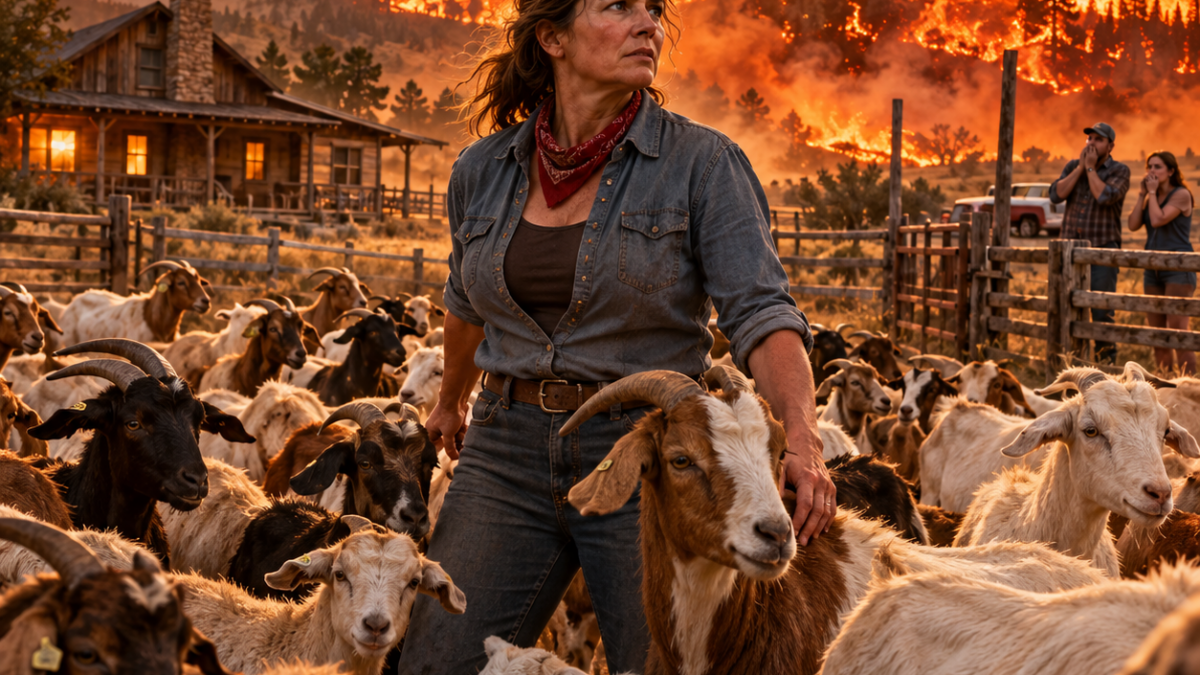
Then somebody said, “It’s at Juniper Hollow.”
My entire body tightened.
A news crew had a long lens pointed west.
Cole had binoculars.
I moved beside him.
The head fire reached my western boundary around 5:20.
I wish I could say I was calm.
I wasn’t.
I knew the science.
I knew why the treatment should reduce intensity.
I knew the purpose of every paddock.
None of that mattered emotionally.
My house was there.
My barn.
My goats.
Everything I had saved for.
Science becomes personal when your life is standing underneath it.
The fire entered Juniper Hollow.
It did not stop.
That matters.
People later exaggerated the story.
They said forty-seven goats stopped a wildfire.
They did not.
The fire crossed onto my ranch under the same wind, heat, and pressure that had destroyed everything before it.
Then it reached the western treatment band.
Four hundred feet deep in the widest section.
Brush canopy broken.
Dead material reduced.
Fine fuels cropped.
Low branches removed.
Fuel continuity interrupted.
The fire went in.
And changed.
Cole saw it first.
He lifted the binoculars.
Lowered them.
Then raised them again.
Grant stepped closer.
“What?”
Cole said nothing.
For hours, the fire had crossed the valley like one solid wall of orange.
Over Juniper Hollow, the wall began to break.
Flames shortened.
The crown fire dropped toward the surface.
The front separated into smaller fingers.
Patches slowed.
Grant took the binoculars.
He stared.
Then lowered them.
“The desert.”
Nobody laughed.
He looked at Cole.
“The Callaway Desert.”
Cole pointed toward the western slope.
“That isn’t damaged ground.”
Grant stared at him.
“That’s a fuel break.”
“With goats?”
“Every foot.”
Grant turned back toward the ranch.
I looked at Preston.
He stood about ten feet away.
Phone in his hand.
His family’s ranch was burning.
The hillside he had called irresponsible management was visibly reducing the intensity of the same fire.
Our eyes almost met.
He looked away.
At 5:40, a structure protection group reached my access road.
Four engines.
One water tender.
They had spent two hours retreating from one driveway after another.
Every place they tried to defend was surrounded by untreated fuel.
No safe anchor.
No clear escape.
Then they reached Juniper Hollow.
The road was cleared on both sides.
Wide enough for two vehicles.
Around the house was one hundred fifty feet of reduced fuel.
The barn had treated ground.
The equipment shed too.
Water tank full.
Pump ready.
Hose accessible.
The supervisor made the decision quickly.
They stayed.
That decision saved my buildings.
Embers landed on the roof.
Crews extinguished them.
A northern fence caught.
They cut it off.
Surface fire moved through the stubble.
Low enough that firefighters could work.
That was all I had wanted.
Not fireproof land.
Fightable land.
From Danbury, we knew none of those details.
We only saw the fire behaving differently.
For months, people had laughed at the pale strips.
Now nearly two hundred evacuees stood watching them matter.
I could have said something to Preston.
God knows I had enough material.
Still think forty-seven goats aren’t a serious herd?
How’s that flail mower doing?
Want to buy my western eighty now?
The lines were sitting in my mouth.
Then I looked at him.
His family’s ranch was burning.
The windbreak planted by his grandfather was gone.
His barn was gone.
His feed was gone.
Suddenly humiliation felt cheap.
Fire had already punished him more severely than anything I could say.
So I stayed silent.
The fire did enough talking for me.
The jokes about my goats ended that afternoon.
They never returned.
The wildfire continued for eighteen more days before full containment.
Final size was around ninety-four thousand acres.
Nobody died.
That was the number that mattered.
When the road finally reopened, I drove home.
The landscape looked unfamiliar.
Black ground.
Gray ash.
Smoke rising from pockets that appeared dead.
I stopped at the gate.
House standing.
I drove farther.
Barn standing.
Equipment shed standing.
Well house standing.
I parked.
For several seconds, I couldn’t move.
Then I put my forehead against the steering wheel and cried.
Juniper Hollow had not escaped untouched.
Roughly two thousand feet of fence burned.
A storage shed behind the barn was gone.
My welder was inside it.
Most of my fencing supplies too.
Around sixty acres of upper ground burned.
Some of the sage had been killed completely.
The eastern grass went down almost to dirt.
Two goats developed respiratory trouble.
I had months of work ahead.
But every animal was alive.
House standing.
Barn standing.
The core of the ranch remained.
When I stepped out, the gray doe with the torn ear walked toward me.
Her brass bell rang once.
I put my hands around her neck.
She smelled like smoke, dirt, and goat.
I started laughing through the tears.
“I told them you were enough.”
She tried to eat my shirt.
Blackwood Cattle Holdings lost nine miles of fence.
The hay barn.
Three hundred tons of feed.
A tractor shed.
Two equipment trailers.
The juniper windbreak.
Around six hundred acres of fall pasture.
The main house survived because it sat inside irrigated lawn.
Preston had moved his cattle early, so the herd survived.
Financially, his losses were enormous.
He could absorb them.
But money wasn’t the real issue.
Money rebuilds structures.
It replaces equipment.
It cannot erase the moment a man realizes the assumptions guiding him were wrong.
Grant lost his hay shed.
Pipe fence.
About eighty acres.
Mostly insured.
He spoke less afterward.
Three weeks later, the fire district held a debrief meeting.
I almost skipped it.
I had fence to rebuild.
Cole came to my ranch.
“You’re going.”
“I have work.”
“You need to hear this.”
“What?”
“Come.”
Around forty people attended.
A fire behavior analyst showed maps of the final perimeter.
She talked through wind.
Terrain.
Fuel types.
Suppression lines.
Places where the fire accelerated.
Places where it slowed.
Then she pointed toward the northeast corner of Juniper Hollow.
I sat forward.
That corner was almost two-thirds of a mile from my house.
Nothing valuable of mine stood there.
No barn.
No shed.
No equipment.
But during the hottest part of August, I had spent eighteen days treating a band almost three hundred feet wide through that corner.
The analyst explained that when fire reached it, intensity dropped enough for a bulldozer and two engines to anchor there.
The line held through the night.
Because it held, the fire did not make the run it had been positioned to make down the east drainage.
That run would have threatened Evelyn Harrington’s ranch.
Then four more properties.
The analyst was careful.
She said the wind also weakened after midnight.
She said no single factor determines fire behavior.
Then she said the sentence that mattered.
“Without that treated area, the crews would have had nowhere safe to establish the anchor.”
The room went silent.
Evelyn Harrington sat in the third row.
Her husband’s family had owned nine hundred acres since the 1940s.
All summer, she had quietly sided with Preston.
She believed expensive machinery represented modern management.
She believed my goats represented desperation.
After the meeting, she stood beside her truck for a long time.
Then drove home.
A few days later, Cole came to see me.
I was rolling up netting.
He leaned against the fence.
“The northeast treatment.”
“What about it?”
“Your house isn’t there.”
“No.”
“Barn isn’t there.”
“No.”
“Road doesn’t depend on it.”
“No.”
“That treatment took what? Two weeks?”
“Eighteen days.”
“In August.”
“Yes.”
He stared.
“Why?”
I continued rolling.
Eventually I stopped.
“Fire doesn’t know whose fence it is.”
Cole frowned.
“What?”
“Fire doesn’t know whose fence it is.”
I pointed toward the drainage.
“Wind doesn’t care about deeds. Slope doesn’t care about surveys. If the best place for a fuel break happens to be near a boundary, that’s where it goes.”
“You knew it could protect Harrington.”
“I knew it could protect whoever was downwind.”
“She laughed at you too.”
“I know.”
“That didn’t bother you?”
“Of course it bothered me.”
“And you still did it.”
I looked at him.
“What was I supposed to do? Leave a gap because she hurt my feelings?”
Cole stared at me.
Then smiled.
“I’m stealing that sentence.”
“What sentence?”
“Fire doesn’t know whose fence it is.”
“Take it.”
He used it for years afterward at safety meetings.
Evelyn came to my ranch the following week.
She brought two coffees.
“Tessa.”
“Evelyn.”
She held one out.
“Peace offering.”
I accepted it.
We stood near the barn.
She looked toward the northeast corner.
“They explained what happened.”
“I heard.”
“My husband’s grandfather bought our ranch after the war.”
I waited.
“My grandson wants it someday.”
Her voice changed.
“That treatment gave them somewhere to stand.”
“That’s what the analyst said.”
“You spent eighteen days doing it?”
“About that.”
“For us.”
“For the drainage.”
“That includes us.”
“Yes.”
She stared into her coffee.
“I laughed too.”
“I know.”
Her head lifted.
“People talk.”
“I’m sorry.”
I believed her.
So I nodded.
Then she asked the question that mattered more than the apology.
“Will you help me figure out where we should treat?”
“Of course.”
That was how the valley changed.
Not all at once.
People came individually.
Pride prefers private appointments.
They asked about paddock sizes.
Rotation.
Water.
Timing.
Goat breeds.
Fence.
Cost.
Eventually they all reached the same question.
Could my goats work their property?
Preston came on the third Saturday in October.
Alone.
No employee.
No foreman.
No audience.
His truck still had ash packed into the seams around the hood.
He stopped outside my gate instead of driving through.
That was new.
He waited.
I walked down.
I assumed he wanted to discuss our shared fence.
Roughly two thousand feet had burned.
Local custom said we should split the replacement.
I had figures folded in my shirt pocket.
I needed the money badly.
I had practiced sounding as though I didn’t.
Preston never mentioned the fence.
He stood looking uphill.
The goats were working surviving sagebrush.
The gray doe led them.
Brass bell ringing.
Finally he asked, “Where did you buy them?”
I blinked.
“What?”
“The goats.”
I looked at him.
“Where did you buy them?”
There are moments when revenge walks politely up to your gate and introduces itself.
This was mine.
Months of ridicule came back instantly.
Forty-seven isn’t a serious herd.
Hobby with hooves.
Poor stewardship.
The pancake breakfast.
The complaint.
The cheap offer for my western eighty.
Now Preston Blackwood stood on my property asking where he could buy goats.
I could have destroyed him with one sentence.
“Still think forty-seven isn’t serious?”
I could have asked how the flail mower performed.
Could have asked whether he still wanted to buy my western acres.
Could have reminded him exactly how many people had laughed.
For several seconds, I wanted to.
Then I remembered him in the Danbury parking lot.
Phone in both hands.
Watching his family history burn.
I remembered Northern California.
The ranch I had worked.
The owners standing in ash.
Fire had already humbled him.
Anything I added would be for my ego.
“Wait here,” I said.
I went inside.
Found the livestock broker’s name and number.
Wrote them on a piece of paper.
Returned.
Preston took it.
“Thank you.”
“Wait.”
I went inside again.
Found the grazing plan I had drawn on graph paper before spring.
Paddock sequence.
Acreages.
Rest periods.
Priority treatment zones.
I copied it.
Brought it outside.
Preston looked at the pages.
“What’s this?”
“My rotation.”
“You’re giving it to me?”
“Yes.”
“Why?”
“Because you asked about goats.”
“That’s not what I mean.”
“I know.”
He looked at me carefully.
Maybe he had rehearsed an argument.
Maybe he expected me to embarrass him.
I leaned against the gate.
“You don’t have to like me.”
He said nothing.
“You don’t have to agree with me.”
“I think we’re past that.”
“Maybe.”
I looked toward the burned slope.
“But I’m not interested in watching your ranch burn again just to prove I was right.”
He lowered his eyes.
“There is one thing I want.”
“What?”
“Next time you see something you don’t understand, stop laughing long enough to look first.”
Silence.
Preston Blackwood had spoken at every landowners meeting for twenty years.
That afternoon he could not find an answer.
Eventually he folded the papers.
Put them inside his jacket.
“Thank you.”
I nodded.
He walked toward his truck.
Then stopped.
“Tessa.”
“Yeah?”
He turned.
“I was wrong.”
Two words.
That was enough.
He drove away.
I stood by the gate listening to the brass bell on the hill.
I had imagined revenge differently.
I thought it would feel hot.
Loud.
Triumphant.
Instead it felt peaceful.
Because I realized I did not need Preston humiliated.
I needed him changed.
That lasted longer.
By November, six ranchers had contacted me about targeted grazing.
Grant Worthington was last.
Naturally.
He had invented the phrase Callaway Desert.
His pride had farther to travel.
My phone rang one afternoon.
“Tessa.”
I recognized his voice.
“Grant.”
“How’s the fence?”
“Which section?”
He laughed nervously.
“Fair.”
We spent nearly a minute talking about weather.
Insurance.
Fence posts.
Nothing.
Then he gave up.
“Those goats of yours.”
“What about them?”
“You keeping them next year?”
“Yes.”
“Running them in spring?”
“Yes.”
Silence.
“The north side of my place has gotten pretty brushy.”
“I know.”
“And that draw.”
“I know.”
“You think…”
He stopped.
I waited.
“You think your goats could clear it?”
“Yes.”
Grant let out a breath.
“Good.”
I waited three seconds.
“Grant?”
“Yeah?”
“They’re not working for free this time.”
Silence.
Then he laughed.
Not his old laugh.
A real one.
“Fair enough.”
I gave him a price.
He accepted without negotiating.
That was the day the Callaway Desert became profitable.
I registered Hollowline Grazing in February.
I bought a used gooseneck trailer.
Then two guardian dogs.
Forty-seven goats became seventy.
Then a hundred.
Within eighteen months, I had roughly two hundred ten.
We took fuel-reduction contracts across four counties.
Fence lines.
Road corridors.
Steep slopes.
Drainages.
Overgrown acreage.
Places where machinery had trouble.
Places where herbicide was undesirable.
The goats did not care.
To them, every contract was lunch.
The fire district began recommending us.
Blackwood Cattle Holdings became one of my largest clients.
The second season after the fire, Preston signed a three-year contract.
Nine hundred acres of fence line, windbreak, and priority treatment.
The first time I sent the invoice, I stared at his company name.
Remembered the pancake breakfast.
Then pressed send.
He paid early.
Every time.
We never discussed his old presentation.
Never discussed his offer to buy my land.
Never discussed the complaint.
There are apologies people say.
And apologies people live.
I accepted both.
Grant’s handmade sign disappeared that winter.
CALLAWAY DESERT.
Arrow pointing west.
I had driven past it all summer.
Then one morning it was gone.
Nobody mentioned it.
I never asked.
By spring, Callahan Valley looked different.
Brush-free bands appeared along fences.
Access roads were cleared earlier.
Juniper windbreaks were limbed.
Western slopes were treated before the grass cured.
Some ranchers hired me.
Some bought goats.
Others used mechanical equipment.
I did not care which method they chose.
The point was never that goats were magical.
They weren’t.
The point was that preparation mattered.
The gray doe with the torn ear stayed with me for years.
She had been one of the cheapest animals in the original group.
Scarred.
Plain.
Old enough that most serious producers would have ignored her.
She had stepped out of the trailer that first day and walked directly into blackberry like she had finally found her purpose.
She became the lead doe.
Whenever we moved paddocks, she went first.
The others followed her bell.
As she aged, she slowed.
I moved her to easier ground.
She still tried to lead.
Then one spring morning, I found her lying beside the barn.
Gone.
I sat beside her longer than I expected.
People who do not work with animals sometimes believe ranchers avoid attachment.
We don’t.
We simply know attachment does not prevent endings.
I removed the brass bell.
Hung it on a nail beside the barn door.
It stayed there almost a year.
The following spring, before the first major contract, I took it down.
Polished it.
Fastened it around the neck of another lead doe.
I have done that every spring since.
On quiet evenings, I can hear it coming down the slope before I see the herd.
One metallic note.
Then another.
Whenever I hear it, I remember that first summer.
Grant laughing at the feed store.
Preston’s presentation.
The pancake breakfast.
The complaint.
The ash.
Danbury.
The wall of fire.
Grant whispering, “The desert.”
Cole saying, “That’s a fuel break.”
Firefighters finding a place to stand.
My barn still there when I came home.
People simplify the story now.
They say forty-seven goats saved a ranch from a wildfire.
That isn’t true.
They did not stop ninety-four thousand acres of fire.
Nothing that simple happened.
I lost fence.
A shed.
Tools.
Sixty acres.
The fire burned through Juniper Hollow.
What the goats changed was intensity.
Fuel continuity.
Access.
Flame length.
They created places where people could fight.
That difference matters.
Preparation is less dramatic than rescue.
Nobody films you moving netting in May.
Nobody applauds a cleared access road in June.
Nobody gathers around while goats eat blackberry.
Then something bad happens and suddenly the boring work becomes the only thing anybody can see.
That is what happened in Callahan Valley.
The valley did not change because I gave a speech.
I never did.
It changed because everyone watched the same fire behave differently on different ground.
Years later, Cole and I walked the old western fire line.
The land had begun healing.
Grass returned.
Shrubs returned.
Some junipers survived.
Others didn’t.
He pointed toward regrowth.
“You’ll need the goats here again.”
“I know.”
“Never ends.”
“No.”
We walked toward his truck.
He stopped.
“You know people still tell the story?”
“Unfortunately.”
“They tell it wrong.”
“How?”
“They say the goats saved the valley.”
“They didn’t.”
“I correct them.”
“Good.”
Cole looked toward the herd.
“Know what else they get wrong?”
“What?”
“They think the fire changed everyone.”
“Didn’t it?”
“The fire scared them.”
He pointed toward me.
“You changed them.”
“That sounds dramatic.”
“Doesn’t mean it’s wrong.”
I almost argued.
Then decided I had finally learned something about unnecessary arguments.
Preston visited again the following spring.
Hollowline was growing.
More goats.
Used trailer.
Guardian dogs.
An employee repairing netting.
My old 1994 pickup still parked beside the barn.
Preston looked at it.
“You ever going to replace that thing?”
“Why?”
“Second gear sounds terrible.”
“I rebuilt the transmission.”
“So you’re keeping it.”
“Yes.”
“Why?”
“I like making people underestimate my equipment.”
He stared at me.
Then laughed harder than I had ever heard him laugh.
“Fair.”
He started toward his truck.
I called him.
“Preston.”
He turned.
“How many goats did you end up buying?”
He hesitated.
“Sixty.”
I raised an eyebrow.
“Sixty?”
“Yes.”
“That enough to be considered serious?”
For a second, neither of us said anything.
Then he smiled.
“You’ve been saving that.”
“Maybe.”
He nodded.
“Well?”
“Well what?”
“Are sixty enough?”
I looked toward his truck.
Then back at him.
“They’re enough for what you need.”
Preston covered his face with one hand and laughed.
I laughed too.
That was my revenge.
Not ruining him.
Not humiliating him in public.
Not cheering while his ranch burned.
Just the most powerful rancher in the valley standing on my property asking whether sixty goats were enough.
Somehow, that felt better.
Because he understood.
A year after the fire, Juniper Hollow still was not the biggest operation in Callahan Valley.
I was not rich.
The roof still needed work.
Fences always needed repair.
Goats escaped occasionally because goats appear to regard fences as personal challenges.
My pickup still smelled like dust and dog.
But the ranch lived.
My business grew.
People who had once laughed were now paying me for the work they mocked.
Whenever somebody new called one of the treated strips ugly, somebody else usually corrected them.
“Fuel break.”
“Defensible space.”
“Smart.”
Funny how vocabulary changes after consequences.
The summer taught me something I never forgot.
Preparation often looks ridiculous before the emergency.
It can look excessive.
Paranoid.
Wasteful.
Ugly.
Unnecessary.
The person doing it may look foolish right until everybody else wishes they had done the same.
I was not smarter than every rancher in Callahan Valley.
I simply paid for my lesson eleven years earlier.
In Northern California.
Standing in ash with a shovel.
Watching another family lose nearly everything.
That experience gave me fear.
Useful fear.
Fear that becomes work instead of panic.
When I finally owned land, I promised myself the important decisions would be made before I smelled smoke.
So I made them.
Forty-seven goats.
Eleven rolls of netting.
Two solar chargers.
A water tank.
An old pickup.
It did not look sophisticated.
It did not impress people at meetings.
But fire does not rank tools by purchase price.
It responds to what burns.
And for four months, forty-seven animals changed what would be available when the fire arrived.
One mouthful at a time.
Blackberry.
Sage.
Dry grass.
Dead leaves.
Low branches.
Vines.
Material cattle ignored.
Material people ignored.
Material fire would not ignore.
Then the worst wildfire in thirty years came directly toward us.
Every ugly strip mattered.
Every fence move mattered.
Every morning I had spent working instead of arguing mattered.
That was why my house stood.
Why my barn stood.
Why firefighters had room.
Why crews could anchor near Evelyn’s place.
Why Preston eventually carried my grazing plan home inside his jacket.
People sometimes ask what I felt when Preston admitted he was wrong.
The simplest answer is satisfaction.
The truer answer is freedom.
All summer, I pretended other people’s opinions did not matter.
But they did.
Grant’s jokes bothered me.
Preston’s speeches bothered me.
Men laughing in parking lots bothered me.
I carried those things while pretending I didn’t.
After the fire, I stopped needing approval.
The evidence existed on the ground.
Black beside green.
Burned beside treated.
Structures standing.
That certainty changed me.
I became less interested in winning conversations.
More interested in outcomes.
Maybe that was why I gave Preston the broker’s number.
Why I helped Evelyn.
Why I took Grant’s money without humiliating him.
Revenge is usually imagined as making the other person hurt.
Sometimes the better revenge is becoming so useful that the people who dismissed you must confront their mistake every time they ask for your help.
You do not have to destroy them.
Reality corrects them.
Your job is to keep standing.
Hollowline kept growing.
We worked private ranches.
Public land.
Utility corridors.
Steep roadsides.
Overgrown watersheds.
People began coming to watch.
Landowners.
Fire officials.
Occasionally reporters.
Once, even schoolchildren.
That part always made me smile.
Grant had joked about a petting zoo.
Now people actually visited the goats.
Only they brought notebooks.
One spring, I spoke to a group of landowners while Preston stood near the back.
An older man from another county pointed toward the herd.
“You really believe goats can stop a wildfire?”
Before I could answer, Preston spoke.
“No.”
Everyone looked at him.
He pointed toward the treated ground.
“They change the fuel.”
The man waited.
Preston continued.
“They reduce the intensity enough that people may be able to fight it.”
He glanced toward me.
“Big difference.”
I said nothing.
I just smiled.
The man who had once joked about goats blowing flames away was now correcting somebody else’s misunderstanding.
That might have been the most satisfying revenge of all.
Grant changed too.
He hired Hollowline every spring.
Eventually he stopped sounding embarrassed.
One March, he called.
“Need you on my north draw before May.”
“That a request?”
“Order.”
“You don’t own my company.”
“Fine. Strong request.”
I laughed.
He gave me the acreage.
Before hanging up he said, “Bring more than forty-seven this year.”
“Why?”
“My neighbor complains about the smell.”
“You want fewer?”
“No. I want enough goats to finish before he complains twice.”
That was Grant.
Still Grant.
Just pointed in a better direction.
The landowners meetings changed too.
Preston invited Cole to speak.
Treatment maps appeared.
Fuel moisture became part of normal conversation.
Evelyn organized people along the east drainage so projects connected across boundaries.
That mattered.
Individual fuel breaks help.
Connected planning helps more.
One spring, Cole and I stood on a ridge looking across Callahan Valley.
Pale strips crossed multiple ranches.
Roads were clearer.
Windbreaks thinner.
Western slopes broken into treatment zones.
Cole smiled.
“Ugly.”
“Terrible.”
“Ruined the valley.”
“Completely.”
We stood there a moment.
Then he said, “Looks good.”
It did.
Not beautiful like untouched brush.
Beautiful like a seat belt.
Like a fire exit.
Like water stored before drought.
Some things are beautiful because of what they prevent.
I thought about the Callaway Desert.
How much that name had once bothered me.
Now I almost liked it.
Without that summer, I might never have learned how little mockery matters compared with results.
People can laugh at preparation.
They cannot negotiate with consequences.
I continued treating Juniper Hollow every year.
Because successful preparation can become dangerous if it creates arrogance.
One good outcome does not make you invincible.
Fuel grows back.
Weather changes.
Wind changes.
Fire changes.
The same fuel break that worked five years ago may not work now if nobody maintains it.
So every spring, the brass bell goes around the neck of a lead doe.
Every spring, the goats return to the slopes.
Every spring, the work begins again.
One evening years later, I stood outside the barn watching clouds build over the mountains.
No lightning.
No smoke.
Just clouds.
The herd came down the western slope.
The bell sounded in the dusk.
My dog lay beside the porch.
Juniper Hollow looked peaceful.
The scars from the fire were becoming harder to see.
Grass had returned.
Shrubs.
Young trees.
A stranger could have driven past and never known.
I touched the post where the original gray doe’s bell had once hung.
I imagined her stepping off the trailer.
Torn ear.
Rough coat.
No idea that everyone in the valley thought she was ridiculous.
Animals have one advantage over people.
They do not need strangers to respect them.
They just do the work in front of them.
Maybe that was the lesson I had been learning all along.
That summer, everybody thought I was trying to prove forty-seven goats belonged on a serious ranch.
I wasn’t.
I was trying to keep a ranch alive.
If I had spent more time convincing people, perhaps I would have treated less ground.
If I had sold the western eighty to Preston, maybe that slope would have stayed thick with brush.
If the complaint had forced me to stop along the boundary, maybe crews would have lost a useful line.
Small decisions accumulate.
So does preparation.
A goat takes one bite.
Then another.
A fuel break is built one paddock at a time.
A ranch survives because hundreds of boring choices were made while nothing dramatic was happening.
People remember the fire.
I remember the mornings before it.
Sunrise over netting.
Moving water.
Untangling fence.
The old doe’s bell.
My truck refusing second gear.
Sweat running down my back while someone drove past and laughed.
Those mornings were the real battle.
The wildfire was only the test.
That is what I would tell someone now.
You rarely know which ordinary decision will become important later.
Do the work anyway.
Prepare anyway.
Let people laugh.
Their laughter does not change wind.
It does not change fuel moisture.
It does not change the slope.
It does not change the value of the work.
By the time the hardest day arrives, it is usually too late to become the person you wish you had been months earlier.
You only get to use what you prepared.
I had forty-seven goats.
They were enough.
Enough to begin.
Enough to change the fuel.
Enough to give firefighters room.
Enough to help keep my ranch standing.
Enough to teach my neighbors something my words never could.
Enough to build a business.
And unexpectedly, enough to give me back something I had lost eleven years earlier.
Trust.
Not trust that disaster would never happen.
That is fantasy.
Trust that preparation can matter.
That people can learn.
That traditions can change.
That black ground can grow something useful afterward.
People ask whether this is really a story about goats.
It isn’t.
The goats were a tool.
It is a story about how easily people confuse familiarity with wisdom.
Callahan Valley understood cattle.
Machinery.
Money.
Family names.
Pasture that looked good from the road.
It did not understand a woman using forty-seven mismatched goats to prepare for a disaster nobody wanted to imagine.
So people laughed.
Then the disaster arrived.
For one afternoon, opinions stopped mattering.
Only results remained.
Preston’s machinery could not erase four years of fuel in eighteen hours.
Grant’s jokes could not save his hay shed.
My pride could not save Juniper Hollow.
But four months of preparation changed what the fire found.
That was enough.
Years later, when the brass bell comes down the hill in the evening, I sometimes close my eyes.
I can still hear the old joke.
“They’re enough for what I need.”
The sentence that once embarrassed me became one of my favorite memories.
Because they were.
Forty-seven goats were enough to start.
Enough to protect more than just my buildings.
Enough to change the future of a valley.
Enough to make the most powerful rancher there stand at my gate asking where to buy his own.
And enough to teach me that the best revenge is rarely watching somebody who mocked you suffer.
The better revenge is surviving what they were certain would destroy you.
Building something valuable from the thing they called ridiculous.
Watching them quietly realize that while they were laughing, you were doing the work they should have been doing themselves.
And then discovering that when they finally ask for help, you have become strong enough to help them without needing to hurt them first.
I thought my satisfying ending would be Preston embarrassed.
Grant apologizing in public.
The whole valley admitting I had been right.
That was not what I wanted once the smoke cleared.
What I wanted was the sound of a bell on a living hillside.
My barn standing.
My animals alive.
Evelyn’s family still owning their ranch.
Preston treating his property before fire season.
Grant clearing his draw before June.
Those things lasted.
Humiliation wouldn’t have.
Years after the fire, Preston and I stood near the western boundary while one of my crews moved goats.
He looked across the treated slope.
“You ever think about selling those eighty acres?”
I looked at him.
He smiled.
This time it was a joke.
“No.”
“Still stubborn.”
“Still interested?”
“Sure.”
He laughed.
“But I know better than to offer.”
“Good.”
Then his expression became serious.
“I honestly thought you’d lose this place.”
“I know.”
“I figured three years, maybe less.”
“I know.”
He looked toward the old fire scar.
“I cost you time that summer.”
I knew what he meant.
The complaint.
“Yes.”
“I should have stopped it.”
“Yes.”
“I didn’t.”
“No.”
He looked at me.
“I’m sorry.”
That was the apology I had never demanded.
I nodded.
“Thank you.”
He waited, as if expecting more.
There wasn’t more.
We stood quietly.
Then the goats discovered blackberry and rushed toward it.
Preston watched.
“Still ugly animals.”
I smiled.
“Careful.”
“I said ugly. Not useless.”
“That’s progress.”
He nodded.
“Apparently I’m trainable.”
“So are goats.”
He laughed.
And that was enough.
When I think about the wildfire now, I do not think first about the flames.
I think about before.
April.
May.
June.
July.
August.
Before the smoke.
Before the evacuation.
Before everybody cared.
Preparation is invisible until the moment it becomes necessary.
Then suddenly it is the only thing anyone can see.
Maybe that is why people underestimate it.
Nobody applauds the barn that does not burn.
Nobody writes headlines about the engine crew that does not have to retreat.
Nobody takes pictures of the disaster that never became worse.
But those quiet successes are real.
Juniper Hollow taught me to value them.
I never wanted another wildfire.
None of us did.
But if another one came, Callahan Valley would meet it differently.
Not perfectly.
Nothing makes wildfire safe.
But better.
More access.
More treated ground.
More planning.
More communication.
Less pride.
That became the legacy of the fire.
Not just my business.
Not Preston’s apology.
Not Grant hiring me.
Prepared land.
Prepared people.
Neighbors who understood that what one person did on one hillside could determine whether someone else had a safe place to stand.
Fire doesn’t know whose fence it is.
Neither does wind.
Neither does smoke.
And in a bad year, nobody survives simply because the deed says one piece of ground belongs to them.
Sometimes I wonder what would have happened if the fire had never come.
Maybe Grant would still call my ranch the Callaway Desert.
Maybe Preston would make another low offer.
Maybe the valley would keep laughing.
Maybe Hollowline Grazing would never exist.
I am not grateful for the fire.
People lost too much.
We came too close to losing more.
But disaster exposes the value of things ordinary life allows people to dismiss.
The goats were one of those things.
I wish the lesson had come without flames.
It didn’t.
So I made sure the lesson was not wasted.
That became the only answer I ever needed to give.
More treated acres.
More prepared ranches.
More clear roads.
More people doing the work before July.
Every acre became another reply to the old joke.
Every invoice Preston paid.
Every spring Grant called.
Every time Evelyn’s family moved goats along the eastern drainage.
I never needed to say, “I told you so.”
The valley was full of evidence.
Grant once heard the brass bell from the road.
He stopped his truck.
I was near the gate.
He leaned out.
“That bell always reminds me of that sign.”
I pretended not to know.
“What sign?”
He stared.
“Don’t.”
“The Callaway Desert?”
He groaned.
I laughed.
“Still sorry?”
“I have paid you enough money to prove it.”
“That’s true.”
“Can we retire the story?”
“Never.”
“Cruel woman.”
“Targeted revenge.”
He laughed.
That is what victory eventually became.
Not enemies.
Neighbors.
Complicated neighbors.
People who had misjudged each other.
People who had hurt one another.
People who learned.
Not perfectly.
Not instantly.
But enough.
Real endings are smaller than people expect.
My truck got a rebuilt transmission.
Eventually my roof got replaced.
The fence went back slowly.
The sage returned.
Hollowline grew.
The gray doe died.
The bell moved to another goat.
Preston paid early.
Grant stopped making petting-zoo jokes.
Evelyn’s family stayed on the ranch.
Cole kept teaching.
Life continued.
That was the ending I wanted most.
Life continuing.
When you have watched a ranch disappear in ninety minutes, ordinary problems become precious.
A leaking roof means you still have a roof.
Broken fence means you still have land worth fencing.
A goat escaping means the goat is alive.
An old pickup refusing second gear means you still have somewhere to drive.
That was what I understood when I came home after the wildfire.
Everything that followed was extra.
The business.
The respect.
The apology.
The satisfaction.
Extra.
The heart of the story was much simpler.
I prepared.
The fire came.
And I still had a home.
Maybe that is why the old joke eventually made me smile.
“They’re enough for what I need.”
Yes.
They were.
I never said they were the answer to every problem.
I never said goats could defeat nature.
They were simply the right tool for the problem I saw coming.
Sometimes wisdom is nothing more glamorous than that.
See the real problem.
Choose the right tool.
Start early.
Keep working.
Let people laugh.
Then let the result speak.
The summer everyone mocked my forty-seven goats ended with ninety-four thousand acres burned.
Miles of fence destroyed.
Barns gone.
Pasture blackened.
Families exhausted.
But nobody died.
My ranch stood.
My neighbors learned.
And Callahan Valley never looked at a pale strip of goat-treated hillside the same way again.
Whenever someone asks why I still use the brass bell, I give them the short answer.
“It reminds me where we started.”
The real answer is longer.
It reminds me what being underestimated feels like.
It reminds me never to underestimate someone else.
It reminds me that useful ideas can look ridiculous before people understand them.
It reminds me that preparation is often invisible.
It reminds me that revenge can be quieter than anger.
It reminds me that helping somebody who laughed at you can sometimes be more satisfying than defeating them.
Most of all, it reminds me of the lesson I learned twice.
Once in Northern California.
Once at Juniper Hollow.
The important decisions come before the flames.
Long before.
When the sky is blue.
When the road is quiet.
When nobody believes anything bad is coming.
When the work looks unnecessary.
When your neighbors are laughing.
That is when you decide what kind of chance you will have when the bad day finally arrives.
I made my decisions one paddock at a time.
One roll of netting at a time.
One stubborn goat at a time.
Then the worst wildfire in thirty years came straight for us.
And for the first time all summer, nobody laughed.
They watched the wall of orange reach the place they called a desert.
They watched it break apart.
They watched it drop.
They watched engines move into ground firefighters could finally defend.
They watched expensive confidence meet simple preparation.
And when the smoke cleared, they came to my gate.
One by one.
Not to laugh.
To learn.
The thing Callahan Valley mocked hardest became the thing it copied.
The woman they called inexperienced became the person they called before fire season.
The western eighty acres Preston thought I would lose became part of the reason my ranch remained standing.
And forty-seven mismatched goats—old, scarred, cheap animals nobody considered worthy of a serious operation—changed the future of an entire valley without ever knowing anyone had doubted them.
Sometimes at dusk, I still stand on my porch and listen.
Wind through grass.
Dogs moving beside the barn.
Goats coming down the slope.
Then the bell.
One clear note.
Another.
And whenever I hear it, I remember Preston standing beside my fence that first spring.
“Forty-seven? You really think they’re enough?”
I know the answer now better than I did then.
Yes.
They were enough for what I needed.
Enough to begin the work.
Enough to keep me moving while everyone laughed.
Enough to reduce the fuel.
Enough to give firefighters somewhere to stand.
Enough to save the heart of my ranch.
Enough to help protect a neighbor who had mocked me.
Enough to force the most powerful rancher in Callahan Valley to question what he thought he knew.
Enough to turn a joke into a business.
Enough to turn critics into clients.
Enough to turn fear into preparation.
And enough to teach me that I never needed to shout louder than the people who doubted me.
I only needed to keep working until the results became impossible to ignore.
That day came wrapped in smoke and fire.
I would never wish it on anyone.
But when it came, I was ready.
And in the end, that was the only revenge I ever truly needed.




