PART 2: They Chained Rusty Inside a Freezing Warehouse and Walked Away—But They Never Expected Him to Survive
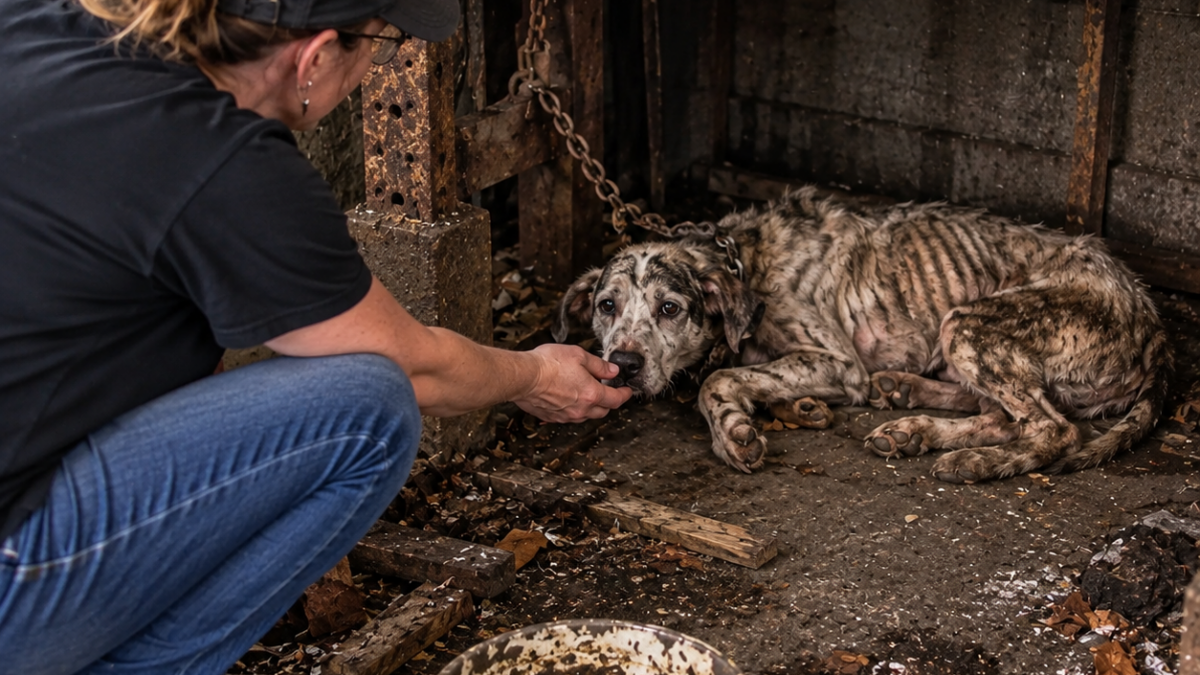
PART 2
I wanted to turn around.
Every angry thought in my head told me to ask what name was on that envelope.
But the dog in my arms shivered.
Once.
Barely.
And everything else became less important.
“Later,” I said.
Officer Alvarez nodded.
“Later.”
We moved quickly toward the entrance.
Outside, the winter air felt almost warm compared with the darkness inside that warehouse.
Frank held the door open.
When he saw the dog clearly for the first time, his face changed.
“Jesus.”
He stepped back.
“I didn’t know it was that bad.”
“You couldn’t see him from outside,” I said.
“I should’ve called sooner.”
“You called.”
“But I heard him for days.”
“You called.”
He looked guilty anyway.
People always do that after a rescue.
They rewrite the timeline in their heads.
What if I had noticed yesterday?
What if I had come sooner?
What if I had looked behind the building?
What if?
I understood the feeling.
But guilt wasn’t going to warm the animal in my arms.
“Can you call the emergency clinic and tell them we’re coming?” I asked another volunteer.
She was already dialing.
I climbed into the back of the rescue van.
We had placed thick blankets and heating pads there, but I was afraid to warm him too quickly.
I kept him wrapped lightly and held him against my chest.
Officer Alvarez appeared at the open door.
“I’m coming behind you.”
“What about the scene?”
“My partner is staying. We’ve called the investigator.”
I looked at the dog.
“What do we call him?”
She studied him.
“Not yet.”
“Why?”
“Let him get to the clinic first.”
I understood what she meant.
Names make hope dangerous.
I gave him one anyway.
“Rusty.”
Alvarez raised an eyebrow.
“The warehouse?”
“The color under all that dirt.”
“You can actually see his color?”
“A little.”
The corner of her mouth moved.
“Rusty it is.”
I pulled the door closed.
The van started moving.
Rusty didn’t lift his head.
I slipped one hand beneath his jaw just so I could feel his breathing.
Every few seconds, I checked.
Still there.
Still there.
Still there.
At the clinic, three technicians were waiting at the entrance.
The doors opened before the van stopped completely.
“Two-year-old cattle-dog mix, severe emaciation, exposure, possible prolonged confinement,” I said as we moved.
A technician slid a stretcher beside me.
“Any known trauma?”
“Old wounds. Pressure sores. Long nails. Heavy matting. Chain confinement.”
“Eating?”
“No food on site.”
“Water?”
“Contaminated.”
They took him from me.
For a second, my arms felt empty.
Then the treatment-room doors closed.
I stood in the hallway staring at them.
Alvarez came in five minutes later.
She still had her coat on.
“What did they say?”
“Nothing yet.”
She looked toward the doors.
“You okay?”
“No.”
“Good answer.”
I sat down.
She sat beside me.
For several minutes neither of us spoke.
Then I looked at her.
“The envelope.”
“Yes.”
“Whose name?”
“We have a name connected with the warehouse.”
“Owner?”
“Possibly.”
“You know him?”
“Not personally.”
“Does the mechanic?”
“We’ll ask.”
“Was the dog registered?”
“We don’t know yet.”
I leaned forward.
“Did somebody actually chain him there and leave?”
“Looks that way.”
“How long?”
“We need evidence.”
I hated that answer.
Not because it was wrong.
Because it was the answer that always came before justice.
We need evidence.
Photographs.
Records.
Witness statements.
Dates.
Ownership documents.
Veterinary findings.
Things that could survive a courtroom.
Anger was immediate.
Accountability was paperwork.
The treatment-room door opened.
A veterinarian I knew, Dr. Rachel Bennett, stepped out.
Her face was serious.
“Come with me.”
I stood.
Alvarez followed.
Rusty was lying on a heated pad with an IV catheter taped to one leg.
His coat looked even worse beneath the clinical lights.
What I had thought was dirt was mixed with dried blood in places.
The pressure sores on his hips were deep.
One elbow had a raw patch almost the size of my palm.
His body temperature was low.
His gums were pale.
His eyes opened when I approached.
“Hey,” I whispered.
Nothing else moved.
Dr. Bennett pointed toward the monitor.
“He’s hypothermic, dehydrated, severely malnourished, and profoundly weak.”
“How bad?”
“Very.”
I swallowed.
“Do you think he’ll make it?”
“I don’t know yet.”
She said it without softening it.
I appreciated that.
“His bloodwork?”
“We’re running it.”
“Organs?”
“Too early to say.”
“Can we feed him?”
“Not normally.”
That confused me.
“He’s starving.”
“Exactly.”
She pulled her mask down slightly.
“When animals have been severely malnourished for a long period, aggressive feeding can cause dangerous electrolyte shifts. We need to stabilize him first.”
“So food can hurt him?”
“Too much too fast can.”
I looked at Rusty.
His nose moved slightly when a technician opened a can of recovery food nearby.
He smelled it.
His eyes changed.
That tiny response crushed me.
“He wants it.”
“I know.”
“Can he have some?”
“Small amount, controlled.”
The technician prepared a tiny portion.
I expected Dr. Bennett to feed him.
Instead, she looked at me.
“You found him.”
I sat beside the table.
“Rusty.”
His eyes shifted toward me.
I placed a little food near his mouth.
For several seconds, nothing happened.
Then his tongue moved.
Once.
He licked the food.
The technician exhaled.
“Good.”
I gave him another small bite.
He swallowed.
Another.
Slowly.
Carefully.
After the fifth bite, Dr. Bennett stopped me.
“That’s enough for now.”
I stared at the tiny empty dish.
“That’s it?”
“For now.”
“He could eat more.”
“His brain says yes. His body may say no.”
I understood.
It still felt wrong.
I stroked his cheek.
“We’ll get there.”
His eyes closed.
The bloodwork came back twenty minutes later.
Anemia.
Electrolyte abnormalities.
Evidence of prolonged nutritional deprivation.
Parasites.
Dehydration.
Infection.
His body was surviving on almost nothing.
His muscles had wasted badly, especially along the hind legs.
One technician estimated that if Rusty had been healthy, he should have weighed nearly twice what he weighed that afternoon.
“What about the scars?” Alvarez asked.
Dr. Bennett looked at her.
“Some old. Some recent.”
“Consistent with abuse?”
“Some could be from injuries, confinement, or untreated skin disease. I’ll document everything accurately.”
“What about the pressure sores?”
“Those are consistent with spending extensive time on hard surfaces without adequate bedding.”
Alvarez nodded.
“Could he have been chained there for months?”
“I can’t tell you exactly how long from one exam.”
“But not days.”
Dr. Bennett looked at Rusty.
“No.”
That single word changed the room.
No.
This hadn’t happened last week.
Rusty had lived like this.
Perhaps for months.
Maybe longer.
I stepped away.
My hands were shaking.
Dr. Bennett noticed.
“Sit.”
“I’m fine.”
“You’re not.”
I sat.
Alvarez crossed her arms.
“You want to hit something.”
“Yes.”
“I know.”
“Someone watched this happen.”
“I know.”
“Someone walked into that building and saw him getting thinner.”
“I know.”
“Somebody knew he slept on concrete.”
“I know.”
“And then they left him there in freezing weather.”
She waited until I was finished.
Then she said, “Give me what I need to prove it.”
That sentence stayed with me.
Not anger.
Proof.
Dr. Bennett allowed me to remain while Rusty was stabilized.
His IV fluids had to be managed carefully.
His temperature rose slowly.
They treated parasites.
Cleaned his wounds.
Clipped away sections of matted coat where necessary.
Each layer of dirt revealed something new.
More sores.
Old abrasions.
Skin infection.
At one point, a technician cut away a large mat near his hind leg.
Rusty flinched.
I stopped breathing.
It was the strongest movement he had made.
“Sorry, buddy,” she whispered.
Rusty looked at her.
Then rested his head again.
Nobody in the room spoke for a moment.
He did not growl.
Did not snap.
Did not pull away.
He simply accepted whatever happened.
“That’s not trust,” Dr. Bennett said quietly.
“What?”
I realized she was speaking to me.
“People see a dog who doesn’t resist and think he trusts them. Sometimes he’s just learned resistance doesn’t matter.”
I looked down at Rusty.
The words felt heavier than anything else I had heard that day.
“How do you fix that?”
“You give him choices.”
“What kind?”
“Small ones at first.”
She pointed toward the towel beneath his head.
“Blue towel or gray towel. Food from a dish or from a hand. Do you touch him now, or wait until he approaches you? Door open or closed. Left turn or right turn on a walk.”
I almost laughed.
“That seems small.”
“It is.”
“But it matters?”
“It matters enormously.”
I looked at Rusty again.
A chain that short had taken every choice from him.
Where to stand.
Where to sleep.
Where to relieve himself.
Whether to move.
Whether to get away from cold concrete.
Whether to find clean water.
Dr. Bennett touched the edge of his blanket.
“He doesn’t need anybody to control his entire life anymore.”
That night, I left the clinic after midnight.
I lasted twelve minutes at home.
Then I called.
The overnight technician answered.
“Rusty?”
“Yes.”
“He’s stable.”
“Still critical?”
“Yes.”
“Did he eat?”
“A tiny amount.”
“Temperature?”
“Coming up.”
“Breathing?”
“Steady.”
“Okay.”
I hung up.
Twenty minutes later, I called again.
The same technician answered.
“Still Rusty.”
“Sorry.”
“You’re not the first rescue person to do this.”
“How is he?”
“Exactly the same as twenty minutes ago.”
“Good.”
“Go to sleep.”
“I’ll try.”
I didn’t.
At 5:30 a.m., the clinic called me.
My heart nearly stopped.
I answered immediately.
“What happened?”
“Nothing bad.”
I sat up.
“What?”
The technician laughed softly.
“I thought you’d want to know he lifted his head by himself.”
I closed my eyes.
“That’s why you called?”
“Yes.”
“Thank you.”
“And he drank a little water.”
“On his own?”
“On his own.”
I was dressed ten minutes later.
When I entered the clinic, Rusty was awake.
Not alert.
Not strong.
But awake.
His head rested on his paws.
His eyes followed me as I approached.
“Morning.”
His tail did not move.
His body barely moved.
But his eyes stayed on me.
I sat on the floor.
“I came back.”
He blinked.
“I told you I would.”
That became our routine.
Every morning, I arrived early.
Every afternoon, I checked again.
Every night, I called.
Rusty improved in fractions.
A quarter cup of food.
A slightly warmer temperature.
A little better hydration.
A few minutes sitting upright.
The victories were so small that anyone outside rescue medicine might have missed them.
We celebrated all of them.
On the second evening, I was sitting beside his kennel when a technician named Brooke came in.
“Watch.”
She knelt.
“Rusty.”
His eyes moved.
Brooke smiled.
“Hi, handsome.”
His tail flicked.
Once.
I stared.
“Did that just happen?”
Brooke laughed.
“I saw it an hour ago too.”
“You didn’t tell me?”
“I wanted to see if he’d do it again.”
“Do it again.”
She looked at Rusty.
“You hear that? Apparently you’re performing now.”
His tail moved again.
Tiny.
Barely an inch.
But it moved.
I covered my mouth.
Brooke’s eyes watered too.
“You’re crying,” I said.
“So are you.”
“That’s different.”
“No, it isn’t.”
Rusty watched us both as though we had lost our minds.
The following morning, he lifted his head without being prompted.
Later, he accepted food from my hand.
Not because he couldn’t eat otherwise.
Because he chose to.
That mattered.
I offered the dish.
He turned away.
I offered my palm.
He ate.
Choice.
Dr. Bennett smiled when I told her.
“Good.”
“Why does it feel bigger than the bloodwork?”
“Because it’s emotional progress.”
His physical progress continued.
The infection began responding.
His hydration improved.
His eyes grew clearer.
His body temperature stabilized.
But the muscles in his back legs were severely wasted.
“He won’t be walking soon,” Dr. Bennett warned.
“How long?”
“Could be weeks.”
“He can’t stand at all.”
“Not yet.”
“Will he?”
“I think there’s a good chance.”
“That’s not a yes.”
“No.”
I looked at her.
She didn’t look away.
“I don’t give guarantees I don’t have.”
I respected her for it.
I also hated hearing it.
While Rusty fought to recover, Officer Alvarez built the case.
The envelope from the warehouse had contained insurance paperwork and a utility notice.
Both carried the same name.
Darren Cole.
The warehouse lease, although technically expired, had also been associated with him.
Frank recognized the name.
“He used to keep equipment in there,” Frank told investigators.
“What kind of equipment?” Alvarez asked.
“Pressure washers. Landscaping stuff. Sometimes kennels.”
“Kennels?”
“Yeah.”
“For dogs?”
“I assumed.”
“When did you last see him?”
Frank thought for a moment.
“Couple weeks ago.”
“Did you ever see the dog?”
“Not clearly.”
“Ever hear him?”
“Sometimes.”
“How long?”
Frank looked uncomfortable.
“Months.”
I was standing nearby when he said it.
“Months?”
He turned toward me.
“I didn’t know—”
“You heard a dog in there for months?”
“Not every day.”
“But you heard him.”
“I thought the owner was coming.”
“How could you not—”
Alvarez touched my arm.
“Outside.”
“I’m fine.”
“Outside.”
Her tone made it clear this was not a discussion.
I followed her.
The cold air hit my face.
“You can’t do that.”
“He knew.”
“He may be a witness.”
“He heard Rusty for months.”
“And now he’s giving us information we need.”
I stared at the warehouse.
“I’m angry.”
“I know.”
“At him too.”
“I know.”
“He could have called.”
“Yes.”
“Rusty could’ve died.”
“Yes.”
She waited.
“Are you going to tell me anger doesn’t help?”
“No.”
I looked at her.
“Really?”
“No. Anger tells you something matters. What you do with it decides whether it helps.”
I shoved my hands into my coat pockets.
“So what do I do?”
“Let me interview witnesses without making them afraid to talk.”
That was fair.
I hated that it was fair.
“Okay.”
The investigation uncovered more.
A former employee of Cole’s said Rusty had once been a working dog.
He had been used around construction equipment and storage yards.
At first, according to the employee, Rusty rode in trucks and followed workers around.
Then Cole’s business began failing.
Jobs disappeared.
Employees left.
Equipment was sold.
Rusty ended up chained more often.
“He used to say the dog was too wild,” the former employee told investigators.
“Was he?”
“No. He had energy. Cattle dogs do.”
“Did you see Cole feed him?”
“Sometimes.”
“Did he take him to a veterinarian?”
“Not that I know.”
“Did you ever see injuries?”
The man hesitated.
“I saw sores on his elbows.”
“When?”
“Last spring.”
Last spring.
It was now winter.
I stared at the interview notes after Alvarez later showed me the relevant parts.
“You’re telling me people knew in spring?”
“Somebody saw sores.”
“And did nothing.”
“He says he told Cole the dog needed a better place to sleep.”
“That’s it?”
“That’s what he says.”
“Did Cole answer?”
“According to him, Cole said the dog was tough.”
I put the papers down.
Tough.
I hated the word.
Animals suffer because humans decide endurance equals consent.
He’s tough.
He can handle cold.
He can live outside.
He doesn’t need much.
He’ll be fine.
Rusty had survived.
That did not mean what happened to him had been survivable.
There is a difference.
A survivor is not proof that conditions were acceptable.
A survivor is proof that the victim outlasted them.
Three days after the warehouse rescue, officers went to Cole’s listed residence.
He was gone.
His truck was missing.
Neighbors said they had seen him packing the previous evening.
A warrant was issued.
For two days, nobody knew where he was.
Those two days changed something inside me.
Before, I had wanted accountability.
Now I wanted him found.
Not because I feared he would hurt Rusty again.
Rusty was safe.
But running felt like another act of abandonment.
Leave the warehouse.
Leave the dog.
Leave town.
Leave everyone else to clean up the damage.
On the fifth day, Alvarez called.
“They got him.”
I sat up.
“Where?”
“Motel about eighty miles north.”
“How?”
“Traffic stop.”
“Is he in custody?”
“Yes.”
I exhaled.
“What happens now?”
“Charges are being filed.”
“What charges?”
“Animal cruelty, abandonment, failure to provide adequate care, depending on what the prosecutor approves.”
“Will he get out?”
“Probably pending trial.”
I stared at the clinic wall.
“That’s it?”
“That’s how the process works.”
“He can just walk out?”
“With conditions.”
“What conditions?”
“Likely no contact with animals, depending on the judge.”
“Likely?”
“Don’t start.”
“I’m not starting.”
“You are.”
I rubbed my forehead.
“Rusty almost froze to death chained to a beam.”
“I know.”
“And he gets a court date?”
“He gets due process.”
I didn’t answer.
She softened her tone.
“If we do this right, it lasts. If we do it wrong because we’re angry, everything gets harder.”
I knew she was right.
Again.
I was beginning to resent how often that happened.
Rusty didn’t care about court.
That was one of the things I loved most about him.
His universe had become very small.
Warm blankets.
Food.
Water.
Gentle voices.
Hands that stopped when he pulled away.
A green rubber toy Brooke placed beside him.
At first he ignored it.
The next day, I found it closer to his front paws.
“Did you move that?”
Brooke shook her head.
“He did.”
I crouched.
“Rusty?”
He looked at me.
I nudged the toy.
It rolled.
His eyes followed it.
I rolled it again.
His nose moved.
Then he reached one paw forward.
He touched it.
The room went silent.
“Come on.”
He pulled it closer.
Didn’t bite it.
Didn’t play.
Just placed one paw on top of it.
Brooke whispered, “That counts.”
“It absolutely counts.”
The next week was harder.
Rusty developed a fever.
One of his wounds became more inflamed.
His appetite dropped.
After several days of steady progress, it felt like we had fallen backward.
I arrived one morning and found Dr. Bennett reading his chart.
“You look worried.”
“I’m paying attention.”
“That’s doctor language for worried.”
She sighed.
“The infection is responding slower than I want.”
“What are we doing?”
“Adjusting antibiotics. More cultures.”
“Is he getting worse?”
“Not dramatically.”
“That’s not comforting.”
“It isn’t meant to be.”
I walked over to his kennel.
Rusty did not lift his head.
My stomach tightened.
“He was brighter yesterday.”
“I know.”
I sat beside him.
“Hey.”
Nothing.
I touched the blanket.
His eyes opened.
“That’s enough.”
I stayed for an hour.
Then two.
I canceled everything else.
At noon, Brooke brought me coffee.
“You have to eat too.”
“I’m not hungry.”
She handed me a sandwich anyway.
“Rusty eats when he’s supposed to. So do you.”
I looked at the sandwich.
“Did Dr. Bennett send you?”
“No. I’m bossy on my own.”
I ate half.
By evening, Rusty’s temperature had come down slightly.
The next morning, he accepted food again.
Two days later, the fever was gone.
Recovery continued.
Not smoothly.
But forward.
Week two brought the first real sign of personality.
I was replacing his blanket when he grabbed the corner in his mouth.
I stopped.
“Excuse me?”
He held it.
“You need that.”
He pulled.
I pulled gently back.
His eyes changed.
Something playful appeared.
I tugged once.
He tugged harder.
Brooke looked over.
“Is he playing?”
“I think so.”
Rusty gave one weak shake of his head.
Then dropped the blanket, exhausted.
But for five seconds, he had played.
I wrote the date on the whiteboard outside his kennel.
FIRST TUG.
Dr. Bennett saw it later.
“You know that board is for medical information.”
“This is medical.”
“No.”
“Quality-of-life metric.”
She shook her head.
“You rescue people are impossible.”
“You love us.”
“Occasionally.”
By the end of the second week, Rusty could sit upright for longer periods.
His front legs grew stronger first.
His hind legs lagged behind.
Physical therapy began gently.
Passive range-of-motion exercises.
Supported standing.
Short sessions on non-slip mats.
At first, two technicians had to hold most of his weight.
His paws slipped.
His legs trembled.
His entire body seemed confused by the idea of standing.
The first time I watched, I had to look away.
Not because he was in pain.
Because I remembered the chain.
Standing should have been ordinary.
For Rusty, it had become rehabilitation.
“You’re okay,” the therapist whispered.
Rusty’s legs shook.
“Just three seconds.”
One.
Two.
He collapsed before three.
“That was good,” she said.
I looked at her.
“That looked terrible.”
“It was good.”
“He fell.”
“He engaged his muscles.”
I glanced at Rusty.
“He seems offended.”
“He should be. Physical therapy is annoying.”
The next day, he lasted four seconds.
Then seven.
Then twelve.
Every day we measured progress in numbers too small to sound important.
But they were.
At the beginning of week three, I arrived to find half the staff gathered outside his recovery room.
My heart jumped.
“What happened?”
Brooke grinned.
“Nothing bad.”
“Why is everyone here?”
“You’re late.”
“I’m six minutes early.”
“Still late.”
“For what?”
Dr. Bennett appeared.
“He’s been trying to stand.”
I froze.
“By himself?”
“Yes.”
“Why didn’t you call me?”
“We did. You were driving.”
I pulled out my phone.
Three missed calls.
“I hate all of you.”
“Come inside.”
Rusty was sitting on a padded mat.
A technician crouched behind him but wasn’t touching.
“Rusty,” she said.
He looked at her.
“Come on.”
He leaned forward.
His front legs straightened.
His hindquarters rose halfway.
Dropped.
He rested.
My hands were clenched.
“Again?”
The therapist waited.
Rusty repositioned himself.
Front paws under chest.
Weight forward.
Hind legs pushed.
For one second, he was up.
Then two.
Then three.
His whole body shook.
Nobody made a sound.
Four.
Five.
His legs trembled violently.
Six.
Rusty looked around.
Seven.
Then he sat down.
The room exploded.
Brooke clapped.
Someone cheered.
I laughed and cried at the same time.
Dr. Bennett wiped beneath one eye and pretended she hadn’t.
Rusty stared at us with the expression of a dog deeply confused by human behavior.
I knelt.
“You stood.”
His tail wagged.
“You actually stood.”
He leaned toward me.
I pressed my forehead against his.
“You did it.”
That afternoon, I bought him a new blanket.
Blue fleece.
Thick.
Ridiculously expensive.
Brooke looked at the label.
“You know he doesn’t care.”
“I care.”
Rusty slept on it that night.
Three days later, he took his first independent step.
One.
Then sat.
The next session, two steps.
Then four.
His gait was awkward.
Rear legs weak.
Paws uncertain.
But every step carried him farther from the warehouse floor.
The first time he crossed the entire therapy room without assistance, staff lined the wall like people watching a graduation.
“Come on, Rusty.”
He walked toward me.
One step.
Another.
His nails had been trimmed gradually because they were too long to correct all at once comfortably.
His paws landed flat now.
His head was up.
His tail moved.
Halfway across the room, he stopped.
I held out my hands.
“Your choice.”
That phrase had become important.
Not “come.”
Not “you have to.”
Your choice.
Rusty stood there.
Looked at me.
Looked toward the door.
Then chose me.
He walked the rest of the way and pressed his head against my knees.
I hugged him carefully.
“That’s it.”
The physical victory mattered.
The choice mattered more.
Rusty was transferred from the emergency clinic to our rehabilitation shelter after nearly a month.
The first day terrified him.
Different building.
Different smells.
Dogs barking.
New people.
He froze at the entrance.
I stood beside him.
“We don’t have to go fast.”
He looked at the open doorway.
I stepped inside.
He stayed outside.
So I waited.
Thirty seconds.
A minute.
Two.
Then Rusty took one step.
Another.
No leash pressure.
No pulling.
He entered when he decided.
His room at the shelter had a thick orthopedic bed.
Several blankets.
A low water bowl.
A few toys.
And a window that faced a fenced courtyard.
Rusty ignored everything except the bed.
He approached it.
Smelled it.
Walked around it once.
Then carefully lay down.
His eyes widened slightly when his body sank into the padding.
I laughed.
“You’ve never had one of those, have you?”
He rolled his shoulder.
Settled deeper.
Within minutes he was asleep.
I stayed until his breathing slowed.
For a dog who had spent months on concrete, softness seemed almost unbelievable.
The shelter changed him.
Slowly.
At first, barking from other dogs frightened him.
A metal bowl falling in the kitchen made him flatten to the floor.
The clink of a chain caused him to panic.
That sound became our biggest challenge.
One afternoon, someone dropped a slip lead with a metal clasp.
It hit the tile.
Rusty froze.
His body went rigid.
Then he backed into the corner.
I sat down several feet away.
“Okay.”
He was breathing fast.
“No one’s putting that on you.”
I pushed the lead away with my foot.
Rusty watched it.
I stayed on the floor.
Ten minutes passed.
Then fifteen.
Eventually he approached me.
He did not look at the lead.
I didn’t force him to.
The next day, we worked with softer equipment.
A fabric harness.
No metal chain.
Treats.
Choice.
He learned that a leash could mean grass.
Sunlight.
Walks.
Not captivity.
The first time I took him into the courtyard, he stood at the threshold for almost five minutes.
The grass moved in the breeze.
Rusty stared.
I wondered whether he remembered grass.
Maybe he did.
Maybe he didn’t.
He placed one paw outside.
Then another.
His nose lowered.
He smelled the ground.
One step.
Two.
He walked to the nearest patch of sunlight.
Stopped.
Then sat.
He closed his eyes.
That was all.
He simply sat in the sun.
I sat beside him.
For twenty minutes neither of us moved.
Later, sunlight became his favorite thing.
If one bright patch appeared through a window, Rusty found it.
If the courtyard was sunny, he wanted outside.
If clouds covered the sky, he seemed personally offended.
Brooke visited one afternoon and found him stretched across the grass.
“So this is the dog who wouldn’t lift his head?”
“Apparently.”
Rusty rolled slightly onto one side.
She crouched.
“Look at you.”
He showed her his belly.
Brooke froze.
“Is that new?”
“Yesterday.”
“He wants a belly rub?”
“I think so.”
She scratched gently.
Rusty’s hind leg moved.
Brooke laughed.
“Oh, that’s it. He’s officially spoiled.”
I smiled.
“That’s the plan.”
His coat began changing.
The grease disappeared.
The skin healed.
Under treatment and proper nutrition, thick speckled fur emerged.
Blue-gray.
White.
Rust-colored patches.
The name suddenly fit for a completely different reason.
He gained weight.
Muscle returned.
His shoulders broadened.
He started looking less like an emergency and more like a young cattle dog.
Which meant energy.
Lots of it.
The first time Rusty stole a towel and ran down the hallway, I didn’t stop him.
I followed, laughing.
He looked back.
Tail high.
Towel hanging from his mouth.
“You know you’re committing a crime?”
He ran faster.
A staff member shouted from the laundry room.
“Who took the towel?”
“Rusty.”
“Again?”
I stopped.
“Again?”
She pointed.
“He took one this morning.”
I looked at him.
He wagged.
The dog who had once collapsed when his chain was removed had become a repeat towel thief.
I considered that excellent progress.
While Rusty healed, the court case moved forward.
Darren Cole had been released pending trial under conditions that prohibited him from possessing or caring for animals.
The prosecutor requested photographs and updated veterinary reports.
I provided everything through proper channels.
One afternoon, I saw Cole for the first time.
Not in court.
Outside the animal control office.
I had gone there to sign a statement.
He was walking toward the parking lot with an attorney.
I recognized him from photographs.
Average height.
Dark jacket.
Short hair.
Nothing about him looked remarkable.
I stopped.
He looked at me.
For one second, neither of us spoke.
His attorney glanced between us.
“Let’s go.”
Cole started walking.
Then I said, “Rusty survived.”
He stopped.
His attorney immediately turned.
“Do not engage.”
Cole looked back at me.
Something unreadable crossed his face.
“I know.”
That was all he said.
I felt the anger hit me like a wave.
“You know?”
His attorney stepped between us.
“This conversation is over.”
But Cole spoke again.
“He was a good dog.”
I stared at him.
The words were so absurd that for a second I didn’t understand them.
A good dog.
As though he had misplaced Rusty.
As though the warehouse had been an unfortunate accident.
As though there had not been a chain.
A cracked bucket.
Concrete sores.
Freezing nights.
“You don’t get to say that.”
His attorney touched his arm.
“Darren.”
Cole looked down.
“I had problems.”
I laughed once.
No humor.
“So he paid for them?”
“I couldn’t manage everything.”
“You could have called someone.”
He didn’t answer.
“You could have surrendered him.”
Silence.
“You could have opened the chain.”
Still nothing.
“You could have left the warehouse door open and given him a chance.”
His attorney stepped closer.
“That’s enough.”
I looked at Cole.
“Do you know what he did when we cut the chain?”
His face changed.
“He collapsed.”
Cole swallowed.
“He couldn’t stand.”
“I didn’t—”
“No. Don’t.”
Officer Alvarez came through the building door.
She saw us.
“Inside.”
Her eyes were on me.
“I’m fine.”
“Inside.”
The same tone as before.
I walked past her.
My hands were shaking.
She followed.
“What happened?”
“He said Rusty was a good dog.”
She closed her eyes briefly.
“That’s what set you off?”
“You didn’t hear how he said it.”
“Doesn’t matter.”
“It matters to me.”
“I know.”
I paced the hallway.
“He said he had problems.”
“He probably did.”
“That doesn’t excuse it.”
“No.”
“He acted like Rusty was just one more thing he couldn’t manage.”
“Maybe that’s exactly what happened.”
I stopped.
“What?”
“Neglect doesn’t always come from somebody waking up and deciding to torture an animal.”
“Don’t defend him.”
“I’m not.”
Her voice sharpened.
“I’m telling you something harder. Sometimes neglect comes from selfishness, avoidance, addiction, money problems, depression, chaos, irresponsibility, pride, denial. People keep saying they’ll fix it tomorrow until the animal has no tomorrow left.”
I was silent.
“And accountability still matters,” she continued. “But if you need him to be a movie villain, real life will frustrate you.”
I sat down.
“I hate that.”
“I know.”
“He could’ve asked for help.”
“Yes.”
“That’s what I can’t get past.”
“Neither can I.”
The court process stretched for months.
Meanwhile, Rusty kept living.
That became important.
I didn’t want his entire identity trapped inside a legal case.
He learned fetch.
Poorly at first.
I threw a ball.
Rusty chased it.
Picked it up.
Then ran the opposite direction.
“That’s not fetch.”
He looked thrilled.
“Come back.”
He ran faster.
Eventually, another shelter dog named Daisy taught him.
Daisy retrieved anything thrown.
Ball.
Rope.
Stick.
Once, embarrassingly, my glove.
Rusty watched her.
Then copied.
The first time he brought the ball back, I gave him three treats.
That was probably too many.
He remembered.
After that, fetch became serious business.
He would drop the ball at my feet.
If I ignored it, he pushed it closer.
If I still ignored it, he placed it on my shoe.
If that failed, he barked.
I had created a monster.
A happy one.
Six months after his rescue, an application arrived.
Retired couple.
Tom and Linda Harris.
Both in their late sixties.
Large fenced yard.
No young children.
One previous cattle dog who had died two years earlier at age fifteen.
Veterinary references excellent.
Home quiet.
Experience with high-energy working breeds.
I read the application twice.
Then called.
Linda answered.
“We’ve been waiting for your call.”
“You’ve been following Rusty?”
“Since the warehouse rescue.”
That made me cautious.
Sometimes people fell in love with the story rather than the animal.
“Why Rusty?”
There was a pause.
Then Linda laughed softly.
“Because he steals towels.”
I smiled.
“You saw that update?”
“My husband said any dog who survives what he did and becomes a laundry thief deserves retirement with professionals.”
“That is strangely persuasive.”
Tom got on the phone.
“We also understand he’s not just a sad story.”
“Good.”
“He’s a cattle-dog mix.”
“Yes.”
“Which means he’s probably smarter than us.”
“Definitely.”
“And he’ll need exercise.”
“Yes.”
“And training.”
“Yes.”
“And something to do.”
“Absolutely.”
Tom laughed.
“Then we know what we’re signing up for.”
We arranged a meeting.
The day they arrived, Rusty was in the courtyard.
Linda didn’t rush him.
Neither did Tom.
They sat on a bench.
Talked to me.
Ignored Rusty at first.
That caught his attention.
He approached.
Smelled Linda’s shoe.
Moved to Tom.
Tom kept his hand relaxed against his knee.
Rusty smelled it.
Then walked away.
“Good,” Linda said.
I looked at her.
“You’re not disappointed?”
“He came over because he wanted to.”
Choice.
That word again.
I liked them immediately.
We spent almost two hours together.
Rusty brought Tom a ball.
Tom threw it.
Rusty returned it.
Tom threw it again.
Ten minutes later, I realized I had become irrelevant.
Linda smiled.
“He likes him.”
“Apparently.”
Tom threw the ball for the twentieth time.
“Do your shoulders work?”
Linda called.
“Barely.”
“Good. He’ll fix that.”
Rusty eventually collapsed in the shade near them.
Not touching.
Just close.
That was enough.
After the meeting, I drove home with a knot in my chest.
I knew.
They were right for him.
That should have made me completely happy.
It didn’t.
I had been there when Rusty couldn’t lift his head.
When he wagged his tail once.
When he first stood.
When he took one step.
When he discovered sunlight.
When he learned fetch.
Giving him away felt like losing something.
That night, I stayed late.
Rusty lay on his bed.
I sat beside him.
“You’re probably leaving.”
His ears moved.
“You like them.”
He sighed.
“Traitor.”
His tail tapped the bed.
“They have a fireplace.”
Another tail tap.
“Big yard.”
Tap.
“Retired people.”
Tap.
“So basically two full-time employees.”
Rusty rolled onto his back.
I rubbed his belly.
“You’re going to be spoiled.”
He closed his eyes.
The adoption was approved.
Before he left, Dr. Bennett performed a final examination.
She hadn’t seen him in several weeks.
When Rusty entered the clinic, she stared.
“No.”
I laughed.
“That’s him.”
“That is not my patient.”
Rusty walked toward her.
Tail wagging.
She knelt.
He licked her chin.
She covered her face.
“Oh, you’re kidding.”
“You remember the guy who wouldn’t stand?”
She hugged him around the neck.
“I remember.”
Rusty leaned into her.
Dr. Bennett’s eyes filled.
“Look at you.”
The appointment went perfectly.
Healthy weight.
Good muscle development.
Skin recovered.
Bloodwork normal.
Scars remained on his elbows and hips.
Some would always be visible.
But scars are records.
Not definitions.
The day Rusty left, Tom and Linda arrived with a new harness.
Soft.
Wide.
No metal around his neck.
That detail mattered more than they knew.
I handed Linda his medical folder.
Feeding schedule.
Training notes.
Fears.
Favorite treats.
Sunlight obsession.
Towel theft warning.
Ball addiction.
“Anything else?” she asked.
“Yes.”
I looked at Tom.
“If he drops a ball on your foot at six in the morning, do not throw it.”
“Why?”
“Because then six in the morning becomes official fetch time forever.”
Tom nodded seriously.
“Important.”
“Very.”
Rusty stood beside them.
Ready.
I clipped his leash to the harness.
Then handed it to Linda.
He looked at me.
I crouched.
There are moments in rescue when language becomes useless.
You can explain medication.
Behavior.
History.
Routine.
But you cannot explain what it feels like to hand over the leash of an animal whose heartbeat you once counted because you were afraid it might stop.
I put one hand against Rusty’s chest.
Strong heartbeat.
Steady.
“You don’t owe me anything.”
He licked my nose.
“Go live.”
He turned.
Walked beside Linda.
Tom opened the back door of their SUV.
A thick bed covered the seat.
Rusty jumped in.
Jumped.
I laughed.
Six months earlier, he had collapsed when a chain was cut.
Now he jumped into his own ride home.
The door closed.
Linda hugged me.
“We’ll send pictures.”
“You’d better.”
“We will.”
The SUV pulled away.
Rusty stood with his paws near the window.
For a second, I saw his face.
Then they turned the corner.
Gone.
I cried.
Of course I did.
The first photograph arrived less than an hour later.
Rusty asleep on their couch.
The caption from Linda read:
He lasted twelve minutes before claiming it.
I laughed through tears.
The second came that evening.
Rusty lying in front of a fireplace.
His body stretched across a rug.
His eyes closed.
Warm.
Safe.
I stared at that image for a long time.
Warehouse concrete.
Fireplace rug.
Short chain.
Open home.
Dirty rainwater.
Full bowl.
No bed.
Three beds, according to Linda.
That was revenge enough.
At least, I thought it was.
Then the trial date arrived.
The prosecutor contacted me because I might be called as a witness.
I had given statements.
Photographs.
Intake records.
But testimony was different.
The night before court, I couldn’t sleep.
Not because I feared speaking.
Because I feared seeing Cole again.
I had spent months trying to move forward.
Rusty had moved forward.
Why did we have to go backward?
Officer Alvarez called that evening.
“You ready?”
“No.”
“Good.”
“You always say that.”
“People who say they’re ready for court usually aren’t.”
“What should I expect?”
“Questions. Waiting. More waiting. Lawyers arguing about details you think are obvious.”
“That sounds terrible.”
“It can be.”
“Will I have to look at him?”
“Only if you want.”
“I don’t.”
“Then don’t.”
The courthouse was crowded.
Not with protesters.
Not with reporters.
Just ordinary people dealing with ordinary legal problems.
Traffic cases.
Family matters.
Probation hearings.
The cruelty case occupied one courtroom.
Cole sat with his attorney.
I stayed on the opposite side.
The prosecutor opened with photographs of the warehouse.
The beam.
The chain.
The bucket.
The concrete.
Then Rusty.
A sound moved through the courtroom when the intake photographs appeared.
Not dramatic.
Just a few people inhaling sharply.
I looked down.
I had seen those pictures before.
Still, I hated them.
The defense did not argue that Rusty had been healthy.
They could not.
Instead, they focused on intent.
Cole’s financial collapse.
Personal problems.
Claims that he had been trying to arrange care.
Claims that other people had occasionally fed Rusty.
Claims that he never intended for the dog’s condition to become life-threatening.
Then I was called.
I walked to the witness stand.
Swore to tell the truth.
Sat.
The prosecutor asked me to describe the rescue.
I did.
The darkness.
The workbench.
The blink.
The chain.
“How long was the chain?”
“Short enough that he could only move a few feet from the beam.”
“Was there food?”
“No.”
“Clean water?”
“No.”
“Bedding?”
“No.”
“What happened when the chain was removed?”
I looked at Cole.
For the first time.
He was staring at the table.
“Rusty collapsed.”
“Did he attempt to run?”
“No.”
“Did he stand?”
“No.”
“Why not?”
The defense attorney stood.
“Objection. Calls for medical speculation.”
“Sustained.”
The prosecutor nodded.
“What did you personally observe?”
“He could barely lift his head. When we removed the chain, his body fell sideways. I caught him.”
“What did you do?”
“Wrapped him in a blanket and carried him to the van.”
“Was he heavy?”
“No.”
“Did he resist?”
“No.”
“Did he growl?”
“No.”
“Bite?”
“No.”
“Bark?”
“No.”
“What was his behavior?”
I thought about Dr. Bennett’s words.
Not trust.
Learned helplessness.
“He was almost completely passive.”
The prosecutor paused.
“Did that concern you?”
“Yes.”
“Why?”
This time the defense did not object.
“Because healthy young dogs usually react to strangers. Rusty didn’t have enough strength or confidence to react to anything.”
My voice broke on the final word.
I hated that.
The prosecutor gave me a moment.
Then showed a photograph.
Rusty standing in Tom and Linda’s yard.
Coat full.
Eyes bright.
Ball in his mouth.
“Do you recognize this dog?”
“Yes.”
“Who is it?”
“Rusty.”
A murmur moved through the courtroom.
The prosecutor smiled slightly.
“When was this taken?”
“Last week.”
I looked at Cole again.
This time he was staring at the photograph.
His face changed.
Not dramatically.
Just enough.
Regret?
Shame?
I couldn’t know.
For months, I had imagined that seeing Rusty healthy might punish him.
In that moment, I realized I didn’t care what he felt.
Rusty’s recovery was not a weapon.
It belonged to Rusty.
Dr. Bennett testified next.
Her testimony was devastating because she used no dramatic language.
Severe malnutrition.
Hypothermia.
Dehydration.
Untreated wounds.
Parasitic burden.
Muscle wasting.
Pressure sores consistent with extended periods on hard surfaces.
She explained the risks.
The controlled feeding.
The infection.
The rehabilitation.
“How close was this dog to death?” the prosecutor asked.
The defense objected to the phrasing.
The question was reworded.
“In your professional opinion, was Rusty’s condition life-threatening when he arrived?”
“Yes.”
“Would he likely have recovered without intervention?”
“No.”
That one word filled the room.
No.
Without Frank’s call.
Without officers entering the warehouse.
Without the cutters.
Without the van.
Without veterinary care.
Rusty would have died chained to that beam.
The former employee testified.
He described seeing Rusty earlier in the year.
Described the worsening business.
Described the sores.
Described telling Cole the dog needed better shelter.
The prosecutor introduced text messages recovered from Cole’s old phone.
One message from months before the rescue read:
Dog’s still at the warehouse. I’ll deal with him later.
Later.
I felt sick.
Another message, sent weeks afterward:
He’s fine. Tough dog.
There was that word again.
Tough.
Rusty had survived despite neglect.
Not because neglect was tolerable.
The defense called witnesses too.
People who described Cole as overwhelmed.
A man who had lost contracts.
Debt.
Family problems.
Possible alcohol abuse.
A life collapsing.
I listened.
I did not feel sympathy.
But I began to understand something uncomfortable.
There had been dozens of moments when this could have ended differently.
One phone call to a shelter.
One surrender form.
One neighbor told the truth.
One employee refused to ignore it.
One person cut the chain.
Nobody did.
Until Frank called.
The judge ultimately found Cole guilty on multiple animal cruelty and neglect counts.
At sentencing, the prosecutor requested incarceration, fines, restitution for veterinary expenses, and a long-term prohibition on animal ownership.
Cole’s attorney asked for leniency.
Then Cole stood.
He was given an opportunity to speak.
His voice was quiet.
“I failed that dog.”
The courtroom was silent.
He looked toward me.
Then toward the photograph of Rusty still displayed near the prosecutor.
“I kept thinking I would fix everything.”
He swallowed.
“My business. My debts. My life.”
He looked at the floor.
“I kept telling myself the dog was okay because he was still alive.”
My jaw tightened.
Cole continued.
“I was ashamed to ask for help.”
The judge watched him.
“So you left an animal chained without adequate food, shelter, or medical care?”
“Yes.”
“You disappeared when authorities attempted to contact you.”
“Yes.”
“I was scared.”
The judge leaned forward.
“Mr. Cole, fear does not feed a dog.”
Silence.
“Shame does not provide clean water.”
Cole lowered his head.
“And personal hardship does not give you the right to transfer your suffering onto an animal completely dependent upon you.”
I looked down at my hands.
That was the sentence I had been waiting months to hear.
Not because it was cruel.
Because it was true.
Cole received a custodial sentence along with supervised probation, financial restitution, mandatory counseling, and a court order barring him from owning, breeding, or keeping animals for years.
Was it enough?
I don’t know.
Punishment never feels as clean in real life as people imagine.
There is no sentence that gives Rusty back the months he spent on concrete.
No fine erases the scars.
No courtroom order warms the nights he spent freezing.
But the legal outcome mattered.
It created a record.
It created consequences.
It prevented Cole from simply getting another dog the following week.
Most importantly, it said clearly that survival did not excuse neglect.
Outside the courthouse, Alvarez stood beside me.
“You okay?”
“I think so.”
“You don’t look happy.”
“I’m not unhappy.”
“That sounds complicated.”
“It is.”
She waited.
“I used to imagine this moment.”
“The sentencing?”
“Yes.”
“And?”
“I thought I’d feel like we won.”
She looked toward the street.
“Rusty won six months ago.”
I looked at her.
“When?”
“When he left the warehouse alive.”
I smiled.
“That sounds like something from a movie.”
“Fine. Then he won when he stole your towel.”
“That’s better.”
She laughed.
My phone buzzed.
A message from Linda.
Perfect timing.
A photograph.
Rusty lying in a patch of sunlight on their deck.
Ball between his paws.
Eyes half-closed.
Caption:
Court day today, right? Rusty says he is too busy sunbathing to attend.
I showed Alvarez.
She smiled.
“See?”
I stared at the photograph.
Rusty had no idea that a judge had spoken his name that morning.
He did not know someone had been sentenced because of what happened to him.
He did not know witnesses had testified.
He did not know his medical records had been entered as evidence.
He cared about sunlight.
A ball.
Dinner.
Tom.
Linda.
His yard.
That felt right.
Over the next year, Rusty’s life became beautifully boring.
Tom walked him every morning.
Exactly at seven.
If Tom was three minutes late, Rusty stood beside the bed and stared.
Linda called it psychological warfare.
Rusty learned the sound of the treat cabinet.
The garage door.
Their car.
The mail truck.
He learned that squirrels were enemies.
Deer were fascinating.
Rain was unacceptable.
Snow was apparently wonderful.
The first winter after his adoption, Linda sent me a video.
Rusty stood in their backyard while snow fell.
For a second, he looked confused.
Then he ran.
Around the yard.
Across the deck.
Back into the snow.
Rolling.
Jumping.
Biting at flakes.
I watched the video three times.
Then four.
Cold had once meant a warehouse.
Concrete.
No blanket.
No escape.
Now winter meant running through snow and coming inside whenever he wanted.
That difference mattered.
A year after his rescue, Tom and Linda invited the clinic staff, shelter volunteers, Alvarez, Frank, and several others to a small gathering.
They called it Rusty Day.
I told them that was ridiculous.
Linda ignored me.
“There will be cake.”
“For people?”
“Yes.”
“And Rusty?”
“Dog-safe cake.”
“Of course.”
When I arrived, Rusty saw me through the glass door.
He barked.
Ran toward the entrance.
Slid on the floor.
Recovered.
Then launched himself at me.
Not literally.
Mostly.
“You’re heavy.”
He wagged harder.
“Remember when you weighed almost nothing?”
He licked my chin.
“I remember.”
The yard filled with people who had each been one piece of his survival.
Brooke.
Dr. Bennett.
Officer Alvarez.
Frank.
Two other technicians.
Tom and Linda.
Rusty moved between everyone like a politician working a room.
Except he had no agenda beyond treats.
At one point, Frank stood alone near the fence.
Rusty wandered toward him.
Frank crouched.
“Hey, buddy.”
Rusty smelled his hand.
Then sat.
Frank’s eyes filled.
“I’m sorry.”
Rusty wagged.
Frank scratched behind his ears.
“I should’ve called sooner.”
I walked over.
“You called when you understood something was wrong.”
“He was crying.”
“I know.”
“For days.”
“I know.”
“I still hear it sometimes.”
I looked at Rusty.
He had placed one paw on Frank’s shoe.
“You can’t change the day you called.”
Frank nodded.
“But you can remember that you did call.”
He looked at me.
“Would he have died?”
“Yes.”
The word came out before I could soften it.
Frank looked down.
“Then maybe I should’ve called sooner.”
“Maybe.”
He looked surprised by my answer.
I wasn’t going to lie to make him comfortable.
“Maybe you should have.”
He swallowed.
“But you still called.”
Rusty leaned against his leg.
“And because you did, he’s standing here.”
Frank started crying.
Rusty licked his hand.
That was the closest thing to forgiveness I could imagine.
Not forgetting.
Not pretending delay didn’t matter.
Just accepting that one correct decision can still matter even after earlier failures.
Later, Dr. Bennett sat on the grass with Rusty’s head in her lap.
“You know,” she said, “this dog once refused to eat for me.”
“He had standards.”
“He tried to bite a thermometer after that.”
“Excellent judgment.”
She laughed.
“His coat is incredible.”
“Linda brushes him every day.”
“I believe it.”
Rusty rolled onto his back.
Dr. Bennett rubbed his stomach.
“He doesn’t remember me.”
“I think he does.”
“You do?”
“He doesn’t hide from you.”
She looked down at him.
“That could mean anything.”
“Maybe.”
We sat quietly.
After a minute, she said, “I’m glad he doesn’t need me anymore.”
That sentence captured rescue perfectly.
The goal is to become unnecessary.
The party ended around sunset.
People left one by one.
I stayed.
Rusty lay on the deck, exhausted.
Tom sat beside me.
“We owe you.”
“No.”
“Yes.”
“No.”
He smiled.
“You always argue this?”
“Yes.”
Linda came outside carrying two mugs of coffee.
“He’s serious.”
“So am I.”
She handed me a mug.
“You brought him to the clinic.”
“Someone else would have.”
“You don’t know that.”
“Frank called.”
“And you went.”
“Alvarez cut the chain.”
“And you carried him.”
“Dr. Bennett treated him.”
“And you stayed.”
I looked at Rusty.
“Lots of people stayed.”
Linda sat beside me.
“That’s the point.”
“What?”
“No one person saved him.”
She looked around their yard.
“People like stories where one hero appears. But Rusty needed a mechanic to call. Officers to enter the building. A clinic to treat him. Volunteers. Investigators. A court. A shelter.”
She smiled.
“And two retired people with too much time.”
Tom raised his mug.
“Especially that.”
Rusty opened one eye.
Then closed it again.
Linda continued.
“He survived because enough people finally did the next right thing.”
I remembered the warehouse.
The darkness.
The beam.
The chain.
The blink.
One next right thing.
Then another.
Call.
Enter.
Cut the chain.
Carry him.
Warm him.
Feed him slowly.
Treat infection.
Help him stand.
Let him choose.
Find him a home.
Build the case.
Show up in court.
No single moment had saved Rusty.
A chain of human decisions had.
One chain had trapped him.
Another kind had brought him out.
Two years after the rescue, the scars on Rusty’s hips faded under thick fur.
His elbows still showed patches where hair grew differently.
His nails stayed normal.
His weight remained healthy.
He became stronger than anyone expected.
Tom took him on hiking trails.
Linda entered him in a beginner scent-work class because cattle dogs apparently require hobbies.
Rusty excelled.
Of course he did.
He could find hidden treats faster than any dog in the class.
I accused him of cheating.
He ignored me.
One summer afternoon, I visited again.
Rusty was lying under a tree.
The sun had shifted away from him.
I watched him wake.
Look at the shade.
Stand.
Walk ten feet.
Lie back down in the new patch of sunlight.
Such a simple act.
But I couldn’t stop staring.
In the warehouse, sunlight had not mattered because he could not move far enough to choose it.
Now he could follow warmth across an entire yard.
“How long are you going to stand there looking sentimental?” Linda called.
“I’m not sentimental.”
“You’re staring at him.”
“He moved.”
“Dogs do that.”
“You know what I mean.”
She smiled.
“Yes.”
I sat beside her.
Rusty rolled onto his side.
“Do you ever think about the warehouse?” Linda asked.
“Yes.”
“All the time?”
“Less now.”
She nodded.
“So do we.”
“You weren’t there.”
“No.”
“But when it gets cold, sometimes I look at him sleeping by the fireplace and think about it.”
I understood.
“Does it make you angry?”
“Sometimes.”
“Me too.”
“Still?”
“Yes.”
I watched Rusty breathing in the grass.
“I used to think healing meant the anger would disappear.”
“And now?”
“Now I think it means anger stops driving the car.”
Linda laughed.
“That’s specific.”
“I’ve had time to think.”
“What drives now?”
I looked at Rusty.
“This.”
He lifted his head.
A squirrel had appeared near the fence.
Rusty exploded to his feet.
The squirrel ran.
Rusty sprinted after it.
Linda sighed.
“Justice?”
I laughed.
“Something like that.”
Rusty reached the fence.
The squirrel escaped.
Rusty barked as though announcing a major victory.
Then turned and ran back toward us.
Full speed.
Healthy.
Strong.
Free.
He stopped beside Linda.
She handed him a treat.
I stared at her.
“You reward failed squirrel hunts?”
“He tried.”
“You’re creating unrealistic expectations.”
“He deserves them.”
Rusty ate the treat.
I couldn’t argue.
On the third anniversary of the rescue, Frank sent me a photograph of the warehouse.
Demolition crews had begun tearing it down.
The building had finally been condemned.
The rusted workbench was gone.
The steel beam was gone.
The cracked windows.
The oil-stained concrete.
All disappearing.
I drove there that afternoon.
I don’t know why.
Maybe I wanted to see it one last time.
A fence surrounded the site.
Heavy machinery sat nearby.
Half the roof had already been removed.
Officer Alvarez happened to be there speaking with the demolition supervisor.
She saw me.
“Knew you’d come.”
“How?”
“You’re predictable.”
I stood beside her.
“Which beam was it?”
She pointed.
“Already gone.”
I looked at the open space.
For years, I could see that beam whenever I thought about Rusty.
Steel.
Chain.
Concrete.
Now there was nothing.
“How do you feel?” Alvarez asked.
I thought about it.
“Good.”
“Really?”
“Yes.”
She nodded.
“I figured you’d be emotional.”
“I am.”
“But good?”
“Very.”
A truck moved across the lot.
Dust rose.
“I used to think places held what happened inside them,” I said.
“Sometimes they do.”
“Maybe.”
I looked at the rubble.
“But Rusty doesn’t.”
She smiled.
“What does he hold?”
“Tennis balls.”
“That sounds accurate.”
When the warehouse came down completely, Frank saved one thing.
A small piece of weathered brick from the outer wall.
He asked whether I wanted it.
I said no.
For a moment he looked surprised.
“Not even as a reminder?”
“I don’t need a reminder.”
I already remembered too much.
Rusty did not need a monument to suffering.
His home was enough.
Years later, I visited Tom and Linda on a cold January evening.
Snow covered their yard.
Rusty was older.
White had begun showing around his muzzle.
Not much.
Just enough to remind me that time had kept moving.
He still greeted me at the door with a ball.
“You’re getting predictable,” I told him.
He dropped it on my foot.
Tom laughed.
“That means throw it.”
“I know what it means.”
I threw.
Rusty ran.
Not as fast as before.
But fast enough.
He brought it back.
We played three more times.
Then he decided the fireplace was more important.
He walked to the rug.
Turned in a circle.
Lay down.
The fire crackled.
Outside, the temperature was well below freezing.
I sat on the floor beside him.
His fur was warm beneath my hand.
For a long time, nobody spoke.
Linda eventually brought coffee.
Tom sat in his chair.
Rusty slept.
Snow tapped against the windows.
And suddenly the contrast became almost unbearable.
The first winter night.
Cold warehouse.
Short chain.
Dirty water.
Concrete.
This winter night.
Fire.
Blanket.
Full stomach.
Family.
I pressed my hand against Rusty’s side.
Steady breathing.
He opened one eye.
“You’re okay.”
His eye closed.
Maybe I was saying it to myself.
Sometimes people want rescue stories to end at the dramatic moment.
The chain breaks.
The dog is carried out.
Music rises.
Everyone cries.
But rescue is rarely one moment.
The hard part begins after the door opens.
The medical bills.
The infection.
The night calls.
The setbacks.
The physical therapy.
The behavioral fear.
The court dates.
The paperwork.
The adoption screening.
The goodbye.
And then, if you’re lucky, years of ordinary updates.
Rusty gave us all of that.
He taught me that survival is not always loud.
Sometimes it is one tail flick in a clinic.
One bite of food.
Seven seconds standing.
One step.
A dog choosing to walk through a doorway.
A dog learning that a leash means grass instead of a chain.
A dog discovering that cold weather can be followed by a warm house.
He also taught me something about revenge.
I had wanted it.
I will admit that.
In the first days, I wanted Darren Cole to feel every terrible thing I imagined Rusty had felt.
Cold.
Hunger.
Fear.
Helplessness.
I wanted suffering answered with suffering.
But time changed that.
The court imposed consequences.
Those consequences mattered.
The ownership ban mattered.
The criminal record mattered.
The restitution mattered.
The sentence mattered.
But none of those things became the part I remembered most.
The best revenge was Rusty becoming happy without permission from the person who had failed him.
The man who chained him no longer decided where Rusty slept.
Rusty did.
No one decided when he could move.
He did.
No one decided whether he could stand in the sun.
He walked there himself.
No one left him waiting for food.
He now reminded Tom about dinner fifteen minutes early.
Every night.
Without fail.
The life Cole had reduced to a chain radius expanded into miles of walking trails, a fenced yard, a living room, a fireplace, a car seat, veterinary visits, holidays, toys, and people who worried if he sneezed twice.
That was justice in a form no judge could order.
Years after the case ended, Darren Cole’s name rarely came up.
Rusty’s did.
At the clinic.
At the shelter.
Among volunteers.
People remembered the cattle dog who stood after three weeks.
The dog who stole towels.
The dog who loved sunlight.
The dog who recovered.
Not the man who chained him.
That distinction mattered.
Cruelty wants to become the whole story.
It shouldn’t.
Rusty’s worst days were real.
They were documented.
They had consequences.
But they were still only part of his life.
The rest belonged to him.
One evening near the end of my visit, Tom opened the back door.
Rusty stood.
Cold air entered the room.
Snow covered the deck.
For a second, Rusty looked outside.
Then back at us.
He had a choice.
Stay near the fire.
Go into the snow.
Nobody pulled him.
Nobody ordered him.
Nobody chained him.
Rusty stepped outside.
He walked onto the deck.
Then into the yard.
Snow reached halfway up his legs.
He stopped.
Lifted his head.
The winter air moved through his fur.
I stood in the doorway.
My chest tightened.
Rusty turned.
Looked at me.
Then suddenly ran.
Across the snow.
Around the tree.
Past the fence.
Back toward the house.
His ears bounced.
His tail flew behind him.
He looked ridiculous.
Perfect.
Alive.
Tom laughed.
“He does that every time it snows.”
Rusty ran another circle.
I thought about the warehouse.
Below-freezing nights.
A dog who could not move far enough to escape the wind.
And now here he was choosing cold because he knew warmth waited behind him.
That difference was everything.
After several minutes, Rusty trotted back.
He shook snow across the entryway.
Linda groaned.
“Oh, wonderful.”
Rusty walked straight to the fireplace.
Collapsed on the rug.
Rolled onto his side.
Tom picked up a towel.
“Come here.”
Rusty saw the towel.
His eyes brightened.
Then he grabbed it and ran.
Linda shouted.
“Rusty!”
I started laughing so hard I had to lean against the door.
Years later.
Still stealing towels.
Tom chased him through the living room.
Rusty dodged around the coffee table.
Linda tried to cut him off.
He changed direction.
The old dog suddenly looked young again.
Eventually, he dropped the towel and returned to the fire.
Everyone was laughing.
I sat beside him.
“Some things never change.”
Rusty sighed.
I rubbed the scar near his elbow.
Barely visible beneath his coat now.
That scar had once been raw.
Now it was just a small patch under warm fur.
Before I left, I crouched beside him.
“You know something?”
He looked at me.
“I’m glad we saw you blink.”
His tail moved once.
Just once.
Exactly like that first tiny flick at the clinic.
For a moment I was back there again.
Dark warehouse.
Flashlight.
Work bench.
A shape that didn’t look alive.
Then the memory faded.
I looked around.
Firelight.
Family photographs.
Dog toys.
Blankets.
A water bowl.
A rack of leashes.
Warmth.
Home.
That was Rusty’s real ending.
Not the warehouse.
Not the chain.
Not the arrest.
Not even the courtroom.
The ending was a dog lying beside a fire after running through the snow because he wanted to.
The ending was a retired couple complaining that he took up too much space.
The ending was a full food bowl that nobody forgot.
The ending was a leash hanging by the door that meant adventure instead of imprisonment.
The ending was sunlight moving across a yard and Rusty being free to follow it.
I stood and put on my coat.
Linda walked me to the door.
“Come back soon.”
“I will.”
Tom waved from his chair.
Rusty lifted his head.
“Stay,” I told him.
Then laughed at myself.
Rusty didn’t need anyone to tell him that anymore.
He would stay because this was his home.
Because he was wanted.
Because his people would wake up tomorrow and fill the bowl again.
I opened the door.
Cold air rushed in.
Behind me, I heard Rusty settle back onto the rug.
I stepped outside.
The snow was still falling.
For years, I had remembered Rusty as the dog we nearly missed in the darkness.
Now I remembered him differently.
Running across white snow.
Stealing towels.
Sleeping in sunlight.
Demanding fetch.
Pressing his head into the hands of people he trusted.
I no longer saw the chain first.
I saw everything that came after it.
And maybe that is the most complete kind of justice rescue can offer.
Someone tried to reduce Rusty’s world to a few feet of cold concrete.
He survived long enough to watch that world become enormous.
He survived long enough to choose where he slept.
What he played with.
Who he trusted.
When he ran.
When he rested.
When he stepped into the snow.
When he came back inside.
They had left him in that warehouse as though his life no longer mattered.
They were wrong.
Rusty’s life mattered to the mechanic who finally made the call.
It mattered to the officers who entered the dark building.
It mattered to the technician who noticed one tiny tail movement.
It mattered to the veterinary team that taught his body how to survive again.
It mattered to the investigators who refused to treat neglect as an excuse.
It mattered to the court that imposed consequences.
It mattered to Tom and Linda every morning when he dropped a ball beside their bed.
And somewhere along the way, I think it began to matter to Rusty too.
That might have been the greatest recovery of all.
Not simply learning that people could be trusted.
Learning that he was worth protecting.
Worth feeding.
Worth warming.
Worth waiting for.
Worth coming home to.
When we first found him, Rusty looked like a dog who had stopped expecting anything.
Years later, he expected everything.
Breakfast on time.
Walks.
Treats.
Soft beds.
Open doors.
Sunshine.
A place beside the fire.
And I loved that about him.
Because after everything he had endured, expectation itself was proof of healing.
A dog who expects dinner believes tomorrow is coming.
A dog who sleeps deeply believes he will wake safely.
A dog who steals a towel believes no one will hurt him for making a mistake.
A dog who runs into snow believes the door behind him will still open.
Rusty believed all of those things.
That was how I knew we had finally won.
Not against Darren Cole.
Not against the warehouse.
Against the part of Rusty that had once learned there was no reason to hope.
On the night we carried him out, his body had collapsed because there was nothing left to hold him up.
Years later, he ran because there was nothing holding him back.
And that is how I choose to remember him.
Not chained beneath a rusted workbench.
Not covered in grease.
Not shivering on concrete.
I remember Rusty crossing a snowy yard at full speed while two people waited for him inside a warm house.
I remember him turning once toward the open door.
Then running one more joyful circle simply because he could.
And when he finally came inside, nobody fastened a chain around his neck.
They dried his paws.
Gave him a treat.
And made room for him beside the fire.
He had spent too long waiting for someone to notice he was still alive.
Now, everywhere he went, someone was waiting for him to come home.




