PART 2: The Shelter Said These Two German Shepherds “Never Relaxed”—The First Night Home, I Learned Why I Needed Them Both
PART 2
The drive home took twenty-eight minutes.
I remember because I checked the dashboard clock three times.
Not because I was in a hurry.
Because I was nervous.
It’s strange what scares you after you’ve lived through things that are supposed to make ordinary problems look small.
I had handled weapons.
Worked under pressure.
Gone long stretches without real sleep.
But driving home with two German Shepherd mixes in the back seat had my hands locked around the steering wheel like I was taking an exam.
Ranger sat directly behind me.
Willow sat on the passenger side.
Neither lay down.
Every few seconds, I saw their heads moving in the mirror.
Left.
Right.
Rear window.
Side window.
Intersection.
Passing vehicle.
Pedestrian.
Nothing escaped them.
“Guys,” I said, “you’re allowed to sit.”
Ranger looked at the mirror.
I could see one dark eye staring back.
“Apparently not.”
Willow shifted when a motorcycle passed.
Her body tensed.
I lowered the radio.
There was no need to flood them with more noise.
When we reached my street, snow still clung to the shaded sections of lawns despite the clear afternoon sun.
Pikes Peak stood white in the distance.
I had always liked seeing the mountains.
They made the city feel anchored.
But I wondered what Ranger and Willow saw.
New streets.
New smells.
New territory.
No idea where the exits were.
No idea whether I was taking them somewhere safe.
I pulled into the driveway.
Neither dog moved.
I opened my door.
“Home.”
They stared.
“Maybe.”
I got out.
Walked around.
Opened the rear passenger door.
Willow leaned away.
Ranger shifted forward.
Neither bolted.
Good.
Melissa had given me two slip leads in addition to the new collars I bought.
I clipped Willow first.
Then Ranger.
We entered the house slowly.
They didn’t explore like dogs in adoption videos.
There was no joyful racing through rooms.
No jumping on couches.
No excited sniffing.
They mapped the house.
That’s the only way I can describe it.
Ranger walked into the living room, stopped, checked every visible doorway, then moved on.
Willow inspected the kitchen.
Then windows.
Then the hallway.
Both paused at the stairs.
Ranger went up first.
Willow followed.
I remained behind them.
At my bedroom, Ranger stood in the doorway.
Willow entered.
Checked the closet.
Bathroom.
Window.
Returned.
Ranger stepped aside.
Then they changed positions.
It was coordinated enough to make me uncomfortable.
Not because they were dangerous.
Because I recognized the behavior.
When you have spent enough time expecting trouble, entrances matter.
Sight lines matter.
Blind corners matter.
You don’t relax until you know where everything is.
I had done the same thing the day I bought the house.
Three years earlier.
The realization made me sit on the edge of the bed.
“You two are ridiculous.”
Ranger looked at me.
“So am I.”
That first evening, they ate dinner separately but within sight of each other.
Melissa had warned me they weren’t known to guard food, but I wasn’t going to test that unnecessarily.
Willow finished first.
Then sat facing the back door.
Ranger finished and walked to the living room.
He positioned himself where he could see both the front hallway and me in the kitchen.
I had bought two expensive dog beds.
Neither used them.
At nine, Willow lay on the hardwood near the front door.
Ranger stretched across the hallway.
Not sleeping.
Just lying down with his head raised.
I turned on the television.
Ranger’s eyes followed every movement on-screen.
I changed from an action movie to a baseball replay.
“You’re welcome.”
Willow’s ears twitched when the crowd cheered.
I lowered the volume.
At eleven, I went upstairs.
I expected them to remain downstairs.
I was wrong.
Ranger followed immediately.
Willow waited at the bottom for nearly a minute before joining us.
I changed into sweatpants.
Brushed my teeth.
Checked the front door.
Then checked it again.
When I turned around, Ranger was standing in the hallway.
He watched me.
“Don’t judge me.”
He blinked.
I pointed toward the bedroom.
“Sleep.”
Neither dog understood.
Or maybe they understood and disagreed.
Ranger lay beside the bed.
Willow positioned herself near the open bedroom doorway.
Of course she did.
I got under the blankets.
Turned out the light.
Darkness settled.
Usually that was when my body became more awake.
My brain started cataloging sounds.
Heating system.
Wind.
Car.
Pipes.
Neighbor’s garage.
Tonight there were different sounds.
Breathing.
Two dogs.
Ranger sighed.
Willow’s nails clicked when she adjusted position.
It felt strange.
Not peaceful exactly.
Just less empty.
I remember looking at the clock at 12:43.
Then 1:06.
Sometime after that, I fell asleep.
The nightmare hit hard.
One second I was asleep.
The next I was somewhere else.
Heat.
Noise.
Pressure.
Someone shouting.
I couldn’t find where the sound was coming from.
Then something slammed.
I woke sitting halfway upright.
My heart was racing.
My shirt was soaked across the chest.
For a few seconds, I didn’t recognize the bedroom.
That’s the worst part.
Those first seconds.
Your mind knows you are awake, but your body has not received the message.
I couldn’t breathe deeply enough.
My right hand searched beside the bed for something that wasn’t there.
Then something warm pressed against my wrist.
I jerked.
Ranger.
He was standing beside the mattress.
His head rested near my hand.
Not licking.
Not pawing.
Just touching me.
I stared at him.
His eyes were calm.
Across the room, Willow sat at the doorway.
Facing outward.
Her silhouette barely visible in the hallway light.
I listened.
Nothing.
No threat.
No shouting.
No radio.
Just my house.
Colorado Springs.
Two dogs.
Ranger pushed his head under my hand.
I touched his neck.
The panic didn’t disappear.
That would be too simple.
But it dropped.
Maybe from a ten to a seven.
Then five.
My breathing slowed.
I looked at Willow.
“You see anything?”
She looked back.
Then toward the hallway.
I almost laughed.
“Good.”
Ranger remained beside me.
I lay back down.
Usually after a nightmare, sleep was over.
I would go downstairs.
Make coffee at three in the morning.
Watch television until sunrise.
That night, I closed my eyes.
Ranger’s breathing stayed near the bed.
Willow remained by the door.
And somehow I fell asleep again.
When I woke, sunlight was coming through the blinds.
7:18.
I stared at the clock.
Five hours.
Not uninterrupted.
But five hours.
I hadn’t slept that long in weeks.
Ranger was on the floor.
Willow had moved sometime during the morning and was curled near the wall.
Curled.
Not sitting.
I lay there looking at them.
“You two did that?”
Ranger lifted his head.
Willow’s tail moved once.
I sat up.
For the first time since the adoption, Ranger wagged.
One slow sweep.
Then another.
I smiled.
“All right.”
That was our first morning.
I wish I could tell you everything got easier after that.
It didn’t.
Two anxious dogs do not become relaxed because they sleep in a house one night.
And a veteran who hasn’t slept normally for years does not become healed because a dog puts his head on the mattress.
Recovery is less cinematic.
The next week was rough.
Ranger barked at every delivery truck.
Willow paced whenever someone walked along the sidewalk.
Neither liked the vacuum.
Both reacted strongly to raised voices on television.
A dropped pan sent Willow sprinting upstairs.
Ranger refused to enter the basement.
I didn’t know why.
I didn’t force him.
They followed me everywhere.
Bathroom.
Kitchen.
Garage.
If I closed a door between us, Ranger waited directly outside.
Willow found another route whenever possible.
At night, they resumed their positions.
Ranger near me.
Willow watching the doorway.
I started wondering whether I was letting them reinforce the very behavior we were supposed to help them lose.
So I called Melissa.
“Am I making them worse?”
“Probably not.”
“That’s reassuring.”
“How long have you had them?”
“Eight days.”
“Daniel.”
“I know.”
“You expect too much.”
“I’m not expecting them to be perfect.”
“You called because Willow watches a doorway.”
“She watches every doorway.”
“She spent years feeling like she had to.”
I leaned against the kitchen counter.
Ranger was under the table.
Willow near the window.
“So what do I do?”
“Routine.”
“That’s it?”
“Routine. Positive reinforcement. Exercise. Low-pressure enrichment. Don’t reward panic, but don’t punish fear. Give them opportunities to disengage.”
“What if they don’t?”
“They will.”
“You sound certain.”
“I’ve been watching them for eleven months. They’re already doing better with you.”
“How?”
“They leaned on you the first day.”
“That seems like a low bar.”
“For them, it wasn’t.”
I looked down.
Ranger’s head rested on my boot.
Melissa added:
“Have you considered working with a trainer who understands fearful dogs?”
“Yes.”
“I can send you a name.”
“Do that.”
That was how I met Karen Wu.
Karen was not impressed by my military background.
I liked her immediately.
She came to the house with a pouch of treats and no interest in touching either dog.
Willow watched from the hallway.
Ranger stood beside me.
Karen sat.
“Tell me your goals.”
“I want them to relax.”
“That’s not a behavior.”
I stared at her.
“Okay.”
“What would relaxed look like?”
“Sleeping during the day.”
“Good.”
“Not reacting to every sound.”
“Better.”
“Being able to stay in a room when I walk away.”
“Good.”
“Playing.”
“Excellent.”
I hesitated.
“And not feeling like they need to guard me.”
Karen looked at Ranger.
“Are they guarding you?”
“They watch everything.”
“That’s hypervigilance. Not necessarily guarding.”
I knew that word.
Too well.
Karen continued.
“You and these dogs have an interesting thing happening.”
“What?”
“You recognize their behavior because you live versions of it.”
I stiffened.
She noticed.
“I’m not treating you.”
“Good.”
“But you may be unintentionally validating each other.”
“How?”
“If a sound makes them alert and you become alert too, they learn the sound mattered.”
I thought about every time Ranger raised his head and I listened.
Every time Willow approached a window and I looked outside.
Damn.
“So I ignore everything?”
“No. You model recovery.”
“What does that mean?”
“The dog reacts. You assess. Then return to normal.”
“That sounds annoyingly reasonable.”
“I get that often.”
She taught me simple things.
Place work.
Mat training.
Rewarding disengagement.
Teaching them to look at a sound, then look back at me.
Scatter feeding.
Sniffing games.
Calm leash walking.
Separating them for short periods without creating distress.
Most importantly, she taught me not to rush.
The funny part was that I had to practice the same skill.
Sound outside.
Assess.
Safe.
Return to normal.
Door closes.
Safe.
Return to normal.
Someone walks behind us.
Notice.
Keep moving.
Karen never said I was training myself too.
She didn’t have to.
A month passed.
Then two.
Ranger began sleeping during baseball games.
Willow discovered tennis balls.
Not normal interest.
Obsession.
It happened at the park.
A kid nearby threw a ball for his Labrador.
Willow froze.
I assumed she had spotted something threatening.
Then the ball bounced near the fence.
Willow’s eyes followed it.
The Labrador missed.
The ball rolled toward us.
Willow grabbed it.
The kid laughed.
“Hey!”
I stepped forward.
“Sorry.”
Willow refused to release it.
I offered a treat.
Nothing.
“Willow.”
She stared at me with the ball in her mouth.
The Labrador waited.
Embarrassing.
Karen had taught “trade.”
I used it.
Eventually Willow dropped the ball.
The kid picked it up.
He looked at Willow.
“She likes tennis balls.”
“Apparently.”
He threw it gently toward her.
Willow chased.
Full speed.
I had never seen her run without a reason.
She caught it.
Turned.
Tail high.
Mouth open around the ball.
Something inside me loosened.
Ranger chased her.
For five minutes, the two “watchful dogs” forgot to watch anything.
They played.
Willow kept the ball.
Ranger tackled her.
Willow spun away.
I laughed so loudly the kid’s mother looked over.
That evening I bought twelve tennis balls.
One would have been enough.
I didn’t care.
Willow carried one to bed.
The next change belonged to Ranger.
He learned snoring.
At first I thought something was wrong.
I was reading on the couch when a low rumbling sound started beside me.
I looked down.
Ranger was asleep.
Head sideways on the rug.
Mouth slightly open.
Then another snore.
I recorded it and sent the video to Melissa.
Message:
Rarely relax.
She replied:
I’m crying at work. I hate you.
I watched the video ten times.
Because the sound that would have annoyed me from any human being felt like a miracle coming from Ranger.
Sleep.
Deep enough to snore.
Trust deep enough to stop listening.
I understood that miracle.
By six months, my own sleep improved.
Not cured.
Improved.
Some nights were still bad.
Some nights I woke sweating.
Some nights I paced downstairs.
But Ranger followed.
Willow sometimes came too.
Neither tried to fix me.
They were simply present.
That mattered more than people realized.
Trauma can make you feel separated from the rest of the world.
People can be standing three feet away and you still feel isolated.
Dogs don’t ask for explanation.
They don’t ask whether the nightmare was “real.”
They don’t need you to translate it into a story.
Ranger would put his head against my knee.
Willow would lie nearby.
That was enough.
At my support group, a guy named Marcus noticed the change first.
“You look less dead.”
I laughed.
“Thanks.”
“I mean it.”
“Dogs.”
“What?”
“I adopted two dogs.”
“You adopted two?”
“They’re bonded.”
“You barely tolerate people.”
“Exactly.”
A few guys laughed.
Marcus asked:
“Service dogs?”
“No.”
“Emotional support?”
“No paperwork. Just dogs.”
“What do they do?”
I thought about it.
“They breathe.”
He waited.
“That’s it?”
“Pretty much.”
Marcus nodded.
He understood.
Sometimes the sound of another living thing resting near you is enough to remind your body that the world is not ending.
Around month eight, Melissa called.
Not unusual.
But her voice sounded different.
“Daniel, I need to tell you something before you hear it another way.”
I stopped.
“What happened?”
“It’s about Ranger and Willow’s old neglect case.”
My chest tightened.
“What?”
“The previous owner’s attorney contacted the shelter.”
I stood from my desk.
“What does he want?”
“He claims the dogs were surrendered improperly during the investigation.”
“What?”
“The criminal case ended months ago, but there’s a civil property challenge regarding several animals removed from that farm.”
“Several?”
“Ranger and Willow were two of nine.”
I hadn’t known that.
Melissa continued.
“Most were adopted. Two stayed in rescue. The former owner is challenging transfer procedures.”
“He wants them back?”
“I don’t know if it’s about the dogs or money.”
“I’m asking if he can take Ranger and Willow.”
“Right now? No.”
“Right now.”
“The shelter’s attorney believes the transfer was valid.”
“Believes?”
“Daniel.”
I hated that word.
“When do I know?”
“There’s a hearing.”
“When?”
“Three weeks.”
I hung up and immediately called Karen.
Not because she was a lawyer.
Because Ranger had sensed my stress and was pacing.
“Don’t let them mirror you,” she said.
“I’m trying.”
“What are the facts?”
“Former owner wants them back.”
“Is that fact?”
I stopped.
“No.”
“What is fact?”
“Attorney challenged custody transfer.”
“Good.”
“Good?”
“Not good. Accurate.”
I sat on the floor.
Ranger approached.
“Next fact?”
“Shelter thinks transfer was legal.”
“Next?”
“There’s a hearing.”
“Next?”
“They’re still mine.”
“Exactly.”
Willow came over with a tennis ball.
I threw it.
She brought it back.
Again.
Again.
That became our strategy for three weeks.
Facts.
Not imagination.
A hard skill for all three of us.
The attorney for the former owner filed claims saying the animals had been seized during a neglect investigation without proper notice.
The county disagreed.
The shelter had records.
Photographs.
Veterinary reports.
Court orders.
Transfer documents.
The former owner’s name was Everett Shaw.
I learned more about him than I wanted.
He owned a rural property east of the city.
Investigators had found dogs kept outside in inadequate conditions.
Water bowls dirty or empty.
Several dogs underweight.
Poor shelter.
Ranger and Willow had lived there together for years.
Their hypervigilance made more sense.
They hadn’t been trained to relax because nobody had given them enough safety to practice.
The hearing was on a Tuesday.
I attended even though the shelter attorney told me I didn’t need to.
Everett Shaw looked like any other man.
Late fifties.
Work boots.
Gray jacket.
He didn’t look monstrous.
Real neglect rarely comes with a costume.
He looked at me once.
Then at the floor.
His attorney argued process.
The county argued authority.
The shelter produced records.
I sat there trying not to imagine Ranger and Willow back on that property.
I could feel my heart rate climbing.
My leg bounced.
Marcus from my support group had offered to come.
I said no.
Now I wished I hadn’t.
Then my phone buzzed.
Karen.
One message.
Facts.
I exhaled.
Facts.
They were home.
They were safe.
This hearing was about paperwork.
A judge would decide.
Not my imagination.
The county attorney introduced photographs.
I had seen some before.
Not all.
Ranger tied near a shed.
Willow behind a makeshift fence.
Mud.
Debris.
Another dog with ribs visible.
I looked away.
Then back.
I forced myself to see.
Everett’s attorney said:
“My client cared for these animals for years.”
The county attorney answered:
“The issue is not duration of possession. It is the legal seizure and subsequent adjudication following documented neglect.”
Everett shifted.
I wanted him to look at the photos.
I wanted shame.
Regret.
Something.
Instead, he stared at the table.
The judge reviewed the orders.
Asked questions.
The hearing lasted less than two hours.
It felt like two days.
Finally:
“The court finds the prior removal and transfer procedures were substantially compliant and legally effective. Claims for return of the adopted animals are denied.”
I didn’t process it immediately.
Denied.
Ranger and Willow stayed mine.
The shelter attorney touched my shoulder.
“You’re good.”
I nodded.
Everett looked toward me.
For a second, our eyes met.
I expected anger.
He looked tired.
Outside the courtroom, he approached.
Every part of my body tightened.
My old instincts arrived before my thoughts.
Distance.
Hands.
Exit.
Position.
Then Ranger wasn’t there.
Willow wasn’t there.
Just me.
Everett stopped several feet away.
“You got the shepherds.”
I didn’t answer.
“Ranger and Willow.”
“Yes.”
“They were good dogs.”
That sentence made something hot move through me.
“Then why were they living like that?”
His face changed.
“You don’t know what happened.”
“I know what the photographs showed.”
“I got behind.”
“With nine animals?”
“My wife died.”
I hadn’t known that.
It didn’t erase anything.
But it complicated the shape of my anger.
He continued.
“Farm started falling apart. I started falling apart.”
I said nothing.
“Dogs got worse before I realized.”
“You didn’t get them help.”
“No.”
He looked down.
“Doesn’t mean I didn’t love them.”
That was harder to hear than an excuse.
Because love is not always enough.
People can love something and still fail it.
I knew that from my own life.
Everett asked:
“How are they?”
I almost said, None of your business.
Instead:
“Ranger snores.”
His eyes lifted.
“What?”
“Loud.”
Something moved across his face.
“And Willow carries a tennis ball everywhere.”
Everett gave a tiny laugh.
“She never used to play.”
“She does now.”
He nodded.
“Good.”
I waited.
He looked toward the courthouse steps.
“I’m not asking for them back.”
“Your lawyer was.”
“That was about the seizure record. Property. Insurance. Other things.”
I didn’t know whether I believed all of that.
Maybe it didn’t matter.
He continued.
“I couldn’t take care of them.”
“No.”
“I know.”
Silence.
Then he said:
“Keep them safe.”
I felt anger rise again.
“They are safe.”
I walked away.
For months, I had imagined revenge.
Not violence.
Nothing like that.
But I had imagined Everett seeing what Ranger and Willow had become and understanding exactly what he lost.
I thought satisfaction would come from making him feel small.
It didn’t.
The satisfying part happened that evening.
I opened my front door.
Ranger came running.
Willow followed carrying a tennis ball.
Ranger leaned against my legs.
Willow dropped the ball at my feet.
I looked around the house.
Their house.
Rugs.
Beds.
Water.
Toys.
Windows they could walk away from.
Doors they didn’t have to guard.
That was enough.
Everett’s punishment, whatever the court had decided in his original case, was not my ending.
The dogs being safe was.
I threw the ball.
Willow chased.
Ranger ran after her.
And just like that, the man who had once controlled their entire environment became irrelevant to their ordinary Tuesday night.
That felt better than revenge.
A year passed.
Then another.
The dogs changed.
So did I.
Ranger stopped sleeping beside the bedroom door.
Eventually he chose the foot of the bed.
Then, because he was enormous and had no respect for boundaries, half the bed.
Willow stopped sleeping where she could watch the hallway.
She preferred a round bed beneath the window.
Sometimes on her back.
Feet in the air.
Completely useless as a guard dog.
Perfect.
My nightmares decreased.
Not vanished.
I still went to therapy.
Still had difficult anniversaries.
Still avoided certain kinds of fireworks.
Still sat facing exits in restaurants.
Recovery did not turn me into someone who had never been through anything.
It taught me I didn’t need to treat every memory as a current threat.
Ranger and Willow learned the same thing.
One July Fourth, fireworks started before dark.
The first explosion sent all three of us alert.
Ranger stood.
Willow dropped her ball.
My body reacted.
Heart rate up.
Shoulders tense.
For years, I would have spent the evening checking windows and trying not to lose control.
This time, I looked at Ranger.
Ranger looked at me.
Willow looked between us.
Karen’s voice came into my head.
Model recovery.
I exhaled.
“That was fireworks.”
Ranger remained standing.
Another boom.
Willow moved toward the hallway.
I sat on the floor.
“Come here.”
Ranger approached.
Willow hesitated.
Then joined us.
I turned on a fan.
Closed curtains.
Played music.
Gave them frozen food toys.
The explosions continued.
At first, nobody relaxed.
Then Ranger lay down.
Ten minutes later, Willow started licking peanut butter from the toy.
My breathing slowed.
We got through the night.
Not fearlessly.
Together.
That mattered.
A few weeks later, Marcus came over.
He had never met the dogs.
Ranger watched him from the living room.
Willow held a tennis ball.
Marcus laughed.
“These are the terrifying shepherds?”
“Be careful.”
Willow dropped the ball near him.
He picked it up.
“Does she bite?”
“Only if you fail to throw.”
He threw.
Willow ran.
Marcus stared at Ranger.
“Which one fixes the nightmares?”
“Neither.”
He looked at me.
“You said—”
“They don’t fix them.”
I sat.
“They make waking up easier.”
Marcus nodded.
Later, after dinner, he said something unexpected.
“I’ve been thinking about a dog.”
“Get one if you want a dog.”
“I thought you’d give me the inspirational speech.”
“No.”
He laughed.
“Why?”
“Because a dog isn’t medication with fur.”
Marcus became serious.
I continued.
“You still need your therapist. Your doctor. Your people. The dog can be part of life. Not the whole treatment plan.”
“That’s annoyingly healthy.”
“I’ve been told.”
Ranger leaned against Marcus.
Marcus scratched his neck.
Three months later, Marcus adopted an older Labrador.
Not because I told him to.
Because he wanted the dog.
That distinction mattered.
Ranger and Willow were never formally trained service animals.
I never pretended they were.
They had no special public-access status.
They were pets.
Companions.
Family.
Their ability to notice when I was anxious was something they developed naturally.
That made it meaningful, but it didn’t turn them into medical devices.
They were allowed to be dogs.
Willow could chase tennis balls.
Ranger could snore.
They didn’t exist to manage me.
Just as I didn’t exist only to rehabilitate them.
We lived together.
That was the point.
Around their eighth birthday, Ranger developed arthritis in one hip.
Willow’s muzzle began graying.
I hated it.
Aging feels unfair when you adopt adult dogs.
You don’t get the puppy years.
You meet them halfway through.
Then suddenly halfway becomes most of the way.
The veterinarian prescribed joint supplements, later anti-inflammatory medication.
I bought an orthopedic bed.
Ranger ignored it for two months.
Then one cold morning, he climbed onto it.
I texted Melissa.
He used the bed.
She replied:
Photographic evidence or it didn’t happen.
I sent one.
She responded:
My boy looks old.
That hurt.
My boy.
Ranger and Willow had belonged to so many phases of life.
Neglect case.
Shelter dogs.
Adoption listing.
My dogs.
Somewhere along the way, dozens of people had loved them.
Melissa visited that winter.
Ranger recognized her.
He walked over slowly.
She knelt.
“Hey, handsome.”
Ranger leaned into her.
Willow brought the ball.
Melissa cried.
“You still do this?”
“Every day.”
“She didn’t play here.”
“I know.”
Melissa threw.
Willow chased despite her gray muzzle.
Ranger watched.
Melissa whispered:
“I used to think nobody would adopt them.”
I looked at her.
“Why?”
“People wanted one.”
I knew.
“Or they saw the size.”
“Yeah.”
“Or the watching.”
She nodded.
“One couple said it made them uncomfortable. Like the dogs were always waiting for something.”
I watched Ranger.
Now lying on his orthopedic bed.
Eyes closing.
“They were.”
“For what?”
“Proof.”
“Of what?”
“That nothing bad happened when they stopped paying attention.”
Melissa looked at me.
Then smiled.
“Looks like they got it.”
So did I.
The proof came in ordinary days.
Morning coffee.
Walk.
Work.
Dinner.
Television.
Sleep.
Nothing terrible.
Again.
Again.
Again.
The nervous system learns from repetition.
So does trust.
At nine, Willow tore a ligament in her knee chasing a tennis ball.
Of course she did.
The emergency veterinarian asked:
“What happened?”
I said:
“She’s an idiot.”
Willow sat beside me with the ball still in her mouth.
The veterinarian laughed.
Surgery.
Recovery.
Physical therapy.
Restricted activity.
Willow considered all restrictions unreasonable.
Keeping her from running was harder than getting her to run had ever been.
I built a small ramp.
Used baby gates.
Leashed bathroom breaks.
She glared.
Ranger stayed near her.
When she returned from surgery, he sniffed her for nearly a minute.
Then lay beside her crate.
Old habits.
But different.
He wasn’t guarding.
He was keeping company.
For eight weeks, he slept there.
When Willow finally returned to the yard, she walked carefully.
I rolled the ball instead of throwing it.
She picked it up.
Tail wagging.
Ranger followed slowly.
Three survivors moving slower now.
Still moving.
My own life had changed too.
I became more involved in the veterans’ support group.
Not as a counselor.
I wasn’t qualified.
Just as someone willing to sit with new guys who didn’t want to talk.
That mattered.
A young veteran named Cole joined.
First meeting, he said almost nothing.
Second, nothing.
Third, he stayed after.
“Do you ever stop checking exits?”
I thought.
“No.”
His face fell.
“But I check once instead of twelve times.”
He looked at me.
“That’s supposed to be hopeful?”
“Yes.”
He almost smiled.
“Does therapy work?”
“For me, it helps.”
“Medication?”
“You need to ask a doctor.”
He nodded.
“What about the dogs?”
I looked down at Ranger, who sometimes waited in the truck during outdoor group events when weather was cool enough.
“They help because they’re part of my life.”
Cole stared at the parking lot.
“I don’t want to feel like this forever.”
“You probably won’t feel exactly like this forever.”
“You don’t know.”
“No.”
I waited.
“But forever is too big to solve on Tuesday.”
He laughed once.
That was something my therapist had told me years before.
I had hated it then too.
Cole eventually found his own path.
Not mine.
That mattered.
Ranger and Willow were my story.
Not a prescription for everyone.
At ten, Ranger’s arthritis worsened.
He stopped climbing stairs willingly.
I moved my bedroom downstairs.
People told me that was excessive.
They were wrong.
The guest room became my room.
Ranger’s orthopedic bed went near mine.
Willow had three beds and still preferred the rug.
Ranger’s nights changed.
Now I was the one waking because he needed help standing.
At two in the morning, he would shift.
I knew the sound.
I would get up.
Help his back legs.
Walk him outside.
Wait.
Return.
Sometimes Ranger looked embarrassed.
Dogs can’t be embarrassed in exactly the human sense, maybe.
But there was something in his posture.
I would scratch his ears.
“You spent years getting me out of bed.”
His tail moved.
“My turn.”
Willow watched from inside.
Still alert.
Still her.
Then, one fall morning, Ranger collapsed.
No warning.
He had eaten breakfast.
Walked outside.
Came in.
Then his legs gave out.
I dropped beside him.
“Ranger.”
He tried standing.
Couldn’t.
Willow paced.
I called the veterinarian.
We were seen immediately.
Imaging.
Bloodwork.
Ultrasound.
The diagnosis came that afternoon.
A mass near his spleen.
Internal bleeding.
Likely cancer.
The veterinarian explained options.
Emergency surgery.
Possible removal.
But Ranger was older.
Arthritis.
Other age-related changes.
The mass could be malignant.
Surgery might buy time.
Might not.
I sat beside him.
His head rested against my leg.
Willow lay near the examination-room door.
Of course she did.
The veterinarian gave me a few minutes.
I called Melissa.
Then Karen.
Then my therapist.
Not because anyone could decide.
Because I had spent years learning not to make hard decisions entirely alone.
The surgeon believed Ranger was stable enough for surgery.
I chose it.
Some people would choose differently.
For Ranger, given the information we had, I wanted to try.
Surgery went well technically.
The spleen came out.
He came home two days later.
Willow inspected him.
Then followed him everywhere.
Pathology took a week.
Hemangiosarcoma.
Aggressive cancer.
The veterinarian spoke gently.
“With this type, even after surgery, prognosis is usually limited.”
“How limited?”
“Could be weeks. A few months. Sometimes longer.”
I looked at Ranger.
He was eating chicken from my hand.
“How will I know?”
“Quality of life.”
I hated those words.
Because quality sounds measurable.
It isn’t.
Not perfectly.
For three months, Ranger did well.
He ate.
Walked short distances.
Slept in the sun.
Still came to the bed after my nightmares.
Slower now.
But he came.
One night I woke with my heart racing.
Ranger tried standing.
His legs slipped.
I immediately got out of bed.
“No.”
He tried again.
“Stay.”
I went to him.
Sat on the floor.
Ranger put his head in my lap.
I laughed and cried at the same time.
“You’re ridiculous.”
His tail tapped.
“You don’t have to come get me.”
Willow walked over.
She lay beside us.
I rested my back against the bed.
The panic passed.
This time, Ranger didn’t rescue me from it.
I went to him.
Maybe that was the lesson.
Eventually support becomes reciprocal.
Not identical.
Reciprocal.
January came.
Cold Colorado mornings.
Ranger began refusing breakfast.
Then eating dinner.
Then refusing both.
Medication helped nausea temporarily.
The cancer was progressing.
One morning, he could not stand without pain.
I knew.
Knowing didn’t make it easier.
I scheduled a home visit.
That was the hardest phone call of my life.
I had made worse calls.
Seen worse things.
Still.
This was Ranger.
The dog who had put his head beside my hand on our first night together.
I spent his last morning on the living-room floor.
Willow beside us.
Sunlight through the window.
Ranger ate steak.
Not much.
Enough.
“Breaking all dietary rules today.”
He chewed slowly.
Willow tried stealing some.
“Not yours.”
She stared.
I gave her a piece too.
Fair.
Melissa came.
She sat with Ranger.
Cried into his fur.
“You weren’t supposed to leave before me.”
Ranger licked her wrist.
Karen came later.
Then left before the veterinarian arrived.
She understood it needed to be quiet.
My therapist texted:
You do not have to be composed.
Good.
Because I wasn’t.
The veterinarian explained everything.
First sedation.
Then final medication when he was deeply asleep.
Willow remained.
I wanted her to understand in whatever way dogs understand.
I sat behind Ranger.
His body against my chest.
The first medication went in.
He relaxed.
His breathing slowed.
I put my hand on his head.
“You know what you did?”
His eyes were heavy.
“You taught me how to sleep.”
My voice broke.
“That’s a ridiculous job for a dog.”
Willow lay in front of him.
Ranger looked toward her.
“You took care of her too.”
His eyes closed.
“I’ve got her.”
That was the hardest promise.
“I’ve got her.”
The veterinarian gave the final medication.
Ranger’s heart stopped with my hand on his chest.
For several seconds, I kept waiting for another breath.
None came.
Willow stood.
Sniffed him.
Then stepped back.
She looked at me.
I don’t know what she understood.
I only know she stayed close.
The house changed immediately.
One dog can fill enormous space.
Ranger’s breathing had been part of my nights for years.
Without it, every sound returned.
Furnace.
Wind.
Pipes.
My own heartbeat.
The first night after Ranger died, I didn’t sleep.
Willow lay near the bedroom door.
Old position.
The position she hadn’t used in years.
I stared.
“No.”
She looked at me.
“Come here.”
Nothing.
I got out of bed.
Moved her round bed beside mine.
She hesitated.
Then walked over.
Curled.
I put my hand down.
“Neither of us is doing this alone.”
The months after Ranger died were rough.
My nightmares increased.
Willow stopped playing.
She carried the tennis ball but didn’t chase it.
She searched rooms.
Checked his bed.
Sometimes stood by the back door at times he used to go outside.
Grief reopened old patterns for both of us.
Karen came by.
“What are you doing?”
“Keeping routine.”
“Good.”
“Walks. Meals.”
“Good.”
“She won’t play.”
“Don’t force it.”
“I know.”
“You’re not eating enough.”
“That’s not dog training.”
“No.”
I looked at her.
She shrugged.
“You look terrible.”
Fair.
I called my therapist.
Went back to weekly sessions for a while.
Marcus came over more.
Melissa visited Willow.
We did what I had spent years learning.
Used the support around us.
Willow eventually chased a ball again.
One throw.
Then two.
The first time she brought it back, I cried.
She stared like I was embarrassing.
“You started it.”
Tail wag.
We kept moving.
Willow became more attached to me after Ranger died.
Not unhealthy at first.
Just different.
She slept beside my bed.
Followed me more.
When I woke from nightmares, she approached.
Ranger’s role had never been official.
Still, Willow seemed to absorb some of the pattern.
Head against my arm.
Quiet presence.
Then she would return to bed.
She was eleven.
Time mattered now.
I knew it.
I hated knowing it.
At twelve, Willow’s hearing began fading.
Strangely, that reduced some of her sound reactivity.
The dog who had once tracked every noise became capable of sleeping through the doorbell.
There was something beautifully unfair about that.
I could enter the house, walk into the living room, and find Willow asleep belly-up.
I would stand there.
Watch.
The shelter description came back to me.
Rarely relax.
Now she could sleep through me coming home.
That was a victory no one at the shelter would have imagined.
Her tennis-ball obsession never faded.
Arthritis changed the rules.
No more high throws.
Only rolling.
Willow accepted this with resentment.
At thirteen, she developed cognitive changes.
Nothing severe at first.
Sometimes stood in corners.
Sometimes forgot which side of a door opened.
The veterinarian prescribed medication and supplements.
We added night-lights.
Non-slip rugs.
Another ramp.
My house became an assisted-living facility for one stubborn German Shepherd.
I didn’t mind.
She had given me years.
At night, if I woke, I checked her breathing.
The reversal was complete.
The dog once monitoring everything now slept while I watched over her.
One spring afternoon, Melissa came with an old folder.
“What’s that?”
“Shelter stuff.”
“Why?”
“Cleaning archives. Found something.”
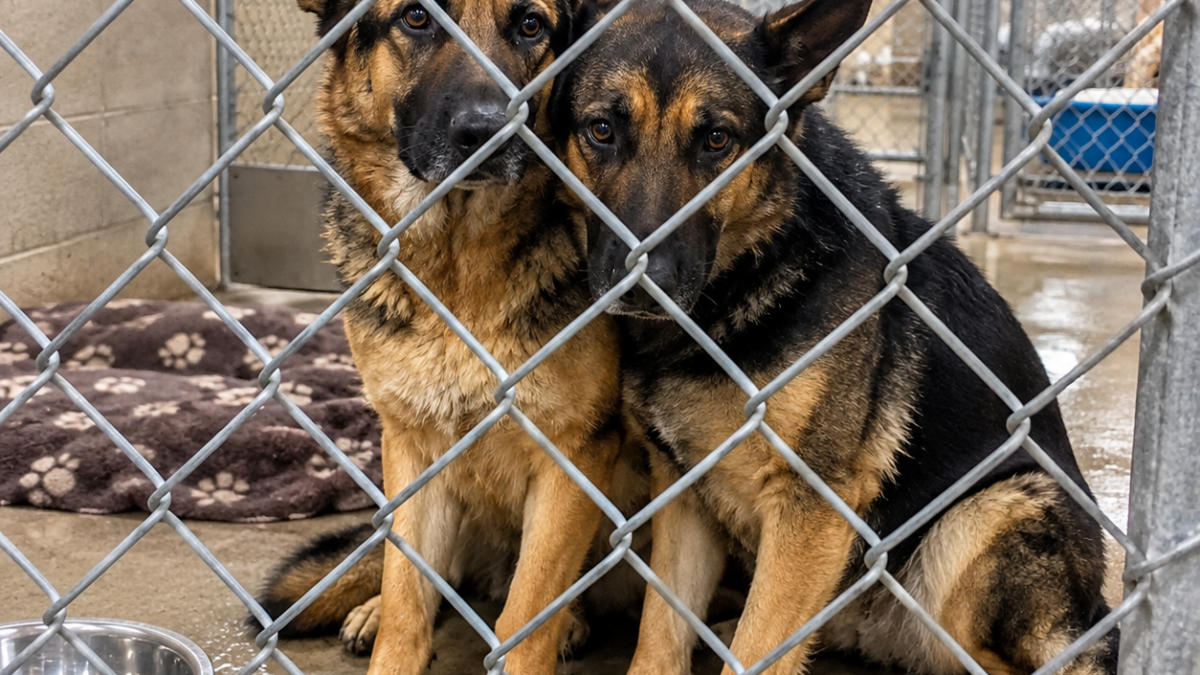
Inside was the original intake photograph.
Ranger and Willow.
Thin.
Dirty.
Pressed together.
Ranger facing the camera.
Willow turned toward something outside the frame.
Both alert.
I stared.
“I haven’t seen this in years.”
Melissa sat.
“You want it?”
I looked at Willow sleeping in the sun.
Gray.
Old.
One tennis ball beneath her chin.
“No.”
Melissa seemed surprised.
“Why?”
“That’s not who I need to remember.”
She smiled.
“Fair.”
She put the folder away.
I realized something.
There was a time when I thought healing meant proving the past could no longer hurt me.
That’s impossible.
The past leaves marks.
In people.
In animals.
Healing, for me, became something else.
The past stopped being the only explanation for the present.
Ranger and Willow could hear a sound without assuming danger.
I could wake from a nightmare without believing I was back there.
We remembered.
But memory no longer controlled every next step.
Willow’s final winter was gentle.
She slept most mornings.
Short walks.
Food warmed because she had become picky.
Tennis balls everywhere.
One beside the couch.
One by the back door.
One under my bed.
One in her water bowl somehow.
Her kidneys started failing in February.
Early stage.
Then faster.
Medication.
Fluids.
Diet.
For a while, stable.
Then not.
One morning, she refused chicken.
That was when I knew.
Willow never refused chicken.
The veterinarian came to the house two days later.
I had waited just long enough to be certain.
Not long enough for crisis.
That had been the promise I made after Ranger.
Willow lay on her bed beneath the window.
The sun was out.
Pikes Peak bright in the distance.
A tennis ball rested beside her front paw.
I sat on the floor.
She looked at me.
“You’re the last one.”
Her ears barely moved.
“You know that?”
Tail.
One slow thump.
I thought about the first day in the shelter yard.
Willow stationed near the perimeter.
Ranger at the gate.
Me sitting in a chair pretending I had only come to look.
Three exhausted creatures.
All watching.
All convinced vigilance was survival.
Now Ranger was gone.
Willow was leaving.
I was still here.
That frightened me more than I wanted to admit.
For years, I had told people the dogs didn’t fix me.
True.
But they had become part of the structure of my life.
Who was I without them?
The veterinarian gave me time.
I held the ball.
“You made this thing disgusting.”
Willow blinked.
“You know how much money I spent on tennis balls?”
Nothing.
“Hundreds.”
Tail thump.
I put it back beside her.
“You were worth it.”
First medication.
Willow relaxed.
I rubbed her ears.
“You don’t have to watch the door.”
Her breathing slowed.
“No perimeter.”
Eyes closing.
“No fence.”
I swallowed.
“Ranger’s not here for me to hand you off to.”
That sentence broke me.
I put my forehead against hers.
“But you can still rest.”
The final medication went in.
Willow died quietly.
Her head beneath my hand.
Tennis ball touching one paw.
For the first time in years, my house held no dogs.
The silence was brutal.
I made it three weeks.
Not because I replaced them.
You can’t.
I made it three weeks before I drove to the shelter just to visit Melissa.
That’s what I told myself.
She knew better.
“You ready?”
“No.”
“Good.”
“What?”
“If you came in saying you were ready to replace them, I’d throw you out.”
“I’m not adopting.”
“Okay.”
We walked the kennels.
Dogs barked.
Jumped.
Spun.
A little pit bull mix brought a stuffed toy to the gate.
A senior hound slept through everything.
Then I saw a medium-sized brown dog sitting near the back of a kennel.
Not watching like Ranger and Willow.
Just quiet.
I stopped.
Melissa stopped beside me.
“His name is Finn.”
“I’m not adopting.”
“I didn’t ask.”
“How old?”
“Eight.”
“Medical?”
“Arthritis. Some dental work needed.”
“Dogs?”
“Good.”
“People?”
“Shy.”
Melissa smiled.
“You’re asking a lot of questions for a man who isn’t adopting.”
I walked away.
Came back the next day.
And the next week.
Finn came home a month later.
One dog.
Different breed.
Different personality.
He did not sense nightmares.
He slept through them.
The first time I woke sweating, Finn remained on the couch downstairs.
I laughed.
Actually laughed.
“Useless.”
Finn snored.
That was good.
I didn’t need Ranger again.
I didn’t need Willow again.
I needed Finn to be Finn.
We built a different life.
The lesson Ranger and Willow gave me was not that every damaged veteran needs two damaged dogs.
It was that healing sometimes begins when you stop demanding that yourself—or anyone else—become who they were before.
Ranger did not become a fearless dog.
Willow did not forget neglect.
I did not erase deployment.
We became safer versions of ourselves.
That was enough.
Years after Ranger and Willow were gone, the shelter invited me to speak at a fundraiser.
I almost refused.
Public speaking wasn’t my favorite.
Melissa threatened me with the original intake folder.
“You wouldn’t.”
“I will put baby pictures on the screen.”
“They were five.”
“Still.”
I agreed.
I stood in front of a room of adopters, volunteers, rescue workers, and donors.
Finn slept behind the podium.
Completely uninterested.
I told them about Ranger and Willow.
Not as miracle dogs.
Not as service dogs.
Not as saviors.
As two anxious shelter dogs nobody wanted to separate.
Two animals who had learned that constant vigilance was necessary.
I told them how I recognized that behavior because I lived it.
How our first months involved trainers.
Routine.
Mistakes.
Patience.
How Willow discovered tennis balls.
How Ranger learned to snore.
How they slept belly-up eventually.
How they got old.
How they died.
The room was quiet.
Then I said something I hadn’t planned.
“When I adopted them, people told me I was saving two difficult dogs.”
I looked down at Finn.
“I don’t think that’s what happened.”
People waited.
“They didn’t save me either.”
A few expressions shifted.
I continued.
“We practiced safety together.”
That felt true.
“They learned that a person could leave a room and come back. That a noise could be just a noise. That sleep didn’t mean danger.”
I paused.
“And I learned some of the same things.”
No dramatic rescue.
No debt.
No hero.
Practice.
Afterward, a woman approached me.
Her husband stood several feet behind.
She whispered:
“He’s a veteran.”
I nodded.
“He doesn’t sleep.”
I looked at the husband.
He looked away.
She asked:
“Should we get a dog?”
I thought about Ranger.
Willow.
All the mistakes people make trying to turn animals into treatment plans.
“Maybe.”
She looked disappointed.
I continued.
“If you both want a dog and can care for one, talk to a reputable rescue or service-dog organization depending on what you need. But don’t get a dog because you expect it to cure him.”
Her eyes softened.
“What then?”
“Build the whole support system.”
Therapy.
Medical care when appropriate.
Family.
Friends.
Routine.
Community.
A dog, if the dog fits.
No single thing carrying everything.
I had learned that from Mara—well, not Mara, but another lesson: no one creature should carry all responsibility. I did not say that, of course. Different story.
The woman nodded.
Her husband finally approached.
He asked:
“Do you still have nightmares?”
“Yes.”
“How often?”
“Less.”
“Do they still scare you?”
I thought.
“Yes.”
He looked disappointed.
“But they end.”
He met my eyes.
“That sounds obvious.”
“It didn’t used to.”
He nodded.
I knew that feeling.
That night, I went home.
Finn was asleep.
I checked the door once.
Only once.
Turned off the kitchen light.
Went to bed.
No Ranger beside me.
No Willow at the doorway.
Their absence was still real.
But so was everything they had helped build.
The house no longer felt empty even when it was quiet.
I had learned how to stay in it.
How to sleep in it.
How to wake and know where I was.
That was mine now.
Not borrowed from a dog.
Not dependent on one.
Mine.
Sometimes people still ask me which dog helped me more.
Ranger or Willow.
I refuse to answer.
They were a pair.
That was the point.
Ranger taught me that presence doesn’t need words.
Willow taught me that vigilance can become play.
Ranger showed me what trust sounds like when it snores.
Willow showed me what freedom looks like when an anxious dog runs after a yellow tennis ball without checking behind her.
Both showed me that two things can be true at once.
You can still carry what happened.
And rest.
You can still remember.
And play.
You can still have bad nights.
And have a good life.
For years after leaving the military, sleep felt like something that belonged to other people.
Then two dogs arrived who didn’t know how to sleep either.
That first night, Ranger rested his head beside my hand while Willow watched the bedroom door.
None of us knew how to stop scanning.
None of us trusted quiet.
None of us believed safety could last simply because the room happened to be calm.
But repetition did what words could not.
Morning after morning.
Night after night.
Nothing happened.
We ate breakfast.
Walked.
Worked.
Played.
Slept.
Woke.
Again.
Eventually Ranger stopped needing the doorway.
Eventually Willow stopped checking the fence.
Eventually I stopped checking the lock three times.
Ranger started snoring.
Willow started dreaming hard enough to kick her legs in the air.
And some nights, before I fell asleep, I would hear both dogs breathing and realize my own body had stopped waiting for an alarm that wasn’t coming.
The former owner once told me to keep them safe.
For years, that sentence annoyed me.
It felt like responsibility being handed to me by the person who had failed them.
Eventually I understood something that made the anger unnecessary.
I had kept them safe.
Not because he asked.
Because they were mine.
And they had given safety back in the only way dogs can.
Not by making promises.
By staying.
The most satisfying revenge against every year those dogs spent frightened was not a courtroom.
Not punishment.
Not watching their former owner lose.
It was Ranger getting old enough to need an orthopedic bed.
It was Willow injuring her knee because she was running too hard after a tennis ball.
It was gray fur.
Arthritis.
Veterinary bills.
Slow walks.
The privilege of age.
The neglect case had once made people wonder whether Ranger and Willow would ever relax.
They eventually relaxed so completely that Ranger snored through thunderstorms and Willow slept through someone opening the front door.
That was the answer.
And if there is one picture I wish existed, it would not be the shelter photograph.
It would be an ordinary afternoon about five years after I adopted them.
Sunlight across the living-room floor.
Willow on her back beneath the window.
One paw curled.
Ranger stretched across the rug.
Mouth open.
Deep asleep.
I was on the couch.
Also asleep.
No one watching the door.
No one checking the perimeter.
No one preparing for the worst.
Three survivors in one quiet room.
Doing absolutely nothing.
For us, that was everything.
People often imagine healing as becoming fearless.
I don’t.
Fear still visits.
Memory still visits.
Grief definitely visits.
Healing is realizing they are visitors.
They do not own the house.
Ranger and Willow taught me that before I had words for it.
They came into my life because a shelter described them as “too watchful.”
What no one knew was that I had spent years being too watchful too.
Maybe that is why we recognized each other.
Not because we were meant to save one another.
Because none of us needed explanations.
A dog could raise his head at a noise and I understood.
I could wake shaking at two in the morning and Ranger didn’t need to understand why.
Willow could stare through a window for ten minutes and nobody pulled her away.
We gave each other time.
Then life slowly became larger than vigilance.
Ranger discovered sunbeams.
Willow discovered tennis balls.
I rediscovered mornings after actual sleep.
That is the story.
Not that two unwanted dogs magically healed a veteran.
Not that trauma disappeared.
Not that love fixed everything.
Love gave us a reason to practice.
Practice gave us routine.
Routine created predictability.
Predictability made safety believable.
And safety, repeated often enough, finally gave us rest.
Years after both dogs were gone, I dreamed about them once.
Not one of my nightmares.
A normal dream.
We were walking near Garden of the Gods.
Ranger was young again.
Willow had a tennis ball.
Neither was watching anything.
They ran ahead.
I remember calling:
“Wait.”
They didn’t.
For once, I wasn’t afraid.
I knew where they were going.
I woke before sunrise.
Finn was snoring downstairs.
The house was dark.
My heart was calm.
I looked at the empty space beside the bed where Ranger used to sleep.
Then the corner where Willow’s round bed had been.
I missed them.
I still do.
But grief and danger are not the same thing.
That is another lesson.
I closed my eyes again.
And I went back to sleep.
For years, sleep had felt like surrender.
Ranger and Willow taught me something better.
Sometimes sleep is simply what happens when your body finally believes someone—or something—can stop watching for a while.
And long after they were gone, that lesson remained.
The dogs who could never relax had finally rested.
And because of the life we built together, eventually, so could I.




