PART 2: Someone Taped a Screaming Cat to a Tree in the Middle of Nowhere—Then I Heard Her Final Cry
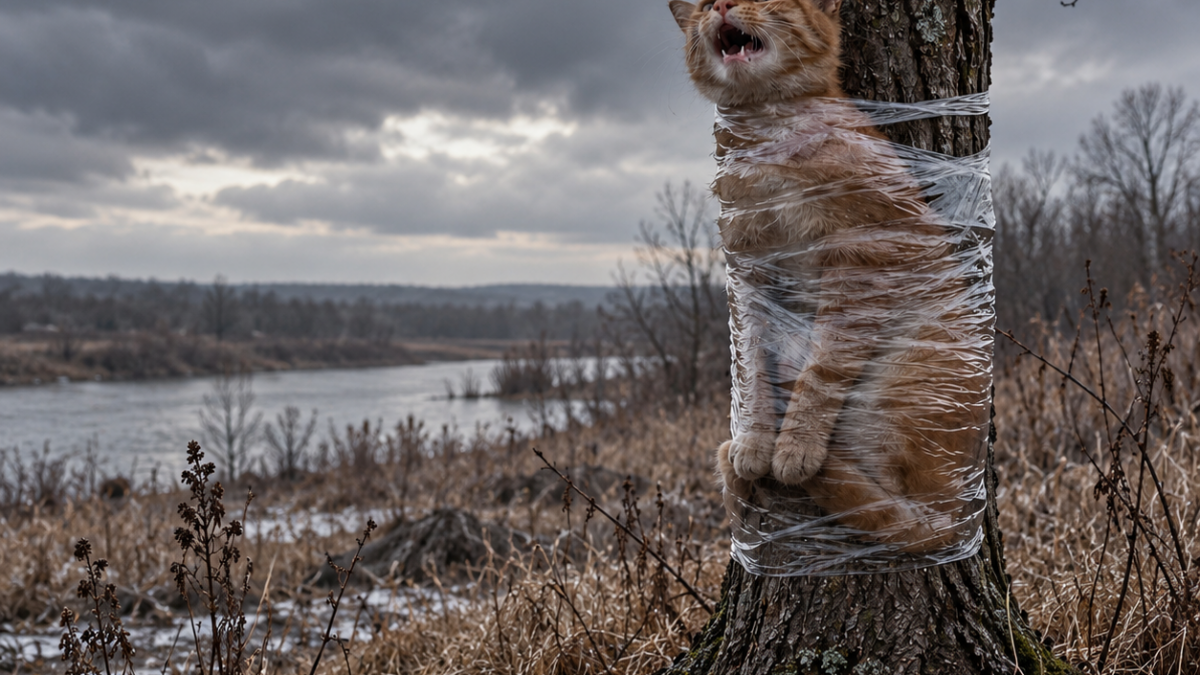
PART 2
I drove faster than I should have.
Not recklessly.
But close.
The nearest veterinary clinic was thirty-five minutes away in town, and every time I looked at the passenger seat, the cat seemed smaller.
I had placed her inside an empty cardboard produce box lined with my sweatshirt because I had no carrier.
She lay curled on one side.
Eyes half closed.
Breathing shallow.
At every stop sign, I put two fingers against her side to make sure she was still breathing.
“Stay with me.”
The first few times, she didn’t react.
Then, about ten minutes from town, her paw moved.
Barely.
I took that as an agreement.
The clinic was called Prairie Creek Veterinary Hospital.
I had been there once with my brother’s Labrador.
I parked crooked and ran inside carrying the box.
The receptionist looked up.
“I need help.”
That was all I had to say.
A technician appeared immediately.
Then another.
They lifted the cat carefully.
“What happened?”
“She was taped to a tree.”
The technician stopped.
“Taped?”
“Duct tape. Around her whole body.”
Her face changed.
“Where?”
“County Road 18, near the old Talbot property.”
She called toward the back.
“Dr. Reese!”
Within a minute, the cat was on an examination table.
Dr. Emily Reese, a small woman with dark hair streaked silver at the temples, moved quickly but gently.
Temperature.
Heart rate.
Gums.
Eyes.
Abdomen.
Paws.
Skin.
“She severely dehydrated.”
“Can you save her?”
Dr. Reese didn’t answer immediately.
“She’s alive.”
I hated that answer.
“Is she dying?”
“She doesn’t have to.”
Better.
That was better.
They started warmed fluids.
The cat barely resisted the needle.
Normally, cats fight.
Scratch.
Bite.
Object.
She simply lay there.
Dr. Reese frowned.
“How long do you think she was out there?”
“I don’t know.”
“Could’ve been hours. Maybe longer.”
“Could she have been there overnight?”
“In that wind?”
She looked at the cat.
“Possibly.”
I remembered the dry grass.
The empty field.
The night temperature had dropped into the thirties.
My anger returned.
“What kind of person tapes a cat to a tree?”
Dr. Reese continued working.
“The kind we document carefully.”
I looked at her.
“What?”
She pointed at the pieces of tape still stuck around the cat’s hind legs.
“Don’t throw anything away.”
“For police?”
“Animal control first. Maybe sheriff.”
That was the first moment I understood this wasn’t only a rescue anymore.
It was evidence.
## 1
The cat stayed overnight.
Dr. Reese said her injuries looked dramatic but, thankfully, most were superficial.
Dehydration.
Stress.
Minor abrasions.
Bruising around the ribs.
Several patches of hair pulled out by adhesive.
One front paw swollen from being held in an unnatural position.
But no fractures.
No internal bleeding.
No severe organ damage.
“She got lucky,” Dr. Reese said.
I looked at her.
“She was duct-taped to a tree.”
Dr. Reese sighed.
“You know what I mean.”
I did.
I just didn’t feel lucky yet.
Animal control arrived before I left.
Officer Natalie Perez.
Late thirties.
Calm.
Sharp eyes.
She photographed everything.
The remaining tape.
The fur stuck to it.
Red marks.
The cardboard box I’d used.
My sweatshirt.
Even the dirt on the cat’s paws.
Then she asked me to explain exactly where I’d found her.
I gave directions.
She recorded everything.
“Did you touch anything else near the tree?”
“No.”
“Any vehicles nearby?”
“No.”
“Tracks?”
“I wasn’t looking.”
“Cigarette butts?”
“I don’t know.”
“Food containers? Rope? Gloves?”
“I don’t know.”
I felt stupid.
Perez shook her head.
“You weren’t processing a crime scene. You were saving an animal.”
That helped.
She left to inspect the site before dark.
I stayed another hour.
The cat slept.
At some point, Dr. Reese said:
“You know you can go home.”
“I know.”
“She isn’t going to wake up and think you abandoned her.”
That sentence hit me harder than she intended.
“I know.”
Dr. Reese studied me.
“You want to foster her?”
I laughed.
“No.”
“Okay.”
“I have never owned a cat.”
“Okay.”
“I travel for work.”
“Okay.”
“I don’t have cat food.”
“Daniel.”
“What?”
“You’re arguing against a question I didn’t ask yet.”
I stopped.
She smiled.
“If she survives and isn’t claimed, would you be willing to foster her temporarily?”
I looked at the sleeping cat.
One ear twitched.
“Temporarily.”
“Of course.”
“That word matters.”
“Deeply.”
## 2
She survived the night.
When I returned the next morning, she hissed at me.
I was thrilled.
“That’s the healthiest thing she’s done,” Dr. Reese said.
The cat hissed again.
“See?”
Her fluids had worked.
She was eating small amounts.
Her temperature was stable.
The swollen paw was improving.
The tape adhesive was harder.
Removing it safely required shaving patches of fur and using oil-based solution.
When she emerged, she looked ridiculous.
Orange coat interrupted by bald rectangles.
One shoulder nearly bare.
Tail half shaved.
Dr. Reese handed me a towel.
“Beautiful.”
The cat glared.
“She’s offended.”
“Good.”
Anger meant personality.
Personality meant energy.
Energy meant life.
I decided to call her Maple.
The tree where I found her wasn’t a maple.
That wasn’t why.
Her fur reminded me of autumn leaves.
Dr. Reese approved.
Maple did not.
I signed foster papers that afternoon.
Temporary.
I underlined it mentally.
## 3
My house was not prepared for Maple.
I had one couch.
Two chairs.
A kitchen table.
A television.
A bed.
No litter box.
No scratching post.
No toys.
No carrier.
No idea.
I stopped at a pet store on the way home.
An employee asked:
“New cat?”
“Temporary.”
She smiled.
“Sure.”
I bought:
Litter.
Box.
Food.
Bowls.
A cat bed.
Scratcher.
Carrier.
Toys.
Another toy because apparently the first six weren’t enough.
A brush.
Treats.
And something called calming spray I absolutely did not understand.
By the time I got home, my credit card had accepted that Maple was temporary more easily than I had.
She spent the first night in my bathroom.
Dr. Reese recommended a small safe space.
Maple stayed inside the carrier with the door open.
I sat on the floor outside.
“You know this is not your house.”
Maple blinked.
“You’re staying until somebody adopts you.”
Nothing.
“I mean it.”
She slowly extended one paw.
Placed it on my sock.
And went back to sleep.
Manipulation.
Pure manipulation.
## 4
Officer Perez called the next day.
“We found tire tracks.”
My pulse quickened.
“Good?”
“Maybe.”
“Anything else?”
“Several strips of tape backing, a disposable glove, and fresh footprints.”
“Fingerprints?”
“Maybe from the tape, but don’t get excited.”
“Why?”
“Textured surfaces don’t always give us usable prints. Weather doesn’t help.”
I sat at my kitchen table.
Maple was under it.
“What kind of tape?”
“Commercial duct tape. Common brand.”
“So nothing.”
“I didn’t say nothing.”
“What else?”
“The tree is on private land.”
“So?”
“Property owner installed a game camera last month.”
I stood.
“Did it catch anything?”
“We’re waiting for him to retrieve the card.”
That afternoon lasted nine years.
At 6:14 p.m., Perez called again.
“We have a vehicle.”
I gripped the phone.
“What?”
“Camera captured a van entering the access road at 11:42 p.m. Two nights before you found her.”
“Two nights?”
“Looks like she may have been out there over a full day.”
I looked under the table.
Maple was washing one paw.
My chest tightened.
“What kind of van?”
“White cargo van.”
“Plate?”
“Partially.”
“Driver?”
“No clear face.”
“But something?”
Perez hesitated.
“There’s lettering on the side.”
My stomach turned.
“What lettering?”
“Happy Tails Mobile Grooming.”
## 5
I knew the name.
Everyone in town did.
Happy Tails had been operating for years.
Pink-and-blue logo.
Mobile grooming van.
Dogs.
Cats.
Nail trims.
Baths.
The owner was a woman named Denise Harrow.
Mid-forties.
Known in local animal circles.
She sponsored adoption events.
Donated gift cards to fundraisers.
Had pictures online holding rescued dogs.
It made no sense.
Perez warned me:
“Do not contact her.”
“I wasn’t going to.”
“Daniel.”
“I said I wasn’t.”
I was lying.
The only thing stopping me was the fact that Maple was sitting beside my foot.
I looked down.
“What?”
She meowed.
“Fine. I’m not calling.”
Good cat.
Bad influence.
## 6
Happy Tails wasn’t necessarily responsible.
That became clear quickly.
Three employees used the van.
Denise.
Her assistant, Caleb.
And a part-time groomer named Megan Shaw.
The van also sometimes stayed overnight at Denise’s house.
The game camera showed one person getting out.
Dark jacket.
Baseball cap.
Average height.
Impossible to identify.
The person carried a pet carrier.
That mattered.
A red plastic carrier.
They walked toward the tree.
Eight minutes later, they returned carrying the empty carrier.
No cat visible.
Then drove away.
Maple had been delivered there.
Not wandered.
Not escaped.
Placed.
Perez interviewed all three employees.
Denise denied involvement.
Caleb said he had never used that access road.
Megan said the same.
Van logs were incomplete.
GPS tracking had been disabled months earlier because of a billing issue.
Convenient.
Then Denise did something that made me suspicious.
She called me.
## 7
I didn’t know how she got my number.
Probably local gossip.
Small towns move information faster than police.
“Is this Daniel?”
“Yes.”
“This is Denise from Happy Tails.”
I stopped.
“Officer Perez told you not to contact witnesses.”
“She didn’t tell me anything.”
“Then why are you calling?”
“I heard you found the cat.”
Maple lifted her head at my voice.
“Yes.”
“Is she okay?”
“Why?”
“Because my business is being dragged into something awful.”
Not:
Because the cat was tortured.
Because my van may have been used.
My business.
I said:
“She survived.”
Denise exhaled.
“Thank God.”
The reaction sounded real.
I didn’t know what to think.
Then she asked:
“What kind of cat?”
I hesitated.
“Orange.”
“Female?”
“Yes.”
Silence.
Only half a second.
But I noticed.
“You know her?”
“No.”
Too fast.
“What did you think?”
“Nothing.”
“You hesitated.”
“I didn’t.”
I wrote everything down.
“Denise.”
“Yes?”
“If you know anything, tell Perez.”
“I don’t.”
Then she said:
“I just want this to go away.”
That sentence stayed with me.
## 8
Maple improved quickly.
Physically.
Emotionally was different.
She hated tape sounds.
I discovered that by accident when I opened a package.
The tearing sound of packing tape made her bolt beneath the couch.
She stayed there for two hours.
The next time, same thing.
She also panicked when I held anything long and silver.
Foil.
Flashlight.
Even a ruler once.
But otherwise, she became affectionate.
She slept at the foot of my bed.
Followed me into the kitchen.
Sat outside the shower.
Attacked my shoelaces.
Ignored every toy I bought except a crumpled grocery receipt.
Temporary.
Every time I said the word, she seemed less impressed.
## 9
The first major break came from a customer.
Her name was Lauren Price.
She called animal control after seeing a news post asking whether anyone recognized Maple.
“I think that’s my cat.”
Perez called me before telling her anything.
“Don’t panic.”
“That’s always a terrible opening.”
“Possible owner.”
I looked at Maple asleep beside me.
“Owner?”
“Maybe former owner.”
“What does that mean?”
Lauren came to the clinic the next morning.
Maple was there for a checkup.
The moment Lauren walked into the room, Maple froze.
Her tail lowered.
Lauren covered her mouth.
“Pumpkin.”
Maple backed away.
Not aggressive.
Scared.
Very scared.
Lauren started crying.
“That’s her.”
Dr. Reese looked at me.
I didn’t know what to feel.
Relief?
Anger?
Fear I’d lose Maple?
Perez asked:
“How long has she been missing?”
Lauren wiped her eyes.
“Three weeks.”
“Reported?”
“Yes.”
She produced screenshots.
Missing-cat posts.
Local neighborhood group.
Flyers.
Vet records.
Microchip registration.
The chip number matched.
Maple’s real name was Pumpkin.
She belonged to Lauren.
Or had.
My chest hurt in a way I didn’t expect.
Then Perez asked:
“Who last saw her?”
Lauren’s face changed.
“The groomer.”
## 10
That changed everything.
Lauren had booked Happy Tails for grooming.
Pumpkin had long fur in winter, prone to mats.
Denise herself had arrived.
Lauren remembered because Pumpkin hated the carrier, so Denise said she would groom her in the van parked outside.
Forty minutes later, Denise knocked.
Said the cat had slipped out when the van door opened.
“She told me Pumpkin ran into the alley.”
“Did you see that?”
“No.”
“Did anyone?”
“No.”
“Was the cat returned to you at any point?”
“No.”
Lauren had spent days searching.
Called shelters.
Posted online.
Walked the neighborhood every night.
Denise had apologized.
Even offered free future grooming.
I wanted to break something.
Perez remained calm.
“Did Denise ever mention injury during grooming?”
“No.”
“Sedation?”
“No.”
“Behavior problems?”
“No.”
Lauren looked at Maple.
“Pumpkin hated grooming, but she wasn’t vicious.”
Maple pressed against the back of the carrier.
Wouldn’t approach Lauren.
That confused everyone.
Then Dr. Reese asked:
“Was she ever frightened of you before?”
“Never.”
“Did you use tape in your home?”
Lauren stared.
“What?”
“No.”
It wasn’t Lauren Maple feared.
It was everything connected to the memory.
The clinic.
Carrier.
Strangers.
Maybe grooming scent.
Maybe Denise.
## 11
Microchip records proved ownership.
Normally, Maple would have gone home with Lauren.
But because she was evidence in an active cruelty investigation, and because she showed severe stress, animal control requested temporary protective custody while the case developed.
Lauren agreed.
That surprised me.
“You don’t want her home?”
“Of course I do.”
She started crying again.
“But look at her.”
Maple had retreated behind my legs.
“She trusts you.”
I didn’t know what to say.
Lauren continued.
“I want her safe more than I want her back tonight.”
That told me everything about her.
I liked her immediately.
We arranged visits.
Slowly.
No forcing.
Lauren sat on my living-room floor.
Ignored Maple.
Read quietly.
Brought familiar blankets.
Old toys.
A shirt from home.
The first visit, Maple stayed upstairs.
Second, hallway.
Third, she sat ten feet away.
Fourth, she approached.
Smelled Lauren’s fingers.
Then walked away.
Lauren cried afterward in her car.
“It’s like she doesn’t remember me.”
“She does.”
“How do you know?”
“Because she didn’t run.”
That was all I had.
But sometimes progress is that small.
## 12
The cruelty investigation shifted hard toward Denise.
Van.
Last known custodian.
False escape story.
Her phone records placed her near County Road 18 that night.
Then came the missing piece.
Blood.
Dr. Reese had noticed a small healed cut near Maple’s shoulder.
At first, everyone assumed tape abrasion.
But Lauren remembered Pumpkin did not have it before grooming.
Investigators examined the Happy Tails van.
It had been professionally cleaned.
Too professionally.
Floor mats scrubbed.
Surfaces bleached.
But in a seam beneath the grooming table, they found dried blood.
DNA testing matched Maple.
Denise changed her story.
Again.
Pumpkin had scratched a groomer.
Caleb restrained her.
Cat panicked.
Small cut.
Then escaped.
But Caleb told investigators something else.
“I wasn’t working that day.”
Payroll records proved it.
Megan wasn’t either.
Denise had been alone.
## 13
She hired an attorney.
Stopped answering questions.
Posted a statement online claiming she was being “persecuted over an unfortunate accident.”
People divided immediately.
Some defended her.
“She loves animals.”
“She groomed my dog for years.”
“She donated to rescue.”
Others attacked.
I hated all of it.
Social media wanted a monster.
Real life was more uncomfortable.
Denise had apparently treated thousands of animals well.
Then something happened with Maple.
One terrible choice.
Then another.
Then another.
The question became:
Why?
## 14
We learned at the preliminary hearing.
Not fully.
But enough.
Denise had been grooming Pumpkin.
Pumpkin panicked.
Scratched.
Bit.
Denise became angry.
Tried to restrain her.
Used grooming tape temporarily around her front legs.
That itself was already improper.
Pumpkin fought harder.
Knocked equipment over.
Bit Denise’s wrist deeply.
Denise later told police she “lost control.”
Not of the cat.
Of herself.
She wrapped more tape.
Not to kill Pumpkin, she claimed.
“To calm her down.”
That sentence made the courtroom turn cold.
Then she said she panicked.
Couldn’t take the cat back to Lauren injured and taped.
Couldn’t admit what she’d done.
So she drove.
Farther than she intended.
Saw the tree.
And—
I still cannot understand this part—
finished wrapping Pumpkin to it.
Then left.
Her attorney called it an impulsive act under extreme stress.
Officer Perez called it intentional abandonment and cruelty.
I called it unforgivable.
At least then.
## 15
Denise claimed she planned to come back.
No one believed her.
“Why leave the cat tied?” the prosecutor asked.
“I was scared she’d run.”
“Why not leave her inside the carrier?”
No answer.
“Why not call animal control?”
Silence.
“A veterinarian?”
Nothing.
“Why not return her to the owner and tell the truth?”
Denise began crying.
“I was afraid I’d lose my business.”
There it was.
Business.
Reputation.
Money.
More important, in that moment, than the animal in front of her.
The prosecutor said:
“So you protected your business by leaving a restrained domestic cat in an isolated field overnight?”
Denise whispered:
“Yes.”
Lauren sobbed beside me.
I stared straight ahead.
## 16
Maple recovered.
But the legal case lasted months.
During that time, Lauren visited every week.
Slowly, Pumpkin returned to her.
First sniffing.
Then sitting nearby.
Then accepting one touch.
Then climbing into Lauren’s lap for three seconds.
The first time it happened, Lauren didn’t breathe.
Neither did I.
Pumpkin jumped down.
Lauren covered her mouth.
“She remembers.”
“Yeah.”
She did.
By the third month, Pumpkin purred when Lauren arrived.
That created a new problem.
Mine.
I had known from day one Maple wasn’t mine.
Pumpkin.
Her name was Pumpkin.
Not Maple.
Lauren had raised her from a kitten.
Loved her.
Searched for her.
Never abandoned her.
I had been temporary.
But temporary had become mornings.
Meals.
Medication.
Trust.
Sleeping on my bed.
I didn’t want to admit how much it would hurt to return her.
So I didn’t.
Until Dr. Reese said:
“You know she’s going home eventually.”
“I know.”
“You look like someone told you your house is being demolished.”
“I know.”
“You did this right.”
I looked at her.
“What?”
“You kept her safe until she could remember safe somewhere else.”
That was rescue too.
I hated it.
But she was right.
## 17
Pumpkin returned to Lauren six months after I found her.
We did it gradually.
Afternoon visits.
Then evenings.
Then one overnight.
Pumpkin came back to my house after the first overnight.
No panic.
That helped.
Second overnight.
Then weekend.
Finally, full return.
I packed her things.
Too many toys.
Blankets.
Medication no longer needed.
A bed she never used.
My sweatshirt.
The same one from the field.
Lauren noticed.
“You kept that?”
“I washed it.”
She smiled.
“I figured.”
Pumpkin sat in the carrier.
Door open.
No fear.
That alone felt like victory.
I knelt.
“This is extremely ungrateful.”
Pumpkin blinked.
“I bought you furniture.”
Nothing.
“Thousands of dollars.”
Tail flick.
“You ruined my sleep.”
She reached through the carrier opening.
Touched my wrist.
I started crying.
Lauren hugged me.
“I’ll bring her.”
“You better.”
“I mean it.”
“I know.”
## 18
The house was horrible without her.
Too quiet.
No scratching outside the bathroom.
No orange fur on my black shirts.
No criminal activity at 3:00 a.m.
I lasted five days.
Then I went to the shelter.
Not to replace Pumpkin.
That isn’t how it works.
I told myself I was donating supplies.
Officer Perez happened to be there.
She laughed.
“You’re adopting a cat.”
“No.”
Dr. Reese, somehow also present, said:
“He is.”
“I hate all of you.”
The shelter had an eight-year-old gray male named Jasper.
Missing one tooth.
Overweight.
Uninterested in me.
Perfect.
I adopted him.
He hated Pumpkin when she visited.
Pumpkin hated him.
Eventually they achieved diplomatic neutrality.
## 19
Denise’s case ended in a plea.
Felony-level cruelty charges had been considered, but the final agreement included multiple animal-cruelty and abandonment counts under state law, substantial fines, restitution, probation, mandatory counseling, and a prohibition on working professionally with animals for several years.
Her grooming license was revoked.
Happy Tails closed.
Part of her restitution covered Pumpkin’s veterinary care.
Another portion went to county animal services.
People called it too lenient.
Others called it too harsh.
I stopped reading comments.
The important result was simple.
Denise could not groom another animal while the order remained in place.
She could not make money from animals.
She could not hide behind a business.
And the incident became public record.
## 20
But Denise wasn’t done with us.
Months after the case, she filed a civil complaint against Lauren.
Defamation.
Loss of business.
Emotional distress.
It was absurd.
Her attorney later withdrew several claims.
But for six weeks, Lauren lived in fear.
“What if she takes my house?”
“She won’t.”
“What if legal fees ruin me?”
“We’ll figure it out.”
“Why is she doing this?”
Because some people cannot tolerate consequences without finding someone else to blame.
The complaint alleged Lauren had publicly accused Denise of intentionally torturing Pumpkin before conviction.
But Lauren’s actual statements were careful.
Mostly factual.
The van.
The disappearance.
The search.
The recovery.
The veterinary report.
Her attorney moved to dismiss.
And then Denise made the worst legal decision of her life.
She lied in a sworn affidavit.
## 21
Denise stated she had never intentionally restrained Pumpkin with tape inside the grooming van.
That directly contradicted her criminal plea.
The judge noticed.
So did the prosecutor.
The civil case collapsed.
Fast.
Denise’s complaint was dismissed.
The judge ordered her to pay a portion of Lauren’s attorney fees.
For the first time in months, Lauren laughed.
Not cruelly.
Relieved.
“She tried to sue me for telling the truth.”
“And lost because she lied.”
“That’s almost too neat.”
Almost.
## 22
Then came the part everyone later called revenge.
I call it accounting.
Happy Tails’ old van was seized and sold to satisfy part of outstanding judgments and costs.
A local rescue organization bought it cheaply at auction.
They stripped the decals.
Repainted it.
Installed carriers.
Medical storage.
Climate control.
And turned it into a rescue transport vehicle.
The same van used to take Pumpkin to the field became a vehicle that transported abandoned animals to clinics and foster homes.
When Officer Perez told me, I laughed for a full minute.
“That’s cruel,” she said.
“No.”
I wiped my eyes.
“That’s perfect.”
The rescue renamed it:
**The Second Ride.**
Lauren cried when she saw it.
So did I.
Pumpkin peed in the carrier during the dedication.
Cats maintain perspective.
## 23
The first animal transported in The Second Ride was a mother cat with six kittens found beneath a warehouse.
The second was a hit-by-car dog.
Then two rabbits.
Then another cat.
Then dozens more.
Every mile erased a little of what the van had once meant.
Not literally.
Nothing erases.
But transformation matters.
Objects can outlive cruelty.
Sometimes they can be reassigned to kindness.
## 24
Denise eventually moved away.
Before she did, she sent Lauren a letter.
No attorney.
Handwritten.
Lauren called me.
“What does it say?”
“I don’t know if I should read it.”
“Then don’t.”
She did.
Denise apologized.
Not perfectly.
There were excuses.
Stress.
Financial pressure.
Burnout.
Fear.
But also one clear sentence:
**What I did to Pumpkin was cruel, and nothing that happened before it excuses what I did after.**
Lauren sat quietly.
“Do you forgive her?”
I asked.
“I don’t know.”
“That seems fair.”
“You?”
I thought.
“No.”
Then:
“Maybe eventually.”
Forgiveness wasn’t required.
Accountability was.
## 25
Pumpkin became herself again.
Not the same self.
Trauma changes animals.
People too.
She still feared the ripping sound of tape.
Lauren stopped using packaging tape around her.
Scissors instead.
She hated grooming vans.
So Lauren drove her to a quiet cat-only salon where grooming happened in a private room.
No mobile service.
No metal tables.
No rushing.
She learned to tolerate brushing again.
Not love it.
Cats don’t owe personal growth arcs to anyone.
## 26
One year after I found her, Lauren brought Pumpkin to the field.
I wasn’t sure that was a good idea.
Neither was Dr. Reese.
But we didn’t go to the tree itself.
We parked on the road.
Stayed inside the vehicle.
Pumpkin sat in her carrier with the door open.
She smelled the air.
Listened.
No panic.
Lauren touched her.
“This is where?”
“Yes.”
She looked toward the cottonwood.
“That’s the tree?”
“Yeah.”
The tree looked smaller.
Ordinary.
That bothered me.
I had built it into something monstrous in my memory.
But trees don’t commit cruelty.
People do.
Pumpkin walked out of the carrier onto Lauren’s lap.
Curled.
And slept.
We left after five minutes.
That was enough.
## 27
The landowner cut the tree down the following winter.
Storm damage.
When he told me, I felt relieved.
No shrine.
No memorial.
Nothing sacred about a place where suffering happened.
The land became pasture again.
Grass grew.
Cattle grazed.
Life moved over the scar.
## 28
Pumpkin’s story changed Lauren.
Before, she had been shy.
Private.
Conflict-avoidant.
Afterward, she started volunteering with animal welfare education.
Not because she wanted to be known.
Because she understood how quickly “an accident” can become a cover story when nobody asks questions.
She taught pet owners:
Photograph animals before professional services.
Use microchips.
Keep veterinary records.
Report missing animals immediately.
Ask for written incident reports.
Trust discomfort.
Practical things.
Boring things.
Things that prevent stories like ours.
## 29
It changed me too.
I became a foster volunteer.
Jasper objected.
Constantly.
The first foster was a three-legged tabby named Rocket.
Jasper hated him for forty-eight hours.
Then slept beside him.
Second foster:
A deaf white kitten.
Third:
An old tortoiseshell.
I learned that temporary can become permanent if you’re not careful.
Jasper remained the only permanent one.
Mostly because he threatened legal action.
## 30
Pumpkin visited often.
The first time she returned after moving home, she ran straight upstairs.
Found my bedroom.
Jumped on the old spot at the foot of the bed.
I cried.
Lauren laughed.
“She hasn’t forgotten.”
“No.”
“She won’t.”
That helped more than I expected.
Rescue doesn’t mean being remembered forever.
But sometimes you are.
## 31
Three years after the incident, The Second Ride rescue van had transported more than eight hundred animals.
They put a small decal near the rear door:
**Every animal deserves a safer second destination.**
No mention of Denise.
No mention of Pumpkin.
I liked that.
Bad people don’t need monuments either.
## 32
Then someone vandalized the van.
Slashed tires.
Spray paint.
One message:
**LIARS**
Everyone immediately suspected Denise.
I did too.
That was wrong.
Police identified a teenage boy whose mother had worked for Happy Tails and blamed the closure for financial hardship.
He wasn’t sent to jail.
Restitution.
Community service.
Part of that service was completed at the rescue.
At first, I thought it was ridiculous.
Then he began cleaning carriers.
Walking dogs.
Loading food.
Months later, he stayed as a volunteer.
Life is annoyingly complicated.
Sometimes people associated with harm become useful.
I had to make room for that truth.
## 33
Lauren never publicly named him.
Neither did I.
Punishment had happened.
The rest was his life to build.
That’s the thing about justice.
If it becomes only revenge, eventually you start wanting suffering more than safety.
I didn’t want that.
Not anymore.
## 34
Pumpkin turned five.
Then six.
Then seven.
She became rounder.
Spoiled.
Opinionated.
Lauren married a man named Andrew who understood immediately that Pumpkin outranked him.
At their wedding, there was a photograph of Pumpkin on the welcome table.
I asked:
“Why?”
Lauren said:
“She survived more relationship drama than both of us.”
Fair.
## 35
Andrew installed wall shelves so Pumpkin could climb.
She loved them.
The cat once unable to move a single leg now spent afternoons jumping between platforms along an entire wall.
The first time I saw her do it, I stopped.
Lauren noticed.
“You okay?”
“Yeah.”
Pumpkin launched to the top shelf.
Tail high.
“Just thinking.”
“I know.”
Movement meant something different with her.
Every jump felt like an answer.
## 36
Dr. Reese retired.
At her retirement party, someone brought photographs from memorable cases.
Pumpkin was there.
First day.
Shaved patches.
Red marks.
Angry eyes.
Then recent.
Fat.
Perfect.
Dr. Reese looked at me.
“She almost didn’t make it.”
“I know.”
“Best hiss I ever heard.”
We laughed.
## 37
Officer Perez became supervisor of the county animal-control unit.
She later trained new officers using parts of Pumpkin’s case.
Documentation.
Scene preservation.
Microchips.
Vehicle evidence.
Veterinary cooperation.
She always emphasized one thing:
“Don’t decide the story before you’ve collected the facts.”
That applied to me too.
I had wanted Denise to be a monster.
The truth was more useful.
She was a person who did something monstrous.
That distinction doesn’t excuse anything.
It warns us.
Cruelty isn’t limited to people who look cruel.
Sometimes it comes from ordinary people under pressure who choose self-protection over responsibility.
That’s more frightening.
And more important to understand.
## 38
Years later, Denise attended a restorative justice program connected to her probation.
Lauren was invited.
She declined.
No guilt.
No explanation.
She told me:
“I don’t need to hear her pain to validate mine.”
I agreed.
Victims do not owe offenders closure.
Pumpkin definitely didn’t.
## 39
I did eventually read Denise’s full apology.
Lauren gave me permission.
There was one paragraph I still remember.
**I kept thinking that if nobody saw what I had done, then I could go back to being the person I believed I was. But leaving Pumpkin there didn’t erase the moment. It became the truest thing about me until I admitted it.**
I hated that I understood it.
Most people want identity to cancel behavior.
I’m a good person.
I’m an animal lover.
I’m stressed.
I’m scared.
None of those sentences undo what happens next.
Actions remain.
## 40
Pumpkin lived to fifteen.
I wish I could say she reached twenty.
She didn’t.
Kidney disease.
Thyroid problems.
Age.
Normal things.
After such an abnormal beginning, normal aging felt almost holy.
Lauren called me when the kidneys worsened.
I drove over.
Pumpkin was thinner.
Still orange.
Still green-eyed.
Still suspicious of anyone holding tape.
She slept beneath the wall shelves.
Andrew had placed ramps between them because she could no longer jump.
Adaptation.
Always.
## 41
For almost a year, they managed the kidney disease.
Fluids.
Food.
Medication.
Routine.
Pumpkin tolerated it with the dignity of a queen being mildly inconvenienced by servants.
Then she stopped eating.
The vet came home.
Lauren called me first.
“Can you come?”
“I’m already getting my keys.”
## 42
Pumpkin lay on a blanket by the window.
Sunlight touched her fur.
I sat beside Lauren.
Andrew stayed on the other side.
Pumpkin opened her eyes when I spoke.
“Hey.”
One ear moved.
“Remember me?”
She lifted her head.
Slowly.
Then put one paw on my wrist.
Exactly where she had touched me years before in the carrier.
I cried instantly.
Lauren laughed through tears.
“She remembers.”
“Yeah.”
She did.
## 43
The veterinarian gave the sedative.
Pumpkin relaxed.
No tape.
No wind.
No cold.
No tree.
No empty field.
Only home.
Lauren’s hand on her side.
Andrew stroking her head.
My wrist beneath her paw.
The last thing she heard was Lauren whispering:
“You’re safe.”
Then her breathing stopped.
## 44
We cried for hours.
Not because the ending was tragic.
Because fifteen years is still not enough when you love something.
Pumpkin’s ashes stayed with Lauren.
No field.
No tree.
No van.
Home.
Exactly where they belonged.
## 45
The Second Ride van retired two years later.
More than four thousand animals transported.
The rescue kept one door panel.
Not because of Happy Tails.
Because volunteers had signed the inside over the years.
Names.
Dates.
Tiny messages.
**Milo made it.**
**Bella adopted.**
**Three puppies safe.**
**Mama + 6 transported 5/14.**
Thousands of journeys.
One vehicle.
Repurposed.
## 46
The replacement van inherited the name.
The Second Ride II.
Terrible name.
Great mission.
The original story became less important.
That’s good.
Systems should outgrow origin stories.
## 47
Sometimes people ask me whether finding Pumpkin changed my view of revenge.
It did.
At first, I wanted Denise destroyed.
Business gone.
Money gone.
Reputation gone.
Freedom gone.
I wanted her to feel helpless.
Exactly like Pumpkin.
That urge felt righteous.
It wasn’t.
It was pain looking for symmetry.
Justice didn’t require symmetry.
It required:
Truth.
Accountability.
Prevention.
Restitution.
Safety.
The business closed.
Animals were protected.
Lauren got legal protection.
The van became rescue equipment.
Other animals lived.
That was stronger than making Denise suffer forever.
## 48
Still, I won’t pretend the day the rescue bought her van didn’t feel good.
It did.
Very good.
Watching volunteers remove the Happy Tails logo felt like watching an old lie come off in strips.
Then the new lettering went on.
**THE SECOND RIDE.**
I stood beside Lauren.
She looked at me.
“You enjoying this too much?”
“Yes.”
“Same.”
We allowed ourselves that.
## 49
Revenge becomes dangerous when it replaces purpose.
A little satisfaction after accountability?
Human.
I can live with that.
## 50
The field where I found Pumpkin is green now.
The old cottonwood is gone.
A new fence crosses the property.
The county improved the access road.
Cell service is better.
Sometimes I drive past.
I never stop.
There’s nothing there I need.
Pumpkin’s life wasn’t there.
Only one terrible chapter.
## 51
Her life was everywhere else.
Lauren’s couch.
My bathroom.
The veterinary clinic.
Wall shelves.
Windows.
Sunlight.
A wedding photograph.
An old sweatshirt.
A carrier she eventually learned not to fear.
Fifteen birthdays.
Thousands of meals.
## 52
The tape that once held her against a tree stayed in an evidence bag for years.
After the case, Officer Perez asked if I wanted it destroyed without notification.
“Yes.”
No souvenir.
No artifact.
Some things deserve only disposal.
## 53
I kept the sweatshirt.
Not intentionally.
It remained in my truck.
Years later, I found it behind the seat.
Old.
Faded.
One orange hair still stuck near the cuff.
Maybe Pumpkin’s.
Maybe Jasper’s.
Maybe imaginary.
I kept it anyway.
## 54
Jasper lived to seventeen.
Old tyrant.
He died before Pumpkin.
By then, I had fostered thirty-eight cats.
Adopted two more after him.
I became exactly the kind of person I once made fun of.
Cat furniture in every room.
Lint rollers in the truck.
Emergency carriers.
Officer Perez blamed Pumpkin.
Correctly.
## 55
If I hadn’t heard that first cry, I sometimes wonder who would have.
Maybe nobody.
That’s difficult to sit with.
The field was empty.
The road barely used.
Wind loud.
Her voice already failing.
Chance played too large a role.
That is why systems matter.
Cruelty shouldn’t require luck to be discovered.
## 56
After the case, the county added clearer procedures for reporting abuse by mobile animal-care businesses.
Licensing checks improved.
Insurers started requiring documented incident protocols.
Small changes.
Boring.
Good.
Boring prevention saves more animals than dramatic rescue stories ever will.
## 57
Pumpkin’s case also changed grooming practices locally.
Several businesses began requiring two-person handling for highly stressed cats.
Mandatory stop rules.
Owner notification if an animal becomes unsafe to handle.
No improvised restraint.
No “finish the appointment at any cost.”
Again:
Boring.
Good.
## 58
The most satisfying outcome was one I didn’t learn about until years later.
A groomer called me.
She had attended one of Perez’s training sessions.
A cat became extremely aggressive during grooming.
Old version of her would have pushed through.
Instead, she stopped.
Called the owner.
Recommended veterinary grooming with sedation.
The owner complained.
She lost the fee.
Nothing bad happened.
She said:
“I thought about Pumpkin.”
That mattered more than court.
## 59
One cat.
One decision not repeated.
That’s how impact spreads.
## 60
Lauren eventually stopped talking publicly about the case.
She became tired of being introduced as:
“The woman whose cat was taped to a tree.”
Fair.
Nobody wants the worst thing that happened to someone they love to become their title.
Pumpkin became:
Pumpkin.
Not victim.
Not evidence.
Not survivor.
Cat.
That was the goal.
## 61
People love the word survivor.
It sounds heroic.
Pumpkin was not trying to inspire anyone.
She was trying to live.
That’s enough.
## 62
On her tenth birthday, Lauren sent me a photograph.
Pumpkin sleeping upside down.
All four legs open.
Completely vulnerable.
I stared at it for a long time.
Not because of the position.
Because once, her legs had been taped so tightly she couldn’t move.
Years later, she slept with them stretched in every direction.
Safety had changed her posture.
That may be the most beautiful transformation photograph I’ve ever seen.
## 63
Freedom is often ordinary.
A cat stretching without resistance.
Jumping onto a shelf.
Walking away from touch.
Choosing where to sleep.
Refusing food.
Leaving a room.
Coming back.
Choice.
Denise took that away for one night.
Lauren gave it back for fifteen years.
Guess which mattered more.
## 64
That’s the revenge.
Not pain returned.
Freedom multiplied.
## 65
If I could speak to the version of Pumpkin tied against that tree, I wouldn’t promise:
“They’ll pay.”
She wouldn’t care.
I would say:
“Soon, you get choices again.”
Where to walk.
Where to sleep.
Whose lap.
Which food.
When to leave.
Whether to stay.
That’s what was stolen.
That’s what mattered.
## 66
I think about the first time I cut through the tape.
Her paw came free.
Immediately reached for me.
That still breaks something in me.
She had every reason to fear hands.
But the first thing she did with freedom was hold on to one.
Not because she trusted humanity.
Because she needed help.
Trust came later.
Slowly.
Earned.
## 67
Lauren earned it back.
So did I.
So did Dr. Reese.
Every person who handled Pumpkin gently added something.
Every time a carrier opened and she wasn’t hurt.
Every grooming appointment that stopped when she became stressed.
Every tape sound avoided.
Every choice respected.
Recovery is repetitive.
So is trauma.
That means repetition can heal too.
## 68
One bad night became fifteen good years.
Do the math.
That’s why I don’t let the field be the biggest part of her story.
## 69
Denise lost her business.
Pumpkin gained a lifetime.
Those things aren’t equivalent.
Nothing makes them equivalent.
But one is far more important.
## 70
The last time I saw Denise was by accident.
Grocery store.
Almost ten years later.
I recognized her before she recognized me.
Older.
Shorter hair.
Shopping cart.
Ordinary.
We looked at each other.
She stopped.
“Daniel.”
I nodded.
“How is Pumpkin?”
That surprised me.
I answered honestly.
“She died last year.”
Denise’s face changed.
“I’m sorry.”
I believed her.
Mostly.
“She had fifteen years.”
Denise closed her eyes briefly.
“Good.”
We stood there.
No dramatic confrontation.
No speech.
Finally she said:
“I think about her.”
I replied:
“You should.”
Then I walked away.
That’s all.
## 71
I didn’t need to destroy her.
Time had done enough reshaping.
Consequences had happened.
Pumpkin had lived.
I went home.
Fed my cats.
Normal evening.
That’s recovery too.
The villain stops controlling the room.
## 72
When people tell this story now, they usually begin:
“A cat was duct-taped to a tree.”
I understand.
It’s shocking.
Memorable.
But if I had my way, they’d begin differently.
“A cat lived fifteen years after someone tried to make one terrible night the end of her story.”
That’s more accurate.
## 73
Because tape wasn’t the most powerful thing in Pumpkin’s life.
Neither was the tree.
Neither was Denise.
It was persistence.
Lauren searching.
Me stopping.
Dr. Reese treating.
Perez investigating.
Evidence surviving.
A judge listening.
Volunteers rebuilding.
Pumpkin trusting again.
## 74
Cruelty gets attention because it’s dramatic.
Kindness wins because it repeats.
Every day.
For years.
## 75
That’s harder to photograph.
But stronger.
## 76
The morning after Pumpkin died, Lauren called me.
“I woke up and listened for her.”
I understood.
“What did you hear?”
“Nothing.”
Silence.
Then:
“I hate it.”
“I know.”
Months later she adopted another cat.
Not orange.
Black.
Male.
Terrible personality.
Named Otis.
Perfect.
## 77
Otis once tore open an entire roll of packing tape.
Lauren found him sitting in the middle.
She froze.
Then laughed.
Really laughed.
She sent me a picture.
Caption:
**Progress.**
I understood.
## 78
Trauma doesn’t disappear when you can laugh.
But sometimes laughter proves it has stopped owning every association.
Tape became household trash again.
Not only evidence.
Not only terror.
That mattered.
## 79
The rescue still tells new volunteers about Pumpkin.
But they show the final photograph first.
Sleeping upside down.
Then the intake image.
That order was Lauren’s idea.
“Let people meet who she became before they meet what happened.”
Good rule.
Maybe for people too.
## 80
If this story has a lesson, I don’t think it’s complicated.
When you see suffering, stop.
Don’t assume someone else will.
Document what you can.
Call people who know more.
Protect the living thing first.
Find the truth second.
Let justice come third.
In that order.
## 81
I almost reversed those priorities.
The moment I saw Pumpkin, I wanted revenge before I knew who had hurt her.
Anger can make you fast.
Care makes you useful.
I learned.
## 82
The final piece of the story sits in the rescue office.
A framed photograph.
Not Pumpkin.
The Second Ride van.
Doors open.
Carriers inside.
Beneath it:
**What was used once to abandon became something used thousands of times to bring them home.**
I don’t love inspirational quotes.
I love that one.
Because it’s true.
## 83
Pumpkin’s life contained cruelty.
But cruelty didn’t get the final object.
The van became rescue.
The court file became training.
The owner became an advocate.
The stranger became a foster.
The cat became old.
Every part moved.
Changed.
## 84
Except one thing.
The memory of her paw on my sleeve.
That stayed exactly the same.
## 85
Sometimes at night, when one of my cats cries from another room, I still stop instantly.
My body remembers the field before my mind does.
I listen.
Then go check.
Usually it’s nothing.
Food.
Door.
Attention.
Good.
I prefer meaningless cries now.
They mean nobody is dying.
## 86
That first cry was almost the last sound Pumpkin had left.
She used it anyway.
One more time.
Louder.
The truck stopped.
I heard her.
Everything after that grew from one tiny decision:
She kept calling.
## 87
I think that’s why the title people gave her story never felt right.
They called her:
“The Cat Taped to the Tree.”
I called her Pumpkin after I learned her real name.
Lauren called her baby.
Dr. Reese called her trouble.
Perez called her Exhibit A exactly once and apologized when I glared.
Names change what we remember.
## 88
Pumpkin was never the tree.
Never the tape.
Never the case.
Never Denise’s mistake.
She was a cat who liked high shelves.
Chicken.
Warm laundry.
Lauren’s pillow.
Sleeping upside down.
Ignoring expensive toys.
Hating grooming.
Living.
## 89
That was her revenge.
If you insist on calling it revenge.
She outlived the moment designed to erase her.
She became bigger than the worst thing done to her.
And the person who hurt her had to live knowing the cat she left to die became loved enough that dozens of people fought to protect her.
## 90
The most satisfying punishment wasn’t Denise losing Happy Tails.
It was seeing Pumpkin walk freely into Lauren’s lap.
No tape.
No restraint.
No one deciding where her body could go.
Freedom returned.
## 91
Years later, whenever Lauren opened a door, Pumpkin could choose whether to follow.
Usually she didn’t.
Cats are cats.
But choice was the point.
## 92
The last photograph I took of Pumpkin shows her asleep by a window.
Sunlight across orange fur.
One paw stretched forward.
You can see a tiny line of scar tissue where tape once pulled skin.
Almost invisible.
If you didn’t know, you’d miss it.
That’s how I like memory.
Not erased.
Integrated.
A scar.
Not a cage.
## 93
If I had arrived an hour later, maybe this story would be different.
If the wind had been stronger.
If my radio had been louder.
If I had decided the sound was nothing.
Too many ifs.
I don’t live there.
I live in what happened.
I stopped.
She lived.
## 94
The rest was hard.
But possible.
## 95
And possible is enough to begin.
## 96
So no, I don’t remember Pumpkin as the cat someone taped to a tree.
I remember the cat who survived long enough to turn the van that carried her toward death into a symbol of thousands of rides toward safety.
The cat who returned to her real owner.
The cat who taught one rescuer that temporary is a dangerous word.
The cat who forced a town to improve its systems.
The cat who grew old.
## 97
Anyone can cause one terrible night.
It takes years of ordinary care to build a life.
Lauren gave Pumpkin those years.
And Pumpkin filled them completely.
## 98
Fifteen years.
Thousands of mornings.
Storms.
Meals.
Vet visits.
Naps.
Birthdays.
Hair on furniture.
Scratches on doors.
Ordinary annoyances.
That’s what winning looked like.
## 99
If Denise had wanted Pumpkin’s story to disappear in that field, she failed.
But not because the story became famous.
Because Pumpkin came home.
That’s enough.
## 100
And if you ask me what I remember from the moment I first saw her, it isn’t the tape.
Not anymore.
It’s the sound.
One final, ragged cry.
Then my truck stopping.
Then green eyes opening wider.
Then one paw coming free.
Reaching.
Holding my sleeve.
And me saying:
“I’ve got you.”
At the time, I meant for the next few minutes.
Cutting tape.
Driving to the vet.
Keeping her alive.
I didn’t know how many people would eventually be included in that sentence.
Lauren.
Dr. Reese.
Perez.
The rescue.
The court.
The volunteers.
Everyone who helped.
But in the end, maybe that was the whole story.
One terrified cat cried out into an empty field.
Someone answered.
Then someone else.
Then another.
Until she wasn’t alone anymore.
And she never had to be again.
**THE END**


