PART 2: She Waited Outside Her Owner’s Gate for Seven Days—Then Gave Birth to 10 Puppies Without Him
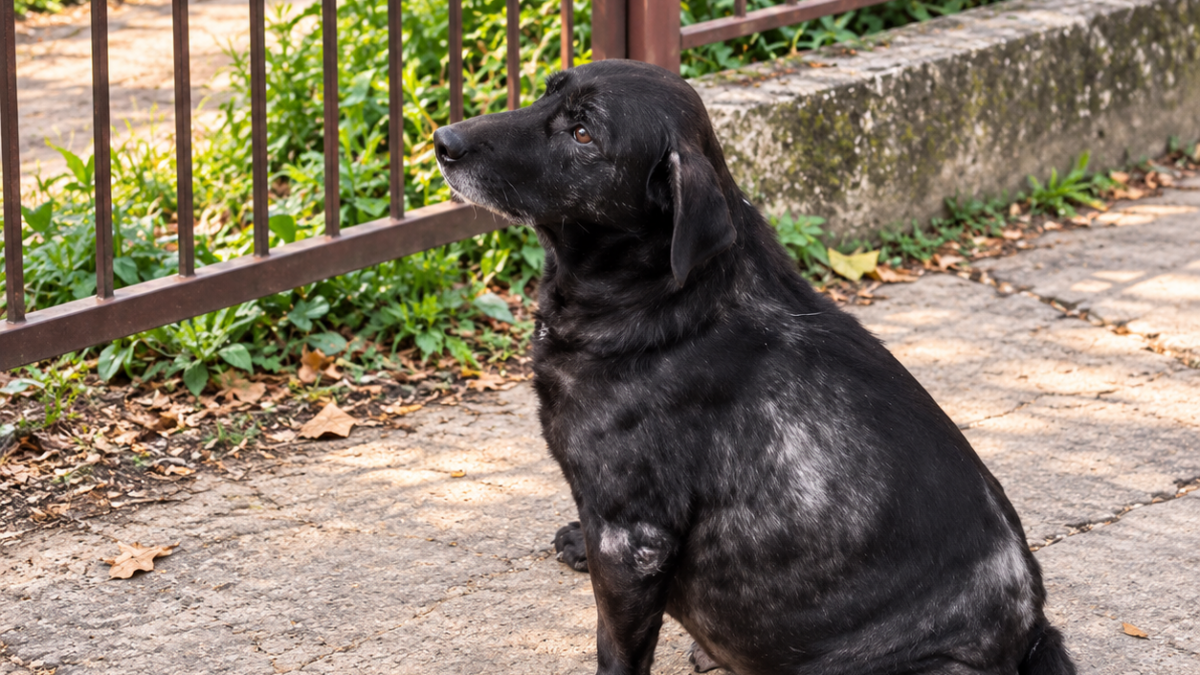
PART 2
I will remember that paw for the rest of my life.
It was muddy.
Cold.
Her nails were too long.
And she was trembling hard enough that I could feel it through my fingers.
But she gave it to me anyway.
Trust from a frightened animal is never something I take casually.
Especially when every reason she had been given lately told her not to trust people at all.
“We’re getting you out of here,” I whispered.
Maria went back to the car for another blanket.
Moving Daisy wasn’t easy.
Her belly was so heavy that lifting her incorrectly could hurt her or the puppies.
I slid one arm beneath her chest while Maria supported her rear.
Daisy whimpered.
“I know. I’m sorry.”
Outside, the rain hit us immediately.
Daisy turned her head toward the street.
Toward the house with the locked gate.
I followed her gaze.
It was maybe two hundred yards away.
A blue pickup sat in the driveway.
Someone was home.
For one moment I wondered whether Daisy would try to go back.
She didn’t.
She lowered her head against my chest.
That was the moment I stopped thinking about her owner as someone who had made a poor decision.
There are mistakes.
And then there are choices.
Leaving a heavily pregnant dog outdoors for a week, knowing she was waiting at your gate, wasn’t an accident.
It was a choice.
We placed Daisy carefully into the back of my SUV.
Maria climbed in beside her.
I called our veterinarian while pulling away.
“Dr. Patel, it’s Claire.”
“What happened?”
“Pregnant dog. Probably close to labor. Maybe active labor.”
“How close?”
“Very.”
“Any discharge?”
“Not that I can see.”
“Temperature?”
“Don’t have one.”
“Bring her now.”
“We’re ten minutes away.”
“I’m ready.”
Daisy panted the entire drive.
At every stoplight, Maria stroked her head.
“You’re okay,” she whispered. “You’re okay.”
I didn’t say it out loud, but I wasn’t sure.
Pregnancy is not automatically safe for dogs.
Especially if the mother has been malnourished, exposed to cold rain, stressed, or denied veterinary care.
We didn’t know Daisy’s age.
We didn’t know whether she had given birth before.
We didn’t know how many puppies she was carrying.
We didn’t know whether any were positioned incorrectly.
We didn’t know if she had eaten enough during pregnancy.
We didn’t know anything.
What we did know was that she had chosen a wet abandoned house because it was the safest place available to her.
That thought made me furious.
At the clinic, Dr. Patel and two technicians met us at the door.
Daisy was moved into an examination room.
Her temperature was slightly low.
She was dehydrated.
Her gums were pale but not dangerously so.
And yes—
she was in early labor.
Dr. Patel examined her carefully.
“She has a lot of puppies.”
“How many?” I asked.
“I’d like an X-ray.”
Daisy looked nervous when the staff moved around her.
But she never snapped.
Never growled.
Never tried to escape.
She simply watched us with those tired brown eyes.
The X-ray appeared on the screen.
I leaned closer.
One skull.
Two.
Three.
Four.
I lost count.
Dr. Patel pointed.
“Ten.”
Maria gasped.
“Ten puppies?”
“At least ten visible.”
I looked at Daisy.
“You’ve got ten babies in there?”
Her tail tapped the table once.
Dr. Patel checked the fetal heart rates.
“So far, they look good.”
I finally breathed.
“Does she need surgery?”
“Not necessarily. She’s contracting, and her pelvis looks adequate. We’ll monitor closely.”
We moved Daisy into a quiet maternity room.
Fresh blankets.
Heat.
Water.
Food.
For the first time in a week, she was dry.
That should not have felt like a miracle.
But it did.
### 1
For the next three hours, nothing happened.
Daisy paced.
Nested.
Lay down.
Stood again.
Panted.
Scratched at the blankets.
Every few minutes, she looked toward the door.
At first, I thought she wanted to leave.
Then I realized she was watching whenever I stepped away.
So I stayed.
Around 6:40 that evening, I sat on the floor beside her.
“You picked a terrible night for this,” I told her.
She rested her head on my thigh.
“I had dinner plans.”
Her tail moved.
“Very important dinner plans.”
Maria, sitting in the corner, laughed.
“You were eating leftover pasta.”
“That was confidential.”
Daisy’s body suddenly stiffened.
I stopped joking.
A stronger contraction moved through her.
Then another.
Dr. Patel entered quietly.
“This may be it.”
Daisy began pushing.
Instinct took over.
She turned in circles twice, lay on her side, then sat up again.
I could see fear in her face.
“It’s okay,” I whispered.
Ten minutes later, the first puppy appeared.
Tiny.
Wet.
Dark brown.
For one horrifying second, there was no movement.
Then Daisy spun around.
She tore open the sac.
Licked the puppy furiously.
A squeak filled the room.
Maria started crying.
I almost did too.
“That’s one,” Dr. Patel said.
Daisy kept licking.
The little puppy found her belly.
Twenty-two minutes later, another was born.
Tan female.
Healthy.
Then a black male.
Then another tan puppy.
The room became a rhythm.
Contraction.
Push.
Puppy.
Clean.
Check.
Nurse.
Wait.
At some point I stopped looking at the clock.
Daisy knew what to do.
Whatever else had been taken from her, instinct remained.
Over almost two hours, she delivered all ten.
Ten living puppies.
No emergency C-section.
No stillbirths.
No severe complications.
By the end, Daisy looked exhausted.
Her head rested flat against the blanket.
Ten newborn bodies pressed around her.
Some were tan.
Some black.
Two had white markings across their chests.
One tiny female had a white stripe down her nose.
I counted them twice.
Then a third time.
“Ten,” Maria whispered.
“Ten.”
Dr. Patel smiled.
“She’s done.”
I looked at Daisy.
She had been lying in a wet abandoned house only hours earlier.
Now her puppies were warm.
Breathing.
Nursing.
Alive.
I should have felt nothing but relief.
Instead, anger slipped beneath it.
Because they had come so close to being born on wet carpet beneath a leaking roof.
And somewhere just a few streets away, the person who had owned Daisy was sitting inside a dry house.
### 2
The first night was harder than the birth.
Daisy had very little milk.
That can happen after stress, poor nutrition, dehydration, or difficult pregnancy.
Ten puppies made the problem worse.
Ten tiny mouths searched for food.
They crawled over one another.
Cried.
Fought for the best position.
Daisy looked toward us helplessly.
Dr. Patel checked her again.
“No mastitis. No obvious infection.”
“So why isn’t she producing enough?”
“Her body has been under enormous stress.”
The phrase sounded clinical.
I knew what it meant.
A week sleeping outside.
Rain.
Fear.
Hunger.
Pregnancy.
Rejection.
Stress wasn’t an abstract word for Daisy.
It had a face.
A gate.
A locked door.
We began supplemental feeding.
Every two hours.
There are few things less glamorous than bottle-feeding ten newborn puppies at 3:00 a.m.
They don’t politely wait.
They crawl.
Scream.
Pee.
Fall asleep halfway through feeding.
Wake up immediately when placed down.
One little black male screamed as though we had kidnapped him every time the bottle left his mouth.
Maria nicknamed him Diesel.
The name stuck.
The smallest female—the one with the white stripe—became Hope.
I resisted naming the rest.
“We’re rescuers,” I told Maria. “Not a naming committee.”
By sunrise, every puppy had a name.
Diesel.
Hope.
Buddy.
Rosie.
Max.
Penny.
Scout.
Mabel.
Tucker.
And Blue.
I blamed sleep deprivation.
Daisy ate three bowls of high-calorie food.
Then a fourth.
By the second day, her milk production improved.
By the third, the puppies were nursing more effectively.
By the fourth, we were supplementing less.
Every small improvement felt enormous.
I posted a private update to our rescue volunteers:
**Mama stable. 10/10 puppies thriving.**
The message received more heart emojis than any medical update probably deserved.
But Daisy had already become special to everyone who met her.
She wasn’t dramatic.
She didn’t demand attention.
She didn’t bark much.
She simply wanted to stay near her puppies.
If one cried, she checked it.
If we picked one up, she watched.
If I sat near the bed, she rested her chin on my knee.
The first week, she barely slept deeply.
Every sound woke her.
I wondered whether she had learned not to relax outside that gate.
Maybe she had spent nights listening for the door.
Listening for footsteps.
Waiting for the person she trusted to change his mind.
That thought bothered me more than I wanted to admit.
### 3
Three days after the birth, I returned to the neighborhood.
I needed information.
Animal control had opened a case after we reported Daisy’s condition.
But there was a problem.
Daisy’s former owner, a man named Rick Dalton, claimed she wasn’t his.
“She was a stray,” he told Officer Martinez.
Neighbors said otherwise.
Maria had photographs.
One showed Daisy in Dalton’s backyard six months earlier.
Another showed him walking her on a leash.
A teenager across the street had a video of Daisy riding in the passenger seat of his truck.
He had apparently called her his dog plenty of times when she was healthy.
Now?
Stray.
Convenient.
Officer Martinez asked me to help collect statements.
Maria walked with me.
The first neighbor was Mr. Harris, a retired mechanic.
He didn’t hesitate.
“That was Rick’s dog.”
“How long?”
“Two years, maybe more.”
“Did you see him put her outside?”
Mr. Harris scratched his jaw.
“I saw him chase her out of the yard.”
My pen stopped.
“When?”
“Last week.”
“How?”
“He opened the gate and yelled at her.”
“Did he hit her?”
“Didn’t see that.”
“What did he say?”
Mr. Harris looked toward Dalton’s house.
Then back at me.
“Get out. Go somewhere else. I don’t want those damn puppies.”
I wrote it down word for word.
The second neighbor had seen Daisy sleeping beside the gate.
The third had brought her water.
The fourth said Dalton sprayed Daisy with a garden hose when she tried to enter his yard.
That one made me put the pen down.
“He sprayed a pregnant dog?”
“She wouldn’t leave.”
I looked toward the house.
Blue pickup.
Clean porch.
Dry garage.
It was all so ordinary.
That’s what bothered me.
Cruelty doesn’t always happen in dark alleys.
Sometimes it happens in broad daylight on a quiet street while someone waters the lawn.
Maria touched my arm.
“Don’t go over there.”
“I wasn’t going to.”
“You were looking like you were.”
“I just want to ask him one question.”
“No.”
“What question?”
She narrowed her eyes.
“Claire.”
I sighed.
“Fine.”
She was right.
Confrontation would help nobody.
Evidence would.
So we collected it.
Photographs.
Videos.
Statements.
Dates.
Descriptions.
The neighbors had been watching Daisy wait for a week.
Now, for once, their watching mattered.
### 4
The puppies doubled in size faster than seemed possible.
By day ten, their eyes began opening.
Hope’s opened first.
Not fully.
Just two tiny dark slits.
I sent Maria a photo.
She responded:
**She looks judgmental.**
She did.
Diesel remained the loudest.
Tucker slept upside down.
Rosie somehow always ended up beneath Daisy’s front leg.
Blue crawled away from the pile and then complained about being alone.
Daisy gained weight.
Her ribs became less visible.
Her coat improved.
Most importantly, her expression changed.
The first days, every unexpected sound made her raise her head sharply.
By the second week, she began sleeping deeply.
Sometimes on her back.
That might sound unimportant.
It wasn’t.
An animal showing its stomach while asleep is an animal beginning to believe it is safe.
I saw it one afternoon while changing bedding.
Daisy was sprawled beneath the heating lamp, all four paws loose, ten puppies scattered across her like fallen toys.
I took a picture.
Then I sat there longer than necessary.
“You finally believe us, don’t you?” I whispered.
Her eyes stayed closed.
Her tail thumped twice.
### 5
The first official notice came two weeks later.
Animal control had cited Dalton for abandonment and failure to provide necessary care.
I expected him to ignore it.
Instead, he became angry.
Very angry.
He called the shelter.
I wasn’t there when it happened.
Our director, Janice, was.
According to her, Dalton began by saying:
“You people stole my dog.”
Janice had the patience of a saint.
“Mr. Dalton, Daisy was reported abandoned and was found in an unsafe vacant structure while heavily pregnant.”
“She wandered off.”
“Multiple witnesses report otherwise.”
“They’re lying.”
“You told the responding officer she wasn’t your dog.”
Pause.
Then:
“I was mad.”
Janice wrote down every word.
Dalton demanded to know where Daisy was.
Janice refused to disclose the foster location.
Then he asked about the puppies.
“How many?”
Janice hesitated.
“Why?”
“Because they’re mine.”
That was interesting.
Daisy wasn’t his when animal control asked.
But the puppies were.
Janice told him the animals remained under rescue and legal custody pending the case.
He hung up.
I thought that would be the end of it.
It wasn’t.
Three days later, Dalton posted an advertisement online.
**Purebred shepherd mix puppies available soon. Taking deposits. Ten available.**
Maria sent me the screenshot.
I stared at it.
Ten.
Not “maybe.”
Not “litter expected.”
Ten available.
He had never seen them.
Had never paid a vet bill.
Had never fed them.
Had never warmed them.
Had never sat awake beside Daisy while she pushed them into the world.
But apparently he knew enough to sell them.
The price?
Four hundred dollars each.
Four thousand dollars total.
I forwarded the screenshot to Officer Martinez.
His response was immediate.
**Do not contact him. Save everything.**
We did.
### 6
At three weeks old, the puppies started walking.
“Walking” is a generous word.
They moved like drunken potatoes.
Hope took three steps and fell into the water dish.
Diesel tried to climb over Daisy’s leg and rolled backward.
Buddy walked directly into a wall.
I laughed more during that week than I had in months.
Daisy began playing too.
At first, she simply watched.
Then one evening, Scout grabbed her ear.
Daisy froze.
Scout tugged.
Daisy looked at me.
Her expression seemed to say:
**Are you seeing this disrespect?**
I laughed.
Then Daisy gently nudged him over.
Scout came back.
She nudged him again.
Within seconds, all ten puppies joined.
Daisy stood in the middle of them, tail wagging wildly.
That was the first time I saw her look young.
Until then, motherhood and survival had made her seem older.
But as she bounced around those puppies, she looked like a dog who remembered she was allowed to be happy too.
Then my phone rang.
Officer Martinez.
“We’ve got a problem.”
My smile disappeared.
“What kind?”
“Dalton filed a property claim.”
“For Daisy?”
“For Daisy and the litter.”
I looked at the puppies.
“What does that mean?”
“He’s claiming the rescue unlawfully retained his animals.”
“You’re joking.”
“No.”
“He abandoned her.”
“He says she escaped.”
“He told you she wasn’t his dog.”
“I remember.”
“He advertised the puppies.”
“I have the screenshot.”
“So what happens?”
“Probably nothing immediately. But don’t release any of them until we sort it out.”
I sat down.
“They were supposed to start taking adoption applications next week.”
“I know.”
“Can he get them back?”
Martinez was quiet.
“I don’t think so.”
“That isn’t what I asked.”
“Legally, ownership cases can become messy.”
I looked at Daisy.
She was licking Hope’s face.
“What if he says he changed his mind?”
“That doesn’t erase abandonment.”
“But?”
“But we need the evidence documented properly.”
There it was again.
Evidence.
Not anger.
Not outrage.
Evidence.
So we prepared.
### 7
Dalton’s claim created a strange situation.
People wanted to adopt the puppies.
We couldn’t finalize anything.
Applications piled up.
Dozens.
Then hundreds after a local television station learned about Daisy’s rescue.
A reporter named Jamie called me.
“I’d like to interview you.”
“I don’t want this turned into circus content.”
“I understand.”
“No dramatic music.”
She laughed.
“I can’t promise what the editor does.”
“No showing my home.”
“Fine.”
“No attacking Dalton publicly.”
That surprised her.
“You don’t want to criticize him?”
“I want the facts to speak.”
That was the lesson rescue had taught me.
Public anger burns quickly.
Documentation lasts.
The story aired on a Tuesday evening.
They showed Daisy’s intake picture.
Wet fur.
Huge belly.
Exhausted eyes.
Then they showed her three weeks later.
Healthy.
Surrounded by puppies.
The segment ended with one sentence:
**The rescue says ownership is currently being disputed by the man neighbors identify as Daisy’s former owner.**
They never said his name.
They didn’t need to.
The neighborhood knew.
Dalton apparently hated that.
The next morning, he called the station demanding a retraction.
Then he called the rescue.
Then animal control.
Then me.
I don’t know how he got my number.
Maybe from an old public rescue post.
Maybe someone gave it to him.
I answered because I didn’t recognize the number.
“Hello?”
“Is this Claire?”
“Yes.”
“This is Rick Dalton.”
My grip tightened.
“Why are you calling me?”
“You have my dog.”
“Any communication needs to go through animal control or the rescue.”
“I just want to talk.”
“I don’t.”
“You’ve been telling people I abandoned her.”
“I’ve been telling investigators what I found.”
“She ran away.”
“Then discuss that with Officer Martinez.”
“You think you’re some kind of hero?”
I looked toward Daisy.
She was sleeping.
“No.”
“You stole ten puppies from me.”
“Goodbye, Mr. Dalton.”
“I know where your rescue works.”
That stopped me.
“What did you say?”
Silence.
Then:
“I said I know where the shelter is.”
His tone had changed.
Calmer.
Too calm.
I wrote the exact words down.
“Do not contact me again.”
I hung up.
Then I called Martinez.
### 8
The call became part of the case.
So did the online advertisement.
So did neighbor statements.
So did photographs.
So did Dalton’s conflicting claims.
But the strongest evidence arrived from someone none of us expected.
His former girlfriend.
Her name was Melissa.
She contacted the rescue after seeing the television story.
“I lived with Rick when he got Daisy,” she told me.
We met at the animal control office.
Melissa looked nervous.
She kept twisting the strap of her purse.
“I’m not trying to get involved in drama.”
“I understand.”
“But I saw that dog on TV.”
“What can you tell us?”
Melissa opened her phone.
Photographs.
Daisy as a younger dog.
Daisy sleeping on a couch.
Daisy wearing a red collar.
Daisy beside Dalton.
Then she showed us messages.
One from Dalton, sent months earlier.
**Need to find a male for Daisy. Puppies could sell easy.**
Another:
**If she has a big litter, that’s decent money.**
Another, sent while Daisy was pregnant:
**Didn’t know taking care of a pregnant dog would be this annoying.**
My stomach tightened.
Then one from the week before we found Daisy.
**Put her outside. She keeps scratching everything. If she wants back in she’ll learn.**
Officer Martinez leaned forward.
“Can we take copies of these?”
Melissa nodded.
“There are more.”
The next message was worse.
**She keeps coming back to the gate. Stupid dog.**
Then:
**Might just let her go. I’m not paying vet bills for ten mutts.**
The room became very quiet.
There it was.
Intent.
Not an accident.
Not an escape.
Not confusion.
A decision.
I looked at Melissa.
“Why did you keep these?”
She shrugged.
“I don’t delete messages.”
Sometimes justice depends on very ordinary habits.
### 9
Dalton’s property claim collapsed quickly after that.
But he wasn’t finished.
His attorney argued that even if Daisy had been neglected, the puppies were valuable property he still owned because they were born from his dog.
That argument made Janice furious.
“They’re not furniture.”
Legally, animals often occupy uncomfortable categories between living beings and property rights.
But there were other laws.
Abandonment.
Neglect.
Forfeiture.
Custody transfers.
The county filed for permanent forfeiture.
A hearing was scheduled.
I attended.
Daisy didn’t.
She was home with her puppies.
Dalton sat across the room wearing a clean button-down shirt.
It was strange seeing him in person.
After everything, I had imagined someone monstrous.
He looked ordinary.
That disturbed me more.
His attorney argued first.
“Mr. Dalton acknowledges that the dog left his property, but denies intentionally abandoning her.”
Officer Martinez testified.
Then Maria.
Then Mr. Harris.
Then Melissa.
Dalton’s messages were entered as evidence.
His attorney objected.
The judge allowed them.
Then the advertisement appeared.
**TEN PUPPIES AVAILABLE. $400 EACH.**
The judge looked toward Dalton.
“When was this advertisement posted?”
“April 17.”
“And when did Mr. Dalton first assert ownership of the puppies?”
Officer Martinez checked his records.
“April 16.”
The judge turned.
“When did he deny ownership of Daisy?”
“March 29.”
There was a pause.
“So on March 29, the dog was not his.”
“Yes, Your Honor.”
“But after she survived childbirth and produced ten healthy puppies, she and those puppies became his property again?”
Dalton’s attorney stood.
“Your Honor—”
The judge raised a hand.
“I am asking about the timeline.”
Nobody answered.
I looked at Dalton.
For the first time, his confidence slipped.
Not dramatically.
Just enough.
And I realized something.
He had expected the system to be complicated enough that everyone would eventually get tired.
He hadn’t expected every careless thing he’d said to become part of a timeline.
The judge ruled that Daisy and her puppies would remain in protective custody pending final resolution.
Dalton did not get them back.
But the case continued.
### 10
Meanwhile, the puppies became actual dogs.
At five weeks, they discovered running.
This was disastrous.
Ten puppies running simultaneously is not movement.
It is weather.
They exploded across the foster room.
Under chairs.
Into boxes.
Over each other.
Diesel learned to bark.
Unfortunately, he enjoyed practicing.
Hope became obsessed with shoelaces.
Tucker escaped the puppy pen twice.
The second time, I found him asleep inside a laundry basket.
Daisy watched everything with the patience of someone who had accepted that her children were idiots.
She was becoming less interested in nursing and more interested in playing.
Her body was finally hers again.
One afternoon, I opened the back door to the fenced rescue yard.
Daisy hesitated.
Open gates still made her nervous.
She looked at me.
“It’s okay.”
She stepped outside.
Sunlight hit her coat.
For several seconds, she stood still.
Then she ran.
Not away.
Just ran.
Across the grass.
Around the tree.
Back toward me.
Then away again.
Her ears flew.
Her mouth opened into what looked exactly like a smile.
I had never seen Daisy move that fast.
Maria stood beside me.
“She looks different.”
“She is different.”
“No.”
Maria shook her head.
“She looks like herself.”
That sentence got me.
Because she was right.
We hadn’t created a new Daisy.
We had simply given the old one enough safety to return.
### 11
At seven weeks, the puppies were cleared for adoption once the court released them.
Applications were already waiting.
We screened carefully.
Very carefully.
Maybe too carefully.
I rejected one family because they planned to keep the dog outside permanently.
Another because they wanted an unaltered female for “just one litter.”
No.
Not again.
Hope went to a pediatric nurse with two older children.
Diesel went to a firefighter who somehow loved his noise.
Rosie and Mabel were adopted together.
Buddy went to an older couple.
Max to a young married pair who had recently lost their senior dog.
Scout went to a woman with three acres and a calm Labrador.
Tucker was adopted by a college professor who promised to puppy-proof every laundry basket.
Blue went to Maria’s sister.
Penny went to a veterinary technician.
One by one, they left.
Daisy watched each departure.
That worried me.
Would she think we were taking them away from her?
But motherhood changes naturally.
By then, she spent more time seeking human affection than lying with the puppies.
After Hope left, Daisy sniffed the empty pen.
Then she walked over to me and put her head beneath my hand.
“You did it,” I whispered.
She leaned closer.
“All ten.”
Not one had died.
Not one had been lost.
From a wet abandoned house to ten homes.
That should have been the ending.
But Daisy still needed one.
### 12
Applications came for her too.
Fewer than for the puppies.
That’s common.
Everybody loves babies.
Adult mothers are often overlooked after the cute part ends.
One family met her and said she was “too quiet.”
Another wanted a dog who would run five miles every morning.
Another asked whether she could have puppies again.
I ended that meeting immediately.
Weeks passed.
Daisy stayed with me.
At night, she slept on a bed beside my desk.
Sometimes I caught her staring at the front door.
I wondered whether she remembered Dalton’s house.
Probably.
Dogs remember places.
Smells.
Routines.
Maybe rejection too.
Then one Saturday, a man named Tom Avery arrived.
He was fifty-eight.
Widowed.
Retired from the postal service.
He lived alone in a small house with a fenced backyard.
His dog of fourteen years had died the previous winter.
He sat on the floor when Daisy entered.
Didn’t call her.
Didn’t pat his knees.
Didn’t invade her space.
He simply sat.
Daisy looked at him.
Then at me.
Then back at him.
Tom smiled.
“Hi.”
Daisy took one step.
Then another.
She sniffed his shoe.
He didn’t reach.
Five minutes passed.
Then Daisy sat beside him.
Tom looked at me.
“Is this good?”
I smiled.
“Yes.”
He slowly placed one hand against her shoulder.
Daisy leaned into him.
Not dramatically.
No movie moment.
No leap into his arms.
She just leaned.
For Daisy, that was enough.
Tom visited three more times.
On the fourth, I asked:
“Are you ready?”
He looked at Daisy.
“I’ve been ready since the first day. I was waiting for her.”
That was the right answer.
### 13
Before the adoption could be finalized, the county held Dalton’s sentencing hearing.
The abandonment case had expanded after investigators reviewed evidence.
He eventually pleaded to animal cruelty-related charges and violations for failure to provide care.
There would be fines.
Probation.
Restrictions on animal ownership.
Mandatory payment toward Daisy’s veterinary expenses.
Not prison.
Some people online were furious about that.
I understood.
But I had learned something over the years.
Justice is rarely cinematic.
It doesn’t always end with handcuffs.
Sometimes it’s quieter.
Sometimes it’s a court order preventing someone from owning another dog.
Sometimes it’s thousands of dollars in restitution.
Sometimes it’s a public record.
Sometimes it’s losing the thing you planned to profit from.
And sometimes it’s standing in a courtroom while every lie you’ve told is read back to you.
Dalton spoke before sentencing.
He said he had been overwhelmed.
He said Daisy had become difficult.
He said he hadn’t understood how close she was to giving birth.
I couldn’t believe that.
Nobody could look at Daisy that week and fail to understand.
Her belly nearly touched the ground.
But then he said something that made the entire courtroom go quiet.
“I figured she’d find somewhere.”
That was his explanation.
I figured she’d find somewhere.
And she had.
A ruined house.
A soaked carpet.
A leaking roof.
That was “somewhere.”
The judge looked at him for a long moment.
“She was a domesticated animal dependent on you for shelter.”
Dalton said nothing.
“You expelled a heavily pregnant dog from the property where she had been living and repeatedly refused her return.”
His shoulders tightened.
“The fact that strangers eventually rescued her does not reduce your responsibility.”
I remember those words exactly.
Because they mattered.
Rescue does not erase cruelty.
Survival does not excuse abandonment.
A happy ending doesn’t make what happened acceptable.
Dalton received probation, fines, restitution, mandatory animal welfare education, and a multi-year prohibition on owning or breeding dogs without court approval.
His planned puppy money?
Gone.
Instead, he was ordered to help pay the medical and rescue costs for Daisy and her ten puppies.
The amount was considerably more than he would have made selling them.
Maria leaned toward me when the total was read.
“Four hundred dollars each, huh?”
I almost laughed.
Not because suffering was funny.
Because there was something deeply satisfying about the mathematics.
Dalton had looked at ten unborn puppies and seen profit.
In the end, every one of them cost him money.
### 14
Outside the courthouse, Dalton approached me.
Officer Martinez immediately moved closer.
Dalton stopped several feet away.
He looked tired.
Not angry exactly.
Just bitter.
“Hope you’re happy,” he said.
I had heard versions of that line before.
People imagine rescuers want victory.
We don’t.
We want there to have been no suffering in the first place.
“I would have been happier if Daisy had never needed us,” I said.
He looked away.
“You people made this bigger than it was.”
“No.”
His eyes returned to mine.
“You could’ve just given me the dog.”
“Why?”
“She was mine.”
That word.
Mine.
As though ownership meant entitlement without obligation.
I thought about Daisy sitting outside his gate.
Rain running down her back.
Waiting.
“Then you should’ve opened the gate.”
He said nothing.
I continued.
“She waited for you.”
His jaw tightened.
“For seven days.”
Still nothing.
“She kept coming back because she thought that was her home.”
“I told you, I was overwhelmed.”
“So was she.”
He looked irritated.
“You think you’re better than everybody because you rescue dogs.”
“No.”
I shook my head.
“But I know one thing you apparently didn’t.”
“What?”
“When an animal depends on you, you don’t get to stop caring just because caring becomes inconvenient.”
Officer Martinez stepped slightly closer.
Dalton looked at him.
Then at me.
Finally, he walked away.
That was the last time I ever saw him.
### 15
Daisy went home with Tom three days later.
I packed her things.
Favorite blanket.
Medication records.
Food.
A stuffed duck she had stolen from the puppy room.
Tom carried the bag.
Daisy stood beside my car.
For a moment, I couldn’t move.
This is the part of rescue people misunderstand.
They say:
“How can you give them away?”
The answer is:
Badly.
You give them away badly.
You cry.
You worry.
You question every decision.
Then you do it anyway because keeping every animal would eventually mean you could save none.
I knelt in front of Daisy.
“You know this is good, right?”
She licked my chin.
“That is not an answer.”
She wagged.
Tom looked away politely while I cried.
“I’ll send pictures,” he promised.
“You better.”
“Every day if you want.”
“I will absolutely hold you to that.”
Daisy climbed into his car willingly.
That helped.
Tom opened the rear window halfway.
I reached through.
Daisy pressed her nose against my fingers.
Then they drove away.
I stood in the parking lot long after the car disappeared.
That night, my house felt strangely quiet.
No puppies.
No Daisy.
No midnight feedings.
No barking.
No paws against the floor.
I thought I would enjoy the silence.
I hated it.
At 8:17 p.m., my phone buzzed.
Tom.
A photograph.
Daisy asleep on his couch.
On her back.
Four paws in the air.
Underneath he wrote:
**I think she’s comfortable.**
I cried harder than I had when she left.
### 16
Three months later, Tom invited us to Daisy’s “new birthday.”
He didn’t know her actual birth date.
So he chose the day she was rescued.
Maria came.
Dr. Patel came.
Officer Martinez stopped by after his shift.
Several puppy adopters came too.
Not all ten.
But six.
Hope arrived first.
Daisy sniffed her intensely.
Hope’s tail exploded into motion.
Then Diesel came barreling across the yard and nearly knocked over a chair.
“He’s still loud,” I said.
His adopter sighed.
“He has discovered delivery trucks.”
Blue arrived with Maria’s sister.
Rosie and Mabel came together.
Scout arrived last.
Daisy stood in the center of Tom’s backyard while six nearly grown puppies surrounded her.
For one second, everything stopped.
Then chaos.
They chased.
Wrestled.
Rolled.
Daisy tried to keep up.
Tom laughed so hard he had to sit down.
I watched from beside the fence.
The scene looked nothing like the maternity room.
Nothing like the abandoned house.
Nothing like the locked gate.
Sunlight.
Green grass.
Bowls of water.
People laughing.
Dogs running.
Safe.
I took a picture.
Later, I placed it beside the photograph Maria had taken the day we found Daisy.
In the first, she was curled on wet carpet beneath a broken window.
In the second, she stood in the sun surrounded by dogs she had once carried inside her.
Same dog.
Different world.
### 17
A year passed.
Then another.
I stayed in touch with almost every adopter.
Hope became inseparable from the nurse’s youngest son.
Diesel learned enough obedience to become a surprisingly good hiking dog.
Tucker still slept in laundry baskets.
Rosie and Mabel remained attached at the hip.
Blue grew enormous.
Scout loved ponds.
Penny’s veterinary technician owner occasionally brought her to work.
Buddy became famous in his neighborhood for carrying the newspaper from the driveway.
Max slept beneath a crib after his family had their first baby.
Ten puppies.
Ten stories.
Not one belonged to the future Dalton had imagined for them.
Daisy’s story was even simpler.
She lived.
Really lived.
Tom took her walking every morning.
She slept in his bed.
She gained a healthy amount of weight.
She stopped reacting nervously to gates.
She learned that closed doors didn’t necessarily mean rejection.
Sometimes Tom sent videos.
Daisy stealing toast.
Daisy snoring.
Daisy refusing to go outside in light rain.
That one made me laugh.
The dog who had once spent nights soaked outside now stood at Tom’s open back door, saw drizzle, and backed away dramatically.
“She has standards now,” Tom wrote.
Good.
She deserved them.
### 18
One spring afternoon, almost exactly two years after we rescued her, I visited Tom.
Daisy met me at the driveway.
She recognized my car before I even opened the door.
Her whole body started wagging.
I knelt.
She crashed into me.
“Hi, mama.”
She licked my face.
Tom stepped onto the porch.
“She does that every time she sees your car.”
“I thought I was special.”
“You are. She doesn’t lick the mailman’s ears.”
We sat outside.
Daisy lay between us.
Tom scratched her neck.
“You know,” he said, “she still does one strange thing.”
“What?”
“Every night around nine, she goes to the front window and sits there.”
I looked at Daisy.
“For how long?”
“Maybe five minutes.”
“Waiting?”
“I don’t know.”
Then she gets up and comes to bed.”
I wondered whether some part of her remembered waiting at a gate.
Maybe she always would.
Recovery isn’t deletion.
Animals can heal and still carry echoes.
People do too.
I reached down.
Daisy rested her chin on my knee.
Tom said quietly:
“I needed her.”
I looked at him.
“After my wife died, this house…”
He stopped.
I understood.
“Too quiet?”
He nodded.
“She needed a home. I needed something to come home to.”
Daisy sighed.
Tom smiled.
“Worked out pretty well.”
It had.
### 19
Years in rescue taught me not to romanticize suffering.
I don’t believe Daisy was abandoned “for a reason.”
I don’t believe she needed to suffer so she could meet Tom.
I don’t believe everything happens because the universe has a plan.
Sometimes terrible things simply happen because someone makes a terrible decision.
What matters is what people do afterward.
Maria noticed.
Neighbors fed Daisy.
Someone called.
I answered.
Dr. Patel stayed late.
Technicians worked through the night.
Fosters volunteered.
Adopters applied.
Animal control documented.
Witnesses spoke.
Melissa saved messages.
A judge listened.
Tom opened his home.
No single person saved Daisy.
A chain of people did.
That is how rescue really works.
Not miracles.
Links.
If one breaks, an animal may fall through.
That night in the abandoned house, Daisy placed one muddy paw into my hand.
But there were dozens of hands waiting behind mine.
She just didn’t know it yet.
### 20
I still drive through that neighborhood sometimes.
Not intentionally.
It’s on the way to another rescue route.
The abandoned Patterson house was demolished.
A new home stands there now.
Fresh siding.
White porch.
Children’s bicycles outside.
The first time I saw it, I pulled over.
For a moment, I could still picture that old room.
Rain dripping.
Broken window.
Wet carpet.
Daisy curled against the wall.
Pregnant.
Alone.
Waiting for labor to begin.
Then I looked at the new house.
There was nothing left of the place where we found her.
Maybe that was fitting.
Some shelters are meant to be temporary.
Some chapters deserve to disappear.
Dalton’s old house changed too.
He moved away less than a year after the case.
Maria said he complained that the neighborhood had “turned against him.”
I didn’t celebrate that.
But I didn’t feel sorry for him either.
He had spent days watching a loyal animal wait outside his gate.
The neighbors simply remembered.
Consequences don’t always arrive loudly.
Sometimes they look like people finally believing what they saw.
### 21
On Daisy’s fifth rescue anniversary, Tom organized another reunion.
This time all ten puppies came.
It took months to coordinate.
People drove from three states.
I arrived early.
Daisy was older.
Gray around the muzzle.
Still healthy.
Still beautiful.
Tom had hung a banner across the fence.
**DAISY’S FAMILY DAY**
I laughed when I saw it.
“You’ve become one of those dog people.”
He looked offended.
“I was always one of those dog people.”
Cars began arriving.
Hope.
Diesel.
Buddy.
Rosie.
Max.
Penny.
Scout.
Mabel.
Tucker.
Blue.
Ten adult dogs.
Different sizes.
Different lives.
Different personalities.
But when they stood together, I could see pieces of Daisy in almost all of them.
The ears.
The eyes.
The tan coat.
The white markings.
Daisy moved through them slowly.
Sniffing.
Wagging.
Accepting attention.
Then everyone tried to take a group picture.
It was a disaster.
Diesel wouldn’t sit.
Blue faced backward.
Tucker tried to eat the banner.
Hope sat perfectly and looked embarrassed by the rest.
Daisy eventually lay down.
The others gathered around her.
For approximately three seconds, everyone was still.
The camera clicked.
That photograph hangs in our rescue office now.
Underneath it is a small plaque.
It doesn’t mention Dalton.
Doesn’t mention court.
Doesn’t mention cruelty.
It says:
**DAISY AND HER TEN — EVERY LIFE MADE IT HOME.**
That’s the part worth remembering.
### 22
After the reunion, I stayed late.
Everyone had gone except Tom and me.
Daisy lay beneath the porch light.
I sat beside her.
“You’re famous, you know.”
She opened one eye.
“Very important dog.”
Nothing.
“Ten children. All successful.”
Her tail moved once.
“Your son Diesel still screams.”
The tail moved again.
I scratched behind her ear.
Five years earlier, I had been afraid she would give birth on wet carpet.
Now she was sleeping beside me in a fenced yard belonging to a man who treated her like family.
There is no punishment that could have satisfied me more than that.
Not Dalton’s fine.
Not his court restrictions.
Not losing his claim to the puppies.
Not paying restitution.
Those things mattered.
They protected other animals.
They created accountability.
But revenge?
If you want to call something revenge, call it this:
Daisy lived long enough to forget what hunger felt like.
Her puppies grew up without ever knowing a locked gate.
The man who thought they were worth four hundred dollars each never received a cent from them.
Instead, his money paid part of their medical care.
Every puppy went to someone who treated them as family.
Daisy ended up in a house where the door opened whenever she wanted to come inside.
That was enough for me.
More than enough.
### 23
One evening, years after the rescue, Tom called.
His voice was shaky.
My stomach tightened immediately.
“What’s wrong?”
“Nothing terrible.”
That is not a phrase anyone wants to hear.
He continued.
“Daisy’s getting older.”
I sat down.
“How old?”
“Vet thinks maybe ten or eleven now.”
“What’s happening?”
“Arthritis mostly. She’s slowing down.”
We talked for twenty minutes.
No emergency.
No crisis.
Just time.
That night I pulled up old photographs.
Daisy in the abandoned house.
Daisy nursing ten puppies.
Daisy running in the yard.
Daisy with Tom.
Daisy surrounded by adult children.
A whole life measured in images.
I realized how easily that life might have ended before we ever knew her.
What if Maria hadn’t called?
What if Daisy had delivered alone?
What if a puppy had been stuck?
What if she had hemorrhaged?
What if the temperature dropped?
What if ten newborn puppies had spent their first night on soaked carpet?
Rescue stories sometimes sound inevitable once you know the ending.
They aren’t.
They are fragile.
Timing matters.
One phone call matters.
Opening one door matters.
### 24
A few weeks later, I visited Daisy again.
She walked slowly to meet me.
Her muzzle had turned almost completely white.
I sat on the porch floor.
She lowered herself beside me.
Tom brought coffee.
“She still hates rain.”
“Smart girl.”
“She also refuses cheap treats now.”
“Standards.”
“And she stole half a hamburger last Tuesday.”
“Excellent.”
Tom smiled.
“She has no regrets.”
I rested my hand against Daisy’s side.
Her breathing was slow.
Peaceful.
No puppies kicking inside.
No contractions.
No cold rain.
Nothing to prove.
She was simply an old dog resting at home.
That ordinary scene felt like the greatest victory of all.
### 25
When people hear Daisy’s story, they often focus on the ten puppies.
Ten makes the story dramatic.
Ten healthy births.
Ten adoptions.
Ten lives saved.
But I think about the week before.
One dog.
One gate.
Seven days.
Every morning she returned.
Every night she slept nearby.
Pregnant and confused.
She could not understand property disputes.
She could not understand inconvenience.
She could not understand someone changing his mind about wanting her.
She only knew:
This is my house.
That is my person.
The door used to open.
Why doesn’t it open now?
That is the tragedy.
Not that Daisy was homeless.
That she had a home in her mind long after the human inside had stopped considering her family.
### 26
Maybe that’s why Tom’s house mattered so much.
The first night Daisy stayed with him, he told me something later.
He went outside to take out the trash.
When he returned, Daisy was sitting on the porch.
She didn’t cross the threshold.
The door was wide open.
She simply sat there.
Waiting.
Tom called her.
Nothing.
He walked back outside.
Knelt beside her.
Then he said:
“Come on, Daisy. You live here.”
She entered.
The next night, she hesitated again.
By the end of the week, she didn’t.
Months later, she pushed doors open with her nose.
Years later, she slept directly across Tom’s bedroom doorway so he had to step over her every morning.
That’s what safety did.
It didn’t teach her she was lucky.
It taught her she belonged.
### 27
The last photograph in the file I keep for Daisy was taken on Tom’s porch.
She’s lying on a thick blue bed.
Her muzzle is gray.
Her eyes are half closed.
The front door behind her is open.
Wide open.
No gate.
No one pushing her away.
No rain.
Beside her is a framed photograph from the family reunion showing all ten puppies as adults.
Tom didn’t stage it intentionally.
The frame had been sitting on a small table.
But when he sent me the picture, I stared at it for a long time.
The dog who had once waited outside one closed gate was now sleeping peacefully beside an open door.
I don’t think stories need symbols.
But sometimes life provides one anyway.
### 28
I was asked once whether I hated Dalton.
The answer surprised the person who asked.
No.
Hatred takes maintenance.
Daisy needed my energy more.
The puppies needed it.
The court case needed it.
Rescue needed it.
I didn’t need to hate him.
I needed him stopped.
There is a difference.
Anger can start action.
But documentation finishes it.
Neighbors speaking up finished it.
Melissa’s messages finished it.
Veterinary reports finished it.
The law finished it.
And Daisy living well made the rest irrelevant.
That is the kind of revenge I can live with.
Not destruction.
Not cruelty returned for cruelty.
Just a person discovering that abandoning a life doesn’t erase responsibility for it.
### 29
The rescue eventually used part of Dalton’s restitution payment to expand our maternity supplies.
We bought two heated puppy pads.
A new scale.
Emergency formula.
Whelping equipment.
Portable oxygen support.
The first mother to use those supplies was a skinny black dog named June.
She arrived pregnant the following winter.
I remember opening the box containing the heating pads.
Janice looked at the invoice.
Then at me.
“You know where part of this money came from.”
I did.
I smiled.
There was poetic justice in that too.
A man who refused to spend money caring for a pregnant dog ended up helping pay for equipment used to save other pregnant dogs.
He never intended to help anyone.
Didn’t matter.
The puppies stayed warm anyway.
### 30
Years later, Daisy’s original rescue call remains saved in my phone.
I never deleted it.
Maria’s message:
**Pregnant dog. Been sitting outside a house for almost a week. Owner won’t let her in. Rain coming tonight. Can you help?**
Five sentences.
That’s all.
No one knew what came next.
No one knew there were ten puppies.
No one knew about court.
No one knew about Dalton’s advertisement.
No one knew Tom existed.
No one knew there would someday be a backyard reunion with ten grown dogs surrounding their mother.
There was simply a dog in trouble.
And a question.
Can you help?
That’s where almost every rescue begins.
### 31
Daisy eventually became too old for big reunions.
Her puppies became middle-aged dogs themselves.
Tom kept sending updates.
Short walks.
Long naps.
Arthritis medication.
A new orthopedic bed.
Her world became smaller.
But it remained hers.
One summer morning, he sent me a photograph of Daisy lying in a patch of sunlight beside the back door.
The caption read:
**She asked to go out, saw the wet grass, changed her mind.**
I laughed.
Then I cried a little.
Because some memories become funny only after safety lasts long enough.
Rain was no longer something Daisy had to survive.
It was weather she could decline.
### 32
If I could go back to the abandoned house and speak to that frightened dog, I know what I would tell her.
Not:
Everything will be okay.
I didn’t know that yet.
Not:
Your puppies will all survive.
I couldn’t promise it.
Not:
The person who hurt you will pay.
That wasn’t guaranteed either.
I would tell her something simpler.
You don’t have to wait at that gate anymore.
Someone else is opening a door.
Maybe that’s what rescue is at its core.
Not replacing one owner with another.
Not playing hero.
Just showing an animal that the world contains more than the last person who failed them.
### 33
The final time I saw Daisy, she walked toward me slowly.
Tom had warned me she wasn’t moving much.
But when she recognized me, her tail started wagging.
I sat on the ground before she reached me.
She pressed her forehead against my chest.
Exactly the way she had leaned into me years earlier when we carried her from the abandoned house.
I wrapped my arms around her carefully.
“You did good, mama.”
Her tail moved.
“Ten babies.”
Another wag.
“All ten.”
Tom stood nearby.
His eyes were wet.
Daisy settled beside us.
We talked.
About nothing important.
Weather.
Neighbors.
Food.
Dogs.
Tom told me Daisy had recently started demanding scrambled eggs.
I accused him of spoiling her.
He said that was his legal right.
Daisy slept while we laughed.
There was no dramatic goodbye.
I’m glad.
Not every meaningful moment needs to announce itself.
Sometimes you simply leave a house believing you’ll visit again.
And you carry the memory anyway.
### 34
When Daisy eventually died, she was at home.
Tom was with her.
Her favorite blanket was beneath her.
The door was open because the weather was warm.
She had been deeply loved for years.
Tom called me afterward.
Neither of us spoke for a while.
Then he said:
“She never had to wait outside again.”
That broke me.
Not because it was sad.
Because it was true.
She never did.
### 35
We planted a small flowering tree beside the rescue building in Daisy’s memory.
Nothing elaborate.
No giant memorial.
Just a tree.
Under it, we placed a simple stone.
**DAISY
BELOVED MOTHER OF TEN
SHE FOUND HER OPEN DOOR**
Every spring, it flowers.
Sometimes new volunteers ask who Daisy was.
I tell them.
Pregnant dog.
Locked gate.
Seven days waiting.
Abandoned house.
Rain.
Ten puppies.
One extraordinary mother.
And then I tell them the part that matters most.
Not that she was abandoned.
That she was found.
Not that someone closed a gate.
That other people opened doors.
Not that her former owner saw ten puppies as money.
That ten families saw them as family.
Not that she spent one terrible week unwanted.
That she spent the rest of her life knowing exactly where she belonged.
### 36
That is the ending I choose to remember.
Not the rain.
Not the empty house.
Not Dalton.
Not court.
Daisy on Tom’s couch.
Daisy refusing wet grass.
Daisy running with her puppies.
Daisy sleeping with her belly exposed because she finally trusted the room around her.
Ten puppies growing up safe.
Ten families who sent birthday photographs.
A widower whose quiet house became noisy again.
A mother dog who stopped waiting outside doors.
And a man who once said:
“I figured she’d find somewhere.”
He was right about one thing.
She did.
She found somewhere.
Just not with him.
She found a veterinarian who stayed late.
A rescue that refused to give her back.
Neighbors who spoke when it mattered.
A court that listened.
Ten families who loved her children.
And one man named Tom who opened his front door and eventually taught her that she never had to ask permission to come home again.
In the end, Dalton lost every dollar he thought those puppies might earn him.
He paid toward their care instead.
He lost the right to decide Daisy’s future.
He lost the chance to profit from her litter.
And he had to watch ten lives he once dismissed grow into something he could never claim.
But Daisy?
Daisy lost nothing that truly mattered.
She survived.
Her ten puppies survived.
Every one of them found a home.
And the dog who once spent seven nights staring at a locked gate spent the rest of her life sleeping beside an open door.
That was enough justice for me.
More importantly—
it was finally enough peace for her.
**THE END**




