PART 2: Rangers Found Her Deep in the Woods With Her Mouth Taped Shut—Then She Led Them Beneath an Old Oak
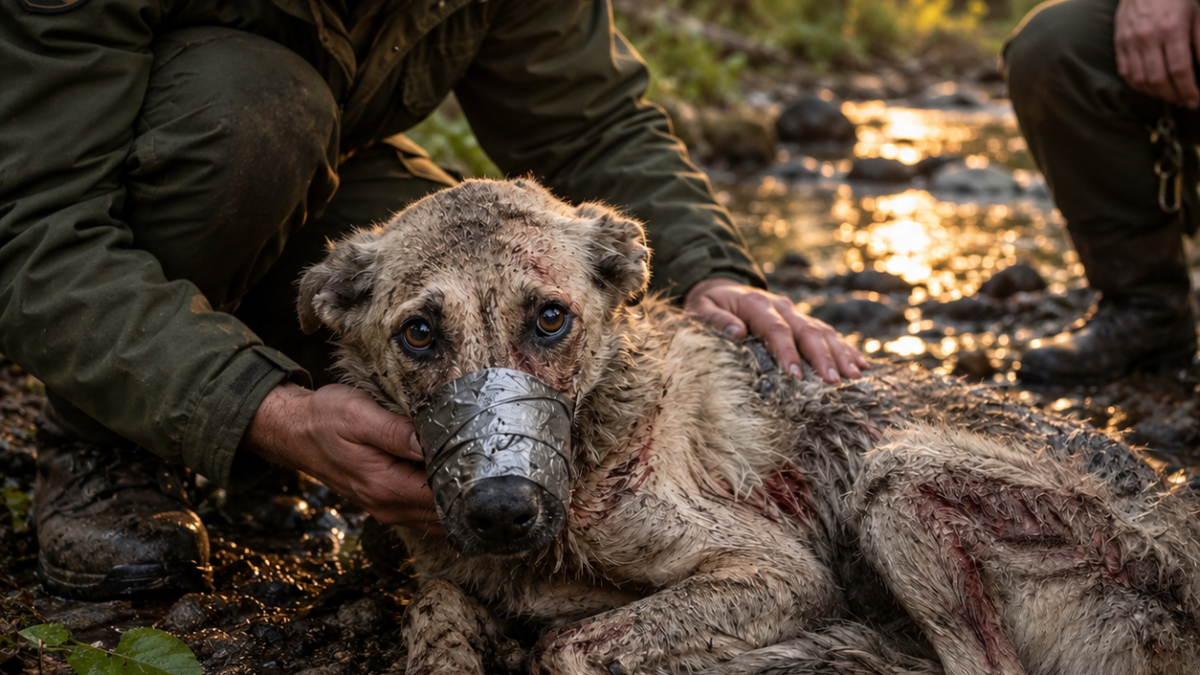
PART 2
I dropped to my knees.
The opening beneath the oak wasn’t much larger than a backpack, formed where rain had washed soil from between two massive roots. Dead leaves had gathered inside, along with grass, scraps of bark, and something pale that looked like shredded cloth.
Then I heard it.
A tiny squeak.
Not one.
Several.
“Oh, no.”
Marcus pointed his flashlight into the hollow.
Seven puppies were packed together beneath the roots.
At least, I counted seven.
They were tiny.
Maybe two weeks old.
Their eyes were only beginning to open, and every one of them was pressed against the others for warmth.
The dog beside me tried to crawl into the hollow.
That’s when I understood.
She wasn’t just a starving stray.
She was their mother.
“Marcus, call dispatch.”
He already had his radio out.
I reached toward the nearest puppy.
The mother stiffened.
I stopped.
“Okay.”
She watched my hand.
Then looked at the hollow.
Then back at me.
It was almost as though she couldn’t decide whether humans were dangerous or whether she needed us too badly to refuse.
I lowered my voice.
“We’re not taking them away from you.”
Her ears moved.
I touched the first puppy.
Warm.
Alive.
The second.
Alive.
Third.
Cold.
Very cold.
I lifted it gently.
The puppy barely moved.
“Marcus.”
He saw my face.
“How bad?”
“I don’t know.”
Dispatch answered.
Marcus gave our location and requested animal control plus emergency veterinary support.
They were at least forty minutes away.
Too long for the cold puppy.
I opened my jacket and put the little body against my chest.
The mother immediately stood.
She whimpered.
“I’m not stealing him.”
I sat beside her.
“He needs heat.”
She stared.
Then, to my surprise, she lowered herself against my leg.
Close enough that her shoulder touched mine.
That was the first voluntary contact she gave me.
## 1
We named her Willow before we even reached the veterinary hospital.
Technically, Marcus named her.
He was carrying the box containing four puppies while I carried three and supported their mother into the transport vehicle.
“Can’t keep calling her ‘the dog.’”
“We’re not keeping her.”
“I didn’t say we were.”
“Don’t name animals you’re not keeping.”
Marcus looked at her.
“Willow.”
I sighed.
“Why Willow?”
“Because we found her near the water.”
“That makes no sense.”
“She looks like a Willow.”
Unfortunately, she did.
The name stayed.
The animal-control officer who met us was Carla Ramirez, a woman I’d worked with on several wildlife-dog incidents. When she saw the duct tape in the evidence bag, her expression changed.
“Where did you find this?”
“On her.”
“All of it?”
“There was more.”
Carla looked at Willow.
Then at the puppies.
“This isn’t abandonment anymore.”
“What is it?”
“Potential animal cruelty.”
I already knew.
Hearing it out loud made it different.
At Prairie Valley Veterinary Emergency Center, Dr. Nina Harris examined Willow first.
Severe dehydration.
Malnutrition.
Soft-tissue injuries around the mouth.
Bruising along her ribs.
Infected abrasions on two legs.
Heavy parasite load.
But no broken bones.
No internal bleeding.
The puppies were younger than I’d guessed.
About twelve days.
Six were stable.
The cold one wasn’t.
He was hypothermic and weak.
Dr. Harris took him into the treatment area.
Willow tried to follow.
I had to hold her harness.
She panicked immediately.
Her eyes went wild.
“Easy.”
She twisted.
Not biting.
Just trying desperately to get after her puppy.
Dr. Harris came back.
“She can come.”
They placed Willow in a warmed kennel beside the incubator.
The moment she could smell the puppy, she calmed.
I sat on the floor outside.
Marcus leaned against the wall.
“Long day.”
“It was supposed to be trail markers.”
“Trail markers are overrated.”
Willow watched us.
Her mouth was finally free.
But she barely made a sound.
## 2
The puppy survived.
That was the first good news.
We called him Creek.
Again, Marcus.
Again, I objected.
Again, nobody cared.
By midnight, Willow had received fluids, medication, careful feeding, and treatment for the wounds around her muzzle. The seven puppies nursed beside her, all of them tucked against her body beneath warmed blankets.
I should have gone home.
Instead, I stayed.
At one point Dr. Harris sat beside me.
“She’ll probably sleep now.”
Willow was not sleeping.
Her eyes remained open.
Scanning.
Door.
Technician.
Hallway.
Me.
“She doesn’t trust anything.”
“Would you?”
No.
I wouldn’t.
Dr. Harris looked at the tape bag.
“Whoever did that expected her to die.”
The sentence sat between us.
“Why leave the puppies?”
“Maybe they didn’t know about them.”
I shook my head.
“She led us straight there. She was nursing.”
“Then maybe someone did know.”
That possibility was worse.
If whoever abandoned Willow knew about the puppies, they hadn’t abandoned one dog.
They’d abandoned eight lives.
And by taping Willow’s mouth shut, they’d made it impossible for her to eat, drink, or properly care for her litter.
It wasn’t neglect.
It was a sentence.
## 3
Carla returned to the oak the next morning with two deputies.
I went too.
The site looked different in daylight.
More obvious.
The hollow was lined with material.
Old towel pieces.
Straw.
Newspaper.
Someone had created a nest.
That mattered.
Willow hadn’t simply wandered into the forest and given birth.
Someone had prepared the spot.
Near the creek, we found tire impressions.
One large vehicle.
Another narrower set.
A cigarette butt.
Two disposable gloves.
Pieces of the same duct tape.
And something else.
A torn plastic feed bag.
Printed on the side:
**RED OAK WORKING DOGS — PERFORMANCE BREEDING & TRAINING**
I knew the name.
Everyone in the county did.
Red Oak bred German Shepherds, Belgian Malinois, and mixed working dogs.
Their owner, Calvin Mercer, marketed them to private security companies, rural property owners, and people looking for “high-drive protection dogs.”
I had never met him.
Marcus had.
“Not a fan.”
“Why?”
“Guy likes talking about dogs like they’re equipment.”
I photographed the bag.
Carla picked it up with gloves.
“Could be trash.”
“Could.”
“You know how many feed bags get reused?”
“A lot.”
“Don’t decide before the evidence.”
I nodded.
But my instincts had already started pointing.
## 4
Willow was some kind of Shepherd mix.
That didn’t prove anything.
Thousands of dogs looked like her.
No microchip.
No collar.
No tattoo.
Nothing immediately connected her to Red Oak.
Then the vet found something.
A faded scar inside her left ear.
Dr. Harris showed me.
“Looks like a removed identification tattoo.”
“Removed?”
“Possibly altered.”
The skin had been damaged.
Not recently.
Months ago.
“Can you recover it?”
“Maybe with photography.”
Animal control brought in a forensic photographer.
Under filtered light, part of the original mark became visible.
**R-17**
Carla searched Red Oak’s licensing files.
Their breeding records listed:
**Female R-17 — name: Willow.**
I stared at the page.
Marcus leaned over my shoulder.
“Your stupid name was right.”
“Your stupid name.”
“Still right.”
Willow had been registered to Red Oak Working Dogs eighteen months earlier.
Then marked:
**Transferred.**
No buyer information.
No date.
No signature.
Just transferred.
## 5
Carla called Calvin Mercer.
He answered immediately.
Yes, he’d owned a dog named Willow.
No, he didn’t own her anymore.
Sold her.
To whom?
Didn’t remember.
Cash sale.
No receipt.
Date?
Sometime last year.
Had she ever been bred?
Once.
Was she pregnant when sold?
No idea.
Did he recognize the puppies?
No.
Was Red Oak feed used widely?
Yes.
Could his truck have been near the forest?
Maybe.
Employees drove everywhere.
He said all the right things.
Calm.
Cooperative.
Vague.
Then Carla asked:
“Mr. Mercer, why was Willow’s ear identification intentionally damaged?”
Silence.
Only a second.
Then:
“Wasn’t me.”
That silence mattered.
Not legally.
Yet.
But it mattered.
## 6
The investigation would take time.
Willow didn’t care.
She was busy surviving.
Her first week in the hospital was difficult.
Her milk production was low because of starvation and dehydration, so technicians supplemented the puppies around the clock.
Willow hated bottles near her babies.
Not because she attacked.
She would simply take each puppy afterward and pull it against her chest as though checking nobody had stolen it.
The bruising faded.
Her appetite grew.
And she ate like food might vanish.
Bowl down.
Gone.
Another.
Gone.
She licked the metal until it shone.
Dr. Harris ordered smaller meals more often so she wouldn’t make herself sick.
Every time a bowl arrived, Willow’s entire body tensed.
One afternoon I sat beside her while she ate.
“You know there’s more, right?”
She looked at me.
Then returned to the food.
“You don’t believe me.”
She didn’t.
Trust takes evidence.
So did our case.
## 7
The first real witness was a former Red Oak employee named Tyler Boone.
He called animal control after a local newspaper ran a short piece about the “muzzled forest dog.”
No pictures of Willow had been published yet.
Still, Tyler knew.
“It’s R-17.”
Carla asked:
“How?”
“I know the dog.”
“What was her name?”
“Willow.”
My stomach tightened.
Tyler had worked for Mercer for three years.
He said Willow had been one of Red Oak’s breeding females.
Not primarily trained for protection.
Calm temperament.
Good mother.
Two previous litters.
“What happened?”
Tyler looked uncomfortable.
“Last litter wasn’t planned.”
“What does that mean?”
“Wrong male got to her.”
Mercer had intended to breed Willow to a registered working-line Shepherd.
Instead, another dog—a mixed-breed farm dog kept on the property—mated with her.
The puppies would have no commercial pedigree value.
“How did Mercer react?” Carla asked.
Tyler rubbed his face.
“Bad.”
“How bad?”
“He said the litter was worthless.”
There was that word.
Worthless.
I had heard it in animal cases before.
Usually right before somebody did something unforgivable.
## 8
Tyler said Willow was heavily pregnant when he quit.
Why did he quit?
“Mercer wanted me to take her somewhere.”
“Where?”
“He didn’t say.”
“What exactly did he tell you?”
Tyler looked down.
“Make the problem disappear.”
Nobody spoke.
“Did you?”
“No.”
“What did you say?”
“That I wasn’t doing it.”
“And?”
“He fired me.”
Three days later.
Tyler had assumed Mercer would surrender Willow or sell her cheaply.
Then he saw the news story.
He knew.
But testimony is one thing.
Proof is another.
We needed more.
## 9
A trail camera gave us the next piece.
The forestry department had cameras in several access corridors because of illegal dumping.
One camera caught a black pickup entering the road the night before we found Willow.
License plate blurry.
Rear bumper distinctive.
Large dent on the left.
Red Oak owned a black Ford pickup.
Same year.
Same model.
Same dent.
At 9:47 p.m., it entered.
At 10:18, it left.
Thirty-one minutes.
Enough time.
Still circumstantial.
Then another camera, farther south, captured the passenger side.
Logo faint but visible.
**RED OAK WORKING DOGS.**
Carla finally got a warrant.
## 10
Red Oak’s property looked professional from the entrance.
Clean gravel.
Large sign.
Training field.
Fenced kennels.
Website photographs had not lied exactly.
The front half was respectable.
The rear wasn’t.
Old runs.
Rusting gates.
Medical supplies with expired dates.
Incomplete records.
Three dogs with untreated skin infections.
One older female with a swollen mammary gland.
Nothing horrific enough for headlines.
Enough for citations.
Then officers found the storage shed.
Inside:
Duct tape.
The same brand.
Again, common.
Feed bags.
Expected.
Veterinary gloves.
Normal.
Then Willow’s file.
Not transferred.
No buyer.
Instead:
**R-17 — accidental breeding / remove from program.**
Below that:
**Litter due approx. 5/12.**
And underneath, handwritten:
**No resale. Dispose.**
Carla stared at the page.
I felt my jaw tighten.
“Dispose.”
She photographed it.
“Don’t touch.”
I didn’t.
I wanted to tear it in half.
## 11
Mercer changed his story.
He hadn’t sold Willow.
An employee had taken her without permission.
Which employee?
Tyler.
Tyler had been fired.
Therefore, Tyler must have dumped her.
Convenient.
Tyler had an alibi.
At 9:47 that night, he was working a shift at a warehouse eighty miles away.
Security badge records.
Cameras.
Supervisor.
Mercer’s accusation collapsed in under an hour.
Then Mercer said maybe another employee.
Who?
Couldn’t say.
His attorney arrived shortly after.
Interview over.
## 12
The puppies grew.
That became the part of my life I cared about more.
We named them all.
Yes.
Marcus again.
Creek remained Creek.
Then:
Oak.
Juniper.
Moss.
River.
Bear.
And Daisy.
Willow gained weight.
Her ribs slowly disappeared.
The wounds around her mouth healed, leaving thin lines where the tape had cut deepest.
The first time she barked, everyone in the treatment room stopped.
It wasn’t dramatic.
A delivery guy knocked.
Willow barked once.
Then looked startled by her own voice.
Marcus laughed.
“There she is.”
I did too.
It was strange how emotional one ordinary bark could be.
Someone had taken that sound from her.
Now she had it back.
## 13
Willow came home with me as a medical foster.
Temporary.
Marcus reminded me of that word every day.
“You hate cats,” I said.
“This is a dog.”
“You have two dogs.”
“Three is reasonable.”
“You live in a one-bedroom cabin.”
“Details.”
Willow chose my house because she already trusted me more than most people.
At least, that’s what Dr. Harris said.
I suspected everyone had conspired.
I prepared a quiet room.
Seven puppies.
One mother dog.
My previously clean home became chaos in four hours.
Blankets.
Puppy pads.
Formula.
Laundry.
More laundry.
Barking.
Whining.
The smell of warm milk.
Willow slept beside the puppies.
At night, I slept on the floor nearby because the first time I left the room she panicked.
She clawed at the door.
I came back.
She calmed.
Second night:
Same.
Third:
Less.
Eventually, she learned something simple.
When I left, I returned.
## 14
The case became public when Mercer was formally charged.
Animal cruelty.
Abandonment.
Evidence tampering concerns involving Willow’s ear mark.
Licensing violations.
The local community exploded.
Some defended him.
“He’s trained dogs for twenty years.”
“My dog came from Red Oak and is perfect.”
“He donates to police charities.”
Others called him a monster.
Reality, again, was harder.
People who do terrible things aren’t always terrible every second of their lives.
Mercer had produced healthy dogs.
Helped some families.
Donated.
Then faced a litter he couldn’t profit from and made a decision.
That’s why accountability matters.
A good reputation cannot cancel a cruel act.
## 15
Mercer’s attorney tried to get the tape evidence excluded.
Failed.
Tried to argue the forest site wasn’t under proper chain of custody.
Failed.
Tried to blame Tyler again.
Failed.
Then he claimed Willow had attacked livestock and Mercer had intended only to restrain her temporarily before finding another location.
Nobody explained why temporary restraint required wrapping her muzzle shut and leaving her miles from help with seven nursing puppies.
The story changed faster than evidence could.
That usually tells you something.
## 16
Then we found the recording.
Not police.
Not animal control.
Mercer’s own office camera.
Red Oak had a security system.
Most footage overwrote after thirty days.
But one clip had been downloaded automatically because motion occurred after hours near the loading area.
Mercer had emailed it to himself when checking a false alarm.
The timestamp matched the night.
Video showed:
Mercer loading Willow into the black truck.
A roll of gray duct tape on the tailgate.
A plastic crate.
A feed bag.
He was alone.
No employee.
No Tyler.
He loaded Willow.
Then drove away.
Thirty-eight minutes later, another exterior camera captured the truck returning.
Without Willow.
That was enough to destroy his alternative story.
## 17
But there was more.
Audio.
Weak.
Mostly wind.
Mercer stood beside the truck before leaving.
Willow could be heard whining in the crate.
He said:
“Quit it.”
Then:
“Nobody’s paying for a litter like this.”
Nine words.
That was the case in one sentence.
Money.
Not danger.
Not accident.
Value.
## 18
Mercer offered a plea deal before trial.
The prosecutor rejected the first one.
Accepted the second after additional animal-welfare restrictions were included.
But before sentencing, something happened that made the case personal in a new way.
Mercer came to my house.
I don’t know how he got the address.
Public ranger records, maybe.
Court documents.
Someone talking.
I was feeding the puppies when Willow suddenly froze.
Her entire body went rigid.
Then she began growling.
Low.
Different from anything I’d heard before.
I looked through the window.
Black pickup.
Mercer.
I called 911 before opening anything.
Then stepped onto the porch but stayed behind the locked screen door.
“What are you doing here?”
He raised both hands.
“Just want to talk.”
“You have an attorney.”
“So do you people.”
“Leave.”
Willow appeared behind me.
Mercer saw her.
Something changed in his face.
For half a second, I expected remorse.
Instead:
“She looks good.”
My stomach turned.
“She almost died.”
“She always was tough.”
That sentence made me colder than anger.
“Get off my property.”
“I want to know what’s happening with the pups.”
“Why?”
“They’re technically mine.”
I laughed.
Not because it was funny.
Because sometimes audacity is so large the body doesn’t know what else to do.
“You called them worthless.”
“They’re still dogs from my line.”
“Your line?”
“Willow’s registered.”
“So?”
“People are asking about them.”
There it was.
The news had made them valuable.
Adoption applications poured in.
Hundreds.
Now Mercer saw demand.
## 19
“You abandoned them.”
“I abandoned her.”
He stopped.
Too late.
I stared.
Behind me, Willow growled.
Mercer’s face changed.
“I mean—”
“I heard you.”
He stepped backward.
My doorbell camera heard him too.
Police arrived seven minutes later.
Mercer left with a warning for unlawful contact and potential witness intimidation review.
His attorney must have nearly killed him afterward.
The prosecutor certainly enjoyed the video.
## 20
At sentencing, the courtroom was full.
Too full.
News.
Rescuers.
Former customers.
Employees.
Tyler.
Marcus.
Me.
Mercer spoke.
He apologized.
At first, badly.
He blamed stress.
Business losses.
A divorce.
Rising veterinary costs.
Then the judge interrupted.
“Mr. Mercer, are you apologizing for what you did, or explaining why you believe you did it?”
Mercer went silent.
The judge waited.
Finally:
“For what I did.”
Better.
Not enough.
But better.
The sentence included probation, substantial fines and restitution, surrender of breeding licenses, prohibition from commercial breeding for a lengthy period, limitations on animal possession, mandatory inspections, and animal-welfare counseling.
The remaining dogs at Red Oak were evaluated.
Several were transferred.
Others went to approved owners.
The business closed.
## 21
Some people wanted prison.
I understood.
But I cared more about the fact that he could not simply open another breeding program the following week.
The judge said something I still remember:
“Commercial value does not determine whether an animal is entitled to humane treatment.”
That sentence should not need to be spoken in a courtroom.
But it did.
## 22
The puppies became legally available for adoption at nine weeks.
We screened carefully.
Very carefully.
Oak went to a veterinary nurse.
Juniper to a retired teacher.
River to a firefighter and his wife.
Bear to a family with a fenced farm.
Moss went to Tyler.
That surprised me.
He cried when we approved him.
“I should’ve done more.”
“You refused when Mercer told you to make her disappear.”
“I still left.”
“You also came back with the truth.”
He looked at Moss.
“I’m not messing this one up.”
He didn’t.
Daisy went to Marcus.
Of course.
“I told you three dogs were reasonable.”
“You now have three dogs.”
“Exactly.”
Creek stayed longest.
The puppy who had nearly died of hypothermia.
Hundreds of applications.
I rejected most.
Then Dr. Harris said:
“You know what you’re doing.”
“No.”
“You’re waiting for a reason not to adopt him yourself.”
I stared at her.
“No.”
She looked at Creek asleep on my boot.
“Yes.”
I adopted Creek.
Temporary had failed again.
## 23
Willow was different.
I had assumed she’d stay too.
But recovery changed her.
She became affectionate.
Confident.
Gentle.
And deeply attached to one person who wasn’t me.
Mrs. Eleanor Brooks.
She was seventy-two.
Widowed.
Lived on ten quiet acres bordering the forest.
She volunteered twice a week at the clinic.
Willow adored her.
The first time Eleanor sat in my yard, Willow crossed the entire lawn and rested her head in the woman’s lap.
No hesitation.
Eleanor whispered:
“Oh, sweetheart.”
Willow sighed.
I knew.
I hated knowing.
“She likes you.”
Eleanor smiled.
“I like her.”
I said nothing.
“Ethan.”
“What?”
“She doesn’t have to stay with me.”
I looked at Willow.
Then at my chaotic house.
Creek.
Ranger shifts.
Long emergency calls.
Eleanor had time.
Quiet.
A fenced property.
Experience with Shepherds.
“You’d let me visit?”
“Only if you bring groceries.”
That was the deal.
## 24
Willow went home with Eleanor.
I cried less than I expected.
Maybe because Willow didn’t look back.
That sounds cruel.
It wasn’t.
She walked into Eleanor’s house, sniffed every room, found a bed beside the fireplace, circled twice, and lay down.
Safe animals don’t always need dramatic goodbyes.
Sometimes the best sign is that they can move forward.
## 25
The revenge people wanted came later.
Not from us.
From consequences.
Mercer’s Red Oak property went into foreclosure after the business collapsed and legal costs mounted.
The county eventually purchased part of the land because it connected two conservation parcels.
The old kennel building was renovated.
Not demolished.
Renovated.
Guess what it became.
A regional emergency animal shelter used during wildfires, floods, and cruelty seizures.
Marcus called me when the proposal passed.
“Ethan.”
“What?”
“You’re going to enjoy this.”
I did.
The same place where Willow had been called a worthless breeding mistake became a place used to protect animals no longer useful to anyone financially.
I won’t pretend that didn’t satisfy me.
It did.
A lot.
## 26
The county named the facility:
**Willow Haven Emergency Animal Center.**
I objected.
Willow couldn’t care less.
Eleanor loved it.
At the opening ceremony, Willow attended wearing a green bandana.
She hated the microphone.
Loved the treats.
Creek came too.
Moss.
Daisy.
Several of the litter.
Seven dogs running across the grass where Red Oak’s training field had once stood.
I looked at them.
Healthy.
Large.
Loud.
Worthless?
Not one person there could understand the word.
## 27
Tyler stood beside me.
“You ever think about that night?”
“Every time I drive County 18.”
“I should’ve reported him earlier.”
I looked at him.
“We’ve been through this.”
“I know.”
He watched Moss chase Creek.
“If I’d called when he told me to make Willow disappear…”
“Maybe we’d have stopped it.”
“Exactly.”
“Maybe.”
He looked at me.
“Maybe?”
“You also might have had no evidence. He might have claimed you were a disgruntled employee.”
Tyler was quiet.
“What matters is you spoke when you had proof.”
He nodded.
Not fully convinced.
Guilt is stubborn.
## 28
Willow changed after living with Eleanor.
Not magically.
She still feared tape.
The sound of duct tape ripping could send her into another room.
She hated pickup trucks for almost a year.
Men wearing baseball caps made her nervous.
Mercer always wore one.
Eleanor never forced anything.
If Willow backed away, she let her.
If Willow approached, she offered a hand.
Safety became predictable.
One winter afternoon, I visited.
Willow was asleep on her back.
All four legs loose.
I stopped in the doorway.
Eleanor noticed.
“What?”
“Nothing.”
“You’re staring.”
“First night we found her, she curled so tight she looked half her size.”
Eleanor looked at Willow.
“She takes up the whole couch now.”
Exactly.
That is healing.
Taking up space.
## 29
Creek grew into an enormous dog.
Not elegant.
Not particularly smart.
Marcus called him “the forest potato.”
I objected.
Accurately.
Creek loved water.
Maybe because his first warmth came after nearly dying beside a creek.
Or maybe because dogs like water.
We humans love turning preferences into symbolism.
Creek probably just liked mud.
He came to work with me occasionally after training.
Not as an official ranger dog.
Just company on appropriate patrols.
The first time I took him near the oak, I almost turned around.
The tree was still there.
Creek sniffed.
Peed on one root.
Walked away.
I laughed for five minutes.
So much for sacred memory.
## 30
The hollow where the puppies had been hidden slowly collapsed over time.
Leaves filled it.
Rain reshaped the soil.
Within three years, you couldn’t tell anything had happened there.
I liked that.
The forest didn’t preserve the cruelty.
It absorbed it.
Moved on.
## 31
Mercer completed probation.
I saw him once afterward.
Gas station.
He recognized me.
I recognized him.
For a moment, I wondered whether he’d say something.
He did.
“How’s Willow?”
That surprised me.
“Good.”
He nodded.
“The pups?”
“Good.”
Another nod.
Silence.
Then:
“I shouldn’t have done it.”
No excuse.
No speech.
I looked at him.
“No.”
“I know.”
We stood there.
Part of me wanted to say more.
Everything.
You taped her mouth.
You left newborn puppies.
You nearly killed Creek.
You lied.
You came to my house.
Instead:
“She trusted people again.”
Mercer looked away.
“Good.”
I believed he meant it.
That didn’t erase anything.
Remorse isn’t a time machine.
But accountability without the possibility of change becomes something else.
I walked away.
## 32
Willow lived with Eleanor for nine years.
Nine.
Longer than anybody expected after we first saw her by that creek.
She became gray around the muzzle.
Arthritis.
Slower walks.
Still loved the property.
Still slept beside Eleanor’s fireplace.
Every year on the anniversary of the rescue, Eleanor sent me a photograph.
Willow in spring grass.
Willow in snow.
Willow with Creek.
Willow sleeping.
No dramatic captions.
Just:
**She’s good.**
That was enough.
## 33
Eleanor died first.
Unexpectedly.
Stroke.
Willow was eleven.
When I arrived, she was lying beside Eleanor’s empty chair.
The family was gathered.
Willow looked at me.
Didn’t move.
I sat beside her.
“Hey, girl.”
Her head came into my lap.
For the first time in years, she made the same tiny sound I’d heard after we removed the tape.
A broken whimper.
I cried.
## 34
Eleanor’s will had instructions.
Willow came to me.
Not because there were no other options.
Because Eleanor had asked.
Creek was already older.
The two recognized each other immediately.
Willow tolerated him.
Creek worshiped her.
My house became an old-dog retirement facility.
I complained constantly.
Loved every second.
## 35
Willow’s final year was quiet.
She liked the porch.
Warm blankets.
Chicken.
Sleeping near Creek.
She no longer feared my truck.
That mattered.
Eventually, I could tear duct tape for repairs in the garage without her leaving the room.
The first time it happened, I didn’t notice until afterward.
Then I stopped.
Looked at her.
She was asleep.
No reaction.
I sat down.
Cried like an idiot.
Healing had become boring enough not to announce itself.
That’s when you know it’s deep.
## 36
Creek died at twelve.
Cancer.
Fast.
Willow was thirteen.
She searched for him for several days.
Then slept on his bed.
I left it there.
## 37
Six months later, Willow stopped eating.
Bloodwork.
Kidneys.
Age.
Everything that eventually comes.
No enemy.
No cruelty.
Just time.
Dr. Harris had retired, but she came anyway.
Personal favor.
We sat on my porch.
Willow’s head in my lap.
She smelled like old dog.
Grass.
Sun.
Home.
I touched the scars near her muzzle.
Still faintly visible after all those years.
“Remember when you wouldn’t let me near you?”
Her ears moved.
“You were right.”
Dr. Harris smiled sadly.
“Great goodbye speech.”
“I’ve never been good at speeches.”
“You saved her.”
I shook my head.
“No.”
Willow opened her eyes.
“We cut tape.”
I looked toward the forest in the distance.
“She did the hard part.”
She survived long enough to lead us to the puppies.
Long enough to trust.
Long enough to live.
## 38
Before Dr. Harris gave the medication, Willow lifted her head.
The wind moved through the trees.
A creek wasn’t far from my property.
I could hear water.
For a second, everything folded together.
Sunset.
Old oak.
Tape.
Seven puppies.
Marcus saying my name.
Then thirteen years.
A whole life inside the space between two memories.
I whispered:
“You don’t have to lead anybody anywhere now.”
Willow relaxed.
A few minutes later, she was gone.
Safe.
Mouth free.
Body warm.
No fear.
## 39
I buried some of her ashes beside Eleanor’s grave because the family asked.
The rest went near Creek.
Not at the old oak.
Never there.
That forest clearing was where somebody tried to end her story.
It didn’t deserve ownership of her memory.
## 40
Willow Haven still operates.
Over the years, it has housed animals evacuated from wildfires.
Flood rescues.
Hoarding cases.
Cruelty seizures.
Lost pets during tornadoes.
Thousands.
The old kennel walls were replaced.
The exercise yard expanded.
The Red Oak sign disappeared long ago.
Only the foundation remained.
Good.
## 41
Near the entrance stands a small photograph of Willow.
Not the rescue photograph.
I refused that.
It’s Willow at Eleanor’s house.
Older.
Healthy.
Standing in tall grass with sunlight on her coat.
Underneath:
**WILLOW HAVEN
No animal’s value is determined by what someone can earn from them.**
That came from the judge’s sentence.
Better wording.
## 42
People often ask me about revenge.
They hear Mercer lost his business.
The land became a rescue center.
Willow lived.
All seven puppies survived.
They call that karma.
Maybe.
I don’t think life is that tidy.
Bad people sometimes prosper.
Good animals sometimes die despite everything.
There’s no universal accounting system I trust.
But consequences?
Those we can build.
Evidence.
Courts.
Licenses.
Regulations.
People willing to speak.
That’s real.
## 43
Mercer’s greatest punishment wasn’t financial.
Not to me.
It was irrelevance.
For the first year, he dominated every conversation about Willow.
Who did it?
Why?
What will happen to him?
Then time passed.
Willow became more important than Mercer.
The puppies became more important.
Eleanor.
Creek.
Willow Haven.
Other animals.
Eventually, Mercer became one paragraph.
That’s justice too.
The person who caused the pain stops being the center.
## 44
I learned the same thing from Willow’s fear.
For months, tape defined her reaction.
Then years passed.
One day it didn’t.
Trauma became smaller.
Not gone.
Smaller.
Life grew around it.
## 45
That’s what people miss when they talk about rescue like it’s one heroic moment.
Cutting the tape was fifteen minutes.
Recovery was years.
Showing up.
Feeding.
Medication.
Training.
Respect.
Not forcing touch.
Returning when you leave.
Boring repetition.
That’s what rebuilt her.
## 46
The same is true of justice.
The dramatic evidence took seconds.
Truck on camera.
Audio clip.
“Worthless litter.”
But the work was paperwork.
Interviews.
Warrants.
Vet reports.
Court dates.
Inspections.
Follow-up.
Boring systems.
Again.
Boring things save lives.
## 47
I still carry a utility knife on patrol.
Different one.
Better safety mechanism.
Every time I use it, I remember Willow.
Not the blood.
Not the tape.
Her paw.
After the last strip came away, she stood.
She should have collapsed.
Instead, she walked.
Why?
Puppies.
Seven lives hidden beneath roots.
She was starving.
Thirsty.
In pain.
Terrified.
Still, her first decision after getting her mouth back wasn’t to save herself.
It was:
Follow me.
## 48
That’s why I reject the idea that animals need to be useful to deserve compassion.
Willow had nothing to prove.
She didn’t need to be brave.
Didn’t need to save puppies.
Didn’t need to become symbolic.
Even if she had simply lain there after we cut the tape, she deserved rescue.
Worth isn’t earned through heroism.
It’s inherent.
Mercer never understood that.
## 49
The litter grew into wildly different dogs.
Creek: enormous, slow thinker.
Oak: calm family dog.
Juniper: agility champion.
River: obsessed with tennis balls.
Bear: scared of vacuum cleaners.
Moss: Tyler’s shadow.
Daisy: slept in Marcus’s bed despite being “not allowed.”
Seven puppies.
No commercial pedigree.
No planned pairing.
No price tag.
Seven entire worlds.
## 50
At one reunion, five years after rescue, Mercer drove past Willow Haven.
We saw his truck.
He slowed.
Didn’t stop.
Marcus noticed.
“Think he knows?”
“Knows what?”
“That those are the worthless puppies?”
I watched River chase Bear.
Daisy barking.
Creek lying in a mud puddle.
“Probably.”
Marcus smiled.
“Good.”
I allowed myself that.
## 51
Satisfaction isn’t the same as cruelty.
I didn’t want Mercer hurt.
I wanted him to understand how wrong he’d been.
Maybe seeing them alive helped.
Maybe not.
We can’t control insight.
Only consequences.
## 52
Tyler eventually became an animal-control officer.
That surprised everybody except me.
He said Willow’s case made him realize how often employees see warning signs before anyone else.
He became good at interviews.
Especially with workers afraid to report bosses.
Once he told me:
“I keep thinking if someone had asked me earlier…”
I interrupted.
“You’re asking people now.”
That shut him up.
In the best way.
## 53
Marcus retired before me.
Daisy died at fourteen.
He buried her beneath a maple behind his cabin.
At retirement dinner, he raised a glass.
“To trail markers.”
Everyone laughed.
Because if those trail markers hadn’t been damaged, we wouldn’t have been on the eastern boundary that evening.
Tiny causes.
Huge outcomes.
## 54
I don’t call it fate.
Too convenient.
I call it circumstance followed by choice.
We heard something.
We stopped.
Willow walked.
We followed.
Tyler spoke.
Carla investigated.
Dr. Harris treated.
Eleanor opened her home.
People made choices.
Good outcomes are often built that way.
## 55
The old oak finally fell in a storm twelve years after the rescue.
I found it during patrol.
Trunk split.
Roots exposed.
The hollow completely gone.
I stood there for a while.
Then kept walking.
No ceremony.
The forest doesn’t need one.
## 56
A young ranger with me asked:
“Wasn’t this where you found that dog?”
“Near here.”
“The famous one?”
I laughed.
“Willow would’ve hated being called famous.”
“What was she like?”
That question pleased me.
Not:
What happened to her?
What was she like?
“Stubborn.”
He smiled.
“Good dog?”
“The best.”
## 57
I told him how she stole bread from Eleanor’s counter.
How she hated baths.
How she slept sideways.
How she once chased a turkey and regretted it.
How she became gentle with children.
How she snored.
Normal things.
He looked surprised.
The rescue story was all he’d known.
That’s the problem with viral stories.
They freeze animals at the worst moment.
Willow wasn’t always a taped-mouth dog beside a creek.
She became old.
Annoying.
Loved.
Ordinary.
That’s success.
## 58
If I could change how her story gets told, I’d start at the end.
An old Shepherd mix sleeping in sunlight.
Then work backward.
Let people first know she survived.
That cruelty didn’t own the frame.
Then show the beginning.
Perspective changes everything.
## 59
Mercer’s recording still exists in court archives.
“Nobody’s paying for a litter like this.”
He was right about one thing.
Nobody paid for them.
They were adopted.
Loved.
Given away with contracts requiring care, sterilization, and return to rescue if needed.
No one bought them as products.
Their value existed elsewhere.
## 60
Years later, Willow Haven started a program for pregnant and nursing dogs seized or abandoned in rural areas.
They named it the Oak Program.
I liked that more than naming everything after Willow.
Heating units.
Maternity rooms.
Emergency formula.
Volunteer foster network.
Every year, dozens of litters use it.
No oak roots required.
## 61
The first mother housed there was a black Lab mix found pregnant beside a highway.
She gave birth to nine.
All survived.
I visited.
One volunteer said:
“Imagine doing this outside.”
I did.
Too easily.
## 62
The original duct tape was destroyed after the case closed.
Carla asked if I wanted to know when.
“No.”
Good.
Evidence had done its job.
No relic.
## 63
I kept one thing from that night.
My jacket.
The one Willow touched when she first trusted me near the creek.
Old.
Torn.
Smells like nothing now.
It hangs in my garage.
Not displayed.
Just hanging.
Sometimes I think about throwing it away.
Never do.
## 64
People often use the phrase:
“She knew you were saving her.”
I don’t think she did.
Not at first.
Her fear was real.
She had learned hands could hurt.
The knife terrified her.
My voice meant nothing.
She didn’t know my intentions.
She tolerated me because desperation narrowed her choices.
Trust came later.
That matters.
Rescue is not instant gratitude.
It’s responsibility even when the animal doesn’t understand you’re helping.
## 65
Willow didn’t owe us affection for saving her.
She gave it anyway, eventually.
That was a gift.
Not payment.
## 66
The most powerful moment wasn’t when she first licked my hand.
Or slept in Eleanor’s lap.
Or barked again.
It was one morning months after rescue.
I opened the back door.
Willow was outside.
No leash.
Fenced yard.
She could stay.
She could walk away from me.
I called:
“Willow.”
She turned.
Looked.
Then came.
Choice.
That’s what healing looked like.
She chose proximity.
No tape.
No trap.
No force.
## 67
Mercer had tried to control her body completely.
Mouth shut.
Movement restricted.
Location chosen.
Years later, Willow chose where she slept.
Who touched her.
When she walked.
Who she followed.
That reversal mattered more than punishment.
## 68
If you need a revenge ending, take that one.
The dog he treated like disposable property gained a life defined by choice.
The puppies he called worthless outlived his business.
The land where he bred for profit became a rescue center.
His former employee dedicated a career to preventing similar abuse.
His own recorded words became training material in cruelty investigations.
Consequences multiplied in the opposite direction of his intent.
That’s enough revenge for me.
## 69
The courtroom could punish one man.
Willow’s story changed systems.
That’s larger.
## 70
When I finally retired, the staff at Willow Haven gave me a framed photograph.
Willow standing beside the creek years after rescue.
Healthy.
Gray around the muzzle.
Eleanor just outside the frame.
On the back someone had written:
**She led us there. We just kept following.**
I put it in my office.
That line feels true.
## 71
We thought we rescued Willow.
In reality, she gave us instructions from the beginning.
Cut this.
Water.
Follow.
Babies.
Then later:
Patience.
Distance.
Return.
Trust.
She was never passive.
Even at her weakest, she was making decisions.
## 72
I wish Mercer had seen that before reducing her to commercial value.
Maybe he did.
Maybe that’s why he taped her mouth.
Because a living thing with a voice complicates disposal.
Silence is easier.
That’s the part I still struggle with.
## 73
But he didn’t get silence.
Willow couldn’t bark that evening.
Still, she communicated.
Eyes.
Movement.
Turning back.
Walking.
She couldn’t speak.
She led.
## 74
And once we found the puppies, other people spoke for her.
Tyler.
Carla.
Dr. Harris.
The prosecutor.
The judge.
Witnesses.
Documentation.
A silenced animal ended up with an entire room of voices.
There’s something satisfying about that.
## 75
The last time I visited Willow Haven as a ranger, a young mother dog was nursing six puppies in the maternity wing.
She looked at me suspiciously.
Fair.
I sat outside the kennel.
Didn’t reach.
Just waited.
After ten minutes, she moved closer.
One paw.
Then another.
I smiled.
“Take your time.”
That’s what Willow taught me.
## 76
You cannot force trust because you’re in a hurry to feel good about saving someone.
You create conditions.
Then wait.
## 77
The woman running the facility asked:
“Do you miss her?”
“Every day.”
“Still?”
“That’s how it works.”
She nodded.
We watched the mother dog settle.
## 78
I drove home along County Road 18.
Passed the creek.
Passed where the oak used to stand.
Nothing dramatic.
Sunset.
Wind.
Grass.
The forest had become quiet again.
## 79
That first evening, quiet had fooled us.
We thought nothing was there.
Then the “pile of rags” moved.
Everything changed.
## 80
Sometimes saving a life begins with noticing the thing that doesn’t belong in the landscape.
A movement.
A sound.
A pair of eyes.
Then stopping.
## 81
Willow’s story could have ended beside that creek.
Mouth taped.
Puppies cold.
No witnesses.
Instead, it became thirteen years.
Thirteen years is a lot of ordinary days.
That is the part cruelty failed to erase.
## 82
She had mornings with Eleanor.
Afternoons in grass.
Winters by fire.
Visits from puppies.
Vet appointments.
Stolen food.
Mud.
Arthritis.
Old age.
Loss.
Comfort.
All the boring pieces of a complete life.
## 83
I would choose those over revenge every time.
But the fact that Mercer had to watch the system he tried to evade become stronger because of his own actions?
I won’t pretend I dislike that.
## 84
He wanted a problem to disappear.
Instead, he created evidence.
A case.
A rescue center.
A training example.
A legacy he did not choose.
Actions do that.
They escape ownership.
## 85
Willow’s legacy escaped too.
Hers was better.
## 86
The puppies’ adopters still send occasional updates.
Most are gone now.
Old age.
Creek.
Daisy.
Moss.
River.
One by one.
Their lives were long enough for endings.
That’s something worth saying.
They weren’t fragile puppies forever.
They got old.
Old is a gift.
## 87
Every death hurt.
None felt like failure.
Because they had time.
## 88
When Willow died, I thought back to the first water we gave her from Marcus’s hands.
She drank as though someone might take it away.
At Eleanor’s house years later, she sometimes walked past a full bowl without drinking.
Because she knew it would still be there.
That’s what abundance does.
It lets you stop panicking.
## 89
The same with food.
The same with beds.
The same with people.
At first, Willow monitored every doorway.
Later, she slept through departures.
She knew return existed.
## 90
That may be the deepest form of safety.
Not constant presence.
Confidence in return.
## 91
Mercer abandoned her.
Eleanor taught her that leaving and abandoning are not the same.
I did too.
Every shift.
Every trip.
Every door closing.
Then opening again.
Evidence accumulated.
Trust is built like a legal case.
Repeated proof.
## 92
That’s why one apology rarely heals trauma.
Behavior does.
Again.
Again.
Again.
## 93
Willow taught me that before I had words for it.
## 94
If someone asks me whether she forgave Mercer, I say:
Wrong question.
Dogs don’t owe moral closure to people who hurt them.
She didn’t need to forgive him.
She needed him gone.
Then she needed safety.
She got both.
## 95
That is enough.
## 96
The old forest photograph is still the one journalists prefer.
Willow thin.
Mud-covered.
Mouth taped.
Eyes terrified.
I understand why.
It shocks.
But I always send another photograph too.
Willow at twelve.
Gray muzzle.
Sleeping on Eleanor’s couch.
Because without the second image, the first one lies by omission.
## 97
Pain happened.
So did everything after.
## 98
The final ending is not the tape falling away.
Not the puppies being found.
Not Mercer’s conviction.
Not Red Oak closing.
It’s Willow dying old.
That is the ending.
Old.
Safe.
Loved.
Mouth free for thirteen years.
Voice returned.
Seven puppies grown.
Business gone.
Forest quiet.
## 99
If there is justice anywhere in the story, it is in the scale.
Mercer’s cruelty lasted one night.
The consequences lasted years.
Willow’s life lasted longer.
## 100
I still remember what she did after we cut the final strip.
She could have stayed beside the creek.
Collapsed.
Waited for rescue.
Instead, she stood on legs that barely held her.
Walked into the brush.
Stopped.
Looked back at us.
And asked us, in the only way she had left:
**Follow me.**
We did.
Under the roots of that old oak, we found seven tiny lives she had refused to abandon even after someone had abandoned her.
That was Willow.
Not the duct tape.
Not the cruelty.
Not the court case.
A mother who was starving, bleeding, terrified, and still used the first moments of her freedom to lead us toward somebody else who needed help.
Years later, after the scars faded and the puppies were grown and the man who discarded her no longer had any power over her life, I finally understood what that first walk through the brush had meant.
She wasn’t asking us to avenge her.
She wasn’t asking us to punish anybody.
She was asking us to save what still could be saved.
So we did.
And in the end, that became the most satisfying kind of justice of all.
The man who tried to silence Willow lost his business, his control, and the right to decide what her life was worth.
The dog he left to disappear lived long enough to become the name on a building dedicated to saving animals.
Her seven “worthless” puppies became seven beloved family members.
The former employee he tried to blame became an animal-control officer.
The land once used to measure dogs by profit became a sanctuary.
And Willow?
Willow spent the rest of her life with people who never again asked what she was worth.
They already knew.
**THE END**


