PART 2: My Missing Cow Came Home Covered in Yellow Dust—Her Hoofprints Led Me to a Mine Someone Had Opened Again
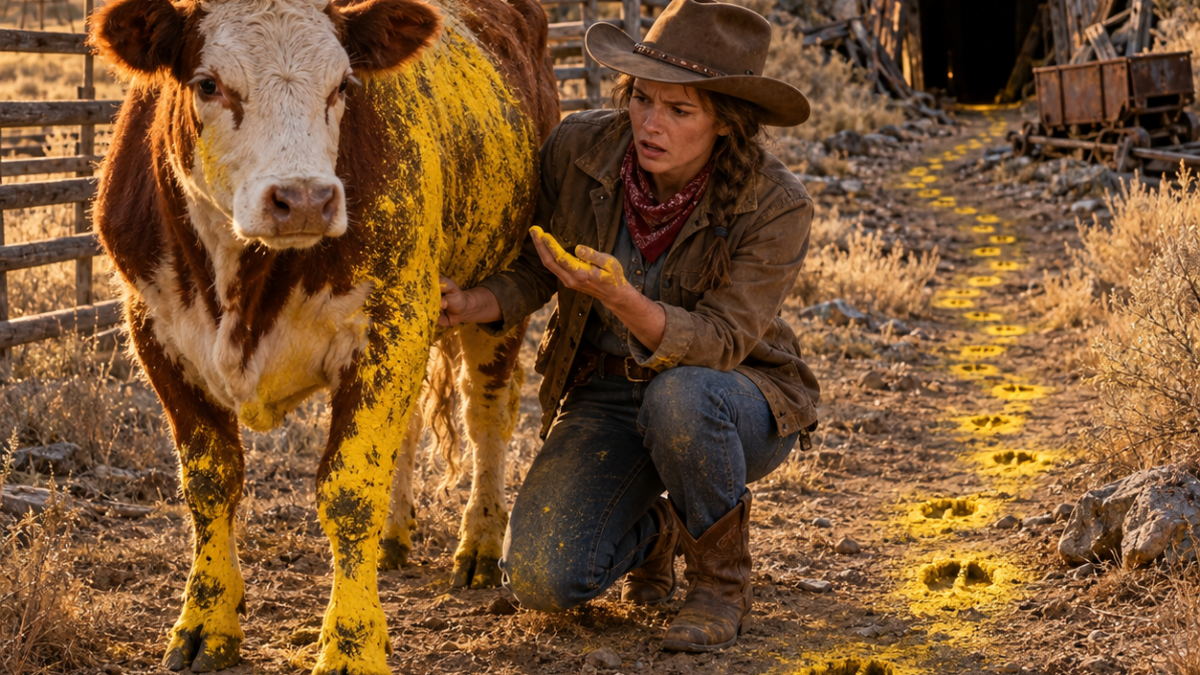
PART 2
I backed away from the gate so fast my heel slipped on loose rock.
For half a second, my body reacted before my mind did.
Run.
Then I stopped myself.
The mine was quiet.
No movement.
No voice.
No engine.
Only the dry hiss of wind through serviceberry and the ticking sound of small stones cooling in the shade.
I put the flashlight back through the gap.
The boot prints were still there.
Clean tread.
Deep heel.
The loose yellow material around the edges had not slumped back yet.
I knew enough about tracks to know what fresh looked like.
My father had taught me that too.
I followed the print only as far as the beam allowed.
Mabel’s tracks went in.
The boot tracks went in after hers.
Both disappeared around a bend.
I did not open the gate.
I did not touch the chain again.
Whatever curiosity I had left was finally balanced by common sense.
Old mines kill people who enter them believing ten minutes will be safe.
Bad timber.
Invisible gas.
Vertical drops.
Loose roof.
Water.
I had grown up in a county with enough graves to know that.
I took photographs.
The chain.
Padlock.
Tool mark.
Hoofprints.
Boot tread.
Gate.
Road.
Then I started down.
I descended faster than I should have.
The temperature climbed as I lost elevation.
By the time the ranch came into view, sweat had soaked the back of my shirt.
I was still two hundred yards from my home gate when I saw the black SUV.
It was parked beside the cattle guard.
Spotless.
Nothing stayed spotless on our road.
A man leaned against the front fender with his arms folded.
He watched me approach.
I knew the name before he introduced himself.
Blackthorne.
Everybody in Dry Creek knew that family.
Grant Blackthorne pushed away from the SUV and extended a hand.
“Rowan Hail?”
I looked at his hand.
Then shook it.
“Grant.”
He smiled.
“You know me.”
“Your signs are on half the county.”
His smile remained, but something sharpened behind it.
He was forty-one.
Clean boots.
Expensive sunglasses.
Sunburn that looked recreational rather than occupational.
He gave me condolences about my father.
One sentence.
Then admired the ranch.
One sentence.
Then got to business.
“Blackthorne Holdings is interested in your northern parcel.”
I looked at him.
“What northern parcel?”
“The hundred forty acres from your fence up toward the ridge.”
“You mean the rocks.”
He smiled.
“Rough ground.”
“Bad grazing.”
“Yes.”
“Almost no water.”
“Correct.”
I folded my arms.
“How much?”
He named the number.
Four hundred thousand dollars.
I stared at him.
He watched me calculate.
Range ground in that condition was worth maybe four or five hundred dollars an acre.
Less in a drought.
Grant had just offered nearly ten times what I would have expected anyone to pay for that particular section.
My face must have shown something because his smile widened.
“Cash,” he said. “We close within sixty days.”
“For rock.”
“For long-term land assembly.”
“What are you assembling?”
“Recreational holdings. Access. Future options.”
I glanced toward the mountain.
He followed my eyes for only a fraction of a second.
That was enough.
Then he changed tactics.
“I understand the ranch carries debt.”
My shoulders tightened.
“That isn’t your concern.”
“Your father was ill a long time.”
“My father is also not your concern.”
“Medical costs have a way of staying after people are gone.”
My anger rose.
Grant’s voice never did.
“Hay is two-twenty a ton. Forecast is bad. You have six hundred acres, and from the road I’d guess maybe forty head?”
“Forty-one.”
“There you go.”
He spread one hand.
“I’m offering you real money for ground that isn’t producing anything.”
“Why?”
“I just told you.”
“No. You told me what you want me to believe.”
His expression changed.
Slightly.
I continued.
“If it’s just worthless rock, why is your family paying four hundred thousand dollars for it?”
For two seconds, Grant Blackthorne had no expression.
No smile.
No irritation.
Nothing.
Then the smile returned.
Tighter.
“Long-term strategy.”
“Not selling.”
“Rowan.”
“No.”
“You haven’t thought about it.”
“I have now.”
He laughed once.
Small.
Almost fatherly.
“Your principles won’t service your bank note.”
“Neither will selling land I don’t understand to a man who understands it too well.”
That landed.
I saw it.
Grant put his sunglasses on.
“The offer won’t remain forever.”
“I’ll survive.”
He got into the SUV.
Then drove through my gate and left it open.
I stood there watching dust rise behind him.
Only after the vehicle disappeared did I realize something else.
Grant had never asked whether I knew about the mine.
He had not needed to.
He had shown up the same morning I found it.
That night I opened my father’s gun safe.
The guns were on one side.
Paper occupied nearly everything else.
The Hails had owned land in Dry Creek since 1926, and my great-grandfather apparently believed throwing away a document was a personal attack on civilization.
Deeds.
Tax statements.
Survey notebooks.
Plat maps.
Water filings.
Letters tied with string.
Receipts for equipment that had been scrap before I was born.
At 12:17 a.m., I found the Yellow Finch Mine.
A county plat from 1949.
Tiny black square north of the Hail boundary.
The property line passed close to it.
Very close.
I used a ruler.
Checked again.
Then found a parcel sheet from 1962.
I laid them side by side.
The ranch boundary had moved.
On the newer map, the northern line sat farther southwest.
The strip between the old and new boundaries was roughly one hundred twenty acres.
Irregular.
Running along the base of the mountain.
I searched the deed box.
No sale.
No transfer.
No quitclaim.
No recorded conveyance by my grandfather.
Nothing explaining how Hail ground had become somebody else’s ground.
At two in the morning, I stopped and stared at the maps.
The mountain was supposedly worthless.
The mine supposedly empty.
Yet somebody had changed the boundary near it.
Someone was still visiting it.
And a Blackthorne had offered me four hundred thousand dollars for the adjoining parcel within hours of me finding the entrance.
By sunrise, I had stopped believing coincidence was involved.
The county extension agent gave me the name of Miles Ardan.
Independent surveyor.
Thirty-eight.
Great Falls.
Did boundary disputes.
Occasionally worked against mining companies.
He arrived Thursday in a truck that looked as tired as mine.
I spread the maps across my kitchen table.
Miles studied them.
Then leaned back.
“Don’t fall in love with your theory.”
“I don’t love any of this.”
“Good.”
He tapped the 1949 plat.
“Old maps disagree constantly.”
“So the boundary shift might mean nothing.”
“It might mean a drafting error.”
“One hundred twenty acres?”
“I’ve seen worse.”
“What settles it?”
“Original monuments.”
“From when?”
“1924 survey, probably.”
“You think they still exist?”
“I think after a hundred years they may be buried, moved, bulldozed, rusted away, or sitting exactly where somebody put them.”
“And if we find one?”
“If we find enough, ground beats paper.”
That sounded like my father.
Ground beats paper.
Miles started at the courthouse.
I started watching Mabel.
She returned to normal.
Ate.
Drank.
Stayed with the herd.
Except twice a day.
Morning and evening, she drifted north.
Always to the same place.
She stood near the repaired fence.
Head lifted.
Ears forward.
At first I assumed she wanted back through.
I strengthened the section.
Two new posts.
Four fresh strands.
Mabel did not touch them.
She just stood.
On the fourth evening, I walked out beside her.
“Okay.”
She flicked one ear toward me.
“What is different?”
That was my father’s question.
Not what is wrong.
What is different today?
I stopped looking at Mabel’s eyes.
Started looking at her ears.
She was not staring north.
She was listening.
I followed the direction.
Six feet inside the pasture lay an old iron pipe.
I had known it my entire life.
Rusty.
Three inches across.
Half buried in a shallow swale.
Dad once told me it belonged to an abandoned stock-water scheme.
“Never worked,” he said.
I knelt.
Put one hand on it.
Nothing.
Then I pressed my ear against the iron.
Wind.
Cicadas.
My heartbeat.
And underneath all of it—
Water.
Moving.
I jerked upright.
Put my ear back down.
There it was.
A low rushing sound inside a pipe everyone had told me was dead.
I called Miles.
“You busy?”
“Usually.”
“I found water in an abandoned pipe.”
A pause.
“Do you have a normal sentence available?”
“No.”
“I’ll come tomorrow.”
Laurel’s laboratory results arrived first.
The yellow dust was not dangerous in the quantities on Mabel.
Mostly weathered iron minerals.
Limonite.
Jarosite.
Yellow clay.
Trace sulfides.
Mine waste.
Not gold.
Not valuable.
I read that report sitting in my truck outside the veterinary clinic.
Something inside me sank.
I had never admitted to myself that I believed the yellow dust might mean gold.
Of course I had.
Old mine.
Yellow powder.
Blackthorne money.
Everybody would think the same thing.
A hidden vein.
Forgotten ore.
Something valuable inside the mountain.
The report destroyed that story.
No recoverable precious metal.
No commercial value.
The Yellow Finch had produced less than nineteen hundred ounces of gold during its entire recorded life.
By mining standards, almost nothing.
I drove home angry.
Not because I had lost a treasure.
Because Grant’s offer now made less sense than before.
If there was no gold, what exactly was he paying me four hundred thousand dollars not to examine?
I went to Everett Shaw.
He was behind his equipment shed fitting a new handle to an axe.
He looked up when I arrived.
Then saw the laboratory report in my hand.
His shoulders dropped.
“I told you to leave it.”
“I’m done with that sentence.”
“Rowan.”
“No.”
I set the report on his bench.
“There’s no gold.”
He kept sanding.
“I know.”
That stopped me.
“You know.”
“Yes.”
“You knew when you followed me up there.”
He said nothing.
“You knew about the mine.”
“Yes.”
“You knew someone still used it.”
His sanding slowed.
“Everett.”
He set the axe down.
Then sat on an overturned bucket.
“I went to work for Blackthorne Mining in 1979.”
I stared.
“You?”
“I was twenty-four.”
“You never told me.”
“Wasn’t proud of some of it.”
“What happened up there?”
He looked toward the mountain.
“The gold was gone.”
“I know.”
“Had been for years.”
“So what did you do?”
“Pipe.”
“What pipe?”
His eyes came back to me.
“The water.”
That word changed everything.
Everett told me the original miners had driven a lateral drift off the second level while chasing a vein.
The vein pinched.
The rock changed.
Then they broke into water.
Not a seep.
Not groundwater dripping from cracks.
A steady pressurized flow.
Cold.
Clean.
Enough to run through a four-inch line without a pump.
The upper edge of an aquifer.
Blackthorne bought the Yellow Finch and adjoining claims in 1961.
By the late seventies they were developing the water system.
Everett worked two summers underground installing pipe.
“Where did it go?”
“Downhill.”
“Onto their ranch?”
He hesitated.
“Eventually.”
“What does that mean?”
“The formation slopes southwest.”
I stared.
“Toward me.”
“Under you.”
My mouth went dry.
“How far?”
“A long way.”
“Under Hail Ranch?”
“Yes.”
The whole story tilted.
Gold was valuable once.
You removed it.
Sold it.
It was gone.
Water was different.
Dry Creek received fourteen inches of rain in a good year.
Nine in a year like this one.
Families sold ranches because wells went dry.
Developers out near the interstate paid fortunes securing reliable supply for subdivisions.
A source that had flowed continuously for decades was not just valuable.
It controlled what could exist above it.
“Does Blackthorne own the water?”
Everett rubbed both hands over his face.
“That depends on who you ask.”
“I’m asking you.”
“They’ve used it.”
“That isn’t what I asked.”
“No.”
He looked at me.
“They don’t own everything underneath you just because they found an opening in the mountain.”
My anger rose.
“Did Dad know?”
Everett’s silence answered before he did.
“When?”
“Twelve years ago.”
I sat on the shed floor.
He told me my father had been pulling a bogged heifer from the north swale when he got curious about the old pipe.
He traced it.
Asked Everett questions.
Everett answered.
For two years, Dad quietly collected records.
Water bureau correspondence.
Survey maps.
County deeds.
Then he stopped.
“He gave up,” I said.
Everett shook his head.
“No.”
“He stopped.”
“That isn’t the same thing.”
“What is it, then?”
Everett leaned forward.
“Your father ran the numbers.”
I almost laughed.
“Of course he did.”
“He knew what a fight against Blackthorne would cost.”
“So he quit.”
“No.”
Everett’s voice hardened.
“He looked at you.”
I stopped.
“You were twenty-two. Ranch had debt. Tom knew if he started a lawsuit and Blackthorne dragged it four years, he might lose everything halfway through.”
I looked at the floor.
“He wasn’t waiting because he was scared.”
“What was he waiting for?”
“Until they couldn’t push you off the ground.”
My throat tightened.
Everett stood and reached onto a high shelf.
He pulled down an old coffee can.
Bolts.
Washers.
Cotter pins.
Then a brass key.
A paper tag was wired through the ring.
My father’s handwriting.
SURVEY ROOM B.
Everett put it in my hand.
“He gave me that eleven years ago.”
“Why you?”
“Because he didn’t want it in the house.”
“What did he say?”
Everett swallowed.
“Hold it. Don’t give it to Rowan.”
I stared at the key.
“Ever?”
“Unless a Blackthorne comes back around wanting the hill.”
My fingers closed over the brass.
Dad had expected this.
Maybe not Grant.
Maybe not now.
But someday.
He had known the mountain would become important again.
I wanted to go straight up there.
I didn’t.
That may have been the smartest decision I made that summer.
Old mines are not mystery novels.
You do not enter because you possess a key and unresolved feelings about your father.
Miles found a retired state mine inspector named Dean Foster.
We pulled reclamation records.
A stability assessment from 1988 said the major collapse was confined below the second level.
Upper workings and an eastern survey room had been rated stable at the time.
That did not make them safe now.
So we prepared.
Four-gas meter.
Hard hats.
Lights.
Backup lights.
Rope.
Communication.
We notified Laurel and Everett.
Dean insisted on testing air every few yards.
Saturday morning, we climbed to the secondary portal.
I had never noticed it.
Sixty yards east of the main entrance.
Partially hidden behind fallen rock and brush.
Steel door.
Old paint.
Recently oiled hinges.
Miles touched them.
“Somebody’s been maintaining this.”
No one answered.
The brass key opened the inner survey-room lock on the second try.
The room was twelve feet square.
No gold.
No stacked cash.
No dramatic treasure.
A green steel filing cabinet stood against one wall.
Canvas field books.
Rolled maps.
Two boxes of photographs.
The air was dry enough that much of the paper remained surprisingly clean.
I opened the first field book.
My father’s handwriting was inside the front cover.
I had to sit.
Miles noticed.
“You okay?”
“No.”
“Want to stop?”
“No.”
My father had used the room.
Carried copies of records up the mountain.
Stored them here.
Locked them behind the one door the Blackthornes assumed belonged to them.
The documents built the history one piece at a time.
February 1961.
Blackthorne Mining hired a Helena survey firm to locate the claims and adjoining surface boundaries.
Their field crew found original section monuments.
Two of them were iron pipes driven in 1924 at corners of Hail ground.
The field notebook recorded coordinates.
Distances.
Bearings.
Then November 1961.
A revised county plat.
On that version, the Hail line moved southwest.
Roughly one hundred twenty acres disappeared.
The filing called it correction of a prior scrivener’s error.
My father had taped a yellow tab beside the entry.
Three words:
THEY MOVED IT.
Miles read both records twice.
“This is not good for them.”
“Meaning?”
“If the original monument is where this crew says it was and there was no deed transferring the strip, the later plat may not control.”
“May?”
“We still need the monument.”
I kept going.
The third map tube contained a 1963 geologic cross-section.
Mountain profile.
Mine workings red.
Water-bearing formation shaded blue.
The blue layer entered at the drift.
Then dipped southwest.
Off the edge of the original sheet.
Someone had taped on an extension.
In pencil:
Estimated depth at 1.25 miles southwest.
Miles and I looked at each other.
My home pasture sat approximately one and a quarter miles southwest.
I understood Grant’s offer completely for the first time.
The northern 140 acres contained more than rocks.
It contained the portal.
The drift.
Old pipeline access.
And the historic infrastructure proving Blackthorne had been drawing from the formation for decades.
Water rights do not turn on who owns the nicest truck.
They depend on law.
Priority.
Beneficial use.
Place of use.
Point of diversion.
Historical records.
And evidence.
Grant wanted control of the land where those facts physically came together.
I took photographs of everything.
Then we found the monitoring records.
At first I did not understand them.
Fourteen coordinate entries.
Dates spanning decades.
Second column marked in feet.
The coordinates were not near the mine.
That night at home, I plotted them on a parcel map.
Eleven landed on Hail Ranch.
Two in my home pasture.
One near the iron pipe Mabel had been listening to.
I called Miles at six the next morning.
He sounded half asleep.
“Read the numbers again.”
I did.
“Second column?”
“Thirty-eight point four. Thirty-seven point nine. Forty-one point two…”
Silence.
“Miles?”
“Those sound like depth-to-water measurements.”
My hand tightened on the phone.
“Monitoring wells?”
“That would be my guess.”
“So they’ve been—”
“Rowan.”
His voice changed.
“If this is what it looks like, Blackthorne hasn’t just been pulling water through the mine.”
“What have they been doing?”
“Measuring water under your land.”
We needed proof.
Not guesses.
Miles started reconstructing the 1924 survey.
County records were incomplete.
Some notes had been microfilmed badly.
Some monuments referenced trees that no longer existed.
He spent weeks measuring from stable control points.
Meanwhile, the drought worsened.
Hay climbed higher.
My bank called.
I told them I was handling it.
That phrase had become almost meaningless.
Then Conrad Blackthorne came to the ranch.
Grant’s father.
Sixty-seven.
No SUV.
He arrived in a muddy pickup and asked permission before walking through my gate.
That alone made him more dangerous.
He knew courtesy could lower defenses faster than arrogance.
We walked toward the corral.
He talked about Dad.
Not vaguely.
Specifically.
“Flood of ’94,” Conrad said. “Your father and I pulled six head out of Cottonwood Draw.”
I looked at him.
“He told me about that.”
“He was mad at me.”
“Why?”
“I wanted to wait for equipment.”
“Dad never liked waiting.”
Conrad smiled.
“No.”
For ten minutes, I almost forgot why he was there.
Then we reached the corral.
He gave me an offer.
Not Grant’s four hundred thousand.
Much more.
Enough to clear every dollar of ranch debt.
Fix the barn.
Replace equipment.
Buy two years of hay at current prices.
Leave cash after all of it.
I stared at the number.
Conrad did not rush me.
“Your father spent half his life holding on to a mountain,” he said.
I looked up.
“Interesting wording.”
“Don’t spend the other half of yours making the same mistake.”
“You know about the mine.”
“Everyone my age knows Yellow Finch.”
“You know about the water.”
His face remained calm.
“I know there are water resources in that area.”
“That isn’t an answer.”
“It’s the answer I’m giving.”
I looked at the offer again.
It would be a lie to say I never considered it.
I considered it hard.
Debt is not philosophical when it sits on your kitchen table.
Neither is hay.
Neither is a tractor payment.
Neither is a bank manager asking whether you have a plan.
Conrad could make all of that disappear.
And he was right about one thing.
People did not usually beat the Blackthornes in fights because the Blackthornes could afford to keep fighting long after ordinary ranchers ran out of money.
I had seen it happen.
A family could be legally right and still settle in year three because legal correctness did not buy diesel.
Conrad did not threaten me.
He did not need to.
His offer was pressure disguised as relief.
“I need time.”
“Take it.”
“How much?”
“A week.”
He walked back toward his pickup.
At the gate, he stopped.
“Rowan.”
“Yes?”
“Your father was a good man.”
I waited.
“That doesn’t mean every fight he chose was worth inheriting.”
Then he left.
I sat at the kitchen table that night with the field books.
Could not sleep.
I plotted the fourteen coordinates again.
Then I noticed the dates.
Some predated the years my father had been investigating.
He had copied older measurements into his own records.
Thirty-three years of water levels.
Blackthorne had apparently been monitoring the formation for decades.
The next morning Miles confirmed my suspicion.
“If the source record checks out, this is a long-term observation network.”
“Why put wells on our land?”
“Maybe they believed it wasn’t your land.”
“Because they moved the boundary.”
“Possibly.”
The sentence made me angry enough to laugh.
“They move a line, then drill wherever the new map tells them belongs to them.”
“If that is what happened.”
“You always talk like a deposition.”
“Keeps me employed.”
Six weeks after beginning the survey, Miles called.
“Come north.”
“Where?”
“Brush draw near the disputed corner.”
I drove up.
County survey staff were already there.
A shallow excavation cut through roots and old stone.
Fourteen inches below grade, a galvanized pipe protruded from bedrock.
Brass cap.
Flattened with age.
Stamped surveyor license number.
Issued by Montana in 1922.
Miles stood beside it.
“That is your corner monument.”
“How far from the 1962 plat?”
“One hundred ninety feet northeast.”
I stared.
“So?”
He smiled for the first time in weeks.
“The argument about whether the line moved is over.”
My legs almost gave out.
One hundred ninety feet sounds small until you run it across a boundary.
Over distance, it became acreage.
Land.
Access.
History.
The county later located a second confirming monument.
The 1962 correction had not corrected anything.
It had relocated my family’s boundary on paper.
That was the first moment I believed I could actually win.
Then Laurel said something that changed the story again.
She was leaning against the corral one evening watching Mabel.
“You know what still bothers me?”
“I have options.”
“Mabel.”
“What about her?”
“I’ve treated cattle eleven years.”
“Congratulations.”
“I’ve never seen one cross broken mountain ground at night, squeeze through fence, enter a mine, and coat herself in waste rock because she felt adventurous.”
I looked at Mabel.
“She wandered.”
“Animals almost never wander.”
“What do they do?”
“Move toward something.”
“Food?”
“Food. Water. Other cattle.”
Water.
I stopped.
Laurel saw it.
“What?”
“The north seep.”
“What seep?”
I had almost forgotten.
A small wet patch in the north pasture.
Seasonal.
Nothing important.
Except it had gone dry in June.
For three mornings, I walked the north ground in a grid.
I found the old seep four hundred yards inside the fence.
Sedge.
Rush.
Vegetation different from everything around it.
Dead now.
I checked Dad’s rainfall log.
Last meaningful rain: May 29.
Then I went uphill.
Seventy yards east of the Yellow Finch portal, beneath a leaning pine, I found rotten timber cribbing.
Ventilation shaft.
Partially collapsed.
I put my hand above the opening.
Cool air moved upward.
In a landscape baked dry, that cold damp breath was unmistakable.
Air from underground workings.
Air moving over water.
I stood there and finally understood Mabel.
She had not found the mine because of gold.
Or because of Blackthorne.
Or because fate needed to send me a message.
She was thirsty.
Her normal seep dried.
On a hot night, she caught the scent of damp air drifting downslope.
She followed it.
Up the old road.
Through failing fence.
To the ventilation shaft.
Then to the portal.
She entered far enough to reach the wet drift.
Walked into the yellow waste.
Probably slipped or lay down when the footing turned bad.
Then came back.
The yellow dust was not treasure.
It was dirt.
Worthless dirt.
That was the beautiful trick of the entire story.
Everyone—including me—looked at gold-colored material from an abandoned gold mine and thought about gold.
The Blackthornes had benefited from that assumption for generations.
As long as people asked what had been removed from Yellow Finch, they were not asking what was still coming out.
Water.
The dust was never the treasure.
The dust was the disguise.
I stood on that mountain thinking about my father.
For years I had believed he was simply sentimental about the north range.
He refused offers.
Refused boundary adjustments.
Refused to sell rocky ground that barely fed cattle.
Even during cancer treatment.
I remembered getting angry once.
“Dad, it’s rocks.”
He had looked at me.
“Ground is ground.”
I thought he meant pride.
Now I understood.
He had not been protecting a mountain.
He was protecting what the mountain reached into.
The aquifer beneath our grass.
And he had waited because he knew someday I would need enough evidence to defend it.
The state water hearing was scheduled for October.
The matter was technical on paper.
Boundary correction.
Objection to Blackthorne’s pending change in appropriation.
Historic use.
Ownership.
Monitoring.
Water rights.
Nothing about those phrases sounded dramatic.
The week before the hearing, Grant came back.
He did not get out of the SUV immediately.
I walked to him.
He opened the door.
“You should take my father’s offer.”
“No.”
“You’re going to spend years on this.”
“Maybe.”
“Your note comes due before your principle does.”
“Probably.”
“You really think those maps change the world?”
“No.”
I looked toward the mountain.
“I think monuments change boundaries.”
His jaw tightened.
“You think you’ve found some conspiracy.”
“I think your company filed a plat that moved my family’s line.”
“That happened before I was born.”
“Your company is still benefiting from it.”
“Rowan.”
He stepped closer.
“We can settle this.”
“By selling.”
“Yes.”
“The land.”
“Yes.”
“The access.”
His eyes changed.
“The water history.”
He said nothing.
“There it is.”
“You don’t understand water law.”
“Then explain why you need my northern parcel.”
“We don’t need it.”
I smiled.
“You offered me four hundred thousand dollars for rocks.”
“That was a business decision.”
“Your father offered enough money to pay off my life.”
“Because he respects your father.”
“No.”
I shook my head.
“He respects evidence.”
Grant’s face hardened.
“You’re making this personal.”
“You came to my ranch the morning I found a mine you didn’t know I knew about.”
“That proves nothing.”
“Correct.”
“You think some old papers are going to turn six hundred acres into a kingdom?”
“No.”
“What, then?”
I looked him straight in the eye.
“I think they’re going to make you pay me for water you’ve been pretending was yours.”
He laughed.
But the laugh did not reach his face.
“You have no idea how expensive that sentence is.”
“Then I guess we’ll both find out.”
He got into the SUV.
This time, he closed my gate.
The hearing took place on a Thursday morning.
County commission room.
Forty folding chairs.
Long table.
Coffee urn borrowed from the church.
A hearings examiner from the state water bureau sat at the front.
Two county planning-board members.
Recorder.
Staff counsel.
Miles beside me.
My attorney, Karen Sloan, to my left.
I had resisted hiring another lawyer after seeing her hourly rate.
Then Miles said something simple.
“You’re not paying her to know your land. You’re paying her to make sure the people deciding this can legally hear what your land is saying.”
So I hired her.
Grant arrived eight minutes late.
Two attorneys.
No apology.
Conrad sat in the second row.
Hat on his knee.
He looked at me once.
Then at the documents.
Blackthorne went first.
Their lead attorney described the disputed parcel as marginal rangeland.
Limited productive capacity.
Historic mapping inconsistency.
Their company’s interest was characterized as modest.
Grant testified briefly.
“Our family has operated in Dry Creek for generations. We have no desire to interfere with Ms. Hail’s ranch.”
I almost admired how smoothly he said it.
The attorney asked about his purchase offer.
“Was it intended to pressure Ms. Hail?”
“No.”
“Why offer above typical grazing value?”
“Strategic land assembly.”
There was that phrase again.
When it was our turn, Karen looked at me.
“Ready?”
“No.”
“Good enough.”
I stood with a cardboard box.
No speech.
I placed the 1949 plat on the table.
Then the 1962 plat.
Side by side.
Next, the 1961 survey field notes.
Original monument calls.
Coordinates.
Distances.
Then the county surveyor’s report.
Photographs of the recovered brass-capped monument.
Measured offset.
One hundred ninety feet.
Grant’s attorney stopped writing.
I put down the second monument documentation.
Miles explained how original monuments control survey reconstruction when later mapping conflicts.
Blackthorne’s attorney challenged methodology.
Miles answered calmly.
“Were you hired by Ms. Hail?”
“Yes.”
“Paid?”
“Yes.”
“So you have a financial interest in supporting her position.”
“I have an interest in being paid for survey work.”
A few people smiled.
The attorney frowned.
“Could the monument have been moved?”
“Not realistically.”
“Why?”
“It is a galvanized pipe driven into bedrock, capped with a survey stamp consistent with the original notes, found at the called bearing and distance from independent control.”
“So impossible?”
“I did not say impossible.”
The attorney leaned back.
Miles continued.
“I said if somebody moved it, they also moved bedrock very carefully.”
Nobody smiled at the next document.
The 1963 geologic cross-section.
Blue aquifer wedge.
Mine workings.
Southwest dip.
Home pasture projection.
Then my father’s fourteen coordinates.
Miles’ report confirming eleven lay on Hail ground.
Historic depth-to-water values.
Monitoring over decades.
Karen asked Miles:
“What do these observations indicate?”
“That somebody was tracking water levels in the formation beneath Hail Ranch over a long period.”
“Is that normal if you believe the formation has no relevance to your water supply?”
“No.”
Blackthorne objected.
Speculation.
Sustained in part.
Karen moved on.
Then she produced something I had not seen until four days earlier.
A Blackthorne memorandum obtained through a state public-records request connected to an earlier water filing.
Dated four months before Grant came to my gate.
Northern Hail parcel strategically necessary to company water position.
The words were plain.
No metaphor.
No ambiguity.
I watched Grant read his own company’s language on the screen.
His face changed.
His attorney stopped taking notes altogether.
Karen asked me to speak.
I stood.
My knees shook.
I wished they didn’t.
Then I decided shaking did not make evidence weaker.
“Mr. Blackthorne was right about one thing.”
Grant looked up.
“I don’t own a gold mine.”
His mouth tightened.
I pointed toward the cross-section.
“I own the ground above the reason their ranch needs less rain than everybody else’s.”
Silence.
Grant started to answer.
His attorney touched his wrist.
Conrad stood in the second row.
He buttoned his jacket.
“Examiner, may we request a recess?”
Granted.
In the hallway, Grant turned on me.
“You think this is victory?”
Conrad’s voice came from behind him.
“Stop talking.”
Grant looked back.
“Dad—”
“I said stop.”
Grant’s jaw tightened.
Conrad turned toward me.
“You found the monument.”
“Yes.”
“And Tom’s records.”
“Yes.”
He nodded slowly.
“I wondered where he put them.”
That sentence froze me.
“You knew he had records.”
“I knew he was asking questions.”
“Did you know about Survey Room B?”
“No.”
“Did you know your company’s plat moved our boundary?”
Conrad looked at the closed hearing-room door.
“I knew the 1962 line favored us.”
“That isn’t what I asked.”
He looked back.
“I never went looking for the older answer.”
I stared at him.
“Convenient.”
“Yes.”
Grant stepped forward.
“This is ridiculous.”
Conrad turned.
“Go outside.”
“I’m forty-one years old.”
“Then act like it.”
Grant left.
Conrad stayed.
“You’re going to win the boundary.”
“You sound sure.”
“I am.”
“What about the water?”
“That takes longer.”
“Good.”
He studied me.
“You sound like your father.”
“That isn’t always a compliment.”
“No.”
A faint smile.
“It usually wasn’t when I said it to him either.”
Five more months followed.
Paper.
Technical reviews.
Legal arguments.
Hydrology.
Historic appropriation evidence.
Title work.
Blackthorne did not collapse.
I did not suddenly become wealthy.
No judge handed me their ranch.
Real disputes are rarely that clean.
But one by one, the important pieces settled.
Blackthorne withdrew the objection to restoring the disputed one hundred twenty acres to the Hail deed.
The county corrected the parcel boundary using the recovered monuments and original survey evidence.
Those acres came back in spring.
The day the corrected deed arrived, I put it on my kitchen table beside Dad’s photograph.
I did not cry.
Then I did.
The water issue took longer.
Blackthorne had a history of use through the Yellow Finch drift.
We had senior rights associated with water beneath and connected to our own ground.
The lawyers argued.
Engineers measured.
Eventually we negotiated.
They acknowledged Hail Ranch’s senior right to the aquifer beneath our property.
Blackthorne received a limited, metered agreement allowing continued withdrawal of a defined volume through the old drift.
Not unlimited.
Not hidden.
Not whatever they wanted.
Metered.
Capped.
Reported.
And paid for.
The company funded rehabilitation of the old pipeline corridor.
Five monitoring wells.
Public reporting.
For the first time in sixty years, anyone in Dry Creek could see water levels in the aquifer.
Numbers.
Not rumors.
Not Blackthorne assurances.
Numbers.
The lower mine workings were permanently sealed.
Unsafe openings stabilized.
Both accessible portals received bat-friendly steel grating.
The ventilation shaft was capped.
The old secret infrastructure stopped being secret.
Everett watched the installation with me.
“Tom would hate all these people up here.”
I laughed.
“He would.”
“He’d complain about government trucks.”
“Absolutely.”
Everett looked toward the mine.
“He’d like the meter.”
“Yes.”
That part I knew.
The following April, we installed a legal stock-water system on Hail Ranch.
Three tanks.
Buried line.
Metered draw from the formation beneath our ground.
Nothing fancy.
No huge irrigation project.
No subdivision.
Just reliable cattle water.
When the first north tank filled, I brought Mabel up deliberately.
Laurel came too.
“You invited me to watch a cow drink?”
“Yes.”
“Your social life is deteriorating.”
“It was never strong.”
Mabel walked to the tank.
Sniffed.
Then drank.
I laughed.
Laurel leaned on the rail.
“Very dramatic.”
“You started this.”
“Mabel started this.”
“Fair.”
The next summer was hot.
Dry.
The north pasture stayed green almost six weeks longer than the previous year.
Not because we suddenly had abundant rainfall.
Because livestock water stopped forcing the cattle to overuse the same lower ground.
We could rotate properly.
I paid down forty percent of the ranch note with the first two years of water-use income from Blackthorne.
Then stopped.
My banker suggested using the new revenue to leverage improvements.
I said no.
He looked surprised.
“Debt can be useful.”
“I have enough useful things.”
I hired Everett full-time for fence and maintenance.
He argued.
“I’m sixty-three.”
“You followed me up a mountain in July.”
“That was stupidity.”
“I’m hiring the stupidity.”
“I don’t need charity.”
“It’s a job.”
“I’m expensive.”
“No, you aren’t.”
He glared.
“Now I’m offended.”
He accepted.
The first project I gave him was the north fence.
We rebuilt it in October.
New posts.
Five strands.
Tight enough to sing when the wind hit it.
At the section where Mabel had pushed back through, Everett held the wire while I stapled.
“Remember telling me there was nothing up there worth my boots?”
He groaned.
“I knew this was coming.”
“I’ve been saving it.”
“You won.”
“Say it.”
“No.”
“Everett.”
He looked at me.
“There was something up there worth your boots.”
“Thank you.”
“Happy?”
“Very.”
He shook his head.
“Your father would be unbearable right now.”
The state held a small dedication at Yellow Finch the following September.
Historical marker near the county-road pullout.
Names of the two miners killed in the 1958 collapse.
Mine history.
Reclamation work.
Water-system history described publicly for the first time.
I stood in the back.
No speech.
Conrad attended.
Grant did not.
Afterward, Conrad approached.
He was carrying his hat.
“Rowan.”
“Conrad.”
He looked at the marker.
“My grandfather hated this place.”
“Why buy it?”
“He thought every resource needed an owner.”
“That sounds hereditary.”
He smiled slightly.
“Probably.”
We stood quietly.
Then he said, “Grant still thinks you should have sold.”
“I’m devastated.”
“He thinks he could have developed the water better.”
“For whom?”
Conrad looked at me.
“Exactly.”
I had not expected that answer.
“You disagree with him now?”
“I disagree with the idea that control and stewardship are the same thing.”
I studied him.
“That lesson cost you money.”
“The expensive ones usually last.”
He started to leave.
I called after him.
“Conrad.”
He turned.
“Did my father ever tell you what he planned to do?”
“With the water?”
“Yes.”
“No.”
“You never asked?”
“He wouldn’t have answered.”
That sounded right.
Conrad put his hat on.
“But once he told me something.”
“What?”
“He said the problem with my family was that we saw a map and immediately started looking for the part we could color in.”
I laughed.
“Sounds like him.”
“Yes.”
“He was right.”
Conrad walked away.
Grant stayed angry longer.
The limited-use agreement required quarterly reporting.
The third quarter, Blackthorne’s withdrawals approached the cap.
Their operations manager requested additional volume.
I said no.
Grant called personally.
“You have unused capacity.”
“Some.”
“We need it.”
“I know.”
“This is business.”
“I know.”
“We pay market.”
“I know.”
“Then why no?”
“Because monitoring levels dropped.”
“Our engineer says temporary.”
“My engineer says wait.”
His voice hardened.
“You enjoy this.”
There it was.
For a moment, I considered lying.
Then I told the truth.
“A little.”
Silence.
“That’s petty.”
“Yes.”
“At least you admit it.”
“I also have forty-one cattle, downstream neighbors, and a father who spent years recording water levels because your company acted like the aquifer was bottomless.”
“We’re nowhere near depletion.”
“Good.”
“Then approve the increase.”
“No.”
Grant breathed slowly.
“You know, there was a time you would’ve taken four hundred thousand and thanked me.”
“There was a time you thought I didn’t know what I owned.”
“Maybe we both learned something.”
“I did.”
He hung up.
The withdrawal request waited until spring.
Levels recovered.
Then I approved part of it.
That surprised Grant.
He came to the ranch two weeks later.
“You approved it.”
“Half.”
“Why?”
“Because the numbers support half.”
“You could have said no.”
“Yes.”
“After everything?”
“This isn’t revenge.”
He looked skeptical.
“Some days it sounds like revenge.”
“Revenge was making you sit through the hearing.”
That almost got a smile.
“This is water management.”
He looked toward the north tank.
“You really believe that?”
“Yes.”
He nodded slowly.
“You’re harder to fight now.”
“I’m not fighting you.”
“That’s what makes it worse.”
He left.
I stood by the gate thinking about that.
For years, the Blackthornes had been strongest when everything became personal.
Buy.
Pressure.
Wait.
Outlast.
Turn another person’s survival into a negotiation.
The public monitoring system changed the terms.
We did not need trust.
We had measurements.
If the aquifer declined, withdrawals changed.
If levels recovered, use could rise.
The argument became less about who had the most money.
More about what the ground could support.
My father would have loved that.
He trusted measurements more than people.
Especially himself.
That fall, I finally opened every remaining file from Survey Room B.
There were letters I had never seen.
Copies of state correspondence.
Drafts Dad never sent.
One letter was addressed to me.
No envelope.
No date.
Only:
Rowan—
If you are reading this, either Everett ignored me or a Blackthorne finally got greedy enough to make the hill interesting again.
I laughed so hard I had to stop reading.
Then I continued.
Do not romanticize me.
I did not solve this.
I found enough to know there was a fight and not enough money to finish it.
If you can finish it without losing the ranch, do that.
If you cannot, protect the ranch first.
Land is only useful if you still own it when the argument is over.
Do not let anybody make you feel ashamed for choosing survival.
That sentence broke me.
For months, I had secretly judged him.
Why had he not told me?
Why had he stopped?
Why leave me with half a puzzle?
Now he was answering from years earlier.
He had done what he could.
Then waited.
Not for a heroic future.
For a safer one.
The letter ended:
And if this turns out to be nothing, tell Everett I always thought he talked too much.
I drove straight to Everett’s house.
He was changing oil in his truck.
I handed him the letter.
He read it.
Snorted.
“Dead twelve years and still insulting me.”
“Six.”
“Feels longer.”
“He says you talk too much.”
“Your father lied about many things.”
“Like there being nothing up that mountain?”
Everett looked away.
“That was for your own good.”
“Of course.”
I sat on the tailgate.
“Why did you really try to stop me?”
He took a long time.
“I was afraid.”
“Of the mine?”
“Of history.”
He wiped his hands.
“I watched your father spend two years getting angrier.”
“At Blackthorne.”
“At himself too.”
“Why?”
“Because once he knew the boundary had moved and water ran under your ground, every ordinary conversation became a calculation.”
I understood.
“He thought somebody was watching?”
“Maybe.”
“Were they?”
“I don’t know.”
Everett sat beside me.
“Tom worried if he pushed too soon, they’d buy the bank note, squeeze the ranch, make everything legal and unbearable.”
“Did they ever?”
“No.”
“Then maybe he worried too much.”
“Maybe.”
He looked at me.
“Or maybe he never gave them a reason to.”
That answer stayed unresolved.
Not every mystery got solved.
I eventually accepted that.
The mine’s fresh boot prints were investigated too.
We never proved whose they were.
Blackthorne employees had occasionally inspected infrastructure.
Reclamation staff had visited years earlier.
Contractors knew the site.
Someone had recently been inside.
That was certain.
Who followed Mabel?
Unknown.
Grant denied knowing she had entered the mine before visiting me.
Could I prove otherwise?
No.
Did I believe him?
Not entirely.
But I learned an important difference that year.
Not everything you believe belongs in a legal claim.
Sometimes uncertainty stays uncertainty.
What mattered was what we could prove.
The boundary.
The water.
The monitoring.
The company memorandum.
The physical infrastructure.
That was enough.
The ranch changed slowly.
Not magically.
Six hundred acres still required work.
Drought did not care that I won a boundary dispute.
Hay still cost money.
Cattle still found new ways to injure themselves.
A tractor hydraulic pump failed during calving.
The barn roof still leaked in two places.
But the sense of countdown disappeared.
That was wealth to me.
I knew where stock water came from.
I knew the aquifer level.
I knew what the Blackthornes could legally withdraw.
I knew what belonged to Hail Ranch.
And the bank no longer felt like a hand around my throat.
One spring morning, Miles came by.
He brought a framed copy of the corrected survey.
“What’s this?”
“A gift.”
“You charge for gifts?”
“Usually.”
I looked at the frame.
The old Hail line had been restored.
One hundred twenty acres back.
Yellow Finch just beyond it.
Our 140-acre northern parcel covering the critical access corridor below.
I ran my finger along the line.
“You know what’s funny?”
“Probably not.”
“For months, I thought the mine was the point.”
“It usually isn’t.”
“You knew?”
“I suspected.”
“Why didn’t you tell me?”
“I’m a surveyor. I prefer disappointing people with measurements rather than theories.”
I laughed.
“Dad would’ve liked you.”
“I’m told that often by dead stubborn men.”
I hung the map in his office.
Beside it went a small glass jar.
Half full of pale yellow dust.
The exact material I brushed off Mabel’s flank.
Worth nothing.
The laboratory had documented that clearly.
That was why I kept it.
People who visited always noticed the jar first.
“What’s that?”
“Mine waste.”
“Gold?”
“No.”
“Then why keep it?”
Because for the first two weeks, I thought that dust was the valuable part.
It looked valuable.
It looked like money.
It looked like an answer.
Instead, it was the least important material in the entire story.
The real value was invisible.
Water moving through rock.
A legal boundary beneath brush.
A survey monument fourteen inches under roots.
A dead man’s notes.
The willingness to keep asking after the exciting explanation failed.
I usually just told visitors:
“It reminds me to look underneath.”
The first anniversary of the hearing came quietly.
Grant did not send flowers.
I was heartbroken.
Conrad did send a water-use report on time.
That amused me more.
Everett brought beer.
Laurel brought nothing and drank ours.
We sat outside the barn.
Mabel grazed nearby.
Laurel nodded toward her.
“Still your most valuable employee.”
“She doesn’t know she has a job.”
“Those are the cheapest kind.”
Everett said, “She nearly got herself killed.”
“She found water.”
“She entered an abandoned mine.”
“Details.”
I looked at Mabel.
Seven years old now.
Ordinary Hereford.
No awareness of survey law.
No interest in Blackthorne Holdings.
She wanted grass.
Salt.
Shade.
Water.
That simplicity had carried her through a mystery humans complicated for sixty years.
Everett opened another beer.
“You know what Tom would say?”
“That I should’ve fixed the north fence sooner.”
“Exactly.”
I smiled.
He probably would.
Two years later, Dry Creek entered another severe drought.
This time everyone watched the public monitoring wells.
Aquifer levels declined.
Blackthorne automatically reduced withdrawal under the agreement.
No lawsuit.
No secret argument.
Just numbers.
One neighboring ranch asked to participate in a broader groundwater-management discussion.
Then another.
Nobody suddenly became environmental saints.
They wanted their wells to survive.
Self-interest can still produce good systems when information is public.
The water bureau added online reporting.
I could open my phone and see depth readings.
I showed Everett once.
He stared.
“So now the mountain is on the internet.”
“Basically.”
“Terrible.”
“You hate progress.”
“I hate phones.”
Conrad died four years after the hearing.
Heart attack.
His obituary called him a rancher, developer, employer, father, grandfather.
All true.
Grant became head of Blackthorne Holdings.
For the first year, I expected trouble.
Instead, he called before renewing the water agreement.
“I want a longer term.”
“How long?”
“Ten years.”
“No.”
“Five?”
“Maybe.”
“You enjoy saying no before thinking.”
“I thought before you called.”
He sighed.
“What do you want?”
“Same monitoring triggers. Public reporting. Automatic reduction if levels fall below threshold.”
“That makes planning difficult.”
“So does drought.”
“We need certainty.”
“So do I.”
Silence.
Then:
“Five years.”
“Three.”
“Four.”
I smiled.
“Four.”
We signed.
Not friendship.
Not forgiveness.
An agreement between two landowners who finally understood the other one was not going away.
That was enough.
Years later, Grant and I stood together at a county water meeting.
A young developer proposed a new subdivision west of Dry Creek.
His presentation showed homes.
Roads.
Trees that did not grow naturally in our climate.
Then a slide labeled WATER AVAILABILITY.
He referenced regional supply generally.
I raised my hand.
“Specific source?”
He hesitated.
Grant looked at me.
Then raised his hand too.
The developer sighed.
I whispered, “Look what you’ve become.”
Grant whispered back, “This is your fault.”
“Good.”
After the meeting, he caught me outside.
“You know, my father would hate that I agreed with you.”
“My father would hate that I was at a planning meeting after dark.”
Grant laughed.
Then grew serious.
“Rowan.”
“What?”
“I’ve wondered something.”
“Dangerous.”
“Would you really have sold to Conrad?”
I looked toward the parking lot.
Years had passed.
No reason to lie.
“Almost.”
Grant’s surprise was genuine.
“How close?”
“Very.”
“What stopped you?”
I thought of the coordinates.
Monitoring wells.
Dad’s letter.
Mabel.
“Your family knew too much.”
He frowned.
“That’s why you stayed?”
“If you had offered money without knowing why the land mattered, maybe.”
“You’re saying our own interest made you suspicious.”
“Yes.”
Grant shook his head.
“Should’ve offered less.”
I laughed.
“Your first mistake was showing up too quickly.”
“What was the second?”
“Leaving my gate open.”
He stared.
“What?”
“First day.”
“You remember that?”
“I remember everything when somebody offers me four hundred thousand dollars for useless rock.”
He smiled.
“I suppose I deserved that.”
“You deserved worse.”
“Yes.”
That was as close to an apology as Grant ever gave me.
I accepted it because by then I no longer needed more.
The revenge I imagined during the worst weeks had been dramatic.
Public humiliation.
Bankruptcy.
Maybe forcing the Blackthornes to surrender the entire water system.
Anger likes simple endings.
Reality gave me something better.
They still existed.
But they could no longer act without measurement.
They had to ask.
Pay.
Report.
Share data.
Respect boundaries.
Grant Blackthorne could own forty thousand acres and still call me about water beneath six hundred acres because the law finally recognized what his family had tried to treat as invisible.
That was more satisfying than destruction.
Destruction ends a conflict.
Accountability changes behavior.
The Yellow Finch itself became quiet again.
Properly quiet.
Steel grating.
Locked access for inspections.
Bats moving through the openings.
Historical marker near the road.
No fresh boot prints.
No secret crews.
No hidden water line operating without public records.
I drove up once a year.
Sometimes more.
Not inside.
Never again without reason.
I would stand at the pullout and read the marker.
Two miners died there in 1958.
For decades afterward, everyone talked about the failed gold mine.
Nobody mentioned water.
Now the marker did.
Not dramatically.
One paragraph.
Historic groundwater development later became central to regional water-rights disputes.
That sentence represented years of my father’s life.
Years of secrecy.
Months of mine.
Reduced to twenty words.
I liked that.
The truth did not need to be dramatic anymore.
It only needed to remain available.
The old iron pipe in the north swale stayed too.
We disconnected the useless section but did not remove it.
Mabel still visited occasionally.
She would stand near it.
Listen.
Then wander away.
I never knew whether she remembered the night she climbed the mountain.
Probably not the way humans remember stories.
Animals do not need narrative.
The north seep returned after we adjusted withdrawals and had two wetter years.
Small.
Seasonal.
Enough to green a kitchen-sized patch.
The first time I saw water there again, I crouched and touched it.
Cold.
Clear.
I thought of Mabel smelling damp air in the dark.
Following what her body understood.
A cow had no concept of aquifers.
Yet she knew thirst.
Maybe that was what my father meant all those years when he told me cattle would explain land if I watched their bodies.
They show you where grass is sweeter.
Where flies are worse.
Where wind shelters.
Where water lies.
Not because they understand property.
Because they do not.
A survey line means nothing to a thirsty animal.
That indifference had exposed everything humans had hidden beneath maps.
On an evening in late spring, I found Mabel at the north tank.
The sun was low.
Her red coat looked almost copper.
She was drinking steadily.
I leaned against the rail.
“Next time you find a secret…”
One ear flicked toward me.
“Stay on this side of the fence.”
She kept drinking.
“Seriously. I’m too old for another mine.”
Mabel lifted her head.
Water ran from her muzzle.
Then she went back to the trough.
I laughed.
My father would have laughed too.
The ranch still carries his habits.
Weighted rain gauge.
Fence notebook.
Calving records.
Old wrench hanging by the shop door.
But the habit I kept closest was the one he taught me at seven.
Look at what is different today.
Not what is broken.
Not what you expect to find.
What changed?
A cow missing from the evening count.
Yellow dust.
Fence bent inward.
A modern lock on an old gate.
Fresh boot prints.
An offer too large for bad land.
A boundary line that moved without a deed.
Water sounding inside a pipe everybody called useless.
None of those things proved the whole story.
Together, they made it impossible to stop asking.
That was what defeated Blackthorne.
Not money.
I had almost none.
Not power.
They had more.
Not confidence.
I was terrified most of that year.
What beat their strategy was attention.
They had lived for decades assuming no one would connect the ordinary details.
The failed mine.
The shifted plat.
The pipeline.
The monitoring wells.
The dry pasture.
Separate, each fact meant little.
Together, they became a history.
And history is dangerous to people who rely on everybody forgetting one piece at a time.
The jar of yellow dust still sits in my father’s office.
Beside it hangs the corrected survey.
Below them is the brass key to Survey Room B.
I never polished it.
The tag still carries Dad’s handwriting.
Sometimes I walk past and imagine the moment he gave it to Everett.
He knew he might not be alive when the fight came.
That is difficult to accept.
Parents spend so much time trying to prepare children for things they hope never happen.
My father could not pay off every debt.
Could not defeat every powerful neighbor.
Could not leave me a ranch without problems.
What he could leave was evidence.
A key.
Records.
A warning disguised as silence.
And the freedom to decide whether the fight was worth finishing.
For a long time I wished he had told me everything.
Eventually I stopped.
If he had told twenty-two-year-old me, I would have confronted Blackthorne immediately.
I know myself.
I would have been furious.
Loud.
Underfunded.
Easy to dismiss.
Dad knew that too.
Maybe waiting was not perfect.
But it worked.
He died before seeing the boundary corrected.
Before the water agreement.
Before Mabel came home yellow.
I hate that part.
There are victories you cannot return to the person who made them possible.
You can only keep living inside what they protected.
That is what I do.
Every summer the north tanks fill.
Every quarter the monitoring numbers post.
Every year the Blackthorne payment arrives.
Not a fortune.
Enough.
I use part of it for pasture work.
Part on the bank note.
Part goes into a reserve account I refuse to touch unless water or weather forces me.
The first time that account reached a number large enough to cover a bad hay year, I sat in my truck outside the bank and cried.
Not because I was rich.
Because the ranch finally had time.
Time is what money buys when you live close to the edge.
One season.
One repair.
One drought.
Dad had spent years without enough of it.
Now I had some.
Grant once called the water payments “lease income.”
My attorney called them “consideration under a limited-use agreement.”
I called them the Blackthorne apology.
Not publicly.
But to myself.
Every check said the same thing:
We need something you own.
That was enough.
The deepest satisfaction came not from beating them.
It came from never again needing them to admit I had value.
The ground did that.
The records did that.
The water did that.
Years later, a reporter from Helena called about the Yellow Finch story.
She wanted the dramatic version.
“Did you think the dust was gold?”
“Yes.”
“Were you disappointed when it wasn’t?”
“For about fifteen minutes.”
“What did you think the Blackthornes were hiding?”
“Gold.”
“And instead it was water.”
“Yes.”
“Which was more valuable.”
“In a dry county? Easily.”
She paused.
“Would you say the cow saved your ranch?”
“No.”
That disappointed her.
“Why not?”
“Mabel wanted a drink.”
“But she led you to the mine.”
“She led herself to water.”
“That uncovered the secret.”
“Because I followed her tracks.”
“So she did save it.”
I smiled.
“If that makes your article better.”
After we hung up, I thought about how stories simplify themselves.
Cow finds mine.
Woman discovers water.
Rich family exposed.
Land saved.
All true.
Not complete.
The important part happened between those sentences.
Doubt.
Bills.
Research.
Danger.
Waiting.
People telling me to quit.
Moments I nearly sold.
The survey crew digging fourteen inches through roots.
Everett carrying a key for eleven years.
Dad copying coordinates into a notebook no one knew existed.
Those are not headline details.
They are what made the headline possible.
That winter, I finally paid off the last of Dad’s medical debt.
The hospital statement had followed us six years.
Not huge by the end.
Still there.
I wrote the final check at his desk.
Then sat looking at it.
Everett happened to stop by.
He stood in the doorway.
“You all right?”
“Paid Dad’s hospital.”
He nodded.
“Good.”
“I thought I’d feel more.”
“What do you feel?”
“Tired.”
“That’s more.”
I laughed.
He came in.
Looked at the jar of dust.
“You really keeping that forever?”
“Yes.”
“Ugly.”
“That’s why.”
“What happens when you die?”
“Maybe somebody throws it away.”
“Tom would hate that.”
“Then I’ll put it in a log.”
Everett stared at me.
“What?”
“Nothing.”
I smiled.
Private joke.
He would not have understood.
What mattered was simpler.
Some things survive because somebody deliberately leaves a trail.
Other things survive because one animal walks through the evidence and carries it home on her hide.
You do not always get to choose how truth arrives.
You only choose what to do when it is standing beside your water trough.
On the tenth anniversary of Dad’s death, I walked up to the Yellow Finch marker alone.
Spring snow still clung to shaded cuts.
The mountain looked smaller than it had when I was thirty-four.
Maybe mountains do that once fear stops enlarging them.
I sat on a rock.
Took out Dad’s letter.
The paper had begun softening along the folds.
I read the line again.
Land is only useful if you still own it when the argument is over.
“Still do,” I said.
Wind moved through the pines.
That was all.
No sign.
No voice.
No dramatic answer.
I didn’t need one.
I walked back down the old road.
The road Mabel had climbed in darkness.
The road Everett tried to keep me from following.
The road Blackthorne had used for crews.
The road my father carried records up when he was trying to protect me from a fight I did not know existed.
At the bottom, the ranch opened beneath me.
Six hundred acres.
Plus the restored one hundred twenty.
Still rough.
Still dry.
Still mine.
The north tanks caught sunlight.
Cattle moved slowly between them.
From that height, fences looked thin.
Almost imaginary.
That felt appropriate.
For generations, men had argued over lines.
Moved them.
Filed them.
Bought them.
Protected them.
But beneath every line, the aquifer had continued exactly where geology put it.
The mountain did not care about Blackthorne.
The water did not care about Hail.
What mattered was whether human law finally recognized enough of reality to keep one family from taking all of it.
That was the victory.
Not ownership of nature.
Limits on ownership.
Grant and I never became friends.
We became something more useful.
Predictable.
He knew what I would defend.
I knew what he would ask for.
Our lawyers stopped making money off surprise.
The agreement worked.
When water dropped, Blackthorne reduced use.
When it recovered, we negotiated increases.
The county watched.
Neighbors watched.
Nothing stayed hidden.
That transparency was the thing his family had resisted most.
Eventually it became ordinary.
That may have been the greatest change of all.
Secrets become powerful partly because exposing them feels unimaginable.
Once exposed, they can become paperwork.
A quarterly table.
A meter.
A public website.
A meeting agenda.
Boring.
I learned to love boring.
Boring meant no cow came home coated in mystery.
Boring meant no fresh boots in abandoned mines.
Boring meant nobody needed a brass key hidden for eleven years.
Boring meant the tank filled and cattle drank.
One June evening, I walked to the north pasture after supper.
Mabel was older.
White around the face.
Still attached to the herd.
She stood at the tank.
I scratched behind her ear.
“You know people think you’re a hero?”
She moved away because I was interfering with her drinking.
“Exactly.”
I leaned against the rail.
The water surface trembled beneath her muzzle.
Clear.
Cold.
Legal.
Metered.
Publicly accounted for.
I thought back to that first morning.
Yellow dust.
For a few hours, I believed the color was the clue.
It wasn’t.
The most obvious thing in the story was the least valuable.
That happens more often than people admit.
Money is bright.
Land prices are easy to print.
Gold catches light.
A black SUV announces itself.
But the thing holding a ranch together is usually quieter.
A working well.
A deed line.
A spring.
A notebook.
A person who remembers.
A cow willing to follow the smell of water through darkness.
The Blackthornes had spent sixty years understanding that water was more valuable than gold.
Their mistake was believing nobody else ever would.
My mistake was assuming my father had protected a worthless hill out of pride.
Mabel corrected both of us.
Not intentionally.
She was thirsty.
Sometimes that is all it takes.
One creature moves toward what it needs.
One person notices something different.
One track leads to another.
And a secret powerful people assumed would stay buried finally reaches daylight.
The next morning I walked the fence.
Habit.
The north wire was still tight.
No broken staples.
No yellow tracks.
The mountain was quiet.
I checked the tank.
Full.
Mabel came behind me with three other cows.
She lowered her head and drank.
I smiled.
“Much better choice.”
She ignored me.
I kept walking.
Behind me, water moved through the trough.
Ahead, the sun climbed over ground my family had nearly lost on paper sixty years earlier.
The corrected line sat on county maps now.
The restored acres sat on my deed.
The aquifer level sat in a public database.
The mine sat behind permanent steel.
The truth had finally become ordinary enough that nobody needed to whisper it.
That was the ending I wanted.
Not Grant ruined.
Not the Blackthorne name erased.
Not some fantasy where one hearing fixed every injustice.
I wanted my ranch.
My water.
My father’s boundary.
And the right to decide what happened on my own ground without somebody richer telling me what it was worth before I understood it myself.
I got those things.
The Blackthornes kept their empire.
But they no longer owned the story underneath my feet.
I did not need them destroyed to know I had won.
Every time their meter turned, it recorded the truth.
Every payment acknowledged it.
Every public report preserved it.
And every morning Mabel drank from the north tank, I was reminded that the entire thing began because one ordinary cow came home wearing a worthless yellow dust that looked exactly like treasure.
The dust was never worth anything.
That was precisely why I kept the jar.
Because it reminds me that the brightest clue can point in the wrong direction.
And that the thing truly keeping a place alive may be silent, invisible, and buried so deep beneath your feet that you will never know it is there until something thirsty decides to go looking.
[END OF STORY]




