PART 2: My 3-Year-Old Walked Past Every Puppy and Chose the 8-Year-Old Rottweiler Nobody Wanted—That Night, He Refused to Leave My Son’s Bed
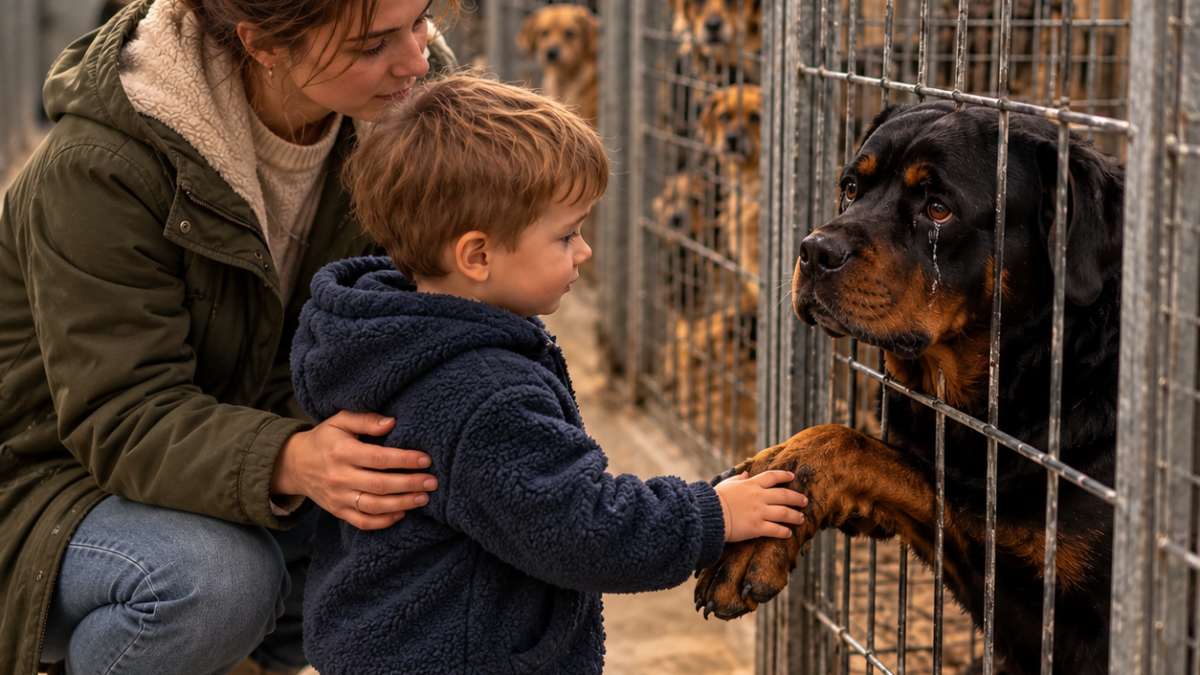
PART 2
I stood in the doorway for several seconds, listening.
Nothing.
The house was old enough to make noises. Pipes clicked when the heat came on. Wood shifted with temperature. Once, a squirrel had somehow gotten into the attic and spent three days convincing me a murderer lived above the guest room.
So I wasn’t immediately frightened.
“Baron.”
He didn’t look at me.
The growl stopped, but his ears remained forward.
I crossed the room and touched Noah’s forehead.
Normal.
Warm.
Sleeping.
Baron moved between me and the wall, sniffed near the baseboard, then looked upward.
“What is it?”
He obviously didn’t answer.
I turned on the closet light.
Shoes.
Toy bins.
A pile of blankets.
Nothing supernatural.
Nothing criminal.
Nothing remotely interesting.
Baron sniffed once more, then returned to Noah’s bedside and lay down.
I stared at him.
“You’re weird.”
His eyes closed.
That was our first night together.
I didn’t know yet that Baron’s refusal to leave Noah’s room would eventually become the reason my son was still alive and our house was still standing.
But I’m getting ahead of myself.
—
The next morning, Noah woke at 5:47 because apparently children have no respect for weekends.
I found him sitting on the floor beside Baron with a plastic plate and two toy pancakes.
“Breakfast,” Noah explained.
Baron looked deeply concerned.
“Those aren’t real.”
“I know.”
“Baron doesn’t.”
Noah held one up.
Baron sniffed it.
Then looked at me as though asking why I had brought him into a household where food was a lie.
I laughed.
That was the first sound Baron heard in our house that wasn’t cautious.
His ears lifted.
Then, slowly, his tail moved.
Noah cheered.
“He’s happy!”
Baron immediately stopped wagging, perhaps offended by the attention.
—
The shelter had warned me not to expect instant affection.
Baron had spent eight years with one family. Whatever they had done at the end, they had still been his entire world. He knew their voices, their routines, their home, their smells. Then one night he had been tied to a fence while the only people he understood drove away.
Dogs do not understand property transfers.
They understand absence.
For the first two weeks, Baron watched the front door constantly.
Whenever a car slowed outside, his head lifted.
Whenever a man’s voice came from the sidewalk, he stood.
The first time a dark SUV parked across the street, Baron walked to the window and remained there for almost twenty minutes.
Waiting.
That hurt more than I expected.
“That’s not them,” I whispered.
He stayed.
“They’re not coming.”
I regretted saying it the moment the words left my mouth.
Because I knew what waiting for someone who wasn’t coming felt like.
Noah’s father, Daniel, had died before Noah’s second birthday.
A drunk driver crossed the center line on a rainy night and hit Daniel’s car head-on. He died before I reached the hospital.
For almost a year afterward, I still occasionally woke believing I had heard his key in the front door.
Grief can make intelligent adults believe impossible things for half a second.
So when Baron watched cars, I stopped pulling him away.
I simply stood beside him.
“You can look.”
Eventually, he stopped.
—
Baron never became what people imagined when they heard “Rottweiler.”
He didn’t patrol the house.
Didn’t bark at mail carriers.
Didn’t charge fences.
He mostly wanted to sleep.
Preferably near Noah.
Always near Noah.
If Noah played in the living room, Baron lay beside the rug.
If Noah ate, Baron lay under his chair.
If Noah took a bath, Baron waited outside the bathroom.
If Noah slept, Baron stationed himself beside the bed.
At first I worried.
“Is this guarding behavior?” I asked Dr. Emily Carter, our veterinarian.
She watched Baron and Noah interact during his first checkup.
Noah was sitting on the floor coloring while Baron rested nearby.
“Could be attachment.”
“Is that bad?”
“Not necessarily.”
“What should I watch?”
“Stiffness around other people approaching Noah. Blocking. Growling at appropriate interaction. Resource guarding.”
“Baron?”
She smiled.
“No. Your son.”
I laughed.
Noah held up a crayon.
“Baron doesn’t eat purple.”
“Good,” Emily said. “Let’s keep it that way.”
—
The medical exam wasn’t terrible.
Baron had mild to moderate hip arthritis, dental tartar, an old scar across his shoulder, and irritation around both eyes.
That explained the “tears.”
He wasn’t literally crying.
His tear ducts were inflamed.
Still, Noah refused to accept that explanation.
“He was sad.”
Maybe both things could be true.
His bloodwork looked good.
Heart sounded strong.
Weight slightly high.
“Eight isn’t ancient for every dog,” Emily said. “But for a Rottweiler, he’s definitely senior.”
“How long?”
I hated myself for asking.
She understood.
“No one can tell you.”
“I know.”
“You might get five years.”
My chest lifted.
“You might get one.”
There it went again.
She put a hand on my arm.
“Don’t adopt seniors because you want a long future. Adopt them because the present still matters.”
I looked at Baron.
Noah had fallen asleep against his side in the examination room.
The present looked pretty good.
—
We started arthritis medication.
Dental care.
Short walks.
Weight loss.
Baron lost six pounds over three months.
I lost four because apparently an eighty-pound dog needing exercise is more effective than every gym membership I’ve ever purchased.
Noah rode in a stroller for longer walks and shouted motivational speeches.
“Go, Baron!”
Baron walked.
“You’re fast!”
Baron was not fast.
“You’re a race car!”
Baron looked embarrassed.
—
The first real breakthrough happened with a tennis ball.
I tossed it one afternoon without thinking.
Baron watched it roll across the yard.
No reaction.
Noah ran after it, picked it up, carried it back.
“Your turn.”
He placed it in front of Baron.
Baron sniffed.
Nothing.
Noah pushed it closer.
“Ball.”
Baron sighed.
Then, perhaps simply to end the conversation, picked it up.
Noah screamed with joy.
Baron dropped it immediately.
The next day, he picked it up twice.
A week later, he chased it.
Only about ten feet.
Still.
The first time I saw that enormous gray-muzzled dog run toward a ball with his ears back and tail wagging, I had to turn away for a second.
He wasn’t young again.
That isn’t how life works.
But he had remembered something.
Play.
—
Noah loved introducing Baron to strangers.
“This is my puppy.”
People would stare at the ninety-pound senior Rottweiler.
“Your puppy?”
“Yes.”
“How old?”
“Three.”
Baron was eight.
Noah was three.
In Noah’s mind, apparently age transferred through ownership.
I stopped correcting him.
—
The neighborhood took longer to accept Baron.
Mrs. Jenkins across the street saw him and immediately said:
“Those dogs are dangerous.”
I smiled politely.
“Some are. Some aren’t.”
“They’re bred to attack.”
“Noah is bred to eat crackers off the floor. Genetics are complicated.”
She didn’t appreciate that.
Baron ignored her.
Three weeks later, Mrs. Jenkins dropped her grocery bag in the driveway.
Baron calmly stood beside her while I helped pick up oranges.
She touched his head.
Once.
After that, she started keeping biscuits in her coat pocket.
Human beings are trainable too.
—
The strange behavior at Noah’s wall continued.
Not every night.
Maybe twice a week.
Baron would sniff near the same baseboard.
Sometimes stare toward the electrical outlet near the closet.
Once he scratched lightly at the carpet.
I inspected everything.
Nothing.
I even called an electrician.
He checked the outlet.
“Looks fine.”
“Dog keeps staring at it.”
He looked at Baron.
“Dogs stare at walls.”
“Helpful.”
“Could be mice.”
That made sense.
I bought humane traps for the basement.
Caught nothing.
Eventually I stopped worrying.
That would become one of the biggest regrets of my life.
—
Four months after adoption, Noah developed a terrible cold.
Nothing serious.
Runny nose.
Cough.
Low fever.
I put him to bed early.
At 2:13 a.m., Baron woke me.
Not by barking.
By hitting my bedroom door with his body.
Once.
Twice.
I sat up.
“What?”
Baron barked.
One sharp sound.
Then ran toward Noah’s room.
Every cell in my body went awake.
I followed.
Noah was asleep.
The room smelled strange.
Not smoke exactly.
Hot plastic.
Baron stood beside the closet outlet, barking.
I turned on the light.
A thin black line had appeared above the outlet cover.
Then I heard it.
Crackle.
I grabbed Noah.
“Out.”
Baron followed.
I called 911 from the driveway.
By the time firefighters arrived, smoke had begun spreading inside the wall.
An electrical connection had failed behind the outlet.
Insulation had started burning.
The fire captain later told me that if Baron hadn’t woken me, the flames could have spread upward into the wall cavity and attic before our smoke alarms reacted.
“How long?” I asked.
He shook his head.
“Impossible to say.”
“But bad?”
“Yes.”
I looked at Baron.
He was standing beside Noah in the driveway.
My son had one hand resting on his head.
The dog had been warning me for months.
I had called him weird.
—
The firefighter crouched.
“This your dog?”
Noah nodded.
“My puppy.”
The captain smiled.
“Good puppy.”
Baron’s tail moved once.
—
We stayed at a hotel for three nights while repairs were completed.
Baron refused the dog bed.
No surprise.
He slept beside Noah.
At 3:00 a.m. the first night, I woke and saw his silhouette against the hotel window.
I whispered:
“You knew.”
He looked toward me.
“You smelled it?”
Maybe.
He lay back down.
I got out of bed and sat beside him.
For the first time, I wrapped both arms around his neck.
Not cautiously.
Not like an adopter still learning boundaries.
Like family.
“Thank you.”
Baron leaned his weight against me.
Heavy.
Warm.
Real.
I cried into his fur.
He tolerated it with the weary dignity of an old dog who had survived worse.
—
The fire department posted a photograph after asking permission.
Nothing dramatic.
Noah in pajamas.
Baron beside him.
The caption said:
**Senior rescue dog alerts family to electrical fire before major damage occurs.**
The local news picked it up.
Then a larger page.
Then another.
Within three days, Baron’s picture had been shared tens of thousands of times.
People called him a hero.
The shelter received donations.
Senior-dog adoption inquiries increased.
Megan called me laughing.
“You broke the internet.”
“Baron did.”
“He still hates cameras?”
“Yes.”
“Perfect.”
I thought that was the end of the excitement.
It wasn’t.
—
The first message arrived on Friday.
Unknown Facebook account.
**That dog belongs to my family.**
I stared.
Then another message.
**You need to contact me immediately. Baron was never legally surrendered.**
My stomach turned cold.
I clicked the profile.
Mark Sullivan.
The name from Baron’s old microchip record.
His former owner.
I knew because the shelter had shown it to me while completing transfer paperwork.
He had abandoned Baron.
Now he was contacting me.
I blocked him.
Five minutes later, another account messaged.
A woman.
Jill Sullivan.
**We want our dog back.**
I took screenshots.
Called Megan.
Her first word:
“Seriously?”
“Yes.”
“Don’t respond.”
“I wasn’t planning to.”
“We have abandonment documentation.”
“Is that enough?”
“Yes.”
“You sound uncertain.”
“I’m calling our director.”
That did not make me feel better.
—
Mark called the shelter the next morning.
He claimed they’d never intended to permanently surrender Baron.
According to him, they’d experienced a “temporary housing crisis.”
Megan reminded him that he had tied Baron to the shelter gate at 2:08 a.m., driven away, ignored fourteen phone calls over three days, then eventually told staff he was “too old and too much work.”
Mark denied saying that.
The shelter had recorded the call.
Oops.
He changed his version.
They had been “emotionally overwhelmed.”
Then another version.
They thought Baron would be happier with someone else.
Megan asked why they now wanted him returned.
Mark answered:
“Because he’s our dog.”
Not:
We miss him.
Not:
We made a terrible mistake.
Our dog.
Ownership.
—
The shelter director contacted an attorney.
The advice was clear.
Baron had been legally transferred after abandonment procedures, mandatory hold, documented attempts to locate and contact the registered owners, and their explicit confirmation that they would not reclaim him.
My adoption was valid.
“Then why am I scared?” I asked Megan.
“Because people who don’t deserve power can still create stress.”
Good answer.
—
Two days later, Mark posted publicly.
A photograph of Baron from years earlier.
Younger.
No gray muzzle.
Standing beside two children.
Caption:
**Our beloved family dog Baron was taken from us during a difficult period and adopted out without our consent. After seeing him on the news, we’re fighting to bring him home.**
The comments exploded.
Some people believed him.
Some didn’t.
Someone found the shelter’s page.
Messages arrived.
“Dog thieves.”
“Return the family’s pet.”
Then others defended us.
It became ugly.
I deleted social media from my phone for three days.
Baron didn’t care.
Noah still called him “my puppy.”
That helped.
—
The shelter initially refused to make private records public.
Professionalism.
Privacy.
Correct.
Then Mark gave a television interview.
He cried.
Actual tears.
Said Baron had “escaped” during a move.
Claimed the shelter refused to cooperate when they searched.
That was a lie.
Not interpretation.
Lie.
The shelter board finally authorized a factual statement.
No insults.
No private address.
No drama.
Just timeline.
**2:08 a.m.: Vehicle arrives at shelter gate.**
**2:11 a.m.: Male dog tied to fence.**
**2:13 a.m.: Vehicle departs.**
Still images from security video.
Mark carrying Baron out of the SUV.
Jill standing beside him.
Mark tying the leash.
Both returning to the vehicle.
Driving away.
Then excerpts from the phone record.
**Shelter:** “Do you intend to reclaim Baron?”
**Mark:** “No. We got a younger dog. He’s old and has trouble getting around. We can’t deal with both.”
That was enough.
The internet reversed direction so fast it almost gave me whiplash.
I didn’t celebrate.
Public shame isn’t something I enjoy.
But lies should not be allowed to become truth simply because someone tells them emotionally on camera.
—
Mark deleted his interview.
Then he called me.
I hadn’t given him my number.
That frightened me.
“Sarah?”
“Do not call me.”
“Listen.”
“No.”
“You don’t understand.”
“I understand enough.”
“He was with us eight years.”
“And you tied him to a fence.”
Silence.
“We made a mistake.”
“Yes.”
“People make mistakes.”
“Yes.”
“We want to fix it.”
“By taking him away from the child he’s bonded with?”
“He bonded with our kids too.”
That hurt.
Because I knew it was probably true.
Baron had loved them.
Maybe still would.
Dogs don’t organize morality the way we do.
“Why now?” I asked.
“What?”
“You knew the shelter had him. You refused to take him. Why now?”
Silence.
Then:
“We saw what happened.”
“The fire?”
“Yes.”
I waited.
“He’s special.”
My anger became cold.
“He was special when you left him tied to a gate.”
Mark said nothing.
“Do not contact me again.”
I hung up.
—
Three nights later, someone knocked on my door at 8:40.
Noah was asleep.
Baron stood.
One bark.
I checked the doorbell camera.
Mark and Jill.
My heart slammed.
I called the police before opening anything.
Then I spoke through the door.
“Leave.”
Mark raised his hands toward the camera.
“We just want to see him.”
“No.”
“Sarah, please.”
“You were told not to contact me.”
“We drove two hours.”
“Drive back.”
Jill started crying.
“Please. Our children miss him.”
That sentence hurt more than I expected.
I looked toward Baron.
He stood in the hallway.
He heard their voices.
His ears lifted.
Then he walked toward the door.
My stomach twisted.
“Baron.”
He stopped.
Mark called from outside.
“Baron! Buddy!”
Baron’s tail moved.
Once.
My heart cracked.
Of course he remembered.
Eight years don’t disappear because someone behaved cruelly at the end.
Jill said:
“See? He knows us.”
I didn’t answer.
Baron approached the door.
Sniffed beneath it.
Then something happened I will never forget.
He stood there for maybe five seconds.
Listening.
Smelling.
Remembering.
Then he turned away.
Walked down the hallway.
Entered Noah’s room.
And lay beside his bed.
Mark continued calling.
Baron didn’t return.
I cried silently in the hallway.
Not because I thought Baron had chosen morally correct people.
Dogs don’t do courtroom verdicts.
But because whatever old scent had reached him through that door had not been enough to pull him away from the place he now felt safe.
—
Police arrived.
Mark argued.
Jill cried.
They left with a warning.
The next morning, I filed for a no-trespass order.
I felt guilty.
Then angry that I felt guilty.
—
The former owners filed a civil claim three weeks later.
Return of property.
Baron.
Property.
I hated the word.
Their attorney argued that the shelter’s abandonment process had been improper because the microchip remained in Mark’s name when Baron was adopted.
Our attorney produced the transfer documents.
Shelter records.
Phone calls.
Security footage.
Adoption contract.
Veterinary invoices paid by the shelter.
My adoption records.
The claim was weak.
Still, it dragged on for months.
Stress doesn’t have to be legally strong to be emotionally exhausting.
—
During that time, we learned more about Baron’s past.
Not because we went looking.
Because people came forward.
A former neighbor of the Sullivans contacted the shelter after seeing the news.
Her name was Denise.
She remembered Baron.
“He used to sleep on their front porch.”
“Was he treated badly?”
“Not when he was young.”
That answer bothered me.
“What changed?”
“They got busy. Kids got older. Baron slowed down.”
“Then?”
“They bought a Rottweiler puppy.”
There it was.
“Before abandoning Baron?”
“About three months before.”
“Did Baron and the puppy fight?”
“No. Baron mostly avoided him.”
“Why get rid of Baron?”
Denise sighed.
“Mark complained he was costing money.”
“What money?”
“Arthritis medication. Dental work. Something about a lump.”
I froze.
“A lump?”
“That’s what he said.”
No lump had been documented at Baron’s shelter intake.
Maybe benign.
Maybe gone.
Maybe simply another excuse.
Denise continued.
“He said he didn’t want to spend thousands on an old dog.”
The shelter had spent less than six hundred dollars stabilizing Baron before adoption.
We later spent more.
I would have spent more still.
That’s what caring for an aging animal means.
Not romantic.
Not cheap.
Love develops invoices.
—
Then another person contacted us.
A veterinary receptionist.
She couldn’t legally release medical records without proper authorization, so she encouraged investigators to request them during the civil discovery process.
Baron’s old clinic had records.
Years of them.
Vaccines.
Checkups.
Arthritis diagnosis.
Then one final appointment three weeks before abandonment.
Notes:
**Owner requesting euthanasia due age and inconvenience. No terminal medical indication. Discussed quality of life. Dog ambulatory, eating, interactive. Owner declined diagnostic work and left.**
I had to read it twice.
They had tried to have him euthanized.
Not because he was dying.
Because he was old and inconvenient.
The veterinarian refused.
Three weeks later, Baron was tied to the shelter gate.
My hands shook.
—
I did something then that I regret slightly.
I called Mark’s attorney.
Not Mark.
The attorney.
I left a message.
“Please tell your client that if he continues claiming Baron was stolen, the court will now see a veterinary note documenting that he requested euthanasia three weeks before abandoning him. We are prepared to introduce it.”
Our attorney later told me never to communicate independently again.
Fair.
But two days later, Mark withdrew the claim.
No hearing.
No dramatic judge.
Just withdrawal.
Sometimes evidence doesn’t need a courtroom.
It only needs to exist.
—
I thought that would be the satisfying ending.
It wasn’t.
Because Baron was changing.
He began limping more.
At first only after long walks.
Then mornings.
Then stairs.
Emily increased his arthritis management.
We added rugs across slippery floors.
Noah thought they were racetracks.
Baron thought they were wonderful.
I built a small ramp to the porch.
My brother laughed.
“That’s excessive.”
Then he watched Baron use it.
“Never mind.”
—
The local news eventually stopped caring.
Good.
Baron returned to being a dog.
Not hero.
Not disputed property.
Not viral senior rescue.
Dog.
He stole toast once.
Only once, because he learned I noticed.
He learned Noah dropped food under the table approximately every thirty seconds.
He learned the sound of the school bus long before Noah was old enough to ride it.
He learned that thunder meant Noah climbed into my bed and Baron followed.
He learned Christmas trees were not indoor bathrooms.
After one incident.
We all make mistakes.
—
Noah turned four.
Then five.
Baron attended both birthday parties.
At four, he wore a blue bandanna.
At five, a paper crown.
He hated the crown.
There is a photograph of him looking at me with such betrayal that I still laugh.
—
Baron became especially gentle with children.
Parents who had originally feared him began asking whether their kids could pet him.
I always supervised.
One child at a time.
Respectfully.
Baron would sit.
Children touched his shoulder.
Sometimes his ears.
Never climbing.
Never hugging unless he initiated closeness.
I became annoying about dog safety.
“No dog owes your child affection.”
That became my favorite sentence.
Because Baron was wonderful.
Still a dog.
—
Noah understood that better than most adults.
If Baron walked away, Noah let him.
If Baron slept, Noah didn’t climb on him.
If Baron wanted contact, he placed his enormous head in Noah’s lap.
They developed rules without language.
That bond became the center of our home.
—
At six, Noah began kindergarten.
The first morning, he cried.
Not at school.
At home.
“I don’t want Baron alone.”
I crouched.
“He’ll be okay.”
“He needs me.”
I looked at the dog.
Baron was sleeping.
“I’m pretty sure Baron needs approximately seven hours of uninterrupted napping.”
Noah didn’t laugh.
So we created a ritual.
Before school, Noah placed one treat in Baron’s bowl.
“Guard Mommy.”
Baron ate.
After school, Noah ran inside.
Baron met him at the door.
Not fast anymore.
But always.
—
That winter, Baron developed a mass.
This time real.
Near his shoulder.
My stomach dropped when I felt it.
Emily aspirated it.
Benign fatty tumor.
I almost collapsed from relief.
“Sarah.”
“What?”
“You look pale.”
“I hate aging.”
Emily looked at Baron.
“So does biology.”
Unhelpful.
True.
—
The following spring, animal control called me.
Not about Baron directly.
About the Sullivans.
I almost didn’t answer.
Mark and Jill’s younger Rottweiler, Diesel, had been found loose twice.
The second time, officers discovered he had an untreated skin infection and a chain wound around his neck from being tethered outside.
My anger returned instantly.
“What happened?”
“They surrendered him.”
“Voluntarily?”
“After citations.”
“Where is he?”
“County shelter.”
I sat down.
Another dog.
Another young animal once more exciting than Baron, now inconvenient in a different way.
“Can I see him?”
The officer hesitated.
“Why?”
“I don’t know.”
That was honest.
—
Diesel was three.
Beautiful.
Powerful.
Terrified.
He paced constantly.
His neck was raw.
The shelter told me he had poor leash training, high energy, no aggression history, and almost no indoor manners.
He was exactly what happens when people buy an impressive puppy without wanting the adult dog inside it.
Noah came with me.
He was six.
He stared through the kennel bars.
“Is that Baron’s brother?”
“No.”
“Friend?”
“Not really.”
“Why is he here?”
I didn’t want to tell a six-year-old every ugly detail.
“His family couldn’t take care of him.”
Noah looked at me.
“Baron’s family?”
“Yes.”
He became quiet.
Then:
“Can Baron meet him?”
I almost said no.
Then the shelter behaviorist said maybe.
Neutral introduction.
Careful.
—
Baron and Diesel met in a fenced yard.
Baron was twelve by then.
Gray face.
Slow hips.
Diesel circled nervously.
Pulled.
Whined.
Then he saw Baron.
Stopped.
Something changed.
Dogs are extraordinary at reading other dogs.
Baron stood still.
Diesel approached.
Sniffed.
Baron sniffed back.
No growling.
No posturing.
Then Baron walked away.
Diesel followed.
Again.
Baron stopped.
Diesel stopped.
Within ten minutes, the frantic younger dog had slowed his entire body to match the old dog’s pace.
The behaviorist whispered:
“That’s interesting.”
“What?”
“He’s regulating off Baron.”
I watched them.
The old dog the Sullivans discarded because they wanted a puppy was now teaching their replacement dog how to be calm.
If life has a sense of irony, it is occasionally cruel and perfect.
—
We could not adopt Diesel.
I knew that immediately.
Baron deserved peace.
I had one large dog.
A child.
A small house.
Sometimes love means not saying yes to everything.
But we fostered Diesel for three weeks through a rescue partner.
Baron taught him stairs.
Doorways.
Leashes.
That humans leaving the house sometimes came back.
Noah taught him balls.
I taught him that counters were not buffets.
He taught me that I was too old for high-energy Rottweilers.
—
A retired police officer named Thomas and his wife adopted Diesel.
Large fenced yard.
Breed experience.
No children at home.
They renamed him Duke.
I hated the name.
Not my dog.
Their choice.
Two months later, Thomas sent a video.
Duke asleep on a couch.
No chain.
No pacing.
Healthy neck.
I showed Baron.
He ignored it.
Again, dogs are humbling.
—
Animal control eventually brought misdemeanor neglect and tethering violations against Mark related to Duke’s condition.
The outcome wasn’t dramatic.
Fines.
Probation.
Mandatory compliance with animal-ownership restrictions.
Both Mark and Jill were placed on regional do-not-adopt lists used by several shelters and rescues.
They were prohibited from owning additional animals during the probation period.
Some people online wanted prison.
I didn’t.
I wanted no more dogs cycling through their idea of love until age or inconvenience made them disposable.
That outcome mattered more.
—
Mark sent one final letter.
Not to me.
To the shelter.
Megan forwarded it.
He wrote:
**I know everyone thinks we’re monsters. We loved Baron. We just couldn’t handle him getting old.**
I stared at that sentence.
Couldn’t handle him getting old.
As if aging were a betrayal.
As if Baron had violated some contract by becoming the inevitable future of every puppy.
The letter continued.
**Seeing him with Sarah’s son made me realize we gave up too early.**
Too early?
I almost laughed.
Then:
**I hope he’s happy.**
I didn’t answer.
But I looked at Baron sleeping under Noah’s desk.
Yes.
He was.
—
Baron’s thirteenth birthday was unofficial.
We didn’t know the exact date, so Noah chose one.
May 4.
Why?
“Because it’s sunny.”
Excellent methodology.
Noah made Baron a card.
It read:
**YOU ARE MY BEST PUPPY EVEN THOUGH YOU ARE VERY OLD.**
Baron ate the corner.
Sentimental.
—
By then, stairs were difficult.
I moved Noah’s bedroom downstairs.
Actually, I told Noah it was because he was “getting a bigger kid room.”
The real reason was Baron.
He could no longer climb upstairs comfortably, and Noah refused to sleep away from him.
So the dining room became Noah’s room.
My dining table moved to the kitchen.
We adapted.
Homes should serve the people and animals living in them, not the imaginary magazine photographs nobody takes.
—
Baron’s hearing faded.
At first I thought he was ignoring me.
Then I noticed he didn’t react to doorbells.
Or the vacuum.
Good side effect.
Noah learned hand signals with him.
Palm down meant stay.
Point toward bed meant settle.
Two taps on Noah’s chest meant come.
Baron understood.
Their language changed with age.
The relationship didn’t.
—
When Noah was eight, a boy at school called Baron “scary.”
Noah came home furious.
“He’s not scary.”
“He is big.”
“He’s nice.”
“Yes.”
“So why did he say that?”
“Because people make guesses based on what things look like.”
Noah thought.
“That’s dumb.”
“Frequently.”
He sat beside Baron.
The old dog rested his head on Noah’s leg.
“He doesn’t know Baron.”
“No.”
“That’s his problem.”
Correct.
—
At fourteen, Baron developed heart disease.
Not severe.
Medication.
Monitoring.
Then kidney values started creeping upward.
Emily became more serious during appointments.
I became more skilled at pretending I didn’t see her expression.
“Still eating?”
“Yes.”
“Walks?”
Short.
“Interest?”
Definitely.
“Pain?”
Managed.
Then okay.
Still life.
—
Noah was nine when Baron had his first collapse.
Backyard.
One second standing.
Next second down.
Noah screamed.
I ran.
Baron regained consciousness before we reached the emergency clinic.
Heart rhythm issue.
Medication adjusted.
“Is he dying?” Noah asked.
Emily knelt to his height.
“Not tonight.”
That answer was honest.
I loved her for it.
No promises.
No lies.
—
At home, Noah crawled beside Baron.
“You can’t die.”
I froze.
Baron licked his hand.
Noah started crying.
“You’re my first dog.”
I sat beside them.
“Hey.”
He looked at me.
“Everything we love eventually leaves in some way.”
Wrong sentence for a nine-year-old?
Maybe.
But Noah had already lost his father before he could remember him.
I refused to make death a secret.
“That doesn’t mean we spend the good days afraid of the last one.”
He wiped his face.
“How many good days?”
“I don’t know.”
Baron sighed.
Noah whispered:
“Then we use all of them.”
Yes.
—
We did.
Short walks.
Sun on the porch.
Chicken mixed into food.
No unnecessary rules.
Baron became shameless.
He had spent years respecting the kitchen.
At fourteen, apparently morality expired.
He stole half a sandwich from Noah.
We applauded.
—
The fire captain who had met Baron years earlier visited once.
He was retired.
Saw our address on a community post.
Brought biscuits.
Baron barely heard him.
But recognized something.
Smell?
Voice vibration?
Who knows.
Tail.
Slow.
The captain crouched.
“You saved your people, big guy.”
Baron accepted the biscuit.
Heroism requires snacks.
—
Megan visited too.
Still working at the shelter.
She sat beside Baron.
“You know how many senior dogs got adopted because of you?”
I looked up.
“What?”
She smiled.
“After the fire story, people started asking for older dogs.”
“How many?”
“Can’t count exactly.”
Baron slept.
Megan touched his paw.
“You were good advertising.”
I laughed.
The dog nobody wanted because everyone wanted puppies had helped other old dogs go home.
That felt like a circle closing.
—
One of those dogs was a twelve-year-old beagle named Mabel.
Adopted by a widow.
Another, a ten-year-old pit bull, went home with a retired teacher.
An eleven-year-old shepherd found a family after two years in rescue.
Baron knew none of this.
Didn’t need to.
Legacy is a human concept.
Dogs just live.
—
Baron’s final winter was gentle.
Snow.
Heat running.
Orthopedic beds in three rooms.
He used whichever one was least convenient.
Noah slept beside him on the floor more than once.
I bought a camping mattress so my child wouldn’t destroy his spine for love.
Practical romance.
—
Then one February morning, Baron refused breakfast.
I knew immediately.
Dogs can skip food.
Baron could not.
Chicken?
No.
Cheese?
No.
Noah offered toast.
Nothing.
I called Emily.
Bloodwork.
Kidney failure progressing.
Heart disease worse.
Fluid around the lungs beginning.
We could hospitalize.
Aggressive treatment might buy time.
Maybe days.
Maybe weeks.
At fourteen and with multiple systems declining, Emily looked at me and asked the question every loving owner hates.
“What are we buying the time for?”
I cried.
Not quietly.
Noah held my hand.
Baron rested on the blanket.
—
We brought him home.
Medication for comfort.
One good day.
Maybe two.
I informed school Noah would be absent.
No explanation necessary.
Some things are education.
—
People came.
Megan.
My brother.
Mrs. Jenkins from across the street, the woman who once said Rottweilers were dangerous.
She brought a biscuit.
Baron couldn’t eat it.
She cried.
“I was wrong about you.”
Baron slept.
No forgiveness ceremony.
No need.
—
Thomas brought Duke.
I wasn’t sure.
Emily said brief and calm was okay.
Duke was seven now.
Still huge.
Healthy.
He entered the yard and immediately slowed when he saw Baron.
Approached.
Sniffed.
Baron lifted his head.
Their noses touched.
Duke lay down beside him.
For ten minutes, neither moved.
Then Thomas took Duke home.
Noah watched from the porch.
“Does he know?”
“What?”
“That Baron is dying?”
“I don’t know.”
Maybe.
—
That evening, Noah brought Baron’s old blue bandanna.
The one from his fourth birthday.
Faded.
Too tight now because Baron’s neck had changed with age.
He laid it beside him.
“Remember?”
Baron opened one eye.
Noah laughed through tears.
“You hated it.”
Correct.
—
At 2:00 a.m., Baron’s breathing worsened.
I called Emily.
She came to the house.
Same house Baron once saved.
Same room beside Noah where he had refused to sleep anywhere else.
We placed his bed beside Noah’s.
I wanted him exactly where he’d always chosen to be.
—
Emily listened to his chest.
Then looked at me.
“Now.”
I nodded.
Noah was awake.
He knew.
I had asked whether he wanted to stay.
“Yes.”
No hesitation.
He sat beside Baron.
Now nine years old.
His hand no longer tiny enough to disappear beneath Baron’s paw.
Almost.
—
I touched the gray muzzle.
“You were supposed to be a puppy.”
Noah laughed.
Baron’s eyes moved toward me.
“I had a plan.”
Noah said:
“He was better.”
“Yes.”
Much.
—
Emily gave the sedative.
Baron relaxed.
Noah placed both hands over Baron’s paw.
Exactly the way he had at the shelter.
I saw it.
Three-year-old Noah.
Tiny hands.
Huge paw.
**Don’t be scared. I came for you.**
The memory hit so hard I couldn’t breathe.
Noah whispered:
“Baron?”
His voice broke.
“You don’t have to be scared.”
I covered my mouth.
“I came for you.”
Baron’s tail moved.
Once.
One slow tap against the blanket.
Megan later told me Baron hadn’t wagged for a month before Noah touched him at the shelter.
Now, at the end, he did it again.
For Noah.
—
I bent down.
“You saved him.”
I kissed Baron’s forehead.
“You saved me too.”
Because he had.
Not from fire only.
From the years after Daniel died when I had become a machine for surviving.
Work.
Parent.
Bills.
Sleep.
Repeat.
Baron brought walks.
Neighbors.
Shelter people.
Laughter.
Dog hair.
Emergency vet bills.
Mud.
Noise.
Fear.
Life.
—
Emily prepared the final medication.
I put one hand on his chest.
Noah held his paw.
“You don’t have to watch the wall anymore,” I whispered.
His breathing slowed.
“No more stairs.”
Another breath.
“No more arthritis.”
Noah’s tears dropped onto Baron’s fur.
“No more waiting for the people who left.”
I looked toward my son.
“You’re home.”
One breath.
Then stillness.
—
For several minutes, nobody moved.
Noah eventually leaned over and pressed his face into Baron’s neck.
“He’s still warm.”
“Yes.”
“When does that stop?”
“Slowly.”
I hated that answer.
It was true.
—
We let Noah stay as long as he wanted.
No rushing.
No hiding.
No pretending.
Baron had once been abandoned without understanding why.
He would not disappear from Noah’s life behind a closed veterinary door.
Noah would know.
Love includes explanation when possible.
—
Baron was cremated.
We kept most of his ashes.
Some went beneath the maple tree in our backyard.
The same yard where he learned to chase a tennis ball again.
Noah chose the stone.
It read:
**BARON**
**MY FIRST PUPPY**
**HE WAITED FOR US.
THEN HE SAVED US.
THEN HE STAYED AS LONG AS HE COULD.**
I suggested removing “puppy.”
Noah refused.
Correct decision.
—
The shelter asked permission to put Baron’s photograph near the senior-dog section.
Not the fire picture.
Not a dramatic one.
The photograph from his first month with us.
Gray muzzle.
Noah asleep beside him.
Baron awake.
Watching.
Under it:
**OLDER DOESN’T MEAN FINISHED.**
Perfect.
—
Mark never contacted me again.
I learned through animal control that his probation ended years later.
No additional animals registered to the household.
Good.
That was enough.
I stopped caring whether he regretted Baron.
Regret is useful only if it changes what you do next.
His feelings no longer mattered to our family.
—
Years later, when Noah was twelve, we went back to the shelter.
Not because I was ready.
Because he asked.
The puppy room was still loud.
He walked past it.
Of course.
My stomach twisted.
History.
He went toward the senior wing.
Megan was still there.
Older.
Gray in her hair.
She laughed when she saw him.
“No.”
Noah smiled.
“What?”
“You’re going to ruin your mother’s life again.”
“Probably.”
We stopped in front of an eleven-year-old mixed-breed dog named Daisy.
Small this time.
Thank God.
Noah crouched.
Daisy stayed in the back.
Didn’t approach.
He sat.
Waited.
Five minutes.
Ten.
Then Daisy came forward.
Placed one paw near the bars.
Noah looked at me.
I started crying before he spoke.
“Mom.”
“No.”
“You don’t know what I’m going to say.”
“Yes, I do.”
He smiled.
“Everyone wants the young dogs.”
I covered my face.
Megan laughed.
—
We adopted Daisy.
Of course.
She lived four years.
Different dog.
Different story.
No fire.
No legal battle.
No viral news.
Just four wonderful ordinary years.
And that’s important too.
Not every old dog needs to become a hero to deserve a home.
They don’t need to save a child.
Detect a fire.
Protect a family.
Go viral.
They only need to be alive.
That should be enough.
—
But Baron did become a hero.
Accidentally.
The irony never left me.
His first family decided he wasn’t worth keeping because he was old.
They replaced him with a puppy.
The child who chose him didn’t care about age.
He saw one thing.
“He’s alone.”
That’s all.
A three-year-old understood what adults had complicated.
—
People sometimes ask whether I think Noah somehow “knew” Baron was special.
No.
I don’t believe in magical dog selection.
I think Noah saw sadness without knowing the word for it.
Children sometimes respond to what adults train themselves to ignore.
The puppies were happy.
Baron wasn’t.
Noah noticed.
That’s enough.
—
The original shelter security photograph still exists.
Baron tied to the gate.
Headlights leaving.
I have never shown Noah.
He doesn’t need it.
Our photographs are different.
Baron in the back seat.
Baron wearing a crown.
Baron stealing toast.
Baron beside the Christmas tree.
Baron with Duke.
Baron sleeping outside Noah’s room.
Baron gray.
Baron old.
Baron home.
Those are the pictures that deserve space.
—
The fire left a scar inside Noah’s bedroom wall.
Repair workers covered it.
Painted.
You’d never know.
When Noah eventually moved upstairs again after Baron died, he asked me not to put anything over that spot.
“Why?”
“Because Baron found it.”
So the wall stayed empty.
No picture.
No shelf.
Just paint.
A blank space representing a dog who noticed danger before any human in the house did.
—
When Noah turned sixteen, he volunteered at the shelter.
Senior wing.
Naturally.
He came home smelling like bleach and dogs.
Baron would have approved.
One evening he said:
“Remember when I picked him?”
“Yes.”
“I don’t really.”
That hurt.
He was three.
Of course he didn’t.
“You remember the story.”
“Yeah.”
He looked toward Baron’s photograph.
“Do you?”
“Every second.”
He smiled.
“Good.”
“Why good?”
“Then somebody remembers for both of us.”
That sentence nearly destroyed me.
—
So I remember.
I remember the kennel.
The gray muzzle.
The wet eyes.
The huge paw through the bars.
My son’s tiny hands.
I remember trying to redirect him toward puppies because I thought I knew what would make him happy.
I remember being wrong.
I remember Baron’s first tail wag.
The ride home.
The growl at the wall.
The smell of burning plastic.
The firefighters.
The viral article.
The people who came back only after the world called him special.
The legal letters.
The security footage.
The old veterinary record.
The young dog who replaced him.
The day Baron quietly taught that dog how to slow down.
The final night.
The final tail tap.
All of it.
—
Was there revenge?
Yes.
But not the kind people expect.
Mark and Jill abandoned Baron because they believed age had reduced his value.
Then the old dog they discarded became more loved than they could have imagined.
Their public lie collapsed under the video of their own actions.
Their attempt to reclaim him failed.
The younger dog they chose over Baron was eventually removed from their care and found a better home.
Their access to additional animals was restricted.
The shelter changed its procedures.
Senior adoptions increased.
Baron’s story helped old dogs they would never meet.
That is enough justice.
More than enough.
—
The better revenge was time.
Baron got years.
Not endless years.
Enough.
Years of Noah.
Years of soft beds.
Years of arthritis medication hidden in cheese.
Years of Mrs. Jenkins carrying biscuits in her pocket.
Years of stealing food under a toddler’s chair.
Years of learning a tennis ball could still matter at eight.
Years of growing older in a home where old age was not treated like failure.
The people who abandoned him thought becoming old made him disposable.
We let him become even older.
That feels like the perfect answer.
—
I used to think adoption stories were about rescue.
One side saves the other.
Simple.
Then Baron complicated that.
We saved him from a kennel.
He saved us from a fire.
Noah saved him from being overlooked.
Baron saved Noah from learning that only young, cute things deserve love.
And all three of us pulled each other through grief in different ways.
There was no single rescuer.
Just a family forming badly, unexpectedly, perfectly.
—
If I could go back to the first moment in the shelter, I would not change anything.
Not even my hesitation.
Because my hesitation makes Noah’s certainty more beautiful.
I was the adult.
I had read articles.
Made lists.
Researched puppies.
Thought about training schedules and energy levels.
My three-year-old had one question:
“Who is alone?”
Then he chose accordingly.
Sometimes compassion is smarter before adults teach it to calculate.
—
The last time I visited Baron’s stone alone, I sat under the maple tree.
Noah was at school.
Daisy had already died by then.
The yard was quiet.
I touched the words:
**MY FIRST PUPPY**
I laughed.
“You were never a puppy with us.”
Wind moved the leaves.
For half a second, I could almost imagine his nails clicking across the porch.
Grief does that.
Even years later.
Then I said aloud:
“But he was right.”
Baron had been Noah’s puppy.
Not by age.
By beginning.
The first dog.
The first animal Noah chose.
The first creature who taught him that love isn’t about getting something new.
Sometimes it’s about seeing what everyone else keeps walking past.
—
That is how I remember Baron now.
Not as the dog tied to a shelter gate.
Not as the senior nobody wanted.
Not as the Rottweiler people feared.
Not even as the hero who smelled a fire before we did.
I remember him lying in the back seat on adoption day while my three-year-old son slept against his side, both of them trusting a future none of us could see yet.
Baron looked out the window the whole way home.
Maybe he was still searching for the car that had left him.
Maybe he wondered where we were taking him.
Maybe I am giving a dog too many human thoughts.
I don’t know.
What I do know is that when we reached our driveway and I opened the back door, Baron looked at Noah before he looked at me.
Noah woke, wrapped both arms around his neck, and said:
“We’re home.”
At the time, I thought he was telling Baron where we were.
Years later, I understood he was making a promise.
And this time, nobody broke it.


