PART 2: My 27 Cows Refused Our Brand-New Well for 3 Days—Then a Lab Test Made the Richest Rancher in the County Stop Smiling
PART 2
“No.”
The word came out too fast.
I gripped the phone harder.
“No one. Not me. Not Nora. Not the cows.”
Laurel exhaled.
“Good.”
“What did you find?”
“I need to confirm it.”
“You called me at eight in the morning to tell me not to touch my own well. You already found something.”
“I found something on the first run. I need a second method before I tell you what I think it is.”
“What kind of something?”
“Willa.”
Her voice was calm but no longer casual.
“Keep that well shut.”
I looked through my kitchen window.
The east pasture was already bright under the morning sun. Clover stood beneath the cottonwoods, chewing slowly.
The new wellhead sat beyond the barn.
Clean steel casing.
New concrete pad.
Eighteen thousand borrowed dollars.
“Is it dangerous?”
“I am not going to answer that until I verify.”
“That sounds like yes.”
“It sounds like I’m trying not to give you bad information.”
“When will you call?”
“Soon.”
She hung up.
I stood there listening to the dead line.
The kitchen suddenly felt too quiet.
My daughter, Nora, had been living in Billings for almost two years while training as a surgical technician. She still came home every few weekends, and I had almost bragged to her about the new well when drilling finished.
I had imagined turning on the tap and saying, Look. We’re going to be okay.
Instead I called her.
She answered sleepy.
“Mom?”
“Did you drink water here last weekend?”
“What?”
“At the ranch.”
“I don’t know. Probably.”
“From where?”
“Kitchen?”
“The kitchen is still on the old shallow line.”
“Why?”
I shut my eyes.
“Nothing. I’m checking something.”
That woke her.
“Mom.”
“I’m fine.”
“That usually means you’re absolutely not fine.”
“The new well has an issue. Nobody drank from it.”
“What issue?”
“I don’t know yet.”
There was a pause.
“Should I come home?”
“No.”
“Are you sure?”
“Yes.”
I did not want her there until I understood what I was dealing with.
That sentence would repeat itself many times over the next year.
I spent the morning hauling water.
At eleven, Laurel Finch drove up my road herself.
Her sedan had three coolers strapped into the back seat.
She climbed out wearing jeans, work boots, and the expression of somebody who did not enjoy being right.
“You came all the way out here?”
“I want my own sample.”
That scared me more than the phone call.
I showed her the well.
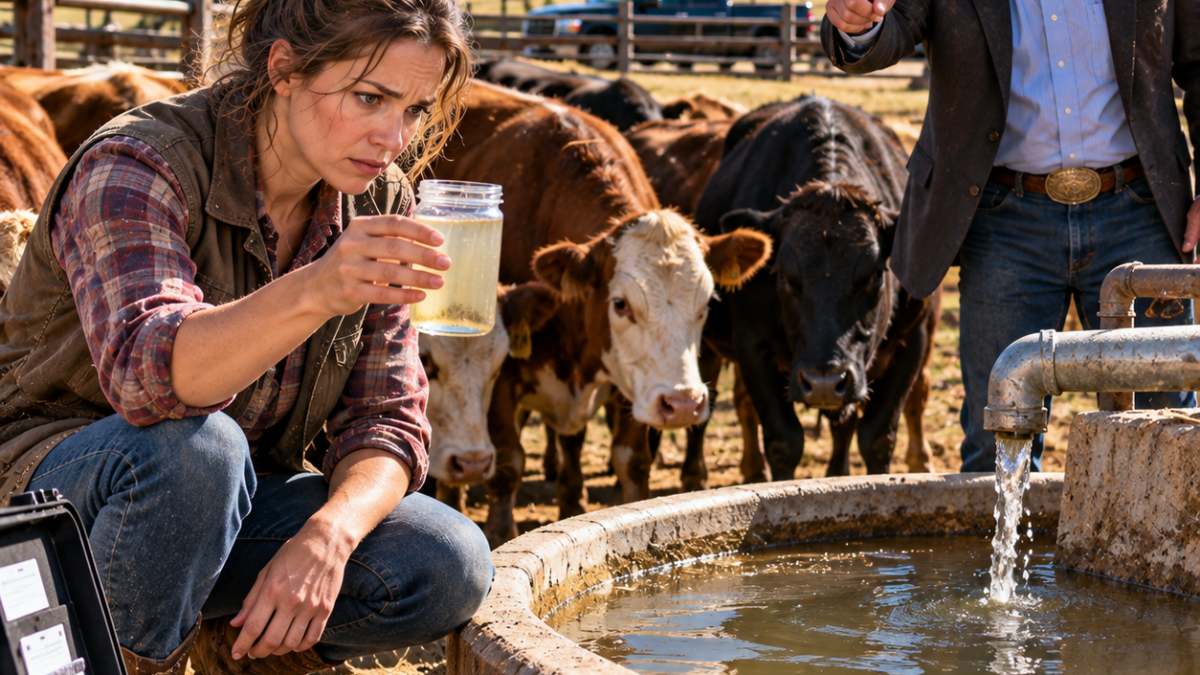
She purged the line for almost twenty minutes, filled glass vials with no air bubbles, labeled everything, placed them into coolers, and sealed them.
Only then did she sit beside me on the tailgate of my pickup.
“What?”
She removed her glasses.
“The first sample showed trichloroethylene.”
I stared.
“You’re going to have to translate that.”
“TCE. Industrial solvent. Used heavily for degreasing metal.”
“On a ranch?”
“It shouldn’t be here.”
“How much?”
“Several times the federal drinking-water limit.”
I looked toward the well.
“Could drilling have caused it?”
“The well could have connected you to contaminated groundwater. It did not manufacture the chemical.”
“Can cattle drink it?”
“No.”
“Can I use it for washing?”
“No.”
“Cleaning the parlor?”
“No.”
“Anything?”
“No.”
That answer hit harder than the chemical name.
Laurel continued carefully.
“The first sample also contained breakdown products.”
“What does that mean?”
“TCE degrades over time. Those compounds suggest this isn’t something that entered the water last week.”
“How long?”
“I cannot date it from one sample.”
“But old.”
“Potentially.”
I stared at the pasture.
Clover flicked flies with her tail.
“The cows smelled it.”
“Maybe.”
“You’re telling me they knew?”
“I’m telling you they detected something they didn’t like.”
She pointed toward me.
“Do not turn that into magic. They didn’t perform chemistry. Maybe odor. Maybe taste. Maybe another property of the water.”
“They saved me from using it.”
“They gave you a reason to ask a question.”
I nodded.
Fair.
Laurel pulled out a notebook.
“Has there ever been industrial activity on your land?”
“No.”
“Repair shop?”
“No.”
“Fuel storage?”
“Diesel for tractors. Nothing like what you’re describing.”
“Dump?”
“No.”
“Old machinery yard?”
“No.”
“What about neighbors?”
I almost laughed.
“This is cattle country.”
“Anything within three miles?”
“Hay ground. Abandoned church. Whitmore pasture.”
Her pen stopped.
“How much Whitmore ground?”
I pointed.
“Most of everything northwest.”
Laurel looked toward the hills.
Then she pulled an aquifer map from her bag.
It was folded into quarters.
She spread it over my hood and weighted the corners with two sample bottles.
For almost ten minutes she followed contour lines.
Finally she tapped one.
“Groundwater in the deep unit under your well appears to move southeast.”
“From where?”
She traced backward.
Northwest.
The line disappeared beneath Whitmore property.
I looked at her.
She raised a hand immediately.
“This is not proof.”
“But.”
“But if your sample confirms, we look upgradient.”
“At Whitmore.”
“At whoever is upgradient.”
“That’s Whitmore.”
“Willa, maps are models. Groundwater is complicated.”
I nodded.
“Do you think it’s coincidence?”
She folded the map.
“I’ve been doing environmental chemistry nineteen years.”
“That isn’t an answer.”
“No.”
She looked at the new well.
“I don’t like coincidences that line up this neatly.”
The news traveled before the lab report did.
By Friday, people in town knew my new well was bad.
By Monday, they knew it was contaminated.
By Tuesday, the story had somehow become that I had contaminated it by hiring the wrong driller.
Preston never said that directly.
He did something more effective.
He expressed concern.
At the feed store, he reportedly told three men how unfortunate it was when inexperienced drilling disturbed old material and carried surface contaminants into a clean aquifer.
At the café, he said improperly developed wells could produce all kinds of misleading results.
People repeated the sentences without his name attached.
Then one of my milk buyers called.
“Just checking.”
“Checking what?”
“Whether you’ve had a water issue.”
“The milk never touched that water.”
“I know.”
“My parlor is still supplied from the old system.”
“I know.”
“Then why are you calling?”
He hesitated.
“Customers get nervous.”
That was the beginning.
Four days after Laurel’s visit, I received a letter from Daphne Whitmore.
Preston’s daughter.
Thirty-four.
Attorney.
In-house counsel for Whitmore Cattle Holdings.
The paper was thick enough to have opinions.
The letter informed me that any public statement attributing contamination to Whitmore property without competent evidence could be defamatory.
I read it twice.
Then placed it beneath the salt shaker with my power bill.
It belonged there.
Laurel called that evening.
“Confirmation is back.”
“And?”
“Same compounds. Similar concentrations.”
My stomach tightened.
“So it’s real.”
“Yes.”
“What happens now?”
“We find out whether you’re the only one.”
I did not understand what she meant until she started calling neighboring landowners.
She offered free screening using part of her own discretionary lab budget.
Most people said no.
I could not blame them.
Testing creates knowledge.
Knowledge creates obligations.
A rancher who discovers contaminated groundwater does not magically receive money to fix it.
Sometimes not knowing feels cheaper.
Evelyn Shaw agreed.
She lived almost two miles southeast of me.
Sixty-three.
Hard woman.
Owned one hundred forty acres once.
Now sixty.
The rest had been sold years earlier.
Nine days after Laurel sampled her well, she called me.
“Same chemical.”
“How much?”
“Lower concentration.”
“How much lower?”
“About a third of yours.”
My hands went cold.
“Same breakdown compounds?”
“Yes.”
“So it’s moving.”
“It looks like a plume.”
That was the first time I heard the word.
Plume.
It sounded soft.
Almost beautiful.
There is nothing beautiful about contaminated groundwater moving beneath people who do not know it is there.
Laurel explained.
“One well can be local. Two wells nearly two miles apart with the same chemical pattern along predicted groundwater flow is different.”
“What do we do?”
“History.”
“Meaning?”
“Chemicals don’t appear without a source.”
She spent days in county records.
Old leases.
Waste permits.
Corporate filings.
Business licenses.
Hauling manifests.
One Thursday night she called.
“You know Cordell Industrial Services?”
“No.”
“They operated nineteen to twenty years ago.”
“What did they do?”
“Transported spent degreasing solvent.”
I sat down.
“Where?”
“Their filings list a staging location.”
I waited.
“Whitmore north section.”
For a long moment, I could hear nothing except my refrigerator humming.
“Owned by Whitmore?”
“For twenty-two years.”
“Do we have proof they dumped anything?”
“No.”
“Then what do we have?”
“A place to look.”
I drove to Evelyn Shaw’s that Sunday.
Brought two loaves of bread because showing up empty-handed felt wrong.
She left me on her porch nearly a minute.
Finally opened the door.
“I don’t want trouble.”
“Neither do I.”
“Then why are you here?”
“Because Laurel found the same solvent in your well.”
Evelyn’s face changed.
“Come in.”
Her kitchen smelled like coffee and cinnamon.
We sat across from each other.
She told me that twelve years earlier several wells south of Whitmore ground had started tasting strange.
“Strange how?”
“Chemical.”
“Did anyone test?”
“Full tests cost money.”
“Anybody complain?”
“To who?”
I had no answer.
She stirred coffee.
“My granddaughter wouldn’t drink from the tap. Said it tasted like a swimming pool.”
“What did you do?”
“Bought bottled water.”
“For how long?”
“Years.”
“Why didn’t you tell someone?”
Her eyes hardened.
“Tell them what? That coffee tasted funny?”
I looked down.
“Sorry.”
She softened slightly.
“People out here solve what they can afford.”
Then she named four families who had sold.
One after another.
Different years.
Different reasons.
Retirement.
Debt.
Bad water.
Weak cattle prices.
I wrote names.
“Who bought?”
She smiled without humor.
“You know.”
Whitmore.
Or companies that later turned out to share Whitmore’s registered agent.
“What did they pay?”
“Not much.”
“Did they know about the wells?”
Evelyn looked at me.
“They always seemed to know exactly which places were getting hard to keep.”
I drove home with that sentence in my head.
Two nights later, Caleb Ror arrived after dark.
He did not come inside.
He stood in the barn doorway holding his hat with both hands.
“You have something to tell me.”
He looked toward the cows.
“Eleven years ago, Whitmore hired me.”
“For what?”
“Monitoring wells.”
My stomach dropped.
“How many?”
“Four.”
“Where?”
“North grazing section.”
“Cordell site?”
“I didn’t know that name then.”
“Who sampled?”
“Consulting company from Denver.”
“What were they testing?”
“They never told me.”
“You never asked?”
“I asked.”
“And?”
Caleb stared at the floor.
“They said groundwater quality.”
“What happened?”
“They sampled. Two weeks later, Whitmore paid me.”
“That’s it?”
“Confidentiality agreement.”
I stared.
“You signed one.”
“My wife was sick.”
He said it quietly.
“She had cancer. I had bills. Whitmore was half my business at the time.”
I wanted to be angry.
Part of me was.
Then I saw his hands shaking.
“They ever hire you again?”
“No.”
“Why?”
He gave a small bitter laugh.
“Maybe I knew too much. Maybe somebody cheaper came along.”
“Why tell me now?”
“Because I drilled your well.”
“That wasn’t your fault.”
“Doesn’t feel that way.”
He put his hat on.
“Gray layer.”
“What about it?”
“When we drilled through that shale, I kept thinking I’d seen that geology before.”
“On Whitmore land.”
“Yes.”
“So the shallow and deep water are separated.”
“That’s what that layer does.”
“And I punched through it.”
“Yes.”
He looked toward the east field.
“You may have opened into the same deep zone they were monitoring.”
That night, I called an attorney.
Grant Bellamy.
Forty-three.
Office above a tax preparer in town.
He took contingency plus two thousand up front.
I did not have two thousand.
I sold my father’s welder.
Nora called when she found out.
“You sold Grandpa’s Miller?”
“Yes.”
“You loved that welder.”
“It was a machine.”
“That’s what you say when something hurts.”
I sat at the kitchen table.
“Nora.”
“Do you want money?”
“No.”
“I have some.”
“No.”
“Mom.”
“I am not taking your school money to fight a cattle company.”
“Why is that different from selling Grandpa’s welder?”
“Because I’m your mother.”
She was silent.
“That’s not an argument.”
“It is tonight.”
Grant’s first advice was disappointing.
“We need to separate what feels wrong from what we can prove.”
“They knew.”
“Maybe.”
“They drilled monitoring wells.”
“That proves they investigated.”
“Why would they investigate?”
“Good question. Not evidence.”
“They bought properties along the plume.”
“Buying cheap property isn’t illegal.”
“They threatened me.”
“You received a defamation warning. Annoying, not necessarily illegal.”
I hated him for about five minutes.
Then understood why I needed him.
“What matters?”
“Knowledge of a release. Duty to report. Failure to act. Concealment. Misrepresentation. Anything showing they knew contamination was moving off-site.”
“How do we get that?”
“Slowly.”
The old Cordell lease gave us a foothold.
Whitmore had leased eleven acres to the company for six years.
The stated purpose was staging equipment and containerized materials.
Grant stared at the rent figure.
“That’s high.”
“How high?”
“Too high for parking equipment.”
He filed records requests with state agencies.
County.
Environmental offices.
Then we waited.
Waiting became unbearable because Preston stopped waiting.
My feed dealer called.
“Willa, I need you on cash terms.”
“I’ve had thirty-day credit for nine years.”
“I know.”
“Did I miss a payment?”
“No.”
“Then why?”
He exhaled.
“I’m sorry.”
“Whitmore?”
“I didn’t say that.”
“You didn’t have to.”
Caleb called a week later.
A maintenance contract he had held through a Whitmore affiliate would not be renewed.
“I’m going to be unavailable for a while.”
“Caleb, don’t disappear.”
“I have employees.”
“I know.”
“I have to feed them.”
“I know.”
“Doesn’t mean I’m changing what I told you.”
“I know.”
He sounded ashamed anyway.
Then the bank letter came.
My mortgage note had been sold.
New servicer.
Review for compliance with agricultural covenants.
I searched the company.
Four clicks.
Managing member.
Whitmore.
I called Grant.
“They bought my debt.”
“Looks that way.”
“Can they foreclose?”
“Not because they feel like it.”
“Can they make my life miserable?”
“Yes.”
At least he was honest.
The high school gymnasium meeting happened in September.
Officially about drought response.
Everybody knew it was about me.
Preston stood beneath the basketball hoop.
He spoke for twenty minutes.
Jobs.
Taxes.
Feed contracts.
Local economy.
He never said my name.
Then he warned about irresponsible accusations.
“A single unverified claim can damage more families than drought.”
People nodded.
He mentioned a ranch family that had been offered generous assistance and refused.
“Sometimes,” he said, “not everyone wants to be saved.”
The room made a low agreeing sound.
I sat three rows from the back.
My hands stayed flat on my knees.
Preston looked directly at me once.
Only once.
He knew exactly what he was doing.
Afterward, Nora called.
She had heard about the meeting from somebody online.
“Come to Billings.”
“No.”
“For a week.”
“No.”
“Mom, they’re isolating you.”
“I know.”
“That’s what scares me.”
I swallowed.
“Me too.”
That was the first time I admitted it.
The next weeks were worse.
My main milk buyer suspended me.
Not because of contamination in the product.
I had documentation proving every gallon of wash water and herd water came from certified hauled supply.
It did not matter.
“We need to manage perception.”
I almost laughed.
“Perception doesn’t pay my hauling bill.”
“I’m sorry.”
The hauling bill reached nineteen hundred dollars that month.
I sold four cows.
I did not watch the trailer leave.
Clover stood at the fence calling after them.
That hurt more than I expected.
One October night, two sections of my east fence went down.
Eleven cows got onto the county road.
I spent until three in the morning walking the shoulder with a flashlight.
I found the last heifer in a ditch half a mile away.
The posts were old.
Wire was tired.
No clean cuts.
No proof anyone had touched anything.
That uncertainty was its own kind of cruelty.
I never knew whether it was sabotage or simply a neglected fence finally failing at the worst possible time.
Two days later, Preston knocked on my kitchen door.
Alone.
No Daphne.
No witnesses.
I let him in.
He sat at my table.
Placed a folder between us.
“One hundred fifty thousand.”
I stared.
“Funds within seventy-two hours.”
“Why are you here?”
“To end this.”
“Your problem or mine?”
“Both.”
He slid the papers toward me.
“You keep the house and two acres if you want.”
“What do you get?”
“The rest.”
“And?”
“Withdrawal of complaints.”
I looked at him.
“There it is.”
“Willa.”
“No testing?”
“We decline participation in speculative testing programs.”
“Release?”
“Routine.”
I opened the folder.
I was too tired to read properly.
One hundred fifty thousand.
Enough to satisfy the note.
Enough to move the remaining herd.
Enough to stop paying trucks.
Enough to breathe.
For the first time, I understood how people sold to Whitmore.
It was not always greed.
Sometimes exhaustion signs paperwork.
“I’ll have Grant look at it.”
Preston smiled.
“Of course.”
He sounded like the lawyer was ceremonial.
Grant called at seven the next morning.
“Do not sign.”
“What did you find?”
“The release.”
“Preston said it was routine.”
“Preston is lying.”
I closed my eyes.
“How bad?”
“It releases every environmental claim. Known or unknown. Yours and your heirs.”
“Nora?”
“Yes.”
My eyes opened.
“What else?”
“You agree not to provide testimony or data in any proceeding brought by other parties.”
“Meaning Evelyn.”
“Meaning anyone.”
I sat down.
“Why would that be in a land sale?”
“That is the correct question.”
I went to the barn.
Sat on an overturned bucket.
The lights were off.
Clover came over.
She stood near enough that I could hear her breathing.
I put my hand against her shoulder.
Warm hide.
Hay smell.
Eleven years old.
Everything had started with her.
She walked to a trough.
Smelled water.
Turned away.
No lawyer.
No laboratory.
No groundwater map.
Just an old cow saying no in the only language she had.
I had nearly ignored her.
People had laughed because I didn’t.
I rested my forehead against her side.
“I’m not signing.”
Clover kept chewing.
That evening, Caleb came up my road with his headlights off.
I met him outside.
“Why are you sneaking?”
“Because I’m tired of being watched.”
He carried a drilling log.
And a spiral notebook.
He handed both to me.
The notebook stopped me.
My father’s handwriting.
I knew it instantly.
“Where did you get this?”
“He gave it to me.”
“When?”
“Months before his stroke.”
I opened it.
Not a diary.
Measurements.
Dates.
Water levels.
Notes.
Nine years.
Same weighted-string method he had taught me.
Two springs when he recorded cattle going off feed.
No clear diagnosis.
A note from one dry August:
North stock well has sweet/chemical taste. Capped today. Run cattle south only.
Underlined twice.
I looked at Caleb.
“He knew.”
“He suspected.”
“Why didn’t he tell me?”
“Maybe he thought he had time.”
I kept reading.
Final page.
Written the winter before his death:
Do not drill deep on north side until somebody who knows rock looks at it first.
I had to put the notebook down.
“Why did you keep this?”
“He asked me.”
“For six years?”
“Yes.”
“Why didn’t you bring it when I hired you?”
Caleb’s face folded with regret.
“I forgot.”
I stared.
“I had a wife dying. Then Whitmore monitoring wells. Then years passed. Your dad’s notebook stayed in a toolbox.”
He looked at me.
“When I drilled your place, I remembered he didn’t like the north side. I thought it was superstition.”
“And now?”
“Now I know better.”
He used the drilling log and sketched the geology.
Shallow south water.
Gray confining shale.
Deep aquifer beneath.
Buried channel northwest to southeast.
My new well penetrated through the confining layer into the deeper contaminated unit.
“The old shallow system may have protected you,” Caleb said.
“Because contamination stayed below.”
“Looks that way.”
“So Dad kept us safe without knowing exactly why.”
“He knew enough.”
I ran my thumb over the handwriting.
My father had been called stubborn his whole life.
So had I.
Maybe sometimes stubbornness was just memory refusing to die.
Grant’s records request came back in November.
Phase II environmental site assessment.
Eleven years old.
Commissioned by Whitmore Cattle Holdings.
North grazing section.
Surface staining.
Stressed vegetation.
Removed drums.
Groundwater appendix referenced repeatedly.
Missing.
Grant called.
“Missing is interesting.”
“It’s missing.”
“Exactly.”
He tracked the consulting project.
The original firm had been bought by another company.
Polite request failed.
He subpoenaed.
January brought four hundred pages.
The groundwater appendix was there.
Three of four monitoring wells contained TCE.
Same breakdown compounds.
Report recommended further delineation.
Recommended identifying downgradient water users.
Cover letter warned off-site migration toward the southeast was likely.
I sat in Grant’s office reading the words.
“They knew.”
“Yes.”
“For eleven years.”
“Yes.”
“Before they bought those ranches.”
“Yes.”
I thought about Evelyn.
Four families.
Low offers.
“Grant.”
“I know.”
“What happens now?”
“We prove what they did with that knowledge.”
Daphne provided the answer.
I did not know she had been investigating until much later.
At the time, I assumed she was still Preston’s lawyer.
What I later learned—from her testimony, from investigators, and eventually from Daphne herself—was that she had started questioning her father after the first defamation letter.
At dinner one night, Preston had referred to the Hartley property as “in the corridor.”
She asked what corridor.
He changed the subject.
That bothered her.
So she opened old acquisition files.
Fifteen years.
Parcels.
Dates.
Prices.
She mapped them.
They formed a line.
Northwest to southeast.
Almost exactly along the groundwater flow path Laurel had drawn on my truck hood.
Then Daphne found a handwritten note in one appraisal:
Limit adjacent owners.
She kept looking.
In the corporate archive, she found a board memorandum tied to the Phase II report.
It discussed the recommended delineation.
Costs.
Potential reporting obligations.
Then one sentence changed everything.
Alternative approach: reduce number of downgradient landowners through acquisition as opportunities arise.
Below it:
Prioritize parcels with documented water-quality complaints.
I have read that line many times since.
It never gets less ugly.
The acquisitions Whitmore described as helping distressed families had also served another purpose.
Fewer owners.
Fewer wells.
Fewer people who might discover the plume.
Daphne photographed everything.
The archive access system logged her name.
She knew Preston would see it.
Before he could stop her, she carried the originals to Grant Bellamy’s office.
At 6:15 the next morning, two state investigators were already waiting.
The state opened a formal action in February.
Monitoring wells went in.
Actual hydrogeologists mapped the plume.
Four and a half miles.
TCE and degradation products.
Concentration highest near the old Cordell staging area.
Declining southeast.
The chemical age fit the period when Cordell operated.
Twenty-two affected households eventually required alternate water.
The emergency order forced Whitmore Cattle Holdings to supply it.
The first tanker they sent to my ranch arrived on a gray morning.
I stood beside the driveway watching it come.
For months, I had paid for every gallon.
Now their name was printed on the delivery paperwork.
The driver looked uncomfortable.
“Where do you want it?”
“Same tank as always.”
He filled it.
Handed me the slip.
I signed.
Revenge rarely looks the way people imagine.
That morning, mine looked like four thousand gallons of clean water paid for by the company that had tried to buy my silence.
But the real confrontation came in April.
Same high school gymnasium.
Same basketball hoop.
Same folding chairs.
Last time Preston had stood there describing me as reckless without saying my name.
This time the state had scheduled a public environmental hearing.
The room was full before I arrived.
I came straight from morning milking.
Work boots.
Mud on my jeans.
My father’s notebook sealed in a plastic sleeve under my arm.
Preston wore a charcoal suit.
Two outside attorneys.
Daphne sat apart from him.
That was the first thing I noticed.
He looked across the room at me.
Then said loudly enough for the first three rows:
“Remarkable that the state intends to reorganize a county economy based on a woman who herds cows and has never read a geologic cross-section.”
A few people shifted.
Nobody laughed.
I looked at him.
“I’ve read every page of my father’s notebook.”
He smiled faintly.
I added:
“Apparently that’s more than Whitmore read of the groundwater appendix you paid for.”
The room changed.
His attorneys leaned toward him.
Laurel testified first.
Fifty minutes.
No drama.
Chemistry.
Concentrations.
Flow direction.
Degradation products.
Age of release.
Her plume map filled the screen behind her.
She traced the source area.
Whitmore north section.
Then my well.
Then Evelyn’s.
Then farther southeast.
Preston’s lawyer cross-examined.
“Doctor, can you state with absolute scientific certainty that no other historical source contributed TCE?”
“No.”
“So multiple sources are possible.”
“Possible.”
“Then your conclusion is speculative.”
Laurel looked at him.
“My conclusion is based on concentration gradients, degradation signatures, groundwater flow, monitoring-well data, historic site use, and the Phase II report your client commissioned.”
The lawyer paused.
“Not absolute certainty.”
“Science rarely offers the phrase you’re asking me to use.”
Then Grant put up the acquisition map.
One layer showed the plume.
Another showed Whitmore acquisitions.
The shapes overlapped almost perfectly.
You could feel the room understand before anyone spoke.
Evelyn sat behind me.
I heard her whisper:
“Lord.”
Caleb testified about the monitoring wells.
He admitted signing the confidentiality agreement.
Preston’s lawyer pushed hard.
“You signed willingly.”
“Yes.”
“You were paid.”
“Yes.”
“You never personally saw drums leaking.”
“No.”
“You never tested the samples yourself.”
“No.”
“So you cannot testify Whitmore knew the results.”
Caleb looked toward Preston.
“I can testify they paid people to drill the holes.”
The lawyer frowned.
“That wasn’t my question.”
Caleb nodded.
“I know.”
My father’s notebook came next.
Preston’s attorneys argued it was hearsay.
Grant had already laid the evidentiary foundation carefully.
The hearing officer allowed it for limited purposes related to historical water observations and drilling choices.
I read the final entry.
Do not drill deep on north side until somebody who knows rock looks at it first.
My voice shook.
I hated that.
Then Nora’s hand touched my shoulder from behind.
I had not seen her come in.
She had driven from Billings.
I looked at her.
She mouthed:
Keep going.
So I did.
Then Daphne Whitmore took the chair.
The whole gymnasium seemed to lean forward.
She identified herself.
“Daphne Whitmore. Former general counsel for Whitmore Cattle Holdings.”
Former.
That word caused a stir.
Preston stared at her.
His face did not move.
Grant introduced the internal memorandum.
Daphne authenticated it.
Her own father’s attorney objected.
“Privileged.”
The hearing officer asked for argument.
That took twenty minutes.
Eventually enough of the document came in through corporate reporting and environmental compliance exceptions for Daphne to read the relevant section.
Her voice stayed steady.
“Alternative approach: reduce number of downgradient landowners through acquisition as opportunities arise.”
Nobody moved.
She continued.
“Prioritize parcels with documented water-quality complaints.”
Preston’s face changed.
Not much.
But I saw it.
The same expression he had worn months earlier when I refused his first low offer.
A man suddenly realizing the conversation no longer belonged to him.
His lawyer stood.
“Ms. Whitmore, you were company counsel at the time certain later acquisitions occurred.”
“Yes.”
“You signed documents.”
“Yes.”
“You benefited from the company.”
“Yes.”
“You are now attempting to distance yourself by placing responsibility elsewhere.”
Daphne looked at him.
“No.”
“Then what are you doing?”
“Correcting something I should have questioned earlier.”
The lawyer smiled.
“Convenient.”
Daphne’s eyes moved to Preston.
“No. It isn’t.”
That was all.
Preston asked to speak at the end.
He was not recognized immediately.
He stood anyway.
For the first time, I saw anger under the polish.
“My family has kept people employed in this county for forty years.”
The hearing officer told him to wait.
He continued.
“We have bought distressed properties when banks would not extend credit. We have paid taxes. Supported schools. Supported producers.”
The officer repeated his name.
“Mr. Whitmore—”
“I have saved families from losing everything.”
Then Evelyn Shaw stood.
Fourth row.
Sixty-three years old.
She held the chair in front of her.
Her voice was not loud.
“How did you know which wells were going bad before the people drinking from them did?”
That question ended him.
Not legally.
Not financially.
But in that room.
Preston opened his mouth.
Nothing came.
The ventilation fans hummed overhead.
Everybody heard them.
Evelyn waited.
“So?”
Preston’s attorney touched his arm.
He sat.
That silence traveled farther than any speech I could have made.
The legal consequences moved slowly.
Real consequences usually do.
The state issued corrective-action orders.
Source removal.
Monitoring.
Treatment.
Long-term alternative water.
Initial remediation estimate exceeded twenty million dollars.
A consolidated civil action formed for eighteen affected landowners.
Several old land sales were challenged.
Two families eventually recovered part of properties or value they had lost.
Others settled confidentially.
Preston did not go to prison.
People expected me to be angry about that.
I wasn’t surprised.
The original release involved a contractor long dissolved.
The strongest evidence involved Whitmore’s later failure to investigate and report, plus acquisitions made after knowledge of risk.
Civil and regulatory consequences were much easier to prove than criminal intent.
Investigators continued reviewing reporting failures.
By autumn, Whitmore’s board removed Preston as chief executive.
Not because boards suddenly become moral.
Because morality and liability finally pointed the same direction.
He remained wealthy.
He owned land.
He kept his house.
But he lost the thing he had spent decades building.
Certainty.
Before the hearing, a Whitmore statement ended conversations.
Afterward, people asked for documents.
Daphne stayed with the company.
That surprised me.
She accepted a professional sanction connected to her earlier role.
Then rebuilt Whitmore’s environmental compliance program.
Real authority.
Direct board access.
She wrote letters to families whose properties had been purchased along the plume corridor.
Some answered.
Some did not.
Evelyn never wrote back.
But when Daphne passed her in town months later, Evelyn did not cross the street.
That counted for something.
My settlement arrived fourteen months after the hearing.
It was not a fortune.
People always want the revenge ending to include millions.
Mine did not.
The money paid off the ranch note.
Covered hauling.
Paid attorney expenses not covered by contingency.
Paid veterinary debt.
Funded a new shallow well on the south side.
State-certified monitoring.
Treatment system.
Backup storage.
What the settlement bought me was not wealth.
It bought me the right to stay.
The morning the new south system came online, I woke at five.
Couldn’t sleep.
I walked outside before sunrise.
Clover was still alive then.
Older.
Slower.
Twenty-three cows remained in the herd after everything I had sold.
I opened the valve.
Clean water entered the same galvanized trough that had sat untouched during the worst three days of my life.
I shut the valve.
Waited.
The herd drifted over.
Clover first.
Of course.
I held my breath.
She lowered her head.
Sniffed.
For one terrible second, she paused.
My heart stopped.
Then her tongue touched the water.
She drank.
Long.
Deep.
The other cows crowded behind her.
I laughed.
Actually laughed.
Alone in a pasture at six in the morning.
Then I started crying.
Clover lifted her head and looked at me with water running from her mouth as if I were the embarrassing one.
Maybe I was.
I put both hands over my face.
“You stubborn old girl.”
She went back to drinking.
Later that week, I drove a cedar post beside the capped deep well.
The state required the casing to remain accessible for quarterly monitoring.
Steel cover.
Lock.
Warning plate.
I added my own sign.
Painted by hand.
Listen before you dismiss what you don’t understand.
Nora came home in July.
She read it.
Looked at me.
Then at Clover.
She didn’t ask what it meant.
I took that as a compliment.
We walked the pasture that evening.
The grass had come back greener than the previous year.
Not lush.
This was still eastern Montana.
But alive.
Nora tucked her hands into her jacket.
“You really would’ve sold?”
I knew what she meant.
Preston’s $150,000 offer.
“Yes.”
She looked at me.
“I almost signed.”
“Why didn’t you tell me?”
“Because you would’ve told me not to.”
“I would have.”
“I know.”
“Would that have been bad?”
“Yes.”
She frowned.
“Why?”
“Because I needed to choose for myself.”
We walked farther.
“I was tired, Nora.”
“I know.”
“No. I mean tired enough that being right stopped mattering.”
She listened.
“I wanted somebody else to own the problem.”
“That doesn’t make you weak.”
“I know that now.”
She smiled faintly.
“Good.”
I looked at her.
“Don’t get used to me admitting personal growth.”
She laughed.
The east hills still carried the Whitmore name on county maps.
For most of my adult life, those hills had felt like a wall.
Thirty thousand acres.
Money.
Influence.
Trucks that never broke.
Lawyers on payroll.
Everything I did not have.
After the hearing, they became hills again.
That may have been the most satisfying change.
Power gets larger in your mind when nobody questions it.
Once you see the paperwork underneath it, the signatures, the mistakes, the scared executives, the missing appendices, the whole thing becomes human-sized.
A year after the hearing, Preston came to my ranch.
I did not expect him.
He drove an older truck.
Not the white one.
He stopped near the gate.
I walked out.
“What do you want?”
“No offer.”
“That’s new.”
He almost smiled.
“I deserved that.”
I waited.
He looked toward the capped well.
“So that’s it?”
“That’s what?”
“The well.”
“The deep one.”
“Monitoring?”
“Quarterly.”
He nodded.
For a while neither of us spoke.
Then he said, “Daphne hates me.”
I did not expect that either.
“That sounds like a family conversation.”
“She talks to you.”
“Sometimes.”
“About what?”
“Not you.”
That bothered him.
Good.
He looked toward the pasture.
“Your father knew.”
“Enough to stay shallow.”
“My father probably knew too.”
I looked at him.
Preston stared at the hills.
“The Cordell lease started under him.”
“You signed later reports.”
“I know.”
“Your company bought the properties.”
“I know.”
“You tried to buy mine while knowing there was contamination upgradient.”
His jaw tightened.
“I knew there had been findings.”
“That isn’t the same sentence.”
“No.”
“Try again.”
He looked at me.
“I knew there were findings that had never been fully delineated.”
“Better.”
“I believed the consultants overstated the risk.”
“After they recommended more testing.”
“Yes.”
“You decided not to know.”
He said nothing.
“That’s different from not knowing.”
“I know.”
The words seemed difficult for him.
I thought I would enjoy that.
I did not.
He looked old.
Older than sixty.
“I thought if we controlled the corridor, we could manage it.”
“Manage what?”
“Exposure.”
“People.”
He looked at me.
“What?”
“You mean people.”
Silence.
“Fewer owners. Fewer wells. Fewer questions.”
He stared at the ground.
“Yes.”
I had waited over a year to hear someone admit it plainly.
When it came, anger rose so quickly I surprised myself.
“Evelyn’s granddaughter drank bottled water because her tap tasted wrong.”
“I know.”
“Families sold for half what their land was worth.”
“I know.”
“My father spent years keeping us off the north water because he sensed something was wrong and couldn’t afford proof.”
“I know.”
“You stood in a gymnasium and made me sound irresponsible.”
His face tightened.
“I know.”
“You bought my mortgage.”
“That was a mistake.”
“No.”
I stepped closer.
“That was deliberate.”
He did not argue.
I took a breath.
“What do you want from me?”
“I don’t know.”
“That’s not good enough.”
“I wanted to see the ranch.”
“Why?”
He looked toward Clover.
“Maybe because I spent my life thinking every problem had a price.”
“And?”
“You didn’t.”
“That bothers you?”
“It changed things.”
“For you.”
“Yes.”
I looked at him.
“I’m not here to make you feel forgiven.”
“I didn’t ask.”
“Good.”
He nodded.
Then started toward his truck.
I called after him.
“Preston.”
He stopped.
“You said I’d be calling you in a few weeks.”
His shoulders went still.
“I remember.”
“I never did.”
He turned.
For the first time, the smile he gave me had no power in it.
“No,” he said. “You didn’t.”
Then he left.
That was the closest I ever came to the revenge speech I had imagined.
It was enough.
Evelyn became my friend slowly.
She was not warm by nature.
Neither am I.
We started with water records.
Then coffee.
Then helping each other with gates.
One afternoon we sat on her porch looking across the eighty acres she still owned.
“Wish I’d known.”
“About the plume?”
“About everything.”
She shook her head.
“They bought my lower field for nothing.”
“You couldn’t know.”
“That’s what people say when they’re trying to make you feel better.”
“It’s also true.”
She looked at me.
“Your father knew.”
“He suspected.”
“Difference?”
“Yes.”
She considered.
“What was he supposed to do?”
“Exactly.”
Testing cost money.
Lawyers cost money.
Even knowing what question to ask costs something.
We like to tell ourselves truth is available to anyone willing to seek it.
That is only partly true.
Truth often sits behind invoices.
My father had four hundred dollars in the bank and a strange-tasting well.
So he shut it down.
Kept records.
Protected his cattle.
Gave a notebook to Caleb.
He did not expose Whitmore.
He did not save the county.
He did what he could.
For years I had been angry that he left me debt.
After reading that notebook, I understood he had also left me a trail.
That changed how I remembered him.
Clover lived another two years.
She died in winter.
Quietly.
No drama.
I found her near the barn one cold morning.
Old cows rarely give you cinematic endings.
They simply reach the end of the work their bodies can do.
I sat beside her in the straw.
Put my hand on the white patch above her eye.
That cow had been the first alarm in a case involving twenty-two households, millions in cleanup, a public company board, state investigators, and years of litigation.
She never knew.
She had wanted water.
Smelled something wrong.
Walked away.
That was all.
Nora came home that weekend.
We buried Clover on the south rise.
“Is this legal?” she asked.
“Probably.”
“That doesn’t sound confident.”
“Don’t call Grant.”
She laughed through tears.
We placed a stone.
No plaque.
No grand inscription.
Just Clover.
The ranch continued.
That matters.
Stories often end where the public consequences end.
Real life does not.
I still milked before sunrise.
Still repaired fence.
Still argued with equipment.
Still watched the sky.
Drought came back.
Then snow.
Then another green spring.
The cleanup north of me took years.
Whitmore funded extraction systems.
Monitoring wells appeared along roads.
Tankers delivered alternate water until treatment systems were installed.
Property values recovered slowly.
Some never fully did.
The plume did not disappear because everyone finally knew about it.
Knowledge is not magic.
It only allows work to begin.
Daphne and I spoke occasionally.
The first time she came to my ranch after the hearing, she stood outside the gate.
Almost like Preston had.
“You can drive in.”
“I wasn’t sure I was welcome.”
“You testified.”
“I also sent the first letter.”
“That’s true.”
She winced.
“I deserved that.”
We sat at the kitchen table.
Same place where Preston had tried to buy my silence.
She placed a folder down.
I stared.
She laughed.
“Not a purchase agreement.”
“Good.”
“Updated monitoring map.”
She opened it.
Concentrations were declining near the source.
Slowly.
“What happens to the company?”
“Which answer?”
“Real one.”
She leaned back.
“Financially? We survive.”
“Of course.”
“Reputationally, I don’t know.”
“Preston?”
“Still owns shares.”
“Still your father.”
“Yes.”
“Hard?”
Her eyes moved toward the window.
“Yes.”
I understood then that exposing someone you love does not stop you from loving them.
It only makes love painful.
“You regret it?”
“No.”
She answered immediately.
Then added:
“I regret that I didn’t look sooner.”
That sounded familiar.
I poured more coffee.
“Everybody says that after.”
“After what?”
“After the moment they finally look.”
She nodded.
“What made you look?”
I smiled.
“Clover.”
“The cow.”
“The cow.”
She laughed softly.
“I’ve testified in front of three agencies because of a cow.”
“No.”
I shook my head.
“Because your family buried a groundwater problem.”
“Fair.”
Years passed.
The sign beside the deep well weathered.
I repainted it twice.
Listen before you dismiss what you don’t understand.
Some visitors assumed it referred to neighbors.
Others thought it was philosophical.
Kids thought it meant cows were smarter than people.
Sometimes they were.
But that was not the lesson.
The cows had not solved anything.
They had only refused.
The important part came afterward.
Someone had to believe refusal meant something.
Someone had to spend money she didn’t have on a lab.
Someone had to compare two wells.
Someone had to search old leases.
Someone had to admit he drilled monitoring holes.
Someone had to preserve a notebook.
Someone had to subpoena a missing appendix.
Someone had to betray her own family’s silence.
Truth arrived through many people.
Not one hero.
That made the ending more satisfying to me.
I had been alone at the beginning.
By the end, the case existed because other people stopped being afraid one at a time.
Caleb.
Evelyn.
Laurel.
Grant.
Daphne.
Even Nora, who had never stopped asking me whether I was okay.
The county changed.
Not dramatically.
Whitmore remained important.
But people stopped treating importance like innocence.
At public meetings, someone always asked whether groundwater had been tested.
Land-sale disclosures became more detailed.
Banks requested environmental reviews on some corridor properties.
A few ranchers complained about bureaucracy.
I understood.
Then I thought about twenty-two households drinking water above a plume nobody wanted to delineate.
Paperwork did not feel so offensive.
One summer evening, years after the first bad well, I walked the east fence at sunset.
The light turned the hills gold.
For most of my life, those hills had represented Preston Whitmore.
Money.
Land.
Power.
Now I knew what lay underneath.
Shale.
Ancient channel.
Groundwater.
Monitoring wells.
A plume shrinking slowly under treatment.
Maps in state offices.
Nothing mystical.
Nothing belonging to one family.
The land had never respected the boundaries the Whitmores built on paper.
Neither had the contamination.
Groundwater crossed fences exactly the way truth eventually did.
I stopped beside the capped deep well.
The steel cover was cold under my hand.
This hole nearly ruined me.
It also saved us.
That sounds contradictory.
It isn’t.
The contamination existed before I drilled.
My new well did not create it.
It revealed it.
If I had chosen a shallower location, perhaps the ranch would have survived another decade without anyone knowing what moved beneath us.
Maybe more families would have sold.
Maybe children would have kept drinking water nobody tested.
I hated that well.
Then I learned to be grateful it existed.
Not for the poison.
For the window.
Nora moved back closer after finishing training.
Not onto the ranch.
She refused that part.
“I love you,” she said. “I do not love dairy cows at five in the morning.”
“Character flaw.”
She laughed.
She worked in Billings and visited often.
One July evening, she came out while I was moving mineral tubs.
She stopped near the old well sign.
“Remember when you called me and pretended nothing was wrong?”
“I have no idea what you mean.”
“You said, ‘I’m fine.’”
“I probably was.”
“You were never fine.”
“I was functioning.”
“That is not the same thing.”
I looked at her.
“You sound like a hospital employee.”
“I am a hospital employee.”
She read the sign.
“Do you ever wish the cows had drunk it?”
I stared.
“What?”
“Not really. I mean—do you ever wish none of this happened? That you never knew?”
I considered the question.
The debt.
The humiliation.
The cows sold.
The buyer lost.
The nights wondering if my fence had been cut.
My father’s notebook.
Preston’s offer.
Everything.
“Yes.”
Nora looked surprised.
“Sometimes.”
I continued.
“Knowing something doesn’t automatically make life better.”
“But?”
“But once you know, you don’t get to unknow.”
She nodded.
“That’s very annoying.”
“Most truths are.”
The greatest satisfaction came unexpectedly.
A family named Larson had sold Whitmore forty acres years earlier after their well began smelling strange.
They were part of the later litigation.
The settlement did not return all the land.
But enough value was restored that the Larson daughter bought twelve acres bordering their original home place.
She invited me to the closing celebration.
I almost didn’t go.
Too sentimental.
Nora made me.
The daughter was in her forties.
She took my hand.
“My dad died thinking he’d failed.”
I didn’t know what to say.
“He sold cheap because he thought the well was his fault.”
My throat tightened.
“He wasn’t the only one.”
“I know that now.”
She looked toward her new little piece of ground.
“He never did.”
That stayed with me longer than Preston losing his title.
Because that was what concealment really stole.
Not just money.
People blamed themselves.
Bad rancher.
Bad well.
Bad choices.
Bad luck.
Families carried shame that belonged somewhere else.
Whitmore’s strategy depended on that.
Make every failure look individual.
Then buy the pieces separately.
The plume connected them.
Once the map existed, nobody had to carry the shame alone.
That was the real revenge.
Preston’s power had always rested partly on controlling the story.
He helped distressed neighbors.
He bought failing land.
He stabilized agriculture.
After the hearing, that story could no longer stand without another question beside it.
What did you know?
And when did you know it?
The next drought came four years later.
Hard one.
The creek shrank again.
Pastures browned.
But my south system held.
Monitoring remained clean.
Whitmore supplied treatment to several properties still affected farther down-gradient.
One afternoon, a young rancher stopped at my gate.
He had bought a place three miles southeast.
“Mrs. Hartley?”
“Willa.”
“Sorry.”
He held a folder.
“My lender wants environmental testing.”
“Good.”
He looked uncertain.
“Seller says it’s overkill.”
“Maybe.”
“What would you do?”
I looked toward my herd.
Younger cows now.
Clover gone.
“Test.”
“Even if it costs?”
“Especially if not knowing could cost more.”
He nodded.
Before leaving, he looked at the sign.
“Was that about the cows?”
“Yes.”
“They really refused the water?”
“All of them.”
“For three days?”
“Yes.”
He smiled.
“Smart animals.”
I smiled back.
“Smart enough.”
That evening, I thought about how the story had traveled.
At first I hated being known as the woman whose cows would not drink.
It sounded ridiculous.
Then it became useful.
People remembered.
Maybe one rancher tested because of it.
Maybe one family asked another question.
That was enough.
Preston died many years later.
I learned from the newspaper.
No dramatic ending.
No last confrontation.
His obituary mentioned land.
Business.
Jobs.
Philanthropy.
Children.
Grandchildren.
It did not mention the plume.
Obituaries rarely contain groundwater maps.
Daphne called me a week later.
“I thought you should know.”
“I saw.”
“He asked about you once.”
“When?”
“Near the end.”
“What did he ask?”
“Whether you still had the ranch.”
I looked out my window.
“Yes.”
“I told him.”
“What did he say?”
A pause.
“Good.”
I did not know what to do with that.
Part of me wanted to dismiss it.
Too easy.
Too late.
Another part remembered the man who once stood in my driveway certain I would call him.
People are rarely one thing all the way to the end.
“He was wrong,” Daphne said.
“About a lot.”
“About you.”
I leaned against the counter.
“He wasn’t completely wrong.”
“What do you mean?”
“I almost sold.”
“But you didn’t.”
“No.”
“That matters.”
After the call, I walked to the barn.
The ranch was quiet.
I had fewer cows by then.
Enough.
I passed the south trough.
Full.
Clean.
Animals drinking without hesitation.
Then I walked to the capped deep well.
The sign was faded again.
I ran my fingers over the letters.
Listen before you dismiss what you don’t understand.
I thought about Preston asking whether I still owned the place.
Maybe he needed to know the answer.
Maybe not.
Either way, I did.
The ranch was still Hartley ground.
Not because I was tougher than everyone else.
Not because I never doubted.
I doubted constantly.
Not because justice moved quickly.
It didn’t.
Not because the system worked perfectly.
It didn’t.
I stayed because an old cow refused a drink.
Because I noticed.
Because Laurel believed a strange lab result deserved another test.
Because Evelyn opened her door.
Because Caleb eventually chose truth over a contract.
Because my father wrote down what he could not prove.
Because Grant knew where to look.
Because Daphne chose records over loyalty.
The ending belonged to all of them.
A few years later, I replaced the sign.
The old board had split.
Nora helped paint the new one.
She wanted prettier letters.
I wanted readable ones.
We compromised badly.
When we finished, she stood back.
“Still the same words?”
“Yes.”
“You never considered changing it?”
“To what?”
She shrugged.
“Trust the cows.”
I laughed.
“That would be popular.”
“Exactly.”
“No.”
“Why?”
“Because the cows weren’t always right about everything.”
“Neither are people.”
“Exactly.”
She rolled her eyes.
We hung the board.
Then she looked toward the trough where the herd was drinking.
“Mom?”
“Yeah?”
“What would you have done if Clover drank?”
That question stopped me.
I had never considered it.
Maybe I would have trusted the water.
Maybe I would have connected the milking system.
Maybe I would have drunk from it myself.
Maybe nothing obvious would have happened for years.
The thought made my skin go cold even after all that time.
“I don’t know.”
Nora nodded.
Then put the hammer away.
That was the answer.
So much of life turns on moments nobody recognizes while they are happening.
An animal refusing water.
A driller remembering gray shale.
A scientist noticing a pattern.
A clerk finding an old lease.
A daughter asking her father what he meant by one careless word.
Small things.
Then suddenly a map exists.
For years, Whitmore’s power had looked enormous because everyone saw each struggling ranch separately.
One dry well.
One old farmer.
One cheap sale.
One family leaving.
One woman who could not keep water in front of her cows.
The moment those dots connected, the story changed.
That was what Preston had truly feared.
Not me.
Connection.
A single frightened rancher could be purchased.
Twenty-two households on one plume were harder.
A single strange well could be blamed on drilling.
Two matching wells formed a pattern.
A missing appendix could disappear.
A second corporate copy could bring it back.
One family’s shame was private.
A county’s evidence was public.
That was why my revenge never needed shouting.
The map did it.
The records did it.
Their own memorandum did it.
Their own strategy became the evidence against them.
That was more satisfying than anything I could have invented.
On the tenth anniversary of the first bad well, Laurel came out to the ranch.
She had more gray in her hair.
So did I.
We sat on the porch with coffee.
“You still test quarterly?” she asked.
“State does.”
“Good.”
“You knew that.”
“I like hearing you say it.”
I smiled.
“Still don’t believe in coincidences?”
“Some.”
“Not that one.”
“No.”
We watched the cattle move.
I told her Clover had died.
She was quiet.
Then said:
“She was a good field instrument.”
I laughed so hard coffee came out my nose.
“That is the most scientist thing you could possibly say.”
“I meant it respectfully.”
“She would’ve hated laboratories.”
“She had excellent detection limits.”
I laughed again.
Then we grew quiet.
“Laurel?”
“Yeah?”
“If you hadn’t called.”
“I would’ve.”
“No. I mean if the result landed on somebody else’s desk.”
She understood.
“Most competent labs would have flagged it.”
“Most?”
“Willa.”
“Sorry.”
She looked toward the hills.
“Systems work because people do their jobs.”
“And fail because they don’t.”
“Yes.”
I thought of Whitmore.
Then my father.
Then Caleb.
Then Daphne.
Nobody was perfectly brave.
That was another thing I had learned.
Bravery often arrives late.
After fear.
After silence.
After compromise.
Sometimes it still counts.
The following morning, I walked the ranch before sunrise.
Habit.
The sky was pale blue.
Grass wet with dew.
I stopped at the trough.
A young cow I had named June approached.
She lowered her head.
Sniffed.
Drank.
Nothing dramatic.
That was the point.
I leaned on the fence.
For three days years earlier, a full trough had sat untouched beneath this same sky.
People laughed.
I felt incompetent.
Preston smelled opportunity.
But the animals were not refusing my ranch.
They were refusing something that did not belong in their water.
That distinction saved me.
Sometimes people with power survive by convincing you that the problem they created is evidence of your failure.
Your business fails because you are bad at business.
Your land loses value because you mismanaged it.
Your well goes bad because you drilled wrong.
Your animals struggle because you are incompetent.
If you believe that story long enough, their offer starts to feel like rescue.
I almost believed it.
That is the part I never leave out.
I was not fearless.
I was one signature away from selling.
One.
What stopped me was not pride.
It was the release clause.
A document asking me to give up claims my daughter might need twenty years later.
That was too much.
Preston wanted my silence more than he wanted my land.
Once I understood that, the price stopped looking generous.
It looked frightened.
Years later, people still asked whether I hated him.
No.
Hate would have made the story simpler.
He made choices.
He protected a company.
Protected wealth.
Protected a family name.
Each choice probably felt reasonable when separated from the next.
Do not spend millions on testing yet.
Buy the neighbor who wants to sell.
Settle quietly.
Control the corridor.
Manage perception.
Protect jobs.
Protect the balance sheet.
Then one day, those small decisions formed a map.
A plume.
A strategy.
That is how people cross lines without noticing how far they have traveled.
The same thing happened to me in reverse.
One cow refused water.
I asked one question.
Then another.
Then another.
Until I found myself sitting in a public hearing across from the richest man in the county with my father’s notebook under my arm.
No single step felt heroic.
Together they changed my life.
Callaway Ranch had horses.
Cold Water had logs.
My story had water.
Different things can carry memory.
A horse remembers a route.
Wood preserves a message.
Groundwater carries a chemical fingerprint for miles.
My father preserved numbers.
Clover preserved nothing except instinct.
But all of them told the truth when somebody finally looked closely enough.
By the time I was sixty, I no longer milked twenty-seven cows.
I had fewer.
Nora had children.
They came to the ranch and climbed fences they were told not to climb.
One morning my granddaughter pointed at the locked deep well.
“What’s that?”
“A well.”
“Why can’t we use it?”
“Bad water.”
“Why is it still here?”
“Because we test it.”
She looked at the sign.
“What does that say?”
I read it.
“Why?”
I looked toward the herd.
How do you explain twenty years of legal history to a seven-year-old?
I pointed at the trough.
“Once, the cows told me something was wrong.”
“They talked?”
“No.”
“How?”
“They wouldn’t drink.”
She considered that.
“Did you listen?”
I smiled.
“Eventually.”
That answer satisfied her.
She ran toward the barn.
I stood beside the capped well.
Eventually.
Maybe that was the word that mattered.
The county eventually listened.
Caleb eventually spoke.
Daphne eventually looked.
The board eventually acted.
I eventually stopped believing Preston’s version of me.
None of us did the right thing instantly.
But eventually can still matter if it arrives before the last chance disappears.
The hills northwest of my ranch still carried Whitmore ownership.
The groundwater map still showed the old plume.
Concentrations fell over time.
Treatment continued.
Monitoring continued.
The story became less dramatic each year.
That was success.
Environmental cleanup is boring when it works.
Fewer headlines.
Lower numbers.
Clean samples.
Routine reports.
Ordinary water.
Ordinary was exactly what I wanted.
One June morning, I filled the trough and watched the cows drink.
I no longer held my breath.
That was the final change.
Not money.
Not Preston losing his title.
Not public vindication.
Trust.
I could turn a valve.
Watch clear water flow.
Know where it came from.
Know it had been tested.
Know my animals could drink.
There are people who have always had that and never considered it a luxury.
I never took it for granted again.
I walked to the cedar post beside the deep well.
The board had weathered silver.
Letters still readable.
Listen before you dismiss what you don’t understand.
Behind me, one of the cows pushed another away from the trough.
Water splashed over the rim.
I laughed.
Years earlier, silence around that trough had terrified me.
Now the noise felt like wealth.
Hooves in mud.
Water moving.
Animals drinking.
Nothing hidden.
Nothing refused.
And no one standing in my driveway waiting for me to believe that my problems made my land worth less.
The ranch was still mine.
The water was clean.
The truth was on the record.
That was enough.
[END OF STORY]




