PART 2: Kiki Watched Her Owner Eat Through the Glass While She Slowly Starved Outside—Then Rescuers Arrived
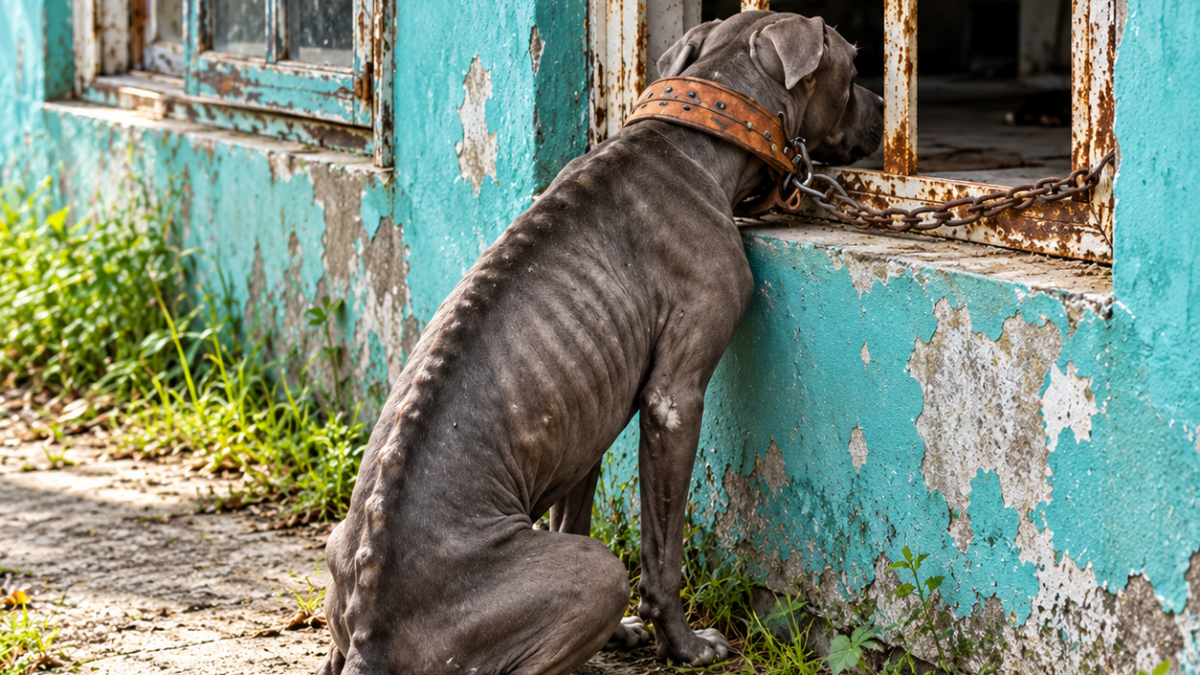
PART 2
The latch clicked.
For a moment, nobody spoke.
Dr. Carter pulled a rolling stool closer to the examination table and rested one hand near Kiki’s front paw without touching her.
“I don’t want to overwhelm her,” she said. “But I need you to understand what I’m seeing.”
I nodded.
Marcus stood against the wall with his arms folded tightly across his chest.
His jaw had been clenched since we left the property.
Dr. Carter continued.
“Malnutrition this severe doesn’t happen because a dog skips meals for a few days. We’re looking at prolonged nutritional deprivation. Her muscle mass is badly depleted. Her coat condition suggests chronic stress and poor nutrition. Her nails are overgrown. She has skin irritation around the collar area, and I’m concerned about an infection in one ear.”
She gently lifted Kiki’s lip.
“Her gums are pale too. We need to check for anemia, organ function, parasites, infection, all of it.”
I looked at Kiki.
She was staring at the stainless-steel table beneath her.
“What about her behavior?”
Ellen exhaled.
“That worries me too.”
“What do you see?”
“A dog who has learned that making herself invisible may be safer than asking for anything.”
Marcus looked away.
I knew why.
That sentence had landed hard.
Kiki wasn’t aggressive.
She wasn’t panicked.
She wasn’t trying to escape.
She was doing something worse.
She was disappearing while standing right in front of us.
Ellen ordered bloodwork, fluids, a careful feeding protocol, and several additional tests.
With severely malnourished animals, feeding too much too quickly can be dangerous. Her system needed time to adjust. Everything had to be controlled.
Small portions.
Careful monitoring.
Frequent checks.
No sudden changes.
No overwhelming her.
No pretending love alone could repair what neglect had done.
That first evening, I sat on the floor outside Kiki’s kennel.
I had placed a folded blanket inside, but she wasn’t lying on it.
She had pushed herself into the back corner with her chin against the wall.
A bowl containing a small prescribed meal sat several feet away.
She had eaten some of it.
Not all.
I didn’t reach for her.
I didn’t call her name every thirty seconds.
I simply sat there and answered emails on my phone while pretending not to watch her.
After twenty minutes, she looked at me.
I kept my eyes on the screen.
After another ten minutes, she looked again.
“Hi,” I whispered.
Her gaze dropped.
That became our routine.
For the first few days, Kiki seemed to tolerate us more than accept us.
There is a difference.
People like to imagine rescued dogs understand immediately that they are safe.
Sometimes they do.
Sometimes they seem almost relieved the second they enter a warm room.
But trauma doesn’t follow a sentimental script.
Kiki had spent too long learning rules we didn’t know.
Maybe looking at people had been dangerous.
Maybe approaching food had caused trouble.
Maybe pulling against the rope had taught her that resistance only made things worse.
We didn’t know.
So we stopped expecting her to behave like a dog who had always been loved.
On the third morning, I brought her breakfast.
“Good morning, Ki.”
Her eyes followed the bowl.
That was progress.
I set it down and backed away.
She waited.
I moved farther back.
She waited again.
Finally, when I sat on the floor near the door, she stood.
Her legs were still weak.
She took one step.
Paused.
Another.
Then she approached the bowl and began eating.
I felt ridiculous for being so emotional about a dog taking six steps.
But rescue work changes the things you celebrate.
Sometimes victory is a dog eating.
Sometimes it is sleeping without shaking.
Sometimes it is allowing a hand to touch her shoulder without flinching.
And sometimes it is simply choosing to move toward something instead of away from it.
Her bloodwork showed anemia and several nutritional deficiencies, but thankfully her organs had not reached the point of irreversible failure.
That gave us something precious.
Time.
Dr. Carter adjusted her treatment and warned us that recovery would not be fast.
“She didn’t get into this condition overnight,” she told me. “We can’t expect her to come out of it overnight.”
I understood.
What I didn’t understand was the man who had watched it happen.
The image of that window wouldn’t leave me.
I kept seeing Kiki’s head resting against the glass.
I kept seeing the plate inside.
I kept hearing him say, “She doesn’t eat much.”
On the fourth day, an animal-control investigator named Luis Mendoza called me.
“I went back to the property.”
I sat straighter at my desk.
“And?”
“I photographed the tether area, bowls, shelter, everything that was still there.”
“Was there food?”
A pause.
“Not where the dog was kept.”
My hand tightened around the phone.
“What did he tell you?”
“That she was difficult. That she wouldn’t eat. That she was old.”
“She ate here.”
“I know.”
“She’s eating every meal we give her.”
“I know.”
“He had food inside that house while she was standing outside watching him.”
“I know, Rachel.”
Luis had worked cruelty cases for years.
He was calm because he had to be.
I wasn’t.
“What happens now?”
“I build the case.”
“And while you build it?”
“Kiki stays with your rescue under the surrender paperwork you obtained.”
I glanced toward the kennel room.
“So he can’t come take her back?”
“No.”
That was the first moment in days when my shoulders relaxed.
“Good.”
“But I need documentation. Every weight check. Every photograph. Every veterinary finding. Everything.”
“You’ll have it.”
“I mean everything.”
“I said you’ll have it.”
Luis was silent for a beat.
Then he said, “I know.”
That night, I started a file.
KIKI — MEDICAL / INTAKE / CASE.
Every report went into it.
Her intake weight.
Body-condition assessment.
Photos.
Blood results.
Treatment plan.
Medication.
Food schedule.
Behavioral observations.
I didn’t know whether the case would go anywhere.
Animal-neglect cases can be frustrating.
People make excuses.
Evidence disappears.
Witnesses refuse to cooperate.
A sick or thin dog does not automatically prove criminal neglect.
You need records.
Patterns.
Timelines.
Expert statements.
Proof that a person responsible for the animal knew—or reasonably should have known—what was happening and failed to act.
So I documented.
And while we built the paperwork, Kiki slowly rebuilt herself.
The first major change came because of a squeaky duck.
One of our volunteers, Hannah, was cleaning kennels and accidentally stepped on a yellow rubber toy.
SQUEAK.
Kiki’s head shot up.
Hannah froze.
“Oh.”
Kiki stared.
Hannah slowly picked up the duck.
“Squeak?”
Kiki tilted her head.
I happened to be walking past the doorway.
“Hannah, do that again.”
SQUEAK.
Kiki stood.
Her tail didn’t wag.
Not yet.
But she took two steps toward the sound.
Hannah sat on the floor.
“Want it?”
Kiki stared at the toy.
Then at Hannah.
Then at me.
It was as if she was waiting for one of us to reveal the trick.
Hannah rolled the duck gently across the floor.
Kiki watched it travel.
She took another step.
Then stopped.
We didn’t push.
The next day, the duck went into her recovery room.
For two hours, she ignored it.
Then I saw it move.
Just an inch.
I checked the camera.
Kiki had nudged it with her nose.
I called Marcus.
“You’re not going to believe this.”
“Did she finish her food?”
“Better.”
“What?”
“She touched the duck.”
There was a pause.
Then he laughed.
“You called me because the dog touched a toy?”
“Yes.”
“That’s pathetic.”
“You’re coming over to see it, aren’t you?”
“I’m already getting my keys.”
By the end of that week, Kiki had started pushing the duck across the blanket.
Not playing exactly.
Exploring.
Testing.
Learning.
When Hannah squeaked it, Kiki’s ears lifted.
When Marcus rolled it, she followed.
One afternoon, I rolled it toward her and the toy stopped beside her front paw.
Kiki looked down.
Then she looked at me.
I tapped the floor.
“Your move.”
She lowered her nose.
Pushed it.
SQUEAK.
Kiki jumped backward.
Marcus burst out laughing.
I covered my mouth.
For half a second, Kiki looked offended.
Then something incredible happened.
Her tail moved.
Once.
A tiny sweep against the blanket.
Marcus stopped laughing immediately.
“Did you see that?”
“Yes.”
“Rachel.”
“I saw it.”
He crouched down.
“Kiki.”
Her tail moved again.
Two beats this time.
I turned my face because my eyes had filled so suddenly I couldn’t hide it.
Nobody in that room made a big celebration.
We had learned that Kiki didn’t like sudden noise.
So Marcus whispered, “That’s my girl.”
Kiki had no idea why three grown adults were fighting tears over a tail wag.
Maybe that was for the best.
Her weight increased gradually.
Her coat started changing.
The dullness faded.
Her eyes grew brighter.
Her shoulders began showing muscle instead of bone.
She stopped spending every hour pressed into corners.
First she slept beside the blanket.
Then on it.
Then one morning I arrived and found her stretched across the entire thing with her back legs kicked behind her like she owned the building.
“That’s new,” I said.
Kiki opened one eye.
“Excuse me. I believe this is a medical facility.”
She closed the eye again.
I smiled.
“Fine. Your facility.”
The emotional changes came more slowly.
She still ducked when hands moved too fast.
She still hated doors slamming.
If a man raised his voice in the hallway, even in laughter, Kiki sometimes froze.
And windows affected her.
That surprised us.
During her second week, Hannah walked her through the clinic lobby after hours.
Kiki passed a large front window and stopped.
She stared through the glass.
Her breathing changed.
Hannah called me.
I came around the corner and found Kiki standing perfectly still.
“What happened?”
“She just froze.”
I followed her gaze.
Outside was the parking lot.
Nothing threatening.
No person.
No animal.
Just the glass.
I crouched.
“Kiki.”
Nothing.
I moved beside her rather than behind.
“You don’t have to stay here.”
Her eyes remained fixed outside.
I held the leash loosely.
“Come on.”
Nothing.
I took one slow step away.
Kiki didn’t follow.
So I sat down.
Hannah sat too.
For several minutes, the three of us stayed on the lobby floor.
Eventually Kiki looked at me.
I held out the squeaky duck.
Her ears lifted.
I rolled it away from the window.
She followed.
That night, I wondered what glass meant to her.
Had she spent months watching life happen on the other side?
Warmth.
People.
Food.
A couch.
Conversation.
A television.
Normal life.
All separated from her by one thin sheet she could see through but not cross.
I hated that thought.
Two days later, Luis called again.
“I found a neighbor willing to talk.”
“What did they say?”
“That Kiki had been tied outside for a long time.”
“How long?”
“Months, at least. Possibly longer.”
I closed my eyes.
“They saw her getting thinner?”
“Yes.”
“Did anybody report it?”
“Apparently one person did months ago, but the complaint didn’t contain enough information to locate the exact property.”
My stomach twisted.
“So she almost got help.”
“Maybe.”
I hated the word maybe.
Luis continued.
“The neighbor says the owner used to feed her more regularly, then stopped paying much attention after she became less active.”
“Less active because she was starving?”
“We don’t know the sequence.”
I knew he was reminding me not to build conclusions ahead of evidence.
“What else?”
“The neighbor says Kiki occasionally got scraps.”
“Scraps.”
“Yes.”
“That’s not food.”
“I know.”
“Luis, she was standing at a window watching him eat.”
“I know what you saw.”
“And he told me she didn’t eat.”
“I know.”
“She eats.”
“I know.”
I realized I was nearly shouting.
I lowered my voice.
“Sorry.”
“You’re allowed to be angry.”
“No, I’m allowed to be useful.”
“Those aren’t mutually exclusive.”
That sentence stayed with me.
Anger could be useful if it was pointed in the right direction.
Not at revenge in the way people imagine revenge.
I didn’t want anything terrible to happen to Kiki’s owner.
I didn’t want to threaten him.
I didn’t want somebody showing up at his house.
I wanted something much simpler.
I wanted him to face the thing Kiki had never been allowed to do.
Consequences.
The following week, he called the rescue.
I recognized his voice immediately.
“I’m checking on my dog.”
My whole body went cold.
“You surrendered Kiki.”
“I know what I signed.”
“Then you understand she is under our care.”
“I want to know how she’s doing.”
I looked toward the office door.
Marcus was standing there.
He could tell from my face who was on the phone.
“She’s receiving veterinary treatment.”
“So she’s alive.”
“Yes.”
“See? I told you she was fine.”
I almost laughed because the alternative was screaming.
“Fine?”
“She just needed some feeding up.”
I gripped the desk.
“Her veterinarian has documented severe malnutrition.”
“She was picky.”
“She eats for us.”
“Because you probably give her expensive stuff.”
“We’re feeding her a veterinary recovery diet under controlled medical supervision.”
“Exactly.”
I stared at the wall.
This was not going anywhere useful.
“Kiki will not be returned.”
“I said I know.”
“Then what are you asking?”
Another pause.
“I heard animal control came by.”
There it was.
Not concern about Kiki.
Concern about himself.
“You’ll need to speak with animal control.”
“What did you tell them?”
“The truth.”
Silence.
Then his voice sharpened.
“You people always exaggerate.”
I stood.
Marcus came closer.
“We photographed Kiki when we arrived.”
“She’s always been skinny.”
“We have medical records.”
“She’s old.”
“We have veterinary findings.”
“You weren’t there every day.”
“No,” I said. “But she was.”
He said nothing.
For the first time since the call began, I felt completely calm.
Kiki had been there every day.
Her body had recorded what happened even when nobody else was watching.
Her ribs had recorded it.
Her depleted muscles.
Her skin.
Her bloodwork.
Her fear.
Her silence.
We didn’t need to invent a dramatic accusation.
We only needed to tell the truth clearly enough that nobody could look away.
“I’m ending this call now,” I said.
“You think you’re better than everybody.”
“No. I think Kiki deserved food, medical care, and basic protection.”
“She’s a dog.”
Marcus heard that through the receiver.
His face changed.
I answered carefully.
“Yes. She is. And you were responsible for her.”
Then I hung up.
My hands shook afterward.
Marcus pulled out the chair across from me.
“You okay?”
“No.”
“Good.”
I looked at him.
“What?”
“I’d be worried if you were.”
I laughed despite myself.
Then I started crying.
Not graceful crying.
Not one cinematic tear.
I cried because Kiki had been reduced to something disposable in the mind of the person responsible for her.
I cried because she had watched through a window while food sat within sight.
I cried because even after being removed in a condition that frightened experienced medical staff, somebody still wanted to minimize it.
Marcus let me cry for a minute.
Then he said, “Come see something.”
He led me to the recovery room.
Kiki was standing with Hannah.
The yellow duck lay between them.
Hannah moved sideways.
Kiki followed.
Hannah moved the other direction.
Kiki followed again.
Then Hannah tossed the duck six feet across the room.
Kiki trotted after it.
Trotted.
Not staggered.
Not crawled.
Trotted.
She picked it up.
SQUEAK.
Her tail started wagging.
Hannah laughed.
Kiki spun once.
Then again.
I stood in the doorway staring.
Marcus whispered, “That’s why we do this.”
Kiki saw me.
For half a second, I expected her to stop.
Instead she ran toward me.
Not fast.
She still wasn’t strong enough for fast.
But she came.
The duck was hanging from her mouth.
Her tail was going.
And when she reached me, she bumped her head against my knee.
I crouched.
“Hey, you.”
She pushed closer.
I put one hand against her chest.
Her heart was beating quickly.
For once, not from fear.
“You found yourself, didn’t you?”
She squeaked the duck.
Marcus laughed.
“I think that means yes.”
That was the first day I allowed myself to believe Kiki would not merely survive.
She might become happy.
There is a difference.
Survival is breathing.
Survival is blood values improving.
Survival is weight gain.
Happiness is choosing a toy.
Trusting a hand.
Running toward someone because you expect something good.
Kiki was learning the second part.
And people began noticing.
One of our clinic technicians posted a photograph through the rescue’s official page after the investigation team approved what could be shared.
It showed Kiki lying on her blanket with the yellow duck beneath one paw.
No graphic images.
No accusations.
Just a simple update that a severely underweight dog was recovering in care.
Adoption inquiries arrived almost immediately.
Then more.
A retired couple.
A young woman who worked from home.
A family with another dog.
A man who said he had owned dogs for thirty years.
Messages stacked up.
Everyone wanted Kiki.
But wanting a rescued dog and being the right home for that dog are not the same thing.
I called applicants.
“Does your home have children?”
“Do you have other animals?”
“How many hours would Kiki be alone?”
“Do you have a fenced yard?”
“What happens if she has behavioral setbacks?”
“What if she hides?”
“What if she refuses food for a day because something scares her?”
“What if she never becomes the dog you imagine from the photos?”
That last question mattered most.
People fall in love with transformations.
Before and after.
Sad dog.
Happy dog.
The problem is that the middle does not disappear after adoption.
Trauma can resurface.
A noise.
A window.
A certain movement.
A smell.
A man’s voice.
We wanted someone who would love Kiki even on days she seemed to move backward.
One applicant told me, “I just want to spoil her.”
“That’s kind,” I said, “but she needs more than spoiling.”
Another said, “She’ll forget all that once she realizes she’s safe.”
“Maybe some of it. Maybe not all.”
Another said, “I’ve got a huge property. She can stay outside whenever she wants.”
I ended that conversation politely and quickly.
Then I spoke with a woman named Claire Bennett.
She was fifty-eight, lived alone except for an elderly indoor cat named Oliver, and worked three days a week at a public library.
She had lost her dog, Rosie, eight months earlier.
“I’m not trying to replace Rosie,” Claire told me immediately.
That got my attention.
“A lot of people say that.”
“I mean it. Rosie was Rosie.”
“What made you apply for Kiki?”
There was a pause.
“The picture of her with the toy.”
“Not the intake photo?”
“No.”
“Why?”
“Because everybody feels sorry for the worst photo. I wanted to know who she was becoming.”
I wrote that down.
“What if she’s afraid of you?”
“Then I’ll leave her alone.”
“What if it takes weeks before she wants affection?”
“Then it takes weeks.”
“What if she never sleeps in your bed?”
Claire laughed softly.
“Then I’ll survive the heartbreak.”
I smiled.
“What would her daily routine look like?”
Claire described it in detail.
Morning walk.
Breakfast indoors.
Quiet time.
A fenced backyard she could enter through a dog door that could be closed at night.
No tethering.
No leaving her outside unattended.
A veterinary clinic eight minutes away.
One spare bedroom Claire had converted years earlier into a reading room.
“She can have that room if she needs somewhere quiet,” Claire said.
“You’d give your reading room to a dog?”
“I work at a library. I can find another chair.”
We scheduled a meeting.
Claire arrived carrying nothing.
No toys.
No treats.
No leash.
That surprised me.
“Most people bring gifts.”
“I didn’t know what she likes.”
I pointed at the yellow duck.
“She has one strong opinion.”
Claire smiled.
Kiki stayed across the room.
Claire sat in a chair.
She didn’t call her.
Didn’t clap.
Didn’t crouch and reach out.
She simply talked to me.
After ten minutes, Kiki moved closer.
Claire ignored her.
Another few minutes.
Kiki sniffed Claire’s shoe.
Claire kept talking.
Then Kiki walked away.
Claire didn’t look disappointed.
Twenty minutes later, Kiki returned.
This time she sniffed Claire’s hand.
Claire kept it still.
Kiki touched her nose to two fingers.
Claire whispered, “Hi.”
Kiki backed away.
Claire looked at me.
Her eyes were wet.
“I think that went well.”
It had.
We arranged two more visits.
On the second, Claire brought a small blanket from her house so Kiki could learn the scent.
On the third, Kiki lay three feet from her chair.
Still no dramatic instant bond.
Exactly what I wanted.
Meanwhile, the investigation moved forward.
Luis obtained the veterinary report.
He interviewed another neighbor.
Then another.
One had photographs taken weeks before the rescue.
Kiki was visible in the background near the same window.
Tethered.
Thin.
Another witness described hearing her crying at night during bad weather.
I felt sick reading the statements.
Then came the piece that changed the case.
A local veterinary clinic had records showing Kiki had once been brought in nearly a year earlier.
The veterinarian had documented early weight loss and recommended follow-up testing.
There had been no follow-up.
Luis called me late one afternoon.
“This matters.”
“Because he knew?”
“Because there is documentation that someone specifically told him she was losing weight and needed additional care.”
“Did he ever return?”
“Not according to their records.”
I closed my eyes.
Kiki had not been invisible.
People had noticed.
A veterinarian had noticed.
Recommendations had been made.
And still she ended up at that window.
“What happens next?”
“I’m submitting everything.”
“For charges?”
“Yes.”
My pulse jumped.
“Luis.”
“I can’t promise the prosecutor will take every count.”
“I know.”
“And I can’t promise what a judge will do.”
“I know.”
“But the case is documented.”
That was all I wanted.
Not rumors.
Not social-media outrage.
Evidence.
A record.
Kiki’s suffering had happened quietly.
The accountability should not depend on who could shout the loudest.
A week later, Luis confirmed the case had been accepted.
The owner was cited and later charged under applicable animal-neglect provisions.
Because legal proceedings take time, Kiki’s life did not stop while humans argued over what humans had done.
She kept gaining weight.
She discovered tennis balls.
She hated bananas.
Loved chicken.
Was suspicious of the vacuum cleaner.
Had an inexplicable fascination with the clinic printer.
And began greeting Marcus every morning by stealing one of his gloves.
“You know those cost money,” he told her one day.
Kiki trotted away carrying the glove.
“She doesn’t care,” I said.
“I can see that.”
“You should feel honored.”
“I feel robbed.”
Kiki’s tail wagged harder.
The greatest change came during her final week with us.
I arrived early and found Hannah standing inside the playroom.
“Don’t move,” she whispered.
I looked through the window.
Kiki was lying beside another rescue dog named Pepper.
Between them sat the yellow duck.
Pepper reached for it.
Kiki grabbed it first.
Pepper play-bowed.
Kiki froze.
Then she play-bowed back.
The next thirty seconds were chaos.
They bounced.
Spun.
Chased each other around a chair.
Kiki lost the duck.
Recovered it.
Pepper stole it.
Kiki chased her.
For the first time, I saw Kiki playing without checking the room every few seconds to make sure she was safe.
She was simply there.
Alive inside her own life.
Hannah covered her mouth.
“I’m going to cry.”
“You’re already crying.”
“So are you.”
“I cry professionally.”
“Sure.”
Kiki slammed into a pile of blankets.
Pepper jumped over her.
Both dogs sneezed.
Then Kiki rolled onto her back with her mouth open in that loose, ridiculous expression dogs get when they are completely engaged in play.
Her face looked different.
Not because she had gained weight.
Not because her coat had improved.
Because fear had finally released its grip for a moment.
That was the Kiki I wanted Claire to meet.
Not the dog at the window.
Not the case number.
Not the medical file.
Kiki.
The adoption was scheduled for Saturday.
I barely slept Friday night.
People assume rescuers are always happy when animals leave.
We are.
And we aren’t.
You spend weeks teaching a dog that humans can be trusted.
Then one morning you put that dog into somebody else’s car.
You hope you judged correctly.
You hope you didn’t miss anything.
You hope the home stays kind after the excitement wears off.
Saturday morning, Claire arrived at nine.
She brought a collar, harness, identification tag, food we had approved, medication instructions, a bed, and exactly one toy.
A yellow rubber duck.
Marcus looked at me.
“That’s unfair.”
“What?”
“You’re going to start crying before she even leaves.”
“I am not.”
Claire held up the duck.
Kiki’s ears lifted.
SQUEAK.
That was it.
My eyes filled.
Marcus sighed.
“Called it.”
We reviewed every instruction twice.
Food amounts.
Transition schedule.
Follow-up appointment.
Behavioral notes.
What scared her.
What calmed her.
How she reacted to windows.
The importance of never tethering her.
Claire listened without interrupting.
Then she signed the paperwork.
I knelt beside Kiki.
She had gained enough weight that lifting her no longer felt like picking up a bundle of sticks.
Her shoulders were stronger.
Her coat had softened.
Her eyes were bright.
“You know what this is?” I asked.
Kiki licked her nose.
“This is the part where you leave me.”
Her tail wagged.
“Rude.”
Claire smiled.
I clipped on Kiki’s leash and handed it over.
For a second, Kiki stayed beside me.
Then Claire walked toward the door.
Kiki hesitated.
I held my breath.
Claire stopped.
She didn’t pull.
She simply waited.
Kiki looked back at me.
I wanted to call her.
I wanted one more hug.
Instead I smiled.
“Go on, Ki.”
She stared.
“You’re okay.”
Claire waited.
Kiki took one step toward her.
Then another.
At the doorway, she looked back one final time.
Marcus whispered, “Go home, girl.”
Kiki walked outside.
Not carried.
Not wrapped in a blanket.
Not with her head lowered.
She walked.
Claire opened the back door of her car.
A padded cover had been secured across the seat.
Kiki sniffed it.
Then hopped in with a small boost.
I stood in the parking lot until the car disappeared.
Marcus remained beside me.
“You all right?”
“No.”
“Me neither.”
We went back inside.
Her room looked enormous without her.
The blanket remained in the corner.
Her water bowl sat beside the wall.
And the first yellow duck—the original one—was still lying under the chair.
Claire had deliberately bought a new one.
“She should keep that,” Hannah said.
I picked up the old duck.
Its face was covered in tiny tooth marks.
One wing had nearly been chewed off.
“No,” I said. “I’m keeping this one.”
Marcus raised an eyebrow.
“That’s theft.”
“Evidence.”
“Of?”
I squeezed the duck.
SQUEAK.
“That she came back.”
For the first day, Claire sent no messages.
That was good.
We tell adopters to contact us anytime, but I also try not to hover.
Sunday morning, my phone buzzed.
A photograph.
Kiki was curled on a rug beside Claire’s couch.
Not on the couch.
Not touching Claire.
But inside the room.
The message said:
She slept six hours. Ate breakfast. We walked around the yard twice. She is still unsure about the kitchen doorway, so I moved her bowl for now.
I smiled.
Perfect.
Monday:
Kiki discovered the hallway mirror and barked at herself once. She seemed embarrassed.
Tuesday:
She followed me into the reading room.
Wednesday:
She brought the duck into the reading room.
Friday:
She fell asleep while I was reading aloud.
That photo broke me.
Claire sat in an armchair with an open book.
Kiki was asleep on the rug beside her.
The yellow duck rested under her chin.
Sunlight came through a nearby window.
A window.
I stared at that detail for a long time.
But this time Kiki wasn’t outside looking in.
She was inside.
Warm.
Fed.
Safe.
She could walk away from the window whenever she wanted.
I forwarded the image to Marcus.
He replied thirty seconds later.
Don’t make me cry at work.
I wrote back:
Too late.
Several weeks passed.
Then Luis called.
“The first hearing is scheduled.”
My stomach tightened.
“Do you need me?”
“Possibly. The veterinarian will provide records and may testify. I’d like you available because you conducted the rescue intake.”
“I’ll be there.”
Courtrooms are strangely ordinary places for painful stories.
Fluorescent lights.
Wood benches.
Paper shuffling.
People checking phones.
A clerk calling names.
Everything that happened to Kiki was reduced to documents inside a folder.
But that folder was thick.
Dr. Carter attended.
Luis attended.
I attended.
Kiki’s former owner sat with his attorney.
He looked exactly as he had the day we took her.
That unsettled me.
Part of me expected him to somehow look different now that I knew more.
People rarely do.
He glanced at me once.
I looked away.
This wasn’t about the two of us.
It wasn’t a personal feud.
It was about responsibility.
The early proceedings were procedural.
Dates.
Evidence.
Arguments about documentation.
Nothing dramatic happened that day.
No sudden confession.
No judge pounding a gavel and delivering instant justice.
Real accountability can be slow.
Months passed.
During that time, Kiki’s case became stronger as medical records, witness statements, and prior veterinary documentation were reviewed.
The defense argued that Kiki had underlying health problems contributing to weight loss.
Dr. Carter acknowledged that possibility.
Then she explained something important.
Underlying illness does not eliminate the responsibility to seek veterinary care.
If a dog stops eating, loses significant weight, or becomes weak, the answer is not to leave her tied outside while her condition worsens.
The prior clinic record mattered because concerns had already been documented.
The later photographs mattered because decline was visible.
The rescue examination mattered because it established her condition when removed.
And Kiki’s response to structured feeding and medical treatment mattered too.
She gained weight.
Her blood values improved.
Her strength returned.
Not magically.
Not instantly.
But steadily.
I testified during a later hearing.
The attorney asked, “You were emotionally affected by the animal’s condition, correct?”
“Yes.”
“So you were angry with my client.”
“Yes.”
“Would you say that anger influenced how you interpreted what you saw?”
“No.”
“You just admitted you were angry.”
“I was angry after observing the condition she was in.”
“That’s not what I asked.”
“I documented what I saw before my feelings mattered.”
He flipped through papers.
“You described the dog as severely thin.”
“I did.”
“You are not a veterinarian.”
“No.”
“So that was your opinion.”
“I described visible ribs, hip bones, weakness, and difficulty standing. Dr. Carter made the medical diagnosis.”
He paused.
“You also described my client eating inside.”
“Yes.”
“What does that prove?”
“By itself? Nothing.”
He seemed surprised.
“So why mention it?”
“Because Kiki was tied immediately outside that window at the time we arrived, and that is part of what I observed.”
“Are you suggesting he was intentionally eating in front of the dog?”
“No.”
“Are you suggesting he intentionally starved her?”
“I’m telling you what I personally saw. The medical and investigative conclusions are for the qualified professionals and the court.”
Luis looked down, hiding what I was fairly sure was a smile.
The attorney changed subjects.
That was the moment I understood something.
The strongest version of Kiki’s story did not need exaggeration.
Truth was enough.
Eventually, rather than continue toward a longer contested process, Kiki’s former owner entered a plea resolving the neglect charges.
The exact legal penalties mattered less to me than the restrictions that followed.
There were fines and court costs.
There were conditions concerning future animal ownership.
There was a formal record.
And there was no path back to Kiki.
When the judge reviewed the case, he spoke carefully.
He did not shout.
He did not insult anyone.
He simply described responsibility.
Animals depend on the people who control their food, shelter, medical care, and movement.
A tethered dog cannot schedule her own veterinary appointment.
She cannot buy food.
She cannot unlock a door.
She cannot explain that she is getting weaker.
Responsibility belongs to the human being who has taken control of her life.
That was the accountability I had wanted.
Afterward, I walked outside the courthouse with Luis.
He leaned against the railing.
“You look disappointed.”
“I’m not.”
“You expected more?”
I thought about it.
“No.”
“Then what?”
“I spent months imagining this would feel bigger.”
“It usually doesn’t.”
I looked toward the street.
Cars moved through the intersection.
Someone across the road carried groceries.
Normal life continued.
“Do you think people change after something like this?”
Luis considered the question.
“Some do.”
“And the others?”
“We build enough consequences that maybe the next animal doesn’t depend on whether they changed.”
That answer satisfied me more than any dramatic revenge ever could.
Because revenge fades.
Protection matters.
Kiki was protected.
And when I drove home that afternoon, I realized I hadn’t pictured her former owner once.
I pictured Kiki sleeping beside Claire’s chair.
That was freedom too.
Three months after the adoption, Claire invited me to visit.
I almost said no.
Not because I didn’t want to see Kiki.
Because I was afraid she might not remember me.
Rescuers say we don’t care about that.
Sometimes we lie.
Claire lived in a small blue house at the end of a quiet street.
There were flowers along the porch.
A wooden bench near the front door.
A fenced backyard visible through the side gate.
I climbed the steps and knocked.
Movement sounded inside.
Then barking.
Real barking.
Confident barking.
Claire opened the door.
“Give her a second.”
Kiki stood ten feet away.
For one heartbeat, neither of us moved.
She looked healthier than in any photo.
Her body had filled out.
Her coat shone.
Her ears were forward.
Her tail was halfway raised.
“Kiki?”
Her head tilted.
Then her entire body changed.
The tail started.
Once.
Twice.
Then so hard her hips moved with it.
She ran.
Actually ran.
Straight toward me.
I barely had time to crouch before she hit my chest.
“Kiki!”
She licked my chin.
I laughed and cried at the same time.
Claire closed the door behind me.
“I guess she remembers.”
“You think?”
Kiki raced toward the living room.
Then back to me.
Then toward Claire.
Then back again.
She grabbed the yellow duck.
SQUEAK.
I covered my face.
“Oh, come on.”
Claire laughed.
“What?”
“That stupid duck.”
“It is apparently sacred.”
We walked into the living room.
There were two dog beds.
One beside the couch.
One near the reading room.
“Two?”
“She kept stealing Oliver’s cat bed.”
I looked around.
“Where’s Oliver?”
Claire pointed.
The elderly cat was sitting on top of a bookshelf staring down at Kiki with the expression of a landlord disappointed in his tenant.
“Do they get along?”
“They have negotiated a treaty.”
“What are the terms?”
“Kiki doesn’t chase him. Oliver doesn’t smack her unless she violates the first condition.”
“Seems fair.”
Claire showed me the backyard.
Kiki followed us through a door near the kitchen.
She walked onto the grass without hesitation.
There was no rope.
No chain.
No tether point.
Just a fence.
A shaded patio.
Water.
A small basket of outdoor toys.
Kiki carried her duck outside and dropped it at my feet.
“You want me to throw it?”
She stared.
I tossed it.
She chased.
Claire leaned against the porch rail.
“She does this every evening.”
Kiki returned.
I threw it again.
“She still nervous about anything?”
“Storms.”
“Expected.”
“And if someone argues loudly on television, she leaves the room.”
I nodded.
“Windows?”
Claire’s expression softened.
“Not anymore.”
“What changed?”
“I don’t know if anything changed exactly. She just learned she can move.”
I looked at her.
Claire continued.
“At first she would stand near the living-room window and freeze. So I started opening the back door whenever she did it. Not forcing her outside. Just showing her there was another direction available.”
“That’s smart.”
“Eventually she stopped freezing.”
Kiki returned with the duck.
I threw it.
Claire smiled.
“She sleeps under the window now.”
I swallowed.
Of all the things anyone could have told me, that one hurt the most.
In the best way.
We went back inside.
Claire made coffee.
Kiki lay on the kitchen rug.
I watched her closely.
The first time I had seen her near a kitchen, she had been separated from it by glass.
Now she was stretched across the floor while someone opened a refrigerator above her.
Claire pulled out a container.
Kiki’s head rose immediately.
“Oh, look who suddenly has excellent hearing.”
Kiki sat.
Claire took out a piece of cooked chicken.
She looked at me.
“Vet-approved.”
“Of course.”
“Small piece.”
“I’m watching you.”
Claire handed it to Kiki.
Kiki ate.
Then looked hopeful.
“No,” Claire said. “That was it.”
Kiki continued staring.
“You told me she was traumatized. Nobody warned me she was manipulative.”
I laughed.
“That means she’s recovered enough to become a professional.”
We carried our coffee to the reading room.
Kiki followed.
On one wall, Claire had framed several photographs.
Rosie.
Oliver.
Family members.
And one photograph of Kiki lying beside the yellow duck during her first weeks there.
Below it was another.
Kiki running through the backyard.
I stood in front of them.
“She belongs up there,” Claire said.
“Yes.”
“Rachel?”
I turned.
“Thank you.”
I shook my head.
“You did the hard part.”
“No.”
“Yes, you did. Rescue gets them out. Home is what comes after.”
Claire looked down at Kiki.
“She made it easy.”
We both knew that wasn’t true.
Kiki had not made it easy.
She had been frightened.
Withdrawn.
Uncertain.
She had needed patience.
Structure.
Medical care.
Space.
Repetition.
A thousand ordinary moments proving that tomorrow would not suddenly become dangerous again.
That is what real recovery often looks like.
Not one dramatic rescue.
A thousand safe mornings afterward.
Six months after Kiki left us, our rescue held an adoption reunion.
I debated inviting Claire because I worried the crowd might overwhelm Kiki.
Claire decided to bring her for twenty minutes and leave immediately if she showed stress.
Kiki lasted two hours.
She walked into the yard beside Claire.
Paused.
Looked around.
Then saw Marcus.
He was holding a box of supplies.
Kiki sprinted toward him.
The box went flying.
“Whoa!”
She jumped against his legs.
Marcus laughed.
“Thief!”
Kiki circled him.
“You still owe me a glove!”
Hannah came running.
Kiki greeted her next.
Then Pepper appeared with her adoptive family.
The two dogs recognized each other instantly.
Play bows.
Circles.
Chasing.
The yellow duck was not present.
Probably wise.
I stood back watching.
One of our newer volunteers came beside me.
“Which one is Kiki?”
I pointed.
“The brown dog chasing Pepper.”
“That’s Kiki?”
“Yes.”
“She looks normal.”
I smiled.
That word.
Normal.
People sometimes mean it kindly without realizing how extraordinary it is.
Normal meant nobody looking at her and immediately seeing starvation.
Normal meant a dog running in grass.
Normal meant somebody could meet her without knowing the worst thing that happened to her.
“Yes,” I said. “She does.”
Claire walked toward me.
Kiki followed a minute later and leaned against her leg.
Not mine.
Claire’s.
And I was glad.
That was exactly where she belonged.
Later that year, Luis stopped by the rescue on another case.
He saw Kiki’s photograph pinned to our bulletin board.
“That her?”
“Yep.”
He studied it.
“She looks good.”
“She’s spoiled.”
“Good.”
“Not medically spoiled. Properly spoiled.”
“Important distinction.”
I looked at him.
“Do you ever think about the cases after they’re closed?”
“All the time.”
“That seems exhausting.”
“It is.”
“What do you remember most?”
He thought for a moment.
“Usually not the person we charged.”
“What then?”
“The animal leaving.”
I understood.
For months, I had believed the ending of Kiki’s story would be the legal case.
It wasn’t.
The case mattered.
Accountability mattered.
But punishment was never the heart of the story.
The heart was that Kiki no longer needed us.
A year after the rescue, Claire sent me a video on the anniversary of the day we untied her.
I was sitting at my desk.
The clip began in Claire’s backyard.
Kiki stood near the porch with the yellow duck in her mouth.
Claire called her name.
Kiki ran.
Full speed.
Across the grass.
Around a tree.
Past the patio.
Back toward the camera.
Her body was strong.
Her coat moved in the sunlight.
She dropped the duck.
Claire threw it.
Kiki chased it again.
Then the video shifted inside.
Kiki walked into the kitchen.
Claire set down her dinner bowl.
Kiki sat and waited.
“Okay,” Claire said.
Kiki ate.
Afterward, she carried her duck into the living room and climbed onto a bed beneath the window.
She turned in a circle.
Lay down.
Rested her head against the glass.
I stopped breathing for a second.
The pose was almost identical to the first day.
Head against a window.
Eyes looking through glass.
But everything else was different.
No rope.
No starving body.
No plate of food she couldn’t reach.
No person ignoring her.
Beside the bed sat a full water bowl.
Her dinner was already inside her.
Behind her, Claire was reading.
When Kiki lifted her head, Claire reached down and scratched behind her ears.
Kiki leaned into the hand.
Then she went back to watching the yard.
The final few seconds showed something even simpler.
Claire opened the back door.
Kiki looked at it.
She could go outside.
She could stay inside.
She chose to remain on the bed.
That choice hit me harder than anything else.
The first time I met Kiki, she was outside because somebody else had decided where she belonged.
Now a door stood open.
And she decided for herself.
I watched the video three times.
Then Marcus walked into my office.
“What are you crying about now?”
I turned the phone toward him.
He watched.
By the end, his eyes were wet too.
“I’m not crying,” he said.
“Of course not.”
“Allergies.”
“In December?”
“Very aggressive winter allergies.”
I laughed.
The video ended.
Kiki’s face froze on the screen, bright-eyed and healthy.
Marcus pulled up a chair.
“Remember carrying her in?”
“Yes.”
“I thought she might die that night.”
“So did I.”
“She fooled us.”
“No,” I said. “She fought harder than we knew.”
For a while, we sat quietly.
Rescue work gives you plenty of endings you wish you could rewrite.
Animals you reach too late.
Cases that go nowhere.
Adoptions that fall through.
Medical treatments that fail.
You remember all of them.
That is why dogs like Kiki matter so much.
Not because their stories erase the others.
Because they remind you what can happen when intervention arrives before the last chance disappears.
Kiki didn’t become happy because one heroic person saved her.
There was no single hero.
Someone reported concern.
Rescuers removed her.
A veterinary team stabilized her.
Volunteers sat quietly beside her.
An investigator documented evidence.
Witnesses spoke.
A prosecutor took the case.
A judge imposed consequences.
An adopter gave her time.
Recovery was a chain of people doing the next right thing.
That is less dramatic than a miracle.
It is also more powerful.
Because ordinary people can do it.
I eventually put the old yellow duck inside a clear box on the shelf above my desk.
Not because it was valuable.
It was disgusting, actually.
Chewed.
Cracked.
Missing part of one wing.
Marcus complained about it constantly.
“You know people display awards.”
“I like my duck.”
“It looks diseased.”
“It is historic.”
“It squeaks when the air conditioner turns on.”
“That’s ambiance.”
One afternoon, a nervous new volunteer noticed it.
“Why is there a rubber duck in a box?”
I pointed toward Kiki’s photograph.
“That dog wouldn’t play when she came here.”
The volunteer looked at the photo.
“What happened?”
“She learned.”
That answer was enough.
Two years later, Claire invited us to Kiki’s unofficial birthday celebration.
Nobody knew Kiki’s exact birthday, so Claire chose the date she had adopted her.
There were six people.
One dog.
One elderly cat observing from a safe height.
And a small dog-friendly cake.
Kiki wore no ridiculous hat because Claire knew she hated things on her head.
Marcus brought gloves as a joke.
Kiki stole one immediately.
“I knew it!”
She ran around the table.
Everyone laughed.
Claire tried to catch her.
Kiki dodged.
I sat on the porch steps watching.
Eventually Kiki abandoned the glove and came to me.
She stood between my knees.
I rubbed her chest.
“You’ve got a good life, Ki.”
Her tongue hung out.
“You know that?”
She bumped my hand.
I looked toward the kitchen window.
Claire was inside cutting the cake.
The sight stopped me.
Kiki noticed.
She turned too.
Through the window, we could see Claire moving around the kitchen.
Food on the counter.
Warm lights.
A home.
Kiki watched for maybe two seconds.
Then she walked to the door.
Claire saw her through the glass and opened it immediately.
“There you are.”
Kiki went inside.
No hesitation.
No waiting.
No rope stopping her.
I stayed on the porch.
That was when I finally felt the ending settle into place.
Not in a courtroom.
Not when charges were filed.
Not when the judge spoke.
Not when the man who failed her faced consequences.
Those things mattered.
But they were not Kiki’s ending.
This was.
A door opening.
Someone expecting her.
A warm room she was allowed to enter.
Dinner prepared with her in mind.
Her bed waiting nearby.
A person who noticed when she wanted in.
Kiki had spent too much of her life learning that the world existed on the other side of glass.
Now there was no other side.
There was only home.
Claire appeared in the doorway.
“You coming in?”
“In a minute.”
She nodded and went back inside.
Through the window, I saw Kiki sitting beside her.
Claire gave her a small piece of the dog-safe cake.
Kiki swallowed it instantly.
Marcus stepped onto the porch.
“You’re doing the emotional staring thing again.”
“Leave me alone.”
“I’m just saying, people are waiting.”
I stood.
Before entering, I looked through that window one last time.
The first time I had seen Kiki through glass, her body had been weak enough that she could barely hold up her head.
She had watched somebody else eat while she remained tied outside.
She had expected nothing.
Now she was standing in a kitchen with a healthy body, a wagging tail, and a woman laughing because Kiki was trying to steal another piece of cake.
Some people might call that revenge.
I don’t.
Revenge would have meant allowing the person who neglected Kiki to remain the most important character in her life.
He wasn’t.
He became paperwork.
A closed case.
A name in an old file.
Kiki became everything else.
The running dog.
The stolen glove.
The battered yellow duck.
The quiet evenings beside Claire’s chair.
The bed beneath the window.
The open door.
The choice to stay inside.
That was better than revenge.
It was a life so full that the worst thing ever done to her no longer defined who she was.
And when I opened the door and stepped into the kitchen, Kiki looked up at me with bright eyes before turning right back toward Claire.
Exactly as she should.
She knew where home was.
And this time, nobody could leave her outside of it.


