PART 2: I Went to the Shelter for One Kitten—Then I Saw What the Others Were Doing to Keep Her Alive
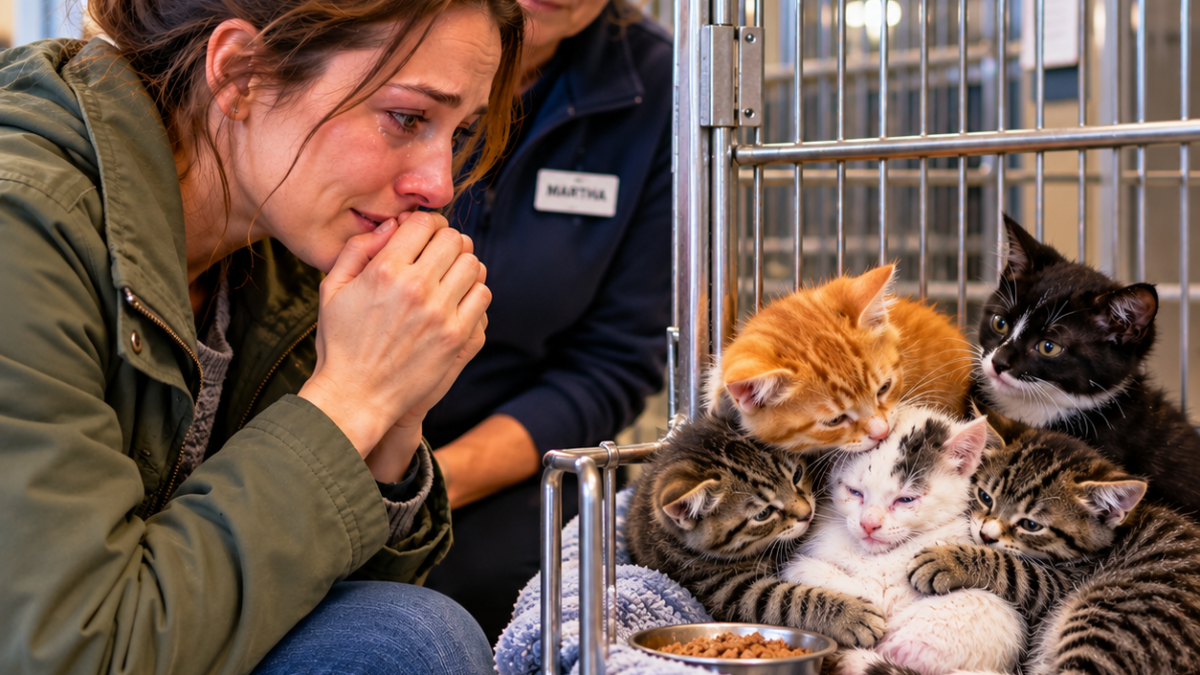
I walked into that shelter believing the hardest decision I would make that day was which kitten to bring home.
Ten minutes later, I was kneeling in front of a cage with tears burning behind my eyes, realizing there was something no one had told me.
And before I left that building, one quiet little kitten would pull me into a fight I never saw coming.
I had driven forty minutes that morning determined to be sensible.
One kitten.
That was the rule I had made for myself.
At home, I already had a small carrier waiting beside my couch, one food bowl on the kitchen floor, a brand-new litter box in the bathroom, and a bag of kitten food tucked inside the pantry.
One of everything.
Because I was adopting one cat.
Not two.
Definitely not five.
I had even laughed at myself before leaving my apartment.
“Do not turn your home into an animal shelter,” I said to my reflection.
I meant it.
At thirty-six, I lived alone in a modest two-bedroom apartment outside Columbus, Ohio. I worked from home most days, and after years of telling myself I was too busy for a pet, I had finally admitted that the apartment had become painfully quiet.
I didn’t want to fill it with animals.
I just wanted one small creature waiting for me at the end of the day.
When I reached the county shelter, I parked outside the weathered brick building and sat behind the steering wheel for several seconds.
Rain dotted the windshield.
“All right, Rachel,” I whispered. “You pick one and leave.”
Inside, the air smelled like disinfectant, dry food, and something strangely warm and familiar.
A woman around fifty sat behind the front desk.
Her name tag read MARTHA.
She smiled when she saw the empty carrier in my hand.
“Here for a kitten?”
“Yes. I called yesterday.”
Her smile faded just slightly.
“We have kittens.”
Something in the way she said it made me pause.
“Okay.”
“But I should warn you,” she continued. “A litter came in late last night. Five of them. Someone found them in a cardboard box beside a row of dumpsters.”
My stomach tightened.
“How old?”
“Maybe seven weeks.”
She led me down a short hallway.
Before opening the door to the kitten room, Martha stopped.
“You can choose one today.”
“I know.”
“We’re over capacity, so we’ll probably send the others to different foster homes by tomorrow.”
I nodded.
At that moment, it didn’t seem important.
Then she opened the door.
Five kittens were curled together inside the second cage.
One orange.
One black with a white chest.
Two nearly identical gray tabbies.
And one tiny white female with a gray mark beside her left ear.
The four larger kittens were pressed tightly against one another.
The white kitten wasn’t.
She was lying several inches away.
I crouched.
The orange kitten immediately stood.
One gray kitten pushed its nose through the bars.
The black one stared suspiciously at me.
But the little white kitten did nothing.
She simply lifted her head.
And looked directly into my eyes.
She didn’t meow.
She didn’t approach.
She didn’t raise a paw.
She just watched me.
There was something about that look that made every rational thought I had brought into the building disappear.
“I think I want her,” I whispered.
Martha didn’t smile.
Instead, she unlocked the cage and carefully lifted the kitten.
The little body practically disappeared inside her hands.
“She’s very quiet,” Martha said.
“Is that bad?”
“Sometimes.”
I looked up.
“What does that mean?”
Martha gently stroked one finger between the kitten’s ears.
“When a kitten is unusually quiet, people think she’s calm. But sometimes she isn’t calm.”
She hesitated.
“Sometimes she’s just stopped expecting anyone to help.”
A knot tightened in my throat.
“What happened to her?”
“She was the weakest when they came in. Barely ate overnight. We gave her fluids this morning.”
I looked at the other four kittens again.
And that was when I noticed something strange.
The orange kitten walked over to the food dish, picked up a piece of wet food in his mouth, crossed the cage—
and dropped it beside the white kitten.
I froze.
The tiny white kitten sniffed it.
One of the gray kittens moved beside her and curled around her back.
Then the black kitten positioned himself directly between her and the open cage door.
Not randomly.
Protectively.
Martha stopped moving.
I looked at her.
“Do they always do that?”
For several seconds, she didn’t answer.
Then she whispered:
“Yes.”
PART 2
I stayed crouched in front of the cage, staring at the five kittens.
The orange one nudged the food closer to his sister.
She tried to eat.
Her mouth opened.
She took one tiny bite.
Then her head lowered again.
The gray kitten beside her immediately pressed closer.
“That’s not normal, is it?” I asked.
Martha folded her arms.
“Not exactly.”
“What do you mean?”
“When they came in last night, we separated her for an examination. The black kitten screamed until we brought her back.”
I looked at him.
He was tiny.
Maybe three pounds.
Yet he stood in front of his sister as though he were a guard dog.
Martha continued.
“The orange one kept carrying food toward her. One of the gray kittens groomed her. They sleep around her.”
“All four?”
“All four.”
Something tightened inside my chest.
I had come to choose one.
Suddenly the phrase felt ugly.
“What’s wrong with her?”
“We don’t know yet. Our veterinarian is coming back this afternoon. Her temperature was low when they arrived, and she’s dehydrated.”
“Can she recover?”
“We hope so.”
Hope.
It was a word people used when they didn’t want to promise anything.
I reached through the open cage.
The white kitten didn’t pull away.
I touched the top of her head.
Her fur felt softer than I expected.
She blinked.
Then, slowly, she leaned her forehead against my finger.
That was it.
Nothing dramatic.
No purring.
No happy little meow.
Just the weight of her head against one finger.
And somehow it destroyed every defense I’d brought with me.
“I’ll take her.”
Martha’s expression changed.
She glanced toward the cage.
“Rachel…”
“What?”
“She may require medical care.”
“I understand.”
“She may not eat on her own.”
“I’ll learn.”
“You might have to bring her back here for treatment.”
“I’ll bring her.”
Martha studied me.
Then she said something I wasn’t expecting.
“Would you consider fostering her instead of adopting immediately?”
“Why?”
“Because technically all five are still under observation. And if she’s unstable, it would help us keep her connected to her litter.”
I looked at the kittens.
“You mean I’d foster all five?”
Martha almost smiled.
“You said it. I didn’t.”
I laughed once because surely she was joking.
She wasn’t.
“No.”
“That’s completely reasonable.”
“I have one carrier.”
“We have carriers.”
“I bought one litter box.”
“We have litter boxes.”
“I have one food bowl.”
“We have many bowls.”
I stared at her.
“You’ve done this before.”
“Many times.”
“No. Absolutely not.”
She nodded.
“I understand.”
And I meant it.
I really did.
Then the white kitten tried to stand.
Her front legs trembled.
She took half a step before collapsing sideways.
Instantly, all four siblings moved.
The gray female pushed against her back.
The orange kitten began licking her face.
The black kitten crawled over her front paws.
The other gray kitten simply pressed his entire body against hers.
Five tiny animals in a steel cage.
No mother.
No home.
No idea why someone had placed them inside a cardboard box and left them beside garbage.
But somehow four of them had decided the fifth would not be abandoned again.
I closed my eyes.
“Damn it.”
Martha laughed softly.
Twenty minutes later, I was filling out foster paperwork for five kittens.
1
The first problem was getting them into my car.
My original carrier was large enough for two kittens comfortably.
Martha loaned me another.
“You’re going to want to keep them together during the ride,” she said.
“All five?”
“They’ll pile on each other anyway.”
She was right.
The moment we placed them inside the larger carrier, the white kitten disappeared beneath a mound of orange, gray, and black fur.
I looked through the wire door.
“What are their names?”
Martha shook her head.
“They don’t have any yet.”
“Nothing?”
“Intake numbers.”
I hated that immediately.
“What are they?”
She glanced at the clipboard.
“K-417 through K-421.”
“No.”
Martha smiled.
“That was my reaction.”
During the drive home, I talked to them even though I knew they had no idea what I was saying.
“All right. You people have ruined my plan.”
A tiny meow came from the carrier.
“I had a very good plan.”
Another meow.
“Don’t argue with me.”
At a stoplight, I glanced over.
The black kitten was staring through the carrier door.
“You look like a Milo.”
He blinked.
“Fine. Milo.”
The orange kitten became Finn.
The two gray kittens became Lucy and Theo.
I waited until I got home to name the white kitten.
I carried the carrier into my apartment, shut the door, and sat on the floor.
For the first time, I opened it without steel shelter walls around us.
Finn emerged immediately.
Theo followed.
Lucy took a cautious step.
Milo remained inside.
And the little white kitten stayed behind him.
I held out my hand.
Milo sniffed my fingers.
Then he moved aside.
The white kitten stepped forward.
Sunlight from the window fell across her face.
That was when I noticed her eyes properly.
One was pale blue.
The other was greenish gold.
“Oh,” I whispered.
She looked almost unreal.
Like a tiny piece of winter someone had forgotten indoors.
“Winter.”
The kitten tilted her head.
I smiled.
“That’s your name.”
Winter.
Within an hour, my carefully organized apartment looked as though five toddlers had moved in.
Finn climbed the curtains.
Theo discovered the space behind my television.
Lucy fell asleep inside my slipper.
Milo sat beneath the coffee table studying everything.
Winter remained on a blanket near the radiator.
Every few minutes, one sibling checked on her.
By noon, I understood something important.
They weren’t simply affectionate.
They were monitoring her.
If Winter moved, Milo watched.
If she tried to eat, Finn followed.
If she slept, Lucy or Theo slept against her.
I sent Martha a message.
They won’t leave her alone.
She replied almost immediately.
That’s how they survived.
I stared at those words.
Then another message appeared.
Vet can see her at 3:30. Bring all five if possible.
At three fifteen, I loaded everyone back into the carrier.
That decision saved Winter’s life.
2
The shelter veterinarian was named Dr. Elena Ruiz.
She had the calm voice of someone who had delivered bad news many times and still hated doing it.
She examined Winter first.
Temperature.
Heart.
Lungs.
Eyes.
Mouth.
Weight.
Then she frowned.
“How long did you say they were outside?”
“We don’t know,” Martha said.
Dr. Ruiz listened to Winter’s chest again.
“Her breathing is worse.”
I felt my stomach drop.
“What does that mean?”
“Possibly an upper respiratory infection that’s moving into pneumonia. She’s also underweight, dehydrated, and hypoglycemic.”
“Can you treat it?”
“Yes.”
The answer came quickly enough to let me breathe again.
“But she needs aggressive support.”
Winter was given warm fluids, antibiotics, glucose, and nutritional paste.
I stood beside the table while she barely reacted.
Milo screamed from the carrier.
Dr. Ruiz looked over.
“That one doesn’t like this.”
“He’s her bodyguard.”
Martha told her what the kittens had been doing.
Dr. Ruiz listened.
Then she walked to the carrier.
“Let’s try something.”
She opened the door and lifted Milo out.
The moment she placed him beside Winter, something changed.
Winter raised her head.
Milo pressed against her side.
Then Winter began kneading the towel beneath her paws.
Dr. Ruiz stared.
“Well.”
“What?”
“Stress can affect sick kittens more than people realize.”
She looked at me.
“If these two are strongly bonded, separation may be making her condition worse.”
My heart sank.
“So I shouldn’t adopt her alone.”
“I wouldn’t recommend it.”
I looked at Milo.
He had placed one paw over Winter’s back.
Of course he had.
“How many cats were you planning to adopt?” Dr. Ruiz asked.
“One.”
Martha started laughing.
I pointed at her.
“This is her fault.”
“It absolutely is not.”
“You had extra carriers ready.”
“Preparedness is not conspiracy.”
Even Dr. Ruiz smiled.
For the first time that day, I felt hopeful.
Then she examined the other kittens.
Finn had worms.
Lucy had an eye infection.
Theo had a small healing wound near his shoulder.
Milo was underweight.
None were healthy.
Winter was simply the worst.
Dr. Ruiz finished her notes.
“These kittens weren’t abandoned yesterday.”
I looked at her.
“What?”
“Their condition suggests neglect before they were dumped. At least several days. Possibly much longer.”
“Could they have been strays?”
“Maybe.”
But her tone said otherwise.
Martha crossed her arms.
“All five are unusually comfortable around people.”
Exactly.
Finn had spent the morning trying to sleep on my keyboard.
Lucy climbed into my lap every time I sat down.
These kittens weren’t afraid of humans.
They knew humans.
Someone had handled them.
Someone had fed them.
And then someone had put them in a box.
I felt anger for the first time.
Not sadness.
Not pity.
Anger.
“Who found them?”
I asked.
Martha’s face tightened.
“A sanitation worker.”
“Where?”
“Behind a small shopping center on Westfield Road.”
“Was there a camera?”
“We don’t know.”
Dr. Ruiz looked at Martha.
“You should check.”
Martha nodded.
“I already asked animal control.”
That should have been the end of it.
Five abandoned kittens.
One irresponsible person we would probably never identify.
A sad story with no villain’s name attached.
But that evening, after I brought them home, I found something caught beneath Theo’s collar of fur.
Not a collar.
A piece of blue plastic.
At first, I thought it was trash.
Then I pulled gently.
It was part of a thin identification band.
Three letters were still visible.
HBP.
I took a picture.
And sent it to Martha.
She called me less than five minutes later.
“Don’t throw that away.”
My pulse quickened.
“Why?”
“Put it in a plastic bag.”
“Martha, what is it?”
There was silence.
Then she said:
“I think I know where those kittens came from.”
3
The initials belonged to a business called Heritage Bengal & Persians.
It wasn’t really a business.
Not legally, anyway.
It was a backyard breeding operation run from a rural property about twelve miles outside town.
The owner’s name was Calvin Mercer.
I had never heard of him.
Martha had.
“So he’s a breeder?”
“Calls himself one.”
“What does that mean?”
“It means responsible breeders provide veterinary records, screen animals for genetic conditions, keep clean facilities, and don’t dump sick kittens beside dumpsters.”
I looked at Winter sleeping against Milo.
“Has he done this before?”
“We can’t prove it.”
The phrase irritated me.
“Can’t prove what?”
Martha hesitated.
“Two years ago, three Persian mixes were found near that area. Last spring, animal control picked up two pregnant cats less than a mile from his property.”
“And nobody investigated him?”
“They did.”
“What happened?”
“Nothing they could make stick.”
I could hear how much she hated saying it.
“What about the plastic band?”
“It could matter.”
“Could?”
“Rachel, finding part of a band doesn’t prove who placed those kittens in a box.”
“So what would?”
“A witness. Video. Records. Something tying him directly to them.”
I stared out my apartment window.
Rain streaked the glass.
On the blanket beside me, Winter twitched in her sleep.
Finn lay upside down beside the radiator.
Lucy had climbed onto my couch.
Theo was chewing a cardboard box.
Milo hadn’t moved more than six inches from Winter.
“What happens if you can’t prove it?”
“Nothing.”
That answer stayed with me.
Nothing.
Someone could neglect five animals until one was close to death, seal them in a box, leave them beside garbage, and if nobody saw it happen, there might be no consequence.
I hated that.
But Martha warned me.
“Do not contact Mercer.”
“I wasn’t planning to.”
“I mean it.”
“Why?”
“He’s aggressive.”
That got my attention.
“He threatened one of our volunteers two years ago.”
“Over what?”
“She asked questions about a cat he claimed belonged to him.”
“What kind of threat?”
“The kind that made us document it with the sheriff.”
I looked again at Winter.
“All right.”
“Rachel.”
“I said all right.”
I meant it.
At least then.
The next morning, Winter was worse.
She wouldn’t eat.
Her breathing sounded wet.
I rushed her to Dr. Ruiz before the clinic officially opened.
Milo came with us.
The other three remained at home in a large playpen Martha had brought over.
Dr. Ruiz put Winter in an oxygen enclosure.
I stood outside watching her tiny chest rise and fall.
“Is she dying?”
I finally asked.
Dr. Ruiz didn’t lie.
“She is very sick.”
That wasn’t an answer.
I looked at her.
“Is she dying?”
“She could.”
I sat down.
For a few seconds, the room seemed to tilt.
Milo was inside his carrier beside my chair.
He began scratching at the door.
I opened it.
He climbed directly into my lap.
That nearly broke me.
I had known these kittens less than forty-eight hours.
Two days.
Yet I couldn’t imagine carrying that carrier home without Winter inside it.
Dr. Ruiz sat across from me.
“Her biggest problem is that her body doesn’t have many reserves. She was already weak before the infection got bad.”
“Because someone didn’t feed her.”
“Probably.”
I clenched my jaw.
“What can I do?”
“Keep doing exactly what you’re doing.”
She stood.
“We’ll keep her here today.”
“Can Milo stay?”
Dr. Ruiz looked at him.
Normally, clinic rules wouldn’t allow it.
But she sighed.
“Put a towel in the enclosure.”
We placed Milo inside.
He immediately curled around Winter.
Three hours later, she ate.
Not much.
But she ate.
That evening, she ate again.
By the next morning, her temperature had stabilized.
Dr. Ruiz called me at 6:42 a.m.
“She yelled at me.”
I sat straight up in bed.
“What?”
“Winter. She yelled at me when I gave her medication.”
I heard laughter in her voice.
“That’s good?”
“That’s excellent.”
I started crying.
I hadn’t realized how terrified I’d been until that moment.
Two days later, Winter came home.
And when I opened the carrier, Finn, Lucy, and Theo rushed toward her.
I sat on the floor watching five kittens tumble into one another.
Milo climbed out last.
Winter walked three steps.
Then five.
Then nine.
She reached the water bowl without falling.
It felt like watching someone cross a finish line.
I was so focused on her that I almost forgot about Calvin Mercer.
Until Martha called.
“We got video.”
My hand tightened around the phone.
“Of the dumping?”
“Maybe.”
“What does maybe mean?”
“The shopping center camera caught a truck behind the dumpsters at 2:13 in the morning.”
My pulse accelerated.
“Can you see the plate?”
“Not clearly.”
“Driver?”
“No.”
“So it proves nothing.”
“Not exactly.”
“What?”
“The truck has a business logo on the passenger door.”
I already knew the answer before she said it.
“Heritage Bengal & Persians.”
4
Animal control opened a formal investigation.
I expected that to feel satisfying.
It didn’t.
Investigations are slow.
Winter’s recovery was immediate.
Every hour mattered.
Every medication mattered.
Every ounce she gained felt more real than any report being passed across a government desk.
So I focused on the kittens.
Winter gained three ounces.
Then five.
Then nine.
Her coat became softer.
Her eyes became brighter.
And once she had enough energy to develop a personality, I discovered that the quiet, defeated kitten I had met at the shelter was not quiet at all.
She was a criminal.
At 2:00 a.m., she attacked my feet.
At 5:00 a.m., she learned how to climb my comforter.
She stole pieces of chicken from my plate.
She shoved Finn out of the warmest place near the radiator.
She screamed if I closed the bathroom door.
The first time I heard her run down the hallway, I actually laughed.
Milo remained her shadow.
If Winter jumped onto the couch, Milo followed.
If she slept beside me, Milo slept at my feet.
If I carried Winter into another room, Milo appeared thirty seconds later wearing an expression that clearly meant:
Explain yourself.
Three weeks passed.
By then, the kittens had technically completed their foster period.
Martha came over one Saturday afternoon with adoption paperwork.
I knew this moment was coming.
I still hated it.
“You can’t keep five,” she said gently.
“I know.”
My apartment looked like a toy store after an earthquake.
“I really know.”
“Finn has an approved adopter.”
I swallowed.
“Who?”
“A retired couple. They lost their orange cat last year.”
“Do they have other pets?”
“One older dog who loves cats.”
“House?”
“Yes.”
“Indoor only?”
“Yes, Rachel.”
“References?”
“Checked.”
“Vet?”
“Checked.”
I narrowed my eyes.
“Are you making fun of me?”
“Little bit.”
Finn left two days later.
I cried in my car afterward.
His new family sent pictures that night.
He had already stolen the dog’s bed.
That helped.
Lucy and Theo were adopted together by sisters who lived in the same house.
That left Winter and Milo.
Martha didn’t even bring separate applications.
“You’re keeping them.”
It wasn’t a question.
“Yes.”
“Both?”
“Yes.”
“What happened to one cat?”
I looked at Milo asleep with one paw over Winter’s neck.
“I have no idea.”
I signed the paperwork.
For exactly twenty-four hours, everything felt complete.
Then Calvin Mercer came to the shelter.
5
I wasn’t there.
Martha called me afterward.
Her voice sounded different.
Tight.
“Are Winter and Milo inside?”
I looked across the room.
They were chasing each other around the couch.
“Yes.”
“Keep them there.”
I stood.
“What happened?”
“Mercer came in.”
Every muscle in my body stiffened.
“What did he want?”
“The kittens.”
My mouth went dry.
“He admitted they’re his?”
“Not exactly.”
“Then what did he say?”
“He said he heard we had kittens that belonged to him.”
“How?”
“He wouldn’t say.”
“What kittens?”
“The white one and the black one specifically.”
I stared at Winter.
“Why those two?”
“We don’t know.”
That wasn’t true.
At least, I didn’t think it was.
Winter was unusual-looking.
One blue eye.
One gold-green eye.
Nearly white coat.
Milo had striking tuxedo markings and unusually long fur developing around his neck.
If Mercer sold kittens, those two were marketable.
Even sick, they had value to him.
My anger turned cold.
“He didn’t ask about Finn?”
“No.”
“Lucy?”
“No.”
“Theo?”
“No.”
Only the pretty ones.
Of course.
“What did you tell him?”
“That the kittens had been legally transferred into shelter custody after the required stray hold, treated, and adopted.”
“What did he do?”
“He got angry.”
“How angry?”
Martha went quiet.
“Martha?”
“He said whoever had his property would regret keeping it.”
His property.
Not kittens.
Property.
I felt something shift inside me.
“Did you call the police?”
“We filed an incident report.”
“Does he know my name?”
“No.”
“My address?”
“No.”
“You’re sure?”
“Yes.”
I tried to believe that.
For the next week, nothing happened.
Then, on Wednesday afternoon, someone knocked on my apartment door.
I wasn’t expecting anyone.
I looked through the peephole.
A man stood outside.
Late forties.
Heavyset.
Brown jacket.
Baseball cap.
I didn’t recognize him.
“Who is it?”
“Package.”
I looked down.
No package.
My heartbeat changed instantly.
“Leave it.”
Silence.
Then:
“Rachel?”
Every hair on my arms rose.
I stepped backward.
He knew my name.
“Who are you?”
“I think you’ve got something that belongs to me.”
My stomach dropped.
Winter and Milo were in the living room.
I immediately walked toward them.
“Leave.”
“I’m not here to cause trouble.”
“Then leave.”
“You’ve got two of my cats.”
“They were adopted legally.”
“So you know who I am.”
I picked up my phone.
“Yes.”
“Good. Makes this easier.”
“No, it doesn’t.”
I dialed 911 but didn’t press call yet.
“You don’t understand what you have,” he said.
“I understand exactly what I have.”
“I spent money breeding that litter.”
That sentence erased the last bit of fear.
“You left them beside a dumpster.”
“You can’t prove that.”
The way he said it made my blood turn cold.
Not I didn’t do it.
You can’t prove it.
I pressed the call button.
He must have heard the dispatcher answer.
His voice changed.
“Seriously?”
“Yes.”
“For a conversation?”
“You were told not to contact the adopters.”
“I wasn’t told anything.”
“Police are on the way.”
He swore.
Then I heard his shoes against the hallway floor.
I stayed away from the door until officers arrived.
By then, Mercer was gone.
But my apartment building had security cameras.
And unlike the shopping center camera—
these cameras showed his face perfectly.
6
That was Mercer’s first mistake.
His second was believing intimidation would make me disappear.
It did the opposite.
Until that afternoon, I had been willing to let animal control handle everything.
Now he had come to my home.
Now it was personal.
I filed a police report.
My landlord provided video.
Martha documented Mercer’s shelter visit.
And Dr. Ruiz gave animal control the kittens’ complete medical records.
Then something unexpected happened.
One of the officers investigating Mercer contacted me.
Her name was Officer Dana Greene.
“Ms. Collins, do you still have the plastic identification band you found?”
“Yes.”
“Don’t handle it.”
“It’s in a bag.”
“Good.”
“Why?”
“We executed an inspection at Mercer’s property this morning.”
I stopped breathing for a second.
“And?”
“We found matching bands.”
My hand tightened around the phone.
“How many animals?”
She didn’t answer immediately.
That told me enough.
“How many?”
“Twenty-three cats.”
I sat down.
“Twenty-three?”
“Eleven adults. Twelve juveniles.”
“Are they okay?”
“Some are.”
Some.
Two syllables.
They hurt worse than a paragraph.
“Did you take them?”
“We removed fourteen immediately based on veterinary recommendations.”
“What about the others?”
“The investigation is ongoing.”
“Is there a mother cat?”
“What?”
“A white or gray female. Maybe the kittens’ mother.”
Officer Greene paused.
“There are several females.”
“Could you find out?”
“I can’t promise anything.”
“I know.”
Three days passed.
Then Martha called me at work.
“Rachel.”
Something about her voice made me stand.
“What happened?”
“They found her.”
“Who?”
“The mother.”
I pressed the phone against my ear.
“How do you know?”
“One of the cats seized from Mercer is lactating. Her coloring matches Winter, Lucy, and Theo. And…”
“And?”
“When they brought her into the shelter, she had one of those blue plastic bands around her neck.”
I closed my eyes.
“Is she okay?”
“No.”
My knees weakened.
“What happened?”
“She’s alive. But she’s thin, anemic, and she has an infected wound near her abdomen.”
“Can I see her?”
“Not yet.”
“Why?”
“Evidence hold.”
“I don’t care.”
“I know.”
“I just want to see her.”
“I know.”
Martha lowered her voice.
“There’s something else.”
“What?”
“Her identification band has a handwritten code.”
I waited.
“L7.”
“So?”
“The kittens’ old intake photos show remnants of similar markings.”
I remembered Theo’s plastic strip.
HBP.
“Litter seven,” I whispered.
“That’s what investigators think.”
Litter seven.
Not names.
Not lives.
Inventory.
Suddenly I understood why Mercer wanted Winter and Milo back.
Not because he missed them.
Not because they were family.
Because they were merchandise.
And Winter, with her unusual eyes and white coat, was probably worth more to him than the others.
That night, I sat on my kitchen floor beside Winter.
She climbed into my lap.
“You were a product to him,” I whispered.
She bit my sleeve.
I laughed through tears.
“No. You’re right. You’re a menace.”
Milo climbed into my lap too.
I wrapped my arms around both of them.
And I made a promise.
I wasn’t going to hurt Calvin Mercer.
I wasn’t going to threaten him.
I wasn’t going to break his property or ruin his life illegally.
I was going to do something worse.
I was going to make sure every legal consequence he had avoided for years finally found him at once.
7
The investigation widened.
Former customers came forward.
A veterinary technician remembered treating a kitten purchased from Mercer that had severe congenital problems.
A woman produced text messages showing Mercer had refused to take back a sick kitten after selling it.
Another family had receipts for thousands of dollars in veterinary bills.
Then came the witness who changed everything.
His name was Daniel Price.
He worked nights delivering bread to grocery stores.
At 2:05 a.m. on the night the kittens were abandoned, Daniel had been parked behind the Westfield shopping center.
He had seen Mercer’s truck.
More importantly, his delivery vehicle had a dashboard camera.
The video showed the truck stopping beside the dumpsters.
A man got out.
He carried a cardboard box.
Placed it on the ground.
Got back in.
Drove away.
The footage wasn’t perfect.
But it showed the truck.
The logo.
The timestamp.
And the man.
Calvin Mercer.
When Officer Greene told me, I sat silently for several seconds.
“So that’s it?”
“It helps significantly.”
“He can’t say they weren’t his.”
“He can say whatever he wants.”
“But now you can prove it.”
“We can prove much more than we could before.”
I looked down.
Winter was lying across my desk while I worked.
She had gained almost two pounds since the day I met her.
“Good.”
Mercer was charged weeks later.
Animal abandonment.
Multiple counts related to neglect.
Violations connected with the conditions of his breeding operation.
The exact case would take months.
But his animals were removed.
His breeding operation stopped.
And for the first time, the man who had always counted on nobody being able to prove anything had a mountain of evidence sitting in front of him.
I thought that would be the end of my involvement.
I was wrong.
Mercer sued me.
8
When I received the envelope, I actually thought it was a joke.
It wasn’t.
Calvin Mercer claimed Winter and Milo were valuable breeding animals unlawfully transferred from his ownership.
He wanted them returned.
Or compensation.
I read the filing twice.
Then a third time.
Finally, I called Martha.
“He’s suing me.”
“What?”
“He wants Winter and Milo back.”
There was a long silence.
Then Martha said:
“That man has lost his mind.”
Apparently, Mercer believed the civil case might give him leverage.
He claimed someone had stolen the litter from his property and dumped the kittens without his knowledge.
He claimed he had only visited the shelter to recover them.
He claimed I had knowingly retained animals belonging to him.
The story might have sounded possible—
if he hadn’t made so many mistakes.
The shelter had documented every legal step of the adoption.
The stray hold had expired.
No owner had claimed the kittens during the required period.
Mercer had only appeared after the kittens were already placed.
He had no veterinary records proving routine care.
No vaccination documents.
No microchips.
No legitimate sales contracts tied specifically to Winter or Milo.
And there was still that inconvenient little problem.
The dashcam video.
I hired an attorney named Samantha Reed.
At our first meeting, she placed Mercer’s complaint on the table.
“This is intimidation.”
“I know.”
“He’s hoping you’ll surrender the cats to avoid legal expenses.”
“I won’t.”
Samantha looked at me for several seconds.
“What if this costs more than they’re financially worth?”
I stared at her.
“They’re not financially worth anything to me.”
She smiled slightly.
“Good answer.”
“No. I mean it. He can say they’re worth five thousand dollars or ten thousand. It doesn’t matter.”
“I understand.”
“He put them beside garbage.”
“I know.”
“He doesn’t get to decide their value now.”
Samantha leaned back.
“Then we’ll answer.”
The first hearing was scheduled for six weeks later.
Mercer appeared with an attorney.
I sat beside Samantha.
I’d never been inside a courtroom except for jury duty.
My hands shook beneath the table.
Then Mercer looked at me.
And smiled.
It wasn’t friendly.
It was the smile of a man convinced I would eventually become tired, frightened, or broke.
I looked away.
The judge entered.
The hearing began.
Mercer’s attorney argued that valuable animals had been taken from his client.
Samantha presented the shelter records.
Then the judge asked the obvious question.
“If these kittens belonged to Mr. Mercer, why did he not claim them during the shelter’s hold period?”
Mercer’s attorney answered:
“My client was unaware of their location.”
The judge looked at him.
“And how did they arrive behind the Westfield shopping center?”
A pause.
“We dispute the implication that my client placed them there.”
Samantha stood.
“Your Honor, may I address that?”
She handed over still images from Daniel Price’s dashcam footage.
Mercer’s smile disappeared.
I watched his face.
For the first time since this started, he looked uncertain.
It was a small thing.
But I will admit something.
I enjoyed it.
Not because I wanted him to suffer.
Because Winter had suffered.
Milo had suffered.
Their mother had suffered.
Twenty-three cats had lived in conditions they had never chosen.
And Mercer had spent months acting as though everyone else was powerless.
Watching that certainty finally crack felt like justice taking its first breath.
The judge reviewed the documents.
Then she looked directly at Mercer’s attorney.
“Your client is currently facing related criminal allegations?”
“Yes, Your Honor, though no conviction has occurred.”
“Understood.”
She turned several pages.
“What precisely is your client asking this court to do today?”
“Order the return of the animals pending determination of ownership.”
“No.”
One word.
Mercer stiffened.
The judge continued.
“These animals have been in the defendant’s care for months, have received extensive veterinary treatment, and were transferred through a licensed shelter after the statutory process. I see no basis for disrupting their placement at this stage.”
I exhaled.
Samantha touched my arm.
Mercer’s request was denied.
But the lawsuit wasn’t dismissed yet.
That would come later.
And when it did, Mercer made his third major mistake.
He lied under oath.
9
During discovery, Mercer produced records.
That was supposed to help him.
Instead, it destroyed his case.
One handwritten breeding ledger listed litters by number.
Litter 1.
Litter 2.
Litter 3.
All the way through Litter 9.
Beside Litter 7 was a date matching Winter’s estimated birth date.
Five kittens.
Colors listed:
W/F
B/M
O/M
G/F
G/M
White female.
Black male.
Orange male.
Gray female.
Gray male.
Winter.
Milo.
Finn.
Lucy.
Theo.
Samantha read the entry twice.
Then looked at me.
“You understand what this is?”
“He just proved they’re his.”
“Yes.”
“Isn’t that bad for us?”
Her smile surprised me.
“No.”
I frowned.
“He’s suing me because he says they’re his.”
“He also told investigators he couldn’t confirm the abandoned kittens were from his property.”
I stared at her.
“Oh.”
“And he submitted a sworn declaration saying he had no records specifically identifying the litter.”
“Oh.”
“Exactly.”
The ledger also contained financial notes.
Projected sale values.
Breeding dates.
Medical expenses.
Beside Winter’s notation was a number.
$1,800–2,500
My stomach turned.
“That’s why he wanted her.”
“Probably.”
Milo had been valued at twelve hundred.
Finn, seven hundred.
The gray kittens, six hundred each.
I sat staring at those numbers.
Winter climbed onto the table and sat directly on a photocopy of the court filing.
Samantha laughed.
“Appropriate.”
I scratched Winter under the chin.
“She almost died over an $1,800 estimate.”
“No.”
I looked at Samantha.
“What?”
“She almost died because he valued $1,800 more than he valued her life.”
That sentence stayed with me.
Mercer’s lawsuit was eventually dismissed.
He was ordered to pay part of my legal fees.
But the ledger went somewhere else too.
To prosecutors.
10
The criminal case became much harder for Mercer to explain away.
The prosecution had the dump-site video.
The identification bands.
The breeding ledger.
Veterinary reports.
Photographs from his property.
Witness statements.
Customer complaints.
And records showing multiple animals had gone without appropriate medical treatment.
I didn’t attend every hearing.
I couldn’t.
I had a job.
A life.
Two cats who believed keyboards were furniture.
But I testified once.
I hated it.
Mercer’s attorney asked whether I had become emotionally attached to Winter.
“Yes.”
Whether I disliked Mercer.
“Yes.”
Whether I had referred to him as cruel.
“Yes.”
“So you are biased.”
I looked at the attorney.
“I’m the person who watched a seven-week-old kitten struggle to breathe because she had been neglected.”
He shifted.
“That wasn’t my question.”
“It explains my answer.”
The judge told me to answer only what was asked.
I apologized.
Mercer stared at me across the room.
For a second, I remembered him standing outside my apartment.
You can’t prove that.
He had been right once.
We couldn’t.
Now we could.
The prosecution showed the dump-site footage.
I watched Mercer carry the box.
The same box that had contained five tiny bodies pressed together for warmth.
He set it beside a dumpster.
He didn’t kneel.
Didn’t open the lid.
Didn’t look inside.
He simply put it down.
Then he drove away.
The entire act took less than twenty seconds.
Less than twenty seconds to decide five lives no longer mattered.
I had imagined the scene many times.
Reality was worse because it was so casual.
There was no rage.
No panic.
No desperation.
He moved as though he were taking out trash.
I looked away.
Samantha, who had come with me even though the civil case was over, whispered:
“You okay?”
I nodded.
But I wasn’t.
That evening, I went home and sat on the floor.
Winter climbed into my lap.
Milo curled beside us.
I cried into their fur.
Not because I was sad.
Because they would never understand what had almost happened to them.
And I was grateful for that.
11
Their mother was named Ivy.
Martha chose it.
After the court released her from evidence hold, I finally met her.
She was smaller than I expected.
Gray-and-white.
Long-haired.
One torn ear.
Her belly had been shaved for medical treatment.
She watched me from the back of a shelter enclosure.
“She’s afraid of people,” Martha said.
“Because of Mercer?”
“We don’t know.”
I sat on the floor outside the enclosure.
Ivy didn’t move.
I didn’t reach for her.
I simply sat.
After ten minutes, she blinked.
After twenty, she came forward.
After thirty, she sniffed my fingers.
Then I did something Martha had been waiting weeks for.
I brought Winter.
We didn’t put them together immediately.
Dr. Ruiz insisted on a controlled introduction.
Winter entered inside a carrier.
The moment Ivy smelled her, she froze.
I will never forget what happened next.
Ivy stood.
Her whole body went rigid.
Then she made a sound.
Not a normal meow.
Low.
Broken.
Almost questioning.
Winter answered.
Ivy rushed to the carrier door.
Winter pressed herself against the bars.
Martha covered her mouth.
I started crying before anyone said a word.
Maybe cats don’t remember family the way humans do.
Maybe it was scent.
Maybe instinct.
Maybe something simpler.
I don’t know.
I only know Ivy pushed her face against the carrier while Winter rubbed against the other side.
When Dr. Ruiz finally allowed them into the same enclosed room, Ivy groomed Winter’s head for almost ten minutes.
Winter tolerated it for thirty seconds.
Then she attacked her mother’s tail.
Dr. Ruiz laughed.
“There she is.”
Milo met Ivy later.
He was more cautious.
Ivy sniffed him.
Milo sniffed her.
Then Winter ran between them and ruined the emotional moment by crashing into a food bowl.
It was perfect.
I wished Finn, Lucy, and Theo could be there.
Then Martha smiled.
“What?”
“Saturday.”
“What about Saturday?”
“I made some calls.”
12
The reunion happened in the shelter’s volunteer room.
Finn arrived first with his retired couple.
He had grown enormous.
“That’s Finn?” I asked.
His adopter laughed.
“He likes breakfast.”
Lucy and Theo came next.
They were sleek, healthy, and completely inseparable.
For the first few minutes, the kittens seemed uncertain.
Different homes.
Different smells.
Different routines.
Then Finn saw Milo.
He crouched.
Milo crouched.
I held my breath.
Finn charged.
Milo charged.
They crashed together—
and began wrestling.
Lucy joined them.
Theo chased Winter beneath a chair.
Within sixty seconds, the room was chaos.
Ivy sat in the corner.
Watching.
Then Winter ran to her.
Ivy licked her head once.
Finn approached next.
Then Lucy.
Then Theo.
Milo.
Five kittens gathered around the mother who had survived the same place they had.
Every adult in the room stopped talking.
Finn’s adopter wiped his eyes.
One of Lucy and Theo’s owners whispered:
“Oh my God.”
Martha stood beside me.
“You were supposed to adopt one.”
I laughed while crying.
“I did.”
“You adopted an entire extended family emotionally.”
“That’s different.”
“Is it?”
I looked around the room.
“Yes.”
It wasn’t.
13
Mercer’s final hearing took place almost nine months after I first walked into the shelter.
By then, Winter was nearly full-grown.
She had developed a ridiculous plume of a tail.
Milo weighed almost twice what he had at intake.
Ivy had been adopted by a quiet woman named Carol who had spent twenty years working as a veterinary receptionist.
I had visited twice.
Ivy slept on Carol’s bed.
The cat who had once hidden at the back of a shelter enclosure now demanded breakfast by tapping Carol’s face at six every morning.
Mercer’s breeding operation was gone.
The seized animals had been legally surrendered or transferred through the courts.
Most had found homes.
Some remained in specialized foster care.
A few had chronic medical issues that would never fully disappear.
That part mattered.
Justice didn’t magically undo damage.
You don’t punish someone and suddenly return years to an animal’s body.
You don’t erase fear.
You don’t restore pregnancies.
You don’t remove scars by signing a court order.
But consequences still matter.
Mercer stood before the judge.
He had eventually accepted a plea agreement rather than risk trial on every count.
I won’t pretend the sentence felt as severe as I wanted it to.
When you’ve watched a sick kitten in oxygen, almost any punishment seems small.
But it was real.
He received probation.
Substantial fines and court costs.
Restitution tied to veterinary and shelter expenses.
Restrictions that barred him from breeding animals.
He was prohibited from possessing more than a limited number of animals subject to compliance checks, and under the final disposition of the case, the animals seized from the breeding operation were forfeited.
His civil case against me was already dead.
His business was finished.
His name was attached permanently to public court records documenting what had happened.
And the money he had once expected to make from Winter and her siblings?
A meaningful portion of his restitution went toward the care of the very animals he had treated as inventory.
That part felt right.
But the moment I remember most came after court.
Mercer walked past me in the hallway.
For months, I had imagined what I would say if I ever had the chance.
I had rehearsed speeches.
Angry ones.
Cruel ones.
I imagined telling him exactly what I thought of him.
Instead, when he stopped beside me, I said nothing.
He looked tired.
Older.
Smaller somehow.
“You happy now?” he asked.
I stared at him.
There it was.
The question.
As if this had all been done to make me happy.
As if the kittens were pieces on a board between us.
I could have insulted him.
I could have reminded him of everything he had lost.
Instead, I said:
“Winter lived.”
His expression changed.
Just slightly.
I continued.
“Milo lived. Finn lived. Lucy lived. Theo lived.”
He looked away.
“Their mother lived too.”
He said nothing.
“They have homes. They have names. People love them.”
I stepped closer.
“And nobody will ever put a price beside their names again.”
For the first time since I’d met him, Mercer had no answer.
He walked away.
That was enough.
14
A year after the kittens were found, the shelter invited me to a small fundraiser.
I almost didn’t go.
Crowds exhaust me.
But Martha insisted.
When I arrived, I understood why.
One room at the shelter had been renovated.
New incubators.
Heating pads.
Oxygen equipment.
Better isolation enclosures for sick kittens.
A plaque beside the door read:
THE SECOND CHANCE ROOM
I looked at Martha.
“What is this?”
“Restitution money covered part of it. Donations covered the rest.”
I stared through the glass.
Inside, a volunteer was feeding a tiny tabby with a syringe.
“You’re kidding.”
“No.”
“So his money…”
“Helped build this.”
I laughed.
I couldn’t help it.
Martha laughed too.
There it was.
The revenge I had never planned.
Calvin Mercer had once abandoned five sick kittens because caring for them wasn’t profitable.
In the end, his money helped create a room specifically designed to save kittens just like them.
If there was such a thing as poetic justice, I was standing inside it.
Martha handed me a small framed photograph.
It was the intake picture.
The five kittens inside the steel cage.
Finn.
Milo.
Lucy.
Theo.
Winter.
All tiny.
All frightened.
Winter separated slightly from the others.
I touched the glass.
“I hate this picture.”
“I know.”
“Why are you giving it to me?”
“Turn it over.”
I did.
On the back was another photo.
Taken at the reunion.
Five healthy young cats sprawled across the volunteer room.
Ivy in the center.
Winter sitting on her back.
Milo beside them.
Underneath, Martha had written:
Same family. Different ending.
I couldn’t speak for several seconds.
Then I hugged her.
15
People sometimes ask whether I regret taking Winter that day.
The question makes me laugh.
Because technically, I didn’t take Winter that day.
I took five kittens home in two borrowed carriers while repeatedly telling myself it was temporary.
I bought four more food bowls.
Three additional litter boxes.
Two baby gates.
Enough toys to fill a preschool.
I learned how to give medication.
How to recognize dehydration.
How to stimulate an appetite.
How to sleep while kittens ran across my face.
I learned that orange cats have absolutely no respect for gravity.
That gray tabbies can open cabinet doors.
That tuxedo cats can develop suspiciously strong opinions about bathroom privacy.
And that a tiny white kitten who once didn’t have enough strength to stand could eventually become capable of launching herself from the top of a refrigerator directly onto my shoulder.
Winter changed.
But so did I.
Before her, I thought rescue was one big dramatic act.
You save something.
You carry it somewhere safe.
The end.
It isn’t.
Rescue is hundreds of small decisions.
One more feeding.
One more medication.
One more vet visit.
One more night without sleep.
One more chance given after someone else decided there shouldn’t be one.
And sometimes rescue isn’t gentle.
Sometimes it means documenting.
Reporting.
Testifying.
Showing up.
Refusing intimidation.
Keeping records.
Letting someone discover that the beings they considered disposable have people standing behind them now.
I didn’t destroy Calvin Mercer’s breeding business.
He did.
Every neglected animal did nothing more than exist.
Every record he kept was written by his own hand.
Every lie was his.
Every choice was his.
All I did was refuse to hand Winter back.
That was enough to start the chain.
16
Two years after the day I first walked into the shelter, I woke to something heavy sitting on my chest.
I opened my eyes.
Winter.
Naturally.
She stared directly into my face.
Behind her sat Milo.
“What?”
Winter meowed.
I looked at the clock.
5:48 a.m.
“No.”
She meowed again.
“Breakfast is at six thirty.”
Milo placed one paw on my cheek.
“You’re supposed to be the reasonable one.”
He stared.
Winter stepped onto my throat.
“All right.”
I got up.
They ran toward the kitchen like animals who hadn’t eaten in weeks.
Their bowls were beside each other.
Milo waited.
Winter did not.
She shoved her face into breakfast immediately.
I leaned against the counter.
Morning light came through the window.
Winter’s white coat glowed gold at the edges.
For a moment, I remembered the first time I saw her.
Tiny.
Still.
Separated from the others by only a few inches, but somehow looking impossibly far away.
I remembered Martha saying:
“Sometimes she’s just stopped expecting anyone to help.”
I had thought about that sentence many times.
Because Martha had been right.
Winter hadn’t reached for me.
She hadn’t cried.
She hadn’t begged.
She had simply watched.
Maybe she had already learned that asking didn’t always matter.
But her siblings hadn’t given up.
Finn brought her food.
Lucy kept her warm.
Theo slept beside her.
Milo stood between her and the open door.
Four tiny kittens had done everything they knew how to do until a human finally noticed.
And perhaps that was the part of the story that stayed with me most.
Not Mercer.
Not court.
Not the lawsuit.
Not even the moment he finally faced consequences.
It was what happened inside that cage before any of us knew their names.
They had almost nothing.
But they had one another.
Winter finished eating and walked over to Milo’s bowl.
He moved aside.
Of course he did.
“You still let her steal your food?”
Milo blinked.
Winter ate happily.
Some things never changed.
My phone buzzed.
A message from Martha.
It contained a photograph.
A little black kitten had arrived at the shelter overnight.
Underweight.
Scared.
Alive.
Beneath the picture, Martha wrote:
First patient in the Second Chance Room this morning.
I stared at it.
Then smiled.
Winter jumped onto the counter.
“Get down.”
She ignored me.
I picked her up.
She began purring instantly.
The vibration ran through my chest.
One kitten.
That had been the plan.
One carrier.
One bowl.
One litter box.
One perfectly controlled decision.
Instead, I walked into a shelter and discovered five siblings protecting the weakest among them.
I watched the weakest survive.
I watched the man who had abandoned them try to reclaim them only after they became valuable again.
I watched him threaten, lie, sue, and finally learn that evidence doesn’t disappear just because you refuse to look at it.
I watched a frightened mother reunite with the babies she’d lost.
I watched five kittens become five loved cats.
And I watched the money of the man who had treated them as disposable help build a room where other unwanted kittens could survive.
That morning, standing in my kitchen with Winter purring against me and Milo waiting patiently for the breakfast she had just stolen from him, I finally understood something.
I had gone to the shelter hoping to save one kitten.
But Winter hadn’t entered my life alone.
She came carrying four siblings, one missing mother, a secret somebody wanted buried, and a fight that would force me to become braver than I thought I was.
And in the end, the best revenge wasn’t watching Calvin Mercer lose.
It was watching every life he had thrown away become worth more than he ever understood.
Winter reached up and touched my chin with one white paw.
I kissed the top of her head.
“You know,” I whispered, “I really did only want one cat.”
Milo meowed from the floor.
Winter immediately jumped from my arms and chased him down the hallway.
I watched them disappear around the corner.
Then I laughed.
Because the apartment was no longer quiet.
And I never wanted it to be again.
THE END




