PART 2: I Went to the Shelter for a Kitten—Then an Old Cat Wrapped His Paw Around a Dying Baby and Changed My Life
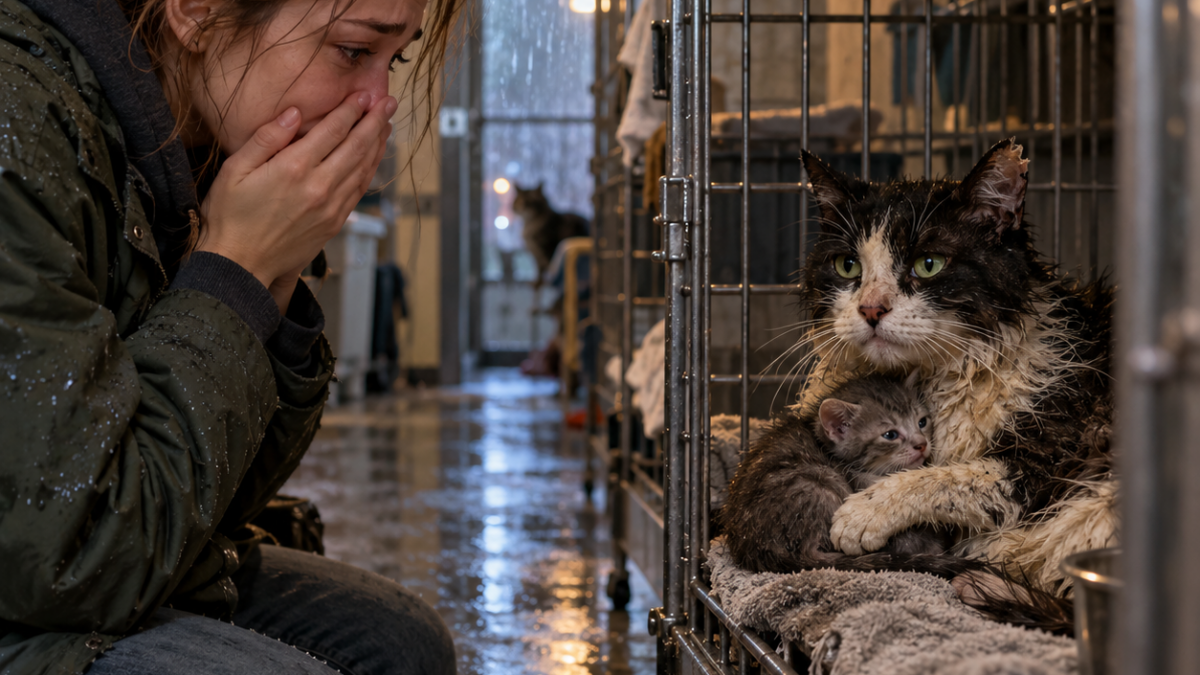
I walked into the shelter expecting to leave with a three-month-old kitten.
Instead, I found an old cat using his starving body to protect a baby that wasn’t even his.
And before I walked back out those doors, I would learn that some animals remember abandonment so deeply that love can look almost like fear.
It was a cold October morning, the kind when the sky never really brightens and a thin drizzle seems to hang in the air rather than fall.
I had been planning that day for months.
The carrier was sitting on the passenger seat of my car. A soft blue blanket was folded inside. At home, I had already set up a little bed beside the couch, two ceramic bowls in the kitchen, a scratching post near the window, and enough toys to make it look as though I were preparing for a toddler instead of a cat.
For years, I had told myself I wasn’t ready.
My job had been too demanding. My apartment had been too small. I traveled too often. There was always some practical reason to postpone it.
But the truth was simpler.
I had gotten used to living alone.
Too used to it.
I wanted something waiting for me when I came home.
Something alive.
Something that would turn an empty apartment into a home.
That was why I had chosen the orange kitten from the shelter’s website.
Three months old.
Friendly.
Healthy.
Playful.
Perfect.
When I entered the shelter that morning, a tired-looking woman in her fifties glanced up from the front desk.
“You must be here for the orange kitten,” she said.
I smiled.
“That’s me.”
“I’m Denise.”
She gathered several papers and stepped around the desk.
“Come on. He’s a sweetheart. If you sit down, he’ll probably climb into your lap before you even finish the paperwork.”
That was exactly what I wanted to hear.
I followed her down a long hallway.
The shelter wasn’t unpleasant, but there was a sadness to the place that no amount of cleaning could erase. The air smelled faintly of disinfectant, wet fur, old wood, and canned food.
Cats watched us from behind metal doors.
Some meowed immediately.
One reached both paws through the bars.
Another pressed its face against the cage door.
Several didn’t move at all.
I tried not to look too closely.
I had come for one cat.
I couldn’t save all of them.
That was what I kept telling myself.
Then I heard it.
A weak, rough sound from somewhere behind me.
Not a real meow.
Barely even a cry.
I stopped.
Denise took two more steps before realizing I wasn’t following.
“What was that?”
She looked toward the far end of the room.
For the first time since I’d arrived, her expression changed.
“That’s probably him.”
“Him?”
She hesitated.
“An older stray. Animal control brought him in yesterday.”
I looked past her.
The sound came again.
There was a cage near the floor in the back corner.
Inside, lying on an old gray towel, was one of the saddest animals I had ever seen.
He was black and white, though dirt had turned much of his white fur gray. His coat was tangled around his legs and chest. One ear was torn along the edge. His ribs showed when he breathed.
But it was his eyes that stopped me.
Large.
Green.
Exhausted.
He looked as though he’d spent too long waiting for something that never came.
Then I noticed the tiny shape curled against his stomach.
A kitten.
It was so small I almost hadn’t seen it.
Gray fur.
Closed eyes.
A body that seemed to tremble with every breath.
I crouched beside the cage.
“Is that his baby?”
“No.”
I looked up.
Denise folded her arms.
“They weren’t even found together. The little one came in separately. We put him in here temporarily last night because we ran out of heated recovery cages.”
“And the older cat accepted him?”
Denise gave a quiet laugh, but there was no humor in it.
“Accepted him? He gave up his food for him.”
I looked back through the bars.
As if he’d understood us, the older cat slowly lifted his head.
His eyes met mine.
He didn’t hiss.
He didn’t retreat.
He simply stared.
Then the kitten made that weak sound again.
Immediately, the old cat moved.
With visible effort, he brought one front leg forward and curled it around the kitten.
Protecting him.
The movement was so gentle it almost broke something inside me.
The kitten buried his tiny face into the old cat’s dirty chest.
And the old cat lowered his chin over him.
I swallowed hard.
Behind me, Denise spoke softly.
“We tried moving the kitten this morning so the vet could look at him.”
“What happened?”
“The old guy panicked.”
I turned.
“Panic how?”
“He threw himself against the cage door. Wouldn’t eat afterward. Wouldn’t stop crying until we brought the kitten back.”
I stared at him again.
Ten minutes earlier, I had been thinking about an orange kitten racing across my living room.
Now I couldn’t remember why that had seemed so important.
I put my fingers against the bars.
The old cat’s eyes followed them.
He didn’t come closer.
But he didn’t look away either.
“What happens to him?” I asked.
Denise didn’t answer immediately.
And somehow, that silence told me enough.
I looked at the tiny gray kitten beneath his paw.
Then at the carrier I had brought for one healthy, playful baby.
Finally, I asked the question that changed everything.
“What happens if I take only the kitten?”
PART 2
Denise didn’t answer right away.
She looked down at the old cat, then back at me.
“I think he’d survive it physically,” she said.
There was something careful in her voice.
“And emotionally?”
She exhaled.
“I don’t know.”
That answer stayed between us.
I looked through the bars again.
The old cat was still watching me.
I had no idea how old he really was. Ten, maybe twelve. His face had the roughness of an animal that had spent too much time outdoors, but there was something else there too.
He wasn’t feral.
I could tell.
A truly feral cat would have moved away from me, flattened his ears, hissed, hidden.
This cat knew people.
Worse, he seemed to understand exactly what people could do.
“Does he have a name?”
“Not yet.”
“No microchip?”
“We haven’t scanned him thoroughly. He was dehydrated and frightened when they brought him in. The vet gave him fluids, checked for immediate injuries, and decided to let him rest overnight.”
“And the kitten?”
“Male. Maybe six weeks, but severely underweight. We don’t know yet whether there’s something medically wrong or if he just hasn’t had enough food.”
The little gray kitten shifted.
The old cat immediately lowered his nose to him.
Something inside my chest tightened.
“Can I open the cage?”
Denise studied me.
“Slowly.”
She unlocked it.
The old cat’s body stiffened.
I stayed where I was.
“I’m not taking him,” I whispered.
I don’t know why I said it.
Maybe I was talking to him.
Maybe I was talking to myself.
“I’m not taking your baby.”
His eyes remained fixed on me.
I put my hand on the towel several inches away.
For almost a minute, nothing happened.
Then he leaned forward.
Not enough to touch me.
Just enough to smell my fingers.
His nose twitched.
He looked at me again.
The kitten stirred.
The old cat glanced down.
And that was when I saw something that made my decision for me.
His food bowl was behind him.
Almost untouched.
But there were tiny smears of wet food around the kitten’s mouth.
“He really hasn’t eaten?”
“Only a few bites.”
“Since yesterday?”
“Yes.”
“But he’s feeding the kitten.”
“Every time we put food in there, he waits until the little one eats.”
I closed my eyes for a second.
I had walked into that building thinking I was there to choose a pet.
Standing in front of that cage, I suddenly felt ashamed of how simple I’d expected the whole thing to be.
Pick the cutest one.
Fill out the forms.
Take him home.
Buy him toys.
Post pictures.
Give him a good life.
But love wasn’t always convenient.
Sometimes it came filthy and frightened.
Sometimes it had a torn ear.
Sometimes it had already lived most of its life before you arrived.
And sometimes it came with someone else attached to it.
I stood.
“Show me the orange kitten.”
Denise blinked.
“Of course.”
She led me three cages down.
The orange kitten was everything his online photograph had promised.
He bounced toward the door the moment we approached.
He was beautiful.
Healthy.
Bright-eyed.
When Denise opened the cage, he immediately climbed onto my arm, purred, and tried to bite the zipper on my jacket.
I laughed.
For a few minutes, I let myself imagine taking him home.
He would be easy.
He would adapt quickly.
Someone would adopt him within days if I didn’t.
I looked over my shoulder.
At the far end of the room, the old black-and-white cat had raised his head.
He couldn’t see the kitten in my arms clearly from where he was.
But his eyes were on me.
I handed the orange kitten back to Denise.
“He’s wonderful.”
“He is.”
“He’ll find a home.”
She looked at me for a long moment.
“Probably before the weekend.”
I nodded.
Then I pointed toward the corner.
“What about those two?”
She didn’t speak.
“Could I take both?”
Her eyebrows lifted.
“You came for one kitten.”
“I know.”
“That older cat may need a lot of medical care.”
“I know.”
“He may have kidney disease. Dental problems. Arthritis. He could need medication. We haven’t even completed his intake exam.”
“I understand.”
“And the kitten is weak. There could be complications.”
“I understand that too.”
She stared at me.
“You’re serious.”
I looked back at the cage.
“I think I am.”
Denise smiled for the first time.
It wasn’t a big smile.
It looked more like relief.
“Then let’s get the vet.”
The examination took nearly two hours.
The kitten went first.
He weighed less than he should have. He was dehydrated, anemic, and covered in fleas, but the veterinarian, Dr. Patel, believed he had a good chance.
“He needs calories, warmth, parasite treatment, and monitoring,” she explained. “But his heart and lungs sound good.”
I looked through the glass of the examination room.
The old cat was pacing inside his carrier.
He could hear the kitten crying.
“Can you bring him in?”
Dr. Patel glanced toward Denise.
“I usually prefer examining one animal at a time.”
“Please.”
They brought him in.
The moment his carrier door opened, he went straight toward the kitten.
Not toward the door.
Not toward a hiding place.
Toward the kitten.
He sniffed the baby’s face, then sat beside him.
The kitten stopped crying.
Dr. Patel stared.
“Well,” she said quietly. “That’s unusually strong bonding for two unrelated animals.”
Then she examined the older cat.
His condition was worse.
He was severely underweight.
Several teeth were broken.
He had an old injury in his left rear leg that had healed badly.
His ear had been torn months, maybe years, earlier.
He had scars beneath his fur.
His claws were worn unevenly.
But his bloodwork surprised everyone.
“For an old street cat, his kidneys aren’t terrible,” Dr. Patel said. “Liver values are acceptable. He has anemia and infection, probably dental. His leg gives him pain. But…”
She paused.
“But what?”
“He might be tougher than he looks.”
I smiled.
“How old?”
“Hard to say. At least ten. Possibly twelve or thirteen.”
I looked at him.
He was washing the kitten’s head.
“What would you do?”
Dr. Patel understood the question.
“If you’re asking whether I would separate them?”
I nodded.
“No.”
That was enough.
“I’ll take both.”
Denise put a hand over her mouth.
Dr. Patel smiled.
The old cat kept washing the kitten as though none of us mattered.
I named the kitten Oliver.
The old cat took longer.
For the first two days, I called him Buddy, Old Man, Mister, and occasionally Sir when he gave me the particular suspicious look that made me feel as though I were being interviewed for permission to live in my own apartment.
Nothing seemed right.
Then, on the third night, I woke around 2:00 a.m. and found him sitting beside my bed.
He had never willingly come into the bedroom before.
Oliver was asleep between his front paws.
The old cat looked at me.
I held out my hand.
After several seconds, he stepped forward and placed one paw against my fingers.
“Okay,” I whispered. “Walter.”
I had no idea why.
He simply looked like a Walter.
His eyes narrowed slowly.
I took that as approval.
From then on, he was Walter.
The first few weeks were not easy.
Oliver recovered quickly.
Once the medication began working and he started gaining weight, he transformed into a small gray hurricane.
He attacked curtains.
He climbed furniture.
He slept upside down.
He once ran across my face at four in the morning because he had apparently discovered that a bottle cap could be pushed across hardwood flooring.
Walter was different.
Walter lived as if good things could disappear without warning.
He slept lightly.
If I moved too fast near him, his whole body flinched.
If I carried a large object into the room, he hid.
The sound of keys made him freeze.
Plastic garbage bags terrified him.
And whenever I picked Oliver up and walked toward another room, Walter followed.
Every time.
At first I found it sweet.
Then I realized it wasn’t affection alone.
It was fear.
He was making sure Oliver came back.
One evening, I carried Oliver into the bathroom because I needed to trim a little matted fur near his tail.
I shut the door so he couldn’t escape.
Within seconds, Walter began crying outside.
Not meowing.
Crying.
The sound was raw and desperate.
I opened the door immediately.
Walter rushed in, sniffed Oliver all over, and then stared at me.
That look stayed with me.
Something had happened to him.
Something more than living on the street.
I became certain of it.
Three weeks after I adopted them, Denise called.
“Are you sitting down?”
I looked across the room.
Walter was asleep on the couch with Oliver stretched across his stomach.
“Should I be worried?”
“No. I don’t think so. We found something.”
“What?”
“A microchip.”
I sat up.
“I thought you scanned him.”
“We did. Twice. It didn’t register. During his dental surgery yesterday, Dr. Patel felt something near his shoulder blade. The chip had migrated. They scanned that exact area and got a number.”
My stomach tightened.
“Does he have an owner?”
There was a pause.
“He did.”
The word did mattered.
I stood.
“What do you mean?”
“The registration is old. The phone number doesn’t work. But the name attached to it is a woman named Margaret Bell.”
“Do you have an address?”
“Yes.”
“And?”
Denise hesitated.
“The address is the abandoned house where animal control found him.”
I looked at Walter.
He was awake now.
Watching me.
“Can you find Margaret?”
“We already started looking.”
“And?”
“She died eleven months ago.”
I didn’t say anything.
“There’s more,” Denise continued.
My hand tightened around the phone.
“What?”
“The property changed ownership after she died.”
“To who?”
“A relative.”
I looked at the old scars on Walter’s body.
A terrible possibility began forming in my head.
“Denise…”
“I know.”
“Was he left there?”
“We don’t know yet.”
“But he belonged to that woman.”
“According to the chip, yes.”
“And he was found outside her abandoned house almost a year after she died.”
“Yes.”
I felt sick.
Walter lifted his head as Oliver climbed over him.
The old cat immediately began cleaning the kitten’s ear.
“Find out,” I said.
There was steel in my voice that hadn’t been there before.
“Please find out what happened to him.”
Margaret Bell had been seventy-eight when she died.
I learned that from an obituary Denise found online.
There was a photograph of her standing beside a garden full of sunflowers.
And beside her feet was a young black-and-white cat.
Walter.
His fur was glossy.
His ear was whole.
His body was strong.
He looked about four years old.
I stared at that photograph for a long time.
Then I enlarged it.
Margaret had one hand resting on his back.
Walter was looking up at her.
I had seen that expression before.
Not the fear.
The trust.
I called Denise.
“That’s him.”
“I know.”
“He loved her.”
“I’m sure he did.”
“What happened after she died?”
“We’re working on it.”
The answer came six days later.
And it made me angrier than I had expected.
Margaret’s nephew, a man named Eric Bell, inherited the house.
According to neighbors, he arrived with a crew two days after the funeral.
They emptied the property.
Furniture.
Clothes.
Boxes.
Trash.
Everything.
One neighbor remembered seeing Walter sitting on the front porch.
Another remembered asking Eric what he planned to do with Margaret’s cat.
Eric’s answer had apparently been:
“Not my problem.”
Then he locked the house.
And left.
Walter stayed.
For almost eleven months.
At first neighbors fed him.
Then the property became tangled in legal and financial problems.
The electricity was shut off.
The yard became overgrown.
People moved.
Winter came.
Walter remained.
Waiting outside the house where the only person he trusted had disappeared.
I couldn’t stop thinking about it.
Every day, he must have expected Margaret to come back.
Every night, he must have found some place beneath that porch or inside an old shed to sleep.
Rain.
Snow.
Summer heat.
Nearly a year.
And he stayed.
Because that had been home.
Because she had been his person.
Because animals don’t understand probate court or funerals or inheritance.
They understand doors.
Voices.
Routines.
Smells.
They understand that someone leaves and sometimes returns.
Walter had waited for someone who could never return.
And the one human who could have helped him had looked at him and said:
Not my problem.
That night, I sat on the floor beside Walter.
Oliver was asleep nearby.
Walter watched me carefully as I reached out.
“I found her,” I whispered.
His ears moved.
“Margaret.”
Of course he couldn’t understand the name the way I did.
But something changed.
His eyes widened slightly.
I said it again.
“Margaret.”
Walter stood.
For one second, I thought I had imagined it.
Then he walked toward me.
“Margaret.”
He made a sound deep in his throat.
Not a meow.
Almost a question.
My eyes filled.
“Oh, buddy.”
Walter pressed his head against my hand.
That was the first time he had ever done it.
I broke.
I sat on my kitchen floor with tears running down my face while an old cat leaned against me and purred for a woman who had been dead nearly a year.
“I can’t bring her back,” I whispered.
Walter kept purring.
“But I swear to you, nobody is leaving you outside again.”
I thought that would be the end of it.
It wasn’t.
The next morning Denise called again.
“The kitten may be connected.”
I stopped pouring coffee.
“What?”
“Oliver.”
“How?”
“Do you remember that I told you they were found separately?”
“Yes.”
“They were. Walter was found at Margaret’s house. Oliver was found almost three miles away behind a grocery store.”
“So?”
“Animal control went back through the intake notes. A woman found Oliver inside a cardboard box with two other kittens.”
My stomach dropped.
“Two others?”
“They didn’t survive.”
I closed my eyes.
“Why are you telling me this?”
“Because the box had an address label.”
I already knew.
I didn’t want to.
But I knew.
“Margaret’s house?”
“Yes.”
For several seconds neither of us spoke.
“That doesn’t prove anything.”
“No.”
“Maybe someone reused the box.”
“Possible.”
“But you don’t think so.”
“No.”
I looked toward the living room.
Oliver was attacking Walter’s tail.
Walter tolerated it for several seconds before gently placing one paw on Oliver’s head.
“Do you know who put them there?”
“Not yet.”
I heard myself say, “Find out.”
It took animal control another two weeks.
By then, Walter had gained almost two pounds.
His infected teeth were gone.
His coat was beginning to shine.
He had discovered the heated blanket on my couch and treated it like a royal throne.
Oliver had discovered Walter’s patience had limits, though he seemed determined to test those limits every twenty minutes.
My apartment had become louder.
Messier.
More expensive.
And more alive than it had been in years.
Then Officer Ramirez from county animal control called me.
She asked if I could meet her at the shelter.
I knew immediately it was serious.
Denise was waiting when I arrived.
So was Dr. Patel.
Ramirez placed a folder on the table.
“We’ve been investigating the property where Walter was found.”
I sat.
She opened the folder.
“Margaret Bell’s nephew, Eric, inherited the house. He never lived there, but he continued using the detached garage for storage.”
“Okay.”
“One of the neighbors has a security camera facing part of the alley.”
My stomach tightened.
“We found footage from the week Oliver was discovered.”
I stared at her.
“What does it show?”
Ramirez’s expression hardened.
“A truck registered to Eric Bell entering the alley behind the grocery store.”
“That’s not enough.”
“No.”
She turned the page.
“But we also interviewed someone who worked for him.”
I said nothing.
“A handyman named Lewis. He claims Eric had been storing boxes in Margaret’s garage. About seven weeks ago, Lewis found a stray female cat there with three kittens.”
My mouth went dry.
“Three.”
“Yes.”
“Gray kittens?”
“Two gray. One black.”
I looked down.
“What happened?”
“According to Lewis, he wanted to contact a rescue group.”
“And Eric?”
Ramirez paused.
“He told him to get rid of them.”
The room seemed to shrink.
I could hear the fluorescent light buzzing above us.
“What does that mean?”
“Lewis says he refused. The next day the cats were gone.”
“Where was the mother?”
“We haven’t found her.”
I pushed my chair back.
I needed space.
“You’re saying that man abandoned Walter after his aunt died, then later abandoned three kittens?”
“We’re saying we’re investigating evidence consistent with that.”
“Two of those kittens died.”
“Yes.”
“And Walter nearly died.”
“Yes.”
I looked at Denise.
Her eyes were wet.
“Can you do anything?”
Ramirez’s voice remained calm.
“We can.”
That was the moment my grief became anger.
Not the explosive kind.
Something colder.
Something useful.
“What do you need from me?”
Over the next month, I learned more about animal cruelty law than I ever expected to know.
I learned that justice is rarely dramatic at first.
It looks like paperwork.
Veterinary records.
Photographs.
Dates.
Statements.
Receipts.
Microchip registrations.
Security footage.
Witness interviews.
It looks boring.
Until enough boring pieces form a picture nobody can deny.
I gave them everything.
Walter’s medical reports.
Photographs from his first day.
Bills showing treatment for malnutrition, infection, dental disease, fleas, dehydration, and the old leg injury.
The shelter documented Oliver’s condition.
The veterinarian documented the condition of the two kittens that hadn’t survived.
Neighbors provided statements about Walter waiting outside Margaret’s house.
One neighbor had photographs.
That nearly destroyed me.
In one, Walter sat on Margaret’s front steps during winter.
Snow covered the yard.
His body was thin.
He was staring at the front door.
In another, he was curled beneath a patio chair.
In another, he sat beside an empty food bowl someone had left outside.
Month after month.
Waiting.
I printed one photograph and brought it home.
Then I regretted it.
Walter saw the paper in my hand and came closer.
I didn’t know whether cats understood photographs.
Probably not the way we do.
But when I placed it on the coffee table, Walter sniffed it.
Then he sat beside it.
I picked it up immediately.
“No,” I whispered. “You don’t need that.”
I put the photo in a drawer.
His past belonged in evidence files.
Not in his new home.
Eric Bell found out about the investigation before charges were filed.
And that was when he made his first mistake.
He came to my apartment.
I still don’t know exactly how he found my address.
My information was on some veterinary documents associated with the case, and his attorney later claimed he obtained it through legitimate discovery.
Maybe.
Maybe not.
All I know is that one Saturday afternoon, someone pounded on my door.
Walter vanished under the couch instantly.
Oliver froze.
I checked the peephole.
A man in a dark jacket stood outside.
Mid-forties.
Angry.
I didn’t open the door.
“Who is it?”
“Eric Bell.”
My entire body went cold.
“What do you want?”
“My aunt’s cat.”
I almost laughed.
Not because it was funny.
Because the audacity was so unbelievable my brain didn’t know what else to do.
“Go away.”
“That cat belongs to my aunt’s estate.”
“No, he doesn’t.”
“You adopted property that wasn’t the shelter’s to give away.”
Walter was under the couch.
I could see his eyes in the darkness.
He was trembling.
I put the chain on the door and opened it two inches.
“Listen carefully. You abandoned him.”
Eric stepped closer.
“I didn’t abandon anything.”
“There’s an active investigation.”
“Exactly. And you’re helping them make me look like some monster.”
“You don’t need my help.”
His face changed.
“Give me the cat.”
“No.”
“I can make this very expensive for you.”
“So can I.”
That stopped him.
I wasn’t brave.
My hands were shaking.
But I had spent weeks looking at photographs of Walter waiting outside an empty house.
I had watched him wake from nightmares.
I had seen him panic when Oliver disappeared behind a bathroom door.
Whatever fear I felt wasn’t enough to make me step aside.
Eric leaned toward the gap.
“You’re getting involved in family business you know nothing about.”
I looked him directly in the eye.
“Your aunt’s cat spent nearly a year outside her house waiting for her.”
His jaw tightened.
“You don’t know what you’re talking about.”
“I know she loved him.”
Silence.
“I know you were asked what would happen to him.”
Nothing.
“And I know what you said.”
His eyes changed.
That was how I knew the neighbor’s statement was true.
Not my problem.
I closed the door.
He slammed his palm against it.
Walter bolted from beneath the couch and ran into the bedroom.
That was Eric’s second mistake.
Because my doorbell camera recorded everything.
Including his final words.
“You’ll regret making this personal.”
I sent the video to Officer Ramirez within ten minutes.
Three days later, Eric’s attorney sent me a letter demanding Walter’s return.
By then, the shelter’s attorney was involved.
So was the county.
The letter claimed that because Walter had been registered to Margaret, he technically belonged to her estate and had been transferred improperly.
That argument lasted approximately four days.
Margaret’s will contained a small but devastating paragraph.
She had left instructions concerning Walter.
She wanted her nephew to place him with her friend, a retired nurse named Evelyn Harper, if anything happened to her.
Nobody had known.
Evelyn had moved to Arizona two years earlier.
She had never been contacted after Margaret died.
When investigators reached her, she cried.
Then she provided emails.
Margaret had written about Walter constantly.
One email, sent three months before her death, said:
“If anything happens to me, please make sure Walter never ends up alone. He hates being outside. He’s slept beside me every night since he was a kitten.”
I couldn’t read that without stopping.
Another email mentioned Eric.
“I’ve told Eric about you and Walter. He says I’m worrying over nothing, but promise me you’ll check on him.”
Evelyn had promised.
But nobody told her Margaret was dead until months afterward.
Eric had handled the estate.
He knew about the instructions.
And he ignored them.
His claim to Walter collapsed.
But something more important happened.
Evelyn asked to speak with me.
I was nervous when the video call connected.
A woman with silver hair appeared on the screen.
She stared at me for one second.
Then said:
“Can I see him?”
I turned the camera.
Walter was asleep beside Oliver.
Evelyn covered her mouth.
“Oh, Walter.”
His ears moved.
I looked at him.
Evelyn said his name again.
“Walter.”
He lifted his head.
Then came the moment I still can’t explain without feeling my throat tighten.
She said:
“Hey, Walty. Where’s your sunshine?”
Walter stood.
His eyes widened.
He walked directly toward the phone.
Evelyn started crying.
“Margaret always said that to him.”
I couldn’t speak.
Walter sniffed the screen.
Then he meowed.
A clear, loud meow.
I had almost never heard him make that sound.
Evelyn wiped her eyes.
“She loved that cat more than most people.”
“I know.”
“No. I mean she really loved him. Her husband died eight years before she did. Walter got her through it.”
I looked at him.
Suddenly, the whole story changed again.
I had thought I rescued Walter.
But once, Walter had rescued Margaret.
Evelyn asked me a question I wasn’t expecting.
“Are you keeping him?”
My chest tightened.
“If I can.”
“Good.”
“You don’t want—”
“No.”
She shook her head.
“He’s home.”
Walter settled beside Oliver again.
Evelyn smiled through tears.
“Look at him. Margaret would know.”
“Know what?”
“That he found another person.”
I turned away for a moment because I couldn’t let her see me crying.
The county filed charges against Eric two weeks later.
Animal abandonment.
Animal neglect.
Additional counts related to the kittens.
The case became uglier before it became better.
Eric denied everything.
He claimed Walter had run away.
He claimed he’d assumed neighbors were caring for him.
He claimed the kittens had nothing to do with him.
He claimed the security footage proved only that he’d driven through an alley.
Then Lewis, the handyman, produced text messages.
That changed everything.
One message from Eric read:
Get those cats out of the garage today. I don’t care where.
Lewis had replied:
They’re babies. I’ll call the shelter.
Eric:
No. They’ll make paperwork and ask questions. Put them somewhere else.
Another:
And don’t feed that old black-and-white cat. He keeps coming back because people keep feeding him.
I read that message three times.
Then I walked into my bathroom and was physically sick.
Don’t feed him.
Not because Eric had forgotten Walter.
Not because he didn’t know.
Because he wanted Walter to stop coming back.
The old cat had spent months returning to Margaret’s house.
And Eric had understood exactly what was happening.
He had simply wanted the problem to disappear.
That night, I sat beside Walter’s bed.
He was sleeping with Oliver pressed against his chest.
“You won,” I whispered.
Walter opened one eye.
“You don’t know it yet.”
I touched the edge of his torn ear.
“But you won.”
The legal process took months.
During that time, Walter changed.
Slowly.
Almost invisibly.
Then all at once.
He stopped hiding when I came home.
Instead, he began waiting near the door.
The first time I saw him there, I nearly dropped my groceries.
Oliver raced into the hallway immediately.
Walter stood behind him.
For a second I was back at the shelter, looking at that filthy cat who seemed convinced everything could be taken away.
I knelt.
“I’m home.”
Oliver climbed onto my knee.
Walter took three slow steps toward me.
Then he head-butted my hand.
I laughed.
“Yeah. I’m home.”
That became our ritual.
Every evening.
No matter how late I returned.
Oliver first.
Walter behind him.
Eventually Walter stopped staying behind.
His first Christmas with me was absurd.
I bought two stockings.
Oliver attacked both.
Walter ignored them.
I bought catnip toys.
Oliver went insane.
Walter stared at me as though I had brought illegal drugs into the house.
Then I gave Walter his present.
A heated orthopedic bed.
He sniffed it.
Stepped into it.
Turned twice.
Lay down.
And refused to leave for six hours.
“Best sixty dollars I’ve ever spent,” I told him.
Oliver jumped on top of him.
Walter looked at me with betrayal.
“Sorry. I can’t return the kitten.”
Walter sighed.
It was the most human sound I’d ever heard from an animal.
I laughed until my stomach hurt.
That was another thing I hadn’t expected.
I thought rescuing an old cat would be sad.
And sometimes it was.
But Walter was funny.
He hated bananas.
He loved rotisserie chicken.
He could hear a can of tuna opening from three rooms away but somehow became completely deaf when I told him to get off the kitchen table.
He snored.
He stole my pillow.
And despite acting exhausted by Oliver’s existence, he panicked if the younger cat disappeared for more than five minutes.
Oliver worshiped him.
Whatever Walter did, Oliver copied.
Walter sat by the window.
Oliver sat by the window.
Walter scratched the post.
Oliver scratched the post.
Walter drank water.
Oliver tried to push his entire head into the same bowl at the same time.
Walter tolerated everything.
Until Oliver began attacking his tail.
That was where fatherly patience ended.
The court hearing happened in February.
I wasn’t required to testify at the first hearing, but I went.
I wanted to see Eric.
Not because I wanted him humiliated.
At least, that’s what I told myself.
The truth was less noble.
Some part of me wanted him to understand what he’d thrown away.
I brought one photograph.
Not the winter photograph of Walter waiting outside.
A new one.
Walter lying in his heated bed.
Oliver sleeping across his back.
Both healthy.
Both safe.
I kept it in my folder.
Eric looked smaller in court.
Not physically.
Just less powerful.
The threatening man outside my apartment had become a defendant sitting beside an attorney while a judge read charges.
His lawyer negotiated.
Some counts were consolidated.
There would be fines.
Restitution.
Probation.
Community service under restrictions that prevented him from working directly with animals.
The court also prohibited him from owning or possessing animals during his probation.
It wasn’t prison.
At first, that disappointed me.
Then Officer Ramirez said something that changed my perspective.
“Justice isn’t always about making someone hurt.”
We stood outside the courthouse.
Snow was beginning to fall.
“Sometimes it’s about making sure they can’t hurt the same way again.”
I nodded.
She pointed to the folder in my hand.
“What’s that?”
I showed her the photograph.
She smiled.
“That’s the part no judge can order.”
“What?”
“He lost the right to matter in Walter’s life.”
I looked at the picture.
She was right.
Eric had inherited a house.
Furniture.
Property.
Money.
But the one thing Margaret had trusted him with that actually loved her?
He had thrown it away.
And Walter had found something better.
At the final hearing, something unexpected happened.
Eric asked to speak.
His attorney looked uncomfortable.
The judge allowed it.
Eric stood.
He apologized.
Not to me.
Not to the shelter.
Not exactly to Walter.
He said he had been overwhelmed after Margaret’s death.
He said he hadn’t wanted responsibility for an old animal.
He said he knew he had handled things badly.
Then he said a sentence that made my hands clench.
“It was just a cat.”
The judge stared at him.
The entire courtroom went silent.
Eric seemed to realize too late what he had said.
The judge leaned forward.
“Mr. Bell, the problem is that your actions demonstrate you treated a living animal as though its suffering was irrelevant because caring for it was inconvenient.”
Eric looked down.
The judge continued.
“Whether you personally value that animal is not the legal standard.”
I didn’t smile.
But something inside me settled.
The judge ordered restitution covering a substantial portion of veterinary and shelter costs.
He ordered the maximum probation available under the negotiated agreement.
He confirmed the ban on possessing animals.
And then, because the estate dispute had been raised, he formally recognized that any remaining claim Eric asserted to Walter had been abandoned and superseded by the lawful shelter adoption.
Walter was mine.
Legally.
Finally.
Completely.
Outside the courthouse, Eric walked past me.
He stopped.
For one second, I wondered whether he would say something.
He looked at the folder in my hand.
I opened it.
I don’t know why.
Maybe this was my small revenge.
Maybe I wanted him to see.
The photograph of Walter and Oliver was on top.
Eric stared at it.
Walter looked nothing like the dying animal from the abandoned house.
His coat shone.
His body was heavier.
His green eyes were calm.
Oliver was asleep against him.
Eric looked away.
I said quietly:
“That’s the cat you called a problem.”
He didn’t answer.
I didn’t need him to.
I closed the folder and walked away.
That was the last time I ever saw him.
Spring arrived.
Then summer.
Oliver turned one.
I made him a ridiculous plate of cat-safe treats and bought a paper birthday hat.
Walter refused to wear one.
Oliver wore his for approximately eleven seconds before eating the elastic string.
Life became ordinary.
That might sound like a disappointing ending.
It wasn’t.
Ordinary was the miracle.
Walter slept.
Walter ate.
Walter watched birds.
Walter complained when dinner was late.
Walter followed me to the bathroom.
Walter sat beside Oliver.
Walter stopped checking every room after I carried Oliver somewhere.
One evening, I realized I had closed the bedroom door with Oliver inside.
Walter was in the hallway.
A year earlier, he would have panicked.
This time he sat calmly outside.
He looked at the door.
Then at me.
He waited.
He knew Oliver would come back.
That tiny moment meant more to me than the entire court case.
Trust had returned.
Not completely.
Maybe trauma never disappears completely.
But enough.
Walter had learned that closed doors could open again.
Two years passed.
Then three.
Walter aged.
His arthritis worsened.
Dr. Patel prescribed medication.
I bought ramps for the couch and bed.
Oliver refused to use the ramps and continued launching himself through the air like an idiot.
Walter used them with dignity.
At thirteen—or fourteen, or possibly fifteen—he developed kidney disease.
We managed it.
Fluids.
Special food.
Regular bloodwork.
He hated every second of it.
But afterward, I always gave him a small piece of chicken.
That made the betrayal tolerable.
One afternoon, Evelyn visited.
She had moved back east to be closer to her daughter and asked whether she could see Walter in person.
When she entered my apartment, Walter was sleeping.
She didn’t approach immediately.
Instead, she sat on the floor.
“Walter.”
His eyes opened.
She said the old phrase.
“Where’s your sunshine?”
Walter stared at her.
Then he stood.
Slowly.
Painfully.
He walked across the room.
Evelyn began crying before he reached her.
Walter sniffed her hands.
Then her face.
And finally he climbed into her lap.
I had never seen him do that with a stranger.
She buried her face in his fur.
“Oh, Margaret,” she whispered. “He made it.”
I turned away.
Oliver, confused by the emotion, climbed onto Evelyn too.
She laughed through her tears.
“Who is this?”
“That’s Oliver.”
“The baby?”
“The baby.”
She looked at the full-grown gray cat now attempting to sit on Walter’s head.
“That’s not a baby.”
“Don’t tell Walter.”
We spent the afternoon talking about Margaret.
For the first time, I learned what Walter had been like when he was young.
He used to sleep in Margaret’s laundry basket.
He once stole an entire chicken breast from the kitchen counter.
He hated thunderstorms.
He loved Christmas wrapping paper.
He had a habit of waiting beside the bathtub whenever Margaret took a bath because apparently he believed water was dangerous and she required supervision.
Every story gave me a piece of him I had missed.
I realized something then.
Rescuing an older animal means accepting that you will never know the whole story.
Someone else may have seen their first steps.
Someone else may have named them.
Someone else may have been their first home.
But love isn’t diminished because you arrived later.
You simply become the next chapter.
Margaret had been Walter’s first great love.
I didn’t need to replace her.
I never could.
I just needed to make sure the rest of his story was worthy of the beginning she had given him.
The following winter was difficult.
Walter’s kidneys declined faster.
He lost weight.
He slept more.
Oliver noticed before I admitted it.
The younger cat stopped wrestling with him.
Instead, he slept nearby.
Sometimes he groomed Walter’s face exactly the way Walter had groomed him in that shelter cage years earlier.
The first time I saw it, I sat on the floor and cried.
The circle had closed.
Walter had once protected a dying kitten.
Now that kitten was protecting him.
Dr. Patel was gentle with me.
“We’re not there yet,” she said after one appointment. “But we’re getting closer.”
I knew what she meant.
I hated her for saying it.
Then I hated myself for hating her.
I wanted numbers.
Months.
Dates.
Certainty.
She couldn’t give me any.
So I did what Walter had taught me.
I stopped worrying about how long love would last.
I started paying attention to the fact that it was still there.
On a cold morning in January, Walter stopped eating.
Not completely.
But enough.
He turned away from chicken.
That frightened me more than any laboratory result ever had.
We went to Dr. Patel.
Blood tests confirmed what I already knew.
His kidneys were failing badly.
We tried fluids.
Medication.
Anti-nausea drugs.
For three days, he improved.
Then he didn’t.
On the fourth night, Walter climbed into my bed.
He hadn’t been able to jump up for almost a year, so I had built a small ramp beside it.
He walked up slowly.
Oliver followed.
Walter settled against my chest.
Oliver curled behind him.
I stayed awake most of the night.
Around three in the morning, Walter began purring.
Very softly.
I put my hand on his side.
“I know.”
I don’t know why I said it.
Maybe because he knew.
Maybe because I did.
“I know, buddy.”
He put one paw on my wrist.
Exactly the way he had touched my fingers the night I named him.
I cried silently.
“I’m not going anywhere.”
For years, Walter had been afraid of being left.
That night, I understood my final responsibility.
He would not be the one left behind again.
I would stay.
No matter how much it hurt.
The next afternoon, Dr. Patel came to my apartment.
I couldn’t take Walter back to the clinic.
He had spent enough of his life being carried somewhere he didn’t understand.
His final memory would be home.
His heated bed.
His blanket.
My voice.
Oliver.
Evelyn came too.
Denise came.
Even Officer Ramirez stopped by earlier and kissed his head.
Walter had built a strange little family without ever trying.
We sat around him.
He was tired.
But calm.
Oliver lay pressed against his side.
Dr. Patel explained everything.
I barely heard her.
I held Walter.
Evelyn stroked his torn ear.
She whispered:
“Margaret is waiting, old man.”
I wasn’t sure what I believed about death.
But in that moment, I wanted it to be true.
I wanted Margaret somewhere beyond everything we understood.
I wanted a door opening.
Sunlight.
Her voice.
Walter young again.
I leaned close.
“You don’t have to wait anymore.”
His eyes opened.
Green.
Still beautiful.
“You were never the problem.”
His paw moved weakly against my hand.
“You were worth coming back for.”
Dr. Patel gave the medication.
Walter relaxed.
His breathing slowed.
Oliver lifted his head and began washing Walter’s forehead.
Once.
Twice.
Again.
Walter’s last breath came while the kitten he had saved was grooming him.
There was no fear.
No cage.
No cold porch.
No locked door.
He was home.
I thought grief would make the apartment silent again.
I was wrong.
Oliver screamed for breakfast the next morning at six.
I laughed and cried at the same time.
For several days, he searched for Walter.
Behind the couch.
In the bedroom.
Near the heated bed.
He cried at night.
So did I.
I almost put Walter’s bed away.
Then I couldn’t.
On the fifth evening, Oliver climbed into it.
He circled twice.
Exactly like Walter.
Then he lay down.
I sat beside him.
“Okay,” I whispered.
“We’ll keep it.”
A month later, a package arrived from Evelyn.
Inside was a framed photograph.
Margaret sitting in her garden.
Walter beside her.
The same photograph I had first seen online.
But this copy was clearer.
On the back, Margaret had written something years earlier.
Walter always chooses the lonely ones.
I read the sentence again.
And again.
Then I sat down.
Evelyn had included a note.
Margaret had once taken Walter to visit her husband during the final months of his illness. Walter would ignore everyone else in the room and climb beside him.
After Margaret’s husband died, Walter slept on the empty side of the bed for months.
Walter always chooses the lonely ones.
Suddenly I thought about Oliver.
The weak kitten in the shelter.
About Margaret.
About me.
I had walked into that shelter because my apartment felt empty.
I thought I was choosing a cat.
Maybe Walter had chosen me long before I understood what was happening.
Six months after Walter died, Denise called.
I still spoke to her regularly.
Oliver had become something of a shelter legend.
The kitten who survived.
The old cat who protected him.
The court case.
People remembered.
“I need you to tell me no,” Denise said.
I laughed.
“That sounds dangerous.”
“We have a cat.”
“No.”
“You didn’t even let me finish.”
“I know what you’re doing.”
“He’s fourteen.”
“No.”
“Owner died.”
I closed my eyes.
“Denise.”
“He’s been here three weeks.”
“No.”
“He won’t eat when people are watching.”
“Stop.”
“He sleeps facing the wall.”
I looked across the room.
Oliver was sitting in Walter’s old heated bed.
Denise remained silent.
I knew she was smiling.
“You’re evil.”
“I’ve been called worse.”
“I am not adopting another cat.”
“Of course not.”
“I mean it.”
“I believe you.”
“I have one carrier.”
“We sell carriers.”
I hung up on her.
Then I sat there for ten minutes.
Oliver looked at me.
“No.”
He blinked.
“Absolutely not.”
He yawned.
Twenty minutes later, I put the carrier in the car.
The senior cat’s name was Henry.
He was orange.
The color of the kitten I had originally planned to adopt all those years earlier.
That felt like the universe making a joke at my expense.
Henry was enormous.
Fourteen years old.
Overweight despite refusing food at the shelter.
One cloudy eye.
No patience.
When I approached his cage, he hissed.
“Great,” I said.
Denise laughed.
“You have a type.”
“I hate you.”
“You love me.”
“I tolerate you.”
Henry hissed again.
“See? He gets me.”
I sat in front of the cage.
For a long time, Henry didn’t move.
Then Oliver’s scent must have reached him on my jacket.
He leaned forward.
Sniffed.
Paused.
I put my fingers near the bars.
“Listen, buddy. I knew a cat once who was pretty convinced people were terrible.”
Henry’s ears twitched.
“He wasn’t completely wrong.”
Denise stood behind me without speaking.
“But he gave us another chance.”
Henry looked at me.
“And apparently I have a spare heated bed.”
Bringing Henry home was chaos.
He hated Oliver.
Oliver adored him.
For the first week, Henry hissed every time Oliver entered the room.
Oliver responded by lying three feet away and staring at him.
On day eight, Henry stopped hissing.
On day twelve, Oliver slept beside him.
On day sixteen, I came home and found Oliver washing Henry’s face.
I froze in the doorway.
The groceries slipped from my hand.
Henry opened one eye.
Oliver kept grooming him.
Exactly as Walter had once groomed Oliver.
I sat on the floor.
For a long time, I couldn’t move.
Then I laughed.
“Of course.”
Walter had taught him.
Not through words.
Not through commands.
Through kindness.
A starving old cat in a shelter had shared his food with a kitten who wasn’t his.
Years later, that kitten was doing the same thing for another frightened old animal.
That was Walter’s revenge.
Not the courtroom.
Not the fines.
Not Eric losing his case.
Not the judge’s words.
This.
The thing Eric had treated as worthless had created more love than Eric could destroy.
Walter had been abandoned.
So he refused to abandon Oliver.
Oliver had been saved.
So he learned how to save Henry.
Cruelty had reached our door.
And somehow, instead of spreading, it had stopped there.
Walter had changed its direction.
A year later, the shelter renovated the cat recovery room.
Donations from people who had followed Walter and Oliver’s story helped pay for it.
Denise asked whether they could name one of the senior-cat spaces after him.
I said yes.
A small plaque went beside the door.
It didn’t mention Eric.
It didn’t mention the case.
It didn’t mention the suffering.
It simply read:
WALTER’S ROOM
For the ones who waited too long to be chosen.
Below that was a photograph of Walter.
Not the winter photograph.
Not the intake photograph.
The good one.
Walter in his heated bed.
Oliver asleep across him.
Safe.
Loved.
Home.
The first cat placed in Walter’s Room was a twelve-year-old female named Daisy.
She had been surrendered after her owner entered a nursing facility.
A retired couple adopted her nine days later.
The next was sixteen-year-old Max.
Then eleven-year-old Pearl.
Then thirteen-year-old Simon.
Every time Denise sent me a photograph of another gray-faced old cat leaving through the shelter doors in someone’s arms, I thought about that October morning.
I had gone there for a kitten.
A perfect kitten.
A young kitten.
A kitten without a complicated past.
Instead, I met Walter.
He was dirty.
Old.
Scared.
Expensive.
Damaged.
And carrying a kitten under one paw as if that tiny life were the last good thing left in the world.
Maybe it was.
At least to him.
What I didn’t understand then was that Walter wasn’t asking me to rescue him.
He wasn’t asking anything.
He had already stopped expecting people to help.
All he was trying to do was make sure the little creature beside him survived.
That was the moment he became impossible to leave behind.
Sometimes people ask whether I regret not taking the orange kitten I originally went to adopt.
I don’t.
I checked once.
He was adopted two days after my visit.
A family with two children took him home.
I saw a photograph.
He looked happy.
Exactly where he was supposed to be.
And so was Walter.
So was Oliver.
So, eventually, was Henry.
There are moments in life when the thing you planned and the thing you need are standing only a few feet apart.
I had planned for easy.
Walter taught me something better.
He taught me that love isn’t measured by how convenient someone is to bring home.
It isn’t measured by age.
Health.
Appearance.
Cost.
Or how much time you think you have left together.
Sometimes the ones who have the least time left teach you the most.
Walter lived with me for a little over four years.
Four years.
That was all.
If someone had told me at the shelter, I might have thought it wasn’t enough.
Now I know better.
Four years was thousands of mornings.
Thousands of meals.
Hundreds of evenings at the window.
Christmases.
Vet visits.
Chicken stolen from plates.
Oliver jumping on his head.
Walter stealing my pillow.
Quiet nights.
Warm blankets.
Trust returning one day at a time.
Four years wasn’t short to Walter.
It was the rest of his life.
And the rest of his life was good.
That is enough.
More than enough.
I still have Margaret’s photograph on my bookshelf.
Beside it is another picture.
Walter and Oliver together.
Sometimes I look at those photographs and imagine the years between them.
Margaret’s hands.
The empty house.
The winter porch.
The shelter cage.
My apartment.
Oliver.
The courtroom.
The heated bed.
The final night.
It would be easy to look at Walter’s life and think the cruel parts defined it.
They didn’t.
Eric abandoned him.
But Eric didn’t get the last word.
Abandonment didn’t get the last word.
Fear didn’t get the last word.
The last word was home.
The last word was Oliver washing his forehead.
The last word was an old cat falling asleep in the arms of someone who had promised not to leave.
And keeping that promise.
These days, Oliver sleeps beside Henry almost every night.
Henry pretends not to care.
He has learned many of Walter’s habits.
He waits near the kitchen at exactly 5:30.
He steals my pillow.
He has also developed Walter’s selective hearing.
I’m beginning to suspect senior cats exchange instructions somewhere.
Sometimes Oliver puts one paw over Henry while they’re sleeping.
The first time I noticed, I took a photograph.
I placed it beside Walter’s.
Same position.
Same quiet protection.
Different cats.
I sent the picture to Denise.
She replied with four words:
Walter taught him well.
I looked at Oliver.
Then at Henry.
“Yeah,” I whispered.
“He did.”
Every October, on the anniversary of the day I walked into that shelter, I visit Walter’s Room.
I bring food.
Blankets.
Sometimes I pay an adoption fee for a senior cat whose family hasn’t arrived yet.
I never ask which person eventually takes them.
I don’t need to know.
I just like imagining the moment.
A door opening.
Someone walking past the kittens.
Stopping.
Looking down.
Seeing an old face.
And deciding that old doesn’t mean finished.
Maybe they’ll crouch.
Maybe a frightened cat will look back.
Maybe there will be a pause.
Then a hand against the bars.
A nose moving closer.
The beginning of something.
That’s how it happened for me.
I arrived believing I knew exactly what I wanted.
A three-month-old orange kitten.
Instead, I went home with a dying gray baby and an old black-and-white cat who had already lost almost everything.
One needed someone to keep him alive.
The other needed proof that people could still come back.
And I needed them both far more than I understood.
Walter never stopped carrying the marks of what happened to him.
His torn ear remained torn.
His bad leg never became straight.
Certain noises always frightened him.
But scars aren’t the same thing as defeat.
That old cat taught me that.
The people who abandoned him probably thought his story had ended when they locked the door.
They were wrong.
His real story began when another door opened.
Mine.
And if there is any justice in that, it isn’t that the man who abandoned him was punished.
It’s that Walter became impossible to erase.
He lives in Oliver’s gentleness.
In Henry’s second chance.
In Walter’s Room.
In every old cat adopted because someone heard his story and decided to look twice.
And in me.
I went to a shelter looking for a kitten.
I came home with a family.
And the old cat I almost walked past became the one I will remember for the rest of my life.




