PART 2: I Rescued a Half-Starved Horse From a Wyoming Road—Before Dawn, an Entire Wild Herd Came Looking for Her
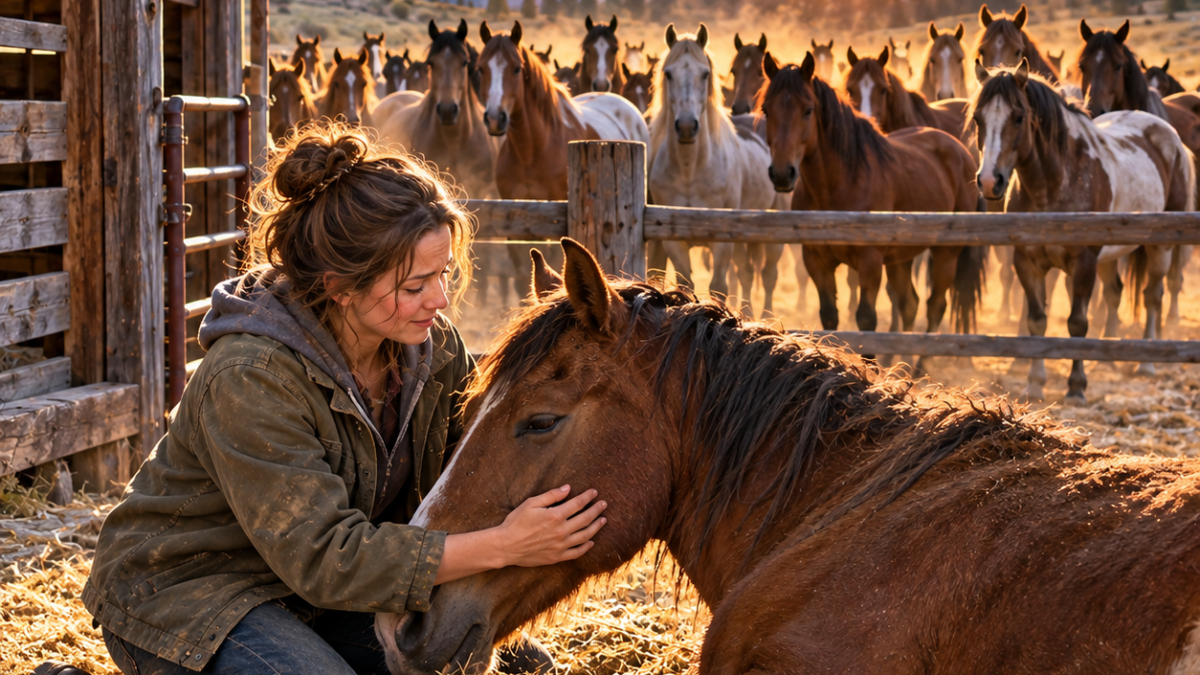
PART 2
There were horses standing in the dark.
Not two or three.
Twenty.
I counted them twice because the number seemed impossible.
They stood beyond my north fence in a loose line, nearly shoulder to shoulder, every head turned toward Juniper.
None of them grazed.
None wandered.
None ran when my porch light came on.
That alone was wrong.
I had seen wild horses all my life. Small bands crossed distant ridges, appeared in badlands draws, moved like smoke across places where roads gave up. If people got too close, they left.
These horses stayed.
Juniper stopped kicking the moment she saw them.
Her body had been trembling hard enough to shake the stall rails.
Then, suddenly, she became quiet.
A heavy bay stallion stood several yards in front of the others. His neck was thick, his mane rough, and a wide blaze had yellowed with age.
He stepped forward.
The fence wire stopped him.
He lowered his head until his muzzle almost touched the ground.
Juniper made a tiny sound.
Not the deep call from midnight.
Something softer.
The stallion raised his head.
Behind him, several mares crowded closer.
I wrapped both hands around the porch rail because my knees had become unreliable.
“Hollis,” I whispered.
I went inside and called him.
He answered on the fourth ring.
“If this is a calf, put it back in.”
“It isn’t a calf.”
A pause.
“What happened?”
“There are horses at my north fence.”
“How many?”
“Twenty.”
“Whose?”
“I think they’re wild.”
That woke him.
“Don’t go near them.”
“I’m not.”
“What are they doing?”
“Watching Juniper.”
Silence.
Then Hollis said, “I’m coming.”
By the time his headlights came up my road, dawn was beginning to gray the eastern sky.
The horses remained.
Hollis parked beside the barn and walked toward me without shutting his truck door.
He stopped halfway across the yard.
“Well.”
“That your professional opinion?”
“At four-thirty in the morning, yes.”
We stood together.
The stallion shifted sideways when Hollis moved, placing himself between us and several younger animals.
But he did not leave.
Hollis stared at Juniper.
Then at the band.
“You said something answered her last night?”
“Yes.”
“From the north?”
“Yes.”
He watched them for almost ten minutes.
Finally he said, “They know her.”
That was the first thought I had been afraid to say.
“You’re sure?”
“No.”
“Hollis.”
“But look at them.”
Juniper stood pressed against the rail closest to the wild horses.
The stallion did the same on his side.
Eighty feet of grass and one fence separated them.
“They came to her,” I said.
Hollis looked toward the northern hills.
“Maybe.”
“What does that mean?”
“It means we don’t know enough.”
The first truck arrived on the county road shortly after sunrise.
Then another.
By nine, half the valley seemed to know that a band of wild horses was standing outside Callaway Ranch.
People parked along the road.
Phones came out.
Kids climbed onto truck beds.
I hated it.
The horses tolerated distant vehicles, but every slammed door made the stallion lift his head.
I walked to the road.
“Keep back from the fence.”
A man from town smiled.
“They yours now?”
“No.”
“Looks like they think so.”
“They’re wild animals. Give them room.”
By noon, rumors had already outrun facts.
I was feeding them.
I was trying to capture them.
I had rescued their leader.
I was creating a tourist attraction because the ranch was failing.
Every version irritated me.
What mattered was Juniper.
And the raw ring around her throat.
After Hollis left to see another patient, I hitched my trailer and drove back to the county cut where I had found her.
In daylight, the ground told a different story.
I parked where she had been standing and walked the ditch slowly.
Truck tracks curved through the dirt.
Wide dual tires.
A heavy rig.
The pattern showed it had backed around tightly.
Near the sage, I found one hole.
Then another.
Four in all.
Placed in a rough square.
Post holes.
Fresh enough that the edges had not weathered.
I stood inside them.
The dirt there was destroyed.
Hoof prints overlapped one another in circles.
Deep.
Churned.
A horse had been moving desperately in too little space.
I found three lengths of nylon rope in the brush.
Yellow.
Cleanly cut.
Not broken.
Cut.
A single trail of hoof prints left the enclosure area.
They led south.
Long strides.
Running.
I crouched beside one print.
Juniper had not been abandoned.
Somebody had held her here.
She had escaped.
The question that followed me home was worse.
Why?
There were hundreds of wild horses scattered across that part of the state.
Some ranchers disliked them.
Others barely noticed them.
Nobody I knew would risk illegally capturing one middle-aged mare simply to own a horse with no training and no market value.
When I reached Callaway Ranch, the band was still at the north fence.
Hollis had returned.
He crouched beside the road studying tracks.
I showed him the rope.
His mouth tightened.
“Where?”
“Where I found Juniper.”
“Post holes?”
“Four.”
“Hoof churn?”
“Yes.”
He looked toward the mare.
“That’s a temporary catch pen.”
“You think someone trapped her?”
“I think someone restrained a horse there.”
“The throat?”
“Fits.”
“Why?”
Hollis stood.
“That’s the question.”
Preston Whitlock arrived on the third day.
I knew his truck from half a mile away.
Juniper knew it sooner.
She had been standing quietly near the water trough.
The moment Preston’s truck came into view, her head snapped up.
She backed rapidly.
Not startled.
Panicked.
Her hindquarters hit the far rails.
Wood groaned.
“Juniper.”
I moved toward her.
She pressed harder into the corner, eyes showing white.
Preston parked.
He stepped out.
Juniper stared at the truck.
Not him.
The truck.
Her entire body shook.
I felt something inside me tighten.
Preston glanced toward the twenty horses beyond the fence.
Then laughed.
A short, genuine sound.
“You’ve got a talent, Marin.”
“For what?”
“Turning a struggling cattle ranch into an animal shelter.”
I said nothing.
His smile disappeared.
“Grant increased the offer.”
“I’m still not selling.”
“You haven’t heard the number.”
“I don’t need to.”
“You should.”
He told me.
My stomach dropped.
It was close to the actual market value of the ranch.
The Whitlocks had never done that.
Their strategy depended on distress.
They bought tired properties from tired people before the bank did.
They waited.
They never rushed.
Preston reached into his truck and handed me a paper.
“Seventy-two hours.”
I stared at him.
“Why?”
“Why what?”
“Why is the offer good for seventy-two hours?”
“Because Grant has other decisions to make.”
“Your family has waited forty years to own every ranch on this road.”
He smiled faintly.
“Maybe our patience is improving.”
Twice during that conversation, Preston asked about Juniper.
Casually.
Almost carelessly.
“What are you going to do with the mare?”
“I don’t know.”
“County might remove her.”
“She’s on my property.”
“If she’s wild, that gets complicated.”
“I’ll handle it.”
A few minutes later he asked again.
“You planning to keep her here?”
I looked straight at him.
“Why do you care?”
“I don’t.”
He answered too quickly.
When he drove away, Juniper remained crushed against the rails until the truck disappeared.
Then she slowly lowered her head.
I went to her.
She allowed me to touch her neck.
The scarred band around her throat felt rough beneath my fingers.
“Do you know him?” I whispered.
Of course she didn’t answer.
But I stopped thinking Preston’s new offer was merely about my debt.
That night, I went into my father’s office.
He had kept maps the way other men kept tools.
Nothing was ever thrown away if it showed a fence, a ditch, a water filing, an easement, or a road that no longer existed.
I pulled open the old map case.
Hours passed.
Then I found a range overlay from the 1960s.
Linen-backed.
Brittle.
Across it ran a dashed line.
It came from the badlands southeast of the ranch.
Crossed directly through what was now Callaway property.
Then continued north through a notch in the ridge.
The legend identified it as a seasonal movement corridor.
I traced the line with one finger.
Again.
Then again.
Wild horses had moved across our ranch before my family owned it.
And at the northern end of that corridor sat land Whitlock Range Holdings had purchased six months earlier.
I called Hollis.
It was after nine.
“Come over.”
“I’m old.”
“I found something.”
“That’s how old people get tricked into leaving warm houses.”
“Bring your reading glasses.”
He arrived twenty minutes later.
We spread the map across my kitchen table.
Hollis stared at it.
Then took off his glasses.
“Wild horse bands remember routes.”
“I know animals remember water.”
“More than that.”
He tapped the line.
“The older mares carry the map.”
“Meaning?”
“Meaning they teach it by walking it. Water. Seasonal ground. Passes.”
He leaned back.
“A band may keep using a route long after the horse that first found it is dead.”
“Juniper?”
“Could be.”
“So the twenty horses came looking for her.”
Hollis was quiet.
“Maybe that isn’t why they’re at your fence.”
I frowned.
“What else would it be?”
“They may be trying to go somewhere.”
We rode the north line the next morning.
Two hours into it, we reached the Whitlock boundary.
The fence was new.
Steel posts.
Five tight strands.
Heavy enough to turn cattle.
Probably horses too.
I dismounted.
The ground on my side was powdered.
Not from cattle.
Hoof prints.
Thousands.
They ran parallel to the fence.
Turned.
Doubled back.
A fifteen-foot-wide strip churned by repeated pacing.
Hollis crouched.
“This isn’t one night.”
“How long?”
“Weeks. Maybe months.”
He pointed.
“They know there’s supposed to be a way through here.”
We followed the fence east.
Eventually it crossed the old creek bed.
That creek had run through Callaway Ranch my entire childhood.
My father had watered cattle from it during drought.
I had photographs of myself as a little girl standing beside it while he held my hand.
Now the channel carried a thread of water no wider than my palm.
I stared.
“We had two inches of rain nine days ago.”
“I know.”
“Every ditch in the county ran.”
“I know.”
I walked down into the channel.
The gravel above the tiny flow was pale and dry.
Young weeds had established near the old edge.
Water does not vanish during a wet month.
Something had changed upstream.
Grant Whitlock arrived at four that afternoon.
Grant was different from Preston.
Older.
Quieter.
More dangerous because he rarely needed to insult anyone.
He walked to my porch instead of making me cross the yard.
“Marin.”
“Grant.”
He removed his hat.
“Your father ran good cattle.”
“Thank you.”
“I mean it.”
“I know.”
Then he named his offer.
Nearly twice Preston’s.
I could have paid the bank.
Cleared the equipment loan.
Finished my father’s medical bills.
Bought another place.
A smaller ranch with reliable water.
I looked at Grant.
“That’s a lot of money.”
“It’s fair.”
“Your family doesn’t usually lead with fair.”
His mouth moved slightly.
“People change.”
“Not that quickly.”
He didn’t argue.
“I know how this looks.”
“Do you?”
“Yes.”
He looked north.
“Our family buys land. Yours doesn’t sell. That has become a story larger than it needs to be.”
“It’s my ranch.”
“I know.”
“Then no.”
Grant nodded once.
No anger.
That bothered me more than Preston’s smugness.
He went down two porch steps.
Stopped.
Turned back.
“You rescued a horse.”
My body went still.
“That was decent.”
I said nothing.
“Just be careful she doesn’t become the reason you lose everything else.”
He walked away.
I stayed on the porch after his truck disappeared.
I had never told Grant I rescued Juniper.
People knew there was a strange mare on my property.
But he knew enough to call it a rescue.
He knew enough to connect her to my decision.
That evening, I took warm water to Juniper’s pen.
I had cleaned the obvious mud before.
This time I worked carefully through her mane.
Near the left side of her withers, I noticed a pale patch.
At first it looked like scar tissue.
I rubbed away dirt.
Numbers appeared.
Faint.
A letter.
Not a ranch brand.
Not anything I recognized.
I called Hollis.
He arrived after dark.
One look changed his face.
“What?”
He leaned closer.
“That’s an old range identification mark.”
“What kind?”
“Inventory work.”
“How old?”
“Could be twenty years.”
He straightened.
“I have records.”
At eleven that night, he returned carrying file boxes.
We sat at my kitchen table until after one.
Survey reports.
Gather records.
Animal identification sheets.
At 1:40, Hollis stopped turning pages.
“Marin.”
I looked up.
He pushed a record toward me.
Dun mare.
Four years old at first identification.
High basin band.
Observed repeatedly over eleven years.
Described as a lead mare.
Identification mark matched.
Then, in the final inventories:
Unaccounted for.
I looked toward the dark kitchen window.
“She was wild.”
“She still is.”
“She was never abandoned.”
“No.”
“She was taken.”
Hollis nodded.
“And escaped.”
I looked down at the old sheet.
The twenty horses outside my fence had not found some random rescued mare.
They had found one of the animals that had spent years leading them to water.
The mystery should have become simpler.
Instead, it got worse.
“Why would anybody steal her?”
Hollis leaned back.
“That’s what doesn’t make sense.”
Wild horses were not valuable enough to explain the risk.
Something else did.
The county notice arrived Monday.
A deputy brought it personally.
He looked embarrassed.
“Sorry, Marin.”
Three complaints.
Road hazard.
Fence damage.
Unpermitted concentration of animals.
Fourteen days to respond.
Possible removal costs assessed to me.
I read the pages twice.
The wild horses were outside my fence.
Yet somehow their presence was becoming my financial responsibility.
“Who complained?”
“Not listed on your copy.”
“You know?”
He looked away.
“I’m delivering paperwork.”
That was answer enough.
The town shifted.
People who had known me since childhood became cautious.
At the café, I heard someone say I was feeding the wild horses to keep them there.
At the feed store, someone claimed I wanted publicity.
At the cattlemen’s meeting, Preston stood beside the coffee table talking loudly enough for me to hear.
“Pretty impressive.”
“What?” somebody asked.
“A woman who can’t save her own ranch deciding she’s going to save the American West.”
Two men laughed.
I was standing in the doorway.
For half a second, I wanted to cross the room.
Instead, I went to my truck.
I sat behind the wheel until my hands stopped shaking.
Bill Mercer followed me outside.
I had stacked hay for him when I was sixteen.
He stood beside my door.
“I didn’t file anything.”
“I didn’t ask.”
“I know.”
He looked toward the building.
“You need to understand something.”
“What?”
“People have mortgages.”
“So do I.”
“People sell cattle to Whitlock.”
I looked at him.
“Nobody wants to get between you and that family.”
There it was.
Not hatred.
Fear.
That was how families like the Whitlocks accumulated power.
Not because everybody loved them.
Because everybody needed something from them.
Preston brought another contract to my house.
He placed it on my kitchen table.
The number would have cleared everything.
Bank note.
Equipment.
Medical debt.
Enough left for another property.
“This ends in forty-eight hours,” he said.
“There won’t be another offer.”
I stared at the pages.
Then he looked through the window toward Juniper.
“What happens to the mare?”
“What?”
“If you sell.”
“Why do you care?”
“We could arrange transport somewhere appropriate.”
I looked at him.
His eyes stayed on mine.
“That’s generous.”
“Practical.”
“Where is appropriate?”
“We’d find somewhere.”
“Where?”
He finally looked away.
“I’m not managing animal placement.”
I closed the contract.
“I need to think.”
He wrote a number on the top page.
Then left.
I did think.
Because pretending the money meant nothing would have been dishonest.
I was tired.
My father had been dead two years.
I had sold his good saddle to pay a repair bill.
Some nights I slept four hours.
I had not taken a real day away from the ranch in more than a year.
There was a version of my life where I signed.
Paid everything.
Bought a smaller place.
Stopped fighting.
Maybe the horses found another route.
Maybe nothing terrible happened.
Maybe I became one more person who decided somebody else would handle it.
Then Hollis noticed something.
The band did not use the north fence evenly.
Every morning they returned to the same two-hundred-yard stretch where the ground dipped into a swale.
Better grass existed east.
Shade lay near the barn.
I had water in the stock tank.
They ignored all of it.
Juniper did the same.
When I turned her into the big pasture, she walked directly toward that low place and faced north.
“Horses don’t choose one place on a fence because it’s attractive,” Hollis said.
“They choose it because that’s where the route goes.”
Back into my father’s office.
More tubes.
Water records this time.
A hydrology sketch.
Irrigation filings.
A surveyor’s letter.
The swale was the head of a natural drainage.
The drainage ran through the notch.
Four miles into Whitlock ground.
At its upper end sat Red Willow Spring.
The old documents described Red Willow as the main year-round water source for the upper valley.
Strong through historic drought.
And its outflow fed my creek.
I drove the drainage the following morning without leaving Callaway property.
I photographed everything.
Three feet above the tiny trickle was a dark watermark.
The old normal flow.
Below it, weeds were establishing in gravel that should have been regularly wet.
Near the Whitlock boundary, machinery tracks scarred the bank.
Fresh grading.
Recontoured earth.
The new fence crossed directly over it.
Water had not simply disappeared.
Someone had moved it.
The county building gave me the reason.
Whitlock Range Holdings had filed a development project in the North Valley.
Residential parcels.
Guest lodge.
Equestrian facilities.
Hundreds of millions in eventual value if the project succeeded.
The project depended on demonstrated water supply.
The supply named in the filings originated at Red Willow.
I sat in my truck outside the county building staring at the application.
Then the entire thing turned over in my head.
They did not need my grass.
They needed my ranch because it completed something.
The historic movement corridor ran from public badlands through Callaway ground to Red Willow.
Whitlock now owned nearly everything north of me.
If they owned Callaway too, the route disappeared inside one private block.
No holdout.
No continuous corridor anyone could point to.
No neighboring rancher documenting reduced creek flow.
No woman with a wild lead mare standing in her pasture proving the animals still remembered the route.
Preston had spent two years making me feel poor.
Grant had spent two years making offers based on what I owed.
I had absorbed their version of me.
The failing rancher.
The stubborn woman who didn’t understand reality.
But men do not quadruple offers for property they consider worthless.
They had never believed I was insignificant.
They needed me to believe it.
That realization was almost more humiliating than their insults.
I started documenting everything.
Daily creek photographs.
Flow measurements.
Dates.
Weather.
Coordinates.
Hollis went hunting through university archives.
He came back with a box.
Twenty-two years earlier, researchers had fitted tracking collars to several animals in three wild horse bands.
The position data still existed.
Juniper’s identification mark matched one of the tracked mares.
We spread printed coordinates across my kitchen table.
South through the badlands.
Across Callaway Ranch.
Through the north swale.
Up the notch.
Straight to Red Willow Spring.
Again.
Again.
Again.
Across three and a half years.
The route was not theory.
It was data.
Hollis tapped Juniper’s record.
“She’s corroboration that breathes.”
I looked outside.
Juniper stood at the north fence.
“Why take her specifically?”
“Because she remembered.”
Grant came out two evenings later.
No folder.
No Preston.
He sat on my porch step.
“I’m going to stop pretending this is about helping you.”
“That’s refreshing.”
He accepted the insult.
“The North Valley project matters to my family.”
“I know.”
“We have years invested.”
“I know.”
“You know enough to cause problems.”
“That sounds like your problem.”
“It becomes yours when legal bills start.”
I looked at him.
“Is that a threat?”
“No.”
He sounded almost tired.
“It’s arithmetic.”
Then he named his final offer.
I felt it physically.
That much money could erase the last three years.
All of it.
Debt.
Fear.
Repairs postponed.
The bank manager’s careful voice.
The shame of deciding which bill could wait.
Grant watched my face.
“You don’t owe these horses anything.”
“That isn’t what this is about.”
“The water isn’t yours.”
“No.”
“The north valley isn’t yours.”
“No.”
“You could spend ten years fighting for things that belong to nobody you know.”
I looked toward the corral.
Juniper stood quietly.
He continued.
“You could walk away whole.”
That night, I considered it.
Honestly.
I sat on the porch for nearly an hour after Grant left.
Nobody in town had rushed to defend me.
The wild horses were not mine.
Red Willow was not mine.
I had not asked to become part of any of this.
A simpler life sat inside a signature.
I went inside.
Put the contract on the kitchen table.
Picked up a pen.
Then I saw my father’s handwriting on the map tube beside it.
I put the pen down.
I did not sign.
Four nights later, the wild horses vanished.
I woke before sunrise.
The fence line was empty.
Juniper stood against her pasture gate.
Every part of her pointed north.
I knew what she wanted.
Opening that gate was probably the least rational thing I did during the entire story.
I unlatched it.
Juniper walked past me.
No hesitation.
She crossed the pasture.
Reached the swale.
Then broke into a trot.
I saddled my gelding and called Hollis.
We found the band on public ground east of Whitlock.
Juniper had joined them.
They traveled single file.
Not wandering.
Moving.
Seven miles in three hours.
Hollis checked the old tracking printout twice.
“They’re on it.”
“The route?”
“Exactly.”
Around ten, the band came over a rise.
Stopped all at once.
Ahead stood an eight-foot mesh fence.
Steel posts set in concrete.
It crossed the entire head of the drainage.
Behind it, the willows had been cleared.
A trench along the fence showed months of hoof traffic.
The horses had been coming here.
Trying.
Failing.
Hollis handed me binoculars.
Beyond the mesh stood a concrete headworks.
A sluice gate.
A steel pipe roughly forty inches wide.
It carried water west.
We followed public ground around the shoulder.
The pipe ended at a lined holding basin hidden behind a berm.
Water.
The missing water.
Then we found the staging site.
Four filled post holes.
Trailer grooves.
Cut yellow nylon rope.
Same weave as what I had found on the county cut.
Hoof prints churned inside the square.
Hollis walked it twice.
Then sat down.
His face looked sick.
“What?”
He rubbed both hands over his knees.
“A band doesn’t vote on where to go.”
“I know.”
“The old mares lead.”
“Juniper.”
“One of them.”
He looked toward the horses.
“If you want the band to stop returning to a place, you don’t have to move twenty animals.”
My stomach tightened.
“You move the memory.”
Hollis nodded.
“Take the lead mares. Haul them away. Release them far enough from the route.”
“And eventually?”
“Younger animals stop learning it.”
The route dies.
Nobody needs to shoot horses.
Nobody needs to permanently hold them.
No obvious crime scene remains.
Just animals that slowly stop arriving where somebody needs them not to arrive.
“They captured Juniper here.”
“Looks like it.”
“Then hauled her south.”
“Probably.”
“Why the second pen?”
“Maybe transfer. Maybe waiting on transport.”
“She escaped.”
“Yes.”
I looked toward Juniper.
She stood beside the old stallion.
That mare had broken free with a damaged throat.
Instead of running randomly, she had followed the route written into her life.
South.
Through the corridor.
Toward the one ranch not yet fenced by Whitlock.
Then stopped beside a road where I happened to drive by.
That coincidence had put a living piece of evidence in my corral.
The nuisance hearing was scheduled for the second Tuesday of the month.
It did not stay a nuisance hearing.
Once my documentation went in, county officials expanded it into a joint review.
A commissioner attended.
State hydrologist.
Land-use planner.
Conservation representatives.
Neighboring ranchers.
Attorneys.
Stenographer.
Grant came with two lawyers.
Preston carried the purchase contract.
He placed it visibly on the table.
I brought Hollis and three binders.
Whitlock went first.
Their presentation was excellent.
That matters.
People like to imagine opponents as stupid.
The Whitlocks were not stupid.
Their hydrologist called the Red Willow diversion a lawful improvement.
Their planner described jobs.
Tax base.
Housing.
Investment.
Their attorney treated the horses respectfully.
He never insulted me.
He said wild horses moved opportunistically.
Forage.
Weather.
Season.
Then:
“There is no evidence of a fixed historic corridor.”
Exactly what I expected.
He smiled slightly.
“There are photographs of horses and an emotional story.”
My turn.
I stood.
No speech.
I started with the 1960s range overlay.
Dashed movement line.
Then historical aerials.
The creek width marked across decades.
My father’s hydrology sketch.
Surveyor’s letter identifying Red Willow.
My photographs.
Watermark.
Flow measurements.
Machine tracks.
Recontoured channel.
Headworks.
Forty-inch pipe.
Holding basin.
Then Hollis put up the tracking data.
A route recorded twenty-two years earlier appeared over a modern parcel map.
It crossed Callaway Ranch.
Passed through the notch.
Ended at Red Willow.
The Whitlock attorney stopped writing.
Hollis testified.
Eleven minutes.
Calm.
Clinical.
Juniper’s rapid weight loss.
Throat abrasion consistent with restraint.
Hoof wear of a range animal.
Identification mark.
Historic record.
Tracking data.
Post holes.
Cut rope.
Fence pacing.
He was careful.
“Can you testify Whitlock employees captured this mare?”
“No.”
“Can you testify who installed the temporary pen?”
“No.”
“Can you prove these animals returned solely because of Red Willow Spring?”
Hollis paused.
“I can tell you they ignored better forage, shade, and accessible stock water to return repeatedly to one section of fence located at the head of the documented drainage.”
“Is that proof?”
“It is behavior consistent with route persistence.”
The attorney sat.
Preston had stopped smiling.
Then I opened the final binder.
My father had kept everything.
And four nights before the hearing, I had found one more document.
A 1958 agreement.
My grandfather.
The owner of the upper valley at the time.
Recorded with the county.
In exchange for the Callaway family permanently giving up any claim to irrigate from the creek, the upper owner and every successor accepted an obligation to maintain the historic outflow of Red Willow through the drainage.
I handed copies forward.
The room became completely quiet.
The state hydrologist read it once.
Then again.
Whitlock’s senior attorney stood.
“This instrument’s enforceability requires legal review.”
The county counsel nodded.
“Agreed.”
For half a second, Preston almost looked relieved.
Then counsel continued.
“Which is precisely why permits involving alterations to the source cannot proceed until that review is complete.”
Grant did not move.
The commission voted to suspend the relevant development permits.
Full hydrological review.
Historic-use review.
State referral regarding the diversion works.
Investigation of the two staging sites.
Preston sat slowly.
The contract remained closed in front of him.
For months, he had always had something to say.
Not then.
Grant buttoned his jacket.
He crossed the room after the hearing.
“What number?”
I stared at him.
“What?”
“What number makes this go away?”
Even now.
Even after all of it.
He believed every obstacle eventually became a price.
“A review could take years,” he said. “You still have a ranch to carry.”
I looked at the contract.
The one that had sat there all morning like an escape hatch.
Then I slid it toward him.
Six inches.
“You still think everything out here is for sale.”
Grant stared at me.
Something passed through his expression.
Anger first.
Then frustration.
Then, strangely, respect.
He picked up the folder.
The water returned before the legal fight ended.
The state ordered historic flow restored within three weeks.
The sluice gate opened.
The creek changed slowly.
Then visibly.
Water widened through the gravel.
Dry edges darkened.
The old channel began sounding like a creek again.
By October, the wild band stopped gathering at my north fence.
They moved through the notch.
Up the drainage.
Toward Red Willow.
Exactly as the old map said they had.
Juniper healed.
Her ribs disappeared beneath muscle.
The hollows over her eyes filled.
Winter coat grew thick.
The throat scar faded to a pale narrow ring.
And she became easy around me.
That was the hardest part.
I could walk into the pasture.
She would come close.
She accepted my hand against her neck.
Sometimes she followed me to the gate.
Wild did not mean incapable of trust.
It meant the trust was never mine to own.
On the first morning of November, frost covered the grass.
Twenty horses stood three-quarters of a mile up the northern slope.
Waiting.
Juniper saw them.
I stood beside the pasture gate.
My hand rested on the latch.
“Go on.”
She looked at me.
I opened it.
She did not move immediately.
For several seconds, we stood facing each other.
I knew it was foolish to give human meaning to a horse’s expression.
I did it anyway.
“Go.”
Juniper stepped through.
Walked.
Then trotted.
Halfway up the slope, she broke into a run.
The herd shifted toward her.
She disappeared among them.
I cried after she went over the rise.
Hollis waited beside his truck until I stopped pretending I wasn’t.
Then he said, “Want to hear something annoying?”
“No.”
“I’m going to tell you anyway.”
“Of course.”
“You still think they came here for Juniper.”
“Didn’t they?”
“Not exactly.”
He leaned against the fender.
“We keep putting human stories on animals.”
I looked at him.
“The band had been using that drainage long before you rescued her.”
“I know.”
“They were already pressing your fence because their water route was blocked.”
“So Juniper didn’t bring them.”
“No.”
“They didn’t come to rescue her.”
“No.”
I looked toward the ridge.
“Then what happened?”
“Juniper escaped. She followed the route she knew. That route crossed your place.”
“And I happened to find her.”
“Yes.”
“The band happened to be doing the same thing.”
“Yes.”
I almost laughed.
“That’s less romantic.”
“It’s better.”
“Why?”
“Because none of this required magic.”
He pointed north.
“Memory. Water. Terrain. An open route.”
He looked at me.
“You weren’t chosen.”
“Thanks.”
“You were available.”
“That sounds worse.”
“You were the last person who hadn’t closed the door.”
I looked at the north corridor.
That stayed with me.
For months I had thought I saved a horse.
Then I thought the horse somehow led a herd to me.
The truth was simpler.
And larger.
The route had existed for generations.
Juniper carried it in memory.
The band carried it in memory.
My ranch happened to be the last private link that had not been fenced shut by somebody with a development plan.
The truth did not find me because I was special.
It found the only open door left.
Nine months later, Callaway Ranch still looked like Callaway Ranch.
The barn roof was patched.
Not replaced.
The pickup door still required two tries on cold mornings.
The east fence needed forty posts.
I still owed the bank.
But the note was no longer a countdown.
A voluntary conservation agreement covered the north portion of the ranch.
It protected the corridor and drainage head.
Payments helped carry the ranch through dry months.
I ran cattle on the remaining ground.
It did not make me rich.
It gave me a floor.
For the first time in years, I had one.
Whitlock Range Holdings did not collapse.
Companies like that rarely do because they lose one fight.
Their North Valley development survived in a smaller form.
Roughly two-thirds was cut.
The redesigned project required water purchased elsewhere at significant cost.
The diversion system at Red Willow was removed.
The contractor connected to the staging work lost its license after the investigation.
The Whitlock family remained carefully distant from anything prosecutors could directly attach to them.
Preston did not go to prison.
Grant did not lose his fortune.
Some people in town found that disappointing.
I didn’t.
Their punishment was more permanent than a dramatic public collapse.
For years they had treated every piece of land around them as something that eventually became theirs if they waited long enough.
Callaway Ranch became the property that didn’t.
The corridor became permanent.
The water obligation survived.
And the very project they believed would make them richer had to be redesigned around rights and routes they thought nobody remembered.
Grant had measured me by what I owed.
Preston measured me by how tired I looked.
Neither understood that the most valuable thing I had was the one thing they could not calculate on a balance sheet.
I could still say no.
The town changed afterward too.
Not completely.
Small towns do not suddenly become noble because paperwork proves somebody wrong.
Some people apologized.
Others pretended they had never laughed.
Bill Mercer came to repair part of my east fence without being asked.
We worked half a morning before he finally spoke.
“I should’ve said something at the Grange Hall.”
I drove a staple.
“Yes.”
He winced.
“I was hoping you’d tell me it didn’t matter.”
“It mattered.”
He nodded.
“Fair.”
We kept working.
That apology meant more because he did not ask me to make it easier for him.
Preston came to the ranch once the following spring.
He stopped near the gate.
No contract.
No smile.
I walked out.
“Need something?”
He looked north.
“Grant wanted me to ask if you’d reconsider a boundary adjustment.”
“No.”
He almost smiled.
“I told him that would be your answer.”
“Then why come?”
He looked at the creek.
It was running wider than it had the previous year.
“Wanted to see it.”
“The water?”
“Yes.”
We stood quietly.
Then Preston said, “You cost us a great deal of money.”
I looked at him.
“You moved water you weren’t entitled to move.”
“That wasn’t my decision.”
“Was taking Juniper?”
His jaw tightened.
“I never touched that horse.”
“Not what I asked.”
He looked directly at me.
For a moment, I thought he might answer.
Instead he said, “Our contractor acted outside instructions.”
I laughed once.
“There it is.”
“What?”
“The sentence rich people use when the dirty work becomes visible.”
His face hardened.
“You think you know everything.”
“No.”
I stepped closer.
“I know enough.”
He looked toward the north corridor.
“Do you hate us?”
The question surprised me.
“No.”
He seemed almost offended.
“No?”
“Hating you would take energy I need elsewhere.”
“You nearly lost your ranch because of us.”
“I nearly sold my ranch because I believed the version of myself you kept handing me.”
He said nothing.
“That part I’m never letting happen again.”
Preston looked toward his truck.
Then back at me.
“You were supposed to take the money.”
“I know.”
“Most people would have.”
“I almost did.”
That seemed to affect him more than pretending I had never been tempted.
“I sat with the contract and a pen.”
He stared.
“What stopped you?”
I looked north.
“A horse that didn’t know any of us existed.”
For once, Preston had nothing clever to say.
He left.
I never saw him at my house again.
The following July was wet.
Bright mornings.
Cool nights.
Grass stayed green longer than usual.
One morning during the second week, I walked out behind the barn carrying coffee.
Something moved on the northern hillside.
I stopped.
Horses.
I counted automatically.
Twenty-one.
There was a foal now.
Leggy.
Sleepy.
Pressed against its mother.
I stood beside a fence post.
Near the center of the group was a dun mare.
Dark stripe down her back.
A pale thin ring around her throat.
Juniper lifted her head.
She looked down toward the ranch.
Maybe at me.
Maybe at the barn.
Maybe at nothing in particular.
I stopped myself from turning it into more than it was.
Still, I put my coffee on the post.
For three or four seconds, she stood there.
Then another mare started walking.
Juniper turned.
The herd moved.
The foal stumbled once, recovered, and hurried after its mother.
They crossed the ridge.
Gone.
I did not call out.
Did not walk after them.
Did not wish Juniper back into my corral.
I finished my coffee.
Then I went down and closed the gate to the home pasture because that was what my father taught me to do.
The north corridor I left alone.
Open from the swale to the ridge.
That became the simplest part of the whole story.
I had spent most of my adult life believing keeping something meant closing a gate around it.
Land.
Cattle.
Family history.
Security.
Then a wild mare with a scar around her throat taught me something different.
Sometimes protecting a thing means leaving the way through open.
The Whitlocks had tried to close every opening.
Buy every ranch.
Fence every boundary.
Move the water.
Remove the animals that remembered where it used to run.
Control enough pieces and eventually the landscape would tell the story they wanted.
They almost succeeded.
Not because they were monsters.
Because they had money, plans, lawyers, and the dangerous confidence that comes from being able to solve most problems by purchasing whatever stands in the way.
They reached Callaway Ranch and assumed I was another price.
For a while, I assumed that too.
The bank had taught me to measure myself in monthly payments.
Preston’s offers taught me to measure my ranch by what somebody richer was willing to pay.
The town taught me to wonder whether holding on made me stubborn instead of strong.
Then one exhausted mare appeared beside a road.
I gave her a trailer ride.
That was all.
One small decision.
And because I brought her home instead of driving past, I looked at twenty horses standing beyond my fence and asked why.
That question led to tracks.
The tracks led to a map.
The map led to water.
The water led to records.
The records led to a hearing.
And the hearing forced people with far more money than I had to acknowledge something they could not buy their way around.
The land remembered.
The horses remembered.
The paperwork remembered.
My father remembered enough to keep the right tubes in his office even though he never explained them.
Sometimes memory is the only thing standing between what happened and what powerful people say happened.
I kept Juniper’s first lead rope hanging inside the barn.
Not as a trophy.
It was cheap nylon.
Frayed.
Dirty.
Nothing special.
But sometimes when the bank statement made me anxious, or a pump failed, or I looked at another year of repairs, I touched that rope.
It reminded me of the afternoon I thought I was rescuing a horse.
I had no idea what I was really doing.
I was opening a door.
Years later, the north corridor remained protected.
Wild bands did not use it every day.
Sometimes months passed without a horse.
That was never the point.
A road home does not stop being a road because nobody is on it today.
The creek ran.
The willows at Red Willow slowly recovered.
Hollis retired from regular veterinary work and then ignored retirement almost completely.
He still stopped by.
One autumn morning, he found me fixing fence near the swale.
“Seen her?”
“Who?”
He gave me a look.
“Juniper.”
“Not since July.”
“Good.”
I frowned.
“Good?”
“Means she has somewhere better to be.”
I considered that.
“You always this irritating?”
“Since medical school.”
We worked quietly for a while.
Then I asked, “Do you really think she remembered the route all those years?”
Hollis leaned on a post.
“I think she remembered where water was.”
“That simple?”
“Most important things are simple underneath all the human paperwork.”
He looked north.
“Water. Shelter. Family. Movement.”
“And people?”
“People complicate all four.”
I laughed.
He was right.
My revenge on the Whitlocks did not look like what I once imagined revenge should look like.
Nobody led Preston away in handcuffs.
Grant did not lose his house.
There was no dramatic bankruptcy.
Their name remained on thousands of acres.
Their trucks still passed through town.
But every time they looked north, they saw a development one-third the size they planned.
Every time they opened the project books, they saw the cost of replacement water.
Every time they crossed the drainage, they saw a creek they had been forced to restore.
And every spring and fall, when wild horses moved through that corridor, they saw twenty living reminders that the one ranch they believed was weakest had been the one piece they could not buy.
That was enough for me.
More than enough.
One late summer afternoon, Grant stopped at my gate.
Years had passed since the hearing.
His hair was grayer.
He looked older in a way money could not prevent.
I walked down.
“Lost?”
“No.”
He nodded toward the north pasture.
“You still running cattle up there?”
“Not on the corridor.”
“Costs you grass.”
“Some.”
He looked amused.
“You never were good at maximizing value.”
I smiled.
“And you never learned there’s more than one kind.”
He accepted that.
Then he surprised me.
“I was wrong about you.”
“Which part?”
He laughed softly.
“That’s fair.”
He looked toward the ranch.
“I thought debt would make you predictable.”
“It almost did.”
“You know, Preston believed you’d sign that forty-eight-hour offer.”
“So did I.”
Grant turned toward me.
“Why didn’t you?”
I could have given him a speech.
I could have told him about my father.
Juniper.
Water.
The hearing.
Instead I said the simplest thing.
“Because you needed me to.”
Grant nodded slowly.
There was nothing to argue with.
He returned to his truck.
Before opening the door, he looked back.
“You know I would still buy the ranch.”
“I know.”
“Offer would be good.”
“I know.”
He smiled.
“I won’t insult either of us by making it.”
“That’s progress.”
“Expensive progress.”
He drove away.
I watched the dust disappear.
Then went back to work.
That was the end of the war between Callaway and Whitlock, if it could be called a war.
Not because either family stopped wanting things.
Because the terms changed.
They knew I understood what I held.
I knew being offered money did not obligate me to accept somebody else’s definition of value.
Callaway Ranch never became easy.
I want that part clear.
A satisfying ending does not mean everything stops breaking.
The barn roof eventually needed replacing.
A winter storm took sixty feet of fence.
Hay prices climbed.
One cow required an emergency cesarean at two in the morning and Hollis complained the entire time that retirement should protect a man from such things.
The pickup finally died.
I replaced it with another used truck.
The bank still sent statements.
But those statements stopped feeling like threats.
The conservation agreement gave me predictable income.
Water reliability improved.
The ranch became stable enough that planning felt possible again.
That was all I had ever needed.
Not wealth.
Room to breathe.
One winter evening, I found an old photograph of my father.
He was young.
Standing beside the creek.
Behind him, several horses were visible on a distant slope.
Wild horses.
I had never noticed them before.
I sat on the floor of his office holding the photograph.
He had probably never thought those animals mattered to our title.
Our water.
Our future.
They were simply part of the landscape.
That was the lesson I kept returning to.
The most important thing on your property may be something you do not own.
A road animals use.
Water passing through.
A view.
A memory.
An old agreement nobody has read in sixty years.
Value is not always the thing inside the fence.
Sometimes it is the connection the fence interrupts.
Years after Juniper left, a young foal appeared with the band.
Then another.
I stopped counting exact numbers after a while.
They changed.
Animals joined.
Some disappeared.
Juniper became harder to identify at a distance as she aged.
Then one spring I did not see her at all.
The next autumn, still nothing.
I asked Hollis.
He shrugged.
“She’d be old.”
“I know.”
“You want me to lie?”
“No.”
He looked at me kindly.
“She had a wild life, Marin.”
“I know.”
“That’s the best ending for her.”
I nodded.
That night I walked to the north gate.
The juniper tree I had named her after moved slightly in the wind.
The corridor beyond was empty.
I stood there longer than necessary.
Then somewhere beyond the ridge, too far away to place exactly, I heard a horse call.
One low note.
I smiled despite myself.
I did not answer.
Some endings do not need witnesses.
The following morning, the creek was running clear.
I filled my coffee.
Walked past the barn.
Checked the home-pasture gate.
Closed it.
Then I looked north.
The corridor was open.
Exactly as it should be.
For most of my life, I thought saving Callaway Ranch meant keeping every acre under my control.
Then I nearly lost it because men with more money believed control was the same thing as ownership.
Juniper taught me otherwise without ever belonging to me for a single day.
She did not need a savior.
The herd did not need a hero.
The land did not choose me.
A frightened mare escaped a rope.
She followed an old route.
I happened to stop my truck.
Then I cared enough to ask one question after another.
That was all.
But sometimes that is enough.
Sometimes the difference between something disappearing and surviving is one person refusing to look away when the story stops making sense.
And sometimes the sweetest revenge is not taking everything from the people who tried to take from you.
It is making sure the one thing they needed erased stays visible long after their offers, their deadlines, and their threats mean nothing.
The creek still runs through Callaway Ranch.
Wild horses still cross the north corridor when the season turns.
And every time I see hoof prints in the swale after sunrise, I know exactly what the Whitlocks once tried so hard to make me forget.
That road was there before any of us.
And because I refused to sell it, it will still be there after we are gone.
[END OF STORY]




