PART 2: I Inherited an Old House — HOA Karen Kept My Driveway; I’m the Sheriff Who Towed Her Car
PART 2
The next morning, I found the first notice addressed to me.
White envelope.
Maplewood Estates HOA printed in the upper-left corner.
Inside, beneath the words VIOLATION NOTICE in red letters, was my offense.
UNREGISTERED VEHICLE PARKED ON PROPERTY WITHOUT HOA APPROVAL.
Fine: $200.
My truck.
Parked in Louise’s driveway.
The driveway Brenda’s Escalade had partially blocked most of the night.
I stood beside the mailbox holding the notice and almost admired the audacity.
Almost.
Then I carried it into the kitchen, opened Louise’s file box again, and laid out the documents in chronological order.
The original deed.
Recorded 1952.
Tax records.
The attorney’s opinion from 2015.
HOA letters.
Canceled checks.
Brenda wasn’t dealing with someone who enjoyed paperwork.
She was dealing with someone who had spent twenty years learning that paperwork tells you what people hope nobody bothers to read.
I drove to the county clerk’s office that afternoon.
I wasn’t going there as Sheriff Marcus Cole.
Maplewood wasn’t in my county anyway.
I went as the owner of 114 Maple Drive.
The clerk pulled the records.
Original deed: 1952.
Maplewood subdivision plat: 1997.
HOA incorporated: 1998.
Louise’s parcel wasn’t inside the subdivision boundary.
Different parcel number.
Different legal description.
Separate tax history.
No HOA covenant running with the land.
No recorded annexation.
No HOA lien.
Nothing.
I requested certified copies.
Then I stopped at the assessor’s office.
Same answer.
The property had never been reassigned into Maplewood Estates.
Then the recorder.
Same answer.
No valid HOA encumbrance.
I returned to the house carrying a folder thick enough to make me smile.
Before confronting Brenda, I called the HOA’s management company.
A receptionist answered.
“Maplewood Estates Homeowners Association. How can I help?”
I gave Louise’s address.
“I need a copy of the CC&Rs for this parcel.”
Typing.
Pause.
More typing.
“Sir?”
“Yes?”
“I’m not showing that address as one of our member properties.”
I leaned back in Louise’s chair.
“Could you check again?”
“I did.”
More typing.
“It’s adjacent to Maplewood, but it doesn’t appear within our association.”
“Interesting.”
“Are you sure you have the right HOA?”
“I might be mistaken.”
I thanked her and hung up.
For a few seconds, I sat there annoyed with myself.
I had nearly told the receptionist everything.
Emotion does that.
Twenty years wearing a badge, and I almost tipped my hand because I wanted somebody to confirm what I already knew.
This wasn’t my jurisdiction.
It wasn’t an investigation.
Yet.
It was personal.
That made patience harder and more important.
So I walked next door.
Brenda opened the door holding the same clipboard.
“Mr. Cole.”
I held up the violation notice.
“You fined me for parking my truck.”
“All vehicles must be registered.”
“My house isn’t part of your HOA.”
Her eyes changed.
Recognition.
Then annoyance.
“I have the original deed, subdivision plat, tax documents, and a legal opinion.”
Brenda folded her arms.
“You live inside Maplewood Estates.”
“No. Maplewood Estates grew around this property.”
“That’s semantics.”
“That’s property law.”
She laughed.
“I don’t care what some old paperwork says.”
That was mistake number one.
I didn’t react.
She continued.
“Your house benefits from our neighborhood. Our road maintenance. Our standards. Our property values.”
“Public road.”
Her smile disappeared.
“The point is that everyone follows the same rules.”
“No.”
I held the fine between two fingers.
“The point is that you’re demanding money from a property your organization has no jurisdiction over.”
“Be careful accusing me of things.”
“I’m describing what’s written on the paper.”
She stepped closer.
“I’ve been president here for twelve years. I know everybody at the management company, everybody on the board, everybody at the county office who matters.”
The threat wasn’t subtle.
“I can make living here extremely unpleasant.”
I looked past her toward the Escalade.
Still hanging over the edge of my driveway.
“I’m sure you can try.”
Brenda gave me a short laugh.
“Louise tried too.”
I froze.
“What?”
“Your aunt got some attorney involved years ago.”
There it was.
Confirmation.
She knew.
“She thought a letter would change things.”
Brenda leaned against the doorframe.
“You know what happened?”
I said nothing.
“Nothing.”
Her smile returned.
“She still got violation notices. She still paid. Because eventually people understand fighting is more expensive than compliance.”
I stared at her.
Louise had not been confused.
Brenda had known the house was exempt.
Known for at least eight years.
And kept sending demands anyway.
“Louise was elderly.”
“That doesn’t change community standards.”
“She paid twelve thousand dollars to an organization she didn’t belong to.”
Brenda’s face remained smooth.
“She chose to pay rather than contest the notices.”
“That’s your defense?”
“My defense against what?”
Good question.
Because I didn’t yet have enough for what I wanted.
Not just a neighbor dispute.
Not an HOA argument.
I wanted a documented pattern.
I wanted every accusation defensible.
And I wanted Brenda to be unable to claim she had simply misunderstood an old plat map.
“I won’t be paying.”
She shrugged.
“They all say that.”
“Don’t send another notice.”
“We’ll see.”
She closed the door.
I walked back home.
The $200 fine went into a folder.
Not the trash.
I had almost torn it up.
Training stopped me.
Keep originals.
Always.
That evening, I bought three cameras.
One covered the driveway.
One covered the front yard and mailbox.
One covered the garage approach.
Motion activated.
Night vision.
Cloud backup.
I mounted them before dark.
Brenda’s Escalade appeared in the corner of the driveway feed.
She had moved it six feet.
Still blocked enough of the entrance that backing in required an awkward angle.
That was Brenda.
Never large enough to look outrageous in isolation.
Just enough pressure to remind you she could.
Small trespass.
Small fine.
Small rumor.
Small inconvenience.
Repeat until resistance becomes exhausting.
Louise had not lacked courage.
She had lacked energy.
There’s a difference.
Four days later, I saw the community turning against me.
A woman walking her dog crossed the street.
A man washing his sedan suddenly became very interested in the passenger-side wheel when I drove past.
People who had known Louise for years stopped making eye contact.
That told me Brenda was talking.
Tom Braddock confirmed it.
Tom lived at the far end of Maple Drive.
Late seventies.
White beard.
Wind chimes hanging from every available surface of his porch.
He appeared at the edge of my driveway one morning.
“You’re Louise’s nephew.”
“Yes.”
“You drink coffee?”
“I’ve survived on it professionally.”
“Come on.”
His kitchen smelled like pipe tobacco even though he claimed he hadn’t smoked in twenty years.
He poured coffee thick enough to qualify as asphalt.
“Louise was my friend.”
“I know.”
“Forty years.”
He looked toward the window.
“When Brenda became president, Louise became her project.”
“Why?”
“Because that house doesn’t match.”
“That’s it?”
“That’s enough for people like Brenda.”
Tom described twelve years of pressure.
Monthly notices.
Board-meeting complaints.
Rumors that Louise was letting the property deteriorate.
Suggestions she had become senile.
Inspections Louise never authorized.
Photos taken over the fence.
Fines.
More fines.
“How much did she pay?”
Tom looked down.
“About twelve thousand that I know of.”
My fingers tightened around the mug.
“She needed medication.”
“I know.”
“She was on a fixed income.”
“I know.”
“Why didn’t anyone help?”
His eyes came up.
There was guilt there.
“We told ourselves it was HOA nonsense.”
“Even though she wasn’t in the HOA?”
“Most people didn’t know.”
“You did.”
“Yes.”
I waited.
Tom looked older suddenly.
“I told myself getting involved would make Brenda come after me.”
That honesty mattered.
“Anything else?”
He pulled out his phone.
Brenda’s community post.
COMMUNITY ALERT.
The individual claiming inheritance rights to Louise Whitmore’s property has not provided verified documentation. Residents should exercise caution until ownership claims are authenticated.
Forty-three likes.
Twenty-seven comments.
Someone wrote:
We should call police if he comes onto HOA property.
Another:
Louise never talked about a nephew.
That was a lie.
Her mantel had photographs of me from childhood through adulthood.
Tom handed the phone back.
“She’s telling people you forged the inheritance.”
“Without saying it directly.”
“Brenda’s good at that.”
“Has she done this before?”
“Three families I know.”
That got my attention.
“What happened?”
“Two sold.”
“And the third?”
“Fought. Spent everything on lawyers. Eventually moved anyway.”
Tom leaned toward me.
“Louise deserved better.”
I looked down at the coffee.
“So did you.”
He frowned.
“For what?”
“For spending twelve years afraid of your own neighbor.”
He absorbed that without getting angry.
Then nodded.
“Fair.”
Back at Louise’s house, I created a file on my laptop.
MAPLEWOOD DOCUMENTATION.
Sections:
PROPERTY STATUS.
FINANCIAL DEMANDS.
HARASSMENT.
DEFAMATION.
TRESPASS / ACCESS OBSTRUCTION.
WITNESSES.
CAMERA FOOTAGE.
I scanned every document.
Cloud backup.
External drive.
Printed copies.
My old instincts returned.
Cases are stories told with proof.
If your evidence is strong enough, you don’t need adjectives.
The dates tell the story.
Brenda kept helping.
Over the next nine days, the Escalade blocked my driveway again and again.
Sometimes fully.
Sometimes partly.
Sometimes she moved it for two hours, then returned it.
Every incident recorded.
Date.
Time.
Duration.
I never confronted her.
Then, on the tenth morning, I woke to an unfamiliar engine idling outside.
6:47 a.m.
A black Ford F-250 sat directly behind my truck.
Inside my driveway.
Not on the road.
Within inches of my bumper.
I checked the overnight recording.
3:17 a.m.
The truck arrived with headlights off.
A man stepped out.
Baseball cap.
He walked down the street.
Toward Brenda’s house.
I went outside.
Brenda waited on the sidewalk.
Three men stood beside her.
One I recognized from the community comments.
Kevin.
He sold insurance locally.
Apparently he had also volunteered for Brenda’s enforcement squad.
“Morning,” Brenda said brightly.
“Whose truck?”
“Kevin’s.”
Kevin stepped forward.
“Community vehicle inspection.”
I almost admired how ridiculous the phrase sounded when spoken seriously.
“My truck is being inspected?”
“It has no HOA registration sticker,” Brenda said.
“My house is not part of the HOA.”
“We disagree.”
“You don’t get to disagree with recorded property boundaries.”
She looked at her watch.
“A towing company is coming.”
“For what?”
“To remove your vehicle.”
I laughed once.
“You called a tow company to take my truck out of my own driveway?”
Brenda lifted the clipboard.
“Noncompliant vehicles can be removed under Section 12.”
“Not from property outside your jurisdiction.”
“Twenty-nine minutes.”
That was when I knew she was finally crossing a clean line.
Not a vague fine.
Not social-media insinuation.
She had placed another person’s truck onto my property and was preparing to remove my own vehicle.
The cameras had everything.
I leaned against the porch rail and waited.
Fifteen minutes later, a flatbed appeared.
MARTINEZ TOWING.
The driver stepped out.
Mid-thirties.
Work jacket.
He surveyed the scene.
“Someone call for a tow?”
Brenda pointed.
“That red truck.”
The driver walked toward mine.
Looked at the driveway.
Looked at the house.
Then at the NO TRESPASSING sign I had installed beside the garage.
“Who owns the property?”
Brenda answered.
“The home is under Maplewood community standards.”
“That wasn’t what I asked.”
I liked him immediately.
She stiffened.
“I am HOA president.”
“Okay.”
He looked at me.
“You own the truck?”
“Yes.”
“The house?”
“Yes.”
“You want it towed?”
“No.”
He turned back to Brenda.
“I can’t take it.”
“I’m authorizing the tow.”
“You’re not the homeowner.”
“The HOA has authority.”
“Show me a police order.”
She couldn’t.
He shook his head.
“Not touching it.”
Then he looked at me again.
Longer.
His eyes narrowed.
“Wait.”
I said nothing.
“I know you.”
Brenda glanced between us.
The tow driver snapped his fingers.
“Sheriff Cole.”
Silence.
“You helped my cousin last year. Stolen Corvette case.”
Brenda’s face drained.
The three men behind her stopped looking tough.
The driver smiled.
“You’re Sheriff Marcus Cole.”
I looked at Brenda.
“Madison County.”
The jurisdiction next door.
But the title was enough.
Brenda stared at me.
“You’re a sheriff?”
“Yes.”
“Why didn’t you tell me?”
That question almost made me laugh.
“You never asked.”
Kevin looked toward his truck.
The other two men were already shifting backward.
Martinez looked around.
“So there’s no tow?”
I pointed behind my truck.
“Not mine.”
Kevin’s head snapped toward me.
“Your F-250 has been parked on my private property since 3:17 this morning.”
“It’s leaving.”
“You have five minutes.”
He moved faster than I expected a man his size to move.
The F-250 reversed out.
Tires squealed.
Brenda stood with the clipboard hanging uselessly at her side.
I walked toward her.
“We’re going to have another conversation.”
Her mouth opened.
“Not today.”
I lowered my voice.
“Before then, speak with a lawyer.”
She stared at me.
“An actual property lawyer.”
Then I went inside.
For three days, nothing happened.
No violation notices.
No social posts.
No Escalade.
Brenda’s house stayed quiet.
Tom called.
“You scared her.”
“No.”
“You sure?”
“People like Brenda don’t get scared first.”
“What do they get?”
“Busy.”
I was right.
On the fourteenth morning, voices pulled me toward the window.
Fifteen or twenty residents gathered at the edge of my yard.
Brenda stood in front.
Her white Escalade was parked across my driveway again.
Same position as the first day.
The vanity plate glittered in sunlight.
HOA PRES.
She had brought an audience.
That meant whatever came next was designed to humiliate me publicly.
I stepped onto the porch.
The crowd went quiet.
Brenda smiled.
“Sheriff Cole.”
No more Mr. Cole.
She wanted everyone to hear the title.
“We’ve come as representatives of Maplewood Estates.”
“I’m listening.”
“The association has reviewed the matter and voted to enforce all outstanding violations on this property.”
“What violations?”
She raised the clipboard.
“Exterior paint. Fence height. landscaping. unregistered vehicles. Architectural noncompliance.”
“And the amount?”
“Fourteen thousand six hundred dollars.”
A few people murmured.
“Fourteen-six?”
“Yes.”
“And if I don’t pay?”
“We will proceed with lien action.”
There it was.
The threat she had used for years.
But now she was saying it in front of witnesses.
I walked down the porch steps.
“Mrs. Holloway, I’m going to explain this one final time.”
She held her smile.
“This property was built in 1952.”
Silence.
“Maplewood subdivision was recorded in 1997.”
Someone glanced at Brenda.
“The HOA was incorporated in 1998.”
More shifting.
“This parcel has never been part of your subdivision.”
Brenda interrupted.
“That’s your interpretation.”
“No.”
I held up certified records.
“That is the county recorder’s interpretation.”
Her smile wavered.
“I have the deed.”
I raised another document.
“The plat.”
Another.
“The assessor’s parcel record.”
Another.
“The HOA management company’s own confirmation that this address is not a member property.”
Someone behind Brenda said, “They said that?”
Brenda turned.
“Please let me handle this.”
I continued.
“I also have Louise’s 2015 attorney letter explaining the same thing.”
I watched Brenda.
“And I have fifteen years of notices showing you continued demanding money after receiving that letter.”
That hit.
Tom stepped from the crowd.
“That’s true.”
Brenda spun toward him.
“Tom, stay out of this.”
“No.”
One word.
Quiet.
But more powerful than shouting.
“I should’ve said something years ago.”
Brenda’s cheeks reddened.
“This is an HOA enforcement meeting.”
“No,” I said.
“This is a group of people standing in front of property none of you have jurisdiction over while your HOA president threatens to place a lien she has no legal basis to file.”
A woman near the back frowned.
“Brenda, you said this house belonged to the association.”
“I said it was subject to community rules.”
“Same thing.”
“No, it isn’t.”
The crowd was beginning to fracture.
I took another step.
“I have video of Mrs. Holloway blocking my driveway repeatedly for fourteen days.”
Brenda’s jaw tightened.
“I have video of Kevin parking a truck on my private property at 3:17 in the morning.”
Several heads turned.
Kevin wasn’t there.
Smartest decision he had made.
“I have screenshots of public posts implying I forged my inheritance.”
Someone whispered.
“And I have witnesses and records showing my aunt paid thousands in fines to an HOA she never belonged to.”
Brenda pointed toward me.
“You’re trying to intimidate this community because you have a badge.”
There it was.
The argument she had been saving.
I nodded.
“You’re right about one thing.”
That surprised her.
“This isn’t my jurisdiction.”
I pulled out my phone.
“So I’m not going to arrest anybody.”
Brenda seemed to relax.
“I’m going to call the sheriff’s office that has jurisdiction.”
Her face changed again.
I dialed the direct number.
Deputy Janet Reyes arrived twelve minutes later.
I had worked with Janet on cross-county cases.
Professional.
Methodical.
Absolutely unimpressed by titles.
She nodded toward me.
“Sheriff.”
Then toward Brenda.
“Who called?”
“I did.”
“Okay. Let’s hear both sides.”
I deliberately said nothing.
Brenda went first.
HOA authority.
Neighborhood standards.
Outstanding debt.
Noncompliant property.
Aggressive heir.
She used the word “aggressive” three times.
Janet listened.
Then looked at me.
I handed her a folder.
Not my badge.
Documents.
She read the deed.
Plat.
Parcel data.
Management-company confirmation.
2015 attorney letter.
Then I opened camera footage.
Escalade blocking entrance.
Time stamps.
Black truck arriving.
Brenda’s public post.
Janet took her time.
The crowd became restless.
Finally she looked at Brenda.
“Your HOA does not appear to have authority over this parcel.”
Brenda crossed her arms.
“That’s disputed.”
“By whom?”
“The board.”
“The board doesn’t redraw recorded plat boundaries.”
Someone coughed to hide a laugh.
Janet continued.
“I’m also seeing repeated obstruction of a private driveway.”
Brenda gestured.
“My car is legally parked.”
Janet looked toward the Escalade.
“It is blocking an active driveway.”
“I’ll move it.”
“That would be wise.”
Janet returned my phone.
“And before you have any further contact with Sheriff Cole regarding enforcement on this property, I suggest speaking to counsel.”
Brenda’s hands began shaking.
Not dramatically.
But enough that her keys jingled.
She marched toward the Escalade.
Opened the door.
Got inside.
Started the engine.
Then everything happened fast.
She reversed too aggressively.
The rear bumper struck the wooden mailbox post.
Crack.
She jerked the wheel.
The Escalade jumped partly onto my lawn.
Tires tore through wet grass.
Janet raised one hand.
“Stop!”
Brenda froze.
The engine kept running.
Janet walked toward the front window.
“Mrs. Holloway, turn the vehicle off.”
Brenda stared straight ahead.
“Turn it off.”
The engine died.
Janet inspected the mailbox.
Broken post.
Then the tire marks across the yard.
“Ma’am, you’ve just damaged private property in front of me.”
“It was an accident.”
“I didn’t say otherwise.”
Brenda’s eyes filled.
“I’ll pay for it.”
“Fine. But right now the vehicle is partly on private property, and given the circumstances, I’m not comfortable with you continuing to operate it while this dispute is active.”
She reached for her radio.
“I need a tow.”
Brenda looked at me.
“No.”
I said nothing.
“You did this.”
“No.”
Her voice rose.
“You planned this!”
Janet turned.
“Mrs. Holloway.”
Brenda pointed at me.
“He’s using his position!”
I finally spoke.
“I haven’t given a single order.”
That was true.
Janet had made the call.
Different jurisdiction.
Different agency.
Different authority.
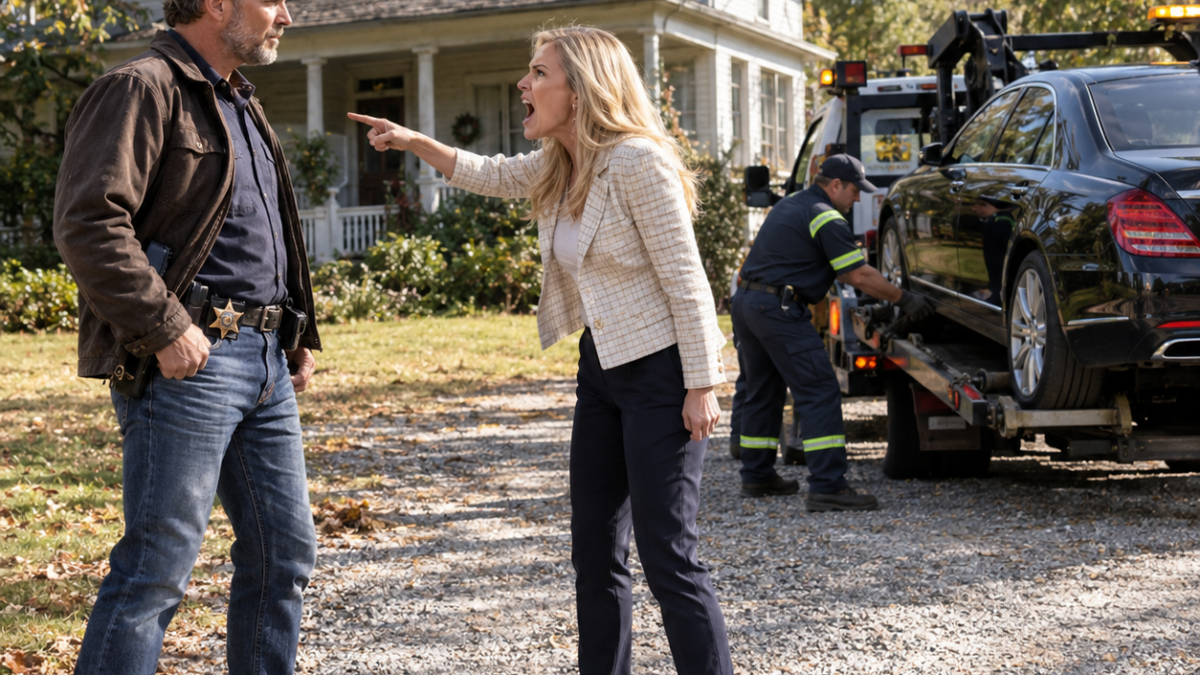
Twenty minutes later, a tow truck rounded the corner.
Same white cab.
Same yellow flatbed.
Martinez stepped out.
He saw the Escalade.
Then Brenda.
Then me.
He stopped.
“No way.”
Janet almost smiled.
“You know the vehicle?”
“I know the owner.”
Brenda turned away.
Martinez walked around the Escalade.
“Keys?”
Janet handed them over.
Brenda sat on the curb.
Her clipboard rested beside her.
For fourteen days, that clipboard had been an extension of her authority.
Now it looked like what it had always been.
Plastic.
Paper.
Nothing more.
Martinez hooked the Escalade.
The rear wheels lifted.
The vanity plate tilted upward.
HOA PRES.
He looked toward me.
“Life’s funny.”
I didn’t answer.
I didn’t feel like laughing.
Not when I thought about Louise.
The Escalade rolled away.
Two weeks earlier, Brenda had parked across my entrance and told me she would move when she was ready.
Now the car disappeared around the corner on somebody else’s schedule.
That wasn’t revenge.
It felt too quiet for revenge.
It was consequence.
And consequence didn’t care how important Brenda thought she was.
The formal investigation grew from the incident.
Janet interviewed Tom.
Then requested records from Maplewood’s management company.
The company’s director provided something I hadn’t expected.
Internal notes.
Years earlier, after Louise’s attorney sent the exemption letter, the management company had flagged her address:
NONMEMBER PROPERTY — NO ENFORCEMENT AUTHORITY.
Yet violation requests kept arriving from Brenda’s board account.
Brenda had overridden the warnings.
Again.
Again.
Again.
That changed everything.
No more misunderstanding.
No outdated map.
No clerical confusion.
Documented knowledge.
Tom gave investigators dates.
Louise’s checks showed payments.
Bank records confirmed the HOA had deposited them.
The district attorney reviewed the file.
The charges were not dramatic felonies.
This wasn’t murder.
It wasn’t a million-dollar conspiracy.
It was what it was.
Harassment.
Fraud-related misdemeanor conduct.
Trespass tied to the escalating incidents.
Enough to create a criminal case.
Enough to make Maplewood finally look backward at everything Brenda had done.
Her arraignment came a month later.
I didn’t attend.
Tom did.
He called me afterward.
“She wore navy.”
“What?”
“Suit. Navy.”
“Tom.”
“I’m giving you atmosphere.”
“I don’t need atmosphere.”
“She pleaded not guilty.”
“That part I need.”
“Lawyer argued it was a civil dispute.”
“Expected.”
“Judge disagreed enough to keep the charges.”
“Good.”
“Protective conditions too.”
“What?”
“No contact with you. Five hundred feet from the house except public road travel. No posting about you.”
I sat quietly.
Louise should have had that protection years earlier.
Tom seemed to know what I was thinking.
“You did what she couldn’t.”
“No.”
“You did.”
“She shouldn’t have needed me to.”
That was the part nobody understood.
People kept congratulating me.
Sheriff beat the HOA bully.
Great headline.
Wrong story.
Louise had the same property rights.
Same deed.
Same exemption.
Same law.
She didn’t have a badge.
But she shouldn’t have needed one.
Three months later, Brenda accepted a plea.
No contest to harassment and fraud-related misconduct.
Trespass dismissed under the agreement.
Probation.
Fine.
Community service.
Restitution.
Louise had paid more than twelve thousand dollars in illegitimate fines over the years.
Not all the money was traceable directly to Brenda’s conduct, and not all restitution could be recovered personally from her.
The final order required six thousand dollars paid to Louise’s estate.
Half.
Some people thought I should be furious.
I wasn’t.
Not because the missing money didn’t matter.
Because the court order contained something Louise never got while alive.
An official acknowledgment.
She had been wronged.
She had not been confused.
She had not been some stubborn old woman refusing reasonable neighborhood standards.
She had been right.
That mattered.
A week after arraignment, Maplewood held an emergency board meeting.
Tom attended.
I didn’t.
Not a member.
Never intended to become one.
Twelve votes.
Zero against.
Brenda Holloway removed as president.
The board suspended several enforcement actions and hired outside counsel to review whether any other nonmember or improperly annexed properties had received fines.
People who had cheered Brenda’s community post suddenly discovered skepticism.
Funny how quickly everyone becomes a lifelong critic after the person they followed loses power.
Kevin avoided me entirely.
The first time I saw him after the charges, he was walking his dog.
He crossed the street.
I almost called after him.
Didn’t.
Fear wasn’t what I wanted.
Awareness was enough.
Six weeks after the plea, a FOR SALE sign appeared outside Brenda’s house.
Gary Holloway had barely spoken throughout any of this.
I saw him once loading cardboard boxes.
He looked tired.
Not angry.
Just exhausted.
I walked over.
“Gary.”
He looked at me.
For a moment I expected resentment.
Instead he said, “I’m sorry about Louise.”
I didn’t know what to say.
“She talked about the notices at home,” he continued.
“You knew?”
“I knew some.”
“Did you know the house wasn’t in the HOA?”
His eyes dropped.
“Not at first.”
“But later?”
He didn’t answer.
That was answer enough.
“Why didn’t you stop her?”
Gary laughed softly.
Not humor.
“If I knew how to stop Brenda from doing something once she decided she was right, my life would’ve been different.”
I understood more than I wanted to.
“That doesn’t excuse it.”
“I know.”
The moving truck arrived Wednesday.
By sunset, Brenda’s house was empty.
Three weeks later, a young couple bought it.
Mike and Sarah.
Toddler named Emma.
They arrived with wine.
I stood on Louise’s porch as they introduced themselves.
“We heard the neighborhood had some HOA drama.”
Mike looked embarrassed.
“A little.”
“How bad is it?”
I thought about the Escalade.
The notices.
Louise’s checks.
The black truck at 3:17 a.m.
Then I looked at Emma, who had discovered Louise’s birdbath and was trying to touch the water.
“It’s quieter now.”
Sarah smiled.
“We like quiet.”
“So did Louise.”
That spring, I started repairing the house.
First the roof.
Then porch boards.
Then gutters.
The rear fence.
I repainted the porch white because Louise always liked white.
I kept the old wind chimes.
Her crocheted blankets.
Her garden.
The chair beside the window where she used to read.
Not because I wanted the house frozen in grief.
Because some things were hers in a way paint never could be.
Tom became a Sunday regular.
Coffee on the porch.
Sometimes whiskey in the evening.
He told stories about Maple Drive before Maplewood existed.
Fields where beige houses now stood.
Louise riding a bicycle as a young woman.
My mother running barefoot down the dirt road.
My grandfather helping rebuild the porch after a storm.
That was when I understood why the HOA fight had hurt more deeply than the inconvenience itself.
Brenda saw Louise’s house as a visual defect.
A noncompliant structure.
Something to standardize.
But the house had existed before every rule she worshipped.
It held a history no architectural committee could manufacture.
One April afternoon, Emma wandered to the edge of my garden while Sarah planted flowers next door.
Sarah rushed over.
“I’m sorry.”
“For what?”
“She keeps coming over here.”
Emma stared at a butterfly.
“She’s fine.”
“I don’t want her bothering you.”
“Louise would have loved this.”
Sarah relaxed.
After that, Emma became part of the scenery.
Tiny boots in the grass.
Juice box on the porch.
Questions about birds.
One afternoon, she pointed at the driveway.
“Why is your mailbox crooked?”
I looked at it.
The replacement post had never been perfectly level.
“Because someone hit the old one.”
“Who?”
“Long story.”
“Was it a bad guy?”
I smiled.
“No.”
That surprised her.
“She did bad things.”
“What’s the difference?”
Good question.
“People aren’t only the worst thing they did.”
Emma thought about that for approximately two seconds.
Then chased a butterfly.
Kids know when an answer is too complicated.
In May, I found Louise’s journal.
Small leather notebook.
Hidden in the nightstand beneath reading glasses and old receipts.
Most entries were ordinary.
Buy tomatoes.
Call Marcus.
Doctor Thursday.
Tom’s birthday?
Then Brenda began appearing.
Another violation.
Brenda says fence too tall.
Paid fine. Easier than fighting.
Tom says stop paying.
Don’t want trouble.
Then one entry stopped me.
Sometimes I wonder if I should have fought back.
Marcus would have.
He’s never been afraid to stand up when something isn’t right.
But fighting takes energy and I don’t have much left.
I hope whoever has this house after me has more strength than I did.
I closed the journal.
For a long time, I couldn’t move.
Louise hadn’t believed Brenda.
She hadn’t been fooled.
She had been exhausted.
That distinction mattered.
We celebrate people who fight.
Sometimes unfairly.
Because not everybody has enough money.
Enough health.
Enough time.
Enough family.
Enough emotional energy.
Predators understand that.
Brenda understood it.
Her power had never been the HOA bylaws.
It was exhaustion.
Send another notice.
Another fine.
Another warning.
Make peace more expensive until surrender looks cheaper.
Louise chose peace.
And Brenda charged her twelve thousand dollars for it.
I sat alone in Louise’s bedroom with the journal in my hands.
“I’m sorry.”
For not coming back.
For not noticing.
For letting three years pass after Thanksgiving.
The same guilt I had felt when I first arrived returned.
Then I reread the entry.
I hope whoever has this house after me has more strength than I did.
Not blame.
Hope.
That was Louise.
Even when she was tired, she wasn’t bitter.
I carried the journal to the porch.
The sun was going down.
Tom’s wind chimes sounded from the far end of Maple Drive.
Emma waved from next door.
I waved back.
“I kept it, Louise.”
My voice caught.
“The house.”
The porch creaked beneath me.
“I kept it.”
Months passed.
The restitution checks arrived in installments.
I deposited every one into a separate account.
LOUISE FUND.
I didn’t know what to do with it at first.
Then Tom suggested something.
“Fix the garden.”
“That’s six thousand dollars.”
“Have you seen what landscaping costs now?”
He had a point.
Louise had loved roses.
The garden had deteriorated during her last years.
I hired a local gardener.
Not an HOA-approved landscaping contractor.
That part gave me unreasonable satisfaction.
We restored the roses.
Tomatoes.
Hydrangeas.
A small bench beneath the dogwood tree.
I had a simple brass plaque made.
LOUISE’S GARDEN.
Nothing about Brenda.
Nothing about HOA battles.
I didn’t want her name occupying permanent space in Louise’s home.
That was another lesson.
Winning doesn’t mean preserving the enemy forever.
Sometimes it means refusing to let them remain important.
Maplewood changed.
The new board commissioned a review.
Some fines reversed.
Refunds issued.
Meeting minutes published online.
Board members required to disclose conflicts.
Enforcement notices now included the parcel’s membership status before any violation could be issued.
You would think that should have existed from the beginning.
It should have.
Systems often get basic protections only after somebody proves how badly they can fail.
Tom attended every meeting.
“Someone has to annoy them.”
“You enjoy it.”
“I earned it.”
One evening, he arrived holding a letter.
“No return address.”
It was for me.
Pale-blue stationery with tiny flowers.
I recognized it.
Brenda had used the same paper for handwritten additions to some of Louise’s notices.
Two words.
I’m sorry.
No name.
No explanation.
I stood in the driveway looking at it.
For a few seconds I felt anger.
An anonymous apology is cheap.
She had publicly accused me.
Harassed Louise for years.
Collected money.
Blocked my property.
Brought a crowd.
Now two words?
Tom read my expression.
“Going to throw it away?”
“I don’t know.”
“Louise wouldn’t.”
That irritated me because he was right.
I carried it inside.
Opened the file box.
Fifteen years of notices.
I placed the apology on top.
Closed the lid.
Then returned it to the closet.
I didn’t forgive Brenda that day.
Maybe forgiveness wasn’t the point.
But the story now had an ending written in her handwriting.
I was wrong.
Even if she couldn’t bring herself to write those exact words.
A year after I inherited the house, Maple Drive looked different.
Not because the houses changed.
Because I did.
The first weeks, I saw threats everywhere.
Cars.
Clipboards.
HOA letters.
Neighbors whispering.
By the next autumn, I knew names.
Sarah and Mike next door.
Tom down the street.
Janice with the golden retriever.
The teenager who cut grass badly but cheaply.
The retired teacher who made too much zucchini bread.
Community wasn’t the HOA.
That might have been Brenda’s greatest mistake.
She believed the organization and the community were the same thing.
They weren’t.
An HOA was paperwork.
The community was Tom walking down on Sunday morning with coffee.
Sarah calling when a storm damaged a branch over my roof.
Emma leaving chalk drawings on the sidewalk.
Martinez waving whenever his tow truck passed through town.
Deputy Reyes checking in once just because she was nearby.
People.
Not bylaws.
That was what Louise understood.
One Sunday, Tom asked the question I knew was coming.
“You staying?”
I looked at the house.
“I don’t know.”
“You planning to sell?”
“Maybe.”
He nodded slowly.
“Louise wouldn’t blame you.”
“I know.”
“You think keeping it proves something?”
I looked at him.
He continued.
“You don’t owe the dead your whole future, Marcus.”
That sentence sat with me for weeks.
I had assumed keeping the house was the final act of loyalty.
But loyalty isn’t imprisonment either.
Eventually, I made a decision.
I kept it.
Not because I had to.
Because I wanted it.
That made all the difference.
I renovated the upstairs bedroom.
Made it mine.
Moved some of my things in.
Started spending most weekends there.
Then more than weekends.
My county was only an hour away.
The commute wasn’t impossible.
I found myself sleeping better in Louise’s old house than I had anywhere in years.
Maybe because part of me still remembered being twelve.
Parents separating.
World breaking.
Louise making pancakes.
Telling me:
You always have a room here.
Forty years later, she had kept that promise.
Even after she was gone.
Two years after Brenda left Maplewood, I saw her once.
A grocery store three counties away.
I wasn’t sure at first.
Hair shorter.
No expensive cardigan.
No clipboard.
She stood near the pharmacy counter holding a basket.
She saw me.
Everything stopped.
I could have walked away.
Instead, I nodded.
“Brenda.”
“Marcus.”
No Sheriff Cole.
No Mr. Cole.
Just names.
“How are you?”
She looked confused by the question.
“Fine.”
I nodded.
Then she said:
“I meant the note.”
“I figured.”
“I should have signed it.”
“Probably.”
Her eyes filled.
“I was awful to Louise.”
“Yes.”
No softening.
She deserved honesty.
“I told myself I was protecting the neighborhood.”
“I know.”
“I believed that.”
“That doesn’t make it true.”
She nodded.
“I know.”
For the first time, Brenda Holloway looked like someone who wasn’t trying to win.
“I can’t give her the years back.”
“No.”
“Or the money.”
“Some of it got returned.”
“That’s not what I mean.”
I knew.
“What do you want me to say?”
“Nothing.”
She looked toward the pharmacy counter.
“I’m sorry.”
This time she said it out loud.
I believed her.
That surprised me.
Believing an apology didn’t erase the harm.
Forgiveness, I discovered, wasn’t pretending someone deserved trust again.
It was deciding you no longer needed their punishment to continue in order for your own life to move forward.
“I hope you do better wherever you are.”
She looked at me.
“So do I.”
Then we walked away from each other.
No handcuffs.
No tow truck.
No audience.
That was more satisfying than I expected.
The world had become ordinary again.
A few months later, Tom died.
Eighty-one.
Heart attack in his sleep.
His daughter called me.
I sat on Louise’s porch after the funeral and listened to his wind chimes down the street.
Maple Drive felt too quiet.
Tom had spent years believing he was powerless against Brenda.
Yet without him, I never would have understood the full pattern.
He had kept memories no official record contained.
Dates.
Conversations.
Louise’s fear.
The human story beneath the paperwork.
Evidence isn’t only documents.
Sometimes it’s an old man remembering who was hurt and refusing to let everybody pretend nothing happened.
Tom’s daughter gave me one of his wind chimes.
“He said you’d know where to put it.”
I hung it beside Louise’s.
Now two sets chimed whenever wind crossed the porch.
Aunt and witness.
That was how I thought of them.
Years later, people still occasionally hear the story and focus on the Escalade.
“You had the HOA president’s car towed?”
Technically, Deputy Reyes ordered the tow after Brenda damaged my property and ended up on the lawn during an active dispute.
But yes.
Her Escalade left on a flatbed.
Same company she had called to tow mine.
It makes a good story.
People laugh.
Karma.
Poetic justice.
But that isn’t the part I remember most.
I remember Louise’s canceled checks.
One after another.
$150.
$300.
$275.
Money she needed.
I remember the journal.
Fighting takes energy I don’t have anymore.
I remember Tom saying he had been too afraid to get involved.
I remember the crowd Brenda brought scattering the moment real law enforcement arrived.
I remember how much power disappears once everyone stops agreeing to pretend it exists.
The badge helped.
Of course it did.
The moment Martinez recognized me, Brenda recalculated.
But if my badge were the whole story, nothing would have changed for Louise.
What changed things was evidence.
The 1952 deed.
The 1997 plat.
The 1998 HOA incorporation.
The separate parcel.
The management company record.
The cameras.
The checks.
Tom’s testimony.
Brenda’s own words admitting she knew about the attorney’s letter.
Twenty years of law enforcement taught me how to put those pieces together.
But Louise had always possessed the most important piece.
She owned the house.
That should have been enough.
The fact that it wasn’t is why I kept pushing.
Eventually Maplewood adopted one new rule I actually liked.
Every enforcement action had to begin with written verification that the parcel was legally subject to the HOA.
Sounds obvious.
It is.
Obvious protections are often written in the aftermath of obvious abuse.
Sarah eventually joined the board.
I teased her.
“Careful.”
She laughed.
“I have you next door.”
“That’s not a recommendation.”
“It’s a threat to behave.”
Emma was six by then.
She still wandered into Louise’s garden.
One afternoon, she asked about the brass plaque.
“Who was Louise?”
“My aunt.”
“Did she live here?”
“For a long time.”
“Was she nice?”
“The nicest.”
“Did she plant these?”
“Some of them.”
Emma smelled a rose.
“I like her.”
“You never met her.”
“So?”
Fair point.
Children have a clearer definition of legacy.
You don’t have to meet someone to enjoy what they planted.
That evening, I sat on the porch.
Two wind chimes moved in the breeze.
The house behind me had fresh paint.
The porch didn’t sag anymore.
The fence had been repaired.
Louise’s old mailbox stood straight.
My truck sat in the driveway.
Unblocked.
No violation notice waited beneath the wiper.
No clipboard approached from next door.
The new neighbors were grilling.
Emma laughed.
Someone down the street was mowing too late in the evening.
Completely ordinary.
That was the victory.
People love dramatic endings.
Tow trucks.
Charges.
Court.
Humiliation.
But the best ending to harassment is boredom.
The day arrives when you realize the bully hasn’t occupied your thoughts for weeks.
You stop checking the camera every time a car slows.
You open the mailbox without bracing for a threat.
You park in your driveway because it is simply where you park.
Your home becomes a home again.
Not evidence.
Not a battlefield.
Home.
Sometimes I still open Louise’s file box.
Less often now.
The notices have yellowed.
Her attorney letter sits near the bottom.
Brenda’s unsigned apology rests on top.
Louise’s journal stays in my desk.
The page about me is marked with a ribbon.
I hope whoever gets this house after me has more strength than I did.
For a long time, that sentence made me proud.
Then sad.
Now I read it differently.
Louise wasn’t weak.
She survived the way she knew how.
She preserved kindness in a place where somebody kept punishing her for not fighting.
That took its own kind of strength.
I didn’t defeat Brenda because I was stronger than Louise.
I had advantages Louise didn’t.
Health.
Experience.
Time.
Money.
Knowledge.
A badge.
Friends in law enforcement.
Cameras I could install without worrying about whether groceries still fit in the budget.
Louise paid because she was tired.
That never made Brenda right.
It made what Brenda did worse.
The older I get, the more I think justice should protect tired people.
Not only people strong enough to demand it.
That is what I carried back to my job.
When residents called about harassment, I listened differently.
When elderly homeowners sounded confused, I didn’t assume confusion meant their complaint was false.
When somebody showed up angry with a stack of badly organized papers, I reminded deputies:
The paperwork being messy doesn’t mean the truth is.
Predators are often better organized than victims.
Brenda had beautiful letterhead.
Louise had a cardboard box.
Guess who was telling the truth?
Three years after I inherited the house, I retired.
Twenty-three years.
My department held a ceremony.
Too many speeches.
Bad cake.
My deputy chief told a story I wish he hadn’t.
Lily—my daughter, who was grown by then—asked what I planned to do.
I said:
“Fix the chimney.”
She laughed.
“Seriously?”
“It’s leaned left since I was born.”
“Maybe it wants to.”
Louise would have said the same thing.
I left the chimney alone.
Some imperfections deserve grandfather status too.
My first morning as a retired sheriff, I woke before sunrise.
No alarm.
Old habits.
I made coffee and walked outside.
Maple Drive was silent.
Morning fog hung low.
Louise’s garden was wet with dew.
The driveway stretched empty to the road.
I thought about the first day.
Brenda’s Escalade across the entrance.
Her clipboard.
Her smile.
“I’ll move it when I’m ready.”
At the time, I thought the fight was about a car.
Then fines.
Then the house.
Eventually I understood it was about something simpler.
Who gets to decide where your boundaries are?
Brenda believed authority meant she could define everybody else’s.
Your fence is too high.
Your paint is wrong.
Your car doesn’t belong.
Your house should comply.
Your aunt should pay.
Your driveway can be blocked.
Your family history matters less than my clipboard.
No.
A boundary is not rude because someone else dislikes it.
Ownership isn’t selfish because somebody wants control.
And refusing illegitimate authority isn’t causing conflict.
Sometimes the person creating conflict is the one demanding obedience they were never entitled to.
I finished my coffee.
The sun rose.
Emma—now old enough to ride a bicycle without supervision—came down the sidewalk.
“Morning, Sheriff!”
“Retired.”
“You’re still Sheriff.”
“Not how employment works.”
She rang the bicycle bell.
“Sheriff!”
I laughed.
Then watched her disappear around the corner.
Louise would have loved Maple Drive now.
Not because every house looked right.
They didn’t.
One family painted their door bright yellow.
Somebody built a vegetable garden the old board would have hated.
Christmas decorations remained up until February one year.
Nobody died.
Property values survived.
Children played.
Neighbors argued.
Then borrowed ladders from each other.
Community survived imperfection.
Maybe it even needed it.
I walked to the garden.
Touched the plaque.
LOUISE’S GARDEN.
“You were right,” I said.
The wind moved the chimes.
Maybe about Brenda.
Maybe about leaving me the house.
Maybe about always having somewhere to come home.
I don’t know.
The house no longer feels inherited.
It feels mine.
But not only mine.
Louise is there in the garden.
My mother in the family photographs.
Tom in the wind chime.
My childhood in the pond behind the property.
Emma’s chalk marks sometimes cover the walkway.
Sarah brings tomatoes.
Mike borrows tools and never returns them until I ask twice.
Life keeps adding itself to the place.
That is what homes do when nobody is trying to control them into perfection.
If Brenda Holloway had succeeded, maybe I would have sold.
Maybe somebody would have demolished Louise’s house and built another beige model with approved shutters and regulation landscaping.
Maybe nobody would remember the porch existed before Maplewood.
But she didn’t.
The house is still here.
So am I.
And every time I pull into the driveway, I remember a white Escalade sitting across it and a woman telling me she’d move when she was ready.
I never needed revenge as much as I thought I did.
Her car getting towed was satisfying.
I won’t pretend otherwise.
Watching the same flatbed driver she had summoned for my truck hook up her Cadillac after she damaged my mailbox and lawn?
Yes.
There was poetry in that.
But the real revenge was quieter.
She left.
The house stayed.
The garden bloomed.
Louise’s name stayed on a plaque instead of Brenda’s name staying in my head.
That is the ending I think Louise would have wanted.
Not destruction.
Peace.
The kind she had tried to buy for years with checks she never should have written.
Now the peace is free.
One summer evening, long after Brenda had become a story instead of a threat, I found one final envelope inside Louise’s file box.
It had slipped beneath the cardboard flap.
My name was written on it.
Marcus.
Louise’s handwriting.
I sat at the kitchen table before opening it.
Inside was one sheet.
Dear Marcus,
If you’re reading this, then either you finally came back to visit or I’m not around to nag you about it anymore.
The house may look old to you.
Don’t be in a hurry to fix everything.
Some things are supposed to show their age.
This place took care of your mother when she was young.
It took care of you when your family was falling apart.
It took care of me when I got old.
Maybe it can take care of somebody else after us.
I know the neighborhood people can be difficult.
Don’t let them make you angry enough to stop loving the place.
That’s how they win.
Love,
Louise.
I read the last two lines again.
Don’t let them make you angry enough to stop loving the place.
That’s how they win.
For months, I had told myself I beat Brenda with evidence.
Patience.
Cameras.
Law.
Maybe all of that was true.
But Louise had understood something deeper.
Anger can defend a home.
It can’t make one.
For that you need something else.
Memory.
People.
Laughter.
A garden.
Coffee on the porch.
A child waving from next door.
A crooked chimney you finally decide not to fix.
I folded the letter.
Placed it inside her journal.
Then walked outside.
The driveway was empty.
Exactly the way a driveway should be.
I sat on the porch until dark.
No badge.
No case file.
No one to arrest.
Just Marcus.
Louise’s nephew.
Home.
And this time, nobody with a clipboard was going to tell me otherwise.


