PART 2: I Inherited a Bankrupt Farm — HOA Karen Sent Guards and Blocked the Entrance, Not Knowing I Was FBI
PART 2
I barely slept that first night.
Not because I was afraid of Brenda Holloway.
Because I kept reading Granddad’s letter.
They’re trying to take the farm.
Those words felt different now.
When the letter arrived two months before his death, I had been buried in a financial-fraud investigation in Virginia involving shell companies, Medicaid billing, and people who knew how to make theft look like paperwork.
I called Granddad.
He sounded tired.
Confused.
He told me there were HOA notices.
Some woman kept sending people onto the farm.
He mentioned assessments.
A management agreement.
I asked him if his attorney knew.
He said he thought so.
Then somebody interrupted me at work, and I promised I would call him back the next evening.
I didn’t.
It took me two weeks.
By then his memory was worse.
He said maybe he had overreacted.
Maybe everything was fine.
I let myself believe that because believing it was easier.
Now he was dead.
And I was sitting in a Nebraska motel with a forged-looking signature in front of me.
Guilt is dangerous in an investigation.
It pushes you to move before you’re ready.
I knew that.
So I did what I had trained other agents to do.
I separated what I felt from what I could prove.
FACT:
Henry Bailey owned the farm.
FACT:
Brenda claimed he owed $47,322.17.
FACT:
She claimed the HOA had authority to manage his land.
FACT:
A document bearing his name allegedly granted that authority.
POSSIBLE ISSUE:
The signature did not resemble his known handwriting.
The next morning, I was waiting outside the Madison County Recorder’s Office before it opened.
At 8:30 sharp, the doors unlocked.
A clerk named Marjorie led me to a public terminal.
“What are you looking for?”
“Everything involving Henry Bailey’s farm for the last three years.”
She typed in the parcel number.
I started with liens.
If the HOA really believed Granddad owed more than forty-seven thousand dollars, there should have been a lien.
That was the obvious step.
A recorded claim.
Something protecting the HOA’s alleged interest.
There was nothing.
I checked again.
No Meadowbrook Estates lien.
No judgment.
No foreclosure action.
No recorded HOA debt at all.
“Can you search management agreements?”
Marjorie nodded.
Nothing.
The agreement Brenda had shoved in front of me at the gate had never been recorded.
That mattered.
An unrecorded contract wasn’t automatically worthless.
But if Brenda truly believed it gave the HOA control over a six-figure piece of real estate, why keep it out of the county record?
Because recorded documents become public.
Public documents get examined.
And forgery works better in the dark.
“Can I see the tax history?”
Marjorie pulled it up.
Granddad had paid his property taxes every year for decades.
Then, eighteen months earlier, the payer changed.
HEARTLAND ASSET MANAGEMENT LLC.
I read the name twice.
“Who are they?”
Marjorie shrugged.
“I only have the payment record.”
“Did they own the property?”
“No.”
“Recorded mortgage?”
“No.”
“Tax lien certificate?”
“No.”
“Why would a company with no recorded interest in the land pay somebody else’s taxes?”
Marjorie gave me the look public-record clerks develop after years of learning not to speculate.
“I couldn’t tell you.”
I could speculate.
Because I had seen versions of this before.
Take over routine expenses.
Pay taxes.
Pay insurance.
Handle maintenance.
Create paperwork showing that you are the responsible party.
Then later, when ownership becomes disputed, point to the history.
We kept this property alive.
We paid.
We maintained.
The real owner abandoned it.
It wasn’t enough to establish ownership by itself.
But it made a story.
And fraudsters survive on stories long enough to convert them into documents.
I requested certified copies.
Then I drove back toward the farm.
I didn’t approach the gate.
I parked a hundred yards down the county road and watched.
The guards were gone.
Brenda was gone.
But a pickup sat beside the barn.
Two men were loading equipment onto a flatbed trailer.
Granddad’s equipment.
His red tractor.
The one he bought in 1992.
I knew the exact year because I had been a kid when he brought it home.
He let me sit behind the wheel while it was still parked in the yard and told me not to touch anything.
I immediately touched everything.
Now two strangers were chaining it to a trailer.
Every part of me wanted to drive through the gate.
I wanted to stop them.
I wanted to demand names.
Instead, I photographed.
Truck.
License plate.
Faces.
Trailer.
Tractor serial number visible on the side.
Evidence before emotion.
The flatbed drove away.
I followed from a distance long enough to record the direction, then broke off.
At the motel, I reviewed Granddad’s medical records from the estate package.
Parkinson’s disease.
Eight years.
Then a secondary diagnosis eighteen months earlier.
Early cognitive decline.
The timing hit me.
Eighteen months.
Heartland Asset Management began paying the taxes at the same time Granddad’s mental condition worsened.
Fourteen months ago, Brenda claimed he voluntarily signed the management agreement.
Somebody had identified vulnerability and moved.
My phone rang.
Helen Chavez.
We had worked together at the Bureau for nine years.
She was one of the best analysts I knew.
“What did you find?” I asked.
“Heartland Asset Management LLC was formed three years ago.”
“Owners?”
“Still working.”
“Registered agent?”
She paused.
“Victor Shaw.”
I looked at the business card on my nightstand.
Attorney at Law.
“Brenda’s lawyer.”
“Apparently.”
“What else?”
“Business address is a mailbox in Omaha.”
“No real office?”
“Not under that name.”
“Keep going.”
“I already am.”
I opened my laptop.
Three years ago: Heartland formed.
Eighteen months ago: Granddad diagnosed with cognitive decline.
Eighteen months ago: Heartland begins paying taxes.
Fourteen months ago: alleged management agreement.
Three months ago: Granddad dies.
Now: Brenda blocks the heir and claims $47,000 debt.
That wasn’t coincidence.
It was sequence.
And sequence is where schemes reveal themselves.
Tuesday morning, somebody slipped an envelope beneath my motel-room door.
No stamp.
Hand delivered.
VICTOR SHAW — ATTORNEY AT LAW.
The letter accused me of interfering with property lawfully managed by Heartland Asset Management and Meadowbrook Estates.
It demanded that I cease contact with HOA representatives within seventy-two hours.
Failure to comply would result in restraining orders and civil damages.
I added it to the file.
At noon, Sheriff Raymond Alvarez knocked on my door.
Late fifties.
Weathered face.
Careful voice.
“Alexander Bailey?”
“Yes.”
“I received a complaint.”
“From Brenda Holloway?”
His expression told me I was right.
“She says you’ve been harassing association personnel and attempting to interfere with managed property.”
“I haven’t crossed the gate.”
“She acknowledged that.”
“Then what’s the harassment?”
“You’re watching the property.”
“From a public road.”
He exhaled.
“Look, I’m not here to arrest you.”
“Good.”
“I’m trying to keep this from escalating.”
“Did Brenda show you proof the HOA controls the farm?”
“She showed paperwork.”
“Recorded?”
His eyes narrowed.
“You an attorney?”
“No.”
“Then how do you know to ask?”
“Habit.”
He handed me a copy of the complaint.
Brenda had signed it that morning.
9:15.
Someone had slipped Shaw’s legal threat under my door before dawn.
Brenda filed with the sheriff by nine.
Pressure from two directions.
By four that afternoon, there was a third.
The motel manager canceled my reservation.
“I’m sorry, Mr. Bailey.”
“Why?”
“We were told there’s pending litigation involving your stay.”
“What does that have to do with your motel?”
He looked miserable.
“I don’t know.”
“Who told you?”
“Corporate.”
“Who called corporate?”
“I wasn’t given a name.”
Legal threat.
Sheriff visit.
Housing cut off.
One day.
That was when I knew for certain this wasn’t their first time.
Improvised intimidation is messy.
This was organized.
Apply legal pressure.
Apply authority pressure.
Remove stability.
Make the target tired.
Make the target spend money.
Make leaving easier than fighting.
I loaded my bags into the car.
The December wind cut through the parking lot.
I should have felt defeated.
Instead, I felt almost calm.
I had interviewed enough fraud victims to recognize what Brenda was trying to create.
Exhaustion.
Confusion.
Isolation.
Most people don’t lose property because they are stupid.
They lose because the people taking it can devote every day to the fight while the victim still has to live a normal life.
Work.
Children.
Illness.
Bills.
Grief.
Granddad had been eighty-two, sick, and alone.
They had chosen well.
Then they chose his grandson without checking carefully enough.
I drove to the neighboring property.
Martha Jennings had lived beside Granddad for more than forty years.
She opened the door with suspicion.
When I said Henry Bailey’s name, her face changed.
“You’re Alexander.”
“Yes.”
“I wondered when you’d come.”
She invited me inside.
Coffee appeared before I asked.
“They got to Henry,” she said.
“What do you mean, got to him?”
“The same way they got to Earl Thompson.”
“Who’s Earl?”
Martha looked at me as if I had just proven how much I didn’t know.
“Sit.”
She told me about three farms.
Elderly owners.
Families far away.
Sudden Meadowbrook assessments.
Maintenance violations.
Letters from Victor Shaw.
Then management agreements.
Then property transfers.
“You’re saying the same HOA took three farms?”
“I’m saying land ended up with companies connected to the same people.”
“Heartland Asset Management?”
Martha’s eyes sharpened.
“So you found that.”
My pulse increased.
“You’ve heard the name?”
“Heard it plenty.”
She left the kitchen.
Came back carrying a shoebox.
Inside were HOA notices addressed to her.
A management agreement.
Her name appeared at the bottom.
She pointed.
“I never signed that.”
The signature was smooth.
Too smooth.
Same style as Granddad’s.
Same formatting.
Same legal language.
“Why didn’t they take your property?”
“My son drove down from Omaha.”
“What did he do?”
“Threatened to sue everybody in sight.”
“And Brenda backed off?”
“Within a week.”
That fit.
Pick targets who are isolated.
Avoid people with immediate support.
“Who are the guards?”
“Derek Nash.”
“Name means nothing to me.”
“Owns Heartland Security. Brenda calls him whenever someone becomes difficult.”
Another Heartland.
I photographed Martha’s documents.
Same boilerplate.
Same structure.
Same pressure campaign.
One victim can be a dispute.
Two becomes suspicious.
Four becomes a pattern.
I checked into another motel thirty miles away.
Used a shortened version of my name.
Then Helen called.
“You sitting down?”
“Yes.”
“Victor Shaw is not licensed to practice law in Nebraska.”
I stopped moving.
“Repeat that.”
“He was admitted in Kansas twelve years ago. Suspended eight years ago for misappropriating client funds. Never reinstated.”
I stared at the letterhead.
VICTOR SHAW — ATTORNEY AT LAW.
“He’s been sending legal threats.”
“He’s been pretending to be an attorney.”
“That’s no longer an HOA dispute.”
“No.”
“Derek Nash?”
“Heartland Security. Prior aggravated-assault conviction. Served time.”
“Anything else?”
“Yes.”
Her tone changed.
“Heartland Asset Management connects to two South Dakota LLCs through overlapping agents and financial records.”
“How many properties?”
“At least seven transfers we’ve found so far.”
“Owners?”
“Mostly elderly.”
“All after incapacity or death?”
“Every one.”
I stood.
Seven.
Nebraska and South Dakota.
Now we had interstate activity.
Possible wire transfers.
Possible bank fraud.
Possible conspiracy.
And a clear vulnerability pattern.
That was the moment my personal problem became something else.
It was also the moment I knew I had to step carefully.
An FBI agent investigating crimes involving his own inheritance is a conflict waiting to destroy a prosecution.
I could not simply turn myself into the case agent and do whatever I wanted.
The evidence had to be handed off.
Chain of custody had to survive.
Every federal action had to be authorized.
But before I made the formal referral, I needed enough to show this wasn’t just suspicion.
Helen gave me one name.
Benjamin White.
His father, Earl Thompson, lost a farm two years earlier.
Benjamin had fought.
He lost.
I drove to his house the next morning.
He opened the door and looked exactly like a man who had spent years waiting for somebody to believe him.
“My name is Alexander Bailey.”
“I know.”
“My grandfather was Henry.”
“I know that too.”
“I think the people who took your father’s farm are trying to take mine.”
He stared at me.
Then stepped aside.
His kitchen table was covered in paper.
“Two years,” he said. “I kept all of it.”
Earl Thompson had been eighty.
Sharp.
Independent.
Then Meadowbrook suddenly claimed he owed $12,000.
Three months later, a management agreement appeared.
Six months later, Earl had a stroke.
Benjamin obtained power of attorney.
By then, a quitclaim deed had already been filed.
“Dad never signed it,” Benjamin said.
“How do you know?”
“He told me.”
“Anything stronger?”
Benjamin reached into a box.
“His bank.”
The bank had signature cards.
Checks.
Loan documents.
The transfer signature didn’t match well.
Then Benjamin showed me something worse.
During his civil lawsuit, Victor Shaw had produced medical records claiming Earl suffered early dementia before signing the transfer.
“Was that true?”
“No.”
“What doctor?”
Benjamin handed me the record.
An Omaha clinic.
“My father had never been there.”
“Your attorney verify?”
“Tried. Clinic said the originals had been moved to off-site storage.”
“Convenient.”
Benjamin’s laugh contained no humor.
“They called Dad confused after he died. Made everyone think he had signed everything and forgotten.”
I understood why he still kept the papers.
He wasn’t protecting money.
He was protecting his father’s memory.
Then we reached the bank statements.
The developer that ultimately bought Earl’s property paid $420,000.
Money went to Heartland Asset Management.
Then to Prairie Holdings LLC in South Dakota.
Then back to Nebraska.
Final destination:
HOLLOWAY FAMILY TRUST.
I stared at the words.
Not theory.
Not inference.
Money.
Brenda Holloway’s family trust received proceeds from a farm acquired through the same process being used against Granddad.
Benjamin looked at me.
“You can prove it now?”
“I can prove enough to bring people who can prove the rest.”
His eyes filled but he looked away quickly.
“My father died thinking he screwed everything up.”
I said nothing.
“He thought he got old and careless.”
Benjamin pressed his lips together.
“If you prove they did this to him, I don’t care if I ever see a dollar.”
“You should care.”
He looked at me.
“Why?”
“Because returning what they stole is part of proving he didn’t fail.”
He nodded slowly.
I secured copies of everything and drove back toward Madison County.
Helen called when I crossed the county line.
“They filed something on Henry’s property.”
“What?”
“Corrective deed application.”
I almost missed the next turn.
“When?”
“Three weeks ago.”
“Basis?”
“Management agreement plus tax-payment history.”
There it was.
The purpose of Heartland paying Granddad’s taxes.
They were converting their manufactured history into a property claim.
“Status?”
“Pending.”
“How long?”
“County review deadline in twelve days.”
Twelve days.
Once that filing moved forward, ownership would become formally contested.
The farm wouldn’t magically belong to Brenda.
But litigation could tie it up for years.
Bankruptcy pressure alone could force a settlement.
Exactly what she wanted.
I finally called the Omaha FBI field office.
I identified myself fully.
Badge number.
Unit.
Supervisor contact.
Then asked for the Special Agent in Charge.
Patricia Reeves called me back.
I gave her the short version.
She didn’t interrupt.
When I finished, she said, “You understand you cannot run an official investigation into your own family’s property.”
“Yes.”
“You’ve already used Bureau resources.”
“Helen conducted preliminary open-source and permitted database checks at my request. I’m disclosing everything.”
“Good.”
“If you want me completely out, I step out.”
“What do you have?”
“Seven potential victims. Two states. Shell companies. Possible fraudulent transfers. Wire records terminating in the Holloway Family Trust. Unlicensed legal practice. Suspected forged signatures. A pending deed filing on my grandfather’s farm.”
Silence.
“That last part gives us urgency.”
“Yes.”
“Send everything.”
I did.
One hundred forty-three documents.
Sixty-seven photographs.
Twenty-two pages of timelines.
Property records.
Medical history relevant to capacity.
Tax payments.
Martha’s notices.
Benjamin’s banking records.
Corporate filings.
Every file numbered.
Every source identified.
Every personal item separated from public-record material.
The next morning, Reeves called.
“We’re opening a preliminary federal inquiry.”
I sat down.
“Good.”
“You are not the lead.”
“Understood.”
“You are a witness and potential victim.”
“Understood.”
“But you’re also the person Brenda expects to negotiate with.”
I waited.
“Has she contacted you?”
“Not yet.”
“Make her.”
That surprised me.
“You want me to call her?”
“I want you to behave as the heir she thinks she’s pressuring. If she offers a settlement, we’ll evaluate whether a consensually monitored meeting is appropriate.”
I looked at Granddad’s letter.
“All right.”
Friday morning, I called Brenda.
She answered on the second ring.
“Mr. Bailey.”
Warm.
Friendly.
Like she hadn’t sent the sheriff to my motel.
“I’ve thought about what you said.”
“I’m glad.”
“I can’t afford this.”
A lie.
But a believable one.
“Alexander, nobody wants to see you waste your inheritance fighting.”
That sentence almost made me break character.
Instead, I let my voice sound tired.
“What are my options?”
“We should meet.”
“Where?”
“My office Monday. Ten.”
“I’ll be there.”
A courier delivered the settlement package Sunday afternoon.
Twenty-two pages.
Outstanding HOA debt supposedly forgiven.
Heartland would pay me $10,000.
In return, I would sign a quitclaim deed transferring the farm.
A property worth more than $300,000.
Ten thousand dollars.
Page nineteen contained language stating I had entered the agreement voluntarily, without coercion, after being advised to obtain independent counsel.
I smiled.
They had written their defense before the crime was finished.
Nobody can say we coerced him.
Look.
He signed that he wasn’t coerced.
Classic.
Then Helen called with one final discovery.
“Linda Price.”
“The notary?”
“Commission expired four years ago.”
I stared at the management agreement.
“You’re sure?”
“State record is clear.”
“Never renewed?”
“Never.”
Granddad’s document.
Earl’s document.
Martha’s document.
Same notary.
Expired commission.
The system was collapsing before we even touched it.
Sunday night, I drove to the farm.
Parked outside the chained gate.
Walked up to it.
The farmhouse was dark.
The wind moved through dry grass.
I could see the barn silhouette against the winter sky.
Granddad’s tractor was gone.
I wondered how many mornings he had stood there after Brenda began sending notices.
How many times he looked toward the road hoping I would appear.
That thought was almost unbearable.
“I’m sorry,” I said out loud.
Nobody answered.
“I should’ve come sooner.”
Wind against the gate.
I put my hand on the cold chain.
“But I’m here now.”
Monday morning at seven, federal technicians fitted the transmitter.
Agents Morrison and Tan would monitor from the parking lot.
Reeves gave me one instruction repeatedly.
“Do not manufacture a confession.”
“I know.”
“Let them speak.”
“I know.”
“Do not threaten federal action.”
“I know.”
“Alexander.”
“I know.”
She softened slightly.
“This is personal. That makes experienced agents do stupid things.”
“I won’t.”
“You better not.”
At 9:55, I entered the Meadowbrook community center.
Brenda sat at the head of a conference table.
Victor Shaw sat to her left.
Derek Nash stood near the wall.
Brenda gestured.
“Please.”
I sat.
Victor wore a dark suit and had a legal pad in front of him.
Fake lawyer.
Real legal pad.
The irony almost distracted me.
Brenda slid the agreement across.
“I’m glad you’ve decided to be practical.”
“Ten thousand dollars?”
“The property is heavily encumbered.”
“There’s no lien.”
She blinked.
“Administrative processing can lag.”
“No recorded assessment debt.”
“Not everything appears immediately.”
“No delinquent property taxes.”
Brenda’s eyes narrowed.
“Heartland paid them.”
Victor spoke.
“Mr. Bailey, the purpose of this meeting is settlement, not debate.”
I turned toward him.
“You’re Mr. Shaw?”
“Yes.”
“Licensed in Nebraska?”
Silence.
Brenda jumped in.
“Victor advises several entities.”
“That wasn’t my question.”
His face lost color.
I turned back to Brenda.
“My grandfather never signed the management agreement.”
“You cannot know that.”
“I know what his handwriting looked like.”
“Grief can make families remember selectively.”
That sentence nearly got me.
I breathed once.
“Linda Price notarized it.”
“Yes.”
“Her commission expired four years ago.”
Derek uncrossed his arms.
Victor looked at Brenda.
Brenda stared at me.
“You’ve been doing research.”
“A little.”
“You came here pretending to negotiate.”
“I came here to understand the offer.”
She leaned back.
“What do you want?”
“The farm.”
“That’s unrealistic.”
“It’s mine.”
“Your grandfather surrendered management control.”
“With a forged signature?”
Her voice sharpened.
“Be very careful.”
“Why?”
“Because accusing people of crimes can have consequences.”
“So can committing them.”
Victor stood.
“This meeting is over.”
Brenda raised one hand.
“No.”
Interesting.
She wanted to finish.
She looked at me.
“You live in Washington.”
“Yes.”
“You have a career.”
“Yes.”
“You’re not a farmer.”
“My family is.”
“Was.”
That word landed hard.
She continued.
“You’re going to pour money into a failing property because of sentiment. Heartland can absorb the debt. We can repurpose the land. You walk away with cash.”
“What happens to the farm?”
“Development.”
“How much?”
“That depends on zoning.”
“How much does Heartland make?”
“That isn’t your concern.”
“What happened to Earl Thompson’s farm?”
All three changed.
Tiny reactions.
But trained eyes notice tiny reactions.
Brenda recovered first.
“I’m not familiar with every transaction.”
“Money from his property ended up in the Holloway Family Trust.”
Silence.
Derek shifted toward the door.
I kept my eyes on Brenda.
“Seven properties.”
Her face tightened.
“What are you talking about?”
“Nebraska. South Dakota. Elderly owners. Same structure.”
Victor gathered his papers.
“You need to leave.”
“Manufactured assessments.”
“Leave.”
“Management agreements.”
“Mr. Bailey—”
“Heartland pays taxes. Property gets transferred. Proceeds move through shell companies.”
Derek stepped forward.
That was when I reached into my coat.
Not quickly.
Slowly.
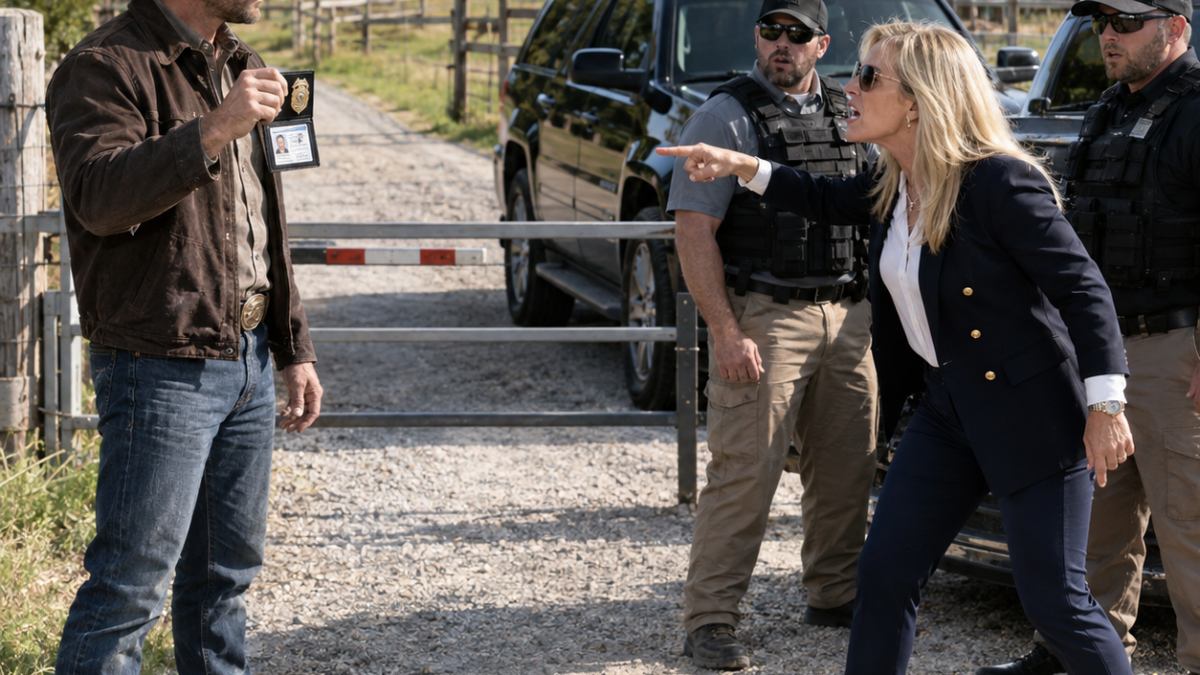
I placed my FBI credentials on the table.
The gold shield caught the fluorescent light.
For the first time since I met Brenda Holloway, she had no expression ready.
“My name is Special Agent Alexander Bailey.”
Nobody moved.
“I am employed by the Federal Bureau of Investigation’s financial-crimes program.”
Victor’s chair scraped backward.
Derek turned toward the door.
It opened before he reached it.
Agents Morrison and Tan stepped inside.
Morrison’s voice filled the room.
“Stay where you are.”
Brenda looked at me.
Her face had gone pale.
“This is entrapment.”
“No.”
I kept my voice level.
“This is your settlement meeting.”
“You lied about who you are.”
“I never told you what I did.”
“You manipulated this.”
“The agreement in front of me was written before this meeting.”
Victor began talking quickly.
“I want counsel.”
Morrison looked at him.
“You might want licensed counsel this time.”
Even I almost smiled.
Derek said nothing.
He knew the moment had passed.
Federal agents entered from the hall.
Brenda stood.
“You don’t understand what you’re doing.”
“I understand exactly what’s being investigated.”
“My attorneys will destroy this.”
I looked at Victor.
“Maybe find a different attorney.”
She was handcuffed first.
Not because I requested it.
Because she was the central subject named in the arrest authorization obtained from evidence outside my personal observations.
That mattered.
Everything had been reviewed.
Everything had been handed off.
This wasn’t my revenge arrest.
It was their case.
I stood near the window while they read rights.
Victor demanded representation.
Derek stared at the carpet.
When Brenda passed me, she stopped.
“You think this gives you your farm back?”
“No.”
Her eyes burned.
“This ruins everyone.”
“No, Brenda.”
I looked at her.
“You did that before I arrived.”
They led her outside.
Word spread before the vehicles even left.
Small towns don’t need social media.
They have windows.
By the time I stepped into the parking lot, thirty people stood nearby.
Martha Jennings was there.
She took my hand.
Tears filled her eyes.
“You got them.”
“The investigation got them.”
“You know what I mean.”
A man approached.
“My mother received letters.”
“Keep them.”
“What?”
“Every letter. Every envelope. Every email. Don’t throw anything away.”
“Was Brenda stealing farms?”
“We’re investigating property fraud targeting elderly owners.”
His face changed.
“My mother thought she did something wrong.”
I understood.
“Tell her not to sign anything else until counsel reviews it.”
News crews arrived by noon.
The sheriff’s office issued a cooperation statement.
Raymond Alvarez called me personally.
“I owe you an apology.”
“No.”
“I gave too much weight to Brenda because she’s been here forever.”
“You were doing a courtesy visit.”
“I still should’ve asked more questions.”
I respected that.
“Then ask them now.”
He did.
The federal investigation grew quickly.
Once Brenda’s arrest became public, people started calling.
Families.
Former residents.
Bank employees.
A retired county clerk.
A contractor who had been asked to estimate properties before the owners even knew they were under enforcement.
Seven potential victims became nine.
Then eleven.
Not every complaint belonged to the scheme.
Investigators separated legitimate HOA enforcement from fraud.
That distinction mattered.
Because real justice isn’t saying everything your enemy ever did was illegal.
It’s proving exactly what was.
Heartland Asset Management’s bank records showed transfers among shell entities.
Prairie Holdings.
Midwest Recovery Partners.
Several accounts eventually fed the Holloway Family Trust.
Victor Shaw had drafted threatening documents for years while representing himself as an attorney.
Linda Price admitted using an expired notary stamp.
She cooperated early.
Derek Nash’s employees described intimidation assignments.
Park outside a target’s home.
Follow family members.
Block gates.
Deliver notices.
Make people believe resistance would be more expensive than surrender.
Then came the evidence that hurt most.
Investigators recovered emails discussing Granddad.
One from Brenda to Victor.
H. Bailey declining quickly. Family contact minimal. Push management before estate complications.
I read that sentence alone in a conference room.
Declining quickly.
Family contact minimal.
That was me.
I had become one of the variables in their targeting analysis.
They knew he was alone because I had let him become alone.
Reeves sat across from me.
“Don’t do that.”
“What?”
“Take their guilt and turn it into yours.”
“I should’ve answered sooner.”
“Yes.”
I looked at her.
She didn’t soften it.
“You should have.”
That honesty helped more than comfort would have.
“But being an imperfect grandson did not authorize fraud.”
I said nothing.
“Henry was targeted because they chose to target him.”
“I know.”
“Then know it.”
That night I drove to the farm.
The chain was still evidence.
Federal agents had photographed it before the county removed the guards.
The corrective deed filing had been frozen.
Three days after Brenda’s arrest, Madison County formally rejected it because the supporting documents could not establish a valid legal basis.
The farm was still mine.
Bankrupt?
Nearly.
Damaged?
Absolutely.
But ours.
I finally entered the farmhouse.
The silence was heavier than I expected.
Granddad’s coat still hung beside the door.
His boots sat on newspaper.
A coffee cup remained beside his chair.
I touched the handle.
Could almost see his shaking hand around it.
On the kitchen table sat unpaid bills.
Some legitimate.
Seed supplier.
Electricity.
Equipment repair.
Then Meadowbrook.
Assessment.
Penalty.
Late fee.
Legal enforcement cost.
Another assessment.
Another fee.
Stacks designed to overwhelm.
I found handwritten notes from Granddad.
Called Brenda. She says must pay.
Victor says court.
Do not remember signing.
Call Alexander.
The last line appeared three times.
Call Alexander.
I sat in his chair and cried.
Not quietly.
Not dignified.
I had spent twelve years seeing victims after the damage.
Parents who lost savings.
Widows tricked into sending money.
Business owners destroyed by partners.
I knew every professional sentence.
You couldn’t have known.
These people are skilled.
The responsibility belongs to the offender.
All true.
None of it stopped grief from asking the same question.
Why weren’t you there?
I stayed until dark.
Then I found something beneath a stack of farm catalogs.
An envelope.
ALEXANDER.
Granddad’s handwriting.
Shaky.
Uneven.
Real.
Inside was a shorter letter than the one he mailed me.
If you’re reading this at the farm, then you came home.
Don’t be angry at yourself.
I know you work.
I know you have a life.
I stayed here because this is where I wanted to be.
If something happens to the place, fix what you can.
Land lasts longer than mistakes.
I read that line until I could no longer see it.
Land lasts longer than mistakes.
Six months later, the federal courthouse in Omaha was packed.
By then, Brenda had pleaded guilty.
Her attorneys reviewed the evidence and did what competent defense attorneys do when the government has bank records, emails, forged documents, cooperating witnesses, cross-state transfers, and recorded pressure tactics.
They negotiated.
She admitted participating in a conspiracy involving fraudulent property acquisition and movement of proceeds.
Victor Shaw admitted fraud-related conduct and criminal impersonation.
Derek Nash admitted conspiracy and intimidation-related offenses.
Linda Price cooperated in exchange for leniency.
Sentencing day arrived in late spring.
I sat beside Benjamin White.
Martha sat behind us.
Several families from South Dakota attended.
Brenda entered wearing gray.
No designer coat.
No HOA folder.
No security guards.
When the judge asked if victims wanted to speak, Benjamin went first.
He carried no notes.
“My father’s name was Earl Thompson.”
His voice shook.
“He farmed until his body couldn’t do it anymore.”
He looked at Brenda.
“You made him believe he had become incompetent.”
Brenda stared forward.
“You forged paperwork, created debt, and used medical lies to make his own family question him.”
Benjamin swallowed.
“He died thinking he failed us.”
The courtroom was silent.
“You stole land.”
His voice cracked.
“But what I hate you for is stealing the way my father remembered himself at the end.”
He sat down.
I couldn’t look at him.
Then my name was called.
I walked to the lectern.
For weeks, I had drafted speeches.
Angry speeches.
Professional speeches.
Speeches about federal law.
Elder fraud.
Property rights.
In the end, I left them all behind.
“My grandfather was Henry Bailey.”
I looked toward the judge.
“He was stubborn.”
A few people smiled.
“He could repair almost any tractor built before 1995 and almost nothing containing a computer.”
More smiles.
“He developed Parkinson’s. Later his memory began failing.”
I paused.
“Those conditions made him vulnerable.”
I looked at Brenda.
“They did not make him available.”
That was all I needed to say.
The judge imposed sentence.
Brenda received nine years in federal prison, followed by supervised release, along with substantial restitution obligations.
Victor received six years.
Derek received four.
Linda avoided prison because of cooperation but received probation, community service, and permanent consequences connected to her notary misconduct.
The Holloway Family Trust assets were seized where legally available.
Restitution orders totaled more than $1.2 million.
But money was only the beginning.
Earl Thompson’s farm became the first major property case reopened.
The fraudulent transfer was challenged using the forged documents, invalid notarization, and financial evidence.
Months later, Benjamin called me.
“I got it.”
I was standing inside Granddad’s barn.
“Got what?”
“The order.”
His voice broke.
“They’re returning Dad’s farm.”
I closed my eyes.
For a second neither of us spoke.
“What are you going to do with it?”
“Fix the roof.”
I laughed.
“That bad?”
“Worse.”
“What after that?”
“Plant.”
His answer came without hesitation.
That was the moment the case finally felt larger than punishment.
Prison stopped Brenda.
Restitution repaid some losses.
But a field being planted again?
That was restoration.
Martha Jennings received reimbursement for fraudulent fees.
Her forged agreement was formally voided.
Two families in South Dakota recovered property claims.
Others received settlements because developments had already been built or innocent third parties had become involved.
Real life doesn’t always allow land to be returned as though nothing happened.
Sometimes justice means money.
Sometimes title.
Sometimes just an official declaration that the victim was telling the truth all along.
Meadowbrook Estates held emergency elections.
Nearly the entire old board resigned.
Financial records were opened.
Independent audits became mandatory.
No HOA officer could direct property-management action against a member’s land without documented board approval and legal review.
Private security contracts were terminated.
People who once whispered about me at the diner began saying hello.
That part embarrassed me more than satisfying me.
One Wednesday morning, I returned to Maze Kitchen.
Same booth.
Same waitress.
She brought coffee immediately.
“Eggs?”
“Sure.”
She hesitated.
“Mr. Bailey?”
“Yes?”
“I’m sorry.”
I knew exactly what she meant.
“You don’t owe me anything.”
“We believed Brenda.”
“A lot of people did.”
“She told everyone you abandoned your grandfather.”
That hurt.
But not the way it would have months earlier.
“I was away too much.”
She looked uncomfortable.
“That doesn’t mean what she said was right.”
“No.”
“It doesn’t.”
She walked away.
I ate hot eggs this time.
The farm took nearly a year to stabilize.
It really had been close to bankruptcy.
Granddad’s legitimate debts remained.
The fraud case didn’t magically pay suppliers.
I used savings.
Sold some equipment that no longer made sense to keep.
Renegotiated loans.
Leased part of the south acreage to a neighbor.
The tractor Brenda’s people removed was recovered from an equipment auction yard before sale.
When it came back, I stood beside it for ten minutes.
Same dent near the rear fender.
Same faded Bailey Farms sticker Granddad had applied crooked twenty years earlier.
I climbed into the seat.
Turned the key.
Nothing.
Of course.
Granddad would’ve laughed.
Two weeks later, after a new battery, fuel-line cleaning, and more profanity than I care to admit, it started.
The engine shook the whole barn.
I sat behind the wheel smiling like I was eight again.
Martha came running from across the property because she heard it.
“You got that old thing running?”
“Eventually.”
“Henry said you never listened.”
“He was right.”
“He’d be happy.”
That almost undid me.
I looked toward the farmhouse.
“I hope so.”
By late spring, I repaired the porch.
Fresh paint.
New posts.
The old chain and padlock were gone.
I built a simple wooden sign.
BAILEY FARM.
The letters weren’t perfect.
Granddad wouldn’t have wanted them perfect.
On the back, where nobody could see unless they removed the sign, I carved:
LAND LASTS LONGER THAN MISTAKES.
The first planting season after the case, Benjamin came down for a weekend.
His farm was two hours away, but he wanted to help.
We stood at the field edge before sunrise.
“You actually going to farm this?”
“Part-time.”
“You live in Washington.”
“I know.”
“You have an FBI job.”
“I know.”
“You’re forty-three and barely remember how to operate half this equipment.”
“I know.”
He grinned.
“This should go well.”
It did not go well.
The first planter clogged.
A hydraulic hose burst.
I buried the front tire of a tractor in soft ground.
Benjamin laughed so hard he had to sit down.
For the first time in months, I laughed too.
Not courtroom laughter.
Not relief.
Ordinary laughter.
That evening we sat on Granddad’s porch.
Benjamin held a beer.
I drank coffee.
“My dad would’ve liked this place.”
“Granddad would’ve liked yours.”
“You ever think about selling?”
I looked over the fields.
“Yes.”
He seemed surprised.
“I thought you’d say never.”
“I used to think keeping it was the only way to honor him.”
“And now?”
“Now I think he’d haunt me if I bankrupted myself proving a point.”
Benjamin laughed.
“So what will you do?”
“Keep enough of it working. Lease some. Restore the soil. See what happens.”
“That sounds reasonable.”
“Don’t tell anyone. I have a reputation.”
The truth was, I had learned something during the investigation.
Legacy is not a museum.
Granddad didn’t preserve this farm for three generations so I could freeze it exactly as he left it.
Land survives because each generation changes what needs changing without forgetting what matters.
A new roof isn’t betrayal.
Leasing acreage isn’t surrender.
Selling a broken baler isn’t erasing Granddad.
Protecting a legacy sometimes means refusing to let nostalgia destroy it.
The hardest thing to change was the farmhouse.
I kept Granddad’s chair.
His coffee cup.
A wall of family photographs.
But I replaced the ancient kitchen appliances.
Martha complained.
“Henry hated new appliances.”
“Henry hated anything with buttons.”
“He trusted knobs.”
“Knobs never betrayed him.”
She laughed.
I turned the spare bedroom into an office.
Not an FBI office.
A farm office.
Tax records.
Leases.
Insurance.
Actual bills.
Every document scanned.
Every account backed up.
No single person would ever again be able to manufacture a paper trail without someone noticing.
I created a simple rule:
If a document affected ownership, debt, or management authority, three people knew about it.
Me.
The estate attorney.
And a trusted local accountant.
Granddad’s problem wasn’t that he lacked intelligence.
He lacked redundancy.
Everything depended on him until he became too sick to manage everything.
Brenda exploited the gap.
I wouldn’t leave that gap again.
One afternoon, Sheriff Alvarez stopped by.
No uniform.
Just jeans and a winter coat.
He stood on the porch holding a pie.
“What’s that?”
“My wife said I couldn’t come empty-handed.”
“Is this an apology pie?”
“Don’t make it weird.”
I let him in.
We ate pie at the kitchen table.
He looked toward Granddad’s photograph.
“I knew Henry.”
“I figured.”
“He complained about everything.”
“That sounds right.”
“Especially HOA meetings.”
“That sounds even more right.”
Alvarez became serious.
“I should’ve listened more carefully.”
“To him?”
“To several people.”
I waited.
“Brenda had credibility because she had structure. Documents. Titles. Security. A lawyer.”
“Fake lawyer.”
“That would’ve been useful to know earlier.”
I smiled.
He continued.
“When ordinary people complained, they sounded emotional.”
“That doesn’t mean they were wrong.”
“No.”
He looked at me.
“I think law enforcement forgets that sometimes.”
I appreciated the admission.
“Systems prefer organized liars over disorganized victims.”
He nodded.
“Exactly.”
That sentence stayed with me.
Brenda had succeeded for four years because she understood institutions.
Put the fraud on letterhead.
Use official language.
Create a company.
Hire uniforms.
Call threats “enforcement.”
Call theft “management.”
Call coercion “voluntary transfer.”
Then the victim shows up angry, confused, holding a stack of contradictory papers.
Who looks credible?
The organized person.
That is why documentation mattered.
Not because paper is always truth.
Because truth needs structure too.
A year after sentencing, I returned to Washington after spending almost three weeks continuously at the farm.
For the first time, leaving Nebraska didn’t feel like abandoning Granddad.
I had neighbors checking the property.
Cameras.
A local farm manager.
Regular reports.
Martha had my number.
So did Alvarez.
Benjamin had threatened to drive down personally if I ignored him for longer than forty-eight hours.
That was the system Granddad should have had.
People.
Not just paperwork.
My Bureau work changed too.
I couldn’t officially use personal cases as training material without proper authorization, but the investigation changed the way I interviewed older fraud victims.
I stopped asking only:
What did you sign?
I started asking:
Who was around you when you signed?
Who had become your source of information?
Who controlled your mail?
Who paid bills for you?
Who said your family didn’t care?
Who benefited when you became isolated?
Because financial exploitation rarely begins with the money.
It begins by separating the victim from people who might ask questions.
Brenda didn’t take Granddad’s farm in one step.
First she made him doubt.
Then she created debt.
Then she made herself useful.
Then Heartland paid bills.
Then Victor sent legal threats.
Then Derek provided pressure.
Then fake paperwork turned their interference into apparent authority.
By the time I arrived, the chain on the gate was only the final symbol.
The theft had begun months earlier.
Maybe years.
On the second anniversary of Granddad’s death, I drove to the cemetery.
His headstone was simple.
HENRY JAMES BAILEY
FARMER
FATHER
GRANDFATHER
1929–2025
I stood there holding the first letter he sent me.
The one that said:
They’re trying to take the farm.
I finally answered him.
Out loud.
“You were right.”
Wind moved through the cemetery grass.
“I should’ve listened sooner.”
No answer.
“I got it back.”
I laughed softly.
“Mostly.”
I told him about the porch.
The tractor.
Benjamin getting Earl’s farm returned.
Martha still complaining about everything.
I told him the south field produced better than expected.
I told him I replaced the refrigerator.
“You would’ve hated it.”
That made me smile.
Then I said the thing I had been avoiding.
“I’m sorry I wasn’t here when you needed me.”
I waited.
Nothing.
Of course.
But grief changes over time.
At first silence feels like absence.
Later, silence can become room for memory.
I remembered Granddad teaching me to drive the tractor.
My hands barely reached the wheel properly.
He stood beside me.
“Don’t look at the hood,” he said.
“Why?”
“Because the hood goes where you point it.”
“What do I look at?”
“Where you want to end up.”
I was eight.
I thought he was talking about tractors.
Maybe he was.
But standing beside his grave, I finally understood why the memory returned.
For months after Brenda’s arrest, I had kept looking backward.
The letter I ignored.
The calls I missed.
The weeks Granddad fought alone.
Guilt had become the hood of the tractor.
So close to my face I couldn’t see where I was going.
I folded the letter.
Put it back in my coat.
Then looked toward the road.
Spring fields beyond the cemetery.
Green beginning to return.
I knew where I wanted to end up.
Home.
Not permanently.
Not yet.
But enough.
That summer, I took leave and spent a month on the farm.
My sister visited with her kids.
My nephew asked if he could drive the tractor.
He was nine.
I heard myself say, “Absolutely not.”
Then I heard Granddad laughing in my head.
Five minutes later, my nephew sat beside me while I drove slowly across the pasture.
His hands on the wheel.
Mine close enough to grab it.
“Don’t look at the hood,” I told him.
“Why?”
I almost cried.
“Because it goes where you point it.”
“What do I look at?”
I swallowed.
“Where you want to end up.”
He nodded like that was obvious.
Kids do that with wisdom adults need decades to relearn.
We reached the fence.
Turned around.
The farmhouse looked small in the distance.
The repaired porch.
The new Bailey Farm sign.
The barn.
Fields.
Nothing about it looked like nine years in federal prison.
Nothing looked like wire fraud.
Nothing looked like forged signatures.
That’s another thing I learned.
Justice rarely leaves a visible monument.
The field just grows again.
The family comes back.
The gate opens.
A son discovers his father wasn’t confused.
A grandson learns he wasn’t too late for everything.
Years from now, nobody driving past Bailey Farm will know Brenda Holloway’s name.
They won’t know Victor Shaw.
They won’t know Derek Nash.
Good.
Predators often believe being feared makes them permanent.
It doesn’t.
Land is permanent.
Work is permanent.
Families can be permanent if they take care of one another.
Fraud disappears when the documents are overturned and the people who built it are gone.
I keep one item from the case in my farm office.
Not Brenda’s photograph.
Not a newspaper clipping.
Not the federal indictment.
The original chain.
The one they wrapped around Granddad’s gate.
After the case closed, evidence released it back to me.
I cleaned the rust but left the cut where county workers removed it.
It hangs on one wall.
Visitors sometimes ask why.
I usually say:
“Reminder.”
Reminder of what?
That authority isn’t ownership.
That confidence isn’t truth.
That legal language isn’t law.
That uniforms don’t make trespass legitimate.
That an elderly man with shaking hands can still know exactly when someone is trying to steal from him.
And that being far away from family doesn’t erase your responsibility to listen when they say something is wrong.
I couldn’t save Granddad.
I have accepted that.
Some nights, accepting it still hurts.
But I saved what he asked me to protect.
More importantly, his warning helped save properties belonging to people he never met.
Earl Thompson.
Martha Jennings.
Families in South Dakota.
People who had spent years thinking they were stupid, careless, confused, or simply unlucky.
They weren’t.
They had been targeted.
There is dignity in learning the difference.
On a warm evening three years after the gate confrontation, I sat on Granddad’s porch with Benjamin.
We had finished repairing a section of fence.
Neither of us was as young as we thought.
“My father used to say fences teach you patience,” Benjamin said.
“Granddad said fences teach you profanity.”
“Your grandfather sounds more accurate.”
We laughed.
A pickup approached from the county road.
For a split second, an old reflex made me tense.
Then I saw Martha.
She pulled into the driveway carrying a casserole.
“Why?” I asked when she climbed out.
“You two look like men who would forget supper.”
Benjamin looked at me.
“She’s right.”
“She usually is.”
We ate on the porch.
The sun dropped behind the fields.
No guards.
No Lexus.
No fake attorney.
No Heartland Asset Management.
Just three people eating casserole beside a farm someone once thought could be stolen with paper.
Martha looked toward the sign.
“Henry would like that.”
“The sign?”
“The whole thing.”
I looked across the land.
“I hope so.”
“He knew you’d come.”
That still hurt.
“He waited.”
“He also complained about you constantly.”
I laughed.
“That helps.”
“He’d say, ‘Boy thinks catching crooks in Washington is more important than helping me fix a fence.’”
“That sounds exactly like him.”
Martha smiled.
“But whenever someone asked what would happen to the farm, Henry said the same thing.”
“What?”
“Alexander will handle it.”
I looked away.
For years, Granddad’s faith in me had felt like another burden.
That evening, it felt different.
Not expectation.
Love.
He trusted me.
I arrived late.
But I arrived.
The farm survived.
The people who tried to steal it didn’t keep it.
And the last time I locked the gate that night, I used my own key.
No chain.
No warning sign.
No guard telling me I didn’t belong.
Just a simple latch beneath the wooden letters I carved myself.
BAILEY FARM.
Three generations behind me.
And, if I do my job right, more ahead.
Brenda Holloway thought she was blocking an overwhelmed heir from a bankrupt farm.
She saw a man from Washington, a dead farmer, unpaid bills, and land that would be easier to develop than preserve.
What she didn’t see was the one thing Granddad had known all along.
I wasn’t coming back for the value of the property.
I was coming back because it was ours.
And there are some things money can measure only after someone tries to take them.
The day I first stood outside that chained gate, I wanted revenge.
I wanted Brenda humiliated.
I wanted those guards removed in handcuffs.
I wanted every person involved to feel powerless.
But revenge turned out to be smaller than what eventually happened.
Revenge would have punished Brenda.
Evidence exposed the whole network.
Revenge would have reopened one gate.
The investigation reopened farms.
Revenge would have given me satisfaction for a day.
Restoration gave families something they could keep.
That was better.
The final lesson came from Granddad’s second letter.
Land lasts longer than mistakes.
He was right.
My mistake was waiting.
Brenda’s mistake was believing nobody would connect the records.
Victor’s mistake was thinking legal-looking paper made him a lawyer.
Derek’s mistake was believing intimidation looked like authority.
Heartland’s mistake was creating too many transactions.
And Brenda’s biggest mistake?
She stood at my grandfather’s gate with two guards, looked directly at me, and assumed that because I hadn’t flashed a badge, I didn’t have one.
She mistook patience for weakness.
So I let her keep talking.
Let her keep filing.
Let her keep threatening.
Let her keep building the paper trail she thought protected her.
Then, in a beige HOA conference room, after she slid a quitclaim deed across the table and offered me ten thousand dollars for land worth hundreds of thousands, I finally placed my credentials between us.
I still remember her face.
Not because seeing fear on it satisfied me.
Because for the first time, she understood what Granddad had tried to tell her all along.
The farm belonged to the Bailey family.
She had never been managing it.
She had only been leaving evidence on it.
And eventually, somebody came home who knew how to read the evidence.
I walk the property every time I visit now.
Fence line.
Barn.
North pasture.
Machine shed.
Farmhouse.
Then I stop at the gate.
Sometimes I touch the wooden sign.
Not for luck.
Just habit.
Granddad once told me farmers measure time differently.
City people measure years by calendars.
Farmers measure them by planting.
Harvest.
Drought.
Rain.
What grows.
What fails.
What comes back.
Maybe that’s why the ending feels right to me.
Brenda’s years are measured now by a sentence.
Mine are measured by seasons on land she couldn’t take.
Another planting.
Another harvest.
Another child learning to steer a tractor badly.
Another evening with the porch light glowing while someone makes coffee inside.
The farm was nearly bankrupt when I inherited it.
Maybe that made it look weak.
It wasn’t.
It was tired.
There’s a difference.
Granddad was tired too.
He was sick.
He shook.
He forgot things.
But he knew his land.
He knew something was wrong.
And before he died, he put the truth into the hands of someone he trusted.
Me.
For a long time, I thought the story was about proving worthy of that trust.
Now I think it’s simpler.
You don’t honor people by never failing them.
You honor them by answering when you finally understand what they were asking.
Granddad asked me to protect the farm.
I came late.
I came angry.
I came carrying guilt.
But I came.
And this time, when I passed through the gate, nobody could tell me I didn’t belong there.
Because Brenda Holloway had her forged documents.
Her shell companies.
Her fake lawyer.
Her guards.
Her family trust.
Her intimidation.
Her entire machine.
Granddad had one shaky signature.
One desperate letter.
And the truth.
In the end, that was enough.


