PART 2: I Found a Moving Sack by the River at Dusk—The Five Puppies Inside Led Us Back to the Man Who Tried to Erase Them
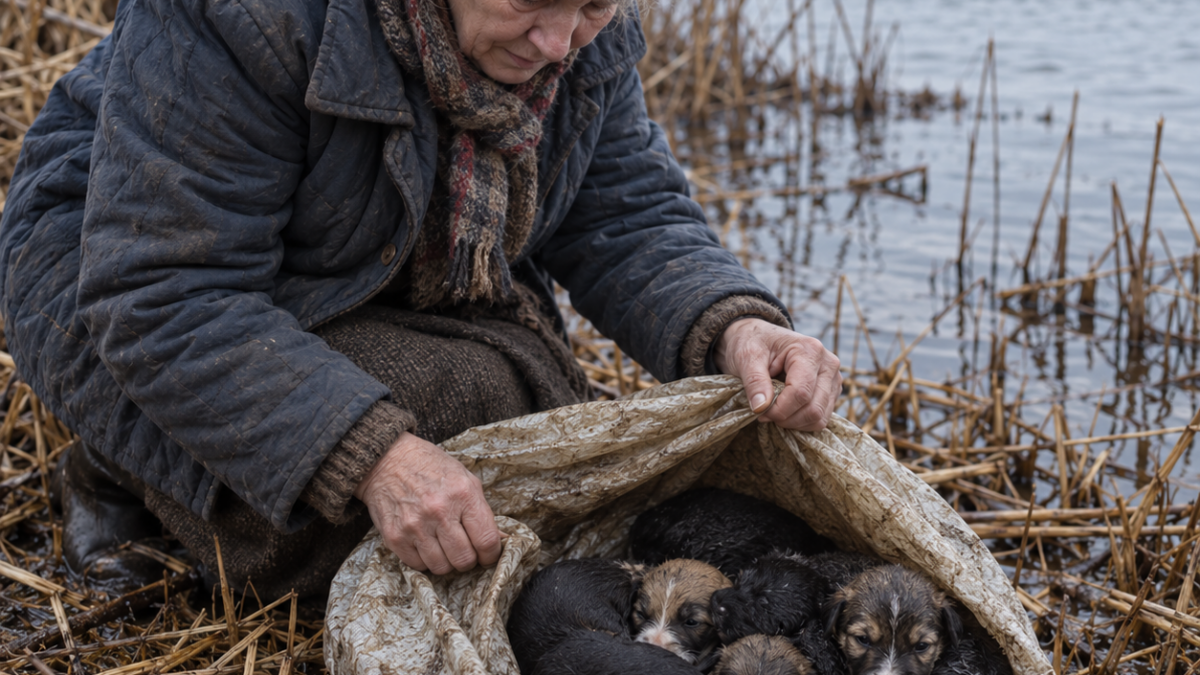
PART 2
“Come on.”
I rubbed harder.
Not violently, but enough to create friction through the towel.
My fingers shook so badly that I could barely hold him.
The phone rang.
Once.
Twice.
Three times.
“Please answer.”
A sleepy male voice finally came through.
“Riverbend Veterinary.”
“Daniel?”
“Maria?”
Dr. Daniel Harris had known me for almost twenty years. He had treated my husband’s old hunting dog, then my cat, then the stray animals I occasionally brought him because apparently retirement had turned me into the unofficial grandmother of every creature within three miles.
“I found puppies.”
“What?”
“Five. In a sack. By the river.”
His voice changed instantly.
“How old?”
“Very young. They’re soaked. One isn’t breathing.”
“Maria, listen carefully.”
I put the phone on speaker.
“Warm him gradually. Don’t put him directly against very high heat. Rub his chest. Clear his nose and mouth. Can you feel a heartbeat?”
I pressed two fingers against the tiny chest.
At first, nothing.
Then—
Maybe.
“I think so.”
“Good. Keep rubbing.”
The other puppies were crying now.
That sound was both terrible and wonderful.
Alive puppies make noise.
I kept rubbing the smallest.
“Come on, sweetheart.”
Daniel was already getting dressed on the other end.
“I’m coming to you.”
“No. I’ll bring them.”
“You are seventy-two, it’s dark, and there’s a storm.”
“I’m perfectly capable.”
“Maria.”
I knew that tone.
The same tone he used with people who argued against medical advice.
“Fine.”
“Keep them warm. I’m ten minutes away.”
The line ended.
I looked down.
The puppy still wasn’t breathing normally.
“You’re making me look bad.”
Nothing.
“Daniel thinks I’m too old to handle this.”
Still nothing.
“Personally, I find that insulting.”
Then the little body jerked.
A breath came out.
A tiny, wet gasp.
I froze.
Another.
Then a sound.
Barely a squeak.
“Oh!”
I started crying.
“Good boy.”
I had no idea whether the puppy was male.
I did not care.
“Good anything.”
I wrapped him against my chest again.
The other four had begun crawling blindly over the towels, seeking warmth.
They looked pitiful.
Their stomachs were hollow.
One had a small cut near the ear.
Another had mud inside his nose.
And all five smelled like cold river water and old grain.
Whoever put them in that sack had not accidentally lost them.
The rope had been tied.
That thought sat like a stone inside me.
Someone had made a decision.
Someone had picked up five living animals, placed them inside a bag, tied it closed, and left them at the water.
Perhaps they had intended the sack to float away.
Perhaps the reeds had caught it.
Perhaps that was the only reason I had found them.
I looked toward the window.
Rain ran down the glass.
“How can anyone do that?”
The puppies had no answer.
—
Daniel arrived eleven minutes later carrying a medical bag, towels, heating pads, and the expression of a man who had already decided I had caused him a difficult night.
“You look terrible,” he said.
“Thank you.”
“Where are they?”
I pointed.
He knelt beside the stove.
His face changed as soon as he saw the puppies.
“Jesus.”
The humor disappeared.
He examined them one by one.
Temperature.
Heart rate.
Gums.
Breathing.
The smallest puppy worried him most.
“Severely hypothermic.”
“Can he survive?”
“Maybe.”
I hated maybe.
“What about the others?”
“Cold. Dehydrated. Underweight. But stronger.”
“How old?”
“Five weeks. Maybe six.”
“Too young to be away from their mother?”
“Yes.”
That word bothered me.
Mother.
Somewhere there might be a dog missing five puppies.
Or perhaps she was dead.
Or perhaps the person who had put them in the sack still had her.
That thought would come back later.
At the time, survival was enough.
—
Daniel had a small clinic behind his house.
We loaded the puppies into a laundry basket lined with warm towels and drove there in his truck.
I went too.
He did not argue.
He knew better.
At the clinic, we worked until after two in the morning.
Warm fluids.
Glucose.
Slow feeding.
Oxygen for the smallest.
We weighed them.
The largest was barely four pounds.
The smallest—who turned out to be male—weighed only two pounds, nine ounces.
“That’s too small,” I said.
Daniel nodded.
“He may have always been the runt.”
I looked through the clear incubator.
The puppy’s dark eye patch made him look as if someone had touched him with a paintbrush.
“What do we call him?”
Daniel looked at me.
“Maria, they’re medical patients.”
“Patients have names.”
He sighed.
“You’ve known them three hours.”
“Long enough.”
I pointed.
“Patch.”
“Predictable.”
“Useful.”
The cream puppy became Sunny.
The two black-and-tan pups became Max and Milo.
The brown female became Rosie.
Daniel wrote the names on the chart while pretending this wasn’t emotionally significant.
It was.
Names are declarations.
They say:
You are here.
You are not waste.
You are not a sack.
You are somebody.
—
Patch stopped breathing again at 2:17 a.m.
For nine seconds.
Maybe ten.
It felt like an hour.
Daniel stimulated him.
Oxygen.
Warmth.
Then Patch breathed again.
I gripped the examination table.
“You are doing this deliberately.”
Daniel didn’t look up.
“Doing what?”
“Trying to kill me before the puppy.”
That finally made him laugh.
“Sit down, Maria.”
“I’m fine.”
“You’ve been awake all night.”
“So have you.”
“I’m forty-one.”
“Show-off.”
—
At dawn, four puppies were stable.
Patch remained critical.
I sat beside his incubator.
The rain had stopped.
Morning light came through the blinds.
Daniel handed me coffee.
“You’re going home.”
“No.”
“Maria.”
“I have nowhere I need to be.”
That sentence sounded different after I said it.
For years, since Peter died, I had often felt I had nowhere anyone needed me to be.
Now five small animals had appeared inside one impossible evening and suddenly my empty morning had a purpose.
Daniel must have heard something in my voice.
He stopped arguing.
“Fine. But eat something.”
I looked at him.
“My groceries are by the river.”
He blinked.
“You left your groceries?”
“There were puppies.”
“Of course there were.”
—
By nine, news had already spread.
Small towns are efficient that way.
My neighbor, Carol, appeared with soup.
Then Victor from the grocery store brought replacement milk and potatoes after somebody found my abandoned shopping bag.
Then a teenager named Noah delivered blankets from his mother’s house.
By noon, half the town knew about the river puppies.
I did not post pictures.
I did not want spectacle.
But someone had committed cruelty.
Daniel called county animal control.
Officer James Mercer arrived shortly after lunch.
He was a serious man in his fifties with a notebook that looked older than some of our volunteers.
He asked me to tell him exactly what happened.
I did.
“Where’s the sack?”
“At my house.”
“Rope?”
“Also there.”
“Don’t wash anything.”
“Why?”
“Evidence.”
That word changed the room.
Evidence.
Until then, I’d been thinking only about puppies.
Now there was a person somewhere who had done this.
And perhaps there was a way to find him.
—
James went with me back to the river.
The rain had washed away most footprints.
Still, the bank held tire marks near an old maintenance track.
Fresh.
Deep.
A vehicle had been there recently.
“Could be anybody,” I said.
“Could be.”
He photographed them.
Then we found something else.
A small torn piece of white plastic caught on a blackberry bush.
James picked it up with gloves.
It looked like part of a feed sack.
Printed on it were several green letters.
**…CREEK FARM SUP…**
James frowned.
“Mill Creek Farm Supply?”
There was only one store by that name in the county.
Twenty-five miles away.
“Could have come from anywhere,” he said.
But he bagged it anyway.
—
The grain sack I had opened carried a faded manufacturer logo.
Not unusual.
Sold in several states.
But the blue rope was more interesting.
Thick polypropylene.
One end had a distinctive melted red mark.
James examined it.
“Someone cut this with a hot knife or torch.”
“Does that help?”
“Maybe.”
He looked inside the sack.
There were traces of straw.
Dog hair.
And something else.
Small wood shavings.
“Kennel bedding?” I asked.
“Could be.”
He looked at me.
“Let’s not solve the case before the lab.”
“I’m retired. I have time.”
He almost smiled.
—
Patch survived the second night.
Then the third.
On day four, he took formula from a bottle without help.
I cried.
Daniel rolled his eyes.
“You cry a lot.”
“I’m emotionally available.”
“You’re exhausting.”
Patch gained three ounces by the end of the week.
Sunny became the loudest.
Max discovered that shoelaces were enemies.
Milo slept constantly.
Rosie learned to climb out of the laundry basket before any of the others.
“They’re becoming criminals,” Daniel said.
“Good.”
“Good?”
“Healthy puppies are inconvenient.”
That was another thing I began to understand.
Sick animals are quiet.
Recovery is noisy.
I would take noise.
—
We still had no mother.
That worried Daniel.
“They’re old enough to survive without nursing if necessary, but a mother would help.”
“Can we find her?”
“Maybe she’s nowhere near here.”
Maybe again.
I hated the word more every day.
—
Mill Creek Farm Supply provided James with sales records voluntarily.
Blue polypropylene rope was sold there.
So were the grain sacks.
That meant almost nothing.
Dozens of customers.
Then the store manager noticed something in the photograph.
“The red melted end?”
“Yeah,” James said.
“We sell rope by the foot. My employee seals cuts with a red-hot blade.”
“Only your store?”
“Plenty of places do.”
Still.
A possibility.
James asked about customers who bought dog feed in bulk.
The manager printed receipts.
There were twelve regular buyers purchasing more than 200 pounds a month.
One name caught James’ attention.
**Dale Whitmore.**
Why?
Because county animal control had received two complaints about barking from his property during the previous year.
No cruelty charges.
No seizure.
Just barking.
But enough to check.
—
Dale lived eight miles upriver.
Not far by road.
His property sat behind a line of pines.
An old farmhouse.
Three sheds.
A barn.
And, according to satellite images, several fenced runs behind the house.
James visited.
Dale was cooperative.
Too cooperative, James later said.
He showed him three adult dogs.
Two males.
One older female.
All appeared reasonably cared for.
No puppies.
“No litters recently?” James asked.
“No.”
“What do you do with the dogs?”
“Hunting.”
“What kind?”
“Mixed hounds.”
The dogs in his yard were hound mixes.
Not obviously related to our puppies.
James left.
For the moment.
—
Another lead arrived from somewhere none of us expected.
A school bus driver named Linda called.
She had driven the river road on the evening before I found the puppies.
At approximately 5:40, she saw a dark green pickup parked near the maintenance track.
“Could you identify it?”
“Maybe.”
“Driver?”
“No.”
“Anything distinctive?”
She thought.
“One taillight had white tape over it.”
James wrote that down.
Dale Whitmore drove a dark green Ford pickup.
Rear passenger-side taillight repaired with white tape.
Coincidence.
Possible.
But coincidences start looking different when they stack.
—
James returned with a warrant request.
Not enough yet.
He needed more.
Then the lab found canine DNA inside the sack.
Expected.
But there were two distinct profiles.
Puppies.
And an adult female.
“Mother?” I asked.
“Could be.”
Hair from an adult dog had been inside that sack.
Perhaps from bedding.
Perhaps from the person who loaded them.
It meant the puppies had recently been around an adult female.
—
Meanwhile, Rosie became ill.
Vomiting.
Diarrhea.
My heart stopped.
Parvo test.
Negative.
Parasites.
Positive.
Heavy worm burden.
All five needed treatment.
Patch was so small that medication had to be calculated carefully.
Daniel explained everything.
I listened like it was a university lecture.
“You’re taking notes?” he asked.
“Yes.”
“Why?”
“So you don’t make mistakes.”
“Get out of my clinic.”
I stayed.
—
Three weeks passed.
The puppies doubled in weight.
Patch remained smaller but stubborn.
He followed me everywhere once he learned to walk properly.
If I sat, he sat on my shoe.
If I moved, he waddled after.
Daniel noticed.
“He’s chosen you.”
“No.”
“Maria.”
“I’m seventy-two.”
“So?”
“I don’t need a puppy.”
Patch was asleep inside my cardigan.
Daniel looked at him.
“Clearly.”
—
Then James called.
“We found the mother.”
I stood so fast I knocked over my tea.
“Where?”
“Dale Whitmore’s property.”
My stomach tightened.
“How?”
“A neighbor sent video.”
—
The neighbor, Ray Collins, lived half a mile away.
He had installed trail cameras after coyotes started killing chickens.
One camera faced a fence line near Dale’s back pasture.
James showed me the footage later.
Date: six weeks earlier.
A brown-and-black female dog was visible inside a small pen.
Thin.
Nursing.
Five tiny puppies crawled around her.
My hands began shaking.
The markings matched.
Patch’s dark eye.
Rosie’s brown body.
Sunny’s pale fur.
All there.
Alive.
With their mother.
Another clip, two weeks later, showed the puppies larger.
Then a third clip.
Dale entering the pen.
Picking up puppies one by one.
Placing them inside a grain sack.
I covered my mouth.
“Stop.”
James paused the video.
I couldn’t breathe.
“You don’t have to watch the rest.”
“What happens?”
His jaw tightened.
“The mother tries to follow.”
My eyes filled.
“And?”
“He kicks the gate shut.”
“Does he hurt her?”
“Not badly. But she panics.”
“Then?”
“Dale carries the sack to his truck.”
I looked away.
We had it.
Not suspicion.
Not rope.
Not feed receipts.
Video.
—
“But you said you found the mother.”
James nodded.
“When we showed this to the judge, we got the warrant.”
Animal control and sheriff’s deputies searched Dale’s property that morning.
The brown-and-black female from the video was still there.
Her name, according to Dale’s kennel records, was Daisy.
She was underweight.
Her nipples still enlarged from nursing.
She had a skin infection.
And one back leg bore a healed fracture.
They found seven other dogs too.
Several in acceptable condition.
Two not.
One had untreated ear disease.
Another had an infected paw.
More importantly, they found breeding records.
Dale wasn’t simply hunting with dogs.
He sold puppies.
Unlicensed.
Mostly through cash transactions.
Daisy had produced three litters in two years.
The latest had not sold.
Why?
A note in his ledger said:
**Mixed litter. Wrong color. No buyers.**
Wrong color.
I read those words three times.
Five puppies nearly died because they were the wrong color.
—
Dale was arrested on animal-cruelty and abandonment charges.
The exact counts would depend on prosecutors.
He denied everything.
At first.
Said someone else had used his truck.
Said the video was unclear.
Said the puppies were sick.
Said he intended to surrender them.
Then officers found something in his barn.
More blue rope.
Same diameter.
Same manufacturer.
Ends melted with the same red heat-sealing method.
Still not unique.
But beside it sat sacks identical to the one from the river.
And under a workbench, a metal rod used for heat cutting.
Red residue.
—
The strongest evidence wasn’t rope.
It was his phone.
A warrant recovered messages between Dale and a friend.
Two days before the river:
**Nobody wants these mutts.**
Friend:
**Take them to county shelter.**
Dale:
**They charge surrender fees and ask questions.**
Friend:
**Then give them away.**
Dale:
**Done feeding dogs that don’t sell.**
Another message on the day I found them:
**Problem handled.**
That phrase made me sick.
Problem handled.
Five breathing bodies.
One sack.
Problem handled.
—
Daisy came to Daniel’s clinic under protective custody.
I met her the afternoon she arrived.
She was smaller than I expected.
Maybe forty pounds.
Shepherd-hound mix.
Brown coat with black along the back.
Eyes almost amber.
When she entered, the puppies were in the playpen.
Daisy heard them before she saw them.
She stopped.
Her ears lifted.
Patch squeaked.
Daisy pulled toward the sound.
James looked at Daniel.
“Safe?”
“Yes.”
We opened the playpen.
Daisy rushed forward.
The puppies exploded.
All five.
They crawled over each other.
Climbed onto her.
Cried.
Daisy began licking them so quickly she could barely choose where to start.
I covered my face.
Patch buried himself against her belly.
Rosie rolled over beneath her chin.
Sunny made a sound like a rusty hinge.
Daisy cried too.
Dogs cry differently than people.
But nobody in that room mistook it for anything else.
—
For several minutes, I hated Dale more than I had hated anyone in years.
He had taken this from them.
A mother.
Her babies.
Not because he was starving.
Not because he was desperate.
Not because the animals were dying.
Because they weren’t profitable.
That distinction mattered.
—
Daisy stayed with the puppies during the remainder of their recovery.
She couldn’t produce much milk anymore, but they didn’t need it.
What they needed was her.
She corrected their biting.
Cleaned their faces.
Slept with them.
Taught them how dogs behave.
Patch became bolder within days.
Max stopped crying at night.
Rosie slept beneath Daisy’s chin.
I realized that even though we’d saved their bodies, something had still been missing.
Now it wasn’t.
—
The story became public after charges were filed.
I hated publicity.
Reporters called.
Someone wanted me to reenact finding the sack.
Absolutely not.
One television producer asked me to stand beside the river holding an empty bag.
I told him exactly what he could do with the idea.
Daniel later said my language had been medically impressive.
Still, publicity brought something useful.
More witnesses.
—
A woman named Rebecca came forward.
She had bought a puppy from Dale the year before.
It became sick two days later.
Parvovirus.
She spent thousands saving it.
Dale refused to refund anything.
Another family said their puppy had severe worms.
Another said Dale insisted buyers meet him in parking lots rather than at his property.
A pattern emerged.
Not every problem was illegal.
But the business was clearly hidden.
—
Then came the most important witness after Ray’s camera.
Dale’s seventeen-year-old nephew, Tyler.
He had worked on the property during summer.
He knew Daisy.
He knew the litter.
When police first interviewed him, he said nothing.
A week later, he returned with his mother.
He looked terrified.
“I helped put the puppies in the sack.”
I stared at him from across the interview room.
James had asked whether I wanted to be there because I was the finder and potential witness.
I almost said no.
Then I went.
Tyler couldn’t look at me.
“Why?”
“My uncle told me they were being taken to a farmer.”
“Then why the sack?”
“He said it was easier.”
“Did you know he was taking them to the river?”
“No.”
“Did you go?”
“No.”
“Then what happened?”
“He told me later.”
“What did he say?”
Tyler swallowed.
“That he didn’t have to worry about feeding them anymore.”
I felt my nails press into my palm.
“Did you report him?”
“No.”
“Why?”
“He’s my uncle.”
I looked at him.
“Those puppies had a mother.”
His eyes filled.
“I know.”
“Daisy pulled at the gate while you took them.”
His face collapsed.
“I know.”
I stopped.
Anger is easy when the person across from you looks like a villain.
Tyler looked seventeen.
Young.
Ashamed.
Complicit.
But not beyond repair.
He continued.
“I should’ve stopped him.”
“Yes.”
“I didn’t.”
“No.”
“I’m sorry.”
I believed that he was sorry.
That didn’t erase what he had done.
But his testimony would matter.
Sometimes accountability begins after failure.
—
Dale’s attorney offered a plea.
The first offer felt insulting.
Probation.
Fines.
Short animal-ownership restriction.
No jail.
I was furious.
James listened.
Then said:
“The prosecutor hasn’t accepted it.”
“Good.”
“We have video.”
“Good.”
“We have texts.”
“Good.”
“We have Tyler.”
“Good.”
He looked at me.
“Maria.”
“What?”
“You’re saying good like you’re preparing an execution.”
“I’m seventy-two. Let me have hobbies.”
—
The case went to a preliminary hearing.
I testified.
I wore Peter’s old navy coat because it made me feel less alone.
The prosecutor asked me to describe what I found.
I did.
The sack.
The rope.
The cold puppies.
Patch not breathing.
The walk home.
Dale sat at the defense table.
He avoided looking at me.
Until the prosecutor displayed a photograph of the puppies the first night.
Patch looked almost dead.
Sunny’s fur was plastered to his ribs.
Rosie was barely lifting her head.
I looked at Dale.
He looked back.
No expression.
That disturbed me more than anger would have.
—
Daniel testified next.
“Could these puppies have died?”
“Yes.”
“How quickly?”
“Given hypothermia and their age, some could have died within hours.”
“Did any nearly die?”
“Patch experienced repeated respiratory failure.”
The prosecutor pointed.
“Is Patch in the courtroom?”
The judge looked surprised.
“No,” Daniel said. “He’s at Ms. Ivanov’s home.”
I frowned.
I had told him Patch was not staying permanently.
Daniel smiled at me from the witness stand.
Traitor.
—
Ray’s footage played.
I didn’t watch.
I looked at the floor.
But I heard Daisy barking on the recording.
Heard the metal gate.
Heard Dale say something.
The audio wasn’t clear.
Then his truck engine.
I closed my eyes.
—
Tyler testified.
That hurt.
His attorney tried to suggest Tyler blamed Dale to protect himself.
Tyler answered:
“I helped. I’m not denying that.”
“Then you participated.”
“Yes.”
“Why should the court believe you now?”
Tyler swallowed.
“Because I should’ve told the truth the first day.”
Simple.
No excuse.
The defense didn’t get much from him after that.
—
Then came Dale’s messages.
**Nobody wants these mutts.**
**Done feeding dogs that don’t sell.**
**Problem handled.**
The courtroom changed.
Words remove ambiguity.
Cruelty often depends on people pretending intent can’t be known.
Dale had written his intent himself.
—
The judge found sufficient evidence to move the case forward.
Outside the courthouse, Dale came toward me.
His attorney immediately told him not to.
He ignored her.
“You happy?”
I stared.
“No.”
“You ruined my life over some dogs.”
I almost laughed.
There it was.
The sentence people say when they want consequence to feel like persecution.
I stepped closer.
“I was walking home with potatoes.”
He frowned.
“I didn’t know your name. I didn’t know where you lived. I didn’t know you existed.”
I pointed toward the courthouse.
“You brought yourself here.”
His jaw tightened.
“Those puppies were mine.”
“No.”
“They were born on my property.”
“That doesn’t give you the right to kill them.”
“I didn’t kill them.”
“Because the reeds caught the sack.”
Silence.
“You didn’t save them.”
I continued.
“You failed.”
That landed.
His face changed.
I walked away.
Not dramatic.
No applause.
Just done.
—
The plea offer changed after that hearing.
Dale accepted rather than risk a full trial.
He pleaded guilty to multiple animal-cruelty and abandonment-related counts, along with licensing violations connected to the breeding operation.
The sentence wasn’t everything I wanted.
Justice rarely is.
He received county jail time.
Probation.
Substantial fines.
Restitution for veterinary care.
A multi-year prohibition on owning, breeding, or selling animals.
Mandatory counseling.
Animal-control inspections during probation.
His unlicensed breeding operation was permanently shut down under county regulations.
Every dog on the property was surrendered.
That mattered most.
—
At sentencing, the judge asked Dale whether he wanted to speak.
He stood.
“I made a bad decision.”
I hated the phrase.
One bad decision.
As though the sack had tied itself.
As though five puppies accidentally entered it.
The judge seemed to have the same thought.
“One?”
Dale hesitated.
“I was under financial pressure.”
The judge looked at his records.
“You purchased a new fishing boat three weeks before this incident.”
I almost smiled.
Dale’s attorney closed her eyes.
The judge continued.
“You declined a shelter because you did not want to pay a surrender fee.”
Silence.
“You chose to place five living animals in a tied sack near moving water.”
Dale looked down.
The judge’s voice stayed calm.
“Financial pressure does not explain that sequence of choices.”
Exactly.
—
The county seized his remaining breeding equipment.
The runs were dismantled.
Dogs went to rescue groups.
Daisy became legally available after the case.
That created a problem.
Me.
Again.
—
By then, the puppies were nearly four months old.
Sunny went to a family with two boys who had been following his recovery since the first week.
Max went to a retired firefighter.
Milo went to a veterinary technician.
Rosie went to Carol, my neighbor, who had spent weeks pretending she was “just helping.”
I saw through her immediately.
Patch?
Daniel asked:
“So when are you signing?”
“Signing what?”
“The adoption.”
“No.”
Patch sat on my foot.
“Maria.”
“I’m old.”
“You keep saying that like it’s relevant.”
“I have stairs.”
“Patch has legs.”
“I travel occasionally.”
“You haven’t left the county in nine years.”
“That is not the point.”
Patch climbed into my lap.
Daniel handed me the form.
“Traitor.”
“Sign.”
I signed.
—
Then there was Daisy.
Nobody applied immediately.
She was an adult.
Scarred.
Underweight.
Cautious with men.
She needed patience.
I told myself one dog was enough.
Then Patch refused to sleep unless Daisy was nearby.
For the first week after the other puppies were adopted, he cried at night.
Daisy stayed at the clinic.
I brought Patch to visit.
He exploded with happiness every time.
Daniel watched me.
“No.”
“I didn’t say anything.”
“Your face did.”
“Maria.”
“No.”
—
Daisy came home “temporarily.”
The word lasted six days.
On day seven, she was asleep beside my stove while Patch chewed one of Peter’s old slippers.
I looked at them.
Then at the adoption paperwork Daniel had suspiciously left on my table.
“Peter,” I said toward the ceiling, “this is your fault somehow.”
Patch tore the slipper in half.
I signed.
—
My house changed.
For six years after Peter died, I had preserved it almost exactly.
His chair.
His coat hooks.
His tools in the shed.
His mug in the cabinet.
Then dogs happened.
Daisy took Peter’s chair.
Patch stole his slippers.
Dog hair appeared on his favorite blanket.
At first, part of me resisted.
Then one afternoon, Daisy was sleeping upside down in his recliner with all four paws in the air.
I laughed.
Really laughed.
Not polite laughter.
Not the sound you make for neighbors.
The kind that hurts your stomach.
And suddenly Peter’s chair stopped being a shrine.
It became a chair again.
I think he would have approved.
—
Daisy had nightmares.
At least that’s what I called them.
She would twitch.
Whine.
Sometimes wake suddenly and look toward the door.
Patch learned to sleep against her.
When she woke, he was there.
A son she had nearly lost.
I often sat nearby.
A widow.
A mother dog.
A puppy.
Three creatures who had learned different versions of absence.
Not a conventional family.
Still a family.
—
Tyler began volunteering at Daniel’s clinic as part of his juvenile diversion agreement for his role.
At first, I didn’t like it.
I told James.
“He helped put them in the sack.”
“I know.”
“He should be punished.”
“He is.”
“Cleaning kennels is punishment?”
“Partly. Counseling too.”
I frowned.
James said:
“Maria, do you want him scared of consequences or changed by them?”
“Both.”
He laughed.
“Fair.”
—
Tyler worked.
Laundry.
Kennels.
Floors.
No unsupervised animal contact.
He never complained.
After his required hours ended, he kept coming.
That surprised me.
One afternoon, I found him sitting outside Daisy’s run at the clinic.
She was inside.
He hadn’t entered.
“Why are you here?”
He looked embarrassed.
“I wanted to say sorry.”
“To a dog?”
“Yeah.”
“She doesn’t understand court apologies.”
“I know.”
Daisy watched him.
Tyler looked down.
“I was there when he took her puppies.”
“Yes.”
“I remember her barking.”
“Good.”
He looked at me.
“Good?”
“Remembering should hurt enough to change you.”
He nodded.
Daisy eventually approached the fence.
Sniffed his fingers.
He didn’t touch her.
A month later, she accepted a treat from him.
Tyler cried.
He tried to hide it.
I pretended not to see.
—
Years later, Tyler became a veterinary technician.
That part of the story surprised me most.
He told me once:
“I think I owe them.”
I corrected him.
“You don’t build your life around owing Daisy.”
He frowned.
“Then what?”
“You build it around making sure another Daisy doesn’t need you to apologize later.”
He thought.
“That’s better.”
“Usually.”
—
The county changed too.
Dale’s case exposed gaps.
Unlicensed breeders had been difficult to track because complaints lived in separate files.
The sheriff’s office and animal control created a shared database.
Feed-store tips weren’t evidence, but patterns became easier to see.
Repeat barking complaints.
Multiple litters.
Frequent cash sales.
Prior welfare warnings.
None proved cruelty alone.
Together, they could justify closer inspection.
Boring policy.
Important policy.
—
A local rescue created a surrender-assistance program.
That mattered to me.
I didn’t want people learning the wrong lesson from Dale.
If you cannot care for puppies, surrender them.
Ask for help.
Don’t fear judgment so much that animals pay.
The county shelter waived surrender fees in verified hardship cases.
No more excuse.
No more “I didn’t want questions.”
Questions are cheaper than funerals.
—
The riverbank changed too.
For months, I avoided the willow.
Then one evening I walked there with Daisy and Patch.
Daisy sniffed the reeds.
Patch tried to eat a stick.
Nothing dramatic happened.
I stood exactly where I’d found the sack.
The water moved quietly.
I expected anger.
Instead, I felt something strange.
Gratitude.
Not for what Dale did.
Never.
For the reeds.
The stupid, ordinary reeds that caught a sack before the current could carry it away.
For one weak whimper.
For the fact that my hearing, despite my age, had been good enough that evening.
Life sometimes turns on ridiculous details.
A knot.
A plant.
A woman resting because her hip hurts.
—
At Patch’s first birthday, Daniel brought a cake made for dogs.
“Excessive,” I said.
“You invited nineteen people.”
“Community.”
“Daisy has a party hat.”
“Carol did that.”
Daisy looked humiliated.
Patch loved everything.
He tore open wrapping paper.
Stole Rosie’s toy.
Ate too fast.
Then fell asleep with his face in my lap.
I touched the dark patch over his eye.
One year earlier, I’d thought he was dead beneath my coat.
Now he snored.
Ordinary life is the best revenge against someone who tried to erase you.
—
Dale served his sentence.
Probation continued.
His animal ban was enforced.
Once, three years later, he tried to adopt a dog from a county shelter.
Background check.
Denied.
Another rescue denied him.
He complained online that people were “holding one mistake forever.”
James showed me.
I read it once.
Then handed the phone back.
“Good.”
James laughed.
“You’re ruthless.”
“No. I’m old.”
Apparently that explained many things.
—
Dale later moved out of the county.
I didn’t care.
That was progress.
For the first year, I thought about him often.
Then less.
Then almost never.
He became what people who hurt animals should become after accountability:
irrelevant to the animal’s future.
—
Daisy became healthy.
Her coat grew thick.
Her ribs disappeared.
She learned toys slowly.
At first, balls frightened her.
Then Patch taught her.
He would chase one.
Bring it back halfway.
Drop it.
Daisy watched.
One day, she picked it up.
I shouted so loudly she dropped it again.
“Sorry.”
She stared at me.
I tried calmer enthusiasm.
“Very good.”
She picked it up.
Patch stole it.
Family.
—
At ten, Daisy developed arthritis.
Daniel prescribed medication.
I installed a ramp.
Then another.
My house slowly turned into an accessibility center for an aging woman and an aging dog.
Patch remained young enough to ignore every ramp and jump over furniture instead.
—
Rosie lived next door with Carol.
Sunny’s family sent Christmas pictures.
Max became a therapy dog for the retired firefighter’s wife after she suffered a stroke.
Milo grew huge despite being small as a puppy and became famous in his home for sleeping inside laundry baskets he no longer fit in.
Every year, on the anniversary of the river rescue, we exchanged photographs.
Five puppies.
Five lives.
The number never stopped astonishing me.
—
One year, Sunny’s family brought him back for a reunion.
Then Max.
Then Rosie.
Milo’s family drove two hours.
All five met Daisy in my yard.
Chaos.
Patch barked.
Rosie stole food.
Sunny tried to mount a lawn chair for reasons known only to him.
Daisy walked among them.
Sniffing.
Correcting.
Calm.
I watched from the porch.
Carol sat beside me.
“Do you think she knows they’re hers?”
“I don’t know.”
Daisy licked Patch’s face.
“Maybe.”
We didn’t need certainty.
—
Daisy turned twelve, approximately.
Her muzzle white.
Hearing weaker.
Eyes cloudy.
She still knew the refrigerator opening from three rooms away.
Medical miracle.
One afternoon, Daniel examined her and found a heart murmur.
“How bad?”
“Manageable.”
“How long?”
He gave me that look veterinarians give when people ask impossible questions.
“Maria.”
“I know.”
“Could be years.”
“Good.”
“Could be less.”
“Unnecessary second sentence.”
—
My own health changed too.
I was eighty by then.
Hip replacement.
Blood-pressure medication.
My children lived several hours away and tried repeatedly to convince me to move.
“No.”
“Mom.”
“I have dogs.”
“We know.”
“Daisy hates apartments.”
“You don’t know that.”
“She told me.”
Patch barked.
“See?”
My daughter gave up.
—
Still, I prepared.
Peter had taught me that love without plans becomes someone else’s emergency.
I created a pet trust.
Daniel agreed to be emergency contact.
Carol promised Daisy and Patch would stay together if I died first.
My daughter agreed too.
No uncertainty.
No river.
No shelter chaos.
No animal left wondering why a person disappeared.
That mattered more as I aged.
—
Daisy’s final year came quietly.
She stopped going on long walks.
Then short walks.
The yard became enough.
She slept beneath the kitchen window.
Patch, now seven, adjusted his speed.
He waited when she stood.
Waited at steps.
Waited by the water bowl.
A puppy once saved beside her became the dog who cared for her.
Love changes roles.
—
One rainy evening, Daisy refused dinner.
I knew.
Not immediately.
But somewhere in me.
Daniel came the next morning.
Blood tests.
Kidney decline.
Heart failure progressing.
We could adjust medication.
Maybe gain weeks.
The question was quality.
Always quality.
I sat on the floor beside Daisy.
She rested her head on my leg.
Patch lay against her back.
“Not today,” I said.
Daniel nodded.
“Not today.”
—
We got twelve more good days.
Chicken.
Sunlight.
Slow walks around the yard.
One trip to the river.
I wasn’t sure whether taking her there was fair.
But Daisy loved water smells.
She stood by the willow.
Patch beside her.
I touched the bark.
“This is where I found them.”
Daisy sniffed the reeds.
No panic.
No recognition I could see.
Just a river.
Good.
Let the place mean nothing to her.
Trauma does not need monuments.
—
On day thirteen, Daisy couldn’t stand without help.
I called Daniel.
He came to the house.
Carol came.
My daughter drove in.
Tyler came only after I said yes.
He was twenty-five by then.
Veterinary technician.
Good man.
Complicated history.
Still good.
He sat on the floor five feet away.
Daisy looked at him.
Then slowly moved her paw toward him.
He touched it.
“Hey, girl.”
His voice broke.
“I’m sorry.”
I almost corrected him.
Then didn’t.
Some apologies are not requests.
They’re acknowledgments.
—
We put Daisy on Peter’s old blanket.
Patch curled beside her.
I sat in the recliner she had stolen years ago.
Then changed my mind.
I got on the floor.
“My knees are going to regret this.”
Daniel smiled.
Daisy looked at me.
“I found your babies in a sack.”
Her ears moved faintly.
“Terrible introduction.”
Carol cried.
“You were supposed to be temporary too.”
Patch lifted his head.
“I am apparently bad at temporary.”
—
Daniel gave the sedative.
Daisy relaxed.
Patch began licking her ear.
I put one hand on her chest.
“No more chains.”
Breath.
“No more litters.”
Another.
“No more people deciding your babies aren’t worth feeding.”
Tyler covered his face.
I continued.
“They all lived.”
Daisy’s eyes were half closed.
“Every one.”
Sunny.
Max.
Milo.
Rosie.
Patch.
“Five.”
I kissed her head.
“You did your job.”
The final medication entered.
One breath.
Then another.
Stillness.
Patch stayed beside her.
For almost an hour.
—
We buried part of Daisy’s ashes beneath the willow in my yard.
Not the river willow.
My willow.
A tree Peter had planted thirty years earlier.
The stone read:
**DAISY**
**HER FIVE PUPPIES WERE THROWN AWAY.**
**NONE OF THEM STAYED LOST.**
Carol said it was dramatic.
I told her she could design her own stone someday.
She stopped criticizing.
—
Patch grieved.
Of course.
He checked Daisy’s bed.
The kitchen.
The yard.
He slept beside the stone for two nights until I brought him inside.
Then he started sleeping in my room.
I let him.
Rules become silly near grief.
—
The annual puppy reunion continued without Daisy.
Five adults.
Gray beginning around some muzzles.
Different families.
Different lives.
Patch always came home with me.
My small dog.
My river dog.
The puppy who stopped breathing against my chest.
—
When Patch turned ten, I was eighty-two.
Daniel joked that we were aging competitively.
Patch developed arthritis.
I developed arthritis somewhere else.
We both took medication.
I stored his in a blue box and mine in a red box.
One morning I nearly gave him my blood-pressure pill.
After that, my daughter labeled everything in enormous letters.
Humiliating.
Useful.
—
Tyler eventually became manager of Daniel’s clinic when Daniel reduced his hours.
I never expected that.
The teenager who had helped load puppies into a sack now spent his career caring for animals.
Some people disliked that part of the story.
They wanted permanent villains.
I understood.
But I had lived long enough to know people are more useful changed than destroyed.
Dale faced justice.
Tyler faced himself.
Different roles.
Different consequences.
That distinction matters.
—
Tyler started speaking at high schools about animal cruelty and peer pressure.
He didn’t sanitize his story.
“I helped.”
That was always his first sentence.
Not:
My uncle made me.
Not:
I was young.
Not:
I didn’t know.
“I helped.”
Then:
“I didn’t stop him.”
Then:
“I eventually told the truth.”
Young people listened because he didn’t pretend.
He told them:
“The first wrong thing you do doesn’t have to decide every thing you do afterward. But you still have to own it.”
I liked that.
—
The rescue created a program in Daisy’s name.
Not mine.
I refused.
**Daisy’s Second Chance Fund**
It paid surrender fees, emergency veterinary treatment, and temporary foster care for people who genuinely couldn’t keep litters safely.
The point was simple:
No one should ever be able to say tying puppies in a sack was easier than asking for help.
—
The first family helped by the fund had six unexpected puppies after their unfixed dog escaped.
They were embarrassed.
Poor.
Overwhelmed.
Instead of judging them, the rescue took the puppies into foster care, spayed the mother, helped place the babies, and returned the mother home.
No river.
No sack.
No crime.
Prevention is less dramatic than rescue.
Better too.
—
Patch reached thirteen.
His dark eye patch had faded beneath white fur.
Still there.
He moved slowly.
Slept deeply.
Barked at delivery trucks with less conviction.
I was eighty-five.
We matched.
—
One evening, we walked to the river.
Very slowly.
My cane.
Patch’s stiff legs.
The old willow still stood.
I stopped beside the reeds.
“Right there.”
Patch sniffed.
He had no idea.
Good.
I sat on a bench.
He rested at my feet.
I remembered carrying him inside my coat.
Two pounds.
Nine ounces.
No breath.
Now thirteen years.
A whole life.
I cried quietly.
Patch looked up.
“Don’t worry.”
I touched his head.
“Old people leak.”
—
His final decline came that winter.
Heart failure.
Kidney problems.
Age.
Not the river.
Not hypothermia.
Age.
That mattered deeply to me.
Patch had survived long enough to die of being old.
There is no more satisfying outcome for a discarded puppy.
—
His last morning, he refused bacon.
I called Tyler.
Not Daniel.
Daniel had retired fully.
Tyler came.
Carrying the same medical bag style Daniel used years ago.
For a moment, time folded.
Tyler examined Patch.
Then looked at me.
“Maria.”
“I know.”
“We can manage symptoms a little longer.”
“Good days?”
He didn’t answer.
I nodded.
“No.”
Patch lay on Peter’s blanket.
The same blanket Daisy had used.
I sat beside him.
My daughter was there.
Carol had died two years earlier.
Rosie had been gone for four.
Sunny too.
Max and Milo still lived, old and slow.
Life was thinning around the edges.
That’s what happens if you’re lucky enough to stay.
—
Tyler prepared the sedative.
I looked at him.
“Funny.”
“What?”
“The first time I met you, I wanted to hit you with my cane.”
He laughed through tears.
“Fair.”
“Now I’m letting you do this.”
He looked down.
“I don’t take that lightly.”
“I know.”
That was why.
—
I held Patch against my chest as best I could.
Not because he needed it.
Because I did.
“You remember this?”
Of course he didn’t.
“I carried you like this.”
His breathing was shallow.
“You were freezing.”
One breath.
“You stopped breathing.”
Another.
“I threatened you.”
My daughter laughed softly.
“Sounds like you.”
“I told you nobody was dying before I reached the stove.”
Patch’s tail moved once.
I smiled.
“You disobeyed for thirteen years.”
—
The sedative relaxed him.
I kissed the dark patch above his eye.
“No more medicine.”
Breath.
“No more stairs.”
Another.
“No more waiting for me to catch up.”
Tyler’s eyes filled.
I whispered:
“Go find Daisy.”
The final medication went in.
Patch breathed once.
Then stopped.
This time, I did not rub his chest.
I did not beg.
I did not call Daniel.
I simply held him.
Because the first time he stopped breathing, he was a baby who still had a life ahead.
This time, he had already lived it.
That is the difference between tragedy and completion.
—
Patch’s ashes went beside Daisy.
The stone was changed.
Now it read:
**DAISY & PATCH**
**THE RIVER DID NOT GET THE LAST WORD.**
My daughter said it sounded like something I would write.
Correct.
—
I stopped walking the river alone after that.
Not because I was afraid.
Because my knees finally won the argument.
But sometimes my daughter drove me there.
We sat in the car.
I looked at the reeds.
The water.
The willow.
People fishing.
Children throwing stones.
Ordinary life.
No one passing by knew what had happened there.
That’s fine.
Not every place needs a plaque.
—
Dale Whitmore eventually completed probation.
His animal ban expired years later.
By then, no reputable shelter in our region would approve him for adoption because the conviction remained public.
He never returned to breeding.
At least not that anyone could find.
He moved away.
His old property was sold.
The buyer tore down the pens.
Then something poetic happened without anyone planning it.
A young couple purchased the land and converted the barn into a boarding and foster facility for a regional rescue.
The first time Tyler told me, I thought he was joking.
“No.”
“Seriously.”
“The breeding property?”
“Yes.”
“What do they call it?”
He smiled.
“Willow Creek Foster Farm.”
I laughed so hard I started coughing.
Not because they knew about my willow.
They didn’t.
Coincidence.
Still perfect.
—
I visited once.
At eighty-seven.
My daughter drove.
The old kennel runs were gone.
Grass.
Shade trees.
Clean yards.
Dogs playing.
No chains.
No litter ledger.
No sacks.
A volunteer showed us the converted barn.
He didn’t know who I was.
“This place used to belong to a breeder who got shut down.”
“I heard.”
“We’ve fostered over two hundred dogs here.”
I touched the wooden railing.
Two hundred.
Dale had once measured dogs by whether they sold.
Now the same ground was used to keep animals alive until homes were ready.
If revenge needs an image, use that one.
Not Dale in court.
Not handcuffs.
Not fines.
Dogs running safely across the land where dogs had once been inventory.
That was enough.
—
Before we left, one young female shepherd ran toward the fence.
Brown.
Black along the back.
Amber eyes.
For one impossible second, she looked like Daisy.
I stopped.
The volunteer said:
“That’s Maggie. She came from a neglect case.”
I laughed.
Of course.
I crouched as far as my knees allowed.
Maggie sniffed my fingers.
“Hello, sweetheart.”
Tail.
I smiled.
“You’re going to be fine.”
I believed it.
—
People often ask what happened to all five puppies.
Sunny lived fourteen years.
Max thirteen.
Milo fifteen.
Rosie nearly fourteen.
Patch thirteen.
Five lives.
Almost sixty-nine combined years after someone decided they weren’t worth one more bag of food.
Think about that.
Nearly seventy years of barking, sleeping, stealing food, comforting people, chewing furniture, getting old, going gray, making families laugh.
All inside one tied sack.
That is why cruelty is so difficult to measure.
You don’t only risk ending one moment.
You erase every possible tomorrow.
Dale nearly erased sixty-nine years.
He didn’t.
—
Sometimes I think about the exact sequence.
If I had walked faster, I might have passed before the sack moved.
If my hip hadn’t hurt, I might not have stopped at the willow.
If the current had been stronger, the sack might have gone downstream.
If the knot had been tighter, my old knife might not have cut it.
If Patch hadn’t gasped one more time—
Too many ifs.
I don’t live inside them.
Not anymore.
What happened happened.
The reeds caught the sack.
I stopped.
The knife cut.
Daniel answered.
James investigated.
Ray kept his old camera footage.
Tyler eventually spoke.
A judge listened.
Daisy came home.
Five puppies grew old.
That’s enough reality for me.
—
I am ninety now.
Yes.
Ninety.
Still stubborn.
Still drinking tea too strong.
Still living in the same white house, although my daughter spends most nights here and pretends she isn’t supervising me.
There are no dogs in the house now.
Not permanently.
My knees and common sense finally reached an agreement.
But foster puppies still visit sometimes.
Tyler brings them.
He claims exposure to old women builds character.
I claim veterinary technicians need better hobbies.
—
On my refrigerator are six photographs.
Daisy.
Then five puppies as adults.
Sunny.
Max.
Milo.
Rosie.
Patch.
None of the photographs show them wet.
Cold.
Inside a sack.
I don’t keep that image.
The police have the evidence photographs.
I have the life photographs.
That’s what matters.
—
My favorite picture is Patch at twelve.
Gray face.
Dark eye patch almost gone.
Standing beside me on the river path.
I am holding my cane.
He is looking toward the camera.
Behind us, the river shines.
If you didn’t know the story, you’d see an old woman and an old dog on a walk.
Perfect.
That’s exactly what I wanted the ending to become.
Ordinary.
—
Dale Whitmore was once the most important person in the story because he made the cruelest choice.
Then he became less important.
James became more important.
Daniel.
Tyler.
The families who adopted the puppies.
The people who built the fund.
The rescuers at Willow Creek.
Daisy.
Patch.
Eventually, Dale was barely a footnote.
That may be the most satisfying consequence of all.
He tried to decide those puppies’ ending.
He didn’t even get to remain central in their beginning.
—
If you want to call what happened revenge, call it this:
The man who didn’t want to pay to surrender five puppies eventually paid fines, restitution, attorneys, and lost his breeding operation.
The mother dog he used for litters spent her final years on a couch.
The teenager who failed to stop him grew into a man who saves animals for a living.
The land where he treated dogs as inventory now shelters rescued animals.
The runt he thought wasn’t worth feeding slept against my heart for thirteen years.
And the old woman who was supposed to walk home quietly with milk and potatoes ended up helping change how an entire county handled abandoned litters.
That’s enough revenge.
More than enough.
—
But if you ask me what mattered most, it wasn’t court.
It wasn’t punishment.
It wasn’t even finding Dale.
It was the first breath.
Patch’s first breath after I thought I’d lost him.
That tiny gasp in my kitchen.
Because everything else came after.
One breath.
Then another.
Then thirteen years.
—
The river still runs.
It doesn’t remember.
Water doesn’t keep guilt.
It doesn’t know what was thrown into it or what was pulled back out.
People remember.
That is our job.
Not to carry hatred forever.
To carry the lesson.
When something moves in the reeds, look.
When you hear a weak cry, stop.
When someone says an animal is “only” an animal, pay attention to what they’re trying to make small.
And when somebody tells you one old woman can’t change very much, tell them about five puppies in a grain sack.
—
That evening, I thought I was rescuing five tiny dogs from cold water.
I didn’t understand that one day they would rescue pieces of me too.
After Peter died, I had become very good at surviving quietly.
Wake.
Tea.
Market.
Walk.
Home.
Television.
Bed.
Repeat.
Then Patch chewed Peter’s slipper.
Daisy stole his chair.
Rosie dug under Carol’s fence.
Sunny’s family sent ridiculous Christmas cards.
Max became somebody’s comfort after a stroke.
Milo refused to understand the dimensions of laundry baskets.
Life became inconvenient again.
Noisy.
Messy.
Expensive.
Alive.
Peter would have liked that.
—
The last time I visited the willow, I touched the bark and said aloud:
“Thank you.”
My daughter asked:
“For what?”
“The tree.”
She looked at me like I had finally lost my mind.
Maybe.
But I know what I mean.
For giving an old woman somewhere to stop.
For holding the reeds close enough to shore.
For one evening when five lives had almost reached their ending and instead found a beginning.
—
The sack had been tied.
The water had been cold.
The smallest puppy had stopped breathing.
Someone had already decided none of them mattered.
He was wrong.
And if there is one thing I have learned after ninety years, it is this:
Never confuse someone’s cruelty with the value of the life they harmed.
Dale thought five puppies were worthless because nobody would buy them.
Daisy knew better.
The families who loved them knew better.
I knew better the moment one cold nose touched my hand inside that sack.
The river nearly carried them away.
Instead, they stayed long enough to grow old.
And in the end, that was the only verdict I ever truly needed.


