PART 2: I Agreed to Foster the Pit Bull Everyone Feared for Two Weeks—Six Years Later, He Still Sleeps Outside My Door
PART 2
I stood in the hallway for a long time.
Diesel didn’t move.
He simply watched me through one half-open eye, as if he was waiting to see whether coming out of the closet had been a mistake.
I lowered myself carefully onto the floor.
“You know your bed is six feet away, right?”
His eye closed.
“It cost seventy dollars.”
Nothing.
“You’re sleeping on hardwood.”
His tail tapped once.
I smiled.
“Your financial judgment is terrible.”
I got my water and returned to bed.
I left the door open.
When I woke the next morning, Diesel was gone.
For one terrible second, I thought I had imagined the whole thing.
Then I looked into the closet.
He was there again.
Curled behind my shoes.
But something had changed.
The distance between us had become negotiable.
That mattered.
I went to work that morning with dog hair on my pants even though I had barely touched the dog.
My coworker Melissa noticed immediately.
“You finally got a dog?”
“Fostering.”
“What kind?”
“Pit bull mix.”
Her eyebrows rose.
“Oh.”
I knew that “oh.”
I had used that “oh” myself.
“What?”
“Nothing.”
“You made a face.”
“I didn’t.”
“You did.”
She leaned against my desk.
“I just didn’t picture you with a pit bull.”
“I’m not with a pit bull. I’m temporarily housing one.”
“Same difference.”
“No. Very different.”
“How is he?”
“Scared.”
“Aggressive?”
“No.”
“You sure?”
I looked at her.
“I’ve had him four days.”
“That’s what I mean. You don’t really know him yet.”
The words stayed with me all afternoon.
Not because she was wrong.
Because I had thought exactly the same thing before bringing Diesel home.
You don’t really know him.
Therefore be careful.
Therefore assume danger.
Therefore every movement might mean something bad.
I drove home wondering whether Diesel could sense that kind of suspicion.
Probably.
Dogs notice where our weight shifts.
How our hands move.
Whether our muscles tighten.
Maybe he had spent his whole life watching humans prepare themselves to fear him.
When I opened the apartment door, Diesel wasn’t in the closet.
He was in the living room.
Standing beside the couch.
We both froze.
“Well.”
His tail lowered slightly.
“You’ve expanded your territory.”
I placed my bag down slowly.
Diesel watched.
I walked toward the kitchen.
He remained where he was.
Then I opened the refrigerator.
His nose lifted.
I laughed.
“Ah. So we have discovered motivation.”
I was cutting chicken for dinner when a small piece fell.
Diesel moved before I could pick it up.
He crossed half the kitchen.
Stopped.
Looked at me.
Then looked at the chicken.
“Go ahead.”
He hesitated.
“You can have it.”
Diesel took one more step.
Then another.
He lowered his head.
Picked up the chicken.
Chewed.
His tail moved.
Once.
Then again.
I stared.
“That counts.”
He looked at me.
“That absolutely counts.”
The tail wag became slightly stronger.
It was the first real wag I had seen.
And because I am apparently a ridiculous person, I took a photograph of him immediately afterward.
The picture was terrible.
Diesel looked blurry.
Half the kitchen counter was in frame.
The trash can was visible.
I sent it to Rachel anyway.
FIRST TAIL WAG.
She replied thirty seconds later.
Told you.
I typed back:
Don’t get comfortable. Still temporary.
Her response came immediately.
Sure.
I hated that.
The next few days brought tiny victories.
Diesel began eating while I stayed in the room.
Then he started drinking without waiting for me to turn away.
One evening, I sat on the couch watching television.
He stood near the hallway.
For several minutes, he watched me.
“Do whatever you want,” I said.
He approached.
Slowly.
One step.
Pause.
Another.
He reached my knee.
Smelled it.
Then, very carefully, rested his enormous head against my leg.
My whole body went still.
Diesel stayed there for maybe three seconds.
Then he seemed to realize what he had done.
He jerked backward and retreated toward the hallway.
I didn’t follow.
“It’s okay.”
He stared.
“You can change your mind.”
His breathing slowed.
I returned my attention to the television.
Five minutes later, he came back.
This time he lay on the rug.
Not touching me.
But close.
By the end of the first week, the closet was no longer his only safe place.
The hallway became safe.
Then the rug.
Then one corner of the couch.
The dog bed remained completely ignored.
I eventually moved it near the bedroom door.
Diesel sniffed it.
Walked around it.
Then lay beside it on the floor.
“You’re doing this on purpose.”
He sighed.
I called Rachel.
“Can I return a dog bed?”
“You’re returning Diesel?”
“The bed.”
“Ah.”
“He hates it.”
“He probably doesn’t know what it is.”
That thought stopped me.
I looked toward Diesel.
He was asleep on the floor.
“You think he’s never had one?”
“Possible.”
I put the phone down.
Then I took one of the blankets from his closet and placed it on the bed.
That night, I woke at two.
Diesel was lying on the dog bed.
His head was on the blanket.
I didn’t take a picture because I was afraid the flash would wake him.
But I watched for several minutes.
His legs twitched.
His jaw moved.
His breathing changed.
Dreaming.
Then his whole body jerked.
He woke suddenly.
Head up.
Eyes wide.
For one second, he looked lost.
“Diesel.”
His head turned toward me.
“You’re home.”
I didn’t think about the word until after I said it.
Home.
That was dangerous.
He lowered his head.
Within a minute, he was asleep again.
The second week began with a thunderstorm.
I learned something important that night.
Diesel was seventy pounds of muscle wrapped around the emotional stability of a frightened toddler.
The first thunderclap hit just after ten.
Diesel was in the living room.
I was brushing my teeth.
There was a crash of thunder.
Then claws scrambled against tile.
Diesel appeared in the bathroom doorway.
His eyes were huge.
Another thunderclap.
He pushed through the doorway.
“There is literally no room in here.”
He disagreed.
He pressed his entire body against my legs.
I almost fell into the sink.
“Okay.”
Another rumble.
Diesel trembled.
I sat on the floor.
He attempted to climb into my lap.
“You are not a lap dog.”
He continued.
“You weigh seventy pounds.”
No concern.
“You have no respect for physics.”
He managed to get half his body across my legs.
I gave up.
For twenty minutes, I sat on the bathroom floor holding a pit bull who had supposedly frightened me before I met him.
His head was buried under my arm.
Every thunderclap made him press closer.
At some point, I started laughing.
Diesel lifted his head.
“I’m sorry.”
He looked offended.
“You’re very intimidating.”
Thunder.
Back under the arm.
The next morning, Melissa asked why I looked tired.
“Dog had a panic attack during the storm.”
“The pit bull?”
“Yes.”
“She was scared?”
“He.”
“Right.”
She looked amused.
“Scared of thunder?”
“Terrified.”
She laughed.
Something about it bothered me.
Not because it was cruel.
Because fear seemed to make Diesel more acceptable.
If he was frightened, people could see him as harmless.
But why should he need to be helpless before anyone offered softness?
Why couldn’t a strong dog simply be gentle?
I didn’t say that.
Not yet.
At home, Diesel kept changing.
Or maybe I kept seeing more.
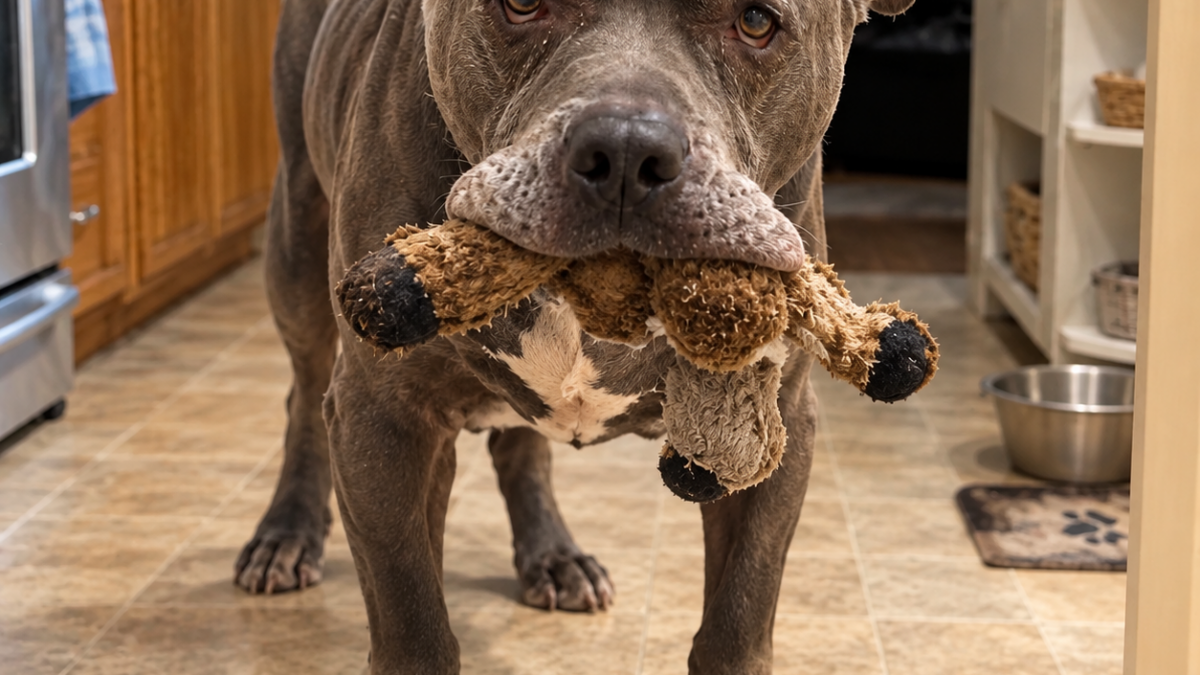
He carried stuffed toys carefully.
His favorite was a faded elephant Rachel had included with his supplies.
He never tore it.
Never shook it.
He carried it by one leg as if transporting something fragile.
The first time I threw a tennis ball for him, he stared at it.
The ball bounced.
Diesel looked at me.
Then at the ball.
Then back at me.
“That’s the game.”
Nothing.
“You chase it.”
Nothing.
I retrieved the ball.
“Clearly you’re a deep thinker.”
The elephant, however, mattered.
He brought it to the couch.
Placed it beside me.
Walked away.
I picked it up.
“Is this a gift?”
Diesel returned.
Took it.
Left again.
Apparently not.
By day ten, he followed me everywhere.
Kitchen.
Laundry room.
Bathroom.
Bedroom.
If I moved, Diesel moved.
If I closed the bathroom door, his nose appeared underneath.
“This is unhealthy.”
Sniff.
“Boundaries.”
Sniff.
I opened the door.
Diesel walked in and sat.
“You won.”
His tail wagged.
It became impossible not to talk to him.
I narrated cooking.
Complained about work.
Explained bills.
Asked whether I should respond to annoying emails.
Diesel was an excellent listener.
His solutions were terrible.
One afternoon, I came home later than usual.
Traffic.
A meeting that ran long.
By the time I reached the apartment, I was almost ninety minutes behind schedule.
Diesel was waiting behind the door.
When I opened it, he did not jump.
He did not bark.
He pressed his forehead into my chest.
Hard.
I crouched.
“Hey.”
His tail moved rapidly.
He kept his forehead against me.
I put both hands around his neck.
“I’m sorry.”
He breathed against my shirt.
That became his goodbye ritual.
Every morning before work, Diesel followed me to the door.
I knelt.
He pressed his head against my chest.
Three seconds.
Sometimes five.
Then stepped away.
I would say, “I’m coming back.”
At first, I said it for him.
Eventually, I realized I said it for myself.
On the twelfth day, I took him to the park.
Not the dog park.
I wasn’t ready for that.
Just a quiet public park with wide walking paths.
Diesel wore a harness.
The rescue had told me neck pressure sometimes made him panic, probably because of the chain.
The first ten minutes went well.
He smelled everything.
Grass.
Trees.
A bench.
A trash can.
Someone’s bicycle tire.
A leaf that apparently deserved extensive investigation.
Then a family approached.
Mother.
Father.
Little girl.
Maybe six years old.
The girl wore a red coat and blue mittens.
One mitten slipped from her hand near us.
Diesel saw it.
So did the mother.
Her entire body changed.
She grabbed her daughter.
“Stay back.”
Diesel froze.
I shortened the leash slightly.
Not because he had done anything.
Instinct.
The old reflex.
The mother looked at me.
“Can you hold your dog?”
The words hit harder than they should have.
“I have him.”
Diesel looked at the mitten.
Then at the girl.
Then he picked it up.
The mother pulled her daughter farther behind her.
“Diesel.”
He turned toward me.
The blue mitten hung gently from his mouth.
I expected him to drop it.
Instead, he walked toward the family.
The mother looked ready to retreat.
“He’s bringing it back,” I said.
Diesel stopped several feet away.
Tail moving.
The little girl peeked around her mother.
“That’s mine.”
Diesel lowered his head.
Dropped the mitten on the path.
Then looked up.
The girl smiled.
The mother didn’t move for a second.
Then she slowly reached down and picked it up.
“Thank you.”
I don’t know whether she was speaking to me or Diesel.
Probably both.
Diesel wagged harder.
The father laughed.
“Well, that was unexpected.”
I smiled.
“Not really.”
I said it before thinking.
The mother looked embarrassed.
“I’m sorry. I just saw…”
She stopped.
“You saw a pit bull.”
She nodded.
I understood.
Because two weeks earlier, I had seen the same thing.
Breed first.
Dog second.
“No harm done,” I said.
The little girl waved.
“Bye, Diesel.”
Diesel watched her go.
I stood there for a moment after the family disappeared down the path.
I felt something shift in me.
It wasn’t just affection.
It was guilt.
I had expected danger from Diesel before he ever gave me a reason.
I had accepted stories as evidence.
Warnings as personality.
Other people’s fear as fact.
And now I was watching strangers do the same thing.
It felt different from the inside.
That evening, Rachel called.
“How’s my foster?”
“Your foster?”
“Yes.”
“He returned a child’s mitten.”
“Of course he did.”
“You’re not surprised?”
“Not remotely.”
I sat on the couch.
Diesel was beside me.
His head rested near my leg.
“I was.”
Rachel was quiet.
Then she said, “That’s okay.”
“No, it isn’t.”
“Yes, it is.”
“I judged him.”
“You changed your mind.”
“Because I got to know him.”
“That is usually how it works.”
I ran my hand along Diesel’s shoulder.
“I keep thinking about how many people never get that far.”
Rachel sighed.
“That’s the hard part with dogs who look like him.”
I looked at Diesel.
His eyes were closing.
“People make a decision before the dog gets a chance.”
“Sometimes.”
“That’s unfair.”
“Yes.”
Something protective rose in me.
Not the dramatic kind.
Something quieter.
Diesel had spent enough time being interpreted by people who didn’t know him.
I wanted him to have a chance to exist without defending himself.
By day fourteen, I had stopped checking the calendar.
That should have warned me.
Rachel did not call.
That should have warned me too.
The rescue agreement sat in a folder on my kitchen counter.
I noticed it one evening while paying bills.
FOSTER TERM: TWO TO THREE WEEKS.
I stared at the words.
Diesel walked over.
Placed his chin on my knee.
“Don’t.”
Tail wag.
“This is manipulative.”
He sighed.
“You’re supposed to leave.”
No reaction.
“I’m supposed to help you become somebody else’s problem.”
Diesel climbed onto the couch.
Turned around twice.
Lay down.
His back pressed against my thigh.
I looked at the foster agreement again.
Then at him.
I folded the paper.
Put it back in the folder.
The call came the next afternoon.
Rachel sounded cheerful.
Too cheerful.
“Good news.”
I was at work.
My stomach tightened before she said anything else.
“What?”
“We have an adopter for Diesel.”
I stopped typing.
“Oh.”
“Great application. Owns their home. Fenced yard. Previous pit bull experience. Vet references check out.”
I stared at the computer screen.
“That’s good.”
“It is.”
“Yeah.”
“They’d like to meet him Sunday.”
Sunday.
Four days away.
“Okay.”
Rachel became quiet.
“You okay?”
“Why wouldn’t I be?”
“You sound like someone told you your car was stolen.”
“I’m working.”
“Right.”
“I’ll call you later.”
I hung up.
For several minutes, I didn’t move.
Melissa noticed.
“What happened?”
“They found Diesel a home.”
She smiled.
“That’s great.”
“Yeah.”
“Isn’t it?”
“Yes.”
I forced myself to smile.
“That’s the whole point.”
And it was.
Foster.
Heal.
Place.
Repeat.
Responsible rescuers knew that.
Foster homes were limited.
Every dog adopted created room for another.
I understood all of it.
The problem was that none of those facts changed the feeling in my stomach.
That evening, Diesel greeted me at the door.
Forehead to chest.
I held him longer.
“You got adopted.”
His tail moved.
“Congratulations.”
He licked my chin.
“You have a yard.”
More tail.
“Experienced people.”
He sat.
“You’re going to be fine.”
I said it repeatedly that week.
You’re going to be fine.
Maybe I was trying to convince myself.
Friday night, I washed his blanket.
Saturday, I organized his medication.
I wrote down his feeding schedule.
The exact amount.
His fear of thunderstorms.
The fact that cabinet doors slamming made him flinch.
The way he sometimes froze at narrow doorways.
His favorite treats.
The stuffed elephant.
His morning routine.
His forehead hug.
I stopped when I wrote that one.
The adopter didn’t need to know that.
That belonged to us.
I crossed it out.
Then stared at the line.
Finally, I wrote it again.
Every morning before you leave, kneel near him. He may press his forehead against your chest. Let him.
I put the paper away.
Saturday night, Diesel slept on the couch beside me.
I watched a movie I didn’t follow.
He snored.
Loudly.
Halfway through the movie, his paw landed on my leg.
I looked down.
“This is rude.”
Snore.
“You’re taking up seventy percent of the couch.”
Snore.
“I pay rent.”
No response.
I rested my hand on his paw.
Sunday morning came too fast.
I packed everything.
Leash.
Harness.
Medication.
Vet records.
Food.
Blanket.
Elephant.
A tennis ball he still didn’t understand.
Three toys.
The dog bed.
Rachel called.
“They’re on the way.”
“How long?”
“Twenty minutes.”
“Okay.”
“You sure?”
“Stop asking.”
“I have to ask.”
“No, you don’t.”
“Are you keeping him?”
“No.”
The word came out immediately.
Too immediately.
Rachel was silent.
“You hesitated?”
“I literally did not.”
“Fine.”
“This is what fostering is.”
“I know.”
“I agreed to two weeks.”
“I know.”
“It’s been almost three.”
“I know.”
“He needs a permanent home.”
“I know.”
“Stop saying you know.”
She laughed.
“I’ll talk to you later.”
I hung up.
Diesel was sitting in the hallway.
The bags were by the front door.
His blanket was rolled.
His elephant rested on top.
Diesel looked at them.
Then at me.
His posture changed.
Subtle.
Head lower.
Tail still.
“Hey.”
I walked toward him.
He stepped backward.
“Diesel.”
Another step back.
My stomach tightened.
He knew something.
Maybe not the details.
But he recognized packed belongings.
Disruption.
Things leaving.
I crouched.
“You’re okay.”
Diesel remained frozen.
Then the doorbell rang.
His entire body jerked.
Once.
Then again.
He moved behind me.
Not barking.
Not growling.
He pressed himself against the backs of my legs.
The trembling started.
Hard.
I could feel it through my jeans.
I looked down.
“Hey.”
Diesel pushed closer.
The doorbell rang again.
I reached for the knob.
Diesel tried to wedge himself between me and the wall.
That was when something inside me cracked.
Not because I thought the adopters were bad.
They weren’t.
Not because I thought Diesel could never trust anyone else.
He could.
Given time.
Given patience.
Given all the things I had given him.
But he was standing behind me trembling like he believed the world was taking him away again.
And for the first time, I understood that the question was not whether someone else could love Diesel.
Of course they could.
The question was whether I already did.
I opened the door.
A couple stood there.
Mark and Susan.
Mid-forties.
Friendly faces.
Susan carried a new leash.
Mark held a bag of treats.
“Hi,” Susan said brightly. “You must be Diesel’s foster.”
I looked down.
Diesel was almost completely behind me.
“Yeah.”
“We’re so excited.”
“I know.”
Mark smiled.
“We’ve had pits before. Our last girl made it to thirteen.”
That should have reassured me.
It did.
Which somehow made everything worse.
They were good people.
Exactly what Diesel deserved.
Susan crouched.
“Hi, Diesel.”
Diesel retreated another inch.
She stopped immediately.
Good.
She knew dogs.
“Take your time,” she said gently.
I liked her.
I hated that too.
Mark looked at me.
“Rachel told us he’s shy.”
“He is.”
“We’re patient.”
“I know.”
“We have a quiet house.”
“That’s good.”
“And a fenced yard.”
“Good.”
Susan smiled.
“We’ve been looking forward to meeting him all week.”
I nodded.
Then Diesel pressed his forehead into the back of my leg.
The same way he pressed it into my chest every morning.
Except now there was no calm ritual.
He was shaking.
I looked at the packed blanket.
The elephant.
The leash.
Then at the couple.
“I’m sorry.”
Susan stood.
“What?”
The words came before I could edit them.
“He’s not available anymore.”
Silence.
Mark looked confused.
Susan looked from me to Diesel.
“I don’t understand.”
I swallowed.
“I was supposed to foster him.”
“Yes.”
“Temporary.”
“Yes.”
I looked down.
Diesel’s face was turned upward.
Those eyes.
The same eyes I had seen from the back of the kennel.
Only different now.
Because he knew me.
And I knew him.
“I can’t send him away.”
Susan’s expression softened.
I continued.
“He’s already home.”
There it was.
Out loud.
Home.
Susan looked at Diesel.
Then at me.
For a second, I expected anger.
They had driven all this way.
Prepared.
Hoped.
Instead, she smiled.
A little sadly.
“Oh.”
Mark exhaled.
“You’re a foster fail.”
I laughed.
A shaky, embarrassing laugh.
“I guess.”
Susan crouched again but kept her distance from Diesel.
“Lucky dog.”
My eyes burned.
“I’m really sorry.”
She shook her head.
“Don’t be.”
“You were expecting to take him.”
“We were.”
“I feel terrible.”
Mark shrugged.
“We want a dog who needs us.”
He smiled toward Diesel.
“Looks like this one already found his person.”
That sentence finished me.
I covered my face for a second.
Susan laughed softly.
“Don’t cry. You’re making me cry.”
Diesel peeked from behind my leg.
Susan looked at him.
“Take care of your human, okay?”
His tail moved.
One cautious wag.
They stayed another few minutes.
Rachel called while they were still in the parking lot.
“You did it.”
I leaned against the closed door.
“How do you know?”
“Susan called.”
“That was fast.”
“She said congratulations.”
“I feel terrible.”
“You shouldn’t.”
“They were good people.”
“I know.”
“They would’ve given him a great home.”
“I know.”
“You are unbearable.”
Rachel laughed.
“So?”
“So what?”
“Are you adopting him officially?”
I looked at Diesel.
He was standing near the bags.
His tail was beginning to move again.
“Apparently.”
“Apparently?”
“Yes.”
“Say it.”
“I’m adopting Diesel.”
Louder tail.
Rachel laughed.
“I knew it.”
“Do not say that.”
“I knew it on day four.”
“You’re lying.”
“You sent me a photograph of his first tail wag.”
“That was documentation.”
“You bought him a seventy-dollar bed.”
“Which he ignored.”
“You called me because he slept outside your bedroom door.”
“That was behavioral progress.”
“You asked me what brand of orthopedic bed was best.”
“He has pressure sores.”
“You began saying ‘we’ instead of ‘he.’”
I stopped.
“When?”
“Days ago.”
I looked at Diesel.
He walked toward me.
Slowly.
Then placed his head against my chest.
I wrapped both arms around him.
Rachel was still talking.
I barely heard her.
For the first time since the doorbell rang, Diesel stopped shaking.
That afternoon, I unpacked everything.
Blanket back on the bed.
Food back in the kitchen.
Medication back in the cabinet.
Elephant back on the couch.
Diesel watched the entire process.
When I put the empty bag away, he climbed onto his dog bed.
Turned around.
Lay down.
Then sighed.
A deep, full-body sigh.
I sat beside him.
“You knew, didn’t you?”
His eyes closed.
“You knew those bags meant something.”
I rubbed his chest.
“They aren’t going anywhere.”
Tail tap.
“Neither are you.”
Another tap.
That was the day Diesel officially became mine.
Or I became his.
Depending on whom you ask.
The following months taught me that adoption was not the ending.
It was the beginning of another kind of work.
Diesel trusted me.
That did not mean he trusted the world.
The first real problem came with my landlord.
Someone in the building had complained.
I received an email stating that another tenant had reported an “aggressive large dog” in the hallway.
I stared at the words.
Aggressive.
I knew exactly which incident they meant.
Two days earlier, Diesel and I had been waiting for the elevator when an older man stepped out unexpectedly.
Diesel startled.
Backed away.
And hid behind me.
That was the entire event.
No bark.
No growl.
No lunge.
But someone had seen a large pit bull react.
And “frightened” became “aggressive.”
I called management.
The property manager, Mr. Jenkins, sounded uncomfortable.
“We’re just following up on a complaint.”
“What behavior was described?”
“A tenant felt unsafe.”
“That isn’t behavior.”
Pause.
“They said the dog appeared threatening.”
“How?”
Another pause.
“I wasn’t there.”
“Exactly.”
He sighed.
“I need proof of vaccination and licensing.”
“You’ll have it today.”
“And confirmation from the rescue that the dog has no known bite history.”
“You’ll have that too.”
“We may need an evaluation.”
“Fine.”
I hung up furious.
Diesel was sitting by the window.
I looked at him.
“You have an appointment.”
Tail wag.
“With a professional who gets to decide whether you’re terrifying.”
More tail.
I wanted revenge then.
Not the kind that hurt anyone.
The kind where I could make everyone who had judged Diesel feel stupid.
I wanted to walk him into that evaluation and have the behaviorist laugh.
Instead, I learned something harder.
You don’t help a fearful dog by turning his life into an argument.
Diesel didn’t need to perform goodness for strangers.
He needed support.
The behaviorist was named Dr. Hannah Reed.
She came to the apartment rather than making Diesel enter a clinic.
I liked her immediately.
She ignored Diesel when she arrived.
No direct eye contact.
No reaching.
No baby voice.
She sat at my kitchen table.
Diesel watched from the hallway.
“Tell me what you’re worried about,” she said.
“The building thinks he’s dangerous.”
“That wasn’t my question.”
I stopped.
“I’m worried people will misunderstand him.”
“Good.”
“Good?”
“That’s honest.”
She took notes.
“Now tell me what he does when he’s afraid.”
“Freezes. Retreats. Sometimes shakes.”
“Growling?”
“No.”
“Snapping?”
“No.”
“Biting?”
“No.”
“Resource guarding?”
“No.”
“Handling sensitivity?”
“Some around his collar. Harness is better.”
She nodded.
“Noise sensitivity?”
“Very.”
“Strangers?”
“Cautious.”
“Children?”
“Limited exposure. He returned a mitten to one.”
She looked up.
“A mitten?”
I told her.
She smiled.
After almost an hour, Diesel approached.
Not her.
The table.
Then her shoe.
Dr. Reed continued talking to me as though nothing happened.
Diesel smelled her.
Walked away.
Ten minutes later, he returned.
This time, he stood beside her chair.
She placed one treat on the floor.
Did not hand it to him.
Diesel ate it.
Then retreated.
“Good,” she said.
“What do you think?”
“I think you have a fearful dog with a history of trauma.”
“Not aggressive?”
“I didn’t say he is incapable of aggression. Every dog is.”
That answer irritated me.
She noticed.
“You want me to certify him as incapable of doing harm.”
“Would be useful.”
“Would be dishonest.”
I leaned back.
“So what can you certify?”
“That based on what I have observed and what records show, he does not display abnormal aggressive behavior. His responses are predominantly avoidant and fearful.”
That was enough.
She continued.
“And I think you should stop treating every fear response as proof he’s gentle.”
I frowned.
“What?”
“He is gentle.”
“I agree.”
“Then what do you mean?”
“His fear is not evidence of goodness. His choices are.”
I stayed quiet.
“He returns to you. He uses distance instead of escalation. He accepts handling. He recovers after stress. He seeks social contact. Those things matter.”
Dr. Reed looked toward Diesel.
“But he’s allowed to dislike people too.”
I laughed.
“What?”
“He doesn’t owe every stranger affection just because his breed has a reputation.”
That sentence changed the way I handled him.
Until then, part of me had unconsciously wanted Diesel to be perfect.
Perfectly calm.
Perfectly friendly.
Perfectly forgiving.
Because every mistake felt like it would confirm someone else’s prejudice.
Dr. Reed released me from that.
Diesel could bark.
Diesel could be afraid.
Diesel could walk away.
Diesel could dislike someone.
He did not have to become a public relations campaign for pit bulls.
He only had to become himself.
Management accepted the evaluation.
The complaint disappeared.
But I didn’t forget it.
Neither did I forget how quickly “scared dog” had become “aggressive dog” once breed entered the story.
From then on, I documented everything.
Training.
Vet visits.
Behavior evaluations.
Not because Diesel needed a defense file.
Because sometimes people only believe gentleness after paperwork gives them permission.
Three months after adoption, Diesel learned fetch.
It happened by accident.
I was carrying laundry.
A sock fell.
Diesel grabbed it.
“Drop it.”
He ran.
“Diesel.”
He ran faster.
I followed.
He stopped in the living room.
I reached.
He dodged.
His tail was wagging violently.
“Oh.”
I realized.
This was play.
I found a ball.
Threw it.
Diesel stared.
We were back to our old problem.
I picked up the ball.
Threw it a shorter distance.
He watched.
“Come on.”
I tossed the sock instead.
Diesel ran.
Got it.
Returned.
I traded for a treat.
We repeated.
By the end of the week, I transitioned from socks to a soft ball.
He understood.
Throw.
Run.
Retrieve.
Return.
Treat.
Soon he stopped needing the treat.
The game itself became enough.
Every morning before work, Diesel brought me the ball while I drank coffee.
I threw it down the hallway.
He ran.
He returned.
Again.
Again.
Again.
The first time he barked at me because I stopped, I nearly applauded.
“Did you just complain?”
Bark.
“You are aware I rescued you from emotional shutdown?”
Bark.
“This is extremely disrespectful.”
Tail wag.
I threw the ball.
Diesel ran.
One Saturday, Melissa visited.
She had never met him.
Before arriving, she texted:
Is he okay with visitors?
The question was reasonable.
Still, I could hear old assumptions behind it.
I replied:
He’s shy. Ignore him at first.
When she entered, Diesel stood behind the couch.
Melissa stopped.
“He’s bigger than I expected.”
“He hears you.”
“I know.”
She put her bag down.
Diesel watched.
Ten minutes passed.
Then twenty.
We drank coffee.
Talked about work.
Diesel crept closer.
Melissa pretended not to notice.
Good.
Finally, he smelled her hand.
She remained still.
He smelled her shoe.
Then walked away.
“He doesn’t hate me?”
“No.”
“How do you know?”
“He didn’t take your purse.”
She laughed.
Half an hour later, Diesel approached again.
This time he leaned against her knee.
Melissa froze.
“Oh.”
“Congratulations.”
“What do I do?”
“Nothing.”
“He’s leaning.”
“Yes.”
“Is this good?”
“Very.”
She slowly placed one hand on his shoulder.
Diesel stayed.
Her expression changed.
“He’s so soft.”
I laughed.
“What did you expect?”
“I don’t know.”
“Armor?”
She looked embarrassed.
“A little.”
Diesel sat beside her.
Then placed his head in her lap.
Melissa’s eyes filled.
“No.”
“What?”
“Now I feel awful.”
“Why?”
“I was scared before I came.”
“So was I before I met him.”
She looked down at Diesel.
“I feel stupid.”
“Good.”
She laughed.
“Thanks.”
“I mean it kindly.”
“No, you don’t.”
“Mostly.”
Diesel sighed.
Melissa rubbed behind his ears.
“This is the dangerous dog?”
“He is dangerous around unattended chicken.”
That became the pattern.
One person at a time.
A neighbor who had crossed the hallway to avoid him eventually started carrying treats.
The delivery driver who once dropped a package from ten feet away learned Diesel liked standing behind me when the door opened.
A maintenance worker who asked, “Is he secure?” before entering ended up sitting on the kitchen floor scratching Diesel’s chest.
Not everyone changed.
Some people still crossed the street.
Some pulled dogs away.
Some stared.
One man once said, “You should muzzle those things.”
Diesel was sitting beside me at the time.
Not moving.
I wanted to argue.
I wanted to deliver every fact I knew.
Instead I said, “We’re giving you plenty of space.”
Then walked away.
That became another lesson.
Not every person deserved access to Diesel’s story.
Not every assumption needed correction.
His life could not become one endless courtroom where he had to prove innocence.
Sometimes the strongest answer was leaving.
A year passed.
Then two.
Diesel changed physically too.
His weight settled into a healthy range.
The sores healed.
His coat became glossy.
The folded ear remained.
I loved that ear.
One winter morning, I woke with a migraine.
A bad one.
Light hurt.
Sound hurt.
I called in sick.
Closed the curtains.
Lay in bed.
Diesel knew something was wrong.
Normally, he brought the ball.
That morning, he didn’t.
He climbed onto the bed carefully.
He had never been invited onto the bed before.
I was too sick to stop him.
Diesel circled once.
Then lay beside me.
Placed his head across my chest.
I rested one hand on his neck.
For five hours, he barely moved.
No demands.
No ball.
No pacing.
Just breathing.
When I woke in the afternoon, his head was still there.
“You stayed.”
Tail tap.
It took me back to the closet.
The dog who once needed to see me to feel safe had learned how to become safety for someone else.
That realization hit harder than any dramatic rescue moment.
A few months later, something happened in the courtyard.
A baby bird had fallen from a nest.
I found Diesel standing over it.
Not touching.
Just staring.
The bird fluttered.
Diesel whimpered.
Actually whimpered.
I approached carefully.
“Leave it.”
He backed away.
The bird was alive.
I called a wildlife rehabilitator.
While we waited, Diesel paced at the patio door.
Every time the bird moved, he whined.
I laughed.
“You survived being tied to a pole and this is emotionally overwhelming?”
Whine.
“Yes. Tragic.”
The rehabilitator took the bird.
Diesel watched from the window.
For the rest of the evening, he checked the courtyard repeatedly.
That story became my favorite answer when people described him as intimidating.
Not because it proved all pit bulls were harmless.
It proved Diesel was Diesel.
A seventy-pound dog traumatized by thunderstorms, devoted to stuffed elephants, upset by injured birds, suspicious of unfamiliar doorways, and capable of making my entire couch unusable.
Breed did not disappear.
It simply stopped being the most interesting thing about him.
By the third year, Diesel slept inside my bedroom.
Not on the bed.
Usually.
His dog bed sat near the door.
Every night, he turned three circles and lay down facing the hallway.
The old habit remained.
He still liked to know where I was.
Sometimes I woke and found him watching.
“You checking?”
Tail tap.
“I’m still here.”
Eyes close.
One night, a thunderstorm rolled through.
I expected the old panic.
Diesel came into the bathroom where I was brushing my teeth.
Thunder.
He flinched.
Then leaned against my leg.
No shaking.
No attempt to climb into my lap.
Just contact.
I put my hand on his shoulder.
“You’re getting brave.”
Another thunderclap.
He looked toward the window.
Then at me.
Tail wag.
Not fearless.
Braver.
There is a difference.
People talk about healing as though fear disappears.
It often doesn’t.
Sometimes healing means fear arrives and no longer controls everything that happens next.
Diesel taught me that.
In the fourth year, we moved.
That was the hardest transition since adoption.
The apartment had become his map of safety.
Closet.
Hallway.
Couch.
Bedroom door.
Courtyard.
Every corner carried familiarity.
The new place was larger.
Better.
A small fenced patio.
More sunlight.
But Diesel didn’t know that.
On moving day, boxes appeared.
The moment he saw them, he froze.
I understood immediately.
The bags from adoption day.
The packed blanket.
The fear of being sent away.
I knelt.
“Not this time.”
Diesel trembled.
“You’re coming.”
I clipped on his harness.
He followed me reluctantly.
At the new place, he entered and immediately searched every room.
Bedroom first.
Then closet.
He walked inside.
Smelled the floor.
Turned around.
Looked at me.
I smiled.
“You can have that one too.”
Diesel walked back out.
That surprised me.
He didn’t hide.
Instead, he followed me to the living room.
I placed his old bed near the bedroom.
His blanket.
Elephant.
Ball.
Diesel smelled each item.
Then lay down.
Same bed.
Different house.
I sat beside him.
“See?”
Tail tap.
“We move together.”
That sentence became one of the promises I was most proud to keep.
Years earlier, someone had tied him to a pole and disappeared.
Now every transition included him.
Every plan considered him.
Every home had space for him.
When I traveled, he stayed with people he knew.
When fireworks season came, I prepared the quiet room.
When his joints began getting stiff, I bought rugs.
When he developed allergies, I changed food.
When thunder came, I stayed close.
Ordinary care.
That was the best revenge against abandonment.
Not punishment.
Consistency.
The person who left Diesel behind had taught him people disappear.
For years afterward, I got to prove the opposite.
Morning after morning.
Night after night.
“I’m coming back.”
And then I did.
By the fifth year, gray appeared around Diesel’s muzzle.
Very little.
Just enough to offend me.
“You are not allowed to age.”
He yawned.
“I mean it.”
He scratched his ear.
“We have an agreement.”
No concern.
His vet laughed during his annual exam.
“He’s considered senior now.”
“Take that back.”
“I’m afraid biology—”
“Take it back.”
Diesel leaned into the veterinarian for treats.
Traitor.
His bloodwork looked good.
Heart good.
Lungs good.
Mild arthritis beginning.
We added joint support.
Reduced high-impact exercise.
Bought an orthopedic bed.
This time, he used it immediately.
I stared.
“Six years ago, I spent seventy dollars for nothing.”
Diesel turned around and slept.
“Now you appreciate quality.”
He snored.
Somewhere around that time, Rachel found the old foster record.
She sent me a photograph.
Diesel — emergency foster requested. Estimated stay: 14–21 days.
I laughed for five minutes.
Then looked at Diesel asleep on the couch.
Six years.
The dog who had been given two weeks had taken over my entire life.
My furniture.
My schedule.
My camera roll.
My vacation planning.
My budget.
My heart.
And somehow, I was grateful.
One afternoon, Rachel came to visit.
Diesel recognized her immediately.
Tail wagging.
She sat on the floor.
He pressed his head into her shoulder.
“You remember me?”
“He remembers chicken.”
She laughed.
“Still has the elephant?”
I pointed.
The original elephant had died years earlier.
This was Elephant Number Four.
Identical replacement.
Diesel carried it over.
Rachel smiled.
“I remember when you said you didn’t picture yourself owning a pit bull.”
“I still don’t.”
She looked at me.
I pointed at Diesel.
“I own Diesel.”
That distinction mattered to me.
Not because breed was meaningless.
Breed traits can matter.
Strength matters.
Energy matters.
Training matters.
Individual history matters.
But I had gone from seeing Diesel as a category to seeing him as a person-shaped collection of habits, fears, preferences, and ridiculous behaviors.
That was what I had been missing in the beginning.
One evening, during our usual walk, a woman crossed the street when she saw us.
Diesel didn’t notice.
He was too busy smelling a mailbox.
I noticed.
Once, that would have made me angry.
Now I mostly felt tired.
A block later, a boy walking with his father pointed.
“Can I pet your dog?”
The father hesitated.
I looked at Diesel.
Diesel looked at me.
His body was relaxed.
I asked the boy, “Can you stand sideways and let him come to you?”
The boy nodded.
He did exactly what I asked.
Diesel approached.
Smelled his shoe.
Then his hand.
Tail wag.
The boy smiled.
“He’s nice.”
I smiled too.
“He is.”
The father relaxed.
“What’s his name?”
“Diesel.”
“That’s a tough name.”
I laughed.
“He isn’t.”
The boy scratched Diesel’s chest.
Diesel leaned in.
For a second, I remembered the park.
The dropped mitten.
The mother pulling her daughter away.
Years later, here was another child.
Another parent.
But this time the story began with curiosity instead of fear.
That felt like enough progress for one evening.
Diesel never became a perfect dog.
Thank God.
He barked at the vacuum cleaner.
Stole food once.
Destroyed an entire bag of flour when I forgot to close the pantry.
Had an irrational hatred of one specific delivery truck.
Refused to walk across a metal grate.
Farted like a chemical weapon.
Snored loudly enough to wake me.
Dragged mud across clean floors.
Once ate half a birthday cake when I left the room for four minutes.
I called Rachel afterward.
“He ate chocolate frosting.”
“How much?”
“Not enough to be funny.”
We ended up at the emergency vet.
He was fine.
My cake was not.
When people asked whether rescuing Diesel had “saved” him, I never knew how to answer.
Yes.
But not the way people imagine.
I did not take a dangerous dog and turn him gentle.
He was already gentle.
I did not teach him loyalty.
He had loyalty in him before I deserved it.
I did not remove every fear.
Some stayed.
What I gave him was time.
Predictability.
Food.
Medical care.
A safe place.
Permission to make choices.
And eventually, permanence.
What he gave me was much harder to summarize.
He embarrassed every lazy assumption I had accepted.
He forced me to examine the difference between caution and prejudice.
He taught me that physical strength and emotional softness can exist in the same body.
That fear is not aggression.
That trust does not arrive all at once.
That a dog lying outside your bedroom door can change your life without making a sound.
The most emotional moment happened on his sixth adoption anniversary.
Rachel came over with a small cake for humans and dog-safe treats for Diesel.
“You celebrate this every year?” she asked.
“Obviously.”
“You swore he was temporary.”
“People grow.”
“You threatened me when I suggested you might keep him.”
“Misremembering.”
“I have text messages.”
“Delete them.”
Diesel sat between us.
Gray muzzle slightly brighter now.
Elephant Number Four beside him.
Rachel scratched his head.
“You know what’s funny?”
“What?”
“The couple who wanted to adopt him.”
I stopped.
Mark and Susan.
I hadn’t thought about them in years.
“What about them?”
“They adopted another dog from us two weeks later.”
“Really?”
“Yes.”
“Pit bull?”
“Yep.”
I smiled.
“How did I never know that?”
“You were busy becoming insufferable.”
“Are they okay?”
“They’re great. Dog’s still with them.”
Something relaxed inside me.
For years, a tiny piece of guilt had remained.
I had taken away their chance to adopt Diesel.
Now I understood that I hadn’t cost another dog a home.
They had simply opened their door to someone else.
Rachel pulled out her phone.
“Want to see?”
She showed me a photograph.
Mark and Susan on a couch.
Between them sat a brindle pit bull with one white paw.
“He looks happy.”
“He is.”
I looked at Diesel.
He was watching me.
“You hear that?”
Tail wag.
“Everybody landed where they were supposed to.”
Rachel smiled.
“That’s a dangerous sentence for someone who pretends not to be sentimental.”
I ignored her.
Later that evening, after she left, Diesel climbed onto the couch.
He had slowed down.
The jump required more thought than before.
I moved a cushion.
“Come on.”
He climbed.
Turned.
Then collapsed across half the couch.
Exactly as he had done for years.
I sat beside him with popcorn.
Diesel opened one eye.
“No.”
He stared.
“You have your treats.”
Stare.
“Veterinarian says you’re overweight.”
Stare.
“Emotional manipulation will not work.”
His paw moved onto my leg.
I gave him one piece without salt or butter.
“You are corrupt.”
He chewed.
Then rested his head against my side.
Six years.
I thought about the back kennel.
The rattling tags.
The way he flinched when a door slammed.
The closet.
The first night outside my bedroom.
The chicken.
The first tail wag.
The park.
The mitten.
The adoption bags.
The doorbell.
The trembling body pressed against my legs.
“I’m sorry. He’s not available anymore.”
“He’s already home.”
That sentence turned out to be true in more ways than I understood.
Home was not simply my apartment.
Home became routine.
Home became a promise.
Home was the place where a thunderstorm could frighten him without anyone getting angry.
Where he could leave food unfinished.
Where he could walk away from strangers.
Where his bed stayed in the same place.
Where his elephant waited.
Where someone noticed when his joints hurt.
Where he did not have to perform gratitude.
Where he did not have to prove he deserved to stay.
I think that last part mattered most.
Dogs who have been abandoned sometimes live as if love is conditional.
One mistake.
One bad day.
One frightened reaction.
And perhaps everything disappears again.
Diesel spent years learning otherwise.
He barked.
Stayed.
He got sick.
Stayed.
He destroyed flour.
Stayed.
He became old.
Stayed.
He needed more.
Stayed.
That was my favorite kind of revenge.
Someone had tied him behind a tire shop as though he were disposable.
Years later, he had become the least disposable thing in my life.
Someone had left him in heat with no shade.
Now I checked pavement temperature with my hand before summer walks.
Someone had let his elbows develop sores on concrete.
Now I owned three orthopedic dog beds because he preferred sleeping in whatever room I occupied.
Someone had taught him that chains meant abandonment.
Now the sound of his leash meant a walk home.
Every ordinary kindness answered something ugly from his past.
Not by erasing it.
By making it smaller.
Six years after Diesel arrived, people still misunderstood him.
A woman once pulled her small dog behind her as we passed.
A man told me, “Those dogs turn.”
Someone at a café asked whether he was “safe.”
I stopped arguing with all of them.
Not because prejudice stopped mattering.
Because Diesel deserved a life bigger than constantly proving strangers wrong.
He did not exist to educate everyone.
Sometimes he was simply allowed to be a dog.
Sniff a tree.
Sleep in sunlight.
Demand chicken.
Carry Elephant Number Four.
Snore.
Be loved.
That was enough.
One evening, we were walking home when rain started unexpectedly.
Diesel hated rain.
Always had.
He looked up at me.
Then toward home.
“You want to run?”
His ears lifted.
I started jogging.
Diesel ran beside me.
Not fast.
Age had slowed him.
But his tail lifted.
His paws splashed through puddles.
We reached the building.
I opened the door.
Diesel hurried inside.
Then turned.
Waited.
He always waited for me now.
Years earlier, he had been afraid I would disappear.
Now he seemed to believe I might need supervision.
“Go.”
He stayed.
“I’m coming.”
Tail wag.
I stepped inside.
Only then did he turn toward the apartment.
I laughed.
“You don’t trust me to find my own house?”
No concern.
At the door, Diesel waited while I unlocked it.
Then he entered.
Walked into the living room.
Stopped.
Looked back at me.
I suddenly remembered that first night.
He had walked past the dog bed.
Past the toys.
Past the blankets.
Straight into the closet.
That was where he believed safety lived.
A dark corner barely large enough for his body.
Now he stood in the middle of the living room as though every inch belonged to him.
Because it did.
The couch.
The rug.
The bedroom.
The kitchen.
The hallway.
The patio.
No hiding.
No permission needed.
I closed the door behind us.
Diesel shook rainwater everywhere.
“Absolutely not.”
More shaking.
“Diesel!”
He ran.
I chased him with a towel.
He dodged around the couch.
For a senior dog, his speed improved dramatically when being dried against his will.
“Come here.”
He grabbed the towel.
I froze.
He backed away.
Tail wagging.
Towel in mouth.
I laughed.
“You’re kidding.”
He pulled.
I tugged.
Diesel growled playfully.
The sound would have terrified me six years earlier.
Now I laughed harder.
“Give me that.”
He shook the towel.
We played tug for maybe thirty seconds.
Then he released it.
Sat.
Looked proud.
I rubbed his head.
“You know, someone once told me dogs like you were unpredictable.”
Diesel licked my wrist.
“They were right.”
His tail wagged.
“I never predicted any of this.”
That night, a thunderstorm rolled in.
Not a severe one.
Just distant rumbles.
Diesel climbed onto the couch beside me.
Thunder.
His ear twitched.
He looked at the window.
Then rested his head on my chest.
I placed one hand over him.
His heartbeat was slower now.
Older.
Steady.
“You’re okay.”
He sighed.
I thought about how many times I had said those words.
You’re okay.
At first, they were a promise I hoped would become true.
Eventually, they became fact.
No rusted pole.
No tire shop.
No chain.
No heatwave.
No shelter kennel.
No packed bags.
Just home.
Diesel closed his eyes.
I watched him sleep.
And I realized something I had never understood when I first agreed to foster.
People love to talk about rescuing animals as though humans are always the ones making the noble sacrifice.
We open the door.
We provide food.
We pay bills.
We heal wounds.
We save them.
That wasn’t how Diesel’s story felt to me.
I had given him a place to stay.
He had given me a completely different way to see the world.
Before Diesel, I believed caution was always objective.
It wasn’t.
Sometimes caution was inherited fear dressed up as common sense.
Before Diesel, I believed rescue success meant finding an animal a home.
Now I knew sometimes success meant recognizing when the animal had already found one.
Before Diesel, I thought strength looked loud.
Confident.
Fearless.
Diesel taught me strength could look like leaving a closet on the fourth night.
Sleeping outside a bedroom door.
Taking one step toward a stranger.
Returning a mitten.
Trusting again after someone had made trust look foolish.
That was courage.
Not never being afraid.
Choosing connection while afraid.
I spent years watching Diesel do that.
One morning, long after the two-week foster agreement had become a family joke, I woke and found Diesel lying outside my bedroom door again.
He had not done that in months.
His arthritis made the hardwood uncomfortable.
I sat up.
“Hey.”
His head lifted.
“Why are you out there?”
I walked over.
He stood slowly.
Then pressed his forehead into my chest.
The old ritual.
I closed my eyes.
For a few seconds, we were both younger.
Me, confused by how much I already cared.
Diesel, unsure whether I would return.
I wrapped my arms around him.
“I’m here.”
His tail moved.
I helped him back toward the orthopedic bed.
He settled.
I sat beside him.
“I told you two weeks.”
He looked at me.
“Maybe three.”
Tail tap.
“You completely ignored the agreement.”
Another tap.
“You took advantage of me emotionally.”
Eyes closing.
I smiled.
“Good.”
The story people sometimes tell about Diesel is that I saved an unwanted pit bull.
That version is too simple.
Yes, animal control saved him from the pole.
The rescue saved him from an overcrowded shelter.
Veterinary care helped heal his body.
I gave him somewhere quiet to recover.
Those things mattered.
But the part that changed both of us happened later.
The dog everybody expected me to fear showed me how fear itself can lie.
Not always.
Some dogs do need careful management.
Some dogs have behavior challenges.
Breed traits are real.
Training matters.
Strength matters.
Responsible ownership matters.
But fear without evidence had made Diesel guilty before anyone knew him.
And once I knew him, I couldn’t unknow him.
Not the pit bull.
Diesel.
The dog who cried during thunderstorms.
The dog who carried stuffed elephants like newborn puppies.
The dog who returned a child’s mitten.
The dog who slept beside me through migraines.
The dog who worried about a fallen bird.
The dog who had once hidden behind shoes because the closet felt safer than a human home.
The dog who later snored across half my couch like he owned the building.
Maybe that was the most satisfying part.
He stopped asking whether he was allowed to exist.
He stopped shrinking himself.
He stretched across furniture.
Blocked doorways.
Demanded walks.
Insisted on breakfast.
Barked when fetch ended too early.
Stole popcorn.
He became inconvenient.
And I loved every inconvenient inch of him.
Abandoned dogs are often described as grateful.
Diesel eventually became something better than grateful.
Secure.
Gratitude still contains debt.
Security means you believe love is yours without earning it every morning.
Diesel learned that.
Slowly.
Years later, if I worked late, he waited.
But he no longer panicked.
Because I always came home.
If I packed a suitcase, he watched.
But he no longer shook.
Because he had learned sometimes bags meant I left.
And then returned.
If someone rang the bell, he stayed near me.
But he no longer assumed every stranger had come to take him away.
Trust had become stronger than memory.
That was the victory.
And maybe that was the revenge too.
Not revenge against one person.
We never knew enough about who left him behind to build our lives around anger.
The revenge was what came after.
Someone tried to teach Diesel he was disposable.
He learned he was permanent.
Someone left him in the heat.
He learned air conditioning.
Someone denied him softness.
He collected blankets.
Someone tied him to a pole.
He spent years following me freely from room to room.
Someone walked away.
I stayed.
That was enough.
More than enough.
Today, Diesel is older.
His muzzle is silver.
His steps are slower.
The elephant has been replaced more times than I can count.
He sleeps harder.
Runs less.
Still hates thunder.
Still likes chicken.
Still believes the couch is legally his.
And people still occasionally cross the street.
I notice.
Diesel rarely does.
He has more important things to think about.
Interesting smells.
Dinner.
Whether I have treats.
Whether a squirrel has violated patio boundaries.
Whether it is time for his afternoon nap.
His world used to be narrow.
A pole.
A chain.
A strip of shade beside a dumpster.
Then a shelter kennel.
Then a closet.
Now his world is measured differently.
Every room in the house.
Every route we walk.
Every friend who knows his name.
Every blanket he has ruined.
Every morning he expects me to return.
That is what I see when I look at him.
Not a breed.
Not a warning.
Not a statistic.
Not somebody’s fear.
A life.
A very specific, stubborn, gentle life.
And I am grateful I almost said no.
Because sometimes I wonder what would have happened if I had.
Maybe someone else would have fostered him.
Maybe Mark and Susan would have adopted him.
Maybe he would have been okay.
I hope so.
But I also know what happened because I said yes.
Two weeks became six years.
A closet became a whole home.
Fear became trust.
A foster dog became family.
And the man who once insisted to a rescue coordinator that he was absolutely, definitely, under no circumstances adopting a pit bull now sleeps with a seventy-pound senior dog snoring beside his bed.
Sometimes I wake in the middle of the night and hear him breathing.
Slow.
Steady.
Safe.
I remember that first hallway night.
Diesel lying outside my bedroom door because getting any closer felt like too much.
Now he sleeps with one paw stretched across the threshold as though making sure I stay where I belong.
Maybe that is fair.
He spent the beginning of his life waiting for people to leave.
He has spent the rest making sure I don’t.
And every morning, when I stand up to go to work, Diesel still follows me to the door.
I kneel.
His forehead presses against my chest.
Older now.
Heavier.
Softer around the face.
I wrap my arms around him.
“Coming back.”
His tail moves.
Then he steps away.
No panic.
No trembling.
He believes me.
After everything that happened before we met, that trust still feels like the most valuable thing anyone has ever given me.
I once thought Diesel needed somebody brave enough to take in a pit bull.
I had that backward.
Diesel was the brave one.
He trusted a human again.
And six years later, I am still trying to deserve it.




