PART 2: HOA Security Gave Me 24 Hours to Tear Down My Family Ranch—Then I Found the Clause That Raised Their Rent 10X
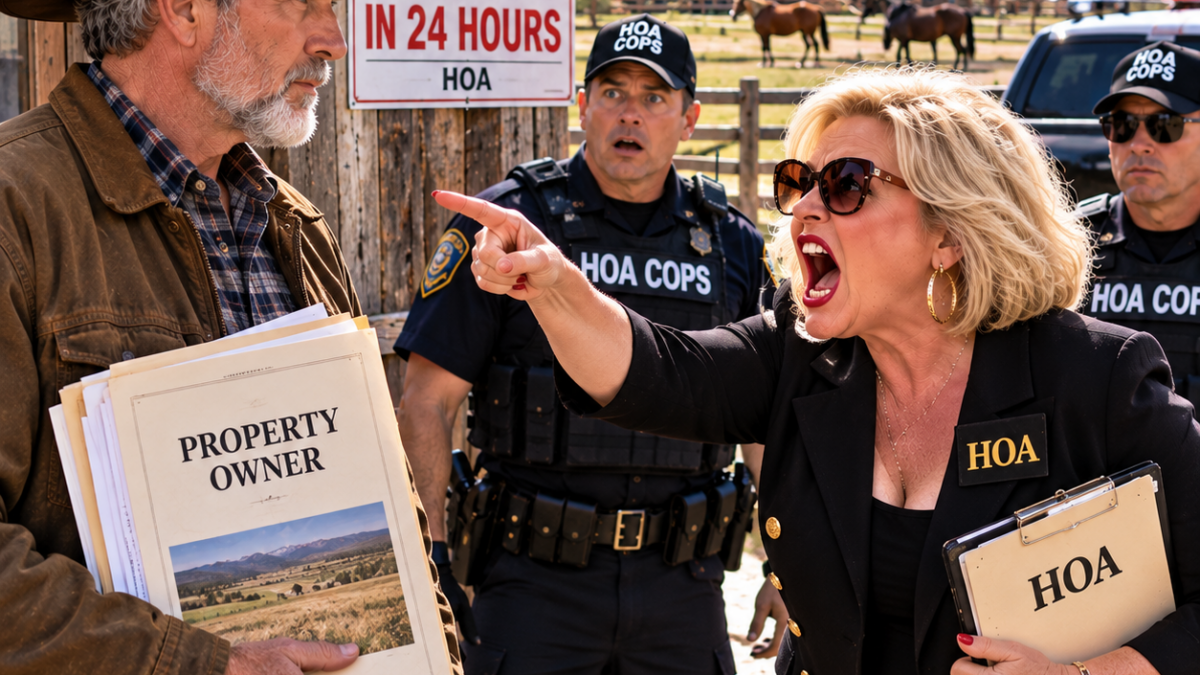
Two men in black uniforms showed up at my ranch before sunrise, handed me a demolition order, and told me I had twenty-four hours to tear down the barn, fences, and home my family had spent three generations building.
They expected an old rancher to panic when they mentioned enforcement, county officials, and people with enough influence to make my life difficult, but I had learned a long time ago that authority means very little when nobody can show you where it comes from.
I let them drive away believing they had frightened me, then I opened the fireproof cabinet my father had guarded for decades—and found a reason the woman behind those threats should have read her own neighborhood’s paperwork before coming after mine.
My name is Thomas Dawson.
I had lived on the Dawson ranch for fifty years.
My grandfather set the first fence post in 1947.
My father was born there.
I learned to walk in a farmhouse kitchen that still had uneven floorboards from when Grandpa built it himself.
Three generations of our family had watched the same sunrise come over those pastures.
Fifteen years earlier, my father made the only major land sale in our family history.
A developer wanted three hundred acres along our eastern boundary for a residential subdivision.
Dad agreed.
But he did not sell everything.
He kept the original eighty-acre homestead.
The barn.
The wells.
The cattle ground.
The water rights.
Certain access rights.
And several parcels around the new development that he said were “too useful to give away just because somebody showed up with a checkbook.”
The subdivision became Ridgewood Estates.
Four hundred houses eventually appeared where pasture used to stretch toward the county road.
At first, we coexisted.
Then the complaints started.
Cattle odor.
Tractor noise.
Dust.
Fence appearance.
Early-morning equipment.
One resident complained that my barn lowered the “visual quality” of the neighborhood.
I learned to ignore most of it.
People had paid suburban prices for homes next to a working ranch and somehow convinced themselves the ranch was the thing that had moved in afterward.
Still, irritation was not war.
Then came Tuesday morning.
I was mixing feed inside the barn when I heard a vehicle climbing my gravel road.
Six in the morning.
Too early for deliveries.
Too smooth for one of my neighbors.
I walked outside.
Black SUV.
Tinted windows.
Parked just beyond my gate.
County easement.
Not my property.
Two men stood beside it.
Black tactical-style pants.
Black polo shirts.
Utility belts.
Flashlights.
Pepper spray.
Metal badges.
The taller man stepped forward.
“Mr. Dawson?”
“That depends.”
His face remained expressionless.
“Martinez. Ridgewood Estate Security.”
He gestured toward the other man.
“Chen. Operations lead.”
Private security.
Not deputies.
Not police.
I knew the difference.
Martinez held a paper through the gate.
“We’re here on behalf of the Ridgewood Estates Homeowners Association.”
I took it.
Across the top:
**NOTICE OF DEMOLITION ORDER**
I read it once.
Then again.
According to the HOA, my ranch violated Ridgewood’s community aesthetic standards.
I supposedly had twenty-four hours to begin removing all “nonconforming structures.”
Barn.
Outbuildings.
Fencing.
Agricultural installations.
The wording was broad enough to include almost everything my family had built.
At the bottom:
**Vivien Hartley
President, Ridgewood Estates HOA**
I looked up.
“What court issued this?”
Martinez did not answer.
“What county office?”
Nothing.
“What statute gives your HOA authority over my property?”
He folded his hands.
“The association is protecting the interests of the community.”
“That isn’t legal authority.”
“Ridgewood residents have invested heavily in maintaining property values.”
“My ranch is not part of Ridgewood.”
Chen finally spoke.
“Boundaries change.”
I looked at him.
“Not because a security guard says so.”
His expression hardened.
“Mrs. Hartley has relationships with county officials.”
There it was.
Not law.
Influence.
I pulled out my phone.
“I’m recording.”
Martinez glanced at Chen.
I continued.
“You are private security delivering an HOA notice to property outside the HOA. Correct?”
Martinez chose his words carefully.
“Our authority comes from the association’s governing documents.”
“Which don’t include my land.”
“Mrs. Hartley would prefer to resolve this without lawyers.”
“So would I.”
I folded the notice.
“That’s why you should leave.”
Martinez smiled slightly.
“Twenty-four hours, Mr. Dawson.”
“And after that?”
“The association will consider enforcement.”
“By whom?”
He did not answer.
I opened the gate just enough to point toward their SUV.
“Until a court or county agency gives me something legitimate, this conversation is over.”
They left.
Dust hung over the road.
I stood there holding the paper.
For the first time in years, I wished my father were still alive.
Then I remembered something.
Dad never trusted memory when paper could do the job.
That evening, I sat behind his old desk and opened the fireproof cabinet he had kept locked for most of my childhood.
Deeds.
Water records.
Tax files.
Surveys.
Then one thick folder:
**RIDGEWOOD DEVELOPMENT LAND SALE AGREEMENT — 2010**
I placed it on the desk.
And started reading.
PART 2
The first section was exactly what I expected.
Three hundred acres transferred to Ridgewood Properties LLC.
Purchase price.
Boundaries.
Closing date.
My father’s signature.
Developer’s signature.
Survey references.
Nothing unusual.
Then I reached the attachments.
Dad had always loved attachments.
He believed the important parts of any agreement were usually buried after the page where everybody stopped paying attention.
Schedule A.
Excluded parcels.
Our eighty-acre homestead.
Water rights.
Utility corridors.
Schedule B.
Reserved easements.
Then:
**LOT 12A LEASE AGREEMENT.**
I stopped.
I remembered Lot 12A vaguely.
When the developer bought the three hundred acres, they had a problem.
The best location for their community center sat outside the tract they purchased.
The access road they wanted also crossed land Dad had deliberately retained.
I remembered him telling me:
“Never sell the road somebody needs to reach what you sold them.”
At the time I thought he was being difficult.
Now I kept reading.
Lot 12A contained several acres covering the community-center footprint and a critical access connection between Ridgewood Estates and the county road.
Dad had leased it.
Not sold it.
Thirty-year term.
Two thousand dollars per month.
Automatic annual payments.
The original developer signed.
The lease ran with successor obligations.
When Ridgewood Properties went bankrupt five years later, whoever inherited the development’s interests inherited the lease too.
Apparently the HOA had been paying it ever since.
I checked bank statements.
There it was.
Every month.
$2,000.
Usually labeled only:
**RIDGEWOOD PROPERTY OBLIGATION**
They had paid for years without understanding what the payment represented.
Then I reached Section 7.
I read it.
Stopped.
Read again.
The language was straightforward.
If the tenant—or any entity acting on the tenant’s behalf—attempted to impair, restrict, interfere with, or challenge the lessor’s rights in adjacent retained property, the lessor could adjust rent to as much as ten times the base amount.
Ten times.
$2,000 became $20,000 per month.
Effective upon written notice after qualifying interference.
In the margin was Dad’s handwriting.
Small.
Careful.
**Insurance policy in case they forget who owns what.**
I leaned back.
For several seconds, I just stared at those words.
Dad had died six years earlier.
Cancer.
Slow decline.
Toward the end, he could barely stand long enough to walk from his bedroom to the porch.
But he had protected the ranch fifteen years in advance from a woman neither of us had ever heard of.
I actually laughed.
Quietly.
“Dad.”
I looked toward the dark window.
“You paranoid old genius.”
Then I called Amanda Reyes.
Amanda was a real-estate attorney in Austin.
Not cheap.
Worth every dollar.
We had used her once during a water-rights dispute.
She answered the following morning.
“Thomas Dawson.”
“Amanda.”
“Either somebody wants your water or your road.”
“HOA wants the ranch.”
She laughed.
Then realized I wasn’t joking.
“What?”
I explained the demolition notice.
Private security.
Vivien Hartley.
Boundary threats.
Then Section 7.
Amanda became silent.
“Send me the agreement.”
I scanned it.
An hour later she called.
“Your father was terrifying.”
“That’s what I said.”
“The clause appears enforceable.”
“Appears?”
“I haven’t completed the title and successor review.”
“Assuming it is?”
“If Ridgewood HOA inherited the lease properly, and if their actions qualify as interference with retained property rights, you can increase the rent.”
“To twenty thousand?”
“Maximum.”
I smiled.
“When?”
“Slow down.”
That was Amanda.
“You don’t use your best leverage because somebody annoyed you once.”
“They told me to demolish my home.”
“And you still own your home.”
“Yes.”
“Then document.”
She continued.
“Let them clarify their position.”
“You think they’ll escalate.”
“I think people who send private security to deliver fake-sounding demolition orders rarely stop after one letter.”
She was right.
The twenty-four-hour deadline passed.
Nothing happened.
No bulldozers.
No deputies.
No county notices.
I fed cattle.
Repaired fencing.
Drank coffee on the porch.
Part of me wondered if Vivien had simply tried a bluff.
Then the patrols began.
Wednesday morning.
White security SUV.
Passed at 6:42.
Returned 7:19.
Noon.
Again.
3:10.
5:03.
It slowed each time.
Thursday was different.
Fewer passes.
Longer pauses.
Friday evening, one vehicle stopped across from my gate for eleven minutes.
I photographed everything.
Plate.
Time.
Driver if visible.
Amanda had given me one instruction:
**Make the record boring.**
“Boring wins,” she said.
“Anger entertains. Records survive.”
By Sunday, I had forty-seven documented passes.
Monday morning, three notices were taped to my gate.
**UNLICENSED AGRICULTURAL OPERATION**
**NOISE DISTURBANCE**
**ODOR NUISANCE**
All Ridgewood letterhead.
No county seal.
No agency reference.
No authority.
I photographed them.
Scanned them.
Added them to the folder.
Then my phone rang.
Unknown number.
“Mr. Dawson?”
“Yes.”
“This is Vivien Hartley.”
Her voice was exactly what I expected.
Controlled.
Educated.
Not loud.
People who believe they possess institutional power rarely need to raise their voices.
“I understand you’ve received communications from our association.”
“I’ve received a demolition notice, three citations, and approximately fifty security patrol passes.”
“I’m sorry you view appropriate enforcement as harassment.”
“Appropriate under what authority?”
Pause.
“I’m calling to resolve this.”
“How?”
“The association is prepared to purchase your property.”
“No.”
“You haven’t heard the offer.”
“Doesn’t matter.”
“It would be fair market value.”
“Still no.”
Vivien breathed slowly.
“Mr. Dawson, your ranch is surrounded by changing development.”
“On one side.”
“Ridgewood is growing.”
“Good for Ridgewood.”
“The agricultural operation is increasingly incompatible with residential use.”
“My cattle were here first.”
“This isn’t about who arrived first.”
“Property law usually cares quite a bit about ownership.”
Silence.
Then her tone changed.
Barely.
“I serve on the county planning commission.”
“I know.”
“How?”
“Public records.”
Another pause.
“I chair the zoning subcommittee.”
“Congratulations.”
“Your agricultural exemption comes up for review.”
There it was.
I activated the recording app.
Texas recording law permitted me to record a conversation I was part of, but Amanda had still told me to document carefully and avoid provoking.
Vivien continued.
“Renewal requires favorable findings.”
“My operation has complied for decades.”
“Standards evolve.”
Funny.
Martinez had used the same phrase.
“And your water permits are complicated.”
“They’re valid.”
“They cross several jurisdictions.”
“Also valid.”
“I have strong relationships with those offices.”
I said nothing.
She filled the silence.
“Sometimes a clean sale is better than years of administrative headaches.”
“Mrs. Hartley.”
“Yes?”
“Are you telling me that if I refuse to sell you my ranch, you’ll use your county position to interfere with my agricultural exemption and water rights?”
Long pause.
“I am explaining the realities.”
“Good.”
“What does that mean?”
“It means I wanted to understand you correctly.”
She became colder.
“Don’t play games with me.”
“I’m not.”
I looked toward Dad’s old desk.
“Before threatening a man’s livelihood, you should probably know what he owns.”
“What is that supposed to mean?”
“It’ll make sense later.”
She hung up.
I saved the recording.
Backup.
Second backup.
Amanda received a copy.
Her reply came twelve minutes later.
**Do not contact her again. Let her contact you.**
Then another message.
**We are getting close.**
That night, I studied the survey attached to the lease.
Lot 12A was larger than I remembered.
Community center.
Access road.
A strip extending toward the main entrance.
I opened county GIS maps.
Compared them.
Then realized something.
Every resident of Ridgewood Estates used Dawson land almost every day.
The access road they treated as part of their subdivision crossed property Dad had never sold.
The community center where Vivien held meetings sat on leased family land.
They were my tenants.
In a sense.
And they were sending security to tell their landlord to tear down his ranch.
Dad would have laughed for a week.
Then things stopped being funny.
Two mornings later, I found the eastern fence cut.
Three strands.
Clean.
Bolt-cut clean.
No storm damage.
No animal damage.
Posts standing.
Wire severed.
Three cattle had wandered out.
Two were grazing in the roadside ditch.
The third had tried to return through the damaged section and become tangled.
She was a young Hereford I had raised from a calf.
She had a serious cut along her flank.
Not life-threatening.
But bad enough for stitches.
I called the veterinarian.
Then sheriff.
Security cameras had motion footage.
2:47 a.m.
Two hooded figures.
Dark clothing.
Faces invisible.
Moving along the fence.
No identifiable plate.
No clear facial image.
Deputy Wilson arrived.
Good man.
Professional.
He studied the cut.
Watched video.
“I can document trespass and criminal mischief.”
“Can you connect it to anyone?”
“No.”
“Neither can I.”
“Any threats?”
I played Vivien’s call.
He listened.
“That’s concerning.”
“Enough?”
“For the fence?”
“No.”
I nodded.
He continued.
“Pattern is not identity.”
“I know.”
“Your lawyer involved?”
“Yes.”
“Good.”
He filed the report.
Three hours later, county agriculture called.
Anonymous complaint.
Loose cattle on County Road 47.
My name.
Exact location.
Reported at 7:15.
Ninety minutes after I discovered the damaged fence.
The complaint triggered review.
Of course it did.
Vivien had threatened my agricultural standing.
Then somebody cut my fence.
Then someone promptly reported the animals that escaped through it.
Could I prove the same person did all three?
No.
But the sequence went into the file.
Amanda called.
“Do not say conspiracy in writing yet.”
“I wasn’t going to.”
“You sound like you were.”
“Pattern.”
“Good.”
The veterinarian stitched the Hereford.
She recovered.
But the scar remained.
Every time I saw it, my patience became more difficult.
That was probably what someone wanted.
The final HOA notice arrived the following week.
Seven days to cease agricultural activity.
Copies supposedly sent to:
Planning commission.
Agricultural board.
Environmental office.
Signed:
Vivien Hartley.
Then she showed up.
This time with an actual county employee.
Robert Okonquo.
Code enforcement.
He wore a county uniform.
Displayed official credentials.
Immediately, the difference between him and HOA security was obvious.
“Mr. Dawson.”
“Officer Okonquo.”
“We received a complaint alleging building and agricultural violations.”
“Come in.”
Vivien stepped toward the gate.
I raised my hand.
“Not her.”
Okonquo nodded.
“Mrs. Hartley is the complainant.”
“She stays outside.”
“That is your right.”
Vivien frowned.
“County procedure allows me to observe.”
“From the public side.”
Okonquo turned.
“Mrs. Hartley, you may observe from outside the fence. You do not have permission to enter.”
She hated that.
The inspection lasted forty-five minutes.
Barn permits.
Electrical.
Water.
Livestock enclosures.
Waste handling.
Fences.
Feed storage.
Okonquo was thorough.
I respected thorough.
At the end, he stood near the gate.
“Mr. Dawson, I find no county code violations.”
Vivien stepped closer.
“What about the odor complaints?”
“This is an agricultural operation.”
“Noise?”
“Within permitted agricultural use.”
“Structure appearance?”
“Not a county code issue.”
Her face tightened.
Okonquo continued.
“And county mapping shows this parcel outside Ridgewood HOA jurisdiction.”
Vivien snapped:
“Those boundaries are under review.”
He looked at her.
“My report addresses current law and current boundaries.”
“I’ve been working with the planning commission.”
“I’m aware you serve there.”
“Annexation petitions—”
“That isn’t part of today’s inspection.”
He handed me his card.
“My report will be filed tomorrow.”
Then left.
Vivien stayed.
Just outside the fence.
“You think that report saves you?”
I folded my arms.
“I think it says what it says.”
“One inspector.”
“One official report.”
“I’ve spent six years building relationships in this county.”
I said nothing.
“I helped elect commissioners.”
Silence.
“I’ve contributed to judicial campaigns.”
I kept watching.
“You have no idea how decisions get made.”
“Apparently you plan to teach me.”
She smiled.
“Your grandfather built something here.”
“Yes.”
“Your father maintained it.”
“Yes.”
“And you’re going to lose it.”
There it was.
Direct.
“Not because you’ve done anything wrong.”
That sentence chilled me more than the threat itself.
“Because you chose the wrong fight.”
Then she walked away.
I watched her car disappear.
Went inside.
Called Amanda.
Played everything.
She said:
“Thomas.”
“Yes?”
“Invoke the clause.”
Finally.
We prepared notice.
But before filing, Amanda wanted the complete lease history.
County recorder.
Successor documents.
Bankruptcy transfer.
Everything.
Three days in the recorder’s office.
That was when I found Lot 12B.
Two acres.
Never leased.
Never sold.
Directly beside 12A.
The community-center parking lot had expanded three years earlier.
Survey said part of it crossed onto 12B.
I drove there with the recorded survey.
Found old iron pins.
Measured visually.
Then hired a licensed surveyor for confirmation.
The result:
Parking lot.
Light poles.
Drainage improvements.
Approximately forty feet of permanent infrastructure extended onto my land.
No easement.
No lease.
No permission.
Permit application signed:
Vivien Hartley.
Site plan used an outdated survey.
Maybe deliberate.
Maybe careless.
Amanda stopped me when I said “fraud.”
“We prove intent later.”
“Fine.”
“But it is an encroachment.”
“Yes.”
“And very useful leverage.”
“Yes.”
We now had two separate issues.
Lease interference.
Physical encroachment.
Then came Gerald Foster.
Board member.
Retired engineer.
He had been standing near Vivien during the county inspection.
Didn’t look comfortable.
I found his address.
Knocked.
He opened the door.
Saw me.
Almost closed it.
“Mr. Dawson.”
“Five minutes.”
“I shouldn’t talk to you.”
“You should decide that after hearing why I’m here.”
He checked the street.
Then let me inside.
“Five minutes.”
I placed the Ridgewood plat on his table.
“My ranch is outside your HOA.”
“I know that now.”
That surprised me.
“When?”
“After Okonquo’s inspection.”
“You didn’t know before?”
“Vivien told us the boundary issue was temporary.”
“Meaning?”
“That your property should have been included originally.”
“Should have is not was.”
“I understand.”
I placed the lease.
“Do you know why your HOA pays my family $2,000 monthly?”
He frowned.
“Legacy obligation.”
“For?”
“I don’t know.”
“Community center.”
He looked up.
“And access road.”
His face changed.
I opened Section 7.
“Read.”
He did.
Slower.
Then again.
His face went pale.
“You can increase this?”
“Maximum tenfold.”
“Twenty thousand.”
“Yes.”
“Our annual operating reserve is barely—”
“I know.”
He stared.
“Vivien doesn’t know.”
“No.”
“Does she?”
“Apparently not.”
Gerald leaned back.
For a long time, neither of us spoke.
Then he said:
“I voted for enforcement against you.”
“I know.”
“You do?”
“Minutes.”
He winced.
“She told us you were refusing a reasonable sale.”
“I refused a sale.”
“She said you were using agricultural exemptions to block development that had already been approved.”
“My ranch wasn’t part of the development.”
“I know that now.”
“That phrase keeps coming up.”
He rubbed his face.
“Three board members resigned in two years.”
“Why?”
“They challenged her.”
“And?”
“Code complaints appeared.”
“On their homes?”
“Yes.”
“Proof she ordered them?”
“No.”
Good.
Gerald continued.
“Financial records are messy.”
“How messy?”
“She has been collecting money for legal expenses.”
“Against me?”
“Partly.”
“What’s it spent on?”
He hesitated.
“Political consultants.”
Not attorneys.
Lobbyists.
Campaign strategy.
Outreach.
Gerald had requested full lease documents months earlier.
Vivien told him they were irrelevant.
Legacy issue.
Nothing to review.
Then I showed him the Lot 12B encroachment.
He stared.
“She signed that permit.”
“Yes.”
“She used the old survey.”
“Yes.”
“Could be mistake.”
“Yes.”
I appreciated him saying that.
Then:
“Could also not be.”
“Correct.”
He looked at me.
“What do you want?”
“I don’t want Ridgewood.”
“Then?”
“I want my property left alone.”
“And the rent?”
“If you stop fighting me, we negotiate.”
“You already have grounds to raise it.”
“Yes.”
“Why not twenty?”
“Because four hundred families didn’t send Martinez to my gate.”
Gerald looked at me differently after that.
“There’s a board meeting Saturday.”
“I know.”
“She wants authorization for expanded legal action.”
“How much?”
“Blank check.”
I smiled without humor.
“She’s raising money to fight the landlord she doesn’t know she has.”
Gerald almost smiled.
Then became serious.
“I can get you speaking time.”
“Can you?”
“Your property rights are directly affected.”
“What about financial disclosure?”
“I’ve requested it.”
“She’ll fight.”
“Yes.”
“What happens if she knows you’re helping me?”
“I lose my seat.”
“Still want to?”
Gerald looked toward a family photograph.
Wife.
Children.
Grandchildren.
“I’ve spent six months telling myself I was maintaining unity.”
“And?”
“I think I was maintaining silence.”
That was enough.
Amanda prepared the formal notice.
Section 7.
Lease interference.
Supporting actions:
Demolition demand.
Unauthorized HOA citations.
Pressure campaign.
Recorded regulatory threat.
Notice:
Base rent increasing from $2,000 to $20,000 monthly.
Effective thirty days.
Separate notice:
Lot 12B encroachment.
Remove unauthorized improvements within ninety days or negotiate compensation and lawful occupancy.
Filed with county.
Served on HOA registered agent.
Not yet announced publicly.
Vivien responded with her own lawsuit.
Emergency abatement.
Agricultural nuisance.
Injunction preventing me from interfering with community operations.
Amanda read it.
“She’s giving us more.”
“What does she want?”
“Court to treat your ranch as a nuisance.”
“Based on HOA authority?”
“Yes.”
“Which she doesn’t have.”
“Yes.”
“Why file?”
“Pressure.”
Same strategy.
Always.
Saturday approached.
Then Ridgewood homeowners received an emergency assessment notice.
$500 per household.
Legal action against nuisance properties affecting community welfare.
Four hundred houses.
Potential $200,000 if fully collected.
Gerald called.
“She’s invoking emergency powers.”
“Can she?”
“Technically, if board and membership approve.”
“Turnout?”
“Eighty-five registered.”
“Enough?”
“Yes.”
“What’s the narrative?”
“You.”
Of course.
Danger to property values.
Agricultural nuisance.
Obstruction.
Community threat.
I spent Friday building slides.
Amanda hated slides.
“Lawyers like exhibits.”
“Residents like pictures.”
She admitted I had a point.
Slide one:
1998 subdivision plat.
Dawson Ranch clearly outside Ridgewood.
Slide two:
2010 lease.
Lot 12A.
$2,000 per month.
Slide three:
Section 7.
Tenfold adjustment.
Slide four:
Current survey.
Lot 12B.
Parking-lot encroachment.
Slide five:
Permit signed by Vivien.
Slide six:
Audio transcript.
Planning commission threat.
Nothing emotional.
No insults.
No speculation about the fence.
No claims I couldn’t prove.
Amanda said:
“Do not mention the sabotage unless asked.”
“Why?”
“Because you cannot identify who did it.”
“It happened.”
“Yes.”
“You have a sheriff report.”
“Yes.”
“But?”
“Stay on what connects directly to Vivien.”
Right.
Saturday morning.
I fed cattle before leaving.
The injured Hereford stood near the trough.
Scar visible.
She was healing.
I rested a hand against her neck.
“You’re staying.”
She chewed hay.
Good audience.
The ranch looked exactly as it had before Vivien.
That steadied me.
I drove twelve minutes to Ridgewood.
Parking lot overflowing.
Irony.
Many of those vehicles were parked partly on my land.
Inside:
Packed.
Gerald estimated more than eighty residents.
Actually closer to one hundred.
Vivien sat center.
Four board members.
Microphone.
Polished.
She began exactly at ten.
Announcements.
Security.
Landscaping.
Then emergency assessment.
She said:
“Our community is under pressure from an outside property owner whose activities threaten values and safety.”
Outside.
My family had owned land there before Ridgewood existed.
But I stayed seated.
“The board is requesting a $500 assessment per household to fund legal action.”
Questions.
One man asked:
“How much has already been spent?”
Vivien:
“Legal strategy is confidential.”
Another:
“What exactly is the nuisance?”
“Agricultural violations.”
A woman:
“County violations?”
Vivien paused.
“Multiple regulatory concerns.”
Not answer.
The vote happened.
Seventy-one in favor.
Four against.
Emergency assessment authorized.
Then next item.
Expanded legal expenses.
I stood.
“Point of order.”
Vivien looked at me.
“Public comment is later.”
“State property law gives affected property owners an opportunity to address actions directly impacting their rights.”
“You are not a Ridgewood member.”
“Correct.”
A murmur.
“Which is precisely the problem with you spending member money trying to regulate my property.”
Gerald spoke.
“His request is properly logged.”
Vivien turned.
He held her gaze.
She realized fighting me procedurally in front of everyone would look terrible.
“Five minutes.”
“I need fifteen.”
“No.”
Gerald:
“I move to extend.”
Another board member:
“Second.”
Vote.
Three to two.
Fifteen minutes.
Vivien looked betrayed.
I connected the projector.
Slide one.
“Thomas Dawson.”
I faced the room.
“My family has owned the ranch beside Ridgewood for three generations.”
Silence.
“Two weeks ago, Ridgewood security gave me twenty-four hours to demolish it.”
People looked confused.
Vivien leaned toward her attorney.
“I was told my property violates your HOA standards.”
Slide.
Subdivision plat.
“County records show something else.”
I highlighted boundary.
“My ranch has never been part of Ridgewood Estates.”
Someone said:
“What?”
I continued.
“Your covenants do not bind my land.”
Next slide.
Lease.
“This is Lot 12A.”
Community center highlighted.
Access road.
“Fifteen years ago, my father leased this parcel to Ridgewood’s original developer.”
People turned toward the walls around them.
“This building sits on Dawson land.”
Now the room changed.
“Your main access corridor also crosses Dawson land under the same agreement.”
A man near the front:
“Are you saying we rent this building?”
“Yes.”
“How much?”
“Two thousand dollars monthly.”
Someone else:
“We pay him?”
“Your HOA pays my family.”
Vivien stood.
“This is a legacy agreement being reviewed.”
I looked at her.
“Correct.”
Then slide three.
Section 7.
“Your president sent security to my gate and ordered me to destroy property outside her jurisdiction.”
I read the clause.
“Attempts to impair or restrict lessor’s adjacent property rights permit a rent adjustment up to ten times base rent.”
Silence.
“Last Wednesday, my attorney filed notice.”
I clicked.
**NEW MONTHLY RENT: $20,000**
Someone gasped.
Another voice:
“What?”
Vivien hit the microphone.
“This is extortion.”
Amanda had warned me she might say that.
I answered calmly.
“It is a contract your association inherited and has been performing under for ten years.”
Gerald spoke into his microphone.
“Is the lease recorded?”
“Yes.”
“Where?”
“County recorder. Instrument number is on the screen.”
Phones came out.
People searched.
Then slide four.
Lot 12B.
Survey overlay.
Parking lot.
Red line.
“This is a separate parcel my family owns outright.”
I showed photographs.
“Your parking lot extends roughly forty feet onto it.”
People stared toward the windows.
“Three years ago, Ridgewood expanded that lot.”
Next slide.
Permit.
Vivien’s signature.
“The application relied on an outdated site plan.”
Vivien said:
“That is a county permitting issue.”
“Yes.”
I nodded.
“And my encroachment notice is filed separately.”
A woman in the first row turned to her.
“Did you know?”
Vivien said:
“These claims have not been verified.”
I pointed to instrument numbers.
“You can verify them.”
Then the last slide.
“I want you to hear something.”
Audio.
My phone conversation with Vivien.
Her voice:
Planning commission.
Agricultural exemption.
Water rights.
Relationships.
Administrative headaches.
The room became absolutely still.
Then my own recorded question:
**Are you telling me that if I refuse to sell, you’ll use your county position to interfere with my agricultural exemption and water rights?**
Vivien’s recorded response:
**I am explaining the realities.**
Recording ended.
No applause.
Thank God.
Just people processing.
Gerald stood.
“I move for an immediate vote of no confidence in the president.”
Vivien snapped:
“This is not on the agenda.”
Gerald:
“It is now.”
“You cannot—”
Another board member raised her hand.
“Second.”
Vivien stared.
“Linda.”
The woman said:
“I want an audit.”
Then residents erupted with questions.
Where did legal money go?
Why didn’t board members know about the lease?
Why was the ranch targeted if outside HOA?
Why did security deliver a demolition order?
Why was Vivien threatening permits?
Vivien tried the microphone.
“Order.”
Nobody listened.
Gerald called the vote.
Sixty-eight to seventeen.
Vivien removed as president pending investigation.
She remained standing.
For the first time, she looked smaller.
Not weak.
Just human.
Titles do that.
They make ordinary people appear larger until everyone stops agreeing to the illusion.
I disconnected my laptop.
Walked toward the exit.
Gerald followed.
“Thomas.”
I stopped.
“The board will negotiate.”
“Good.”
“Twenty thousand?”
“Notice is filed.”
“Our reserves can’t sustain that.”
“Then negotiate quickly.”
He nodded.
“Encroachment?”
“Also negotiable.”
“What do you want?”
“My ranch permanently acknowledged outside HOA jurisdiction.”
“Yes.”
“Stop all enforcement actions.”
“Yes.”
“Withdraw nuisance case.”
“I’ll recommend it.”
“Pay for damage and unauthorized use where appropriate.”
“Yes.”
“Financial transparency for your residents isn’t my condition.”
He looked surprised.
“But you should probably do it anyway.”
Gerald laughed once.
Then extended his hand.
“Monday.”
I shook it.
But Vivien’s lawsuit was already moving.
Some machinery doesn’t stop simply because the person who started it loses the steering wheel.
Two weeks later:
County administrative hearing.
Judge Catherine Morales.
Property dispute veteran.
No patience.
HOA counsel tried:
De facto inclusion.
Shared community impact.
Neighborhood compatibility.
Judge Morales interrupted.
“Show me recorded jurisdiction.”
Counsel tried again.
She repeated:
“Recorded documents.”
Nothing.
Subdivision plat excluded Dawson ranch.
She looked toward Amanda.
“Anything else?”
Amanda stood.
“Yes.”
She called Vivien.
Subpoenaed.
Vivien walked to witness chair.
Still composed.
Oath.
Amanda:
“Did you authorize Ridgewood security to deliver a demolition notice to Thomas Dawson?”
“I directed security to communicate the board’s position.”
“Did the board possess jurisdiction over his ranch?”
“We believed boundaries were subject to adjustment.”
“That wasn’t my question.”
Judge Morales looked up.
Amanda continued.
“Was his ranch within Ridgewood Estates at the time of the notice?”
Vivien hesitated.
“No.”
That answer mattered.
“Did you tell Mr. Dawson his agricultural exemption could become difficult if he refused to sell?”
“I discussed regulatory considerations.”
Amanda played recording.
Vivien’s voice filled the room.
Afterward:
“Are those your words?”
“Yes.”
“Did Mr. Dawson threaten you?”
“No.”
“Did he threaten the HOA?”
“No.”
“Did he refuse a purchase offer?”
“Yes.”
“Did enforcement begin before or after that refusal?”
Vivien hesitated.
“After.”
Amanda paused.
Nothing dramatic.
Just:
“No further questions.”
Then Vivien made the mistake herself.
Judge Morales asked:
“Why did you believe the ranch should fall under HOA standards?”
Vivien said:
“Because it was supposed to be sold.”
Silence.
She continued.
“The original developer expected the entire Dawson property.”
Amanda looked at me.
Vivien kept going.
“His father held back land that should have completed the community.”
Judge Morales said:
“Should have?”
Vivien realized.
Too late.
“That’s not a legal category, Mrs. Hartley.”
The nuisance complaint was dismissed.
With prejudice.
Then Judge Morales referred the recorded threats and permit issues for independent review.
She did not declare Vivien guilty.
That mattered.
Referral.
Investigation.
Process.
I left with Amanda.
On the courthouse steps she said:
“You look disappointed.”
“I wanted it over.”
“It is over with respect to jurisdiction.”
“Not everything.”
“No.”
“Criminal investigation?”
“Not our job.”
“Fence?”
“Still unproven.”
“Right.”
“Rent?”
She smiled.
“Very much our job.”
County investigators already had other complaints involving Vivien’s planning role.
Developers alleging political pressure.
Contribution expectations.
Zoning influence.
My recording added something concrete.
Then investigators reviewed Ridgewood finances.
Political consultants paid through “legal expense” categories.
Permit representations.
Complaint timing.
Security operations.
Martinez and Chen were interviewed.
Their licensing status reviewed.
The story grew larger than my ranch.
That bothered me.
I had wanted my land left alone.
Instead, I became part of a county ethics investigation.
Reporters called.
I declined most interviews.
One caught me outside feed store.
“Mr. Dawson, did you raise your HOA’s rent tenfold as revenge?”
“They’re not my HOA.”
“Did you raise Ridgewood’s rent from two thousand to twenty thousand?”
“I invoked a contract.”
“Because they threatened your ranch.”
“Because the lease allows adjustment when the tenant interferes with adjacent property rights.”
“Isn’t that revenge?”
“No.”
“What would revenge be?”
I looked at him.
“Wanting them hurt more than I want the problem fixed.”
He actually lowered his microphone.
That answer became the quote.
I didn’t intend it to.
Vivien was eventually charged on several matters tied to official misconduct, false regulatory filings, and permit-related activity.
Martinez and Chen also faced consequences connected to how security representations had been made.
They entered plea arrangements.
Lost licenses.
Cooperated.
I testified.
So did Gerald.
So did county officials.
The fence incident remained less clear.
Investigators could establish the damage.
They could establish timing.
But not enough reliable evidence tied Vivien personally to the cutting itself.
That detail mattered to me.
I refused to claim more than could be proven.
Vivien had done enough proven things.
No need to borrow guilt from uncertainty.
Her trial lasted four days.
I attended only when required.
The outcome:
Convictions on the proven counts.
Sentence:
Probation.
Fines.
Community service.
Ban from HOA leadership and county advisory positions.
Some people online wanted more.
Prison.
A dramatic collapse.
I didn’t.
I wanted her away from authority she had misused.
The court did that.
She could no longer chair planning.
Could no longer run an HOA.
Could no longer tell someone:
I have relationships.
As if relationships were law.
That was enough.
Then came Ridgewood.
New board.
Gerald became acting president.
He called.
“We’re ready.”
Amanda and I met them in the community center.
Technically my family’s building.
That still amused me.
Five board members.
Association counsel.
Insurance representative.
Accountant.
Gerald started.
“We accept that the ranch is outside HOA jurisdiction.”
Amanda slid a document.
“Put it in writing.”
They did.
Permanent acknowledgment.
No present or future attempt to annex, regulate, assess, or impose covenants without lawful Dawson consent and all required government procedures.
Next:
Encroachment.
The easiest legal answer would be removal.
Tear out parking.
Move lights.
Restore Lot 12B.
Possible.
Also wasteful.
I thought about the irony.
Vivien had ordered me to demolish my property.
Now I had the legal leverage to make Ridgewood demolish part of theirs.
Amanda asked:
“What do you want?”
I looked through the community-center window.
Families moving through parking lot.
Parents.
Kids.
Retirees.
“They compensate use.”
Gerald:
“Instead of removal?”
“For the current agreement period.”
Relief crossed his face.
“Fair market?”
“Plus past unauthorized use.”
Negotiated.
Then rent.
Original:
$2,000.
My notice:
$20,000.
Gerald said:
“We cannot sustain twenty.”
“I know.”
Amanda looked at me.
She knew I had already decided.
“Twelve thousand.”
Gerald blinked.
“Monthly?”
“Yes.”
“Five-year fixed?”
“Yes.”
“Then renegotiate?”
“Yes.”
He looked toward counsel.
Whisper.
Calculator.
Reserve projections.
Then:
“We can do twelve.”
The final settlement:
$12,000 monthly rent.
Five-year fixed agreement.
Encroachment compensation.
Back-use damages.
Formal ranch exclusion.
Withdrawal of all HOA actions.
$52,000 immediate combined payment for defined damages and settlement items.
The emergency assessment?
Refunded through recovered funds and insurance adjustments.
Vivien had wanted residents to pay $500 each to fight me.
They got their money back.
That felt right.
The ranch had never been at war with four hundred homeowners.
It was at war with an abuse of authority.
Important distinction.
I used settlement money on the eastern fence.
Heavier wire.
Better gates.
Motion cameras.
Not fortress-style.
Practical.
The injured Hereford healed.
Her scar remained.
Children later loved that cow.
Funny how stories change.
Then I built the equipment barn Dad had planned.
He had drawn it on graph paper years earlier.
Storage bays.
Workshop.
Tool wall.
Roof orientation for future solar.
I found the drawings in his cabinet beside the Ridgewood lease.
That almost broke me.
Dad had written dimensions in pencil.
One note:
**Thomas will complain this side is too wide. Ignore him.**
I laughed so hard I had to sit down.
He was right.
I built it exactly as drawn.
Too wide and all.
Solar panels came later.
Six months after the case ended, Gerald called again.
“I have an idea.”
“Usually dangerous opening.”
“Open ranch day.”
“No.”
“For Ridgewood residents.”
“Still no.”
“Thomas.”
“They complain about cows.”
“That’s why.”
I thought.
“Why?”
“Because half the neighborhood has never actually been on the ranch.”
“They’ve been complaining from a distance.”
“Yes.”
“Efficient.”
“Come on.”
I agreed to one afternoon.
Rules.
Stay with marked areas.
No entering working pens.
Children supervised.
Do not feed cattle without permission.
Forty-three residents came.
More than expected.
Families.
Retirees.
People who had voted for the assessment against me.
Some looked embarrassed.
One man introduced himself.
“I voted yes.”
“I know.”
“How?”
“Meeting record.”
He laughed nervously.
“I’m sorry.”
“Did you know about the lease?”
“No.”
“Then learn from it.”
He nodded.
“That’s fair.”
A little girl asked whether cows really slept standing up.
I explained.
A boy wanted to touch the injured Hereford.
She stood calmly.
Her scar visible.
His mother looked at it.
“What happened?”
I considered.
“Fence accident.”
That was enough.
No need to give a six-year-old the politics.
Eleanor—my sister, not part of the original dispute, but the family member who had helped me organize Dad’s papers after his death—came that afternoon.
She stood beside Dad’s equipment barn.
“You finally built it.”
“He was right about the width.”
“He always was.”
“Don’t encourage him.”
She smiled.
Then looked toward Ridgewood families walking through pasture.
“Dad would hate this.”
“The people?”
“The liability.”
I laughed.
True.
One retired Ridgewood resident stopped beside me.
“I thought the ranch was dirty.”
“Is it?”
“Yes.”
I stared.
He grinned.
“But I didn’t know dirt could look this good.”
We talked cattle.
He had grown up on a Nebraska farm.
Had not touched a cow in forty years.
He stood with one hand on the fence like he had found something lost.
That afternoon changed more than the lawsuits.
Not everyone became my friend.
Good.
I didn’t need four hundred friends.
What changed was distance.
Before, people saw:
Ranch.
Odor.
Noise.
Obstruction.
Afterward some saw:
Thomas.
Family land.
Working cattle.
History.
Most conflicts get easier when nouns become names.
The new HOA board asked before making decisions affecting the lease.
Imagine.
Email:
“We want to restripe parking. Does any work approach Lot 12B?”
I checked.
“No problem.”
Another:
“Community-center drainage contractor needs temporary access.”
“Approved Wednesday through Friday.”
Simple.
Functional.
Nobody said:
We are the law.
One year later, Ridgewood requested a new walking-path connection near my eastern boundary.
Old board would have built it and apologized afterward.
New board sent a survey.
Asked.
I denied the first route.
Suggested another.
They accepted.
That is what boundaries are for.
Not permanent hostility.
Clarity.
Vivien disappeared from Ridgewood social life.
Her house eventually sold.
I did not attend the closing.
Did not care where she moved.
People asked:
“Do you forgive her?”
No idea.
Forgiveness was not required for my fence to stand.
I stopped thinking about her every morning.
That was enough.
The county planning commission changed procedures after the ethics investigation.
Members had to disclose relevant conflicts.
Ex parte communications documented.
Certain zoning matters required fuller public record.
Contribution disclosures strengthened.
Did my case change everything?
No.
Systems rarely transform because of one rancher.
But officials became more cautious about people using government language as personal leverage.
Useful.
The security company also changed.
Ridgewood terminated its old contract.
New company uniforms clearly said:
**PRIVATE SECURITY**
No badge-like insignia.
No pseudo-official notices.
No delivery of legal demands outside association jurisdiction.
I approved.
Not that I had authority to approve their company.
Old habits.
Gerald Foster became permanent board president after an election.
He did not want the job.
Which probably made him better at it.
He called me monthly at first.
Then less.
Eventually, only when rent questions arose.
The lease payments arrived on the first.
$12,000.
Every month.
I would see the deposit.
Think of Dad’s margin note.
**Insurance policy in case they forget who owns the land.**
He never forgot anything important.
One afternoon I drove to his grave.
Hadn’t been in months.
Small cemetery.
My mother beside him.
I brought no flowers.
Dad thought flowers were a waste.
I stood there.
“Your clause worked.”
Wind.
Nothing.
“You would’ve enjoyed it too much.”
Still nothing.
“I didn’t charge the full twenty.”
I could almost hear him:
Why not?
“Because the new board didn’t do what Vivien did.”
That was the answer.
Contracts can punish indiscriminately if you let them.
People are not clauses.
I used the leverage to stop the interference.
Then adjusted to something sustainable.
Was $12,000 still six times the original rent?
Yes.
Ridgewood had received a bargain for years.
Market rates had changed.
Liability had changed.
The new agreement reflected reality.
Some homeowners still called it punitive.
One confronted me at a hardware store.
“You’re making money off us.”
“Yes.”
He seemed surprised.
“You admit it?”
“I own the land your community center uses.”
“That doesn’t make twelve thousand fair.”
“Maybe not.”
He frowned.
“So?”
“Your board negotiated with my lawyer.”
“That’s your answer?”
“No.”
I pointed toward the parking lot outside.
“What do commercial land leases cost now?”
He didn’t know.
“Neither did your old board.”
He walked away.
Not every conflict needs resolution.
Sometimes people dislike the result.
That is allowed.
Three years later, the ranch looked better than it had in decades.
New barn.
Solar panels.
Fencing.
Improved water system.
Dad’s old tractor still refused to die.
I considered replacing it.
Could afford to.
Didn’t.
Some things belong because they belong.
The eastern pasture remained open.
Ridgewood houses visible beyond fence.
At sunset, their windows caught orange light.
For years I had seen them as encroachment.
Then as enemies.
Eventually:
Neighbors.
Not friends.
Neighbors.
That was healthier.
The most difficult lesson came from the Hereford.
She recovered completely.
Scar remained.
During open ranch day, children always asked about it.
For years I said:
“Fence accident.”
One teenager eventually knew the story.
“My dad says the HOA cut your fence.”
I corrected him.
“We never proved who cut it.”
“But it happened during the fight.”
“Yes.”
“So obviously—”
“No.”
He stared.
“You don’t think it was them?”
“I have suspicions.”
“Same thing.”
“No.”
He looked confused.
I pointed at the county road.
“If you want people to respect property rights, you respect evidence too.”
He thought.
“So you’ll never say?”
“I’ll say what I can prove.”
That became one of my favorite moments from the whole mess.
Not because I sounded wise.
Because five years earlier I might not have had the patience.
Vivien’s campaign taught me something strange.
When somebody lies about you, the temptation is to compensate by overstating your own side.
Don’t.
Truth does not become stronger when decorated.
The real facts were enough.
Demolition notice.
No jurisdiction.
Recorded regulatory threat.
Lease.
Section 7.
Encroachment.
Permit.
Financial spending.
Everything else was secondary.
Amanda retired eventually.
At her retirement dinner, I brought her a framed copy of Section 7.
She looked horrified.
“You didn’t.”
“I did.”
Under it I engraved:
**READ THE ATTACHMENTS.**
She laughed.
“Your father should be here.”
“Yes.”
“He’d be unbearable.”
“Also yes.”
Then she became serious.
“You know what saved you?”
“The lease.”
“No.”
“The fact you waited.”
I thought.
“If you had raised rent the first morning?”
“Vivien would have framed you as retaliatory.”
“She did anyway.”
“Yes.”
“But less effectively.”
“Exactly.”
“What if I had confronted security?”
“Same.”
“What if I accused her of cutting the fence?”
“You might have weakened your credibility.”
“Even if I believed it?”
“Especially then.”
I nodded.
“Boring wins.”
She smiled.
“You finally learned.”
Years later, younger ranchers asked about the case.
Not because they cared about Ridgewood.
Because development was spreading.
A man named Caleb visited.
Thirty-two.
Family ranch twenty miles north.
Developer wanted an easement.
“What should I do?”
“Hire a lawyer.”
“Besides that.”
“Know what you’re selling.”
“They want five acres.”
“No.”
He looked confused.
“No what?”
“They say five acres.”
“What are they actually buying?”
“Five acres.”
“Road?”
“Yes.”
“Utilities?”
“Yes.”
“Future expansion?”
“Maybe.”
“Emergency access?”
“I think.”
“Then they’re not buying five acres.”
He stared.
I opened Dad’s lease.
Showed him.
“Land value is one number.”
“Control is another.”
“Dependency is another.”
“Future rights are another.”
Caleb spent months negotiating.
Later he thanked me.
I told him:
“Thank my father.”
That became Dad’s real legacy.
Not the rent.
Preparation.
He looked fifteen years ahead and asked:
What if somebody who doesn’t respect the boundary eventually gets control?
Then wrote one paragraph.
That paragraph protected eighty acres.
I wonder how many families lose land because nobody asks that question.
Not through dramatic theft.
Through assumptions.
Easements.
Renewals.
Vague access.
Handshake arrangements.
Unrecorded promises.
I became obsessive about documentation after the Ridgewood fight.
Every cattle lease.
Every access agreement.
Every utility crossing.
Written.
Recorded where appropriate.
Some neighbors teased me.
“Thomas needs paperwork to borrow a shovel.”
Almost.
When a neighbor borrowed my post driver, I wrote his name on a whiteboard.
He laughed.
Three months later he forgot he had it.
Documentation.
Always.
Ridgewood’s five-year rent agreement eventually approached expiration.
Gerald called.
“We need to renegotiate.”
“I know.”
“You raising it again?”
“Market appraisal.”
“Not revenge?”
“That got old.”
He laughed.
We hired independent appraisal.
Land value.
Access value.
Community-center use.
Comparable commercial lease.
New rent ended up slightly higher.
Not dramatic.
Nobody screamed.
Nobody called security.
Contract signed.
Residents barely noticed.
Normality is underrated.
The Lot 12B encroachment also resolved long-term.
Instead of removing parking, Ridgewood purchased a limited easement from me after full survey.
Not ownership.
Defined use.
Drainage responsibility.
Maintenance.
Liability.
Expiration conditions.
Everything Dad would have wanted.
Gerald joked:
“You write contracts like you expect betrayal.”
“No.”
“I write contracts so betrayal isn’t ambiguous.”
He stopped joking.
Fair.
Vivien’s name eventually vanished from county political conversation.
New planning commissioners came.
Then left.
People forgot.
That is how influence works.
Feels permanent while you’re standing near it.
Then the room changes.
Property lasts longer.
Dad understood that.
One summer evening, I found the original demolition notice while cleaning the fireproof cabinet.
Yellowed slightly.
**24 HOURS**
Tear down structures.
Compliance.
Enforcement.
Vivien’s signature.
I sat at Dad’s desk.
Remembered Martinez at the gate.
Black uniform.
Badge.
Confident tone.
I had been angry.
But mostly I had been insulted.
Someone who had never repaired a fence.
Never delivered a calf in freezing rain.
Never watched drought take pasture.
Never sat beside Dad during chemotherapy.
Had signed a piece of paper telling me the barn was an aesthetic violation.
That barn contained three generations.
How do you explain that to someone measuring everything in property values?
You don’t.
You show the deed.
I almost threw the notice away.
Then put it back.
Not evidence anymore.
History.
Beside it:
Section 7.
Dad’s note.
Two competing versions of authority.
Vivien:
**I have connections.**
Dad:
**Read the contract.**
Dad won.
Not because he knew powerful people.
Because he understood limits.
That became my answer whenever anyone asked what the story was about.
They expected:
HOA revenge.
Tenfold rent.
Corrupt president.
I told them:
“Boundaries.”
Physical ones.
Legal ones.
Human ones.
Vivien’s real mistake was not disliking my ranch.
People can dislike anything.
Her mistake was believing dislike created authority.
She crossed the boundary from complaint into control.
Then from control into retaliation.
Then used public office language to make personal pressure sound official.
Once somebody believes every boundary can be moved because they know the right people, eventually they meet a boundary recorded before they arrived.
My father’s line held.
The ranch held.
One winter morning, I was repairing a water line when a Ridgewood family stopped at the fence.
Father.
Mother.
Two kids.
The father said:
“Mr. Dawson?”
“Yes.”
“My daughter has a school project.”
The girl held notebook.
“About local history.”
I looked at him.
“Your father volunteered you,” the mother said.
Correct.
The girl asked:
“Did your grandpa really build this fence?”
“First version.”
“When?”
“1947.”
“Was Ridgewood here?”
“No.”
“What was?”
“Grass.”
She wrote.
“Why didn’t you sell?”
I thought.
“My father sold some.”
“Why not all?”
“Because he wanted this part.”
“Why?”
“Home.”
She looked at the houses.
“But Ridgewood is our home.”
“Yes.”
Children find the point faster.
She asked:
“Can both be homes?”
“Yes.”
That was the answer nobody had been capable of saying during the fight.
The ranch did not have to disappear for Ridgewood to matter.
Ridgewood did not have to disappear for the ranch to survive.
Vivien treated it as one or the other.
That was why everything escalated.
Power often manufactures false choices.
Sell or suffer.
Comply or be punished.
Join us or be obstruction.
Real solutions usually appear when somebody rejects the frame.
The girl drew the fence.
Then the houses behind it.
Two homes.
Same picture.
I kept a copy.
Years after Gerald retired from the board, his replacement invited me to a community barbecue.
I went.
Surprised everyone.
One resident joked:
“Careful. He’ll charge us for the chair.”
I said:
“Only if it’s on Lot 12B.”
People laughed.
The joke would have been impossible years earlier.
That is what healing looks like sometimes.
Not tears.
Not speeches.
People being able to joke about what used to frighten them.
The community center still sits on our land.
Lease current.
Rent paid.
The access road stays open.
I have no desire to close it.
Never did.
The ranch remains outside HOA jurisdiction.
Permanent acknowledgment recorded.
Fence maintained.
No citations.
No security patrols.
Cattle do what cattle do.
Some Ridgewood residents still complain about smell.
They send complaints to the county.
The county investigates if needed.
That is their right.
Difference?
Nobody pretends an HOA complaint is a court order.
Nobody shows up at six in the morning with a fake demolition deadline.
Process.
Dad would call that progress.
I turned seventy not long after the case.
Eleanor gave me a photograph.
Grandpa.
Dad.
Me as a boy.
Three of us standing beside the old barn.
The original eastern fence behind us.
I framed it.
Hung it above Dad’s desk.
Under it I placed a copy of the 2010 lease.
My sister said:
“That is the most boring family shrine in Texas.”
“She doesn’t understand heritage.”
“It’s a contract.”
“Exactly.”
We laughed.
Then she pointed at Dad.
“He knew.”
“What?”
“You’d need him after he was gone.”
That hit harder than expected.
For years I had thought Dad’s obsessive files were about control.
Maybe partly.
But mostly he understood time.
He knew eventually the person who remembered why a deal was made would be gone.
Then only the paper remained.
Contracts are memory after people die.
That is why careless wording lasts.
So does careful wording.
Dad had protected me with a sentence.
I try to remember that whenever I sign my own name now.
What problem will the person reading this fifteen years later have?
Can they understand what I meant?
Can somebody twist it?
Good paperwork is kindness to people you may never meet.
Even if those people are your own children.
I revised my estate plan.
Not because I planned to die soon.
Because Dad taught by example.
Ranch ownership.
Water rights.
Lot 12A lease.
Lot 12B easement.
Access.
Equipment.
Everything clear.
My nephew will eventually inherit much of it.
I sat him down.
He complained.
“This is depressing.”
“No.”
“You’re explaining what happens when you die.”
“That happens whether I explain it or not.”
He sighed.
I showed him Section 7.
His eyes widened.
“This is the famous clause?”
“Unfortunately.”
“So I could raise the rent ten times?”
“If contractual conditions exist.”
“So yes.”
“No.”
He frowned.
“You just said—”
“I said conditions.”
“Same.”
“No.”
I leaned forward.
“Leverage is not a toy.”
He became serious.
“You use enough to solve the problem.”
“What if I hate the HOA?”
“You probably will at least once.”
“Then?”
“Read the contract before you read your emotions.”
He wrote that down.
I almost laughed.
Dad’s lesson had reached another generation.
Vivien once told me she understood how power actually worked.
For a while, she did.
Calls.
Donations.
Relationships.
Influence.
People returning favors.
That is one form.
But borrowed power has an expiration date.
County seats change.
Boards vote.
Campaigns end.
People stop answering.
Recorded ownership is a different kind of power.
So is patience.
So is credibility.
So is refusing to say what you cannot prove.
Those lasted longer.
When I think of the case now, I do not picture Vivien in court.
I picture Martinez standing at my gate.
Six in the morning.
Demolition notice.
Twenty-four hours.
He wanted urgency.
Urgency is useful when you want someone acting before thinking.
Scams use it.
Bad contracts use it.
Manipulative people use it.
**Act now.**
**Deadline.**
**No time.**
**Last chance.**
Dad had another rule.
“If somebody gives you twenty-four hours, spend the first twelve reading.”
That is almost exactly what I did.
And tucked inside a fifteen-year-old lease was the reason the people threatening my ranch could not afford to keep doing it.
Not magic.
Not revenge.
Preparation.
The final time a reporter interviewed me, she asked:
“Did you enjoy raising the rent?”
I said:
“At first.”
She smiled.
“Finally, honesty.”
“I was angry.”
“Understandably.”
“But anger is not a good long-term pricing model.”
She laughed.
“So what was satisfying?”
I looked toward the eastern fence.
“The acknowledgment.”
“What acknowledgment?”
“That the ranch was never theirs to control.”
That mattered more than money.
The $20,000 notice got everyone’s attention.
The $12,000 settlement helped compensate risk and reflected lease value.
The $52,000 payment repaired damage.
But the sentence in the final agreement mattered most:
**The Dawson Ranch is and shall remain private property outside the jurisdiction of Ridgewood Estates HOA absent the express lawful consent of the Dawson ownership and compliance with all applicable governmental procedures.**
I had Amanda frame that too.
She said I needed hobbies.
Maybe.
I hung it beside Dad’s picture.
Some families display diplomas.
We display boundary clauses.
One evening, years after everything, I sat on the porch.
Cattle settling.
Sun dropping.
Ridgewood community center visible.
Lights coming on.
Probably another meeting.
Their rent had been paid three days early.
Good tenants.
My new fence caught the last orange light.
Beyond it:
Four hundred houses.
On my side:
Eighty acres.
Neither threatened the other anymore.
That was the outcome I wanted.
Not empty homes.
Not bankrupt families.
Not revenge that spread beyond the person who started the problem.
Vivien had tried to make four hundred homeowners her shield.
I refused to treat them like her army.
That choice made the ending easier to live with.
The subdivision remained.
The ranch remained.
The road remained open.
The community center remained.
Only the illusion changed.
They finally understood what they owned.
And what they didn’t.
So did I.
My grandfather built the first fence.
My father wrote the clause.
I simply had the good sense to read both before somebody convinced me they meant nothing.
Vivien Hartley gave me twenty-four hours to erase three generations of Dawson history.
I never tore down a single board.
Instead, thirty days later, her HOA received a notice that its $2,000 monthly rent was becoming $20,000 because the contract they had ignored gave me exactly that right.
In the end, I accepted less.
Twelve thousand.
Not because they had beaten me down.
Because the people sitting across the negotiating table were no longer the people who had threatened my home.
Knowing when to use leverage matters.
Knowing when to stop using it matters more.
Dad understood that.
Maybe that was why he called Section 7 an insurance policy.
Insurance is supposed to protect what matters.
Not become the thing you live for.
The rent still arrives on the first of every month.
The cattle still wake me before sunrise.
The barn still stands.
And whenever I pass the fireproof cabinet, I think about the two men who came to my gate believing twenty-four hours could erase fifty years.
They were wrong.
Paper can threaten.
Paper can intimidate.
But the right paper can also remember exactly where the boundary has always been.
And mine had been waiting fifteen years for somebody to finally read it.




