PART 2: HOA Security Burned My Entire Winter Stockpile—They Expected Me to Snap, but Their Own Records Brought the Whole Scheme Down
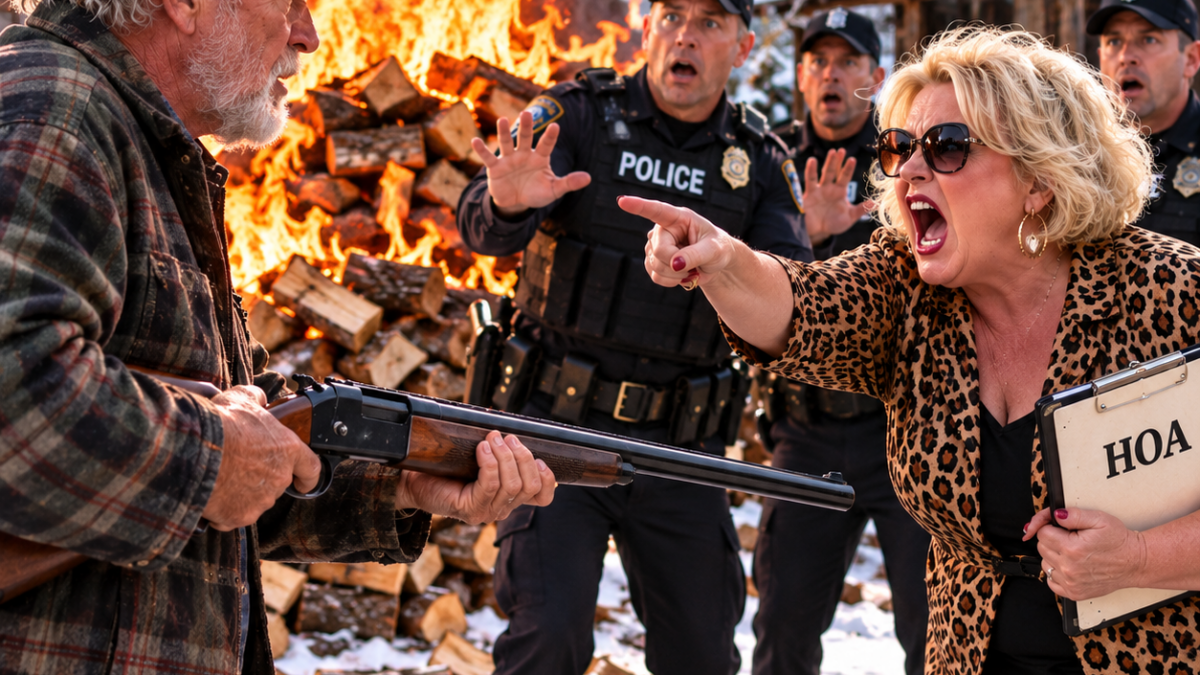
They destroyed four months of winter supplies in less than fifteen minutes, then stood across my property line watching the flames like they were waiting for me to become exactly the dangerous man they had already told the neighborhood I was.
By sunrise, two tons of firewood, hundreds of pounds of smoked meat, emergency water, and the shed that had kept me alive through Montana winters were gone—but the camera they thought was dead had recorded more than they realized.
What happened after that fire started with an old shotgun hanging above my fireplace, but it ended with a document buried deep inside the HOA’s own files that one very powerful man never expected anyone to read.
My name is Austin Gonzalez.
Three years earlier, I had moved to Pinewood Ridge, Montana, looking for the one thing I could not seem to find after my second deployment overseas.
Quiet.
Not happiness.
Not excitement.
Just quiet.
My cabin stood at the end of Ridgewood Lane, where the pavement gave way to gravel and the mountains filled most of the western sky.
Two bedrooms.
Wraparound porch.
Wood stove.
Enough land that I could split firewood without anyone complaining about the noise.
The first winter nearly broke me.
A storm took down power lines across the region.
Nine days.
Nine days without reliable electricity while the temperature dropped far below freezing.
I learned quickly how fragile comfort becomes when cold takes over.
By the time power returned, I had a mild case of frostbite and a new rule:
Never depend on someone else being ready for winter.
So the following July, I began preparing.
Every weekend, I drove out to the Henderson farm and loaded seasoned oak and pine.
Cord after cord.
Split.
Stacked.
Covered.
I smoked meat from my September elk harvest and vacuum-sealed most of it.
Fifty gallons of emergency water went into food-grade barrels.
Blankets.
Fuel.
Batteries.
Canned food.
Nothing extreme.
Nothing illegal.
Just preparation.
My storage shed had stood behind the cabin for two years without a single complaint.
Then, one Tuesday afternoon in November, an orange envelope appeared in my mailbox.
**VIOLATION NOTICE.**
Unauthorized structure.
Visual obstruction.
Failure to maintain community standards.
Section 14.7.
I read it twice.
The shed had not moved.
It had not grown.
It had not changed.
The photograph attached showed the same structure that had existed since my first year in Pinewood Ridge.
At the bottom:
**$500 PER DAY UNTIL CORRECTED.**
Signed:
Gerald Hoffman.
President, Pinewood Ridge Homeowners Association.
I drove to the HOA office the next morning.
The receptionist knew my name before I introduced myself.
“Mr. Gonzalez. Mr. Hoffman is expecting you.”
That bothered me.
I had made no appointment.
Gerald’s office looked less like an HOA workspace and more like a corporate executive suite.
Dark wood.
Leather chairs.
Framed awards.
Perfectly aligned pens.
He was fifty-eight, silver-haired, polished, relaxed.
“Austin.”
He offered his hand.
“Please sit.”
I stayed standing.
“My shed has been there for two years.”
His smile barely changed.
“Standards evolve.”
“Not retroactively without notice.”
His eyes sharpened.
“Your property has become problematic.”
He emphasized that last word.
Property.
But the way he looked at me made it clear he meant something else.
“Remove the structure,” he said.
“It contains my winter supply.”
“That is your responsibility.”
“The shed complied when I built it.”
“I’m telling you it doesn’t comply now.”
“According to what?”
Gerald leaned back.
“You need to understand something about Pinewood Ridge.”
I waited.
“We protect standards here.”
Then:
“And I enforce them.”
I left without raising my voice.
That evening, my seventy-eight-year-old neighbor Eleanor Marsh opened her door only a few inches when I knocked.
The moment she saw me, fear crossed her face.
“Austin, you shouldn’t be here.”
“Why?”
She looked toward the road.
“They took my rose garden.”
“Who?”
“The HOA.”
Her hands trembled.
“First fines. Then legal notices. I nearly lost my house.”
“Gerald?”
She whispered:
“He has friends everywhere.”
Then she said something I would remember long after everything else ended.
“No one beats him.”
Her door closed.
I stood alone on the porch.
Across the road, a white Pinewood Security SUV drove slowly past.
That night I sat in my dark living room staring at two things.
My grandfather’s old Remington mounted above the fireplace.
And a small red light blinking near the corner of my porch.
Security camera.
The HOA believed it had stopped working the previous year.
It hadn’t.
And three mornings later, that camera would record the moment Pinewood Ridge stopped being an HOA dispute and became something far more serious.
PART 2
The final notice arrived forty-eight hours later.
Not in the mailbox.
On my porch.
Three hard knocks at six in the morning.
By the time I opened the door, whoever delivered it was gone.
Twelve pages.
Dense language.
References.
Sections.
Definitions.
Threats wrapped in bureaucracy.
The first paragraph was all that mattered.
I had forty-eight hours to remove the shed and everything associated with it.
Otherwise, the association would undertake “corrective action.”
At my expense.
I read that phrase repeatedly.
Corrective action.
Bureaucracies love language that removes people from what words actually mean.
They weren’t threatening to “correct” anything.
They were threatening to enter my property.
I called attorneys.
First office:
No response.
Second:
“We’ll call you.”
They didn’t.
Third attorney listened for less than two minutes.
“Pinewood Ridge?”
“Yes.”
“Gerald Hoffman?”
“Yes.”
Silence.
“I’m sorry, Mr. Gonzalez. Conflict.”
“What conflict?”
“I can’t discuss that.”
Click.
Fourth office told me:
“Pay the fine.”
Fifth:
“Move the shed.”
Sixth:
“You’ll spend more fighting than complying.”
That last answer stayed with me.
That was probably the entire business model.
Make compliance cheaper than truth.
I had seen that approach before.
Different country.
Different uniforms.
Same psychology.
You do not need to defeat everyone.
You only need to make resistance feel more expensive than surrender.
That afternoon, I finally checked the Pinewood Ridge neighborhood forum.
I rarely used it.
I should not have opened it while eating.
**CONCERNED ABOUT UNSTABLE RESIDENT**
More than two hundred comments.
No name.
Didn’t need one.
“Veteran at the end of Ridgewood.”
“Stockpiling food.”
“Antisocial.”
“Possible threat.”
“Hoarder.”
“Survivalist.”
One person claimed I had confronted him aggressively near the mailbox.
I had never spoken to him.
Another wrote:
“HOA needs to act before he snaps.”
Then somebody posted:
“People like that always seem quiet until something happens.”
People I had helped.
People whose packages I accepted.
A neighbor whose battery I had jumped in January.
Another whose driveway I shoveled during a storm.
Not one had asked me why I stored firewood.
That evening, Pinewood Security started circling.
White SUV.
Every thirty minutes.
Slow past my driveway.
The first two times I ignored it.
The third time I wrote down the plate.
Fourth time:
Photograph.
Around midnight it parked across the street.
Headlights off.
Driver inside.
Phone glowing.
I sat behind my curtain.
In the Army we would have called it pressure.
Not action.
Preparation.
Make the target feel watched.
Make sleep harder.
Make every ordinary sound suspicious.
Eventually, a person begins making mistakes.
Gerald wanted a mistake.
I was starting to understand that.
The following night, Eleanor appeared on my porch.
No coat despite the cold.
“Austin.”
I opened the door wider.
“Come inside.”
“No.”
“You’re freezing.”
“If they see me…”
She looked toward the street.
“If who sees you?”
“You know.”
I stepped outside and closed the door behind me.
“What do you know?”
She whispered:
“Sunrise Realty.”
I had never heard the name.
“Company buys houses here.”
“So?”
“Gerald’s brother-in-law.”
“Derek Hoffman?”
She looked surprised.
“You know him?”
“I know Gerald has a brother-in-law named Derek.”
“Derek is Sunrise.”
“What does that have to do with you?”
Eleanor looked down.
“They fined me after Henry died.”
Her husband.
“Three months after.”
“For what?”
“Garden.”
I frowned.
“Your roses?”
“First roses.”
“Then fence.”
“Then roof trim.”
“Then parking.”
She counted on trembling fingers.
“I owed almost eighteen thousand before it stopped.”
“What stopped it?”
“I borrowed from my daughter.”
Her eyes filled.
“They offered to buy the house.”
“Who?”
“Sunrise.”
“For how much?”
“Barely half what it was worth.”
“You refused.”
“Yes.”
“Then?”
“The fines continued.”
“How did they stop?”
“My daughter hired someone from outside the county.”
Eleanor looked up.
“He sent a letter.”
“Why didn’t you tell me before?”
“I was ashamed.”
That word made me angry.
Not at her.
“At what?”
She looked toward the houses.
“For being scared.”
“You’re seventy-eight.”
“Fear doesn’t ask your age.”
Fair.
Then Eleanor told me the part that changed everything.
She had tracked property sales.
Twelve houses.
Five years.
All Sunrise Realty.
All sellers had serious HOA enforcement before selling.
All sales far below comparable prices.
“Thirty, forty percent below?”
“Sometimes more.”
“Do you have records?”
“Yes.”
“Give me copies.”
She hesitated.
“Austin…”
“Copies.”
She nodded.
The next HOA meeting was the following evening.
I went.
Community center.
Stale coffee.
Fluorescent lighting.
Gerald on a raised platform.
Four board members.
Routine business first.
Holiday decorations.
Landscaping contract.
Dues increase.
Then public comment.
I raised my hand.
Gerald saw me.
Immediately.
“Mr. Gonzalez, you’re not registered.”
“For what?”
“Public comment.”
“I need to register to ask about a violation against my property?”
“Thirty days in advance.”
A murmur.
I stayed calm.
“Where is that rule published?”
Gerald smiled.
“We’re not debating procedures.”
“I’m asking for the procedure.”
“This meeting is about community standards.”
His eyes stayed on me.
“And some residents seem to have difficulty understanding standards.”
Fifty people heard it.
That mattered.
Not because the insult hurt.
Because later nobody could say I had never tried the official route.
I drove home.
Opened my military notebook.
Fresh page.
**GERALD HOFFMAN**
Timeline.
Violation.
Meeting.
Security patrol.
Sunrise.
Eleanor.
Attorneys.
Next steps.
County complaint.
HOA financial requests.
Property transfers.
Vendor contracts.
I went to sleep thinking:
Tomorrow.
Tomorrow I start.
At 3:14 a.m., smoke woke me.
Not fireplace smoke.
Chemical.
Hot.
Wrong.
I opened my eyes.
Orange light moved across the ceiling.
I ran outside barefoot.
The shed was burning.
Not smoldering.
Engulfed.
Flames reaching high above the roof.
The heat hit my face from yards away.
Water barrels collapsing.
Plastic melting.
Firewood exploding with sparks.
Four months of work.
Food.
Emergency supplies.
Winter fuel.
Gone.
Two Pinewood Security employees stood near the edge of my property.
Watching.
One held a phone.
Neither moved toward the fire.
Neither called anyone.
One saw me.
Smiled.
Then they walked to the white SUV.
Drove away.
I called 911.
“Pinewood Ridge.”
“Yes.”
“My storage shed is on fire.”
Keyboard.
“We already have a controlled burn logged at your address.”
I froze.
“What?”
“A debris-removal permit.”
“This is not controlled.”
“Sir—”
“Someone set my property on fire.”
Pause.
“Please hold.”
“No.”
I hung up.
Called again.
Asked for a supervisor.
The first fire truck arrived forty-seven minutes later.
By then, there was almost nothing left to save.
I stood in the cold wearing boots I had barely tied.
Ash landed on my hair.
One firefighter examined the foundation.
He knelt.
Touched soil.
Smelled his glove.
He looked toward me.
“We’ll need an investigator.”
“Accelerant?”
“I can’t make that determination yet.”
Good answer.
No assumptions.
Photos.
Samples.
Report.
By sunrise, the shed looked like a skeleton.
Black posts.
Twisted metal.
Gray ash.
I remembered the camera.
My pulse changed.
I went inside.
Laptop.
Cloud backup.
3:14 a.m.
Two figures.
Approaching from the tree line.
Caps low.
Pinewood Security jackets.
One carried a red fuel container.
Pouring liquid.
Around foundation.
Stepping back.
Ignition.
Flame.
Departure.
Four minutes.
I watched twice.
Then once more.
One face caught moonlight.
Enough to identify later.
I uploaded copies.
Three locations.
Then I drove thirty-two miles to the county seat.
I did not take the footage to Pinewood’s local police.
Eleanor had told me Gerald played golf with Chief Barnes.
That proved nothing by itself.
I simply wanted distance.
Different chain of authority.
Deputy Diane Reyes met me.
Sharp eyes.
Straight questions.
“What happened?”
I explained.
She wrote.
“Proof?”
I opened the laptop.
Played video.
She stopped me at one frame.
“Back.”
I rewound.
“Pause.”
Face.
She typed into her system.
Then turned her screen.
Mugshot.
Travis Whitmore.
Criminal mischief.
Assault-related history.
Current employer:
Pinewood Security.
Diane watched the footage again.
“This is serious.”
“Yes.”
“Potential arson.”
“Yes.”
“Do you have Gerald directing it?”
“No.”
“There’s the problem.”
“I know.”
She leaned back.
“These people at the top rarely touch anything themselves.”
“Then I find the link.”
She studied me.
“You military?”
“Army.”
“Don’t turn this into a mission.”
“It already is.”
“That wasn’t permission.”
I almost smiled.
She continued.
“Document.”
“Stay visible.”
“Do not confront the security employees.”
“Do not give anyone an excuse to say you’re the threat.”
Exactly.
Gerald had spent weeks building a story about me.
Unstable.
Dangerous.
Stockpiler.
Veteran who might snap.
Then he destroyed the thing I depended on for winter.
If I reacted badly, he won.
Back home, I stood before the fireplace.
Grandfather’s Remington 870.
It had hung there for fifteen years.
I removed it.
Not quickly.
Not dramatically.
I checked it.
Then sat at the kitchen table with it across my lap.
For maybe thirty seconds, I imagined doing the worst possible thing.
Driving to Gerald’s house.
Demanding an explanation.
Making him afraid.
I hated how satisfying the thought felt.
Then I understood.
That was the trap.
Everything Gerald had done was designed to produce that image.
Austin Gonzalez.
Angry.
Armed.
At someone’s home.
Then no evidence would matter.
No Sunrise.
No arson footage.
No corruption.
The story would become:
Veteran snapped.
I stood.
Set the shotgun on the table.
Opened the laptop.
If Gerald wanted me to become his evidence, I would give him something else.
Paper.
Three days.
Records.
Financial disclosure requests.
Property transfers.
Vendor lists.
Meeting minutes.
HOA budgets.
No independent audit.
Reserve fund approaching half a million dollars.
Vendor:
Hoffman Property Maintenance.
Owner:
Derek Hoffman.
Payments over four years:
More than $300,000.
For what?
Landscaping.
Repairs.
Maintenance.
Pinewood Ridge had under three hundred homes.
Most residents handled their own lots.
The common areas were modest.
The numbers didn’t make immediate sense.
Then Sunrise Realty.
Twelve purchases.
Five years.
Each homeowner heavily fined beforehand.
Each sale significantly below comparable market prices.
Registered agent:
Derek Hoffman.
Gerald controlled enforcement.
Derek controlled acquisition.
Maybe coincidence.
Once?
Perhaps.
Twelve times?
Worth investigating.
I called Diane.
Explained.
“Send me documents.”
“I will.”
“Do not label it fraud yet.”
“I haven’t.”
“Good.”
“What do you call it?”
“A pattern.”
“Better.”
She paused.
“Austin.”
“Yes?”
“Be careful.”
That evening, an anonymous email arrived.
One line.
**DROP THIS OR LOSE MORE THAN FIREWOOD.**
I saved it.
Screenshots.
Headers.
Copies.
I almost replied.
Then didn’t.
No reason.
Every response teaches the sender something.
The next morning, Diane called.
“State investigators are interested.”
“Which?”
“Nonprofit and financial oversight.”
“Good.”
“Interested does not mean charges.”
“I know.”
“We need independent verification.”
“I know.”
“You sound disappointed.”
“I sound cold.”
Silence.
“How are you heating?”
“Main cabin wood supply.”
“Enough?”
“For now.”
That question almost broke me.
The shed wasn’t a hobby.
People kept calling it “your stockpile.”
Like I had built a bunker.
It was winter survival.
The previous blackout still lived in my feet.
Three toes had nearly been lost.
Gerald knew that because I had mentioned it at a community preparedness event.
He knew what he had destroyed.
Or at minimum, he knew the shed contained my winter supplies.
That made the fire personal.
But personal anger could wait.
On the fourth night, I sat at the table.
Shotgun nearby.
Notebook open.
Gerald.
Derek.
Sunrise.
Security.
Local influence.
Complaints disappearing.
Then process server.
Monday morning.
“Austin Gonzalez?”
“Yes.”
“You’ve been served.”
Gerald sued me.
$500,000.
Defamation.
Harassment.
Intentional infliction of emotional distress.
I almost laughed.
The complaint said I had damaged his reputation.
Created a hostile community environment.
Spread malicious falsehoods.
The man whose security employee appeared on video near the destruction of my property was accusing me of harming him.
Then I saw the opportunity.
Discovery.
By suing me, Gerald created a process where both sides could seek relevant records.
I called Diane first.
Then searched for counsel outside the region again.
Three days later, Rebecca Thornton contacted me.
She worked with a civil-liberties organization in Montana.
She had seen the video I released publicly after speaking with investigators.
I had debated posting it.
Diane did not love the idea.
But I believed making the footage public would make it harder to quietly disappear.
Rebecca met me at a diner thirty miles away.
Mid-forties.
Gray in her hair.
No wasted words.
She laid documents on the table.
Other HOA complaints.
Other communities.
Property pressure.
Financial irregularities.
Aggressive private security.
“Gerald isn’t unique.”
“No?”
“He’s a recognizable type.”
“What type?”
“Someone operating in the space between private governance and weak oversight.”
She looked at me.
“Most residents cannot afford prolonged litigation.”
“I noticed.”
“That’s why these systems work.”
“Can you represent me?”
She slid over an agreement.
Pro bono.
Litigation costs covered.
I stared.
“Why?”
“Because your case isn’t just about you anymore.”
I signed.
Rebecca smiled slightly.
“Gerald thinks his lawsuit is leverage.”
“And?”
“We are going to make it discovery.”
Gerald’s attorneys attacked first.
Tax returns.
Military records.
Medical records.
Bank accounts.
Phone records.
Social media.
They wanted every corner of my life.
Rebecca responded.
Seven years of HOA finances.
Vendor contracts.
Payments above $5,000.
Board communications.
Security contracts.
Property liens.
Property sales involving affiliated companies.
Internal enforcement policies.
Correspondence involving me.
Correspondence involving Eleanor.
Then she used a phrase Eleanor remembered hearing once:
**Phase Three.**
The HOA objected.
Rebecca moved to compel.
The judge ordered broad production.
“If these records are routine,” she said, “production should not require theatrics.”
Fourteen boxes arrived.
Rebecca rented a conference room.
Four days.
Coffee.
Highlighters.
Spreadsheets.
We found the maintenance payments first.
Then shell entities.
Pinewood Property Services.
Emergency repairs on structures that did not match invoices.
Ridge Security Consultants.
“Threat assessments” that consisted largely of property photographs and compliance reports.
Mountain View Holdings.
Nevada mailbox.
More than $120,000 in administrative fees.
Connections looping toward Gerald or Derek.
Then emails.
**PROBLEM RESIDENTS.**
The language was sanitized.
“Noncompliant.”
“Escalation.”
“Financial pressure.”
“Voluntary disposition.”
Then:
**PHASE THREE.**
One internal email explained it.
Coordinated enforcement designed to maximize financial pressure and encourage voluntary sale.
I read it twice.
Rebecca said nothing.
Then another spreadsheet.
Fourteen names.
Addresses.
Estimated values.
Twelve crossed out.
Sale dates.
Eleanor Marsh:
13.
Austin Gonzalez:
14.
I felt physically sick.
My shed had never been the issue.
Eleanor’s roses had never been the issue.
The Whitfields’ RV.
Margaret Chen’s fence.
James Okonquo’s property.
They were inputs.
Leverage.
A machine.
Find a vulnerable homeowner.
Create violations.
Accumulate fines.
Increase fear.
Offer below-market exit.
Move property into Sunrise.
I brought copies to Eleanor.
She read the spreadsheet.
Saw her name.
Sat down.
“Henry had been dead three months.”
I knew.
“He handled everything.”
She touched the page.
“Gerald knew.”
Tears came.
“He watched my husband die and saw a business opportunity.”
I couldn’t prove Gerald had literally “watched” her husband die.
But I understood what she meant.
He knew she had become vulnerable.
“Will you testify?”
She looked frightened.
I immediately added:
“You don’t have to.”
Silence.
Then she straightened.
“I’m seventy-eight.”
“Yes.”
“I buried Henry.”
“Yes.”
“I raised four children.”
“Yes.”
“I’ve been afraid for three years.”
Her jaw set.
“I’m tired.”
“Is that a yes?”
“Yes.”
Neighbors started coming.
Margaret Chen.
$12,000 in fence fines.
Fence allegedly two inches too tall.
Different inspector.
Different measurements.
Robert and Linda Whitfield.
Nearly $30,000 in penalties related to their son’s RV staying for one weekend.
James Okonquo.
Seventy-one.
Retired postal worker.
Had already sold.
Sunrise Realty.
Forty percent below market.
When James described cleaning out his late wife’s garden before leaving, he cried.
So did Eleanor.
I didn’t.
Not then.
I was too angry.
Eight households met in Eleanor’s living room.
Then nine.
Then twelve.
People brought folders.
Not rumors.
Not stories alone.
Notices.
Checks.
Lien threats.
Offer letters.
Sale records.
Dates.
The pattern became impossible to dismiss.
Gerald responded with an emergency meeting.
Official letterhead.
Board vote on my “expulsion.”
Threatening conduct.
Disruption.
Defamation.
Hostile activity.
A mechanism that could lead toward property enforcement if they succeeded.
Rebecca obtained the resolution in advance.
I read it.
“They want me gone before discovery becomes public.”
“Yes.”
“Can they do this?”
“They can try.”
“Meeting?”
“Tuesday.”
I called Diane.
She listened.
Then:
“The state attorney general’s office has opened a preliminary investigation.”
I closed my eyes.
“Finally.”
“Preliminary.”
“I heard you.”
“These things take time.”
“We don’t have time.”
“You have a meeting.”
“And Gerald has a vote.”
“Then go.”
I was surprised.
“Go?”
“Calmly.”
“Obviously.”
“Factual.”
“Yes.”
“No confrontations.”
“Yes.”
“And Austin?”
I knew what was coming.
“No firearm.”
I looked toward the old Remington.
Silence.
She said:
“I mean it.”
“I hear you.”
Then I called Cynthia Chavez.
Investigative reporter.
She wanted the story.
Eight residents willing to speak.
Documents.
Discovery materials.
Public board confrontation.
She said:
“I’ll livestream.”
That night, I sat at the table.
Evidence stacked beside me.
Shotgun on the other side.
I had planned for days to bring it.
Not to use.
Not loaded.
Not as threat.
As something symbolic.
My grandfather had kept it through harder winters than mine.
He had taught me not that violence solves problems, but that courage means not surrendering simply because someone tries to make you afraid.
Still, symbolism can be misunderstood.
Gerald had constructed a narrative about me.
Unstable veteran.
Dangerous loner.
If I brought a weapon into his meeting, even legally and unloaded, I risked helping him.
Rebecca called late.
“What are you thinking?”
“How do you know I’m thinking?”
“You’ve gone quiet.”
I told her.
She sighed.
“Austin.”
“I know.”
“You don’t need it.”
“I know.”
“Then why?”
I stared at the wooden stock.
“Because he burned what kept me safe.”
“And?”
“Because his men watched.”
“And?”
“Because I’m tired of feeling like prey.”
Rebecca became quiet.
Then:
“The opposite of prey isn’t armed.”
That hit.
“What is it?”
“Protected by evidence.”
I didn’t answer.
She continued.
“If you bring it, you let Gerald choose what everybody sees first.”
“The gun.”
“Yes.”
“Not the files.”
“Yes.”
I looked at the notebook.
“So leave it?”
“My advice?”
“Yes.”
“Leave it.”
I slept badly.
Morning.
Cold.
Clear sky.
I dressed.
Clean jeans.
Pressed flannel.
The shotgun stayed above the fireplace.
I stood beneath it for several seconds.
Then picked up my evidence case.
That was what I carried out.
At the community center, more than two hundred people had arrived.
Eleanor sat beside me.
James.
Margaret.
Whitfields.
Others.
Cynthia’s camera team set up in back.
Rebecca arrived.
Deputy Diane Reyes stood near the side wall.
Official capacity.
Watching.
Gerald entered at eight.
Charcoal suit.
Attorney beside him.
Four board members.
He saw me.
Then the empty space around me.
Perhaps he expected the weapon too.
He looked almost disappointed.
That told me I had made the right choice.
He called the meeting.
“Community safety.”
“Standards.”
“Disruptive resident.”
The resolution.
My alleged threats.
My defamatory campaign.
My supposed instability.
He finished.
I raised my hand.
“I’d like to respond.”
“You are not on the speaker list.”
Rebecca stood.
“Your bylaws guarantee a disciplinary respondent the right to be heard before a vote.”
Gerald glanced at counsel.
Whisper.
Forced smile.
“Five minutes.”
I stood.
Carried my notebook.
No weapon.
No dramatic entrance.
No excuse for anybody to look anywhere except the evidence.
“My name is Austin Gonzalez.”
Camera livestreaming.
Two hundred neighbors.
“I served two tours overseas.”
Gerald rolled his eyes.
“I moved here for peace.”
Then:
“My storage shed was destroyed after I challenged an HOA violation.”
Gerald interrupted.
“Allegedly—”
Rebecca:
“Let him finish.”
I clicked the first video.
Security footage.
3:14 a.m.
Two men.
Pinewood Security jackets.
Red fuel container.
Gerald’s face changed.
Travis Whitmore stood near the wall.
His face went still.
The video showed accelerant.
Ignition.
Departure.
Residents gasped.
I said:
“The camera the HOA believed was inoperative recorded this.”
Next.
Fire department report.
Accelerant indicators.
Delayed emergency response.
Controlled-burn claim.
Next.
HOA finances.
Hoffman Property Maintenance.
Hundreds of thousands.
Next.
Sunrise Realty.
Twelve properties.
Violation histories.
Below-market sales.
Derek Hoffman.
Next.
Phase Three.
The room stopped moving.
I read:
“Coordinated enforcement designed to maximize financial pressure and encourage voluntary sale.”
Gerald stood.
“This is confidential.”
That was the wrong response.
Not false.
Confidential.
People reacted.
I continued.
Fourteen names.
Twelve crossed out.
Eleanor:
Number thirteen.
Me:
Number fourteen.
Someone shouted:
“What is that list?”
Another:
“Was my mother on there?”
Gerald hit the microphone.
“Order!”
I projected another email.
Gerald to Travis Whitmore.
Three days before the fire.
**Handle the Gonzalez situation. Make sure he gets the message. I want him gone before the next board meeting.**
Gerald shouted:
“Fabricated!”
Rebecca stood.
“Produced by your counsel in discovery.”
Gerald looked at his attorney.
His attorney looked as if he wished the floor would open.
I said:
“Metadata links the message to the account disclosed in litigation.”
Gerald’s face turned red.
“Context!”
“Then provide it.”
Silence.
“What did ‘handle the Gonzalez situation’ mean?”
“I meant enforcement.”
“What message?”
“Compliance.”
“Why Travis?”
“Security.”
“Why three days before my shed burned?”
“I didn’t order any fire.”
Important.
I did not claim he had.
Not yet.
I turned toward the residents.
“Evidence establishes that Pinewood Security employees were present.”
“Evidence establishes internal coordination around targeted enforcement.”
“Evidence establishes related-party companies receiving substantial HOA funds.”
“Evidence establishes properties being pressured before sale to a company associated with Gerald Hoffman’s family.”
I looked at Gerald.
“What investigators establish beyond that is their job.”
Diane watched me.
Tiny nod.
That was the line.
Facts.
Not vengeance.
Then Eleanor stood.
No microphone.
Still everyone heard.
“My husband died.”
Gerald froze.
“Three months later, they came after me.”
She held up her fines.
“My roses.”
“Fence.”
“Roof.”
“I thought I was stupid.”
Her voice broke.
“I thought I had failed because Henry used to handle everything.”
She looked at Gerald.
“You knew I was alone.”
Gerald said:
“Mrs. Marsh, this is not—”
“Be quiet.”
The room went completely still.
Eleanor had barely spoken above a whisper for years.
Now:
“I was afraid of you.”
She held up the Phase Three sheet.
“Not anymore.”
James rose next.
Told his story.
Then Margaret.
Then Whitfields.
One after another.
Not shouting.
Documents.
Dates.
Amounts.
Gerald could fight me.
Harder to fight ten people holding receipts.
The livestream count climbed.
Cynthia’s assistant whispered:
Three thousand viewers.
Then Gerald broke.
“I built this community!”
He slammed his hand on the table.
“I protected property values!”
People stared.
“You people have no idea what it takes to keep standards!”
He pointed toward us.
“You want to know why some residents had to leave?”
Rebecca looked at me.
Do not interrupt.
Let him speak.
Gerald continued.
“Because communities require discipline.”
He swept his hand toward the audience.
“You think you can run this place?”
His voice cracked.
“You’re sheep.”
There.
No polished president.
No “community excellence.”
“You needed someone to make decisions.”
Silence.
“I gave you order.”
Then the line Cynthia’s livestream replayed for weeks:
“I am the law in Pinewood Ridge.”
Diane stepped forward.
Not theatrically.
Professionally.
“Mr. Hoffman.”
He turned.
Two deputies moved from the side.
She informed him investigators had probable cause related to the fire investigation and financial case.
Real cuffs.
Real procedure.
No cheering.
At least not immediately.
The room seemed stunned.
Travis Whitmore tried to move toward a side door.
Another deputy stopped him.
One board member stood.
Another sat frozen.
Gerald shouted at his attorney.
Then at Diane.
Then at me.
I did not answer.
That surprised him.
Probably me too.
He had spent months trying to provoke a reaction.
The moment consequences arrived, I gave him nothing.
The investigation expanded.
Travis cooperated.
That changed the arson case.
Other security employees were identified.
Records linked intimidation campaigns to past enforcement.
Derek Hoffman was arrested later while investigators traced money from Sunrise and related entities.
The state opened broader reviews.
Chief Barnes resigned amid scrutiny of how complaints had been handled.
I stayed careful about rumors.
People wanted simple headlines.
“Corrupt chief.”
“Criminal HOA.”
“Everything rigged.”
Real cases are less tidy.
Some allegations were proven.
Others weren’t.
Some conduct was unethical but not criminal.
Some board members were careless rather than conspirators.
That distinction mattered.
Gerald eventually went to trial on multiple counts connected to fraud, property schemes, and the stockpile fire conspiracy.
The source record of the story put his sentence at eight years.
Derek received five.
Pinewood Security was dissolved.
Travis’s cooperation reduced his exposure but did not erase responsibility.
Multiple homeowners received settlements and restitution through insurance, seized assets, and civil proceedings.
Not enough.
Never enough.
James never got his wife’s garden back.
Eleanor never got three years of fear back.
Families forced to move could not simply rewind.
Money can acknowledge harm.
It cannot undo time.
Six months after the meeting, I stood in my backyard.
New shed frame.
Fresh lumber.
Mountain air.
Eleanor walked over carrying bread.
“You need help?”
“With construction?”
She looked offended.
“I was a teacher.”
“Exactly.”
“I taught shop one semester.”
“When?”
“1973.”
“Then absolutely not.”
She laughed.
That laugh mattered.
For the first year I knew her, Eleanor always looked over her shoulder.
Now she walked across the street in daylight.
James visited with seedlings.
His daughter convinced him to move closer to family in Billings.
Before leaving, he wanted something planted at my property.
“What are these?”
“Mountain ash.”
“Why?”
“My wife liked them.”
We planted two.
One for her.
One for my grandfather.
The new HOA board had been elected.
New president.
Independent audit.
Open financial records.
Competitive contracts.
Term limits.
No affiliated vendor without disclosure.
Recorded enforcement hearings.
Residents received meaningful appeal rights.
Security contract canceled.
The camera on my cabin still blinked red.
I told the new board it worked.
The president said:
“Good.”
That was strange.
Normal.
Good.
My grandfather’s shotgun remained above the fireplace.
Cleaned.
Oiled.
Unfired.
Rebecca visited one afternoon.
She noticed it.
“So you left it home.”
“At the meeting.”
“Yes.”
“I did.”
“Regret it?”
I looked at the old gun.
“No.”
“Why?”
“Because Gerald wanted that story.”
“And?”
“I gave him another.”
She smiled.
“The better one.”
“Boring one.”
“Evidence is boring.”
“That’s why it wins.”
She laughed.
We sat on the porch.
“You know people online call you Shotgun Austin now.”
I stared.
“What?”
“Apparently someone found an old picture of you with it.”
“That is terrible.”
“It could be worse.”
“How?”
“They could call you HOA Batman.”
I considered.
“Shotgun Austin is fine.”
She laughed harder than Eleanor had.
Humor came back slowly.
The first winter after the fire was difficult.
Every time I smelled smoke, my body reacted before my mind.
Heart.
Breathing.
Awareness.
I had known that feeling before.
Different place.
Different fire.
I started seeing a counselor again.
I almost didn’t.
Pride.
Old habit.
Then I remembered Gerald’s entire campaign had depended on people assuming my military history made me unstable.
For a while I avoided help because I feared proving him right.
That was absurd.
Getting help is not evidence of being dangerous.
It is evidence of understanding when something is heavy.
I went.
Talked.
Slept better.
Winter came.
New shed full.
Firewood.
Food.
Water.
Backup supplies.
Nothing extravagant.
Eleanor visited the first week of December.
She inspected the shed.
“More organized.”
“Bins.”
“You labeled them.”
“I’m getting old.”
“You’re not even sixty.”
“War ages people.”
“HOAs too.”
Fair.
She touched one stack of firewood.
“You know, I used to think your stockpile was excessive.”
“Most people did.”
“Then your shed burned.”
“Exactly.”
“No. Then I understood why losing it terrified you.”
I looked at her.
“Everybody focused on the amount.”
“Not what it meant.”
“Yes.”
For me, the stockpile meant:
No freezing.
No helplessness.
No waiting nine days hoping power returned.
Gerald burned supplies.
He also burned a sense of safety.
Rebuilding the shed was easier than rebuilding that.
It took time.
So did the community.
Not everyone apologized.
Some residents still believed Gerald had been “good for property values.”
One man told me:
“He went too far, but the neighborhood looked better under him.”
I answered:
“At whose expense?”
He didn’t have much to say.
Others apologized constantly.
I told them eventually:
“Stop.”
One woman said:
“But we believed him.”
“Yes.”
“We talked about you.”
“Yes.”
“We should’ve known.”
“No.”
That surprised her.
“You should’ve asked.”
Different.
Knowing is impossible without information.
Questioning is possible.
The most important failure in Pinewood Ridge was not that Gerald lied.
Liars exist.
It was that nobody wanted the inconvenience of checking.
I understood that too.
People were busy.
Work.
Children.
Bills.
You receive a violation.
You assume somebody checked.
You see your neighbor fined.
You assume they did something.
You see a house sold cheap.
You think divorce.
Job loss.
Retirement.
Nobody imagines a machine.
That is how machines survive.
Individual events look ordinary.
Pattern turns them into evidence.
A year after Gerald’s conviction, the new board held a winter-preparedness workshop.
They asked me to speak.
I said no.
Then Eleanor volunteered me.
I attended.
Not military presentation.
Nothing tactical.
Just:
Backup heat.
Water.
Food.
Communication.
Check elderly neighbors.
Know where shutoffs are.
Have fire extinguishers.
Don’t store supplies dangerously.
The irony was not lost on me.
The shed that had made me “unstable” became the reason the HOA created a community emergency plan.
At the end, an older man asked:
“How much firewood is too much?”
I said:
“When it becomes a hazard.”
He nodded.
“How much do you have?”
“Enough.”
People laughed.
I liked that.
The sign Eleanor painted appeared a few weeks later.
She brought it to my porch wrapped in newspaper.
“What is this?”
“Housewarming.”
“I’ve lived here four years.”
“Shed-warming.”
I opened it.
Hand-painted.
Careful schoolteacher script.
**THIS PROPERTY PROTECTED BY DUE PROCESS.**
I laughed.
“That’s terrible.”
“You’re hanging it.”
“No.”
She stared.
I hung it.
It stayed.
Visitors photographed it.
Someone posted it online.
For a while, it became a small local joke.
That was fine.
A joke is better than fear.
Two years after the fire, James came back from Billings.
The mountain ash seedlings had grown.
He stood beside them.
“My wife would like this.”
“You think?”
“She would’ve corrected how we planted them.”
“Too deep?”
“Probably.”
He smiled.
Then looked at the new shed.
“Does it still bother you?”
“What?”
“Seeing it.”
Sometimes.
“Not like before.”
He nodded.
“I still dream about the house.”
His old home.
Sunrise had resold it after renovation.
Different family.
Different paint.
He had driven past once.
Regretted it.
“You ever think about moving back?”
“No.”
“Why?”
“Because home stopped being the house.”
I understood.
“Where is it?”
“My daughter’s dinner table.”
That stayed with me.
The HOA scheme stole property from people.
But property and home are related without being identical.
Gerald had treated houses as units.
Pressure.
Extract.
Acquire.
Resell.
James reminded me what those units contained.
Gardens.
Birthdays.
Marriage.
Grief.
Coffee.
Ordinary Tuesday mornings.
Predatory systems often depend on reducing humans to numbers.
Parcel.
Balance.
Violation.
Opportunity.
Resistance begins when names return.
James.
Eleanor.
Margaret.
Robert.
Linda.
Austin.
Fourteen targets on a spreadsheet.
Not anymore.
The civil cases dragged on longer than the criminal case.
Insurance disputes.
Property claims.
Damages.
Restitution.
Appraisals.
Sunrise transactions.
Some prior sales could not simply be reversed because later buyers had legal rights too.
That frustrated people.
They wanted everything returned exactly.
Law rarely does exactly.
It tries to allocate harm after events have moved forward.
Sometimes imperfectly.
Rebecca explained this repeatedly.
One afternoon I said:
“That’s not fair.”
“No.”
“You’re the lawyer.”
“Yes.”
“Fix it.”
“That is not how law works.”
“Then what does it do?”
“Best available remedy.”
I hated that phrase.
Eventually understood it.
Justice cannot always restore the previous world.
It can stop ongoing harm.
Compensate some loss.
Punish proven wrongdoing.
Reform institutions.
Record truth.
Then people rebuild.
That is what we did.
Eleanor never moved.
Her children begged.
She refused.
“This is my house.”
Nobody argued.
The new board formally rescinded every improper violation they could document.
Her rose garden returned.
Different roses.
She planted them herself.
I helped dig.
“You’re doing that wrong.”
“You asked for help.”
“I asked for muscle.”
“Then stop supervising.”
She pointed.
“Two inches left.”
I laughed.
Later, she placed a small plaque among the roses.
**HENRY’S GARDEN**
I pretended not to notice her wiping tears.
Three years after the fire, Cynthia Chavez returned for a follow-up story.
She sat on my porch.
Camera off.
Notebook only.
“What changed most?”
“Governance.”
“That sounds boring.”
“Good.”
“Personally?”
I thought.
“I stopped waiting for the next attack.”
She wrote.
“What did the shotgun mean?”
There it was.
People loved that part.
I looked through the window toward the fireplace.
“It meant anger.”
“Not protection?”
“Not really.”
“Your grandfather?”
“Yes.”
“Why did you consider carrying it?”
“Because I wanted Gerald to see I wasn’t afraid.”
“And why didn’t you?”
“Because fear wasn’t the question.”
She waited.
“The question was whether I could prove what he did.”
Cynthia wrote.
“What do you think would’ve happened if you had brought it?”
“Best case?”
“Yes.”
“Nothing.”
“Worst?”
“I become the headline instead of the evidence.”
She nodded.
That became her article.
Not:
Veteran faces HOA armed.
Instead:
**WHY THE MAN THEY CALLED DANGEROUS LEFT THE GUN HOME**
I liked that headline.
Gerald never understood restraint.
He interpreted restraint as weakness.
That was his mistake.
Restraint is expensive.
It means you carry anger without spending it immediately.
You gather evidence while someone laughs.
You let someone speak long enough to document the lie.
You choose the slower road because the faster one ends badly.
The Army taught me patience under pressure.
Civil life taught me patience around paperwork.
Combined, apparently, they make you very annoying to corrupt HOA presidents.
At the five-year anniversary of the fire, Eleanor baked bread.
James returned.
Rebecca drove up.
Diane came off duty.
Cynthia sent flowers because she was covering an election.
We stood around the shed.
I said:
“This is weird.”
Eleanor:
“Anniversary party.”
“For arson?”
“For rebuilding.”
Better.
Someone suggested a toast.
I hate toasts.
Rebecca forced me.
I held coffee.
“Fine.”
Everybody waited.
I looked at the mountain ash trees.
The roses Eleanor had brought.
The camera.
The new shed.
Then:
“To boring paperwork.”
Groans.
“To receipts.”
More groans.
“To people who finally ask questions.”
Silence.
Then Eleanor raised her cup.
“To not being afraid.”
That was better.
We drank.
Years passed.
The sign faded.
I repainted it.
Not because I still expected Gerald.
Because due process had become a family joke.
My nephew visited once.
Read:
THIS PROPERTY PROTECTED BY DUE PROCESS.
“Uncle Austin, this is the least intimidating sign in Montana.”
“Good.”
“Most people have BEWARE OF DOG.”
“No dog.”
“SECURITY CAMERA.”
“Have one.”
“TRESPASSERS PROSECUTED.”
“Boring.”
He pointed.
“This is boring.”
“Exactly.”
He shook his head.
Kids.
By then, I rarely thought of Gerald.
Occasionally his name appeared in legal correspondence.
Restitution.
Appeals.
Administrative matters.
I forwarded everything to Rebecca.
No emotional involvement.
That was progress.
The stockpile rebuilt every summer.
Firewood.
Food.
Water.
A little less than before.
Not because I stopped believing in preparation.
Because Pinewood Ridge changed.
The new board created a shared emergency plan.
Backup generator at community center.
Volunteer check-ins.
Priority list for elderly residents.
Shared warming space.
During the next major outage, something happened that would have been impossible under Gerald.
Neighbors helped each other.
Five days without power.
No one died.
Eleanor stayed at my cabin one night.
“Your wood stove is too hot.”
“You complained about the cold last time.”
“I contain multitudes.”
At three a.m., we heard a truck outside.
I looked.
New HOA president delivering fuel to an elderly couple down the lane.
No security patrol.
No intimidation.
Just help.
That morning, Eleanor said:
“This is what community standards should mean.”
“What?”
“People showing up.”
Yes.
Not fence height.
Not paint colors.
Those things can matter.
But they are not community.
Community is what happens when things go wrong.
Gerald built compliance.
We eventually built trust.
Those are not the same.
One winter, I finally took my grandfather’s shotgun down again.
Not because of threat.
Maintenance.
Oil.
Cleaning.
My nephew watched.
“Is that the famous one?”
“Unfortunately.”
“You carried that into the meeting?”
“No.”
“I thought the story says—”
“Stories improve themselves.”
“So you didn’t?”
“I considered it.”
“Why didn’t you?”
“Because being angry and being right are two different things.”
He stared.
“That sounds like something Grandpa would say.”
“He did.”
“Really?”
“No.”
He laughed.
I put the gun back above the fireplace.
That was where it belonged.
Memory.
Not argument.
If there is one thing I wish people understood about what happened, it is this:
I did not beat Gerald because I was tougher.
Gerald had money.
Influence.
Lawyers.
Private security.
A board.
Years of practice.
I had a notebook.
A camera.
Neighbors who eventually became witnesses.
A deputy who followed evidence.
A lawyer willing to use discovery.
A reporter willing to verify.
And records Gerald created himself.
That last part matters.
Powerful people often think documentation protects them.
Sometimes it does.
Sometimes the same records become the map of what they did.
Invoices.
Emails.
Spreadsheets.
Contracts.
Meeting minutes.
Property transfers.
Gerald’s system had to document itself to function.
He just assumed no outsider would ever assemble the pieces.
That was his final mistake.
The “Phase Three” spreadsheet still bothers me.
Fourteen names.
Twelve crossed out.
Eleanor.
Me.
Sometimes I wonder who number fifteen would have been.
Maybe there was already a list.
Maybe not.
Doesn’t matter.
There was no number fifteen under Gerald.
That is enough.
The new shed has weathered now.
Wood darkened.
Roof survived storms.
Mountain ash trees almost as tall as the eaves.
Eleanor’s roses grow along one side.
She is older.
So am I.
James calls from Billings.
Rebecca still sends holiday cards with legal jokes nobody understands.
Diane retired from the sheriff’s department.
Cynthia wrote a book about private governance and local accountability.
Apparently I appear in one chapter.
I refuse to read it.
“You lived it,” she says.
“Exactly.”
Pinewood Ridge no longer feels like Gerald’s neighborhood.
It feels like ours.
Messy.
Annoying.
Meetings too long.
Budget debates.
Arguments about snow removal.
One year people spent forty minutes debating mailbox colors.
I sat in the back laughing.
Eleanor asked:
“What’s funny?”
“This.”
“This is miserable.”
“It’s democracy.”
“Same thing.”
Maybe.
But nobody was afraid to speak.
That difference was everything.
On November 14 each year, I wake early.
Not intentionally.
Body remembers dates.
I make coffee.
Walk to the shed.
Open the door.
Dry wood smell.
Cold metal.
Water barrels.
Shelves.
Normal.
Sometimes I touch one beam.
Then go back inside.
No ceremony.
Healing doesn’t always need ceremony.
One year, I noticed the camera’s red light had finally gone dark.
Actually broken.
I stood beneath it.
For years, I had believed that camera saved me.
It did, partly.
But the truth is more complicated.
Video gave me evidence.
People gave the evidence somewhere to go.
Without Diane, maybe nothing.
Without Rebecca, maybe the lawsuit buries me.
Without Eleanor speaking, maybe residents still call me paranoid.
Without James and the others, maybe the pattern remains abstract.
Without Cynthia, maybe public pressure never forms.
Evidence matters.
Institutions matter.
People matter.
None are enough alone.
I replaced the camera.
Then, after thinking, told the HOA.
Full disclosure.
The new president replied:
“Thanks. Please angle it away from common sidewalk privacy areas.”
Reasonable.
I adjusted it.
That tiny exchange would have been impossible under Gerald.
No threat.
No power contest.
Just:
Here’s the concern.
Okay.
Fixed.
Boring.
Again:
Victory.
People ask me if I got revenge.
Yes and no.
If revenge means Gerald lost power, faced trial, and paid consequences, then perhaps.
But I didn’t create those consequences.
His conduct did.
If revenge means I hurt him because he hurt me?
No.
I did something far less dramatic.
I refused to disappear.
That mattered more.
Gerald’s machine needed people to leave.
Leave the meeting.
Leave the neighborhood.
Sell.
Stop asking.
Get tired.
Become ashamed.
Move on.
The moment enough of us stayed, the economics of fear changed.
Twelve families before us had been separated.
By the time my case broke open, we were sitting in Eleanor’s living room together.
Names became voices.
Voices became records.
Records became pattern.
Pattern became investigation.
That is the sequence I remember.
Not the fire.
Not the gun.
Not Gerald being taken away.
Eleanor saying:
“I’m tired of being afraid.”
That was the turning point.
An old teacher with trembling hands.
No weapon.
No title.
No office.
Just enough courage for one sentence.
Everything after was easier because somebody else heard it and thought:
Me too.
That is how systems fall.
Not always from one heroic act.
Sometimes from a room slowly filling with people who realize they were never alone.
The last time I spoke publicly about Gerald, a reporter asked:
“If you could go back to the morning after the fire, what would you tell yourself?”
I thought.
“Don’t pick up the shotgun.”
He looked surprised.
“That’s it?”
“No.”
I smiled.
“Pick up the notebook.”
He wrote that down.
It became another headline.
I hated that one too.
But it was true.
The Remington represented everything emotional in me.
Heritage.
Anger.
Fear.
Pride.
The notebook represented something harder.
Patience.
Dates.
Facts.
Restraint.
When my life felt chaotic, the notebook asked:
What do you actually know?
That question saved me more than once.
Gerald fined the shed.
Known.
Eleanor alleged a property pattern.
Needs verification.
Security patrol observed.
Known.
Gerald connected to Derek.
Known.
Fire caused intentionally?
Investigators determine.
Camera shows Pinewood employees.
Known.
Gerald ordered it?
Needed evidence.
Sunrise bought twelve houses.
Known.
Owners fined first.
Known.
Scheme?
Pattern needing proof.
That discipline prevented me from becoming the thing Gerald accused me of being.
Paranoid people see certainty everywhere.
I learned to leave room for verification.
That was the real battle.
Not Austin versus Gerald.
Facts versus fear.
By the time investigators finished, the facts were enough.
One autumn morning, years later, a new family moved into one of the houses Sunrise had once acquired.
Young couple.
Baby.
They stopped by.
“We heard you know the neighborhood history.”
“Unfortunately.”
They laughed.
“Is it really as crazy as people say?”
“People exaggerate.”
“So no corruption?”
“Oh, there was corruption.”
“No arson?”
“There was a fire.”
“No gunfight?”
“Absolutely not.”
The husband looked disappointed.
“YouTube lied.”
“Imagine that.”
His wife pointed at Eleanor’s sign.
“Due process?”
“Long story.”
They stayed for coffee.
That felt like the perfect way for the story to age.
From danger to neighborhood legend.
The facts remained.
The fear faded.
The shed still stands.
I still prepare for winter.
But I also know that if power fails now, someone will knock on Eleanor’s door.
Someone will check James’s old property.
Someone will start the community generator.
Preparation is no longer only individual.
That may be Gerald’s greatest accidental legacy.
By trying to isolate everyone, he taught us why isolation was dangerous.
A community built on fear is efficient until one person falls.
A community built on trust is messy, but people catch each other.
I prefer messy.
Tonight, as I write this, snow is falling.
The mountains have disappeared behind gray clouds.
My wood stove is running.
The shed is full.
Eleanor’s bread is cooling on the counter because she still refuses to accept that one person does not need two loaves.
My grandfather’s Remington hangs above the fireplace.
Unfired.
Untouched except for cleaning.
The notebook sits on a shelf below it.
If I had to choose which object tells the story better, it is the notebook.
Gerald wanted the gun to be true.
He wanted the unstable veteran.
The dangerous loner.
The man who could be provoked into throwing away his credibility.
Instead, he got timestamps.
Public records.
Financial disclosures.
Discovery.
Witnesses.
Video.
A livestream.
An independent investigation.
He tried to create chaos.
We created a record.
And records survive people.
That is why Pinewood Ridge remembers the winter stockpile fire differently now.
Not as the night Austin Gonzalez finally snapped.
As the night Gerald Hoffman made the mistake of destroying evidence in front of a camera he believed was dead.
He burned my food.
My firewood.
My water storage.
My shed.
For a while, I thought he had burned my peace too.
He hadn’t.
Peace came back.
Slowly.
With every board meeting where people spoke freely.
Every financial report published on time.
Every rose Eleanor planted.
Every family that received some measure of restitution.
Every winter morning when I opened my shed and found exactly what I had prepared.
Some things were never restored.
Some people never returned.
Some money was never recovered.
That is reality.
But Gerald’s system ended.
That mattered.
The camera caught the fire.
The records exposed the reason.
The neighbors supplied the history.
The law supplied consequences.
And the shotgun?
It stayed where it belonged.
Above the fireplace.
Because Gerald Hoffman spent months trying to convince everyone I was a dangerous man waiting to explode.
The most satisfying thing I ever did was refuse to become his proof.




