PART 2: HOA President Ordered My Guests Off the Lake—Then Froze When I Showed Her the Deed to My Private Shoreline
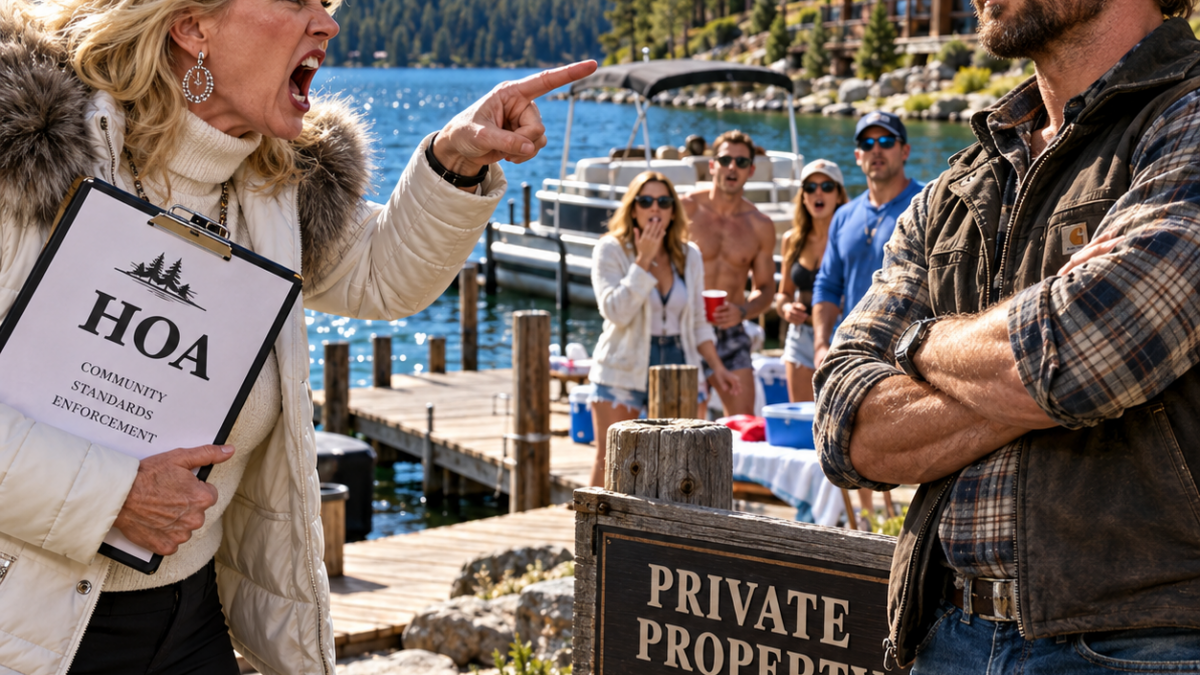
I was standing beside my grill with four friends, a cooler of lemonade, and my nephew skipping stones across the lake when the HOA president marched down the trail with a clipboard pressed against her chest and ordered every one of my guests to leave immediately because, according to her, we were trespassing on “community-owned shoreline.”
She spoke loudly enough for nearby homeowners to hear, quoted rules that didn’t apply to my property, and looked genuinely offended when I pointed to the rusted iron marker and laminated county plat proving the strip of grass beneath her expensive shoes belonged to Lot 17—my lot, my deed, and absolutely not the HOA’s common area.
For several seconds she simply stared at the map, but what happened three days later told me her silence wasn’t surrender at all, because Burgett Overton had spent years treating neighborhood boundaries like suggestions, and this time she had finally chosen the one homeowner willing to check every line she crossed.
My name is Daniel Mercer, and until that afternoon, I had no interest in becoming the center of an HOA war.
I had lived in Willow Creek for seven years.
Lot 17 sat at the western edge of the subdivision, where manicured lawns gave way to cottonwoods, reeds, and a narrow strip of shoreline that had been privately deeded with the house when the development was recorded in 1986.
Most homeowners never cared about that distinction.
I did.
Mostly because Burgett Overton cared too much.
She had been HOA president for so long that people joked she probably came with the subdivision.
Every meeting featured the same clipboard.
The same high-waisted khakis.
The same tight smile whenever somebody asked a question she had not planned to answer.
So when I saw her marching across my grass that Saturday, I already knew the burgers were about to get cold.
“Excuse me,” she called.
My friend Phil looked at me.
“Are we in trouble?”
“Apparently breathing near water requires approval now.”
Burgett stopped ten feet from the grill.
“This is private lake access.”
“Correct.”
She frowned.
“Residents only.”
“Still correct.”
“Your guests need to leave.”
That was where she lost me.
“They’re my guests.”
“HOA rules require guest authorization for use of lake common areas.”
“This isn’t a common area.”
Her expression hardened.
“All lake access inside Willow Creek belongs to the association.”
“No.”
I pointed toward the tree line.
A rusted iron marker stood beside an old sign:
**PRIVATE PARCEL — LOT 17 — NOT HOA MAINTAINED**
Burgett glanced at it.
Then at me.
“That sign is outdated.”
“That sign is older than your presidency.”
“The handbook is clear.”
“The handbook doesn’t rewrite a county deed.”
I walked over to the wooden post where I had attached a laminated copy of the original subdivision plat after our previous disagreement over the same shoreline.
“See this red line?”
Burgett said nothing.
“Lot 17 extends from my backyard to this section of shore.”
I pointed.
“This strip is explicitly excluded from HOA common access.”
“That can’t be right.”
“It is.”
“The lake is community property.”
“The water is regulated separately. The ground we’re standing on isn’t.”
Phil lifted his lemonade.
“And for the record, we aren’t even swimming.”
Burgett shot him a look.
He lowered the cup.
“Just contributing.”
She turned back to me.
“You still have to notify the HOA before hosting gatherings.”
“It’s four people.”
“And a child.”
“My nephew.”
“That still constitutes a gathering.”
“Then Thanksgiving must require a federal permit.”
Phil coughed to hide a laugh.
Burgett’s jaw tightened.
“You think this is funny?”
“No.”
I pointed again toward the plat.
“I think property lines matter.”
She stared at the map for several seconds.
Then at the marker.
Then at me.
Her mouth opened.
Closed.
Opened again.
Finally:
“I’ll be discussing this with the board.”
“Please do.”
She turned sharply and walked back toward the trail.
Phil waited until she disappeared through the cottonwoods.
“She’s going to try something else.”
“Oh, absolutely.”
Three days later, I came home from work and found a bright yellow notice zip-tied to my mailbox.
**NOTICE OF VIOLATION**
**UNAPPROVED GATHERING ON HOA-MANAGED PROPERTY**
**SECOND INFRACTION**
**$250 FINE — PAYMENT DUE WITHIN TEN DAYS**
I stood in the driveway reading it twice.
Then I opened my security-camera app.
At 11:14 that morning, Burgett Overton appeared on screen wearing gardening gloves and a wide-brimmed sun hat.
She looked directly toward my house.
Fastened the notice to my mailbox.
Photographed it.
Then walked away.
That was when I stopped treating her like an irritating neighbor with a clipboard.
Because she had been shown the boundary.
She had been shown the county plat.
She had already lost the argument at the lake.
And she had responded by creating an official-looking punishment anyway.
PART 2
I took the yellow notice inside and laid it on my kitchen counter.
For almost ten minutes, I didn’t touch it.
Instead, I made coffee.
Not because I needed caffeine.
Because I needed to do something ordinary before I did something angry.
There is a very specific kind of frustration that comes from being punished because you proved somebody wrong.
If Burgett had misunderstood the plat, fine.
If she had checked the county records and apologized, even better.
If she had asked the board to review the boundary, that would have been reasonable.
Instead, she had waited three days and fined me for using ground the public record said I owned.
That made the situation different.
I replayed my driveway-camera footage.
Burgett walked into frame.
Yellow notice in one hand.
Zip tie in the other.
No hesitation.
No confusion.
She attached it to my mailbox, stepped backward, photographed it, then left.
The way she moved bothered me.
She didn’t look like someone making a difficult judgment call.
She looked like someone checking off a task.
I exported the footage.
Saved one copy on my computer.
One in cloud storage.
One on an external drive.
Then I photographed the notice before removing the zip tie entirely.
Date.
Time.
Amount.
Her signature at the bottom.
Then I called Dale Whitman.
Dale worked for city zoning.
We had gone to high school together, though “together” was generous.
He had been student-council treasurer and probably alphabetized his notebooks.
I had once set off the chemistry lab alarm because I misunderstood a burner valve.
Our adult relationship mostly consisted of nodding at town meetings.
He answered on the fourth ring.
“Zoning.”
“Dale.”
“Daniel?”
“Yeah.”
“You in trouble?”
“That depends how emotionally attached you are to homeowners associations.”
He groaned.
“What happened?”
“My HOA fined me for using land that isn’t HOA land.”
Pause.
“Start over.”
I told him about Lot 17.
The private shoreline.
Burgett.
The old plat.
The laminated map.
The gathering.
The yellow notice.
Dale was quiet long enough that I checked whether the call had dropped.
“They’re formally claiming the lake strip as common property?”
“Yes.”
“And this has happened before?”
“Burgett tried the same argument last year.”
“What stopped her?”
“I showed her the deed.”
“And now she fined you anyway?”
“Apparently.”
Dale exhaled.
“Send me everything.”
“Why?”
“Because if this is just an internal HOA map that’s wrong, that’s one kind of mess.”
“And if it isn’t?”
“If they filed something publicly that represents your private land as association property, that becomes a different mess.”
I sat straighter.
“What sort of filing?”
“Maintenance maps. Amended plats. Common-area exhibits. Easement records.”
“They can’t just change a deed.”
“No.”
“Then why does it matter?”
“Because they might have tried to make people believe they could.”
I looked again at the yellow notice.
“I’ll send it.”
“And Daniel?”
“Yeah?”
“Get a certified copy of the original plat.”
“I have one.”
“Certified.”
“Right.”
“Because when people start arguing about property lines, photocopies suddenly become philosophical.”
That sounded exactly like Dale.
The next morning, I stopped at the county recorder’s office.
Jeremy Pike worked behind the counter.
Soft-spoken.
Early thirties.
Rectangular glasses.
The kind of man who looked like he would apologize to a stapler before using it.
I gave him my parcel number.
“Lot 17, Willow Creek.”
He typed for a few seconds.
The original subdivision map appeared.
1986.
Jeremy rotated the monitor.
“There.”
I leaned closer.
Lot 17 clearly extended from my house down to the lake.
The private shoreline was marked separately from the association’s common access.
Jeremy zoomed in.
“This section here was specifically excluded from common access when the development was recorded.”
“That’s what I thought.”
“You having trouble?”
“With Burgett Overton.”
His expression changed just enough for me to notice.
“You know her?”
“Everyone knows Mrs. Overton.”
That answer sounded familiar.
Not affectionate.
Not hostile.
Just tired.
“Can I get a certified copy?”
“Sure.”
“Full map too.”
He nodded.
As he printed, I asked:
“Any updated filings involving this boundary?”
Jeremy looked back.
“Recent?”
“Past few years.”
“I’d have to search amendments.”
“Can you?”
“Yes.”
“How long?”
“Twenty minutes?”
“Take your time.”
I sat on a wooden bench beneath a framed photograph of the old courthouse.
Twenty minutes became thirty.
Then thirty-five.
Jeremy returned carrying a thin folder instead of one page.
His expression was no longer neutral.
“There is a supplemental filing.”
“When?”
“Two years ago.”
“What kind?”
“Updated common-area reference map.”
“Approved?”
“It was accepted for filing.”
“That’s different.”
“Yes.”
“Does it affect title?”
“No. A reference map cannot transfer ownership.”
“Show me.”
He placed the newer map beside the 1986 plat.
At first glance, the differences were subtle.
Then I saw my shoreline.
The line had moved.
Not dramatically.
Maybe thirty feet in one place.
More farther along the water.
Enough to take the entire grassy strip where I had been grilling and show it as association-controlled access.
“That wasn’t approved by me.”
Jeremy didn’t answer.
“I owned the house two years ago.”
He nodded.
“I never signed anything.”
“I can only show you what was filed.”
“Who submitted it?”
Jeremy turned to the signature page.
**BURGETT OVERTON**
President, Willow Creek Homeowners Association.
Beneath it:
A notary seal.
I felt something change in my stomach.
“Other board signatures?”
“No.”
“Property-owner acknowledgments?”
“Not attached.”
“Any recorded vote?”
“Not in this packet.”
“Certified copy.”
Jeremy nodded.
“Probably wise.”
Before I left, he said:
“Mr. Mercer?”
“Yeah?”
“You’re the third person this year asking about private-property exclusions.”
I stopped.
“What lots?”
He looked uncomfortable.
“I shouldn’t discuss somebody else’s file.”
“Fair.”
“But you should probably ask the city whether this updated map affects anything besides Lot 17.”
That was enough.
I called Dale from the parking lot.
“I found the mess.”
“You sound excited.”
“I’m not.”
“Send it.”
I scanned both maps when I got home.
Original.
Supplemental.
Dale called twenty minutes later.
“That new line has no legal title effect.”
“Good.”
“But that doesn’t make the filing harmless.”
“Why?”
“If it was knowingly used as a basis for enforcement on private property, it matters.”
“Can the HOA redraw common areas after homeowners refuse an amendment?”
“Not by filing a reference map.”
“Funny you mention an amendment.”
“What amendment?”
“Jason Mullins told me they tried to absorb lakefront lots last year.”
“Who’s Jason?”
“Board member.”
“Did it pass?”
“Apparently not.”
Long pause.
“And this map was filed when?”
“Two weeks after the failed vote.”
Dale said nothing.
“You still there?”
“Yes.”
“What?”
“I’m writing something down.”
“That sounds ominous.”
“It’s zoning. Everything sounds ominous.”
I spent the afternoon drafting a cease-and-desist letter.
Not the kind people write after watching too many courtroom dramas.
No threats about prison.
No ten-page manifesto.
Just facts.
Lot 17 was privately deeded.
The original county plat said so.
The newer HOA map could not alter title.
The $250 notice lacked legal and procedural basis.
The fine should be withdrawn.
The HOA should stop representing my shoreline as common property.
The association should correct any internal records.
I attached:
Certified plat.
Current deed.
Supplemental map.
Photographs of the boundary marker.
Security stills of Burgett personally attaching the notice.
Then I sent it certified mail.
One copy to Burgett.
One to the HOA registered office.
One dropped in the association’s locked document box.
At six that evening, someone knocked on my front door.
Jason Mullins.
Mid-thirties.
Short beard.
Flannel shirt despite summer heat.
He looked like a man who had volunteered for one neighborhood cleanup and somehow ended up responsible for municipal diplomacy.
He raised both hands before I said anything.
“I’m not here to argue.”
“That makes one board member.”
He winced.
“I saw your letter.”
“That was fast.”
“Burgett forwarded it to the entire board.”
“Subject line?”
Jason looked embarrassed.
“Hostile resident escalation.”
I laughed.
“Of course.”
He held up a copy of the yellow notice.
“I didn’t approve this.”
I waited.
“Neither did Melissa.”
“Who’s Melissa?”
“Vice president.”
“And?”
“Tom didn’t approve it either.”
“How many board members?”
“Four.”
“How many votes required for a fine?”
“Majority.”
“So there was no vote.”
“No.”
I leaned against the doorway.
“Then why does the notice represent itself as official HOA action?”
Jason looked toward the street.
“That’s why I’m here.”
I stepped outside and closed the door behind me.
“How often has she done this?”
“I don’t know.”
“That isn’t reassuring.”
“I only realized there was a problem a few months ago.”
“What happened?”
“Family on Birch Lane.”
“Fence?”
He nodded.
“They were fined because the fence style supposedly violated new standards.”
“Was it old?”
“Installed before they bought the house.”
“Grandfathered?”
“Should’ve been.”
“Board vote?”
“None.”
“So you confronted her?”
“I asked.”
“That’s not the same thing.”
Jason looked irritated.
“I’m trying to help you.”
“Then help.”
He breathed out.
“Burgett said enforcement had been delegated to the president years ago.”
“Was it?”
“I couldn’t find a resolution.”
“Did you keep looking?”
“Yes.”
“And?”
“No resolution.”
“Then why didn’t you stop it?”
His eyes hardened.
“Because every time anyone challenges her, she has a reason.”
“Such as?”
“Executive session.”
“Legal advice.”
“Urgent authority.”
“Old precedent.”
“President’s discretion.”
“Did any of that exist?”
“Sometimes enough of it existed to make everyone hesitate.”
There it was.
Burgett’s real skill.
Not necessarily law.
Hesitation.
Make the answer complicated enough that everybody decides not to fight.
I opened my folder and showed Jason the filed map.
He stared.
“What is that?”
“The supplemental plat.”
“I’ve never seen this.”
“Burgett signed it.”
“When?”
He found the date.
His face changed.
“That was after the amendment failed.”
“By how much?”
“Two weeks.”
“What amendment?”
Jason rubbed the back of his neck.
“Last year Burgett proposed reclassifying private lakefront strips as shared access.”
“On what theory?”
“Liability and maintenance.”
“Meaning she wanted the HOA to control them.”
“Yes.”
“Vote?”
“Failed.”
“Margin?”
“Three votes.”
“So the residents said no.”
“Yes.”
“Then this appeared.”
He kept staring at the map.
“I didn’t know.”
“Now you do.”
Jason looked toward the water behind my house.
“Can I take a copy?”
“Yes.”
He folded it carefully.
“We’re meeting tomorrow.”
“Board?”
“Seven. Birch Community Room.”
“Am I invited?”
“No.”
I smiled.
“At least you’re honest.”
“But come.”
“Burgett says residents need speaking reservations.”
“I’ll put property disputes on the agenda.”
“And if she refuses?”
Jason looked at me.
“I’m getting tired of being told what I’m allowed to ask.”
That was the second crack.
The Birch Community Room held about fifty folding chairs.
Half were occupied when I arrived.
Faces I knew from yard sales.
Dog walks.
Block parties.
People I nodded to but rarely spoke with.
Burgett sat at the front behind a long plastic table.
White blouse.
Clipboard.
Two stacks of binders.
Melissa sat beside her.
Tom beside Melissa.
Jason at the far end.
Burgett saw me.
Her eyes narrowed.
“This is a board meeting.”
“So the sign says.”
“Residents must request speaking time seventy-two hours in advance.”
“I’m not speaking.”
I raised my folder.
“I’m delivering public records relevant to an agenda item.”
Jason reached out.
“I’ll take them.”
Burgett turned.
“Jason.”
“What?”
“We have established procedure.”
“And property jurisdiction is on tonight’s agenda.”
“That doesn’t mean anyone can interrupt.”
“He’s not interrupting.”
Jason took the folder.
The room grew quiet.
People love conflict when they don’t believe it involves them.
They become much more attentive when the conflict might determine whether their own fines were legitimate.
The meeting opened with ordinary business.
Pool pump.
Landscape maintenance.
A resident complaining about a dog that barked at delivery trucks.
Then property disputes.
Jason spoke first.
“We need to address Lot 17.”
Burgett immediately leaned toward her microphone.
“That matter is under legal review.”
Jason looked at her.
“Which attorney?”
She paused.
“Our association counsel.”
“Name?”
Her eyes sharpened.
“Jason.”
“I’m asking for the record.”
“This is not the time.”
He opened the bylaws.
“I move to recognize Mr. Mercer for five minutes.”
Burgett stared.
“You can’t unilaterally grant speaking time.”
“I made a motion.”
Melissa quietly said:
“Second.”
Burgett looked at her.
Melissa did not look back.
Vote.
Jason yes.
Melissa yes.
Tom yes.
Burgett no.
Three to one.
My five minutes became official.
I stood.
“My issue is simple.”
I held up the original plat.
“Lot 17 includes private shoreline.”
Passed it to Jason.
“Recorded in 1986.”
Then the supplemental map.
“Two years ago, a new association reference map was filed showing part of that private shoreline as common access.”
People started murmuring.
Burgett interrupted.
“That document reflects updated community-management needs.”
“It doesn’t reflect my deed.”
“Planning boundaries evolve.”
“Property ownership doesn’t evolve because an HOA president redraws a line.”
A laugh from the back.
Burgett’s eyes flashed.
I continued.
“Last Saturday, Mrs. Overton told my guests to leave my shoreline.”
“I showed her the marker.”
“I showed her the map.”
“Three days later, she personally issued a $250 fine.”
I held up the yellow notice.
Jason spoke.
“For the record, I did not approve that notice.”
Melissa:
“Neither did I.”
Tom looked uncomfortable.
“I was not asked to vote.”
The room changed.
A woman behind me whispered:
“Oh my God.”
Burgett sat very straight.
“This was administrative enforcement.”
Jason opened another page.
“Section 7.4 says fines require board authorization.”
“Except under urgent conditions.”
“What urgent condition?”
Burgett pointed toward me.
“Unauthorized lake activity creates association liability.”
I replied:
“Four adults eating burgers on private land?”
“It borders community water.”
“My boundary still exists.”
A man in the back raised his hand.
Burgett snapped:
“No floor comments.”
Jason said:
“I’d like to hear the question.”
The man stood.
“Are you saying fines need board votes?”
Jason nodded.
“Yes.”
The man looked at Burgett.
“Then why did I get three notices last year that were signed only by her?”
Another voice:
“Mine too.”
Then another.
“I paid $400.”
Someone else:
“I paid six hundred.”
Burgett tapped her microphone.
“We are discussing one parcel.”
I looked at her.
“That may be exactly the problem.”
She glared.
“What is that supposed to mean?”
“You keep treating each complaint as if it’s isolated.”
Jason leaned forward.
“I move to suspend enforcement tied to disputed property lines or notices lacking documented board approval until an internal audit is completed.”
Burgett’s chair scraped back.
“Absolutely not.”
Melissa:
“Second.”
Vote.
Three in favor.
One against.
Burgett sat frozen.
Her fingers tightened around the clipboard.
That moment mattered more than I understood at the time.
For years, people in Willow Creek had believed Burgett’s power was fixed.
Not because the bylaws said so.
Because nobody remembered seeing her lose.
That night, they watched her lose two votes.
And nothing terrible happened.
No houses disappeared.
No gates closed.
No police arrived.
Just democracy.
Messy.
Ordinary.
Possible.
The next morning, Dale called.
“You’re not going to like this.”
“I’ve had an exciting week. Surprise me.”
“We spoke to the notary listed on the supplemental map.”
“And?”
“She says she didn’t witness Burgett sign it.”
I sat down.
“Is the seal fake?”
“Seal appears to match hers.”
“So?”
“She believes her stamp may have been used without authorization.”
“That’s serious.”
“Yes.”
“Can you prove who used it?”
“Not yet.”
“But the map?”
“City won’t rely on it pending review.”
“Other parcels?”
“Three.”
My stomach tightened.
“Three private properties?”
“Parts of three.”
“Are those owners being notified?”
“Yes.”
“Does Burgett know?”
“She will.”
Within forty-eight hours, the city suspended recognition of the supplemental map for enforcement purposes.
The HOA was told not to issue new fines based on disputed boundaries.
Then people started bringing records to Jason.
That was when the story stopped being mine.
One resident had paid $275 for a shed that apparently never violated the recorded design standards.
Another had been fined $150 because her visiting daughter parked overnight.
Another had received a “second offense” notice without ever receiving a first.
A retired couple had paid $600 over landscaping complaints and still had no idea what board meeting authorized the charges.
Jason called me.
“I can’t stay on the board.”
“What?”
“I’m resigning.”
“That helps Burgett.”
“No.”
His voice sharpened.
“I’m resigning because the current board is compromised.”
“What are you going to do?”
“Run for president.”
I almost laughed.
“You hate being on the board.”
“I hate this more.”
“What’s your platform?”
“Actually following the bylaws.”
“Radical.”
“I’m serious.”
“So am I.”
Burgett stopped showing up.
First meeting missed:
“Personal reasons.”
Second:
“Legal consultation.”
Her porch lights stayed off more often.
People who once saw her at every morning walk noticed she disappeared.
Then the county investigator served a summons.
I happened to be walking my dog, Max, when it happened.
A woman in a dark blazer approached Burgett’s front door.
Knocked.
Burgett opened.
The investigator showed identification.
Handed her papers.
Burgett looked down.
Then up.
For the first time since I had met her, she seemed unsure where to place her hands.
The woman who always held a clipboard suddenly had nothing to hold.
She took the papers and closed the door.
That evening, Phil called.
“You see the neighborhood group?”
“No.”
“People are losing their minds.”
“I’m staying off.”
“Smart.”
“What are they saying?”
“That Burgett got arrested.”
“She didn’t.”
“That the FBI raided her house.”
“They didn’t.”
“That she fled to Canada.”
“Her car is in the driveway.”
Phil laughed.
“This is why you ruin gossip.”
“Facts have that effect.”
Two days later, someone else knocked.
Detective Elena Rivas.
County Financial Crimes Division.
Tall.
Charcoal blazer.
Hair pulled back.
She showed identification.
“I’m reviewing Willow Creek HOA.”
I invited her in.
She saw the yellow notice framed temporarily in my garage.
“You framed this?”
“Evidence can be decorative.”
That got half a smile.
“Walk me through it.”
I did.
Lake confrontation.
Certified plat.
Supplemental map.
Security footage.
Board vote.
Jason’s statements.
The notice.
Elena took notes.
Then asked:
“Did you ever pay the $250?”
“No.”
“Any other fines?”
“No.”
“Did Mrs. Overton ever request money directly from you?”
“Only through the notice.”
She nodded.
“We believe this may fit a larger pattern.”
“What kind?”
“Unauthorized enforcement tied to unaccounted funds.”
I stopped.
“What does that mean?”
“Some payments collected as fines do not appear consistently in association financial reports.”
“How much?”
“Still determining.”
“Thousands?”
“Yes.”
“Tens of thousands?”
She didn’t answer.
That was answer enough.
She continued.
“We also found payments labeled landscaping, legal consultation, and administrative reimbursement that do not match obvious vendors.”
“Who got the money?”
“Several entities.”
“Burgett?”
“We’re tracing beneficial ownership.”
One of the entities, she explained, was linked to an LLC whose registered agent was Burgett’s nephew.
Now the issue had moved well beyond a $250 fine.
The county subpoenaed bank records.
A forensic accountant entered the picture.
The HOA’s spending authority was placed under temporary oversight.
Residents were notified that nonessential expenditures were frozen.
City council scheduled a special session on association governance.
And Willow Creek—quiet, boring Willow Creek—suddenly had a local-news van parked outside the entrance.
Channel 9 interviewed residents in front of trimmed hedges.
Burgett’s name wasn’t used in the first segment.
They called her “a former or current HOA officer under review.”
Everyone knew.
Jason invited me to a transparency committee.
“We’re not an official board.”
“Good.”
“Garage meeting.”
“Even better.”
Five people came.
Jason.
Me.
Linda Walsh.
Omar Benson.
Denise Grant.
Linda was retired from the postal inspection service.
She arrived carrying a binder thick enough to require its own seat belt.
“I kept everything.”
Color-coded tabs.
2019.
2020.
2021.
2022.
2023.
Violation letters.
Payment receipts.
Email messages.
She flipped to a section.
“Burgett’s name is on all of these.”
Parking.
Pet restrictions.
Fence paint.
Holiday decorations.
Trash cans.
Tree trimming.
“I thought some were supposed to come from architectural review,” I said.
“They were.”
Jason leaned closer.
“Did ARC vote?”
Linda smiled without humor.
“I asked.”
“What happened?”
“Burgett told me internal committee deliberations were confidential.”
Omar laughed.
“For a fence color?”
“Apparently national security.”
Another section.
Petty cash reimbursements.
$8,000 over three years.
Meeting refreshments.
Document printing.
Office materials.
Denise frowned.
“We don’t serve refreshments.”
Jason said:
“The printer hasn’t had new toner in a year.”
Linda flipped again.
Three payments to West Ridge Consulting LLC.
No attached invoice.
No service description.
Jason looked at the name.
“Never heard of them.”
Linda already had corporate registration.
Registered agent:
Burgett’s nephew.
The room became very quiet.
Then Omar pointed to another line.
“Legal consultation.”
Company name:
Overton Administrative Services.
Jason closed his eyes.
“That’s her husband’s old business.”
“Licensed law firm?” I asked.
“No.”
“Then why is the HOA paying legal-consulting fees?”
Nobody answered.
We turned everything over.
Signed statements.
Copies.
Digital backups.
No public accusations.
No confrontation.
That decision became important later.
When people are angry, they want to expose.
When investigators are working, exposure can ruin evidence.
So we stayed quiet.
Which was difficult because the neighborhood rumor mill was running at full speed.
One resident posted a photograph of Burgett taking groceries from her car.
Caption:
**QUEEN STILL SHOPPING WITH OUR MONEY?**
Jason demanded it be removed.
People were furious with him.
“Why defend her?”
He told them:
“We’re not defending her. We’re defending the process.”
That sentence changed my opinion of him.
Marcus Dyer from the state real-estate department arrived the next week.
He specialized in HOA-related fraud and governance abuse.
I handed him a USB drive.
Security video.
Emails.
Maps.
Notices.
County certifications.
He opened the supplemental plat.
“This signature?”
“Burgett.”
“Submission receipt?”
“Recorder’s office.”
“Notary?”
“Denies witnessing.”
He nodded slowly.
“That aligns with another statement.”
“Another?”
“Can’t discuss.”
Fair.
That evening, a neighbor sent me a photograph.
Unmarked vehicles outside Burgett’s house.
Investigators carrying boxes.
A desktop tower in evidence wrapping.
Her husband stood on the porch.
Arms folded.
The text beneath it:
**Guess the Queen’s castle got audited.**
I deleted the message after saving nothing.
By then, this wasn’t entertainment.
People had lost money.
Records might have been falsified.
Private-property boundaries had been altered on official-looking documents.
The next morning, a notice appeared at the community entrance.
**EFFECTIVE IMMEDIATELY, BURGETT OVERTON HAS RESIGNED FROM ALL HOA DUTIES.**
Interim trustee.
Full financial review.
Public accountability meeting.
No explanation from Burgett.
No farewell.
No statement.
Phil called.
“So the barbecue won?”
“No.”
“Feels like it.”
“Don’t make me block you.”
The accountability meeting packed the community room beyond capacity.
People stood along the walls.
The city-appointed trustee opened.
Then a consumer-protection attorney spoke.
“What occurred here appears to involve more than ordinary administrative error.”
The room went quiet.
She continued.
“Investigators are reviewing whether association authority was deliberately expanded through improper filings, misrepresented board approvals, and financial-reporting irregularities.”
An auditor took over.
“We have identified more than thirty violation notices requiring further review because board authorization cannot currently be verified.”
Someone gasped.
“Collected payments exceed twenty thousand dollars.”
Silence.
“Those payments do not appear consistently in the annual operating statements provided to members.”
A man in a denim jacket raised his hand.
“My wife paid almost nine hundred dollars.”
The auditor nodded.
“If the payment was unauthorized, restitution procedures will be available.”
“Can we get it back?”
“That is the goal.”
A woman near the aisle started crying.
Not loudly.
Her husband put an arm around her.
Later I learned they had skipped a family vacation to pay fines they believed could become liens.
That was the moment the story became heavier for me.
My $250 notice had irritated me.
Their $900 had changed decisions in their life.
Jason caught up to me outside.
“You ever imagine this?”
“No.”
“I thought she’d cancel your fine.”
“So did I.”
He shook his head.
“Everybody thought she was just controlling.”
“She was.”
“And more.”
“Apparently.”
Jason looked back through the window.
“She fooled all of us.”
I shook my head.
“Not exactly.”
He frowned.
“She depended on nobody checking.”
“That’s fooling us.”
“Sometimes.”
I looked at Linda inside, explaining a receipt to the auditor.
“Sometimes it’s just people being busy.”
Two weeks later, formal charges were announced.
Falsification-related counts.
Misuse of association funds.
Misrepresentation connected to filings.
Additional financial allegations pending.
I deliberately avoided reading social-media commentary.
The local newspaper did better.
**FORMER WILLOW CREEK HOA PRESIDENT FACES CHARGES FOLLOWING FINANCIAL AND BOUNDARY REVIEW**
No sensational language.
Good.
Summer passed.
The lake stayed peaceful.
My nephew returned.
Phil came over.
Two friends brought lawn chairs.
We grilled.
Nobody asked for paperwork.
But I noticed something.
The first few times people gathered near the lake, they still looked toward the trail.
Expecting her.
Burgett had trained the neighborhood so thoroughly that even after she resigned, people expected enforcement to appear out of nowhere.
It takes longer to unlearn fear than to remove the person who created it.
Linda told me she still photographed her trash cans every pickup day.
“Why?”
“Habit.”
“You don’t have to.”
“I know.”
She looked embarrassed.
“I still do.”
Omar kept copies of every email from the interim trustee.
Denise refused to plant a tree without checking three times whether a rule existed.
We joked about it.
But beneath the jokes was the same realization.
Burgett hadn’t just issued fines.
She had changed how people inhabited their own homes.
October came.
Court.
Cold morning.
The county courthouse hallway buzzed with reporters and residents.
Jason sat beside me.
He carried a thick folder even though he wasn’t testifying that morning.
“You see the witness list?”
“Yes.”
“Notary.”
“Auditor.”
“Three former board members.”
“Two residents.”
“You.”
“Unfortunately.”
He leaned closer.
“They’re saying the supplemental map wasn’t the only changed filing.”
“What else?”
“Fence ordinance.”
“Confirmed?”
“No.”
“Then don’t repeat it.”
Jason sighed.
“You’ve become Dale.”
“That’s insulting.”
Burgett entered with counsel.
Navy blazer.
Hair down.
No clipboard.
She didn’t look toward us.
The prosecution started with money.
It was methodical.
Boring.
And devastating.
A forensic accountant explained disbursements to businesses with unclear services.
Cash reimbursements unsupported by receipts.
Vendor payments routed to entities linked to family.
Legal-consulting charges to a business not licensed to provide legal services.
Then the notary testified.
Soft-spoken woman.
Gray cardigan.
She knew Burgett.
Had notarized legitimate HOA documents before.
One day, Burgett asked her to notarize a document without witnessing the signature.
She refused.
Weeks later, her stamp appeared on the supplemental plat.
“Did you authorize use of your stamp?”
“No.”
“Were you present when Mrs. Overton signed?”
“No.”
“Did you complete this notarial block?”
“No.”
The room shifted.
Then the county auditor presented the original 1986 plat.
Red line.
Private parcels.
Common access.
Then the supplemental map.
Different line.
Three private sections shown as HOA access.
Lot 17 among them.
“Did the association obtain deeds transferring these parcels?”
“No.”
“Recorded easements?”
“No.”
“Owner consent?”
“No.”
“Could this map legally transfer title?”
“No.”
“Was it nevertheless used for enforcement?”
“Yes.”
Then me.
I took the oath.
Sat.
The prosecutor held up the yellow notice.
“Do you recognize Exhibit 34?”
“Yes.”
“What is it?”
“Violation notice Burgett attached to my mailbox.”
“Why?”
“For hosting guests on my privately owned shoreline.”
He showed the security still.
Burgett in the sun hat.
Gardening gloves.
Clipboard.
“Is that Mrs. Overton?”
“Yes.”
He asked about the lake confrontation.
I told it plainly.
She said the area was HOA property.
I showed her the iron marker.
The laminated plat.
She left.
Three days later, fine.
“Did the board vote on the fine?”
“Three board members later stated they did not approve it.”
Cross-examination.
Burgett’s lawyer was experienced.
Calm.
No theatrics.
“Mr. Mercer, you are not a licensed surveyor.”
“No.”
“You are not a real-estate attorney.”
“No.”
“You are not a municipal planning official.”
“No.”
“Then when you told Mrs. Overton the shoreline belonged to you, that was based on your personal interpretation.”
“No.”
He paused.
“What was it based on?”
“The recorded deed and county plat.”
“That requires interpretation.”
“The county clerk interpreted it the same way.”
“Objection.”
Sustained.
He moved on.
“You had a personal conflict with Mrs. Overton before this notice.”
“We disagreed over the property line.”
“You disliked her.”
“I disliked her behavior.”
“Isn’t it true you deliberately hosted a gathering near the water despite knowing the HOA considered that area community access?”
“I hosted friends on my land.”
“Answer yes or no.”
“Yes, I hosted friends.”
“Thank you.”
He paced.
“Alcohol was present?”
“Phil had one beer.”
“Children present?”
“My nephew.”
“Water access?”
“The lake was there.”
A few quiet laughs.
The judge looked toward the gallery.
The attorney continued.
“So this was a social gathering adjacent to shared water.”
“Yes.”
“And HOA rules regulate gatherings near shared amenities.”
“On HOA property.”
“There was a jurisdictional dispute.”
“No.”
He stopped.
“No?”
“There was an HOA claim.”
I looked toward the exhibit.
“My recorded title wasn’t disputed until the HOA decided it was.”
He stared at me.
“That is your opinion.”
“No.”
I pointed toward the certified plat on the evidence screen.
“That’s the point.”
He changed subjects.
“Do you consider yourself responsible for this investigation?”
“No.”
“Yet you contacted city officials.”
“Yes.”
“Obtained records.”
“Yes.”
“Organized residents.”
“No.”
“You attended a transparency committee.”
“Yes.”
“Submitted evidence.”
“Yes.”
“And ultimately Mrs. Overton was charged.”
“Yes.”
“So your actions contributed to this prosecution.”
“My actions contributed documents.”
That answer ended the exchange better than anything clever would have.
Two days later, judgment on the main counts.
The court found Burgett responsible on the charged matters involving falsified filings, unlawful financial conduct, and knowing misuse of association authority.
She did not look toward the gallery.
I expected to feel triumph.
Instead I felt tired.
Outside, Jason handed me the final audit packet.
“Page 63.”
I flipped.
List of homeowners subjected to fines lacking proper authorization.
My name.
Second.
Below me:
Linda.
Omar.
The couple who skipped vacation.
Dozens.
“She has to repay?”
“Restitution.”
“If she can’t?”
“Assets may be used.”
I folded the document.
“Her house?”
“Possibly.”
There was a time I would have smiled at that.
I didn’t.
“What?”
Jason asked.
“I thought this would feel better.”
“What does it feel like?”
“Like paperwork.”
He laughed once.
“Expensive paperwork.”
Back in Willow Creek, signs appeared.
**VOTE FOR TRANSPARENCY**
**READ BEFORE YOU PAY**
And my favorite:
**HOAs AREN’T KINGDOMS**
The emergency panel held one final major meeting.
No raised board platform.
Just folding chairs in a circle.
Linda stood.
“We let this happen.”
A few people immediately objected.
“No, Burgett did.”
“She lied.”
“She abused authority.”
Linda raised one hand.
“Yes.”
The room settled.
“She did.”
Then:
“But we also stopped looking.”
That was harder to hear.
“We didn’t read minutes.”
“We didn’t ask for invoices.”
“We didn’t question why the same person had held power year after year.”
A man said:
“People were afraid.”
Linda nodded.
“I was afraid too.”
She held up her binder.
“But fear isn’t the whole explanation.”
She looked around.
“Governance is boring.”
People laughed nervously.
“Budgets are boring.”
“Meeting minutes are boring.”
“Plat maps are extremely boring.”
I raised a hand.
“Objection.”
More laughter.
Linda continued.
“And because boring things are boring, we let someone else handle them.”
Then her voice softened.
“That ends now.”
Jason presented options.
Rebuild the HOA with strict controls.
Convert it into a limited association.
Or dissolve entirely and create a voluntary neighborhood group for events and coordination.
People debated for two hours.
Some worried property values would fall.
Others worried common spaces would be neglected.
Some wanted enforcement for obvious nuisances.
Others wanted nothing resembling the old structure.
For the first time, disagreement felt healthy.
No one threatened fines for opposing the president.
No one disappeared from committees.
No one was told discussion was “out of order” merely because it was uncomfortable.
The dissolution vote was scheduled by mail.
Independent count.
Verified.
Result:
87 percent in favor.
Willow Creek HOA would cease.
Certain shared infrastructure transferred to appropriate municipal or contractual arrangements.
Private properties remained private.
The neighborhood group would be voluntary.
No fines.
No liens.
No unilateral enforcement.
Jason and I stood beside the lake the day the old sign came down.
**WILLOW CREEK HOA — PRIVATE ACCESS — VIOLATORS WILL BE FINED**
Workers removed it.
I installed a modest wooden post on my parcel.
Small brass plaque.
**LOT 17 — PRIVATE PROPERTY**
**PLEASE RESPECT RECORDED BOUNDARIES**
Phil wanted:
**BURGERS WELCOME**
I vetoed it.
“You have no joy,” he said.
“I have property records.”
“Worse.”
Burgett’s sentencing came the following week.
Supervised probation.
Restitution.
Community service.
Financial penalties.
Her house eventually went on the market to satisfy part of her obligations and broader financial problems stemming from the case.
No dramatic eviction scene.
No cheering neighbors.
One morning, movers arrived.
By afternoon, she was gone.
The hydrangeas remained.
Unwatered.
Wilting.
For some reason, that bothered me.
Phil laughed when I told him.
“After all this, you’re worried about her hydrangeas?”
“Plants didn’t forge anything.”
“That may be the most Daniel sentence ever spoken.”
The new owners removed them two months later.
Young couple.
Baby.
Golden retriever named Tucker.
Within their first week, Tucker escaped and ran onto my shoreline.
The husband came sprinting after him.
“I’m sorry.”
“It’s fine.”
“We saw the marker.”
“It’s a dog.”
“I didn’t know how strict—”
I held up a hand.
“Relax.”
That word felt unfamiliar.
Relax.
For years, Willow Creek residents had been taught that every mistake might become a notice.
Every notice might become a fine.
Every fine might become escalation.
Now a dog could run across a property line and the world did not end.
The neighborhood changed in ways nobody predicted.
People shared tools.
Linda created a neighborhood phone tree.
Omar started a Saturday fence-repair group.
Not enforcement.
Help.
If someone had a broken section, neighbors showed up.
One resident complained:
“What if people don’t maintain their property?”
Jason answered:
“Then we talk to them.”
“What if talking doesn’t work?”
“Then county code exists.”
“But what if it’s ugly and not illegal?”
Jason shrugged.
“Then we survive ugliness.”
That sentence became legendary.
Then came the purple door.
House on Juniper Lane.
Bright purple.
Linda hated it.
She called me.
“You seen that door?”
“Yes.”
“It’s extremely purple.”
“Yes.”
“Shouldn’t someone—”
She stopped.
I waited.
Then she laughed.
“Right.”
“The neighborhood will survive.”
“Barely.”
The door stayed.
Property values did not collapse.
Children did not flee.
Civilization continued.
A year after dissolution, the city released the final restitution report.
Most unauthorized fines had been repaid.
Linda received $1,450.
She brought the check to my house.
Held it up like a trophy.
“Look.”
“You framing it?”
“No.”
“What are you doing?”
“Buying a grill.”
“Why?”
“A ridiculous one.”
“How ridiculous?”
“It has six burners.”
“Linda.”
“And a rotisserie.”
“Why?”
“Because apparently lakeside gatherings are legal now.”
I laughed.
Jason did not become president.
There was no president to become.
He joined the voluntary neighborhood association and immediately tried to avoid every title.
They made him treasurer.
His reaction was worth attending the meeting.
“I specifically said no responsibility.”
Linda said:
“You understand spreadsheets.”
“That is discrimination.”
Unanimous vote.
He lost.
Dale visited the lake one Saturday.
Not in official capacity.
Shorts.
Baseball cap.
No zoning folder.
He looked at the brass marker.
“Simple.”
“That’s intentional.”
“You know the city reviewed twenty-seven association filings because of this.”
“Because of Burgett.”
“You made the first call.”
“She made the first fake boundary.”
“Fair.”
“What happened to the other private parcels?”
“Corrected.”
“Any title lost?”
“No.”
“Money?”
“Some improper fines refunded.”
I nodded.
Dale looked at the water.
“Funny.”
“What?”
“Two hundred fifty dollars.”
“What about it?”
“This started over a $250 notice.”
“No.”
He looked at me.
“It started when she decided the boundary didn’t matter because she thought nobody would check.”
Dale nodded slowly.
“That’s probably the better version.”
Two years passed.
My nephew got taller.
Phil remained terrible at skipping rocks.
Linda’s grill genuinely was ridiculous.
Jason’s daughter graduated high school.
The neighborhood didn’t collapse without mandatory aesthetic control.
People generally preferred mowing their grass before it reached waist height even without fines.
One property developed an ugly shed.
The owner eventually repainted it because his wife hated it.
No committee necessary.
Another family left holiday lights up until February.
Nobody died.
One man parked an old fishing boat in his driveway for six weeks.
Neighbors teased him until he moved it.
Social pressure, apparently, could accomplish remarkable things without certified mail.
I began thinking about Burgett differently.
Not sympathetically, exactly.
But more accurately.
Nobody wakes up one morning and says:
I think I’ll spend the next few years turning an HOA into a personal kingdom.
Maybe Burgett began by volunteering.
Pool schedule.
Landscaping.
Neighborhood events.
Maybe she solved problems.
People thanked her.
Then fewer residents volunteered.
So she decided more.
Then more.
And more.
At some point:
**I manage these responsibilities**
became:
**I understand this community better than everyone else**
then:
**I should make the decisions**
then:
**Anyone who challenges me threatens the community.**
That progression scared me more than a cartoon villain would have.
Because ordinary people can slide into it.
Jason once asked:
“Do you think she knew she was doing wrong?”
I considered.
“By the time she filed that map?”
“Yes.”
“You’re sure?”
“She lost the amendment vote first.”
He nodded.
“Good point.”
“She knew people had said no.”
“And did it anyway.”
“Exactly.”
That was the line.
Power does not become abusive merely because someone makes a bad decision.
It becomes abusive when no stops meaning nothing.
Three years after the original barbecue, I hosted another one.
Same shoreline.
Same grill—though Linda’s was better.
Phil.
Jason.
Linda.
Omar.
Dale.
My nephew with two friends.
Kids chased frogs.
Dogs wandered.
Someone brought a speaker.
Phil lifted a lemonade.
“Do we have guest authorization?”
I pointed at the marker.
“Ask the owner.”
“Who’s that?”
I threw a napkin at him.
Everyone laughed.
For a second, I looked toward the trail where Burgett had appeared years earlier.
Nothing.
No clipboard.
No yellow notice.
That absence felt better than the courtroom.
Linda sat by the lake.
“Remember when people were scared to sit here?”
“Yeah.”
“My husband hated coming near the lake.”
“Why?”
“He thought Burgett would invent something.”
“She probably would have.”
Linda’s smile faded.
“He died before all this changed.”
“I’m sorry.”
“He would’ve liked it now.”
She gestured.
Kids.
Laughter.
Someone burning hot dogs.
“Thank you.”
I shook my head.
“Don’t.”
“Why?”
“I protected my parcel.”
“You gave everyone else a reason to check theirs.”
“That wasn’t the plan.”
“Doesn’t matter.”
I thought about that later.
You don’t always need to lead a movement.
Sometimes you need one certified map.
One question.
One board member willing to say:
I didn’t vote for that.
One resident who kept receipts.
One retired postal inspector who never throws anything away.
One zoning officer willing to compare filings.
Systems built on unquestioned authority often look enormous because nobody has tested the walls.
The first test reveals whether they’re concrete.
Or cardboard.
There was one thing I kept longer than I should have.
The yellow notice.
Framed in the garage.
Beside the laminated plat.
For years, it made me smile.
Then my nephew, now almost sixteen, pointed at it one afternoon.
“Why do you still have that?”
“History.”
“Burgett history?”
“Yeah.”
“She’s gone.”
“I know.”
“So why is she on your wall?”
I stared at the frame.
Kids ask rude questions with frightening efficiency.
He was right.
I had told myself it was a trophy.
A reminder.
Evidence of absurdity.
But it also gave her permanent space in my home.
So I took it down.
Didn’t throw it away.
I’m still me.
Filed it with the deed records.
In its place, I hung a photograph.
The cookout.
Linda laughing.
Jason holding a plate.
Phil mid-sentence.
Kids near the water.
My nephew skipping a stone.
The photo told the better story.
Not what Burgett tried to take.
What existed after she failed.
That summer, a new family moved into Willow Creek.
The husband knocked on my door.
“Hi. Aaron.”
“Daniel.”
“We’re still figuring out lake access.”
I pointed east.
“Common public path starts down there.”
“And this part?”
“Private.”
“Yours?”
“Yes.”
“Can we walk across?”
“If you ask, usually.”
He looked surprised.
“I thought private meant no.”
“Private means mine.”
“So?”
“So I decide.”
He smiled.
“Fair.”
“Our last HOA had rules for everything.”
“We used to.”
“What happened?”
“Long story.”
He glanced at the lake.
“Glad we moved here after.”
I understood.
People had started choosing Willow Creek partly because there was no coercive HOA.
The thing Burgett claimed would destroy values became something buyers liked.
Not everybody.
Some preferred structured communities.
That was fine too.
Choice mattered.
Another autumn came.
I sat by the lake alone one evening.
One burger.
No party.
No guests.
Sunset turned the water orange.
A duck moved through reeds.
I remembered the first Saturday.
Burgett marching across my grass.
Clipboard tight against her chest.
**Your guests need to leave immediately.**
At the time, I thought the satisfying moment would be when I told her the shoreline belonged to me.
It wasn’t.
Then I thought it would be the board vote against her.
Not that.
The investigation?
No.
Court?
No.
HOA dissolution?
Closer.
The real ending happened slowly.
Months passed.
Then one day I realized I hadn’t thought about Burgett in weeks.
That was it.
Freedom is when the person who tried to control your life stops occupying your mind.
She paid restitution.
Lost authority.
Faced consequences.
Moved away.
Those things mattered because accountability matters.
But Willow Creek did not heal because Burgett suffered.
It healed because everybody else started participating.
Reading.
Voting.
Asking.
Checking.
Helping.
Saying no.
Listening when somebody else said no.
That was the part nobody could put into a court order.
One year later, Linda died.
Peacefully.
Her daughter invited several of us to a small memorial.
Linda’s ridiculous grill sat in the backyard.
Her daughter said:
“She left instructions about it.”
I laughed.
“Of course she did.”
“She said Daniel gets first refusal.”
“I absolutely do not need it.”
Jason said:
“You’re taking the grill.”
“No.”
Omar:
“She would haunt you.”
“That sounds legally unenforceable.”
Linda’s daughter handed me an envelope.
Inside:
A note.
**DANIEL—**
**STOP ARGUING. TAKE THE GRILL.**
**AND DON’T LET ANYONE FORM ANOTHER HOA.**
I laughed so hard I had to sit down.
I took the grill.
It still sits near my shoreline.
Six burners.
Rotisserie.
Far too large.
Every time I use it, somebody mentions Linda.
Maybe that is how neighborhoods should work.
Not through enforcement manuals.
Through stories.
The voluntary association eventually added one rule.
Technically a guideline.
No anonymous complaints.
If someone had an issue, they identified themselves unless there was an actual safety reason for confidentiality.
Jason proposed it.
Why?
“Because anonymous power made people cruel.”
Not everybody agreed.
Some worried about retaliation.
They created an exception for reports to actual authorities.
Good.
Compromise.
Messy.
Human.
No one had unilateral authority.
The guideline passed.
Another year.
Another election for the voluntary association coordinator.
Jason refused again.
Omar served one term.
Then Aaron, the newcomer.
Leadership rotated.
Nobody became indispensable.
That became the culture.
If one person knew everything, they trained two others.
If one person controlled an account, another reviewed it.
Expenses posted.
Receipts scanned.
Meetings recorded.
Not because people assumed everyone was corrupt.
Because transparency protects honest people too.
That lesson came directly from the Burgett years.
Jason said it best at one meeting.
“The goal isn’t to create rules because we don’t trust each other.”
He looked around.
“The goal is to create systems so trust doesn’t require blindness.”
I wrote that down.
Years after the case, the old iron marker remained.
Rustier.
Still legible.
The laminated plat on the wooden post eventually faded.
I replaced it with a small weatherproof plaque showing the boundary.
Nothing dramatic.
One day my nephew asked:
“Why keep the old marker if the brass one is clearer?”
“Because the old one was here before all of us.”
“So?”
“It proves nobody needed Burgett’s map.”
He nodded.
Then:
“Can we skip rocks?”
“Obviously.”
He had become good at it.
Better than me.
One stone hit six skips.
“Six.”
“Five.”
“That was six.”
“Last one barely counted.”
“You’re jealous.”
“Deeply.”
He laughed.
The lake looked exactly the same as it had the day Burgett came down the trail.
That struck me.
She had treated the boundary as if it were something abstract.
Political.
Negotiable.
But the land had never moved.
The marker had never moved.
The county record had never changed.
Only the story changed.
That became the final lesson.
Authority can create noise around a fact.
Enough noise that people forget the fact exists.
But noise is not ownership.
A clipboard is not a deed.
A fine is not proof.
A filed map is not title.
A president’s confidence is not jurisdiction.
And a neighborhood is not a kingdom simply because one person behaves like a queen.
The funniest part?
Years later, Phil still tells the story wrong.
He says:
“Daniel destroyed the HOA over burgers.”
I correct him every time.
“No.”
“You absolutely did.”
“I didn’t destroy anything.”
“You filed complaints.”
“I filed records.”
“You got Burgett investigated.”
“She got Burgett investigated.”
“How?”
“By being Burgett.”
Phil usually rolls his eyes.
But I mean it.
I did not need to invent revenge.
I did not need to threaten her.
Did not need to trespass on her property.
Did not need to embarrass her children.
Did not need to damage anything she owned.
I only needed to refuse the first false premise.
**This shoreline belongs to the HOA.**
No.
That one word started everything.
No, the map doesn’t say that.
No, the board didn’t vote.
No, the deed didn’t transfer.
No, the notary didn’t witness.
No, the money doesn’t reconcile.
No, being president does not mean you can make facts disappear.
Burgett’s system survived because people had stopped saying no.
Once they started again, the rest moved quickly.
The neighborhood’s annual summer cookout now happens on the public common lawn east of my parcel.
I still host a smaller one on Lot 17.
No permits.
No guest forms.
No clipboard.
Sometimes newcomers ask about the brass marker.
I tell them:
“Old boundary dispute.”
That’s all.
Most don’t need the whole story.
The children definitely don’t.
They only care whether the frogs are near the reeds and whether Phil brought enough chips.
That’s how I know the neighborhood truly recovered.
The next generation doesn’t inherit the fear.
They inherit the lake.
On quiet evenings, I still sit beside the water.
Sometimes Linda’s enormous grill beside me.
Sometimes Max sleeping in the grass.
The sun lowers.
The lake turns orange.
And the boundary marker catches the last light.
It doesn’t shout.
It doesn’t threaten.
It doesn’t carry a clipboard.
It simply stands where it always stood.
That is what Burgett never understood.
A legitimate boundary does not need intimidation.
It needs clarity.
Her authority ended at that marker.
My property began there.
And every consequence that followed came from one simple choice:
She saw the line.
She knew what it meant.
And she crossed it anyway.
[END OF STORY]




