PART 2: HOA President Ordered My Grandfather’s Water Tower Demolished—Then the Fire Chief Revealed the Terrifying Truth About All 250 Homes
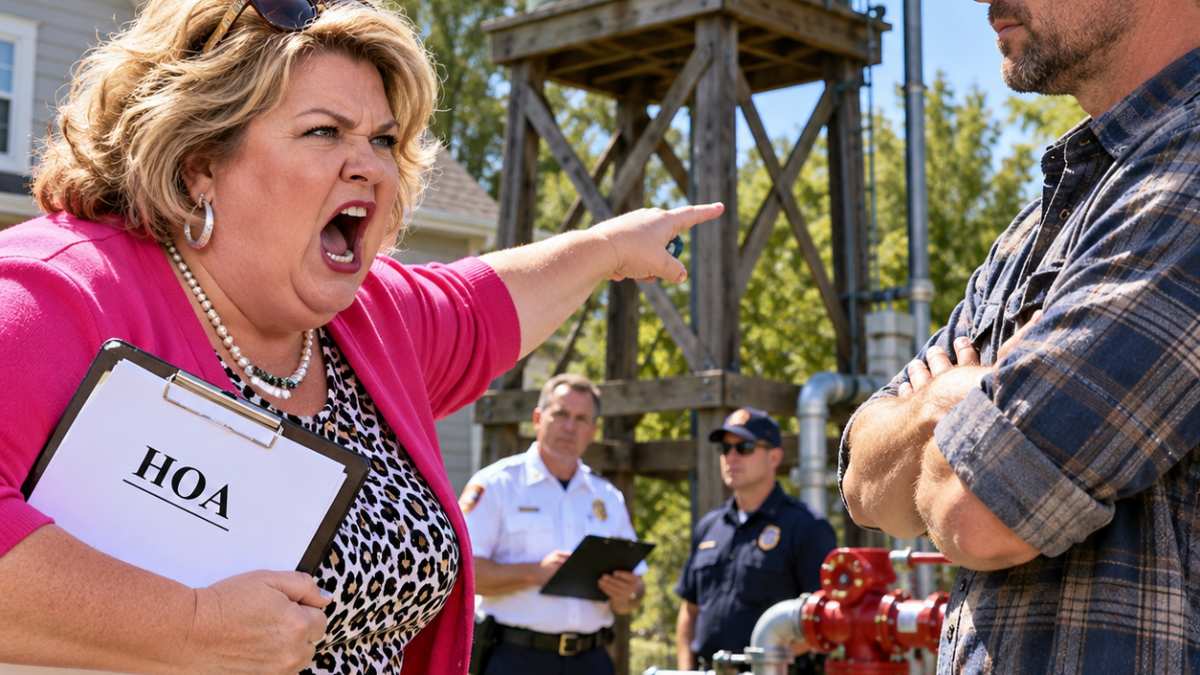
PART 2
The Land My Grandfather Refused to Sell
Sarah followed me into the kitchen, still watching my face with the worried expression she wore whenever she knew I was holding something back.
She had witnessed most of the confrontation through the window, but she hadn’t heard every word. What she had seen was enough to concern her. Karen was already known throughout the neighborhood for her aggressive enforcement of HOA regulations, and anyone who crossed her seemed to find themselves drowning in notices, fines, and threats.
“Tell me exactly what happened,” Sarah said.
I set the violation notice on the kitchen table and pushed it toward her.
She read the first paragraph. Her eyebrows rose. By the time she reached the demolition threat, she looked genuinely frightened.
“They can’t do this, can they?”
“No.”
“Are you sure?”
“Completely.”
“Then why does she seem so convinced she can?”
I pulled out a chair and sat down across from her.
“Because she’s used to people being afraid of her.”
Sarah studied me.
“And you’re not?”
“I’m angry,” I admitted. “But that’s different.”
She reached across the table and took my hand.
“I know what that tower means to you, Jack.”
She did.
Sarah had never met my grandfather, but she knew his story almost as well as I did. She had listened patiently when I described the farm as it used to be, when I’d told her about summer evenings feeding the cattle, helping Grandpa repair broken fences, and watching him climb the water tower’s maintenance ladder with the kind of confidence that made my grandmother furious.
After I came home from Afghanistan, this property had become more than an inheritance. It was the place where I learned to sleep through the night again. It was where Sarah and I planted our first vegetable garden, where we learned to build a life together, and where I finally stopped feeling like a stranger in my own country.
My grandfather had bought these twenty acres after returning from Korea.
Back then, Oak Creek wasn’t a wealthy residential development with decorative streetlights and expensive landscaping. It was farmland, dusty county roads, modest houses, and neighbors who depended on one another.
The nearest reliable municipal water connection was miles away. The local supply struggled during dry summers, and water pressure was inconsistent.
My grandfather was a practical man. When something needed fixing, he didn’t sit around waiting for somebody else to solve it.
He called several Army buddies, ordered steel, hired local tradesmen, and started building a private water storage and pressure system.
It took nearly two years to complete the tower and associated infrastructure.
The final structure wasn’t pretty by modern subdivision standards, but it worked. More importantly, my grandfather made arrangements that allowed the nearby volunteer fire department to draw on the system when necessary.
He considered that part of being a good neighbor.
In 1988, developers purchased most of the surrounding agricultural land and announced plans to build the Estates at Oak Creek.
The development was ambitious: 250 homes, a community clubhouse, landscaped parks, a swimming pool, and a network of paved streets.
But the project ran into a problem.
The area’s elevation and existing water infrastructure made the proposed fire-protection system expensive to complete. County engineers determined that the subdivision needed additional storage and pressure capacity to support its planned hydrant network.
The developers faced a costly choice.
They could construct a dedicated pumping and storage facility.
Or they could negotiate access to the already established system on my grandfather’s property.
They chose the second option.
Grandpa agreed, but only after his attorney ensured the arrangement protected our family’s land.
The developers received a recorded easement allowing their fire-protection infrastructure to connect to and benefit from his water system, subject to an ongoing service and maintenance arrangement.
In exchange, his property—identified in the original documents as Lot One—would remain exempt from HOA covenants, dues, special assessments, and architectural restrictions.
The agreement had been reviewed by county officials, signed by the relevant parties, notarized, and recorded against the property.
It wasn’t a neighborhood handshake.
It was a legally documented arrangement that had survived decades of changing ownership.
And Karen Albright had apparently never bothered to read it.
Sarah looked up from the notice.
“You should call David.”
David Chen was an old Army friend who had become a highly respected property and contract attorney after leaving the service.
“I will,” I replied. “But first, I’m going to the workshop.”
“Why?”
“Because I want to make absolutely certain that everything Grandpa left us is exactly where he said it would be.”
Outside, the afternoon sun had begun slipping behind the oak trees. I crossed the yard and entered the workshop, where my grandfather’s old steel filing cabinet still stood against the back wall.
The cabinet smelled like machine oil, old paper, and the faint mustiness of a building that had survived countless humid summers.
I opened the second drawer.
There it was.
A thick manila folder labeled in my grandfather’s handwriting:
OAK CREEK — WATER EASEMENT — 1988.
I carried it to the workbench.
Inside were the original agreement, county maps, engineering documentation, correspondence with the developer, and records of the system’s maintenance.
I found the specific clause exempting the property from HOA control.
I read it twice.
Then I located the map showing the water-main connection running from my land into the subdivision.
The tower wasn’t merely sitting beside the neighborhood.
It was physically connected to infrastructure serving hundreds of homes.
I placed the documents in separate protective sleeves and began photographing every page.
Sarah appeared in the doorway carrying two mugs of coffee.
“You found it?”
“All of it.”
She handed me a mug and looked down at the spread of documents.
“What are you thinking?”
I studied the map for a moment.
“I’m thinking Karen has no idea what she’s threatening.”
Sarah’s expression changed.
“What does that mean?”
“It means this isn’t only about our property.”
I turned the map toward her.
“Look at this line.”
She leaned closer.
“It goes into the neighborhood.”
“Exactly.”
“And these branches?”
“Water mains serving the hydrants.”
Sarah looked toward the window, where the upper portion of the tower was visible above the trees.
Then she looked back at me.
“Jack…”
“I know.”
She took a slow breath.
“You need to make sure nobody touches it.”
I nodded.
“That,” I said, “is exactly what I’m going to do.”
What neither of us knew was that Karen had already decided Friday was much too long to wait.
And the following morning, she sent strangers to my front gate with orders that could have changed the lives of 250 families.
The Morning Karen Sent a Demolition Crew
At 8:17 the next morning, I heard the unmistakable rumble of a heavy diesel engine coming up our road.
I was in the workshop photographing old documents when the sound grew louder, followed by the electronic beeping of a large vehicle backing up. At first, I assumed it was a delivery truck making a wrong turn, but when I looked out the window, I saw a flatbed carrying demolition equipment and a white pickup truck with ACE DEMOLITION printed across its doors.
My stomach tightened.
I stepped outside and headed toward the gate.
A man wearing a hard hat and fluorescent safety vest climbed out of the pickup. He was broad-shouldered, probably in his forties, with a sunburned face and the weary expression of someone who had already dealt with too many problems that morning.
He looked up at the water tower, then down at his clipboard.
“Morning,” he called. “You Jack Garrison?”
“That depends on why you’re asking.”
He offered a cautious smile.
“Name’s Mitch. I’m the crew supervisor with Ace Demolition. We’ve got a work order to dismantle an elevated water tank at this address.”
I stopped on my side of the closed gate.
“Who issued the order?”
“The Estates at Oak Creek HOA.”
“Did they tell you they own this land?”
Mitch hesitated.
“They told us they had authority over the property.”
“They don’t.”
He frowned and checked his paperwork.
“Look, man, I’m just doing the job they hired us to do. The lady who called said this thing was an immediate hazard and needed to come down before the weekend.”
“What lady?”
“Karen Albright.”
Of course.
I glanced at the heavy equipment waiting behind him. My grandfather’s tower had stood through hurricanes, lightning storms, decades of summer heat, and countless winters.
Now a woman with a clipboard had nearly convinced a demolition contractor to destroy it because she disliked the view.
“Before you unload anything,” I told Mitch, “there’s something you need to see.”
I held up a copy of the recorded easement and the county survey.
Mitch walked toward the gate.
I passed the documents through the bars.
He studied the first page, then flipped to the map.
His expression changed.
“Wait a second. This property isn’t part of the HOA?”
“No. It never has been.”
“But the work order lists this address.”
“That doesn’t give them ownership or authority.”
Mitch examined the documents again.
“There’s a recorded exemption right here.”
“Correct.”
He looked toward the tower.
“Why didn’t she mention that?”
“You’d have to ask her.”
He rubbed the back of his neck.
Then he pulled out his phone.
“I’m calling my boss.”
I stood quietly while he explained the situation.
His supervisor was understandably furious.
Not with me.
With the possibility that his company had almost entered private property and dismantled a structure without lawful authorization.
A few minutes later, Mitch called Karen.
He put the phone on speaker.
Her voice exploded from the device before he finished introducing himself.
“Why hasn’t the equipment been unloaded?”
“Ma’am, we’ve encountered a legal issue with the property.”
“There is no legal issue. I authorized the work.”
“The homeowner has recorded county documents showing this parcel isn’t under your HOA.”
“He’s lying!”
Mitch looked at me.
I didn’t say anything.
Karen continued.
“That man has been obstructing our community improvement efforts for months. He’s deliberately refusing to follow the rules, and I’m not going to let him manipulate another contractor.”
“Ma’am, our legal department will have to review this before we do anything.”
“I don’t have time for a review! I hired you to remove a dangerous structure!”
“Karen,” I said.
There was a pause.
Then her voice dropped.
“Mr. Garrison.”
“You have been told this land is exempt from your HOA. You’ve also been told the tower is connected to an existing service agreement. You are now attempting to have it destroyed anyway.”
“You’re twisting things.”
“No. I’m documenting them.”
“You think you can intimidate me?”
“I think you should tell this contractor to leave.”
For a moment, I heard nothing but breathing through the speaker.
Then she snapped.
“Fine! If he won’t cooperate, call the police. Have him removed so the work can proceed!”
Mitch visibly recoiled.
“Ma’am, that’s not how this works.”
I spoke before she could interrupt again.
“Karen, you’re welcome to call the sheriff. When the deputies arrive, I’ll show them the recorded property agreement, and I’ll ask them to document your attempt to send unauthorized demolition crews onto my land.”
“You wouldn’t dare.”
“Try me.”
The phone went silent.
Then Mitch’s supervisor came back on the line.
“Mitch, load up. We’re not touching that tower.”
“Yes, sir.”
“And send me copies of every document the homeowner showed you.”
“Already taking pictures.”
The call ended.
Mitch returned my paperwork.
“I’m sorry about this,” he said. “We were told everything was approved.”
“I believe you.”
He glanced back at the tower.
“Seems like a lot of trouble over an old water tank.”
“It’s more important than it looks.”
He nodded slowly.
“Most things are.”
Ten minutes later, the trucks were gone.
I watched them disappear down the road, leaving tire tracks in the gravel and the smell of diesel hanging in the morning air.
Sarah came outside.
“Was that what I think it was?”
“Yes.”
“She actually hired someone?”
“Yes.”
“And they left?”
“They did.”
She pressed a hand over her mouth.
For a moment, neither of us spoke.
Then she said something I hadn’t expected.
“Jack, what if we’d gone away for the weekend?”
I looked at the empty road.
The thought hit harder than Karen’s threats had.
If we’d been out of town, if the contractor had accepted her claimed authority without checking the records, if someone had started cutting or dismantling equipment connected to an active water system…
There were too many possibilities.
And not all of them ended with an old tower falling into a field.
That was when I decided this matter could no longer remain a private argument between neighbors.
Karen had made it a public safety issue.
Now the people responsible for public safety needed to know.
The Paper War Begins
By Wednesday afternoon, Karen had changed tactics.
Apparently, when heavy machinery failed, she decided to try drowning me in paperwork.
I found a large envelope in the mailbox bearing the HOA’s official letterhead.
Inside were twelve separate violation notices.
I spread them across the kitchen table while Sarah watched in disbelief.
The first demanded $500 for refusing to comply with an emergency board directive.
The second imposed a $100 daily penalty for maintaining an unauthorized structure.
Then came a $50 fine for my thirty-year-old Ford F-150 being visible from the street.
A $75 fine for improper lawn maintenance.
Another fine for an allegedly unsuitable fence color.
There was even a violation for allowing dandelions to grow near the road.
Sarah picked up that last one.
“Dandelions?”
I nodded.
“They’re dangerous little things.”
She didn’t laugh.
“Jack, this isn’t funny.”
“I know.”
“She can’t just keep doing this.”
“No. But every notice she sends gives us another record of what she’s trying to do.”
Sarah stared at me.
“You’re being awfully calm about someone threatening our home.”
That was when I finally told her what had been turning over in my head since the demolition crew left.
“I spent years overseas learning what happens when someone mistakes authority for ownership,” I said. “Karen isn’t going to stop because I yell louder than she does. She’s going to stop when the people around her understand exactly what she’s doing.”
Sarah lowered herself into the chair beside me.
“And how do we make that happen?”
“Evidence. Witnesses. The county. The fire department. David.”
She leaned against my shoulder.
“Your grandfather would have fought her.”
I smiled faintly.
“Grandpa would have invited her in for coffee first.”
Sarah laughed despite herself.
“He would have.”
“And if she still acted like this?”
“He would have told her to get off his land.”
“Exactly.”
I gathered the notices into a folder, photographed each one, and wrote down the dates and circumstances surrounding both of Karen’s visits.
I also contacted the demolition contractor to request a written record of the work order and its cancellation.
Then I made an appointment with the man I believed could explain the tower’s importance better than anyone alive.
Northwood County Fire Chief Robert Henderson.
I had known him since I was a child.
And he had known my grandfather even longer.
The Fire Chief Who Remembered Everything
Fire Station Two sat several miles outside town, a sturdy brick building with three engine bays and an American flag flying above the entrance.
When I walked inside carrying my grandfather’s files, a young firefighter at the front desk asked whom I needed to see.
“Chief Henderson, if he’s available.”
“Name?”
“Jack Garrison.”
The firefighter looked up.
“Garrison? As in the old water tower?”
I nodded.
He smiled.
“Chief talks about that place all the time.”
He led me down a hallway to Henderson’s office.
The chief was sitting behind a desk covered in reports, reading glasses balanced on the end of his nose.
He looked up.
For a second, he studied my face.
Then he grinned.
“Well, I’ll be damned. Jack Garrison.”
I smiled.
“Good to see you, Chief.”
He stood and came around the desk, pulling me into a rough handshake.
“Last time I saw you, your granddad was threatening to ground you for climbing halfway up his water tower.”
“I remember.”
“You scared ten years off that man’s life.”
“He was pretty mad.”
“Mad? Son, I thought he’d have a heart attack.”
We laughed.
Then Henderson’s smile softened.
“Your grandfather was a good man, Jack.”
“I know.”
“County owes him more than most people remember.”
I set the folder on his desk.
“That’s actually why I’m here.”
He gestured toward a chair.
“Sit down.”
I explained everything.
Karen’s ultimatum.
The violation notices.
The demolition trucks.
The recorded easement.
The escalating threats.
Henderson listened without interrupting.
But as I spoke, his expression darkened.
When I finished, he stared at me for several seconds.
Then he said, very quietly, “She ordered the tower demolished?”
“Yes, sir.”
“The Garrison tower?”
“Yes.”
“While it’s still connected to the subdivision’s fire-protection system?”
“Yes.”
He stood so abruptly his chair rolled backward.
“Good Lord.”
He walked across the room toward a large county infrastructure map hanging on the wall.
“Come here.”
I joined him.
He pointed to the Estates at Oak Creek.
“Two hundred fifty homes. Community center. Swimming pool. Thirty-seven hydrants.”
His finger moved along a red line connecting the subdivision to the water system on my property.
“This is your grandfather’s main connection.”
“I know.”
“Do you understand what happens if somebody takes that tank out of service without an engineered replacement?”
“I have a pretty good idea.”
He tapped the map.
“This neighborhood was designed around that pressure source. The system has other connections, but your tower provides a major part of the available pressure and storage supporting fire flow.”
He opened a cabinet and pulled out a thick binder.
“Last year’s test results showed around 120 pounds per square inch at one of our monitoring points under the recorded test conditions. Our engineers estimated a severe pressure reduction if that tower were simply disconnected.”
He looked directly at me.
“Jack, under certain conditions, we’re talking about a reduction approaching sixty percent.”
Even though I knew the tower was important, hearing that number made my stomach drop.
Henderson continued.
“Without a replacement supply, we could have hydrants that fail to deliver adequate fire flow when they’re needed. That means longer hose lays, more dependence on pumper trucks and tankers, and additional response time.”
He paused.
“And in a fast-moving residential fire, extra minutes can mean lives.”
I thought about the Miller family, whose children I’d seen riding bicycles near the entrance.
I thought about Mrs. Gable, the elderly widow who lived alone on the corner.
I thought about all the ordinary families who trusted the hydrants outside their houses without ever wondering where the water pressure came from.
“Does Karen know?” I asked.
Henderson let out a bitter laugh.
“If she knows and she’s doing this anyway, it’s worse than I thought. If she doesn’t know, she’s dangerously ignorant.”
He turned toward his desk.
“I’m writing a formal letter.”
“Chief, you don’t have to—”
“Yes, I do.”
He sat down, pulled out official letterhead, and began dictating to his assistant.
The document identified the water tower as critical infrastructure supporting the development’s fire-suppression network.
It warned against unauthorized interference, dismantling, or removal.
It referenced the recorded service agreement and explained the potential consequences for emergency response and insurance classifications if the system were compromised.
Then Henderson handed me copies of historical hydrant-flow reports and the relevant infrastructure records.
“I’ll notify the county’s fire prevention office and water-system personnel,” he said. “They need to know somebody has threatened this equipment.”
I nodded.
“Thank you.”
He leaned back in his chair.
“Your grandfather helped keep this county safe. I’m not going to stand by while somebody tears down his work because she doesn’t like looking at it.”
His voice softened.
“Tom built that tower for people he’d never meet. Half those families don’t even know his name.”
I swallowed hard.
“I know.”
Henderson looked at me for a moment.
Then he said, “Maybe it’s time they did.”
I left the station carrying a second folder of documents, heavier than the first.
For the first time since Karen had stepped onto my property, I felt something other than anger.
I felt the weight of my grandfather’s legacy.
And I realized that protecting his tower meant protecting more people than I’d ever imagined.
The Neighbors Karen Had Silenced
I could have taken the chief’s letter straight to Karen and demanded she withdraw every notice.
Instead, I decided to speak with the people who lived under her leadership.
I wanted to know whether I was her only target.
My first stop was a small white house near the subdivision’s western entrance.
Mrs. Eleanor Gable answered the door wearing a flowered apron, her silver hair pinned neatly behind her ears.
She was eighty-two, sharp as a tack, and had lived in Oak Creek since the first houses were built.
“Jack Garrison!” she exclaimed. “My goodness, come inside.”
Her living room smelled like cinnamon and fresh coffee.
Photographs of her late husband covered the mantel, alongside pictures of grandchildren, Christmas gatherings, and a younger Mrs. Gable standing beside my grandfather at what appeared to be a neighborhood celebration.
I picked up the photograph.
“Is that Grandpa?”
She smiled.
“Yes, it is. That’s from the dedication of the first community water connection.”
I studied his face.
He looked strong and happy, his arm around another man’s shoulder.
Mrs. Gable watched me quietly.
“You’ve got his eyes, you know.”
I smiled.
“People tell me that.”
She motioned toward the couch.
“What brings you here, sweetheart?”
I explained Karen’s threats.
Her face changed.
“She wants to tear down Tommy’s tower?”
“Yes, ma’am.”
“Oh, that woman has finally lost her mind.”
She shook her head.
“Your grandfather helped this community before half these people were born. When my husband had his heart attack, Tommy was the one who drove me to the hospital because I was too frightened to drive myself.”
I hadn’t known that.
She reached for a tissue.
“Your grandfather wasn’t rich, Jack. He didn’t have much to give. But he always gave what he had.”
I looked down at my hands.
Hearing stories about Grandpa from someone who had loved him made the confrontation suddenly feel more personal.
Then Mrs. Gable sighed.
“Karen’s been making everyone miserable.”
“What do you mean?”
She stood, walked to a drawer, and returned with several letters.
“I got fined because of my garden gnome.”
I blinked.
“Your what?”
“The little ceramic fellow beside my roses.”
I remembered it immediately—a cheerful red-hatted figure she’d kept by her front walkway for years.
“She said it was inconsistent with the neighborhood’s naturalistic aesthetic.”
I stared at her.
Mrs. Gable gave a tired laugh.
“My husband bought me that gnome for our twenty-fifth anniversary. He thought it was ridiculous, and that’s why I loved it.”
Her voice broke slightly.
“He’s been gone eleven years. Sometimes I sit outside and look at that silly thing because it reminds me of how he used to laugh.”
I looked at the violation notice.
A seventy-five-dollar fine.
For a widow keeping a memory of her husband in her garden.
My anger returned, colder than before.
“Did you pay it?”
“Yes.”
“Why?”
She looked embarrassed.
“Because I didn’t want trouble.”
That answer stayed with me long after I left her house.
I visited the Millers next.
They were a young couple with two children, a seven-year-old boy named Ethan and a four-year-old girl named Lily.
Their house was spotless, their lawn freshly cut, and their driveway almost unnaturally empty.
When I knocked, Daniel Miller opened the door and looked nervously toward Karen’s house across the street.
“Can we talk inside?” he whispered.
His wife, Megan, joined us at the kitchen table.
I asked whether they had experienced problems with the HOA.
Daniel gave a humorless laugh.
“Where do you want us to start?”
They showed me a thick folder.
Fines for leaving Ethan’s tricycle on the driveway overnight.
Fines for installing a basketball hoop too close to the sidewalk.
A warning because their front-door paint was supposedly the wrong shade of white.
Another because Megan had hung a small seasonal wreath without submitting an architectural approval request.
Megan looked exhausted.
“We bought this house because we thought it would be a safe, friendly place to raise our kids,” she said. “Now I feel like somebody’s watching everything we do.”
Daniel glanced toward the window.
“Karen told us if we kept challenging her decisions, she’d make sure we regretted it.”
I looked at their children playing quietly in the living room.
The boy was building a tower out of plastic blocks.
His little sister kept knocking it down, and he kept patiently rebuilding it.
“Would you be willing to share these documents?” I asked.
Daniel hesitated.
“Is this about your water tower?”
“Yes.”
He lowered his voice.
“She’s been telling people you’re dangerous. That you’re refusing to remove some unstable structure that could collapse on the neighborhood.”
I took a slow breath.
“Did she mention that the fire department relies on it?”
Both parents looked at me.
“What?”
I showed them Chief Henderson’s letter.
Megan read it first.
Then she passed it to her husband.
The color drained from his face.
“You’re kidding.”
“I wish I were.”
Daniel looked toward the living room again.
“Lily’s bedroom faces the street. There’s a hydrant right outside our house.”
“I know.”
He stared at the document.
“And she wants that tower gone?”
“Yes.”
For a long moment, he said nothing.
Then he pushed the folder toward me.
“Take whatever copies you need.”
Over the next several days, I spoke with more residents.
A retired teacher who’d been fined for planting the wrong flowers.
A single father threatened with penalties over a wheelchair ramp.
A couple who had received repeated warnings about a harmless bird feeder.
Not every complaint was legally baseless, and not every dispute was the same. But the pattern was disturbing.
Karen seemed to thrive on the fear she created.
She used the HOA rules less like a system for maintaining shared standards and more like a weapon against people who questioned her authority.
And nearly everyone had the same explanation for staying quiet.
They didn’t want trouble.
I understood that feeling.
I had spent enough time around people who abused authority to know how easily intimidation becomes normal when nobody challenges it.
But now I had something Karen didn’t.
I had witnesses willing to speak.
And I had the truth about the tower.
What I needed next was someone who knew how to turn that truth into consequences.
The Attorney Who Had Once Saved My Life
David Chen answered my phone call on the second ring.
“Garrison! What’s going on?”
“David, I need a lawyer.”
There was a brief silence.
Then his tone changed.
“Are you all right?”
“I’m fine.”
“Sarah?”
“She’s fine too.”
“Then what happened?”
I looked out the kitchen window toward the tower.
“The HOA wants to tear down Grandpa’s water tower.”
He laughed.
I didn’t.
His laughter stopped.
“Wait. You’re serious?”
“Very.”
“Tell me everything.”
Twenty minutes later, he said, “Bring your documents to my office tomorrow morning.”
David and I had served together in Afghanistan.
We had shared patrols, miserable field rations, sleepless nights, and the particular kind of trust that develops when your life depends on another man’s decisions.
During one deployment, an explosive device struck a vehicle ahead of ours.
I still remembered the dust, the ringing in my ears, and David pulling me away from danger while I struggled to understand what had happened.
We rarely spoke about those years.
We didn’t need to.
When David left the Army, he used his education benefits to attend law school, eventually building a practice focused on property disputes and contractual litigation.
He was methodical, relentless, and nearly impossible to intimidate.
Which made him precisely the attorney Karen should have hoped I’d never call.
The next morning, I arrived at his office carrying three thick folders.
He met me in the conference room.
“You look like you’re preparing for a court-martial,” he said.
“Feels familiar.”
He grinned.
“Good. Let’s see what we’ve got.”
I laid everything on the table.
The deed.
The 1988 easement.
The property survey.
The HOA violation notices.
Photographs of the demolition equipment.
Records from Ace Demolition.
Chief Henderson’s letter.
Hydrant-flow reports.
Statements from neighbors.
David examined the documents slowly.
He asked questions.
He made notes.
He reviewed dates, signatures, property descriptions, and the language of the original agreement.
I watched his expression change from curiosity to professional concentration.
Finally, he leaned back.
“Jack, this is serious.”
“I know.”
“No, I mean serious for the HOA.”
He tapped the easement.
“This recorded agreement matters. If it’s valid and still enforceable as written, the HOA can’t simply pretend your land falls under its restrictions.”
He picked up the demolition contractor’s statement.
“And she ordered physical work on your property after being told she lacked authority.”
“Yes.”
“Then she sent fines anyway.”
“Twelve of them.”
He exhaled.
“She’s giving us quite a record.”
I asked the question that had been bothering me since the demolition crew arrived.
“Could they actually force us to remove it?”
“Not on the facts you’ve shown me. But we’re going to verify the chain of title, confirm the legal status of the easement, and make sure every relevant agency is aware of the dispute.”
He lifted Chief Henderson’s letter.
“This changes the scale of the problem.”
“How?”
“Because it’s no longer just about your right to maintain a structure. It’s about interference with an infrastructure arrangement that an entire residential development depends on.”
He looked at me.
“If she caused this system to be dismantled without a replacement, the consequences could extend far beyond damage to your property.”
I nodded.
“I’ve been thinking about that.”
David tapped his pen on the table.
“We need to stop her from touching it. Immediately.”
He began outlining possible legal remedies: a cease-and-desist demand, emergency injunctive relief if the threat continued, a request for declaratory judgment concerning the HOA’s authority, and claims arising from any demonstrable harassment or property damage.
He was careful to distinguish what we could prove from what we’d still have to investigate.
“I’m not promising the court will give us everything we ask for,” he said. “But you’ve got strong documentary evidence, and we should use it.”
He studied the folder of HOA fines.
“Has she filed a lien?”
“Not that I know of.”
“We’ll check. And if she has, we’ll deal with that too.”
For nearly two hours, we organized the evidence and developed a plan.
David wanted the county notified, the service agreement independently verified, and the HOA’s legal representatives placed on formal notice that the tower was not to be touched.
He also learned that the HOA’s quarterly meeting was scheduled for the following week.
When I mentioned Karen’s reputation for controlling those meetings, he grew thoughtful.
“She may try to use the membership to authorize the demolition expense,” he said.
“That’s what I’m worried about.”
“Then the homeowners deserve to know what they’re being asked to approve.”
I looked at him.
“What are you suggesting?”
“That we make sure they hear the facts before anyone votes to spend their money.”
He paused.
“And Jack?”
“Yeah?”
“Don’t confront her alone again. If she contacts you, preserve the communication and send it to me.”
I nodded.
Then he stood and offered his hand.
“We’ll handle this properly.”
I shook it.
For a second, we were back in the Army, trusting each other to do what needed to be done.
Only this time, the battlefield was a quiet American subdivision.
And the lives potentially affected belonged to families who thought their biggest neighborhood problem was an old water tower spoiling the view.
Karen Makes Her Most Dangerous Move
The following Friday, I received a registered letter from the HOA.
I opened it at the kitchen table.
Sarah was preparing lunch.
She glanced over.
“More fines?”
“Worse.”
The letter informed me that the board intended to seek authorization for emergency removal of the tower at the upcoming HOA meeting.
According to Karen, the structure represented a continuing threat to community safety and property values.
She also claimed I had refused multiple reasonable opportunities to cooperate.
Then came the sentence that made me stop reading.
The HOA planned to propose a $200 special assessment for each of the 250 households to finance removal-related costs.
I did the math.
Fifty thousand dollars.
Karen wanted to collect fifty thousand dollars from her neighbors to help destroy the structure supporting their own fire-protection system.
Sarah read the letter over my shoulder.
“She can’t be serious.”
“She is.”
“That’s fifty thousand dollars.”
“I know.”
“And everyone has to pay?”
“That’s what she’s proposing.”
Sarah moved away from the table and stood by the sink.
I could see her struggling to understand how anyone could behave this way.
“Does she know the truth now?”
“She has enough information to ask the right questions.”
“Then why is she still doing it?”
I folded the letter.
“Because backing down would mean admitting she was wrong.”
Sarah turned toward me.
“Jack, I don’t like this anymore.”
I stood and walked over to her.
“What do you mean?”
“I mean she keeps getting more aggressive. First the notice, then the trucks, then the fines, and now she’s trying to get the entire neighborhood involved.”
She looked up at me.
“People like that don’t always stop just because the facts are against them.”
I knew she was right.
I put my arms around her.
“That’s why David’s handling the legal side.”
She rested her forehead against my chest.
“I don’t care about winning some fight with that woman,” she whispered. “I just want us to be able to live here without looking over our shoulders.”
Her words hit me harder than I’d expected.
I had been concentrating so completely on protecting the tower that I hadn’t fully considered what the conflict was doing to my wife.
Every strange vehicle made her glance toward the window.
Every letter in the mailbox made her tense.
Every time the phone rang from an unfamiliar number, she wondered whether another threat was coming.
I realized then that Karen wasn’t simply attacking an old structure.
She was stealing the peace my family had worked so hard to build.
And I was finished letting her do it.
That afternoon, I forwarded the special assessment notice to David.
He called me almost immediately.
“Jack, this is useful.”
“Useful?”
“She has put the proposed expenditure in writing. That gives us a concrete issue to raise with the association.”
“Can we stop the vote?”
“We can challenge the action and make sure the membership receives accurate information. I’ve also contacted the HOA’s counsel.”
I glanced toward the tower.
“What about Henderson?”
“He’s aware of the meeting. He’s preparing to address the public safety issue.”
“You think Karen will listen?”
David was quiet for a moment.
“Honestly, I don’t know.”
Then he added, “But I’m not particularly concerned with whether Karen listens. I’m concerned with whether the homeowners understand what she’s asking them to do.”
I thought about Mrs. Gable.
The Millers.
The dozens of people who had told me they were afraid of speaking up.
And for the first time, I began to imagine the meeting differently.
Karen believed she would be standing in front of a room full of obedient homeowners.
She had no idea how many of them were beginning to question her.
The Night Before the Meeting
The evening before the HOA meeting, I walked down to the water tower alone.
The sky was turning orange above the tree line.
A light wind moved through the tall grass, and the old farmhouse glowed warmly behind me.
I stood beneath the tower, resting my hand against one of its weathered steel legs.
The metal was warm from the afternoon sun.
I remembered being eleven years old, sitting beside my grandfather while he tightened bolts on a nearby maintenance platform.
He had been seventy then, his hair almost completely white, but his hands were steady.
I’d asked him why he never painted the tower a prettier color.
He’d laughed.
“Pretty doesn’t put out fires, Jack.”
Then he’d looked out toward the land that would eventually become Oak Creek.
“You know what matters?”
“What?”
“That when somebody turns a valve because their home is burning, the water comes.”
I hadn’t thought about that conversation in years.
Now it came back so clearly that I could almost hear his voice.
I looked up at the enormous tank.
For most of my life, I had thought of the tower as a symbol of Grandpa’s strength.
But standing there, I finally understood what he meant.
Its purpose wasn’t to impress anyone.
Its purpose was to be there when people needed it.
“I’m trying, Grandpa,” I whispered.
The words escaped before I could stop them.
I wasn’t a man who talked to people who were gone.
But grief has a way of surviving in quiet corners of your life, waiting for moments when old memories suddenly become too heavy to carry silently.
I missed him.
I missed his rough laugh, his terrible jokes, and the way he could make any problem seem manageable with a cup of coffee and a few minutes of thought.
Most of all, I missed being able to ask him what he thought I should do.
I stood there until the last sunlight faded from the upper rim of the tank.
Then I heard footsteps behind me.
Sarah approached carrying my grandfather’s old Army jacket.
“You forgot this,” she said.
I slipped it over my shoulders.
She stood beside me.
“Thinking about him?”
“Yeah.”
She reached for my hand.
“He’d be proud of you.”
I shook my head.
“I haven’t done anything yet.”
“You protected what he built. You stood up for your family. And you’re trying to make sure nobody gets hurt.”
She looked toward the tower.
“That sounds like something he’d be proud of.”
I squeezed her hand.
For a while, we stood without speaking.
Then Sarah asked, “Are you ready for tomorrow?”
I watched the first stars appear.
“As ready as I’ll ever be.”
She leaned against me.
“Whatever happens, we’re going through it together.”
I turned and kissed her forehead.
That promise meant more than any legal document in my workshop.
Because by the following evening, Karen would make her accusations in front of the entire neighborhood.
And the truth she’d spent weeks refusing to hear would finally be spoken where everyone could hear it.
The Meeting That Changed Everything
The Estates at Oak Creek clubhouse looked almost cheerful from the outside.
Warm light shone through the windows. Decorative shrubs lined the walkway, and an expensive stone sign near the entrance welcomed residents to what Karen liked to call “Oak Creek’s premier community experience.”
Inside, however, the atmosphere was tense.
Folding chairs had been arranged in rows facing a long table where the HOA board sat beneath an enormous framed photograph of the subdivision.
Karen occupied the center seat.
She wore a dark blue blazer, a pearl necklace, and the same expression of absolute certainty I’d seen on my front lawn.
As Sarah and I entered, conversations slowed.
Several residents glanced our way.
Others looked down at their laps.
Mrs. Gable sat near the middle of the room, holding her handbag tightly.
Daniel and Megan Miller occupied seats closer to the aisle.
I caught Daniel’s eye.
He gave me a small nod.
Sarah squeezed my arm.
“Remember what David said.”
“I remember.”
We took seats in the back row.
The meeting began promptly at seven.
Karen struck her gavel against the table.
“Ladies and gentlemen, thank you for attending tonight’s quarterly meeting of the Estates at Oak Creek Homeowners Association.”
She smiled.
“Unfortunately, we have a very serious matter to discuss.”
I knew what was coming.
She pressed a button on her remote.
A photograph of my water tower appeared on the large screen behind her.
It had been taken on a gray, overcast afternoon, from an angle that emphasized the weathered steel and dark shadows beneath the tank.
Karen gestured dramatically toward the image.
“This,” she announced, “is the unsightly structure threatening the beauty and safety of our community.”
Several people murmured.
Karen continued.
“For too long, this development has tolerated a dangerous, deteriorating industrial structure directly adjacent to our residential properties.”
I leaned back and folded my arms.
Sarah looked at me.
I shook my head slightly.
Not yet.
Karen moved to the next slide.
It contained photographs of the tower, enlarged and accompanied by phrases such as POTENTIAL STRUCTURAL HAZARD, PROPERTY VALUE CONCERNS, and NONCOMPLIANT CONSTRUCTION.
“Your board has made repeated attempts to reach a reasonable resolution with the owner, Mr. Jack Garrison.”
She paused and looked directly toward the back of the room.
“Unfortunately, Mr. Garrison has been openly hostile, uncooperative, and unwilling to comply with our community standards.”
I heard Sarah inhale sharply.
My hands tightened around the arms of my chair.
Karen went on.
“We have therefore been left with no option but to pursue emergency removal.”
A man near the front raised his hand.
“Has an engineer determined that the tower is actually unsafe?”
Karen’s expression tightened.
“The board has reviewed the situation.”
“That wasn’t my question.”
A few people turned toward him.
He continued.
“I’m asking whether a licensed engineer inspected it and concluded it needs demolition.”
Karen looked irritated.
“We have sufficient concerns to justify corrective action.”
“So that’s a no?”
“Please allow me to finish.”
She clicked to the next slide.
An estimate from Ace Demolition appeared.
Then another slide displayed the proposed special assessment.
$200 PER HOUSEHOLD — EMERGENCY STRUCTURE REMOVAL.
The room erupted in murmurs.
“Two hundred dollars?”
“What for?”
“We already pay more than enough in dues.”
Karen raised her hand.
“Please, everyone. I understand that additional expenses are never popular. But the safety and appearance of this community must remain our highest priorities.”
She placed one hand over her chest.
“As your president, I have a responsibility to make difficult decisions.”
I nearly laughed.
Then she said something that changed the atmosphere entirely.
“If we allow this homeowner to ignore our authority, what message does that send? How can we enforce any standard if we make an exception for one man?”
I stood.
“Because my property isn’t part of your association.”
Karen’s head snapped toward me.
“Mr. Garrison, you have not been recognized.”
“Then recognize me.”
A few people gasped.
Her face reddened.
“Sit down.”
“Your presentation contains false statements, and you’re asking these families to pay for work you have no legal right to authorize.”
She slammed the gavel.
“You will not disrupt this meeting!”
“I’d like to explain the recorded agreement concerning my land.”
“There is no need. Our legal position is clear.”
“Then why haven’t you shown anyone the agreement?”
Karen hesitated.
Just for a second.
But I saw it.
Then she recovered.
“Mr. Garrison, if you continue this behavior, security will escort you out.”
Sarah rose beside me.
“Jack has a right to correct what you’re saying about him.”
Karen pointed the gavel toward her.
“Mrs. Garrison, you are also out of order.”
The room grew uncomfortable.
A woman near the front whispered, “Why won’t she let him speak?”
Another resident said, “I want to hear what he has to say.”
Karen struck the table again.
“Enough. We’re proceeding to the vote.”
She looked across the room.
“All in favor of approving the emergency special assessment, please indicate—”
The double doors opened.
And the entire room turned.
The Fire Chief Walks In
Chief Robert Henderson entered the clubhouse in his dress uniform, accompanied by two senior fire officers.
He didn’t rush.
He didn’t shout.
He simply walked through the doorway with the same quiet authority I’d seen him carry at emergency scenes when I was younger.
Karen stopped mid-sentence.
Her gavel remained suspended above the table.
Henderson looked at the screen.
Then at the proposed assessment.
Then at Karen.
“Mrs. Albright,” he said, “before anyone votes on this proposal, the homeowners need to understand what that water tower actually does.”
Karen’s smile returned, but this time it looked strained.
“Chief Henderson. What an unexpected surprise.”
“I’m here in connection with a documented public safety concern.”
She cleared her throat.
“Well, Chief, as you can see, we are conducting official association business.”
“I can see that.”
His voice was calm.
“And I can also see you’re proposing to dismantle infrastructure associated with your community’s fire-protection system.”
Silence settled over the room.
Karen blinked.
“I beg your pardon?”
Henderson stepped forward.
“That tower is part of the water supply and pressure arrangement supporting the hydrant network serving this subdivision.”
Someone near the front whispered, “What?”
Henderson continued.
“Thirty-seven fire hydrants are connected to a system whose engineering design depends significantly on the Garrison water infrastructure.”
The silence became almost unbearable.
A man in the second row stood.
“Chief, are you saying our hydrants get water pressure from that tower?”
“I’m saying the original design includes the tower as a critical component of the fire-protection supply.”
He held up a folder.
“We have the recorded service agreement and years of hydrant-flow records confirming its role.”
Several people turned toward Karen.
She stared at Henderson.
“That can’t be right.”
He looked at her steadily.
“It’s right.”
“There must be some misunderstanding.”
“There isn’t.”
She took a step backward.
“Chief, I’m certain we can discuss this privately.”
Henderson glanced around the room.
“Mrs. Albright, these homeowners are being asked to approve spending their own money to remove infrastructure that helps protect their homes from fire. They have a right to understand that before they vote.”
A man near the center stood.
“Wait a minute. Are you saying she wants us to pay to tear down part of our own fire system?”
Karen raised both hands.
“Everybody, please calm down.”
But nobody was calm.
Henderson continued.
“Under the current arrangement, removing that tower without installing and approving an adequate replacement could severely reduce available fire flow. Depending on conditions, the system could experience a very significant pressure loss.”
He opened the folder.
“Our engineers reviewed the existing records. In certain scenarios, they estimated pressure reductions approaching sixty percent.”
A woman gasped.
“Sixty percent?”
“Yes, ma’am.”
Another homeowner stood.
“What would that mean if my house caught fire?”
Henderson took a moment before answering.
“It could mean inadequate water pressure at the nearest hydrant. Firefighters might need to bring in additional water supplies, use longer hose lays, or rely more heavily on apparatus pumping. Those things take time.”
He paused.
“And time matters when people are trapped inside a burning building.”
I watched the room change.
Not slowly.
Almost instantly.
People who had walked in expecting a disagreement over an ugly old tower were now thinking about their children sleeping upstairs.
Their elderly parents.
Their pets.
Their houses.
The things they could never replace.
A man near the aisle pointed toward Karen.
“Did you know this?”
Karen opened her mouth.
Nothing came out.
He asked again, louder.
“Did you know?”
She finally found her voice.
“I was acting on information provided to me concerning an unsafe structure.”
“By whom?” someone demanded.
“Our board reviewed the matter.”
“Did the board speak to the fire department?”
Karen looked toward the other board members.
Neither answered.
Henderson placed his documents on the front table.
“The original municipal service agreement dates to 1988. It was signed in connection with development of these homes.”
He turned to the audience.
“Jack Garrison’s grandfather, Thomas Garrison, agreed to let the developers use his existing system rather than requiring them to construct an entirely separate facility.”
Mrs. Gable stood.
Her hands were trembling.
“I remember that.”
Everyone looked at her.
She held the back of the chair in front of her for support.
“Tommy Garrison was a good man. He helped us when this neighborhood was nothing but dirt roads and construction equipment.”
Her voice cracked.
“He was proud that his tower could help the firefighters.”
Karen tried to interrupt.
“Mrs. Gable, I understand your emotional attachment, but—”
“No!”
The word came out louder than anyone expected.
Mrs. Gable straightened.
“No, Karen. You’ve had your turn.”
The room went completely still.
The elderly woman looked directly at the HOA president.
“You fined me for keeping a little statue my husband gave me. You made my neighbors afraid to let their children leave toys outside. And now you want to tear down something Tommy Garrison built to help people?”
Tears glistened in her eyes.
“You don’t know what makes a community worth living in.”
I felt my throat tighten.
She continued.
“It isn’t matching paint colors or perfect lawns.”
She looked around at the families seated nearby.
“It’s knowing the people next door will help you when something goes wrong.”
Then she turned back toward Karen.
“And you’ve spent years making us afraid of one another.”
Nobody spoke.
For the first time since I’d known her, Karen seemed unable to control a room.
The Documents She Never Wanted Anyone to See
David Chen entered a few minutes later.
He had been coordinating with the county and the HOA’s legal representatives, ensuring that the emergency infrastructure concerns were documented and that any threatened work could be challenged immediately.
He wasn’t there to create a scene.
He was there because the board was considering an action that could expose both the association and individual decision-makers to serious consequences.
He walked toward the front table, carrying a briefcase.
“Mrs. Albright,” he said, “my name is David Chen. I represent Jack Garrison.”
Karen looked at him as though he were another unwelcome intruder.
“This is a private HOA meeting.”
“I’m aware. I’ve also been communicating with your association’s legal counsel.”
He turned toward the homeowners.
“With permission from the chair, I’d like to clarify the property records and the legal status of the structure under discussion.”
Karen said nothing.
The man who had earlier asked about the engineering inspection spoke up.
“I’d like to hear him.”
“So would I,” another resident said.
“Me too.”
Karen looked toward her fellow board members.
Gerald, the treasurer, stared at his papers.
Finally, the other board member said, “I think we should let him explain.”
Karen’s jaw tightened.
“Fine. Five minutes.”
David nodded.
“Thank you.”
He connected his laptop to the projector.
The photograph of my supposedly dangerous tower disappeared.
In its place appeared the recorded 1988 easement.
David pointed to the property description.
“This agreement identifies the Garrison parcel and establishes the conditions under which the development was permitted to connect its fire-protection infrastructure to the existing water system.”
He moved to the next page.
“Here is the provision exempting the property from the HOA covenants and assessments.”
He looked toward Karen.
“The exemption was recorded long before the present board took office.”
A man in the audience raised his hand.
“So Jack’s property isn’t actually governed by the HOA?”
“Based on the records we’ve reviewed, that’s correct.”
The man stared at Karen.
“Then why are we fining him?”
No answer.
David continued.
“Mr. Garrison has repeatedly provided notice of the property’s legal status. Despite that, he received multiple violation notices and was threatened with demolition.”
He displayed a photograph.
Ace Demolition’s truck sat in front of my gate.
Murmurs rippled through the room.
“What’s that?” a woman asked.
“The contractor hired to begin dismantling the tower.”
Daniel Miller stood.
“She actually sent a demolition crew?”
“Yes,” I answered.
He looked stunned.
David brought up the work-order documentation.
“The contractor declined to proceed after reviewing evidence that the HOA lacked authority over the property.”
He displayed the date.
Then he brought up a copy of Karen’s later violation notice.
“Following that incident, Mr. Garrison received additional fines.”
The screen changed.
Five hundred dollars.
One hundred dollars per day.
Fifty dollars for a truck.
Seventy-five dollars for lawn maintenance.
More notices followed.
People began whispering angrily.
“That’s ridiculous.”
“How can she fine somebody who isn’t even in the HOA?”
“She knew?”
David let the documents speak.
Then he turned toward Karen.
“Mrs. Albright, were you personally informed that the property was exempt before the demolition contractor arrived?”
Karen swallowed.
“I was informed of Mr. Garrison’s claims.”
“Did you verify the recorded documents?”
“Our board believed—”
“Did you verify them?”
She glanced toward Gerald.
He stared at the table.
“I relied on the information available to me.”
David nodded.
“And did you obtain an independent engineering assessment before proposing demolition?”
She hesitated.
“The structure is visibly deteriorated.”
“That doesn’t answer the question.”
A voice called from the back.
“She never answers anything!”
Someone else shouted, “That’s what she does to all of us!”
Daniel Miller stepped into the aisle.
His hands shook.
“My family has been fined over and over for things that hurt nobody. We’ve spent months afraid to let our kids play outside because we never know what she’s going to complain about next.”
Megan stood beside him.
“We were told that challenging the fines would only make things worse.”
Other homeowners began speaking.
A retired teacher described repeated threats over her flower beds.
A father talked about the trouble he’d encountered while trying to make his entrance accessible for a relative with limited mobility.
Several people held up their own violation notices.
One by one, the room filled with stories.
Karen tried to regain control.
“This meeting is not about unrelated personal grievances!”
But nobody was listening.
For years, people had endured her behavior individually.
Now they were hearing one another.
And realizing they weren’t alone.
The Moment Her Own Board Turned Against Her
Gerald, the HOA treasurer, finally stood.
His face was pale.
“Karen,” he said, “you told us the association’s attorney confirmed we could enforce the covenants against Mr. Garrison.”
Karen turned sharply.
“Gerald, not now.”
“No. I need to know.”
He looked toward David.
“Has our attorney actually reviewed the deed exemption?”
David answered carefully.
“I can’t speak to every conversation your attorney may have had with the board. But the recorded exemption has been brought to the association’s attention, and we have received no legal analysis establishing that your board can disregard it.”
Gerald looked horrified.
“Karen, you said this was settled.”
“It was!”
“Then where is the legal opinion?”
She slammed the gavel.
“Sit down!”
He didn’t.
“You also told us the demolition contractor had all necessary approvals.”
“I said the matter was being handled!”
Gerald stared at her.
“My name is on the financial reports.”
Karen’s face hardened.
“Don’t you dare turn this into something about yourself.”
He stepped away from the table.
“I asked you whether we were authorized to do this. You told me yes.”
The other board member, Patricia, looked at the documents on the screen.
“I never saw that easement,” she said quietly.
Karen turned toward her.
“Patricia!”
“I didn’t.”
“You voted with the board!”
“Because you told us the owner was violating HOA rules.”
Now Patricia’s voice rose.
“And you told us an engineer had raised concerns about the tower!”
The room went silent again.
Karen stared at her.
“What are you implying?”
“I’m asking where the report is.”
Nobody moved.
Patricia looked toward the projector.
“Because I’m beginning to think we never had one.”
That was the moment Karen’s authority truly collapsed.
Not when Henderson explained the fire system.
Not when David displayed the recorded agreement.
Not even when the neighbors began recounting their experiences.
It happened when the people who had always supported her finally refused to repeat what she told them.
Karen had built her power on unquestioning obedience.
Now the questions were coming from every direction.
She looked around the room.
Her eyes found mine.
“You,” she whispered.
I said nothing.
“This is your doing.”
I stood.
“No, Karen.”
She pointed at me.
“You’ve been stirring people up behind my back!”
“I showed people documents they should have been allowed to see.”
“You wanted to humiliate me!”
I took a breath.
“I wanted you to leave my family alone.”
She laughed bitterly.
“That’s a lie.”
“No. I asked you to stop on my front lawn. I explained that my property wasn’t under your authority. I tried to tell you why the tower mattered.”
I looked toward the screen.
“You wouldn’t listen.”
She shook her head.
“You think you’re some kind of hero?”
“Absolutely not.”
My voice was steady.
“My grandfather built something that helps protect this neighborhood. You tried to destroy it because you didn’t like how it looked.”
I glanced at the families around us.
“And when I refused, you threatened my home, sent a demolition crew, and tried to make these people pay for it.”
Karen opened her mouth.
I continued.
“You had plenty of chances to stop.”
Her expression twisted.
“You don’t understand what it takes to maintain a neighborhood like this!”
“Then explain it to them.”
I stepped aside.
“Explain why their fire protection mattered less than your opinion of a rusty tower.”
For once, she had no answer.
The Legal Notice
David closed his laptop.
“There’s another matter the board needs to understand,” he said.
He removed a formal notice from his briefcase and placed it on the table.
“My client has authorized legal action seeking protection of his property rights and enforcement of the recorded agreement.”
Karen stared at the document.
“What legal action?”
“We are pursuing appropriate civil remedies, including a declaration concerning the association’s lack of authority over the Garrison property and relief preventing unauthorized interference with the tower.”
He continued.
“The evidence of harassment, threatened demolition, and any improper action affecting title or property rights will also be addressed.”
Karen gave a short, nervous laugh.
“You can’t sue me for doing my job.”
David met her eyes.
“Whether your actions were authorized, reasonable, or undertaken in good faith is a matter that can be examined through the legal process.”
He paused.
“And the fact that someone holds an HOA office does not automatically protect every action they take.”
A ripple moved through the audience.
Gerald sank into his chair.
Patricia covered her mouth with one hand.
Karen stared at David.
Then she looked at me.
For the first time, I saw uncertainty replace the anger in her eyes.
“You’re going to ruin me over a water tower?”
I thought about my grandfather.
About Mrs. Gable paying a fine because she was afraid to lose a reminder of her husband.
About the Millers worrying whether their children could play outside.
About Sarah flinching every time a vehicle slowed near our gate.
“This stopped being about a water tower when you started threatening people,” I replied.
Karen’s face crumpled for a moment.
Then her expression hardened again.
“You’ll regret this.”
David said calmly, “Mrs. Albright, I strongly advise you to discuss the matter with independent counsel before making further threats.”
She looked around the room, searching for support.
There was none.
A homeowner near the rear stood.
“I move that we suspend consideration of the demolition assessment immediately.”
“Seconded!”
Another voice called out, “And I want the board’s conduct reviewed!”
“Me too!”
“We need a new president!”
Karen reached for her gavel.
“This meeting is out of control!”
But the room was no longer hers to control.
Residents demanded an emergency election and an independent review of the association’s finances, legal expenditures, and enforcement practices.
David reminded everyone that any removal or election would need to follow the association’s governing documents and applicable law.
That distinction mattered.
We weren’t going to replace Karen’s abuse of the rules with another violation of them.
The special assessment proposal was withdrawn.
The board agreed to suspend any further action concerning my tower pending legal review.
And residents began collecting signatures to initiate the formal process for removing Karen from office.
When the meeting finally adjourned, Karen pushed back her chair.
Her hands were trembling.
She gathered her purse, walked toward the doors, and stopped beside me.
For a moment, we stood only a few feet apart.
She looked older than she had that afternoon on my lawn.
“You destroyed everything I’ve worked for,” she whispered.
I looked at her.
“No. You did that yourself.”
She flinched.
Then she walked out.
The doors closed behind her.
No one followed.
And I realized that for the first time in years, the people of Oak Creek had stopped being afraid of their HOA president.
But the legal battle wasn’t over.
In fact, Karen was about to make one last desperate attempt to save her position.
And that decision would cost her far more than the title she was already losing.
Karen’s Last Attempt to Save Herself
Three days after the clubhouse meeting, Karen’s attorney sent David a formal response.
It was twelve pages long.
According to the letter, Karen had acted in good faith, believed the tower was dangerous, and had relied on her understanding of the HOA’s governing documents.
It also claimed the confrontation at the meeting had caused her significant personal distress.
When David called to summarize it, I was repairing a fence near the western pasture.
“She’s blaming you,” he said.
“Of course she is.”
“She says you deliberately embarrassed her in front of the community.”
I looked toward the tower.
“She tried to have my grandfather’s work destroyed.”
“I know.”
“She threatened our home.”
“I know that too.”
“And now she’s upset because people found out?”
David gave a short sigh.
“Jack, we’re going to let the documents answer that.”
I stopped working.
“Is she backing down?”
“Not yet.”
“What happens now?”
“We continue. I’ve requested relevant board records, communications with contractors, and copies of any engineering or legal opinions she claims to have relied on.”
I nodded.
“And the tower?”
“The county is aware of the issue. Any further attempt to interfere with it will be addressed immediately.”
After ending the call, I stood beside the fence for a long time.
I had expected Karen to be furious.
What surprised me was her willingness to continue fighting even after the fire chief publicly explained the consequences of dismantling the tower.
It seemed she still believed that admitting a mistake would be worse than making another one.
Over the following weeks, the HOA’s records became central to the dispute.
David reviewed the meeting minutes, invoices, violation notices, and available communications related to the proposed demolition.
What emerged was deeply troubling.
The board had not commissioned a structural engineering report declaring the tower unsafe.
The demolition contractor had been approached on the basis of Karen’s claimed authority.
And the recorded exemption concerning my land had not been properly evaluated before the threats began.
Karen’s position weakened with every new document.
Meanwhile, the residents of Oak Creek moved forward with their petition for an emergency election.
Within days, enough homeowners had signed to trigger the procedure outlined in the association’s governing documents.
The association’s attorney confirmed that a properly noticed membership vote could be held.
Karen responded by sending an angry message to residents accusing a small group of malcontents of trying to undermine community standards.
That message only made things worse.
For years, she had convinced people that disagreement meant disloyalty.
Now the homeowners were discovering that they had the right to question the people governing them.
And they intended to use it.
The Vote That Ended Karen’s Reign
The emergency HOA meeting was held on a Saturday afternoon.
This time, the clubhouse was packed.
Residents filled every chair, stood along the walls, and crowded near the entrance.
An independent meeting administrator had been brought in to oversee the election procedure and ensure the voting complied with the association’s rules.
Karen sat at the front table, looking exhausted.
Her usual confidence was gone.
But when she stood to address the room, her voice still carried the familiar edge of indignation.
“I have given years of my life to this community,” she began. “I’ve worked tirelessly to preserve our property values, maintain standards, and protect our investments.”
Nobody interrupted.
She looked around.
“I made difficult decisions because somebody had to. If that made me unpopular, then so be it.”
For a moment, I wondered whether she might finally acknowledge what had happened.
Then she continued.
“But I refuse to apologize for trying to make this neighborhood better.”
A tired silence followed.
She sat down.
The election administrator explained the voting procedure.
Ballots were distributed.
The residents voted.
Sarah and I waited near the back beside Mrs. Gable and the Millers.
I wasn’t an HOA member, so I had no vote.
And I didn’t need one.
This was their community.
They were finally making their own decision.
After the ballots were counted and verified, the administrator returned to the front table.
He adjusted his glasses.
“The motion to remove Karen Albright from the board has passed by the required margin under the governing documents.”
For a moment, nobody reacted.
Then applause broke out.
It wasn’t the kind of applause I’d expected at a victory celebration.
It sounded more like relief.
Karen remained seated.
Her face went white.
She stared at the table as though she hadn’t understood the announcement.
The administrator continued with the remaining board matters.
Other directors announced their resignations, and the association began the process of filling the vacancies through a properly conducted election.
But I wasn’t listening anymore.
I was watching Mrs. Gable.
She had both hands clasped over her heart.
Tears were rolling down her cheeks.
Megan Miller stood beside her, smiling through tears of her own.
Daniel put his arm around his wife.
Their son Ethan, too young to understand the full meaning of the meeting, tugged at his father’s shirt.
“Dad, does this mean we can put our basketball hoop back?”
Daniel looked down at him.
Then he laughed.
“We’re going to check the rules, buddy. But things are going to be different.”
Something about that simple exchange stayed with me.
Because that was what the whole fight had really been about.
Not destroying someone else’s authority.
Making sure authority had limits.
Karen finally stood.
She gathered her papers into a folder.
Then she looked directly at me.
Her eyes were filled with anger.
I expected another threat.
Instead, she said, “I hope you’re happy.”
I took a breath.
“I’m relieved.”
She shook her head.
“You don’t know what you’ve done.”
“I know exactly what I’ve protected.”
Her mouth tightened.
Then she walked out.
This time, she didn’t slam the doors.
She simply left.
And nobody tried to stop her.
The Settlement That Changed the Neighborhood
The weeks that followed were exhausting.
Legal disputes rarely end with one dramatic moment.
There were more meetings, more letters, more requests for records, and more conversations than I ever wanted to have about easements, liability, insurance policies, and property boundaries.
David handled the legal proceedings with the same thoroughness he’d brought to everything else.
The newly elected HOA board retained its own counsel and commissioned a review of the association’s previous enforcement actions.
A civil engineer named Bill Morrison became the new HOA president.
Bill had lived in Oak Creek for twelve years.
He was quiet, practical, and not particularly interested in being the center of attention.
Which made him a refreshing change.
One afternoon, he called and asked whether he could visit.
I agreed.
He arrived carrying a folder, but no clipboard.
That alone made me smile.
Sarah invited him into the kitchen.
He sat across from me at the same table where we’d read Karen’s first violation notice.
For a moment, he seemed unsure where to begin.
Then he said, “Jack, I owe you an apology.”
I shook my head.
“You personally didn’t threaten my property.”
“No,” he replied. “But I lived here. I watched the way Karen treated people, and I kept telling myself it wasn’t my problem.”
He looked down.
“I thought staying out of it would keep the peace.”
I understood more than he knew.
Bill continued.
“Then I heard the fire chief explain what the tower does, and I realized I’d been ignoring something much bigger than one person’s bad behavior.”
He met my eyes.
“Our board wants to make this right.”
I said nothing.
He opened the folder.
“We’ve authorized our attorney to negotiate a resolution with David. We also want to commission a proper structural assessment of the tower and review the maintenance responsibilities under the original agreement.”
I leaned forward.
“What exactly are you proposing?”
“First, a formal acknowledgment that your property is exempt from HOA covenants and assessments.”
“Good.”
“Second, withdrawal of every improper violation notice and any related claim against your property.”
I nodded.
“Keep going.”
“Third, reimbursement and compensation through a negotiated settlement, subject to the insurance and liability questions the attorneys are working through.”
“And the tower?”
Bill paused.
“We want to inspect it properly and pay for the refurbishment work the engineers recommend, as part of resolving this dispute.”
I studied him.
“You know this isn’t just about making it look better.”
“I do.”
He glanced toward the kitchen window.
“It’s about keeping it in service.”
I liked that answer.
For nearly an hour, we discussed the tower, the neighborhood, and the things that had gone wrong under Karen’s leadership.
Before he left, Bill stood on the porch and looked toward the steel structure rising above the oaks.
“Funny,” he said.
“What is?”
“I’ve driven past that thing thousands of times. I always thought it was just an old farm water tank.”
I followed his gaze.
“A lot of people did.”
He shook his head.
“And all this time, it’s been helping protect our homes.”
I smiled.
“Grandpa would’ve liked hearing you say that.”
The formal negotiations continued through David and the association’s attorneys.
Eventually, we reached a settlement.
The HOA acknowledged the recorded exemption and agreed to refrain from asserting architectural control over my property.
The disputed fines were withdrawn.
The resolution included payment toward my legal expenses and compensation for the harassment and threats I’d endured.
The association also committed to an engineering assessment and agreed to fund defined refurbishment work associated with the tower.
Karen’s personal liability was addressed separately through the negotiated resolution. She was required to contribute a significant amount herself, a financial consequence that David later described as painful but proportionate to the settlement the parties had reached.
I never celebrated that part.
I hadn’t wanted to make Karen poor.
I wanted her to understand that threatening someone’s home and ignoring the law carried consequences.
And for the first time, those consequences were hers to face.
The settlement also required the HOA to review its enforcement practices and improve the transparency of major expenditures.
Residents would receive clearer information about proposed special assessments.
The board adopted procedures for obtaining appropriate professional advice before making decisions affecting safety-critical infrastructure.
And questionable fines imposed under Karen’s administration were reviewed, with numerous penalties rescinded or refunded where justified.
Mrs. Gable got her money back.
So did the Millers.
Several other families received refunds or cancellations of improper charges.
Some of the neighborhood’s most restrictive rules were rewritten through the proper amendment process.
The changes didn’t happen overnight.
But they happened.
And for the first time since Karen had taken office, Oak Creek began to feel like a neighborhood instead of a place where everyone was waiting for the next violation notice.
Restoring the Tower
The structural engineers arrived in early summer.
They spent days examining the tower’s steel framework, foundation, tank, access systems, and associated equipment.
They took measurements, reviewed maintenance records, and inspected areas that hadn’t received close attention in years.
I was nervous.
Not because I thought the tower was about to collapse.
But because after everything that had happened, I needed to know exactly what condition it was in.
The engineer in charge, a man named Randall Pierce, met me beside the workshop when the assessment was complete.
“Well?” I asked.
He smiled.
“The old girl has some years on her.”
I laughed nervously.
“She certainly does.”
“There are areas of corrosion that need attention, some fittings we recommend replacing, and protective coating work that’s overdue.”
My stomach tightened.
“But?”
“But the underlying structure is in better condition than many people would expect from its age.”
I exhaled.
He continued.
“With the recommended repairs, appropriate maintenance, and continued inspection, there’s a path to keeping it in service.”
I looked toward the tower.
For several seconds, I couldn’t speak.
Randall followed my gaze.
“You’ve got some history with this thing?”
“My grandfather built it.”
He nodded.
“Then he built something worth maintaining.”
The refurbishment began several weeks later.
Crews erected temporary access equipment, prepared the steel, addressed corrosion, replaced worn components, and applied new protective coatings.
The water-system work was coordinated with the appropriate professionals so the community’s fire protection would remain properly addressed during the project.
For days, the property echoed with the sounds of machinery.
But this time, every sound meant something was being repaired.
Not destroyed.
Sarah and I often stood on the porch in the evenings, watching the progress.
The tower gradually changed.
Its weathered surface gave way to clean, treated steel.
Old fittings were replaced.
The supporting framework received the attention it deserved.
Eventually, the contractor approached me with paint samples.
Under the settlement, I had final approval over the tower’s new exterior color.
I looked at the options.
For one ridiculous moment, I considered choosing the brightest pink anyone had ever seen.
I imagined Karen driving past it and nearly choking on her coffee.
The thought made me laugh.
But then I looked toward the oak trees.
I remembered Grandpa sitting beneath them.
I remembered his words about building something that helped people.
And I put the pink sample aside.
“Forest green,” I said.
The contractor nodded.
“Good choice.”
It was a deep, dignified shade that blended beautifully with the trees.
When the final coat dried, the tower seemed transformed.
It still looked like my grandfather’s tower.
But now it stood clean and strong against the sky, its steel framework gleaming in the afternoon sunlight.
Sarah joined me in the yard when the workers finished.
She looked up.
“Jack, it’s beautiful.”
I smiled.
“Grandpa would’ve said the paint was unnecessary.”
She laughed.
“Probably.”
Then she slipped her hand into mine.
“But I think he would’ve liked it.”
I looked at the tower for a long time.
“So do I.”
One Final Promise to My Grandfather
There was one more addition to the restoration.
A brass memorial plaque.
David and I had discussed it during the settlement negotiations, and the new HOA board agreed to fund it as part of the project.
The inscription took us several evenings to finalize.
I wanted something simple.
Something honest.
Something that would explain why the tower mattered long after everyone involved in the dispute was gone.
When the plaque arrived, I carried it to the base of the tower myself.
The polished brass reflected the morning sunlight.
I ran my fingers over the engraved letters.
THE GARRISON WATER TOWER
Erected in 1972 by Sergeant Major Thomas Garrison
Providing essential water service and supporting fire protection for the surrounding community since 1988.
Dedicated to his foresight, generosity, and enduring commitment to his neighbors, and to the firefighters who serve and protect this community.
I read the words twice.
Then I sat down on the grass.
I hadn’t cried when Karen threatened me.
I hadn’t cried when the demolition trucks appeared.
I hadn’t cried during the meeting, the legal battle, or the negotiations.
But sitting there with my grandfather’s name shining in the sunlight, I felt tears slipping down my face.
Because for the first time since his funeral, I felt as though I’d done something that might have made him proud.
I remembered the last serious conversation we’d had before he died.
He’d been sitting in his favorite chair on the farmhouse porch, an old blanket over his knees.
His body had grown frail, but his mind was still sharp.
He’d asked me whether I planned to keep the land.
“Of course,” I’d told him.
He’d looked out over the pasture.
“People will offer you good money someday.”
“I don’t care.”
He’d smiled faintly.
“Everybody cares about money eventually.”
Then he’d taken my hand.
“Just promise me something, Jack.”
“Anything.”
“Don’t let this place become something it was never meant to be.”
At the time, I thought he was talking about selling the farm.
Now I understood he had meant something more.
This land had always represented independence, responsibility, and a willingness to help others.
And the tower was the clearest expression of those values.
I wiped my eyes.
Then I looked up toward the enormous green tank.
“I kept my promise, Grandpa.”
The wind moved softly through the oak leaves.
And for a moment, standing beneath the structure he’d built with his own hands, I felt closer to him than I had in years.
A Neighborhood Learns to Be a Community Again
By autumn, Oak Creek had changed.
The difference wasn’t dramatic at first.
Nobody held a parade.
Nobody announced that everything was suddenly perfect.
But small things began happening.
Children left bicycles in driveways without their parents panicking.
Neighbors stopped to talk beside mailboxes.
People decorated their porches without feeling as though every harmless personal choice needed to become a legal dispute.
The HOA still existed.
There were still budgets to approve, common areas to maintain, and legitimate rules to follow.
But the board began conducting its business openly.
Meeting minutes were distributed.
Residents could ask questions without being mocked or threatened.
And major decisions were discussed before money was committed.
Mrs. Gable returned her garden gnome to its place beside the roses.
The afternoon I saw it, I stopped to admire the flowers.
She came out carrying a watering can.
“Jack!”
“Afternoon, Mrs. Gable.”
She followed my gaze toward the little ceramic figure.
“Look who’s back.”
I grinned.
“He seems happy.”
“He’d better be. He’s had quite an adventure.”
We laughed.
Then she grew quiet.
“You know, I thought about throwing him away.”
I turned toward her.
“Why?”
“Because I was so tired of fighting. It seemed easier to get rid of him and forget the whole thing.”
She looked down at the gnome.
“But he was a gift from my Harold.”
Her voice softened.
“Sometimes these little things are all we have left.”
I nodded.
“I understand.”
She looked at me with tears in her eyes.
“Yes, dear. I believe you do.”
A few days later, I drove past the Millers’ house.
Ethan was shooting basketballs into a portable hoop.
Lily rode her pink bicycle in circles around the driveway.
Daniel waved when he saw my truck.
I stopped.
“Looks like the hoop is back.”
He smiled.
“We checked the updated rules and put it where it’s allowed.”
“Good.”
Megan came outside carrying lemonade.
“You want to stay a minute?”
I climbed out.
We stood in their driveway watching the children play.
After a while, Daniel said, “I need to thank you.”
“For what?”
“For helping us remember why we wanted to live here.”
I shook my head.
“You don’t owe me anything.”
He looked toward his children.
“We used to spend so much time worrying about complaints that we forgot to enjoy our own home.”
I watched Ethan miss a shot, chase the ball, and laugh.
Daniel continued.
“Now when the kids go outside, I don’t immediately wonder who’s watching.”
I looked at the little boy running across the driveway.
And I realized that sometimes victory wasn’t a courtroom judgment or a financial settlement.
Sometimes it was a child being allowed to play basketball in front of his own house.
The Last Time I Saw Karen Albright
Several months after the settlement, Sarah and I decided to host a barbecue.
We invited Chief Henderson and his family, David Chen, Bill Morrison, Mrs. Gable, the Millers, and many of the neighbors who had helped bring the truth to light.
The gathering was meant to celebrate completion of the tower’s restoration.
But more importantly, it was a chance to put the bitterness of the previous months behind us.
The afternoon was perfect.
Crisp autumn air.
Golden leaves drifting from the oaks.
Children laughing in the yard.
The smell of hamburgers and hot dogs rising from the grill.
Sarah moved between the tables, making sure everyone had enough food.
David stood near the porch arguing good-naturedly with Henderson about the proper way to cook a steak.
Mrs. Gable sat beneath a tree, telling Megan stories about the neighborhood’s early years.
And above us, freshly painted forest green, stood my grandfather’s water tower.
For the first time, people looked at it with appreciation.
Some asked questions about how it worked.
Others wanted to know how my grandfather had built it.
Several families walked over to read the plaque.
Seeing them stand beneath the tower made me happier than I could explain.
Bill came over carrying a plate of food.
“You know, Jack,” he said, looking upward, “I owe your grandfather a thank-you.”
I smiled.
“So do a lot of people.”
He nodded.
“He saved the original developers a fortune. And none of us really understood what he left us.”
I looked toward the plaque.
“He never cared much about getting credit.”
“Maybe that’s why he deserves it.”
We stood quietly for a moment.
Then Bill said something I’ll never forget.
“I used to think a good neighborhood was one where every house looked the same.”
I glanced at him.
“And now?”
He smiled.
“Now I think it’s one where people look out for each other.”
I nodded.
“Grandpa would’ve agreed.”
A little later, as I carried a tray back toward the grill, I noticed a moving truck parked several houses down.
A real estate sign stood in the front yard.
I recognized the house immediately.
Karen’s.
I hadn’t seen her since the emergency election.
I’d heard she was preparing to move, but I hadn’t paid much attention.
Now the truck was there, and several workers were carrying boxes through the front door.
Then Karen stepped outside.
She wore jeans and a plain gray sweater.
Without her tailored blazer, clipboard, and entourage, she looked strangely ordinary.
She carried a cardboard box toward her car.
As she turned, her eyes met mine.
For a moment, neither of us moved.
The old anger was still there.
I could see it.
But there was something else too.
Exhaustion.
Defeat.
And perhaps the realization that the community she’d tried so hard to control was carrying on without her.
I didn’t wave.
I didn’t smile.
I didn’t call out.
There was nothing left to say.
Karen looked away and loaded the box into her car.
A few minutes later, she drove down the street.
The moving truck remained.
But she didn’t look back.
I watched until her car disappeared around the bend.
Then I returned to the barbecue.
David noticed my expression.
“What happened?”
“Karen’s moving.”
He glanced toward her street.
“Yeah. I heard.”
I handed him a bottle of water.
“Funny thing.”
“What?”
“I thought I’d feel happier watching her leave.”
He studied me.
“And?”
“I don’t.”
David nodded.
“That’s probably a good thing.”
I looked toward the children playing beneath the trees.
“I just feel finished.”
He smiled.
“That’s better than revenge, Jack.”
I thought about that.
Maybe he was right.
Karen had paid a substantial financial price.
She had lost her position, her influence, and ultimately her place in the community she once ruled.
But none of those things gave me as much satisfaction as seeing the tower restored and the people around it living without fear.
She had tried to destroy my grandfather’s legacy.
Instead, she had made the entire neighborhood understand its value.
And somehow, that was the consequence I appreciated most.
The Ending My Grandfather Would Have Wanted
The party continued until sunset.
Henderson told stories about the early volunteer fire department, including a few embarrassing ones involving my grandfather.
Mrs. Gable laughed so hard at one of them that she nearly spilled her lemonade.
Sarah sat beside me on the porch steps, listening.
At one point, Chief Henderson raised his glass.
“I’d like to say something.”
The conversations quieted.
He looked toward the tower.
“Many years ago, Thomas Garrison built something this county needed. He didn’t do it to become famous. He didn’t do it because somebody promised to put his name on a monument.”
The chief paused.
“He did it because he saw a problem, and he knew he could help solve it.”
He turned toward me.
“Jack, your grandfather understood something we sometimes forget.”
Everyone was listening.
“A community isn’t protected by rules alone. It’s protected by people who take responsibility for one another.”
He raised his glass slightly.
“To Thomas Garrison. And to everyone who remembers what being a good neighbor means.”
The others raised their drinks.
“To Thomas.”
For a moment, I couldn’t speak.
Sarah slipped her hand into mine.
I looked at the faces around us.
Mrs. Gable, smiling through tears.
The Millers with their children.
Bill, who had helped restore trust in the HOA.
David, the friend who had stood beside me when things became difficult.
And Henderson, who remembered a man the world had nearly forgotten.
I wished Grandpa could have seen them.
I wished he could have stood on the porch with his old coffee mug and watched families laughing beneath the tower he’d built.
But maybe, in a way, he was there.
In the steel overhead.
In the water flowing through the mains.
In the lives that system continued helping protect.
And in the people who finally understood why it mattered.
After the last guests left, Sarah and I cleaned up the yard.
The sun had disappeared behind the trees, leaving the western sky streaked with purple and gold.
I carried the final trash bag toward the workshop.
Then I stopped beneath the tower.
The new brass plaque caught the last traces of light.
I stood there reading Grandpa’s name.
Sarah came up beside me.
“You okay?”
I nodded.
“Yeah.”
She looked toward the tower.
“It’s strange, isn’t it?”
“What is?”
“How something so ugly to one person could mean so much to everyone else.”
I smiled.
“Grandpa never cared whether it was pretty.”
“I know.”
“He just wanted it to work.”
Sarah slipped her arm around my waist.
“Well, it still does.”
At that moment, the pump in the nearby well house started.
A low, familiar hum filled the evening air.
I’d heard that sound thousands of times.
As a boy.
As a young man.
After coming home from the Army.
During the hardest years of my life.
And through every painful, exhausting moment of the battle with Karen.
But that evening, it sounded different.
It sounded like continuity.
Like a promise kept.
Like something good surviving because people had finally been willing to protect it.
I thought about the afternoon Karen first arrived with her clipboard and her deadline.
She’d stood on my lawn, looked at the tower, and called it a worthless eyesore.
She’d threatened to bury me in fines.
She’d sent demolition trucks to my gate.
She’d tried to convince 250 families to pay for destroying something they depended on.
And she had done it all without understanding the true value of what she wanted removed.
In the end, her actions exposed her own abuse of authority, cost her the presidency, brought financial consequences, and forced her to face the community she’d spent years intimidating.
But my grandfather’s tower remained.
Repaired.
Protected.
And finally appreciated.
I rested my hand against one of its freshly painted steel legs.
“Good night, Grandpa,” I whispered.
Sarah leaned against my shoulder.
Together, we walked back toward the farmhouse.
Behind us, the tower stood tall against the darkening sky, watching over the land my grandfather had loved and the neighborhood he’d helped protect.
And every time I hear that pump start, I remember the most important lesson this whole ordeal taught me.
Karen thought she was fighting one stubborn homeowner over an ugly old water tower. She never understood that she was fighting fifty years of sacrifice, a grandfather’s promise, and an entire community’s right to feel safe in their own homes.
She tried to erase his legacy. Instead, she made sure nobody in Oak Creek would ever forget his name.
THE END.




