PART 2: HOA President Gave Me 48 Hours to Hand Over My Inherited Snowboard Resort—She Had No Idea Who She Was Threatening
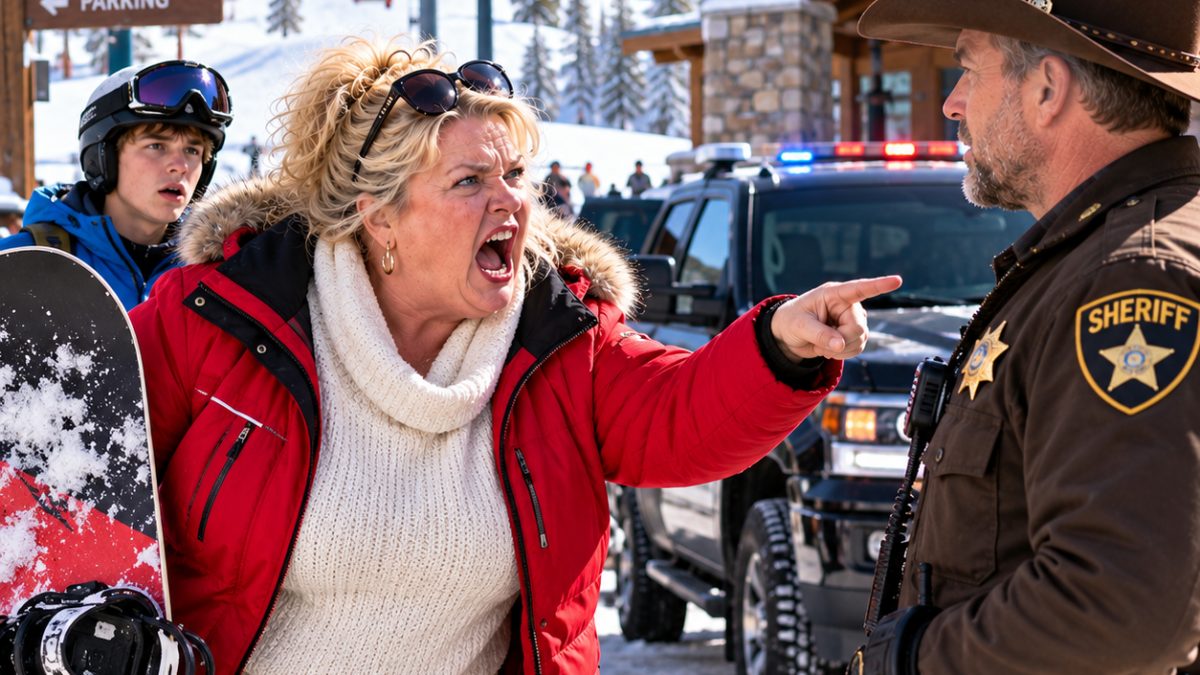
At six o’clock the morning after my uncle’s funeral, a woman I had never met walked into his cabin, dropped a stack of papers on his kitchen table, and told me I had forty-eight hours to surrender the snowboard resort he had spent thirty years building.
She claimed my uncle had promised the property to her son, warned me that refusing would bring fines, lawsuits, and “problems I couldn’t afford,” then smiled as if grief had already made me too tired to fight back.
What she didn’t notice on her way out was the one thing hanging beside the front door that would have changed the way she spoke to me—and by then I had already decided not to tell her.
My name is Emma Dawson, and I had slept maybe two hours.
Uncle Ray’s funeral had ended the evening before. I was still wearing one of his old flannel shirts. His photograph sat on the mantle between wilted flowers and sympathy cards.
I expected the six-a.m. doorbell to be a neighbor bringing breakfast.
Instead, a platinum-blonde woman in a cream cashmere coat pushed past me before I could invite her inside.
“I’m Andrea Murphy,” she announced. “President of Alpine Vista HOA. Twelve years.”
“Good morning to you too.”
She ignored that and crossed straight to the kitchen table.
“I’m sorry about Ray. Truly. But his passing doesn’t change the agreement.”
“What agreement?”
“The sale of Pinecrest Peak to my son, Brandon.”
She slid a document toward me.
“Sign this today, and I’ll give you seventy-two hours to remove your belongings.”
The heading said SUMMIT COUNTY LAND TRANSFER AGREEMENT.
It looked official.
Almost.
The filing reference had five digits.
County land records used seven.
I had signed enough county paperwork to recognize the difference instantly.
“Uncle Ray agreed to sell?”
“Repeatedly.”
“That’s interesting.”
Andrea’s expression sharpened.
“Why?”
“Because his will leaves the resort to me.”
“Wills can be complicated.”
“So can fraudulent paperwork.”
I didn’t accuse her. I let the words sit between us.
She leaned forward, palms on the table.
“Let me explain how this community works, sweetheart.”
I hated the word immediately.
“Your uncle spent years making things difficult. Noise complaints. Parking issues. Signage problems. Legal bills. He could have avoided all of it by being reasonable.”
“You’re saying you filed those complaints?”
“I’m saying he refused to cooperate.”
“And your solution was to make his life expensive?”
Her eyes stayed on mine.
“You can inherit his property, or you can inherit his fight.”
There it was.
Not a misunderstanding.
A threat wrapped in administrative language.
Andrea tapped the contract.
“Brandon has plans for this mountain. Luxury chalets. Private memberships. A proper destination resort. Ray was sentimental. You don’t have to make the same mistake.”
I thought about the lodge downhill.
The scratched rental counters.
The cheap hot chocolate Uncle Ray gave away to kids whose parents couldn’t afford lunch.
The winter program that brought teenagers from shelters and foster homes onto the mountain for free.
Andrea saw land value.
Ray had seen people.
“I need my lawyer to review this.”
Her smile disappeared.
“You have forty-eight hours.”
“That’s not how probate works.”
“In Alpine Vista, I am the law.”
She said it without irony.
I almost looked toward the coat rack.
My uniform jacket hung there beneath Ray’s old ski coat.
My bronze badge was clipped to the belt.
SUMMIT COUNTY SHERIFF.
Andrea never noticed.
She was already gathering her folder.
At the door she turned once more.
“I suggest you think carefully before making yourself unpopular here.”
Then she left.
I waited until her SUV disappeared through the pines.
Only then did I remove my badge from the hook and set it beside the document.
Eight months earlier, Summit County voters had elected me sheriff.
Andrea Murphy had just entered the home of the county’s chief law-enforcement officer, admitted she had spent years pressuring my uncle, and handed me paperwork that already looked wrong.
I could have called her back and shown her the badge.
Instead, I photographed every page, saved the door-camera footage, and dialed Deputy Christian Hill.
He answered half asleep.
“Boss?”
“Christian, I need coffee, a body camera, and everything public you can find on Andrea Murphy and Alpine Vista HOA.”
A pause.
“Should I ask why?”
I looked at Ray’s picture above the fireplace.
“Because I think my uncle was fighting something he never told me about.”
Then I opened Ray’s desk drawer to file Andrea’s papers and found an older copy of the same proposed sale agreement clipped to a handwritten note in my uncle’s unmistakable scrawl.
The first line read:
**Emma—if she comes back after I’m gone, do not believe a word she says.**
PART 2
My hands went still.
The note was written on yellow legal paper, folded once and clipped to an earlier draft of the same transfer agreement Andrea had brought me.
Ray’s handwriting had become shakier during his final year, but I would have recognized it anywhere.
He wrote in capital letters when he was angry.
Most of the page was capital letters.
**ANDREA MURPHY HAS BEEN TRYING TO GET THIS RESORT FOR BRANDON FOR YEARS.**
Below it:
**I NEVER AGREED TO SELL.**
Then:
**CHECK THE BOARD VOTES. SHE DOES THINGS WITHOUT THEM.**
At the bottom, beneath a line scratched so hard the pen had almost torn through the paper:
**PINECREST IS NOT JUST LAND. DON’T LET THEM TURN IT INTO SOMETHING IT WAS NEVER MEANT TO BE.**
I lowered myself into his desk chair.
For a few minutes, the sheriff in me disappeared.
I was twelve years old again.
My father had died in the line of duty that spring.
My mother had been drowning in grief, and looking at me only reminded her of him.
So she sent me to Colorado.
I remember being furious when I arrived.
Furious with her.
Furious with my father for dying.
Furious with Uncle Ray because he was alive.
He didn’t try to fix me.
That was one of his gifts.
On my third morning at the resort, he handed me a snowboard.
“I don’t want to snowboard.”
“Good.”
I stared at him.
“What does that mean?”
“It means you won’t be disappointed when you fall.”
“I’m not doing it.”
He pointed toward the beginner slope.
“Then carry the board back yourself.”
I hated him for approximately eleven minutes.
Then I tried.
I fell on my first run.
And my second.
And my fifth.
By the end of the week, my knees were bruised, my pride was worse, and for the first time since Dad died, I had spent several hours without thinking about death.
At the bottom of the slope one afternoon, Ray looked at me and said something I remembered for the rest of my life.
“Mountains don’t care if you’re rich or poor, Emma. They don’t care who your parents are. They only care whether you’re willing to get up.”
That became the philosophy of Pinecrest Peak.
Not luxury.
Not exclusivity.
Second chances.
I looked at Ray’s note again.
Andrea wanted luxury chalets.
Private memberships.
Higher-end tourism.
She wasn’t just trying to buy property.
She was trying to erase the thing Ray had spent thirty years building.
I heard a vehicle outside around noon.
Christian Hill came through the front door carrying two coffees and a paper bag.
He was thirty-two, broad-shouldered, chronically under-rested, and had been my chief deputy’s unofficial choice to keep me from working myself into an early grave.
He held up one cup.
“Good coffee.”
“What’s in the bag?”
“Breakfast burrito.”
“I asked for coffee.”
“You also need food.”
“That sounded judgmental.”
“It was.”
I handed him Andrea’s document.
His expression changed before he finished the first page.
“This filing number is wrong.”
“I know.”
“You already checked?”
“I’ve been sheriff longer than ten minutes, Christian.”
“Debatable before coffee.”
He sat across from me.
I showed him Ray’s handwritten note.
He read it silently.
Then his eyes moved toward the photograph above the fireplace.
“You think she fabricated the sale agreement?”
“I think she expected me to sign before I knew what I inherited.”
“That’s not the same thing.”
“I know.”
He looked at me.
That was why I trusted Christian.
He didn’t tell me what I wanted to hear.
“What do you want from the department?”
“Nothing official yet.”
“Good.”
He sounded relieved.
“I’m serious.”
“So am I.”
“This is my property. My family. If it becomes criminal, I’m conflicted.”
“Yes.”
“I can preserve anything that happens directly to me as a victim, but I don’t run the investigation.”
Christian nodded.
“We call the DA.”
“If we have a crime.”
“Fake transfer document?”
“Potentially. But Andrea can claim it’s a draft. Bad paperwork isn’t automatically criminal.”
“You really know how to ruin a satisfying morning.”
“That’s why taxpayers elected me.”
I asked him to pull only public records.
Board rosters.
Property ownership.
Civil filings.
Any prior calls involving Pinecrest Peak that were public and lawfully available.
Nothing requiring a warrant.
No confidential databases unless there was an actual law-enforcement basis.
“I want this clean,” I said.
Christian looked at the contract again.
“If she’s as arrogant as this paper makes her look, clean might be easy.”
“Arrogant people still get lawyers.”
“So do sheriffs.”
“I’m not using the county attorney for my inheritance.”
“I meant your private lawyer.”
I looked toward Ray’s old filing cabinet.
“First I need to know what I inherited besides a mountain and a headache.”
After Christian left, I walked down to the lodge.
Pinecrest Peak wasn’t impressive by Colorado resort standards.
One main lodge.
Three chairlifts.
A rope tow.
A modest terrain park.
Two dozen cabins scattered farther uphill.
No heated plaza.
No champagne bar.
No valet parking.
The carpet inside the main building had probably survived four presidential administrations.
The front desk still had the brass bell Ray refused to replace.
I touched it.
A bright ding echoed across the empty room.
Behind the rental counter, rows of boards stood waiting for winter.
On the walls were photographs spanning nearly three decades.
Kids in oversized jackets.
Teenagers making terrible faces at cameras.
Families gathered beneath falling snow.
Veterans.
Foster families.
Youth groups.
School clubs.
Ray rarely appeared in photographs.
He preferred being behind the camera.
In his office, I found a cardboard box marked **LETTERS**.
Hundreds.
Thank-you notes.
Drawings.
Christmas cards.
One came from a mother in Denver.
Her teenage son had been struggling badly before a summer program at Pinecrest. She wrote that he came home from the mountain believing he might have a future.
I had to put the letter down.
Another came from a young woman who had spent part of her childhood in foster care.
**Mr. Dawson was the first adult who gave me something expensive and didn’t make me feel like I owed him for it.**
A third:
**Ray told me falling wasn’t embarrassing. Staying down because other people were watching was.**
I laughed through tears.
That sounded exactly like him.
Then I found another envelope.
My name.
**EMMA.**
Inside was a short letter.
Not legal.
Not complicated.
**Kid,**
**If you’re reading this, I probably waited too long to tell you how tired I got. Don’t feel guilty about that. You had a life to build, and watching you build it was one of the good parts of mine.**
I stopped.
My vision blurred.
I kept reading.
**Pinecrest isn’t worth protecting because it’s expensive. It’s worth protecting because there are kids who need one place where nobody asks how much money their parents have before letting them belong.**
**Andrea won’t understand that. Brandon won’t either.**
**If you keep it, keep it for that reason.**
**If you decide you can’t, I’ll still love you.**
**Ray.**
I pressed the letter flat against the desk.
Fifteen years.
That was how long I had been telling myself I would visit more next season.
After academy.
After promotion.
After the election.
After budget season.
After one more investigation.
There is always another “after” when someone you love is alive.
Then suddenly there isn’t.
A knock sounded at the lodge entrance.
I wiped my face.
An elderly woman stood outside holding a casserole dish.
She introduced herself as Helen Kowalski.
“Twenty-three years next door,” she said. “Ray complained about my dog for nineteen of them.”
“Did the dog deserve it?”
“Absolutely.”
That made me smile.
Helen studied me.
“You have his eyes when you’re trying not to cry.”
Apparently everybody in the county had opinions about my face.
I let her in.
She placed the casserole in the lodge kitchen.
Then she said:
“Andrea came this morning.”
It wasn’t a question.
“How do you know?”
“She told Linda Mercer before she left your driveway. Linda told her husband. Her husband told my neighbor. Alpine Vista is faster than radio.”
“What did she tell them?”
“That Ray’s heir was considering the offer.”
I laughed once.
“Of course she did.”
Helen didn’t.
“She’s been trying to buy Pinecrest for five years.”
“Ray’s note said that.”
“Five years that I know about.”
“Why?”
“Brandon.”
“What about him?”
“He’s always had big plans and very little patience.”
She lowered herself into a chair.
Then Helen told me about the families.
The Hendersons.
Retired.
Eleven violations in less than a year.
Trees supposedly too tall.
Driveway stain.
Fence color.
Holiday lights.
They spent most of their retirement savings fighting.
Eventually they sold.
Arizona.
The Chens.
Nine violations.
Two lawsuits.
Sold forty percent below what neighbors thought the house should have brought.
The Torres family.
Fence dispute.
Then an anonymous complaint to child welfare authorities.
The complaint went nowhere.
The humiliation didn’t.
They sold.
I stopped Helen.
“Who bought?”
She looked at me.
“You don’t know?”
“No.”
“Mountain Vista LLC.”
“Who owns it?”
“Nobody seemed to know.”
“Andrea?”
“I always assumed.”
“Assumption isn’t evidence.”
Helen smiled faintly.
“Ray used to say you’d make a good cop.”
“Sheriff.”
“Don’t get ambitious.”
Despite everything, I laughed.
Then Helen’s eyes filled.
“He fought alone.”
My smile disappeared.
“Why didn’t he tell me?”
“Because he loved you.”
“That’s becoming an irritating answer.”
“It doesn’t make it less true.”
“He was spending his last years answering violation letters.”
“Yes.”
“And I was five hours away.”
“Fifteen years away emotionally, if you want to punish yourself properly.”
That landed.
Helen leaned forward.
“Or you could honor him instead.”
“How?”
“Don’t let guilt make decisions.”
Before leaving, she squeezed my hand.
“Ray didn’t need you to save him, Emma. He needed someone to keep the good thing going after he couldn’t.”
That afternoon, my private attorney called.
Susan Mercer had handled Ray’s estate and had represented me personally before I ran for sheriff.
“The will is clean,” she said.
“No sale contract?”
“None.”
“No option?”
“No.”
“Right of first refusal?”
“No.”
“Promise to Brandon Murphy?”
“Not legally documented.”
“What about Andrea’s transfer form?”
“Send it.”
I did.
Twenty minutes later Susan called back.
“It’s junk.”
“That’s the technical term?”
“Expensive legal education for you.”
“Could it be criminal?”
“Maybe eventually. Right now it’s a bad proposed contract with language designed to imply county approval.”
“That’s what I thought.”
“You’re not investigating this yourself.”
“Christian already lectured me.”
“Good man.”
“I’m starting to dislike everyone.”
“Healthy sign.”
The first HOA violation arrived three days later.
Hand-delivered.
A man in an Alpine Vista polo stood on the porch as if he wished the ground would swallow him.
“Ms. Dawson?”
“Yes.”
“I’m required to give you this.”
“Required by whom?”
He swallowed.
“Mrs. Murphy.”
“What’s your name?”
“Eric.”
“Did the board vote on this, Eric?”
He stared at me.
“I just deliver the notices.”
“Fair enough.”
I accepted the envelope.
The violation:
Pinecrest Peak’s entrance sign used a nonapproved font.
Fine:
$500.
Deadline:
Twenty-four hours.
The sign had stood for twenty-eight years.
I photographed the notice.
The envelope.
The time.
Then filed it.
Two days later:
Parking spaces allegedly two inches too narrow.
$750.
I measured them with the county facilities inspector.
They complied with county standards.
Another notice:
Exterior lodge paint color not approved.
$1,000.
Twenty-four-hour deadline.
Three alleged violations.
$2,250.
One week.
That night, I read the Alpine Vista bylaws from beginning to end.
Forty-seven pages.
By midnight, two sections mattered.
Section 12:
A majority of the HOA board had to approve enforcement actions.
Section 15:
Ordinary violations carried a thirty-day response period unless an immediate safety issue existed.
Andrea had skipped both.
No board minutes attached.
No approval signatures.
Twenty-four-hour deadlines that did not exist in the bylaws.
She wasn’t enforcing the rules.
She was manufacturing pressure.
At 11:03 Tuesday night, someone slid an emergency meeting notice under the cabin door.
Thursday.
Seven p.m.
Agenda:
**PINECREST PEAK PUBLIC NUISANCE RESOLUTION.**
Proposed remedy:
Immediate operational suspension or sale.
I read the notice twice.
Then called Susan.
“Can an HOA vote to force the sale of a privately owned resort?”
“No.”
“Good.”
“Emma.”
“What?”
“Do not walk into that room as sheriff and threaten everyone.”
“I wasn’t planning to.”
“That pause was too long.”
“I’m going as the owner.”
“Then dress like the owner.”
I looked at the uniform hanging by the bedroom door.
“I’m on duty until six forty-five.”
“Change.”
“Susan.”
“Change.”
“I may not have time.”
“Then if you arrive in uniform, say clearly you’re there as a homeowner and private property owner, not directing a criminal investigation.”
“Fine.”
“Also, I hate your tone.”
“You bill me to tolerate it.”
The community center was packed Thursday night.
Thirty-two residents.
Twice the usual turnout, according to Helen.
Andrea stood behind a podium in a cream blazer and pearls.
She had slides.
Of course she had slides.
Photographs of Pinecrest.
Charts alleging excessive traffic.
Graphs suggesting resort operations depressed neighboring property values.
Noise readings with no source information.
A photograph of a dumpster taken from such an angle that it looked like industrial waste.
“Pinecrest Peak represents an ongoing threat to our community investment,” Andrea announced.
A few residents nodded.
Most stared at the floor.
“Tonight, I ask this board to authorize immediate legal action requiring the current owner either to cease operations or negotiate a sale.”
I sat in the back.
Still in uniform.
There had been no time to change after a search-and-rescue call on the north ridge.
My badge caught the fluorescent light when I stood.
Heads turned.
Andrea looked annoyed.
Then recognized me.
Her expression changed so quickly I almost felt sorry for her.
Almost.
“I’m Emma Dawson.”
Nobody moved.
“I’m the legal owner of Pinecrest Peak.”
A whisper moved through the room.
I continued.
“I’m also Summit County sheriff, but I want the minutes to reflect that I’m speaking tonight solely as the property owner affected by this proposed resolution.”
Susan would be proud.
Andrea gripped the podium.
“You’re the sheriff?”
“Yes.”
“Why didn’t you tell me?”
“You never asked.”
A nervous laugh moved through the room.
Andrea recovered.
“This changes nothing.”
“I agree.”
That surprised her.
“The rules should be the same regardless of my job.”
A few people nodded.
I held up the notices.
“Which is why I’m asking this board to explain why three enforcement notices were issued without the majority approval required by Section 12 of your bylaws.”
Board members looked at each other.
Andrea said:
“The board delegated enforcement authority to the president.”
“Where is that delegation recorded?”
Silence.
I continued.
“And why each notice demanded payment within twenty-four hours when Section 15 provides thirty days for ordinary violations?”
One board member, Thomas Greene, leaned toward his microphone.
“Twenty-four hours?”
Andrea turned.
“Thomas, this isn’t—”
“I never approved that.”
Another board member said:
“Neither did I.”
The room shifted.
Not dramatically.
But enough.
Andrea smiled tightly.
“This is procedural confusion. Sheriff Dawson is grieving and may have misunderstood—”
“I understand a twenty-four-hour deadline.”
“Emma—”
“Sheriff or Ms. Dawson is fine.”
Her jaw tightened.
Residents began whispering.
I placed the violation letters on the front table.
“For the record, I’m disputing each notice through the HOA’s civil process. Any separate allegation of unlawful conduct should be referred to independent authorities because of my personal interest in this matter.”
That mattered.
I wanted everyone to hear it.
I was not going to turn my badge into a weapon because Andrea had turned her presidency into one.
Andrea’s face softened into a smile.
“Then perhaps we can discuss this privately.”
“No.”
The smile froze.
“If you believe Pinecrest is a public nuisance, make your case in public.”
For the first time, nobody looked at the floor.
Andrea looked around the room and realized it too.
I left before the meeting finished.
Outside, mountain air hit my face.
My phone buzzed.
Christian.
**Public-record review finished. You need to see this tomorrow.**
I typed:
**8 a.m.**
Then another message came through.
Dispatch.
Routine.
Nothing connected.
But as I drove home, I kept seeing Andrea’s face when she realized I was sheriff.
Not fear.
Calculation.
That worried me more.
People who were merely embarrassed often backed down.
People who believed they were losing control usually changed tactics.
At 1:58 the next morning, my phone rang.
Dispatch.
I answered immediately.
“Dawson.”
The dispatcher’s voice was controlled.
“We received an emergency call regarding Pinecrest Peak. Caller reported an armed disturbance involving a woman matching your description.”
I sat upright.
“What?”
“Deputy Hill is responding.”
“Tell him I’m inside the cabin, alone, and unarmed. I’ll stay inside until he establishes contact.”
“Copy.”
My pulse accelerated.
This was exactly the kind of situation where assumptions could become dangerous.
I turned on every exterior light.
Placed my phone on the kitchen table.
Stayed visible through the front window.
Christian arrived four minutes later.
He followed protocol.
He had to.
When dispatch sends deputies toward a reported emergency, friendship does not get to rewrite procedure.
Only after confirming the scene was quiet did he enter.
“What happened?” he asked.
“Someone reported me.”
He stared.
“You?”
“Yes.”
“For what?”
“A dangerous armed disturbance.”
Christian looked around the perfectly silent cabin.
“You’re kidding.”
“No.”
We pulled the security footage.
No visitors.
No disturbance.
No vehicle near the house during the relevant time.
The caller had described events supposedly happening in real time.
They weren’t.
Christian’s expression hardened.
“This needs to leave our department.”
“I agree.”
Because I was both sheriff and intended target, any investigation into the false report needed independent handling.
I called District Attorney Robert Quinn.
At two forty in the morning.
He answered like a man accustomed to bad calls.
“Please tell me this is weather.”
“It isn’t.”
I explained.
He was silent.
“Emma, you cannot touch the investigative side.”
“I know.”
“I mean it.”
“I know.”
“I’m calling the Colorado Bureau of Investigation duty officer. If federal jurisdiction develops, they can coordinate from there.”
“Good.”
Christian preserved the dispatch audio and camera footage under standard evidence procedure.
Then handed control to an outside investigator by morning.
That decision would later matter more than I knew.
Andrea’s attorneys eventually accused me of creating the entire case to retaliate over the resort.
But I had removed myself from investigative decisions before anyone knew where the evidence would lead.
At seven that morning, I still hadn’t slept.
Christian sat across from me.
“This doesn’t feel like a parking-space dispute anymore.”
“No.”
“You think Andrea ordered it?”
“I think nothing until investigators prove something.”
“That is the least satisfying answer possible.”
“It’s also the right one.”
He stood.
“I hate when you’re responsible.”
“Go home.”
“Boss?”
“Yeah?”
“Whoever made that call knew exactly where you lived.”
I looked toward the window.
“I know.”
The following afternoon, CBI Investigator Maria Santos arrived.
She was in her early forties, compact, direct, and deeply unimpressed by titles.
“I don’t care that you’re sheriff,” she told me during our first interview.
“Excellent.”
“I care that you’re a complainant who happens to know investigative procedure and may accidentally contaminate my witness pool because you think you’re helping.”
“I like you already.”
“Don’t.”
I gave her everything.
Andrea’s contract.
Door-camera video.
Ray’s handwritten note.
Violation notices.
Meeting notice.
My own notes.
The false emergency report.
Then I stopped.
“Anything else?”
“Public records Christian collected before the emergency report.”
“Give them to me. After that, you stay out.”
“Understood.”
Maria looked skeptical.
“Sheriffs are terrible at staying out.”
“So I’ve heard.”
“Prove me wrong.”
Two days later, Susan called.
“You’re getting another HOA notice.”
“How do you know?”
“Andrea’s lawyer emailed me.”
“Good news?”
“No.”
They now claimed Pinecrest owed $18,500 in accumulated compliance penalties dating back to Ray’s ownership.
I laughed.
Susan didn’t.
“They attached old violations.”
“How old?”
“Five years.”
“For what?”
“Noise. Lighting. signage. parking. Waste storage.”
“Board approval?”
“Some packets don’t show any.”
I thought about Ray’s note.
**CHECK THE BOARD VOTES.**
He knew.
Andrea had been doing this for years.
Helen came over that afternoon.
When I told her about the historic fines, she shook her head.
“She used to send them every time Ray rejected Brandon.”
“Every time?”
“Almost.”
“Can you prove the timing?”
“Maybe.”
Helen went home.
Returned an hour later carrying a grocery bag filled with envelopes.
“I kept copies.”
“Why?”
“Ray gave them to me.”
I stared.
“He said if anything happened to him, somebody should have duplicates.”
Inside were years of HOA correspondence.
Offers to purchase Pinecrest.
Violation notices.
Threatened legal action.
Then another purchase offer.
Then more violations.
The pattern was almost embarrassingly clear.
January:
Brandon Murphy Development offered $2.8 million.
Ray declined.
February:
Four HOA violations.
June:
Offer increased to $3.1 million.
Ray declined.
July:
Noise complaint.
Parking violation.
Signage fine.
October:
Another offer.
Then legal demand.
Then another cluster of violations.
“Why didn’t he sue?”
“He did once.”
“What happened?”
“Cost him twenty thousand dollars. Case dismissed without reaching the issue because Andrea withdrew the fines before hearing.”
Of course.
Apply pressure.
Force defense costs.
Withdraw before a judge examines the pattern.
Start again later.
“Did anyone else experience this?”
Helen’s face tightened.
“The Hendersons.”
“Chens?”
“Yes.”
“Torres?”
“Yes.”
I wanted to call Maria.
Instead, I called Susan.
“Can I give Helen’s documents to the investigator?”
“You can provide them as a witness.”
“Good.”
“And then stop.”
“Everyone enjoys saying that.”
“Because you’re bad at it.”
Maria picked up the documents herself.
She listened to Helen.
Then quietly asked for the names of the former residents.
That was the last update I received for nearly two weeks.
It drove me crazy.
I went back to work.
Actual sheriff work.
A missing hiker near Copper Basin.
A burglary series.
Budget meeting.
School safety conference.
A domestic dispute that required six hours and more patience than Andrea Murphy had consumed in six weeks.
Meanwhile Pinecrest sat between seasons, waiting for snow.
I hired an interim operations manager named Eli Barnes, who had worked for Ray for nineteen years.
“You sure you want me running this?” he asked.
“Ray trusted you.”
“Ray also trusted a seventy-eight Ford snowcat.”
“Did it work?”
“Eventually.”
“Then you’re qualified.”
Eli knew the resort better than I did.
That embarrassed me.
He knew which lift tower iced first.
Which furnace in the lodge needed persuasion.
Which local kids relied on scholarship passes.
Which instructor had a habit of giving away gloves and pretending inventory was wrong.
One evening, we walked the main slope.
“I’m sorry I wasn’t here,” I said.
Eli shoved his hands into his coat pockets.
“Ray wasn’t.”
“Wasn’t what?”
“Sorry.”
“He should have been.”
“Why?”
“Because I stayed away.”
“He talked about you constantly.”
“That doesn’t make it better.”
“No.”
We walked a little farther.
“He watched your election results in the lodge.”
I stopped.
“What?”
“Put them on the big screen.”
I stared at him.
“You’re lying.”
“Forty kids from the winter program watched you win sheriff.”
My throat tightened.
“He didn’t call.”
“He figured you were busy.”
The cruelty of inherited habits.
Ray hadn’t called because he didn’t want to interrupt my life.
I hadn’t called because I thought there would be time.
We both loved each other politely from a distance until time ran out.
That night, I read his letter again.
**Don’t feel guilty about that.**
He knew me too well.
Three weeks after the false emergency report, Maria Santos called.
“I need you at the DA’s office.”
“Why?”
“You’ll find out.”
“That sentence should be illegal.”
“It isn’t.”
Robert Quinn sat beside Maria when I arrived.
Another man I didn’t know introduced himself as Special Agent Daniel Reeves from the FBI’s Denver office.
That told me enough.
Maria opened a file.
“We obtained lawful records connected to the emergency call.”
I stayed silent.
She slid a summary across the table.
The originating device was associated with Brandon Murphy.
My chest tightened.
Maria continued.
“We also obtained location information placing that device in the general Alpine Vista area at the relevant time.”
“Did Andrea know?”
“We’re not discussing conclusions yet.”
Reeves spoke.
“The broader investigation uncovered something separate.”
He opened another folder.
“Mountain Vista LLC.”
I thought of Helen’s stories.
“The buyer.”
“Yes.”
“Who owns it?”
“Andrea Murphy.”
There it was.
Reeves continued.
“Over the last three years, twelve properties received concentrated HOA enforcement before being sold below comparable market value.”
“Twelve?”
Helen had named three.
“Twelve,” he repeated.
“Mountain Vista acquired eight directly. Four went through connected entities.”
I stared at the table.
“How many violation notices?”
“Forty-seven.”
“Board approved?”
Maria looked at me.
“Almost none, based on records provided under legal process.”
Ray’s note.
**CHECK THE BOARD VOTES.**
He had been right.
Again.
Robert Quinn folded his hands.
“We are looking at potential fraud, coercive financial practices, and possible wire-related offenses depending on the communications and transactions.”
“Pinecrest?”
“Same pattern.”
“Why Brandon?”
Reeves answered.
“Financial motive.”
He slid another summary toward me.
Brandon was in serious debt.
Not ordinary debt.
Millions.
A failed real-estate venture.
Private loans.
Online wagering losses.
High-interest obligations.
Andrea had mortgaged her own home trying to keep him afloat.
Pinecrest’s estimated value:
$4.5 million.
I sat back.
“That’s why she needed the resort.”
“That is one theory supported by financial records,” Reeves said.
“Ray wasn’t just stubborn.”
“No.”
“He was blocking their way out.”
Maria leaned forward.
“Emma.”
I looked at her.
“You need to understand something. This is no longer your property dispute.”
“I understand.”
“Do you?”
“Yes.”
“Then let us do our jobs.”
I wanted to say that Ray had spent five years being worn down while I built a career enforcing laws against people who did exactly this kind of thing.
I wanted to demand every detail.
Instead, I nodded.
“Tell me what you need from me.”
“Nothing right now.”
That was harder than any order I had given as sheriff.
Over the next month, witnesses surfaced.
The Hendersons flew back from Arizona.
I met them only after investigators finished their interviews.
George Henderson was seventy-four.
His wife, Carol, seventy-one.
They had bought their Alpine Vista home for retirement.
Within six months of challenging Andrea over a drainage issue, violations began.
Eleven in eight months.
George showed me a binder.
“It became my full-time job.”
His voice shook with anger even years later.
“We stopped traveling. Stopped seeing grandchildren. Every morning I checked the mailbox and wondered what we’d done wrong.”
Carol touched his arm.
“We hadn’t done anything wrong.”
They eventually sold to Mountain Vista for almost thirty percent below what another appraiser said the house was worth.
“We knew it was Andrea?” I asked.
George shook his head.
“Not then.”
The Chens sent emails.
Andrea’s words were clinical.
**Continued noncompliance may result in escalating enforcement.**
Then, three days later:
**Brandon may still be willing to discuss acquisition if you prefer a clean resolution.**
The Torres family was hardest.
Their dispute began with a fence.
Then an anonymous complaint questioned the safety of their home.
Authorities investigated and found nothing requiring action.
But rumors spread.
Their children were treated differently at school.
They left.
Mrs. Torres cried while describing it.
“I thought if we moved, everybody would forget.”
“Did they?”
“No.”
I couldn’t think of anything useful to say.
So I said what I wished somebody had told Ray.
“I believe you.”
She covered her mouth.
Sometimes four words are enough.
Digital evidence followed.
Investigators recovered communications between Andrea and Brandon.
Planning acquisition offers.
Discussing pressure.
Complaining about Ray.
One message from Andrea said:
**He’ll give in eventually. Everyone does.**
Another:
**If he won’t sell while he’s alive, Emma won’t keep the place. She hasn’t been here in years.**
I read that one after it became evidence disclosed to me as a victim.
It hurt because Andrea had identified exactly what I feared about myself.
I had been gone.
She had counted on that absence.
Then came Brandon’s message two days before the false emergency call:
**She won’t sell. We need to scare her off.**
His next message:
**I’ll handle it.**
Nothing about those words felt triumphant.
They made me cold.
Robert Quinn called me one evening.
“The U.S. Attorney’s Office is joining.”
“Wire fraud?”
“Among other things.”
“What happens now?”
“Grand jury work. More warrants. More interviews.”
“Do you need me?”
“No.”
I laughed without humor.
“You people are enjoying this.”
“Emma.”
“I know.”
He softened.
“You did the most important thing already.”
“What?”
“You stepped aside.”
I looked out my office window toward the courthouse.
“It doesn’t feel important.”
“It will when defense counsel claims this is revenge.”
He was right.
Andrea did exactly that.
Forty-eight hours before the next HOA meeting, anonymous accounts appeared online.
Posts accused me of using my badge to seize private property.
Fake screenshots circulated.
Messages supposedly from me threatening Andrea’s family.
A petition demanded my removal as sheriff.
Hundreds of signatures appeared unusually quickly.
My communications officer called.
“What do you want to do?”
“Nothing.”
“Sheriff—”
“Nothing official. We don’t use county resources to defend my private property dispute.”
“The posts accuse the department.”
“Then issue one sentence: ‘The sheriff’s office does not comment on investigations being conducted by outside agencies.’”
“That’s it?”
“That’s it.”
A local reporter named Jake Brown called that afternoon.
“Sheriff Dawson, I have documents alleging you threatened Andrea Murphy.”
“Are they authenticated?”
“No.”
“Then authenticate them.”
“Do you deny them?”
“I’m not discussing an active outside investigation.”
“Can you give me anything?”
“Yes.”
“What?”
“Public records.”
He waited.
“County property transfers. Alpine Vista board minutes. Mountain Vista LLC registration. Civil filings involving former residents.”
“You’re telling me where to look.”
“I’m telling you what’s public.”
“Is there a different story?”
“The documents can answer that better than I can.”
Jake spent the next day digging.
He called again around nine at night.
“I nearly got this very wrong.”
“That happens.”
“Mountain Vista is Andrea.”
“Yes.”
“Eight purchases.”
“Public record.”
“The violations happened before the purchases.”
“Also public.”
“The Henderson sale—”
“Jake.”
“Right. Active investigation.”
“Exactly.”
He exhaled.
“I called Andrea. She hung up.”
“Probably wise.”
“She sent me fabricated screenshots.”
“I can’t help you authenticate evidence.”
“I already sent them to a digital-forensics consultant.”
“Then you don’t need me.”
The story that ran the next morning did not accuse Andrea of crimes.
It didn’t need to.
Headline:
**QUESTIONS GROW OVER ALPINE VISTA HOA ENFORCEMENT AND PROPERTY PURCHASES**
Public documents.
Dates.
Transactions.
Former resident interviews.
No speculation.
Andrea’s media strategy had backfired because she had pointed a reporter toward the very story she needed hidden.
Then Brandon broke.
I learned that later.
He walked into Robert Quinn’s office with an attorney and asked for a cooperation agreement.
He was twenty-nine.
Facing serious exposure from the false emergency report and the financial scheme.
His accounts had been frozen.
His creditors were circling.
His mother’s legal bills were accelerating.
He stopped believing she could save him.
According to the cooperation proffer that later became part of the case, Brandon admitted Andrea had spent years using HOA enforcement to acquire property cheaply.
He admitted Pinecrest was different only because it was worth more.
He admitted his financial trouble accelerated the pressure.
And he admitted Andrea knew about the plan to make a false emergency report.
There was a recording.
Andrea’s voice.
Not ordering violence.
Not saying anything dramatic.
Just cold, controlled approval of a plan designed to make me feel unsafe enough to leave.
That was worse somehow.
The prosecutor called me after Brandon signed.
“Emma.”
“Yes?”
“We have enough.”
I sat down.
“For what?”
“Warrants.”
I closed my eyes.
There are moments you imagine wanting for months.
Then they arrive and feel nothing like victory.
I thought about Ray.
The violation letters.
The empty chair in his office.
“He should have seen this.”
Robert was quiet.
“Probably.”
“When?”
“Thursday.”
“The HOA meeting?”
“Yes.”
My stomach tightened.
“Why there?”
“Several subjects are expected to attend. Investigators can execute efficiently.”
“Not for spectacle.”
“No.”
“Good.”
A pause.
“You don’t sound convinced.”
“I don’t want a public humiliation operation.”
“It isn’t.”
“If it turns into one—”
“You won’t be making the arrest.”
“I know.”
“Emma.”
“I know.”
I had to keep reminding myself.
Justice was not me putting handcuffs on Andrea.
Justice was the evidence surviving without me.
Thursday evening, Alpine Vista’s parking lot was overflowing.
Rumors had traveled.
People knew outside investigators were asking questions.
They knew reporters were digging.
They knew something had changed.
What they didn’t know was how much.
I arrived in civilian clothes.
Jeans.
Black coat.
No badge visible.
Christian looked surprised.
“You’re not in uniform.”
“I’m not here as sheriff.”
“Feels strange.”
“It should.”
CBI investigators were already inside.
Federal agents waited nearby.
Robert Quinn was present because state charges were coordinated through his office.
I sat in the back beside Helen.
Her hands trembled.
“You okay?”
“No.”
“Me neither.”
Andrea walked to the podium at seven.
Same cream blazer.
Different expression.
Her eyes moved constantly.
She began with community business.
Snow removal.
Holiday decorations.
Then she shifted.
“In recent weeks, Alpine Vista has been targeted by individuals who wish to undermine our way of life.”
Helen whispered:
“She never changes.”
Andrea continued.
“Certain people have abused public authority and media relationships to intimidate volunteers serving this community.”
A few heads turned toward me.
I stayed seated.
Andrea clicked the projector.
Pinecrest appeared.
“Tonight I am again proposing a resolution declaring Pinecrest Peak incompatible with Alpine Vista community standards.”
I almost laughed.
Even now.
Even with investigators circling.
Even after Brandon had disappeared from her side.
She was still trying to take the resort.
Andrea looked toward the back.
“Ms. Dawson, perhaps you’d like to explain why a county sheriff believes she is above private-property rules.”
I stood.
Not because I needed to argue.
Because for once, I wanted to answer plainly.
“I don’t.”
Andrea blinked.
“I’m subject to the same law as everyone else.”
“Then why—”
The side door opened.
Maria Santos entered with two investigators.
Conversation stopped.
Andrea’s eyes moved toward them.
Then toward me.
I sat back down.
Maria walked to the front.
“Andrea Patricia Murphy?”
Andrea’s face changed.
“What is this?”
“Ma’am, I’m Investigator Maria Santos with the Colorado Bureau of Investigation. We have a warrant for your arrest.”
The room inhaled.
Andrea gripped the podium.
“This is outrageous.”
Maria remained calm.
“You’ll have an opportunity to address the charges through counsel.”
“On what basis?”
Maria did not deliver a dramatic speech.
Real arrests are not theater.
She stated the principal charges.
Fraud-related offenses.
Coordinated harassment.
Conduct connected to the false emergency report.
Additional federal proceedings pending.
Andrea looked at me.
“This is you.”
I didn’t answer.
“This is because of that resort.”
Still nothing.
“You used your office.”
Maria interrupted.
“Sheriff Dawson has been recused from this investigation.”
Andrea stared at her.
“No.”
“Yes.”
“My attorneys—”
“May meet you at processing.”
Andrea looked around the room.
People who once lowered their eyes when she entered were watching openly now.
Thomas Greene, the board member who had objected to her shortened deadlines, stood near the wall.
George and Carol Henderson had returned from Arizona.
The Chens were seated in the third row.
Mrs. Torres stood beside her husband near the entrance.
Andrea saw them one by one.
That was the moment her expression truly changed.
Not when Maria mentioned charges.
When she saw the people.
The history.
The pattern assembled in one room.
“You all benefited from what I built,” she said.
Nobody answered.
“I protected your property values.”
Still nothing.
“I kept this community desirable.”
George Henderson finally spoke.
“You took our home.”
Andrea’s voice sharpened.
“You sold it.”
“After eleven violations.”
“You were noncompliant.”
Carol stood.
“Then why did the violations disappear the day Mountain Vista bought it?”
Silence.
Someone else asked:
“Why did Mountain Vista belong to you?”
Andrea looked toward Maria.
“I’m done speaking.”
For once, a sensible decision.
Investigators escorted her out without spectacle.
No applause.
No cheering.
That mattered to me.
People cried.
Others stood stunned.
Some hugged.
But nobody treated it like entertainment.
These were not spectators watching a villain fall.
They were neighbors realizing how many years they had lived inside someone else’s system.
Then Robert Quinn stepped forward.
“I can confirm that a broader investigation is ongoing. Anyone who believes they were affected by improper HOA enforcement should preserve records and contact the designated hotline.”
That was all.
No triumphant speech.
No promises.
Evidence first.
Always.
Outside, I stood beneath the parking-lot lights.
Snow had begun falling lightly.
Helen joined me.
“Twelve years,” she said.
I looked at her.
“I kept thinking somebody would stop her.”
“So did Ray.”
“Then eventually everyone stopped believing she could be stopped.”
I watched flakes settle on the hood of my truck.
“That’s how people like her become powerful.”
“Because nobody fights?”
“No.”
I thought about the board.
The silent residents.
The withdrawn fines.
The expensive attorneys.
“Because everybody fights alone.”
Helen took my hand.
“Ray isn’t alone anymore.”
My throat tightened.
“No.”
“He’d be proud of you.”
“I wish people would stop saying that.”
“Why?”
“Because I don’t know if it’s true.”
Helen looked annoyed.
“He left you the resort.”
“That doesn’t mean he’d approve of everything.”
“He knew you.”
I looked toward the mountains.
“He knew a twelve-year-old girl.”
“He knew the sheriff too.”
“How?”
“He watched every election interview.”
I turned.
“What?”
Helen smiled.
“Ray subscribed to the county newspaper like it was oxygen.”
The same thing Eli had told me.
Ray watching from a distance.
Proud without interrupting.
It hurt.
But less than before.
The investigation continued for months.
Andrea’s defense attorneys attacked everything.
They argued she had broad discretion under HOA governing documents.
They claimed Mountain Vista acquisitions were legitimate business transactions.
They said former residents sold voluntarily.
They argued Brandon acted independently regarding the false emergency report.
Then Brandon testified.
Emails followed.
Bank records.
Property records.
Board minutes.
The pattern was too consistent.
The Hendersons:
Violations.
Legal pressure.
Sale below market.
Purchase by Mountain Vista.
Violations vanish.
The Chens:
Same.
Other families:
Variations of the same sequence.
Ray:
Purchase offer.
Refusal.
Violations.
Another offer.
More violations.
Another refusal.
Pressure intensifies.
Then death.
Then Andrea came to me before probate was complete carrying a questionable transfer document.
None of those facts alone proved the whole case.
Together they told a story.
The criminal case moved through federal and state proceedings.
I stayed out.
That became unexpectedly difficult.
Reporters asked me for comment almost daily.
Most wanted the same angle.
**SHERIFF TAKES DOWN HOA QUEEN WHO THREATENED HER.**
I refused it.
Because it wasn’t true.
I hadn’t taken Andrea down.
Her own records had.
Her company filings.
Her messages.
Her board minutes.
Her financial trail.
Her son’s cooperation.
Former residents finally speaking together.
I had been the event that forced the documents into one room.
Nothing more.
That distinction mattered.
Three months later, the main federal case went to trial.
I testified for one day.
Civilian clothes.
No uniform.
The prosecutor asked about Andrea’s first visit.
“Did she know your occupation?”
“Not that I could tell.”
“What did she say?”
I repeated it.
**In Alpine Vista, I am the law.**
Several jurors looked toward Andrea.
Her expression didn’t move.
I described the proposed transfer.
Her admission that she had made Ray’s final years difficult.
The violations.
The HOA meeting.
The false emergency call.
Then defense counsel stood.
He was good.
Calm.
Professional.
“Sheriff Dawson, you disliked Mrs. Murphy almost immediately, correct?”
“I disliked her conduct.”
“That wasn’t my question.”
“No. I did not like her.”
“You were grieving.”
“Yes.”
“Angry.”
“Yes.”
“Protective of the resort.”
“Yes.”
“And you had significant law-enforcement power.”
“Yes.”
“Yet you want this jury to believe none of that influenced this investigation?”
I looked at him.
“No.”
He paused.
“No?”
“I want the jury to understand it influenced my decision to recuse.”
The courtroom became quiet.
I continued only when he asked.
“CBI handled the investigation. Federal investigators handled the federal portions. I did not issue the subpoenas. I did not obtain the search warrants. I did not decide charges. I did not execute Mrs. Murphy’s arrest.”
The attorney walked closer.
“But your deputy collected the initial evidence.”
“Because the false emergency report was made to our dispatch center and concerned my residence. He preserved what existed, then transferred it.”
“You understand that you benefited from this investigation.”
“I understand my family property was protected.”
“And your enemy was prosecuted.”
“I would not describe her as my enemy.”
“What would you call her?”
I thought.
“The defendant.”
That ended the exchange better than any speech could have.
The jury deliberated several hours.
Guilty on the principal federal fraud-conspiracy counts.
Additional state charges were resolved afterward.
The sentencing hearing was quieter.
Andrea sat at the defense table without the cream blazer.
No pearls.
No clipboard.
The judge discussed the financial harm.
The abuse of trust.
The pattern across families.
The false emergency report.
The retaliatory use of an organization that was supposed to serve homeowners.
He imposed a multi-year federal sentence, supervised release afterward, and substantial restitution.
The final figure for affected families came to hundreds of thousands of dollars.
Andrea was also barred from holding fiduciary positions in Colorado community associations during a lengthy post-sentence period.
Brandon’s outcome was different.
His cooperation mattered.
So did his role.
He received probation under strict supervision, mandatory treatment for his gambling problem, financial restrictions, and extensive community service.
Part of that service was completed through a nonprofit supporting families displaced by predatory housing practices.
When I heard that condition, I almost laughed.
Not because it was funny.
Because somewhere Ray would have called it “aggressively educational.”
Brandon requested a meeting with me six months later.
Susan asked whether I wanted to accept.
My first answer was no.
Then I changed my mind.
We met at her office.
Neutral ground.
Brandon looked older.
He had lost weight.
No expensive watch.
No confident smile.
“I’m sorry.”
I waited.
He swallowed.
“I know that isn’t enough.”
“No.”
“I thought Pinecrest would solve everything.”
“Your debt?”
He nodded.
“My mom kept saying Ray was being unreasonable.”
“Was he?”
“No.”
“What changed your mind?”
Brandon looked down.
“When I heard the dispatch recording.”
I said nothing.
“I realized I had turned you into a problem instead of a person.”
His hands tightened together.
“That sounds stupid.”
“It sounds convenient.”
He flinched.
“Probably.”
“Why are you really here?”
He looked at me.
“Because part of treatment is making amends where possible.”
“There it is.”
He nodded.
“I deserved that.”
“No, Brandon. This isn’t about what you deserve.”
I leaned forward.
“I’m not the person you hurt most.”
“Ray?”
“The Hendersons. Chens. Torres family. Every resident your mother pressured because your financial problems became her excuse.”
His eyes filled.
“I know.”
“Do they?”
“I’ve written letters.”
“Letters are a start.”
He nodded.
I stood.
“Anything else?”
“I never wanted Pinecrest to be destroyed.”
I looked at him.
“You wanted to turn it into something Ray spent his life refusing to build.”
“Luxury cabins.”
“Private memberships.”
He looked ashamed.
“I thought that was improvement.”
“That’s because you only saw the property.”
“What did he see?”
I opened the office door.
“People.”
The Alpine Vista HOA held an emergency election two weeks after Andrea’s conviction became final.
Helen Kowalski was elected president.
She called me immediately.
“No.”
I hadn’t even said hello.
“I haven’t asked anything.”
“You’re going to ask me to join the board.”
“I was going to ask whether you’d attend the bylaws committee.”
“No.”
“You’re annoying.”
“I’m sheriff.”
“Ray raised you better.”
Eventually I agreed to attend as a property owner.
Not board member.
Not adviser.
Just owner.
The reform meeting lasted three hours.
No one enjoyed it.
That was a promising sign.
The new rules required recorded board approval for enforcement actions.
A sixty-day response period for most non-emergency violations.
Independent review for contested fines above a threshold.
Conflict disclosures.
Competitive review for major vendor contracts.
Restrictions preventing officers from using entities they secretly controlled to purchase distressed member properties without full disclosure and independent approval.
Public meeting minutes.
Clear complaint procedures.
One resident raised his hand.
“What if this makes enforcement too slow?”
Helen answered.
“Then we’ll be slower.”
He frowned.
“But standards matter.”
“So does fairness.”
That settled it.
The Hendersons received restitution.
They wanted their old house back.
That turned out to be complicated because a new couple had bought it from Mountain Vista without knowing the history.
For weeks, everyone worried that justice for one family would require displacing another.
Instead, attorneys negotiated.
The new owners agreed to sell after receiving fair compensation and assistance finding another property.
George and Carol returned the following spring.
I was there the day they unlocked the door.
George stood on the porch holding the key.
“You okay?”
He shook his head.
“No.”
Carol laughed through tears.
“He’s been saying that for twenty minutes.”
George looked at me.
“I thought I’d feel like I won.”
“That seems to be a recurring problem.”
He smiled.
“What do you feel?”
“Old.”
Carol slapped his arm.
The Chens chose not to return.
Their grandchildren lived near Fort Collins now.
They used restitution money to buy a smaller home closer to family.
Mrs. Chen attended the first Alpine Vista summer barbecue under Helen.
She hugged me.
Then immediately criticized the potato salad.
That felt like healing.
The Torres family came back temporarily.
Their youngest daughter, Sofia, enrolled in Pinecrest’s winter youth program.
I recognized the name on the scholarship form.
I called Eli.
“We’re covering everything.”
“We cover most scholarship students anyway.”
“Everything.”
“Emma.”
“Boots. Board. jacket. lessons. lunches.”
“Ray would tell you not to make it weird.”
“I’m not making it weird.”
“You called me at seven in the morning.”
“Fine.”
Eli handled it.
The first day Sofia came to the resort, I stayed out of sight.
She didn’t need the sheriff turning her first snowboard lesson into a symbolic event.
She needed snow.
A board.
And permission to fall without embarrassment.
I watched from the lodge window.
First run:
down immediately.
Second:
same.
Third:
she made it fifteen feet.
Fourth:
twenty.
By lunch, she was laughing.
I found myself crying again.
Ray had been right.
The mountain did not fix people.
It simply gave them a place where failure was expected.
There was freedom in that.
Pinecrest changed too.
I used money recovered through the civil resolution and Ray’s estate to renovate the lodge.
Not luxury.
Safe heating.
Accessible restrooms.
New rental equipment.
Better lighting.
A rebuilt beginner lift.
I doubled the youth scholarship program.
Then partnered with county veteran services for free introductory snowboard weekends.
Susan reviewed every contract.
Twice.
“No Andrea situations,” she said.
“You think I didn’t learn?”
“I think you’re still you.”
I hired Eli full time as general manager.
“Salary’s too high,” he complained.
“It’s market.”
“Ray paid me less.”
“Ray was cheap.”
“That he was.”
We replaced the entrance sign.
The old one had become so weathered it was almost illegible.
A local woodworker carved the new sign from pine.
**PINECREST PEAK**
**WHERE EVERY KID GETS A CHANCE**
**FOUNDED 1994 — RAY DAWSON**
When they installed it, I stood beside Helen.
“You’re crying,” she said.
“No.”
“Your face is wet.”
“Snow.”
“It’s September.”
“I don’t appreciate scrutiny.”
One year after Andrea’s arrest, the first heavy snow arrived before Thanksgiving.
Pinecrest opened early.
I drove up before sunrise.
The lodge lights glowed warm against the dark slope.
Kids were already arriving.
Eli stood at the door pretending to complain about everything.
Christian showed up carrying rented gear.
“You snowboard?”
“No.”
“Then why are you here?”
“Morale.”
“You’re terrified.”
“Yes.”
I gave him Ray’s old beginner board.
He stared at it.
“This thing belongs in a museum.”
“It survived me.”
“That is not reassuring.”
We rode the beginner lift.
At the top, Christian looked downhill.
“I investigate crimes for a living.”
“Yes.”
“I have been in foot pursuits.”
“Yes.”
“I have been shot at.”
“Please don’t make this dramatic.”
“I’m telling you that this is worse.”
“It’s twelve degrees of slope.”
“Death has angles.”
I pushed him lightly.
He slid six feet and fell.
His expression when he sat up was so offended I laughed until my stomach hurt.
A fourteen-year-old girl nearby fell harder.
She immediately stood.
Tried again.
Something about that image froze me.
A kid falling.
Getting up.
Falling.
Getting up.
Thirty years of Pinecrest in one simple act.
Christian finally made it halfway down before falling again.
He raised one arm triumphantly.
“Progress!”
“Technically.”
At lunch, he checked his phone.
Then walked over.
“Boss.”
“What?”
“Andrea’s appeal.”
I went still.
“Decision came down.”
“And?”
“Denied.”
I looked toward the slope.
Kids moved against white snow beneath a blue Colorado sky.
“Final?”
“Pretty much.”
I nodded.
“Okay.”
“That’s all?”
“What do you want me to do?”
“I don’t know. Fireworks?”
“No.”
“Victory lap?”
“No.”
“Burn a cream blazer?”
I looked at him.
“That was almost funny.”
“High praise.”
The truth was, Andrea’s appeal no longer mattered the way I thought it would.
The resort was open.
The families had restitution.
The HOA was functioning without fear.
I had survived.
That evening, I went back to Ray’s cabin alone.
The same cabin Andrea had entered a year earlier.
The kitchen table had been refinished.
The door camera was still there.
Ray’s photograph remained above the mantle.
Funeral flowers were long gone.
In their place sat a small vase filled with dried alpine flowers from summer.
I made coffee.
Then opened the drawer containing his letter.
**If you keep it, keep it for that reason.**
The resort wasn’t really mine.
The deed said it was.
The county record said it was.
But ownership was not the same as purpose.
Ray had understood that.
I raised my mug toward his photograph.
“Pinecrest is safe.”
Silence.
“Helen runs the HOA now, which is terrifying in a completely different way.”
The cabin creaked.
I smiled.
“Christian still can’t snowboard.”
Wind rattled the window.
“And I’m sorry.”
That one changed the room.
I set the coffee down.
“I’m sorry I stayed away.”
My voice cracked.
“I know you said not to feel guilty.”
I looked at his photograph.
“But you don’t get to decide that part for me.”
I laughed once through tears.
“You were always bossy.”
I sat on the floor beside the fireplace.
There are things justice cannot repair.
It cannot give Ray back the hours he spent answering pointless violation letters.
It cannot return the evenings he worried about lawsuits.
It cannot erase the fact that Andrea targeted him because she thought age and isolation made him easier to wear down.
And it cannot give me back fifteen years of visits I kept postponing.
A verdict could punish conduct.
Restitution could repair money.
Reformed bylaws could reduce the chance of repetition.
But grief did not care about court orders.
That was something I had to live with.
The following spring, Brandon completed part of his community service at a housing nonprofit.
I heard about it from Mrs. Torres.
“He was carrying boxes.”
“Good.”
“He looked miserable.”
“Less good.”
She smiled.
“He helped my cousin move.”
That surprised me.
“Did he know who she was?”
“No.”
Maybe that was better.
People rarely change through dramatic speeches.
Sometimes they change by spending enough ordinary days repairing damage that resembles what they caused.
I did not become friends with Brandon.
I did not need to.
Forgiveness and trust are different.
I could hope he became better without giving him access to my life.
Andrea eventually disappeared from neighborhood conversation.
At first everyone talked about her.
Every meeting.
Every barbecue.
Every article.
Then less.
Then almost never.
That was its own kind of consequence.
For twelve years, Alpine Vista had revolved around one woman.
Now people argued about snowplow contracts.
Mailbox paint.
Dog-waste stations.
Parking.
Boring things.
Normal things.
Helen called one evening.
“I hate being president.”
“Good.”
“Why is that good?”
“Means you haven’t started enjoying power.”
“That’s not funny.”
“Little bit.”
“Someone complained the new response period is too generous.”
“What did you say?”
“I told him if his life was being ruined because his neighbor had forty-five days to repaint a fence, he needed hobbies.”
“Ray would approve.”
“I know.”
Two years after I inherited Pinecrest, the winter youth program reached capacity for the first time.
We had to start a waiting list.
I hated that.
So we created a second session.
Then a transportation fund.
Then meal vouchers.
A local outdoor company donated jackets.
Another donated helmets.
I added one rule.
No donor branding on the kids.
Eli argued.
“They want recognition.”
“They can have a sign in the lodge.”
“They’re giving us twenty thousand dollars.”
“And they can enjoy a very nice sign.”
“Ray really did raise you.”
That became less painful to hear.
One afternoon, I was sorting equipment when a teenage boy approached.
Maybe fifteen.
Thin.
Quiet.
“Are you Sheriff Dawson?”
“Depends.”
He looked nervous.
“Am I in trouble?”
“No.”
“Then yes.”
He almost smiled.
“My counselor said your uncle started this place.”
“He did.”
“Why?”
I thought about the letters.
My father.
The summer I arrived.
“Because he thought everybody needed somewhere to start over.”
The boy looked toward the slope.
“I’m bad at this.”
“Excellent.”
He frowned.
“That’s what he told me.”
“Who?”
“My instructor.”
I laughed.
“Then Ray’s still haunting the staff.”
The kid smiled.
“Did you ever get good?”
“At snowboarding?”
“Yeah.”
“I’m sheriff. I don’t answer questions without counsel.”
He laughed and walked away.
I watched him join the line.
There it was again.
Legacy.
Not marble.
Not money.
Repetition.
Someone teaches you something useful.
You carry it.
Years later, you give it to a stranger without realizing where it came from.
My mother finally came to Pinecrest that winter.
She had avoided the mountain since Dad died.
Too many memories.
Too much guilt over sending me away.
We stood at the lodge window watching snow fall.
“I should have come sooner,” she said.
“Apparently that’s a family trait.”
She smiled sadly.
“I thought Ray blamed me.”
“For sending me?”
“Yes.”
“He never did.”
“How do you know?”
“Because he blamed you loudly for everything else.”
She laughed.
Then cried.
I took her hand.
“He saved me, Mom.”
“I know.”
“You didn’t send me away because you didn’t want me.”
Her face crumpled.
“No.”
“I know that now.”
We stood quietly.
Sometimes one family wound sits beside another for decades until somebody finally stops pretending neither exists.
Mom looked around the lodge.
“He would have loved this.”
“He built it.”
“No.”
She pointed toward the kids.
“This.”
The scholarships had doubled.
The lodge was full.
Sofia Torres, now a confident intermediate rider, was helping a younger girl tighten her bindings.
My mother watched her.
“You stayed.”
“Yes.”
“You’re still sheriff.”
“Yes.”
“You run this.”
“Eli runs it. I create paperwork for him.”
She smiled.
“Are you happy?”
I didn’t answer immediately.
That question had become harder after Ray died.
Happiness used to mean achievement.
Election.
Promotion.
Solved case.
Now it meant smaller things.
Morning coffee.
Snow.
A lodge full of noise.
Neighbors who no longer lowered their voices when I walked past.
A kid getting up after falling.
“I’m getting there.”
Mom nodded.
“That’s enough.”
On the third anniversary of Ray’s death, Helen and I hiked above the resort before sunrise.
No ceremony.
No announcement.
I carried a small wooden plaque.
We reached an overlook above the main slope.
Eli had installed a bench there.
The plaque read:
**RAY DAWSON**
**HE GAVE PEOPLE A PLACE TO GET BACK UP**
Helen ran her fingers across the words.
“He’d hate this.”
“I know.”
“Too sentimental.”
“Definitely.”
“He’d complain about the cost.”
“Already heard him.”
We sat.
Below us, Pinecrest began waking.
Snowcat lights moved near the base.
Employees arrived.
A lift started turning slowly.
The mountain brightened as the sun came over the ridge.
Helen looked at me.
“You know what Andrea never understood?”
“What?”
“She thought Ray refused to sell because he wanted more money.”
“I know.”
“She never understood there wasn’t a number.”
I watched the first group of kids gathering below.
“No.”
“There wasn’t.”
That was why every strategy failed.
Andrea had treated Ray like someone negotiating price.
He had been protecting purpose.
She could increase offers.
Increase fines.
Increase legal costs.
Increase pressure.
None of it addressed the thing he valued.
And because she could not understand a person who measured value differently, she convinced herself he was irrational.
That mistake eventually brought her to my door.
The day Andrea Murphy called herself the law, I thought my badge was the secret she had missed.
For a long time, that was how other people told the story too.
**She picked on the sheriff.**
**Wrong woman.**
**Big mistake.**
But years later, I understood that wasn’t the real mistake.
If I had been a teacher, nurse, mechanic, retiree, restaurant server, or single parent, Andrea’s conduct would have been just as wrong.
My badge should never have been what made me worthy of fair treatment.
The real mistake was believing nobody would ever connect the stories.
Ray.
The Hendersons.
The Chens.
The Torres family.
Eleven violations here.
Nine there.
A mysterious buyer.
A withdrawn enforcement action.
A low offer.
A frightened family.
One case looked like a difficult homeowner.
Twelve cases looked like a system.
Andrea survived because each person thought they were alone.
She lost when they finally stood in the same room.
That lesson followed me into my work as sheriff.
Whenever somebody came into our office convinced their problem was too small to matter, I remembered Ray’s folders.
One pointless violation.
Another.
Another.
Until a life became paperwork.
So I changed something at the department too.
Not because of Andrea specifically.
Because of what the case taught me.
We created a liaison process for repeated civil complaints involving vulnerable residents when there were signs of fraud or coordinated coercion.
Not every HOA dispute became a police matter.
Most shouldn’t.
But officers were trained to recognize when a pattern had moved beyond a private disagreement.
Financial exploitation.
False reports.
Document fraud.
Retaliatory conduct.
Things hiding behind ordinary bureaucracy.
Christian complained about the training.
“Four hours of paperwork.”
“You love paperwork.”
“I would rather wrestle a moose.”
“Noted.”
“Is there a practical exercise?”
“Yes.”
“What?”
“Reading bylaws.”
He stared at me.
“You’ve become evil.”
“Growth.”
That winter, a woman from another part of the county came into the sheriff’s office with a folder.
Sixty-six.
Widowed.
Being pressured by a private community association over access to a road.
Nothing obviously criminal.
Christian took the report.
Didn’t promise outcomes.
Didn’t dismiss her.
He called me afterward.
“I get it now.”
“What?”
“Why Ray kept every envelope.”
I looked toward the photograph on my desk.
A copy of the same one from the cabin.
“Yeah.”
“Sometimes people just need somebody to look at the whole stack.”
“Exactly.”
The resort turned thirty.
We held a celebration.
Ray would have hated it.
Food trucks.
Music.
Old photographs projected against the lodge wall.
Former scholarship kids returned as adults.
One was an engineer.
One a teacher.
One ran a repair shop.
One had become a social worker.
A young man named Caleb found me near the lodge.
I recognized his name from one of Ray’s letters.
His mother had written that Pinecrest helped him during the worst year of his adolescence.
He was in his thirties now.
Married.
Two kids.
“I’ve wanted to meet you.”
“Why?”
“Ray talked about you.”
I smiled.
“Apparently he talked about me to everyone except me.”
Caleb laughed.
“He was proud.”
I looked toward the mountain.
“I keep hearing that.”
“He told me once that his niece spent her life protecting people because she knew what it felt like to lose somebody who did that.”
My throat tightened.
“He said that?”
“Yeah.”
Caleb’s daughter tugged at his sleeve.
“Dad, can we go?”
He looked down.
“One minute.”
Then back at me.
“I wouldn’t be here without your uncle.”
I knew what he meant.
Not literally.
But maybe almost.
I nodded.
“Then make sure she knows how to get back up.”
He smiled.
“That’s why we came.”
Later that evening, after everyone left, I sat alone on the lodge deck.
Lights from the county road flickered far below.
The new entrance sign was barely visible in the dark.
My phone buzzed.
Christian.
**Search team found the missing hikers. Both safe.**
I replied:
**Good work.**
Then another message.
Helen.
**Somebody left a trash can visible for 37 minutes after pickup. Should I seize the house?**
I laughed aloud.
I typed:
**Start with prison. House later.**
Three dots appeared.
**Ray would be proud of neither of us.**
Probably true.
I put the phone away.
Snow began falling.
Slow.
Quiet.
The kind of snow that erases sharp edges.
I thought about Andrea only briefly.
Not with anger.
Not anymore.
She had once occupied enormous space in my mind.
That is another kind of power people like her take if you let them.
Eventually I stopped giving it.
Pinecrest survived.
That was enough.
The community survived.
Better than before.
The families Andrea drove away received some measure of restoration.
Not complete.
Nothing restores lost years completely.
Brandon had to rebuild his life without the illusion that somebody else’s property could rescue him from his own decisions.
And me?
I finally came home.
Not because I stopped being sheriff.
Not because I moved into Ray’s cabin permanently.
But because Pinecrest stopped feeling like the place I had failed to visit.
It became the place I could still choose to protect.
On the night of the resort’s thirtieth anniversary, I returned to the cabin.
Same hardwood floor.
Same fireplace.
Same photograph.
I opened the desk drawer and took out Ray’s letter.
The paper had softened along the folds.
I read the last lines.
**If you keep it, keep it for that reason.**
**If you decide you can’t, I’ll still love you.**
I smiled.
“That was unfair.”
The room was quiet.
“You knew I’d keep it.”
Wind moved through the trees outside.
I poured coffee.
Then noticed something hanging beside the door.
My sheriff’s jacket.
Badge clipped to the belt.
Exactly where it had been the morning Andrea walked in.
For a moment, I saw the whole thing again.
Cashmere coat.
Leather folder.
Her saying she was the law.
Me standing barefoot in Ray’s flannel shirt.
I had thought the badge was what she failed to see.
I was wrong.
The badge was obvious.
Eventually everyone saw it.
What Andrea failed to see was Ray.
The thousands of kids.
The letters.
The neighbors.
The families she had pushed too far.
The board members she assumed would always stay silent.
The records she believed nobody would compare.
The son who eventually stopped protecting her.
All the people she treated like separate problems until they became one story.
That was what defeated her.
Not me.
Not the badge.
The truth becoming too connected to ignore.
I carried my coffee outside.
Pinecrest Peak glowed below the cabin, its lodge windows warm against the snow.
A few employees were finishing the night shift.
Tomorrow morning, kids would arrive before sunrise.
Some confident.
Some terrified.
Some carrying more pain than anyone could see beneath a winter jacket.
They would strap boards to their feet.
They would fall.
They would get embarrassed.
They would get angry.
Then somebody would tell them what Ray once told me.
The mountain doesn’t care who you are.
Get up.
Try again.
I raised my mug toward the lights below.
“We did it, Uncle Ray.”
The words disappeared into the cold air.
I thought for a moment about correcting myself.
I hadn’t done it alone.
Neither had he.
So I tried again.
“They didn’t take it.”
That felt right.
Pinecrest was still there.
The resort was safe.
The mountain belonged to no HOA president’s ambition and no desperate son’s business plan.
It belonged, legally, to me.
But in every way that mattered, I was only its guardian.
I finished my coffee as fresh snow covered the road Andrea had once driven up believing she could frighten a grieving woman into giving away a legacy.
By morning, her tire tracks would have been long gone.
The kids’ tracks would be everywhere.
[END OF STORY]





