PART 2: HOA President Declared My Private Dock “Public”—So I Locked the Gate and Charged $500 for Access
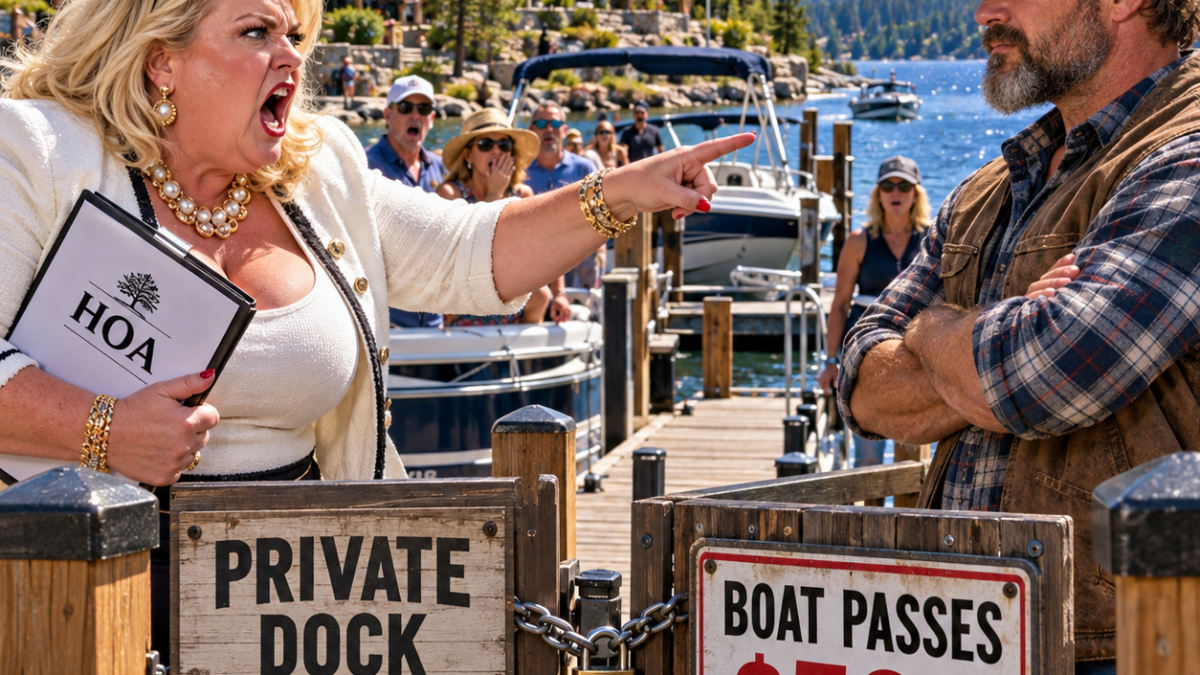
The first time I found our HOA president standing on my dock and ordering two teenagers around like she owned the shoreline, she informed me that the board had voted my privately deeded dock into “community access”—as if four people in a clubhouse could erase the survey, title, and property line I had been paying taxes on for eight years.
I showed her the deed, reminded her that the dock sat entirely inside my parcel, and told her that if the HOA truly believed it could turn private waterfront into public space with a policy memo, it was welcome to explain that theory to the county—but instead of backing down, she returned the next evening with two board members and threatened to fine me for the gate I had just locked across the path.
What happened after that started with one ridiculous rule, one locked gate, and a stack of $500 boat passes, but by the time people finally began opening the HOA’s books, the argument over my dock had exposed something much larger than anyone in Cedar Loop expected.
My name is Carson Klein.
I bought my lakeside house eight years earlier because of one thing.
The dock.
The house itself was fine.
Three bedrooms.
Old stone fireplace.
Kitchen desperately in need of new cabinets.
But the property sloped toward a quiet lake, and at the bottom sat a private wooden dock included specifically in the deed.
Not “shared access.”
Not “community amenity.”
Mine.
That distinction had never mattered until Barbara Densley became obsessed with changing it.
Barbara was the president of the Cedar Loop HOA and treated a clipboard the way some people treat a badge.
So when I saw her standing on my dock one Saturday morning, waving that clipboard at two teenagers who had tied their kayaks to one of my cleats, I knew breakfast was going to wait.
“You can’t use community property without authorization,” she snapped.
The kids looked terrified.
I walked down the hill.
“Barbara.”
She spun toward me.
“Carson, good. Tell them they need to leave.”
“They’re fine.”
“They’re not residents.”
“They’re friends of my neighbor’s daughter.”
“That doesn’t matter.”
“It matters to me.”
Her mouth tightened.
“This dock is now a shared lake-access point.”
I stopped.
“Since when?”
“The board adopted an updated access policy last month.”
“You voted my dock public?”
“That’s an oversimplification.”
“It’s exactly what you just said.”
Barbara lifted her clipboard.
“When you purchased within Cedar Loop, you agreed to HOA governance.”
“I agreed to covenants.”
“Yes.”
“I didn’t donate my land.”
Her face reddened.
“All lakeside structures are subject to association access policy.”
“No.”
I unlocked the small gate at the bottom of the slope and stepped onto the dock.
“This structure is listed on my deed.”
I pointed toward the shoreline.
“My parcel line extends into this section. I have the title report and survey.”
“We’ll see what the board says.”
“The board doesn’t get to vote itself somebody else’s property.”
The teenagers untied their kayaks.
One whispered, “We can just go.”
I shook my head.
“You don’t have to.”
Barbara stared at me.
“You’re creating unnecessary conflict.”
“No. I’m identifying a boundary.”
That evening, I pulled everything from the fireproof cabinet in my office.
Deed.
Closing documents.
Title insurance.
Parcel map.
Original survey.
The dock sat comfortably inside my legal boundary.
It wasn’t even close.
The next morning, I called a contractor.
By noon, a six-foot aluminum gate stood at the foot of the slope, exactly where an improvement plan approved the previous year allowed it.
White sign:
**PRIVATE DOCK — ACCESS BY OWNER PERMISSION ONLY**
Barbara arrived before sunset.
This time Rick and Tanya, two HOA board members, followed her.
“You’re obstructing community access.”
“No.”
I held up my folder.
“I’m controlling access to my property.”
Barbara pointed toward the gate.
“I’ll fine you for an unauthorized structural modification.”
I smiled.
“Check last year’s improvement approvals.”
Her expression shifted.
“You signed this gate yourself.”
Rick looked at her.
Tanya suddenly became very interested in her phone.
For several seconds Barbara said nothing.
Then she turned and walked away.
Two days later, every homeowner received a mass email declaring that, due to “confusion surrounding lake privileges,” all private docks would be treated as open community access unless their owners applied for an exemption.
That was when I stopped arguing with Barbara’s policy.
I decided to demonstrate exactly what private ownership meant.
PART 2
I printed one hundred passes.
Not because I expected one hundred people to buy them.
Mostly because the print shop offered a discount at that quantity.
Heavy laminated stock.
Blue lettering.
A small photograph of the dock.
At the top:
**AUTHORIZED DOCK USER — KLEIN PROPERTY**
Below that:
**Annual private access permission. Revocable by owner.**
Price:
**$500**
When my friend Marcus saw the first one, he stared at me for a full five seconds.
“You’ve lost your mind.”
“Probably.”
“Five hundred dollars?”
“Barbara says the whole neighborhood wants access.”
“She also thinks a clipboard gives her eminent-domain powers.”
“Exactly.”
Marcus turned the pass over.
“What does this actually include?”
“Permission to launch or tie a small boat at my dock when I’m not using it. Reservation system. No overnight storage. No trash. No parties without permission.”
“Insurance?”
“Working on a waiver.”
“You’re serious.”
“I’m very serious.”
He started laughing.
“You’re going to sell three.”
I sold the first five that afternoon.
Not to strangers.
Neighbors.
People who owned kayaks but hated hauling them to the public launch.
A retired couple wanted occasional fishing access.
Another resident wanted somewhere his teenage sons could launch paddleboards.
Then Phil Donnelly from two streets over bought one simply because he disliked Barbara.
“Five hundred dollars is expensive spite,” I told him.
He handed me a check.
“Worth every penny.”
Word spread.
Something unexpected happened.
The passes became symbolic.
People weren’t buying because my dock was worth $500 a year.
Some probably wouldn’t use it more than twice.
They were buying because Barbara had declared that she could force my property open for free.
By paying me directly, they were acknowledging the opposite.
My permission mattered.
That drove her crazy.
I sold eighteen passes the first day.
Thirty-two by day three.
Seventy by the weekend.
The last one sold the following Tuesday.
One hundred.
Fifty thousand dollars.
The number surprised even me.
I immediately called a lawyer named Evan Mercer.
No relation.
He had handled a boundary issue for me years earlier.
“Tell me you did not collect fifty thousand dollars without talking to insurance.”
“Good morning to you too.”
“Carson.”
“Yes.”
“How many people?”
“One hundred.”
He groaned.
“Do you hate peace?”
“Apparently.”
We spent the next week turning my improvised protest into something legitimate.
Written access agreement.
Liability language.
Scheduling system.
Rules against commercial charters.
No fuel storage.
No permanent mooring.
No transfer of passes.
No representation that pass holders owned any interest in the dock.
I also reserved the right to cancel and refund unused access if the dispute affected safety.
The passes were not marina memberships.
They were private licenses to enter my property.
That distinction would matter.
Barbara’s response arrived three mornings later.
Laminated notice.
Zip-tied to my mailbox.
Bright red letters:
**UNAUTHORIZED COMMERCIAL USE OF RESIDENTIAL PROPERTY**
**IMMEDIATE CEASE AND DESIST**
**FINE: $500 PER INFRACTION**
I read it standing beside the mailbox.
Then started laughing.
Not because it was funny.
Because the number was perfect.
She had fined me exactly the price of one dock pass.
My neighbor Ellen was walking her dog.
“What happened?”
I held up the notice.
“Apparently I’ve become a marina.”
“Do you sell snacks?”
“Not yet.”
“Then it’s a terrible marina.”
I photographed the notice before removing it.
Then called Benji Palmer.
Benji was a municipal code inspector I knew from my years volunteering on the city zoning advisory committee.
I brought the notice to his office.
He read it.
Read it again.
Then looked over his glasses.
“They’re fining you for allowing people onto your private dock.”
“They say commercial operation.”
“Are you renting boats?”
“No.”
“Selling fuel?”
“No.”
“Running fishing charters?”
“No.”
“Advertising public marina services?”
“No.”
“Permanent slips?”
“No.”
“What exactly are you selling?”
“Permission.”
Benji leaned back.
“Private access licenses.”
“Correct.”
“For a structure already permitted as part of a residential waterfront parcel.”
“Yes.”
“How many?”
“One hundred.”
His eyebrows rose.
“That many people like your dock?”
“That many people dislike Barbara.”
“Ah.”
He reread the notice.
“This isn’t a zoning violation based on what you’ve described.”
“Can you put that in writing?”
“I can state what the municipal code says and that we have no current zoning-enforcement basis.”
“Perfect.”
“Carson.”
“Yes?”
“Don’t turn this into a nightclub.”
“I promise nothing.”
“I’m serious.”
“So am I.”
He drafted a letter the next day.
My property remained residential.
Granting limited permission to invited users did not automatically transform a private dock into a commercial marina under the cited zoning provisions.
No municipal enforcement action was pending.
I sent the HOA a certified response.
Benji’s statement.
Zoning-code excerpts.
My deed.
Again.
Survey.
Again.
Gate approval.
Again.
I gave the board seven days to withdraw the fine.
Barbara responded on day eight.
Not with a letter.
Orange spray paint.
I stepped outside Thursday morning and found a bright line running across the lower part of my lawn.
Small wooden stakes followed it.
At the center stood a laminated sign:
**PROPOSED EASEMENT — FUTURE COMMUNITY WALKWAY**
I stared at it.
Then toward the lake.
The proposed walkway came from the neighborhood street, crossed my grass, ran beside my house, and appeared to end near the boathouse.
No one had asked me.
No surveyor had contacted me.
No city notice.
No county hearing.
Nothing.
I called Evan.
His first response:
“Don’t remove anything yet.”
“My lawn has orange paint across it.”
“Photograph first.”
“I know.”
“Then video.”
“Already.”
“Security camera?”
“Checking.”
“Good.”
“After that can I pull the stakes?”
“Not until we identify whether a government agency placed them.”
“I guarantee Barbara did.”
“Guarantees are not evidence.”
Lawyers ruin satisfying impulses.
I checked the driveway and backyard cameras.
At 6:12 the previous evening, a white SUV stopped near my house.
Barbara got out.
Two men with measuring wheels followed.
Neither wore city identification.
They marked the lawn.
Placed stakes.
Barbara took photographs.
Then they left.
I called Marcus.
He was a licensed commercial drone pilot and did aerial site documentation for contractors.
“Want to fly?”
“Always.”
“Bring the survey software.”
“That sounds less fun.”
By noon, Marcus had completed a lawful aerial survey flight.
We used the county GIS data as a reference layer, while Evan reminded me GIS alone was not a boundary survey.
The imagery still made the proposal obvious.
The orange line went directly through my parcel.
Not beside it.
Through it.
Across lawn I maintained.
Past a retaining wall.
Ending beside my private boathouse.
Marcus stared at the overlay.
“Barbara wants a walking path to your dock.”
“Yes.”
“After the board declared the dock public.”
“Yes.”
“And after you gated it.”
“Yes.”
“And after you sold passes.”
“Yes.”
He looked at me.
“Do you ever wonder whether maybe you should move?”
“Every board meeting.”
I filed a complaint with county land records and city planning.
Then I sent everything to Evan.
He prepared a formal cease-and-desist.
Remove the markers.
Retract any claim of existing easement.
Stop representing the proposed route as approved.
Preserve all records regarding the walkway proposal.
Then I did something Evan initially hated.
I called a reporter.
Rachel Kim wrote a local column about municipal planning disputes.
Not sensational neighborhood gossip.
Actual document-driven reporting.
I told her:
“I don’t need you to write that my HOA president is crazy.”
“Good. I wouldn’t.”
“I have a deed, survey, city letter, gate approval, proposed easement markings and security footage.”
“That’s more interesting.”
“Why?”
“Because paperwork talks.”
I liked Rachel immediately.
She reviewed documents for three days.
Called the county.
Called Benji.
Called the HOA.
Barbara refused comment.
Then, apparently, she reconsidered.
Rachel called me.
“She says your dock is creating an equity problem.”
I almost dropped my phone.
“An equity problem?”
“Her words.”
“How?”
“Limited shoreline means all residents should benefit.”
“Did she explain why that allows the HOA to take private property?”
“She said the board has broad authority over common recreational resources.”
“The dock isn’t common.”
“I know.”
“Did you tell her?”
“I asked for the recorded instrument granting HOA control.”
“And?”
“She ended the call.”
Perfect.
Barbara arrived at my front door the next morning.
Raincoat.
Clipboard.
Angry.
“You had no right to involve the press.”
My security camera was above her head.
I stepped onto the porch.
“I had every right.”
“This is an internal association matter.”
“You marked an easement across my property.”
“We proposed a walkway.”
“On land you don’t own.”
“For community benefit.”
“That phrase doesn’t create an easement.”
“The board voted.”
“The board cannot grant itself a right over my yard.”
“You think you’re clever.”
“No.”
I pointed toward the camera.
“I think everything should stay factual.”
She glanced up.
Noticed the lens.
Her tone changed immediately.
“You’ve been hostile since the beginning.”
“I installed a gate on my dock.”
“You monetized community frustration.”
“I sold access to my property.”
“You’re exploiting your neighbors.”
“They volunteered to pay.”
“Because you created scarcity.”
I almost laughed.
“Barbara, you declared the dock public without owning it.”
She stepped closer.
“We are trying to protect long-term community access.”
“Then buy land.”
Her expression tightened.
“What?”
“If the HOA wants waterfront property, buy waterfront property.”
“We shouldn’t have to.”
That sentence told me more than anything else she said.
We shouldn’t have to.
Why?
Because she believed wanting something for the neighborhood was enough.
“Take the stakes out,” I said.
“We’ll discuss it at the emergency board meeting.”
“I’m not discussing whether you may take my lawn.”
“Thursday. Seven.”
Then she turned.
“Barbara.”
She looked back.
“The county is already reviewing it.”
Her face changed.
Just slightly.
“You filed a complaint?”
“Yes.”
“Of course you did.”
She walked away.
The emergency meeting was packed.
I had never seen so many residents attend anything that didn’t involve free food.
Barbara stood at the front.
Rick to her right.
Tanya to her left.
Two additional board members farther down.
Jason Holloway, an accountant who rarely spoke at meetings, sat near the end.
Barbara opened with a prepared statement.
“Cedar Loop is experiencing unprecedented conflict regarding equitable recreational access.”
I whispered to Marcus:
“She practiced that.”
He whispered back:
“A mirror suffered.”
Barbara continued.
“One homeowner has attempted to monopolize a valuable community resource for personal financial gain.”
People looked at me.
She didn’t use my name.
Didn’t need to.
“Lake enjoyment is central to our neighborhood identity.”
Then:
“No individual resident should be permitted to place personal profit above the collective good.”
That line got a few nods.
I understood why.
In isolation, it sounded reasonable.
The dock passes made me look greedy.
Maybe I had underestimated that.
Barbara asked for comments.
I raised my hand.
She hesitated.
Then:
“Three minutes.”
I walked forward carrying one folder.
Not a stack.
One.
“This is my deed.”
I placed it down.
“This is the recorded survey.”
Second document.
“This is the city’s written response stating the dock access arrangement is not currently a zoning violation.”
Third.
“This is the county complaint regarding the proposed walkway.”
Fourth.
“This is the security footage showing association representatives marking that walkway on private property without my consent.”
Barbara interrupted.
“We have already explained—”
Tanya said quietly:
“Let him finish.”
Barbara stared at her.
The room noticed.
I continued.
“The board can regulate association property.”
“The board can administer valid covenants.”
“The board can vote on things the governing documents give it power over.”
I looked at Barbara.
“But this board cannot vote my dock into becoming yours.”
A murmur moved through the room.
“The proposed walkway begins on HOA property, crosses my parcel, and ends at my boathouse.”
I held up the aerial image.
“No recorded easement grants that route.”
A man in the second row raised his hand.
“Then why did we vote on it?”
Barbara said:
“You didn’t.”
He frowned.
“You said the board approved it.”
“The board did.”
“I’m on the board.”
Everyone turned.
Jason Holloway.
Barbara’s face stiffened.
“You were absent from the executive discussion.”
Jason opened his binder.
“What executive discussion?”
“Last Monday.”
“There was no noticed executive session Monday.”
Barbara blinked.
Rick suddenly looked at the table.
Tanya stopped touching her phone.
Jason continued.
“I checked the calendar.”
Barbara raised her voice.
“This is not relevant.”
“It’s extremely relevant.”
Jason looked at me.
“Carson, who told you the board voted?”
“Barbara.”
Jason turned back.
“I didn’t vote.”
Tanya said:
“Neither did I.”
Now the room truly changed.
Rick leaned toward Barbara.
“What exactly did you authorize?”
She snapped:
“The president has emergency administrative discretion.”
“For an easement?” Jason asked.
No answer.
I said:
“That’s the same explanation used for the dock policy.”
Barbara turned on me.
“This meeting is not a trial.”
“No.”
I looked around.
“But it’s becoming a records request.”
Someone laughed.
Then another resident stood.
“My fence fine.”
Barbara banged the gavel.
“One speaker at a time.”
“Was that voted on?”
Another person:
“What about my shed?”
Another:
“You denied my boat-storage request and then approved Rick’s brother.”
Rick looked up sharply.
“That has nothing to do with me.”
The room filled with overlapping questions.
Barbara kept striking the gavel.
Finally Tanya took it from her.
“Stop.”
Barbara stared.
Tanya stood.
“I move that all pending enforcement actions involving waterfront access, property-line changes and unapproved structural claims be suspended until counsel reviews jurisdiction.”
Jason:
“Second.”
Vote.
Three yes.
Rick abstained.
Barbara no.
Motion passed.
She looked stunned.
I didn’t celebrate.
Because I had just watched the board realize its president might have been telling them actions were approved when they weren’t.
That was bigger than my dock.
Rachel’s article appeared the next morning.
The headline was less dramatic than the draft I had joked about.
**PRIVATE DOCK DISPUTE RAISES QUESTIONS ABOUT HOA LAND AUTHORITY**
Better.
Factual.
The article included:
The deed.
County map.
Benji’s statement.
Drone imagery.
Comments from three residents who said they received enforcement notices without clear board votes.
Barbara’s response:
**The HOA has always acted in good faith to protect community interests.**
That sentence would appear repeatedly over the next several months.
By noon, a regional outlet had picked up the story.
By Monday, a city council member called me.
Her name was Elaine Porter.
“Would you testify at a land-use oversight hearing?”
“About the dock?”
“About private-property enforcement by HOAs.”
“I’m not an expert.”
“You’re a homeowner with records.”
“Fair.”
Two days later, county administrators announced a formal review of Cedar Loop’s recent amendments, fines and expenditures.
Expenditures.
That word surprised me.
I had expected property filings.
Barbara had apparently given them more to examine.
The first clue came from Jason.
He knocked on my door after dark.
No clipboard.
Just a manila envelope.
“Can we talk?”
We sat on the back deck.
He looked exhausted.
“I’m treasurer.”
“I thought Margaret was treasurer.”
“Officially.”
“What are you?”
“Finance committee.”
“Okay.”
“I’ve been looking at vendor records.”
“Because of the audit?”
“Because the county asked for six years.”
He opened the envelope.
“Landscaping payments.”
I scanned the sheet.
Same company repeatedly.
**SUNCREST LANDSCAPE SERVICES**
“Problem?”
“Rates are high.”
“How high?”
“Twenty to thirty percent above comparable bids.”
“Maybe they’re good.”
“They’re average.”
“Anything else?”
Jason slid over corporate registration.
Owner:
Dennis Densley.
I looked at him.
“Barbara?”
“Her cousin.”
“Disclosure?”
“None I can find.”
“That’s ugly.”
“It gets uglier.”
Legal-consulting fees.
Shoreline erosion invoices.
Drainage assessment.
One contractor existed only at a commercial mailbox.
Jason looked at me.
“County auditors noticed too.”
“How much?”
“I don’t know.”
“You do.”
He rubbed his eyes.
“Hundreds of thousands may require explanation.”
My annoyance disappeared.
That was no longer neighborhood drama.
“Do not give me originals,” I said.
“These are copies.”
“Good.”
“Carson, I’ve sat in meetings for four years.”
“That doesn’t make you responsible for something you didn’t know.”
“I approved budgets.”
“Based on?”
“Reports Barbara and Margaret presented.”
“Then give investigators everything.”
“I am.”
He looked toward the lake.
“I thought she was difficult.”
“Same.”
“I didn’t think…”
He stopped.
Nobody ever does.
The county froze the HOA’s authority to issue new fines while the audit proceeded.
A receiver was appointed temporarily for significant expenditures.
Barbara’s public statements became less frequent.
Rick resigned.
Tanya resigned a week later, publicly stating that she had lost confidence in the board’s internal controls.
Then investigators executed search warrants connected to the financial case.
I was standing in my garage when two state investigators arrived at my house shortly afterward.
Financial Crimes Division.
They wanted a formal statement.
The taller investigator, Mark Ellison, opened a file.
“We’ve reviewed six years of HOA financial records.”
“How bad?”
“That depends what explanations exist.”
“And so far?”
“Not enough.”
His partner placed photocopies on my table.
Special assessments.
Storm drainage.
Shoreline stabilization.
Over $400,000 collected over roughly a decade.
I remembered those assessments.
Everybody did.
The HOA had told us erosion work was expensive.
“Where did it go?”
“Some legitimate projects.”
“How much?”
“Still calculating.”
He slid forward several checks.
One vendor.
Nearly $170,000.
I recognized the name from Jason’s file.
“But there was no shoreline project that size.”
“We’ve found no corresponding permitted construction.”
“Company?”
“Registered through a mailbox.”
I leaned back.
“Barbara signed these?”
“Several.”
“Who else?”
“Other board officers on some.”
“Did they know?”
“Under investigation.”
Mark closed the folder.
“We’d like your account of the dock dispute because it appears to have triggered the document review that exposed discrepancies.”
“Happy to help.”
“You realize that doesn’t make you responsible for the criminal investigation.”
“Believe me, I don’t want credit.”
“Good.”
That distinction mattered.
Online, people were already calling me the man who “took down the HOA.”
I didn’t.
Records did.
Investigators did.
Auditors did.
Residents who finally spoke did.
The biggest development came at the receiver’s town hall.
Her name was Janice Dorl.
Retired judge.
Sixties.
Short gray hair.
No patience for speeches.
She walked to the front carrying one binder.
No slideshow.
No dramatic graphics.
“My job is not to make you happy.”
That was her opening sentence.
People immediately liked her.
“My job is to preserve association assets, determine lawful obligations and ensure that no additional money moves without documentation.”
She looked around.
“If you have evidence, provide it.”
“If you have rumors, keep them until they become evidence.”
I almost applauded.
She continued.
“Past violations will be reviewed.”
“Any unresolved notice lacking sufficient documentation and authorization will be dismissed.”
A woman shouted:
“All of them?”
Janice looked over her glasses.
“Did I say all?”
“No.”
“Then no.”
People lined up afterward.
Unauthorized fines.
Denied modifications.
Threatened liens.
Selective enforcement.
A disabled veteran named Marcus Hale described requesting permission for a ramp for his wife.
He had been told approval would be faster if he contributed to a neighborhood beautification fund.
Janice’s face became very still.
“Do you have that in writing?”
“Yes.”
“Bring it tomorrow.”
When my turn came, I handed her a flash drive.
Dock footage.
Barbara’s emails.
The orange walkway markings.
Drone imagery.
Gate approval.
Pass agreements.
Janice studied the screen.
Then:
“Mr. Klein.”
“Yes?”
“Did you truly sell one hundred passes for five hundred dollars each?”
The room laughed.
“Yes.”
Janice removed her glasses.
“Why?”
I considered several answers.
Spite.
Principle.
Barbara.
Instead:
“Because the HOA said private ownership no longer mattered.”
“And charging people proved it did?”
“It proved permission had value.”
Janice looked at me for several seconds.
“Legally provocative.”
“Probably.”
“Financially successful.”
“Yes.”
“Annoying?”
“Extremely.”
She almost smiled.
Then she returned to the serious matter.
“This footage shows Mrs. Densley entering your property to mark the proposed walkway?”
“Yes.”
“Consent?”
“No.”
“Government authorization?”
“None I found.”
Janice nodded.
“This is exactly why governance requires records.”
That night, roughly ninety percent of pending old violations without adequate support were dismissed.
People cried.
Actual tears.
Over letters.
That taught me something.
A $200 fine might seem small from the outside.
But when a person believes their home is threatened, every official-looking envelope becomes heavy.
Two weeks later, prosecutors announced that Barbara had entered negotiations involving the initial HOA-governance and falsification charges.
Rumors immediately exaggerated everything.
Five years prison.
Twenty years.
House seized that afternoon.
None of that was accurate yet.
Evan reminded me:
“Do not repeat plea terms until they’re entered.”
So I didn’t.
The financial investigation was still expanding.
Then I did something nobody expected.
I ran for city council.
Marcus nearly choked when I told him.
“You hate meetings.”
“I hate bad meetings.”
“That’s all meetings.”
“Fair.”
“Why?”
Because even after Barbara lost control, the legal ambiguity that allowed her to pretend private waterfront could become communal still bothered me.
I wanted the municipal code to be clearer.
Not a law targeting Cedar Loop.
A general rule.
HOAs could regulate association-owned docks.
They could regulate structures where deeds or valid easements expressly granted authority.
They could administer shared facilities.
But they could not create private-waterfront jurisdiction merely through policy language.
My campaign was absurdly simple.
No glossy flyers.
No dramatic slogans.
I invited neighbors to my dock.
Barbecues.
Coffee mornings.
Small conversations.
I told them exactly what I wanted to change.
One voter asked:
“Aren’t you the guy charging five hundred dollars to use a dock?”
“Yes.”
“That seems greedy.”
“Fair criticism.”
“Why so much?”
“Because access had become part of a property dispute.”
“That doesn’t answer the question.”
I smiled.
“I wanted there to be no ambiguity that people were entering by private permission.”
“Couldn’t you charge five dollars?”
“Yes.”
“Then why five hundred?”
“Because I was angry.”
That honesty surprised him.
It surprised me too.
By then I could admit it.
The passes had been legally structured after the fact, but the first impulse was emotional.
Barbara said my dock belonged to everyone.
I responded:
Then let’s see whether everyone recognizes the owner when payment is required.
Was it petty?
Absolutely.
Effective?
Also yes.
Would I recommend it as legal strategy to anybody else?
Not without a lawyer and insurance agent standing beside you.
I won the council seat comfortably.
Not because everybody loved me.
Some thought I had turned a neighborhood dispute into a political career.
They weren’t entirely wrong.
At my first full session, I introduced what reporters nicknamed the Waterfront Property Integrity Ordinance.
The actual title was far more boring.
It clarified that association control over private waterfront structures required explicit recorded authority—ownership, deed restriction, valid easement or another recognized legal interest.
Policy packets alone did not create property rights.
Passed unanimously.
Barbara’s name never appeared.
That mattered.
Good law should outlive the person who inspired it.
Meanwhile, the HOA’s financial investigation kept growing.
The state identified false vendor invoices.
Bid irregularities.
Family-connected contracts.
Money routed through shell companies.
The preliminary resolution Barbara had been discussing on the earlier document-related offenses never became the final end of the matter because additional, separately investigated financial conduct produced a broader prosecution.
That was when the story became much less satisfying and much more serious.
People had lost real money.
Special assessments.
Reserve funds.
Payments that were supposed to protect homes from drainage and erosion.
One afternoon, I received a letter from Baxter & Rowe, a state-capital firm.
I almost threw it away.
Then saw:
**PROPOSED CIVIL ACTION — CEDAR LOOP HOMEOWNERS**
I called.
An attorney named Natalie Baxter came on.
“Mr. Klein, we represent a group of current and former Cedar Loop owners.”
“I didn’t hire you.”
“We know.”
“Why am I being contacted?”
“Because the audit uncovered an insurance policy.”
“What policy?”
“Association liability and fiduciary coverage.”
I stopped walking.
“We were told we didn’t have that.”
“You did.”
“How much?”
“Potential coverage approaching seven hundred thousand dollars, subject to exclusions and court interpretation.”
“And?”
“The policy may cover portions of resident losses connected to certain wrongful association acts.”
“Barbara’s fraud?”
“Careful.”
Lawyers apparently attended the same vocabulary school.
“Some intentional criminal conduct may be excluded. But negligent oversight, covered fiduciary acts, defense obligations and specific riders create potential recovery.”
“So what do you want?”
“Your dock case is the earliest well-documented enforcement dispute directly connected to the records review.”
“You want me as lead plaintiff.”
“Yes.”
I sat on the porch step.
A blue heron crossed the lake.
Slow.
Unconcerned.
“How many people?”
“Seventeen named plaintiffs initially.”
“Former residents too?”
“Yes.”
“People who paid unauthorized fines?”
“Some.”
“Assessment losses?”
“Potentially.”
“What does being lead plaintiff require?”
“Documents.”
“I have those.”
“Testimony.”
“Done that.”
“Patience.”
“I have less of that.”
Natalie laughed.
“Then this will be character-building.”
Six weeks later, we were in civil court.
No television-drama courtroom.
Low ceiling.
Fluorescent lights.
A wall clock loud enough to become part of the testimony.
Seventeen plaintiffs.
A widow whose garden fence had been removed after she disputed an association demand.
A teacher fined for a mailbox identical to one used by a board officer.
Marcus Hale, the disabled veteran whose accessibility request had become leverage for a donation.
Linda Cho, who had paid repeated parking penalties for her daughter’s home-health aide.
Each story alone looked small.
Together, they showed a system.
That was the frightening part.
Abuse rarely starts with a spectacular act.
It starts with something small enough that fighting seems unreasonable.
$75.
$150.
A mailbox.
A fence.
A parking warning.
A dock.
Then people learn that challenging the small thing costs more than paying it.
That teaches the person in power to try something larger.
The civil case focused on records.
Bank statements.
Minutes.
Insurance provisions.
Invoices.
Emails.
The most damaging evidence was an email chain between Barbara and Suncrest Landscaping.
The language was not dramatic.
That made it worse.
Invoice amount adjustments.
Preferred-vendor status.
“Administrative support.”
Payment timing.
One message asked whether a higher invoice could “cover the board-side consideration we discussed.”
Another replied with an amount.
The judge read quietly.
Then removed his glasses.
The courtroom stayed still.
Later, the ruling found substantial support for the homeowners’ covered claims.
Insurance proceeds and other recoverable funds were ordered into a structured settlement distribution subject to the policy and court calculations.
Not every homeowner received the same amount.
The source story people later told simplified it into “everyone split seven hundred thousand dollars.”
Reality was more complicated.
Different damages.
Different documented payments.
Different eligibility.
My eventual share, combined with my direct claims and reimbursement related to the dispute, came to just under $42,000.
Less than the dock-pass revenue I had collected.
Yet the check mattered more.
Because it came with a court order acknowledging that residents had been harmed by governance failures they were repeatedly told did not exist.
Three days after the civil ruling, the county prosecutor announced the expanded financial case.
Forensic accounting had traced funds through shell entities and personal obligations.
Several individuals faced charges.
Some cooperated.
One former board secretary received leniency after providing records.
A former treasurer admitted ignoring obvious warning signs.
The landscaping contractor faced his own tax and contracting investigation.
Barbara eventually entered a final plea resolving the principal financial charges against her.
The sentence was significant.
Multi-year incarceration.
Restitution.
Disqualification from association fiduciary roles.
Additional financial consequences.
I attended sentencing.
I almost didn’t.
Evan asked:
“Why go?”
“Closure?”
“That’s a dangerous expectation.”
“Why?”
“Courts close cases. They don’t necessarily close people.”
I went anyway.
Barbara looked smaller than I remembered.
No clipboard.
No HOA polo.
No crowd of board members.
Just a woman beside her attorney.
The prosecutor described the money.
The altered records.
False vendors.
The pressure placed on residents.
Then Barbara spoke.
She said she had started by wanting Cedar Loop to be beautiful.
Safe.
Orderly.
She said the neighborhood had been neglected before she took over.
That residents constantly complained but rarely volunteered.
That every difficult decision became her responsibility.
Then:
“Somewhere along the way, I stopped seeing disagreement as disagreement.”
Her voice trembled.
“I saw it as disloyalty.”
That line affected me.
Because I believed it.
She continued.
“I told myself that if something helped the neighborhood, the method didn’t matter.”
The judge asked:
“Did that belief justify taking money that was not yours?”
Barbara lowered her head.
“No.”
“Did it justify falsifying or manipulating records?”
“No.”
“Did it justify interfering with private property rights?”
“No.”
For years, I had wanted to hear her say that.
When she finally did, it brought no thrill.
Just sadness.
How much damage could have been avoided if she had said the same word the first morning?
No.
No, the board cannot take Carson’s dock.
No, community benefit does not erase a deed.
No, being president does not make every method acceptable.
The final sentence meant Barbara would be gone for years.
Some neighbors celebrated.
I didn’t judge them.
Some had been treated terribly.
But I drove home quietly.
At the bottom of the hill, my aluminum gate was closed.
The white sign remained:
**PRIVATE DOCK — ACCESS BY OWNER PERMISSION ONLY**
I unlocked it.
Walked down.
Sat at the end.
The lake was dark.
For the first time in months, nobody needed anything from me.
No reporter.
No lawyer.
No investigator.
No neighbor asking what came next.
I stayed there until almost midnight.
The court later ordered the old HOA dissolved under the receiver’s restructuring process.
Janice Dorl held the final meeting.
Every chair filled.
She carried one folder.
“As of the effective date in this order, Cedar Loop Homeowners Association will cease operating in its former form.”
People were silent.
“Property owners remain subject to municipal law, recorded deed restrictions that survive dissolution, and any separate valid property obligations.”
She looked around.
“You are not becoming a lawless wilderness.”
A few people laughed.
“You simply will no longer be governed by this association.”
No applause at first.
Just exhalations.
Then someone began clapping.
Others followed.
Janice raised one hand.
“Save it.”
Everyone stopped.
“I have one more thing.”
She looked directly at the room.
“Do not learn the wrong lesson.”
Silence.
“The lesson is not that homeowners associations are inherently corrupt.”
Some faces showed disagreement.
“The lesson is that concentrated authority without transparency is dangerous anywhere.”
She tapped the folder.
“HOA. City council. Charity board. Corporation. Family trust.”
Then:
“If the person asking questions becomes the enemy, your system is already failing.”
I wrote that sentence down.
Afterward, Janice found me.
“Councilman Klein.”
“Please don’t.”
“You ran for office.”
“I already regret the title.”
She looked toward the lake.
“What are you doing with the gate?”
“Keeping it.”
“Passes?”
“Retiring them.”
“Why?”
“The point’s been made.”
“And the fifty thousand?”
I had thought about that.
After insurance, maintenance, legal structuring and taxes associated with the access arrangement, the money was not simply free profit.
But there was still a substantial remainder.
I used part to rebuild the dock.
New boards.
Safer railing.
Solar lighting.
Emergency flotation ring.
Weatherproof storage.
Then I created a neighborhood recreation fund administered separately from me.
Fishing equipment for kids.
Life jackets.
Small water-safety classes.
I kept ownership.
That distinction mattered.
But access became easier.
Not because Barbara forced it.
Because I chose it.
The aluminum gate stayed locked at night.
During daytime weekends, I often left it open when I was home.
A small chalkboard hung beside it.
**TODAY’S GUESTS — WELCOME**
People texted before coming.
I wrote names.
Simple.
One Saturday morning, Phil arrived carrying his old laminated $500 pass.
“You said these are lifetime.”
“I absolutely did not.”
“Annual private access permission.”
He read the card.
“Oh.”
“Expired three years ago.”
“Refund?”
“No.”
“This is tyranny.”
“You can leave.”
He walked through the open gate.
“See you at the dock.”
The first family to ask after the old pass system ended was new to Cedar Loop.
Woman named Maya Brooks.
She had bought the old Clayborn house.
She stopped at the top of the slope.
Didn’t enter.
“Are you Carson?”
“Depends who’s asking.”
She smiled.
“Maya.”
“New neighbor.”
“Two weeks.”
She pointed toward the dock.
“My son saw the fishing rods.”
“He likes fishing?”
“He thinks he does.”
“How old?”
“Nine.”
“That means he likes throwing things into water.”
“Pretty much.”
“What’s the rule?”
She nodded toward the sign.
I thought about it.
Then:
“Ask first.”
“That’s it?”
“Take care of it.”
“Anything else?”
“Don’t leave hooks where kids step.”
She laughed.
“That’s rare.”
“What?”
“Simple rules.”
“Cedar Loop used to specialize in complicated ones.”
That afternoon, her son caught nothing.
He loved it.
Soon I added a weatherproof tackle box.
Cheap rods.
Bobbers.
No expensive gear.
Kids could borrow them.
Parents started bringing snacks.
Marcus installed a small weather station.
Linda organized a Saturday cleanup.
The dock became busier after I reclaimed it than it had ever been when Barbara called it “public.”
That irony wasn’t lost on me.
Private does not mean selfish.
Public does not automatically mean fair.
Consent was the difference.
Barbara’s mistake was assuming generosity could be mandated.
I wanted neighbors there.
I just wanted the right to say yes.
Or no.
That became increasingly important when I started serving on city council.
People expected me to become anti-HOA.
I wasn’t.
A woman from another subdivision approached after a meeting.
“Our HOA says you want to eliminate every association in the city.”
“No.”
“Then why did you pass the waterfront law?”
“To clarify property authority.”
“She said you believe HOAs are illegal.”
“They aren’t.”
“She said you hate community standards.”
“I hate pretending a handbook transfers a deed.”
The woman smiled despite herself.
“That’s different.”
“Very.”
My council work forced me to confront something uncomfortable.
Barbara had been wrong.
But residents sometimes wanted impossible things too.
One group demanded the city stop an HOA from requiring consistent roof materials.
The covenant clearly granted that authority.
Another homeowner wanted to park commercial equipment in a restricted common driveway.
Another wanted the city to invalidate dues because she simply disliked paying them.
The law was not:
Homeowner always right.
It was:
Authority must come from somewhere legitimate.
That made my own story less satisfying as a simple revenge tale.
But more useful.
Years passed.
The scandal became history.
New families arrived who had never met Barbara.
They heard fragments.
“The dock guy.”
“The $500 passes.”
“The HOA president.”
“The court case.”
Most versions were wrong.
One teenager told my nephew that I had bought the entire lake after suing the HOA.
My nephew came home laughing.
“Did you buy the lake?”
“Apparently.”
“Can I have it?”
“No.”
“Greedy.”
One summer, I found an old box while cleaning the garage.
Inside:
The original one hundred pass templates.
A few unused.
The first commercial-use fine.
Photographs of the orange walkway.
Barbara’s mass email.
**ALL DOCKS WILL BE CONSIDERED COMMUNITY ACCESS UNLESS OWNERS APPLY FOR EXEMPTION.**
I sat on the floor reading it.
That sentence still amazed me.
An exemption.
From having your own property taken by policy.
The burden had been reversed.
Instead of the HOA proving it had authority, homeowners were expected to prove they deserved freedom from it.
That mindset had fueled everything.
I framed the email.
Then changed my mind.
Put it back in the file.
I didn’t want Barbara on the wall.
I hung something else.
A photograph of the first neighborhood fishing day after dissolution.
Twenty people.
Kids.
Parents.
Janice standing awkwardly beside a cooler.
Phil holding his expired $500 pass in the air.
On the dock railing, the new sign:
**KLEIN DOCK**
**PRIVATE PROPERTY**
**NEIGHBORS WELCOME BY PERMISSION**
That photograph represented the ending better.
Not exclusion.
Choice.
One October afternoon, Jason visited.
We hadn’t talked in months.
He looked older.
Less tired.
“Remember when I thought resigning would fix everything?”
“Yeah.”
“Idiot.”
“Definitely.”
He sat beside me at the water.
“Do you know what bothered me most?”
“What?”
“I was there.”
“On the board.”
“For years.”
“You didn’t know.”
“I should have.”
“Maybe.”
He glanced at me.
“That’s not comforting.”
“I’m not your therapist.”
He laughed.
Then became serious.
“I signed budgets.”
“Did you steal money?”
“No.”
“Did you know invoices were false?”
“No.”
“Did you ask enough questions?”
“No.”
“That’s the part you own.”
He nodded.
We watched the water.
“I teach financial literacy at the community center now.”
“You?”
“Yes.”
“That sounds dangerous.”
“Mostly retired people.”
“What do you teach?”
“Read the statement.”
I smiled.
“Groundbreaking.”
“You’d be amazed.”
He was right.
Most fraud survives not because accounting is impossibly sophisticated.
But because nobody wants to be the person who asks why Invoice 441 is twenty thousand dollars higher than Invoice 440.
Linda passed away several years later.
Her daughter gave me a box of neighborhood materials.
Inside was one of my original dock passes.
Number 17.
She had bought it without telling me.
I never remembered seeing her use the dock that first year.
Her daughter said:
“She didn’t buy it for access.”
“Why?”
“She said Barbara needed to see people choose your side.”
I held the laminated pass.
$500.
I suddenly felt embarrassed.
“That was a ridiculous amount of money.”
Her daughter laughed.
“Mom spent more on handbags.”
“Fair.”
I kept Pass 17.
Not framed.
In the file with her letters.
My council term ended after four years.
People wanted me to run again.
I declined.
“Why?” Elaine asked.
“I’d like to become boring again.”
“You’re already boring.”
“Then I’d like to become privately boring.”
The waterfront ordinance remained.
No one repealed it.
No dramatic legal challenges.
That was the best possible outcome.
Good policy becomes boring.
The dock remained mine.
That too became boring.
One Sunday morning, I woke early and walked down.
Gate open.
Nobody there.
Mist over the water.
The aluminum rails were cool under my hand.
I remembered the teenagers Barbara had confronted all those years before.
I never learned their names.
For them, it was probably a weird ten-minute incident.
For me, it changed years of my life.
I wondered whether that’s how major events usually begin.
Not with thunder.
With irritation.
Someone says:
“You can’t be here.”
Someone else says:
“Actually, I can.”
Then one person chooses whether to verify the answer or escalate because being wrong feels intolerable.
Barbara chose escalation.
Again.
And again.
And again.
By the time investigators opened the books, she had made so many choices defending her authority that the original dock argument almost seemed irrelevant.
But it wasn’t.
It was the first loose thread.
Pull one thread.
Find another.
Policy.
Map.
Easement.
Fine.
Vendor.
Invoice.
Account.
Shell company.
Money.
The whole structure unraveled because somebody finally asked:
Where does it say you can do that?
That became the question I taught people to ask.
Not:
Is this unfair?
Not first.
Ask:
Where does the authority come from?
Show me the deed.
Show me the covenant.
Show me the vote.
Show me the statute.
Show me the invoice.
Show me the signature.
Show me the record.
If the power is legitimate, records usually exist.
If the answer is:
“Everybody knows.”
Be careful.
If the answer is:
“We’ve always done it.”
Look closer.
If the answer is:
“Trust me.”
Definitely look closer.
One afternoon a reporter called me for an anniversary story.
“Ten years since the Cedar Loop investigation.”
“Already?”
“Do you have a comment?”
“No.”
“People still remember the $500 dock passes.”
“I wish they’d forget.”
“Do you regret them?”
That was a good question.
“Yes and no.”
“Explain.”
“I regret that anger decided the price.”
“And the no?”
“They forced everyone to confront the difference between public access and private permission.”
“Would you do it again?”
“No.”
“Why?”
“I’d call my lawyer before the print shop.”
She laughed.
“Anything else?”
I looked at the dock.
“People think the story was about revenge.”
“Wasn’t it?”
“At first, maybe.”
“What was it really about?”
I took a moment.
“The right to choose what you share.”
That became the closing line of her article.
It was better than anything involving Barbara.
By then, Cedar Loop had no formal HOA.
The voluntary neighborhood group still existed.
It organized lake cleanup.
Holiday lights.
Emergency contact lists.
A scholarship fundraiser.
Nobody could fine anyone.
Nobody could place liens.
Nobody controlled private architectural decisions beyond actual municipal rules and recorded restrictions.
Some residents missed the old structure.
They said certain lawns looked worse.
A few fences became mismatched.
The world survived.
In exchange, participation became genuine.
People volunteered because they wanted to.
Donated because they trusted the account.
Asked questions without fear of being labeled troublemakers.
Marcus once said:
“The neighborhood got uglier and nicer.”
I thought that was perfect.
My own house changed too.
I replaced the kitchen cabinets eventually.
Rebuilt the retaining wall.
Added native plants beside the slope.
The dock needed major repairs fifteen years after I bought the property.
I considered removing it entirely.
Then neighborhood kids found out.
A petition appeared on my door.
Handwritten.
**PLEASE DON’T DELETE THE DOCK**
Twenty-seven signatures.
I laughed so hard I called Phil.
“You behind this?”
“No.”
“Marcus?”
“No.”
“Who?”
“Maya’s kid.”
He was twenty-four by then.
Still called it “Mr. Klein’s dock.”
I rebuilt it.
My money.
My permit.
My land.
And then I invited everyone to the reopening.
No pass.
No fee.
No application.
Just permission.
One of the teenagers asked:
“So this is basically a public dock?”
I smiled.
“No.”
He looked confused.
“Everybody uses it.”
“Sometimes.”
“Then what’s the difference?”
I pointed toward my house.
“I can close it tomorrow.”
“Would you?”
“Probably not.”
“Then why does it matter?”
Because at sixteen, concepts like private ownership and voluntary access are understandably abstract.
I thought about Barbara.
Then answered:
“Because kindness only means something when you’re allowed to say no.”
He stared at me.
“That’s deep for a dock.”
“Go fishing.”
He did.
That evening, everyone left.
I closed the gate.
Not because anyone had done anything wrong.
Because it was night.
My dock.
My decision.
I stood there looking at the sign.
The gate Barbara once called obstruction had become almost unnecessary.
Everyone knew the line.
Nobody needed a laminated survey with every invitation.
Nobody assumed access simply because they wanted it.
Trust had replaced entitlement.
That was the part of the victory I had never imagined.
The final check from the civil settlement sat in my desk for weeks before I deposited it.
Just under $42,000.
People assumed I would buy a new boat.
I didn’t.
I repaired the dock.
Funded the recreation box.
Donated part to a regional legal-aid fund for property and association disputes.
Not a huge amount.
Enough to help somebody obtain a survey or an initial consultation.
Because that was another thing the story taught me.
I could afford to fight.
Lawyer.
Survey.
Drone documentation.
Time away from work.
Many people can’t.
Barbara’s system had been especially powerful against people who calculated that a $300 fine was cheaper than a $3,000 legal fight.
That wasn’t consent.
It was economics.
I asked Evan to help structure the donation.
He stared at me.
“You’ve become wholesome.”
“Take it back.”
“Sorry.”
“Better.”
Years later, I received a note from a homeowner in another town.
She had used the legal-aid fund for a boundary survey after her association claimed a strip of her yard.
The HOA turned out to be correct.
I laughed when I read that.
Her note continued:
**I’m still grateful. I didn’t need the answer to be mine. I needed to know the answer was real.**
That may have been the best thing to come from everything.
Not everyone who questions authority will be right.
That isn’t the point.
They deserve a real answer.
One supported by documents.
Not status.
Not personality.
Not fear.
Barbara’s greatest mistake wasn’t declaring my dock public.
People make bad legal interpretations.
Her greatest mistake was what came next.
When the records contradicted her, she didn’t stop.
She escalated.
When the gate had prior approval, she invented another theory.
When zoning found no violation, she proposed a walkway.
When residents questioned the vote, she claimed emergency discretion.
When financial records came under review, investigators found years of other conduct.
At every fork, there was an exit.
She kept walking deeper.
That is why I stopped thinking of the story as something I did to her.
I didn’t build her consequences.
I simply stopped absorbing them myself.
The last time I saw Barbara was years later.
Not at Cedar Loop.
A grocery store two counties away.
I almost didn’t recognize her.
Older.
Gray hair.
Simple jacket.
She saw me first.
We both stopped.
For a moment, I expected anger.
Instead she said:
“Carson.”
“Barbara.”
Awkward silence.
Then:
“I heard you left the council.”
“Term ended.”
“You still have the dock?”
“Yes.”
Another silence.
“I was wrong about that.”
I didn’t know what to say.
“Yeah.”
Not graceful.
But true.
She nodded.
“I thought if everyone had access, nobody could accuse me of favoritism.”
“That doesn’t explain the money.”
“No.”
Her face tightened.
“I know.”
I could have walked away.
Instead:
“Why didn’t you stop?”
She looked at the floor.
“Because every time somebody challenged me, I thought backing down would prove I shouldn’t be president.”
That answer was sadder than I expected.
“So you kept proving you should?”
“I thought so.”
She looked at me.
“I confused winning with leading.”
There was nothing more to say.
I didn’t forgive her.
Didn’t condemn her.
We were two older people standing beside frozen vegetables talking about a life that had already happened.
“Take care, Barbara.”
“You too.”
Then we walked in opposite directions.
I never told the neighborhood.
It wasn’t their scene.
Some moments don’t need an audience.
The next weekend, I went to the lake.
Maya’s grandchildren were fishing.
Phil was sleeping in a folding chair.
Marcus was adjusting some unnecessary weather sensor.
The gate stood open.
I sat beside the water.
One child asked:
“Mr. Klein, was this really the five-hundred-dollar dock?”
Phil woke instantly.
“Yes.”
I glared at him.
The child’s eyes widened.
“Five hundred dollars to fish?”
“No.”
Phil said:
“Five hundred dollars to make an HOA president angry.”
“Phil.”
“What?”
I explained:
“It was a private-access pass during a property dispute.”
The kid looked disappointed.
“That’s boring.”
“Reality often is.”
He cast his line.
A few minutes later, another child arrived.
Stopped at the gate.
“Can I come down?”
I smiled.
“Yes.”
That word.
Yes.
For years, the entire fight had been framed around no.
No, Barbara couldn’t take the dock.
No, the HOA couldn’t invent an easement.
No, the fines weren’t automatically valid.
No, records couldn’t be hidden forever.
But sitting there, I realized the most important word had always been yes.
Yes, neighbors could use the dock.
Yes, children could fish.
Yes, friends could launch kayaks.
Yes, people could gather.
Yes, community could exist.
The only difference was that the yes belonged to the person who actually had the right to give it.
That was what private ownership protected.
Not isolation.
Consent.
When the sun began to set, families packed up.
One by one, people carried rods and coolers up the hill.
A teenager swept loose fishing line from the boards without being asked.
Maya’s grandson locked the tackle box.
Phil took his trash.
Marcus checked the gate.
Nobody behaved well because an HOA fine threatened them.
They behaved well because the place meant something.
That was the community Barbara said she wanted.
She just never understood that community could not be forced into existence with a clipboard.
After everyone left, I walked to the gate.
The aluminum had scratches now.
The white sign had faded.
I ran my hand across it.
**PRIVATE DOCK — ACCESS BY OWNER PERMISSION ONLY**
I considered replacing it.
Then decided not to.
The words still mattered.
Not as a warning.
As a memory.
Beyond it, the lake reflected the orange sky.
The same lake that had been there before Barbara.
Before the passes.
Before the reporters.
Before the courtrooms.
Before me.
Someday the dock would belong to somebody else.
Maybe they would keep it private.
Maybe they would invite everyone.
Maybe they would tear it down.
That would be their decision.
Exactly as it should be.
I closed the gate for the night.
Clicked the lock.
Then looked once more toward the water.
Barbara had once believed power meant deciding what other people had to surrender for the good of the community.
I spent years believing my victory meant refusing to surrender anything.
We were both wrong.
The real lesson was simpler.
Nothing meaningful is shared until the person who owns it has the freedom to choose.
And once Cedar Loop finally learned that difference, I didn’t need $500 passes anymore.
I didn’t need reporters.
I didn’t need a courtroom.
I barely even needed the gate.
Everyone knew where the line was.
More importantly, they finally understood why it mattered.
[END OF STORY]




