PART 2: HOA President Called Police to Take My Son From the Home My Mother Left Me—She Didn’t Know I Was a Retired Army Colonel
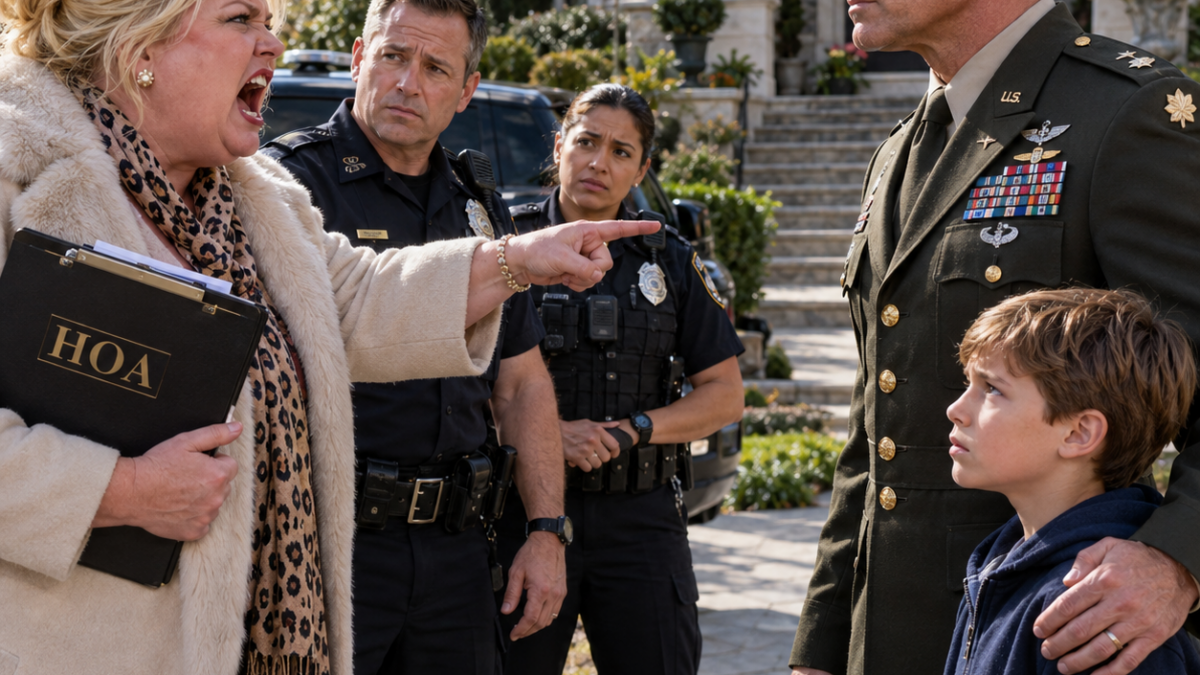
I had driven fourteen exhausting hours to bring my twenty-two-year-old son to the Arizona home my mother had just left me, but before I could even unload a suitcase, a woman wearing an HOA polo planted herself in my driveway and announced that neither of us had permission to enter the house that had been in my family for thirty-one years.
She claimed my late mother had seventeen unresolved violations, warned that “new residents” needed her approval before moving in, and threatened to call the authorities if I didn’t take my son to a hotel—while three different neighbors watched from behind curtains and quickly looked away whenever I caught them staring.
I could have challenged her right there, but something in the way everyone on that street lowered their eyes told me this wasn’t the kind of problem you solved by winning one argument, and before the week was over I would understand exactly what those frightened neighbors already knew.
My name is Joseph Rodriguez.
For twenty-eight years, the Army trained me to recognize the difference between authority and performance.
Beverly Martinez was performing.
She stood in front of my mother Eleanor’s house with her hair pulled into a tight bun, a white polo embroidered with WILLOWBROOK ESTATES HOA, and the expression of someone accustomed to watching people obey before asking why.
Behind me, my son Donald slept in the passenger seat of my truck with his headphones still on.
He had spent most of the drive listening to an astrophysics podcast about black holes.
Donald needed transitions.
Predictability helped him.
Dropping him into a confrontation with an angry stranger after fourteen hours on the road would help nobody.
So I kept my voice calm.
“I’m Joseph Rodriguez. Eleanor Rodriguez was my mother. She passed last month.”
“I know who Eleanor was.”
No sympathy.
Not even a polite pause.
“This property currently has seventeen unresolved violations.”
“Seventeen?”
“And the association requires approval before new residents occupy a noncompliant property.”
“My mother owned this house for thirty-one years.”
“That doesn’t erase the violations.”
“May I see them?”
For the first time, Beverly blinked.
“I’ll email the documentation.”
“Good.”
“In the meantime, I strongly suggest you arrange temporary accommodations.”
I looked at the front door.
Then back at her.
“This is my house.”
“This is Willowbrook Estates.”
I noticed the sign at the entrance again.
WILLOWBROOK ESTATES — A BEVERLY MARTINEZ COMMUNITY.
Not managed by.
Not represented by.
A Beverly Martinez community.
“And you are?”
She straightened slightly.
“Beverly Martinez. HOA president.”
“How long?”
“Eleven years.”
She said it as if she were announcing a military rank.
Then she lowered her voice.
“I’m trying to save you trouble, Mr. Rodriguez. Leave now, resolve the violations properly, and we won’t have a problem.”
“And if I don’t?”
“I’ll contact the authorities.”
Because I wanted to enter my dead mother’s house.
I took one slow breath.
“I’ll wait for your email.”
Then I turned away from her.
I woke Donald gently.
“We’re here.”
He removed his headphones and looked around.
“Grandma’s house?”
“Yeah.”
His eyes found Beverly.
“Who’s that?”
“Nobody you need to worry about.”
She heard me.
Good.
Donald followed me toward the front door.
Beverly didn’t physically block us.
She simply watched.
The key my mother gave me twenty years earlier still worked.
Inside, the house smelled faintly of cinnamon.
Family photographs covered the hallway.
Donald walked directly toward the bedroom he had used during childhood visits.
A few seconds later, I heard him laugh softly.
“Dad.”
I followed.
The glow-in-the-dark stars we had stuck to his grandmother’s ceiling when he was twelve were still there.
“She kept them.”
“Of course she did.”
His smile almost broke me.
I had buried my mother less than a month earlier.
There were still moments when my brain forgot she was gone.
Then I walked into the kitchen.
A yellow sheet of paper was attached to the refrigerator.
NOTICE OF VIOLATION.
Exterior maintenance.
Fine:
$500.
Due within fourteen days.
I checked the date.
Then checked again.
The notice had been issued two weeks after my mother died.
No covenant section.
No description of what needed repair.
No inspection report.
Just a demand for money addressed to a woman who was already gone.
Donald stood behind me.
“Dad?”
“Yes?”
“That paper looks different from Grandma’s old HOA letters.”
I looked closer.
He was right.
Different font.
Different formatting.
No board seal.
I photographed it.
Then looked through the kitchen window.
Beverly was still standing at the end of the street, talking to a neighbor and pointing toward my mother’s house.
That was when I understood what she was doing.
Before I had unpacked a single box, Beverly Martinez had already started telling Willowbrook who I was supposed to be.
And if seventeen violations really existed, I intended to find out whether my mother had broken the rules—
or whether Beverly had simply been waiting for Eleanor Rodriguez to die.
PART 2
The email arrived at 11:47 that night.
I didn’t see it until 5:30 the next morning.
Twenty-eight years in the Army had apparently taught my body that sunrise was sleeping in.
I made coffee in my mother’s old drip machine, sat at the kitchen table, and opened the message.
Subject:
CHEN PROPERTY VIOLATION REPORT
I stared at it.
My name was Rodriguez.
My mother’s name had been Rodriguez.
The property had belonged to our family for thirty-one years.
Yet Beverly had sent me a violation report for the Chen property.
Templates.
Copy.
Paste.
Threaten.
Send.
That tiny mistake told me more about her operation than a perfect letter would have.
I downloaded the attachment.
Seventeen pages.
I read them one by one.
Grass exceeding four inches.
$150.
Mailbox paint allegedly outside approved color standard.
$100.
Garage door showing deterioration.
$200.
Trash container visible outside permitted hours.
$75.
Unfamiliar vehicle parked in driveway.
$50.
I looked through the window at my truck.
My truck.
Parked on my driveway.
At the house I owned.
Apparently my arrival itself had already become a billable offense.
The total was $2,350.
Due in seven days.
I searched every page for a citation to the Willowbrook CC&Rs.
Nothing.
No section numbers.
No hearing dates.
No board vote.
No cure period.
Just accusations and dollar amounts.
Donald walked into the kitchen around seven.
He had his laptop under one arm.
“You’re already working.”
“Unfortunately.”
He poured orange juice.
“What happened?”
I turned the screen toward him.
He read in silence.
Then:
“They called your truck unfamiliar.”
“Apparently the truck hurt their feelings.”
“That’s not logically possible.”
“I know.”
He sat.
“Grandma always parked her car outside.”
“I remember.”
“And sometimes Uncle Carlos parked there.”
“Yes.”
“So the rule is inconsistent.”
I looked at him.
“That’s exactly what I’m trying to determine.”
Donald nodded and opened his astronomy lecture.
For him, once a problem had become a pattern, anxiety often turned into analysis.
I called Robert Finch at eight.
Robert was the real-estate attorney who handled my mother’s probate.
“Joseph.”
“Do you know Beverly Martinez?”
A tired pause.
“Yes.”
“That sounded painful.”
“I’ve worked with Willowbrook before.”
“How bad?”
“How much coffee do you have?”
“Enough.”
“Beverly has been HOA president eleven years.”
“She told me proudly.”
“Nobody has successfully challenged her in a long time.”
“Why?”
“People get tired.”
“That’s not an answer.”
“It’s the most accurate one.”
I described the notices.
Robert asked me to forward them.
Ten minutes later:
“Some of this is facially defective.”
“Meaning?”
“At minimum, Willowbrook’s own procedures require notice and an opportunity to cure before escalating fines in ordinary circumstances.”
“They gave me seven days.”
“Your first notice on the refrigerator gave fourteen.”
“After my mother died.”
“I saw that.”
He went quiet.
Then:
“Joseph, don’t pay anything yet.”
“Wasn’t planning to.”
“Don’t ignore it either.”
“What do we do?”
“We request the enforcement record, board minutes authorizing these fines, inspection documentation, and association financial records available under Arizona law.”
“How quickly do they have to respond?”
“Certain records requests have statutory timelines. I’ll draft it correctly.”
“And if Beverly ignores it?”
“She creates another record.”
I understood.
Paper.
Dates.
Silence.
Response.
Or failure to respond.
Everything becomes evidence.
“File it.”
“I will.”
Robert hesitated.
“Joseph.”
“Yes?”
“Don’t make this military.”
“What does that mean?”
“You know exactly what it means.”
“I’m retired.”
“You called me at eight in the morning with seventeen pages already indexed.”
“Organization is not warfare.”
“Sure.”
He hung up.
That afternoon, I repainted the mailbox.
Not because Beverly was right.
Because I wanted to remove legitimate distractions.
I downloaded the official color specification.
Desert Tan 42-B.
Bought the closest approved exterior paint.
Started working.
An elderly woman next door appeared.
She stopped at the property line.
Not one step over.
“You’re Eleanor’s son.”
“Yes, ma’am.”
“I’m Helen Patterson.”
I put down the brush.
“Mom talked about you.”
“She talked about you too.”
“That’s dangerous.”
Helen almost smiled.
Then looked toward the street.
Her voice lowered.
“Be careful.”
“With the paint?”
“With Beverly.”
I watched her.
“What happens if people challenge her?”
Helen’s eyes dropped.
For a while, I thought she might leave.
Then she whispered:
“The Thompsons.”
“Who?”
“They lived on Sagebrush Lane.”
“What happened?”
“Their son had a medical condition.”
She swallowed.
“Sometimes he had episodes.”
I waited.
“Beverly said neighbors complained about noise.”
“Did they?”
“Not me.”
“Anyone?”
“I don’t know.”
“What did Beverly do?”
“Fines.”
“How many?”
“Every day sometimes.”
I stopped moving.
“Daily fines?”
Helen nodded.
“The Thompsons hired an attorney.”
“And?”
“Then somebody reported them to Adult Protective Services.”
“For what?”
“Mistreatment.”
“Was it substantiated?”
“No.”
“But?”
Helen’s face tightened.
“Eight months.”
I understood.
Eight months of investigators.
Interviews.
Documents.
Fear.
Legal bills.
Neighbors whispering.
Even when you’re cleared, the process itself becomes punishment.
“They sold?”
“Yes.”
“For less than they paid.”
“Do you know who called APS?”
“No.”
“Do you suspect?”
Helen looked toward Beverly’s side of the neighborhood.
That was enough.
“Anybody else?”
She became visibly uncomfortable.
“Mrs. Patterson.”
“Please don’t tell anyone I talked to you.”
“I won’t.”
“You don’t understand.”
“I think I’m starting to.”
Her eyes filled.
“Your mother knew.”
“Knew what?”
“What Beverly was.”
I stood very still.
“Did my mother fight her?”
“Quietly.”
“How?”
“She kept records.”
That sounded exactly like Eleanor Rodriguez.
My mother could remember the date of an argument from fifteen years earlier and produce a receipt before you finished denying it happened.
“Where?”
Helen nodded toward the house.
“Your mother kept everything.”
Then she returned home.
Curtains closed almost immediately.
Donald had been watching from the kitchen.
That evening, he sat at the table solving equations in a notebook.
Without looking up:
“Mrs. Patterson was scared.”
“How could you tell?”
“Her voice.”
He tapped his pen.
“Her pitch changed every time she said Mrs. Martinez’s name.”
I stared at him.
Donald noticed details most people ignored.
He struggled with spontaneous conversation.
He sometimes needed extra time to process emotional ambiguity.
But patterns?
Patterns were his language.
“She was scared,” I said.
“A lot?”
“Yes.”
Donald finally looked at me.
“Should we be?”
That question went through me.
I had led soldiers.
Buried friends.
Made decisions under pressure that I still thought about at night.
But nothing activated fear in me faster than hearing it in my son.
“No.”
Donald watched my face.
I corrected myself.
“We should be careful.”
“That’s different.”
“Yes.”
“Fear means you don’t understand the danger?”
“Sometimes.”
“Careful means you do.”
I smiled.
“That’s good.”
He returned to his equations.
Then:
“Dad?”
“Yeah?”
“Grandma wasn’t scared of Mrs. Martinez.”
“No.”
“How do you know?”
“Because your grandmother once threatened a cable company over a twelve-dollar charge.”
Donald smiled.
For one night, that was enough.
Day three began quietly.
Coffee.
Donald’s lecture playing from the laptop.
Arizona sunlight beginning to warm the kitchen.
Then Robert texted.
CHECK COMMUNITY BOARD. NOW.
Willowbrook required residents to use an app for announcements.
Beverly’s communication kingdom.
I opened it.
The post had been published two hours earlier.
COMMUNITY ALERT
Beverly wrote that an unknown man had moved into “the late Eleanor Rodriguez residence” without completing required HOA approval.
She said the individual “claimed” to be a military veteran but had refused verification.
Then she mentioned Donald.
Not by name.
But obviously him.
An adult male who avoided eye contact.
Displayed repetitive movements.
Behaved unusually.
Potentially unstable.
Residents advised to avoid contact.
Parents advised to use caution.
Report anything suspicious.
I read the post once.
Then again.
127 reactions.
Forty-three comments.
Thank you, Beverly.
We need to protect our kids.
Why are strangers allowed to move in without screening?
I saw the young man. Something definitely seemed off.
A stranger who had seen Donald once from across a street had decided there was “something off.”
I took screenshots.
Every comment.
Timestamp.
Profile.
Then footsteps came from behind me.
Donald.
Phone in his hand.
He had seen it.
His face was still.
Too still.
“Dad.”
I put my phone down.
“She wrote about me.”
“Yes.”
He read the words.
“Highly unusual behavior.”
Pause.
“Mentally unstable.”
His fingers tapped against his thigh.
Fast.
Then faster.
“Is that what people see?”
There are questions fathers prepare for.
What happened to Grandma?
Why did Mom leave?
Am I going to be okay?
Then there are questions you never want your child to ask.
I moved across from him.
“Look at me.”
Donald tried.
His eyes dropped.
“That’s okay.”
I kept my voice steady.
“Do you remember what Dr. Reeves told you when you were younger?”
“My brain processes information differently.”
“Right.”
“Different doesn’t mean wrong.”
“Right.”
He breathed slowly.
“She thinks I’m dangerous.”
“She doesn’t know you.”
“Other people believe her.”
“They don’t know you either.”
“But they’ll look at me like that now.”
I hated that I couldn’t lie.
Some would.
So I didn’t.
“Some might.”
Donald’s jaw tightened.
“That’s not fair.”
“No.”
He stared at the post.
Then:
“Spock.”
“What?”
“Spock.”
I waited.
“He was different from everybody else on the Enterprise.”
“Yes.”
“People didn’t always understand him.”
“Definitely.”
“But Captain Kirk needed him because he thought differently.”
My throat tightened.
Donald looked at me.
“Spock didn’t become useful by pretending to be more normal.”
“No.”
“He was useful because he was himself.”
“That’s exactly right.”
Donald was quiet.
Then:
“You’re not going to let her win.”
“No.”
“How?”
I looked at the screenshots.
“The way Spock would.”
“Logic.”
“Evidence.”
“Patience.”
Donald almost smiled.
“Logical.”
I forwarded everything to Robert.
His response:
Preserve. Do not engage publicly.
Then:
This substantially increases her exposure.
I wanted to answer Beverly.
Wanted to tell every neighbor who had reacted to that post exactly who Donald was.
Wanted to publish his grades.
His university enrollment.
His astronomy work.
Wanted to demand apologies.
But Donald’s dignity was not evidence I owed strangers.
He did not have to prove he was harmless enough to deserve peace.
We went for a walk that afternoon.
A father and two children were throwing a football.
As soon as he saw us, he froze.
Gathered the kids.
Went inside.
Blinds closed.
Donald watched.
“He recognized us from the post.”
“Yes.”
“He doesn’t know us.”
“No.”
We kept walking.
At our driveway, Donald stopped.
“The Thompsons.”
“What about them?”
“She did this to them.”
I looked at him.
“Public story first.”
“Then government report.”
“Yes.”
He was connecting it.
“If nobody stops her, she’ll do it to somebody else.”
“Yes.”
Donald looked toward Beverly’s side of the neighborhood.
His expression was different.
Not fear.
Resolve.
“Then we should stop her.”
I put my hand on his shoulder.
“We do it correctly.”
“Evidence.”
“Evidence.”
“Patience.”
“Unfortunately.”
“And no emotional decisions.”
I smiled.
“You’ve been listening.”
“I always listen.”
That nearly broke me.
The thing Beverly called abnormal was the same thing helping us see her pattern.
I spent the next day reading forty-seven pages of Willowbrook CC&Rs.
Every word.
Article 12.
Fines required board authorization through recorded action.
Where were the minutes?
Article 8.
Annual financial reporting.
Where were the reports?
Article 15.
HOA president elected every two years.
Beverly had served eleven years.
Where were the elections?
I called Helen.
“When was the last HOA election?”
Long pause.
“I don’t know.”
“Five years?”
“I don’t remember one.”
“Ten?”
“Beverly just stays president.”
“How?”
“Every year a notice says existing officers will continue.”
“Anyone challenge it?”
“No.”
“Why?”
Another pause.
“You’ve met her.”
Fair.
Robert filed the formal records request.
Beverly answered:
Request under review. Anticipated response within thirty days.
Robert called.
“She’s ignoring the statutory timeline.”
“On purpose?”
“Can’t prove purpose.”
“Yet.”
“Joseph.”
“I know.”
“No adjectives.”
“Documents.”
“Good.”
I drafted a complaint to state regulators.
Seven procedural irregularities.
Missing records.
Questionable elections.
Unauthorized fines.
I hovered over SEND.
Then stopped.
Robert had warned me.
Procedure could be explained.
Accounting could be “corrected.”
Minutes could appear.
Beverly had eleven years of experience surviving complaints.
What I needed was the thing people like her eventually provide themselves.
Overreach.
The breakthrough came from Gary Morrison.
Seventy-four.
Former HOA board member.
Retired accountant.
Helen gave him my number.
We met at a coffee shop fifteen miles away.
He chose the location.
Not me.
He sat facing the door.
That told me enough.
“I served three years.”
“Under Beverly?”
“Yes.”
“How did you leave?”
“I asked too many questions.”
“About?”
“Money.”
He stirred coffee.
Never drank.
“Reserve fund. Vendor contracts. Unexplained expenses.”
“What happened?”
“Emergency board meeting while I was visiting my daughter.”
“They removed you?”
“Changed a rule.”
“What rule?”
“Attendance.”
He laughed bitterly.
“Hundred percent attendance supposedly required for board eligibility.”
“You missed one meeting.”
“One.”
“So you were removed.”
“Yes.”
“Legal?”
“Robert Finch can answer that.”
Gary reached into his jacket.
USB drive.
He placed it between us.
“What is this?”
“My conscience.”
I looked at him.
“Emails. Statements. Minutes. Original versions.”
“Original?”
“The versions before Beverly edited summaries.”
My pulse changed.
“Why keep them?”
“I was an accountant for forty-two years.”
That was answer enough.
“Why now?”
His eyes met mine.
“Because I watched the Thompsons lose their house.”
He looked away.
“Then the Gaines family.”
“Then people on Maple Lane.”
“I told myself it wasn’t my problem because I’d been removed.”
His jaw tightened.
“That was cowardice.”
“I’m not here to judge you.”
“I am.”
He pushed the drive closer.
“I’m seventy-four.”
Then:
“I’m done being afraid of a woman with a polo shirt.”
That night, after Donald went to bed, I opened the files.
Gary had organized them beautifully.
Folders by year.
Expense.
Reserve.
Minutes.
Email.
Contracts.
I compared historical statements.
Reserve balance eight years earlier:
$412,000.
Most recent available filing:
$285,000.
Difference:
$127,000.
That alone meant nothing.
Reserve funds get spent.
So I traced expenses.
Pool equipment replacement.
I walked to the pool the next morning.
Old pumps.
Maintenance tags years old.
Landscaping increase.
Same contractor.
Same visible scope.
Road resurfacing.
I drove every street.
Cracked asphalt.
No evidence of major resurfacing.
I photographed everything.
Then Gary pointed me toward vendor names.
Several companies shared mailing addresses.
One was registered to a cousin of Beverly’s late husband.
Another had dissolved years earlier despite receiving later “maintenance” payments.
I called Robert.
He came to the house that evening.
We spread documents across Mom’s dining room table.
He worked for three hours.
Finally:
“This is serious.”
“How serious?”
“Potentially very.”
“Say the word.”
“No.”
“Fraud?”
“I am not giving you a criminal conclusion from spreadsheets in a kitchen.”
“You ruin everything.”
“But $127,000 appears unsupported by what we currently have.”
“Could be accounting error?”
“Yes.”
“All of it?”
“Possible.”
“Likely?”
He stared.
“I’m your attorney, not your audience.”
“Fine.”
Robert gathered copies.
“Do not confront her.”
“I know.”
“Do not mention money publicly.”
“I know.”
“Do not post on the board.”
“I know.”
He paused.
“Why are you smiling?”
“Because she thinks I’m fixing a mailbox.”
Robert did not smile back.
“Joseph.”
“What?”
“This is not a deployment.”
“I know.”
“Your son lives here.”
That ended my smile.
He was right.
My anger could not become strategy.
Beverly still controlled social pressure.
She still had access to people willing to call government agencies.
Donald was the person most exposed if I got reckless.
So I waited.
Day seven.
Certified envelope.
Return address:
MARICOPA COUNTY SUPERIOR COURT
That got my attention.
I signed.
Opened it.
TEMPORARY RESTRAINING ORDER
Joseph Rodriguez prohibited from approaching Beverly Martinez within five hundred feet.
Banned from HOA meetings.
Violation could result in arrest.
Reason:
Threatening behavior.
Stalking.
Intimidation.
For about ninety seconds, I believed she had beaten me.
Then training returned.
Read.
Don’t react.
The judge’s signature looked strange.
Case number format wrong.
Letterhead slightly off.
I opened the public court portal.
Entered case number.
Nothing.
My name.
Nothing.
Beverly’s.
Nothing.
I called Robert.
“I got a restraining order.”
“What?”
“Supposedly.”
“Send it.”
I scanned.
Five minutes later:
“Do not do anything.”
“It’s fake?”
“I see no matching case.”
“I already checked.”
“Joseph.”
“Sorry.”
“Preserve the envelope.”
“Done.”
“Certified-mail receipt.”
“Done.”
“Original document in plastic sleeve.”
“Already.”
“You’re deeply annoying.”
“Colonel.”
“Retired colonel.”
“Still annoying.”
Robert contacted the appropriate authorities.
Not with accusations.
With a request to verify authenticity.
The answer came back:
No such case.
No such order.
No such judicial signature attached to any proceeding involving us.
A fabricated court document had been mailed to my mother’s house.
My hands were cold when I held it.
Donald found me at the kitchen table.
“What is that?”
I told him.
His eyes moved line by line.
“If it isn’t real, why would she send it?”
“To make me believe it was.”
“That seems irrational.”
“It works if the person receiving it doesn’t check.”
Donald thought.
“Are you reporting it?”
“Robert is preserving it with the proper agencies.”
“So what happens?”
“We wait.”
He frowned.
“You always say that.”
“So does my lawyer.”
“Does waiting make lawyers money?”
“Now you sound like your grandmother.”
Donald sat.
“Are you trying to trap her?”
I thought carefully before answering.
“No.”
He waited.
“I’m not going to provoke her into anything.”
“But?”
“If she independently tries to use a fake document with police or another agency, that use will be documented.”
Donald nodded.
“So you’re not making her do something.”
“No.”
“You’re letting her choose.”
“Yes.”
“That’s better.”
Sometimes my son had a cleaner moral compass than I did.
I had spent twenty-eight years planning around adversaries.
It would have been easy to think of Beverly that way.
Target.
Objective.
Pressure.
But this was home.
Not war.
I needed the law to work without becoming the thing she accused me of being.
Two days later, a Maricopa County sheriff’s cruiser stopped outside.
My body tightened before I could control it.
I was replacing a damaged fence board.
The deputy stepped out.
Mid-thirties.
Nameplate:
WILLIAMS.
“Mr. Rodriguez?”
“Yes.”
“I’m Deputy Jake Williams.”
He looked toward nearby windows.
Then:
“Could we talk somewhere private?”
That was different.
Not:
You’re under investigation.
Not:
We received a complaint.
Private.
I invited him inside.
Donald was at the table studying gravitational lensing.
He removed one earbud.
“It’s okay,” I told him.
He left one earbud out anyway.
Williams sat.
“I’m going to be direct.”
“Please.”
“I’ve received several complaints from Mrs. Martinez.”
“I assumed.”
“Threats.”
“False.”
“Suspicious activity.”
“Also false.”
“Concerns about your son.”
My jaw tightened.
Williams saw it.
“But.”
I waited.
“I’ve received complaints from Mrs. Martinez about other residents for years.”
“How many?”
“Enough.”
“And?”
“Same pattern.”
He wrapped both hands around the coffee cup I gave him.
“Allegations.”
“Investigations.”
“Little evidence.”
“Families eventually move.”
I stared.
“Why are you telling me this?”
Williams looked toward Donald.
Then back.
“Because I’m tired of feeling like my badge is being borrowed for somebody else’s neighborhood disputes.”
That sentence mattered.
“Have you seen the alleged restraining order?”
“Yes.”
“Is it real?”
“No.”
“Does Beverly know you checked?”
“No.”
I nodded.
“What do you want from me?”
“Nothing.”
That surprised me.
“Then why come?”
“If she files a formal complaint requiring a response, I’ll respond.”
He tapped his body camera.
“And everything will be documented.”
I leaned back.
“You’re taking a risk.”
“No.”
He looked at me.
“Doing my job shouldn’t be a risk.”
Then he added:
“She doesn’t have as many loyal people as she thinks.”
“What does she have?”
“Scared people.”
Williams stood.
“Fear looks like loyalty from far away.”
After he left, Donald took out his earbud.
“I like him.”
“You spoke three words.”
“He said Mrs. Martinez is wrong.”
“Basically.”
“And his coffee cup was shaking.”
I hadn’t noticed.
“Why?”
“He was nervous too.”
Donald returned to his lecture.
Ten minutes later, my phone buzzed.
Unknown number.
Mr. Rodriguez, my name is Linda Torres. 42 Maple Lane. I saw Beverly’s post about your son. I don’t believe it. If you need a witness, I’m willing.
Then another.
Dave Kowalski.
Beverly had targeted his family two years earlier.
Then another.
And another.
Eleven households in two hours.
Bogus fines.
Public humiliation.
Threatened liens.
Employment complaints.
Welfare reports.
Anonymous accusations.
One adult daughter had been reported to her employer as unstable after her parents disputed HOA fees.
She lost her job during the investigation.
No wrongdoing proven.
But the job never came back.
One anonymous message read:
We call her the HOA Hydra. Cut off one head, two grow back. Maybe somebody finally found the heart.
I forwarded everything to Robert.
His instructions:
No public campaign.
No group confrontation.
Preserve original records.
Ask each person for dates.
Documents.
Receipts.
Screenshots.
Over forty-eight hours, nine households sent evidence.
Beverly’s own messages.
Fine letters.
Bank transfers.
Meeting notices.
One audio recording from three years earlier.
Her voice.
“You can keep fighting, but I can make living here very expensive.”
Not illegal by itself.
But ugly.
And consistent.
Robert called.
“This is becoming a pattern case.”
“How big?”
“Potential civil claims across multiple households.”
“Racketeering?”
“Stop trying to write the complaint for me.”
“Just checking.”
“Do not use that word publicly.”
“Fine.”
That afternoon, Donald sat on the front porch reading.
A young man approached from across the street.
I watched through the window.
Twenty, maybe twenty-one.
Baseball cap.
Hands in pockets.
“Hey.”
Donald looked up.
“Hello.”
“You’re the guy Beverly keeps posting about.”
I nearly opened the door.
Then waited.
The young man grinned.
“I’m Tyler.”
Donald said nothing.
“My mom told me not to come over.”
Donald blinked.
“Then why are you here?”
Tyler laughed.
“Because you’re reading a book about planets, man.”
“Exoplanets.”
“Okay.”
“Planets outside our solar system.”
“I figured.”
Donald moved his bookmark.
Tyler sat on the steps.
“What’s interesting about them?”
I watched for an hour.
Exoplanets.
Video games.
Artificial intelligence.
Space telescopes.
Tyler didn’t flinch when Donald paused too long.
Didn’t interrupt when he explained something in enormous detail.
Didn’t treat him like a diagnosis.
When Tyler left, Donald walked inside.
His face looked lighter.
“Dad.”
“Yes?”
“I think I made a friend.”
I put my hand on his shoulder.
“I think you did.”
That moment changed the entire fight for me.
I had been thinking about stopping Beverly.
Donald was thinking about building a life.
Those were different goals.
One ends when the opponent loses.
The other begins when you finally stop organizing your life around them.
Day twelve.
9:47 a.m.
Doorbell.
Two sheriff’s cruisers.
White sedan marked Adult Protective Services.
My chest tightened.
I checked the camera.
Deputy Williams stood on the porch.
Beside him, an older deputy.
Harmon.
An APS worker.
Gray blazer.
Clipboard.
I opened the door.
“Mr. Rodriguez, I’m Charlotte Price with Adult Protective Services.”
“Yes.”
“We’ve received a report concerning a vulnerable adult residing here.”
Behind me, Donald’s footsteps stopped.
He heard.
“What are the allegations?”
Charlotte checked her clipboard.
“An adult male with documented mental-health concerns is allegedly being held against his will, receiving inadequate care, and may present a danger to himself or others.”
Every part of the description was wrong.
But I did not raise my voice.
“Who filed it?”
“Confidential.”
“Do you have a warrant?”
Deputy Harmon stepped forward.
“Sir, just let us in.”
I looked at him.
“I’m willing to cooperate with lawful process.”
“Then cooperate.”
“I am.”
His expression hardened.
“Don’t make this complicated.”
I felt the old Colonel rise inside me.
Command voice.
Posture.
Authority.
I pushed it down.
This was exactly what Beverly wanted.
Angry retired officer.
Defensive father.
Camera footage she could manipulate later.
So I spoke calmly.
“Deputy, I served twenty-eight years in the Army and retired as a colonel. I spent a significant part of my career working alongside military law enforcement and legal officers.”
Harmon’s expression shifted slightly.
“I understand the difference between cooperation and consent.”
I looked at Charlotte.
“I will allow you to speak with Donald voluntarily if he agrees. I am not consenting to an involuntary search of the house without the appropriate legal basis.”
Williams remained silent.
Camera running.
Harmon looked irritated.
Then Donald appeared beside me.
Jeans.
T-shirt with the Andromeda galaxy printed across the front.
Hair messy.
Completely ordinary.
“Dad?”
“It’s okay.”
Charlotte’s voice softened.
“Are you Donald Rodriguez?”
“Yes.”
“I’m with Adult Protective Services.”
Donald stared.
“Why?”
“We received a report that you may need help.”
“With what?”
Charlotte hesitated.
Donald continued.
“I’m working on my astrophysics research.”
“Okay.”
“Do you know Europa?”
Charlotte blinked.
“Europe?”
“Europa.”
Donald became animated.
“Jupiter’s moon.”
I saw Williams hide a smile.
Donald continued.
“It probably has a subsurface ocean. Tidal flexing from Jupiter creates heat, so the water may remain liquid beneath the ice.”
Charlotte lowered her clipboard slightly.
“There could be microbial life.”
He paused.
“Sorry.”
“That happens when I’m nervous.”
Charlotte smiled faintly.
“That’s okay.”
Donald looked at her.
“Am I in trouble?”
“No.”
“Then why did someone say I’m dangerous?”
Silence.
That question hit everyone.
Charlotte’s professionalism changed.
Not gone.
Humanized.
“We have to check reports when we receive them.”
“That makes sense.”
He thought.
“But the report is wrong.”
“I understand.”
Then a voice came from the driveway.
“Why hasn’t he been taken yet?”
I closed my eyes for half a second.
Of course.
Beverly Martinez marched toward the porch.
Not polo this time.
Cream blouse.
Sunglasses.
Anger.
She had come to watch.
That was her mistake.
Charlotte turned.
“Ma’am, please remain back.”
“I filed the report.”
There it was.
No anonymity now.
She pointed at Donald.
“He’s unstable.”
Donald’s expression changed.
Williams stepped slightly between them.
Beverly kept going.
“And his father is violating a restraining order by being anywhere near me.”
Everything became still.
I looked at Deputy Williams.
“Deputy, can you confirm whether any active restraining order exists involving Mrs. Martinez and me?”
Williams did not hesitate.
“No.”
Beverly froze.
He continued.
“We checked before responding today.”
Harmon looked toward him.
“No case.”
“No order.”
“No active restraint.”
Beverly’s face drained.
I did not smile.
Did not move toward her.
Did not raise my voice.
“Mrs. Martinez.”
She looked at me.
“You just stated in front of two law-enforcement officers wearing body cameras and an APS investigator that I am violating a court order.”
“My lawyer handled it.”
“What lawyer?”
She stared.
“There must be some mistake.”
“What lawyer sent the order?”
“I don’t have to answer you.”
“No.”
I nodded.
“You don’t.”
Williams spoke.
“Mrs. Martinez, I need you to step away from the residence.”
“This is my community.”
“Step away.”
“You don’t understand what he’s doing.”
“Ma’am.”
“He’s manipulating you.”
“Step away now.”
The word now changed her.
She obeyed.
For the first time since I arrived, I watched Beverly Martinez obey somebody else.
Charlotte turned toward Donald.
“I’m sorry you were put through this.”
Donald looked at her.
“Are you going to remove me?”
“No.”
“Good.”
Then, with complete sincerity:
“I have an assignment due at noon.”
Williams coughed into his fist.
Charlotte almost laughed.
“You should probably finish it.”
Donald went inside.
Just like that.
The person Beverly had described as unstable and dangerous went back to an astrophysics assignment.
Her story remained standing in the driveway.
And it suddenly looked ridiculous.
Beverly started toward her car.
Williams stopped her.
“Mrs. Martinez.”
She turned.
“I’ll need to speak with you separately regarding the false court-order allegation and today’s report.”
“I already told you. My lawyer—”
“Save that for the interview.”
Her hands began to tremble.
Not theatrically.
Genuinely.
For eleven years, Beverly had written scripts for everyone else.
Difficult resident.
Unstable family.
Noncompliant homeowner.
Concerned president.
Helpful neighbor.
Today, body cameras had captured a scene she could not edit afterward.
Forty-eight hours later, the case accelerated.
Williams filed his full report.
Body-camera footage preserved.
Charlotte documented the APS visit and the discrepancy between the report and what she observed.
Robert delivered the fabricated court document through proper channels.
Gary’s accounting records went to investigators.
The statements from eleven families followed.
The $127,000 reserve-fund discrepancy became the subject of an independent forensic review.
I did not stand in front of cameras.
I did not call reporters.
I did not post:
I TOLD YOU SO.
That was harder than people imagine.
Because once you’ve been publicly humiliated, public vindication feels like oxygen.
But Robert reminded me:
“Let investigators work.”
So I did.
The first major development was the court-document investigation.
The alleged restraining order had no case file.
No issuing judge.
No legitimate docket.
No lawful service.
Investigators traced the document’s creation through digital files obtained during the inquiry.
Beverly’s position that “a lawyer handled everything” became harder to maintain.
Especially because she could not identify the lawyer.
Then came the HOA money.
Independent accountants reconstructed years of records.
The missing reserve money was not one giant transfer.
That would have been too obvious.
It disappeared in pieces.
Maintenance reimbursements.
Vendor payments.
Administrative fees.
Consulting charges.
Small enough to look boring.
Large enough to add up.
The total unsupported or improperly directed amount eventually aligned closely with Gary’s $127,000 estimate.
I called him when the preliminary accounting became public.
“You were right.”
Gary was quiet.
“I wish I wasn’t.”
“Why?”
“Because being right means I watched it happen.”
“You kept the records.”
“I also kept quiet.”
“You’re speaking now.”
“Late.”
“Still counts.”
He breathed out.
“Your mother used to tell me the same thing.”
I went still.
“You knew Mom?”
“She hated Beverly.”
I laughed.
“That sounds healthier than ‘disagreed with.’”
Gary chuckled.
“Eleanor once told Beverly, ‘A title is not a personality.’”
I closed my eyes.
Of course she did.
“Why didn’t Mom tell me any of this?”
“You were in the Army.”
“So?”
“She was proud.”
“That doesn’t answer—”
“She didn’t want every phone call to become another problem for Colonel Rodriguez to solve.”
That hit.
Mom had protected me by staying silent.
I had spent my whole career believing protection meant stepping in.
Sometimes the people we love protect us by keeping us out.
I wasn’t sure which hurt more.
Beverly hired an actual defense attorney.
Her community posts disappeared.
Her profile stopped updating.
The Willowbrook message board went silent for two days.
Then something remarkable happened.
Residents started posting without her permission.
Not accusations.
Questions.
When is the next election?
Where are the financial reports?
Why haven’t we received reserve statements?
Can members nominate board candidates?
One question became ten.
Ten became fifty.
Fear really does resemble loyalty until the first person stands up.
Helen called.
“I think something is happening.”
“What?”
“People are asking questions.”
“Good.”
“I’m scared.”
“That’s okay.”
“What if Beverly comes back?”
“Then you keep asking.”
Helen whispered:
“I don’t know if I can.”
“You already did.”
“How?”
“You talked to me.”
Silence.
“That was the first vote.”
Two weeks later, investigators interviewed dozens of residents.
Some had records.
Others had only stories.
Both mattered differently.
The Thompsons were contacted in another state.
Robert told me they agreed to provide documents.
Their attorney still had copies.
Daily fine notices.
APS chronology.
Emails in which Beverly warned them their son was “affecting community harmony.”
Reading those messages made my hands shake.
Not because the language was dramatic.
Because it was so calm.
Bureaucratic cruelty is often polite.
Community harmony.
Property values.
Resident concerns.
Words clean enough to hide what they do to people.
I showed one to Donald.
He read it.
“They talked about their son like he was a noise problem.”
“Yes.”
Donald stared at the screen.
“Did he know?”
“I don’t know.”
“I hope not.”
That was my son.
After everything Beverly said about him, he was worried about a stranger’s feelings.
Three months after the APS visit, a negotiated resolution was announced.
Beverly entered a plea agreement resolving several state-level matters.
The exact charging decisions differed from the broad accusations people had thrown around online.
That mattered.
Not every ugly act became a criminal charge.
Not every rumor became fact.
But the fabricated document and false official statements had consequences.
The financial investigation had consequences.
The final agreement included supervised probation.
Full repayment of $127,000 to the HOA reserve fund.
A lengthy prohibition against holding HOA leadership or similar community fiduciary roles.
Additional conditions attached to the resolved cases.
People wanted a dramatic sentence.
I wanted the money back where it belonged.
And Beverly unable to control another neighborhood.
I got both.
She put her house on the market shortly afterward.
Nobody forced the sale under the plea agreement.
But Willowbrook had changed around her.
People who once smiled when she walked by stopped.
Board members resigned.
Residents asked for documents.
Her name disappeared from the entrance sign.
The first morning workers removed it, Donald and I stood across the street.
WILLOWBROOK ESTATES — A BEVERLY MARTINEZ COMMUNITY
The metal letters came down one at a time.
B.
E.
V.
Donald watched.
“That sign was weird.”
“Very.”
“One person can’t be a community.”
I looked at him.
“No.”
“By definition.”
“Exactly.”
When the last letter disappeared, I expected satisfaction.
Instead I felt tired.
Donald looked at me.
“Are we done?”
“Almost.”
“With her?”
“Yes.”
“That’s good.”
He put his headphones on.
For him, that was closure.
Two weeks later, Willowbrook held its first contested HOA election in more than a decade.
The community room overflowed.
Residents who had never attended anything showed up.
Robert came only as an observer.
Gary sat near the front.
Helen sat beside me shaking so badly that her ballot rattled.
“You okay?”
“No.”
“You’re running for president.”
“I know.”
“You can withdraw.”
“No.”
“Then stop shaking.”
“That’s terrible advice.”
“It worked on soldiers.”
“I’m a retired librarian.”
“Teacher.”
“Close enough.”
She elbowed me.
Three board seats.
Multiple candidates.
Actual nominations.
Ballots.
Counting performed openly.
Minutes recorded.
It was painfully normal.
Beautifully normal.
Helen Patterson won.
Not unanimously.
Good.
Democracy should make room for disagreement.
She stood when her name was announced.
People applauded.
Helen cried.
Then immediately looked terrified.
“What do I say?” she whispered.
“The truth.”
“That’s not helpful.”
“Works for me.”
She walked to the front.
“I don’t want this job.”
People laughed.
“I mean it.”
More laughter.
“For eleven years, most of us stopped participating.”
The room quieted.
“We told ourselves Beverly handled things.”
Helen looked around.
“And when people got hurt, we told ourselves we didn’t know enough to interfere.”
Her voice trembled.
“I did that.”
She swallowed.
“I watched families leave.”
Gary stared at the floor.
Helen continued.
“I don’t want a better president.”
Pause.
“I want a community that doesn’t depend on the president being good.”
That sentence brought the room to its feet.
Donald, sitting beside Tyler near the back, applauded too.
I looked at my son.
He had come voluntarily.
Crowds were difficult for him.
Unexpected applause was worse.
But he stayed.
Because this mattered.
The new board’s first reforms were simple.
Term limits.
Published financial reports.
Annual independent review.
Recorded votes for fines.
Clear appeal procedures.
No president acting alone.
No community posts naming residents without due process.
No welfare-related allegations discussed publicly.
That last rule was proposed by Donald.
Not formally.
He told Tyler.
Tyler told his mother.
His mother raised it.
The board adopted it.
Donald didn’t even know until later.
“They used my idea?”
“Yes.”
“Without citing me?”
I laughed.
“That is your concern?”
“Academic standards matter.”
I hugged him.
He tolerated it for approximately three seconds.
“Dad.”
“Sorry.”
Several residents asked me to run for the board.
I refused every time.
At the next meeting, someone asked publicly.
“Colonel Rodriguez, why not?”
I stood.
“Because I didn’t come here to replace Beverly.”
A few people shifted.
“I spent twenty-eight years in an institution built around rank.”
I looked around.
“Rank works in the Army because authority is defined, limited, reviewed, and tied to responsibility.”
Then:
“A neighborhood is not an army.”
People laughed.
“I don’t want anybody standing at my mother’s old mailbox wondering whether Joseph Rodriguez personally approves of their paint color.”
More laughter.
“Willowbrook belongs to the homeowners.”
I sat.
That was the longest speech I gave about the entire affair.
Afterward, Dave Kowalski invited us to a barbecue.
Donald almost refused.
Then Tyler appeared.
“You’re coming.”
Donald looked at me.
“Is that an order?”
Tyler laughed.
“No. Social coercion.”
Donald considered.
“Acceptable.”
They walked together.
I stood in the street watching.
Months earlier, parents pulled their kids inside when Donald passed.
Now somebody his own age was dragging him to a neighborhood barbecue.
That mattered more than Beverly’s probation.
More than restitution.
More than the headlines.
At the barbecue, Linda Torres approached.
“I owe your son an apology.”
“For what?”
“I reacted to Beverly’s first post.”
I looked at her.
“Which reaction?”
She lowered her eyes.
“The worried-face emoji.”
I almost laughed.
She didn’t.
“I know that sounds small.”
“It wasn’t to Donald.”
“I know.”
“Tell him.”
Her face tightened.
“What if I make it worse?”
“That’s possible.”
She blinked.
“People usually say it’s fine.”
“I’m not people.”
She looked across the yard.
Donald was explaining something to Tyler using a paper plate and three olives.
Probably orbital mechanics.
Linda walked over.
I stayed away.
Five minutes later, she returned.
“What happened?”
“He explained why Pluto isn’t technically a planet.”
I smiled.
“Sounds like forgiveness.”
“Is that what that was?”
“With Donald, probably.”
She laughed through tears.
Mom’s house slowly became ours.
That sentence took me a year to say without guilt.
At first, I preserved everything.
Her coffee cup beside the sink.
Cinnamon candles.
The throw blanket on the couch.
Magnets on the refrigerator.
I even kept the old yellow violation notice in a folder.
Then one morning Donald took down the faded calendar she had left on the wall.
I reacted too quickly.
“Why’d you move that?”
He froze.
“I thought it was old.”
“It was Mom’s.”
“I know.”
I saw his face.
Immediately regretted my tone.
“Sorry.”
Donald held the calendar.
“Do you want it back?”
I looked at the date.
The month she died.
For almost a year, I had kept the house in mourning because changing it felt like admitting Eleanor was gone.
“No.”
I took the calendar.
Folded it.
“We can put up a new one.”
Donald nodded.
“What picture?”
“Space.”
He smiled.
Of course.
We repainted his bedroom.
Kept the glow-in-the-dark stars.
Those stayed.
Tyler helped.
Their friendship grew slowly.
Video games.
Astronomy.
Occasional lunches.
Sometimes they spent an hour together and barely spoke.
Apparently that was perfectly acceptable friendship behavior.
One evening, Donald came home from a community-college astronomy event.
“I gave a talk.”
“You what?”
“Tyler signed me up.”
“I’m sorry, he did what?”
“It was fine.”
“You gave a public talk?”
“Thirty-two people.”
I stared.
“About?”
“Exoplanet detection.”
“How did it go?”
Donald thought.
“One woman asked a bad question.”
I laughed.
“Meaning?”
“She asked if astronomers can see actual cities on alien planets.”
“And?”
“I explained current telescope limitations.”
“So good?”
“Yes.”
He walked toward his room.
Then turned.
“Dad?”
“Yeah?”
“Mrs. Martinez was wrong.”
Everything inside me stopped.
“What about?”
“She said people would be scared of me.”
I swallowed.
Donald continued.
“Some people are.”
He shrugged.
“But not everybody.”
Then he went upstairs.
I sat alone in my mother’s kitchen.
That was the moment I finally cried.
Not when Beverly was charged.
Not when restitution was announced.
Not when her sign came down.
That night.
Because for months, I had been fighting to prove Beverly wrong.
Donald had discovered something better.
She didn’t matter enough to define the world.
Willowbrook’s finances improved under the new board.
Gary helped voluntarily for six months.
Then refused every invitation to become treasurer.
“I’m seventy-five now.”
“So?”
“I gave you a USB drive. That was my heroic act.”
Helen pointed at him during one meeting.
“You’re reviewing the budget.”
“No.”
“You’re an accountant.”
“Retired.”
“Still know numbers?”
“Unfortunately.”
“Meeting Tuesday.”
He lost.
The reserve fund was rebuilt gradually.
Not overnight.
Residents approved a modest special assessment after seeing real accounting.
That vote fascinated me.
Under Beverly, people fought every fee because nobody trusted the money.
Under Helen, homeowners voluntarily approved an assessment because every dollar had a purpose.
Roof repairs at the clubhouse.
Pool equipment that actually existed.
Road sealing people could watch being completed.
Transparency did what intimidation never could.
It created cooperation.
The Thompsons returned once.
Not to move back.
Just visit.
Robert arranged a meeting with several former families.
I didn’t know what to expect.
Mr. Thompson was older than I imagined.
His wife looked tired even years later.
Their son, Michael, came too.
Forty now.
Quiet.
He sat beside Donald.
Within twenty minutes they were talking about trains.
Michael loved rail systems.
Donald loved orbital systems.
Apparently systems recognize systems.
Mrs. Thompson watched them.
Then started crying.
I pretended not to notice until she spoke.
“Beverly used to describe him like he was a problem.”
I looked at Michael.
He was explaining Japanese high-speed rail.
“He isn’t.”
“I know.”
She wiped her face.
“I knew then too.”
“That doesn’t make it hurt less.”
“No.”
She looked toward Donald.
“Your son seems happy.”
“He’s getting there.”
“Good.”
Before leaving, Michael shook Donald’s hand.
Then said:
“People call things strange when they don’t understand them.”
Donald answered:
“That’s statistically common.”
Michael smiled.
That was enough.
Beverly’s house sold.
Young family bought it.
Two children.
Dog.
I avoided watching move-in day.
Helen didn’t.
She called.
“The new people put a basketball hoop in the driveway.”
“Illegal?”
“Probably.”
“You fining them?”
“Absolutely not.”
“What kind of president are you?”
“A tired one.”
She laughed.
“The little boy drew with sidewalk chalk.”
I waited.
“No architectural approval.”
“Anarchy.”
“Complete collapse.”
The joke felt good because it wasn’t really about Beverly anymore.
People could laugh at rules without fearing them.
A year after the plea agreement, I found a box in my mother’s closet.
HOA paperwork.
Of course.
Helen had been right.
Mom kept everything.
Notices from ten years earlier.
Emails.
Board letters.
Then one handwritten note.
JOEY
Nobody had called me Joey since I was twenty.
I opened it.
The handwriting was Mom’s.
If Beverly ever bothers you after I’m gone, don’t yell at her. It only makes her louder.
I laughed.
First line.
Perfect.
Then:
She wants people to believe she is stronger than the rules. She isn’t.
Next:
I never told you everything because you already carried enough people for the Army. I could carry myself.
I stopped.
Had to put the letter down.
After a minute, I continued.
Donald loves this house. Keep his stars on the ceiling.
I covered my mouth.
And remember that being strong does not mean making everybody afraid of you. Sometimes it means making sure nobody has to be afraid at all.
Love, Mom.
I sat on her bedroom floor for a long time.
The entire fight suddenly rearranged itself.
I had been thinking like a colonel.
Hold ground.
Protect family.
Document enemy behavior.
Maintain discipline.
But Mom had framed it differently.
Strength was not winning.
Strength was removing fear.
Beverly used power to make people smaller.
If my victory merely made Beverly smaller, I had learned nothing.
The goal was to make everyone else feel safe enough to stand upright again.
That became my new measure.
Did Helen speak freely?
Yes.
Did Gary ask questions?
Yes.
Did neighbors see financial reports?
Yes.
Did Donald walk outside without believing he was a threat?
More every month.
Then we were winning.
Two years after I inherited the house, Willowbrook held a neighborhood star night.
Donald’s idea.
Technically Tyler’s idea after Donald complained that most residents could not identify Saturn correctly.
The board approved turning off common-area lights for two hours.
Kids brought blankets.
Donald set up his grandmother’s telescope.
The same one Eleanor gave him years earlier.
Maybe sixty residents came.
Helen.
Gary.
Deputy Williams off duty.
Charlotte Price from APS even stopped by with her husband after Donald invited her through Tyler’s mother.
I stood near the back.
Donald faced the group.
Nervous.
Fingers tapping.
He explained Jupiter.
Saturn.
The Orion Nebula.
People waited patiently when he paused.
Asked questions.
A little girl raised her hand.
“Are there aliens?”
Donald answered seriously.
“We currently have no confirmed evidence of extraterrestrial life.”
The girl looked disappointed.
“But,” he added, “the probability space is interesting.”
Nobody understood what that meant.
Everyone applauded anyway.
Later, Williams stood beside me.
“Remember that morning?”
“Yes.”
“Hard to forget.”
He watched Donald adjust the telescope for a child.
“I almost hated putting on the uniform that day.”
I looked at him.
“Why?”
“Because I knew what it looked like.”
Two cruisers.
APS.
A father at the door.
A vulnerable son inside.
“Like Beverly had won.”
“Yeah.”
I nodded.
“You did your job.”
“I should have questioned her earlier.”
“Maybe.”
Williams looked at me.
“You’re supposed to say it wasn’t my fault.”
“I don’t know enough to say that.”
He laughed.
“Colonel.”
“Deputy.”
Then he became serious.
“I won’t forget again.”
“Good.”
That was accountability.
Not perfection.
Memory.
Helen joined us.
“Joseph.”
“What?”
“Someone parked overnight on the street.”
“Tragic.”
“Should I issue seventeen fines?”
“Minimum.”
Williams shook his head.
“You two are terrible.”
Donald called from the lawn.
“Dad.”
I walked over.
He adjusted the telescope.
“Look.”
I bent to the eyepiece.
Jupiter.
Bright.
Four tiny points nearby.
Moons.
Donald named them.
Io.
Europa.
Ganymede.
Callisto.
I remembered Charlotte standing on the porch while he explained Europa during the worst morning of our lives.
Now sixty neighbors had gathered voluntarily to hear him talk about the same thing.
“How does that feel?” I asked.
“What?”
“This.”
Donald thought.
“Cold.”
I laughed.
“Emotionally.”
“Oh.”
He looked around.
“Good.”
Then:
“Normal.”
That word was everything.
Not famous.
Not vindicated.
Not victorious.
Normal.
Exactly what Beverly had tried to take from us.
Exactly what Mom’s house had finally become.
Home.
Years later, people occasionally asked whether I enjoyed watching Beverly lose power.
The answer was complicated.
At first?
Yes.
I wanted consequences.
I wanted her exposed.
I wanted every neighbor who believed her to see the truth.
I wanted the fake order pinned to a courtroom wall.
I wanted the missing money explained.
I wanted those seventeen violation notices read aloud until she had nowhere left to hide.
But satisfaction faded faster than I expected.
What remained was quieter.
The entrance sign now simply read:
WILLOWBROOK ESTATES
No person’s name.
No kingdom.
No implied ownership.
Board minutes posted online.
Elections every two years.
Financial reports distributed.
Complaints reviewed by multiple people.
Sometimes residents still argued.
Of course they did.
About dogs.
Parking.
Paint.
Pool hours.
One meeting lasted forty minutes because two people disagreed about whether holiday decorations could remain through January 15.
I loved every ridiculous minute.
Because normal disagreement is not tyranny.
People could say no.
People could lose votes.
People could question the president.
And nobody disappeared from the neighborhood afterward.
Beverly had confused silence with harmony.
Fear with respect.
Compliance with community.
The difference became obvious only after she was gone.
On the fifth anniversary of Mom’s death, Donald and I sat in the backyard.
Telescope between us.
He had finished his degree.
Started working with a university research group.
Still lived with me for the time being.
No rush.
Tyler came over often.
Helen remained president for one term, then stepped down exactly when the bylaws required.
Gary attended every financial meeting and complained at all of them.
Williams eventually made sergeant.
Life continued.
Donald pointed toward the sky.
“Jupiter.”
“I know.”
“No, you don’t.”
“I have learned something in five years.”
“Which direction?”
I pointed.
Wrong.
Donald sighed.
“Hopeless.”
“Your grandmother married into bad astronomy genetics.”
He smiled.
For a while, we said nothing.
Then:
“Dad.”
“Yeah?”
“Do you remember when I asked if people saw me the way Mrs. Martinez did?”
Every detail.
“Yes.”
“I was wrong.”
My throat tightened.
“How?”
“I thought the question was whether people saw me as normal.”
He adjusted the telescope.
“That’s not the right question.”
“What is?”
“Whether the people who matter see me as me.”
I couldn’t speak immediately.
Donald continued.
“Tyler does.”
“Grandma did.”
“You do.”
He paused.
“Mrs. Patterson mostly does.”
I laughed.
“Mostly?”
“She still thinks I should date somebody.”
“That’s Helen.”
Donald looked through the telescope.
“So Beverly never actually knew me.”
“No.”
“Then her opinion was based on bad data.”
I laughed harder.
“Exactly.”
“Bad data shouldn’t determine conclusions.”
“No.”
He nodded.
Problem solved.
For him, perhaps it really was that simple now.
I leaned back in my chair.
Twenty-eight years in the Army taught me how to protect positions.
Beverly taught me how easily authority becomes dangerous when nobody reviews it.
My mother taught me something harder.
You can defend what matters without becoming obsessed with defeating whoever threatens it.
Donald taught me the hardest lesson of all.
Sometimes the person you think needs protecting is already stronger than the story somebody told about them.
The first day Beverly stood in our driveway, I assumed my rank would eventually matter.
Retired Army colonel.
Twenty-eight years.
Command experience.
Legal familiarity.
Discipline.
And yes, those things helped.
But the truth?
The rank was never the reason she lost.
Beverly lost because her paperwork didn’t match the rules.
Her fines didn’t match the bylaws.
Her finances didn’t match the expenses.
Her community posts didn’t match reality.
Her fake court document didn’t match any actual court case.
Her welfare allegations didn’t match the young man standing calmly on the porch explaining Jupiter’s moons.
And eventually, eleven years of fear could no longer compete with one morning of facts captured on camera.
That was the real turning point.
Not when I told Deputy Harmon I was a colonel.
Not when investigators opened files.
Not when Beverly signed a plea agreement.
It happened the moment everyone standing on my mother’s porch could see the distance between the story Beverly had created and the people actually standing in front of them.
Donald was not her label.
I was not her “unknown man.”
Mom’s house was not Beverly’s property to approve.
Willowbrook was not her personal kingdom.
Once people saw that clearly, her power became what it had always been.
Performance.
That night, Donald adjusted the telescope.
“Dad.”
“What now?”
“Europa.”
I looked.
A bright point beside Jupiter.
Small.
Far away.
Unimpressive if you didn’t know what you were seeing.
Donald began explaining the hidden ocean beneath its ice.
I listened.
Really listened.
Not because I understood all of it.
Because years earlier, Beverly Martinez had stood in my driveway and tried to convince an entire neighborhood that the way my son’s mind worked was something to fear.
Now I knew better than ever how wrong she had been.
The house behind us still smelled faintly of cinnamon whenever I opened Mom’s old candle cabinet.
The glow-in-the-dark stars remained on Donald’s childhood ceiling.
The yellow $500 violation notice was framed inside my office—not as a trophy, but as a reminder.
At the bottom of the frame, I had written one sentence from my mother’s letter:
Being strong does not mean making everybody afraid of you. Sometimes it means making sure nobody has to be afraid at all.
That was the victory.
Not Beverly leaving Willowbrook.
Not the restitution.
Not the court records.
Not even watching her name disappear from the entrance sign.
The victory was Donald sitting under an Arizona sky, studying the universe from a backyard where nobody told him he didn’t belong.
It was Helen running an HOA meeting without frightening anyone.
It was Gary asking uncomfortable financial questions and expecting answers.
It was children drawing chalk across sidewalks without their parents wondering whether somebody powerful would punish them for it.
And it was me finally understanding why Mom left me this house.
Not so I could win a battle for her.
So Donald and I could have somewhere to come home to.
I looked through his telescope one more time.
Jupiter floated in the darkness.
Four tiny moons beside it.
Donald spoke quietly.
“Grandma would’ve liked tonight.”
“Yes.”
“How do you know?”
I looked back at the kitchen window glowing behind us.
“Because nobody’s afraid.”
Donald thought about that.
Then he nodded.
“Logical.”
And for once, Colonel Joseph Rodriguez had nothing to add.
[END OF STORY]




