PART 2: HOA Karen’s Son Smashed My Car Window and Laughed in My Face—She Went Pale When She Learned I Was the HOA’s Lawyer
PART 2
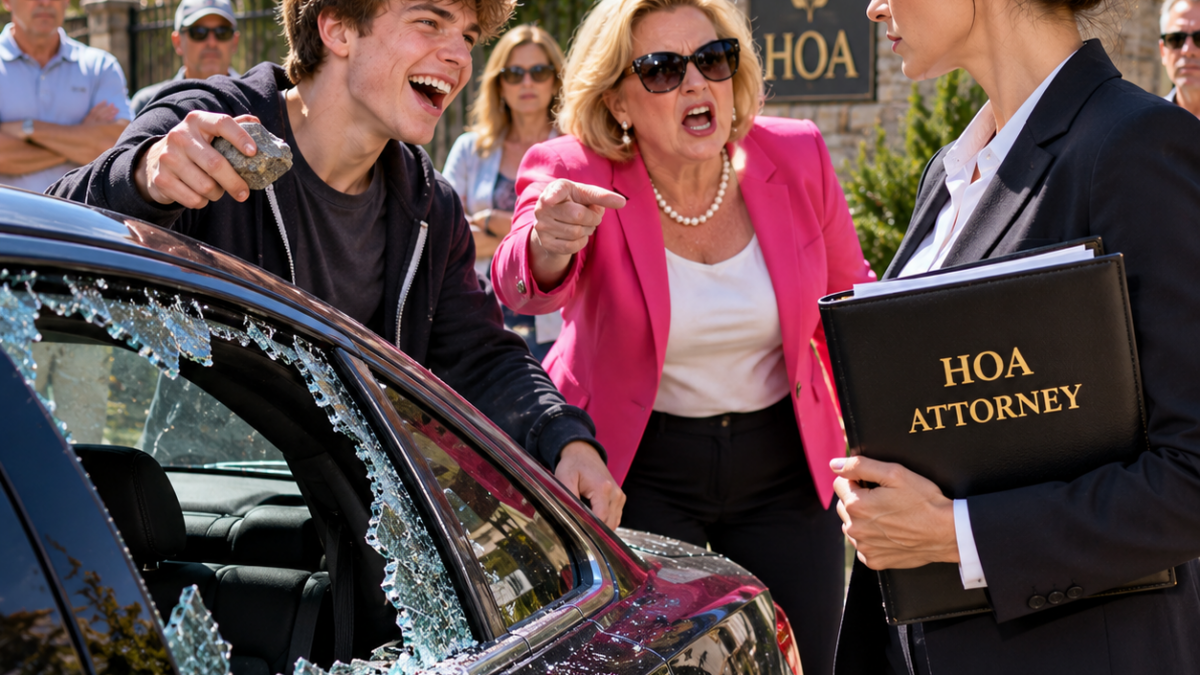
I didn’t tell Karen who I was that afternoon.
That would have been satisfying for about ten seconds.
But satisfaction and strategy are different things.
People who live by intimidation usually make their biggest mistakes when they believe nobody can challenge them.
I wanted to know exactly what Karen would do when she thought I had no leverage.
So I kept taking pictures.
I photographed the glass inside the car.
The damage around the window frame.
The rock.
The position where her son had been standing.
I wrote down the exact time.
Then I took several wider photographs showing the distance between his driveway and mine.
Karen watched me with growing irritation.
“This is ridiculous.”
I didn’t look up.
“You’ve said that.”
“You’re acting like he committed some horrible crime.”
“He deliberately damaged somebody else’s property.”
“You don’t know that it was deliberate.”
Her son looked at her.
That was interesting.
It was a quick glance, but I caught it.
Not guilt.
More like surprise.
Apparently even he hadn’t expected her to deny what both of us had just watched him do.
I straightened.
“Are you saying he didn’t throw the rock?”
Karen’s jaw tightened.
“I’m saying accidents happen.”
Her son finally spoke.
“I was just messing around.”
I turned to him.
“With a rock?”
He gave another shrug.
“I didn’t think it would break.”
Karen immediately seized on that.
“There. You heard him. He didn’t mean to break anything.”
I almost admired the speed with which she transformed an admission into an excuse.
“You threw a rock at a car,” I said.
The teenager rolled his eyes.
“Whatever.”
That word did more to settle my mind than any apology could have.
Whatever.
The window.
The repair cost.
The possibility that I could have had a passenger sitting there.
The fact that shattered glass had sprayed across a seat less than three feet from me.
Whatever.
I nodded slowly.
“All right.”
Karen seemed confused by how calm I had become.
“Like I said, your insurance can handle it.”
“I heard you.”
I walked back toward my house.
Behind me I heard her son say something under his breath.
Then they both laughed.
That sound followed me inside.
I stood in my kitchen for several minutes looking through the window at the driveway.
The anger was still there, but now something else had settled over it.
Disappointment.
Our neighborhood wasn’t perfect.
No neighborhood is.
But most people understood the basic agreement that makes living near other people possible.
You respect their property.
You accept responsibility when you cause damage.
You don’t treat every disagreement like a contest that has to produce a winner and loser.
Karen had spent years demanding those standards from everyone else.
Now, the first time they applied to her own family, she acted as if responsibility itself were an insult.
I pulled my laptop onto the kitchen table.
Then I opened the HOA governing documents.
I already knew most of them.
I had reviewed amendments.
Advised the board about enforcement language.
Explained provisions during disputes.
Sent letters when people threatened litigation.
But I wasn’t going to rely on memory.
Especially not now.
I read them as if I were preparing for someone else’s case.
That distinction mattered.
I was angry.
And angry lawyers can be dangerous when they start confusing what they can do with what they should do.
I had no intention of twisting a technicality just because somebody had broken my window.
If Karen was going to face consequences, they would be consequences she had agreed to when she purchased her home.
Nothing more.
Nothing less.
The relevant provision was straightforward.
Owners were responsible for property damage caused by themselves, members of their household, guests, tenants, or invitees when that damage affected association property or another resident in connection with conduct governed by the community rules.
There were procedures.
Notice.
Opportunity to respond.
Restitution.
Potential fines for violations.
Escalating enforcement for repeated conduct.
I leaned back.
Karen loved those provisions.
I knew because she quoted them constantly.
Usually incorrectly, but enthusiastically.
Now one of them applied to her.
I almost smiled.
Almost.
Then I stopped myself.
This wasn’t supposed to be revenge.
Not yet.
At that moment, all I wanted was the window repaired and a sincere acknowledgment that her son had crossed a line.
If she gave me those things, I was prepared to let the matter end quietly.
The next morning, I called an auto glass company.
The estimate was higher than I expected.
The impact had damaged the trim around the window, and several fragments had scratched the interior.
The technician documented everything.
I asked for a written estimate.
Then I saved the photographs in a folder.
Repair estimate.
Timeline.
Notes.
I also wrote down exactly what I remembered Karen and her son saying.
I did that because memory becomes strangely flexible once money and consequences enter a conversation.
People become certain they never said things they absolutely said.
By Sunday evening, my file was organized.
By Monday morning, Karen had emailed the HOA board about somebody else’s garbage cans.
I knew because the board president forwarded the message to me.
The subject line was in all caps.
REPEATED COMMUNITY STANDARDS VIOLATION.
I stared at it.
Then I laughed for the first time since my window shattered.
The homeowner Karen was complaining about had apparently left his bins beside his garage twelve hours longer than permitted.
Twelve hours.
Her email demanded “consistent enforcement.”
Those were her exact words.
Consistent enforcement.
I forwarded the message to a personal folder.
Not because I intended to use it as evidence.
Because the irony was almost too perfect.
That afternoon, I walked past Karen’s house.
She was trimming her roses.
Her son was bouncing a basketball against the driveway.
The same ordinary scene from before.
He looked at me.
The smile returned.
Smaller this time.
Testing.
Karen raised her chin.
“Get your car fixed?”
“Not yet.”
“Well, insurance companies can be slow.”
“I’m not filing it through my insurance.”
Her pruning shears stopped.
“Why not?”
“Because I didn’t break the window.”
Her expression tightened.
“That again?”
I leaned against the low fence.
“Yes. That again.”
She put the shears down.
“Look, I don’t want this becoming some ridiculous neighborhood feud.”
“Neither do I.”
“Good.”
“I want your son to take responsibility for what he did.”
Her son stopped bouncing the basketball.
Karen sighed dramatically.
“How much is the window?”
I told her.
Her eyes widened.
“That’s outrageous.”
“That’s the written estimate.”
“You’re trying to make money off this.”
I laughed once.
“You think I smashed my own window so I could profit from replacing it?”
“I think you’re exaggerating the damage.”
“I have photographs.”
“Of course you do.”
Something in the way she said it made her son smirk again.
I looked at him.
“Do you still think this is funny?”
He bounced the basketball once.
“Kind of.”
Karen said nothing.
That was the moment I made my decision.
If she had corrected him then, things might have gone differently.
If she had said, “Enough.”
If she had looked at her son and made him understand that destroying someone’s property was not entertainment.
If she had even looked embarrassed.
But she didn’t.
Instead she turned to me.
“You need to stop harassing my family.”
There it was.
The reversal.
Her son damaged my car.
I asked them to pay for it.
Now I was the aggressor.
I nodded.
“Understood.”
She looked surprised again.
“That’s it?”
“That’s it.”
I walked away.
That evening, I prepared a written notice.
Not an HOA violation notice.
That distinction was important.
I wrote as the owner of the damaged property.
I described the incident.
The date.
The approximate time.
The repair estimate.
I requested restitution within a reasonable period.
I also stated that if they disputed responsibility, they could respond in writing.
No insults.
No threats.
No dramatic language.
Just facts.
I sent it by certified mail.
Two days later, I received Karen’s response.
It was four paragraphs long.
The first paragraph accused me of “targeting a minor.”
The second claimed the damage may have been caused by “preexisting structural weakness.”
The third said her son had been “playing in his own yard.”
The fourth warned that she would report me to the HOA if I continued creating “a hostile residential environment.”
I read it twice.
Then I placed it in the file.
That afternoon, my phone rang.
It was the HOA president, Linda.
We had worked together for almost three years.
She was practical, calm, and almost impossible to rattle.
“You and Karen having a problem?” she asked.
“I wondered how long that would take.”
“She emailed the entire board.”
“Of course she did.”
“She says you’re threatening her son.”
“I sent a restitution request.”
“Did her son break your car window?”
“Yes.”
Silence.
“Seriously?”
“Seriously.”
“On purpose?”
“He admitted throwing the rock. He says he didn’t think the window would break.”
Linda exhaled slowly.
“And Karen?”
“Think I should use insurance.”
There was another pause.
Then Linda said, “You’re our attorney.”
“I’m aware.”
“This could get messy.”
“I’m also aware.”
“What do you want us to do?”
“Nothing yet.”
That answer surprised her.
“Nothing?”
“This is my personal property. I’m giving them the opportunity to resolve it privately.”
“And if they don’t?”
“Then we follow the governing documents exactly.”
“You’d be advising us on a dispute you’re involved in.”
“No. If it reaches HOA enforcement, I’m stepping back.”
Linda was quiet.
Then she said, “Good.”
I had expected that response.
“I’ll provide facts like any other homeowner. The board can handle the process without me, and if you need independent legal advice, get it.”
She sighed.
“I have a feeling we’re going to need it.”
“So do I.”
Before hanging up, she added, “For what it’s worth, Karen has already told two board members that you’re abusing your position.”
I looked toward my damaged car through the office window.
“Interesting.”
“She also said she’s considering demanding that the board terminate you.”
That made me smile.
Not because I thought my job was untouchable.
No lawyer should think that.
But because Karen was doing exactly what people like her often do when accountability approaches.
Instead of solving the original problem, she was creating five new ones.
“Let her.”
“You’re not worried?”
“No.”
“Why?”
“Because every communication I’ve sent her has been as a homeowner.”
Linda paused.
“And because you document everything.”
“That too.”
After we hung up, I opened the file again.
Karen still had time to make this simple.
She didn’t.
The following Saturday, I had the window repaired.
The technician vacuumed glass from places I hadn’t even noticed.
Under the seat.
Inside the door pocket.
Between the seat track and carpet.
Watching him work made me angry all over again.
One rock.
One laugh.
And now another person was spending almost two hours cleaning up the consequences.
When he finished, I paid the invoice.
Then I sent Karen a copy.
Three days passed.
Nothing.
On the fourth day, an envelope appeared in my mailbox.
Inside was a personal check.
Not for the full amount.
For less than half.
No note.
No apology.
Just a check.
I stared at it.
Then I noticed the memo line.
“Window settlement—no fault admitted.”
I actually laughed.
Karen wasn’t paying for the repair.
She was purchasing a story.
One in which she could later claim she had simply contributed money to make a difficult neighbor go away.
I photographed the check.
Then I returned it.
With a short note.
“Partial payment is not accepted as full settlement. Please refer to the documented repair invoice.”
The next morning she was waiting near my driveway.
She didn’t say hello.
“You sent my check back.”
“Yes.”
“I offered you money.”
“You offered less than half the cost.”
“That window wasn’t worth what you paid.”
“It’s not a negotiation over what you personally think auto glass should cost.”
“You’re enjoying this.”
Her tone changed.
That caught my attention.
“Excuse me?”
“You’re enjoying having something over me.”
“No, Karen. I wanted you to pay for the damage your son caused.”
“You’ve always had a problem with me.”
“I’ve barely spoken to you outside HOA matters.”
“Exactly. You sit there judging everyone.”
That accusation almost impressed me.
“You send violation complaints about your neighbors every week.”
“Because rules matter.”
I let the silence sit between us.
She realized what she had said.
I watched it happen.
Her eyes shifted.
Her mouth tightened.
I said quietly, “Yes. They do.”
She crossed her arms.
“Don’t twist my words.”
“I didn’t.”
“You know what I mean.”
“I know exactly what you mean. You believe rules matter when someone else is breaking them.”
“That’s not fair.”
“Neither is expecting me to pay for damage your son caused.”
Her face flushed.
“This has gone far enough.”
“I agree.”
“I’m going to the board.”
“You already did.”
That stopped her.
“How do you know that?”
“Because I work for the board.”
Her expression changed.
Not completely.
Not yet.
She knew I did legal work.
Most residents knew I was an attorney.
But apparently she had never connected the dots.
“What do you mean?”
I looked at her.
“I mean I’m the HOA’s counsel.”
She stared.
For once, Karen had no immediate answer.
I continued.
“I advise the board on enforcement, covenant interpretation, procedural compliance, disputes, and legal risk.”
Her face went pale.
“You’re the HOA’s lawyer?”
“Yes.”
“You never told me that.”
“You never asked.”
Her eyes moved toward my house, then toward the clubhouse in the distance, as if the entire neighborhood had suddenly rearranged itself around her.
Then suspicion replaced shock.
“So this is what this is.”
“What?”
“You’re using your position against us.”
“No.”
“Yes, you are.”
“No HOA action has been taken.”
“You just threatened me with the board.”
“I did not.”
“You said you know the rules.”
“I do.”
“Because you’re their lawyer.”
“Yes.”
“That’s a conflict.”
“If the HOA becomes involved, I won’t advise the board about your case.”
She opened her mouth.
I kept going.
“I will be treated as any other homeowner. The board can use independent counsel if necessary.”
That took some of the energy out of her.
She had expected a weapon.
Instead I gave her procedure.
That was probably more frightening.
Because procedure is difficult to argue with when it is being followed correctly.
Karen pointed at me.
“You think you can scare me.”
“No.”
“You think because you’re a lawyer, everyone has to bow down.”
“No.”
“Then what do you want?”
I answered immediately.
“I want the repair bill paid. I want your son to acknowledge what he did. And I want it to never happen again.”
“That’s it?”
“That has always been it.”
She stared at me for several seconds.
Then she said, “You’re not getting an apology.”
Something inside me hardened.
“Then we’re done talking.”
I went inside.
Forty minutes later, Linda called.
“She just emailed us again.”
“I assumed she would.”
“She says you threatened to destroy her family.”
I closed my eyes.
“Those were her words?”
“Those exact words.”
“I never said anything remotely like that.”
“I figured.”
“She also knows I’m HOA counsel now.”
“I gathered that from the six paragraphs about conflicts of interest.”
“Linda, I’m formally recusing myself from anything involving this incident.”
“I know.”
“I’ll send it in writing.”
“Please do.”
“I’m also sending the board my correspondence with her so there’s a complete record.”
“Good.”
“And after that, I don’t want updates except whatever any homeowner would receive.”
There was a pause.
“You’re serious about this.”
“Very.”
I sent my recusal email that afternoon.
I copied every board member.
I explained that because I was personally involved in the property damage dispute, I would provide no legal advice, participate in no executive discussion, draft no enforcement correspondence, and make no recommendation regarding sanctions.
I would simply submit a complaint as a homeowner if necessary.
The board accepted the recusal.
Then Karen made her next mistake.
She filed her own HOA complaint against me.
Harassment.
Intimidation.
Abuse of professional authority.
Creating a hostile environment.
Retaliation.
When Linda forwarded only the formal acknowledgment of the complaint, I almost admired Karen’s commitment.
She had taken a broken window and built an entire legal theory around avoiding one repair bill.
I responded once.
I supplied my written communications.
Nothing more.
No emotional defense.
No attack on Karen.
No accusation.
Just documents.
Then I waited.
The board reviewed her complaint first.
That was appropriate.
Karen deserved the same process anyone else received.
She was invited to present her concerns.
I was invited separately.
Karen spoke for almost forty minutes.
I learned later, through the written disposition, that she described me as “obsessed,” “vindictive,” “dangerous,” and “determined to use technical rules to terrorize a teenage boy.”
Then the board reviewed my letters.
There were no threats in them.
No mention of my role as HOA counsel until after Karen confronted me.
No demand beyond restitution for documented property damage.
Her complaint was dismissed.
The letter was short.
No evidence of harassment.
No evidence of misuse of professional position.
Matter closed.
I thought that might finally end things.
Instead, Karen escalated again.
She began talking to neighbors.
Not casually.
Systematically.
She told one woman that I was trying to “financially ruin” her family.
She told another neighbor I was threatening to have her son arrested.
She told a third that I was attempting to place a lien on her house over a car window.
None of those things were true.
At first I ignored it.
Then one evening, my neighbor Mark walked over while I was pulling weeds near the front steps.
“Can I ask you something?”
“Sure.”
“Are you suing Karen?”
“No.”
He looked relieved.
“She says you are.”
“I’m not.”
“She says you’re trying to take her house.”
I laughed.
“No.”
“Okay.”
He rubbed the back of his neck.
“I figured that sounded crazy.”
“It is.”
Mark looked toward Karen’s house.
Then his expression became more serious.
“I saw the kid throw the rock.”
That stopped me.
“You did?”
“From my garage.”
I remembered seeing him that afternoon.
“I thought maybe you knew.”
“I knew you were outside. I didn’t know what you saw.”
“He picked it up near the curb, looked right at your car, and threw it.”
“Did it look accidental?”
Mark gave me a look.
“No.”
“Would you be willing to say that if the board asks?”
“Yes.”
Then he hesitated.
“Actually, there might be more.”
“What?”
“My doorbell camera points toward the street.”
My pulse changed.
“Does it capture my driveway?”
“Part of it.”
We walked to his house.
He opened the camera app.
The footage was still stored.
The video didn’t show my entire car.
But it showed enough.
Karen’s son walked into frame.
He bent down.
Picked something up.
Looked toward my driveway.
Pulled his arm back.
Threw.
A second later, the sound of glass exploding filled the recording.
Then he laughed.
Clearly.
Loudly.
Karen entered frame less than a minute later.
Mark looked at me.
“You want a copy?”
“Yes.”
That video changed everything.
Not because it showed something I didn’t already know.
Because Karen had spent nearly two weeks describing the incident as an accident.
Now there was objective evidence.
I saved the video.
Then I did something Karen probably wouldn’t have expected.
I didn’t send it to her.
I didn’t confront her.
I didn’t wave my phone in her face.
I simply added it to the file.
Three days later, the HOA board issued notice regarding my property-damage complaint.
I had filed it only after Karen refused full restitution and continued denying responsibility.
The board scheduled a hearing.
Because I was recused, independent counsel reviewed the process.
Karen received the same notice any owner would receive.
Date.
Alleged violation.
Relevant provision.
Opportunity to respond.
Potential remedies.
Nothing dramatic.
Nothing personal.
She reacted as if she had been served with a declaration of war.
She appeared at my front door that evening.
I opened it but did not step outside.
“What did you do?”
“I filed a complaint.”
“You said you weren’t going to use the HOA against me.”
“I said I wouldn’t advise the HOA in a matter involving me.”
“You’re their lawyer!”
“Not in this dispute.”
“This is revenge.”
“No. Revenge would be making up consequences because I’m angry. This is a normal enforcement process.”
“You could stop it.”
“I could withdraw my complaint.”
“Then do it.”
“Pay the repair bill.”
Her eyes flashed.
“I already offered you money.”
“Less than half.”
“It was enough.”
“It wasn’t.”
“You are unbelievable.”
“Karen, this could have ended the first afternoon.”
She laughed bitterly.
“Oh, please.”
“I’m serious. Your son could have apologized. You could have paid for the window. We would have been finished.”
“He is a child.”
“He is sixteen.”
“Exactly.”
“Old enough to understand that throwing rocks at cars breaks things.”
“You have no proof he meant to hit your car.”
I looked at her.
For one second, I considered telling her about the video.
Then I decided not to.
Not because I wanted to trap her.
Because she had been given multiple opportunities to tell the truth.
I wanted the hearing process to work the way it was supposed to work.
“I’ll see you at the meeting.”
“You are sick.”
She turned and walked away.
The hearing was scheduled for Thursday evening.
All week, I felt more tension than I expected.
I knew the documents.
I knew the process.
I knew the facts.
But this was my neighborhood.
These were people I saw every day.
I didn’t enjoy watching something so stupid become so public.
There were moments when I wondered whether I should simply absorb the cost.
Not because Karen deserved it.
Because peace has value.
Then I would remember that laugh.
More importantly, I would remember the way she had looked at her son when he laughed.
She had taught him that consequences were something other people suffered.
If everyone surrendered to that attitude just to preserve peace, there would eventually be no peace worth preserving.
The clubhouse was nearly full when I arrived.
That surprised me.
HOA meetings usually attracted fewer than twenty people unless dues were increasing or somebody wanted permission to cut down a tree.
That night almost every chair was occupied.
Apparently Karen’s campaign had generated interest.
I sat in the back.
My file remained closed on my lap.
Linda called the meeting to order.
Routine business came first.
Landscaping.
Pool maintenance.
A damaged streetlight.
Then the board moved to enforcement matters.
Karen sat three rows ahead of me with her son beside her.
His posture was different now.
No grin.
No bouncing knee.
No sarcastic whispering.
He stared at the floor.
The independent attorney the board had retained sat beside Linda.
That mattered to me.
Whatever happened next needed to be fair.
Linda addressed the room.
“We have one homeowner conduct matter requiring a hearing.”
Karen immediately raised her hand.
“I want it on record that the complaining party is the association’s attorney.”
Linda answered calmly.
“It is already on record. He has recused himself from advising the board on this matter.”
“He still works for you.”
“Yes.”
“That means this process is compromised.”
The independent attorney spoke.
“My firm reviewed the procedure. I have no prior professional relationship with either party. The board has been instructed to evaluate the evidence under the same governing documents applicable to every homeowner.”
Karen looked around the room.
“You all see what’s happening, right?”
Nobody answered.
Linda said, “You will have an opportunity to speak.”
Karen sat down.
I watched her son sink lower in his chair.
The board summarized the allegation.
A member of Karen’s household had intentionally or negligently caused property damage to another resident’s vehicle.
Restitution had been requested.
Responsibility remained disputed.
Linda asked me to speak first.
I stood.
“My statement is simple. On Saturday afternoon, while I was backing out of my driveway, Karen’s son threw a rock that shattered my passenger-side window. He remained at the scene. Karen arrived shortly afterward. I requested reimbursement for the repair. The documented cost is in the packet. I am not requesting anything beyond actual damage.”
Linda nodded.
“Anything else?”
“Yes.”
I handed the independent attorney a USB drive and printed statement from Mark.
“There is video from a neighboring doorbell camera.”
Karen turned around so quickly her chair scraped the floor.
“What video?”
I didn’t answer her.
The attorney reviewed the file on a laptop.
Then he connected it to the clubhouse screen.
The room became completely silent.
The footage played.
Karen’s son appeared.
Bent down.
Picked up the rock.
Looked toward my driveway.
Threw.
CRACK.
Then the laugh.
It sounded worse in that quiet room.
Sharper.
Meaner.
A few people shifted uncomfortably.
Karen stared at the screen.
Her son closed his eyes.
The video ended.
Nobody spoke for several seconds.
Then Linda asked Karen, “Would you like to respond?”
Karen’s first words stunned even me.
“He didn’t know it would break.”
A murmur moved through the room.
Linda raised one hand.
“Please allow her to speak.”
Karen continued.
“Teenagers make mistakes. Everybody here is acting like he committed some violent attack.”
I stayed silent.
“He threw one rock. One. Nobody was injured.”
The independent attorney said, “The issue before the board is property damage and responsibility under the governing documents.”
“I know what the issue is.”
“Then please address it.”
Karen looked at me.
“This man has been trying to punish us from the beginning.”
I finally spoke.
“May I respond?”
Linda nodded.
“I asked for the cost of the repair. Nothing more.”
“That’s not true,” Karen snapped. “You wanted to humiliate my son.”
“No.”
“You took pictures of him.”
“I photographed the scene.”
“You investigated us.”
“I documented property damage.”
“You walked past our house watching us.”
“I live six houses away.”
A few people laughed.
Karen flushed.
“This is exactly what I’m talking about. Everyone thinks this is funny because he’s a lawyer.”
I shook my head.
“No, Karen. Nobody thinks the broken window is funny.”
That line landed harder than I expected.
Her son looked up.
For the first time since the incident, he looked directly at me without arrogance.
There was embarrassment in his face now.
Maybe even shame.
Linda turned to him.
“You were there. Would you like to say anything?”
Karen immediately said, “He doesn’t have to.”
The boy surprised everyone.
“I want to.”
Karen looked at him.
“No.”
“Mom.”
“You don’t need to say anything.”
He sat straighter.
“I threw it.”
Karen whispered something to him.
He ignored her.
“I was mad.”
That was new.
Linda asked, “Mad about what?”
He glanced at his mother.
Then at me.
“You told me to move my truck.”
I frowned.
“I don’t remember that.”
“Two days before. My friend parked in front of your driveway.”
Then I remembered.
A pickup had been partially blocking my driveway.
I had asked the boys standing nearby to move it.
That was it.
That was the motive.
Not some dramatic feud.
Not years of hostility.
I had asked teenagers not to block my driveway.
He continued.
“I thought you were acting like you owned the street.”
“I asked you to move a truck that was blocking my car.”
“I know.”
His voice had become quieter.
“So I threw the rock.”
Karen whispered, “Stop talking.”
He looked at her.
“Why?”
The room seemed to shrink around them.
She said, “Because they’re twisting everything.”
He shook his head.
“No, they’re not.”
Karen froze.
Her son looked down at his hands.
“I did it.”
No excuses this time.
No shrug.
No grin.
“I thought it would scare him. I didn’t think the whole window would blow out.”
I asked, “Why did you laugh?”
He swallowed.
“I don’t know.”
“You laughed again the next day.”
“I know.”
“Why?”
His eyes remained on the floor.
“Because Mom said you couldn’t really do anything.”
The room went dead silent.
Karen’s face changed.
Not anger.
Fear.
“That’s not what I said.”
Her son finally looked at her.
“You said he’d just file insurance.”
“I said—”
“You said people like him make everything complicated and eventually give up when you push back.”
Several heads turned toward Karen.
She stood.
“We’re leaving.”
Linda said, “The hearing is not finished.”
“Yes, it is.”
“Karen, sit down.”
“You have already decided.”
“No decision has been made.”
“This is a public execution.”
Her son remained seated.
“Come on.”
He didn’t move.
Karen stared at him.
“Get up.”
He said quietly, “I want to finish.”
I saw something break across Karen’s expression.
For years she had controlled conversations by being the loudest person in them.
Now her own son had stopped following the script.
She sat.
The independent attorney addressed him.
“You understand that acknowledging responsibility doesn’t mean anyone here hates you.”
The boy nodded.
“It means the damage has to be addressed.”
“I know.”
“Are you willing to participate in paying restitution?”
He hesitated.
Then nodded again.
“I have money saved.”
Karen turned toward him.
“You are not paying him.”
“Mom.”
“No.”
“It was my fault.”
“No.”
That was the first time I genuinely felt sorry for the kid.
He had done something stupid and destructive.
He deserved consequences.
But sitting there, I began to understand part of why he had laughed.
The boy had been raised by someone who treated admitting fault like losing a war.
Karen wasn’t protecting him from consequences.
She was protecting him from the emotional experience of saying, “I was wrong.”
And that was hurting him more than any fine ever could.
I spoke before I had completely decided what I wanted to say.
“If he wants to contribute to the repair, I’m willing to accept that.”
Karen glared at me.
“How generous.”
I ignored her.
“But I don’t want his entire savings.”
The boy looked surprised.
“I want accountability. Not punishment for the sake of punishment.”
Linda nodded slowly.
The independent attorney asked, “What are you proposing?”
I looked at the teenager.
“You contribute an amount your mother believes is reasonable from your own money. She covers the balance. You write a short acknowledgment of the damage and agree that there won’t be another incident.”
Karen laughed sharply.
“You’re making him write a confession?”
“No.”
I looked at him.
“I want him to put in his own words what happened.”
He nodded.
“I can do that.”
Karen shook her head.
“This is insane.”
Linda leaned forward.
“Karen, I’m going to say something as board president, not as anyone’s friend or enemy.”
Karen folded her arms.
“You have submitted repeated complaints asking this board for strict enforcement against other homeowners.”
I watched several people glance at each other.
Linda continued.
“You have asked us to fine residents for trash containers, lawn maintenance, parking, decorations, and noise.”
Those were all true.
“You frequently remind the board that rules must apply equally.”
Karen’s expression became rigid.
Linda placed both hands on the table.
“That principle does not stop applying when the violation involves your household.”
There it was.
Not revenge.
Not humiliation.
Just the sentence Karen had spent years demanding other people live by.
Equal rules.
For the first time, she had nothing to say.
The board moved into closed deliberation.
Everyone waited in the clubhouse.
Karen paced outside.
Her son stayed inside.
I walked to the vending machine.
A minute later, I heard footsteps behind me.
It was him.
He stopped several feet away.
“Hey.”
I turned.
“Hey.”
He shoved his hands into his pockets.
“I’m sorry.”
The words were barely above a whisper.
But they were real.
Not mumbled because someone ordered him to say them.
Not attached to a negotiation.
Not followed by “but.”
Just:
“I’m sorry.”
I nodded.
“Thank you.”
He looked toward the windows.
“My mom is going to be really mad at me.”
“She’ll get over it.”
He gave a nervous laugh.
“Not quickly.”
“No. Probably not.”
He looked at the floor.
“I shouldn’t have thrown it.”
“No.”
“I thought you were just another guy who complains about everything.”
“That’s ironic.”
He almost smiled.
“I know.”
I leaned against the wall.
“You know what bothered me most?”
“The window?”
“No.”
He looked up.
“The laughing.”
His face reddened.
“I know.”
“Glass can be replaced. The laugh made it seem like you believed damaging somebody else’s property made you powerful.”
He was quiet.
Then he said, “I was trying to look tough.”
“I figured.”
“I felt stupid afterward.”
“You hid it well.”
He smiled weakly.
“I’m pretty good at that.”
There was something painfully teenage about the answer.
All swagger on the outside.
Confusion underneath.
I said, “You’re going to make mistakes. Probably a lot of them.”
He looked at me suspiciously.
“You giving me a lawyer speech?”
“No. A neighbor speech.”
That finally made him laugh normally.
I continued.
“The mistake doesn’t define you. What you do after it matters more.”
His smile disappeared.
“Mom says apologizing just gives people something to use against you.”
I took a second before answering.
“Sometimes people will use anything against you. That doesn’t make refusing responsibility a good way to live.”
He looked through the clubhouse window toward his mother.
“I think she’s scared of looking weak.”
I followed his gaze.
“So she fights everything.”
“Yeah.”
“That sounds exhausting.”
“It is.”
That conversation changed something for me.
Not about the damage.
Not about responsibility.
But about what I wanted the ending to be.
I had entered the hearing wanting Karen to finally experience the consequences she had forced on everyone else.
I still believed she should.
But I no longer wanted her son to leave thinking the whole neighborhood hated him.
There was a difference between consequences and destruction.
People forget that when they talk about revenge.
The board returned about fifteen minutes later.
Everyone took their seats.
Linda read the decision.
Responsibility for the damage was established by the video, the witness statement, and the son’s own acknowledgment.
Karen, as homeowner and parent, was required to make restitution for the documented repair cost.
Because the conduct was deliberate and the matter had required formal enforcement after repeated refusal to resolve it privately, the board issued a written violation notice.
A fine would be suspended provided restitution was completed by the deadline and there were no further similar incidents.
If payment was not made, normal enforcement procedures would resume.
That was it.
No giant penalty.
No lien.
No lawsuit.
No dramatic attempt to ruin anyone.
Just the bill Karen should have paid in the first place.
She stood before Linda had finished.
“This whole thing is corrupt.”
The independent attorney calmly said, “The appeal procedure is included in the written decision.”
Karen turned toward me.
“You’re happy now?”
I looked at her.
“No.”
That answer seemed to confuse her.
“You won.”
“This wasn’t supposed to be a contest.”
“You humiliated me.”
“I asked you to pay for a broken window.”
“You showed that video in front of everyone.”
“The board needed evidence.”
“You could have handled this privately.”
I stared at her.
“I tried.”
The anger in her face flickered.
Because she knew that was true.
I had tried on the first afternoon.
Then again the next day.
Then in writing.
Then after she sent partial payment.
Every stage of escalation had been avoidable.
She had mistaken every opportunity to resolve things for weakness.
Her son stood beside us.
“Mom.”
She snapped, “Not now.”
He didn’t back down.
“He did try.”
Karen looked at him.
“What?”
“He asked us to pay.”
“That’s not the point.”
“It kind of is.”
Her face went blank.
Around us, neighbors were quietly leaving.
Nobody laughed at her.
Nobody celebrated.
That somehow made the moment more powerful.
There was no mob.
No public cheering.
Just the uncomfortable silence that comes when a person realizes the story they have been telling everyone no longer matches the facts.
Karen grabbed her purse.
“Come on.”
Her son followed her this time.
Before leaving, he looked back at me.
I nodded once.
He nodded back.
I thought it was over.
I was wrong.
The next morning, Karen sent an email to every homeowner whose address she possessed.
The subject line read:
ABUSE OF HOA POWER — READ THIS BEFORE IT HAPPENS TO YOU.
I learned about it because three neighbors forwarded it to me within twenty minutes.
Karen claimed the board had allowed its attorney to “weaponize association rules against a family over a minor childhood mistake.”
She said residents should be “terrified” that HOA counsel could “target anyone.”
She said the hearing had been “predetermined.”
She said she was considering “legal action.”
Then she made the mistake that finally cost her the reputation she had spent years building.
She claimed there had been “no intentional act of vandalism.”
Several people who had attended the hearing replied to the group.
One wrote:
“We watched the video.”
Another:
“Your son admitted he threw the rock because he was angry.”
Then Mark replied.
“I’m the homeowner whose camera recorded it. The video was not edited or staged.”
Karen answered almost immediately.
“That is not the issue.”
Another neighbor responded:
“Then what is the issue?”
She didn’t answer.
By noon, the thread had become the busiest email chain our neighborhood had ever seen.
I stayed out of it.
Completely.
That restraint drove Karen crazier than any response could have.
People expected me to defend myself.
I didn’t need to.
The facts were already defending me.
At 2:15 p.m., Linda sent one message to the community.
She explained that because confidential enforcement details should not be debated by mass email, the board would not discuss individual sanctions.
She did, however, clarify that independent counsel had overseen the matter because of my recusal.
She stated that the HOA’s regular attorney had not participated in the board’s legal analysis or deliberation.
She reminded residents that all owners were subject to the same governing documents.
Then she closed with one sentence:
“The association will not create one set of rules for vocal homeowners and another set for everyone else.”
Karen did not send another email.
For almost a week.
Then the check arrived.
Full amount.
The memo line was blank this time.
Inside the envelope was a folded piece of notebook paper.
I expected it to be from Karen.
It wasn’t.
It was from her son.
He had handwritten it.
The first line said:
“I broke your window because I was mad you told us to move the truck.”
The second:
“I laughed because I thought it made me look like I didn’t care.”
The third:
“I was wrong.”
There was more.
He wrote that he had contributed money from savings he had earned doing yard work.
He apologized for the damage.
He apologized for laughing.
And at the bottom, he wrote:
“I know paying for it doesn’t undo it, but I wanted you to know I’m not proud of it anymore.”
I read the note twice.
Then I put it in the file.
Not because I needed evidence.
Because it was the first thing in the entire mess worth keeping.
The money cleared.
I notified the board that restitution had been completed.
As far as I was concerned, the property damage issue was over.
Karen apparently did not feel the same.
Two weeks later, another ordinary HOA meeting took place.
I had resumed my normal role on unrelated matters because the enforcement case was closed.
The meeting was sparsely attended.
No drama expected.
Karen arrived late.
Everyone noticed.
For years, she had sat near the front.
That night she chose a chair along the side wall.
During homeowner comments, a man named Richard raised an issue about tree trimming.
Karen interrupted him.
“You’re supposed to submit that in writing.”
Linda looked at her.
“Please let him finish.”
Karen went silent.
It was a tiny moment.
But I noticed something.
Before the window incident, Karen would have argued.
She might have quoted a rule.
She might have accused Linda of inconsistency.
This time she simply sat back.
Her authority hadn’t disappeared because the board had fined her.
They hadn’t even collected the suspended fine.
Her authority disappeared because everyone finally saw the contradiction clearly.
Karen had never been powerful because of the rules.
She had been powerful because people were tired.
Tired of arguing.
Tired of receiving emails.
Tired of being photographed.
Tired of turning every minor issue into a battle.
So they gave way.
The window incident changed that.
People discovered that Karen could be challenged without the world ending.
More importantly, Karen discovered it too.
Over the next month, the neighborhood changed in small ways.
She still cared about rules.
That wasn’t necessarily bad.
But she stopped patrolling other people’s driveways.
The weekly complaint emails slowed dramatically.
She stopped photographing garbage cans.
One afternoon I saw her walk past a house where a child’s bicycle had been left beside the garage.
She looked at it.
Paused.
Then kept walking.
I nearly applauded.
Her son changed more noticeably.
Whenever he passed my house, he waved.
At first awkwardly.
Then normally.
One Saturday morning, about six weeks after the hearing, I was washing my car when he walked over.
“Need help?”
I looked at him.
“With washing a car?”
He shrugged.
“Sure.”
I handed him a sponge.
For twenty minutes, we barely talked.
Then he said, “I got a job.”
“Good.”
“At the grocery store.”
“Congratulations.”
“Mom says it’s because I have to rebuild my savings.”
“That sounds reasonable.”
He smiled.
“Yeah.”
Then he became serious.
“Can I ask you something?”
“Sure.”
“Were you actually going to sue us?”
“No.”
He looked surprised.
“Really?”
“I never wanted to.”
“What if she never paid?”
“Then I would have considered the normal legal options eventually.”
“So maybe.”
“Maybe.”
He nodded.
“She told everybody you were trying to take the house.”
“I heard.”
“She exaggerates.”
“I’ve noticed.”
He laughed.
Then stopped washing for a moment.
“She was really scared when she found out you were the HOA lawyer.”
“I noticed that too.”
“She thought you could just make the board do whatever you wanted.”
“I can’t.”
“I know that now.”
“Good.”
He squeezed water from the sponge.
“Why didn’t you?”
“Why didn’t I what?”
“Use your job to really mess with us.”
I leaned against the car.
That question deserved a serious answer.
“Because then your mother would have been right about me.”
He frowned.
“What do you mean?”
“If I used my position to punish your family beyond what the rules allowed because I was angry, then I would have been abusing authority.”
“But she broke rules all the time.”
“That doesn’t give me permission to break them.”
He thought about that.
“So you could have gotten revenge.”
“I got something better.”
“What?”
“You paid for what you broke.”
He looked at me.
“That’s revenge?”
“No.”
I smiled.
“That’s accountability.”
He shook his head.
“You really are a lawyer.”
“Unfortunately.”
He laughed.
That was the first time I heard him laugh near my driveway without feeling angry.
A month later, something happened that I never expected.
Karen knocked on my door.
Alone.
I opened it cautiously.
She held a folder.
My first thought was that she had found another dispute.
She looked uncomfortable.
“I need legal advice.”
I almost smiled.
“You know I don’t represent individual homeowners in personal matters.”
“I know.”
She looked down at the folder.
“It’s about the HOA.”
“That makes it even more complicated.”
“I’m not asking you to represent me.”
“Okay.”
“I just want to understand something.”
I waited.
She handed me a notice.
It concerned architectural approval for a fence she wanted to replace.
The board had requested additional information.
Nothing dramatic.
She seemed almost embarrassed.
“What does this mean?”
I read it.
“It means they need a site plan before approval.”
“That’s all?”
“That’s all.”
“They’re not denying it?”
“No.”
She stared at the paper.
“I thought they were retaliating.”
“Why?”
“Because of everything.”
“They aren’t.”
She looked at me.
“You’d tell me if they were?”
“Yes.”
She took the notice back.
Then she remained on the porch.
I waited.
Finally she said, “I handled the window situation badly.”
That may have been the most difficult sentence Karen had spoken in years.
I didn’t rescue her from it.
I didn’t say, “It’s fine.”
It hadn’t been fine.
I simply said, “Yes.”
Her mouth tightened slightly.
Then, unexpectedly, she nodded.
“I kept thinking if I admitted he did something wrong, everyone would blame me.”
“I don’t think anyone expected you to control every decision a sixteen-year-old makes.”
“They blame parents.”
“Sometimes.”
“My ex-husband used to say everything was my fault.”
That was the first personal thing she had ever told me.
I said nothing.
She looked toward her house.
“When my son got in trouble at school, he blamed me. When bills were late, he blamed me. When anything went wrong, it was always because I hadn’t done something right.”
Her voice had lost its usual sharpness.
“So when my son broke your window…”
“You heard an accusation.”
She nodded.
“I heard, ‘You failed again.’”
For the first time, the entire incident looked different.
Not excused.
But different.
Understanding someone’s behavior doesn’t erase the damage they cause.
It simply reminds you that most cruelty doesn’t come from nowhere.
Karen had built her life around avoiding blame.
Rules gave her control.
If everyone else followed them perfectly, maybe nothing could ever be her fault.
Then her son threw one rock through one window, and suddenly all the defenses she had spent years building activated at once.
Deny.
Minimize.
Counterattack.
Accuse.
Anything except:
“We were wrong.”
I said, “I wasn’t blaming you for him throwing the rock.”
“I know that now.”
“I blamed you for what happened afterward.”
She gave a small, humorless smile.
“That part was fair.”
We stood quietly for a few seconds.
Then she said, “He likes you.”
“Your son?”
“Yeah.”
“That seems unlikely.”
“He does.”
“He broke my window.”
“I know.”
“He hated me six weeks ago.”
“He probably hated himself more.”
That caught me off guard.
Karen looked toward the driveway.
“He told me you said mistakes don’t define people.”
“I said what they do afterward matters.”
“He repeats that.”
I didn’t know what to say.
She looked back at me.
“I’m not asking you to forget what happened.”
“I won’t.”
“I just…”
She stopped.
For once, Karen seemed unable to force words into obedience.
Finally she said, “I’m sorry too.”
It wasn’t dramatic.
No tears.
No hug.
No movie speech.
Just four words on a quiet porch.
But they mattered.
“Thank you,” I said.
She nodded.
Then she turned to leave.
At the steps she stopped.
“For what it’s worth, the repair bill really was ridiculous.”
I laughed.
“There she is.”
She smiled.
Actually smiled.
Then walked home.
That should have been the ending.
And for me, emotionally, maybe it was.
But there was one final piece.
At the annual HOA meeting several months later, board elections were held.
Karen had served for years on an informal compliance committee.
She wasn’t a board member, but she had volunteered to monitor reported violations and forward concerns.
That role had given her a sense of authority she enjoyed a little too much.
When nominations opened for the new compliance committee, everyone expected her hand to rise.
It didn’t.
Linda looked around.
“Karen? Are you interested in continuing?”
Every head turned toward her.
Karen took a breath.
“No.”
A few people looked shocked.
She continued.
“I think somebody else should do it.”
Linda nodded.
“All right.”
Then Karen raised one finger.
“I do have one suggestion.”
Here we go, I thought.
She said, “Whoever does it should probably focus on actual problems instead of garbage cans being out an extra hour.”
There was a moment of stunned silence.
Then the entire room laughed.
Including Karen.
Especially Karen.
I looked over at her son, who had come along because he needed to borrow the car afterward.
He caught my eye.
Then he whispered loudly enough for me to hear:
“Character development.”
I nearly choked.
Karen turned.
“I heard that.”
He grinned.
“Worth it.”
She rolled her eyes.
But she was smiling.
The new committee was formed with three residents instead of one dominant volunteer.
Complaints had to be documented.
Minor issues received courtesy reminders before formal enforcement.
Repeated or serious violations still received consequences.
The neighborhood became quieter.
Not because rules disappeared.
Because they became what rules are supposed to be.
Boundaries.
Not weapons.
A few weeks later, I was backing out of my driveway again.
Same car.
Same neighborhood.
Same afternoon sunlight.
Karen’s son was shooting baskets next door.
The ball bounced off the rim and rolled toward my driveway.
He chased it.
Then stopped before stepping onto my property.
He looked at me.
“Can I?”
I laughed.
“Yes, you can get your basketball.”
He picked it up.
“Just checking.”
“Smart.”
He turned toward home.
Then I called after him.
“Hey.”
He looked back.
“Yeah?”
“Window’s still intact.”
He laughed.
“So far.”
I pointed at him.
“Don’t test me.”
He raised both hands.
“No rocks. I learned.”
Karen appeared near the garage.
“What are you two yelling about?”
“Nothing,” he said.
She looked suspicious.
I said, “Your son is threatening my car.”
“I am not!”
Karen shook her head.
“If he breaks another window, he’s yours.”
He stared at her.
“Mom!”
I laughed so hard I had to lean against the car.
Months earlier, the sound of that family laughing near my driveway had made my blood boil.
Now it sounded completely different.
Because the first laugh had been about getting away with something.
This one came after accountability.
That difference mattered.
For a long time, I thought the most satisfying part of the story would be the moment Karen discovered I was the HOA’s lawyer.
I imagined that as the victory.
The color draining from her face.
The sudden realization that the rules she constantly used against other people could also apply to her.
And yes, I’d be lying if I said that moment wasn’t satisfying.
But it wasn’t the real victory.
The real victory came later.
It came when her son stood in front of a room full of neighbors and said, “I did it.”
It came when he used his own savings to help repair something he had broken.
It came when Karen finally admitted that protecting someone from every consequence isn’t the same as protecting them.
And it came when I realized that revenge doesn’t always have to mean destroying the person who hurt you.
Sometimes the best revenge is refusing to become like them.
I could have tried to embarrass Karen.
I could have used every legal phrase I knew to make her feel small.
I could have threatened lawsuits, buried her in paperwork, or tried to make an example out of her family.
Maybe some people would have cheered.
But that would have turned a broken car window into something uglier than it needed to be.
Instead, I gave her the same thing she had demanded from everybody else for years.
The rules.
Applied fairly.
Without favoritism.
Without exceptions.
Without anger changing the outcome.
And that turned out to be enough.
My window was repaired.
The bill was paid.
Her son learned that laughing at someone else’s damage doesn’t make you strong.
Karen learned that rules lose their legitimacy the moment you believe they only apply to other people.
The board learned that enforcement works best when it is transparent and consistent.
And I learned something too.
Knowing the law can give you enormous leverage.
But knowing when not to abuse that leverage matters even more.
People still occasionally joke about the incident.
Whenever someone leaves a garbage can outside too long, somebody will say, “Careful. Karen might see it.”
Karen usually answers before anyone else can.
“I’m retired.”
Then she laughs.
A real laugh.
And every time I hear it, I think about that first Saturday.
The shattered glass.
The rock.
The smug teenager.
The furious mother telling me to stop making a fuss.
They had looked at me that afternoon and believed accountability was something they could talk their way out of.
They were wrong.
But in the end, nobody lost a home.
Nobody’s life was destroyed.
Nobody needed to be ruined for the story to have a satisfying ending.
A damaged window got replaced.
A teenager grew up a little.
A mother finally lowered her defenses.
And a neighborhood that had spent years walking around one person’s temper learned that fairness works better when nobody is above it.
Even the HOA Karen.
Especially the HOA Karen.
And every once in a while, when I’m getting into my car and the afternoon sun catches that perfectly intact passenger window, I still remember the sound of the old one exploding.
I remember his laugh.
I remember Karen telling me that insurance would handle it.
Then I remember the meeting.
The video.
The silence after the truth became impossible to deny.
The handwritten apology.
And the day Karen stood on my porch and finally said the words she had fought so hard to avoid.
“I’m sorry too.”
That was worth more to me than any fine.
Because replacing glass is easy.
Changing the way someone sees responsibility is much harder.
And sometimes, if you refuse to be intimidated, refuse to abuse your own power, and simply keep putting the truth in front of people until they can no longer look away, even the most entitled person in the neighborhood can finally learn the one rule that should never need to be written into any HOA handbook:
If you break something that belongs to someone else, you make it right.
And if you hurt someone, you don’t laugh in their face.
You take responsibility.
You apologize.
And you do better next time.




