PART 2: HOA Karen Kept Stealing My Disabled Parking Spot—Then the Tow Truck Came, and She Left in Handcuffs
PART 2
Instead, I gave Karen the benefit of the doubt.
That was my first mistake.
The following morning, her SUV was gone.
I told myself the incident had been inconsiderate, but maybe not malicious.
People make careless decisions.
People become distracted.
Maybe she truly had thought she would only be inside for a minute.
I had learned since my injury that if I treated every inconsiderate act like an intentional attack, I would spend my life angry.
So I let it go.
For four days.
Then it happened again.
I returned from an appointment around 3:00 in the afternoon and saw the same white SUV sitting in my accessible space.
This time, Karen was still inside it.
She was texting.
I pulled up beside her and lowered my window.
“Karen.”
She looked up.
“Oh. Hi.”
“You’re in my space again.”
“I’m waiting for someone.”
“I need the space.”
“I’ll only be a minute.”
I took a slow breath.
“Then could you wait somewhere else?”
Her mouth tightened.
“There’s nowhere convenient.”
I almost laughed.
“That is literally the point.”
Her eyebrows rose.
“I don’t appreciate your tone.”
“My tone?”
“Yes. I’m trying to be neighborly.”
I stared at her.
“You’re parked in the only space that allows me to unload my wheelchair safely.”
“And I said I’m leaving soon.”
“How soon?”
She looked at her watch.
“Ten minutes?”
“I just got home.”
She leaned closer to her window.
“Surely ten minutes won’t hurt you.”
There are sentences you hear once and never forget.
That was one of them.
Surely ten minutes won’t hurt you.
What Karen didn’t understand was that inconvenience is not distributed equally.
Ten minutes sitting in a vehicle might mean nothing to her.
For me, after two hours of therapy, ten minutes could mean muscle spasms.
It could mean fatigue.
It could mean delaying medication.
It could mean trying to transfer somewhere unsafe.
But I could already tell explanations weren’t going to change anything.
So I nodded.
“Move your car.”
Her face hardened.
“I beg your pardon?”
“Please move your car.”
“I said I’m leaving.”
“Karen.”
Something in my voice finally reached her.
She rolled her eyes, started the engine, and pulled away.
As she passed me, she gave a tiny wave.
Like she was the one doing me a favor.
That should have been the warning.
Within two weeks, Karen was using the space regularly.
Sometimes she was unloading groceries.
Sometimes she was carrying paperwork into her house.
Sometimes she claimed another vehicle had taken the space she preferred.
Once she parked there because, according to her, the sun was hitting her usual spot and making the SUV “uncomfortably hot.”
Every excuse came wrapped in the same logic.
Her convenience mattered.
My access could wait.
At first, I handled each incident privately.
I knocked on her door.
I asked her to move.
I remained polite.
Karen remained annoyed.
Then, one Thursday evening, she finally said what she actually thought.
“I don’t understand why you need that spot every minute of every day.”
I looked at her.
“I don’t.”
“Well, then—”
“I need it when I’m home.”
She sighed.
“But when you’re gone, it just sits empty.”
“That doesn’t make it available.”
“That seems wasteful.”
“It’s an accessible parking space.”
“Yes, I can see the paint.”
I stared at her.
“Then why are we having this conversation?”
She folded her arms.
“Because community living requires flexibility.”
That phrase would come up again.
Community flexibility.
Shared resources.
Neighborly accommodation.
Karen had an entire vocabulary designed to make other people’s boundaries sound selfish.
I decided private conversations were accomplishing nothing.
So I filed a written complaint with the HOA.
I kept it simple.
Dates.
Times.
Photographs.
A description of the issue.
A request that the association enforce parking rules consistently.
Three days later, I received an official response.
I knew who had written it before reaching the signature.
“Dear Homeowner,
Thank you for bringing your concern to the association’s attention. Parking matters must be balanced against the practical needs of all community residents. While designated spaces should generally be respected, temporary use may occasionally occur due to loading, unloading, maintenance, or community business.
The board considers parking infractions a low enforcement priority and will address concerns as feasible.”
At the bottom:
Karen Whitfield
President, Willowbrook Estates HOA
I read it twice.
Then a third time.
Karen had reviewed a complaint against Karen.
Karen had decided Karen’s behavior was a low priority.
Karen had then signed Karen’s decision.
I laughed.
Not because it was funny.
Because the alternative was throwing the letter across the room.
At the next HOA meeting, I went in person.
About twenty residents sat in folding chairs inside the clubhouse.
Karen occupied the center seat at the long table at the front.
Naturally.
She had a wooden gavel beside her.
I wish I were joking.
When resident comments opened, I raised my hand.
Karen recognized me with a smile.
“Yes?”
“I’d like to discuss enforcement of the accessible parking space outside my townhouse.”
Her smile faded almost invisibly.
“What specifically?”
“You know specifically.”
Several people looked between us.
Karen tapped a pen against her notepad.
“For the benefit of everyone here, please explain.”
So I did.
I described the repeated parking.
I explained the problem with unloading my wheelchair.
I mentioned the complaint I had filed.
Then I said, “The person repeatedly using the space is you.”
The room became very quiet.
Karen’s chin lifted.
“I occasionally stop there temporarily when conducting association business.”
“Twice last week.”
“I was distributing board materials.”
“One time for almost forty minutes.”
“I don’t recall that.”
“I have photographs.”
Her pen stopped tapping.
For the first time, I saw genuine irritation behind her polished expression.
Then she smiled.
“We all need to share community resources with a certain amount of flexibility.”
A woman in the second row frowned.
I said, “An accessible parking space isn’t a shared convenience space.”
Karen’s eyes sharpened.
“Nobody is disputing your needs.”
“You are every time you park there.”
A board member named Frank cleared his throat.
“Maybe we should verify the parking policy.”
Karen turned toward him.
“The board has already addressed it.”
That was all it took.
Frank looked down.
The other board members did the same.
I understood the power structure immediately.
Karen didn’t need unanimous support.
She needed everyone to be more afraid of conflict than she was.
And she had perfected that.
Another board member quietly said, “Perhaps we could send a reminder to everyone.”
Karen snapped her folder closed.
“That seems excessive over temporary parking.”
Then she looked at me.
“Perhaps you could also be more considerate of neighbors’ needs.”
That sentence hit harder than it should have.
Not because I believed her.
Because I realized she was trying to make my disability the unreasonable factor in the conversation.
I was asking to use the space specifically designated for me.
Karen was describing that request as selfishness.
I looked around the room.
Nobody spoke.
That silence told me what I needed to know.
I was not going to win this by convincing Karen to become reasonable.
From then on, I documented everything.
Every single violation.
Photographs.
Time stamps.
Dates.
Duration when I could establish it.
I photographed the license plate.
The accessible parking sign.
The blue pavement markings.
The striped access aisle.
I saved copies in folders by week.
When possible, I recorded the effect of the violation.
“Unable to unload ramp.”
“Required alternate parking.”
“Waited twenty-two minutes.”
“Returned after physical therapy.”
I did not exaggerate.
I did not editorialize.
Facts only.
Karen noticed.
The fourth time she saw me photograph her SUV, she stormed across the street.
“What are you doing?”
I lowered my phone.
“Documenting.”
“You are taking pictures of my property.”
“Yes.”
“You cannot do that.”
“I’m photographing a vehicle parked in my designated accessible space.”
She stepped closer.
“You’ve become obsessed with me.”
“No, Karen. I’d actually love to think about you less.”
Her face flushed.
“This is harassment.”
“Then stop parking there.”
“You’re following me.”
“I’m sitting outside my own house.”
“Taking photographs of me.”
“Of your vehicle.”
“Delete them.”
“No.”
Her mouth opened slightly.
I think she genuinely expected obedience.
“I am the HOA president.”
“I know.”
“This behavior could violate community harassment policies.”
“Then bring it to the board.”
“I will.”
“Great.”
She walked away furious.
Five days later, a certified letter arrived.
The HOA had received “concerns” that my repeated photography of other residents might be contributing to an “unwelcoming residential atmosphere.”
I read the sentence slowly.
Unwelcoming residential atmosphere.
I was being warned for photographing the president repeatedly violating the parking rules she was supposed to enforce.
I added the letter to my folder.
By then I had stopped becoming angry immediately.
Karen was teaching me patience.
Not because she intended to.
Because I was beginning to realize that every irrational decision she made created another piece of evidence.
The more she tried to use her position to silence me, the clearer the pattern became.
I began checking local parking enforcement procedures.
I contacted the city.
I explained where the space was located and asked what options existed when a properly designated accessible space was repeatedly occupied without authorization.
The person I spoke with was surprisingly helpful.
He told me what information enforcement officers would need.
Clear location.
Photographs if available.
Registration information.
Description of the violation.
He also explained that enforcement depended on the exact circumstances, but if the vehicle was blocking legally protected access, I could report it.
That conversation changed everything.
I no longer needed Karen’s permission.
I no longer needed the HOA to police its own president.
I only needed her to violate the rules again.
And Karen was nothing if not consistent.
October arrived with cooler mornings and leaves beginning to collect along the sidewalks.
My therapy schedule had become more demanding.
That month, I was working on upper-body endurance and transfers, which meant I often came home exhausted.
One Tuesday afternoon was particularly brutal.
My shoulders ached.
My lower back felt as if someone had driven a metal wedge into it.
All I wanted was to get inside, take medication, shower, and lie down.
I turned onto my street.
Then I saw the white SUV.
Karen wasn’t merely parked in the accessible space.
She had positioned herself across the striped access aisle too.
The exact section I needed for my wheelchair ramp.
I stopped in the road.
For several seconds, I couldn’t believe what I was seeing.
The blue paint was visible beneath her tires.
The sign stood directly beside her passenger door.
There was no possibility that she had failed to notice.
I parked temporarily farther down the street and transferred into my chair.
My arms trembled from fatigue as I pushed toward her house.
I knocked.
No answer.
I knocked again.
I heard heels clicking inside.
Karen opened the door.
She was dressed in a cream silk blouse and dark slacks.
Pearls around her neck.
Perfume strong enough to reach me from several feet away.
She looked down.
“Oh.”
“Your SUV is blocking my access aisle.”
She glanced over my shoulder.
“Yes, I know where I parked.”
That answer stunned me.
“Then move it.”
She checked her watch.
“I can’t right now.”
“Why?”
“I’m already late.”
“For what?”
“A luncheon.”
I stared.
She gave a quick smile.
“With the mayor’s wife, actually.”
It was almost impressive how she managed to make every detail sound like a credential.
“I need to get into my house.”
“You are at your house.”
“I need to get my vehicle into the accessible space so I can use my ramp.”
“You managed to get here.”
I felt my fingers tighten around the wheel rims.
“Karen.”
She sighed.
“I’ll be back this evening.”
“You’re leaving your vehicle there?”
“Yes.”
“For hours?”
“I don’t have time to debate this.”
Something inside me became very calm.
No anger.
No shaking voice.
No argument.
Just clarity.
“Okay.”
Karen blinked.
She hadn’t expected that.
“Okay?”
I smiled.
“Of course. Totally understandable.”
Her expression changed.
Suspicion.
“Why are you smiling?”
“I hope you enjoy lunch.”
I turned my wheelchair.
Behind me she said, “Finally, some flexibility.”
I kept going.
Back at my townhouse, I pulled out my phone.
I took photographs first.
Wide angle.
Close view of the sign.
License plate.
Tires across the access aisle.
Then I called parking enforcement.
The dispatcher answered.
I explained the situation.
She asked whether the vehicle displayed an accessible permit.
“No.”
“Is it currently blocking the marked access aisle?”
“Yes.”
“Are you the resident requiring access?”
“Yes.”
“Has the owner been asked to move?”
“Several times.”
“Is the owner currently present?”
“She’s inside preparing to leave for a luncheon.”
There was a pause.
The dispatcher said, “We’ll send someone.”
I thanked her.
Then I waited.
I expected an hour.
Maybe two.
Forty-five minutes later, a city enforcement vehicle appeared at the end of the street.
Behind it came a bright yellow tow truck.
My heart started beating faster.
Not from excitement exactly.
After three months, I had almost stopped believing consequences would ever arrive.
The enforcement officer stepped out first.
Her name tag read MARTINEZ.
She walked directly to Karen’s SUV.
No drama.
No speeches.
She examined the signage.
Looked at the pavement.
Photographed the tires.
Photographed the license plate.
Then she approached me.
“You reported the vehicle?”
“Yes.”
“This is your assigned accessible space?”
“Yes.”
I showed her documentation.
She looked through it carefully.
“You’ve asked the owner to move?”
“Repeatedly.”
“Today?”
“Yes.”
“What did she say?”
“She told me I would have to wait until this evening.”
Martinez’s eyebrows rose slightly.
“That’s what she said?”
“Yes.”
The tow-truck driver climbed down from his cab.
Stocky.
Gray beard.
Work gloves.
His name was Pete.
Martinez spoke to him quietly.
Pete nodded and began positioning the truck.
The hydraulic equipment gave a mechanical groan.
That sound carried farther than I expected.
A curtain moved across the street.
Then another.
A garage door opened.
Mrs. Patterson from two houses down stepped onto her porch holding a coffee mug.
Pete crouched near Karen’s SUV.
The lift moved into position.
That was when Karen’s front door flew open.
She came down the walkway so quickly I thought she might trip.
“What are you doing?”
Nobody answered immediately.
“What are you doing to my car?”
Officer Martinez turned.
“Is this your vehicle?”
“Yes, it’s my vehicle. Tell him to stop.”
“Ma’am, the vehicle is parked in a designated accessible space and obstructing the access aisle.”
Karen looked directly at me.
I didn’t move.
Her eyes widened.
“You called them?”
I raised my phone slightly.
“You told me you couldn’t move it.”
Her face changed from disbelief to fury.
“Officer, there has been a huge misunderstanding.”
Martinez remained calm.
“Do you have an accessible parking permit associated with this vehicle?”
“No, because I don’t need one.”
“Then you cannot park here.”
“I’m the HOA president.”
Pete glanced at Martinez.
Then at me.
Then back at his equipment.
Martinez said, “Your HOA position does not authorize you to use an accessible space.”
“I was only there temporarily.”
“How long has the vehicle been parked here?”
Karen looked at me again.
“He is exaggerating.”
Martinez checked her notes.
“The complaint states over an hour.”
“That’s ridiculous.”
I said, “It has been longer.”
Karen pointed at me.
“This is exactly what he does. He has been harassing me for months.”
Martinez looked toward me.
I said nothing.
Karen continued.
“He photographs me. He follows me. He files complaints because he has some personal grudge.”
“I photograph your SUV when it’s parked in my space.”
“Nobody asked you.”
Martinez held up a hand.
“Ma’am, please speak with me, not him.”
Karen turned back toward the officer.
“Fine. Then tell your tow driver to release my vehicle.”
“The tow has already been authorized.”
Karen laughed in disbelief.
“You cannot possibly be serious.”
Martinez said, “I need your identification and vehicle documentation, please.”
Karen crossed her arms.
“No.”
The word came out hard.
Martinez paused.
“Ma’am, I’m asking you to cooperate.”
“I am not giving you anything until your supervisor comes here.”
“Your disagreement with the citation process does not stop the tow.”
“I said call your supervisor.”
Pete began raising part of the lift.
Metal scraped lightly against pavement.
Karen spun around.
“Stop!”
Pete stopped and looked toward Martinez.
Karen stepped between the tow truck and her SUV.
Both arms spread.
“You are not touching my car.”
Pete sighed.
“Ma’am, please move.”
“No.”
“I’m just doing my job.”
“You’re trespassing on HOA property.”
Martinez said, “Ma’am, step away from the vehicle.”
Karen turned.
“This is private property.”
“Step away.”
“You have no authority here.”
“Ma’am.”
“Do you know who I am?”
Martinez’s expression didn’t change.
That somehow made the entire scene more devastating.
Karen had spent years saying things and watching people retreat.
Martinez didn’t retreat.
Karen pointed toward my townhouse.
“He’s manipulating you.”
I heard doors opening behind me.
More neighbors were outside now.
Some standing on porches.
Some pretending to inspect plants.
Mr. Henderson, who almost never came outside, stood beside his mailbox.
Karen saw them.
That should have convinced her to stop.
Instead, humiliation made her more reckless.
“You’re all enjoying this,” she shouted.
Nobody answered.
She pointed at Pete.
“If you touch that car again, I will have your company banned from this property.”
Pete gave Martinez a tired look.
Martinez stepped closer.
“Ma’am, I am giving you a clear instruction. Move away from the vehicle.”
Karen planted her feet.
“No.”
“Do not interfere with the tow.”
“I am not moving.”
“Final warning.”
“You don’t scare me.”
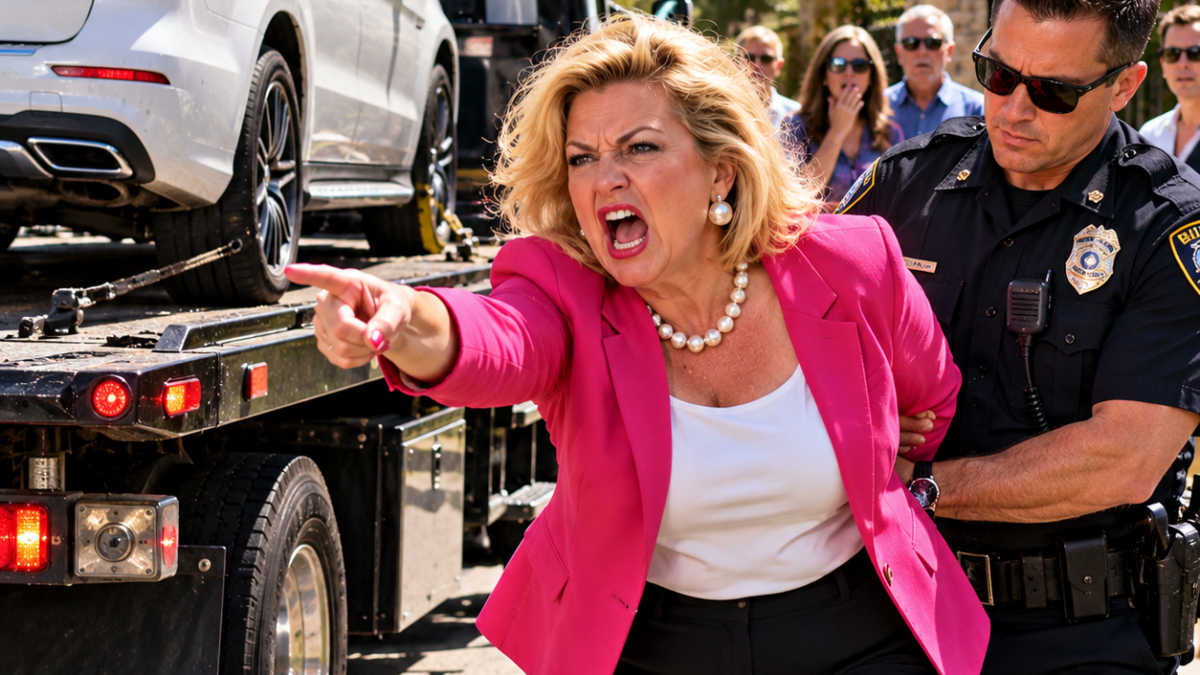
Martinez reached toward the handcuffs on her belt.
That was the moment Karen’s confidence finally flickered.
Not disappeared.
Just cracked.
“Are you threatening me?”
“I’m instructing you to step away from the vehicle and cooperate.”
“This is harassment.”
“Step away.”
“No.”
Martinez moved.
Everything after that happened very quickly.
She guided Karen’s arm behind her back.
Karen screamed.
“Get your hands off me!”
“Stop resisting.”
“Call your supervisor!”
“Ma’am, stop pulling away.”
“I have rights!”
“You are being detained for interfering with official duties.”
“What?”
The second cuff clicked shut.
The sound carried across the street.
Karen went completely still.
“What did you just do?”
Martinez’s voice stayed level.
“You were given repeated instructions.”
“You’re arresting me?”
Karen looked around at the neighbors.
At the tow truck.
At me.
Her face had gone pale beneath her makeup.
“I’m the president of this association.”
Nobody answered.
“I volunteer at the library!”
Pete stared at the pavement.
Mrs. Patterson covered her mouth with her mug.
Karen twisted toward Martinez.
“Call the mayor.”
“Please stop pulling away.”
“I know his wife.”
“Ma’am.”
“I was supposed to have lunch with her today!”
Pete quietly muttered something I couldn’t hear.
Then he resumed the tow.
The SUV began rising.
Karen saw it.
“No!”
The white vehicle lifted inch by inch.
After three months of staring at that SUV in the one place it should never have been, watching its tires leave the ground felt almost unreal.
Karen struggled again.
“That is my property!”
Martinez kept a firm grip.
“Yes, ma’am.”
“Put it down!”
“No, ma’am.”
“My purse is inside!”
“Personal property can be addressed through the impound process.”
“This is insane!”
The Johnson family had come outside.
Their two kids actually brought lawn chairs.
Their mother made them put the chairs away.
Mr. Henderson did not bother hiding his smile.
Karen looked toward the gathering crowd.
“Someone call the HOA attorney!”
Frank, one of the board members, was standing near his driveway.
He looked at the ground.
Karen shouted, “Frank!”
He reluctantly looked up.
“Do something!”
Frank lifted both hands.
“I don’t think I can.”
“You’re vice president!”
“I know.”
“Then act like it!”
Frank looked at the tow truck.
Then at Officer Martinez.
Then back at Karen.
“This isn’t an HOA issue anymore.”
That sentence broke something.
Karen went silent.
Not for long.
But long enough.
Pete finished securing the SUV.
The tow truck engine rumbled.
Martinez opened the rear door of her vehicle.
Karen pulled back.
“I am not getting in there.”
“Please get inside.”
“I haven’t done anything.”
“You’ll have an opportunity to address the charges through the proper process.”
“I want my husband.”
“You can contact him.”
“I want my attorney.”
“You can contact counsel.”
“I want your supervisor.”
“That can also be arranged.”
Every demand hit the same wall.
Procedure.
Karen couldn’t intimidate procedure.
She turned toward me one final time.
“This is your fault.”
That was the first thing I had heard all afternoon that genuinely angered me.
I wheeled closer.
Not too close.
Just enough for her to hear me without shouting.
“No, Karen.”
She glared.
“You did this.”
“No.”
“You called them.”
“Yes.”
“You wanted this.”
“I wanted access to my own home.”
Her mouth tightened.
“You could have waited.”
There it was.
Even now.
Handcuffed.
SUV on a tow truck.
Officer beside her.
Whole neighborhood watching.
Karen still believed the original problem was my unwillingness to wait.
I said quietly, “I waited three months.”
For once, she had no answer.
Martinez guided her into the rear seat.
The door closed.
Pete climbed into his tow truck.
The engine growled.
The yellow truck pulled away with Karen’s white SUV behind it.
Then the enforcement vehicle followed.
I sat on my porch as both disappeared around the corner.
Nobody spoke for several seconds.
The street felt unnaturally quiet.
Then Mrs. Patterson said, “Well.”
Mr. Henderson replied, “That was overdue.”
A few people laughed.
Someone clapped once.
Then stopped.
I looked down at my phone.
I had recorded much of the incident.
My hands were shaking.
Not from joy.
Not completely.
It was adrenaline.
Relief.
Anger.
Vindication.
Maybe even sadness.
Because none of this had needed to happen.
Karen could have moved her SUV the first time.
Or the second.
Or the tenth.
She could have listened during the HOA meeting.
She could have stopped using her office to protect herself.
She could have moved the car that afternoon.
Instead, she had turned a parking violation into an arrest because being told “no” felt more offensive to her than blocking a wheelchair user from getting home.
Frank approached my porch.
He looked exhausted.
“I’m sorry.”
I looked up.
“For what?”
“The board should have dealt with this earlier.”
I didn’t answer immediately.
He sat on the edge of the porch step.
“We all knew she was doing it.”
That hurt more than I expected.
“You knew?”
He nodded.
“I saw the photos.”
“And nobody did anything.”
He looked ashamed.
“She made everything a battle.”
“So everybody let her win.”
“Yes.”
I stared toward the empty accessible space.
“That’s how people like Karen become powerful.”
Frank nodded.
“I know.”
“No. You know now.”
He accepted that.
A few minutes later, neighbors began drifting back home.
The spectacle was over.
I transferred into my vehicle, moved it into my space, lowered the ramp without obstruction, and finally entered my house.
Such a simple thing.
I sat inside my living room and stared at the front door.
Then, unexpectedly, I cried.
Not because I felt weak.
Because for three months I had been forced to explain why basic access mattered.
I had been polite.
Patient.
Reasonable.
I had shown documentation.
Used formal channels.
Attended meetings.
Collected evidence.
And still, somewhere inside me, I had started questioning whether I was causing trouble simply by insisting on something I had every right to use.
That was the worst thing Karen had done.
Not the parking itself.
She had made me feel as if asking for access was aggression.
That feeling finally broke that evening.
The next morning, Willowbrook Estates felt different.
Nobody mentioned Karen directly when I checked the mail.
But everyone knew.
By noon, an emergency HOA meeting had been announced for Friday.
Karen was not home.
Her husband returned around 10:00 that morning.
He parked in their driveway, went inside, and closed the garage.
I didn’t see him again all day.
That afternoon, Frank called.
“Karen has submitted her resignation.”
I paused.
“As president?”
“Yes.”
“When?”
“This morning.”
“Why?”
Frank gave a short laugh.
“I’m guessing yesterday.”
He became serious.
“She says the board failed to protect her from targeted harassment.”
“Of course.”
“But she resigned.”
“That matters.”
“Very much.”
I sat silently.
Part of me had imagined this moment during those months of frustration.
Karen losing control.
Karen being forced to step down.
Karen finally experiencing consequences.
Yet the actual feeling was quieter than expected.
I didn’t feel victorious.
I felt tired.
Frank continued.
“We’re also reviewing the warning letter you received about taking photographs.”
“Good.”
“I didn’t vote for it.”
“You signed it.”
Silence.
That landed.
Finally he said, “You’re right.”
“I don’t need excuses.”
“I know.”
“You all let her use the board as a shield.”
“I know.”
“And if that doesn’t change, removing Karen won’t fix anything.”
Frank exhaled.
“That’s what I wanted to talk about.”
The emergency meeting was packed.
Far more crowded than any meeting I had attended before.
Karen’s chair at the front table sat empty.
Frank opened the meeting.
He did not use the gavel.
Smart man.
He read Karen’s resignation letter.
It was exactly what I expected.
She described herself as “deeply saddened.”
She mentioned “personal attacks.”
She wrote about “toxic division.”
She claimed recent events had made it “impossible to continue serving effectively.”
She did not mention the accessible parking space.
She did not mention the repeated violations.
She did not mention refusing to move her SUV.
She did not mention standing in front of a tow truck.
Still, when Frank finished, nobody applauded.
Nobody booed.
That silence felt appropriate.
Then Frank said, “The board owes this community an acknowledgment.”
People shifted.
He looked toward me.
“For several months, repeated complaints were made regarding the improper use of an accessible parking space. Those complaints were not handled appropriately.”
He swallowed.
“The fact that the individual involved was the HOA president affected how this board responded.”
That was more honesty than I expected.
He continued.
“That should never have happened.”
Mrs. Patterson nodded.
Someone behind me whispered, “Finally.”
Frank said the board would immediately review parking enforcement policies, conflict-of-interest procedures, complaint handling, and authority of officers.
Then he looked directly at me.
“Would you like to speak?”
I had prepared nothing.
I rolled toward the front.
The room went silent.
“I don’t want special rules.”
That was the first thing I said.
“I want the same thing I asked for three months ago.”
I looked around.
“An accessible space only works if people respect it.”
Several people nodded.
“This wasn’t about me getting the best parking space.”
I could hear emotion creeping into my voice.
“It wasn’t about convenience.”
I paused.
“Some of you saw me coming home and parking blocks away.”
A few neighbors looked down.
“You saw me pushing myself over broken sidewalk after therapy.”
Nobody spoke.
“And nobody wanted to get involved.”
That sentence made the room uncomfortable.
Good.
“I understand why.”
I looked toward the empty chair Karen once occupied.
“She made disagreement exhausting.”
A few people laughed quietly.
“But silence has consequences too.”
Frank nodded.
“When a person uses authority unfairly and everyone else decides it’s easier to stay quiet, that person becomes stronger.”
I looked at the board.
“So fix the system. Don’t just replace Karen.”
That became the real turning point.
The board adopted a conflict-of-interest rule requiring officers to recuse themselves from complaints involving their own conduct.
Parking complaints involving accessible spaces were placed into a high-priority category.
A board president could no longer unilaterally dismiss complaints.
Formal warnings required review by more than one officer.
Photographs taken to document potential rule violations could not automatically be labeled harassment simply because the subject disliked being documented.
Most importantly, accessible parking restrictions were clarified in language nobody could pretend to misunderstand.
The space outside my townhouse was mine to use for accessibility.
Not Karen’s loading zone.
Not a temporary convenience spot.
Not overflow parking.
Not a resource to be “shared flexibly.”
Access.
Two days later, I received another letter from the HOA.
This one rescinded the warning about my photographs.
The final sentence read:
“We apologize for the association’s failure to address your concerns promptly and impartially.”
I kept that letter.
Not as a trophy.
As proof that institutions can admit mistakes when enough people stop pretending nothing happened.
Karen returned home several days later.
I saw her SUV first.
Her husband drove it back from the impound lot.
A bright citation notice was still tucked under one windshield wiper.
Karen arrived separately.
She wore sunglasses even though the sky was overcast.
I happened to be outside.
For one second, our eyes met.
Then she looked away.
She did not speak to me.
I didn’t speak to her.
For two weeks, that became our routine.
If she saw me, she crossed the street.
If we approached the mailboxes simultaneously, she waited.
The woman who once seemed to occupy every inch of Willowbrook had become strangely invisible.
Rumors spread.
I ignored most of them.
Some neighbors claimed Karen had spent a night in custody.
Others said she had been released within hours.
People debated charges, fines, court dates, and what might happen next.
I refused to participate in speculation.
What I knew was enough.
She had been cited over the parking violation.
Her conduct during enforcement created additional legal problems.
She now had attorneys involved.
The HOA had accepted her resignation.
Her days of controlling Willowbrook were over.
About three weeks later, I received an unexpected knock.
It was Karen’s husband, David.
We had barely spoken before.
He looked exhausted.
“Can I talk to you?”
I nodded.
He remained on the porch while I stayed inside.
“I’m not here to argue.”
“Okay.”
“I just wanted to apologize.”
That surprised me.
He looked toward his house.
“I didn’t know how bad it had become.”
“You didn’t know she was parking there?”
“I knew sometimes.”
“Sometimes?”
He closed his eyes.
“Okay. I knew.”
I waited.
“I told her to stop.”
“But she didn’t.”
“No.”
“And you let it go.”
His shoulders dropped.
“Yes.”
There it was again.
Everyone had a version of the same confession.
I knew.
I didn’t want the fight.
So I stayed quiet.
David continued.
“She gets fixated when she thinks someone is challenging her.”
“That doesn’t make it okay.”
“I know.”
“She told the board I was harassing her.”
“I know.”
“She tried to stop me documenting violations.”
“I know.”
“She told me to wait until evening before I could properly access my own house.”
David looked down.
“I know.”
I studied him.
“Then what exactly are you apologizing for?”
He looked back at me.
“For knowing and doing nothing.”
That answer mattered.
Not enough to erase anything.
But enough to be real.
I nodded.
“Thank you.”
He started to leave.
Then turned.
“She keeps saying you ruined her life.”
I felt something cold settle inside me.
“I didn’t park her SUV.”
“I know.”
“I didn’t refuse the officer.”
“I know.”
“I didn’t stand in front of a tow truck.”
“I know.”
“Then maybe you should remind her of that.”
David gave a tired half smile.
“I have.”
Over the next month, Karen’s legal consequences moved forward.
She attended court.
There were fines.
Probation requirements.
Community service.
The details mattered less to me than what happened afterward.
For the first time in years, Karen no longer held a position that allowed her to convert personal grudges into official HOA business.
The association’s attorney later confirmed to the board that Karen would not be permitted to return to a leadership role while the issues surrounding her conduct and the association’s liability remained unresolved.
For Karen, that may have hurt more than the towing bill.
Willowbrook had been her kingdom.
The title “HOA President” wasn’t simply volunteer work.
It was identity.
Without it, she was just another homeowner.
And being just another homeowner meant following the same rules as everyone else.
The first real test came in November.
A family on the opposite end of the street left holiday decorations up earlier than HOA policy technically allowed.
Under Karen’s presidency, photographs would have been taken before sunset.
A warning would have arrived the next morning.
Instead, Frank walked over, spoke to them, learned that their son was deploying overseas and the family had decorated early because he wanted to celebrate before leaving.
The board granted a temporary exception.
Nobody’s property value collapsed.
Civilization survived.
A week later, a neighbor left a garbage bin beside the garage overnight.
No threatening letter.
No drama.
The next day, it was gone.
People began talking to each other instead of reporting each other.
That changed Willowbrook more than any bylaw amendment.
Mrs. Patterson started bringing coffee to my porch on Saturday mornings.
Mr. Henderson, who apparently had opinions about everything but had spent years avoiding meetings, joined the architectural committee.
He lasted exactly one meeting before declaring, “I hate committees.”
Then he came back the next month anyway.
The Johnson kids began waving when they passed my house.
One afternoon, their mother stopped me.
“I owe you an apology.”
I smiled.
“Everybody does lately.”
She laughed nervously.
“No, seriously.”
I waited.
“I saw Karen in your space several times.”
I nodded.
“I thought about saying something.”
“But?”
“She scared me.”
“I understand.”
“I kept telling myself it wasn’t my business.”
I looked at her.
“And now?”
“Now I think maybe that was the problem.”
Exactly.
Karen had never actually been as powerful as everyone believed.
Her power came from dozens of small retreats.
A neighbor deciding it wasn’t worth arguing.
A board member choosing not to challenge her.
A homeowner paying an unfair fine because disputing it would take too much time.
A husband deciding silence was easier.
Me trying to be polite longer than I should have.
Enough retreats can turn one ordinary person into a dictator without anyone noticing when it happened.
Then one day, somebody stops retreating.
In my case, that day came with a tow truck.
But the story still wasn’t finished.
In December, I attended another physical therapy session.
It had been a bad day.
My muscles were tight.
Progress felt slow.
Anyone who has gone through long-term rehabilitation understands that healing is rarely dramatic.
There are no movie montages.
No triumphant music.
Mostly repetition.
Try.
Fail.
Rest.
Try again.
That day, I failed repeatedly at a transfer exercise I had completed the previous week.
By the time I drove home, frustration sat heavily in my chest.
Then I turned onto Willowbrook Lane.
The accessible space was empty.
Completely clear.
Nobody parked halfway over the lines.
Nobody had left a delivery vehicle in the access aisle.
Nothing blocked the ramp.
I pulled in.
Lowered the ramp.
Rolled out.
And reached my front door in less than two minutes.
I stopped there.
That ordinary moment nearly broke me.
Three months earlier, I would have taken it for granted.
Now it felt like freedom.
Mrs. Patterson happened to be outside.
“You okay?”
I nodded.
“Yeah.”
“You sure?”
I looked at the parking space.
“I’m just realizing how exhausting it was.”
She understood immediately.
Sometimes people think discrimination or exclusion has to look dramatic.
A locked door.
An insult.
A law.
But often it looks smaller.
A car in the wrong place.
A ramp blocked.
A person forced to ask again and again for something everyone else receives automatically.
The exhausting part isn’t always the physical obstacle.
It is having to prove repeatedly that the obstacle matters.
January brought Karen back into my orbit.
I was checking the mail when she approached.
I noticed her before she reached me.
She looked different.
Not physically.
Something in the way she carried herself.
Quieter.
“Can we talk?”
I considered saying no.
Then nodded.
She stopped several feet away.
“I completed my community service.”
I wasn’t sure what response she wanted.
“Okay.”
“At a rehabilitation center.”
That caught my attention.
She gave a short, bitter laugh.
“Yes. I understand the irony.”
I said nothing.
“They assigned me to administrative work.”
She looked toward the parking space.
“But I spent time around patients.”
Her voice became quieter.
“People using wheelchairs.”
I remained still.
“One woman had an accessible van.”
Karen swallowed.
“Someone parked beside her too closely and she couldn’t deploy the ramp.”
I felt my jaw tighten.
“She had to wait.”
Karen nodded.
“About twenty minutes.”
“And?”
“She cried.”
That surprised me.
Karen looked at me.
“Not loudly. She was just… tired.”
I understood that perfectly.
Karen continued.
“She kept apologizing to everyone.”
“For what?”
“For causing trouble.”
There it was.
My throat tightened.
“She said she didn’t want to make anybody uncomfortable.”
I looked away.
Karen’s voice shook slightly.
“I thought about you.”
I almost laughed, but nothing about it was funny.
“You needed community service to understand?”
She flinched.
“I deserved that.”
“Yes.”
She nodded.
“I kept telling myself you were making the parking situation bigger than it was.”
“It was big to me.”
“I know.”
“No. You know now.”
She accepted that too.
For several seconds neither of us spoke.
Then Karen said, “I’m sorry.”
I had imagined hearing those words many times.
In my imagination, they felt triumphant.
They didn’t.
They felt heavy.
“I’m sorry I parked there.”
She took a breath.
“I’m sorry I dismissed your complaint.”
Another.
“I’m sorry I used the HOA to make you look like the problem.”
That was the one.
My eyes burned.
Karen noticed.
“I was angry because you wouldn’t let me control the situation.”
She laughed softly at herself.
“Which is probably the most Karen sentence anyone has ever said.”
I almost smiled.
“I’m still angry with you.”
“I know.”
“I’m not going to pretend it didn’t happen.”
“I’m not asking you to.”
“You hurt me.”
She nodded.
“I know.”
“You made living here harder than it needed to be.”
“I know.”
I looked directly at her.
“But I appreciate the apology.”
Her shoulders loosened slightly.
“Thank you.”
We were not friends after that.
That matters.
Forgiveness does not always end with friendship.
Sometimes it simply means you stop carrying the other person everywhere you go.
Karen and I became civil.
Nothing more.
If we passed on the sidewalk, we nodded.
If there was an HOA meeting, she sat among the homeowners instead of at the front.
She occasionally spoke during public comments, but something had changed.
She stopped beginning sentences with, “As former president…”
That alone was miraculous.
The strongest sign of change came one rainy afternoon in spring.
I was returning from the grocery store.
A delivery van had temporarily stopped near my accessible space.
Before I could even turn into the street, I saw Karen walking toward the driver.
My first thought was:
Here we go.
Then I heard her.
“Sir, you need to move forward about ten feet.”
The driver pointed at the house.
“I’ll only be a minute.”
Karen shook her head.
“That space needs to stay clear.”
The driver looked annoyed.
“It’s raining.”
“So?”
He stared.
Karen pointed.
“There’s open curb space right there.”
The driver moved.
Karen turned.
Saw me watching.
For one second, both of us froze.
Then she shrugged.
“What?”
I smiled.
“Nothing.”
“Don’t start.”
“I didn’t say anything.”
“I can see your face.”
“What face?”
“That smug face.”
I laughed.
She started walking home.
Then she turned around.
“And before you say it, yes, karma is hilarious.”
That was the closest we ever came to joking about what happened.
The following annual HOA election proved just how much Willowbrook had changed.
For years, elections had been ceremonial.
Karen ran.
Few people opposed her.
Most residents didn’t want the headache.
That year, six people volunteered.
Actual debate happened.
Candidates discussed finances.
Maintenance.
Accessibility.
Communication.
Conflict resolution.
One woman proposed forming an accessibility review committee to inspect community pathways, curb cuts, and common areas.
I ended up serving on it.
Not because I wanted authority.
Because I wanted fewer people to fight the battles I had fought.
Our first inspection found several problems.
A curb cut near the clubhouse had cracked badly enough to become difficult for wheelchairs.
A landscaping company routinely left equipment near a ramp.
One accessible visitor space had faded markings.
None were dramatic.
All were fixable.
And because the new board took them seriously, they were fixed.
That was the most satisfying revenge of all.
Karen had tried to teach me that my access was optional.
Her behavior ended up making accessibility a permanent HOA priority.
She had tried to silence photographs documenting violations.
The new policy formally protected good-faith documentation.
She had dismissed a complaint against herself.
The new conflict rule made that impossible.
She had spent years building a system around her own authority.
Then her abuse of that system caused it to be rebuilt specifically so no future president could do the same thing.
Her legacy wasn’t the empire she wanted.
Her legacy was the safeguards created after it collapsed.
One evening, Frank and I were leaving a board meeting.
He looked at the accessible space.
“Do you ever think about that day?”
“The tow?”
“Yeah.”
“Sometimes.”
“You looked way calmer than I expected.”
I laughed.
“I was not calm.”
“You looked calm.”
“I had been angry for three months. I think I just ran out.”
He nodded.
“Karen always says you planned the whole thing.”
“I planned to call enforcement.”
“You didn’t plan the arrest?”
“Of course not.”
He smiled.
“She still hates admitting that part.”
“What part?”
“That everything after the tow started was her decision.”
Exactly.
That is the piece people sometimes miss when they hear the story.
I didn’t call the police demanding Karen be arrested.
I didn’t ask anyone to handcuff her.
I didn’t demand punishment.
I called because her SUV was blocking the only space I could safely use.
When enforcement arrived, Karen still had choices.
She could have apologized.
She could have produced whatever documentation was requested.
She could have stepped aside.
She could have let the tow happen and challenged it later if she believed it was improper.
Instead, she tried to control a situation that was no longer hers to control.
That was why the ending mattered.
Karen’s downfall wasn’t something I manufactured.
It was something she kept choosing.
One refusal at a time.
One escalation at a time.
One moment of entitlement after another.
Months later, during another therapy appointment, my therapist asked why I seemed less tense.
I laughed.
“Neighborhood drama finally ended.”
“Good drama or bad drama?”
“Both.”
He shook his head.
“That sounds exhausting.”
“It was.”
Then he said something I still remember.
“Sometimes recovery is not only learning what your body can do now. It’s learning you’re allowed to take up space again.”
I went silent.
He thought he had said something wrong.
He hadn’t.
You’re allowed to take up space again.
After my injury, my relationship with physical space changed.
Door widths mattered.
Ramp slopes mattered.
Parking distance mattered.
Crowded rooms mattered.
Every environment quietly told me whether I belonged there.
A step could say no.
A blocked ramp could say no.
A person parked across an access aisle could say:
Your ability to move through the world matters less than my convenience.
Maybe that’s why the conflict with Karen hurt so deeply.
She wasn’t simply occupying a rectangle of pavement.
Every time she parked there after knowing why it mattered, she sent the same message.
You can wait.
My life is more important.
Eventually, I stopped accepting that message.
That changed more than the parking situation.
I became less apologetic.
Not rude.
Not aggressive.
Just clearer.
When a restaurant blocked its accessible entrance with stacked chairs, I said something.
When a store placed a promotional display in the middle of an accessible aisle, I asked them to move it.
When someone parked across a ramp “for only five minutes,” I stopped pretending five minutes didn’t matter.
Karen had unintentionally taught me a lesson.
Standing up for access is not creating conflict.
The person creating the barrier created the conflict.
The final chapter came almost a year after the tow.
Willowbrook held its annual neighborhood cookout.
I had skipped previous ones.
That year, Mrs. Patterson practically ordered me to attend.
There were folding tables on the lawn.
Kids running through sprinklers.
Frank burning hamburgers.
Mr. Henderson loudly explaining to everyone why Frank was burning hamburgers.
I sat under a canopy talking with several neighbors when a white SUV turned onto the street.
Karen.
She parked in her own driveway.
Perfectly.
Mrs. Patterson leaned toward me.
“Look.”
“I see.”
“Should we applaud?”
“Absolutely not.”
She laughed.
Karen walked toward the cookout carrying a bowl.
Nobody stopped talking.
Nobody went silent.
That was important.
She was no longer feared.
But she wasn’t being exiled either.
She was simply another resident.
She set the bowl down.
“Potato salad.”
Mr. Henderson looked suspicious.
“Homemade?”
Karen glared.
“Yes.”
“Just checking.”
She looked around.
Then noticed me.
She hesitated.
Walked over.
“Hey.”
“Hey.”
She looked at the wheelchair-accessible picnic table the HOA had purchased after our committee review.
“You got your table.”
“We got our table.”
She nodded.
“Right.”
A few seconds passed.
Then she said, “You know, I used to hate that blue parking space.”
I raised an eyebrow.
“I remember.”
“I thought it made the street look ugly.”
“I remember that too.”
She looked around at the neighborhood.
“It doesn’t bother me anymore.”
I smiled.
“The paint changed?”
“No.”
“What changed?”
She thought about it.
“Me, apparently.”
That may have been the most honest thing Karen ever said.
Later that evening, children drew with sidewalk chalk near the curb.
One little girl colored around the blue accessible symbol.
Her mother immediately stopped her.
“No, honey. We don’t draw there.”
The girl asked why.
Before anyone else answered, Karen said:
“Because that space needs to stay clear for people who need it.”
The child nodded.
“Okay.”
And continued drawing somewhere else.
Simple.
No argument.
No resentment.
No lecture about sharing resources.
Karen caught me looking at her.
“Don’t.”
I smiled.
“I didn’t say anything.”
“You were thinking something.”
“I’m a private citizen. You can’t regulate my thoughts anymore.”
She rolled her eyes.
“Very funny.”
I laughed.
And for the first time, the entire story felt finished.
People often talk about karma as if it is some mysterious force waiting behind the curtain with a list.
I don’t know whether I believe that.
What I do believe is that choices accumulate.
Karen spent years choosing control over empathy.
She chose convenience over access.
She chose intimidation over accountability.
She chose to dismiss complaints because she could.
And on one October afternoon, when she had every possible opportunity to make a different choice, she kept doubling down until there was nowhere left to go.
The tow truck wasn’t karma.
The handcuffs weren’t karma.
The fine wasn’t karma.
They were consequences.
What felt like karma came afterward.
Karen losing the office she used to silence people.
The HOA rewriting its rules because of what she had done.
Accessible parking becoming a serious enforcement priority.
Neighbors becoming willing to speak up.
A woman who once complained that a blue parking symbol ruined the appearance of her street eventually teaching a child why that space had to remain clear.
That was the part I never could have planned.
If you had told me the first week I moved into Willowbrook that Karen Whitfield would someday stand beside that same parking space defending it, I would have laughed.
If you had told me she would lose the presidency, face legal consequences, complete community service, apologize to me, and eventually help protect the very access she once treated as an inconvenience, I would have assumed you were describing a different person.
Maybe, in some ways, she became one.
Not completely.
Karen was still Karen.
She still complained about landscaping.
She still believed most meetings could be improved if people listened to her faster.
She still wore pearls to community events.
And she still had the supernatural ability to notice a garbage bin from half a mile away.
But she learned something.
So did the neighborhood.
So did I.
The last time I thought seriously about that afternoon, I was sitting on my porch during sunset.
My car was parked in the accessible space.
The blue markings had recently been repainted.
Bright.
Visible.
Impossible to misunderstand.
Karen walked past with her dog.
She stopped.
“Still looks ugly.”
I stared at her.
She held the expression for two seconds.
Then smiled.
“Kidding.”
“You’re lucky.”
“What are you going to do? Call a tow truck?”
We both started laughing.
She pointed at me.
“That was one time.”
“One very memorable time.”
“Let it go.”
“I have.”
And I had.
That surprised me most.
I no longer felt anger when I saw her.
I no longer replayed every insult.
I no longer imagined better arguments I could have made at those early HOA meetings.
I didn’t need to.
The outcome had become bigger than the conflict.
The accessible space remained clear.
The HOA was better governed.
The neighbors were more willing to challenge unfairness.
Karen had faced accountability.
And I had learned that protecting your dignity does not require becoming cruel.
There had been moments when I wanted revenge.
Real revenge.
I wanted Karen embarrassed.
I wanted her removed.
I wanted every person she had bullied to watch her finally lose.
Then the tow truck came.
The arrest happened.
The neighborhood watched.
And for a few minutes, I got exactly the dramatic justice I thought I wanted.
But the satisfaction faded quickly.
What stayed was something else.
The ability to come home.
To park.
To deploy my ramp.
To enter my house without asking permission.
That was the victory.
A person who has never had access taken away might look at a parking space and see paint.
I see independence.
I see the difference between needing help and being able to do something myself.
I see the final few feet between my vehicle and my front door.
I see the right to arrive home without wondering whether someone else has decided their convenience matters more than my mobility.
Karen eventually learned to see some of that too.
Maybe not perfectly.
But enough.
And that is why, if you ask me whether I regret making that call, my answer has never changed.
No.
I don’t regret documenting every violation.
I don’t regret refusing to be intimidated by an HOA title.
I don’t regret calling parking enforcement.
And I certainly don’t regret watching that white SUV rise slowly off the pavement after three months of being told I should simply be more flexible.
Karen once believed being HOA president meant she was the rules.
That afternoon, with Officer Martinez standing beside her and a tow truck carrying away the vehicle she refused to move, she discovered the truth.
Authority does not place you above accountability.
Titles do not erase consequences.
And someone asking for basic access is not asking for special treatment.
For months, Karen kept telling me to wait.
Wait until she finished unloading groceries.
Wait until she picked up her paperwork.
Wait until after her meeting.
Wait until evening.
Wait while the HOA decided whether my access mattered enough to enforce.
Eventually, I stopped waiting.
And that changed everything.
People say karma doesn’t carry a clock.
Maybe it doesn’t.
But on that October afternoon in Willowbrook Estates, it arrived forty-five minutes after my phone call, painted bright yellow, with flashing lights behind it.
And for once, Karen was the one who had to wait.




