PART 2: HOA Karen Had Her “Security” Break Into My Wife’s Classic Mustang—Then She Called 911 and Realized Too Late Who She Had Targeted
PART 2
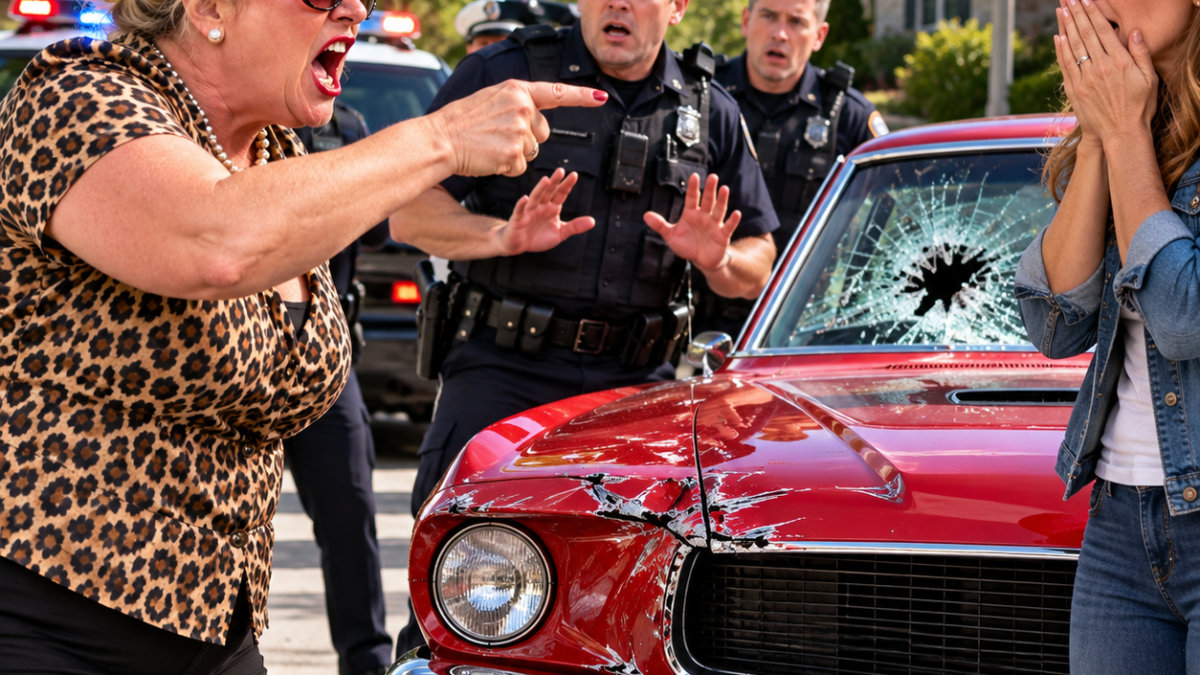
The police cruiser arrived four minutes later.
Two officers stepped out.
Young.
Late twenties, maybe.
Both immediately scanned the scene.
Me.
Patricia.
The two uniformed security guards.
Rachel.
The Mustang.
Patricia moved first.
Of course she did.
“Officers, thank you.”
She walked toward them as if she had summoned employees.
“The situation is under control now, but this gentleman became extremely aggressive while we were carrying out a lawful HOA enforcement action.”
One officer looked at me.
“Sir, please stay where you are.”
I lifted my hands slightly.
“Fine.”
Patricia continued.
“He advanced on my staff. He refused multiple instructions to step back.”
“That’s not what happened.”
The officer held up one hand.
“Sir, I’ll get your statement.”
I stopped.
Patricia nodded solemnly.
“We were attempting to remove an inoperable nuisance vehicle.”
Rachel’s eyes shifted to the Mustang.
The first officer looked at it.
Then at the pry bar.
One guard had set it on the ground.
“What happened to the door?”
Patricia answered before anyone else could.
“The owner refused to provide access.”
“That’s not—”
Rachel touched my arm.
Barely.
I looked at her.
She shook her head once.
Wait.
So I did.
Patricia explained everything.
The complaints.
The supposed violation.
The alleged board authorization.
My “aggressive approach.”
The danger she had felt.
The need to protect community staff.
She spoke beautifully.
That’s the disturbing part.
If I hadn’t lived through the previous ten minutes, I might have believed her.
The guards stood behind her.
Dark uniforms.
Radios.
Utility belts.
HOA SECURITY printed across their shirts.
One officer looked at them.
“You guys licensed security?”
“Yes, sir,” one answered.
“Private?”
“Yes.”
Patricia quickly added:
“They act under board authority.”
Rachel’s eyes moved toward her.
Nothing else.
The officer turned to me.
“Okay, sir. Your turn.”
I explained.
I had been inside.
Heard metal.
Came outside.
Saw them forcing the door.
Asked them to stop.
Walked toward my wife’s car.
Never touched anybody.
Never threatened anybody.
Never shouted.
The officer glanced at Patricia.
She shook her head.
“That is absolutely false.”
I looked at the guards.
“You saw me threaten her?”
They both nodded.
Perfectly synchronized.
One said:
“He moved toward us aggressively.”
The other:
“We felt he was going to interfere physically.”
I stared.
“You were breaking into the car.”
Patricia immediately said:
“See?”
The officer turned.
“Ma’am?”
“That tone.”
I almost laughed.
Rachel touched my arm again.
Stay quiet.
The officer exhaled.
“Everybody needs to calm down.”
There it was.
Calm down.
A phrase that somehow always seems to land on the person whose property is being damaged.
I looked around.
Neighbors had gathered.
Five.
Then eight.
Then maybe twelve.
An older couple across the street.
A jogger.
A woman walking a small dog.
Nobody came closer.
Nobody asked what had happened.
Patricia saw the crowd.
Her voice rose half a level.
“This is exactly why community standards exist.”
I felt Rachel shift beside me.
Patricia continued.
“We have an obligation to protect residents from situations that become unsafe.”
A woman across the street nodded.
My stomach tightened.
It was happening.
Not the legal part.
The social part.
A narrative spreads faster than evidence.
Patricia had uniforms.
A title.
A clipboard.
Police presence.
And the confidence of somebody who had spent years learning how to appear reasonable.
I was the angry new resident standing beside a damaged car.
One officer looked toward Rachel.
His face changed.
Not recognition exactly.
Something close.
He squinted.
Rachel saw it.
Then he looked away.
“Ma’am, did you witness what happened?”
“Yes.”
“Can you tell me—”
Patricia interrupted.
“She came out after the confrontation.”
Rachel looked at her.
“I can answer for myself.”
The officer nodded.
“Go ahead.”
Rachel’s voice remained quiet.
“When I came outside, the vehicle was already damaged. Mr. Crawford was standing several feet from Ms. Henderson. I did not see him touch or threaten anyone.”
Patricia scoffed.
“You weren’t there at the beginning.”
“No.”
Rachel glanced at the car.
“But I have no intention of speculating about something I didn’t personally observe.”
That sentence sounded simple.
But it was Rachel.
Exact.
Limited.
No exaggeration.
No emotional filler.
One of the officers looked at her again.
“Have we met?”
Rachel gave him a polite expression.
“I don’t believe so.”
He nodded.
But I could tell he was still trying to place her.
Patricia didn’t notice.
The second officer asked whether she wanted to make a formal complaint.
“Yes.”
Immediately.
She wanted an incident report regarding threatening behavior.
She would also submit documentation to the HOA.
The officer took information.
Then handed me a card.
Case number.
Contact information.
“If you have additional evidence or want to submit anything, reference this number.”
Rachel took the card from me.
“Thank you.”
The officer looked at her once more.
Then both returned to their cruiser.
No arrest.
No citation.
No determination.
Just a report.
But as they drove away, that distinction didn’t matter to the neighbors.
They had seen police respond to our address.
That was enough.
Patricia watched the cruiser disappear.
Then she turned toward Rachel.
“I don’t believe we’ve formally met.”
Rachel looked at her.
“I know who you are.”
Patricia’s smile flickered.
“Well, then you understand that Ridgewood takes violations seriously.”
“I understand that you do.”
“I’ll be recommending a formal board hearing.”
Rachel nodded.
“And I strongly recommend that you obtain counsel.”
That almost made me speak.
Rachel didn’t react.
Patricia continued.
“Your husband’s conduct is unacceptable.”
Rachel glanced at me.
Then back at Patricia.
“Are you finished?”
Patricia looked offended.
“Excuse me?”
“Are your people finished with the car?”
She turned.
The guards had stopped working.
“Yes. For today.”
Rachel nodded.
“Good.”
Patricia climbed into a golf cart.
The guards followed.
She drove away without another word.
The neighbors slowly disappeared.
No one approached.
No one asked if the Mustang was okay.
No one said, “I saw what happened.”
The street returned to normal.
Except nothing was normal.
Rachel walked to the car.
She didn’t touch it.
She crouched.
Looked at the door frame.
Mirror.
Paint.
Lock.
Then she took out her phone.
Photograph.
Another.
Another.
Wide shot.
Close-up.
Tool marks.
Ground.
Pry bar scratches.
Tire marks.
I watched.
“Rachel.”
She kept photographing.
“Rachel.”
“What?”
“How are you this calm?”
She stopped.
For the first time, something cracked in her expression.
Not much.
Just enough.
Her eyes became wet.
She looked at the Mustang.
“My father rebuilt that door twice.”
I didn’t know what to say.
“He used to complain that Ford engineers designed half the car beautifully and the other half after lunch.”
She gave a small broken laugh.
Then the emotion disappeared again.
She photographed the mirror.
“What are you doing?”
“Preserving it.”
“The damage?”
“Everything.”
She looked at the house.
“Doorbell camera.”
I stared.
“What about it?”
“It recorded them arriving.”
My heart changed rhythm.
“All of it?”
“Probably.”
She walked inside.
I followed.
At the kitchen table, Rachel opened her laptop.
She created a folder.
DATE.
RIDGEWOOD INCIDENT.
Then three subfolders.
VIDEO.
AUDIO.
DOCUMENTS.
I stood behind her.
She opened the doorbell footage.
There it was.
Patricia arriving in the golf cart.
Two guards.
One carrying tools.
No tow truck.
No written notice left at the door.
They walked directly to the Mustang.
Patricia pointed.
One guard tried the handle.
Locked.
Patricia said something.
Audio picked it up faintly.
“Get it open.”
My jaw tightened.
Then the pry bar.
Scrape.
Crack.
The whole thing.
Before I came outside.
Rachel saved copies.
Two locations.
Cloud backup.
External drive.
Then she opened another file.
“What’s that?”
“My laptop recording.”
“You were recording?”
“I was on a video call with Erin.”
“Who?”
“Work.”
Right.
Rachel had been working late the night before and continued early that morning.
“When I heard the noise, I muted the meeting and moved the laptop toward the window.”
The recording showed another angle.
Patricia’s face.
The guards.
Me coming outside.
Then Rachel opened a third file.
Audio.
“You recorded on your phone?”
“When I stepped outside.”
“Why?”
She looked at me.
“Because people remember things differently when consequences arrive.”
I sat.
“That’s an unsettling answer.”
“It’s an accurate one.”
We listened.
Patricia telling me not to approach.
Calling 911.
Saying I was advancing.
The audio clearly captured my footsteps stopping.
My voice.
Her voice.
The distance.
Then something bothered me.
“Rachel.”
“Yes?”
“Why were you ready for this?”
She stopped typing.
Silence.
I knew my wife.
That silence meant there was something she had not told me.
“What?”
She opened another folder.
Not from today.
Older.
Label:
RIDGEWOOD.
I stared.
“What is that?”
Rachel leaned back.
“Complaints.”
“What complaints?”
She clicked.
Six names.
Six households.
Emails.
Photos.
Letters.
Written statements.
One family’s car had been towed without adequate notice.
Another had paid more than two thousand dollars in storage fees.
One elderly couple alleged landscaping crews entered their backyard and removed structures without permission.
Another homeowner claimed violation notices had been altered after disputes began.
All involved Patricia Henderson.
I looked at Rachel.
“How do you have this?”
She didn’t answer immediately.
Then:
“They came through my office.”
That sentence changed the room.
Most of our neighbors knew Rachel was a lawyer.
Almost none knew exactly what kind.
She didn’t advertise it.
She hated people treating her differently because of her title.
My wife was an Assistant District Attorney.
Not assigned to HOA disputes.
Not running some secret investigation.
But her office had received scattered complaints involving possible fraud, false reporting, and property issues.
Nothing complete enough to establish a prosecutable pattern.
Rachel had seen them.
Flagged them.
Then moved on because evidence matters more than suspicion.
“Patricia?”
“Her name appeared repeatedly.”
“And you knew before we bought here?”
“I recognized it during closing.”
My stomach tightened.
“You didn’t tell me.”
“I didn’t have proof of anything.”
“You let us move here.”
“We already had the contract.”
“That’s not the point.”
“I know.”
I stood.
“So you suspected the HOA president might be doing this to people and said nothing?”
Rachel looked at me.
“I suspected residents were making accusations. That is not the same thing.”
“Six families.”
“Six incomplete complaints.”
“You could have told me.”
“Yes.”
That stopped me.
No defense.
No excuse.
Just yes.
Rachel closed the laptop halfway.
“I should have told you I recognized the name.”
I sat again.
“Why didn’t you?”
“Because I didn’t want every interaction we had here to become an investigation in your head.”
“And in yours?”
“It already was.”
That hurt more than I expected.
She saw it.
“I’m sorry.”
I stared at the folder.
“Were you watching Patricia?”
“I was paying attention.”
“That’s a lawyer answer.”
“It’s also the truth.”
“Did you choose this house because of her?”
“No.”
“Rachel.”
“No.”
Her voice sharpened.
“I chose this house because you liked the office and I wanted a garage big enough for Dad’s Mustang.”
That I believed.
She continued.
“If I had believed there was immediate danger, we would not have moved here.”
“What changed?”
She turned the laptop toward me.
“This morning.”
The doorbell footage sat frozen on Patricia ordering a guard toward the Mustang.
“Before today, I had complaints.”
She clicked the audio.
“Now I have evidence.”
That difference was everything to her.
I understood.
I still wished she had told me.
Both things could be true.
“What happens now?”
Rachel opened a blank document.
“We do this correctly.”
“What does that mean?”
“First, photographs.”
“Done.”
“Professional damage estimate.”
“Okay.”
“Second, request body-camera footage from the responding officers.”
“Okay.”
“Third, file a complaint with the appropriate state and county agencies.”
“Okay.”
“Fourth, preserve every HOA communication.”
“Okay.”
“Fifth—”
She looked at me.
“You do nothing.”
I blinked.
“Nothing?”
“No posting.”
“Fine.”
“No confronting Patricia.”
“Fine.”
“No talking to neighbors about what we have.”
“Why?”
“Because right now she thinks she controls the evidence.”
“And?”
“I want to see what she does while she believes that.”
That was Rachel.
Not revenge.
Strategy.
I should have known what came next.
Patricia escalated.
The first neighborhood post appeared the next morning.
**COMMUNITY SAFETY ALERT — INCIDENT INVOLVING NEW RESIDENT**
Our address was included.
My name wasn’t.
It didn’t need to be.
She described an aggressive confrontation.
Threatening conduct.
HOA security personnel “forced to protect themselves.”
Police response.
Potential legal action.
Then she posted a photograph of the Mustang.
Caption:
**Vehicle at center of ongoing nuisance enforcement matter.**
I almost threw my phone across the kitchen.
Instead I read comments.
That was worse.
Eighty by breakfast.
More than two hundred by lunchtime.
Somebody wrote:
> I knew something was off about that house.
They had never met me.
Another:
> People move into nice neighborhoods and immediately think rules don’t apply.
Another:
> If police had to come, there’s probably more to the story.
That one hurt because it sounded reasonable.
Police presence creates credibility even when police make no finding.
A few residents urged caution.
Their comments disappeared under louder ones.
Patricia replied to supporters personally.
Thank you for understanding.
We are committed to safety.
The board will not be intimidated.
Rachel read everything.
Screenshot.
Save.
Timestamp.
I watched her.
“Does none of this bother you?”
“It bothers me.”
“You don’t look bothered.”
“That is different.”
The cease-and-desist letter came the next day.
HOA attorney.
I was ordered not to contact Patricia, security personnel, or board members.
Accused of intimidation.
Harassment.
Interference with official HOA duties.
I had contacted none of them.
“This is insane.”
Rachel read it.
“No.”
“What?”
“It’s useful.”
I stared.
“How?”
“Now the narrative is formalized.”
“That’s useful?”
“If it’s false.”
I paced.
“You know what I hate about being married to a prosecutor?”
“A lot of things, apparently.”
“You can make a disaster sound like office supplies.”
She almost smiled.
“A well-documented disaster is easier to fix.”
By afternoon, a security cart began passing our house every thirty minutes.
Slowly.
Visible.
Never technically stopping.
Never entering the property.
Just reminding us they were there.
That night, one of my coworkers messaged me.
He lived two streets away.
Everything okay?
I answered:
HOA misunderstanding. Being handled.
He replied:
Hope it works out.
Then nothing.
The next morning, he avoided me in a video meeting.
Another Ridgewood coworker barely spoke to me.
Patricia’s story had escaped the neighborhood.
That made me understand what reputation actually is.
Not what people know.
What people think everybody else knows.
Two days later, Patricia discovered Rachel was an attorney.
New post.
**Some residents believe professional status places them above community rules. Ridgewood will not be bullied by legal intimidation.**
Rachel showed me.
“She found your bar profile?”
“Probably.”
“She doesn’t know your job.”
“Apparently not.”
I wanted to respond.
Doorbell video.
Audio.
Everything.
Let them see.
Rachel refused.
“Not yet.”
“Why?”
“Because right now she can say edited video.”
“We have the original.”
“She’ll say missing context.”
“We have audio.”
“She’ll say we provoked her.”
“So we stay silent while she destroys our reputation?”
“For now.”
I stared at her.
“For how long?”
“Until she believes she has won.”
I almost laughed.
“You realize that sounds terrifying.”
“It should.”
Then she softened.
“Daniel, I know this is hard.”
“You’re getting attacked too.”
“I’ve spent twelve years being attacked by defense attorneys.”
“Different.”
“Yes.”
She reached across the table.
“But we cannot win this by becoming louder.”
“So how?”
“Better evidence.”
That evening, two things arrived.
First:
The police body-camera request had been approved.
Second:
Patricia posted video.
Fifteen seconds.
No audio.
Security guard’s phone.
It began with me walking toward the Mustang.
I looked angry.
Of course I looked angry.
Someone was forcing open my wife’s car.
But the clip showed none of that.
Only me.
Walking quickly.
Jaw tight.
Hands moving as I spoke.
Caption:
**SEE FOR YOURSELF.**
My stomach dropped.
Comments exploded.
Rachel watched the clip twice.
Then a third time.
I expected anger.
Instead:
“Interesting.”
“What?”
“Where was the guard standing?”
“What?”
“When he recorded this.”
I replayed it.
Near our driveway.
“On our property?”
“Looks like it.”
“So?”
She paused.
“We don’t jump to conclusions about recording law.”
That surprised me.
In the original story she might have said something broad about consent, but Rachel was careful.
“We establish exactly where he was, what audio existed, whether anything was altered, and what representations accompanied publication.”
She added a note.
“What matters most?”
“The editing?”
“The context.”
She looked at me.
“Patricia is not merely defending herself anymore.”
“What is she doing?”
“Publishing material to support a factual story she knows may be contradicted by complete footage.”
She saved screenshots.
“She thinks this helps her.”
“Does it?”
Rachel’s mouth shifted.
“It helps us establish intent.”
The emergency HOA hearing was scheduled for Thursday.
One hundred forty-seven residents signed in.
I counted.
The community center smelled like cheap coffee and carpet cleaner.
Metal chairs.
Buzzing fluorescent lights.
Patricia sat at the front.
Two guards beside her.
Four other board members.
Papers arranged neatly.
She looked untouchable.
Rachel and I sat in the back.
She had given me instructions before we entered.
“Do not argue.”
“I know.”
“Do not answer from the audience.”
“I know.”
“Do not correct every lie.”
“That one is harder.”
“I know.”
“What if she asks us directly?”
“We preserve our objection.”
“And then?”
“Sit down.”
I looked at her.
“That’s it?”
“That’s it.”
The meeting began.
Patricia thanked everyone for coming.
Then she told her story.
Again.
But more polished.
A routine enforcement action.
A dangerous resident.
Staff frightened.
Police summoned.
Community standards threatened.
She never once mentioned the pry bar.
The first guard spoke.
He said I “advanced rapidly.”
The second said he prepared to defend himself.
That phrase got murmurs.
Defend himself.
Against me.
Patricia nodded gravely.
A board member named Harold Krenshaw proposed sanctions.
$5,000 fine.
Mandatory removal of the Mustang within thirty days.
Future towing at our expense.
My pulse pounded.
That car was sitting inside our garage now.
Damaged.
Still running.
Still registered.
Still insured.
And they were officially labeling it inoperable.
Patricia asked for discussion.
Silence.
Then a man near the front raised his hand.
“What about them?”
Patricia looked toward us.
“The Crawfords may speak.”
Every head turned.
Rachel stayed seated.
I stood.
My knees felt oddly weak.
I walked to the front carrying one page.
No photos.
No videos.
No dramatic evidence.
One formal objection.
I handed it to the secretary.
“This is our written objection to the proceedings. It identifies procedural deficiencies under the association’s governing documents. Please enter it into the official record.”
Patricia stared.
“That’s all?”
“Yes.”
“You have nothing else to say?”
I looked at Rachel.
Then back.
“No.”
I returned to my seat.
The room erupted in whispers.
“He has no defense.”
“If they had proof, they’d show it.”
“Why is the wife staying quiet?”
Patricia let it build.
Then:
“Very well.”
She smiled.
“If the Crawfords decline to defend themselves, we’ll proceed.”
Then she looked directly at Rachel.
“For the record, Mrs. Crawford is an attorney.”
Some residents turned.
“One would think a legal professional would understand respect for established rules.”
Rachel did not react.
“Instead, she has apparently chosen silence while her husband behaves in this manner.”
Still nothing.
Patricia’s voice hardened.
“I will also be submitting a complaint to the Arizona State Bar regarding her conduct.”
Rachel finally moved.
Only enough to write something in her notebook.
That infuriated Patricia more than an argument would have.
The vote passed.
Seven to two.
$5,000.
Removal order.
Patricia looked satisfied.
For the first time, I wondered whether Rachel had miscalculated.
Maybe silence wasn’t strategy.
Maybe we were simply losing.
People got up.
Chairs scraped.
Whispers.
We headed for the door.
Then someone touched my arm.
Older man.
Seventies.
Gray hair.
Weathered face.
Quiet eyes.
“I know what they did to the Mustang.”
I looked at him.
“What?”
“They did something similar to us.”
“Who?”
“Patricia.”
He glanced toward the board.
“My wife had a garden.”
I waited.
“Twenty years.”
His voice dropped.
“Roses. Tomatoes. Native flowers.”
“What happened?”
“HOA said it attracted pests.”
He laughed bitterly.
“Sent contractors while we were visiting our daughter.”
“They removed it?”
“Everything.”
His eyes filled.
“My wife never replanted.”
I didn’t know what to say.
He pressed something into my hand.
USB drive.
“I kept records.”
“Why?”
“Because I kept telling myself one day somebody would care.”
“What’s your name?”
“Walter Morrison.”
Rachel appeared beside me.
Walter looked at her.
“You’re the lawyer?”
Rachel nodded.
“One of them.”
He smiled sadly.
“Good.”
Then walked away.
Outside, I gave her the drive.
“What did he say?”
I told her.
She stared at the USB.
“That makes seven.”
“Families?”
“Yes.”
“What happens tomorrow?”
She looked toward Patricia through the community-center windows.
“I pick up the body cameras.”
“And after that?”
“We stop waiting.”
The body-camera footage changed everything.
Not because it showed something our cameras didn’t.
Because it came from a neutral government source.
Timestamped.
Continuous.
Two officers.
Different angles.
It showed Patricia controlling the conversation from the moment they arrived.
It showed me complying when asked to step back.
It showed her describing aggressive behavior while footage showed none.
More importantly, it preserved statements from the guards.
Statements we could compare with their later hearing testimony.
Rachel watched it with headphones.
Paused.
Rewound.
Typed.
“Guard one said you ‘charged forward’ at the HOA meeting.”
“Yes.”
“Here he tells the officer you ‘walked toward the car quickly.’”
“Difference?”
“Potentially.”
She continued.
“Guard two said at the meeting he was prepared to defend himself.”
“Yeah.”
“Body cam: ‘He was upset but didn’t touch anybody.’”
I stared.
“He said that?”
“Timestamp 08:17:42.”
She played it.
There it was.
The same man who later described me as a threat had told police I had touched nobody.
Rachel exhaled.
“Good.”
“Good?”
“For accuracy.”
Walter’s USB was worse.
Three years.
Photos.
Letters.
Violation notices.
Emails.
Audio.
One family had a vehicle removed under circumstances nearly identical to ours.
Another had fines changed after objections.
Another claimed security personnel entered property without clear authority.
Walter had organized it all.
Dates.
Names.
Witnesses.
“Why did no one act on this?”
I asked.
Rachel looked tired.
“Some did.”
“What?”
“Complaints reached different agencies. Different people. Different times.”
“So nobody connected them.”
“Exactly.”
“Why not?”
“Because institutions are fragmented.”
She tapped the screen.
“One office sees a towing complaint.”
Another file.
“Another sees a civil HOA dispute.”
Another.
“Police see a disturbance.”
Another.
“State regulators see governance.”
She looked at me.
“No single fact necessarily proves a broader pattern.”
“But together?”
“Together you ask better questions.”
That night Rachel told me the part she had been avoiding.
“I can’t touch the case.”
I frowned.
“What do you mean?”
“If this becomes criminal, I have a conflict.”
“Obviously.”
“I need to formally recuse now.”
“From your office?”
“From anything involving Ridgewood.”
“You’ve already been preserving evidence.”
“As a victim.”
“Right.”
“But once this goes further, somebody independent needs to review it.”
“Who?”
“That won’t be my decision.”
It became David Brennan.
Senior prosecutor.
No connection to us.
No personal interest.
Rachel transferred nothing privately.
Everything entered through formal channels.
Our complaint.
Doorbell footage.
Audio.
Damage estimate.
Body-camera records.
Walter’s drive.
Names of other families.
Then she stepped away.
Completely.
That was harder for her than I realized.
She had spent her career building cases.
Now she had to sit beside me and wait.
For three weeks, nothing happened publicly.
Patricia thought she had won.
She posted less.
Security cart stopped circling our block.
Neighbors settled into the story they preferred.
Then the District Attorney’s Office announced a press conference.
Tuesday.
Ten a.m.
Rachel received no inside briefing.
That was deliberate.
We arrived like everyone else.
Reporters filled the room.
Local television.
Print.
Legal press.
A reporter specializing in homeowners associations.
I sat in the back.
Rachel sat near the side aisle.
Then Patricia entered with her attorney.
I almost couldn’t believe it.
She looked confident.
Red jacket.
Pearls.
Hair perfect.
She whispered something to counsel and smiled.
She apparently believed she had been invited as a cooperating HOA representative.
David Brennan stepped to the podium.
“Good morning.”
The room quieted.
“This office has completed an initial review of allegations concerning conduct within the Ridgewood Estates Homeowners Association.”
Patricia’s smile remained.
Brennan continued.
“We have examined evidence involving property interference, allegedly false statements to law enforcement, HOA enforcement practices, and a broader pattern of conduct affecting multiple residents.”
Her smile began to fade.
“Until recently, individual complaints lacked sufficient corroboration to support further action.”
He paused.
“That has changed.”
Screen behind him.
Body camera.
Patricia appeared.
The morning of the Mustang.
Her voice.
“This man became aggressive.”
Video.
Me standing several feet away.
“This man advanced on us.”
Video.
Me stopping when officers asked.
Reporters started typing.
Then the doorbell video.
Earlier timestamp.
Security guards arriving.
Tools.
Patricia pointing.
Guard approaching Mustang.
Pry bar.
Metal bending.
Paint cracking.
My stomach tightened even though I had seen it dozens of times.
Then audio.
Patricia:
“Get it open.”
One reporter stopped typing.
Looked up.
Brennan let the footage continue.
My voice:
“What are you doing?”
Patricia:
“This vehicle is in violation.”
The complete sequence.
No editing.
No missing beginning.
No social-media caption.
Just events.
Then Rachel’s laptop angle.
Clearer.
Patricia calling 911.
“A man is threatening us.”
The image showed me motionless.
The contradiction sat in the room like physical weight.
Brennan stopped the video.
“The vehicle at issue is a 1967 Ford Mustang Fastback.”
Photograph appeared.
Rachel’s father.
Young.
Army uniform.
Standing beside the Mustang decades earlier.
Brennan continued.
“The vehicle previously belonged to Master Sergeant William Torres, who served twenty-five years in the United States Army, including two tours in Vietnam.”
Rachel looked down.
“He left the vehicle to his daughter, Rachel Crawford.”
Next photograph.
Current registration.
Maintenance records.
“The vehicle was operable.”
Next.
Professional damage report.
“Damage attributed to the incident was estimated at more than eighteen thousand dollars.”
Patricia leaned toward her attorney.
He whispered.
She shook her head.
Then Walter’s records appeared.
Not every page.
Enough.
Seven families.
Seven histories.
Similar enforcement tactics.
Towing.
Property entry.
Disputed notices.
Intimidation allegations.
Brennan spoke carefully.
“These matters remain subject to adjudication, and every accused person retains the rights afforded by law.”
That mattered.
Then he announced charges authorized at that stage.
Patricia faced allegations including filing a false police report and harassment, along with fraud-related theories under review.
The two security guards faced property-damage and trespass-related charges, as well as allegations concerning how they represented their authority.
Additional board conduct remained under investigation.
Patricia stood.
Her attorney reached for her.
Too late.
“This is a setup.”
Every camera turned.
Brennan said nothing.
“That woman planned this.”
She pointed at Rachel.
Rachel didn’t move.
“She used her office.”
Brennan finally spoke.
“For clarity, Assistant District Attorney Rachel Crawford formally recused herself from this matter three weeks ago.”
Patricia ignored him.
“She moved into my community knowing exactly who I was.”
I felt Rachel tense.
Brennan continued.
“The investigation was conducted and charging decisions were made independently.”
Patricia’s voice rose.
“This is retaliation.”
Her lawyer whispered urgently.
She pulled away.
“I’ll sue.”
Cameras clicked.
“All of you.”
Her lawyer tried again.
“You have no idea who you are dealing with.”
That sentence.
The same kind of sentence people like Patricia use when control starts slipping.
Brennan waited.
Then said:
“Arraignment will occur next week. We will have no further substantive comment today.”
Questions erupted.
Patricia’s lawyer moved her toward the exit.
She kept talking.
Rachel remained seated.
I watched my wife instead of Patricia.
Rachel looked exhausted.
Outside, I found her near the parking lot.
“You okay?”
She watched Patricia’s car leave.
“I will be.”
“You knew that was coming?”
“No.”
“Nothing?”
“No.”
“Brennan didn’t tell you?”
“Daniel.”
“Right.”
Recused.
Separate.
Independent.
I nodded.
“How do you feel?”
Rachel watched the empty road.
“Sad.”
That surprised me.
“Sad?”
“For Walter.”
She looked at me.
“For the six before us.”
“For your father’s car.”
Then:
“And for everybody in that room who thought power was the same thing as authority.”
I put my arm around her.
“Is it over?”
“No.”
Of course that was her answer.
“She’ll challenge evidence.”
“Probably.”
“Her lawyer will negotiate.”
“Probably.”
“People will say this was political.”
“Some will.”
“What do we do?”
Rachel looked at me.
“Nothing.”
I laughed.
Again.
“Your favorite strategy.”
“We let the process work.”
Three months later, Patricia pleaded no contest to filing a false police report and harassment.
Some of the broader fraud allegations were reduced or resolved as part of the agreement.
She received probation.
Community service.
A substantial fine.
And restrictions that prevented her from serving in HOA leadership during the relevant period.
The security guards received suspended custodial terms and restitution obligations.
Their employer terminated them.
Several board members resigned.
Others cooperated with an independent audit.
Was it the dramatic punishment some neighbors wanted?
No.
People expected prison.
Public humiliation.
Some kind of cinematic destruction.
Real accountability is rarely cinematic.
It’s paperwork.
Orders.
Probation terms.
Restitution.
Restrictions.
Records that follow you.
The civil case settled separately.
Seven families.
$180,000 total.
Our portion:
$32,000.
Enough to restore the Mustang.
More important were the HOA reforms.
No private “security” actions without clearly defined authority.
No property removal without documented notice and procedure.
No anonymous complaint treated as unquestioned fact.
Recorded meetings.
Written evidence requirements.
Independent compliance monitoring.
Two years.
Transparency.
Walter Morrison won the special election for HOA president.
By almost three to one.
The meeting where he accepted was packed.
He stood at the microphone.
No polished speech.
No expensive suit.
Just Walter.
“I stayed quiet too long.”
Silence.
“A lot of us did.”
He looked around.
“We told ourselves Patricia knew the rules.”
Some people lowered their eyes.
“We told ourselves if somebody got a notice, they probably deserved it.”
More eyes down.
“We told ourselves it wasn’t our business.”
He paused.
“It was our business.”
His voice trembled.
“Because they were our neighbors.”
A woman began crying.
Walter continued.
“I can’t undo what happened.”
Then:
“But I can make sure silence isn’t the easiest choice anymore.”
The applause lasted a long time.
Afterward, people started coming to our house.
The older couple across the street arrived first.
Bottle of wine.
Apology.
The husband looked embarrassed.
“We saw them at the car.”
I stared.
“You saw?”
“From the window.”
“Did you see me threaten anyone?”
He looked down.
“No.”
That hurt.
“Why didn’t you say anything?”
His wife answered.
“We were scared of Patricia.”
Rachel stood beside me.
She said nothing.
The woman continued.
“She had fined us before. We didn’t want trouble.”
I wanted to be angry.
Part of me was.
But fear explains behavior without necessarily excusing it.
Rachel finally said:
“Next time, say what you saw.”
The woman nodded.
“We will.”
Another neighbor came.
Then another.
One man admitted he had called me dangerous online.
“I didn’t know.”
“You didn’t ask.”
He looked ashamed.
“No.”
“Why?”
“I trusted Patricia.”
“Why?”
“Because she was president.”
That answer might have been the entire lesson.
Not everyone apologized.
Some defended her.
A few insisted the investigation had been excessive.
One neighborhood thread claimed Rachel orchestrated everything.
Another suggested Patricia had simply made “procedural mistakes.”
People protect their old beliefs because admitting you were fooled feels like losing part of yourself.
We stopped arguing.
The Mustang went to a restoration shop in Phoenix.
The owner was a veteran.
When he learned about William Torres, he walked around the car twice before giving us an estimate.
“You want it perfect?”
Rachel looked at the damaged door.
“No.”
The man frowned.
“No?”
“Safe. Correct. Beautiful.”
“That’s perfect.”
“No.”
She touched the bent frame.
“Don’t erase everything.”
He understood.
Months passed.
The door was straightened.
Paint matched.
Mirror replaced.
Chrome corrected.
Mechanical inspection completed.
The car came back beautiful.
But Rachel had asked them to leave the faintest evidence of repair in one place inside the door frame.
Not visible from ten feet away.
Visible if you knew where to look.
“Why?”
I asked.
She ran one finger along it.
“My father left scars on it too.”
“What?”
“Look.”
She pointed near the lower hinge.
A tiny old repair.
“He dropped the door once in 1987.”
I laughed.
“He never told me that.”
“He told me never to tell anyone.”
“He’s dead.”
“He’ll still be annoyed.”
That was the first time we laughed about the Mustang since the morning it happened.
Then Patricia’s attorney contacted us.
Indirectly.
His client was considering a public statement.
Remorse.
Regret.
A desire to move forward.
In exchange, he hoped Rachel might support early termination of probation when eligible.
I laughed when Rachel told me.
“You’re kidding.”
“No.”
“What did you say?”
“Nothing yet.”
“You’re considering it?”
“I’m considering my response.”
“Why?”
“Because I don’t answer legal requests while angry.”
I paced.
“She tried to destroy your reputation.”
“I know.”
“She damaged your father’s car.”
“I know.”
“She lied about me.”
“I know.”
“She had people calling me dangerous.”
“I know.”
“She filed a bar complaint.”
“I know.”
“Then why are we even discussing this?”
Rachel looked at me.
“Because consequences are not revenge.”
I stopped.
“What does that mean?”
“It means I don’t increase consequences because I hate her.”
“So you help her?”
“I didn’t say that either.”
Rachel took two days.
Then wrote:
The consequences imposed were determined through the legal process based on the evidence and resolution of the case. I do not believe it would be appropriate for me to advocate for modification of those conditions. If Ms. Henderson fulfills her obligations, any future determination belongs to the responsible authorities. I wish her no additional harm, but I will not request leniency she has not earned.
I read it.
“That’s it?”
“Yes.”
“No line about what she did?”
“No.”
“No emotional statement?”
“No.”
“No ‘you brought this on yourself’?”
“Daniel.”
“What?”
“That would make you feel better for five minutes.”
“Probably ten.”
She smiled.
“Exactly.”
The request ended there.
No shortcut.
No personal retaliation.
Just the order.
That night we sat on the porch.
The Mustang was back in the driveway.
Rachel had insisted.
Same place.
I wasn’t sure how I felt about that.
“Why not garage it?”
“Because it belongs here.”
“After everything?”
“Especially after everything.”
The late sun reflected off the green paint.
For a moment, the car looked untouched.
Then I saw the faint repair line.
“You really have no regrets?”
I asked.
Rachel was quiet.
“No.”
“None?”
“I regret that Dad’s car was damaged.”
“Obviously.”
“I regret not telling you I recognized Patricia’s name.”
I looked at her.
That mattered.
“I regret the people before us didn’t have what we had.”
“Evidence?”
“Resources.”
She looked toward the street.
“Knowledge.”
Then:
“And people willing to listen once the evidence existed.”
I nodded.
The memorial was Rachel’s idea.
Not mine.
Not the board’s.
She wanted a bench near the small lake at the edge of Ridgewood.
Nothing about the case.
Nothing about Patricia.
Nothing about HOA reform.
Just her father.
The new board approved it unanimously.
Plaque:
**IN MEMORY OF MASTER SERGEANT WILLIAM TORRES**
**SERVICE. SACRIFICE. HOME.**
The dedication was small.
Walter attended.
A representative from the local VFW.
Several neighbors.
The restoration-shop owner came too.
Rachel stood beside the bench.
No speech.
People waited.
She touched the plaque.
Then sat.
That was all.
Later, I asked what she had been thinking.
“Driving.”
“With your dad?”
She nodded.
“He didn’t talk much.”
“I know.”
“He’d pick me up from school in the Mustang.”
“Showing off?”
“Absolutely.”
I smiled.
Rachel looked toward the water.
“Windows down.”
“Arizona?”
“Even when it was too hot.”
“Sounds like him.”
“He’d play old music.”
“Loud?”
“Always.”
She smiled.
“Sometimes we drove for an hour without saying anything.”
“What did you think about?”
“I didn’t.”
She looked at me.
“I just felt safe.”
That sentence broke something in me.
Because the whole fight had begun with a woman trying to turn William Torres’s car into a symbol of disorder.
An eyesore.
A nuisance.
Something that lowered property values.
But to Rachel, the Mustang had always meant one thing.
Her father came home.
Whatever he had seen overseas.
Whatever years of service had cost him.
He had come home.
He bought that car.
He rebuilt it.
He raised a daughter.
He taught her to drive stick.
He taught her to change oil.
He taught her how to listen for engine knock.
The Mustang wasn’t valuable because collectors said it was valuable.
It was valuable because it carried a family story.
No HOA rule could calculate that.
Six months after the press conference, Rachel took it out for its first real drive.
Just us.
No destination.
She started the engine.
That V8 rumble filled the driveway.
Walter was outside watering his lawn.
He stopped.
Rachel revved once.
Walter laughed.
She backed out.
We drove through Ridgewood.
Past Patricia’s former house.
She still lived there then, although rarely came outside.
Past the community center.
Past the street where security carts once circled our block.
Past houses belonging to people who had judged us.
Past houses belonging to people who later spoke up.
Nobody was purely one thing anymore.
Coward.
Villain.
Hero.
Victim.
Real neighborhoods are messier.
People make bad choices.
Then sometimes better ones.
People stay silent.
Then sometimes speak.
Rachel drove toward the lake.
Parked.
Turned off the engine.
We sat.
The memorial bench was visible in the distance.
“Can I ask you something?”
“Always dangerous.”
“Do you ever wish you had pushed harder?”
She looked at me.
“With Patricia.”
“What does harder mean?”
“You know.”
“I don’t.”
“More.”
“More punishment?”
“Yes.”
Rachel turned toward the windshield.
I waited.
Finally:
“No.”
“Really?”
“Yes.”
“After everything?”
“Especially after everything.”
“Why?”
She looked toward her father’s bench.
“Because winning isn’t how much you can take away from someone.”
I said nothing.
“It’s what you protect.”
She pointed lightly toward the Mustang’s steering wheel.
“This.”
Then toward the neighborhood.
“The people she hurt.”
Then the bench.
“Dad.”
She leaned back.
“Patricia wanted everything to become a war.”
“And?”
“I prefer consequences.”
“What’s the difference?”
“Wars keep expanding.”
She looked at me.
“Consequences end.”
I thought about that.
“She has to live with what she did,” Rachel said. “I have to live with what I did in response.”
“And?”
“I like my side better.”
We sat until sunset.
Then she started the engine.
On the way home, we passed Walter.
Still watering something.
Rachel hit the horn twice.
Beep.
Beep.
Walter looked up.
Smiled.
Waved.
The horn worked again.
Such a stupid little thing.
But I laughed.
Rachel did too.
We pulled into our driveway.
She shut off the engine.
For a moment neither of us moved.
Then she placed both hands on the steering wheel.
“My father would’ve liked this ending.”
I looked at her.
“Why?”
She smiled.
Not the courtroom smile.
Not the controlled smile.
Rachel.
“Because we won without becoming what we fought.”
I looked at the Mustang.
The restored paint.
The chrome.
The faint scar still hidden near the frame.
Maybe she was right.
Patricia had damaged the car.
But she hadn’t changed what it meant.
She had damaged our reputation for a while.
But she hadn’t changed who we were.
She had controlled the neighborhood story.
Until evidence became stronger than reputation.
And in the end, the part that stayed with me wasn’t the press conference.
It wasn’t seeing Patricia lose control.
It wasn’t the settlement money.
It wasn’t even the board election.
It was Walter standing at our door months later.
He had come to drop off an HOA budget report.
Imagine that.
A normal budget report.
Transparent.
Detailed.
Boring.
I looked through it.
“Everything okay?”
he asked.
“I think so.”
“Don’t trust me.”
I looked up.
“What?”
He smiled.
“Check it.”
I laughed.
Walter pointed at the report.
“That was our problem before.”
He became serious.
“We trusted the title.”
President.
Security.
Board.
Attorney.
Authority.
“We stopped checking whether the person behind the title deserved the trust.”
I nodded.
Walter left.
I stood on the porch.
Across the street, children rode bikes.
A dog barked.
Someone’s garage door opened.
Ridgewood looked exactly like it had when Rachel and I moved in.
Same houses.
Same lawns.
Same lake.
Same absurd rules about paint colors and trash cans.
But something important had changed.
Questions were no longer treated as disloyalty.
At meetings, residents asked for documents.
Walter answered.
When he didn’t know, he said:
“I don’t know.”
The first time I heard him say that from the board table, I almost applauded.
Patricia had always had an answer.
Even when she had to invent one.
Walter understood that uncertainty was not weakness.
Dishonesty was.
A year later, we attended a neighborhood block party.
I nearly skipped it.
Rachel made me go.
“Why?”
“Because hiding after you win is weird.”
“We didn’t win the neighborhood.”
“That isn’t what I said.”
The Mustang was parked near our house.
People stopped to look.
An older man asked Rachel about the engine.
A teenager asked whether it was really a ’67.
She spent twenty minutes explaining fastback body lines.
For once, nobody called it a nuisance.
One woman approached me.
She had been among Patricia’s loudest defenders online.
“I owe you an apology.”
I sighed internally.
There had been many.
“You don’t have to—”
“I do.”
She held up a hand.
“I wrote that you were dangerous.”
“I remember.”
Her face reddened.
“I never met you.”
“No.”
“I saw Patricia’s post.”
“Yes.”
“I watched the short video.”
“Yes.”
“And I thought that was enough.”
I looked toward the party.
“Why?”
She was silent.
Then:
“Because everybody else seemed sure.”
That answer might have been more honest than any apology.
Everybody else seemed sure.
Certainty is contagious.
So is fear.
So is cruelty.
But courage can spread too.
Walter had proved that.
The seven families had proved it.
Even some of the neighbors who apologized later had proved it by showing up to vote.
I told her:
“Next time everybody seems sure, ask what they actually know.”
She nodded.
“I will.”
Maybe she meant it.
Maybe not.
That was hers to decide.
Our job was to keep living.
Rachel kept working.
I kept writing software from the home office.
The Mustang spent most nights in the garage.
Not because the HOA demanded it.
Because Arizona sun is cruel to paint.
On Sundays, Rachel sometimes backed it into the driveway and worked on it.
Neighbors stopped to talk.
Walter once walked over carrying a coffee.
“Violation.”
Rachel looked up from the engine bay.
“What?”
“Too much chrome.”
She stared at him.
He managed a straight face for about two seconds.
Then laughed.
Rachel pointed a wrench at him.
“You are dangerously close to losing reelection.”
He held up both hands.
“Abuse of power.”
“Go home, Walter.”
He left smiling.
That laughter felt earned.
Not because we had forgotten.
Because remembering no longer controlled the day.
The faint line in the door frame remained.
Rachel could have had it completely refinished.
She refused.
“Healing does not mean pretending nothing happened.”
That became something of a family phrase.
When people asked about the scar, she sometimes told them.
Sometimes she didn’t.
The car didn’t owe strangers its story.
Neither did we.
One evening, years after Patricia’s board was gone, I found Rachel in the garage.
Lights off except the work lamp.
She was sitting in the driver’s seat.
Not driving.
Just sitting.
I opened the passenger door.
“Everything okay?”
“Yes.”
I got in.
She held an old photograph.
William.
Young.
Uniform.
Mustang.
“You miss him?”
“Every day.”
We sat quietly.
Then she said:
“You know what I hated most?”
“What?”
“Not the damage.”
“What then?”
“That she called it inoperable.”
I almost smiled.
“That offended you professionally?”
“She reduced it to something broken.”
I understood.
Rachel touched the steering wheel.
“Dad came home from war and spent years rebuilding this car because fixing things helped him feel normal.”
I had heard parts of that.
Never so directly.
“He didn’t talk about Vietnam much.”
“No.”
“But he talked while he worked.”
“About what?”
“Anything.”
She smiled.
“Baseball. Grocery prices. The neighbors. Me.”
Her eyes filled.
“This car was where I knew him best.”
I looked at the dashboard.
“So when Patricia called it junk…”
“Nuisance.”
“Right.”
“She wasn’t insulting a car.”
I nodded.
She wiped one eye.
“I know she couldn’t have known.”
That mattered.
Patricia had caused harm without understanding its full meaning.
People often do.
That doesn’t excuse it.
But Rachel wasn’t going to pretend Patricia intentionally attacked William’s memory.
“She saw property,” Rachel said.
“And you saw your father.”
“Yes.”
We stayed there.
No dramatic conclusion.
No courtroom.
No HOA.
Just two people inside an old Mustang.
Eventually Rachel put the photograph in the glove box.
“Want ice cream?”
“At ten?”
“Dad used to.”
“That is not a legal argument.”
“Get in.”
“You’re already in.”
“You know what I mean.”
She started the engine.
We drove.
Windows down.
Music loud.
No destination.
For a while, I understood exactly what she meant when she said the car made her feel safe.
The engine didn’t know anything about Patricia.
The road didn’t care about HOA rules.
The night air didn’t care about neighborhood gossip.
The Mustang did what William had built it to do.
It moved forward.
That is how I remember the story now.
Not with the crowbar.
Not with 911.
Not with Patricia pointing at us.
Not with police lights in our driveway.
I remember Rachel starting the engine after the restoration.
I remember Walter waving.
I remember the memorial bench.
I remember neighbors finally learning that authority without accountability is just confidence wearing a uniform.
And I remember the thing Rachel told me beside the lake.
Patricia wanted a war.
We gave her consequences.
That distinction saved us from becoming consumed by what she had done.
She wanted us angry enough to make mistakes.
Rachel stayed patient.
She wanted us loud enough to look unreasonable.
Rachel documented.
She wanted us to fight her version of events with another version.
Rachel waited until evidence could speak without us.
And when it finally did, it spoke more clearly than either side ever could.
Timestamp.
Video.
Audio.
Paper.
Witnesses.
Seven families.
One pattern.
That was enough.
Patricia lost her position.
The guards lost their jobs.
The families received restitution.
The HOA changed.
The Mustang came home.
William got a bench.
And Rachel kept the tiny scar in the metal.
Not because Patricia deserved to be remembered.
Because William did.
There’s a difference.
One person damaged the car for fifteen minutes.
Another man spent decades giving it meaning.
Rachel refused to let the shorter story become the bigger one.
That may be the part I admire most.
Patricia Henderson thought that morning was about enforcing a rule.
Then she thought it was about controlling me.
Then she thought it was about defeating Rachel.
She was wrong every time.
It was about what happens when people with authority stop believing they have to explain themselves.
And what happens when ordinary people finally demand evidence.
The final victory was not watching Patricia answer charges.
It was watching Ridgewood become boring again.
HOA meetings about irrigation.
Pool hours.
Tree trimming.
Budgets.
Parking.
Walter complaining that nobody reads his financial disclosures after he spent three hours preparing them.
That is what healthy institutions are supposed to be.
Boring.
Predictable.
Transparent.
They should not dominate your life.
They should not make you afraid to ask questions.
They should not make you wonder whether someone will enter your driveway because one person decided your property offended her.
Years later, I can still hear the sound that started everything.
Metal against metal.
For a long time, I hated that memory.
Now another sound comes faster.
The Mustang’s engine starting.
Deep.
Steady.
Alive.
Rachel behind the wheel.
Her father’s photograph in the glove box.
The scar still there if you know where to look.
And every time she pulls out of the driveway, I think the same thing.
They tried to turn that car into evidence that we didn’t belong.
Instead, it became proof that some things survive bad decisions, damaged metal, false stories, and people who mistake control for strength.
The Mustang survived.
So did we.
And when Rachel says her father would have liked the ending, I believe her.
Not because Patricia lost.
Because we never let Patricia decide who we became after she did what she did.
That part remained ours.
Just like the Mustang.
Just like William intended.





