PART 2: HOA Karen Called the Cops to My House With a Made-Up Story—Then One Officer Looked at Me and Went Pale
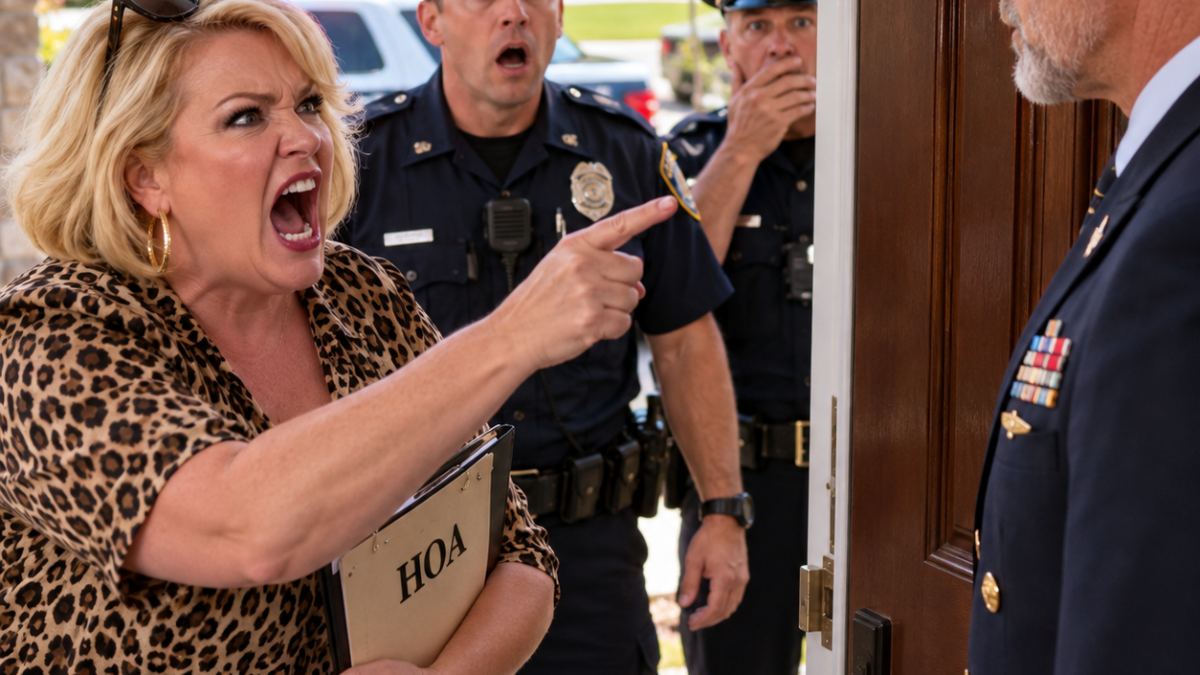
PART 2
The first notice had arrived three weeks after I moved in.
Garage door color.
That was the violation.
Not that the door was falling apart.
Not that it was painted neon orange.
It was beige.
Apparently the wrong beige.
According to Patricia, it was approximately two shades darker than the approved color listed in the architectural standards.
I had checked.
My shade fell comfortably inside the permitted range.
So I wrote back.
Nothing dramatic.
No legal language.
No threat.
Just a polite letter.
I included photographs.
Paint samples.
The manufacturer color code.
Two weeks later, the HOA sent me a $75 fine.
No explanation.
No response to my evidence.
Just:
**NONCOMPLIANCE — PAYMENT DUE.**
That should have told me what kind of system I was dealing with.
Instead, I paid attention without fighting.
Old judicial habit.
Understand the institution before challenging the decision.
Another notice arrived.
Trash can placement.
Then landscaping.
Then hedge height.
Someone had apparently stood at the edge of my yard with a measuring tape.
Another cited a vehicle parking issue even though the vehicle had been inside my own garage.
By June, I had a thick folder.
Every letter signed by Patricia.
Every notice written with the same tone.
Official.
Certain.
Unquestionable.
I attended one HOA meeting.
One.
Approximately forty residents sat in folding chairs inside the clubhouse.
Patricia occupied the center of the board table.
Four others beside her.
Microphone.
Documents.
Water bottle.
She ran the meeting with precision.
Motion.
Second.
Vote.
Approved.
Next.
Motion.
Second.
Approved.
No disagreement.
No debate.
An elderly man stood to ask why his backyard had been flooding for two years.
Patricia smiled.
“Thank you, Harold. We appreciate your concern.”
He remained standing.
“Will somebody inspect it?”
“The board will review the matter.”
“When?”
“We’ll follow up.”
“Last year you said—”
“Thank you, Harold.”
Microphone off.
Next item.
I watched.
Patricia noticed me.
Her eyes held mine for several seconds.
Then she wrote something.
I remember thinking:
Interesting.
By the time I left, I understood that the board was less an independent group than a structure built around one person.
I learned more gradually.
Patricia’s husband, Gregory Vaughn, owned a property-management company.
Vaughn Property Management.
That company happened to manage Willowbrook Estates.
Patricia’s sister served as board secretary.
Her college roommate was treasurer.
Another board member had personal reasons to remain loyal.
Only Brenda Gray, a retired accountant, seemed genuinely independent.
Brenda rarely spoke.
Then there was the neighborhood watch.
Patricia had founded it.
Officers attended community events.
They knew her name.
She knew theirs.
That relationship was not inherently improper.
Community policing works best when officers know residents.
But it gave Patricia something valuable.
Credibility.
When she called, people listened.
Residents told me stories.
Quietly.
Never in groups.
A family challenged selective enforcement.
They spent eighteen months fighting.
Legal costs climbed.
Eventually they settled and moved.
Another resident, a young attorney, asked uncomfortable questions about HOA financial practices.
Violation notices multiplied.
Eventually he left too.
People had learned a lesson.
You could challenge Patricia.
But your life would become exhausting.
That was why the Sunday police call mattered.
She had escalated.
A $75 fine was irritation.
A fabricated accusation to police was something else.
I sat at my kitchen table that morning staring at the folder.
Then I began a timeline.
January:
Garage door.
February:
Trash can.
March:
Landscaping.
April:
Vehicle.
May:
Hedges.
June:
Additional fines.
July:
False allegation.
I drew a line under the final entry.
Then wrote:
**WHY?**
I had spent too many years on the bench to assume motive before evidence.
Maybe Patricia simply hated being challenged.
Maybe I had become a personal fixation.
Maybe she treated everybody this way.
Or maybe the violations were designed to accomplish something larger.
I didn’t know.
Yet.
The next week, an envelope appeared under my doormat.
No stamp.
No name.
Inside:
**I have lived here 12 years. No one beats her. Last year fees increased 40%. Nobody knows where the money went. Be careful.**
Behind the note was a photocopy of old HOA minutes.
One line was highlighted.
**Reserve fund transfer — $127,000 — infrastructure improvements.**
I read it twice.
Then pulled up historical satellite images.
Five years.
Same roads.
Same clubhouse.
Same sidewalks.
Same pool.
Same entrance.
I could not identify $127,000 worth of infrastructure improvements.
Maybe they existed somewhere less visible.
Drainage.
Electrical systems.
Underground work.
I wasn’t ready to assume otherwise.
But now I had another question.
Where did the money go?
For three days after the police visit, I did nothing Patricia could see.
Morning walk.
Coffee.
Garden.
Books.
I imagined she was waiting.
Maybe expecting an angry confrontation.
Maybe expecting a lawyer’s letter.
Maybe expecting me to put the house up for sale.
I did none of those things.
Moving first is not always strength.
Sometimes it only tells the other side what scares you.
Instead, I read.
California HOA law.
Record inspection provisions.
Board procedures.
Financial-disclosure requirements.
Dispute procedures.
Recall mechanisms.
Audit rights.
I had been a federal judge, but that did not make me an expert on every state HOA statute.
Good judges learn early that confidence outside your expertise is dangerous.
So I studied.
Hours.
Coffee.
Highlighter.
Notes.
Then I drafted a formal records request.
Five years.
Annual budgets.
Reserve statements.
Contracts.
Invoices above a stated threshold.
Vendor agreements.
Meeting minutes.
Relevant executive-session records where legally discoverable.
I did not mention fraud.
Did not mention Gregory.
Did not mention $127,000.
I simply exercised a homeowner’s inspection rights.
Certified mail.
Return receipt.
One copy to the HOA.
One to the registered agent.
One to Vaughn Property Management.
Everyone signed.
Paper trail.
Then I requested the police body-camera footage.
Every recording from the visit.
Incident report.
Statements.
Dispatch information where available.
Again:
Paper trail.
I called Anthony King next.
No relation despite the name.
We met in law school.
Anthony had spent his career in real-estate law.
I spent mine first as a prosecutor, later on the bench.
“Steven?”
“Anthony.”
“Either you’re calling because you miss me or because you have a property problem.”
“Can it be both?”
“No.”
I explained.
Silence.
Then:
“You could make one phone call and terrify these people.”
“I know.”
“You know retired judges.”
“I am one.”
“You know prosecutors.”
“Yes.”
“You know half the federal bar.”
“Yes.”
“You could create an institutional headache Patricia Vaughn would remember forever.”
“I don’t want that.”
“Good.”
I smiled.
“Why good?”
“Because that would be stupid.”
“Thank you.”
“Do this like anyone else.”
“That’s the plan.”
“Documents.”
“Yes.”
“Dates.”
“Yes.”
“Photographs.”
“Yes.”
“Do not threaten.”
“I know.”
“Do not tell them who you know.”
“I know.”
“And do not underestimate somebody willing to call police with a story she can’t prove.”
That stayed with me.
I created a spreadsheet.
Date.
Incident.
Document.
Witness.
Photograph.
Response.
Deadline.
It felt almost absurd.
Sixty-seven years old.
Retired.
Building an evidentiary file because my HOA president had opinions about beige.
Except beige wasn’t the issue anymore.
My privacy was.
My name.
My home.
My safety.
And I had to decide whether fighting back was worth losing the quiet retirement I had moved there to find.
That question got harder one week later.
My photograph appeared on the neighborhood message board.
Subject:
**WARNING — DANGEROUS INDIVIDUAL IN OUR COMMUNITY**
It was a picture of me from the one HOA meeting I attended.
Taken without my knowledge.
Zoomed.
Slightly blurred.
Under it:
**This individual threatened HOA volunteers and has been reported to authorities. Residents are encouraged to remain vigilant and report suspicious behavior.**
Signed:
Patricia Vaughn.
President.
I sat alone at my kitchen table reading comments.
Thank you for keeping us safe.
Why hasn’t he been arrested?
We should watch that house.
I always thought something seemed wrong.
People who had never spoken to me now had opinions about whether I was dangerous.
One resident asked:
“Was anyone actually charged?”
Almost immediately someone answered:
“Patricia wouldn’t post this without proof.”
That line bothered me more than the insults.
She wouldn’t say it without proof.
Why?
Because she was president.
Position had become evidence.
Within two days, Ted next door stopped waving.
A woman across the street reversed direction while walking her dog.
At the neighborhood grocery store, the cashier who normally asked what book I was carrying barely looked at me.
I understood.
They had been told I was dangerous.
Still hurt.
Understanding and pain can coexist.
Five days later, I found red paint on my car.
One word.
**LEAVE.**
I stood beside it for a long time.
I felt anger.
Not courtroom anger.
Personal anger.
Ugly anger.
Someone had walked onto my property at night.
Touched my car.
Believed they were doing something justified.
I photographed it.
Every angle.
Timestamp.
Then called a professional to remove it.
I didn’t post pictures.
Didn’t complain online.
Didn’t confront Patricia.
Documentation first.
The following week, a special HOA newsletter arrived.
“Community Safety Alert.”
My photograph.
Reported to authorities.
Under investigation.
Residents advised to exercise caution.
Carefully written.
Just slippery enough to sound factual.
Then:
Emergency Community Safety Meeting.
Saturday.
I was not invited.
For the first time, I seriously considered leaving.
That night I sat alone in the living room.
Eleanor’s photograph sat on the bookshelf.
She was smiling in it.
Cape Cod.
Twenty years earlier.
Wind in her hair.
She used to tell me:
“Choose your battles, Steven.”
I could almost hear her.
Not every injustice needs you.
I imagined selling.
Another city.
Another quiet street.
Nobody knowing Judge Caldwell.
No Patricia.
No files.
No certified mail.
Then I thought about the family who had spent $40,000 fighting.
The young attorney who left.
Harold’s flooded yard.
The anonymous note.
If I left, nothing changed except the target.
Saturday evening, while the “safety meeting” was underway, something slid under my door.
Envelope.
Handwritten note.
**Mr. Caldwell, I know she is lying. I was at the meeting she described. You were not there. I am afraid to say this publicly because I have watched what happens to people who challenge her. If this reaches court, I will testify. I am sorry I cannot do more.**
Unsigned.
But behind it were invoices.
Greenway Infrastructure Solutions.
$18,000.
Premier Community Services.
$23,000.
Apex Maintenance Group.
More.
Across two years:
Well over $100,000.
I opened my laptop.
Greenway:
No credible website.
No obvious operating presence.
Address:
Mailbox.
Premier:
Business registration.
No clear employees.
Address linked to an empty storefront.
Apex:
Similar.
I searched licensing.
Property records.
Business directories.
Nothing proving fraud.
But enough to justify questions.
I called Anthony.
“Steven.”
“Need a forensic accountant.”
“It’s eleven at night.”
“I know.”
“What happened?”
“Possible shell vendors.”
Silence.
Then:
“What have you gotten yourself into?”
“I’m still figuring that out.”
He recommended Sandra Chen.
Former federal financial-crimes analyst.
Now consultant.
I sent her copies.
Then the HOA missed the deadline on my records request.
No response.
Day eleven:
Second request.
Same documents.
Now noting the missed statutory period and potential penalties.
Copies to relevant state regulatory and consumer-protection offices.
Three days later, attorney Robert Harding called.
Friendly voice.
“Mr. Caldwell, administrative delay.”
“Understood.”
“We’re preparing the materials.”
“Good.”
“Some documents may be redacted.”
“On what legal basis?”
“Privacy concerns.”
“Please identify each basis in writing.”
Pause.
“We’ll provide what is appropriate.”
“Please provide what the law requires.”
Another pause.
The warmth vanished.
“I’ll convey your position.”
Click.
That same week, the body-camera footage arrived.
USB drive.
I made coffee.
Sat at the kitchen table.
Pressed play.
Officer Santos’s camera began before I opened the door.
Patricia was already speaking.
“He threatened me.”
Then something I had not heard that morning.
“He said he had a gun.”
I froze.
Replayed.
Again.
Clear.
She claimed I had threatened her with a firearm at the Thursday HOA meeting.
A meeting I had not attended.
She had not merely said I was rude.
Not simply aggressive.
She had created an allegation serious enough to change how officers might approach a house.
I sat back.
For the first time, I felt afraid.
Not of Patricia.
Of what could have happened.
Different officers.
Different assumptions.
A faster escalation.
A misunderstanding at the door.
It didn’t matter that I had been innocent.
Danger sometimes arrives before facts.
I saved three copies.
Original.
Encrypted backup.
Attorney copy.
Then Sandra called.
“Your vendors are real legal entities.”
“That sounds bad for my theory.”
“Not necessarily.”
“What did you find?”
“No employees.”
“Okay.”
“No meaningful operational footprint.”
“Okay.”
“Addresses are mail drops or nonbusiness locations.”
“Okay.”
“Accounts received recurring HOA payments.”
“How much?”
“Preliminary?”
“Yes.”
“Approximately $270,000 over four years.”
I sat very still.
“Can you trace where it went?”
“Working on that.”
“When?”
“Give me a week.”
Inside Willowbrook, things were changing too.
Janet Holloway resigned from the board.
No explanation.
At the mailbox cluster, I overheard residents talking about the 40% fee increase.
One woman said she had asked for financial statements.
Was told they were unavailable.
Tiny fractures.
People who had once accepted “the board knows” were starting to ask:
Why?
Friday evening, Sandra emailed.
Subject:
**FUNDS TRACE — PRELIMINARY FINDINGS**
I opened the report.
Greenway.
Premier.
Apex.
Payments from HOA reserve accounts.
Money moved.
Then consolidated.
Final destination:
Vaughn Property Management LLC.
Gregory Vaughn.
Patricia’s husband.
I read the number.
Approximately $270,000.
I closed the laptop.
Opened it again.
Read everything.
Correlation is not guilt.
Money moving into a related company could theoretically have an explanation.
Subcontracting.
Administrative arrangements.
Reimbursements.
But if legitimate, invoices and contracts should explain it.
The HOA had refused to produce them.
The vendor entities appeared to have no real operations.
And Gregory’s company managed the association his wife controlled.
Conflict questions were no longer theoretical.
I could have gone straight to law enforcement.
Instead, after speaking with Anthony and Sandra, I contacted Reginald Shaw.
Investigative reporter.
Regional newspaper.
He had covered local government and financial misconduct.
We met two towns away.
Neutral coffee shop.
Reginald looked exhausted.
The way good reporters often do.
I gave him documents.
Not conclusions.
False police report.
Records requests.
Vendor invoices.
Business registrations.
Sandra’s tracing work.
He listened.
Then:
“You’re not just some retired guy with an HOA problem.”
I smiled.
“What gave it away?”
“You organize exhibits like a federal clerk.”
I told him.
Thirty-five years on the federal bench.
His eyebrows rose.
“Judge Steven Caldwell.”
“Retired.”
“I know the name.”
“I’d prefer you not make me the story.”
He leaned back.
“That may become difficult.”
“The money is the story.”
“The police report is a story too.”
“The system is the story.”
Reginald smiled.
“Judges really do speak like that.”
“Former judges.”
He wrote nothing for a moment.
Then:
“I’ll verify independently.”
“Please.”
“You understand I may find explanations you don’t like.”
“I hope you do if they’re true.”
That earned his attention.
Two weeks later:
Front page of regional section.
**QUESTIONS MOUNT OVER WILLOWBROOK HOA FINANCES**
No sensational accusations.
No declaration that Patricia stole anything.
Questions.
Unproduced financial records.
Vendor payments.
Businesses with limited visible operations.
Board resignation.
Fee increases.
My name appeared once.
A resident who filed formal records requests.
Patricia gave a quote.
“Baseless attacks by a disgruntled individual.”
Good.
She was talking.
Residents started asking.
Two hundred signatures appeared on a petition.
Enough for an emergency meeting.
Patricia had to hold it.
Saturday.
I sat in the back row.
Exactly where I had sat months earlier.
But the room was different.
Packed.
People standing.
Whispers.
Printed copies of the article.
Patricia began.
“Willowbrook has always operated with integrity.”
Restless room.
“Our volunteers work tirelessly.”
Someone:
“Where’s the reserve money?”
Patricia ignored it.
“We intend to commission an audit.”
“Why wasn’t there one already?”
“Please allow me to finish.”
Another voice:
“Who is Greenway?”
Patricia stiffened.
“All vendor relationships are reviewed.”
“What did they do?”
“We will provide—”
“When?”
The room was no longer hers.
Then a man near the center stood.
“Mrs. Vaughn.”
“Yes?”
“Is it true the man you accused of threatening you is a retired federal judge?”
Silence.
Every face turned.
Patricia looked at me.
Fear.
Real fear.
Not because being a former judge made me more innocent.
Because she finally understood I might know exactly how evidence works.
“I don’t know what you’re referring to.”
The man held up his phone.
“I looked him up.”
Whispers.
“Judge Steven Caldwell.”
More whispers.
“And you called police claiming he threatened you at a meeting he wasn’t even at.”
Patricia stood.
“This individual has been harassing the board.”
The room turned.
Not toward me.
Toward her.
“He has used legal threats—”
I still said nothing.
“His connections—”
Nothing.
“This is a coordinated campaign.”
A woman shouted:
“Were you lying about the meeting?”
Patricia stopped.
Another:
“Did he have a gun or not?”
Her face drained.
“How did you—”
That sentence was enough.
Residents had not known that detail.
Now they did.
Patricia recovered.
“I will not discuss an active police matter.”
Santos’s body camera already had.
One board member stood.
Susan.
Quiet woman.
“I resign.”
Patricia turned.
“What?”
“Effective immediately.”
Susan gathered her bag.
A minute later another member resigned.
Patricia’s sister disappeared through the side door.
Her college roommate followed.
The meeting dissolved.
Residents demanding records.
Audits.
Answers.
By the time the room thinned, Patricia sat almost alone at the table.
I walked forward.
Three weeks earlier, Anthony had filed my civil suit.
Defamation.
Harassment.
Related tort claims.
Claims against the HOA and Patricia personally.
Discovery had begun.
Their attorney had produced emails.
One in particular mattered.
I placed it in front of Patricia.
She looked at me.
“What is this?”
“You know.”
Email.
Six months earlier.
Patricia to Gregory.
It discussed the “new resident.”
Me.
**He asks too many questions.**
Another line:
**Keep pressure on him with violations. He’ll either pay or leave.**
Then:
**If he becomes a problem, the neighborhood-watch relationship may help make the point.**
I didn’t dramatize it.
Didn’t read it aloud.
Patricia read.
Her hands trembled.
“What do you want?”
First time she ever asked me that.
Not told.
Asked.
“I wanted to live quietly.”
She looked up.
“That’s all?”
“That was all.”
“You’ve destroyed me.”
“No.”
My voice remained low.
“I requested records.”
“You went to the newspaper.”
“The newspaper verified records.”
“You filed a lawsuit.”
“After you publicly called me dangerous.”
She looked down.
I thought about delivering some perfect courtroom line.
The kind audiences applaud.
Nothing came.
Because real people look smaller when consequences arrive.
Not cinematic.
Just human.
I turned.
Left.
Officer Santos waited outside.
“Judge Caldwell.”
“Steven.”
He smiled slightly.
“Hard habit to break.”
“What happened?”
“The department reviewed the full footage.”
I waited.
“We’re forwarding Patricia’s statements to the district attorney.”
“Okay.”
“Especially the firearm allegation.”
I nodded.
“And something else.”
“Yes?”
“Financial information has been referred.”
“To?”
“Federal investigators are aware of the Vaughn company issues.”
I closed my eyes briefly.
“What exactly?”
“Potential financial offenses. I can’t discuss details.”
“Good.”
He studied me.
“You don’t seem happy.”
“I’m not unhappy.”
“Then?”
“This neighborhood is full of people who trusted their board.”
Santos nodded.
“Trust doesn’t audit well.”
I looked at him.
“That was almost judicial.”
“I had a good teacher once.”
He held out his hand.
I shook it.
On the drive home, I passed manicured lawns.
Children.
Sprinklers.
Cars.
People cooking dinner.
Ordinary houses full of people discovering that the thing they assumed was annoying neighborhood politics might involve far more.
I thought about justice.
For thirty-five years, people assumed judges enjoyed consequences.
Sentences.
Judgments.
Orders.
Most good judges don’t.
Consequences mean something already went wrong.
Weeks passed.
Willowbrook became news.
Patricia was formally charged over the false police report.
Gregory came under federal investigation concerning the financial transactions.
The civil lawsuit continued.
The independent audit began.
My name escaped retirement.
Television stations called.
Former colleagues emailed.
Old students wrote:
**Judge Caldwell? Is this really you?**
I declined interviews.
I had wanted anonymity.
That was gone.
Sometimes doing the right thing costs something unrelated to the wrong.
Mine was privacy.
The new board election changed Willowbrook.
Brenda Gray ran for treasurer.
The quiet accountant.
She won overwhelmingly.
Afterward she came to my house.
I opened the door.
She looked familiar.
“Brenda.”
“Steven.”
“You were the anonymous note.”
She smiled faintly.
“Took you long enough.”
“Why anonymous?”
“Because I was afraid.”
Fair.
“You had the invoices?”
“Yes.”
“How?”
“Treasurer access.”
“Why not confront Patricia?”
“I tried.”
“When?”
“Privately.”
“And?”
“She told me I didn’t understand vendor relationships.”
“So you stayed quiet.”
“For too long.”
She looked ashamed.
I shook my head.
“You spoke eventually.”
“After you became the target.”
“Yes.”
“I’m sorry.”
I thought about Eleanor.
Justice versus revenge.
“Use the office.”
“What?”
“You’re treasurer now.”
“Yes.”
“Make the records boring.”
Brenda laughed.
“That may be the most insulting thing anyone has ever said to an accountant.”
“I mean transparent.”
“I know.”
Her first changes:
Independent seven-year audit.
Quarterly financial reports.
Contract disclosures.
Term limits.
Competitive bidding.
Conflict-of-interest rules.
Accessible records.
Nothing glamorous.
Exactly what Willowbrook needed.
Patricia’s house went up for sale two weeks after her arraignment.
People stopped visiting.
That part disturbed me.
Months earlier, everyone wanted to be near her.
Now almost nobody did.
Power attracts company.
Loss reveals how much of it was borrowed.
I did not celebrate.
The sentencing hearing came months later.
By then Patricia had accepted a plea arrangement reducing the false-report case.
The prosecutor requested incarceration.
I was entitled to provide a victim-impact statement.
The night before, I sat at my kitchen table.
Legal pad.
Blank paper.
I knew how to write one.
Describe harm.
Fear.
Reputational damage.
Isolation.
Vandalism.
Loss of peace.
Risk created by false information given to police.
I could have written a devastating statement.
Every word would have been true.
I began.
Then stopped.
Eleanor’s voice came back.
Justice is not revenge.
She used to say that after difficult cases.
I would come home frustrated.
A defendant had lied.
A company had cheated people.
Someone had hurt someone who could not fight back.
I would say:
“They deserve everything coming.”
Eleanor would answer:
“Maybe. But make sure what’s coming is justice, not your anger wearing a robe.”
She had a way of cutting through me.
I stared at the blank page.
Patricia had harmed me.
Yes.
She had put me in danger.
Yes.
She had tried to remove me.
Yes.
She had acted deliberately.
The email suggested that.
But she had lost the HOA.
Lost reputation.
Faced civil liability.
Faced criminal consequences.
Her husband’s business was under federal scrutiny.
What additional suffering did I need personally?
That was the difficult question.
Wanting punishment is easy when you’re hurt.
Deciding when enough becomes enough is harder.
I wrote one page.
Then tore it up.
Wrote another.
At the hearing, Patricia stood before the judge.
Gray suit.
Thinner.
Shoulders lowered.
Nothing like the woman who had stood behind two police officers on my walkway.
The prosecutor described the conduct.
False accusation.
Fabricated threat.
Potential danger.
Asked for the maximum permitted under the agreement.
The judge turned to me.
“Mr. Caldwell, would you like to read your statement?”
I walked forward.
Single page.
I looked at Patricia.
She looked back.
No defiance.
Only exhaustion.
“Your Honor, may I speak without reading?”
The judge nodded.
I set down the page.
“What Mrs. Vaughn did caused real harm.”
The room stayed still.
“She attacked my reputation.”
Patricia lowered her eyes.
“She used police intervention based on statements that were not true.”
I paused.
“That could have created consequences much worse than embarrassment.”
The prosecutor listened.
“I lost my sense of safety in my own neighborhood.”
I looked at the judge.
“But I spent thirty-five years on the federal bench.”
I took a breath.
“And the most important lesson I learned was that justice is not measured by how much pain the system can produce.”
Patricia looked up.
“She has lost her position.”
“Her standing.”
“She faces civil consequences.”
“Her family faces separate legal issues.”
I paused.
“I am not asking the court to excuse what she did.”
Then:
“But I am not asking for the maximum punishment either.”
Her attorney moved slightly.
“I believe probation, meaningful community service, counseling, and restitution would protect the community and impose accountability without adding incarceration simply because I have the opportunity to request it.”
Silence.
I finished:
“Mrs. Vaughn tried to decide who I was before knowing me.”
I looked at her.
“I do not want to make the same mistake by deciding she is incapable of becoming someone better.”
Then I sat.
The judge ultimately imposed probation.
Community service.
Counseling.
Restrictions on community leadership.
Restitution toward my documented legal expenses.
Some neighbors hated my statement.
Ted came over.
“You went too easy.”
“Maybe.”
“She could’ve gotten you hurt.”
“I know.”
“She ruined your name.”
“For a while.”
“She deserves—”
I stopped him.
“That’s the problem.”
“What?”
“Everybody knows what other people deserve when they’re angry.”
Ted stared.
“I spent a career trying not to do that.”
He didn’t agree.
He didn’t need to.
Three months later, I was repairing my front fence.
I heard footsteps.
Orange safety vest.
Trash bag.
Community service crew.
Patricia.
We saw each other.
Twenty feet apart.
For several seconds:
Nothing.
Then she nodded.
Small.
No smile.
No apology.
No anger.
I nodded back.
She continued.
I returned to the fence.
That moment gave me more peace than I expected.
Not forgiveness.
Not friendship.
Resolution.
The neighborhood changed.
Patricia’s house sold to a young family.
Two children.
Bicycles constantly left too close to the sidewalk.
Nobody fined them.
Brenda became the most annoyingly transparent treasurer in California.
Every quarter, residents received pages of numbers.
Some complained.
Brenda loved those complaints.
“If they’re bored,” she told me, “they’re reading.”
Meetings became democratic.
Messy.
Long.
People disagreed.
Good.
One meeting spent thirty minutes arguing about pool furniture.
I sat in the back smiling.
A functional community is not one where everyone agrees.
It is one where disagreement doesn’t destroy you.
Reginald published follow-up stories.
The independent audit documented serious financial irregularities.
Investigators continued dealing with Gregory’s company.
I kept my distance from matters outside my own claims.
The civil case eventually resolved.
Terms were less important to me than reforms.
Corrective notices regarding the statements made about me.
Financial transparency.
Records access.
Governance changes.
No more one-person kingdom.
The false image on the neighborhood board disappeared.
Someone eventually painted over the psychological version too.
Neighbors returned.
Slowly.
Ted waved again.
The dog-walking woman stopped changing direction.
The grocery clerk finally said:
“Nice weather.”
I almost laughed.
Normality comes back in tiny pieces.
Then one afternoon, a letter arrived.
Not from the HOA.
Law school letterhead.
I had taught a seminar there decades ago.
They were starting a program on ethics, community governance, and institutional accountability.
Would I consider teaching?
I read the letter twice.
For eight months, I had thought my retirement was about leaving responsibility behind.
Maybe I had misunderstood.
Eleanor used to tell me I didn’t know how to retire.
She was probably laughing somewhere.
I placed the letter beside my coffee.
Looked outside.
Same garage door.
Same shade of beige Patricia had once declared wrong.
Nobody cared anymore.
I thought about the first police visit.
Santos recognizing me.
Patricia demanding an arrest.
The alibi.
The boarding pass.
If the story had ended there, it would have been satisfying in the cheap way.
HOA Karen lies.
Police recognize retired judge.
She gets embarrassed.
End.
But that wasn’t the real story.
The real story started afterward.
Because Patricia was not powerful only because she was manipulative.
She was powerful because people accepted the structure around her.
Residents stopped asking for records.
Board members stopped challenging conflicts.
Friends voted with friends.
Police familiarity became social credibility.
Small fines trained people to comply.
People who resisted eventually left.
That creates a dangerous illusion.
The person in control begins believing control is legitimacy.
Everyone else begins believing resistance is pointless.
That system can last years.
Until one person asks:
Show me.
Show me the receipt.
Show me the contract.
Show me the video.
Show me the meeting minutes.
Show me the authority.
Show me the evidence.
Facts are not dramatic.
That is their strength.
Patricia relied on stories.
Steven is difficult.
Steven threatens people.
Steven is dangerous.
Steven refuses community standards.
Each story needed belief.
My evidence did not.
I was in Portland.
That was either true or false.
Flight records existed.
The body camera recorded Patricia.
The invoices existed.
The businesses had addresses.
Money moved through accounts.
Emails were timestamped.
Documents did not care whether the neighborhood liked me.
That was why patience mattered.
It was also why I eventually stopped calling the whole thing revenge.
At first, yes.
There were moments I wanted Patricia humiliated.
When I saw my photograph labeled dangerous.
When I saw LEAVE painted on my car.
When I heard her claim I had threatened her with a weapon.
Anger told me:
Destroy her.
Expose everything.
Use every connection.
Call every former colleague.
Make one phone call and let federal power land on the neighborhood like thunder.
I could have tried.
Instead I sent certified letters.
Requested records.
Hired experts.
Let an independent reporter verify.
Let police review their own cameras.
Let prosecutors make their own decisions.
That separation protected me too.
Because power used personally—even against somebody who mistreated you—can become the thing you claim to oppose.
I had spent my career telling lawyers:
Process matters most when you are certain you’re right.
Now I had to live by it.
A few months after Patricia finished most of her community service, I received a letter.
No lawyer.
No HOA letterhead.
Patricia.
I almost threw it away.
Then opened it.
Short.
She did not ask forgiveness.
That surprised me.
**Mr. Caldwell,**
**I have spent a great deal of time thinking about what happened. I told myself for years that every decision I made was for the community. I now understand that somewhere along the way I began treating disagreement as disloyalty and authority as ownership.**
I stopped reading.
That phrase.
Authority as ownership.
Exactly.
She continued.
**What I said about you was wrong. Calling police with claims I could not truthfully support was wrong. Publicly describing you as dangerous was wrong.**
Then:
**I do not expect forgiveness. I only wanted to say it without asking for anything in return.**
Signed:
Patricia Vaughn.
I folded the letter.
Placed it in the file.
Not the evidence file.
A different drawer.
I never replied.
Not because I wanted to punish her.
Because sometimes an apology doesn’t require an answer.
Her responsibility was to say it.
Mine was to decide privately what to do with it.
I eventually forgave her.
Not in some dramatic spiritual moment.
It simply happened.
One morning I realized I could think about Patricia without feeling my chest tighten.
That was enough.
The financial case involving Gregory lasted longer.
Those investigations always do.
Bank records.
Contracts.
Corporate entities.
Interviews.
Negotiations.
I deliberately stayed away.
Sandra’s work had helped point investigators toward questions.
After that, professionals handled it.
The HOA’s independent audit became more important to residents than criminal headlines.
They learned how much money had moved.
Where oversight had failed.
How vendor approval operated.
How related-party relationships were not properly scrutinized.
Brenda changed everything.
Two signatures above a threshold.
Open bidding.
Conflict disclosures.
Quarterly reports.
Annual independent review.
Contract registry.
Residents complained that she was overcorrecting.
She replied:
“Good.”
At one meeting:
“Brenda, do we really need fourteen pages on landscaping expenses?”
“Yes.”
“Why?”
“Because last time nobody asked.”
People groaned.
She smiled.
I liked her.
One year after the Sunday police call, Willowbrook held its annual block party.
Patricia no longer lived there.
For the first time, I attended.
I almost didn’t.
Crowds.
Small talk.
People who had once believed the worst of me.
Then Eleanor’s voice again.
Choose your battles.
This one didn’t need to be a battle.
I brought potato salad.
Judge Caldwell.
Federal judge.
Thirty-five years.
And apparently my final civic contribution was potato salad.
Ted laughed when he saw me.
“Dangerous individual approaching.”
I stared.
His smile vanished.
Then I started laughing.
He exhaled.
“Too soon?”
“One year late.”
We ate.
Children ran through sprinklers.
Neighbors argued about football.
Nobody discussed HOA politics for almost an hour.
Then an older woman approached.
Her name was Margaret.
I remembered her comments under Patricia’s original post.
Not the worst.
But supportive.
“Mr. Caldwell.”
“Steven.”
She looked embarrassed.
“I wanted to apologize.”
“You don’t have to.”
“I do.”
She looked at the ground.
“I believed her.”
“I know.”
“I shared the warning.”
“I know.”
“I told my daughter there was a dangerous man on the street.”
“That part I didn’t know.”
She swallowed.
“I never spoke to you.”
“No.”
“I never asked for evidence.”
“No.”
She looked near tears.
“I’m sorry.”
I thought carefully.
“What changed?”
“The body camera.”
“Only that?”
“And the article.”
“Anything else?”
She considered.
“The fact that I realized I wanted you to be guilty.”
That caught me.
“Why?”
“Because if you weren’t…”
She looked toward the houses.
“…then I had helped hurt somebody innocent.”
That was one of the most honest things anyone said to me during the entire ordeal.
Belief protects identity.
Admitting you’re wrong costs.
I nodded.
“Thank you for telling me.”
“Do you forgive me?”
I almost said yes automatically.
Instead:
“I think so.”
She smiled.
“That’s fair.”
She left.
No grand reconciliation.
Human.
Months later, I accepted the law-school invitation.
One seminar.
Then another.
The course wasn’t really about HOAs.
It was about small institutions.
Boards.
Clubs.
Associations.
Nonprofits.
Neighborhood organizations.
Anywhere ordinary people receive a little authority and assume ethics will take care of itself.
First day, I wrote three words on the board:
**AUTHORITY**
**ACCOUNTABILITY**
**LEGITIMACY**
A student asked:
“What’s the difference?”
I smiled.
“That is the course.”
We studied governance.
Conflicts.
Records.
Transparency.
Due process.
Group psychology.
Institutional capture.
Then on the last day, I told them about Willowbrook.
Not Patricia’s name.
Not all the details.
Just the structure.
One student asked:
“Why did everybody let one person control that much?”
“Because it happened gradually.”
Another:
“Why didn’t board members stop it?”
“Relationships.”
Another:
“Why didn’t residents?”
“Cost.”
Another:
“Why didn’t you leave?”
I thought about Eleanor.
The empty house.
My garden.
The quiet I had come seeking.
“Because sometimes leaving solves your problem and preserves everyone else’s.”
The room stayed quiet.
Then a student asked:
“Would you do it again?”
I had never considered that.
The lost privacy.
News.
Legal expenses.
Stress.
Police.
The word LEAVE on my car.
Isolation.
Would I?
“Yes.”
No hesitation.
“Why?”
“Because the second time I would know how it ends.”
The student frowned.
“But you didn’t know then.”
“No.”
“So that’s courage?”
I laughed.
“Absolutely not.”
They smiled.
“Courage is a word people use afterward. During it, mostly you’re tired and trying not to make mistakes.”
That was true.
Years after the incident, my life finally became quiet again.
Not anonymous.
Occasionally someone recognized me.
“Judge Caldwell?”
“Yes.”
“Aren’t you the HOA guy?”
Of all the cases I handled.
All the opinions.
All the years.
The HOA guy.
Life has humor.
I kept gardening.
The hedge grew slightly above the old Patricia-approved limit.
Nobody measured.
I eventually painted the garage door.
Same beige.
One shade darker.
Brenda came over.
Looked at it.
“Violation.”
I stared.
She held the expression for three seconds.
Then laughed.
“You people are terrible.”
“Transparency requires consistency.”
“Leave my property.”
“Dangerous individual.”
I pointed toward the sidewalk.
She left laughing.
I realized then that the house had become home.
Not a battlefield.
Not evidence.
Home.
That mattered more than winning.
One evening I sat on the porch with coffee.
Same place where police had stood.
Same walkway where Patricia crossed her arms.
Sunset.
Quiet.
Eleanor’s photograph visible through the living-room window.
I imagined what she would say.
Probably:
“Took you long enough.”
She had always understood something I learned late.
Peace is not the absence of conflict.
It is what remains when conflict no longer controls you.
Patricia had wanted me gone.
Instead she forced me to understand why I wanted to stay.
I had moved into Willowbrook because I was running from grief.
That wasn’t how I described it.
I said I wanted a simpler house.
A quieter neighborhood.
Retirement.
But the truth was I could not live among Eleanor’s absence in our old home.
So I chose somewhere new.
Then Patricia made that new place unbearable.
For a while, I thought the only options were fight or flee.
There was a third.
Belong.
Not because everyone likes you.
Not because the rules disappear.
Belong because you decide the place is yours too.
That was what changed Willowbrook.
Patricia believed she was the community.
She wasn’t.
Neither was I.
Brenda wasn’t.
Ted wasn’t.
A community is the uncomfortable collection of everyone.
Even the people who disagreed.
That is why transparent rules matter.
They let people coexist without needing perfect trust.
People always say:
“Trust your leaders.”
I disagree.
Respect them.
Work with them.
Assume good faith when appropriate.
But verify systems.
Good leaders should welcome it.
If someone becomes angry because you ask to see the books, that doesn’t prove wrongdoing.
But it proves the books matter.
If someone tells you questions are disloyal, ask more.
If authority depends on silence, it is weaker than it looks.
Patricia learned that.
So did Willowbrook.
So did I.
One autumn morning, Officer Santos stopped by.
Off duty.
No uniform.
He brought coffee.
“Still beige?”
He pointed at the garage.
“Technically.”
We sat on the porch.
I asked:
“Were you really panicked that morning?”
He laughed.
“Is that what people say?”
“Something like that.”
“I wasn’t panicked.”
“You went pale.”
“That I’ll admit.”
“Why?”
He looked toward the walkway.
“I recognized you.”
“That can’t be all.”
He thought.
“Five years earlier, I stood in your courtroom and watched you make a department answer uncomfortable questions.”
I waited.
“And then I showed up at your house because somebody told dispatch you were dangerous.”
He shook his head.
“My brain needed a second.”
I smiled.
“You adjusted your camera.”
“You noticed?”
“I notice things.”
“Still a judge.”
“Retired.”
Santos took a drink.
“I thought, if Patricia is wrong, this is going to be very bad.”
“She was.”
“Yes.”
“And if I weren’t a former judge?”
He looked at me.
“That bothers me too.”
Exactly.
That was the part I could never fully forget.
My identity helped Santos slow down.
My records helped prove my alibi.
My background taught me how to build a case.
But justice cannot depend on everybody being a retired federal judge.
What about the resident without legal knowledge?
Without money?
Without Anthony?
Without Sandra?
Without Reginald?
Without the confidence to request body-camera footage?
That question changed how I taught.
It changed how Brenda governed.
It changed how Santos thought about complaints.
Systems matter because most people are not experts in the system.
Rules should protect them anyway.
Before Santos left, he stood.
“Judge?”
“Steven.”
“Right.”
He smiled.
“I’m glad you stayed.”
So was I.
Years later, people sometimes asked for the “revenge” part.
What happened to Patricia?
Did she lose everything?
Did she beg?
Did I ruin her?
No.
She faced consequences.
That was enough.
Gregory faced his own process.
The HOA recovered and reformed.
Patricia completed her obligations.
She moved.
Life continued.
I never wanted her life destroyed.
I wanted her ability to destroy other people stopped.
Those are different goals.
One feeds anger.
The other protects.
The most satisfying ending was never seeing Patricia punished.
It was seeing Harold—the elderly man with the flooded backyard—standing at a later HOA meeting.
Brenda asked for public comments.
Harold stood.
“My drainage problem.”
Brenda checked her notes.
“Engineering inspection completed.”
Harold waited.
“Report is online.”
He blinked.
“When will repairs happen?”
“Contractor starts Monday.”
Harold looked almost suspicious.
“That’s it?”
Brenda smiled.
“That’s it.”
He sat.
I laughed quietly from the back.
That was victory.
A resident asks.
The board answers.
Problem gets handled.
No humiliation.
No retaliation.
No secret file.
No campaign.
Boring competence.
Worth everything.
My last seminar at the law school ended with a student asking:
“Judge Caldwell, what is the most dangerous kind of corruption?”
I expected financial.
Bribery.
Fraud.
Instead I thought of Patricia standing behind police officers.
I answered:
“The kind that begins before money.”
The room waited.
“When people stop believing they owe explanations.”
I closed my notebook.
“Money may follow.”
“Abuse may follow.”
“But the first failure is often smaller.”
A board member stops answering questions.
A leader treats dissent as betrayal.
A resident assumes another person must be guilty because an official said so.
A friend votes without reading.
A community decides transparency is inconvenient.
Then one day someone looks around and realizes power no longer answers to anyone.
Patricia’s financial story may have involved hundreds of thousands of dollars.
But the conditions that allowed it were built with tiny moments.
A $75 garage-door fine nobody wanted to challenge.
A drainage complaint ignored.
A financial report delayed.
A board vote treated as automatic.
A resident moving away because fighting cost too much.
Small things become architecture.
So do reforms.
One public ledger.
One independent audit.
One contested election.
One resident asking for invoices.
One police officer checking an alibi before making assumptions.
One neighbor admitting:
I was wrong.
Small things become culture.
That was the final lesson Willowbrook gave me.
I had spent thirty-five years thinking justice lived in courtrooms.
It does.
Sometimes.
But most justice lives much earlier.
In whether people tell the truth before a case exists.
Whether officials document decisions.
Whether neighbors refuse to spread an accusation they cannot verify.
Whether boards publish records.
Whether officers ask one more question.
Whether ordinary people decide someone else’s dignity matters enough to slow down.
Courts are often what happens after those things fail.
I know.
I spent a lifetime there.
These days, I prefer the porch.
Coffee.
Books.
Hedge slightly too tall.
Garage door still stubbornly beige.
Sometimes at 7:03 on a Sunday morning, I remember the doorbell.
Two officers.
Patricia.
Santos going pale.
The absurd beginning of everything.
Then I look around Willowbrook.
Kids on bicycles.
Neighbors talking.
Meeting notices with full agendas.
Financial reports available online.
Harold’s backyard finally draining properly after rain.
Brenda complaining nobody appreciates balance sheets.
Ordinary.
Safe.
Not perfect.
Better.
And I think Eleanor would approve.
Not because I beat Patricia.
Because when I finally had the power to ask for maximum punishment, I chose not to confuse justice with revenge.
Patricia had tried to use authority to make me smaller.
The only real victory was refusing to become the same kind of person when the balance shifted.
She called the police because she thought uniforms would frighten me.
Instead, the call created a record.
She accused me because she thought certainty would replace evidence.
Instead, the alibi exposed the lie.
She attacked my reputation because she thought the neighborhood would never question her.
Eventually, they did.
She hid behind a board that rarely challenged her.
Eventually, the board disappeared.
And when the financial questions finally came, the documents did not care who had once been popular.
That is how her control ended.
Not with shouting.
Not with some dramatic act of revenge.
With records.
Questions.
Cameras.
Bank statements.
Votes.
And people finally deciding that “because Patricia said so” was not enough.
I came to Willowbrook hoping to disappear.
Instead, I was forced to become visible one last time.
Maybe that was the final gift hidden inside the whole miserable experience.
It reminded me that retirement does not mean usefulness is over.
Eleanor was gone.
My bench was gone.
The old life was gone.
But experience remained.
And experience, if you hold onto it too tightly, becomes nostalgia.
If you give it away, maybe it becomes something better.
That is why I eventually accepted the law school’s invitation.
That is why I stayed in Willowbrook.
That is why I kept the folder.
Not Patricia’s folder.
The lessons.
Whenever a student asks why rules matter, I tell them:
Because someday you may be the person standing on the other side of someone else’s certainty.
And when that happens, you will want the rule to matter more than the title.
More than the reputation.
More than the uniform.
More than the neighborhood gossip.
More than who has the microphone.
Evidence over confidence.
Process over power.
Accountability over loyalty.
Justice over revenge.
Those principles sounded abstract when I taught them from a bench.
They stopped being abstract at 7:03 on a Sunday morning when I opened my front door.
Patricia Vaughn believed she had called two police officers to remove a problem from her neighborhood.
What she actually did was create the first timestamp in the record that eventually exposed her entire system.
And the strangest part?
If she had left me alone, I might never have looked at the books.
I might never have known about Greenway.
Premier.
Apex.
The $270,000.
The Vaughn company.
The anonymous invoices.
The residents who were afraid.
She created the scrutiny she had spent years avoiding.
That is the problem with abusing power.
Eventually you use it on someone who asks where it came from.
And once that question is asked, sometimes the answer changes everything.
My name is Steven Caldwell.
I am seventy now.
Retired federal judge.
Widower.
Gardener.
Occasional professor.
Willowbrook resident.
My garage door is still beige.
The hedge is probably two inches too high.
Nobody has measured it lately.
And every Sunday morning, I drink my coffee in peace.
Not the fragile peace I came here looking for.
The better kind.
The kind built after people finally learn that no one gets to own a community simply because everyone else became too tired to challenge them.
That peace cost me more than I expected.
But I stayed.
And in the end, that was the part Patricia never understood.
She thought she was fighting to make me leave.
I was fighting to make sure people like her could never decide who belonged here again.





