PART 2: HOA Karen Called the Cops After Her Son Tried to Take My Groceries—Then the Second Patrol Car Arrived
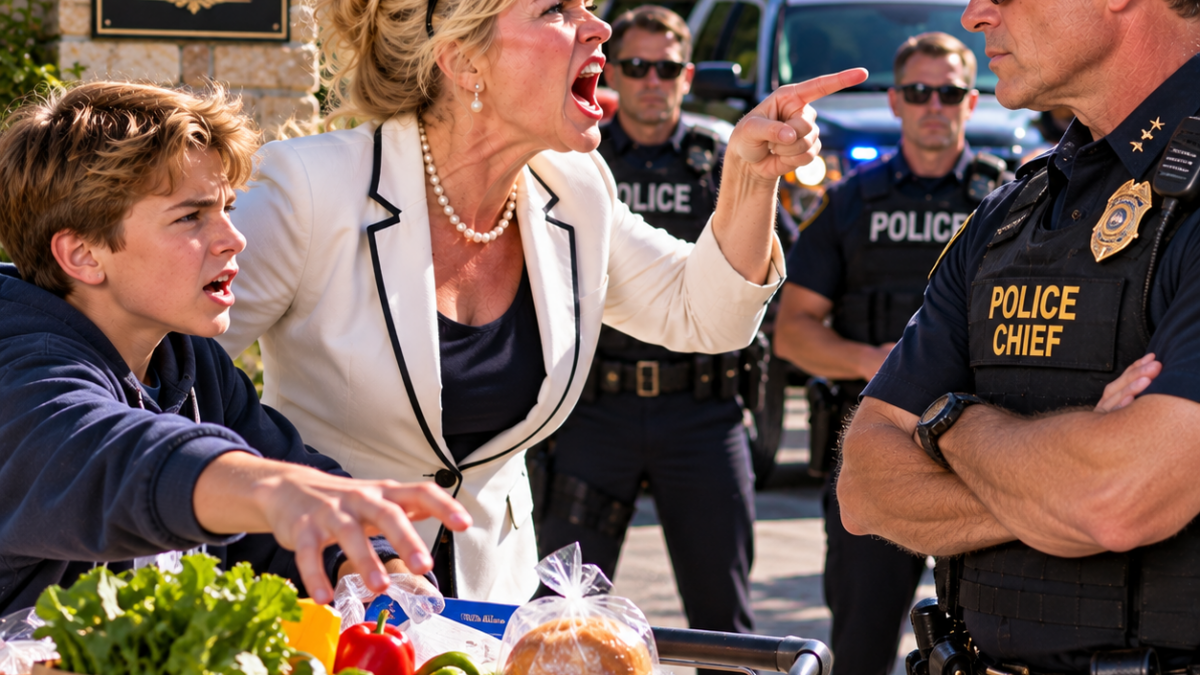
The police cruiser was still rocking from the stop when Patricia Lundgren came charging across my driveway in a coral blazer, pointing at me over six ripped grocery bags and screaming that I had attacked her nineteen-year-old son.
Her son Brandon stood behind her rubbing a shoulder I had never touched, while eggs bled across the concrete, cans rolled toward the gutter, and a young patrol officer reached for his handcuffs before asking the one question Patricia desperately did not want anyone to ask.
When I quietly turned around and let him take my wrist, it wasn’t because I was afraid of being arrested—it was because across the street one neighbor was still recording, and another patrol car had just turned onto Willow Creek Drive faster than anyone expected.
“My son is injured!” Patricia shouted. “Look at this mess. He broke everything. Arrest him.”
Officer Danny Kessler looked from Patricia to Brandon, then to me.
I was fifty-two years old, standing in my own driveway with a gallon of milk in one hand and a torn paper bag hanging from the other.
Bread lay under my truck.
Two cans of soup had rolled beneath Patricia’s SUV.
A dozen eggs were finished.
“Sir,” Kessler said, “put the groceries down and keep your hands where I can see them.”
I set the milk beside my shoe.
“Of course.”
Patricia seemed disappointed by how easily I complied.
“He’s pretending to be calm,” she told Kessler. “He attacked Brandon when Brandon tried to enforce HOA rules.”
I looked at Brandon.
He avoided my eyes.
“What rule?” Kessler asked.
Patricia lifted her tablet.
“Community pantry collection. Every household participates.”
“That doesn’t authorize your son to take somebody’s groceries,” I said.
She swung toward me.
“Don’t interrupt.”
Kessler raised a hand.
“Everybody slow down.”
Then he looked at me.
“Sir, did you put your hands on him?”
“No.”
“He shoved me,” Brandon said quickly.
I watched him carefully.
“Where?”
“My shoulder.”
“Which one?”
His hand moved from his right shoulder to his left before stopping midway.
A woman on the sidewalk noticed.
So did I.
Patricia stepped between us.
“My son does not have to prove anything to him.”
“No,” I said. “But Officer Kessler might want to see the video.”
Her face changed.
Barely.
“What video?”
I pointed across the street.
Marcus Green stood beside his mailbox with his phone still raised.
Patricia’s expression hardened.
“Marcus, turn that off.”
Marcus didn’t move.
Kessler looked over.
“Sir, are you recording?”
Marcus nodded.
“Started when Brandon stepped into his driveway.”
Patricia scoffed.
“That proves nothing. He’s always hated the board.”
Behind Marcus, more neighbors were coming outside.
Willow Creek Estates had gone strangely quiet.
People knew Patricia.
For six years she had chaired the HOA like it was a private government. She controlled fines, landscaping approvals, community events, vendor access, and a so-called pantry program residents were told was mandatory.
Most people avoided challenging her.
I had been in Willow Creek less than a month.
To Patricia, that made me easy.
She stepped closer until I could smell her perfume.
“You’re new here, Tom. You don’t understand how things work.”
“I’m beginning to.”
“You can pay the pantry contribution, accept the violation, and apologize to my son.”
“For trying to take groceries from an eighty-one-year-old widow?”
Her mouth tightened.
“That is not what happened.”
I looked toward the house next door.
Mrs. Edith Bloom stood behind her screen door, one hand gripping her walker.
She looked frightened.
That angered me far more than Patricia’s shouting.
Two days earlier Edith had told me that Brandon had been taking grocery deliveries from her porch for months, claiming they were part of Patricia’s neighborhood pantry program. Edith was paying cash to the HOA and still skipping meals because the food she bought kept disappearing.
I had spent twenty-eight years in law enforcement.
That experience had taught me one rule I trusted more than instinct:
One frightened witness is a beginning, not a conclusion.
So I had bought Edith groceries myself.
Nothing dramatic.
Milk.
Bread.
Fruit.
Chicken.
Soup.
Her medication.
I had been carrying the bags toward her gate when Brandon blocked me.
“Hand them over.”
“No.”
“Pantry contribution.”
“They’re Edith’s.”
He laughed and grabbed the largest bag.
I held on.
He shoved me with both hands.
The bag tore.
That was the scene Patricia arrived to find.
She never asked what happened.
She called 911 and invented the rest.
Now Kessler took his handcuffs from his belt.
“Sir, turn around.”
I looked at him.
“Officer, before you make a decision, I recommend you preserve Mr. Green’s recording and your body-camera footage.”
Patricia laughed.
“Guilty people always ask for cameras.”
I turned around anyway and placed my hands behind my back.
Kessler took my left wrist.
The metal cuff touched my skin.
Then tires hissed at the corner.
A second cruiser came fast down Willow Creek Drive and stopped behind the first.
The driver’s door opened.
Sergeant Maria Delgado stepped out, took one look at the scene, then looked straight at me.
And stopped dead beside her cruiser.
PART 2
For half a second, Maria simply stared.
Kessler still had one cuff against my wrist.
Patricia was still talking.
“Sergeant, thank God. Your officer was just about to arrest this man. He attacked my son, destroyed property, and—”
Maria didn’t look at her.
She looked at me.
“Chief?”
The word landed harder than a shout.
Kessler’s hand went slack.
I heard the tiny metallic click as the cuff opened again.
Nobody on the street moved.
Patricia blinked.
“Chief of what?”
Maria finally turned toward her.
“Chief of Police Thomas Ellsworth.”
Her voice stayed professional.
Then she added:
“My chief.”
Brandon’s hand fell away from his shoulder.
Marcus lowered his phone slightly, then seemed to remember what he was doing and raised it again.
Patricia looked from Maria to me.
Then to Kessler.
Then back to me.
“No.”
It came out almost as a whisper.
I rubbed my wrist.
“Good afternoon, Sergeant.”
Maria’s expression tightened.
“Sir, why were you being handcuffed?”
“Officer Kessler responded to a reported assault.”
Kessler looked like he wanted the pavement to open beneath him.
“I was still separating statements, Chief. Mrs. Lundgren said—”
“I know what she said.”
He swallowed.
“I should have—”
“Not now.”
I wasn’t going to humiliate a two-year officer in front of a crowd for doing exactly what fear makes inexperienced officers do: locking onto the loudest complainant before slowing the scene down.
I looked at him.
“Body camera running?”
“Yes, sir.”
“Good.”
Then I looked toward Marcus.
“His phone matters too.”
Maria followed my gaze.
“Mr. Green?”
Marcus walked over.
Patricia recovered faster than I expected.
“I don’t care what job he has. He still shoved my son.”
Maria looked at her.
“Then we’ll investigate that.”
Patricia pointed at me.
“You heard her. Investigate him.”
“I said the incident.”
“No special treatment.”
“Agreed.”
Patricia seemed thrown by that.
I stepped away from Kessler.
“In fact, Sergeant, because I’m involved personally, I don’t want anyone in our department making a charging decision without outside review.”
Maria nodded immediately.
“I’ll notify county.”
Patricia opened her mouth.
I raised one hand.
“And preserve everything.”
Marcus handed Maria his phone.
“I started recording before they touched each other.”
“Can you play it?”
“Yes.”
We gathered beside the hood of Maria’s cruiser.
The whole street watched.
Marcus tapped the screen.
The video began with me carrying grocery bags.
Brandon stepped from the sidewalk.
His voice was clear.
“Hand them over.”
Video-me stopped.
“No.”
“Pantry contribution.”
“They’re for Mrs. Bloom.”
“My mom says anyone shopping in the neighborhood owes the pantry.”
“Then your mother can call me.”
Brandon laughed.
“You think this is optional?”
He reached.
I stepped sideways.
Then came the part that mattered.
Brandon grabbed the bag.
I held it.
He yanked.
I said:
“Let go.”
He shoved me hard in the chest with both hands.
The paper tore.
Groceries hit the ground.
I took one step backward.
My hands stayed visible.
I never touched him.
Then Patricia stormed into frame.
“What did you do to him?”
I said:
“He tried to take Edith’s groceries.”
She didn’t ask Brandon.
Didn’t look at Marcus.
Didn’t check whether her son was hurt.
She pulled out her phone.
The video caught her speaking to 911.
“A man is attacking my teenage son.”
Marcus paused the recording.
No one said anything.
Maria looked at Brandon.
“Mr. Lundgren, did Mr. Ellsworth touch you?”
Brandon stared at the pavement.
Patricia answered for him.
“He shoved him.”
Maria said:
“I asked Brandon.”
Patricia snapped:
“He is nineteen. He has just been assaulted.”
“Brandon.”
His mouth moved.
Nothing came out.
Maria waited.
That silence did more than shouting could have.
Finally:
“No.”
Patricia spun toward him.
“What?”
“He didn’t touch me.”
Her face went white.
“Brandon.”
“He wouldn’t give me the bags.”
“So you lied?”
“No, I—”
“You told me he attacked you.”
“You said call the police.”
“I called because you told me—”
“Enough.”
Maria cut through both of them.
She looked at Marcus.
“Keep the original file. We’ll arrange a formal evidence transfer.”
Then at Kessler.
“Get dispatch to preserve the 911 audio.”
Kessler nodded.
“Yes, Sergeant.”
Patricia seemed to realize the center of gravity had shifted.
She pointed toward me.
“This is exactly why he shouldn’t be allowed to interfere. He’s your superior.”
I nodded.
“You’re right about one thing.”
She stopped.
“This cannot be handled as though I’m an ordinary uninvolved complainant.”
A flicker of hope appeared in her face.
“So county takes the lead.”
The hope disappeared.
Maria radioed the county sheriff’s office.
I stepped toward my driveway.
Patricia followed.
“We can settle this.”
That was the first time her voice dropped.
I turned.
“Settle what?”
“The misunderstanding.”
“You just told 911 I assaulted your son.”
“You’re making this sound intentional.”
“Was it?”
“He was upset.”
“You were the one on the phone.”
She tightened her grip on the tablet.
“We both got emotional.”
I almost laughed.
“I was holding milk.”
“You know what I mean.”
“No.”
I looked at the groceries.
“Explain it.”
Her eyes hardened again.
There she was.
The Patricia everyone knew.
“You came into this neighborhood and immediately started challenging systems you don’t understand.”
“The pantry?”
“Yes.”
“Your son taking food from an elderly widow?”
“That food belongs to the community program.”
“Show me the rule.”
She lifted her chin.
“The board approved it.”
“Show me.”
“Not here.”
“Meeting minutes?”
She said nothing.
“Budget line?”
Nothing.
“Pantry receipts?”
Nothing.
Her expression told me more than any answer.
Then the gate beside Edith’s house squeaked.
Everybody turned.
Edith Bloom emerged slowly, both hands on her walker.
“Mrs. Bloom,” I said. “You don’t need to come out.”
“Yes.”
Her voice shook.
“I do.”
Patricia’s face changed.
“Edith, this doesn’t involve you.”
Edith kept moving.
One small step at a time.
“It always involved me.”
The street went quiet again.
She stopped near the property line.
Maria moved closer in case she needed support.
Edith looked at Brandon.
Then Patricia.
“Those groceries were mine.”
Patricia smiled in that practiced way she used at meetings.
“Edith, you’re confused about the pantry system.”
“No.”
“I’ve explained—”
“You explained that if I didn’t pay forty dollars every Friday, I would be fined.”
Murmurs moved through the neighbors.
Patricia said:
“That’s the community food contribution.”
Edith’s hands tightened around the walker.
“I paid.”
“Exactly.”
“And then Brandon took my groceries.”
“That isn’t what happened.”
“Every Friday.”
Brandon looked up.
“Mom.”
Patricia snapped:
“Stay quiet.”
Edith continued.
“Eight months.”
I watched faces along the street change.
Some people knew.
Others were learning.
“My grocery deliveries come Friday mornings.”
She swallowed.
“Your son started meeting the delivery car before it reached my porch.”
Patricia laughed.
“Edith, with respect, your memory—”
That was a mistake.
Edith straightened as much as her back allowed.
“My memory is good enough to know when I’m hungry.”
Nobody moved.
She looked toward me.
“Some weeks I stopped buying meat because I still had to pay the fee.”
I felt anger rise from somewhere below thought.
Not police-chief anger.
Neighbor anger.
Human anger.
The kind you have to watch carefully because it feels righteous enough to make recklessness seem reasonable.
I kept my voice low.
“Did you ever report it?”
Edith nodded.
“To Patricia.”
“And?”
“She said the pantry collected excess food for families in need.”
Patricia interrupted.
“It does.”
Edith looked at her.
“Then why did I see my coffee in your garage?”
Patricia went still.
A man across the street raised his hand.
Marcus.
“I’ve paid that fee too.”
Then a young mother named Allison Reed stepped off her porch.
“So have we.”
Another voice.
“Every month.”
A veteran named Carl Morgan came from two houses down.
“Fifty dollars for me. She said seniors were being fed.”
Patricia looked around.
“Everyone calm down.”
Fourteen households spoke before the scene ended.
Fourteen.
Some paid cash.
Some checks.
Some electronic transfers.
Different amounts.
Same explanation.
Community pantry.
Neighbors helping neighbors.
But no one knew where the food went.
No one had ever seen a pantry inventory.
No one had seen a distribution list.
No one knew who supposedly benefited.
And several had noticed Brandon loading delivery bags into Patricia’s SUV.
The thing about fear is that it isolates people.
Each victim assumes his or her experience is private.
Maybe embarrassing.
Maybe too small.
Maybe not worth starting a fight.
Then one person speaks.
Another recognizes the pattern.
Suddenly the story belongs to everyone.
A county deputy arrived twenty minutes later.
Then a county investigator.
I gave a statement the same way I expected anyone else to.
No shortcuts.
No chief’s office.
No special room.
I told them Brandon grabbed the groceries.
I told them he shoved me.
I told them I never touched him.
I explained Patricia’s 911 accusation.
Then I stepped back.
Brandon was detained on suspicion of battery and attempted theft pending review.
I did not order it.
I couldn’t.
Not ethically.
Not with me as the complainant.
I made that clear to everyone.
Patricia shouted anyway.
“You’re destroying my family because I didn’t know who you were!”
I looked at her.
“That sentence is your problem.”
“What?”
“You think this would have been okay if I wasn’t chief.”
Her mouth opened.
I continued.
“If I were a plumber, would Brandon have been allowed to take the groceries?”
“No, but—”
“If I were unemployed?”
“That’s not—”
“If Edith had no police chief next door?”
Silence.
I didn’t need an answer.
Maria spoke quietly behind me.
“Chief, county wants to talk to the other residents.”
“Good.”
I looked at her.
“And call the prosecutor.”
“Already did.”
I paused.
“Also secure the HOA records before anything disappears.”
Maria nodded.
That was the professional instinct speaking.
The moment multiple residents described cash payments and missing food, this became more than a driveway assault.
By sunset, preservation requests were moving.
By midnight, someone from the state auditor’s office had been contacted because association money and a city official’s family connection could complicate local review.
Patricia’s husband, Andrew Lundgren, held a seat on the city council.
He wasn’t at the driveway.
He hadn’t touched the groceries.
I refused to assume his involvement.
Twenty-eight years with a badge had taught me another rule.
Relationship is not evidence.
Evidence is evidence.
I went home that evening and sat in my kitchen with Nora.
She had arrived halfway through the police response after visiting her sister.
She stared at me across the table.
“First month.”
“I know.”
“We wanted peace.”
“I know.”
“You nearly got arrested in our driveway.”
“Technically I wasn’t arrested.”
“Tom.”
“Sorry.”
She rubbed her forehead.
“You really let Kessler put the cuff on you?”
“Yes.”
“Why?”
“Body camera.”
“Of course.”
She sighed.
“You know normal retired-adjacent husbands just argue with the HOA about grass?”
“I’m not retired.”
“That’s the problem.”
She got up.
Opened the refrigerator.
Then stopped.
“What?”
I asked.
She stared at the shelves.
“We have too much food.”
I understood immediately.
Edith’s refrigerator.
Nearly empty.
We had plenty.
Nora shut the door.
“How long was that woman skipping meals?”
“Months.”
“Because Patricia was stealing from her?”
“We don’t know the full scope yet.”
She turned.
“You’re doing your chief voice.”
“What?”
“That thing where you refuse to say what you already believe until somebody hands you an affidavit.”
“Occupational hazard.”
“Fine.”
She sat again.
“But tomorrow I’m feeding Edith.”
I nodded.
“No argument.”
At eight the next morning, the doorbell rang.
I opened it.
Lowell Pomeroy stood on the porch.
HOA treasurer.
Sixty-something.
Retired bookkeeper.
He looked like he had not slept.
“Chief Ellsworth?”
“Tom.”
“I need to talk to you.”
“About?”
His eyes moved toward the street.
“Patricia.”
I let him inside.
Nora was making coffee.
Lowell refused a cup.
He sat at our kitchen table and placed a thin black notebook between us.
“What is that?”
“My second ledger.”
I didn’t touch it.
“Why do you have a second ledger?”
He swallowed.
“Because the official records are false.”
Nora stopped moving behind me.
I sat.
“Start from the beginning.”
Lowell looked at his hands.
“The pantry fund started two years ago.”
“How?”
“Patricia proposed voluntary neighbor assistance.”
“Voluntary?”
“That was the vote.”
That word mattered.
“Then why was Edith told it was mandatory?”
“I don’t know when Patricia changed it.”
“Keep going.”
“She wanted cash because she said some residents didn’t use online payments.”
“How much?”
“Varied.”
“Where was it supposed to go?”
“Local food bank and direct assistance.”
“Did it?”
Lowell shook his head.
“How much?”
His voice was barely audible.
“Eighty-six thousand dollars.”
Nora inhaled behind me.
I looked at him.
“You’re telling me Pine Creek residents contributed eighty-six thousand dollars supposedly for food assistance.”
“Yes.”
“And none of it reached the food bank?”
“Not from the account I tracked.”
I touched the notebook but did not open it.
“How do you know?”
“I kept copies.”
“Why?”
His eyes filled.
“Because I knew something was wrong.”
I waited.
“I asked Patricia for receipts.”
“And?”
“She said she handled confidential assistance personally.”
“You accepted that?”
“At first.”
“Then?”
“I saw payments.”
“What kind?”
“Cabin renovation.”
Nora sat beside me.
“What?”
Lowell continued.
“A leased SUV.”
My jaw tightened.
“Brandon’s college tuition.”
Nora whispered:
“Jesus.”
“Electronics.”
“How much?”
“Some gaming equipment. Computer. Console.”
I opened the notebook.
Dates.
Payments.
Deposits.
Withdrawals.
References.
Some entries were annotated with question marks.
Some with names.
Some with transfer numbers.
Lowell had built a parallel history of the program.
“You told anyone?”
He looked ashamed.
“No.”
“Why?”
“Patricia said Andrew could have me audited.”
“Her husband?”
“Yes.”
“He’s on city council, not the IRS.”
“I know that now.”
“You knew it then.”
He looked at me.
Fear and embarrassment are close relatives.
“I wanted to believe I was misunderstanding.”
I softened.
“What changed?”
“Yesterday.”
“The driveway?”
He nodded.
“Watching her call the police and lie that fast.”
He tapped the notebook.
“I realized every time I doubted myself, that was how she kept going.”
I understood.
“Lowell, you need to give this to county investigators.”
“I brought it to you.”
“I can’t take custody.”
His face fell.
“I’m part of the case.”
“Oh.”
“But I’ll call them.”
I did.
The notebook changed the scope again.
County prosecutors coordinated with state financial investigators.
The food bank confirmed it had received nowhere near the amount Pine Creek residents believed they had donated.
Some checks had never reached any charity account.
Electronic transfers moved through an HOA-controlled fund, then into vendors and personal-benefit payments.
Cash was harder.
But Lowell’s notes and resident receipts created a pattern.
Nora spent that afternoon with Edith.
I came home around six and found both women at our table.
Edith had eaten half a bowl of chicken soup.
Three grocery bags sat near her walker.
She looked embarrassed.
“You shouldn’t have bought all this.”
Nora said:
“You’re not arguing.”
“I can pay.”
“No.”
“I don’t take charity.”
Nora sat across from her.
“Neither do I.”
Edith frowned.
“What?”
“This is neighbor food.”
That made her smile.
I poured coffee.
Edith looked at me.
“Did they believe me?”
“Yes.”
“All of it?”
“They’re investigating.”
“I kept some receipts.”
My head came up.
“What receipts?”
“Delivery slips.”
“Where?”
She looked toward her house.
“Kitchen drawer.”
We retrieved them.
Months of grocery orders.
Delivery dates.
Some matched photographs Marcus had captured incidentally on his porch camera.
One showed Brandon carrying two bags away from Edith’s porch.
Another showed him putting them in Patricia’s SUV.
Not every week.
Enough.
The case was becoming less dependent on memory.
That mattered.
Patricia hired an attorney.
Then started a counterattack.
An HOA email went out claiming a “politically powerful resident” was abusing municipal resources to dismantle community governance.
No name.
Everyone knew.
The email accused me of intimidating board members and targeting Patricia’s family after a personal dispute.
I read it twice.
Nora watched me.
“Mad?”
“Yes.”
“What are you going to do?”
“Nothing.”
She blinked.
“Nothing?”
“Publicly.”
“That sounds ominous.”
“Evidence answers better.”
I sent the email to county investigators.
Then I issued an internal memo recusing myself from all departmental decisions connected to the case.
Maria Delgado would coordinate any city department contact through the county prosecutor.
No officer under my direct command would determine charges against Patricia or Brandon.
I asked the mayor for written acknowledgment.
He gave it.
That did not stop gossip.
Some people said I had orchestrated everything.
Others said Kessler had almost arrested his own chief and would be fired.
He wasn’t.
I called him into my office two days later.
He looked miserable.
“Sit.”
“Yes, Chief.”
He sat.
“I’m not firing you.”
His shoulders dropped.
“I should’ve slowed down.”
“Yes.”
“I let Mrs. Lundgren control the scene.”
“Yes.”
“I saw groceries, angry people, one complainant talking faster than everyone else.”
“Yes.”
“I almost cuffed you.”
“You did cuff me.”
“One side.”
“Still counts.”
He looked at the floor.
“I’m sorry.”
I leaned back.
“You know why I let you?”
“Body camera.”
“Partly.”
He looked up.
“I wanted to know what would happen if I had no rank.”
He swallowed.
“And?”
“You rushed.”
His face tightened.
“But you were not malicious.”
I continued.
“You were inexperienced, overloaded, and allowed confidence to substitute for verification.”
“I understand.”
“Do you?”
“Yes.”
“Good.”
I slid a training notice toward him.
“Then teach it.”
He stared.
“What?”
“Next month. Roll-call scenario training. Complainant dominance and premature detention.”
“Me?”
“You.”
“That feels like punishment.”
“It is.”
I smiled slightly.
“And education.”
He laughed despite himself.
Years later, Kessler would tell younger officers the story.
He never hid that the man he almost cuffed was his chief.
More importantly, he never hid why.
The investigation tightened around Patricia.
Bank records showed pantry contributions moving into accounts controlled through HOA mechanisms.
Invoices linked to a lake cabin she and Andrew used.
SUV lease payments.
Brandon’s tuition.
Electronics.
Some expenses had been disguised as “community outreach logistics” or “food storage infrastructure.”
One $4,800 payment supposedly for refrigeration equipment went to a gaming computer retailer.
Even I stared at that one.
Naomi, our HOA-side legal advisor? No—this time county prosecutors brought in independent counsel and state auditors. I kept distance.
Andrew Lundgren became the largest unanswered question.
Did he know?
Investigators interviewed him.
I wasn’t there.
Later, through public filings and prosecutor summaries, we learned there was not enough evidence to charge him with the pantry theft.
Some personal expenses benefited the household, but Patricia controlled the relevant accounts and communications.
Andrew resigned from city council before the ethics review concluded.
People assumed guilt.
I didn’t.
Resignation isn’t proof.
But politically, the situation was untenable.
His wife had invoked his office repeatedly.
Texts from Patricia to residents included lines like:
**Andrew knows everyone downtown.**
**Don’t make this a city issue.**
**Council will back us.**
Even if he hadn’t authorized those statements, his position had become part of her intimidation.
He stepped away.
Brandon’s case was painful in a different way.
Nineteen is old enough to know better.
Young enough that stupidity can still masquerade as invincibility.
The video showed him trying to take groceries and shoving me.
Other residents described him collecting cash and removing deliveries.
He initially denied knowing where the food went.
Then phone messages showed his mother directing him.
**Bloom delivery Friday 9:30. Pick up before she gets it.**
Another:
**Put dry goods in garage. Keep anything useful.**
Brandon read those messages during an interview.
According to the investigator, he started crying.
He had spent months treating the scheme like family routine.
That didn’t excuse him.
But it made him more understandable.
Patricia had normalized theft until he called it “the pantry.”
The search warrant for the HOA clubhouse came after financial records showed missing documentation and investigators received information that someone might be destroying files.
Marcus texted me around nine one evening.
**Lights on at clubhouse. Patricia’s car there.**
I forwarded it immediately to Maria and the county investigator.
I did not drive over alone.
That distinction mattered.
A judge had already signed a warrant covering HOA financial records and electronic devices based on the developing evidence.
Maria and I arrived with the county team because I was still chief and the clubhouse sat inside our jurisdiction, but I remained an observer unless safety required otherwise.
Through the window, Patricia stood beside a paper shredder.
Coral blazer gone.
White blouse.
Sleeves rolled.
Hair coming loose.
She fed documents into the machine as quickly as her hands could move.
A county investigator looked at me.
“You seeing what I’m seeing?”
“Yes.”
Maria said:
“We go now.”
The door was locked.
The investigator knocked hard.
“County prosecutor’s investigative unit. Search warrant.”
Inside, the shredder stopped.
No answer.
Again.
“Patricia Lundgren, open the door.”
Movement.
Then nothing.
Maria used the authorized key obtained from the property manager.
We entered.
Shredded paper covered the floor.
Thin strips curled around Patricia’s shoes.
She held a folder against her chest.
Her face was pale.
“You can’t be here.”
The investigator held up the warrant.
“We can.”
She saw me behind Maria.
Her expression changed.
“You.”
I said nothing.
“This is your revenge.”
“No.”
“You’ve wanted this since the driveway.”
“No.”
“Since I challenged you.”
I stepped forward just enough for her to hear me clearly.
“Patricia, the first time I met you, you handed me a rulebook and asked for cash.”
Her jaw tightened.
“You decided what happened after that.”
She pointed at the warrant.
“You used your office.”
The county investigator interrupted.
“Chief Ellsworth is not the affiant on this warrant.”
She ignored him.
“You humiliated me.”
I looked at the shredded documents.
“You’re doing that yourself.”
For once, she had no answer.
Investigators recovered bags of shredded paper for reconstruction.
Computers.
Bank files.
Receipts.
Donation lists.
A second cash ledger hidden inside a locked cabinet.
And, almost absurdly, a printed list of households categorized by compliance.
Names.
Payment history.
Notes.
Beside Edith Bloom:
**Pays after reminder. Limited resistance.**
Beside Carl Morgan:
**Complains but complies.**
Beside Marcus Green:
**Watch. Questions too much.**
Beside my address:
**New. Uncooperative.**
I stared at that word.
Uncooperative.
All I had done was ask to read the bylaws before paying cash.
Patricia had built her system around a simple test.
Who would comply without proof?
Anyone who asked questions became a problem.
That explained everything.
The fines.
Threats.
Isolation.
Her rage when I refused the pantry fee.
Her instant certainty that calling police would solve the driveway scene.
For years, it had worked.
She spoke first.
Louder.
More confidently.
People backed away.
Until evidence stopped backing away.
Patricia was arrested at the clubhouse.
The county investigator handled it.
Not me.
Charges included theft by deception, extortion-related conduct, false reporting, financial crimes, and evidence destruction allegations, later refined by prosecutors.
As they walked her outside, neighbors had gathered near the sidewalk.
Nobody cheered.
Good.
Patricia looked smaller than she had at every HOA meeting I had seen.
Not physically.
Authority had drained out of the room before she did.
She kept talking.
“My attorney will fix this.”
No one answered.
“My husband will—”
She stopped herself.
Too late.
A deputy opened the rear door.
Patricia turned toward me one last time.
“You think you’re better than me because you have a badge.”
I shook my head.
“No.”
“Then what?”
“Because when I use mine, somebody gets to review what I did.”
The door closed.
The case took three months to reach its resolution.
Patricia eventually pleaded guilty under an agreement requiring full restitution of the stolen pantry money, probationary supervision, and a lifetime prohibition from serving on an HOA board or controlling association funds.
Some people thought she deserved prison.
Others thought the plea was appropriate because restitution could happen faster and the case avoided years of litigation.
That decision belonged to prosecutors and the court.
Not me.
Brandon received community service and restitution-related obligations.
His placement?
The same food bank the neighborhood had been told it was supporting.
I heard about his first day from the food bank director.
Brandon arrived angry.
Embarrassed.
He was assigned to unload canned goods.
By lunch, he barely spoke.
A month later, the director called again.
“He’s still showing up.”
“Required hours?”
“Finished those last week.”
That surprised me.
“Why?”
“You’d have to ask him.”
I didn’t.
Some changes deserve privacy.
Months later, I happened to see him stacking boxes during a city charity event.
He saw me.
Froze.
Then walked over.
“Chief.”
“Brandon.”
He stared at the ground.
“I owe you an apology.”
“Yes.”
That surprised him.
I wasn’t going to rescue him from discomfort.
He swallowed.
“I lied.”
“Yes.”
“I took Mrs. Bloom’s food.”
“Yes.”
“I thought it wasn’t stealing because Mom said it was community redistribution.”
“Did Mrs. Bloom agree?”
“No.”
“Then you knew.”
He nodded.
“Eventually.”
We stood there.
He said:
“I was awful.”
“You did awful things.”
He looked at me.
“Difference?”
“Yes.”
I let that sit.
“One means you can change.”
His eyes reddened.
“Mrs. Bloom won’t talk to me.”
“She doesn’t owe you that.”
“I know.”
“Then do the work anyway.”
He nodded.
That was our entire conversation.
I never became his mentor.
He didn’t need another authority figure making his life about me.
He needed consequences and a chance to become someone else.
The HOA changed faster.
Lowell resigned as treasurer but helped the interim board reconstruct records.
Every pantry payment was audited.
Every household that had been coerced received reimbursement or credit.
The new board abolished cash collection entirely.
No board officer could personally collect funds.
No “mandatory charitable contribution” could exist without an actual membership vote, legal review, documented recipient, and public accounting.
Even better, the neighborhood created a real pantry.
Not because I suggested it.
Edith did.
She stood at the first post-Patricia HOA meeting with her walker and said:
“If we’re going to keep using the word pantry, maybe we should actually feed somebody.”
That got the biggest applause of the night.
The program became voluntary.
Transparent.
Receipts posted monthly.
Food delivered through the county food bank.
No cash to presidents.
No teenagers intercepting groceries.
Edith served on the advisory committee.
Nora teased her.
“Power went to your head.”
Edith smiled.
“I’ve become dangerous.”
She was.
In the best way.
The first Friday after Patricia’s plea, I bought six bags of groceries.
Same basic list as the day everything exploded.
Milk.
Bread.
Soup.
Fruit.
Chicken.
Medication.
Nora came with me.
We walked toward Edith’s gate.
No one stopped us.
That fact hit me harder than expected.
The driveway was clean.
No broken eggs.
No patrol lights.
No screaming.
Just a quiet afternoon.
I knocked.
Edith opened the door.
“You two again?”
“You need groceries.”
“I can buy my own now.”
“I know.”
“Then why?”
I looked at Nora.
She answered.
“Because we like feeding you.”
Edith rolled her eyes.
“Come in.”
We did.
Her refrigerator was fuller.
Not overflowing.
Enough.
That mattered.
I placed the milk inside.
She watched me.
“You know what I hated most?”
“What?”
“I started thinking maybe I deserved it.”
I stopped.
“What?”
“The fee. Brandon taking things. Patricia telling me I was confused.”
Her fingers tightened around the refrigerator door.
“She made me feel stupid.”
I felt the old anger rise.
Edith saw it.
“Don’t.”
“Don’t what?”
“Make that face.”
“What face?”
“The chief face.”
I smiled despite myself.
“I thought maybe because I was old, I didn’t understand the rules anymore.”
“You understood.”
“I know now.”
Nora took her hand.
“That’s over.”
Edith nodded.
But emotional habits don’t disappear because a judge signs something.
For months, she still checked her porch camera whenever groceries arrived.
Still looked toward Patricia’s old house when someone knocked unexpectedly.
Fear lingers in routines.
So does recovery.
One Friday, almost a year later, I saw grocery bags sitting on Edith’s porch.
I started walking over.
Then stopped.
The bags stayed there.
Ten minutes.
Twenty.
Edith opened the door.
Picked them up herself.
No one came.
She looked across the lawn at me.
Raised one hand.
I waved.
That simple moment felt better than any courtroom result.
Willow Creek eventually elected a new HOA board.
The president was a school librarian named Janet Morse who seemed uncomfortable being called president at all.
At her first meeting she said:
“If I ever tell you not to read the bylaws, remove me immediately.”
People laughed.
I liked her.
She also eliminated half the rule packet.
Forty pages became twenty-three.
Mailbox colors survived.
Trash placement survived.
The fake mandatory pantry fee did not.
Nora asked whether I was disappointed.
“About what?”
“You spent a month reading all forty pages.”
“I’ll recover.”
“You highlighted them.”
“I’m thorough.”
“You made notes.”
“Professional habit.”
She kissed my forehead.
“You’re impossible.”
Peace returned slowly.
That was why we had moved there.
I still received police calls at midnight sometimes.
Chiefs don’t escape radios just because they buy a quiet house.
But I learned to sit on my porch.
Wave at neighbors.
Mow my own grass.
Be Tom.
People knew who I was now, of course.
That part was gone.
The reveal traveled through Willow Creek within an hour.
For weeks people apologized for not knowing.
I kept telling them:
“You weren’t supposed to.”
One neighbor asked:
“Why hide it?”
“I didn’t.”
“You never told anyone.”
“Not the same.”
I had spent twenty-eight years watching what badges do to conversations.
Sometimes they create trust.
Sometimes fear.
Sometimes performance.
I wanted a home where somebody would tell me my hedge looked terrible without worrying whether I could ticket them.
I got that eventually.
Marcus became one of my closest neighbors.
His video had been crucial.
Not because I was chief.
Because a citizen kept recording when someone powerful told him to stop.
I told him that.
He shrugged.
“Patricia always hated cameras unless she controlled them.”
Good line.
Maria Delgado was promoted two years later.
Not because of the driveway incident.
She earned it.
But when she became captain, I gave her the same advice my first chief gave me.
“Watch the quiet person.”
She frowned.
“What?”
“In a chaotic scene, everybody looks at whoever is shouting.”
I thought of Patricia.
“The quiet person often has the facts.”
Maria smiled.
“Like you standing with milk?”
“Exactly.”
Danny Kessler became a very good officer.
The near-mistake changed him.
He slowed scenes down.
Asked more open questions.
Separated witnesses.
Checked video before committing when possible.
Years later, during a promotion interview, someone asked him to describe a professional failure.
He told the panel about almost arresting his own chief.
I was not on that panel.
Thank God.
He got promoted anyway.
The story followed him forever.
He deserved that too.
Andrew Lundgren’s resignation from city council created its own controversy.
Some residents wanted criminal charges simply because he was Patricia’s husband.
Investigators found no sufficient basis for that.
That mattered to me.
Justice means resisting both directions.
You don’t protect someone because they’re connected.
You don’t punish them because they’re connected either.
Andrew moved out after the house was sold.
I saw him once before he left.
He was loading boxes.
I almost walked past.
He called:
“Tom.”
I stopped.
He looked tired.
“I didn’t know.”
I studied him.
“About the pantry?”
“Not the money.”
I didn’t respond.
“Patricia told me dues were supporting community assistance. I never checked.”
“That’s different from not knowing.”
He closed his truck bed.
“I know.”
That answer surprised me.
“She used my council seat to scare people.”
“Yes.”
“I should’ve stopped that.”
“Yes.”
He nodded.
No excuses.
No demand for forgiveness.
Then:
“I’m sorry about Edith.”
“So am I.”
He left the next week.
I never saw him again.
Patricia’s old house sold to a family with three children.
The new owner introduced himself nervously.
“I hope nobody expects us to inherit whatever happened here.”
I laughed.
“Houses don’t commit crimes.”
He smiled.
Good enough.
By the second year, the story had become neighborhood folklore.
New residents heard exaggerated versions.
In one, I personally arrested Patricia.
False.
In another, I had twenty officers surround the clubhouse.
Also false.
Someone claimed Brandon punched me.
No.
A kid told another kid I was an undercover federal agent.
Definitely not.
Edith enjoyed correcting them.
“He was carrying chicken,” she would say.
As though that settled everything.
In some ways, it did.
Because the whole thing started with groceries.
Not police authority.
Not politics.
Not HOA power.
Food.
An eighty-one-year-old widow paying a fake community fee while her own groceries disappeared.
That was the part I never wanted people to forget.
Fraud becomes abstract when you reduce it to numbers.
Eighty-six thousand dollars sounds like a ledger problem.
But theft has a human shape.
For me, it was Edith opening an almost empty refrigerator.
Two cans of soup.
Half a carton of eggs.
A bottle of mustard.
Nothing else.
I had investigated robberies, homicides, fraud rings, domestic violence, crimes far more dramatic than an HOA pantry scheme.
Yet that refrigerator stayed with me.
Because Patricia had taken something ordinary and necessary, then wrapped the theft in the language of generosity.
Community.
Pantry.
Helping neighbors.
Words can hide cruelty when nobody asks what they mean in practice.
After the case, our real pantry served more families than Patricia ever pretended to help.
Residents donated voluntarily.
Local businesses joined.
The food bank coordinated distribution.
Edith refused to let anyone name it after her.
Janet suggested “Willow Creek Community Pantry.”
Edith approved.
“No names.”
“Why?”
“Because then some fool starts thinking it belongs to them.”
Everybody laughed.
She had learned.
So had we.
When Edith turned eighty-three, the neighborhood threw her a birthday party.
She hated the attention.
Nora baked the cake.
Marcus set up chairs.
Danny Kessler stopped by in uniform.
Edith pointed at him.
“You’re the one who tried to arrest Tom.”
Danny sighed.
“Yes, ma’am.”
“You improved?”
“Yes, ma’am.”
“Good.”
She gave him cake.
That was Edith’s version of absolution.
I retired as chief not long after.
Twenty-eight years became thirty-one before I finally turned in the badge.
At the retirement ceremony, Maria gave a speech I had specifically asked her not to give.
She told the driveway story.
Of course.
The room laughed when she described Danny freezing after she said “Chief.”
Then she became serious.
She said:
“The thing I remember isn’t that Chief Ellsworth knew the law better than the people around him. He did. The thing I remember is that once everyone knew who he was, he worked harder to keep himself out of the charging decision, not harder to control it.”
That embarrassed me more than praise should.
Later, Danny handed me a small box.
Inside was an old handcuff key mounted on wood.
A brass plate read:
**CHECK THE CAMERA FIRST.**
I laughed until my eyes watered.
Nora put it on my office shelf.
I told her it was tacky.
She said:
“Perfect.”
Retirement made Willow Creek quieter.
No radio at midnight.
More porch mornings.
More conversations with Edith.
More time to notice things.
Children grew.
Neighbors moved.
The marigolds next door came back every spring.
Patricia became a distant name attached to old court records.
I didn’t follow her life.
That was deliberate.
Revenge requires continued attention.
I no longer wanted to give her any.
One autumn morning, Edith asked me to help carry a box.
Inside were pantry receipts.
Years of them.
Real ones.
Donations received.
Food purchased.
Families served.
She had kept copies.
“Why?”
She smiled.
“Documentation.”
I laughed.
“You’ve been hanging around cops too long.”
“No.”
She tapped the box.
“I’ve been hanging around people who used to tell me I was confused.”
Fair.
We stored it in the HOA office.
Transparent records.
Anyone could review them.
No secret ledger.
No private cash.
The contrast mattered.
Patricia had built power through uncertainty.
Who paid?
Where did it go?
What did the rule say?
Who approved it?
Nobody knew.
The new system was almost aggressively boring.
That is what trust often looks like.
Boring.
Receipts.
Minutes.
Votes.
Published balances.
No coral blazer required.
Edith lived long enough to see the pantry become one of the best things Willow Creek did.
When she died at eighty-six, the neighborhood filled the church.
Brandon came.
I noticed him near the back.
Older.
Quieter.
He stayed after most people left.
He approached me.
“Did she ever forgive me?”
I didn’t lie.
“I don’t know.”
He looked down.
“I wrote her.”
“I know.”
“She never answered.”
“She didn’t owe you an answer.”
“I know.”
He nodded.
Then looked toward the flowers.
“I kept volunteering.”
“I heard.”
“Not because of court.”
“I know.”
He breathed in slowly.
“I wish I could undo it.”
“Most adults eventually collect something they wish they could undo.”
He looked at me.
“What do you do with it?”
“Make sure it doesn’t become your next decision.”
He nodded.
Then left.
That conversation stayed with me.
Because consequences should not erase the possibility of change.
But change should never erase consequences either.
Both can be true.
Patricia paid restitution.
Lost her board power.
Faced court.
Brandon served his sentence.
Andrew lost political office.
Lowell had to live with the years he stayed silent.
Danny had to carry the memory of almost arresting the wrong man too quickly.
I had to admit I nearly used my rank as emotional armor after the fact.
Nobody walked away perfectly clean.
That’s what made it real.
Years after Edith was gone, Nora and I considered moving.
Smaller house.
Less yard.
Closer to our daughter.
We packed a few boxes before deciding.
One afternoon, I found the old HOA welcome packet.
Forty pages.
Patricia’s signature on the front.
I flipped through it.
Mailbox rules.
Garage doors.
Trash cans.
Then the line:
**Community pantry contribution — payable directly to board president.**
I stared at it.
So obvious now.
At the time, merely strange.
That’s how bad systems often appear in the beginning.
Not evil.
Odd.
Inconvenient.
Something you mean to ask about later.
I almost threw the packet away.
Then I stopped.
Nora saw me.
“Keeping evidence?”
“No.”
“What then?”
“History.”
She smiled.
“You’re sentimental.”
“Don’t tell anyone.”
We stayed in Willow Creek another year.
Then another.
Eventually, I realized we weren’t staying because we had failed to leave.
We liked it.
The neighborhood Patricia ruled through fear became the peaceful place we had wanted from the beginning.
Kids left bicycles in driveways.
Janet’s board rarely fined anybody.
Residents argued about trees and pool hours like normal people.
The pantry shelves stayed stocked.
And every Friday, grocery deliveries arrived at houses throughout the community without anyone standing at the curb to intercept them.
One Friday morning, I sat on my porch drinking coffee when a delivery van stopped next door.
The new owner of Edith’s house was a widower named George.
The driver carried six bags to his door.
Milk.
Bread.
Fruit.
Soup.
The ordinary weight of a week.
No one challenged him.
No one demanded a fee.
No one called the police.
I watched him pick up the bags and disappear inside.
Then I looked across my driveway.
For just a second, I could still see the old scene.
Broken eggs.
Rolling cans.
Patricia pointing.
Danny reaching for cuffs.
Marcus holding his phone.
Edith behind the screen door.
Memory does that.
Places hold two versions at once.
What happened.
And what is happening now.
I finished my coffee.
Nora opened the door.
“You coming in?”
“In a minute.”
She followed my gaze toward George’s house.
“You thinking about Edith?”
“Yeah.”
She sat beside me.
Neither of us said much after that.
We didn’t need to.
A delivery truck turned the corner and disappeared down Willow Creek Drive.
Somewhere farther away, children were laughing.
The marigolds next door moved gently in the wind.
And for the first time in years, watching six grocery bags reach the right front door felt like exactly enough.
That should have been the end of it, but the weeks after Patricia’s plea taught me that a neighborhood doesn’t recover just because a judge closes a file.
For years, Patricia had trained Willow Creek to operate around her moods. People checked their lawns twice before leaving for work. They pulled trash cans in early. They avoided questioning unusual fees. They lowered their voices when her SUV came down the street. Even after she was gone, those habits remained.
The first HOA meeting without her was almost painfully awkward.
Janet Morse, the school librarian who had agreed to serve as temporary president, stood behind the folding table Patricia had once treated like a throne. Lowell Pomeroy sat two chairs away with three binders of reconstructed financial records in front of him.
Almost every seat was occupied.
I sat near the back beside Nora and Edith.
Edith leaned toward me.
“Everybody looks like they’re waiting for Patricia to come through the door.”
“They probably are.”
“She’s not coming.”
“I know.”
Edith adjusted her glasses.
“Someone should tell their faces.”
Janet tapped the microphone.
It squealed.
Half the room jumped.
“Sorry,” she said.
A few people laughed nervously.
That tiny laugh helped.
Janet looked down at her notes.
“I’m going to begin with something I wish we had heard more often during the last six years.”
She lifted her eyes.
“I don’t know all the answers.”
The room went silent.
Then Marcus Green, sitting across the aisle, said, “That might be the smartest thing anybody’s said from that chair.”
More laughter.
Janet smiled.
“Thank you, Marcus. I think.”
Then she became serious.
“We have approximately eighty-six thousand dollars in misdirected pantry contributions to account for, additional HOA funds that require review, residents who were pressured into payments they may not have legally owed, and a community that no longer trusts its own board.”
No one disagreed.
She continued.
“The first thing we are going to do is stop pretending trust can be ordered.”
That sentence stayed with me.
Patricia had believed the opposite.
She thought trust meant obedience.
The new board began with records.
Every bank statement was posted for member review.
Every outstanding contract was listed.
Every fee was matched to the section of the bylaws that supposedly authorized it.
Anything that could not be justified was suspended.
That process produced some uncomfortable discoveries.
The pantry scheme was only the worst one.
Patricia had also charged residents “administrative review fees” that appeared nowhere in the bylaws. She had collected cash for parking permits that should have been free. She had pressured three elderly homeowners into paying landscaping penalties without giving them the appeal rights required under the governing documents.
None of those amounts approached eighty-six thousand dollars.
But they mattered.
A hundred dollars matters when someone has fifty dollars left until payday.
A fifty-dollar fee matters to an eighty-one-year-old widow deciding between groceries and medication.
Numbers become easy to dismiss when you’re looking at a spreadsheet.
They look different when somebody tells you what they gave up to pay them.
During the second meeting, a single mother named Allison Reed stood.
Patricia had fined her $300 for leaving a portable basketball hoop near the curb for forty-eight hours too long.
“I paid it because she told me they could put a lien on my house,” Allison said.
Janet asked, “Did you receive an appeal notice?”
“No.”
“Written hearing date?”
“No.”
“Board vote?”
“No.”
Lowell searched the records.
Nothing.
Janet looked at Allison.
“We’re refunding it.”
Allison sat down and covered her mouth.
Three hundred dollars.
Not a fortune.
But I later learned it covered almost an entire month of groceries for her and her two children.
The next resident was Carl Morgan, the veteran from two doors down.
He had paid a so-called “community security assessment” twice.
No such assessment had ever been authorized.
Then a retired teacher.
Then a young couple.
Then another widow.
By the time the meeting ended, Lowell’s legal pad was full.
Outside, I stood near the clubhouse steps while people talked in small groups.
Marcus came over.
“You ever seen anything like that?”
“Too many times.”
“In police work?”
“In life.”
He looked back through the clubhouse windows.
“How does somebody get away with it that long?”
“Usually because each individual incident seems too small to start a war over.”
Marcus nodded.
“That’s what I did.”
“What?”
“Paid.”
He shoved his hands into his jacket pockets.
“Every time she sent something, I paid. Twenty-five dollars. Fifty. Seventy-five.”
“Why?”
“Because I worked twelve-hour shifts and didn’t want to spend my only day off fighting an HOA.”
“That’s reasonable.”
“Was it?”
“Yes.”
I looked at him.
“That’s the point.”
Patricia had built her system around reasonable people.
People who valued their time.
People who disliked conflict.
People who assumed someone else had checked the rule.
People who thought paying fifty dollars was cheaper than spending five hours proving they didn’t owe it.
She didn’t need everyone to be weak.
She only needed everyone to be busy.
That realization bothered me.
For almost three decades, I had thought of corruption as something dramatic.
Bribes in envelopes.
Evidence disappearing.
Politicians making secret deals.
Sometimes it looked like that.
Sometimes it looked like a woman with a clipboard charging tired neighbors just enough money that fighting her seemed inconvenient.
Nora noticed I was quieter than usual that night.
“You’re thinking.”
“Dangerous habit.”
“About Patricia?”
“About us.”
She sat beside me on the porch.
“What about us?”
“I paid those stupid early fines too.”
“So?”
“I knew better.”
“You knew they were annoying.”
“I should’ve checked.”
Nora shook her head.
“Tom, if you’re going to turn this into some speech about how everyone failed because they didn’t investigate a forty-dollar trash-can fine, I’m going inside.”
I smiled.
“That obvious?”
“Yes.”
She pointed toward the darkened clubhouse down the street.
“She did this.”
“I know.”
“The people who paid her didn’t create the scheme.”
“I know.”
“Lowell staying quiet too long didn’t make her steal.”
“I know.”
“Edith being afraid didn’t make Brandon take her food.”
“I know.”
She leaned back.
“You cops love cause and effect so much you sometimes forget responsibility has an address.”
I looked at her.
“That sounded rehearsed.”
“Living with you for thirty years gives me material.”
She went inside.
I stayed on the porch another ten minutes.
Then followed.
Nora was right.
Again.
The weeks after the criminal case were not about discovering who else deserved blame.
They were about repairing what Patricia had damaged.
The real pantry became the center of that work.
At first, I expected the neighborhood to abandon the entire idea.
The words “community pantry” had become poisoned.
Edith refused to let that happen.
At the third rebuilding meeting, she stood slowly from her chair.
Janet hurried toward her.
“You don’t have to stand.”
“I know.”
Edith looked around the room.
“Patricia didn’t invent hungry people.”
Nobody spoke.
“She stole using their name.”
Her voice trembled, but she kept going.
“That doesn’t mean we stop helping.”
A woman near the front nodded.
Edith continued.
“Make it voluntary. Publish every dollar. Let the food bank handle distribution. Nobody hands cash to anybody’s son.”
That last line drew laughter.
Even Edith smiled.
Janet asked:
“Would you help design it?”
Edith frowned.
“I’m eighty-one.”
“That wasn’t a no.”
“I have a walker.”
“We have chairs.”
More laughter.
Edith sat down.
“Fine.”
The Willow Creek Community Pantry began six weeks later.
No mandatory fee.
No cash collections.
Residents could donate food directly or contribute through an account managed jointly with the county food bank.
Every month, the HOA posted total donations and distributions.
No family names.
Just numbers.
Transparency without humiliation.
Nora volunteered.
So did Marcus.
Eventually, Brandon did too, but that came later.
The first distribution day was quiet.
Edith sat at a folding table checking boxes against a list.
I stopped by.
She looked up.
“You’re late.”
“I’m not volunteering.”
“You are now.”
“I’m the police chief.”
She handed me a box.
“Congratulations. Carry canned beans.”
I carried canned beans.
Sometimes leadership is being assigned groceries by an eighty-one-year-old woman.
The pantry served nine households that first month.
Fourteen the next.
Not all from Willow Creek.
The food bank expanded the partnership.
What Patricia had used as cover for theft became something real.
That gave Edith enormous satisfaction.
Still, she struggled.
One Friday morning, Nora called me at work.
“Can you come home for lunch?”
“What happened?”
“Edith.”
My chair moved back immediately.
“Is she hurt?”
“No.”
“Hospital?”
“No.”
“What?”
“She had a grocery delivery.”
I waited.
“And?”
“She found it on the porch.”
“That’s good.”
“She started crying.”
I drove home.
Edith was sitting at our kitchen table with Nora.
A grocery bag stood on the floor beside her.
I sat.
“What happened?”
Edith wiped her eyes angrily.
“I’m being ridiculous.”
“Probably. Tell me anyway.”
She gave me a look.
Then said:
“I opened the door and the food was still there.”
I understood.
Nobody had intercepted it.
No Brandon.
No Patricia.
No invented fee.
Just groceries.
“I kept waiting for somebody to come.”
Her voice cracked.
“I stood there five minutes.”
Nora squeezed her hand.
Edith looked embarrassed.
“I’m old enough to know better.”
I shook my head.
“Fear doesn’t check your birth certificate.”
She laughed weakly.
“That sounds like a police brochure.”
“I’ll work on it.”
She took a breath.
“I hate that she did this to me.”
I knew she wasn’t talking about the food.
She was talking about doubt.
Patricia had made Edith question whether her own groceries really belonged to her.
That kind of damage doesn’t appear in restitution calculations.
There’s no line on a sentencing worksheet for making an elderly woman afraid to open her own front door.
I wanted to say something reassuring.
Instead, I asked:
“Want me to walk over next Friday?”
“No.”
“Why?”
“Because then she still wins.”
That was Edith.
Small frame.
Walker.
More backbone than most people half her age.
The following Friday, I watched from my porch without telling her.
Delivery van.
Driver carried bags to her door.
Drove away.
Edith opened the door.
Paused.
Then picked them up.
She never looked toward me.
I never told her I was watching.
Some victories belong privately to the person who earns them.
Meanwhile, Danny Kessler changed.
The driveway incident had embarrassed him deeply.
I worried at first that the humiliation would make him defensive.
Instead, he became almost obsessive about slowing down domestic and neighborhood calls.
One evening, Maria dropped a report on my desk.
“You should read this.”
“What is it?”
“Kessler.”
I scanned it.
Noise complaint.
Two neighbors.
One claimed the other threatened him.
Video contradicted both accounts in different ways.
Kessler had separated witnesses, checked doorbell footage, interviewed a third neighbor, and resolved the situation without an unnecessary arrest.
I looked at Maria.
“He did his job.”
“Yes.”
“Why am I reading it?”
“Because three months ago he would’ve cuffed the louder guy first.”
I smiled.
“Progress.”
Maria sat down.
“You going to tell him?”
“No.”
“Why?”
“Then he’ll become unbearable.”
She laughed.
I told him anyway.
Not praise.
Just:
“Good report.”
His face changed.
“Thank you, Chief.”
“Don’t make me regret saying that.”
“Yes, sir.”
He became one of the officers I trusted most with emotionally chaotic scenes.
Years later, when recruits asked about his worst mistake, he would say:
“I tried to arrest my own chief because I listened to confidence before evidence.”
Then he’d add:
“The embarrassing part isn’t that he was chief. The embarrassing part is I would’ve treated anyone else the same way.”
That was the real lesson.
Marcus changed too.
Before the incident, he had been one of the people who kept his head down around Patricia.
His phone video changed the case, but afterward he became more active in community meetings.
Not loud.
Never loud.
He simply started asking questions.
“Which bylaw authorizes that?”
“Can we see the invoice?”
“Was that vote recorded?”
Patricia would have hated him.
Janet loved him.
One night after a meeting, Marcus walked with me toward our houses.
“You ruined me.”
“How?”
“I read financial statements now.”
“My condolences.”
“My wife says I need hobbies.”
“She’s right.”
He smiled.
Then became serious.
“I almost stopped recording.”
“When?”
“When Patricia told me to.”
“Why didn’t you?”
He thought.
“Because she looked scared.”
I stopped walking.
“Patricia?”
“Yeah.”
“You saw that from across the street?”
“Just for a second.”
He pointed toward my driveway.
“When you told Kessler to check cameras.”
I remembered Patricia’s face.
The tiny crack.
Marcus continued.
“She wasn’t angry about the recording. She was afraid of it.”
That distinction mattered.
Guilty people don’t always fear authority.
Sometimes they fear documentation.
Patricia understood people.
She knew how to pressure them.
What she could not control was an independent record.
Video.
Ledger.
Receipts.
911 audio.
Bank transfers.
Documents that did not care how confident she sounded.
The state auditor eventually published a final financial report.
I read it once.
Then put it away.
Eighty-six thousand dollars tied to the fake pantry structure and related misuse.
Additional questionable expenditures.
Poor controls.
Cash handling violations.
Conflict-of-interest concerns.
Recommendations.
Dry language describing hungry people.
That is what official reports do.
They flatten human pain into findings because institutions need categories.
Necessary.
Incomplete.
The human version was Edith.
The human version was Allison receiving a $300 refund and buying her children winter coats.
The human version was Lowell sitting in my kitchen admitting he had been afraid.
The human version was Brandon unloading canned soup at the food bank after helping steal somebody else’s.
The human version was Patricia standing in shredded paper realizing nobody was afraid of her title anymore.
Andrew Lundgren’s resignation also divided the neighborhood.
Some people said he had to know.
Others defended him.
I refused to join either side publicly.
At a neighborhood barbecue, a man asked:
“Come on, Chief. You really think a husband doesn’t know where a lake-house renovation came from?”
I looked at him.
“I think evidence should answer that.”
“You always talk like a cop?”
“Unfortunately.”
He laughed.
But I meant it.
Andrew may have ignored signs.
He may have benefited.
He may have failed morally in ways no criminal statute could capture.
But accusing someone of a crime because it feels obvious is exactly how Patricia nearly put me in handcuffs.
I wasn’t going to repeat her method because I disliked her husband.
The county found insufficient evidence to charge him.
That was the legal answer.
His political career ended anyway.
That was the civic consequence.
Both could coexist.
Brandon’s path surprised me most.
At first, his food-bank service was pure punishment.
He arrived resentful.
Did the minimum.
Counted hours.
The director, Elaine Foster, had spent thirty years working with young people in trouble.
She did not try to shame him.
She gave him work.
Boxes.
Shelves.
Deliveries.
After two weeks, she assigned him to ride along on senior deliveries.
He resisted.
Court order didn’t require it.
Elaine told him:
“Then don’t go.”
He went.
The first house belonged to a ninety-year-old man named Harold who lived alone.
Brandon carried two bags inside.
Harold offered him five dollars.
Brandon refused.
Elaine later told me Brandon stood outside afterward staring at the van.
“What’s wrong?” she asked.
“He tried to pay me.”
“So?”
“He has nothing.”
Elaine shrugged.
“People still want dignity.”
That sentence apparently followed him home.
A month later, after his required hours ended, Brandon returned voluntarily.
I did not praise him.
Not then.
Change deserves room without applause becoming another performance.
He began community college instead of the university tuition Patricia had partly funded through stolen money.
He got a job.
Paid restitution.
Stayed away from Willow Creek except when necessary.
Edith never forgave him publicly.
That was her right.
But one Christmas, she found an unmarked box on her porch.
Inside were grocery-store gift cards and a note.
No fee. No rules. Just groceries. I’m sorry. — Brandon
She showed it to me.
“What are you going to do?”
“Use them.”
“Good.”
“You think I should write back?”
“Do you want to?”
“No.”
“Then don’t.”
She nodded.
“I might someday.”
As far as I know, she never did.
Forgiveness is not a debt victims owe people who improve.
The improvement has to matter even without the reward.
Years passed.
Willow Creek got boring.
Beautifully boring.
Janet stepped down after two terms.
Marcus served on the finance committee.
Lowell moved to Arizona to live near his daughter.
Danny became a sergeant.
Maria became captain.
Nora planted tomatoes she complained nobody ate fast enough.
I eventually retired.
Edith’s marigolds spread beyond the garden bed and into places she never intended.
She called them undisciplined.
I called them free-range.
She threatened to ban me from lemonade.
When Edith died, the pantry closed for one Friday.
Not because food stopped being needed.
Because half the volunteers attended her funeral.
The following Friday, it reopened.
Her chair at the folding table was empty.
Janet placed a small pot of marigolds there.
No plaque.
No speech.
Edith would’ve hated both.
People simply worked around the flowers.
I carried canned beans again.
Nora caught me looking at the empty chair.
“You okay?”
“No.”
“Me neither.”
We kept working.
That was how Edith would have wanted it.
The pantry continued.
Every annual report listed donations and distributions.
Every dollar traceable.
No one person controlled anything.
The system had become bigger than whoever chaired it.
That was the opposite of Patricia’s version.
One afternoon after my retirement, Danny—Sergeant Kessler by then—stopped by.
He brought his teenage daughter.
She was applying to college.
We sat on the porch.
At some point she asked:
“Is it true my dad tried to arrest you?”
Danny closed his eyes.
“Why does everyone tell her this?”
I smiled.
“Yes.”
She stared at him.
“You almost arrested the chief?”
“He didn’t tell me he was chief.”
I said:
“He shouldn’t have needed to know.”
Danny pointed at me.
“See? This is why I didn’t bring you around him sooner.”
His daughter laughed.
Then asked:
“Were you mad?”
I thought about it.
“At the time?”
“Yes.”
“I was more worried.”
“About getting arrested?”
“No.”
“Then what?”
“That if your dad treated me that way when I was calm and there were cameras everywhere, what might happen to somebody who was scared, confused, or couldn’t explain themselves well?”
Danny became quiet.
His daughter looked at him.
He nodded.
“That’s why I changed.”
She smiled.
“Good.”
“Thank you for the performance review.”
We laughed.
After they left, I sat alone.
The driveway looked ordinary.
No groceries.
No cuffs.
No Patricia.
Sometimes I wondered what would have happened if Marcus hadn’t recorded.
If Maria hadn’t recognized me.
If Edith hadn’t walked outside.
Would Patricia’s version have held long enough to damage me?
Probably not permanently.
I had resources.
A career.
Colleagues.
Access to counsel.
But Edith didn’t.
Allison didn’t.
Many others didn’t.
That was the part that mattered.
I had entered Patricia’s system as the wrong target for her, but the goal was never to create a world where powerful people are safe from abuse.
The goal was to make the system fair enough that power isn’t required for protection.
That took longer than arresting Patricia.
It required better HOA controls.
Better police training.
Neighbors willing to speak.
Transparent finances.
A real pantry.
People checking cameras.
People questioning rules.
People learning that “because the president said so” is not legal authority.
On what would have been Edith’s eighty-seventh birthday, Nora and I walked past the community pantry.
The door was open.
A young volunteer I didn’t know carried boxes inside.
A delivery van waited at the curb.
On a shelf near the entrance sat a pot of orange marigolds.
Nora touched my arm.
“She would hate that they kept the flowers.”
“She’d secretly love it.”
“True.”
We kept walking.
At the corner, another grocery van stopped at a house.
The driver placed bags on a porch.
Nobody intercepted them.
Nobody demanded cash.
Nobody claimed a community right to take them.
A door opened.
An elderly woman I barely knew waved at the driver and carried the bags inside.
Nora watched me watching.
“You’re doing it again.”
“What?”
“Thinking too hard about groceries.”
I smiled.
“Occupational scar.”
“You’re retired.”
“Apparently scars aren’t.”
She slipped her hand into mine.
We walked home past houses that had once felt tense and guarded and now looked exactly the way I had hoped when we first moved in.
Porches.
Kids’ bikes.
Trash cans occasionally left out too long.
Lawns imperfectly cut.
People arguing about nothing important.
Peace.
Not silence enforced by one person.
Actual peace.
And every Friday, groceries kept reaching the people who bought them.
That was enough for me.
[END OF STORY]




