PART 2: HOA Fined Me for Rebuilding My Family Cabin—Then I Pulled a 1943 Deed That Proved Their Entire Neighborhood Was Built Around My Land
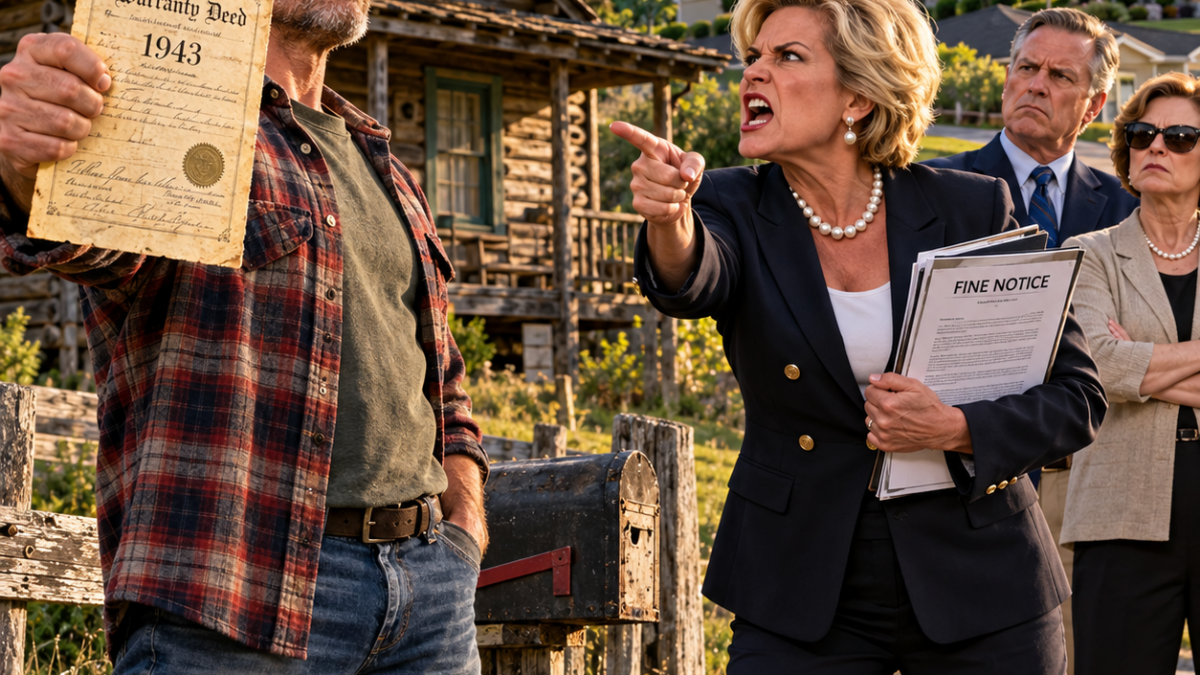
PART 2
The deed was yellow around the edges.
The paper had softened with age.
Some of the type was faint.
But the important parts were perfectly readable.
March 15, 1943.
William Tate to Samuel King.
Three acres.
Purchase price:
$1,200.
Recorded with Wake County.
I read every line.
Then again.
There were no covenants attached.
No restrictive agreements.
No architectural standards.
No reference to a future development.
No mechanism allowing some organization that did not yet exist to control the property.
Of course there wasn’t.
Sycamore Glenn had not been built.
Most of the people now living around me had not been born.
I turned to the next folder.
Tax records.
Survey maps.
Old receipts.
My grandmother had labeled everything in her careful handwriting.
Then I found something I had forgotten.
A small handwritten note tucked between old records.
Samuel King.
My great-grandfather.
The handwriting was hard but deliberate.
**Sycamore Development offered $50,000 for the land. Told them no. This ground isn’t for sale. Not now. Not ever. Whoever reads this next, remember that.**
Date:
1985.
I sat back.
Two years before the first house in Sycamore Glenn had been built.
So the developer had wanted our land.
My great-grandfather refused.
Then they built around him.
I walked to the window.
The half-finished cabin stood dark against the evening sky.
Beyond it, rows of subdivision houses.
Same setbacks.
Similar mailboxes.
Similar rooflines.
Samuel must have watched those houses rise.
One after another.
He had seen fields become streets.
Construction crews working just beyond his fence.
Survey markers.
Sales offices.
Families moving into homes where farmland had been.
He could have sold.
Fifty thousand dollars in 1985 was serious money.
Especially for three acres.
He said no.
Not because the land was worth more on a spreadsheet.
Because it was his.
There are some decisions that make no sense if you only use a calculator.
I picked up Diane’s citation.
Unauthorized structure.
That phrase bothered me.
The cabin wasn’t unauthorized.
It was older than the authority claiming to regulate it.
I pulled out my phone.
Property attorneys Raleigh.
The first thing I needed was certainty.
Not family pride.
Not anger.
Law.
If I was wrong, I wanted to know before I turned this into something bigger.
The next morning I drove to the Wake County Register of Deeds.
I arrived early.
Coffee.
Folder under my arm.
A woman in her sixties helped me.
She had reading glasses hanging from a chain and the kind of patience that disappears from most public offices around lunchtime.
“What are we looking for?”
“Chain of title on three acres.”
I gave her the parcel number.
“And HOA covenants if any exist.”
She typed.
“Old parcel.”
“Family bought it in ’43.”
Her eyebrows rose.
“Then we may be going downstairs.”
She first pulled digital files.
Then microfilm.
Then disappeared into archives.
Thirty minutes later, my family’s history was spread across a table.
The 1943 deed.
Subsequent inheritance records.
Tax transfers.
Estate filings.
Nothing attached.
No covenant.
No HOA.
No annexation.
No amendment binding us to Sycamore Glenn.
“Can you pull the development records?”
“Which development?”
“Sycamore Glenn.”
That file was much newer.
1987.
She returned with incorporation documents and boundary maps.
I laid the maps beside my deed.
There it was.
The subdivision surrounded our land like a horseshoe.
North.
East.
South.
But the lines stopped exactly where our property began.
Not close.
Not ambiguous.
Exact.
I traced the boundary.
“They excluded us.”
The clerk looked.
“Appears so.”
“Was this recorded as part of the original development?”
“Yes.”
“So every original buyer would have had access to this?”
“In some form, yes.”
I leaned back.
Diane had told me geographic boundaries controlled everything.
The actual recorded boundaries showed the opposite.
I asked for certified copies.
While she prepared them, I started thinking about the central issue.
An HOA doesn’t gain authority just because your house is near it.
A property is generally bound because covenants run with the land through recorded documents, or because an owner voluntarily agrees to join under applicable procedures.
My family had done neither.
Samuel hadn’t.
My grandfather hadn’t.
My father hadn’t.
I hadn’t.
Diane had no signed agreement.
No deed restriction.
No annexation.
No recorded covenant.
On paper, the HOA had about as much authority to fine me as the grocery store down the road.
That should have made me feel better.
Instead, I felt uneasy.
Because one question remained.
Why did Diane believe otherwise?
Not casually.
She had arrived with a compliance officer.
Camera.
Citation.
Lien threat.
That didn’t look like somebody making a spontaneous mistake.
It looked routine.
I went home.
And that afternoon, I found the first complication.
Old canceled checks.
My father.
Early 2000s.
Twenty-five dollars.
Fifty dollars.
Seventy-five.
Payable to Sycamore Glenn HOA.
Memo lines:
Exterior modification.
Vegetation.
Fence.
I sat on the floor beside the lockbox.
My father had been paying them.
I could hear him in my head.
“Jonathan, sometimes peace is worth more than being right.”
That had been Dad.
He hated arguments.
If someone sent him a fifty-dollar fine, he would ask himself what two hours with a lawyer would cost.
Then he’d write a check.
I understood him.
But those checks had created history.
A paper trail.
Diane could say:
Your family accepted our authority.
I called Ralph Hughes.
Property attorney in Raleigh.
He answered with the deep voice of a man who sounded as though he’d spent most of his adult life saying, “Objection.”
I explained.
He listened.
Then asked exactly the question I feared.
“Anyone ever pay the HOA?”
“Yes.”
“How much?”
“Small fines.”
“How long?”
“Years, apparently.”
“Did anyone sign an agreement?”
“Not that I can find.”
“Recorded declaration?”
“No.”
“Annexation?”
“No.”
He paused.
“Payments complicate the story.”
My stomach sank.
“But?”
“They don’t automatically create the property interest the HOA needs.”
“So they can’t just say we paid, therefore we’re members?”
“They can say it.”
“Can they win?”
“Different question.”
I smiled despite myself.
“When can I come in?”
“Tomorrow.”
That night I sat on my porch.
Lockbox beside me.
Laptop open.
I researched Sycamore Glenn.
Developer bankruptcy.
1992.
HOA transferred to residents.
Diane joined the board years later.
Eventually became president in 2016.
Her public biography described her as a retired real-estate professional.
That mattered.
She wasn’t some confused volunteer who had never looked at a deed.
She had worked around property.
She should understand boundaries.
I looked at Samuel’s note.
**This ground isn’t for sale.**
I thought about my father paying the fines.
Two generations.
Two approaches.
Samuel drew a hard line.
Dad avoided conflict.
Neither was foolish.
But Diane had benefited from Dad’s silence.
She had learned that letters worked.
That official envelopes worked.
That most people would rather pay fifty dollars than spend a week proving they didn’t owe it.
Now she had moved from nuisance fines to ordering me to stop building.
Different scale.
Different response.
Ralph’s office was downtown.
Third floor.
Old brick building.
Bookshelves.
Coffee.
Legal pads everywhere.
He was mid-forties.
Gray at the temples.
Calm.
I spread everything out.
1943 deed.
Boundary map.
HOA formation papers.
Dad’s checks.
Samuel’s note.
Ralph took his time.
That gave me confidence.
People who already know their answer usually read too fast.
Finally he sat back.
“You have a very strong position.”
“How strong?”
“Your deed predates the development by forty-four years.”
“Yes.”
“The recorded development boundary excludes your land.”
“Yes.”
“There is no recorded covenant.”
“No.”
“No annexation agreement.”
“No.”
“No voluntary membership document?”
“Nothing.”
He tapped the checks.
“These are their only argument.”
“Implied consent.”
“Something along those lines.”
“Does that work?”
“In my view, not to create what they need here.”
He lifted the 1987 map.
“Property restrictions are not supposed to materialize because somebody wrote a few checks.”
I exhaled.
“So the cabin fine?”
“Invalid if your records are complete.”
“And older fines?”
“Likely invalid too.”
That hit differently.
Dad.
Every check.
Every time he sighed and paid.
Ralph watched me.
“You okay?”
“Yeah.”
“No, you’re not.”
I looked at the canceled checks.
“My father hated conflict.”
“A lot of people do.”
“He probably thought fifty bucks was easier.”
“Probably.”
“And they knew that.”
“We don’t know what they knew yet.”
Yet.
That word mattered.
Ralph leaned forward.
“You have two approaches.”
“Okay.”
“First, we send a cease-and-desist demand immediately.”
“What does it say?”
“That the HOA lacks jurisdiction, the fine must be withdrawn, construction interference must stop, and future enforcement may expose the association to liability.”
“And second?”
“You do nothing.”
I frowned.
“Nothing?”
“Keep building.”
“Ignore them?”
“Let them escalate.”
“Why?”
“If they file a lien or lawsuit on property they don’t control, they create a clearer cause of action.”
“That sounds risky.”
“It is.”
“Which would you do?”
Ralph smiled.
“I send letters for a living.”
“Meaning?”
“I’d send the letter.”
He became serious.
“But it’s your land.”
I looked at Samuel’s note.
Fifty thousand.
No.
I looked at Dad’s checks.
Twenty-five.
Fifty.
Seventy-five.
Paid.
Two approaches.
I had loved both men.
But I knew which choice I needed now.
“Send it.”
Ralph nodded.
“Certified.”
“And include the map.”
“Absolutely.”
“The deed.”
“Yes.”
“Everything.”
“Enough to remove any claim they didn’t know.”
That phrase stayed with me.
Didn’t know.
Because if they continued after receiving documents, this would become something else.
The letter went out that afternoon.
Diane signed for it three days later.
I knew because Ralph emailed the return receipt.
I went back to the cabin.
Framing.
Roof.
Window openings.
Work quiets my head.
Every board had a place.
Every cut had a purpose.
Every problem could be measured.
HOA disputes weren’t like that.
They depended on interpretation.
People.
Power.
Memory.
But wood tells you immediately when you’re wrong.
I liked that.
A week passed.
Then the response arrived.
Six pages.
Law firm letterhead.
Expensive-looking paper.
Respectfully disagrees.
Geographic service area.
Longstanding integration.
Prior payments.
Community expectations.
Binding relationship.
Then the number.
Fine increased from $500 to $2,000.
Thirty days.
Possible lien.
I called Ralph.
“You reading this?”
“Third time.”
“Geographic service area?”
“I enjoyed that one.”
“Is it real?”
“Not in the way they’re using it.”
“Community integration?”
“Creative.”
“So?”
“They’re bluffing.”
“You sound certain.”
“I’m certain their letter doesn’t fix the missing covenant.”
“Can they file a lien?”
“They can file paper.”
“That’s not what I asked.”
“You’re learning.”
I stared at the letter.
“What if they do?”
“We challenge it.”
“And?”
“Potential title claim.”
“Against them?”
“Yes.”
That should have scared me more than it did.
Maybe because the bigger the HOA threatened, the clearer the conflict became.
Then Patricia stopped her car beside my property.
Not Diane.
A resident.
Mid-forties.
Friendly face.
Nervous expression.
“You’re Jonathan?”
“Yes.”
“The cabin guy?”
“I guess.”
She lowered her voice.
“I thought you should see something.”
Phone.
Email from Diane.
Subject:
**PROTECTING OUR COMMUNITY STANDARDS**
No name.
But obvious.
An outside property owner.
Unauthorized construction.
Refusal to cooperate.
Potential impact on property values.
Residents encouraged to contact the board.
I read it.
“Thank you.”
Patricia looked surprised.
“That’s it?”
“What do you want me to say?”
“I don’t know.”
“Do you believe it?”
She hesitated.
“Not all of it.”
“Why?”
“My husband said he remembers this property being separate.”
“How long have you lived here?”
“Eleven years.”
“So you knew?”
“Sort of.”
She looked embarrassed.
“Everybody calls it King Land.”
That caught me.
“King Land?”
“Older residents do.”
I almost laughed.
Diane was telling people I was an outside property owner.
The neighborhood had a nickname recognizing my family’s land had existed separately for decades.
“Patricia, why tell me?”
She looked toward the houses.
“Because this is getting ugly.”
Then drove away.
That evening I sat on the porch.
The email bothered me more than the $2,000 fine.
Diane was not merely making a legal argument.
She was preparing the neighborhood.
If the lien came later, residents would think:
Of course.
He broke the rules.
He refused to cooperate.
He brought it on himself.
That is how power protects itself.
First define the person.
Then act against the definition.
Around seven, somebody knocked.
Older man.
White hair.
Hands scarred from work.
“Jonathan King?”
“Yes.”
“Walter Jennings.”
He walked in almost before I finished inviting him.
“I live on Maple.”
He sat.
“I knew Samuel.”
I stared.
“My great-grandfather?”
“Not well.”
Walter smiled.
“Nobody knew Samuel well unless Samuel decided they did.”
That sounded right.
“I moved here in ’89.”
He looked around.
“Your original cabin was already old.”
“It had character.”
“It leaned.”
“Character.”
Walter laughed.
Then became serious.
“I remember when they built Sycamore Glenn.”
“They built around our property.”
“Everybody knew.”
“Diane doesn’t.”
Walter snorted.
“Diane knows plenty.”
“What does that mean?”
He shrugged.
“Means I’ve watched her run this place long enough.”
“Has she always been like this?”
“She likes compliance.”
“That’s diplomatic.”
“I’m old. Diplomacy keeps blood pressure down.”
I smiled.
Walter leaned forward.
“The neighborhood knew your family wasn’t part of us.”
“How?”
“Developer told people.”
“Why?”
“Because Samuel wouldn’t sell.”
“What did people think?”
“Mostly thought he was crazy.”
“Fifty thousand in ’85.”
Walter whistled.
“More than I knew.”
“He said no.”
“I know.”
“How?”
“Everybody knew.”
He looked at me.
“Your great-grandfather became neighborhood folklore.”
That was strange.
My family saw Samuel as family.
Stubborn.
Quiet.
Hardworking.
To Sycamore Glenn, he was the man who forced a subdivision to bend around three acres.
Walter stood.
“If you need somebody to say what residents understood when this place was new, I’ll say it.”
“Why?”
His answer came quickly.
“Because Diane’s wrong.”
Simple.
Then my phone buzzed.
Voicemail.
Diane.
Smooth voice.
Friendly.
“Mr. King, I believe we may have gotten off on the wrong foot.”
Walter rolled his eyes before the message finished.
“I’d like to discuss a peaceful resolution.”
She wanted common ground.
Neighborly approach.
Mutual respect.
Walter waited.
Then:
“Peaceful resolution.”
He laughed.
“What does she want?”
“I don’t know.”
“You going?”
“Not without Ralph.”
“Good.”
I forwarded the voicemail.
Ralph called.
“They’re nervous.”
“How do you know?”
“They escalated your fine, threatened a lien, emailed residents, and now suddenly want coffee.”
“What do we do?”
“We dig.”
Into what?
“HOA records.”
That was how Jessica entered the story.
Ralph’s paralegal.
Twenty-something.
Fast.
Patient.
Apparently incapable of accepting “we couldn’t find it” as a final answer.
Two weeks later she called.
“Mr. King?”
“Yes.”
“Are you driving?”
“Yes.”
“Pull over.”
I laughed.
“Is this dramatic?”
“Pull over.”
I did.
“What did you find?”
“Original development correspondence.”
My heart changed pace.
“From when?”
“1985.”
“Samuel?”
“Yes.”
She emailed scans.
First offer.
$10,000.
Samuel declined.
Second.
$25,000.
Declined.
Third.
$50,000.
Declined.
Then final correspondence from the developer’s attorney.
It acknowledged Samuel’s refusal.
Stated development would proceed on adjacent parcels.
I stared at the screen.
“They knew.”
“Explicitly.”
“That’s good.”
“Keep reading.”
Another file.
Original 1986 site plan.
I zoomed.
Three-acre rectangle.
Across it, bold type:
**PRIVATE PROPERTY — NOT PART OF DEVELOPMENT**
I sat in my truck on the shoulder.
Cars passing.
Hazard lights blinking.
Forty years.
That document had existed for forty years.
The original developer hadn’t merely known.
They had told the county.
Planning commissioners.
Engineers.
Surveyors.
Every official involved in approving Sycamore Glenn.
There was no ambiguity.
The neighborhood was designed around our land.
“Jessica.”
“Yes?”
“Where was this?”
“County planning archives.”
“Public?”
“Yes.”
“So the HOA could have found it.”
“Anybody could.”
I thought about Diane’s career in real estate.
Interesting.
Two days later, Ralph called me into his office.
Jessica was there.
Documents covered a conference table.
“This is beyond the cabin now,” Ralph said.
“What happened?”
“We requested HOA records.”
“And?”
“Diane delayed.”
“Of course.”
“We pushed.”
“And?”
“Court order.”
I looked at the documents.
“What did they give you?”
“Everything they were required to produce.”
Ralph pointed.
“Meeting minutes.”
“Financials.”
“Internal correspondence.”
“Policy memoranda.”
I began reading.
Most was boring.
Parking.
Pool.
Landscaping.
Roof colors.
Then:
2003.
CONFIDENTIAL.
KING PROPERTY JURISDICTION STATUS.
My hands went cold.
I read.
The memo acknowledged the King property was technically outside association jurisdiction.
Original development boundaries excluded it.
No covenant attached.
No annexation.
Then the sentence that changed everything:
Previous owners had paid fines without formal objection.
Recommendation:
Continue existing approach unless challenged.
Reason:
Formal annexation required King family consent, unlikely to be granted.
Public acknowledgement of the jurisdictional issue could weaken board authority.
I read it again.
Then looked at the signatures.
Richard Hoffman.
Board president.
And below:
Diane Prescott.
Board member.
2003.
I sat down.
“She knew.”
Ralph nodded.
“She knew.”
“Twenty years.”
“Yes.”
“She came onto my boundary with a $500 citation knowing.”
“According to this document, she was aware of the jurisdiction issue.”
“She called it a technical ambiguity.”
“Jonathan.”
“She knew.”
“I agree with what the document says.”
I stood.
“My father paid them.”
“I know.”
“He wrote checks because he trusted them.”
“I know.”
“They knew those fines weren’t theirs.”
Ralph let me be angry.
Sometimes good lawyers know when not to interrupt.
I walked toward the window.
Downtown Raleigh.
Cars.
People.
Normal life.
Dad had never been stupid.
He hadn’t been weak.
He trusted official-looking paper.
Most people do.
He assumed an HOA wouldn’t send a bill unless somebody had confirmed it applied.
That trust had been used.
Maybe fifty dollars at a time.
Maybe less.
But money wasn’t what bothered me.
The disrespect did.
They had watched a quiet man pay because confrontation made him uncomfortable.
Then wrote an internal memo recommending they keep going.
“How many checks?”
I asked.
Ralph looked at Jessica.
“We’re calculating.”
“Total?”
“Probably several thousand over the years.”
“I don’t care about the amount.”
Ralph nodded.
“I know.”
I picked up the memo.
“Emergency meeting.”
Ralph studied me.
“You sure?”
“Yes.”
“We can litigate privately.”
“No.”
“Public meeting creates noise.”
“Good.”
“Diane will say we’re trying to embarrass her.”
“I’m not interested in embarrassing her.”
“What are you interested in?”
“Every person she represents seeing this.”
I tapped the memo.
Ralph nodded.
“Then we request the meeting.”
That night, I opened the lockbox again.
I had read everything.
Or thought I had.
Old tax documents.
Photos.
Receipts.
Then an envelope marked SYCAMORE.
Inside:
September 1985.
Final purchase offer.
Typed letter.
At the bottom, handwritten by the company president:
Mr. King, this is our best and final offer. I urge you to consider the benefits of selling now before development begins and your property becomes surrounded by our community.
Samuel had written across the paper in pencil.
**No deal. Not now. Not ever. This ground isn’t for sale. Whoever reads this next, remember that.**
I held the letter for a long time.
He never sent it.
Maybe he just needed to write the answer down.
Maybe he kept it because he knew someone after him might need the reminder.
I certainly did.
Walter came the next day carrying coffee and a folder.
“What’s that?”
“Photographs.”
1989.
Construction.
Half-built houses.
Bulldozers.
Roads.
And in the middle:
Samuel’s cabin.
Small.
Alone.
Standing.
The image looked almost unreal.
Development everywhere.
But the three acres untouched.
“I took that from my backyard,” Walter said.
“You kept it?”
“Thought it was interesting.”
He pointed at Samuel’s cabin.
“That old man drove those developers crazy.”
I smiled.
“Good.”
Walter handed me the photograph.
“Show them.”
At the meeting.
Ralph prepared the presentation.
Sequence mattered.
First:
1943 deed.
Then 1986 site plan.
Then development correspondence.
Then photograph.
Then 2003 memo.
Not emotion first.
Evidence first.
Ralph rehearsed my opening.
“You have fifteen minutes.”
“Diane set that?”
“Of course.”
“Enough?”
“Plenty if she doesn’t interrupt.”
“She will.”
“Then don’t fight.”
“Hard.”
“I know.”
“What will she say?”
“Outdated documents.”
“Okay.”
“Context.”
“Okay.”
“Implied consent.”
“Okay.”
“Community welfare.”
“Property values.”
“Exactly.”
“What do I say?”
“Nothing.”
“Nothing?”
“Return to the next exhibit.”
I hated that answer because it was correct.
Then Ralph added something.
“Other people are asking questions.”
“Who?”
“Woman on Cedar Lane.”
“Patricia?”
“No. Helen Brooks.”
“What’s her issue?”
“Her parcel predates portions of the development.”
“HOA jurisdiction?”
“Potentially.”
“Anyone else?”
“Retired couple on Oak Street. Easement problem.”
“So this isn’t just me.”
“Maybe not.”
That changed the stakes.
Until then, the fight had been personal.
Cabin.
Family land.
Dad.
Samuel.
Now other people were looking at their own papers.
That was exactly what Diane seemed to fear in the 2003 memo.
Acknowledging one boundary problem might encourage others.
The night before the meeting, I stood beside the cabin.
Roof mostly done.
Walls up.
Windows next.
I imagined Samuel in 1985.
Developer offers.
He said no.
Then bulldozers arrived anyway.
Not on his land.
Around it.
He must have wondered whether refusing was worth the isolation.
Whether three acres in the middle of a growing subdivision could remain what he wanted.
He stayed.
Now I had to walk into a room of eighty people and tell them their president had known something for twenty years that she had never told them.
People don’t enjoy discovering they were fooled.
Sometimes they become angry at the liar.
Sometimes at the person who proves the lie.
I was prepared for either.
The Sycamore Glenn Community Center looked exactly like every HOA meeting room ever built.
Beige.
Fluorescent.
Folding chairs.
Cheap coffee.
Eighty residents showed up.
More than usual.
Word had spread.
Diane sat at the front.
Cream blazer.
Three board members beside her.
Gerald near the projector.
When I entered with Ralph and Walter, Diane watched us.
No smile.
No greeting.
Meeting started normally.
Minutes.
Budget.
Pool fence.
Landscaping.
Diane moved efficiently.
She wanted the room reminded that she was president.
That life was normal.
Then:
“New business.”
She looked at me.
“We received a formal request from Mr. Jonathan King to address the board.”
Pause.
“Mr. King, you have fifteen minutes.”
I stood.
Walked forward.
Flash drive.
Folder.
Eighty faces.
“My name is Jonathan King.”
My voice sounded steadier than I felt.
“My family owns three acres adjacent to Sycamore Glenn.”
Diane shifted.
“Since 1943.”
Murmurs.
“Forty-four years before this association existed.”
First slide.
Deed.
“This is the original recorded deed.”
Date enlarged.
1943.
Second slide.
Development formation.
1987.
Third.
Boundary map.
“Our parcel is excluded.”
Diane leaned toward her microphone.
“Mr. King, boundary interpretation is more complex—”
Ralph had warned me.
I clicked next.
1986 site plan.
Bold words:
**PRIVATE PROPERTY — NOT PART OF DEVELOPMENT**
The room went quiet.
I said:
“This is not my interpretation.”
I pointed.
“This is the developer’s.”
A man near the middle leaned forward.
Patricia, the woman who had warned me, covered her mouth slightly.
Next slide.
1985 offers.
$10,000.
$25,000.
$50,000.
“Sycamore Development attempted to purchase our land.”
I clicked.
“They failed.”
Next.
Developer letter acknowledging refusal.
“So they built around it.”
Next.
Walter’s photograph.
Gasps.
Original cabin.
Construction everywhere.
A woman said:
“I remember that.”
Another:
“So does my husband.”
Walter smiled from the front row.
Diane interrupted.
“Historical photographs do not determine modern governance.”
I clicked next.
2003 memo.
That was the moment.
I read the heading aloud.
“King Property Jurisdiction Status.”
I didn’t editorialize.
I read.
Technically outside jurisdiction.
No covenant.
No annexation.
Prior owner paid fines.
Continue current approach unless challenged.
Formal annexation would require consent.
Public acknowledgement may undermine board authority.
People stopped shifting in their chairs.
No coughs.
No whispers.
Silence.
Then final slide.
Signatures.
Richard Hoffman.
Diane Prescott.
I turned toward her.
“Mrs. Prescott.”
Her expression remained controlled.
But her hands had tightened around a pen.
“Would you like to explain your signature?”
She leaned forward.
“That document is being presented without proper context.”
A man immediately stood.
“What context?”
Diane raised one hand.
“Please.”
He didn’t sit.
“Did you know his land wasn’t in the HOA?”
She looked at him.
“The memo discusses a technical jurisdictional question.”
“Yes or no?”
“Sir, sit down.”
“Did you know?”
Another resident:
“Answer him.”
Diane’s face reddened.
“We have always acted in the best interests of the association.”
That was not an answer.
Everybody knew.
Helen from Cedar Lane stood.
“If you knew his property wasn’t included, why were you fining him?”
Diane tried:
“Prior payments established a longstanding—”
Ralph stood just enough to be seen.
“Mr. King has counsel. I would caution against making unsupported legal conclusions in response to residents.”
Diane glared at him.
The room erupted.
Not shouting at first.
Questions.
Dozens.
“How many properties are outside?”
“What about Cedar?”
“I’ve paid fines for twenty years.”
“Can we see the maps?”
“What else is in those memos?”
“Why were records withheld?”
Gerald looked like he wanted to disappear into the projector.
Diane hit the microphone.
“Order.”
No one listened.
“Order!”
Walter stood.
His voice carried without needing a microphone.
“Let people ask.”
Diane stared.
“You are out of order.”
Walter laughed.
“I’ve lived here longer than you’ve been president.”
That got applause.
Then Helen:
“My property came from a farm parcel in 1972.”
She held up papers.
“I want jurisdiction reviewed.”
Retired man from Oak Street:
“You’ve ignored our deeded easement for fifteen years.”
His wife stood beside him.
“We have letters.”
The room changed.
This was no longer my meeting.
It belonged to everyone.
That was worse for Diane.
She had prepared to defeat one man.
Not eighty residents looking inward.
A younger homeowner raised his hand.
“I move for an independent audit.”
Someone shouted:
“Second.”
Diane tried to stop it.
“This is not properly agendized.”
Another resident asked:
“Then schedule it.”
Voices.
Audit.
Records.
Boundary review.
Refunds.
Legal review.
Someone moved for a vote of no confidence.
Diane went very still.
For eight years, she had controlled the room by being the person most certain she belonged at the microphone.
Now certainty was gone.
She gathered her papers.
Her hands shook slightly.
“I have served this community faithfully.”
The room quieted.
“I have given thousands of hours.”
Nobody argued.
“I have acted based on the information available to the board.”
Walter muttered:
“You signed the information.”
A few people laughed.
Diane looked at him.
Then at me.
Then at the residents.
She seemed to understand what the vote would be.
“I am resigning as president of Sycamore Glenn Homeowners Association, effective immediately.”
Silence.
Then murmurs.
She stood.
Picked up her bag.
Walked toward the door.
No dramatic confrontation.
No final threat.
No applause.
Nobody asked her to stay.
The door closed.
And that was it.
Eight years of authority ended in less than thirty seconds.
I stayed at the front.
I expected triumph.
Instead, I thought about Dad.
He should have been there.
Not because he would enjoy Diane resigning.
He wouldn’t.
He hated conflict.
He would probably have spent half the meeting uncomfortable.
But I wanted him to know his checks hadn’t meant he was weak.
He trusted people who claimed authority.
They failed him.
That shame wasn’t his.
Walter found me in the parking lot.
“Well.”
“Well.”
He leaned against his truck.
“Samuel would’ve enjoyed that.”
“He liked HOA meetings?”
“Your great-grandfather liked people discovering they couldn’t push him.”
I laughed.
“Thank you for the photo.”
“I just pressed a button forty years ago.”
“You kept it.”
Walter shrugged.
“Sometimes that’s enough.”
Then he drove away.
I went home.
The cabin stood in moonlight.
I walked inside even though there were no finished floors yet.
Sat on a stack of lumber.
The fight wasn’t over.
Audit.
Refund claims.
Legal review.
Potential title issues.
More meetings.
But the cabin felt different.
Not because Diane resigned.
Because for the first time since her SUV arrived, nobody was telling me to stop building.
Three months later, an envelope arrived.
Sycamore Glenn HOA.
For a second, seeing the logo still tightened my chest.
I opened it.
Letter from the new board.
Formal acknowledgement.
King property not subject to HOA jurisdiction.
All citations withdrawn.
No future enforcement absent lawful voluntary annexation.
Then check.
$4,200.
Total fines paid by my family over approximately two decades.
Refunded.
I stared.
Four thousand two hundred dollars.
Dad had paid more than I realized.
Twenty-five.
Fifty.
A hundred.
Small amounts disappear in memory.
Together they become history.
I called Ralph.
“Got the check.”
“Good.”
“Four thousand two.”
“Matches the audit.”
“What do I do?”
“Deposit it.”
“Feels weird.”
“Why?”
“It’s Dad’s money.”
Ralph paused.
“Then use it for something he’d approve of.”
I knew immediately.
The cabin.
I deposited the check.
Then placed the receipt in Grandpa’s lockbox beside Samuel’s letter.
The money went toward finishing materials.
Not fancy ones.
Good ones.
Oak.
Hardware built to last.
Windows chosen for durability rather than fashion.
I wanted every dollar they had wrongly collected to become part of the structure they had tried to stop me from rebuilding.
That felt right.
The audit created other consequences.
Some residents received refunds.
Not everyone.
Many fines were valid under their deeds.
That distinction mattered.
I never wanted the story to become:
HOAs have no authority.
They do, where properly established and where the governing documents allow.
The problem wasn’t rules.
The problem was pretending rules applied where they didn’t.
Helen on Cedar Lane obtained a boundary review.
Her situation was complicated.
Some restrictions applied.
Others did not.
The Oak Street couple finally had their easement recognized correctly.
Other residents discovered questions too.
Some won.
Some didn’t.
But everyone started reading.
That alone changed Sycamore Glenn.
The new board published boundary maps.
Financial records became easier to access.
Meeting minutes appeared online quickly.
Jurisdiction disputes had a formal review process.
Board members stopped treating questions as insubordination.
A simple phrase became common.
“Show me the document.”
Not rude.
Not hostile.
Responsible.
Diane’s house went on the market six weeks after she resigned.
I heard she moved closer to Charlotte.
I never saw her again.
Some residents expected me to feel satisfaction.
I didn’t care.
She had occupied too much of my attention already.
Her moving wasn’t the ending.
The cabin was.
Late October.
Leaves changing.
The final window went in on a Saturday afternoon.
I stepped back.
Four hundred square feet.
Same footprint.
Fresh wood.
Straight lines.
New roof.
Small porch.
Nothing extravagant.
Everything intentional.
The original cabin had sheltered four generations.
Samuel.
My grandfather.
Dad.
Me.
If I built this correctly, maybe another four would use the rebuilt version.
I had saved several pieces of oak from the original structure.
Most were too damaged for structural use.
One piece was solid enough for a plaque.
I sanded it.
Slowly.
Then carved:
**KING CABIN**
**EST. 1945**
**REBUILT 2024**
Below that:
**THIS GROUND ISN’T FOR SALE.**
I mounted it beside the door.
Not for Diane.
Not for the HOA.
For whoever came after me.
Samuel had written his message on paper.
I wanted mine in wood.
Neighbors started visiting.
Patricia came first.
The woman who had shown me Diane’s email.
She brought pie.
“You didn’t have to do that.”
“I know.”
She looked at the cabin.
“It’s beautiful.”
“Thank you.”
“My husband remembers the old one.”
“He should come by.”
“He will.”
She hesitated.
“I’m sorry.”
“For what?”
“I believed the email at first.”
I appreciated the honesty.
“What changed?”
“The documents.”
I nodded.
“That’s what they’re for.”
Then the Oak Street couple.
They wanted to thank me.
I told them Ralph deserved more credit.
They disagreed.
“You asked first.”
That kept coming up.
People assumed the difficult part was proving something.
Often the difficult part is deciding you’re allowed to ask.
A few weeks later, Walter arrived carrying a package wrapped in brown paper.
“Found something.”
“What?”
“Open it.”
Frame.
Black-and-white photograph.
I recognized the cabin immediately.
Original.
But the man in front of it took longer.
Young.
Lean.
One hand on the doorframe.
Squinting into the sun.
Samuel King.
My great-grandfather.
I had only seen older photographs.
In those, he looked severe.
Here he was smiling.
On the back:
**Samuel King — Summer 1960**
My hands tightened around the frame.
“Where did you get this?”
“Previous owner of my house left old photos.”
“And you kept it?”
“Recognized the cabin.”
“For thirty-five years?”
Walter shrugged.
“I forget to throw things away.”
I laughed.
Then looked again.
Same land.
Same tree line, though thicker now.
Same direction of afternoon sun.
Samuel standing where I stood.
He had no idea who I would become.
Didn’t know my father.
Didn’t know me.
Didn’t know Diane.
Didn’t know HOAs would someday send electronic notices and compliance officers with cameras.
But he understood one thing.
Land attracts people who see only what they can make from it.
His answer had been simple.
No.
I hung the photograph inside the cabin.
Wall facing the door.
First thing anyone saw.
That evening I sat on the new porch.
Sycamore Glenn stretched around me.
Rows of rooftops.
Streetlights.
Mailboxes.
Lawns.
A planned community designed for order.
And in the middle, three acres that had always been outside it.
For years I thought our land looked out of place.
Now I realized Sycamore Glenn looked like it had grown around us.
Because it had.
One Sunday my mother came to see the cabin.
She had avoided most of the dispute.
Not because she didn’t care.
Because conflict made her anxious the way it had Dad.
She walked slowly around the porch.
Touched the wood.
Then saw Samuel’s photo.
“Oh.”
“You know that picture?”
“No.”
She stepped closer.
“I haven’t seen him look that young.”
She stared for a long time.
Then her eyes filled.
“Your father would love this.”
I swallowed.
“You think?”
“He would complain.”
“About what?”
“Price of lumber.”
I laughed.
That was true.
Mom walked to the plaque.
Read the line.
**THIS GROUND ISN’T FOR SALE.**
“You know your father never wanted a fight.”
“I know.”
“He paid those fines because he was tired.”
“I know.”
“He knew something wasn’t right.”
I looked at her.
“What?”
“He’d complain.”
“Why didn’t he challenge them?”
“Because every time one came, it was fifty dollars or seventy-five.”
She shrugged sadly.
“He would say, ‘A lawyer costs more.’”
Exactly what I had imagined.
“He wasn’t giving them permission.”
“I know.”
“Jonathan.”
She looked at me.
“Don’t turn him into the weak one in this story.”
That hit hard.
“I wasn’t.”
“Yes, you were.”
I said nothing.
She continued.
“Samuel said no because he was Samuel.”
She touched the cabin wall.
“Your father kept peace because he was your father.”
Her voice softened.
“Both loved this land.”
I looked toward the trees.
She was right.
I had been comparing them.
Hard line versus quiet path.
As if one made Samuel stronger.
That wasn’t fair.
Dad worked.
Paid taxes.
Maintained the property.
Kept it in the family.
Never sold.
His resistance simply looked different.
“I’m sorry.”
Mom smiled.
“Don’t apologize to me.”
She walked inside.
I stayed on the porch.
That conversation changed how I remembered the checks.
They weren’t evidence of surrender.
They were evidence of a man deciding which battles he had energy for.
The wrongdoing belonged to the people who knew that and kept billing him.
Not to him.
A month later, the new HOA president asked me to attend a meeting.
I almost declined.
Then she explained.
“We want you to tell residents about the history.”
“Why me?”
“Because apparently half the neighborhood thinks Samuel King was some kind of folk hero.”
“He would hate that.”
“Good. Makes the story better.”
Her name was Melissa Grant.
Forty-one.
Teacher.
Had lived in Sycamore Glenn eight years.
Never served on the board before Diane resigned.
At the meeting, she introduced me.
No drama.
I brought Walter’s photograph.
People asked questions.
“Why didn’t Samuel sell?”
“I don’t know every reason.”
“Was he against the development?”
“Not exactly.”
“Did he dislike the residents?”
“No.”
“Then what?”
I thought.
“He didn’t want to sell his land.”
A teenager sitting with his parents looked confused.
“For fifty thousand?”
“In 1985.”
“That’s a lot.”
“It was.”
“So why not?”
“Because not everything people own is inventory.”
The room quieted.
I continued.
“The mistake is assuming every refusal is negotiation.”
That was Samuel.
Developers heard no and increased the offer.
He still meant no.
Diane saw a family paying nuisance fines and assumed resistance had disappeared.
She was wrong too.
Afterward, a resident named Mark approached.
He had been on the board under Diane.
Not in 2003.
Later.
“I owe you something.”
“What?”
“An apology.”
“You didn’t sign the memo.”
“No.”
“I voted for one of your old fines.”
That surprised me.
“When?”
“2019.”
“What for?”
“Weeds along the east fence.”
I almost smiled.
“That sounds like Dad.”
Mark looked ashamed.
“We never checked jurisdiction.”
“Why?”
“Diane said the property was included.”
“And you believed her.”
“Yes.”
“Why?”
“She knew real estate.”
I nodded.
“I signed the vote.”
“Okay.”
“You’re not angry?”
“I was.”
“And now?”
I looked around the room.
“Now you know.”
Mark nodded.
“I joined the records committee.”
“Good.”
“I’m checking every legacy parcel.”
“Better.”
He held out his hand.
We shook.
That was more useful than an apology.
Change.
The cabin slowly became a meeting place for my family.
My cousin brought his kids.
They slept there one weekend.
My niece asked why it didn’t have Wi-Fi.
I told her Samuel didn’t install any.
She rolled her eyes.
Another cousin wanted to add a television.
Denied.
“That cabin has electricity.”
“Electricity is not permission.”
“You’ve become an HOA.”
“Leave.”
He laughed.
Family returned.
That was the point.
The old cabin had become fragile enough that everyone stopped using it.
The rebuilt one invited people back.
Thanksgiving afternoon, Mom sat on the porch wrapped in a blanket.
I brought coffee.
She looked toward Sycamore Glenn.
“Different from when I was a girl.”
“What did it look like?”
“Fields.”
“Walter has pictures.”
“I know.”
“Do you miss it?”
She thought.
“Sometimes.”
“Do you hate the neighborhood?”
“No.”
That surprised me slightly.
“Why would I?”
“It surrounds the land.”
“People need homes.”
She sipped coffee.
“The problem was never houses.”
Right.
The problem was somebody assuming building near us gave them ownership over us.
That distinction mattered.
I had spent months angry at Sycamore Glenn.
But Sycamore Glenn was hundreds of families.
Kids.
Retirees.
Teachers.
Nurses.
People mowing lawns on Saturdays.
They hadn’t tried to take my land.
An institution had exceeded its authority.
A few leaders had perpetuated it.
The residents eventually corrected it.
That was healthier than making the entire neighborhood an enemy.
One evening Walter and I sat on the cabin porch.
He had brought bourbon.
I had coffee.
“You’re boring,” he said.
“I’m working tomorrow.”
“You work for yourself.”
“Boss is strict.”
He laughed.
Then:
“You know Diane wasn’t always like that.”
I looked over.
“No?”
“When she joined the board, she was useful.”
“In 2003?”
“Earlier, maybe.”
“What happened?”
“Same thing that happens sometimes.”
“What?”
“People start thinking being responsible for something means owning it.”
I thought about that.
“She probably convinced herself she was protecting the neighborhood.”
Walter nodded.
“Most people don’t wake up saying, ‘Today I’ll become unreasonable.’”
“You defending her?”
“No.”
He took a drink.
“Understanding isn’t defending.”
Fair.
“Why sign the memo?”
“Because once you believe order matters more than limits, everything becomes justified.”
He looked toward the houses.
“Keep property values up.”
“Keep standards consistent.”
“Don’t let exceptions spread.”
I nodded.
“And King Land was an exception.”
“Except it wasn’t.”
“What?”
“We weren’t an exception to the rules.”
Walter smiled.
“You were outside the rules.”
Exactly.
That was the entire case.
Diane treated exemption and exclusion like the same thing.
They weren’t.
If a rule applies and someone receives special treatment, that’s an exception.
If a rule never applied, there is nothing to exempt.
Small distinction.
Huge consequence.
Months later, I received another letter from the HOA.
My first instinct was annoyance.
Then I opened it.
Invitation.
Annual community history day.
They wanted the cabin included.
I laughed.
The structure Diane had called unauthorized was now on the neighborhood history map.
I called Melissa.
“You’re kidding.”
“No.”
“You want residents touring my property?”
“Only if you agree.”
“Will there be clipboards?”
“Probably.”
“Absolutely not.”
She laughed.
We eventually agreed to a small open-house period.
Walter displayed photos.
I displayed copies of the 1943 deed and 1986 site plan.
Kids cared mostly about old tools.
Adults read the plaque.
One elderly woman stood in front of Samuel’s photograph for several minutes.
“I remember him.”
I walked over.
“You did?”
“Barely.”
She introduced herself as Margaret.
Moved into Sycamore Glenn in 1988.
“Your great-grandfather would sit outside and watch construction.”
“Angry?”
“No.”
She smiled.
“Amused.”
“That sounds possible.”
“My husband once asked if he regretted not selling.”
“What did Samuel say?”
Margaret laughed.
“He said, ‘Ask me when these houses are older than my cabin.’”
I laughed loudly.
That sounded exactly like someone from my family.
“He never got to see that.”
“No.”
She touched the frame lightly.
“But you did.”
The irony wasn’t lost on me.
The original cabin had nearly outlived the first generation of Sycamore Glenn houses.
Then I rebuilt it.
Maybe Samuel won that argument too.
Later, Melissa gave a short talk.
She did something I respected.
She didn’t pretend the new board was perfect.
“Transparency does not guarantee good decisions.”
Residents listened.
“It guarantees people can understand how decisions are made.”
She held up the old 2003 memo.
“Our failure was not simply a wrong conclusion.”
Pause.
“It was knowing there was a legal problem and deciding silence was easier.”
That was exactly it.
She announced a permanent archive policy.
Internal legal or jurisdictional opinions could not simply disappear into confidential files without proper board handling and disclosure requirements where applicable.
Legacy boundary disputes would be reviewed.
Residents could request documents electronically.
Not glamorous reforms.
Useful ones.
The neighborhood became boring again.
That is a compliment.
HOA meetings returned to pools.
Landscaping.
Budgets.
Parking.
One debate lasted forty-five minutes over whether holiday decorations could go up before Thanksgiving.
Walter called me afterward.
“You caused this.”
“What?”
“Now everybody feels empowered.”
“Good.”
“No. Helen wants to debate recycling-bin visibility.”
“Democracy.”
“I preferred tyranny.”
“You’re joking.”
“Mostly.”
I laughed.
The best sign of healing was that people could joke.
For months, every interaction had felt loaded.
Every letter threatening.
Every SUV suspicious.
That faded.
I worked.
Families lived.
The cabin weathered its first winter.
No leaks.
I was proud of that.
One cold morning, I entered and found a tiny line of condensation near the east window.
I stared.
“Dad would complain.”
I could hear him.
Should’ve flashed that differently.
I fixed it.
A few weeks later, Mom visited.
She brought one of Dad’s old tools.
His framing hammer.
“I found this.”
I held it.
Handle worn smooth.
“Why are you giving it to me?”
“It belongs here.”
I swallowed.
I hung it beside Samuel’s photograph.
Four generations on one wall.
Photo.
Hammer.
Plaque.
That was worth more than $4,200.
More than winning.
Years later, people still sometimes called the dispute “the cabin fight.”
I never liked that name.
The cabin triggered it.
But the real issue was permission.
Who gets to tell you what you can do?
Where does their authority begin?
Where does it stop?
What happens when official language outruns legal reality?
And why do so many people assume a demand is valid because it arrives on letterhead?
I understand why.
Most people are busy.
You get a fifty-dollar notice.
You pay.
You don’t pull deeds from 1943.
You don’t search county archives.
You don’t compare 1986 site plans.
You don’t hire Ralph.
You certainly don’t imagine there may be a confidential memo sitting in a file admitting the sender knows the bill may not apply.
That’s how small errors survive.
Sometimes small abuses too.
They depend less on secrecy than inconvenience.
Make the amount cheaper than the fight.
Make the paperwork exhausting.
Make the language intimidating.
Make the recipient feel unreasonable for questioning it.
My father had faced that calculation.
He paid.
I faced a different one.
The cabin mattered enough to force me to look.
That was the difference.
Not courage.
Not intelligence.
Circumstance.
People later told me:
“You stood up where your father didn’t.”
I always corrected them.
Dad stood up every day he kept the property.
He paid taxes.
Fixed fences.
Refused to sell.
Raised me to value the land.
He simply chose not to spend his energy fighting fifty-dollar envelopes.
If he had not kept the land, I would have had nothing to defend.
Samuel gave us the line.
Dad kept us on our side of it.
I made people acknowledge where it was.
Each generation did a different job.
That became the way I understood our family history.
One spring afternoon, a developer contacted me.
Not Sycamore.
Different company.
Professional.
Respectful.
They wanted to buy.
Not the whole property.
A strip.
Access road.
Offer:
$180,000.
I read it twice.
Then laughed.
Not because the money was bad.
Because history has a sense of humor.
I took the letter to the cabin.
Placed it beside Samuel’s 1985 offer.
Fifty thousand then.
One hundred eighty thousand now.
I imagined him.
“Still no.”
I wrote a polite response.
Thank you.
Not interested.
No anger.
No speech.
No fight.
Just no.
That was the luxury Samuel had protected for me.
Choice.
When you own something, the deepest right isn’t the ability to sell.
It’s the ability not to.
The developer accepted my answer.
No second offer.
No threats.
No fake fines.
No problem.
That contrast made the whole Diane episode look even stranger.
Normal business respects no.
Improper power looks for ways around it.
Several years after I rebuilt the cabin, Walter died.
He was eighty-one.
His daughter called.
I attended the service.
At the reception, she found me.
“You’re Jonathan?”
“Yes.”
“Dad talked about you.”
“Hopefully kind things.”
“Mostly about your great-grandfather.”
I smiled.
“That sounds like Walter.”
She handed me an envelope.
“He wanted you to have this.”
Inside was a copy of the 1989 photograph.
And a note.
**Jonathan — People think history is something that already happened. It isn’t. History is what survives long enough to become somebody else’s responsibility. Keep the cabin standing. — Walter**
I sat in my truck afterward.
Read it again.
History is what survives long enough to become somebody else’s responsibility.
Samuel’s land.
Dad’s hammer.
Walter’s photograph.
The cabin.
None of it belonged only to me.
Ownership and stewardship are different.
One is legal.
One is personal.
That evening, I hung Walter’s note beside the photograph.
The wall was becoming crowded.
I didn’t mind.
A decade earlier, Diane had looked at the cabin and seen an unauthorized structure.
Walter saw history.
Dad saw work.
Samuel saw home.
I saw all of them.
One summer night, my nephew asked if the land would eventually be his.
He was fourteen.
“Maybe.”
“What do you mean?”
“Depends.”
“On what?”
“Whether you’re responsible enough.”
He rolled his eyes.
“It’s land.”
“Exactly.”
“What do I have to do?”
“Know the boundaries.”
He groaned.
“You’re going to make me read deeds?”
“Yes.”
“Why?”
I pointed toward Sycamore Glenn.
“Because someday someone may confidently tell you something wrong.”
“Then I call a lawyer.”
“You can.”
“Easier.”
“Still read first.”
He sighed.
I gave him a copy of the 1943 deed.
He stared.
“This is ancient.”
“So am I apparently.”
“I can’t read the handwriting.”
“Learn.”
He spent twenty minutes complaining.
Then started asking questions.
That was how history continued.
Not through speeches.
Through irritation.
Through somebody younger wondering why old paper matters.
I told him the story.
Not Diane as villain.
Not me as hero.
The actual story.
Samuel refused.
Developers documented boundaries.
Dad paid small fines.
HOA knew the problem.
Diane continued enforcement.
I challenged.
Records surfaced.
Community corrected.
“Did she go to jail?”
he asked.
“No.”
“Did you sue her?”
“No.”
“Did you take her house?”
“No.”
He looked disappointed.
“So what happened?”
“She resigned.”
“That’s it?”
“The fines were refunded.”
“That’s boring.”
“Yes.”
He frowned.
“Then why does everybody tell the story?”
I smiled.
“Because the land stayed ours.”
He thought about that.
“Oh.”
Exactly.
People love dramatic endings.
Huge punishments.
Public humiliation.
Somebody losing everything.
Real satisfying endings are often quieter.
Your name still on the deed.
Your family still on the porch.
The thing someone tried to control still standing where it belongs.
Diane didn’t need to lose everything for me to win.
I needed the HOA to stop.
I needed the record corrected.
Dad’s money returned.
Cabin completed.
Boundaries respected.
Done.
That was enough.
One autumn evening, years after the dispute, I sat on the cabin porch with my nephew.
He was older.
College application open on his laptop.
He asked:
“Do you ever think Great-Great-Grandpa should’ve taken the fifty grand?”
“Financially?”
“Yeah.”
“Maybe.”
He laughed.
“Seriously?”
“I don’t romanticize every decision just because an ancestor made it.”
“So maybe he was wrong?”
“Could have been.”
“Then why keep telling the story?”
I looked across the three acres.
“Because whether selling was financially smart wasn’t the point.”
“What was?”
“It was his decision.”
He nodded slowly.
“Then Diane’s mistake was—”
“Thinking she could make decisions that weren’t hers.”
He closed the laptop.
“That’s actually simple.”
“Most important things are.”
At sunset, the roofs of Sycamore Glenn turned orange.
Children rode bikes.
Someone grilled.
A dog barked.
The neighborhood no longer looked like a siege around my land.
Just neighbors.
That change happened partly outside.
Mostly inside me.
During the dispute, every identical house had felt like an extension of Diane.
That’s what conflict does.
It compresses people into sides.
Us.
Them.
Afterward, individuals returned.
Patricia.
Melissa.
Helen.
Mark.
Walter.
Families.
Good people.
Imperfect people.
Some silent too long.
Some mistaken.
Some brave when it mattered.
Sycamore Glenn was never Diane Prescott.
That was another error power encourages.
Leaders start believing institutions belong to them.
Opponents start believing institutions are identical to those leaders.
Neither is true.
Boards change.
Communities remain.
The same was true for my family.
The land wasn’t Samuel.
Wasn’t Dad.
Wasn’t me.
We were temporary.
The three acres remained.
One winter storm knocked a limb onto the cabin roof.
I got the call from Mom.
“Cabin.”
“What happened?”
“Tree.”
“How bad?”
“Go look.”
I drove over.
Large oak limb.
Shingles damaged.
One roof section dented.
I stood in the snow.
Then laughed.
Mom looked at me like I was crazy.
“What?”
“Nothing.”
“This isn’t funny.”
“It survived Diane.”
“It’s a tree, Jonathan.”
“I know.”
I repaired it.
Of course.
That spring I replaced several damaged boards.
Used Dad’s hammer.
While working, I caught my reflection in the window.
For a second, I saw Samuel in the photograph.
Not literally.
Same jaw, maybe.
Same squint.
It made me smile.
I finally understood why he had written:
Whoever reads this next, remember.
He wasn’t asking me to worship his choice.
He was asking me not to forget I had one.
That distinction mattered.
One day the land may be sold.
Maybe by someone after me.
If they choose freely.
If they understand.
If the family agrees.
Samuel’s note wasn’t magic.
It didn’t legally bind every generation forever.
What it did was force us to remember that convenience shouldn’t make the decision for us.
Neither should fear.
Neither should official-looking paperwork.
If my nephew someday sells, I hope it’s because he chooses.
Not because someone convinces him he has no choice.
That’s the inheritance.
Not simply land.
Agency.
The last time I saw Diane was unexpected.
Years after she moved.
Hardware store outside Charlotte.
I was buying hinges.
She was near the paint section.
Older.
Different haircut.
No clipboard.
For a moment I wasn’t sure.
Then she saw me.
We both stopped.
I could have walked away.
She could have.
Instead:
“Jonathan.”
“Diane.”
Silence.
She looked at the hinges.
“Still building?”
“Always.”
She nodded.
“How’s the cabin?”
“Standing.”
Another silence.
Then she said:
“I handled that badly.”
That was not what I expected.
I didn’t answer.
She continued.
“I believed consistency mattered.”
“It does.”
“I convinced myself letting your property exist outside the rules undermined everything else.”
“It wasn’t yours to let.”
She looked down.
“I know.”
I felt no triumph.
No anger either.
Just distance.
“Why keep sending fines after that memo?”
She sighed.
“Because that’s what had always been done.”
“That’s not an answer.”
“No.”
She looked at me.
“It’s the only honest one I have.”
I thought about Walter.
People start thinking being responsible means owning.
Diane said:
“Your father never objected.”
“He shouldn’t have had to.”
“I know that now.”
Another customer walked between us.
Normal store.
Normal day.
Diane reached for a paint sample.
“I’m sorry.”
I studied her.
Was it enough?
Enough for what?
There was nothing left to give.
The land was ours.
Money refunded.
Board reformed.
Cabin done.
“I appreciate you saying it.”
She looked relieved.
I didn’t tell her I forgave her.
Didn’t tell her I didn’t.
Not every conversation needs that.
I bought my hinges.
Went home.
And used them on the cabin.
That felt like the correct ending to Diane’s part of the story.
Not revenge.
Hardware.
Life continuing.
Years later, Samuel’s photograph still hangs inside.
Dad’s hammer beside it.
Walter’s note below.
The plaque outside has darkened with weather.
The carved letters remain.
**THIS GROUND ISN’T FOR SALE.**
Sometimes visitors read it and laugh.
“Serious?”
I usually say:
“Family joke.”
Because now it can be.
That is what victory eventually becomes when it is healthy.
A story you don’t have to relive every day.
A scar that doesn’t hurt whenever weather changes.
The cabin no longer feels like evidence.
It is simply a cabin.
Coffee in the morning.
Tools in a corner.
Family photographs.
Kids sleeping on the floor during holidays.
Rain on the roof.
The smell of oak.
What it should have been all along.
One evening I sat alone on the porch.
Late October.
Leaves turning.
Air cool.
Sycamore Glenn lights coming on one by one.
I had Samuel’s original note in my hand.
Not now.
Not ever.
Whoever reads this next, remember.
I thought about everything that happened because Diane placed one $500 citation on my sawhorse.
If she had ignored the cabin, I might never have read the deed closely.
Never pulled the 1986 plan.
Never found the 2003 memo.
Never understood what Dad’s checks actually represented.
Never met Walter properly.
Never found Samuel’s photograph.
Never forced the neighborhood to examine its own boundaries.
Sometimes pressure reveals things.
Not because pressure is good.
Because it forces you to look at what you had taken for granted.
I had taken this land for granted.
Family land.
Always there.
Always ours.
The HOA taught me to prove it.
The documents taught the neighborhood to respect it.
Samuel taught me why it mattered.
Dad taught me that protecting something doesn’t always look dramatic.
Walter taught me that memory needs witnesses.
And Diane, unintentionally, taught me that authority should never be accepted just because it speaks confidently.
I folded Samuel’s note.
Placed it back in the envelope.
“Thank you.”
The words came out quietly.
No one answered.
Wind moved through the trees.
Somewhere in Sycamore Glenn, a garage door closed.
A child laughed.
Normal sounds.
I looked at the cabin.
Straight roofline.
Oak plaque.
Warm light inside.
Then the land beyond it.
Three acres.
Not much compared with the farms and subdivisions around us.
Enough.
Samuel bought it for $1,200.
A developer offered him $50,000.
Diane fined me $500.
The HOA eventually returned $4,200.
People love numbers because numbers make value feel simple.
But none of those numbers explained the land.
Its value was in continuity.
A man in 1943 deciding to put down roots.
A son maintaining them.
A grandson.
A great-grandson rebuilding a cabin.
The right to decide what happened next.
That is what Diane never understood.
She saw a parcel inside the visual shape of Sycamore Glenn and assumed geography created authority.
The documents said otherwise.
The developer had known otherwise.
The county had known otherwise.
Her own board had known otherwise.
And eventually the neighborhood knew too.
I sometimes wonder what would have happened if I had paid the $500.
Probably nothing.
I would have grumbled.
Written the check.
Maybe stopped building temporarily.
Submitted some pointless application.
Diane would have approved or denied it.
The old memo would have stayed hidden.
Dad’s checks would remain forgotten.
The next generation might assume we really were members.
Another twenty years of administrative habit might pile on top of the first twenty.
That is how incorrect things start feeling permanent.
Repetition.
Not truth.
Someone has to stop and ask:
Where did this begin?
In my case, the answer was 1943.
Once I went back that far, everything after became clearer.
The deed came first.
The neighborhood came later.
The family ownership came first.
The HOA claim came later.
The boundary came first.
The assumption came later.
Order matters.
History matters.
Paper matters.
And sometimes an eighty-year-old deed is stronger than the loudest person in the room.
The stars appeared.
Same sky Samuel had seen.
I pictured him on the original porch.
Maybe tired.
Maybe worried.
Maybe wondering if refusing fifty thousand dollars had been foolish.
He could not know how things would turn out.
Neither could I when Diane arrived in that SUV.
People rarely know.
You make the best decision you can with what you have.
Then someone after you inherits the result.
Samuel’s decision gave me ground.
Dad’s decision gave me continuity.
My decision gave the next person clarity.
That was enough.
Before going inside, I ran my hand across the plaque.
Oak from the original cabin.
Old wood inside new construction.
That felt like us.
The structure changed.
The line held.
I closed the door behind me.
And for the first time in a long time, I didn’t think about fines, memos, lawyers, boards, or Diane Prescott.
I thought about breakfast tomorrow.
A shelf I still needed to finish.
My nephew coming over next weekend.
Rain expected Tuesday.
Ordinary things.
That was the ending I wanted.
Not watching somebody else lose.
Getting my ordinary life back.
Getting my cabin back.
Getting the truth into the record.
And knowing that when the next King opens that metal lockbox and finds Samuel’s note, they will not have to wonder whether our family ever surrendered the land.
We didn’t.
The neighborhood grew around us.
Boards came and went.
Rules changed.
People changed.
But the deed remained.
The boundary remained.
The cabin remained.
And so did the promise.
This ground is ours.
Not because an HOA allowed it.
Because it always was.





