PART 2: Fake HOA “Cops” Gave Me 24 Hours to Leave My Cabin—Their Badges Were the First Mistake
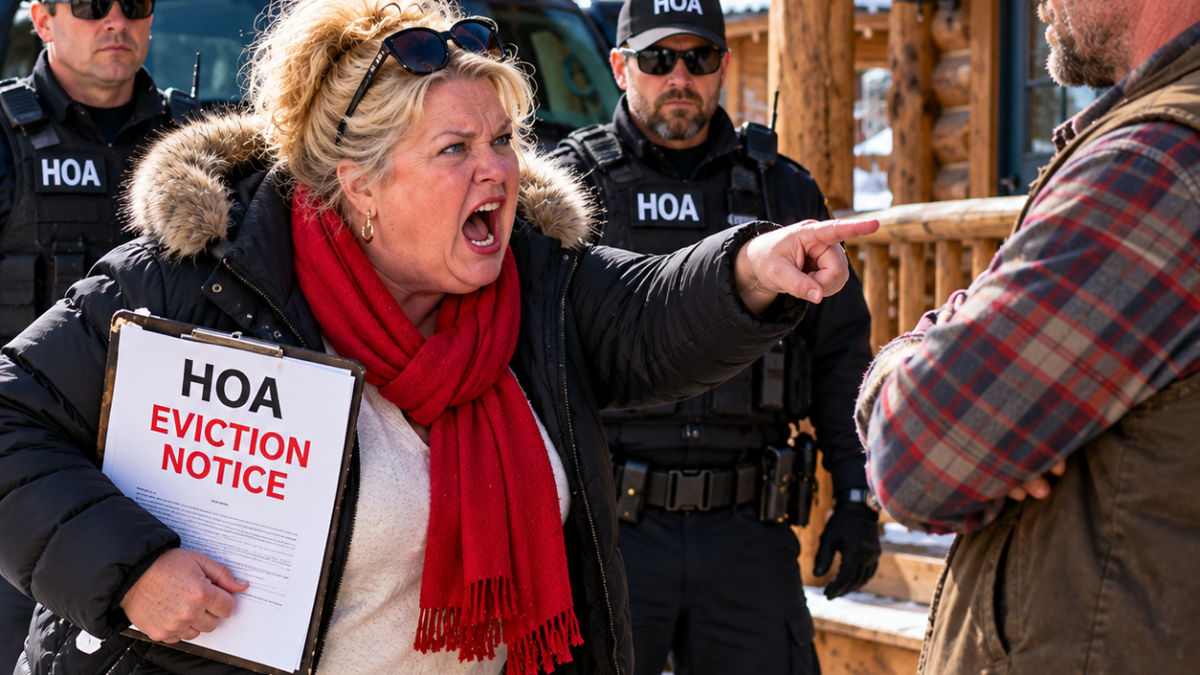
PART 2
I started with the name printed beneath Brennan’s badge.
Pine Ridge Security.
The Colorado business database gave me a result almost immediately.
Pine Ridge Security LLC.
Formed three years earlier.
I opened the corporate filing and read it twice.
Registered agent: Croft Holdings LLC.
My fingers stopped over the keyboard.
I searched Croft Holdings.
The principal owner was Diane M. Croft.
I leaned back slowly.
There it was.
Diane wasn’t merely an HOA president who had hired an overconfident security contractor.
She was financially connected to the company that had just sent two uniformed men to my property.
I printed both records.
Then I carried my coffee into the small room I used as an office and opened the bottom drawer of my filing cabinet.
That was where I kept the documents that mattered.
My deed.
Title insurance.
The original survey.
Closing papers.
Tax records.
I spread everything across the desk.
My five acres sat like an island in the middle of Pine Ridge Estates, but legally it was separate.
The cabin had belonged to a man named Frank Delgado before I bought it. He had owned the parcel since 1987.
Pine Ridge Estates didn’t exist then.
The HOA had been organized years later as the surrounding land was subdivided.
My deed contained no HOA covenant.
No mandatory membership agreement.
No assessment obligation.
No document granting Diane Croft authority over my property.
I already knew that.
I had known it when I bought the place.
But now I needed more than confidence.
I needed a file that somebody else could pick up, read from beginning to end, and understand.
That habit came from twenty-five years as a deputy sheriff.
I had retired three years earlier after spending most of my adult life writing reports, preserving evidence, interviewing people who lied badly and people who lied extremely well.
The job had taught me that being right and proving you were right were two different things.
Diane didn’t know any of that.
Neither did Brennan.
And for the moment, I wanted to keep it that way.
I called Mike Reeves.
Mike and I had worked together for twelve years. By the time I retired, he was on his way up through command.
Now he was a captain.
He answered with, “Gary Reed. I figured the bears finally adopted you.”
“Not yet.”
“You sound serious.”
“I had two fake cops at my door this morning.”
The humor disappeared from his voice.
“Say that again.”
I explained everything.
The uniforms.
Badges.
Fake eviction notice.
Brennan’s language.
The HOA.
Diane.
The corporate records.
Mike listened without interrupting.
When I finished, there was a pause.
“You recorded them?”
“Four angles.”
“Audio?”
“Clear.”
“And what exactly did they call themselves?”
“Officers. Pine Ridge Security.”
“Did either one claim to be sheriff’s office?”
“No.”
“Did they threaten arrest?”
“Not directly. Not yet.”
Mike exhaled.
“Then don’t overstate what you have. Private security can use the word officer in some contexts. The problem is what authority they claimed and what they tried to make you believe.”
“That’s what I was thinking.”
“You want a deputy sent up there?”
“Not yet.”
“Gary.”
“I know.”
“These people showed up at your home.”
“And left.”
“They’re coming back.”
“Which is why I want them talking.”
Mike went quiet.
He knew me well enough to hear what I wasn’t saying.
“You think Diane is keeping herself insulated.”
“I know she is.”
“And you want the instructions traced back to her.”
“Yes.”
“Don’t let the old job make you think you’re still wearing a badge.”
“I don’t.”
“Good. Because you’re the complainant now, not the investigator.”
That stung a little because it was true.
Mike continued.
“Send me copies. I’ll keep them off the formal system unless you tell me you want a report started. But if someone puts hands on you or tries to remove you, you call immediately.”
“I will.”
“Promise me.”
“I promise.”
After we hung up, I uploaded the morning footage to a private folder and sent him access.
Then I called Laura Whitfield.
Laura was a property attorney I had met years earlier through a case involving forged deeds and a family trust dispute. She was the kind of lawyer who could read fifty pages of nonsense and locate the one sentence that mattered.
She answered on the second ring.
“Gary?”
“Are you busy?”
“Always. What happened?”
“I apparently got evicted this morning.”
“You apparently what?”
I told her.
She interrupted three times.
Not because she was impatient.
Because each new fact made the situation stranger.
“Send me the deed.”
“Already scanning it.”
“The survey too.”
“Got it.”
“And the eviction paper.”
“I’m looking at it right now.”
“Court information anywhere?”
“No.”
“Recorded deed reference?”
“No.”
“County clerk stamp?”
“No.”
“Judge?”
“No.”
Laura gave a short laugh.
“That’s not an eviction order. That’s stationery.”
“I figured.”
“What exactly did they say would happen if you remained?”
“They’d come back with additional personnel and ‘assist with the transition.’”
Her voice hardened.
“Do not surrender possession. Do not hand over keys. Do not sign anything. And don’t get cute because you used to be law enforcement.”
“Mike already gave me that speech.”
“Then two competent adults have told you.”
“I’m touched.”
“I’m serious.”
“So am I.”
“I’ll review the chain of title this afternoon.”
I started to thank her.
She stopped me.
“Gary, why do they want the parcel?”
“I don’t know for certain.”
“Guess.”
“Diane tried to buy it twice.”
“How much?”
“First offer was a little below market. Second was better.”
“And you refused?”
“Both.”
“What did she say?”
I repeated the line about everyone eventually cooperating.
Laura became silent.
“Send me everything.”
The email from Diane arrived at 4:07 that afternoon.
The subject line read:
FINAL NOTICE — IMMEDIATE ACTION REQUIRED
I opened it.
The message told me I had until 8:00 the following morning to vacate.
Failure to comply, it said, could result in “immediate enforcement measures,” including physical removal from the property and referral for criminal trespass.
I reread that phrase.
Criminal trespass.
For remaining inside a house I owned.
At the bottom was Diane’s full name and title.
No assistant.
No staff signature.
No plausible way for her later to say she didn’t know.
I forwarded it to Laura.
She called less than five minutes later.
“She signed this herself?”
“Yes.”
“This woman desperately needs better advice.”
“Maybe she thinks she has it.”
“That possibility worries me more.”
“What do you mean?”
“She may have a lawyer telling her what she wants to hear.”
I looked out the office window.
The late afternoon light had turned the pines gold.
“I’m not leaving.”
“I know.”
“I’m not giving them the keys.”
“I know.”
“They’re coming back at eight.”
“Then keep the cameras on.”
“They never go off.”
“Gary?”
“Yeah?”
“Do not provoke them.”
“I won’t.”
“You sound disappointed.”
“I’m retired. I’m allowed hobbies.”
“Find one that doesn’t create exhibits.”
She hung up.
That evening, I cooked dinner and barely tasted it.
I had spent years telling people not to underestimate how unsettling intimidation could be simply because nobody had been physically hurt.
Now I understood it differently.
The violation wasn’t just the threat of losing the cabin.
It was the intrusion.
Knowing strangers believed they could arrive at my home and decide whether I belonged there.
Every time gravel shifted outside, I looked toward the window.
Around nine, I walked through the cabin checking locks I knew were secure.
The living room had a stone fireplace and two deep chairs facing the windows.
My late wife, Ellen, had helped me pick those chairs before she died.
We had talked about moving to the mountains together after retirement.
Cancer changed the schedule.
She never lived here.
But a framed photograph of her sat on my desk, taken on a trip to Estes Park fifteen years earlier.
In the picture, wind had blown her hair across half her face and she was laughing because I couldn’t get the camera timer to work.
Whenever the cabin felt too quiet, that picture made the quiet easier.
I stood in front of it that night.
“This was supposed to be the peaceful part,” I said.
The photograph offered no advice.
At 7:40 the next morning, I made coffee.
At 7:55, I carried it to the porch.
Fog still clung low between the trees.
Every camera was running.
At 8:17, the black SUV appeared.
Same vehicle.
Same men.
But Brennan had changed his equipment.
A pair of handcuffs hung visibly from his belt.
I noticed them before he reached the porch.
Robinson noticed me noticing them.
Brennan stopped at the bottom step.
“Mr. Reed.”
“Morning.”
“Your deadline expired seventeen minutes ago.”
“I’m aware.”
“Have you made arrangements to vacate?”
I took a sip.
“I have questions.”
“This is no longer a discussion.”
“Those handcuffs new?”
Brennan’s right hand moved toward them by instinct, then stopped.
“We’re authorized to detain individuals when necessary.”
“Authorized by whom?”
“The association.”
“The HOA can authorize you to detain homeowners?”
“Individuals violating community rules.”
“On private land?”
“This property is under Pine Ridge jurisdiction.”
“You keep using that word.”
“Because it applies.”
Robinson stared at the ground.
I set my coffee on the porch railing.
“Let me make sure I understand. If I refuse to leave, you’re going to put me in handcuffs?”
“If you refuse a lawful directive, yes.”
“And then?”
“We hold you until law enforcement arrives.”
“Which law enforcement?”
“County.”
“And the county knows you’re doing this?”
Brennan smiled.
“Mr. Reed, Mrs. Croft has a good relationship with local authorities. You’d be smart not to test it.”
That bothered me.
Not because I believed him.
Because people like Brennan relied on statements like that to make ordinary residents feel every door was already closed.
“Can I speak with Diane?”
“Mrs. Croft does not personally negotiate enforcement actions.”
“I thought she signed the order.”
“She authorized it.”
“Then I’d like to hear from the person authorizing my removal.”
Brennan stepped onto the first porch stair.
“You’re running out of chances.”
I looked at Robinson.
“You agree with this?”
His head came up.
Brennan answered for him.
“We both know our responsibilities.”
“I asked him.”
Robinson’s lips parted.
Nothing came out.
Brennan turned slightly.
“Zach.”
One word.
Robinson closed his mouth.
That told me plenty.
I looked back at Brennan.
“I need until tonight.”
“No.”
“I need a moving truck.”
“You should’ve arranged one yesterday.”
“I’m seventy miles from the nearest company that could handle this cabin’s contents on short notice.”
Brennan stared at me.
I let him see an older man trying to bargain for time.
Finally he said, “Six.”
“Tonight?”
“Six p.m. We’ll return. If the property isn’t surrendered, we’ll take whatever steps are necessary.”
“Meaning?”
“You’ll find out.”
He turned away.
Robinson followed.
At the SUV, Robinson stopped for half a second and looked back toward me.
Not pity this time.
Fear.
Not fear of me.
Fear of whatever Brennan had just promised.
I waited until they were gone before going inside.
Then I replayed the footage.
The handcuffs were clear.
So was Brennan’s claim of detention authority.
So was the implication that county law enforcement would support him.
I sent the clip to Mike and Laura.
Mike called first.
“He said what?”
“You heard it.”
“I want a report opened.”
“I agree.”
That surprised him.
“You do?”
“They crossed the line.”
“I’ll send someone.”
“Not yet.”
“Gary.”
“Hear me out. They’re returning at six. I’ve got Laura checking the property side. If you show up now, Brennan says he misunderstood the instructions and Diane blames an employee.”
Mike was quiet.
“You’re trying to establish direction.”
“I want to know who orders the six o’clock action.”
“I hate this plan.”
“So do I.”
“That’s not reassuring.”
“I’m not asking you to approve it.”
“No, you’re asking me not to ruin it.”
“Something like that.”
Mike sighed.
“Call the non-emergency desk before six and make sure there’s an active incident number. If anything changes, you call 911. Not me. Dispatch.”
“I understand.”
“And Gary?”
“Yeah?”
“Cameras are not armor.”
That sentence stayed with me.
Laura called twenty minutes later.
“I found the attempted amendment.”
“What amendment?”
“Last year the board tried to rewrite the Pine Ridge covenants so they could claim authority over all parcels geographically enclosed by the development.”
“Including mine.”
“Especially yours, from the language.”
“Did it pass?”
“The board voted on it.”
“That wasn’t my question.”
“No. It never became effective against your property. They had no consent from you, no covenant attached to your deed, and I’m not finding the filings they would need even for the parcels they actually govern.”
“So Diane knows.”
“Oh, she knows.”
“How sure are you?”
“I found meeting minutes from six months ago.”
I stood up.
“What do they say?”
“Let me read you one line.”
Paper rustled on her end.
Then Laura said, “‘The Reed parcel remains desirable for the proposed community center expansion. Current owner is elderly, isolated, and likely to become receptive if consistent enforcement pressure is applied.’”
For a moment, I didn’t speak.
“Say that again.”
She did.
Elderly.
Isolated.
Consistent enforcement pressure.
It sounded sterile when written in meeting minutes.
That made it worse.
This wasn’t Brennan improvising.
It wasn’t Diane losing her temper because I rejected an offer.
Somebody had discussed pressuring me in a formal meeting.
“How many board members were there?”
“Five, including Diane.”
“Any objections recorded?”
“None.”
“Send it.”
“I already did.”
My inbox chimed.
I opened the attachment and found the highlighted paragraph.
For the first time since Brennan appeared on my porch, anger overtook strategy.
I imagined five people around a table discussing my home as if I were an obstacle on a construction plan.
Not Gary.
Not a neighbor.
Not a property owner.
Elderly and isolated.
A vulnerability.
I closed the document before anger tempted me into doing something stupid.
At 12:31, my phone rang.
Margaret Hollis.
She lived uphill from me and had occasionally brought over bread or vegetables from her garden.
“Gary,” she whispered. “Have you seen the community app?”
“No.”
“You need to.”
“What happened?”
“They posted something about you.”
I logged in.
The announcement was pinned at the top.
SECURITY ALERT — RESIDENTS ADVISED TO AVOID MOUNTAIN VIEW ROAD
Diane had written that I was unlawfully occupying HOA property, refusing official instructions, and had behaved aggressively toward Pine Ridge security personnel.
There was a photograph of me.
Below it was a picture of my cabin taken from the roadside at an angle that made the place look isolated and neglected.
Comments were accumulating.
Some people were frightened.
Some were angry.
A few demanded to know why law enforcement hadn’t removed me.
I stopped reading.
Margaret was still on the phone.
“Gary?”
“I’m here.”
“I don’t believe it.”
“Thank you.”
“I mean, I don’t know what happened, but I’ve known you three years. You helped me replace the culvert pipe last spring.”
“That’s not exactly a character reference.”
“It is to me.”
I smiled despite myself.
“Diane is telling everyone there’s an emergency board meeting tomorrow night.”
“For what?”
“She wants a vote affirming that your land belongs under HOA authority. She’s calling it a community safety matter.”
Of course she was.
If intimidation failed, she would manufacture legitimacy after the fact.
“Margaret, don’t argue with anyone online.”
“I already started typing something.”
“Delete it.”
“But—”
“I mean it. Don’t make yourself a target.”
She was quiet.
“That sounds like something Diane would say.”
The words landed harder than she intended.
I softened my voice.
“Then do what you think is right. Just be careful.”
“I’m tired of being careful around her.”
Before I could answer, she hung up.
I drove into town that afternoon because I needed groceries and, if I was being honest, because I needed to see whether Diane’s story had escaped the development.
It had.
Gary Simmons owned the general store.
For three years he had greeted me with the same joke.
“Morning, Wrong Gary.”
I usually answered, “Morning, Other Gary.”
That day he didn’t smile.
He watched me carry bread, eggs, milk, and coffee to the register.
“You the guy they’re talking about up at Pine Ridge?”
“I’m one of the guys they’re talking about.”
“Heard you threatened security.”
“I didn’t.”
“Heard the cabin belongs to the HOA.”
“It doesn’t.”
He shrugged.
“Just saying what people are hearing.”
I pulled out my wallet.
“Do you want to see my deed?”
His expression changed.
“What?”
“The deed. Survey too. I have copies.”
He glanced toward the two other customers in the store.
“No, that’s your business.”
“That’s the problem, Gary. People are making it their business without checking.”
He rang up my groceries.
Neither of us said anything else.
On the drive home, the Daltons were working in their garden.
Normally Mrs. Dalton waved so enthusiastically you’d think she was guiding airplanes.
That afternoon she saw my truck and immediately looked down.
Her husband went inside.
Three years of small kindnesses disappeared in the space between one social-media post and the next.
I told myself it didn’t matter.
It mattered.
When I reached my mailbox, a certified letter was waiting.
Dennis Pratt.
Attorney at law.
He represented Pine Ridge HOA.
The letter demanded that I vacate within forty-eight hours and threatened civil action seeking at least $100,000 in damages if I continued “unlawful occupancy and harassment of authorized personnel.”
I sent photographs of every page to Laura.
Her response came back almost immediately.
Do not contact Pratt. Do not sign anything. Save envelope.
Then another message appeared.
And Gary? He should know better.
At 5:20, I checked every camera.
At 5:35, I started an additional audio recorder inside the cabin.
At 5:42, I called county dispatch and gave them the existing incident number.
“I’m expecting private security representatives at six,” I explained. “They have threatened to detain me and remove me from property I own.”
The dispatcher confirmed my address.
“Are there weapons involved?”
“None that I’ve seen.”
“Are you armed?”
“I own firearms. They are secured and will remain secured.”
“Good. If the situation becomes physical, call 911.”
“I will.”
At 5:46, I placed my deed and survey inside a waterproof folder on the kitchen table.
At 5:51, I put Ellen’s photograph in the top desk drawer.
I didn’t know why.
Maybe because I didn’t want Brennan seeing it.
At 5:45—fifteen minutes before the deadline—two vehicles came up the gravel road.
The black SUV.
And a silver sedan.
Brennan got out first.
Robinson followed.
The third man wore a charcoal suit and carried a leather briefcase.
Dennis Pratt.
I stepped onto my porch before they could knock.
Pratt gave me a professional smile.
“Mr. Reed. Dennis Pratt. Counsel for Pine Ridge Estates.”
“I know.”
“I understand you received my letter.”
“I did.”
“Then you understand your current position.”
“I understand your client wants my land.”
His smile thinned.
“This isn’t about what anyone wants.”
“Good. Then show me the court order.”
Brennan moved closer.
Pratt held up one hand.
“Mr. Reed, there is a genuine dispute regarding the applicability of Pine Ridge covenants to this parcel.”
“A dispute doesn’t transfer ownership.”
“No one said it does.”
“Your letter says I’m unlawfully occupying it.”
“Because the association’s position is that your continued occupancy violates governing documents.”
“Documents I never signed.”
“That is a matter for adjudication.”
“Exactly. A court.”
Pratt’s eyes narrowed slightly.
“We’re trying to avoid unnecessary litigation.”
“By changing the locks?”
He paused.
That pause was enough.
I looked at Brennan.
“Is that why you’re here?”
Brennan reached toward his belt.
“Last chance.”
I looked up at the camera above the door.
Then spoke clearly.
“For the record, I am the titled owner of this property. I have not consented to leave. I have not authorized anyone to enter my cabin, remove my belongings, change my locks, or detain me.”
Pratt’s face changed.
“You’re recording?”
“Yes.”
“You should have disclosed that earlier.”
“You’re standing under a security camera.”
He glanced upward.
Brennan did too.
Robinson closed his eyes briefly.
Pratt lowered his voice.
“Gary, we can resolve this without theatrics.”
“You came to my house with two men wearing badges.”
“I came with private security.”
“One of whom told me he could put me in handcuffs.”
Pratt turned sharply toward Brennan.
That reaction interested me.
“Rick?”
Brennan’s jaw tightened.
“He refused a lawful directive.”
Pratt looked back at me.
“Mr. Reed, nobody wants a confrontation.”
“Then leave.”
Nobody moved.
I heard wind passing through the pines.
Then Brennan stepped onto my porch.
“Gary Reed, you are being detained for trespassing on Pine Ridge-controlled property.”
He unclipped the handcuffs.
Robinson said, “Rick.”
It was the first time I had heard him challenge Brennan.
Brennan ignored him.
I raised both hands.
“I am not resisting. I do not consent to detention. I am standing on property I own.”
Brennan took my wrist.
His grip was hard.
“Turn around.”
I did.
There are moments when twenty-five years of training fight against every instinct you have as a private citizen.
I knew how easily a tense physical situation could spiral.
I knew the cameras were running.
I knew Mike had an incident number.
So I stayed calm.
Brennan did not fully cuff me.
Instead, he pulled one wrist behind me and walked me off the porch, using the restraint as leverage.
At the edge of the driveway he released me.
Pratt approached.
“Mr. Reed, you’re not under arrest.”
“You might want to explain that to the man holding handcuffs.”
“You are being temporarily excluded while the property dispute is resolved.”
“You cannot exclude an owner without process.”
“That is your legal position.”
“It’s also what my deed says.”
Pratt held out a paper.
I didn’t take it.
“What’s that?”
“Notice of disputed possession.”
“Court filed?”
“No.”
“Then keep it.”
Brennan stepped toward me.
Pratt lifted his hand.
“Enough.”
For the first time, I saw tension between them.
Brennan believed force was the plan.
Pratt wanted the appearance of procedure.
Robinson looked like he wanted to disappear into the trees.
Then Brennan reached toward my shirt pocket.
My phone was recording.
“What are you doing?”
“Securing evidence.”
“You have no authority to seize my phone.”
He took it anyway.
Robinson said, louder this time, “Rick, we shouldn’t do that.”
Brennan turned on him.
“Get inside and start the inventory.”
Robinson did not move.
Pratt said quietly, “Zach. Just document property.”
That got him moving.
For the next twenty minutes, I stood beside the gravel road and watched strangers enter my home.
Brennan changed the front deadbolt.
Robinson carried boxes outside.
Pratt wrote on a clipboard.
My laptop.
Several files.
A wooden document case.
Items from my desk.
I repeatedly stated that I did not consent.
Nobody stopped.
Then another vehicle arrived.
A white BMW.
Diane Croft stepped out.
Cream slacks.
Silk blouse.
Expensive sunglasses pushed into her hair.
She surveyed the scene with the calm satisfaction of someone arriving after the difficult work had already been done.
She walked toward me.
“Mr. Reed.”
“Diane.”
“You made this much harder than necessary.”
“You sent men to remove me from my own house.”
“I offered you a fair price.”
“There it is.”
Her eyes narrowed.
“There what is?”
“The reason.”
She glanced toward the camera over my porch.
For the first time, I saw hesitation.
Then she smiled again.
“I don’t know what story you’ve invented, Gary, but this community has needs. Your parcel sits in the only practical location for the new center.”
“And that gives you ownership?”
“No. It gives us a problem that could have been solved cooperatively.”
“I said no.”
“You refused to even discuss reasonable options.”
“I discussed them. I said no.”
Her expression cooled.
“Sometimes one person’s stubbornness creates consequences for everyone.”
“Is that what the board wrote down? ‘Apply pressure until the old man sells’?”
The smile disappeared.
That was my first confirmation that Laura’s document was real and Diane knew exactly which sentence I meant.
She stepped closer.
“Be careful about repeating things you don’t understand.”
“I understand my deed.”
“You understand a piece of paper.”
“So do courts.”
For half a second, anger broke through her composure.
Then she recovered.
“Your keys.”
Brennan walked over and placed my key ring in her hand.
She looked at them.
Then slipped them into her purse.
The gesture was small.
Almost casual.
It enraged me more than Brennan’s hand on my wrist.
Those were my keys.
My house.
My land.
And Diane placed them in her purse as if she had just collected the keys to a conference room.
“You should have taken the offer,” she said.
Then she turned and walked toward the BMW.
I watched until all three vehicles disappeared.
Only then did I realize how quiet the property had become.
My cabin stood fifty feet away.
Dark.
Locked.
I could see my own chair through the window.
I could see the lamp beside it.
I could not legally force my way in without risking turning a clean case into a confused one before law enforcement arrived.
So I sat on a fallen log.
The sunset was spectacular.
Purple shadows covered the mountains.
Clouds burned orange along the western ridge.
I hated the beauty of it.
A vehicle passed on the lower road.
The Hendersons.
I had helped pull their car from a snowbank the previous winter.
The truck slowed.
The driver looked toward me.
Then continued.
I sat there after dark.
At some point anger drained away and left something worse behind.
Humiliation.
I had spent most of my career helping people regain a sense of control after someone violated their home or property.
I thought I understood.
I had understood the procedure.
Not the feeling.
Footsteps sounded behind me.
I turned.
Margaret emerged from the trees.
She carried a small plastic shopping bag.
“Don’t get up.”
She sat beside me.
“What are you doing here?”
“Being a bad HOA member.”
She handed me the bag.
Inside was a prepaid phone.
“They took yours.”
I looked at her.
“How did you know?”
“I watched from my upstairs window.”
“You saw everything?”
She nodded.
“Diane doesn’t know?”
“I hope not.”
“Margaret, her board controls your water agreement.”
“I know.”
“Then why are you here?”
Her mouth tightened.
“Because what they did was wrong.”
Simple as that.
She handed me a folded slip of paper.
“Some man named Mike Reeves called my house. He was trying to find you.”
I powered on the phone and called.
Mike answered before the second ring.
“Gary?”
“Yeah.”
“What happened?”
“They locked me out.”
His voice changed.
“Start from the beginning.”
I told him everything.
The detention.
Phone.
Locks.
Property removed.
Diane taking the keys.
When I finished, Mike said, “I’m sending deputies.”
I looked toward the cabin.
“Wait.”
“No.”
“Mike.”
“You promised if it became physical—”
“And I called dispatch.”
“Yes, and now I know private actors removed you from titled property after threatening detention. We’re past collecting colorful quotes.”
“There’s a board meeting tomorrow.”
“I don’t care.”
“I do.”
“Gary.”
“I have the deed. Laura has the minutes. I have the corporate records. The whole neighborhood believes Diane’s story. Tomorrow she’s asking them to ratify what happened.”
Mike was silent.
I continued.
“If deputies restore access tonight, she tells everyone this was a technical misunderstanding between lawyers.”
“Let her.”
“Then she does it again to somebody who doesn’t have cameras.”
“That is not your responsibility.”
I knew he was right.
That was the hardest part.
I looked at Margaret.
She was watching me.
“I need one night.”
Mike exhaled slowly.
“You’re asking for something I may not be able to give.”
“I’m asking you not to turn this into a roadside argument before Laura and I put the full evidence together.”
“I’m opening the criminal report tonight.”
“Fine.”
“And I want a deputy to photograph the property.”
“Fine.”
“And you are not sleeping outdoors.”
Margaret said loudly, “He’s staying with me.”
Mike heard her.
“Who is that?”
“My accomplice.”
Margaret rolled her eyes.
Mike didn’t laugh.
“Tomorrow, Gary. No heroics.”
“No heroics.”
After I hung up, Margaret stood.
“Come on.”
“I can stay—”
“No.”
“I’ve slept outside before.”
“You’re seventy-one.”
“I’m sixty-eight.”
“That’s still too old to make stupidity impressive.”
I followed her.
Her cabin was smaller than mine and hidden farther into the timber.
She gave me a blanket, a towel, and the guest room.
“I’m sorry it’s dusty.”
“I’m sorry I brought an HOA conspiracy into your house.”
“That makes us even.”
I barely slept.
Whenever I closed my eyes, I saw Diane dropping my keys into her purse.
At five in the morning I gave up.
Margaret had an old desktop computer in her dining room.
I logged into my cloud account.
Every camera file was still there.
Brennan taking my wrist.
Pratt claiming disputed possession.
Robinson objecting to the phone seizure.
Boxes leaving my cabin.
Diane arriving.
Diane saying my parcel was needed for the community center.
Diane accepting my keys.
I downloaded everything.
At 9:15, Laura arrived carrying a laptop bag and a cardboard file box.
She looked at me.
“You look terrible.”
“Thank you.”
“I spoke to Mike.”
“Everybody’s talking about me.”
“Occupational hazard when you get yourself illegally removed from your house.”
“Please tell me you brought good news.”
She put the box on Margaret’s table.
“I brought documents.”
That was better.
First came my deed and the full chain of title.
Then an official parcel map.
My five acres were clearly separated from Pine Ridge Estates.
Laura tapped the page.
“Frank Delgado acquired the parcel in 1987. Pine Ridge’s declaration was recorded in 2003. Nothing in your chain of title voluntarily brings this land under the association.”
“I knew that.”
“Now everyone else will.”
She pulled out the attempted covenant amendment.
“This is the document Diane may wave around tonight.”
“They’re voting tonight?”
“According to the agenda Margaret forwarded, Diane is asking members to ratify enforcement action and authorize continued possession pending ‘boundary clarification.’”
“Can they retroactively do that?”
“No.”
“Could she make it sound like they can?”
“Absolutely.”
That was the problem.
Laura set down another document.
The meeting minutes.
I read the highlighted paragraph again.
The Reed property is ideal for the proposed community center. Current owner is elderly and living alone. He will likely sell under pressure if we apply consistent enforcement attention.
This time, underneath the paragraph, Laura had marked the vote.
Four in favor.
One abstention.
No opposition.
“I want the names,” I said.
“Later.”
“Why?”
“Because tonight is about Diane’s conduct and your property. If you attack every board member at once, they unite against you.”
“You think one will break?”
“I think one already wants to.”
“How do you know?”
“The abstaining member called me this morning.”
I looked up.
“Who?”
“Thomas Bell.”
I knew the name.
Retired accountant.
Quiet man.
He lived near the entrance.
“What did he say?”
“He says Diane told the board ‘enforcement pressure’ meant ordinary code inspections.”
“You believe him?”
“I believe he’s frightened.”
“That wasn’t my question.”
Laura gave me a tired smile.
“You really did spend too long interrogating people.”
She removed more documents.
Corporate filings connected Croft Holdings to Pine Ridge Security.
Payroll records she had obtained through a board member confirmed Brennan and Robinson worked for the company.
Then came a letter from the county clerk.
No eviction case had ever been filed against me.
No possession action.
No court order.
No judgment.
Nothing.
The eviction existed only on Diane’s letterhead.
I held the clerk’s letter longer than the others.
“This is the simplest piece.”
“Exactly,” Laura said. “That’s why you lead with it.”
“I thought we lead with the deed.”
“No. Diane will argue about boundaries. She cannot argue that a judge signed an order when no case exists.”
Margaret brought coffee to the table.
Laura continued.
“Then deed. Then attempted amendment. Then minutes. Then company records. Then video.”
“Why video last?”
“Because documents make people think. Video makes them feel.”
She was right.
By four in the afternoon, we had a presentation.
No dramatic music.
No captions calling anyone corrupt.
Dates.
Documents.
Video.
Nothing more.
At 5:26, the prepaid phone rang.
Unknown number.
I answered.
“Mr. Reed.”
Diane.
“Hello, Diane.”
“I heard you plan to attend tonight.”
“I do.”
“I think that would be unwise.”
“Why?”
“The board has already reviewed the situation.”
“Then the meeting should be short.”
She ignored that.
“I am willing to give you one final opportunity to resolve this privately.”
“What does privately mean?”
“You withdraw your accusations against security personnel. You confirm that yesterday’s incident was a misunderstanding. We reopen the purchase discussion.”
I looked at Laura.
She was listening.
“How much?”
Diane hesitated.
I didn’t care about the amount.
I wanted her talking.
“One hundred thousand above our previous offer.”
“And if I refuse?”
Her voice cooled.
“The board votes tonight. Once the membership confirms jurisdiction, your options become expensive.”
“Membership can vote itself ownership of my land?”
“That isn’t what I said.”
“Sounded close.”
“You’re not listening.”
“I’m listening very carefully.”
Silence.
Then Diane said, “Gary, nobody wants to ruin your retirement over this.”
I wrote the sentence down.
“Then stop trying.”
She hung up.
Laura stared at me.
“Please tell me that recorded.”
“Margaret’s phone was on speaker recording.”
Margaret raised it.
“Got every word.”
Laura rubbed her forehead.
“You two are becoming a problem.”
Margaret smiled.
“Apparently pressure works.”
At 6:15, Mike called.
“Two deputies and I will be nearby.”
“Uniform?”
“Yes.”
“I don’t want you walking in before I speak.”
“You don’t control that if someone commits an offense in front of us.”
“Understood.”
“You sure?”
“No.”
That was the truth.
For the first time all day, my hands were shaking slightly.
Margaret noticed.
“You okay?”
“I don’t know.”
“You were a deputy for twenty-five years.”
“That doesn’t make this easier.”
“I thought it would.”
“When I wore a badge, I walked into somebody else’s crisis. This one is mine.”
She nodded.
“That makes sense.”
I looked at the box of documents.
“What if they don’t care?”
Laura closed her laptop.
“Evidence doesn’t guarantee courage.”
“That’s comforting.”
“But it gives courage somewhere to stand.”
At 6:42, we drove toward the Pine Ridge community center.
The parking lot was nearly full.
People were still arriving.
Some recognized my truck.
I saw heads turn.
A woman pointed.
A man whispered something to his wife.
I could feel Diane’s story walking ahead of me through the crowd.
Margaret touched my arm.
“Back row?”
“No.”
Laura looked at me.
“Good.”
We entered together.
Diane sat at the front behind a long folding table.
Four board members were beside her.
Dennis Pratt sat to her right.
Brennan stood near the side wall wearing the same black uniform.
Robinson stood ten feet away from him.
When he saw me, his face changed.
Pratt leaned toward Diane and whispered.
Diane looked directly at me.
Then smiled.
Not warmly.
Confidently.
The meeting began at seven.
She moved through two routine items quickly.
Road maintenance.
Snow contractor bids.
Then she folded her hands.
“As everyone knows, Pine Ridge is currently dealing with a serious property enforcement matter.”
People turned toward me.
Diane continued.
“A resident occupying land within our development has rejected repeated attempts to resolve longstanding compliance issues peacefully.”
I almost admired the construction of the sentence.
No lie large enough to challenge immediately.
Just layers of implication.
She described me as uncooperative.
Hostile.
Confused about property boundaries.
She said Pine Ridge Security had conducted a “peaceful temporary possession procedure” after I refused to comply.
Temporary possession procedure.
A phrase manufactured to make taking my keys sound like filing paperwork.
Then she displayed a large map.
My parcel sat in the middle of the development.
“Common sense alone,” Diane said, “shows that this property forms part of Pine Ridge.”
Laura whispered, “Common sense is not a deed.”
I almost smiled.
Diane presented the attempted covenant amendment.
“This clarifying resolution confirms that all parcels within the community boundary are subject to association governance.”
Thomas Bell stared down at the table.
Dennis Pratt watched the audience.
Diane reached the conclusion.
“I am asking the membership tonight to affirm the board’s authority, protect Pine Ridge from ongoing disruption, and authorize legal action necessary to secure permanent community control over the Reed parcel.”
There it was.
Permanent community control.
No longer hidden.
No longer a safety issue.
They wanted the land.
“Before the vote,” Laura said loudly, “the property owner requests time to respond.”
Pratt stood.
“This is a members-only proceeding.”
Margaret immediately rose.
“He’s the person you’re voting to remove from his house.”
Murmurs spread.
Diane lifted a hand.
“Let him speak.”
Pratt turned toward her.
“Diane—”
“He wants a stage. Give him one.”
She looked at me.
“Five minutes.”
I carried my laptop to the front.
Laura carried the file box.
I connected the laptop to the community center projector.
The first image appeared.
Not video.
A white page.
County clerk seal at the top.
I faced the room.
“Yesterday, two men from Pine Ridge Security told me they were executing an eviction order.”
Diane interrupted.
“An HOA enforcement order.”
I nodded.
“Thank you for clarifying.”
That actually hurt her.
Several people shifted.
I continued.
“This letter was issued by the county clerk after my attorney searched the court record.”
I enlarged the important section.
“No eviction case exists.”
Silence.
“No judge has issued an order against me. No possession case has been filed. No court has authorized Pine Ridge HOA, Pine Ridge Security, Diane Croft, or anyone else to remove me from my home.”
Pratt stood.
“Legal process is not limited to—”
Laura spoke from the front row.
“Dennis, sit down unless you want to explain which court supposedly issued the document your clients delivered.”
He looked at her.
“Laura Whitfield.”
“Good evening.”
“You’re representing Mr. Reed?”
“Yes.”
Something in his face changed.
Not fear.
Calculation.
He sat.
I advanced the slide.
My deed.
“My property was purchased legally three years ago from Frank Delgado. Mr. Delgado owned it beginning in 1987.”
Next slide.
Pine Ridge declaration.
“The HOA was formed later.”
Next.
Parcel map.
“My land is surrounded by Pine Ridge. It is not part of Pine Ridge.”
Someone called from the audience, “Then why did the map Diane showed have it inside?”
I looked at Diane.
“That’s a good question.”
Diane stood.
“The association adopted a clarifying amendment.”
I clicked.
Her amendment appeared.
Laura joined me.
“The board voted on this document,” she said. “But it does not place Mr. Reed’s separately titled property under the HOA. He never agreed to membership, no valid covenant was recorded against his parcel, and the board cannot simply vote to acquire jurisdiction over land it does not own.”
Diane’s voice sharpened.
“That is your interpretation.”
Laura nodded.
“Yes. As a property attorney reviewing the recorded chain of title.”
A few people laughed nervously.
Diane flushed.
I advanced the slide.
Meeting minutes.
Six months earlier.
I enlarged the paragraph.
Nobody spoke.
People began reading.
I watched expressions change as they reached the words.
Elderly and living alone.
Likely sell under pressure.
Consistent enforcement attention.
I did not read it aloud.
I let them.
Finally, Margaret said from behind me, “My God.”
Thomas Bell covered his mouth with one hand.
Diane stood quickly.
“That is being taken completely out of context.”
I turned toward her.
“Then give us the context.”
“We were discussing ordinary code compliance.”
“On property you just learned isn’t part of your HOA?”
“I did not just learn that.”
The room changed.
She heard it too late.
I waited.
“You knew?”
Someone near the middle said it.
Diane looked toward the voice.
“I knew there were technical questions.”
I clicked to the next page.
A prior board email Laura had located that afternoon.
Diane writing to Pratt.
Without a voluntary covenant from Reed, direct HOA enforcement may be difficult. Explore acquisition alternatives.
The room erupted.
Pratt stood so fast his chair scraped backward.
“That email is privileged.”
Laura looked at him.
“It came from an HOA board record produced by a board member. Take privilege up with whoever disclosed it.”
Diane turned toward Thomas Bell.
“You.”
Thomas finally looked up.
“No.”
Her gaze moved to the other board members.
Nobody met her eyes.
The certainty in her face began to fracture.
I clicked again.
Pine Ridge Security LLC.
Registered ownership connection to Croft Holdings.
I heard someone say, “She owns security?”
Another voice: “What?”
I spoke.
“Pine Ridge Security is connected through corporate records to Diane Croft’s holding company.”
Diane slammed her palm on the table.
“This is irrelevant.”
“It becomes relevant when the same company sends men wearing badges to remove a homeowner from land the HOA knows may be outside its authority.”
Brennan pushed away from the wall.
“That’s a lie.”
Every head turned.
I looked at him.
“Which part?”
“You were given lawful notice.”
“From a court?”
“From the association.”
“And yesterday you detained me.”
“I escorted you off disputed property.”
“You used handcuffs.”
“I never cuffed you.”
“I didn’t say you completed the cuffing.”
Brennan realized the trap.
His face darkened.
I clicked the video.
The room filled with his own voice from the previous morning.
We’re authorized to detain individuals who refuse lawful orders.
The next clip.
If you don’t cooperate, I have the authority to detain you until proper law enforcement arrives.
Then:
The police in this county are very cooperative with Mrs. Croft.
Mike would enjoy that one.
People turned toward Brennan.
He looked at Diane.
Diane looked at Pratt.
Pratt stared at the table.
I played the next clip.
Six o’clock.
Me standing under the camera.
I am standing on property I legally own. I am not leaving. Any attempt to remove me is without my consent.
Brennan stepped onto the porch.
His hand reached for the cuffs.
Then came the moment he took my wrist.
A woman in the second row gasped.
Brennan shouted, “Turn it off.”
I didn’t.
The next clip showed him taking my phone.
Robinson’s voice was clear.
Rick, we shouldn’t do that.
People looked toward Robinson.
His face had gone pale.
The final video showed Diane arriving.
The room watched her walk toward me.
Watched her tell me the community needed my parcel.
Watched her say I should have taken the offer.
Then Brennan placed my keys in her hand.
On the screen, Diane slipped them into her purse.
The video ended.
Nobody spoke.
Not one person.
I closed the laptop.
That silence was heavier than shouting could have been.
Diane stood behind the table gripping the edge with both hands.
Then she looked at Robinson.
“Tell them.”
Robinson froze.
“Zach,” she said. “Tell them Mr. Reed was hostile. Tell them why security had to act.”
Robinson looked toward Brennan.
Brennan’s expression was a warning.
Then Robinson looked at me.
I saw the same nervous man who had stood on my porch the first morning.
Only now there were more than a hundred witnesses.
“I never heard him threaten anybody.”
Diane stared.
“What?”
Robinson swallowed.
“I never heard Mr. Reed threaten Rick. Or me.”
Brennan stepped forward.
“Zach, shut up.”
Robinson’s shoulders straightened.
“No.”
That one word shifted the entire room.
Brennan took another step.
Robinson backed away.
“I thought the paperwork was real,” he said.
Pratt stood.
“Mr. Robinson, I strongly advise you not to make statements—”
“You told us it was approved.”
Pratt stopped.
Robinson pointed toward Diane.
“She told Rick it was approved.”
Diane’s face drained.
“That is false.”
“No, ma’am.”
His voice was shaking now, but he kept going.
“She told us Mr. Reed was an illegal holdout and the board had authority to take possession until he sold.”
Brennan moved toward him.
“Enough.”
The rear doors opened.
Mike Reeves entered with two uniformed deputies.
Brennan stopped immediately.
The room seemed to inhale as one.
Mike did not look at me first.
He looked at Brennan.
Then Diane.
Then Pratt.
“Everyone stay where you are.”
Diane found her voice.
“What is this?”
Mike held up one hand.
“Captain Mike Reeves, Lamar County Sheriff’s Office. We’re here regarding a report made yesterday involving allegations of unlawful detention, interference with property rights, and removal of personal property.”
Diane looked at me.
“You called them.”
I almost laughed.
“No. You gave them a reason to come.”
Pratt approached Mike.
“I represent the association.”
“Then advise your clients not to interfere while my deputies obtain statements.”
“This is a civil property dispute.”
Mike looked at the projector screen.
“The property issue may be civil. Taking a phone, using restraints, removing property, and changing locks without a court order may present separate issues. We’ll let the appropriate investigators and prosecutors sort out exactly which ones.”
Brennan spoke.
“I acted under legal instructions.”
Pratt closed his eyes.
Mike turned toward him.
“Whose?”
Brennan glanced at Diane.
Nobody missed it.
Diane snapped, “Do not answer that.”
Mike looked back at her.
“Mrs. Croft, you can choose not to speak. You cannot make that choice for him.”
For the first time since I had met her, Diane had absolutely no control over the room.
She tried anyway.
“This meeting is adjourned.”
“No,” Thomas Bell said.
Diane turned.
He rose slowly from the board table.
“I move that the meeting continue under the vice president.”
“You can’t—”
“I can.”
Another board member raised her hand.
“I second.”
The audience erupted.
Diane stared at them.
“You’re making a serious mistake.”
Thomas looked exhausted.
“Maybe. But it won’t be the first one.”
A membership vote followed.
Not on my property.
That question no longer made sense.
They voted to suspend Diane from all HOA authority pending investigation.
The result was overwhelming.
Then they suspended Pine Ridge Security’s contract.
Again overwhelming.
Then Thomas made one more motion.
“All enforcement action against the Reed parcel is rescinded immediately, with the association acknowledging no current evidence of lawful HOA jurisdiction over that property.”
This time, nobody voted against it.
Diane sat through the results with her arms folded tightly.
When the last count was announced, she looked at me.
There was no apology in her face.
Only disbelief.
Not disbelief that the evidence existed.
Disbelief that consequences did.
Deputies separated Brennan, Robinson, Diane, and Pratt for statements.
Laura stood beside me.
Margaret came forward and hugged me before I knew what she was doing.
“I’m sorry,” she whispered.
“For what?”
“For being scared for so long.”
I pulled back.
“You showed up.”
She wiped her eyes.
“Eventually.”
“Eventually counts.”
Mike walked over.
“You done putting on a show?”
“I thought it was tasteful.”
“You are impossible.”
“Did you enjoy the bread-is-buttered comment?”
His face hardened.
“Very much.”
Then his tone changed.
“You ready to go home?”
I looked at him.
“Can I?”
“We have the key issue to resolve.”
“They changed the locks.”
“We know.”
A deputy had already photographed everything.
Diane still had my original keys.
When asked about them, she initially said she didn’t know where they were.
The video ended that argument.
She opened her purse.
My key ring was inside.
Mike took it, documented it, then handed it to me in an evidence bag.
“We’re going to the property,” he said. “Their replacement lock is another matter.”
Brennan had the new deadbolt key.
He surrendered it without speaking.
At 10:41 that night, I unlocked my cabin.
Mike entered first because deputies needed to document the condition.
I followed.
The place looked almost normal.
That was the unsettling part.
Furniture still where I left it.
Coffee cup in the sink.
Blanket folded over the chair.
But drawers were open.
My desk had been disturbed.
Files missing.
Laptop gone.
I opened the top drawer.
Ellen’s photograph was missing.
I stopped.
Laura, behind me, said, “Gary?”
“The picture.”
“What picture?”
“My wife.”
I searched the desk.
Nothing.
The empty rectangle where the frame had stood seemed larger than anything else they had taken.
Mike saw my face.
“We’ll inventory it.”
“It’s just a photograph.”
“It matters if it matters to you.”
I nodded.
That sentence almost broke me.
I sat in my desk chair.
For the first time all day, there was nobody to confront.
No presentation.
No strategy.
No room watching.
Just an empty space on my desk.
Mike rested a hand on my shoulder.
“We’ll find what we can.”
I looked around the cabin.
“I thought getting back inside would feel better.”
“It will.”
“When?”
He shrugged.
“Not tonight.”
He was right.
The criminal investigation took weeks.
Reality after a dramatic confrontation is mostly paperwork.
Interviews.
Copies.
Evidence logs.
Lawyers.
Phone calls.
Waiting.
Robinson obtained his own attorney and began cooperating.
According to what Laura later told me, he admitted Diane had personally directed the enforcement operation through Pine Ridge Security.
Brennan had been the supervisor who handled the physical side.
Pratt’s role became the subject of a separate professional review because investigators wanted to know exactly what he knew about my title before sending the legal demand.
The HOA’s records created additional problems.
Invoices showed significant payments to Pine Ridge Security over several years.
That was not automatically improper.
The undisclosed ownership relationship and approval process were the issue.
Once residents started asking questions, other documents surfaced.
Selective enforcement.
Vendor relationships.
Board decisions made without proper disclosure.
My cabin was not the only problem.
It was simply the problem that had cameras.
Three weeks after the meeting, the local paper ran a short article.
PINE RIDGE HOA PRESIDENT FACES CHARGES AFTER PROPERTY DISPUTE
The article said prosecutors had filed charges against Diane and Brennan connected to the lockout, the detention attempt, and representations made during the supposed eviction.
The exact legal language was less dramatic than neighborhood gossip.
That was fine.
I had learned years earlier that real accountability usually arrived in boring documents.
Brennan was removed from Pine Ridge Security while the case proceeded.
The company lost its HOA contract.
Robinson received reduced exposure after cooperating and providing messages showing Diane had approved the operation.
Pratt’s license came under disciplinary review, and he stopped representing the association.
Diane resigned before the new board could formally remove her.
The HOA office closed for nearly two weeks.
Margaret drove past it one morning and called me.
“There’s a handwritten sign.”
“What does it say?”
“Closed until further notice.”
“That sounds professional.”
“You want a picture?”
“No.”
“Really?”
“I know what a closed door looks like.”
She laughed.
That felt good.
My property was restored immediately after the meeting, but my belongings returned gradually.
Boxes appeared through the sheriff’s office.
Documents.
Laptop.
Desk items.
A pair of binoculars I hadn’t realized they took.
My phone came back in an evidence bag.
Some things were missing.
Including Ellen’s framed photograph.
I reported it.
There was no way to prove who had taken it or whether it had simply been misplaced.
For a while, that bothered me more than I wanted to admit.
I could replace locks.
Print deeds.
Buy another laptop.
But that frame had sat on my desk for years.
One Saturday, I went through an old external drive looking for insurance records.
I found a folder labeled ESTES 2011.
Inside was the original photograph.
Ellen laughing into the wind.
I sat there staring at it.
Same crooked smile.
Same hair across her face.
Same mountains behind her.
I printed a new copy in town.
Gary Simmons was behind the store counter when I came in to pick it up.
He looked at the envelope.
“Photo?”
“My wife.”
He nodded.
Then he said, “Gary, about before…”
I waited.
He rubbed the back of his neck.
“I should’ve asked you what happened.”
“Yes.”
“I heard one side and figured the official people knew better.”
“Yeah.”
“I’m sorry.”
I looked at him.
It would have been easy to make him work harder for forgiveness.
For a few seconds, I wanted to.
Then I thought about how many times in my career I had watched pride turn a simple apology into a permanent feud.
“Thank you.”
He nodded.
“Coffee’s on me.”
“That doesn’t make us even.”
He smiled.
“No. But it’s a start.”
When I returned home, I placed Ellen’s new photograph on my desk.
Not in the exact same spot.
A little closer to the window.
The community’s reaction came slowly.
No parade.
No giant apology letter.
Mostly small things.
Mrs. Dalton started waving again.
The Hendersons stopped one afternoon and asked if I needed help replacing the damaged lock trim.
A card appeared in my mailbox with no signature.
We should have asked questions. We’re sorry.
Others never apologized.
They simply behaved as though nothing had happened.
That irritated me at first.
Then I accepted that embarrassment makes people strange.
Margaret visited one Saturday with lemon bars.
We sat on the porch.
“You know what everyone’s saying now?” she asked.
“I’m afraid to ask.”
“They always knew Diane was trouble.”
I laughed.
“That’s convenient.”
“Isn’t it?”
“You included?”
She considered the question.
“No.”
“No?”
“I knew she scared me. That’s different.”
I appreciated the answer.
She looked across the valley.
“For years, when Diane sent a notice, I paid it. Even when it made no sense.”
“Why?”
“Because she made every disagreement feel expensive.”
That was a good description.
“You weren’t the only one.”
“I know that now.”
She was quiet for a moment.
“People keep calling you fearless.”
“They’re wrong.”
“I told them that.”
I looked at her.
“Thanks.”
She smiled.
“I told them you were terrified and stubborn.”
“That’s more accurate.”
The new HOA election took place six weeks later.
Thomas Bell refused to run for president.
He said he had stayed quiet too long and didn’t think he deserved the role.
I respected him more for saying that than I would have if he had campaigned.
Margaret joined the oversight committee.
The residents hired independent counsel to review the governing documents and vendor contracts.
Pine Ridge Security was replaced by a licensed outside service with a written scope of authority that fit on one page.
Observe.
Report.
Call actual law enforcement when needed.
No invented jurisdiction.
No fake eviction orders.
No private possession actions.
And my property?
The new board sent me a certified letter.
One page.
It acknowledged that my five-acre parcel was outside the association.
No caveat.
No threat.
No “pending clarification.”
I framed that too.
Laura saw it during a visit.
“You frame strange things.”
“I’m retired.”
“That explanation is doing a lot of work.”
We stood on the porch.
She had come to tell me the association was formally abandoning the community-center plan for my land.
“You keeping the cabin forever?” she asked.
“That’s the plan.”
“You could probably sell it for a fortune now.”
“I’ve had offers.”
“I know one.”
I looked at her.
She smiled.
“Too soon?”
“Very.”
Autumn arrived early that year.
The aspens turned yellow along the ridge.
Fog returned to the valley in the mornings.
One day, almost exactly a year after Diane first visited with her purchase offer, I woke before sunrise.
I made coffee.
Then I heard an engine on the gravel road.
For half a second, my body reacted before my mind did.
I set down the mug.
Looked toward the camera monitor.
A white pickup was approaching.
No black SUV.
No fake badges.
The truck stopped near my mailbox.
Margaret climbed out carrying something long and wooden.
I opened the door.
“What are you doing here at six in the morning?”
“Committee business.”
“What committee meets at six?”
“The one avoiding everyone else.”
She held up the object.
A new property marker sign.
PRIVATE PARCEL — NOT PART OF PINE RIDGE HOA
I stared at it.
“You’re kidding.”
“Independent counsel suggested clear boundary signage.”
“You actually approved this?”
“Unanimously.”
She smiled.
“Apparently people are very interested in property lines now.”
We installed it beside the gravel entrance.
Margaret stepped back.
“Too much?”
“Probably.”
“Want me to take it down?”
“No.”
We stood there in the cold morning air.
Fog rolled between the pines.
My cabin lights glowed behind us.
A year earlier, two men had driven through that same fog believing a uniform, a badge, and an official-looking piece of paper would make me surrender my home.
Diane had believed isolation made me weak.
Brennan had believed confidence created authority.
Pratt had believed legal language could make people stop asking questions.
For a while, all of them were almost right.
That was the part I remembered.
Not the meeting.
Not the charges.
Not Diane’s face when the vote turned against her.
I remembered sitting on that fallen log outside a locked house and realizing how easily a person could start doubting something he knew was true when enough people insisted otherwise.
The cabin had always been mine.
The deed said so.
The survey said so.
The county records said so.
But when uniformed men took my phone, changed my locks, neighbors looked away, and an entire organization repeated the same false story, certainty became work.
That was what they had counted on.
Not law.
Exhaustion.
Margaret brushed dirt from her gloves.
“Coffee?”
“I thought you’d never ask.”
We walked toward the porch.
Before going inside, I looked back at the new sign.
Beyond it, the fog was beginning to lift.
Sunlight touched the upper branches first, then worked slowly down through the trees until the gravel road appeared again.
On my desk inside, Ellen’s photograph caught a thin strip of morning light.
My keys rested beside it.
The same keys Diane Croft had once slipped into her purse as if my home had already become hers.
I picked them up before carrying two mugs onto the porch.
They made a small metallic sound in my hand.
Nothing dramatic.
Just keys.
Exactly where they belonged.
[END OF STORY]





