PART 2: Fake Cops Tried to Throw Me Off My Family Ranch—They Had No Idea I’d Spent 30 Years Protecting Deeds
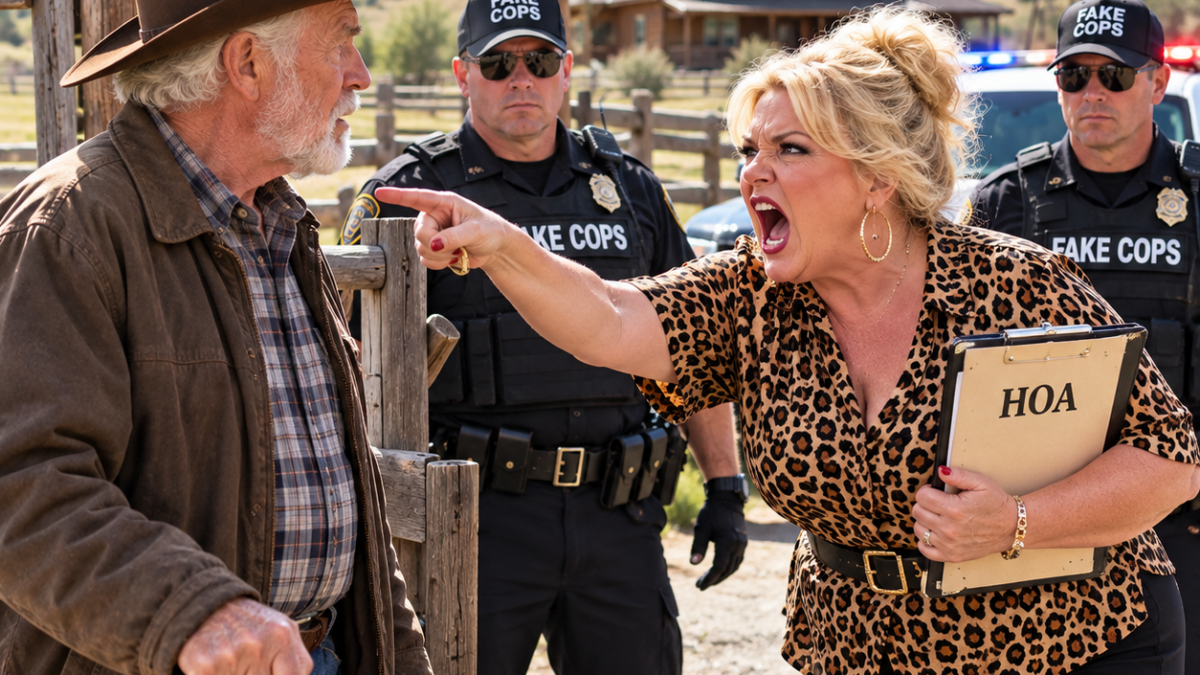
PART 2
I did not go back that afternoon.
That was the first decision that probably saved me.
Twenty years younger, I might have returned to the gate with the deed in my hand and anger in my voice.
At seventy-two, I understood that knowing you are right does not automatically make confrontation wise.
Evidence first.
Always.
I drove twenty minutes outside Cedar Hollow and checked into a motel that looked as though it had survived several decades without renovation.
The carpet had stains.
The neon VACANCY sign flickered.
The lock on the door made me trust a chair wedged under the handle more than the deadbolt.
But nobody there knew me.
That mattered.
I carried the metal box inside.
Set it on the bed.
Opened it.
The deed was exactly where I remembered.
Hall Ranch.
Ownership:
Madison Hall.
No transfer.
No sale.
No deed conveying ownership to Arthur.
No document naming Gloria.
I had paid the property taxes automatically through the same Cedar Hollow bank account for decades.
Unless someone had somehow filed something I had never seen, I was still the owner.
But a lifetime in records had taught me a second lesson.
What you possess is only half the story.
You need to know what everybody else filed.
At 8:30 the next morning, I walked into the Cedar Hollow County records office.
The building had changed.
New counters.
New computers.
Same smell.
Paper, toner, old files, air conditioning turned slightly too cold.
For thirty years, that smell had meant work.
Now it meant war.
The young clerk behind the counter smiled.
“Can I help you?”
“I need the full chain of title and all filings associated with Route 7, Cedar Hollow, Hall Ranch.”
She typed.
Then looked at me.
“Name?”
“Madison Hall.”
Her fingers stopped.
She looked at the screen again.
Then at me.
“Do you have identification?”
I handed it over.
She checked.
Her expression changed.
“Sir…”
“What?”
“The deed still lists you.”
Relief hit me so quickly I nearly had to grab the counter.
“Still?”
“Yes.”
“So there has been no transfer.”
“Not according to the deed record.”
“Anything else?”
She hesitated.
That hesitation told me there was.
“What?”
“There’s an affidavit.”
“Show me.”
She turned her monitor slightly.
Seven years earlier.
Filed by Gloria Peterson.
An affidavit identifying herself as an authorized property manager acting on behalf of Arthur Hall, son of the owner.
It had been used to redirect correspondence.
Tax notices.
Property-related mail.
Administrative contacts.
I read every line.
“This isn’t valid.”
The clerk swallowed.
“I can only tell you what was filed.”
“I never gave Arthur power of attorney.”
She nodded.
“I never gave Gloria authority.”
Another nod.
“Did this change ownership?”
“No.”
“Then what did it change?”
“Contact information.”
“Billing?”
“Yes.”
“Mailing?”
“Yes.”
“Anything else?”
“There are supporting filings.”
“Print everything.”
Her eyes widened.
“Certified?”
“Every page.”
She disappeared into the back.
I stood there thinking.
That affidavit had not stolen my deed.
It had done something more subtle.
It had made Gloria the person receiving information about my property.
If notices went to her instead of me, she could control what I knew.
If agencies called, they called her.
If local officials had questions, she answered.
She had not taken the ranch on paper.
She had taken the flow of information around it.
That was smart.
Dangerously smart.
The clerk returned with a thick packet.
I paid.
Then asked:
“Who accepted this affidavit?”
She glanced around.
“Sir, I really can’t—”
“I’m not asking for gossip.”
I kept my tone gentle.
“I’m asking whose office processed it.”
She found the stamp.
Former deputy clerk.
A man I knew.
Retired now.
I filed that away mentally.
“Is there anything else under Gloria Peterson?”
She typed.
Her face tightened.
“I think you should speak to an attorney.”
“That many?”
She printed.
Property-management filings.
Mailing changes.
Documents referencing Arthur.
Nothing that legally transferred my ranch.
Enough to make someone who did not understand title history believe Gloria had authority.
I thanked her.
Outside, I sat in the truck.
The sensible thing was to call counsel.
File challenges.
Stay away from Gloria.
Instead, I made my first emotional mistake.
I drove back to the ranch.
She was waiting.
That told me she knew I had visited the records office.
Gloria stood behind the gate wearing cream slacks and a dark blouse.
She had aged.
So had I.
The last time I saw her, she was still married to Arthur.
They fought constantly.
Separated.
Reconciled.
Separated again.
She always had the ability to make any disagreement sound as if everybody else had failed her.
Behind her stood the same two men.
Same uniforms.
Same fake badges.
Gloria smiled.
“Madison.”
I stopped outside the gate.
“I was hoping you’d come back.”
“Were you?”
“We need to talk.”
“Open the gate.”
Her smile disappeared.
“No.”
“It’s my ranch.”
“Not anymore.”
I took out one certified deed copy.
“County says otherwise.”
The older security man shifted.
Gloria barely glanced at the document.
“Paper doesn’t tell the whole story.”
I almost laughed.
“In my experience, it tells quite a bit.”
Her eyes sharpened.
“You always did hide behind paperwork.”
“I spent thirty years maintaining public records.”
“And ten years abandoning your family.”
There it was.
The story.
“What did you tell people?”
“The truth.”
“Which version?”
Gloria stepped closer to the gate.
“Do you know what Cedar Hollow thinks of you?”
“I’m beginning to learn.”
“They think you left Margaret when she was dying.”
My entire body went still.
“That is a lie.”
“They think you ran to Oregon with another woman.”
“My sister.”
“They don’t know that.”
“You do.”
Gloria smiled.
“That’s the problem with disappearing, Madison.”
“I didn’t disappear.”
“You were gone.”
“For Eleanor.”
“You expect people to believe that?”
“I have death certificates.”
Her smile faltered.
“Medical records.”
She recovered.
“Then people will say you chose your sister over your son.”
“Where is Arthur?”
Something moved across her face.
Fast.
I almost missed it.
“Arthur doesn’t want to see you.”
“Let him tell me.”
“He has.”
“No, you have.”
She leaned closer.
“Your son hates you.”
I forced myself not to react.
“Open the gate.”
“No.”
“Then bring Arthur outside.”
“Leave.”
I held up the deed.
“I am not surrendering my property.”
Her expression hardened.
Then her voice dropped.
“Let me explain what happens if you keep this up.”
I waited.
“You are seventy-two.”
“So?”
“You’ve been gone for ten years.”
“And?”
“People already believe you’re unstable.”
“Because you told them.”
“Because your behavior supports it.”
I almost smiled.
“Standing outside my own gate?”
“Showing up repeatedly.”
“Twice.”
“Claiming ownership of a property managed by your family.”
“Owned by me.”
She ignored that.
“I have people prepared to testify that your mental condition has deteriorated.”
That landed harder.
“What people?”
“Professionals.”
“What professionals?”
“You don’t need to know.”
“Doctors?”
She smiled.
“If necessary.”
“You have never attended a medical appointment with me.”
“That won’t matter as much as you think.”
Then she said the word that made everything clear.
“Guardianship.”
I stared.
Gloria continued.
“If you keep harassing me, I’ll petition the court.”
“For what?”
“Emergency guardianship.”
“Based on?”
“Cognitive decline.”
My anger vanished.
Not because I was less angry.
Because anger became clarity.
This was not an improvised threat.
She had a strategy.
A legal one.
Or something that looked legal enough to frighten an elderly person.
Gloria leaned closer to the bars.
“You leave Texas.”
I said nothing.
“You stop contacting Arthur.”
Silence.
“You stop claiming this property.”
I watched her.
“And I don’t ask a judge to have you declared incompetent.”
Behind her, the younger fake officer smiled.
Gloria continued.
“You want to spend your remaining years in peace?”
“Very much.”
“Then go.”
I looked at the two men.
The older one stepped forward.
“Mr. Hall, yesterday’s incident has been documented.”
“By which agency?”
He hesitated almost imperceptibly.
“Proper channels.”
“What agency?”
“Don’t play games.”
“I asked a simple question.”
His jaw tightened.
“You show up again, we’ll perform a citizen’s arrest and turn you over to county authorities.”
The younger one added:
“You really want court dates at your age?”
I studied his wrist.
His sleeve had shifted.
Tattoo.
Stylized eagle.
Letters beneath.
PGS.
I knew I had seen it somewhere.
Billboard.
A private security company.
Patriot Guardian Services.
I nodded.
“I understand.”
Gloria looked suspicious.
“That’s it?”
“I’ll leave.”
She relaxed.
“Good.”
I turned.
Then stopped.
“One question.”
“What?”
“Arthur.”
Her shoulders tightened.
“I want to hear him say he wants me gone.”
“He does.”
“Then let him tell me.”
“No.”
“Why?”
“He isn’t here.”
“Where is he?”
“That is none of your business.”
“He is my son.”
“He stopped being your responsibility a long time ago.”
Not answer.
I walked back to the truck.
My dash cam recorded the entire exchange.
That night, I watched it repeatedly.
Gloria’s threats.
Guardianship.
The fake officers.
The PGS tattoo.
Then my phone buzzed.
Unknown number.
Two lines.
**Grandpa, don’t believe anything she says.**
**I’m sorry.**
Grandpa.
Not Dad.
For one second I didn’t understand.
Then I realized it was not Arthur.
It had to be someone younger.
My grandson?
No.
Arthur had no children.
Then perhaps a typo.
Or a borrowed phone.
Before I could process it, the message vanished.
Deleted.
But thirty years behind a government counter had given me reflexes when information appeared unexpectedly.
Screenshot.
Already saved.
I stared at it.
Whoever sent it had access to something connected to Arthur.
Maybe Arthur himself using an account not his own.
Maybe someone helping him.
What mattered was the second line.
I’m sorry.
Somewhere behind Gloria’s wall of silence, someone was trying to reach me.
I barely slept.
The next morning, I went into Cedar Hollow.
I needed people.
Witnesses.
Friends.
The town looked the same.
Brick storefronts.
Flags.
Church steeple.
Martha’s Diner.
Margaret and I had eaten there every Sunday for twenty years.
I walked in.
Bell chimed.
Conversation stopped.
Not slowly.
All at once.
Martha looked up.
Gray hair now.
Same eyes.
She stared.
“We don’t want trouble.”
I stood near the door.
“Martha.”
“Please.”
“We’ve known each other forty years.”
“That was before.”
“Before what?”
She looked toward the customers.
“Just go.”
“What did Gloria tell you?”
Her mouth tightened.
“I said go.”
A man I had known since high school whispered something to his wife.
She looked at me with disgust.
That hurt more than Gloria.
Gloria was an adversary.
These people were memory.
I left.
Outside, I sat in the truck for several minutes.
Then drove to First National.
My bank since 1978.
The young banker who met me was perhaps thirty.
He typed my information.
Then stopped.
“Mr. Hall?”
“Yes.”
“There have been ownership changes on the account.”
“What changes?”
“Converted to joint ownership.”
“When?”
“Six years ago.”
“With whom?”
“Arthur Hall.”
I could accept that possibility.
Maybe paperwork I had forgotten?
“Anyone else?”
“Authorized signatory.”
“Name?”
The banker swallowed.
“Gloria Peterson.”
My hands went cold.
“Balance?”
He hesitated.
“Current available balance?”
“Yes.”
“$47.32.”
For several seconds, I could not understand the number.
“Say that again.”
“Forty-seven dollars and thirty-two cents.”
I stared at him.
That account had held more than eighty thousand dollars.
My savings.
Margaret’s life-insurance proceeds.
Emergency money.
Money I had never needed while caring for Eleanor because her estate covered most expenses.
“Transaction history.”
“Sir—”
“Print it.”
“I’m not authorized to release the full record without additional verification because of the joint ownership status.”
“My name is on the account.”
“Yes.”
“Then verify me.”
“There are restrictions.”
“Imposed by whom?”
“I really think you should speak with legal counsel.”
Fear.
Again.
“What are you afraid of?”
“I’m not afraid.”
“You won’t look at me.”
He did then.
His expression answered.
Everyone knew Gloria.
Everyone had learned not to provoke her.
I left with a partial statement and instructions for obtaining the rest.
By sunset, anger had turned into exhaustion.
Then I pulled into the motel.
Their black sedan was waiting.
No uniforms this time.
Black tactical clothing.
No badges.
The older man stepped away from the car.
“Mr. Hall.”
I stopped several yards away.
“What?”
“Forty-eight hours.”
“For?”
“To leave Texas.”
I slipped my hand into my jacket.
My phone.
Record.
“What happens after forty-eight hours?”
He smiled.
“We stop trying to be helpful.”
The younger man walked behind me.
I did not turn.
The older one continued.
“Back roads can be difficult for elderly drivers.”
I stared.
“What does that mean?”
“Old vehicles fail.”
The younger one said:
“Things happen.”
“Are you threatening my truck?”
“We’re advising you.”
“About mechanical failure?”
“About reality.”
I deliberately made them explain.
“What reality?”
The older man stepped closer.
“The reality where people who don’t know when to walk away have bad luck.”
I kept my breathing slow.
“You’re telling me something may happen if I stay.”
He tapped my chest once.
“Forty-eight hours.”
I stepped back.
The younger man laughed.
Then they left.
The moment their taillights disappeared, I stopped the recording.
Five minutes.
Clear audio.
I uploaded it immediately.
Cloud.
Second cloud.
Email to myself.
Separate storage.
Evidence is useless if somebody can erase the only copy.
That thought bothered me.
Because for the first time, I understood this might be physically dangerous.
Not dramatic danger.
Real danger.
Men willing to impersonate officers had already crossed one serious line.
They had now used language designed to make me fear an “accident.”
I locked myself inside the motel.
At 11:47 that night, the phone rang.
Unknown number.
“Madison.”
I knew the voice.
“Bill.”
Long silence.
“I’m sorry.”
“For what?”
“The window.”
“You saw me.”
“Yes.”
“And hid.”
“Yes.”
“Why?”
His voice broke.
“Because I’m scared.”
Bill Thompson.
My friend for fifty years.
A man who had once driven through a thunderstorm at two in the morning because Margaret called saying our generator had failed.
Scared.
“What happened here?”
“I can’t say on the phone.”
“Bill.”
“Tomorrow. Six a.m.”
“Where?”
“Margaret’s grave.”
That stopped me.
“Come alone.”
“Bill—”
“Please.”
Click.
I walked to the motel window.
Pulled the curtain a fraction.
Black sedan.
Far end of the lot.
Dark.
Then a tiny orange flare.
Cigarette.
Someone watching.
I let the curtain close.
Forty-eight hours.
Six a.m.
Margaret’s grave.
I slept in my clothes.
At 5:20, I left by the side stairwell.
Not because I fancied myself some spy.
Because someone was watching the front.
I walked two blocks.
Called a local cab from a gas station.
Got dropped near the cemetery.
Then approached on foot.
Bill stood beside Margaret’s headstone.
Fresh flowers.
White lilies.
Her favorite.
I stopped.
“You?”
“Every month.”
My throat closed.
“For ten years?”
Bill nodded.
“Someone needed to.”
I looked at the grave.
**MARGARET HALL**
Wife.
Mother.
Beloved.
I placed one hand against the stone.
Then turned.
“Tell me everything.”
Bill looked toward the road.
Then began.
“Gloria came right after you left.”
“How soon?”
“Weeks.”
“Arthur?”
“With her.”
“Voluntarily?”
“At first, maybe.”
Bill shook his head.
“She had documents.”
“What documents?”
“Power of attorney.”
“Fake.”
“I know that now.”
“What else?”
“Letters with your signature.”
“Forged.”
“She said you had asked her and Arthur to manage everything.”
“Why would people believe it?”
“Because you were gone.”
That simple.
Absence creates empty space.
Someone else filled mine.
“What happened next?”
“She started telling people Margaret had died alone.”
My jaw tightened.
“That you left before she passed.”
“I held her hand.”
“I know.”
“Then why didn’t you say something?”
Bill looked ashamed.
“At first I did.”
“And?”
“Gloria said grief had damaged you.”
“She was saying that ten years ago?”
“Yes.”
“Why?”
“So if you came back…”
He didn’t finish.
My stomach turned.
She had been building the instability story before I returned.
“What about Arthur?”
Bill reached into his coat.
Photograph.
Three years old.
Gas station in Tucson.
Arthur.
Thin.
Beard.
Eyes hollow.
My son looked fifty-five going on eighty.
I almost dropped the photo.
“Where?”
“Tucson.”
“You saw him?”
“Yes.”
“What did he say?”
Bill’s voice lowered.
“He grabbed me.”
I could almost see it.
“He said, ‘Don’t trust her. She has something on me. I can’t get out.’”
“What happened?”
“A man came.”
“Who?”
“Big fellow. Security type.”
“Patriot Guardian?”
“I didn’t know the name.”
“What did he do?”
“Put his hand on Arthur’s shoulder.”
Bill looked sick.
“Walked him away.”
“You let him?”
“I didn’t understand.”
I stared at him.
“Madison…”
“You left my son with him.”
“I was afraid.”
“So was Arthur.”
“I know.”
Anger surged.
Then faded.
Bill had spent ten years afraid.
I could punish him with words.
Wouldn’t change anything.
He handed me an address.
Tucson.
“Where did this come from?”
“Arthur slipped it to me.”
“Three years ago?”
“Yes.”
“And you’re giving it to me now?”
His eyes filled.
“I’m sorry.”
I pocketed it.
“Anything else?”
Bill nodded.
“People who questioned Gloria got visits.”
“Fake cops?”
“Men in uniforms.”
“Who?”
“Mrs. Henderson asked about ranch records.”
“What happened?”
“Her barn burned.”
“Was it proven connected?”
“No.”
Good.
I would not turn suspicion into fact.
“Tom Garrett?”
“Destroyed mailbox. Repeatedly.”
“Any proof?”
“No.”
Again.
Keep categories separate.
Known.
Suspected.
Rumor.
That discipline had protected me in government.
It would protect me now.
I went back to the motel.
Created a master file.
Category one:
Property.
Certified deed.
Fraudulent affidavit.
Mail redirection.
Category two:
Financial.
Joint-account change.
Gloria signatory.
Missing savings.
Category three:
Impersonation.
Dash-camera footage.
Fake “Texas State Police” badges.
PGS tattoo.
Category four:
Threats.
Gate conversation.
Motel audio.
Category five:
Arthur.
Deleted message.
Tucson address.
Bill photograph.
Possible coercion.
Then I researched Patriot Guardian Services.
Professional website.
Flags.
Eagles.
Language about protection.
“Dispute resolution.”
“Asset security.”
Several complaints.
Allegations of aggressive behavior.
Claims of impersonation.
No convictions that I could find.
That distinction mattered.
Complaints are not proof.
But patterns tell you where to look.
I needed law enforcement.
Not Cedar Hollow.
Too many people seemed intimidated.
I called Jordan Johnson.
Neighboring county sheriff.
Friend since high school.
He answered.
“Madison Hall?”
“Still alive.”
“Barely, judging by your voice.”
“Need help.”
He stopped joking.
I told him everything.
At “Texas State Police,” he interrupted.
“What?”
“That’s what their badges say.”
“Madison, there is no agency by that name.”
“I know.”
“Video?”
“Yes.”
“Clear?”
“Yes.”
“Threats?”
“Audio.”
“Property fraud?”
“Documents.”
“Arthur?”
“Possibly being controlled in Arizona.”
Long silence.
Then:
“I know somebody.”
“Who?”
“Federal agent in Austin.”
“What unit?”
“Elder fraud and financial exploitation.”
“Name?”
“Tyler Richardson.”
“Can you trust him?”
“Yes.”
“Then call.”
“Madison?”
“What?”
“Do not play hero.”
I almost laughed.
“At seventy-two?”
“You’ve always been stubborn.”
“Different thing.”
“No, it’s not.”
He promised to contact Richardson.
Hope appeared.
I distrusted it immediately.
Hope makes people assume rescue is already on the way.
It wasn’t.
So I backed everything up again.
Then at 9:47 that night:
Another message.
This one stayed.
**Grandpa, I’m at 1847 Mesa Drive, Tucson.**
Then:
**She controls me with something I did when I was drinking.**
And:
**I don’t know how to get out. Please help me.**
Photo attached.
Arthur.
Concrete room.
Fluorescent light.
Cot.
He looked frightened.
The word “Grandpa” still made no sense.
Then I noticed the messaging account.
It belonged to the teenage son of one of Arthur’s old friends.
Maybe borrowed.
Maybe someone helping.
I didn’t care.
The image metadata and account needed to be preserved.
I saved everything.
Called Jordan.
Sent copies.
Then sat on the edge of the bed.
Tucson was fourteen hours away.
Every instinct in me said:
Go.
Drive.
Get your son.
But what if Gloria expected that?
What if I abandoned the Texas evidence?
What if the address was monitored?
What if I walked into something that put Arthur in greater danger?
I had spent my whole career telling frightened people:
Do not improvise when trained investigators are involved.
Now I hated my own advice.
At three in the morning, I decided to stay.
It felt like betraying Arthur.
I told myself:
A few days.
Build the case.
Let Richardson coordinate with Arizona.
Then bring him home.
That decision haunted me even after everything ended.
Parents like to imagine love always gives you a clear answer.
It doesn’t.
Sometimes love offers two terrible choices and asks which one causes less harm.
Around noon the next day, Bill called.
Panicked.
“Town hall.”
“What?”
“Gloria’s holding a meeting.”
“When?”
“Seven.”
“About what?”
“You.”
Of course.
Flyers.
My photograph.
Warnings.
Mental instability.
Threatening behavior.
“Mandatory attendance strongly encouraged.”
That phrase almost made me smile.
Gloria didn’t merely want me gone.
She wanted the town to believe my disappearance would be good.
I had two options.
Stay hidden.
Or show up.
I chose the town hall.
Not because I believed I could win the crowd.
Because if Gloria spoke publicly, I wanted a record.
I wore a small audio recorder.
The dash camera stayed in the truck.
Copies of evidence remained elsewhere.
If they took what I carried, they would not take everything.
Nearly a hundred people filled the hall.
I entered through the back.
Gloria stood at the podium.
Navy suit.
Carefully worried expression.
The fake officers guarded a side door.
She was already speaking.
“Ten years ago, Madison Hall abandoned his family.”
Murmurs.
“He left Margaret while she was dying.”
My hands curled.
“He chose another woman in Oregon.”
Lie.
“Arthur begged him to return.”
Lie.
“Now he has come back confused.”
Lie.
“Angry.”
Debatable.
“And threatening.”
Lie.
“He believes property that now belongs to Arthur and me is still his.”
I almost stepped forward.
Stopped.
Let her finish.
“He needs help.”
That was clever.
Not evil old man.
Sick old man.
Any denial could become evidence of confusion.
Then she said:
“I am afraid for my safety.”
People nodded.
People I knew.
People who attended Margaret’s funeral.
People who once voted for me when I ran for clerk.
I walked forward.
Someone saw me.
Whispers moved through the room.
Gloria pointed.
“That’s him.”
I stopped about ten feet from the podium.
“My name is Madison Hall.”
My voice sounded older than I wanted.
“I was born in this county.”
Nobody interrupted.
“I served thirty years as your county clerk.”
Several people looked down.
“Margaret Hall was my wife for forty-seven years.”
I looked at Martha.
“She did not die alone.”
Martha’s eyes shifted.
“I was with her.”
Silence.
“After she died, I went to Oregon to care for my sister Eleanor, who had cancer.”
I held up a folder.
“I can prove that.”
Gloria leaned toward the microphone.
“See?”
I stared at her.
“This is what happens when someone lives in the past.”
A few people shifted.
I continued.
“The ranch is still deeded to me.”
“False.”
“I have a certified deed.”
“Outdated.”
“Ownership records are current.”
Gloria smiled sadly at the crowd.
“He doesn’t understand.”
I held up the fraudulent affidavit.
“This document was filed by Gloria seven years ago.”
Her eyes changed.
“It does not transfer ownership.”
She interrupted.
“You are harassing me.”
“It only redirected information.”
“Officers?”
The two men moved.
I looked at the crowd.
“These men are not police officers.”
That got attention.
The younger one grabbed my arm.
Fast.
“Enough.”
I felt my shoulder pull backward.
Cold metal around one wrist.
Then the other.
The crowd gasped.
“Do not resist,” the older man said loudly.
I didn’t.
“Ask them which department.”
Gloria shouted:
“Remove him.”
I looked at Martha.
“Ask them!”
Nobody did.
They marched me outside.
The worst part was Bill.
He stood near the back.
Our eyes met.
He looked away.
Again.
They placed me in the rear of the black sedan.
Not a police cruiser.
No cage.
No markings.
The older man drove.
Twenty minutes.
Out of town.
Abandoned gas station.
They removed me.
Took the cuffs off.
The younger man held out his hand.
“Phone.”
“No.”
He stepped closer.
“Don’t make this difficult.”
I gave it.
They had no idea most evidence was backed up.
The older one said:
“Deadline’s over.”
I said nothing.
“Next time we don’t bring you back.”
I looked directly at him.
“Is that a threat?”
“It’s advice.”
“About what?”
He smiled.
“Leave.”
They drove away.
I stood in darkness.
No phone.
No vehicle.
No nearby house.
I sat on the curb.
I felt seventy-two.
Not brave.
Not strategic.
Just old.
Humiliated.
Cold.
For the first time, I wondered if Gloria would win simply because I was too tired.
Then headlights appeared.
Bill.
He pulled up.
“Get in.”
I didn’t move.
“Madison.”
“You looked away.”
“I know.”
“You let them take me.”
“I followed.”
That stopped me.
“You followed?”
“From far back.”
He opened the passenger door.
“Get in.”
I did.
He drove.
“Jordan called.”
“What did he say?”
“FBI is officially involved.”
I turned.
“Richardson?”
“Yes.”
“When?”
“Twenty minutes ago.”
“Arthur?”
Bill gripped the steering wheel.
“They found him.”
Everything inside me stopped.
“Alive?”
“Yes.”
“Safe?”
“Yes.”
“Where?”
“Federal agents coordinated with authorities in Arizona.”
I closed my eyes.
Arthur.
Safe.
Bill continued.
“He wants to testify.”
I covered my face.
Ten years.
Ten years of silence.
For the first time, I let myself cry.
Not much.
Just enough.
Bill drove me to his farmhouse.
Jordan arrived within an hour.
He had photographs.
Vincent Marsh.
Derek Cole.
The two fake officers.
Prior convictions.
Employed by Patriot Guardian Services.
Jordan sat across from me.
“Richardson’s team has been investigating Patriot Guardian.”
“For what?”
“Multi-state elder fraud.”
“Property?”
“Yes.”
“Impersonation?”
“Among other things.”
“And Gloria?”
“They believe she is connected as a client or coordinator.”
“Believe?”
“Evidence still being assembled.”
Good.
Even now:
Believe.
Not know.
Jordan slid my recordings across the table.
“You gave them what they lacked.”
“What’s that?”
“Direct evidence.”
I looked at him.
“Why aren’t they arresting everybody now?”
“They may.”
“May?”
“Richardson wants Gloria giving instructions.”
“She already has.”
“Privately.”
“Recorded.”
“Enough for some charges.”
He paused.
“But if they can connect her directly to an overt act involving Marsh and Cole while agents are present…”
I understood.
“You want me to go back.”
Jordan hated saying it.
“Yes.”
“No.”
He blinked.
“No?”
“I want Richardson to ask.”
Jordan almost smiled.
“Still a clerk.”
“Chain of command.”
Richardson called.
Professional.
Direct.
“Mr. Hall, you are under no obligation to participate.”
“Good opening.”
“This carries risk.”
“How much?”
“We will have agents nearby.”
“Nearby is not beside me.”
“No.”
“What do you need?”
“An interaction with Gloria in which she directs Marsh or Cole to act unlawfully.”
“You think she will?”
“Based on your prior encounters.”
“That’s not a yes.”
“No.”
I appreciated that.
“What happens if she simply tells me to leave?”
“We do not manufacture a crime.”
Exactly.
“Arthur?”
“Safe location.”
“Can I speak with him?”
“Soon.”
That hurt.
Not yet.
“Why not now?”
“Operational security.”
I hated that phrase.
But understood it.
“Tomorrow?”
“Yes.”
“What do I do?”
“Go to the ranch.”
“Alone?”
“Visibly, yes.”
“And agents?”
“Positioned.”
“If something goes wrong?”
“We intervene.”
“How quickly?”
A pause.
“Not instantly.”
There it was.
Truth.
I said yes.
That night I wrote Arthur a letter.
Not because I expected to die.
Because I had learned not to leave important things unsaid.
**Son,**
**I am sorry I mistook silence for rejection.**
I stopped.
Started again.
**I should have come sooner.**
**I should have asked harder questions.**
**Whatever Gloria made you believe about yourself, you are still my son.**
**Your mother loved you.**
**I love you.**
**If tomorrow goes badly, do not waste the years ahead punishing yourself for the years behind.**
I sealed it.
Gave it to Bill.
“Only if needed.”
He looked angry.
“You’re coming back.”
“Probably.”
“Not good enough.”
“It’s the best anyone gets.”
At dawn, I put on the suit I had worn to Margaret’s funeral.
Not for drama.
It was the only formal suit I had brought.
Bill drove me within a quarter mile of the ranch.
I walked.
Certified deed in my hand.
A small recorder hidden.
Heart beating harder than it had in years.
The black iron gate appeared.
Gloria stood behind it.
Marsh.
Cole.
Fake uniforms again.
She looked furious.
“You don’t learn.”
“I learn slowly.”
“You should be in Arizona by now.”
“I’m staying.”
She laughed.
“This ranch is mine.”
I held up the deed.
“No.”
“Arthur transferred his interests.”
“Arthur doesn’t own mine.”
“He signed documents.”
“Not my deed.”
“He signed everything I needed.”
Careful.
Let her talk.
“Where is Arthur?”
“Gone.”
“Where?”
“Somewhere he can’t embarrass me.”
“What does that mean?”
She smiled.
“Arthur does what I tell him.”
My stomach twisted.
“Why?”
“Because I know what he did.”
“What did he do?”
“Things that would put him in court for years.”
“Or things you made him believe would.”
Her face changed.
“He signed.”
“While sober?”
Silence.
“You don’t know what you’re talking about.”
“I know he says you controlled him.”
That landed.
“How did you speak to him?”
There.
Fear.
“He reached out.”
“You’re lying.”
“He wants out.”
Gloria stepped closer.
“He can’t get out.”
“Why?”
“Because I own him.”
The words hung.
I forced myself to remain calm.
“Nobody owns Arthur.”
“I have recordings.”
“Of?”
“Everything.”
“Drunk?”
“He signed.”
“And you used it against him.”
“I protected myself.”
“By isolating him?”
She looked at Marsh.
That was enough for me to know the conversation was reaching its end.
I pushed once more.
“And the ranch?”
Gloria snapped.
“Do you have any idea what this property is worth now?”
Finally.
“Enough to commit fraud?”
“Fraud?”
She laughed.
“I kept this place alive while you disappeared.”
“You redirected my mail.”
“You weren’t here.”
“You drained my bank account.”
“Arthur had access.”
“You added yourself.”
“He authorized me.”
“While you controlled him.”
She pointed at the deed.
“That piece of paper will not save you.”
I almost smiled.
“Thirty years says otherwise.”
Her face twisted.
“Marsh.”
The older fake officer stepped forward.
“Remove him.”
I stayed.
Gloria said:
“Arrest him for trespassing.”
Marsh reached for cuffs.
I asked:
“Under what authority?”
“Citizen’s arrest.”
“For standing on my property?”
Cole moved to my left.
Gloria shouted:
“Just get him out.”
I did not move.
Marsh opened the cuffs.
Then Gloria said something colder.
“Make sure he understands this is his last visit.”
Marsh looked at her.
She added:
“I don’t care how. No more coming back.”
The sentence was vague.
Maybe intentionally.
Richardson apparently wanted clearer.
So I looked at Gloria.
“You threatened an accident before.”
She froze.
“I never said that.”
“Your men did.”
“They work for me.”
Admission.
“But I don’t control every word.”
“Do you control what they do?”
Her anger overcame caution.
“Yes.”
Silence.
“All of it?”
“Yes.”
She turned toward Marsh and Cole.
“Get him off this property and make sure he stays gone.”
Cole reached toward me.
Then sirens.
Real sirens.
The sound came from behind.
One sheriff vehicle.
Then another.
Then a third.
Two unmarked sedans.
Gloria turned.
For the first time since I returned to Cedar Hollow, she had no prepared expression.
Vehicles stopped.
Doors opened.
Real badges.
Real agency markings.
Agent Tyler Richardson approached.
“Gloria Peterson?”
She stepped back.
“What is this?”
“Federal agents.”
“I can see that.”
Marsh dropped the cuffs.
Cole turned toward the house.
Deputies blocked him.
Richardson continued.
“Ms. Peterson, you are being taken into custody pursuant to federal warrants associated with an ongoing investigation.”
“I want my lawyer.”
“You’ll have that opportunity.”
“This is his doing.”
She pointed at me.
Richardson did not look at me.
Good agent.
“This is larger than Mr. Hall.”
Marsh protested.
“We’re licensed security.”
A deputy removed his fake badge.
“Then you can explain this.”
Cole attempted to move toward the sedan.
Stopped.
Real handcuffs clicked.
I stood outside the gate holding my deed.
I had imagined triumph.
Instead I felt empty.
Exhausted.
Gloria kept speaking.
Lawyer.
Rights.
Lawsuit.
Conspiracy.
She said my name repeatedly.
I stopped hearing it.
Then another car came down the road.
Slow.
It parked behind the law-enforcement vehicles.
The passenger door opened.
Arthur stepped out.
I knew him immediately.
Even after ten years.
Even thin.
Even gray around the beard.
Even carrying damage in his posture.
My son.
He stopped.
I stopped.
Everything else disappeared.
The badges.
Gloria.
Sirens.
Agents.
The ranch.
Arthur took one step.
Then another.
“Dad.”
His voice cracked.
I could not answer.
“Dad, I’m sorry.”
He started crying.
That finally moved me.
I crossed the gravel.
He met me halfway.
I put my arms around him.
He felt smaller than I remembered.
Not physically.
Something deeper.
Like a man who had spent years trying not to take up space.
“I’m sorry.”
Again.
I held him tighter.
“Stop.”
“I should’ve called.”
“Stop.”
“I believed her.”
“Arthur.”
“I signed things.”
“Son.”
I pulled back enough to look at him.
“You’re here.”
He cried harder.
“That’s where we start.”
Behind us, Gloria was placed into a federal vehicle.
I did not watch.
That surprised me.
For days, I had imagined her losing.
When it happened, I couldn’t care less.
Arthur was standing in front of me.
That was victory.
Three days later, the FBI held a press conference at the county courthouse.
I stood in the back.
Arthur beside me.
He was safe.
Federal investigators had relocated him during the initial operation.
The Tucson address had led them to a property connected to people associated with Patriot Guardian Services.
Richardson took the podium.
Reporters filled the room.
Cedar Hollow residents stood along the walls.
Martha.
Tom.
Bill.
People who had looked at me like I was a stranger.
Richardson began.
“This investigation concerns a multi-state network accused of targeting older property owners through document fraud, financial exploitation, intimidation, and impersonation.”
Photographs.
Marsh.
Cole.
Fake uniforms.
Counterfeit “Texas State Police” badges.
Richardson explained there was no Texas law-enforcement agency operating under that title.
The room murmured.
Next:
Patriot Guardian Services.
Complaints across multiple jurisdictions.
Associated investigations.
Then Gloria.
“Evidence alleges Ms. Peterson used the network in connection with efforts to control assets belonging to Madison Hall.”
My ranch.
Bank records.
Affidavit.
Audio.
Video.
Arthur.
Richardson did not exaggerate.
He used careful language.
Alleged.
Evidence indicates.
Investigators believe.
Charges would be tested in court.
I appreciated every qualifier.
Then Arthur asked to speak.
I turned.
“You don’t have to.”
“I know.”
“You sure?”
“No.”
That answer made me proud.
Courage rarely feels sure.
Richardson allowed it.
Arthur walked to the podium.
Hands shaking.
“My name is Arthur Hall.”
Silence.
“Madison Hall is my father.”
He looked toward me.
“Ten years ago, I was not well.”
He swallowed.
“I had a serious drinking problem.”
Nobody moved.
“Gloria came back into my life when I was at my weakest.”
His voice broke.
“She told me she wanted to help.”
Pause.
“She recorded me signing documents while I was intoxicated.”
A reporter wrote rapidly.
“She convinced me that if I ever challenged her, I would be charged with fraud.”
He looked down.
“She told me my father had abandoned us.”
I felt tears coming.
“She controlled my phone.”
“My money.”
“My transportation.”
“She moved me to Arizona.”
Arthur gripped the podium.
“I was not locked behind bars.”
He looked up.
“But I did not feel free.”
Martha covered her mouth.
Arthur continued.
“My father did not leave his dying wife.”
“He cared for my aunt Eleanor after my mother died.”
“He did not abandon me.”
“I let someone convince me that silence was safer than telling him the truth.”
His voice strengthened.
“I’m here now to tell it.”
When he finished, nobody applauded.
Thank God.
Applause would have made it feel like performance.
The silence was respect.
Richardson resumed.
Charges included fraud-related offenses.
Financial exploitation.
Conspiracy.
Impersonation.
Extortion-related conduct.
Witness intimidation.
The exact counts varied across defendants and jurisdictions.
Patriot Guardian faced broader investigation.
It was larger than me.
Larger than Gloria.
Other elderly property owners.
Other families.
Other documents.
That mattered.
Afterward, people approached.
Martha first.
She hugged me.
I didn’t hug back immediately.
Then did.
“I’m sorry.”
“I know.”
“I should’ve known.”
“No.”
“Yes.”
“You should’ve asked.”
She cried harder.
“That’s worse.”
Maybe.
Bill stood nearby.
He had done more than apologize.
He followed the car.
Called Jordan.
Kept Margaret’s grave.
Some failures can be answered by later courage.
Tom Garrett shook my hand.
Others apologized.
Some couldn’t look at me.
I accepted what I could.
A reporter approached.
“Mr. Hall, how does it feel to have your name cleared?”
I thought.
“Truth isn’t a feeling.”
He waited.
“The truth was always there.”
I looked at the courthouse behind him.
“It just needed people willing to listen.”
Arthur stepped beside me.
We walked away.
The criminal cases took months.
Of course.
Real cases do.
No instant sentence.
No magical courtroom where everything resolves in ten minutes.
Investigators traced accounts.
Examined signatures.
Interviewed witnesses.
Compared recordings.
The ranch title remained mine.
That was never seriously in doubt once the certified record was reviewed.
The financial recovery was harder.
Money disappears easier than land.
Gloria eventually accepted a federal plea agreement that resulted in a fifteen-year sentence under the source account I later received from prosecutors.
Marsh and Cole received substantial federal sentences as well.
Patriot Guardian Services was dismantled as investigators pursued additional cases in other states.
I attended none of the sentencing hearings.
People were surprised.
“You don’t want to see her?”
“No.”
“After everything?”
“Especially after everything.”
“What if she looks at you?”
“I don’t need that.”
“What if she apologizes?”
“She knows where to send a letter.”
“What if she doesn’t?”
“Then she doesn’t.”
Justice does not require the victim to sit in the front row.
Three months after the arrests, I returned to the ranch permanently.
Arthur came with me.
The iron gate was gone.
I had it removed.
Not because iron was evil.
Because I hated what it represented.
Bill built a wooden sign.
Hand-painted.
**HALL RANCH — SINCE 1952**
Technically my family had held parts of the property before then, but 1952 was when my father had built the gate and established the ranch in the form people remembered.
I liked it.
Arthur and I stepped out of the truck.
He looked around.
“Smaller.”
“What?”
“The ranch.”
I laughed.
“You were a kid.”
“Everything was bigger.”
“Wait until you see the barn.”
“That bad?”
“Worse.”
We walked.
Fence lines.
Barn.
Pastures.
Water trough.
The oak where Margaret and I carved our initials.
Arthur stopped.
They were still visible.
M + M.
Inside a crooked heart.
He touched the bark.
“Mom used to hate that.”
“She carved half.”
“She said you did.”
“She lied.”
Arthur smiled.
First real smile I had seen.
That afternoon, we started making a list.
Barn roof.
South fence.
Pump.
Kitchen plumbing.
Electrical panel.
Arthur looked at the page.
“We need money.”
“We’ll manage.”
“The accounts?”
“Recovery process.”
“I’m sorry.”
I put down the pencil.
“Arthur.”
“I helped her get access.”
“You were sick.”
“I still signed.”
“You were exploited.”
“I made choices.”
“Yes.”
He looked surprised.
I continued.
“You made choices.”
He stared at the table.
“Some bad ones.”
“Yes.”
His eyes filled.
I did not rescue him with a lie.
“But Gloria’s choices are Gloria’s.”
He looked up.
“Both can be true.”
That was important.
Arthur had been manipulated.
He had also struggled with addiction.
If I made him completely helpless in his own story, I would also take away his ability to rebuild.
“You are responsible for what you do next.”
He nodded.
“So am I.”
“For what?”
“For staying away too long.”
“That wasn’t your fault.”
“Don’t do that.”
“What?”
“Don’t take my responsibility away either.”
He stared.
I continued.
“I cared for Eleanor because she needed me.”
“That was right.”
“Yes.”
“But I should have come sooner when your calls stopped.”
“You couldn’t know.”
“I knew something had changed.”
Silence.
“I chose easier explanations.”
He looked down.
“We both lost time.”
“Yes.”
“What do we do?”
I looked around the kitchen.
Margaret’s old kitchen.
“We stop losing it.”
That became our rule.
Not:
Forget.
Not:
Pretend.
Stop losing more.
Arthur entered treatment.
Formal.
Consistent.
He attended meetings.
Worked with a counselor.
Some days he was strong.
Some days he wasn’t.
Recovery did not turn him into the son I remembered overnight.
That would have been another lie.
He had nightmares.
Periods of shame.
Moments he wanted to disappear.
Sometimes he woke at two in the morning convinced someone was monitoring his phone.
Once I found him taking the battery out of a smoke detector because he thought there might be a camera inside.
I did not tell him he was ridiculous.
Trauma doesn’t care what is reasonable.
I sat with him.
We checked.
No camera.
Put it back.
He breathed.
“Sorry.”
“Stop apologizing for breathing.”
“I’m making you deal with this.”
“You’re my son.”
“That’s not an answer.”
“It’s the only one you get tonight.”
Slowly, the ranch helped.
Work is honest therapy when it is not used to avoid actual therapy.
Arthur repaired fencing.
Painted the barn.
Changed rotted boards.
We fixed the old water system.
His hands became steadier.
His face filled out.
He gained weight.
One morning I saw him laughing with Bill over a broken tractor part.
For a second I saw the twenty-five-year-old Arthur.
Then it vanished.
But not completely.
Cedar Hollow came back too.
Slowly.
At first, casseroles.
I had never seen so much baked pasta in my life.
Martha brought food every Sunday.
The first three weeks she apologized every time.
By week four I finally said:
“Martha.”
“Yes?”
“If you apologize one more time, I’m returning the casserole.”
She laughed and cried simultaneously.
“Understood.”
Tom Garrett brought lumber.
The young banker arrived one Saturday with nails and a tool belt.
He stood by the driveway.
“I’m not very good at this.”
“At banking?”
“Construction.”
“Good.”
“Why good?”
“You’ll learn.”
He worked six hours.
Barely spoke.
At sunset, he said:
“I should have helped you get those statements faster.”
“Yes.”
He flinched.
I continued.
“You were afraid.”
“Yes.”
“Next time?”
“I won’t be.”
“Then today’s useful.”
Forgiveness is not pretending failure didn’t happen.
It is allowing failure not to become the only fact that matters.
Bill became family.
He had always been family, really.
One evening we sat on the porch.
Arthur inside.
Bill drank coffee.
I had tea.
“You still mad at me?”
“Yes.”
He laughed.
“Fair.”
“I’m also grateful.”
“Can both happen?”
“At my age, almost everything is contradictory.”
He looked toward the ranch.
“I should’ve opened the door that first morning.”
“Yes.”
“I wanted to.”
“I know.”
“I saw the uniforms.”
“Fake uniforms.”
“I didn’t know.”
“You knew me.”
Bill looked down.
“That’s the part I can’t forgive myself for.”
I thought about it.
“You don’t need to.”
He looked up.
“What?”
“Forgive yourself tonight.”
“That sounds like judge talk.”
“I wasn’t a judge.”
“Clerk talk, then.”
“Better.”
I leaned back.
“Just keep showing up.”
He nodded.
So did I.
The bank recovery took time.
Some funds were traced.
Some recovered through restitution and asset proceedings.
Some were gone.
Money Margaret and I spent decades saving would never all come back.
That bothered Arthur more than me.
One night he said:
“She stole Mom’s life insurance.”
“Yes.”
“How can you be calm?”
“I’m not.”
“You act calm.”
“Different.”
He stared.
“I want every dollar back.”
“So do I.”
“I want her to know what she did.”
“She knows what she was charged with.”
“That’s not the same.”
“No.”
He paced.
“You don’t hate her?”
I considered.
“I did.”
“Did?”
“Hatred is expensive.”
“That sounds convenient.”
“It isn’t.”
“What changed?”
“You came home.”
He stopped.
I continued.
“As long as you were missing, Gloria was the center of the story.”
“And now?”
“You are.”
That silenced him.
I meant it.
Gloria had consumed enough years.
I would not give her the years after prison too.
One cold December afternoon, Arthur and I went to Margaret’s grave.
Bill’s flowers were there.
Arthur stood beside me.
“I’m ashamed.”
“Of what?”
“All of it.”
“Be specific.”
He looked annoyed.
“Why?”
“Because ‘all of it’ is too heavy.”
He thought.
“Drinking.”
“Okay.”
“Signing things.”
“Okay.”
“Believing Gloria.”
“Okay.”
“Not calling you.”
“Okay.”
“Letting Mom down.”
I turned.
“Your mother?”
“She’d be disappointed.”
“No.”
“You don’t know that.”
“I was married to her forty-seven years.”
Arthur’s jaw tightened.
“She hated my drinking.”
“Yes.”
“She begged me to stop.”
“Yes.”
“She died thinking I was a failure.”
“No.”
“How do you know?”
“Because the night before she died, she asked me to promise one thing.”
He stared.
“What?”
“Don’t give up on Arthur.”
He covered his face.
I waited.
He cried.
Not the controlled crying from the reunion.
This was years.
When he finally stopped, I said:
“She was angry at you.”
He looked at me.
“She was afraid for you.”
I touched the headstone.
“She was never finished loving you.”
Arthur looked down.
“I wasted so much.”
“Yes.”
He flinched again.
I refused false comfort.
“Years.”
“Yes.”
“Can’t get them back.”
“No.”
He started crying again.
Then I said:
“The years ahead matter more than the years behind.”
He looked at me.
“That’s easy for you.”
“I’m seventy-two.”
That almost made him laugh.
“I have fewer ahead.”
Silence.
“So don’t insult me by wasting mine feeling guilty about yours.”
He did laugh then.
Margaret would have approved.
We stayed until sunset.
On the drive home, Arthur asked:
“Dad?”
“Yes?”
“Why did you keep all those documents in that box?”
“Because my father didn’t.”
“What?”
“In 1961, there was a boundary dispute.”
“I never heard this.”
“Exactly.”
I told him.
My father had relied on handshakes.
A neighboring owner later remembered the handshake differently.
Nothing malicious.
Just memory.
It took months to resolve.
When I became county clerk, Dad said:
“Paper, Madison. Get it in writing.”
So I did.
Deeds.
Receipts.
Tax documents.
Every important record.
That metal box saved the ranch.
Arthur smiled.
“You were waiting your entire life for this.”
“No.”
“That sounded almost disappointed.”
“I would’ve preferred the box never become interesting.”
We drove past the restored wooden gate.
Hall Ranch.
Home.
Months passed.
Spring came.
The fields greened.
Arthur remained sober.
One year.
Then eighteen months.
We did not celebrate loudly.
He preferred quiet.
On his first anniversary, I gave him something.
A key.
“To what?”
“The ranch.”
He stared.
“I already live here.”
“Not that kind.”
“Then?”
“Safe-deposit box.”
“What’s in it?”
“Copies of everything.”
His eyes widened.
“The deed?”
“Yes.”
“Accounts?”
“Yes.”
“Estate plan?”
“Yes.”
“Why me?”
“You’re my son.”
“I almost helped lose it.”
“And now you need to learn how never to let that happen again.”
We sat at the kitchen table.
I taught him records.
Not emotionally.
Practically.
Deed versus affidavit.
Ownership versus authority.
Power of attorney.
Revocation.
Beneficiary designation.
Joint accounts.
Signatory authority.
Mailing address changes.
He asked questions.
Good ones.
At one point:
“You know most fathers teach their sons fishing.”
“I taught you fishing.”
“I was eight.”
“You forgot?”
“I was drunk for half my twenties, Dad.”
“Then we can relearn that too.”
He smiled.
The FBI case produced other victims.
I did not meet all of them.
Some reached out.
A widow in Oklahoma.
A retired teacher in New Mexico.
An elderly couple in Arkansas.
Different properties.
Similar pattern.
Private security intimidation.
Documents.
Confusion.
Family vulnerability.
That broke something in me.
For a while I had believed Gloria’s scheme was personal.
Then I learned the network had industrialized vulnerability.
People grow old.
Spouses die.
Children struggle.
Families scatter.
Mail gets missed.
Signatures become easier to imitate than relationships are to rebuild.
The criminals understood that.
They did not simply steal assets.
They exploited isolation.
That realization changed what I did next.
I began speaking.
Not to television.
I still hated cameras.
At county senior centers.
Church groups.
Property-association meetings.
I called the talk:
**THE PAPER TRAIL YOU SHOULD BUILD BEFORE YOU NEED IT**
Not catchy.
Useful.
Bring deed copies.
Review account signatories.
Update power-of-attorney documents.
Know who receives tax notices.
List important contacts.
Teach adult children where records live.
Never assume a relative “will figure it out.”
People laughed when I carried the same metal box onto the stage.
I would set it on a table.
“This is why I still own my ranch.”
That got attention.
One elderly woman asked:
“Were you never embarrassed that people thought you were confused?”
I answered:
“Very.”
“How did you tolerate it?”
“I didn’t always.”
She waited.
“I just tried not to let embarrassment make my decisions.”
That was probably the most accurate answer.
There were nights in the motel when I wanted to drive back to Oregon simply because I could not bear Martha looking at me with contempt.
Documents gave me something emotion could not.
A fixed point.
When everyone else said:
You abandoned Margaret.
I had records.
When Gloria said:
You don’t own the ranch.
I had the deed.
When fake officers said:
We are police.
I had the badge image.
When she said:
Arthur wants nothing to do with you.
Arthur found a way to send a message.
Truth doesn’t always arrive loudly.
Sometimes it sits in a box waiting for somebody to open it.
Two years after Gloria’s arrest, I received a letter from federal prison.
Return address.
Her name.
I almost threw it away.
Arthur saw.
“You reading that?”
“No.”
“Why?”
“Don’t want to.”
He thought.
“You tell people documents matter.”
“That is manipulative.”
“Learned from the best.”
“Wrong person to joke about.”
“Sorry.”
I opened it.
Gloria did not apologize.
Not really.
She explained.
Her childhood.
Poverty.
Fear of losing security.
Her belief that Arthur would destroy everything through addiction.
Her resentment toward me.
She claimed she had initially intended only to protect the property.
Then things “got out of control.”
That phrase bothered me.
Things did not get out of control.
She made choices.
Repeatedly.
Then near the end:
**I know you will never forgive me.**
I stopped.
Arthur asked:
“What?”
“She assumes.”
“Will you?”
“Forgive her?”
“Yes.”
“I don’t know.”
He nodded.
I continued reading.
**I hope Arthur understands I did love him in my own way.**
Arthur laughed bitterly.
I handed him the letter.
“You don’t have to read it.”
He did.
His face changed.
Then he folded it.
“Can I burn this?”
“No.”
“Why?”
“Evidence?”
“No longer.”
“Then?”
“Because destroying her words doesn’t destroy what happened.”
He stared at me.
“Keep it?”
“If you want.”
He thought.
Then placed it back in the envelope.
“No.”
He handed it to me.
“You keep it.”
“Why?”
“You keep everything.”
Fair.
I put it in the metal box.
Not beside the deed.
Different folder.
Years later, I stopped thinking of Gloria every day.
That was the real victory.
People assume winning means your enemy loses.
Sometimes winning means they stop renting space in your head.
Cedar Hollow eventually returned to normal.
Or something new that looked normal.
Martha still ran the diner.
One Sunday, Arthur and I went for breakfast.
The bell chimed.
Conversation did not stop.
That mattered.
Martha poured coffee.
“You want the usual?”
I looked at Arthur.
“I haven’t had a usual here in ten years.”
She smiled through tears.
“Then we start one.”
Eggs.
Biscuits.
Coffee.
Arthur ordered pancakes.
Margaret used to tease him for eating pancakes like a child.
I told him.
He smiled.
“I remember.”
At the next table, two men discussed cattle prices.
At another, somebody complained about local taxes.
No one whispered about me.
No one stared.
Normal.
I had missed normal.
Bill arrived ten minutes later.
Sat without invitation.
Stole one of Arthur’s pancakes.
Arthur slapped his hand.
Bill said:
“Your grandfather would’ve let me.”
Arthur looked at me.
“Would you?”
“No.”
Bill laughed.
That was Cedar Hollow again.
Not the town before Gloria.
Communities do not go backward.
Too much had happened.
Trust had changed.
People understood how easily they had believed a lie.
Some became suspicious of everything for a while.
That was not healthy either.
Eventually, balance returned.
Ask questions.
Then listen to answers.
Do not believe authority automatically.
Do not assume authority is always lying either.
Verify.
Bill once said:
“Madison, you turned the whole town into clerks.”
I smiled.
“Could be worse.”
“Everyone wants copies now.”
“Excellent.”
“Martha asked me for documentation that I paid for breakfast.”
“Very responsible.”
He threw a napkin at me.
Arthur continued rebuilding.
Not just ranch.
Life.
He started helping at a recovery group in a neighboring town.
At first, he refused to speak.
Then one night a younger man showed up after a relapse.
Arthur stayed three hours.
Afterward he told me:
“I knew exactly what he was thinking.”
“What?”
“That everybody would be better off if he disappeared.”
I stopped.
“Did you think that?”
“For years.”
My chest tightened.
“What did you tell him?”
“What you told me.”
“Which part?”
“The years ahead matter more.”
I nodded.
Margaret’s words had become mine.
Mine became Arthur’s.
Maybe that is family too.
Not just land.
Language.
Lessons passed down until nobody remembers where they began.
At seventy-five, I finally changed my estate plan.
Not because I distrusted Arthur.
Because trust should never substitute for clarity.
The ranch would pass through a structure designed to prevent confusion.
Independent review.
Clear successor provisions.
Copies filed properly.
Arthur sat with me and the attorney.
He asked:
“You think somebody will try this again?”
“Probably not.”
“Then why all this?”
“Because ‘probably’ is how people end up fighting.”
He nodded.
“Paper.”
“Exactly.”
The attorney laughed.
“You two are exhausting.”
Arthur smiled.
“He started it.”
I signed.
Certified copies.
Metal box.
Safe-deposit box.
Cloud copies.
Maybe excessive.
I slept well.
On the fifth anniversary of my return, Arthur replaced the ranch sign.
Bill’s original had weathered.
The new one was cedar.
Carved professionally.
**HALL RANCH**
**EST. 1952**
Below that, smaller:
**DOCUMENTATION IS EVERYTHING.**
I stared.
“You did not.”
Arthur laughed.
“You hate it?”
“I sound unbearable.”
“You are unbearable.”
“Take it down.”
“No.”
Bill loved it.
Martha took a picture.
Within a month people were stopping to photograph the sign.
I became a local joke.
Former county clerk defeats fraud with paperwork.
There are worse legacies.
One evening, Arthur and I sat beneath the oak where Margaret and I had carved our initials.
Sunset.
Cool air.
He asked:
“Did Mom ever want to leave?”
“The ranch?”
“Yes.”
“Several times.”
He looked surprised.
“Why?”
“Isolation.”
“Money.”
“Repairs.”
“Me.”
I laughed.
“Mostly me.”
“What stopped her?”
“She never wanted to leave forever.”
“What did she want?”
“Choices.”
There was that word again.
Gloria’s whole system had worked by convincing people they had none.
Leave.
Sign.
Pay.
Obey.
Stay silent.
Accept.
People are easier to control when every option feels closed.
My deed reopened one.
Arthur’s message reopened another.
Bill choosing courage reopened another.
Jordan making one call.
Richardson listening.
Evidence moving to people willing to act.
Freedom often returns one option at a time.
Arthur looked toward the house.
“I still feel stupid.”
“About Gloria?”
“Yes.”
“You were sick.”
“I know.”
“You were manipulated.”
“I know.”
“You also made bad choices.”
“I know.”
“Then what part is stupid?”
“Not seeing it.”
I thought.
“People inside systems rarely see the whole system.”
“You did.”
“I was outside for ten years.”
He nodded.
“Perspective.”
“And records.”
“Of course.”
We sat until dark.
I stopped going to Margaret’s grave every week.
At first I felt guilty.
Then realized grief does not require attendance records.
Sometimes I talked to her at the ranch.
Sometimes in the truck.
Sometimes not at all.
One December morning, Arthur and I went together.
Snow threatened but never fell.
He brushed leaves from the stone.
“Five years sober next month.”
I smiled.
“Your mother knows.”
“You believe that?”
“I’m seventy-seven. I’m allowed to believe convenient things.”
He laughed.
Then:
“Dad?”
“Yes?”
“Thank you.”
“For what?”
“Coming back.”
I looked at him.
“I should’ve come sooner.”
“You came.”
That was enough.
We stood quietly.
Then Arthur asked:
“Do you ever think about what would’ve happened if you hadn’t noticed the badge?”
I did.
Often.
“I might have left.”
“Really?”
“Maybe.”
“You had the deed.”
“Yes.”
“But two cops telling you…”
“Fake cops.”
“We know that now.”
Right.
Authority works visually before it works legally.
Uniform.
Badge.
Tone.
Car.
Most people comply first and question later.
That is often sensible.
It can also be exploited.
“What made you look?” Arthur asked.
“The sedan.”
“What about it?”
“Wrong.”
“Anything specific?”
“No markings.”
“That’s all?”
“And the badge name.”
Arthur shook his head.
“Thirty years of county-clerk brain.”
“Finally useful.”
“You say that like you didn’t run an entire records office.”
“People thought we just stamped things.”
“What did you do?”
“Stamped things.”
He laughed.
Then I became serious.
“I spent thirty years watching ownership survive deaths, divorces, arguments, fires, bankruptcies, feuds.”
“Because of documents.”
“Yes.”
“A deed doesn’t care who tells the better story.”
He nodded.
That was why Gloria had ultimately failed.
She was a brilliant storyteller.
She turned absence into abandonment.
Grief into instability.
Control into caregiving.
Fraud into management.
Private security into law enforcement.
Arthur’s addiction into permanent leverage.
My age into incompetence.
Every lie depended on narrative.
Then records arrived.
And narratives had to answer.
A deed.
A bank transaction.
A video frame.
A recording.
A timestamp.
A company record.
A witness.
Individually, none told the whole story.
Together, they did.
That is what I teach now when senior groups ask me to speak.
I do not tell them:
Trust nobody.
That would be a miserable way to live.
I tell them:
Trust people.
Document authority.
Love your family.
Clarify finances.
Help your children.
Do not hand over control casually.
Keep copies.
Review accounts.
Ask questions before a crisis.
And if someone tells you that your age means you should stop asking:
Ask twice.
The audiences usually laugh.
I don’t.
Not entirely.
Age became Gloria’s most powerful weapon because everyone understood how plausible confusion was.
At seventy-two, forgetfulness is believable.
Grief is believable.
Isolation is believable.
That does not mean every elderly person is right.
It means vulnerability deserves more verification, not less.
One afternoon after a talk, a woman approached.
Eighty-one.
Widow.
She held my hand.
“My nephew manages everything.”
“Okay.”
“I trust him.”
“Good.”
“Should I stop?”
“No.”
She looked surprised.
“Then what?”
“Know what he manages.”
She nodded.
“Get statements.”
“Yes.”
“Keep my own copies.”
“Yes.”
“Tell my daughter.”
“Yes.”
She smiled.
“That’s not very dramatic.”
“Good planning rarely is.”
She laughed.
That became the point.
My story sounded dramatic.
Fake cops.
Stolen ranch access.
Missing money.
FBI.
Federal prison.
But almost every major protection was boring.
Dash camera.
Certified deed.
Screenshot.
Bank statement.
Cloud backup.
Recorded threat.
Address.
Phone call.
The most dramatic rescue in my life was built out of mundane habits.
That makes me happy.
It means other people do not need to be heroes.
They need systems.
Arthur eventually asked whether he could take over day-to-day ranch operations.
I hesitated.
He noticed.
“You don’t trust me.”
“I trust you.”
“That pause says otherwise.”
“The pause says history.”
He looked hurt.
I continued.
“You want honesty?”
“Yes.”
“I trust you today.”
Silence.
“I don’t trust anybody forever without accountability.”
“Even yourself?”
“Especially myself.”
He sat.
“What would make you comfortable?”
“Two-signature system on major withdrawals.”
“Okay.”
“Quarterly review.”
“Okay.”
“Attorney holds copies.”
“Okay.”
“No borrowing against ranch property without independent advice.”
“Fine.”
“No signing when you’re impaired.”
He looked at me.
“I’m sober.”
“I know.”
“That one hurt.”
“I know.”
He breathed.
“Still fair.”
That conversation showed me how far he had come.
Old Arthur would have heard:
You are a failure.
New Arthur heard:
Here are guardrails.
We transferred management gradually.
He did well.
Better than me in some ways.
He understood modern ranch software.
Online taxes.
Digital mapping.
I hated all of it.
He teased:
“Documentation is everything, Dad.”
“Paper documentation.”
“It’s 2030.”
“Paper does not need passwords.”
“Neither does a rock.”
“Rocks are reliable.”
He rolled his eyes.
We compromised.
Digital plus paper.
The ranch survived modernization.
So did I.
Bill died at eighty.
Not dramatically.
Sleep.
His daughter found him.
His funeral filled the church.
I stood beside Arthur.
Martha cried.
At the cemetery, I placed a hand on Bill’s casket before they lowered it.
“You opened the door eventually.”
That was all.
His courage had come late.
But it came.
I refuse to believe late courage is worthless.
If Bill had remained silent forever, I might still have won.
Maybe.
But Arthur’s trail would have been harder.
The FBI connection slower.
That abandoned gas-station night could have ended very differently.
Bill spent years ashamed of fear.
I hope before he died, he understood that bravery is not a personality type.
It is a choice.
Sometimes made after years of choosing otherwise.
Arthur took Bill’s old spot at Sunday dinner.
Nobody said that.
It just happened.
Martha still delivered casseroles occasionally even though we repeatedly told her to stop.
She claimed she was feeding Arthur.
I said:
“He can cook.”
Arthur said:
“No, I can’t.”
Traitor.
Cedar Hollow aged.
So did I.
The ranch changed.
Solar pump.
New fencing.
Restored barn.
Arthur planted pecan trees.
I objected because they would outlive me.
“That’s the point,” he said.
Hard to argue.
One evening I watched him water them.
Gloria’s name had not come up in months.
I realized that.
Smiled.
Arthur noticed.
“What?”
“Nothing.”
“You’re smiling at dirt.”
“I’m old.”
“Good explanation.”
I looked toward the gate.
Wood.
No cameras.
No black iron.
The sign.
Hall Ranch.
I remembered the first morning.
Black sedan.
Fake badges.
“Old man, leave.”
For years I thought the moment I proved ownership would be the satisfying ending.
It wasn’t.
The satisfying ending was Arthur watering trees.
That is what Gloria could not understand.
She wanted assets.
The ranch was never just an asset.
It was where my father taught me to repair fence.
Where Margaret laughed.
Where Arthur fell off a horse at nine and insisted the horse apologize.
Where Bill arrived uninvited.
Where my family argued.
Ate.
Mourned.
Recovered.
You can steal money.
You can forge a document.
You can manipulate records for a while.
But belonging is harder to counterfeit.
One summer, a documentary producer contacted me.
Wanted interviews.
“Elder Fraud Survivor Who Outsmarted Fake Police.”
I declined.
He increased his offer.
Declined.
Arthur asked:
“Why?”
“Don’t want to be entertainment.”
“You speak publicly.”
“To help people.”
“Documentary could help.”
Maybe.
But I had spent enough time as somebody else’s story.
I preferred the county workshops.
Twenty people.
Questions.
Photocopies.
No dramatic music.
No reenactments.
At one workshop, a man said:
“So the lesson is always call the FBI?”
“No.”
Everyone laughed.
“The lesson is to start with the smallest verifiable fact.”
“What was yours?”
“The badge.”
“Then?”
“The deed.”
“Then?”
“The affidavit.”
One by one.
Nobody solves a complicated problem all at once.
You build.
Fact.
Fact.
Fact.
At the end, someone asked:
“Did you forgive Gloria?”
That question never disappeared.
I answered differently depending on the year.
At seventy-two:
No.
At seventy-five:
I don’t know.
At seventy-eight:
Probably.
Now?
Forgiveness stopped feeling like a verdict.
I did not wake one morning and declare Gloria forgiven.
I simply reached a point where remembering her did not change my blood pressure.
Where I could think:
She harmed us.
She was punished.
She is no longer part of my life.
Maybe that is forgiveness.
Maybe it is distance.
I don’t need the label.
Arthur struggled more.
Understandably.
Gloria had controlled him for years.
One day he received notice that she might eventually be eligible for some procedural review connected to her sentence.
He panicked.
“What if she gets out?”
“Someday she probably will.”
“What if she comes here?”
“She can be told to leave.”
“What if she tries again?”
“We have documents.”
He laughed despite himself.
“That’s your answer to everything.”
“It has worked.”
Then I became serious.
“You are not the man she controlled.”
Arthur looked down.
“Sometimes I still feel like him.”
“Feeling is not identity.”
He nodded slowly.
We reviewed security.
Legal protections.
No panic.
No obsession.
Reasonable precautions.
Then continued living.
That became another lesson.
Safety is not constantly imagining danger.
It is preparing enough that you can stop thinking about it.
By the time I turned eighty, Arthur had been sober for nearly eight years.
We held a small dinner.
Martha.
Bill’s daughter.
Jordan, retired now.
Agent Richardson sent a card.
Arthur gave me a new metal box.
I opened it.
Fireproof.
Digital lock.
“Traitor.”
“What?”
“No key?”
“There’s a backup key.”
“Better.”
Inside was a new folder.
He had organized copies.
Deed.
Estate plan.
Tax records.
Bank authorizations.
Insurance.
Emergency contacts.
At the front:
**HALL FAMILY — IMPORTANT DOCUMENTS**
I ran my fingers across it.
Arthur said:
“Did I do it right?”
“Almost.”
His face fell.
“What’s wrong?”
“No index.”
He stared.
Then threw a napkin at me.
Everyone laughed.
That may be my favorite birthday.
Not because I reached eighty.
Because my son had become the keeper of the records.
The thing Gloria had nearly used to destroy us became the language through which we rebuilt trust.
Years after all of it, I sometimes drive to Margaret’s grave alone.
I tell her things.
Arthur.
Trees.
Weather.
Martha.
The ranch.
One evening I said:
“I got him back.”
Wind moved through the cemetery grass.
I don’t claim answers from the dead.
But I felt peace.
Then I corrected myself.
“No.”
I touched the stone.
“He got himself back.”
That was more accurate.
I helped.
Bill helped.
Federal agents helped.
Treatment helped.
But Arthur made choices.
Every day.
Sobriety is not something somebody gives you.
Neither is freedom.
We drove home together the first time.
He spent years continuing the journey.
I am proud of him for that.
If people ask me what Gloria’s greatest mistake was, they expect:
Fake badges.
Wrong deed.
Threatening a retired county clerk.
No.
Her greatest mistake was believing everyone would remain isolated.
Me in Oregon.
Arthur in Arizona.
Bill behind curtains.
Cedar Hollow afraid.
Records separated.
Stories controlled.
Fraud thrives by keeping truths apart.
The moment those truths began meeting each other, her structure weakened.
My dash camera met the county deed.
The deed met the affidavit.
The affidavit met the bank account.
The bank records met Arthur’s messages.
Bill’s testimony met the security-company history.
My recordings met the federal investigation.
Arthur met investigators.
Then all of it met in the same case.
That is how truth works sometimes.
Not one revelation.
Convergence.
The final Sunday before I stopped doing public workshops, someone asked why.
“Tired?”
“Yes.”
“Too old?”
“Definitely.”
“What will you do?”
“Sit on my porch.”
“That’s it?”
“Maybe complain about Arthur’s trees.”
“They’re doing well?”
“Too well.”
Everyone laughed.
I closed with the only advice I still cared to repeat.
“Know where your important documents are.”
“Know who has authority over your property.”
“Review your accounts.”
“Do not be embarrassed to verify something that feels wrong.”
“And do not confuse a uniform, title, letterhead, or confident voice with proof.”
I lifted the old metal box.
“This did not save me because paper is magical.”
I looked around.
“It saved me because records gave honest people something they could verify.”
That distinction matters.
Documents can be forged.
Gloria proved that.
Evidence still requires scrutiny.
But scrutiny is possible when records exist.
After the workshop, an elderly man shook my hand.
“You’re lucky.”
“Yes.”
He seemed surprised.
“I thought you’d say prepared.”
“I was both.”
That was true.
I was lucky the dash camera was on.
Lucky I noticed the badge.
Lucky the county record remained clear.
Lucky Bill eventually spoke.
Lucky Jordan knew Richardson.
Lucky Arthur got a message out.
Lucky investigators were already looking at Patriot Guardian.
Preparation does not eliminate luck.
It gives luck somewhere to land.
These days, the ranch sign has weathered again.
Arthur refuses to replace it.
Says character matters.
I tell him wood rot is not character.
We argue.
Healthy arguments.
Nobody threatens guardianship.
Nobody sends fake officers.
Nobody drains accounts.
We just argue.
Sometimes that ordinary disagreement makes me happier than anything else.
One evening, I sat on the porch while Arthur worked near the barn.
Sunset painted the Texas hills orange.
The same hills I saw when I returned after nineteen hours on the road.
I remembered the black iron gate.
Peterson Estate.
The feeling that my own home had rejected me.
Now the wooden gate stood open.
Arthur’s truck parked near the barn.
New pecan trees in the distance.
Bill’s daughter had dropped off pie.
Martha had called to complain that I had missed Sunday breakfast.
Life.
Not restored exactly.
Nothing returns exactly.
Margaret was still gone.
Eleanor gone.
Bill gone.
Ten years with Arthur lost.
Money missing.
Scars remained.
Restoration is not reversal.
It is building something livable from what survived.
That is what Arthur and I did.
What Cedar Hollow did.
Maybe even what I did with myself.
I went home at seventy-two believing I was returning to the ranch I remembered.
I found something else.
A place damaged by lies.
A son damaged by addiction and coercion.
Friends damaged by fear.
My own confidence damaged by age and grief.
I wanted revenge at moments.
Of course I did.
I imagined Gloria seeing the deed.
Seeing federal agents.
Losing control.
But when the moment came, the pleasure lasted seconds.
My son stepping from that car lasted forever.
That is why I do not tell this story as the story of how I destroyed Gloria Peterson.
The federal system handled Gloria.
The story I care about is how I found Arthur again.
How a frightened friend eventually chose courage.
How a community that failed me tried to make amends.
How a battered ranch became home.
How a metal box full of boring documents kept one lie from becoming permanent.
The sun was almost gone when Arthur walked toward the porch.
“You coming in?”
“In a minute.”
He looked at me.
“You okay?”
“Fine.”
“You look emotional.”
“Mind your business.”
He smiled.
Then glanced toward the sign.
**HALL RANCH — SINCE 1952**
“Dad?”
“Yes?”
“Do you ever wish you hadn’t gone to Oregon?”
I thought for a long time.
“If I hadn’t, Eleanor would’ve died alone.”
He nodded.
“If I had stayed, maybe Gloria never gets control.”
“Maybe.”
“Maybe you don’t lose those years.”
“Maybe.”
“So?”
“So life doesn’t let you rerun choices with all the information you learned later.”
Arthur leaned against the porch post.
“Clerk wisdom?”
“Old-man wisdom.”
“Better?”
“Cheaper.”
He laughed.
I looked toward the road.
“I wish I had checked on you more.”
“I wish I had called.”
“I wish your mother was here.”
“So do I.”
“Those are enough wishes.”
Arthur nodded.
Then:
“The years ahead?”
I smiled.
“Matter more.”
He went inside.
I stayed another minute.
Night settled.
Crickets.
Wind through oak branches.
Somewhere far down the road, a vehicle passed.
Nothing about the sound frightened me anymore.
I rested my hands on the porch railing.
The same hands that once shook while zooming in on a fake badge.
Older now.
Steadier in ways that had nothing to do with age.
I thought about Gloria standing at the iron gate telling me I had no home here.
She had been wrong.
But not because a federal agent said so.
Not because a judge sentenced her.
Not because Cedar Hollow apologized.
She was wrong because belonging had never been hers to erase.
The deed proved ownership.
The rest of us proved home.
And when I finally went inside, Arthur had placed the new fireproof document box on the kitchen table.
Open.
Organized.
Indexed.
I stared.
“You made an index.”
He smiled.
“Documentation is everything.”
I shook my head.
“Your mother would blame me for this.”
“She’d be proud.”
I looked at him.
This time, I did not argue.
Outside, the wooden gate remained open beneath the Hall Ranch sign.
No fake badge guarded it.
No stranger claimed I was trespassing.
No one stood between me and the house where four generations of my family had lived.
The road home had taken ten years longer than I intended.
But I had finally reached it.
And this time, I knew exactly where I belonged.





