PART 2: Everyone Thought the Mud-Covered Cat Was Trash—Then I Learned Who He Had Been Waiting For
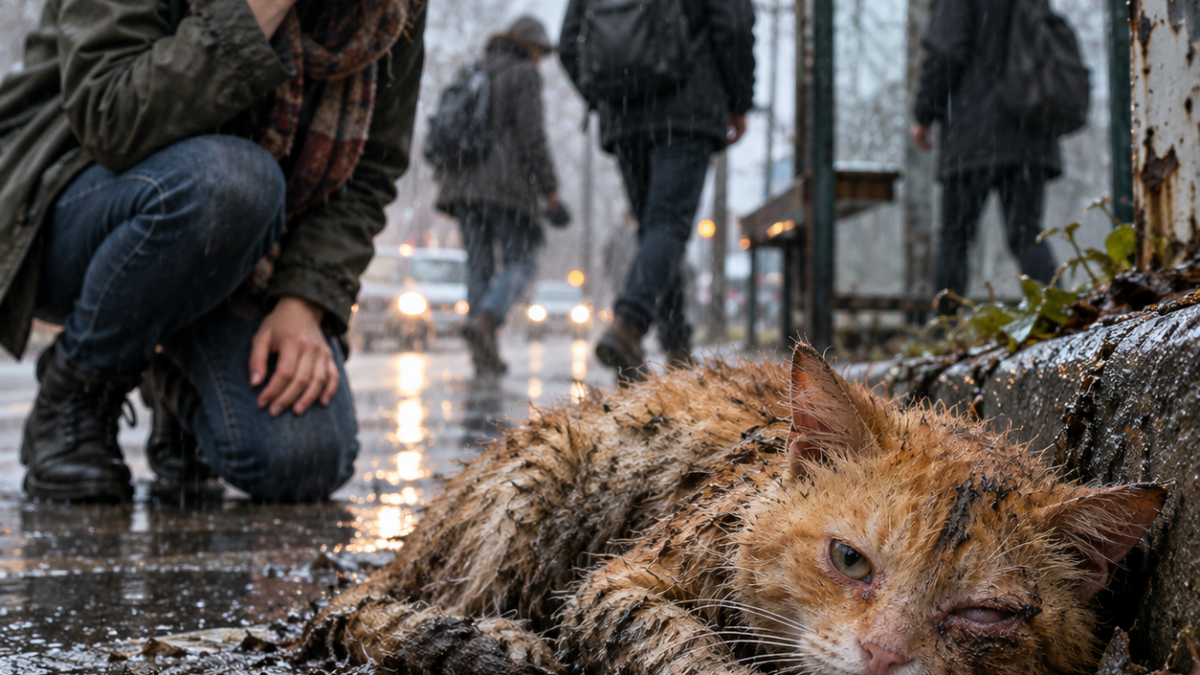
PART 2
I stared at the screen.
“Maybe it’s a mistake.”
“Possibly.”
“Could there be another cat?”
“The microchip number is unique.”
“So somebody told the registry this cat was dead.”
“Yes.”
“But he wasn’t.”
“No.”
I looked toward the treatment-room doors.
“Can I see him?”
Dr. Carter hesitated.
“Just for a minute.”
Charlie was lying beneath blankets with an IV line in his front leg.
Without the mud covering him, I could see just how thin he was.
His orange fur hung in wet clumps against his body. There were bald patches around his neck. His swollen eye had been cleaned, revealing a deep scratch beneath it.
A technician had placed a heating pad under him.
I moved closer.
“Hey, Charlie.”
His good eye opened.
That name did something.
His head lifted slightly.
Dr. Carter noticed too.
“He knows it.”
“Charlie.”
His tail moved once.
I put my hand near his face.
This time he leaned forward.
Only half an inch.
But his nose touched my fingers.
I swallowed.
“Who did this to you?”
Of course he couldn’t answer.
But somebody could.
—
Dr. Carter called the number listed for Todd Hale.
It had been disconnected.
She tried Evelyn’s home number.
Also disconnected.
The address on Charlie’s chip led to a small house in an older neighborhood on the north side of town.
I wanted to drive there immediately.
Dr. Carter stopped me.
“Don’t jump to conclusions.”
“I’m not.”
“You are.”
I looked at her.
She gave me a sympathetic smile.
“I understand. But there could be an explanation.”
“What kind?”
“Maybe the family thought Charlie died. Maybe he disappeared months ago and they assumed the worst.”
“And someone changed the registry?”
“Possibly.”
I wasn’t convinced.
But she was right.
I knew nothing yet.
“What happens now?”
“Legally, because the registered owner is deceased and the emergency contact can’t be reached, we’ll contact animal control. For tonight, Charlie stays here.”
“And after that?”
“That depends on whether anyone claims him.”
I looked at Charlie.
He had closed his eye.
“Can I pay for his treatment?”
Dr. Carter raised an eyebrow.
“You don’t have to.”
“I know.”
She studied me.
“Initial stabilization could be several hundred dollars.”
“Do it.”
“Are you sure?”
No.
I wasn’t.
I had student loans, rent, a car payment, and an emergency fund that I guarded like treasure.
But I had already watched hundreds of people leave Charlie in the mud.
I couldn’t become the next one because helping him was inconvenient.
“Yes.”
—
I barely slept that night.
Every time I closed my eyes, I saw Charlie beside the bus stop.
And that sentence.
**PET REPORTED DECEASED.**
At seven the next morning, Dr. Carter called.
“He’s still with us.”
I sat up.
“That’s good?”
“Very.”
“Did he eat?”
“A tablespoon.”
I smiled.
“That’s something.”
“It is.”
Then she said, “Animal control found Evelyn Hale’s obituary.”
My smile disappeared.
“How long ago?”
“Four months.”
Charlie had been reported dead roughly a month after Evelyn died.
“Anything about Todd?”
“He was listed as her closest surviving relative.”
I got dressed and drove straight to the clinic.
Charlie looked slightly better.
Not healthy.
But more present.
His good eye followed me when I entered.
I sat beside his cage.
“Morning.”
He blinked.
“Apparently we’re both involved in something now.”
His ears twitched.
A technician handed me a small dish of food.
“He eats better if someone sits with him.”
“Really?”
“We noticed overnight.”
I placed the dish near him.
Charlie sniffed it but didn’t move.
I waited.
After almost a minute, he took a bite.
Then another.
I stayed there for forty minutes while he slowly ate half the dish.
When I stood to leave, he stopped.
I sat again.
He resumed.
That nearly broke my heart.
He didn’t want food as much as he wanted someone to stay.
—
Animal control contacted me that afternoon.
The officer’s name was Maria Delgado.
She had already visited Evelyn’s old house.
It was empty.
A FOR SALE sign stood in the yard.
“Do we know who owns it?”
“The estate transferred it to Todd Hale.”
“Where is he?”
“We’re trying to determine that.”
“Did neighbors know Charlie?”
A pause.
“Yes.”
My grip tightened around the phone.
“What did they say?”
“That he belonged to Evelyn for more than ten years.”
“So they recognized him.”
“Immediately.”
“And?”
Officer Delgado’s voice changed.
“One neighbor says she saw him outside after Evelyn died.”
“How long?”
“We’re still establishing the timeline.”
“Was Todd there?”
“Rachel.”
That was the first time she used my name.
“I understand why you’re upset. But let us do this properly.”
“Okay.”
“If there’s evidence of abandonment, we’ll handle it.”
I looked across the clinic waiting room at Charlie’s cage.
His head rested on the blanket.
“Please do.”
—
Three days later, Charlie came home with me.
It was supposed to be temporary.
That is the lie almost every animal rescuer tells themselves at least once.
“Just until he’s stable,” I told Dr. Carter.
She smiled.
“Of course.”
“I’m serious.”
“I know.”
“I’ve never owned a cat.”
“Then Charlie will train you.”
He spent the first hour in my apartment hiding behind the toilet.
I sat outside the bathroom with a book.
Eventually his head appeared around the doorway.
I pretended not to notice.
He moved two feet closer.
Then stopped.
I kept reading.
Ten minutes later, he was sitting in the hallway.
At midnight, I woke on the couch and found him three feet away, staring at me.
“Hi.”
He blinked slowly.
“Are you going to murder me in my sleep?”
No reaction.
“Good talk.”
I closed my eyes again.
When I woke the next morning, Charlie was sleeping against the end of the couch.
Not touching me.
But close enough that one paw rested on the blanket covering my feet.
—
Healing came slowly.
His eye infection improved.
The wound closed.
His blood count rose.
The mud disappeared after several careful baths, revealing fur that wasn’t dull brown at all.
It was bright orange.
Beautiful.
White around his muzzle from age.
Dr. Carter estimated he was at least twelve.
Possibly fourteen.
“How much time does a cat that age have?”
“Could be months.”
My stomach dropped.
“Could be years,” she added.
“That’s not helpful.”
She smiled.
“Welcome to medicine.”
His kidneys showed early disease, but nothing catastrophic.
He had arthritis in both hips.
Several broken teeth.
A healed rib fracture that was at least a year old.
And a scar around his neck.
That bothered Dr. Carter.
“What caused it?”
“Hard to know.”
“Collar?”
“Possibly a tight one.”
“Or?”
She didn’t answer.
I understood.
Charlie had lived a life before me.
And not all of it had been gentle.
—
A week later, Officer Delgado called.
“We found Todd Hale.”
I sat down.
“Where?”
“He lives about forty minutes away.”
“Did you speak with him?”
“Yes.”
“And?”
“He claims Charlie disappeared shortly after Evelyn’s death.”
I frowned.
“Then why report him dead?”
“He says he assumed Charlie had been hit by a car.”
“Did he see a body?”
“No.”
“So he lied.”
“He says he made an assumption.”
I laughed without humor.
“That’s convenient.”
“There’s more.”
I waited.
“According to him, Charlie was difficult. Aggressive. He says Evelyn was the only person who could handle him.”
I looked across my living room.
Charlie was asleep upside down on my rug.
One back leg was hanging off his bed.
“Aggressive?”
“That’s what he says.”
“He’s never even hissed at me.”
“Rachel, behavior can vary.”
“He couldn’t even defend himself.”
“I know.”
“Why would Todd care enough to update the chip if the cat simply disappeared?”
Silence.
That was when I knew Officer Delgado had wondered the same thing.
“We’re checking.”
—
Two days later, someone knocked on my apartment door.
Charlie vanished under the dining table.
I checked through the peephole.
A man stood outside.
Mid-forties.
Expensive jacket.
Impatient expression.
“Who is it?”
“Todd Hale.”
My heart began pounding.
I didn’t open the door.
“What do you want?”
“My cat.”
I almost laughed.
“Charlie isn’t your cat.”
“He belonged to my aunt.”
“Your aunt is dead.”
“And I inherited her property.”
“He’s not furniture.”
“Open the door.”
“No.”
He stepped closer.
“I know he’s in there.”
That sentence frightened me.
“How did you get my address?”
“You filled out paperwork.”
“Leave.”
“I want him back.”
“Why?”
“Because he belongs to the estate.”
“Three weeks ago you thought he was dead.”
Silence.
Then:
“I made a mistake.”
“You abandoned him.”
“You don’t know what happened.”
“I know where I found him.”
“That doesn’t prove anything.”
Charlie was crouched beneath the table, body pressed flat against the floor.
When Todd spoke again, Charlie trembled.
Not because of the knocking.
Not because of the rain.
Because of his voice.
I saw it.
And suddenly every uncertain thought disappeared.
Charlie knew him.
I put my phone on record.
“Say his name.”
“What?”
“Charlie. Say his name.”
Todd went silent.
“Why?”
“Just say it.”
“This is ridiculous.”
“Say his name.”
He exhaled sharply.
“Charlie.”
Under the table, Charlie flattened himself so hard his belly touched the floor.
His ears disappeared against his skull.
I felt something cold settle inside me.
“Leave my property.”
“He’s mine.”
“No.”
“My lawyer will contact you.”
“Good.”
I waited until I heard his footsteps move down the hall.
Then I locked the deadbolt.
Charlie stayed beneath the table for almost two hours.
I lay on the floor several feet away.
I didn’t touch him.
I didn’t call him.
I just stayed.
Eventually he crawled toward me.
His whole body shook.
He pressed his face against my arm.
That was the first time Charlie chose to touch me.
I cried into the carpet.
—
I sent the recording to Officer Delgado.
She called within minutes.
“You should have contacted us immediately.”
“I didn’t know he was coming.”
“Did he threaten you?”
“Not directly.”
“Did you give him the cat?”
“No.”
“Good.”
Charlie raised his head when I said his name.
“Maria.”
“Yes?”
“He recognized Todd.”
A pause.
“How do you know?”
I explained what happened.
She was quiet for a long time.
“That matters.”
“Legally?”
“Potentially.”
“Emotionally, it matters to me.”
“I know.”
—
The investigation changed after that.
Neighbors began talking.
One woman named Mrs. Parker had lived across from Evelyn for twenty-three years.
I met her with Officer Delgado.
She was seventy-one, tiny, sharp-eyed, and angry before we even sat down.
“Evelyn loved that cat.”
She pushed a photograph across the table.
Charlie was sitting in a sunny window.
Healthy.
Heavy.
His coat glowing orange.
A blue collar circled his neck.
I barely recognized him.
“That was two Christmases ago.”
I touched the photograph.
“He was beautiful.”
“He still is.”
I smiled.
Mrs. Parker looked at me.
“Is he safe?”
“Yes.”
“Good.”
Her eyes hardened.
“Todd never liked him.”
“Why?”
“Because Evelyn treated Charlie like family.”
“That’s a strange thing to resent.”
“You didn’t know Todd.”
She poured coffee.
“When Evelyn got sick last year, Todd suddenly became very interested in her affairs.”
“Money?”
Mrs. Parker gave me a look.
“What else?”
Evelyn had owned her house outright.
She also had savings.
Not a fortune.
But enough.
Todd began visiting more frequently during her last months.
Mrs. Parker said Charlie would hide whenever his truck appeared.
“Did Evelyn ever mention that?”
“Once.”
“What did she say?”
“She said Todd was too rough with him.”
My stomach tightened.
“Rough how?”
“Picking him up by the scruff. Shoving him away with his foot. That kind of thing.”
“Did you see it?”
“Once.”
“What happened?”
“He kicked Charlie out of a chair.”
“Hard?”
“Hard enough that Evelyn screamed at him.”
I looked at Officer Delgado.
She was writing everything down.
“What happened after Evelyn died?”
Mrs. Parker’s expression softened.
“Charlie sat by the front door.”
“For how long?”
“Days.”
“Outside?”
“At first he was inside.”
I froze.
“At first?”
“Todd came after the funeral. Cleared out the house.”
“And Charlie?”
“He put him outside.”
My hands clenched.
“Did you see it?”
“I saw Charlie on the porch. I asked Todd whether he wanted me to take him until he figured things out.”
“What did he say?”
Mrs. Parker looked directly at me.
“He said, ‘That thing isn’t my responsibility.'”
I heard the words as if Todd had said them in my hallway.
“Then what?”
“I fed Charlie.”
“How long?”
“About three weeks.”
“And then?”
“He disappeared.”
“Did you assume he ran away?”
“At first.”
Her face changed.
“Then I saw Todd.”
“When?”
“Late one night.”
Officer Delgado stopped writing.
Mrs. Parker continued.
“He pulled into the driveway. Charlie came running from my porch because he recognized the truck.”
My stomach turned.
“Go on.”
“Todd picked him up.”
“Did Charlie fight?”
“No.”
“What happened next?”
“He put him in a carrier.”
“And drove away?”
“Yes.”
“What did you think?”
“I thought he’d finally decided to take care of him.”
She looked down.
“I’m sorry.”
“You didn’t know.”
“I should’ve asked.”
“You were feeding him when nobody else was.”
Her eyes filled.
“I never saw Charlie again.”
Until the photograph of him in the mud reached a local rescue page weeks later.
That photograph was mine.
Dr. Carter’s clinic had posted it while trying to identify him.
Mrs. Parker had recognized Charlie instantly.
—
The old bus stop was thirteen miles from Evelyn’s house.
Thirteen.
Charlie hadn’t wandered there.
Not in his condition.
Not with his arthritis.
Someone had driven him.
Officer Delgado said what I was thinking.
“We need proof.”
Mrs. Parker’s testimony established Todd taking Charlie.
But not where he took him.
Todd could claim he’d delivered him to someone else.
So we looked for cameras.
The bus stop itself had none.
The gas station across the road had replaced its security system two months earlier.
The old footage was supposedly gone.
A warehouse fifty yards away had cameras, but they faced the loading docks.
For several days, it seemed the trail ended there.
Then a seventeen-year-old gas-station employee named Eli remembered something.
“The owner’s cheap,” he told Officer Delgado.
“What does that mean?”
“He doesn’t erase anything.”
The security system had been replaced.
But the old hard drive was sitting in a cabinet beneath the manager’s desk.
—
The footage was grainy.
Black and white.
No sound.
Timestamped 11:43 p.m.
Todd’s truck entered the frame.
I knew it immediately.
I’d seen it outside my apartment building after he left.
The truck pulled into the turnout beside the abandoned bus stop.
The driver’s door opened.
Todd got out.
He walked to the passenger side.
Opened the door.
Then lifted something from the vehicle.
A carrier.
My stomach turned.
He placed it on the ground.
Opened the carrier.
For several seconds, nothing happened.
Then a cat emerged.
Even through the bad footage, the pale outline of Charlie’s body was recognizable.
Todd picked up the empty carrier.
Walked back to the truck.
Charlie stood in the road.
Todd drove away.
I watched Charlie take several steps after him.
The truck disappeared.
Charlie stopped.
Then he returned to the bus shelter.
I couldn’t breathe.
“Turn it off.”
Officer Delgado paused the video.
I covered my mouth.
“How long before I found him?”
She checked the date.
“Twenty-six days.”
Twenty-six days.
Charlie had spent nearly a month beside that bus stop.
Waiting.
At night.
In storms.
Hungry.
Thirsty.
Watching cars come and go.
Maybe every engine sounded like Todd returning.
Maybe despite everything, Charlie still believed the person who abandoned him might change his mind.
I went home and sat beside Charlie for hours.
He was asleep in his new bed.
His fur had begun growing back around his neck.
He looked nothing like the creature I’d lifted from the mud.
But I could still see him on that footage.
Standing in the road behind Todd’s truck.
I touched his paw.
“Nobody is doing that to you again.”
His toes curled around one finger.
—
I thought the video was enough.
It wasn’t.
Todd’s lawyer claimed he’d abandoned Charlie because the cat was violent and Todd feared for his safety.
Officer Delgado stared at him during the interview.
“You transported an allegedly dangerous cat thirteen miles to an abandoned bus stop?”
“I couldn’t keep him.”
“You could have surrendered him to animal control.”
“I didn’t know.”
“There are three shelters within fifteen miles.”
“I wasn’t thinking.”
“You opened a carrier beside a highway.”
Todd shifted.
“I admit it was stupid.”
“Charlie was elderly, underweight, and arthritic.”
“He wasn’t underweight when I had him.”
That sentence became important.
Very important.
Because Todd had just admitted Charlie had been in his possession.
He had previously told investigators Charlie disappeared.
Now, confronted with video, his story changed.
—
Then Evelyn’s attorney called.
His name was Howard Greene.
He had heard about the investigation from Mrs. Parker.
“I believe I may have information concerning the cat.”
I sat straighter.
“What information?”
“Evelyn specifically provided for him in her will.”
My mouth went dry.
“Charlie?”
“Yes.”
“How?”
“She left five thousand dollars to Todd for Charlie’s care.”
I closed my eyes.
Of course.
“Did Todd receive it?”
“Yes.”
“When?”
“Shortly after probate began.”
“What did he tell you happened to Charlie?”
A pause.
“That the cat had died.”
There it was.
Not just an incorrect microchip update.
A lie involving money.
“Did you ask for proof?”
“He supplied a veterinary invoice.”
My eyes opened.
“What veterinarian?”
“I would prefer to discuss details with law enforcement.”
“Was it real?”
Another pause.
“I have serious concerns.”
—
The invoice was fake.
Not sophisticated.
But good enough to pass casual inspection.
It used the letterhead of a clinic that had closed permanently the year before Evelyn died.
Todd claimed Charlie had become sick and had been euthanized.
He reported the cat dead to the microchip company.
Submitted the fake bill to the estate.
Kept the money Evelyn had set aside for Charlie’s care.
Then drove the living cat thirteen miles away and left him beside an abandoned bus stop.
That was the moment the case stopped being merely about animal abandonment.
It became fraud.
—
When Todd realized how much trouble he was in, he tried something I never expected.
He offered me money.
Five thousand dollars.
Exactly what Evelyn had left for Charlie.
His lawyer called mine.
By then, I’d hired one because Todd was still insisting Charlie was estate property.
“He proposes resolving the ownership dispute privately.”
I stared at my attorney, Sarah Kim.
“What does that mean?”
“He’ll waive all claims to Charlie and pay you five thousand dollars.”
“In exchange for what?”
“You agree not to cooperate voluntarily with any civil claims from the estate.”
I laughed.
Sarah didn’t.
“That’s not funny.”
“It is to me.”
“Why?”
“Because he thinks this is about money.”
“What do you want to do?”
“Tell him no.”
“Immediately?”
“Immediately.”
“Rachel, five thousand could cover most of Charlie’s medical bills.”
I looked across the room.
Charlie was sitting in a patch of sunlight.
Three months earlier, he couldn’t stand for more than a few seconds.
Now he was grooming one paw with great concentration.
“I don’t want his money.”
Sarah nodded.
“Then we’ll decline.”
“Wait.”
She looked up.
“If the estate recovers the money…”
“Yes?”
“Can Evelyn’s five thousand go somewhere that helps old cats?”
Sarah smiled.
“I think Howard Greene would like that idea.”
—
Todd came to my apartment once more.
This time he didn’t pound.
He waited outside near my car.
I saw him before he saw me.
For one second, instinct told me to turn around.
Then I remembered Charlie standing behind his truck in the surveillance footage.
I kept walking.
Todd stepped forward.
“We need to talk.”
“No.”
“Your lawyer isn’t helping.”
“Good.”
“I’m facing criminal charges because of this.”
“You’re facing criminal charges because of what you did.”
“You don’t understand what that year was like.”
I stopped.
“What?”
“My aunt was sick. I was handling her house. Medical bills. Estate paperwork. Everything.”
“And Charlie was too much trouble?”
He looked away.
“Yes.”
I couldn’t believe he admitted it.
“You could’ve given him to Mrs. Parker.”
“She would’ve made a big deal out of it.”
“You could’ve taken him to a shelter.”
“They ask questions.”
“Exactly.”
His jaw tightened.
“I made a bad decision.”
“You left a twelve-year-old cat beside a highway.”
“I know.”
“For twenty-six days he waited there.”
“I didn’t know he’d stay.”
“What did you think he’d do?”
“He’s a cat.”
There it was again.
That phrase.
A cat.
As though the category erased suffering.
“You want to know what he did?”
Todd rolled his eyes.
I stepped closer.
“He waited.”
Something in my voice stopped him.
“He waited in the exact place you left him. Night after night. Rain after rain. He was so weak that when I picked him up, he couldn’t fight me.”
Todd looked uncomfortable.
“Stop.”
“No.”
“You’re trying to make me feel like some monster.”
“I’m telling you what happened.”
“I didn’t ask you to save him.”
“No. Charlie did.”
Todd laughed sharply.
“The cat asked you?”
“He looked at me.”
“You’re crazy.”
“Maybe.”
I unlocked my car.
Then Todd said something that made me turn.
“If you hadn’t gotten involved, none of this would’ve happened.”
I stared at him.
“No, Todd.”
He waited.
“If I hadn’t gotten involved, Charlie would’ve died.”
He said nothing.
“And I think that’s exactly what you were counting on.”
His face went pale.
That was answer enough.
—
The criminal case took seven months.
Justice is slower than suffering.
That was one of the hardest things to accept.
Charlie didn’t care about court dates.
He cared about breakfast.
He cared about the heating vent.
He cared about whether I sat in the same room while he ate.
He cared about the birds that landed on my balcony.
And, gradually, he cared about me.
At first he slept across the room.
Then at the foot of the couch.
Then beside my legs.
The first night he climbed into bed, he stood on my chest at three in the morning and stared into my face.
I opened one eye.
“Are you okay?”
He meowed.
A real meow.
Loud.
Demanding.
I nearly cried.
“That’s your voice?”
He meowed again.
“Okay. You don’t have to yell.”
He stepped onto my pillow.
Then lay down against my head.
That became his spot.
Every night.
For months.
—
Charlie had strange habits.
At exactly 5:30 every afternoon, he sat near the front door.
At first I thought he was waiting for dinner.
But even after I fed him, he returned to the door.
I mentioned it to Mrs. Parker.
She started crying.
“What?”
“Evelyn got home at five-thirty.”
I swallowed.
“Every day?”
“Almost. She volunteered at the library four afternoons a week. Bus dropped her two blocks away at five-twenty-five.”
Charlie had waited for her.
For years.
Even in my apartment, in a different neighborhood, after everything that had happened, his body still remembered the hour she used to come home.
One afternoon I sat beside him at 5:30.
He looked at the door.
Then at me.
“I’m sorry she isn’t coming.”
His ears moved.
I don’t know what cats understand.
Maybe more than we think.
Maybe less.
It didn’t matter.
I sat with him anyway.
The next day he waited again.
I joined him.
Eventually it became our routine.
At 5:30, Charlie and I sat by the door for five minutes.
Not because I believed Evelyn would return.
But because once, someone had.
And he remembered.
—
Mrs. Parker gave me a box of Evelyn’s photographs.
Todd had thrown most of them into the garage during the house cleanout.
Mrs. Parker salvaged what she could.
There were dozens of Charlie.
Charlie in Christmas paper.
Charlie sleeping beside Evelyn.
Charlie on the kitchen table.
Charlie wearing a ridiculous red bow tie.
Charlie sitting on the back of Evelyn’s couch while she read.
In one photograph, Evelyn was holding him against her chest.
On the back she had written:
**My Charlie boy. The best thing to come home to.**
I put that photograph beside his bed.
Maybe it was for me more than him.
But it felt right.
—
Evelyn’s attorney later told me how she got Charlie.
He had been abandoned once before.
As a kitten.
Someone left a cardboard box outside a grocery store.
Evelyn found him.
That knowledge devastated me.
Charlie had been abandoned at the beginning of his life.
Then again near the end.
And still, somehow, he remained gentle.
He still leaned into my hand.
Still trusted a warm lap.
Still waited near the door.
There is something almost unbearable about animals that continue loving after people give them every reason not to.
—
Todd eventually pleaded guilty to animal abandonment and a fraud-related charge connected to the estate.
His attorney negotiated the rest.
He avoided jail beyond a short suspended sentence, which disappointed me at first.
I wanted something dramatic.
I wanted him to feel every cold night Charlie had spent in the mud.
I wanted twenty-six days taken from his life.
Twenty-six nights outside.
Twenty-six mornings wondering whether anyone was coming back.
But courts don’t work that way.
He received probation.
A substantial fine.
Restitution.
Community service that could not involve direct contact with animals.
And a court order prohibiting him from owning or possessing animals during probation.
The estate also recovered the five thousand dollars intended for Charlie.
Howard Greene called me afterward.
“Evelyn’s estate has a question.”
“What?”
“Where would you like the recovered pet-care funds to go?”
“Not to me.”
“We assumed that.”
I smiled.
“There’s a senior-cat program at the county shelter.”
“I know it.”
“Give it to them.”
“All of it?”
“All of it.”
He paused.
“I think Evelyn would approve.”
I looked at Charlie.
He was asleep in the window.
“Yeah.”
My voice cracked.
“I think she would too.”
—
The final hearing was on a gray February morning.
I attended even though I didn’t need to.
Todd stood before the judge in a dark suit.
He looked smaller than he had outside my apartment.
His attorney spoke first.
Then the prosecutor.
Then Officer Delgado.
The judge reviewed the surveillance footage.
Photographs.
The fake veterinary invoice.
Charlie’s medical records.
Finally, Todd was allowed to speak.
“I regret how I handled the situation.”
The judge looked at him.
“The situation?”
Todd shifted.
“My aunt’s cat.”
“Charlie.”
“Yes.”
“Use his name.”
Todd swallowed.
“Charlie.”
I will always respect that judge for those three words.
Use his name.
Because that was what Todd had tried to erase.
Charlie wasn’t “that thing.”
He wasn’t “the cat.”
He wasn’t a problem.
He had a name.
A history.
Someone who had loved him.
Someone who loved him now.
Todd continued.
“I was overwhelmed after my aunt died.”
The judge didn’t interrupt.
“I had her house, debts, paperwork. Charlie was old. He needed care. I didn’t want him.”
The courtroom went silent.
Todd seemed to realize how terrible that sounded.
“I mean—I didn’t know what to do with him.”
The judge leaned forward.
“You had multiple lawful options.”
“I know.”
“You chose an abandoned roadside bus stop.”
Todd looked down.
“Yes.”
“You then falsely represented that the animal had died.”
“Yes.”
“And obtained funds your aunt specifically intended for his care.”
Todd said nothing.
The judge repeated:
“Yes?”
“Yes.”
I thought I would feel triumphant.
I didn’t.
Mostly, I felt sad.
Because the entire case had grown from one simple fact:
Todd couldn’t be bothered to care what happened to a living creature.
The judge imposed the agreed sentence.
Then she said:
“Mr. Hale, you appear to have regarded this animal as an inconvenience that could simply be removed from your life. The law does not recognize suffering as irrelevant merely because the victim cannot speak.”
I looked down.
My eyes burned.
Officer Delgado touched my shoulder.
Todd left without looking at me.
That could have been the end.
But life had one more thing to say.
—
Outside the courthouse, reporters from a local station were waiting.
The case had attracted attention after the surveillance footage became public record.
I tried to avoid them.
Todd couldn’t.
A reporter called:
“Mr. Hale, do you have anything to say about Charlie?”
Todd stopped.
He turned toward the cameras.
For a second, I thought he might apologize.
Instead he said:
“It’s been blown out of proportion. At the end of the day, it’s a cat.”
I closed my eyes.
Officer Delgado muttered something under her breath.
Then another voice came from behind me.
Mrs. Parker.
Seventy-one years old.
Five feet tall.
Furious.
“And that cat had more loyalty in one paw than you’ve shown in your whole life.”
Every camera turned.
Todd stared at her.
Mrs. Parker wasn’t finished.
“Your aunt trusted you.”
“Tina—”
“Don’t call me Tina.”
A few people laughed.
She pointed at him.
“Evelyn spent her life helping people. She fed neighbors. Drove sick friends to appointments. Took that cat in when somebody else threw him away.”
Todd glanced toward the courthouse.
“You don’t know what you’re talking about.”
“I knew your aunt before you learned to tie your shoes.”
That shut him up.
Mrs. Parker stepped closer.
“You didn’t just dump Charlie. You betrayed Evelyn.”
Todd’s face hardened.
“He’s alive, isn’t he?”
I felt every muscle in my body go rigid.
Mrs. Parker stared at him.
Then smiled.
“Yes.”
Todd looked confused.
She continued.
“And that’s the part you can’t stand.”
He said nothing.
“He’s alive. He’s loved. And everybody knows what you did.”
Todd walked away.
The cameras followed him.
Mrs. Parker turned toward me.
I stared at her.
“What?”
She shrugged.
“I’ve been waiting months to say that.”
I laughed so hard I cried.
—
The video of Mrs. Parker confronting Todd spread farther than the original court story.
People began sending donations to the county shelter.
Five dollars.
Twenty dollars.
Fifty.
One person donated five hundred in Evelyn’s name.
Another donated food for senior cats.
Someone mailed heated beds.
The shelter director called me.
“We’re creating a small room for elderly cats who don’t do well in cages.”
“That’s wonderful.”
“We’d like to name it after Charlie.”
I looked at him sleeping beside me.
“He’s not dead.”
The director laughed.
“We know.”
“Then why are you talking like it’s a memorial?”
“It’s not.”
“What is it?”
“A legacy.”
I looked at Charlie.
He opened one eye.
“Charlie doesn’t know what a legacy is.”
“He doesn’t need to.”
—
The room opened that spring.
A plaque beside the door read:
**CHARLIE’S CORNER**
**For the old ones who are still waiting for someone to stop.**
I cried when I saw it.
Charlie didn’t attend the opening.
He hated car rides.
We let him stay home.
He spent the afternoon asleep in my bed, completely unaware that six senior cats were being moved from cages into a quiet room because of him.
The first cat adopted from Charlie’s Corner was seventeen years old.
Her name was Millie.
She had kidney disease and only three teeth.
A retired man named George adopted her.
“Why her?” I asked.
He looked confused.
“Why not her?”
That sentence stayed with me.
Why not her?
Why not the old ones?
Why not the injured ones?
Why not the ones who needed medication?
Why not the ones who couldn’t promise you fifteen years?
We spend so much of our lives choosing what seems easiest to love.
Charlie taught me that easy and valuable are not the same thing.
—
A year after I found him, I drove past the old bus stop again.
I hadn’t taken that road in months.
The shelter was still there.
Rusty.
Broken.
The weeds were taller.
I pulled over.
For several minutes, I sat in my car.
I could see exactly where Charlie had been lying.
The puddle.
The mud.
The gray sky.
I remembered holding him beneath my coat.
I remembered his eye opening.
I remembered thinking he might die before we reached the clinic.
Then I looked into the passenger seat.
Charlie was there.
I had brought him because we were returning from Dr. Carter’s office.
He hated the carrier, so on short trips I used a secured soft-sided seat.
His orange face appeared behind the mesh.
“Do you remember this place?”
Charlie looked toward the bus shelter.
His body changed.
Just slightly.
He became still.
I immediately regretted stopping.
“Okay.”
I started the engine.
“We’re leaving.”
Before I could pull away, Charlie meowed.
I looked back.
He was staring at the shelter.
I don’t know what he remembered.
Cold?
Fear?
Todd?
Waiting?
Maybe nothing.
I reached through the opening in the carrier and touched his head.
“You’re not staying.”
He leaned against my hand.
“Never again.”
Then I drove home.
—
Time passed.
Charlie’s kidney disease progressed slowly.
He needed special food.
Medication.
More frequent checkups.
He despised all three.
Especially medication.
Every morning he behaved as if I had invented pills specifically to destroy his dignity.
“You ate garbage beside a highway,” I told him once. “You can swallow half a tablet.”
He spat it onto the floor.
“Apparently not.”
He stared at me.
I tried again.
Five minutes later, I found the pill beneath the refrigerator.
“How?”
Charlie walked away.
He was impossible.
And I loved him.
—
The second anniversary of his rescue arrived.
Dr. Carter estimated Charlie was fourteen or fifteen.
He had gained weight.
His eye had healed, though it remained slightly cloudy.
His arthritis made stairs difficult, so I bought little ramps.
The first time I placed one beside my bed, Charlie stared at it.
Then stared at me.
Then jumped onto the mattress without using it.
“You are seventy in cat years.”
He licked one paw.
“Use the ramp.”
He ignored me.
The next morning, I caught him using it when he thought I wasn’t watching.
Pride survived age.
Apparently in cats too.
—
Then one November, Charlie stopped waiting by the door at 5:30.
At first, I didn’t notice.
Then one evening I looked at the clock.
5:42.
Charlie was asleep.
My chest tightened.
The next day, same thing.
He slept through 5:30.
The ritual Evelyn had left inside him was fading.
I expected to feel relieved.
Instead, I cried.
That habit had been proof of the life he had before me.
Proof that someone had come home to him.
Proof that Charlie had loved before the mud.
I sat beside him.
“You’re allowed to forget.”
His eyes opened.
I touched his face.
“She wouldn’t be angry.”
Charlie purred.
“You’re home now.”
Maybe that was what forgetting meant.
Not losing love.
Making room for another version of safety.
—
Mrs. Parker visited often.
Charlie always recognized her.
Whenever she entered my apartment, he walked directly toward her.
“You remember me, don’t you?”
She’d sit on the floor.
Charlie would sniff her hands.
Then settle beside her.
One afternoon, she brought another photograph.
Evelyn was sitting on the old bus route bench downtown.
Not the abandoned stop where Todd left Charlie.
A different stop.
Charlie was in a carrier beside her.
“What is this?”
“Evelyn used to take him to the senior center sometimes.”
“You can take cats on buses?”
“Apparently Evelyn believed rules were suggestions.”
I laughed.
Mrs. Parker smiled.
“Charlie loved watching buses.”
I looked at the photograph.
Suddenly the abandoned shelter meant something different.
Maybe while he waited there, the sound of buses—or cars—had reminded him of Evelyn.
Maybe Todd had unknowingly left him somewhere filled with the memory of transportation and return.
No wonder Charlie waited.
His whole life had taught him that people went away.
Then came back.
Until one person didn’t.
—
Three years after I found Charlie, his kidneys began failing faster.
Dr. Carter warned me.
“We’re moving into a different stage.”
“How different?”
“More fluids. More monitoring.”
“How much time?”
She gave me the answer veterinarians hate giving.
“I don’t know.”
“Months?”
“Possibly.”
“Years?”
“Less likely.”
I stared at Charlie.
He was trying to steal a treat from the jar.
“He’s not acting sick.”
“Cats are very good at living in the present.”
I looked at her.
“What does that mean?”
“It means maybe you should try it too.”
I hated that advice.
Because it was good.
—
I stopped counting months.
Instead, I counted ordinary things.
Charlie eating breakfast.
Charlie sitting in the sun.
Charlie screaming at birds.
Charlie sleeping on my pillow.
Charlie knocking a glass of water off the counter for no reason.
Charlie refusing medication.
Charlie using the ramp only when he thought nobody was watching.
Charlie being alive.
Every ordinary day became enough.
—
Todd disappeared from our lives.
Probation ended eventually.
The legal case closed.
He sold Evelyn’s house.
Moved out of county.
I never saw him again.
For a long time, I thought that disappointed me.
I had imagined revenge looking larger.
Maybe Todd losing his house.
Maybe prison.
Maybe public humiliation lasting forever.
But as the years passed, I understood something.
Todd’s punishment wasn’t the most important part.
His failure was.
He wanted Charlie gone.
He wanted the problem erased.
He drove an old cat into the dark and left him beside a road because he thought nobody would care enough to ask questions.
He was wrong.
One person stopped.
Then a veterinarian cared.
Then an animal-control officer investigated.
Then a neighbor spoke.
Then a gas-station employee remembered an old hard drive.
Then an attorney opened a file.
Then a judge listened.
Then strangers donated.
Then old cats were adopted.
Todd had tried to make Charlie disappear.
Instead, Charlie became impossible to ignore.
That was better than revenge.
—
On the fourth anniversary of Charlie’s rescue, Charlie’s Corner had placed eighty-three senior cats.
Eighty-three.
I had photographs of many of them.
Millie.
Sam.
Pearl.
Oscar.
Boots.
Martha.
Louie.
Every old face represented someone who had walked into the shelter and decided age wasn’t a reason to turn away.
The shelter director placed a second plaque under Charlie’s.
**83 ADOPTIONS AND COUNTING.**
I sent a photo to Dr. Carter.
She replied:
**Not bad for a cat everyone walked past.**
I stared at that message for a long time.
Not bad at all.
—
Charlie made it to the fifth anniversary.
Barely.
By then, he was very old.
Dr. Carter guessed seventeen.
Maybe eighteen.
His body had become thin again.
Not like when I found him.
This thinness was different.
Natural.
Age taking back what time had given.
He slept most of the day.
His hearing faded.
I could open a can beside him without waking him.
His cloudy eye worsened.
He no longer jumped.
But every night, he climbed his little ramp and slept beside my head.
Every night.
—
Then came the morning I had been dreading for years.
Charlie didn’t want breakfast.
I offered chicken.
Nothing.
Tuna.
Nothing.
His favorite treats.
He turned his head.
I sat on the floor.
“Charlie.”
His eyes opened.
He looked at me.
And I knew.
Dr. Carter came to the apartment that afternoon.
I didn’t want his final hours to involve a carrier.
Or fluorescent lights.
Or a strange examination table.
He had spent enough of his life being moved against his will.
His last place would be home.
Mrs. Parker came.
Officer Delgado came after work.
The shelter director stopped by.
Dr. Carter sat on the floor beside his bed.
Charlie looked at all of us as though slightly annoyed by the crowd.
Mrs. Parker laughed through tears.
“Still hates attention.”
I smiled.
“Unless dinner is involved.”
She stroked his face.
“Evelyn would be so happy.”
I looked at her.
“You think so?”
“I know so.”
Charlie shifted.
I picked him up.
Even at the end, I remembered the first time.
Mud.
Rain.
Almost no weight.
But now his fur was clean.
Soft.
Warm.
He smelled like home.
I held him against my chest.
“Remember the bus stop?”
My voice broke.
Charlie purred faintly.
“I don’t know if you do.”
Dr. Carter prepared the medication.
“But I remember.”
I kissed his head.
“I remember everybody who walked past.”
My tears fell into his fur.
“And I remember stopping.”
Charlie opened his eyes.
“I thought I was saving you.”
His paw moved against my wrist.
“But you were the one who taught me how much one small decision can change.”
His breathing slowed.
Mrs. Parker was crying openly.
I whispered:
“You don’t have to wait anymore.”
Charlie relaxed.
“No more buses.”
His eyes closed.
“No more cold.”
Dr. Carter placed one hand gently against his side.
“No more mud.”
I pressed my face against his head.
“You’re home.”
Charlie died in my arms.
The same arms that had lifted him from the roadside five years earlier.
This time, he wasn’t wet.
He wasn’t hungry.
He wasn’t alone.
—
I didn’t move for a long time.
Eventually, Mrs. Parker touched my shoulder.
“He knew.”
“Knew what?”
“That you stayed.”
That destroyed me.
Because Charlie’s entire story had been about waiting for people to stay.
Evelyn had stayed until death took the choice away.
Todd hadn’t.
Hundreds of strangers hadn’t even stopped.
Then I came along.
And in the end, the only promise I really needed to keep was simple.
I stayed.
—
Charlie was cremated.
I kept part of his ashes.
The rest went beneath a tree outside the county shelter.
The shelter director asked if I wanted a ceremony.
I said yes, but small.
It wasn’t small.
Nearly sixty people came.
Former adopters.
Volunteers.
Veterinary staff.
Officer Delgado.
Mrs. Parker.
George, who had adopted Millie.
Families who had adopted cats from Charlie’s Corner.
Some brought photographs.
One woman held a sixteen-year-old tabby she’d adopted because she’d seen Charlie’s story online.
“I used to only look at kittens,” she told me.
I smiled.
“Me too.”
She looked confused.
“I never even planned to get a cat.”
We both laughed.
—
The shelter placed a stone beneath the tree.
It read:
**CHARLIE**
**He waited too long for someone to stop.**
**Then he taught hundreds of people to do exactly that.**
I cried when I saw it.
Mrs. Parker stood beside me.
“Evelyn would’ve loved this.”
“She would’ve hated the attention.”
“True.”
We laughed.
Then Mrs. Parker handed me a small envelope.
“What is it?”
“Something I found in Evelyn’s things.”
Inside was an old birthday card.
No envelope.
No date.
Evelyn had written on the back:
**People think rescuing an animal means giving it a home. Sometimes it means giving yourself one too.**
I read the words twice.
Then three times.
I looked toward Charlie’s tree.
For five years, I had thought I had given him a home.
Evelyn understood before I ever did.
Charlie had given me one too.
—
Six months after Charlie died, I still wasn’t ready for another cat.
I told everyone that.
Especially the shelter.
“Do not call me.”
The director laughed.
“I didn’t say anything.”
“I’m serious.”
“Understood.”
“No sad stories.”
“Wouldn’t dream of it.”
“No senior cats.”
“Absolutely.”
Two weeks later, Officer Delgado texted me.
**Don’t be mad.**
I stared at my phone.
Then another message arrived.
A photograph.
An old gray cat sitting in the back of a shelter cage.
One torn ear.
Cloudy eyes.
I called her.
“No.”
“Hi, Rachel.”
“No.”
“I haven’t asked anything.”
“You sent a picture.”
“True.”
“That’s emotional manipulation.”
“Also true.”
“How old?”
“Sixteen.”
I closed my eyes.
“What happened?”
“Owner went into hospice.”
“No.”
“Cat’s name is Walter.”
“Maria.”
“He hasn’t eaten much.”
“You are a terrible person.”
“I’ve heard that.”
I hung up.
Then I stared at Charlie’s empty bed.
For another hour.
At 4:30, I got in my car.
—
Walter hissed when I approached.
I laughed.
The shelter volunteer looked confused.
“What’s funny?”
“My last cat was easier.”
Walter hissed again.
“See? Personality.”
I sat outside his cage.
He turned his back.
“Okay.”
I waited.
Ten minutes.
Twenty.
Thirty.
Eventually Walter glanced at me.
I held out one finger.
He ignored it.
“Good boundaries.”
An hour later, he moved closer.
Not much.
Just enough to smell my hand.
That was all.
I filled out the foster paperwork.
Temporary, I told myself.
Just until he ate normally.
The director didn’t even pretend to believe me.
—
Walter moved into Charlie’s apartment.
That’s what it still felt like.
He found Charlie’s heated bed on the first day.
Sniffed it.
Turned around three times.
Lay down.
I stood in the doorway crying.
Walter looked offended.
“Sorry.”
He went back to sleep.
Three months later, I signed the adoption papers.
—
Years have passed since that rainy evening.
The old bus stop is gone now.
The county finally removed it.
There’s a bike path where it used to stand.
I drove past once after construction finished.
For a moment, I felt sad.
Then I realized I didn’t need the shelter to remain.
Charlie’s story wasn’t there anymore.
It was everywhere else.
In the senior-cat room.
In the people who adopted animals because of him.
In the veterinarians who remembered him.
In Officer Delgado, who told his case to new investigators as an example of why “small” cruelty cases matter.
In Mrs. Parker, who kept Evelyn’s photographs alive.
In Walter, sleeping in Charlie’s bed.
And in me.
—
People still sometimes ask whether I hate Todd Hale.
I used to.
I spent months imagining punishments harsher than anything the court gave him.
Then, eventually, anger became exhausting.
Charlie didn’t spend his final years thinking about Todd.
Why should I spend mine doing it?
Todd’s chapter ended the day Charlie came home with me.
Everything after that belonged to us.
That is the part that matters.
Todd left him in the mud.
I watched Charlie learn warm blankets.
Todd left him hungry.
I watched him become picky about chicken.
Todd wanted him forgotten.
A shelter room carries his name.
Todd treated him like garbage.
Hundreds of people learned his story.
Todd thought nobody would stop.
Someone did.
And because one person stopped, other people began stopping too.
That is the only revenge I need.
—
I still think about Charlie’s expression the first night I found him.
That tired look.
That silent question.
**Are you going to leave too?**
At the time, I didn’t know the answer.
I was tired.
Wet.
Hungry.
I had work the next morning.
I had bills.
No cat food.
No litter box.
No plan.
Nothing about stopping made practical sense.
But I stopped anyway.
Sometimes the most important choices in your life don’t arrive looking important.
Sometimes they look like a muddy pile beside an abandoned bus shelter.
Sometimes they weigh eight pounds.
Sometimes one eye is swollen shut.
Sometimes everyone else has already decided not to care.
And sometimes all you have to do is be the person who doesn’t keep walking.
Charlie spent twenty-six days waiting beside that road.
For Todd.
For Evelyn.
For anyone.
I wish I could go back and erase every one of those days.
I can’t.
But I can tell you what came afterward.
Five winters indoors.
Five summers asleep in sunlight.
Thousands of meals.
Hundreds of nights on my pillow.
A heated bed.
Medication he hated.
Chicken he loved.
A woman named Mrs. Parker who never forgot him.
A veterinarian who gave him a chance.
An officer who refused to dismiss his case.
A room full of senior cats given second chances because people heard his story.
And a home where nobody ever left him behind again.
For most of his life, Charlie believed home was a person who came back at 5:30.
Then Evelyn died.
Someone betrayed him.
And for almost a month, he waited in the rain.
But that wasn’t where his story ended.
It ended years later, warm in my arms.
Safe.
Clean.
Loved.
Home.
And if Charlie taught me anything, it was this:
The saddest creature you pass on the road may already have a whole story behind its eyes.
You may never know who failed it.
You may never understand what it has survived.
But sometimes you don’t need the whole story before deciding what kind of person you want to be.
That night, Charlie looked at me as if he expected me to walk away.
I didn’t.
And that one decision changed both of our lives.




