PART 2: Every Night, the Starving Harbor Dog Carried Food Away—When I Followed Her at 1 A.M., I Finally Learned Why
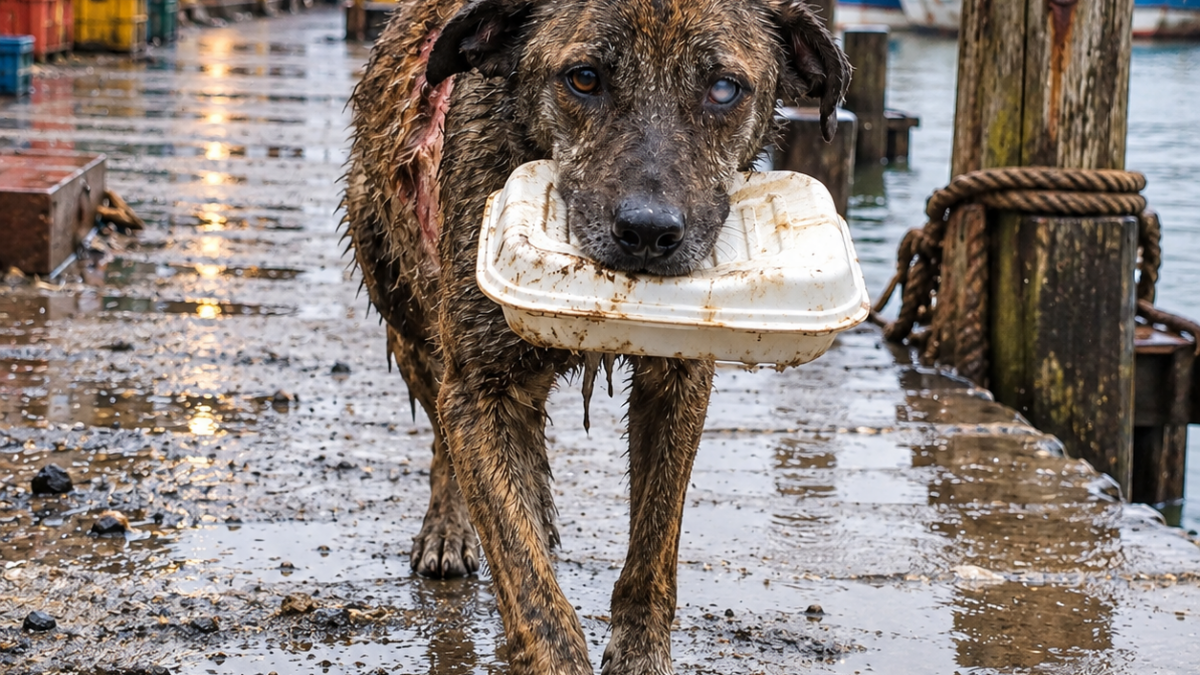
PART 2
I stood behind that overturned crate for several seconds without breathing.
At first, my brain refused to make sense of what I was seeing.
The shipyard was supposed to be empty.
Everyone in Bayport knew the old Harrow Marine Works had been abandoned after Hurricane Serena tore through the eastern docks almost seven years earlier.
The roofs had collapsed.
The offices flooded.
Insurance fights dragged on until everyone stopped caring.
Eventually fencing went up, warning signs appeared, and the whole property became one of those places people drove past without really seeing.
But it wasn’t empty.
Not even close.
A gray cat slipped from beneath a broken pallet.
Then a second cat.
Two beagles emerged from the shadow of a rusted shipping container.
One was painfully thin.
The other walked with his head low and one ear torn.
Several kittens crawled from underneath a pile of tangled fishing nets.
A pelican stood near a puddle with one wing hanging at an unnatural angle.
Behind a row of blue barrels, something larger moved.
I raised my flashlight.
A raccoon.
Limping.
I lowered the light immediately.
And all of them were watching Mara.
She walked to the middle of the cracked concrete yard carrying the foil bundle I had given her.
Then she set it down.
The animals approached.
Slowly.
Not like a feeding frenzy.
That was the part I’ll never forget.
They knew the routine.
Mara nudged the foil open with her nose.
One kitten came forward first.
Then another.
The thinner beagle tried to push between them.
Mara placed her shoulder against him.
No growling.
No snapping.
Just a gentle shove.
He stopped.
Waited.
I whispered to myself, “What are you doing?”
Mara stepped back.
The kittens ate.
Then the smaller cats.
The injured pelican shifted awkwardly toward the food.
Mara picked up a piece of fish and carried it directly to him.
Dropped it at his feet.
The bird swallowed.
She brought another.
I was staring at a dog who looked like she had missed more meals than she’d eaten, and she was distributing food like a mother running a soup kitchen.
The beagles ate next.
Then the cats.
The raccoon waited at the edge.
Only when everyone else had gotten something did Mara lower her head and lick a few scraps from the foil.
Three bites.
Maybe four.
Then she backed away.
That was all.
I had spent weeks feeling sorry for her.
Now I felt ashamed.
Not because pity had been wrong.
She did need help.
But I had assumed weakness meant helplessness.
Mara wasn’t helpless.
She was carrying an entire hidden colony on a body barely strong enough to carry itself.
I stepped backward.
A piece of broken glass cracked under my boot.
Every animal froze.
Mara spun toward me.
Her body changed instantly.
Head low.
Shoulders forward.
Not aggressive.
Protective.
“Easy.”
She stared.
I lifted both hands.
“It’s me.”
Her ears moved.
“You know me.”
She recognized my voice.
But she didn’t come closer.
She moved between me and the kittens.
That told me exactly where I stood in her priorities.
Behind everyone else.
Fair enough.
“I’m not taking anything.”
She watched.
“I just followed you.”
The thinner beagle retreated behind the shipping container.
The cats scattered.
Mara remained.
I crouched.
“You’ve been doing this every night?”
No answer.
Of course not.
I looked at the food remnants around the lot.
Flattened takeout containers.
Foil.
Plastic lids.
A cracked bowl.
Old water bottles.
Some looked weeks old.
Maybe months.
I finally understood why every worker at the harbor had reported the same thing.
Food disappeared.
Mara stayed thin.
She had been dividing one meal into ten.
Maybe more.
I sat down on the concrete.
“You’re insane.”
Her ears moved again.
“You know that?”
She lowered her head slightly.
“I give you fish because I think you’re starving, and you run a shelter.”
The word caught in my throat.
Shelter.
That abandoned shipyard wasn’t shelter.
It was ruins.
No clean water.
No medical care.
No heat.
No protection from storms.
But somehow Mara had turned it into the closest thing these animals had.
I stayed fifteen minutes.
Didn’t approach.
Didn’t interfere.
Then I left.
Mara watched me until I disappeared through the fence.
I barely slept.
At sunrise, I called my friend Dr. Sarah Bennett.
Sarah ran a veterinary clinic three miles inland and had treated every dog, cat, gull, raccoon, and half-dead pigeon I had ever dragged through her door.
She answered at 6:18.
“You know normal people wait until eight.”
“I found something.”
“Animal?”
“Animals.”
Pause.
“How many?”
“I don’t know.”
“That is not a reassuring answer.”
“Maybe twelve. Fifteen.”
“What species?”
“Yes.”
Silence.
“Luis.”
“Cats. Dogs. Kittens. Injured pelican. Raccoon.”
“Where?”
“Old Harrow shipyard.”
“Why are they there?”
“I think people dumped some of them.”
“You think?”
“I don’t know.”
“Are they contained?”
“No.”
“Any obvious contagious disease?”
“No idea.”
“Human safety issues?”
“The structure is dangerous.”
Sarah sighed.
“What did you do?”
“Nothing.”
“Good.”
I was surprised.
“Good?”
“Yes. You walked into an unknown colony at one in the morning without protective equipment, vaccination history, traps, carriers, or backup.”
“When you phrase it that way—”
“That is exactly how I’m phrasing it.”
I smiled despite myself.
“I need help.”
“I know.”
“There’s a dog feeding them.”
“What?”
I explained.
For once, Sarah didn’t interrupt.
When I finished, there was a long silence.
Then she said:
“You are not going back alone.”
“I figured.”
“And you are not trying to grab the dog.”
“I wasn’t planning to.”
“You absolutely were planning to.”
“Maybe eventually.”
“Luis.”
“Fine.”
By noon, Sarah had called a wildlife rehabilitator named Jen Alvarez.
I had called Walter and Marissa.
Walter called two dockworkers.
Marissa told her sister, who volunteered with a cat rescue.
By evening, twelve people knew.
That was already more people than I wanted.
“Keep this quiet,” I told everyone.
“Why?” Walter asked.
“Because if fifty people show up taking pictures, every animal will disappear into the warehouses.”
He nodded.
“And somebody owns the property,” Sarah added.
That was another problem.
Technically, the shipyard still belonged to Harrow Coastal Holdings, a company that had done nothing with it in years.
We couldn’t simply build an unofficial animal camp on private property.
Before solving that, though, we had to understand what was there.
That night, I returned with Sarah and Jen.
No traps.
No crowd.
Just food, water, binoculars, gloves, and patience.
Mara appeared at 12:42.
She looked at me.
Then Sarah.
Then Jen.
“You brought friends,” Sarah whispered.
Mara accepted food from me.
Not Sarah.
That night I gave her nearly four times the usual amount.
Two containers.
She tried lifting both.
Couldn’t.
I almost laughed.
“You’re going to need help.”
She stared at me.
I picked up the second container.
Mara immediately stiffened.
“I know.”
I placed it down.
Stepped back.
She grabbed the first.
Walked twenty feet.
Dropped it.
Returned.
Grabbed the second.
Then disappeared.
Sarah looked at me.
“She’s making two trips.”
“Apparently.”
We followed farther behind this time.
At the shipyard, we counted.
Four adult cats.
Seven kittens from at least two litters.
Two beagles.
One mixed-breed dog hiding beneath a collapsed stairwell.
The pelican.
The raccoon.
And Mara.
Sixteen animals.
Maybe more.
Sarah whispered:
“This isn’t a colony.”
“What is it?”
“A dumping ground.”
That possibility made my stomach turn.
Because feral cat colonies happen.
Wildlife moves into abandoned spaces.
But two beagles?
One still wore part of a faded nylon collar.
The hidden mixed-breed dog had a rope burn around his neck.
Those dogs had belonged to someone.
We stayed out of sight.
Jen watched the pelican.
“That wing’s bad.”
“Can you catch him?”
“With the right setup.”
“Tonight?”
“No.”
“Why?”
“Because rushing means he runs into broken metal and makes it worse.”
Patience again.
I was beginning to hate patience.
The next morning, I called the city.
Not to report every animal immediately.
First, I needed property access.
Bayport’s code enforcement office transferred me three times.
Eventually I reached a man named Howard Bell.
“Harrow shipyard?”
“Yes.”
“That property is condemned.”
“I know.”
“You cannot enter.”
“I already did.”
Silence.
“You should not have told me that.”
“Probably.”
“What do you need?”
“Permission to coordinate an animal rescue.”
“How many animals?”
“Sixteen confirmed.”
“What?”
“Dogs, cats, wildlife.”
“Who put them there?”
“Unknown.”
“Is animal control involved?”
“Not yet.”
“Call them.”
“I’m calling everybody.”
Howard sighed.
“Don’t go back until we inspect the site.”
“That’s not realistic.”
“It’s dangerous.”
“So is leaving injured animals there.”
We argued for fifteen minutes.
He won legally.
I ignored him practically.
That night I placed food at the fence but didn’t enter.
Mara came.
She stared at me as if disappointed.
“I know.”
I pushed containers under the gap.
She took them.
“Tomorrow.”
She disappeared.
The next afternoon, Howard arrived with animal control, Sarah, Jen, me, and a representative from Harrow Coastal Holdings.
The representative was a man named Grant Mercer.
Expensive boots.
Clean truck.
Pressed shirt.
He looked at the ruins as if annoyed they still existed.
“You’re telling me animals are living inside?”
“Yes,” I said.
“Strays.”
“Some.”
“All animals found on abandoned industrial property are not my company’s responsibility.”
“No one said they were.”
“You called the city.”
“For access.”
Grant looked toward Howard.
“This site is unsafe. Nobody should enter.”
Jen pointed through the fence.
“There is an injured pelican within fifty yards.”
“That’s wildlife.”
“Yes.”
“Then wildlife handles it.”
“That’s me,” Jen said.
Grant looked irritated.
Animal Control Officer Dana Pierce stepped forward.
“We need temporary access for assessment.”
Grant crossed his arms.
“I need approval from corporate.”
Howard said, “The city can issue emergency entry authorization if the site presents an active animal-welfare hazard.”
Grant laughed.
“Now the city cares about this property?”
Howard’s expression hardened.
“Don’t confuse delayed redevelopment with a waiver of public-safety authority.”
That ended the conversation.
By sunset, we had written permission for limited supervised entry.
We entered.
Mara was nowhere in sight.
I worried she had been scared off by the daytime activity.
We placed trail cameras.
Fresh water stations.
Food away from contaminated areas.
Then we left.
At 11:48 that night, my phone buzzed.
Camera alert.
Mara.
She walked directly to the largest water basin.
Drank for nearly a full minute.
Then checked every feeding station.
Not ate.
Checked.
Like a supervisor.
Sarah was standing beside me behind the fence.
“She’s unbelievable.”
“She’s annoying.”
“You love her.”
“I barely know her.”
“You built her three water stations.”
“She has sixteen dependents.”
“You love her.”
I didn’t answer.
The first rescue happened two nights later.
Jen caught the pelican safely.
He had a fractured wing that required treatment but was considered potentially rehabilitatable.
When we carried him toward the transport crate, Mara followed twenty feet behind.
Watching.
I stopped.
“He’s okay.”
She stared.
Jen whispered:
“She thinks we’re stealing him.”
“I know.”
I placed fish near Mara.
She ignored it.
The pelican entered the crate.
Mara whined.
That was the first sound I had heard from her.
It hurt.
I crouched.
“He’s hurt.”
She looked at me.
“We’re fixing him.”
Impossible conversation.
Still, I had it.
When Jen drove away, Mara ran after the van along the fence.
Maybe thirty yards.
Then stopped.
She returned slowly.
That night, she barely ate.
The next challenge was the kittens.
Trap-neuter-rescue volunteers brought humane traps.
Mara hated them.
The first time a kitten entered one and the door closed, Mara barked sharply.
Once.
Then again.
She rushed the trap.
I stepped between them.
“Easy.”
She circled me.
The kitten cried.
Mara’s panic rose.
Sarah said, “Let her see what happens.”
We covered the trap partially, carried it to a larger holding crate, and moved the kitten gently.
Mara followed every movement.
We repeated the process.
One kitten.
Then another.
Over four nights, all seven were secured.
Three had eye infections.
Two were underweight.
One had a respiratory infection.
All treatable.
The adult cats were harder.
But by the second week, the colony was shrinking.
Every time an animal disappeared into rescue, Mara seemed unsettled.
She walked the shipyard searching.
That bothered me.
She had spent so long counting bodies that safety looked like absence.
I started bringing animals back occasionally after veterinary care when they were still awaiting foster placement, just long enough for Mara to smell them through carriers.
Maybe that was sentimental.
Sarah said it wasn’t completely unreasonable.
“She’s socially bonded.”
“To all of them?”
“Looks like it.”
“How?”
“She may have lived here a long time.”
“Long enough to create a multispecies neighborhood?”
Sarah smiled.
“Apparently.”
Then something happened that changed the rescue from difficult to ugly.
One morning, we arrived and found two water basins overturned.
One feeding station smashed.
A tarp we had secured over the beagles’ shelter had been cut.
Not blown loose.
Cut.
Clean slice.
Dana crouched beside it.
“Human.”
I felt cold.
“Who?”
“No idea.”
Grant Mercer arrived thirty minutes later after Howard called the property company.
Grant looked at the damage.
“Probably teenagers.”
“You sound certain,” I said.
“I sound realistic.”
Dana pointed at tire tracks near a side gate.
“Your company vehicles enter here?”
“Sometimes.”
“When?”
“Inspection.”
“Last night?”
“No.”
“Who has keys?”
“Several contractors.”
I looked at him.
“Somebody came here and destroyed water for animals.”
Grant shrugged.
“We don’t know that.”
My anger rose.
“Why else cut a tarp?”
“To discourage trespassing.”
Sarah stepped between us verbally before I could make things worse.
“Whoever did this endangered animals under active welfare management.”
Grant looked at her.
“They shouldn’t be here.”
“Neither should broken industrial waste containers, exposed rebar, or unsecured access points, but here we are.”
Howard almost smiled.
Grant noticed.
“This rescue needs to end.”
“It is ending,” I said. “We’re removing animals.”
“Faster.”
“We’re going as fast as medically safe.”
Grant looked toward the beagles.
“They’re dogs. Put them in a truck.”
Sarah’s face changed.
I knew that look.
“Try that with terrified, unsocialized dogs in a collapsed industrial site and you will lose one into traffic.”
Grant exhaled.
“Fine.”
He walked away.
That night, we doubled cameras.
The next morning, footage showed a pickup entering at 2:14 a.m.
No plate visible.
Two men got out.
One wore a work jacket with a logo.
Harrow Coastal Maintenance.
Dana froze the image.
“Interesting.”
Howard called Grant.
Grant claimed no authorized crew had been there.
Dana requested employee records.
Suddenly Grant became much less cooperative.
By the end of the day, city officials were involved.
The company’s legal department called.
So did ours—meaning the volunteer attorney Sarah somehow convinced to help for free.
My tiny harbor dog rescue had become an industrial-property dispute.
All because someone had cut a tarp.
I should have been nervous.
Instead, I was furious.
The animals had survived abandonment.
Storms.
Heat.
Disease.
Hunger.
And now humans who had ignored the property for years wanted them gone immediately because someone noticed.
That felt personal.
But revenge wasn’t what I wanted.
I wanted time.
Time to remove them safely.
The beagles were next.
We named them Finch and Otis.
Finch was the thinner one.
Otis had the torn ear.
Both feared leashes.
Mara slept near them every night.
Whenever volunteers approached, she positioned herself nearby.
Not threatening.
Observing.
On the third attempt, Finch entered a large kennel trap.
Door closed.
Mara barked.
Otis panicked.
I sat near Mara.
“Look at me.”
She wouldn’t.
Finch whined.
Mara paced.
We transported Finch to Sarah’s clinic.
Mara followed the van to the outer fence again.
That night, she stayed beside Otis.
The next evening, she refused food until Otis ate.
I watched from the cameras.
“She thinks he’s next,” I said.
Sarah nodded.
“He is.”
“Do you think she understands we’re helping?”
“Not exactly.”
“Great.”
“She understands pattern.”
“What pattern?”
“Animals leave. You return. Food remains. No one comes back hurt.”
“That’s not enough.”
“It may become enough.”
Two nights later, Otis entered the trap.
Mara didn’t bark.
She stood.
Watched.
Whined once.
Then sat down.
Progress.
The mixed-breed dog under the stairwell took another week.
He was terrified of people.
Eventually food and another calm dog helped lure him into a kennel enclosure.
Then the adult cats.
Then the raccoon, who Jen assessed and later released in safer habitat after treatment for an infected paw.
One by one, Mara’s community disappeared.
And every time, she grew more restless.
When only Mara and two adult cats remained, she stopped coming to the bait shop.
That scared me.
I searched the cameras.
She stayed at the shipyard almost constantly.
Patrolling empty spaces.
Checking pallets where kittens had once slept.
Sniffing the container where the beagles had hidden.
She carried food to places no one lived anymore.
Left it.
Returned later.
Found it untouched.
I watched one video at 3 a.m.
Mara stood beside a pile of nets.
Placed chicken on the concrete.
Waited.
Nobody came.
She nudged the food forward.
Waited again.
Then lay beside it.
My chest hurt.
The next morning I told Sarah:
“We need to take her now.”
“She’s not ready.”
“She’ll never be ready.”
“Then we make it safe.”
Mara had become the last animal because she was the hardest to trap.
Too smart.
Too observant.
Too used to avoiding capture.
We started conditioning a large kennel trap with the door tied open.
Food inside.
No trigger.
First night, Mara stayed five feet away.
Second, three.
Third, she put her front paws inside.
Fourth, half her body.
Fifth, she entered completely, grabbed food, backed out.
I wanted to close it manually.
Sarah stopped me.
“Not yet.”
“She’s inside.”
“And if she escapes once, we may never get another chance.”
Patience.
Again.
The sixth night, Mara entered and stayed long enough to eat.
Seventh, same.
We activated the trigger on night eight.
Mara appeared at 12:31.
Walked around the kennel.
Sniffed.
Entered.
Door closed.
She exploded.
Threw herself backward.
Barked.
Bit the bars.
My entire body reacted.
I ran.
Sarah grabbed my arm.
“Slow.”
“She’ll hurt herself.”
“We move slow.”
Mara saw me.
Froze.
Then started whining.
I approached.
“Hey.”
She backed into the corner.
“It’s me.”
She trembled.
“You’re done.”
Her eyes were enormous.
“No more food runs.”
She pushed her nose against the bars.
I crouched.
“You took care of everybody.”
She shook.
“We got them.”
I put my fingers through carefully.
She sniffed.
Then, for the first time since I had met her, Mara touched her nose to my hand and stayed there.
“You’re the last one.”
Her eyes closed for half a second.
“We’re taking you too.”
We transported her to Sarah’s clinic.
Mara paced the kennel.
Refused food.
Refused water.
Wouldn’t lie down.
When I left the room, she barked.
I returned.
She stopped.
Sarah looked at me.
“That’s your dog.”
“No.”
“Yes.”
“I run a shop.”
“You own a house.”
“I work nights.”
“You have a fenced yard.”
“I don’t need a dog.”
Sarah laughed.
“That ship sailed weeks ago.”
Mara’s exam was worse than I expected.
Underweight.
Anemic.
Dehydrated.
Old corneal scar.
Cracked pads.
Healing shoulder injury.
Parasites.
Moderate skin infection.
The limp came from an older untreated injury plus current inflammation.
Nothing immediately fatal.
Everything evidence of long neglect.
Sarah ran her hands gently along Mara’s sides.
“This dog has been functioning on nothing.”
“She eats.”
“Not enough.”
“She gives it away.”
“I know.”
I looked through the glass toward the kennel.
“How long can a dog do that?”
“Until she can’t.”
That sentence stayed with me.
For two weeks, Mara lived at the clinic and then a temporary foster room behind my shop.
She hated both.
Every evening around ten, she became restless.
By midnight, she paced.
At one, she scratched at doors.
The first time I opened the back door to let her into the fenced alley, she ran to the gate and stared toward the railroad tracks.
Toward the shipyard.
“Everyone’s gone.”
She stared.
“Finch is in foster.”
Nothing.
“Otis too.”
She whined.
“The cats are safe.”
Another whine.
“The pelican went to rehab.”
Mara scratched the gate.
I sat beside her.
“You don’t believe me.”
She looked at me.
“Fair.”
So I did something ridiculous.
I started showing her.
Finch came to the shop with his foster family.
Still thin, but improving.
Mara went crazy.
Tail whipping.
Whining.
She sniffed him from head to toe.
Finch licked her face.
Mara pushed past me to inspect him again.
I laughed.
“See?”
Two days later, Otis visited.
Same reaction.
One foster brought two kittens.
Mara nearly climbed into the carrier.
She licked through the mesh.
One kitten smacked her nose.
Mara looked offended.
For the first time, I saw her play-bow.
Just slightly.
My throat tightened.
“You’re allowed.”
She looked at me.
“You’re allowed to play.”
It took time.
Everything with Mara took time.
Her physical recovery was straightforward.
Food.
Medication.
Parasite treatment.
Paw care.
Rest.
The emotional recovery was harder.
Every sunset triggered responsibility.
Every takeout container made her alert.
If I handed her a large piece of food, she often carried it toward the door.
The first time she did it at my house, I followed.
Mara walked to the front entry.
Set the food down.
Looked at me.
Then at the door.
“You want to take it somewhere.”
She picked it up again.
I sat on the floor.
“No one is hungry tonight.”
She paced.
I opened my phone.
Ridiculous again.
I played a video Sarah had sent of Finch sleeping on a couch.
Mara looked at the sound.
I showed her.
“Finch.”
She sniffed the phone.
Next, Otis.
Then kittens.
Then the pelican at the wildlife center standing stronger.
“You did your job.”
Mara stared at the screen.
“You hear me?”
She looked at the door again.
“You did enough.”
Eventually she ate the food.
Not all.
But some.
That became our ritual.
When she wanted to leave carrying meals, I redirected.
Sometimes another foster dog came to visit.
Sometimes I gave her puzzle toys.
Sometimes we walked.
Sometimes we simply sat.
Her nervous pacing decreased.
Then, one night about six weeks after rescue, something happened.
I was closing the bait shop around two in the morning.
Mara was behind the counter on a blanket.
Usually, when I turned off the front lights, she stood.
Ready to patrol.
That night, she didn’t.
I locked the register.
Cleaned the counter.
Turned.
Mara was asleep.
Deeply.
On her side.
I stopped.
“Hey.”
No response.
Her breathing was slow.
Relaxed.
I stepped closer.
She didn’t wake.
For the first time since I had known her, midnight had come and gone without Mara believing someone needed her.
I sat on the floor beside the blanket.
“You’re getting lazy.”
Her ear twitched.
“That’s good.”
She slept.
I stayed there longer than necessary.
The next phase of the story should have been peaceful.
It wasn’t.
Remember the damaged water stations and the maintenance crew?
Dana’s investigation continued.
City inspectors discovered something much bigger than animal interference.
Harrow Coastal Holdings had been sending unauthorized crews onto the condemned property to remove salvageable metal and equipment without proper environmental clearance.
Some containers had old fuel residue.
Several storm drains were contaminated.
The company had ignored multiple safety notices.
The destroyed animal shelters were just one piece.
When the city issued stop-work orders and environmental citations, Grant Mercer blamed us.
He appeared at my shop one afternoon.
Not called.
Not invited.
Mara was behind the counter.
She stood when he entered.
“Luis.”
“Grant.”
“You caused a major problem.”
I looked around.
“This is a bait shop. Problems usually involve worms.”
“I’m serious.”
“So am I.”
“Your animal operation brought inspectors onto our property.”
“Your illegal work brought inspectors onto your property.”
His jaw tightened.
“That site was being prepared for cleanup.”
“Then you should have filed permits.”
“You have no idea how industrial remediation works.”
“I know cutting water tarps at two in the morning isn’t remediation.”
He stepped closer.
Mara moved between us.
Not growling.
Just standing.
Grant looked down.
“That the stray?”
“Her name is Mara.”
“You kept her.”
“She lives with me.”
He laughed once.
“Of course.”
I leaned on the counter.
“What do you want?”
“Stop giving statements to local media.”
“I haven’t.”
“People are talking.”
“People do that when cameras record your employees destroying animal-welfare stations.”
“No one has proven those were my employees.”
Dana had already identified one worker.
I knew it.
Grant didn’t know I knew.
“Then you have nothing to worry about.”
His face changed.
“Be careful.”
Mara growled.
Low.
The first true growl I had heard from her.
Grant looked at her.
I looked at him.
“You should go.”
He left.
I called Dana immediately.
“Grant Mercer just threatened me.”
“What exactly did he say?”
“Be careful.”
“That’s vague.”
“I know.”
“Any witnesses?”
“Mara.”
Dana sighed.
“Luis.”
“I’m kidding.”
Mostly.
She documented the visit.
A week later, the city issued substantial fines.
Then state environmental authorities became involved.
Harrow Coastal’s redevelopment permit was suspended pending remediation.
The maintenance supervisor admitted crews had been sent overnight specifically to discourage rescue volunteers because company management feared that the animal story would attract press before a planned property sale.
That changed everything.
Grant did not go to prison in some dramatic movie ending.
But he lost his position.
The company paid penalties.
Cleanup became mandatory.
The property could not be sold until environmental conditions were corrected.
And the worker who destroyed the feeding stations was cited separately.
Walter called it justice.
Sarah called it accountability.
I called it expensive stupidity.
Mara didn’t care.
She was eating chicken behind my counter.
That was the best part.
For weeks, I had imagined what I might say to Grant if things turned against him.
Something sharp.
Something satisfying.
In the end, I said nothing.
Because revenge is overrated when the person you’re angry at has already become irrelevant.
The shipyard animals were safe.
Mara was safe.
The company had to clean up its mess.
That was enough.
Three months after Mara moved in, I officially adopted her.
I pretended the paperwork was a technicality.
Sarah laughed in my face.
“You were her person the first night you followed her.”
“That’s not true.”
“You slept beside her kennel.”
“One night.”
“You built ramps at your house.”
“She limped.”
“You changed your shop hours.”
“Business adjustment.”
“You have four dog beds.”
“One is in storage.”
“You bought her a raincoat.”
“She hates storms.”
Sarah folded her arms.
“Luis.”
“Fine.”
I looked at Mara.
She was lying behind the clinic desk.
Healthy weight returning.
Brindle coat filling in.
Cloudy eye unchanged but comfortable.
Tail tapping against the floor.
“Maybe I like her.”
Sarah smiled.
“Coward.”
The adoption form asked:
Reason for adoption?
I stared.
Then wrote:
She already works for me.
Sarah read it.
“No.”
“What?”
“Write something normal.”
“She does.”
“Luis.”
I crossed it out.
I wrote:
Permanent home following rescue.
Boring.
Official.
True.
The first year changed Mara completely.
Her coat grew glossy.
The bald areas filled.
She gained muscle.
Her pads healed.
The shoulder scar faded beneath brindle fur.
Her limp improved with therapy and medication.
She became faster.
One afternoon, a gull stole a piece of bait from a bucket outside.
Mara chased it halfway down Pier 7 before I called her back.
Walter laughed so hard he almost dropped his fishing rod.
“That dog can run now.”
“She always could.”
“Not like that.”
Mara returned.
Tongue hanging out.
Eyes bright.
I stared.
The first night I saw her, she moved like every step cost something.
Now she ran because movement was fun.
That mattered.
But she kept one habit.
Anytime another animal ate near her, Mara waited.
Didn’t matter how hungry she was.
Foster puppy.
Visiting dog.
Injured cat in a carrier.
She would stand beside her bowl untouched until the other animal started eating.
I tried everything.
Separate rooms.
Hand feeding.
Moving bowls.
She still checked.
Eventually Sarah said:
“Stop trying to change it.”
“But she should eat.”
“She does.”
“After everybody else.”
“Yes.”
“That’s not normal.”
Sarah looked at Mara.
“For her, maybe it is.”
I stopped fighting.
Instead, I made sure she always got enough.
If a foster visited, I fed them first.
Then Mara.
She seemed satisfied with that arrangement.
Some habits are fear.
Some are ritual.
Some are identity.
I began to think Mara’s habit belonged to the last category.
She didn’t wait because she expected starvation anymore.
She waited because caring for others had become part of who she was.
There’s a difference.
The rescued cats did well.
Five kittens adopted within weeks.
Two adult cats went to barn placements after medical care.
Two became indoor cats.
One old tom named Harbor ended up living with Marissa above the café.
Finch was adopted by a retired couple.
He gained twenty pounds.
Otis went home with a teacher who had another beagle.
The mixed-breed dog from beneath the stairs, whom we named Anchor, required months of rehabilitation but eventually found a quiet home outside town.
The pelican recovered enough for release.
Jen invited us.
I took Mara.
We stood at the shoreline.
The pelican was released from a crate.
For several seconds, he hesitated.
Then ran awkwardly.
Opened his wings.
Lifted.
Mara watched.
The bird circled once over the water.
Then disappeared along the coast.
Mara barked.
One sharp sound.
Jen laughed.
“You telling him goodbye?”
Mara stared at the sky.
I put my hand on her back.
“You fed that idiot fish.”
She leaned against my leg.
“That one’s done too.”
Years passed.
The old shipyard changed.
Environmental cleanup took almost two years.
The broken fuel containers were removed.
Contaminated soil excavated.
Dangerous structures demolished.
The giant cranes remained because the city eventually designated part of the waterfront for historical preservation.
Nature reclaimed the edges.
Grass.
Reeds.
Birds.
No starving dogs.
No kittens beneath nets.
No injured animals hidden behind barrels.
Sometimes I drove past with Mara.
At first, she became anxious.
She would sit upright.
Stare.
Whine.
The first few visits, I didn’t stop.
Just drove.
Later, when the site was safe and public access opened along a new waterfront trail, we walked there.
Mara recognized it immediately.
I knew from her body.
She slowed near the old entrance.
Nose working.
Ears forward.
Then she walked toward the place where the feeding station had been.
Nothing remained.
Just grass.
Mara sniffed.
Looked at me.
Then walked farther.
No food carried.
No animals waiting.
No emergency.
After ten minutes, she lay down in the sun.
That nearly broke me.
Of all places.
The ground where she had once rationed scraps among abandoned animals had become somewhere she could sleep.
I sat beside her.
“You win.”
She rolled onto her side.
“Yeah.”
I scratched her chest.
“You win.”
I didn’t mean against Grant.
Or Harrow Coastal.
Or whoever had dumped those animals.
I meant against the life that had convinced her rest was selfish.
Mara had finally learned she could stop moving without someone dying.
That was victory.
One summer, Bayport Harbor Association asked if I would tell Mara’s story at a community fundraiser for local animal rescue.
I said no.
Then Walter volunteered me.
I threatened to ban him from the bait shop.
He laughed.
“You make twelve dollars a week off me.”
“Exactly why I can afford the loss.”
I ended up speaking.
Mara sat beside the stage.
I kept it short.
I didn’t call her heroic.
I didn’t say she had a human heart.
Dogs don’t need to become humans to matter.
I told people what she actually did.
She found food.
Carried it.
Shared it.
Repeated the journey.
Protected animals weaker than herself.
Then humans noticed and did what humans should have done sooner.
The fundraiser raised enough money to create a small emergency veterinary fund.
We named it Harbor Hands.
Not Mara’s Fund.
I didn’t want her turned into branding.
Still, everyone knew.
When someone donated, they often looked at Mara.
She usually ignored them.
Unless they had food.
Then she became extremely interested in philanthropy.
At around eight years old, Mara started slowing.
The old leg injury caught up with her.
Arthritis.
Nothing unusual.
Sarah prescribed medication.
I built a ramp behind the counter.
Mara refused it.
Jumped onto her blanket.
Then one rainy morning, she slipped slightly.
The next day, she used the ramp.
I said nothing.
Pride mattered.
She got gray around the muzzle.
The cloudy eye stayed cloudy.
The good eye remained sharp.
Every evening, she still checked the shop door around midnight.
Not to leave.
Just looked.
Then returned to her bed.
The route had become memory.
Not command.
That distinction took years.
One night, a young stray dog appeared behind the shop.
Thin.
Scared.
Nothing as dramatic as Mara had been.
Just lost.
I put food outside.
The dog hesitated.
Mara stood.
I expected her to eat first.
Of course she didn’t.
She walked out.
Stopped several feet away.
The stray came closer.
Mara backed up.
The dog ate.
Only then did Mara approach her own bowl.
I laughed.
“You are never changing.”
Her tail moved.
We found the stray’s owner two days later.
Teenage dog escaped during a thunderstorm.
Microchip.
Happy reunion.
Mara watched the family hug the dog in the parking lot.
Then came inside.
No reaction.
Maybe she understood.
Maybe not.
I did.
Some animals were lost.
Some abandoned.
Some wild.
Some injured.
Mara had spent years treating all of them the same.
If they were hungry, feed them.
If they were weak, wait.
If they needed space, give it.
Simple rules.
Humans complicated everything.
Mara didn’t.
At ten, she developed a heart murmur.
Mild initially.
Monitored.
At eleven, kidney values started creeping up.
Diet adjustments.
Medication.
At twelve, she slept more.
The shop customers treated her like furniture.
“Where’s Mara?”
“Behind the counter.”
“Sleeping?”
“Always.”
People stepped around her bed.
Children learned to pet gently.
Old fishermen brought treats I confiscated because half were bacon.
Walter complained.
“She used to eat fish off concrete.”
“And now she has kidney disease.”
“She deserves bacon.”
“She deserves kidneys.”
Mara lifted her head whenever we argued.
Walter eventually started bringing approved treats.
He acted personally offended.
“She doesn’t know they’re healthy?”
“She’s a dog.”
“She knows.”
By then, Mara had lived with me longer than she had lived without me.
That realization hit strangely.
For years, I thought of her as the dog from the shipyard.
Eventually she became just Mara.
My dog.
The dog who slept behind Pier 7.
The dog who hated vacuum cleaners.
The dog who waited for everyone else to eat.
The dog who stole one glove but never the pair.
The dog who refused carrots unless dipped in chicken broth.
The dog who growled at Grant Mercer.
The dog who had friends across half of Bayport.
That ordinary identity mattered.
Rescue stories sometimes trap animals inside the worst thing that happened to them.
Mara had earned more than that.
Then came the winter when she stopped eating breakfast.
At first, I assumed she was being difficult.
She had always been selective in old age.
Dinner disappeared.
Breakfast sat.
Then dinner began sitting too.
Sarah ran bloodwork.
Kidney disease advancing.
Heart disease still manageable.
Arthritis worse.
“We can support her,” Sarah said.
“For how long?”
“I don’t know.”
I hated that answer.
Everyone does.
We adjusted medication.
Fluids.
Diet.
Mara improved.
For three months.
Then declined.
Good day.
Bad day.
Good morning.
Bad night.
The pattern every old-dog owner learns to fear.
One evening I closed the shop early.
Mara hadn’t stood all day.
Walter noticed.
“Go home.”
“I am.”
“No. I mean go.”
I looked at him.
“I can close.”
“You don’t work here.”
“I have been sitting in that chair since 1998.”
“That is not employment.”
“It should be.”
Marissa appeared from the café.
“I’ll help.”
Everyone knew.
Nobody said it.
I carried Mara to the truck.
She was lighter again.
Not like the old days.
Not starvation.
Age.
Illness.
Still, the feeling of her body in my arms pulled me backward.
Rain.
Foam containers.
Railroad tracks.
The half-crushed bag she once carried after getting hurt.
That night.
I had almost forgotten that night.
The accident.
Years earlier.
The night that changed everything.
I should tell that part properly.
It happened before we trapped her.
Before the colony was fully rescued.
One stormy Friday, Mara failed to appear.
Midnight.
Nothing.
One.
Nothing.
Two.
I paced outside the shop.
At 2:45, I called Sarah.
“She’s missing.”
“Luis, she’s a stray.”
“She never misses.”
“Storm?”
“Light rain.”
“Search route.”
I did.
Railroad tracks.
Fence.
Alleys.
Halfway between the marina and shipyard, my flashlight found something near the gravel shoulder.
Brindle fur.
I ran.
“Mara!”
She was lying beside the tracks.
One side dirty.
Blood near the hip.
Breathing shallow.
I dropped to my knees.
“Mara.”
Her eye opened.
Then I saw what she had in her mouth.
A paper bag.
Crushed.
Wet.
Inside, turkey.
Food.
She had been hit or clipped by a vehicle and still tried to continue carrying food.
Something in me snapped.
I took the bag away.
“No.”
Mara tried raising her head.
“No.”
She reached for it.
I threw it aside.
“You’re done.”
She tried standing.
Collapsed.
That was the first time Mara had ever allowed me to touch her without hesitation.
I slid my arms underneath.
Her head dropped onto my knee.
Then against my chest.
As if some part of her finally admitted the job was too heavy.
I cried.
Right there in the gravel.
“You stupid dog.”
She breathed against me.
“You stupid, stupid dog.”
I called Sarah.
“She’s hurt.”
“How bad?”
“Possible vehicle strike. Conscious. Bleeding.”
“Bring her now.”
I carried Mara to my truck.
Before closing the door, I grabbed the paper bag.
I don’t know why.
Maybe because it mattered.
She had been injured and still thought someone else’s dinner mattered more.
At the clinic, X-rays showed no major fracture.
Soft-tissue injury.
Deep bruising.
Laceration.
Painful but survivable.
Sarah treated her.
I sat beside the kennel until morning.
That was the night I stopped believing Mara would ever rescue herself.
So we did it for her.
Everything afterward—the organized rescue, traps, foster homes, volunteers—grew from that moment.
The colony effort accelerated because Mara had nearly died carrying food.
We realized dependence on her wasn’t noble.
It was dangerous.
The animals needed systems.
Mara needed relief.
And now, more than a decade later, I carried her again.
Not from railroad gravel.
From my shop to the truck.
Sarah examined her.
Kidney failure had worsened.
She looked at me.
I knew.
“How long?”
“Could be days. Maybe a couple weeks with support.”
“Comfort?”
“We can keep her comfortable for a little while.”
“A little while.”
“Yes.”
I took Mara home.
Not the shop.
Home.
She slept on the couch.
I put food beside her.
She sniffed.
Didn’t eat.
The next morning, a foster puppy happened to be staying with Sarah.
I called.
“Bring him.”
“What?”
“Mara won’t eat.”
“And a puppy solves kidney failure?”
“No.”
Sarah understood.
An hour later, she arrived with a little black puppy recovering from a leg injury.
He walked into my kitchen.
Mara lifted her head.
The puppy sniffed her bowl.
I moved food toward him.
He ate.
Mara watched.
Then, slowly, she stood.
Walked to her bowl.
And ate.
Sarah covered her mouth.
“You manipulative old woman.”
Mara ate half.
Not much.
Enough.
“She still needs someone to go first,” I said.
Sarah nodded.
“That’s her.”
For several days, we arranged visitors.
Not for medical reasons exactly.
For Mara reasons.
Finch’s family brought him.
Old now.
Gray.
Mara sniffed him.
He ate a treat.
She ate hers.
Otis had died the year before, but his adopter sent a photograph.
Marissa brought Harbor the cat’s successor—not Harbor, who was long gone, but another rescue cat.
Mara ignored him.
The puppy came twice.
Each visit bought another meal.
Eventually even that stopped working.
Mara was tired.
Not hungry.
Not scared.
Done.
Sarah came to the house on a quiet afternoon.
I had made the appointment that morning.
I hated myself for it.
Then hated myself for waiting.
Then hated everything.
That’s grief before death.
Contradictory.
Useless.
Human.
Mara lay near the back door.
Sunlight across her coat.
Still brindle.
Still glossy in places.
Gray muzzle.
Cloudy eye.
Good eye watching me.
I sat on the floor.
“You know something?”
Her tail moved once.
“You spent your entire life making everyone else go first.”
She blinked.
“Food.”
I scratched her neck.
“Safety.”
Her eyes softened.
“Rescue.”
Sarah sat beside us.
Mara knew her.
No fear.
“You’re going first this time.”
My voice broke.
“No one’s hungry.”
Mara breathed slowly.
“Finch is safe.”
Tail.
Tiny movement.
“The cats were safe.”
I kept going.
“The pelican flew.”
Sarah started crying.
“Anchor had a home.”
I rubbed Mara’s chest.
“The shipyard is empty.”
Her eye closed briefly.
“You finished.”
Sarah gave the first medication.
Mara relaxed.
Her head settled against my leg.
Exactly like that night beside the tracks.
Only this time she wasn’t trying to stand.
Wasn’t trying to carry food.
Wasn’t fighting pain because someone else needed her.
For once, Mara allowed the world to continue without her managing it.
I whispered:
“Everybody ate.”
Her breathing slowed.
“You can stop.”
Sarah gave the final medication.
Mara died with her head against my knee.
At home.
No broken concrete.
No storm.
No abandoned animals.
No paper bag in her mouth.
Nothing left to carry.
For weeks, I kept expecting to see her behind the counter.
Around midnight, I would glance toward the door.
Habit.
That was the irony.
Mara had spent years learning not to make the trip.
After she died, I became the one waiting.
Walter noticed.
“You keep looking.”
“I know.”
“For her?”
“Maybe.”
He nodded.
Didn’t say anything else.
Good friend.
Months later, Harrow waterfront trail added a small plaque near the old shipyard.
Not my idea.
The Harbor Association did it.
I argued against making it sentimental.
They ignored me.
The final wording was simple:
IN HONOR OF THE ANIMALS FOUND HERE AND THE PEOPLE WHO CHOSE TO NOTICE.
No Mara name.
I liked that.
Because the whole point was bigger than one dog eventually.
A community had looked away from an abandoned place.
Mara hadn’t.
Then one person followed.
Then more.
That was the chain.
Notice.
Follow.
Help.
One evening, I walked the trail alone.
I stopped where the old feeding area had been.
Grass moved in the wind.
Nothing hiding.
Nothing waiting.
A pelican flew over the water.
Probably not the same one.
Didn’t matter.
I sat on a bench.
For years people had called Mara extraordinary.
Maybe she was.
But I think the most extraordinary thing was how ordinary her choices were to her.
Someone hungry?
Feed them.
Someone weak?
Wait.
Someone hurt?
Stay.
She never needed a philosophy.
She just did it.
Humans needed committees.
Permits.
Arguments.
Fines.
Forms.
Mara needed a piece of fish and somewhere to carry it.
I still run the bait shop.
Pier 7 hasn’t changed much.
Tourists.
Fishermen.
Cheap coffee.
Bait smell.
Some nights, stray cats wander near the dumpsters.
I keep food.
Water.
Not because every stray is another Mara.
They aren’t.
Most eat immediately.
Good.
That is what food is for.
Sometimes a young worker asks:
“Is this where that harbor dog used to sleep?”
“Yes.”
“The one who fed all the animals?”
“Yes.”
“Was that story real?”
I usually answer:
“Mostly.”
They laugh.
They think I’m joking.
I’m not.
Stories change when people tell them.
Details sharpen.
Numbers grow.
Heroes become cleaner.
Villains become simpler.
Real life is messier.
Mara wasn’t a saint.
She stole fish once.
Growled at delivery drivers.
Chewed two remote controls.
Hated nail trims.
Pooped in Sarah’s clinic lobby after a long argument about whether she needed to go outside.
She was a dog.
That’s why I loved her.
And the lesson wasn’t that dogs are morally better than humans.
The lesson was simpler.
Need was happening in plain sight.
Most of us had walked past.
Mara hadn’t.
That’s all.
Years after her death, Sarah asked me:
“Would you follow her again?”
I said:
“At one in the morning through condemned industrial property?”
“Yes.”
“No.”
She stared.
I smiled.
“Two flashlights this time.”
She laughed.
Then asked:
“What do you think would’ve happened if you never followed?”
I didn’t answer immediately.
Maybe the colony would have kept going.
Maybe someone else would notice.
Maybe Mara would get hit by a car earlier.
Maybe kittens would die.
Maybe the pelican wouldn’t recover.
Maybe nothing dramatic.
Maybe everything slowly worse.
You can torture yourself with alternate timelines.
Better not.
What mattered was the one we got.
A thin brindle dog.
A bait shop.
A trail through dark alleys.
A hidden group.
A community stepping in.
A company held accountable.
Animals leaving one by one.
Mara learning she wasn’t responsible for keeping the world alive.
And eventually, an old dog sleeping in sunlight.
That last image is the one I keep.
Not the shipyard.
Not the blood by the tracks.
Not the skinny body under dock lights.
Mara behind my counter one summer afternoon, years after rescue.
Her coat full.
Belly comfortably rounded.
One paw stretched forward.
A foster kitten eating nearby.
Mara’s own bowl untouched.
Eyes half closed.
Waiting.
The kitten finished.
Walked away.
Mara opened one eye.
Stood slowly.
Walked to her bowl.
Started eating.
No urgency.
No fear.
No journey afterward.
When she finished, she drank water.
Then returned to her bed.
That was it.
Nothing dramatic.
Nobody clapped.
No one filmed it.
But I remember thinking:
She knows.
She knows the food will still be there.
That may have been the greatest gift we gave her.
Not rescue.
Not adoption.
Not veterinary care.
Certainty.
Enough.
Tomorrow.
A full bowl after someone else eats.
A bed that remains hers even after sunset.
A door that doesn’t demand she leave.
A life where caring for others no longer requires destroying herself.
Mara spent years believing love meant carrying something away from herself and placing it in front of someone weaker.
Eventually she learned love could also move in the opposite direction.
Toward her.
Sarah.
Walter.
Marissa.
Jen.
Dana.
The dockworkers.
Me.
People brought food.
Medicine.
Blankets.
Time.
Patience.
Protection.
Home.
At first Mara didn’t know what to do with any of it.
Then, slowly, she did.
She rested.
She played.
She gained weight.
She slept.
She allowed herself to be the one somebody watched over.
And that, more than anything else, is why I still think of her every time the harbor goes quiet after midnight.
Because the little brindle dog everyone assumed was just another stray had spent her life rescuing animals nobody else knew existed.
But the ending I’m proudest of isn’t that we saved the colony.
It isn’t that the company faced penalties.
It isn’t even that Mara survived being hit and eventually became healthy.
It is that one ordinary night, years later, midnight arrived.
The shop closed.
The streets emptied.
No animals were waiting in an abandoned yard.
And Mara stayed asleep behind my counter.
She didn’t get up.
Didn’t carry anything.
Didn’t check the door.
She simply slept.
Because after a lifetime of believing everyone else had to be safe before she could rest, Mara had finally learned the truth.
They were safe.
And so was she.




