PART 2: At 7:30 the Shelter Lights Went Out—That’s When the Pregnant Cat Finally Stopped Waiting for the Man Who Left Her
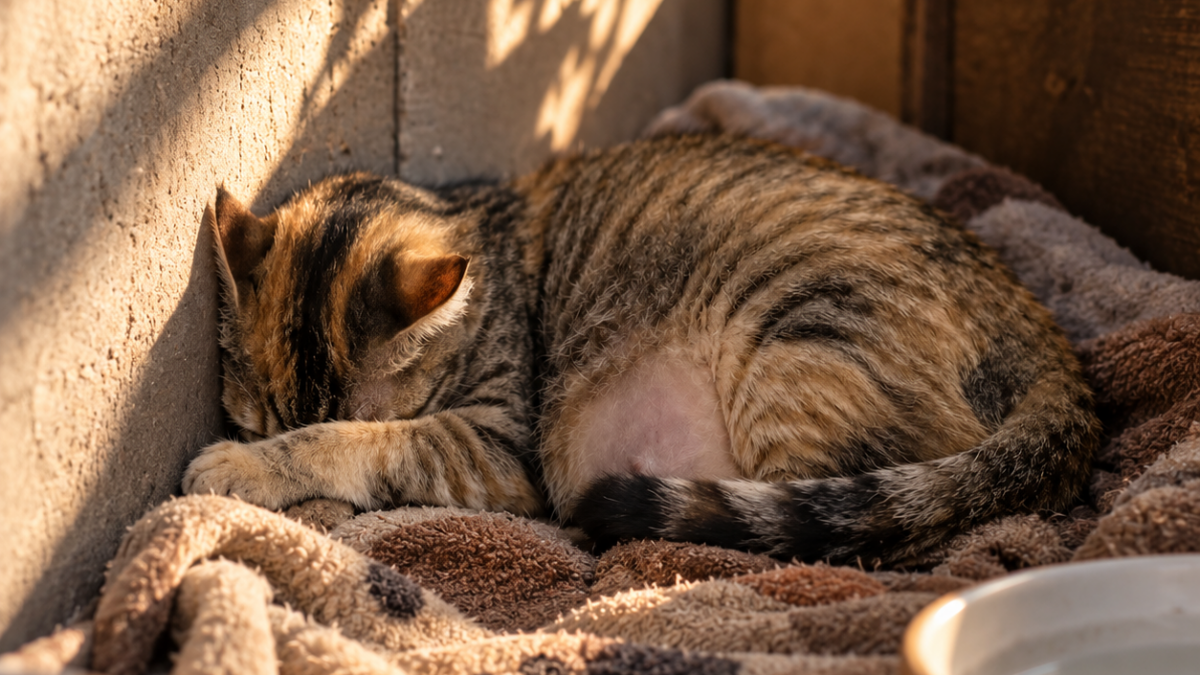
PART 2
The fourth kitten arrived at 12:19 a.m.
She was small, gray, and silent for three terrifying seconds before she opened her mouth and produced the loudest cry of the entire litter.
I laughed from pure relief.
Murka did not.
She was exhausted.
Her breathing had become shallow between contractions, and the blood on the blanket was no longer something I could comfortably call normal without a veterinarian standing beside me.
Dr. Hannah Cole answered on the second ring.
“Alina?”
“Murka’s in labor.”
“Already?”
“Three kittens alive. Fourth just came. There’s bleeding.”
“How much?”
I described it.
Her voice changed.
“I’m coming.”
“How long?”
“Fifteen minutes.”
I looked at Murka.
Another contraction.
“I don’t know if we have fifteen.”
“Listen to me. Keep her warm. Don’t pull a kitten unless one is visibly stuck and I tell you exactly what to do. Watch her gums. Tell me if she becomes unresponsive.”
I did.
Murka’s gums were pale.
Not white.
But pale enough that my stomach tightened.
The kittens crawled blindly against her belly.
Murka tried to lick all of them.
Her head dropped halfway through.
“Hey.”
I touched her shoulder.
Her eyes opened.
“Stay.”
I knew how ridiculous that sounded.
Still, I repeated it.
“Stay with them.”
## 1
Dr. Cole arrived at 12:34.
She didn’t take off her raincoat.
She walked straight into the maternity room, examined Murka, then looked at me.
“How many?”
“Four.”
She palpated Murka’s abdomen carefully.
“More.”
“How many?”
“Can’t tell.”
Murka contracted again.
Nothing came.
Dr. Cole waited.
Another contraction.
Still nothing.
She checked Murka.
Then her expression sharpened.
“One may be positioned wrong.”
My stomach dropped.
“Can you fix it?”
“Maybe.”
The shelter did not have a full surgical suite.
We had basic medical equipment, oxygen, emergency supplies, warming units.
But if Murka needed a C-section, we would have to drive to the twenty-four-hour clinic twelve miles away.
Dr. Cole tried gentle repositioning.
Murka cried.
It was the first real cry I had heard from her.
I hated it.
“I know,” Dr. Cole whispered. “I know.”
Then:
“There.”
A tiny paw appeared.
Wrong position.
Dr. Cole worked carefully.
One minute.
Two.
My hands were shaking.
The kitten emerged.
Completely still.
A small orange male.
Dr. Cole immediately began resuscitation.
I watched Murka.
She watched the kitten.
Even exhausted, she knew.
“Come on,” I whispered.
Dr. Cole rubbed.
Cleared airway.
Stimulated.
Nothing.
Then a gasp.
Another.
The smallest sound.
Dr. Cole smiled.
“Five.”
Murka leaned forward.
I brought the kitten close.
She began licking him.
Slowly.
The orange kitten moved.
I cried.
I didn’t even realize I was crying until Dr. Cole handed me a clean towel.
“Don’t celebrate yet.”
I wiped my face.
“More?”
“At least one.”
## 2
The sixth kitten arrived twenty-three minutes later.
A black-and-white female.
Healthy.
Then labor stopped.
Completely.
Murka lay flat.
No contractions.
No pushing.
No movement from her abdomen that I could see.
Dr. Cole examined her again.
“There may be another.”
“You said six.”
“I said at least one more before the sixth.”
“So?”
“So I’m not sure.”
She pulled out the portable ultrasound.
The shelter owned an older unit donated by a local clinic.
We used it mostly for emergency checks.
Dr. Cole moved the probe across Murka’s belly.
I saw shapes I didn’t understand.
Then Dr. Cole became very still.
“What?”
“One heartbeat.”
I looked at her.
“There’s another kitten?”
“Yes.”
“Alive?”
“Right now.”
“Why isn’t she delivering?”
“Uterine inertia. She’s exhausted.”
“What do we do?”
Dr. Cole checked Murka’s vitals again.
“Medication may restart contractions, but I don’t like how weak she is.”
“So surgery?”
She nodded.
“We’re going.”
## 3
At 1:21 in the morning, I was driving through heavy rain with Murka in a crate beside me and six newborn kittens inside a heated carrier on the back seat.
Dr. Cole followed in her car.
Every stoplight felt personal.
“Come on.”
Murka barely lifted her head.
The kittens squeaked behind me.
I turned up the heater.
“Everybody stays alive.”
Again, ridiculous.
Again, I needed to say it.
We reached Eastside Veterinary Emergency at 1:34.
The team was ready.
Murka disappeared through double doors.
The kittens went with a technician.
I stood in the lobby holding a towel covered in blood.
For the first time all night, there was nothing I could do.
That’s one of the hardest parts of rescue work.
Action protects you from fear.
Once action stops, fear catches up.
I sat down.
At 2:03, Dr. Cole came out.
“They’re operating.”
“Kitten?”
“Heartbeat still present.”
“Murka?”
“Stable enough.”
Enough.
I hated that word.
At 2:41, a technician appeared carrying something wrapped in a pink towel.
She smiled.
“Number seven.”
I stood.
The kitten was cream-colored with a gray patch over one eye.
Tiny.
Alive.
“Mother?”
“Coming out of surgery.”
“Okay?”
The technician nodded.
“Okay.”
I sat back down and cried harder than I had all night.
Seven kittens.
Seven.
## 4
Murka woke slowly.
The surgery had revealed a retained kitten positioned too high in the uterus to deliver naturally.
Without surgery, both might have died.
By sunrise, Murka lay in a warm recovery kennel while seven kittens slept against her.
I took a photograph.
Not for social media.
Not then.
For our records.
In it, Murka looked exhausted.
Shaved belly.
IV catheter.
Eyes half closed.
Seven tiny bodies tucked against her.
Later, that photograph would become important.
At the time, it simply meant:
They made it.
## 5
The shelter director, Karen, arrived at seven.
She looked at me.
“You’ve been awake all night.”
“Yes.”
“Go home.”
“No.”
“Alina.”
“Murka’s waking.”
“Murka will continue waking if you sleep.”
I looked through the glass.
Murka opened one eye.
Karen followed my gaze.
“Oh, no.”
“What?”
“You’re attached.”
“I am not.”
“You’re sitting outside an ICU kennel after being awake fourteen hours.”
“Professional concern.”
Karen laughed.
“Go shower.”
I did.
Then came back four hours later.
Professional concern.
Obviously.
## 6
The first week was touch and go.
Murka had lost a lot of blood.
Her milk production was low.
Three kittens needed supplemental feeding.
One—the orange male who had been stuck—struggled to gain weight.
We named him Sunny.
Not because of his color.
Because volunteers started calling him “the little sunrise kitten” after hearing he nearly died before dawn.
The cream kitten delivered by C-section became Hope.
The others:
Pepper.
Milo.
Bean.
Luna.
And Pip.
Murka did not care what we called them.
She counted them by smell.
Whenever we removed one for weighing, her eyes followed.
Whenever a kitten cried, her head came up.
The cat who had stopped watching the shelter door had found something else to watch.
Her babies.
## 7
She was an extraordinary mother.
Not in some sentimental, magical way.
In practical ways.
She cleaned them.
Moved them closer when they crawled too far.
Allowed supplemental feeding after she understood we were returning them.
Slept curled around the entire litter even when it looked physically impossible.
But there was something else.
Every evening around 7:30, Murka changed.
The first few days I thought I imagined it.
Then Karen noticed.
At seven twenty-five, Murka became restless.
At seven thirty, when the main shelter lights dimmed for evening quiet, she lifted her head.
Looked toward the hallway.
Waited.
Sometimes for five minutes.
Sometimes ten.
Then returned to her kittens.
She remembered.
Maybe not the exact clock.
But the pattern.
Day ending.
Door closing.
Person not returning.
Animals understand routines better than we do.
And broken routines leave marks.
## 8
We posted Murka’s story after the kittens were medically stable.
Nothing dramatic.
A photograph of Murka with the litter.
A short explanation:
Pregnant cat surrendered.
Went into labor her first night.
Emergency C-section.
Seven surviving kittens.
Donations needed for medical care.
The response surprised us.
People loved her.
Not because surrender itself was scandalous.
We were careful about that.
Surrendering an animal responsibly to a shelter is not the same as abandoning one on a road.
Sometimes it is the most humane option available.
The painful part of Murka’s story wasn’t that her former owner used a shelter.
It was how quickly she went from expecting him to return to learning he would not.
Animals don’t understand paperwork.
They understand departure.
Within three days, the post had been shared thousands of times locally.
Donations covered most of Murka’s emergency surgery.
Then something else happened.
Her former owner called.
## 9
His name was Victor Hale.
I recognized his voice before he gave his name.
“I saw the post.”
Karen put the call on speaker because she wanted a witness.
“Yes, Mr. Hale.”
“Those are Murka’s kittens?”
“Yes.”
“All seven survived?”
“Yes.”
A pause.
Then:
“I want two.”
I thought I had misheard.
Karen’s expression changed.
“You want two what?”
“Kittens.”
Silence.
“You permanently surrendered Murka to Greenfield.”
“I know.”
“And any unborn offspring transferred with her.”
“I didn’t know there’d be seven.”
That sentence landed badly.
Karen stayed calm.
“The surrender agreement states that you relinquished ownership of Murka and any dependent offspring.”
“I didn’t read all that.”
“You signed directly beneath the paragraph.”
“I still want two kittens.”
“Why?”
Another pause.
“They’re mine.”
I had to turn away.
Karen answered:
“No, they’re not.”
His voice hardened.
“She’s my cat.”
“She was your cat.”
“I raised her.”
“You voluntarily surrendered her.”
“Because I couldn’t handle a pregnant cat.”
“And now?”
“The kittens are different.”
“How?”
“They’ll be easier to place.”
There it was.
Not love.
Not regret.
Convenience.
## 10
Victor came to the shelter the next day.
He should not have.
Not because he was legally prohibited.
Because Murka saw him.
I was cleaning the maternity area when I heard Karen’s voice at reception.
Then a man’s.
Murka was asleep.
The moment Victor said her name—
“Murka.”
Her eyes opened.
Immediately.
She stood.
Walked to the front of the enclosure.
Her tail rose.
My heart broke.
She remembered him.
Of course she did.
Victor entered the hallway before Karen could stop him.
Murka began purring.
Loudly.
The same cat who had spent days learning we were safe suddenly looked like the animal she had been before the shelter.
She pressed against the enclosure door.
Victor stopped.
For one second, I thought he might cry.
Instead he said:
“She looks good.”
I stared at him.
“She almost died.”
He looked at the kittens.
“Those are all hers?”
“Yes.”
“Pretty.”
Murka rubbed her face against the gate.
Victor did not touch her.
He looked at Sunny.
Then Hope.
“You could probably get a lot for the cream one.”
That was when Murka stopped purring.
Not because she understood.
Because I stepped between him and the enclosure.
“Leave the maternity room.”
He looked at me.
“Who are you?”
“The person who was here when she almost bled to death.”
Karen appeared.
“Victor, front office. Now.”
## 11
His explanation became clearer.
Murka had gotten pregnant after escaping his apartment for several days.
He had no idea which male cat was the father.
When her belly grew, he realized what had happened.
He didn’t want the cost.
The mess.
The kittens.
So he surrendered her.
That part, however emotionally difficult, was legal.
The shelter was there for exactly those situations.
The problem began when the kittens became visible.
Beautiful.
Healthy.
Popular online.
Suddenly Victor saw something he hadn’t seen in Murka’s pregnancy.
Value.
He argued that because he had owned Murka at conception, he should receive part of the litter.
Legally, the signed surrender agreement ended that argument almost immediately.
Still, he refused to accept it.
He called.
Emailed.
Sent messages.
Eventually, he threatened to sue.
Karen forwarded everything to the shelter’s attorney.
## 12
Victor’s biggest mistake was putting his argument in writing.
One email read:
**If I had known the kittens would look like this, I never would have surrendered her.**
Another:
**You are going to make money adopting them out when they came from my cat.**
Our attorney responded simply:
The shelter was a nonprofit.
Adoption fees did not constitute sales profits.
Murka’s surgical care, neonatal supplies, vaccinations, spay/neuter procedures, microchips, and weeks of food would cost far more than the eventual adoption fees.
Victor answered:
**That isn’t my problem.**
I printed that email.
Not because we needed paper.
Because sometimes six words explain an entire conflict.
That isn’t my problem.
Murka’s pregnancy hadn’t been his problem.
Her delivery hadn’t been his problem.
Her emergency surgery hadn’t been his problem.
The seven kittens needing feeding every two hours hadn’t been his problem.
Until they became desirable.
Then suddenly they were his kittens.
## 13
Meanwhile, Murka was becoming herself again.
It happened slowly.
Her incision healed.
Her appetite returned.
Her coat improved.
She stopped flinching at the sound of carriers.
She began greeting volunteers.
But 7:30 remained difficult.
Every evening.
Lights dimmed.
Head up.
Hallway.
Wait.
Then one night, about three weeks after giving birth, something changed.
I was sitting inside the maternity room bottle-feeding Sunny.
The lights dimmed.
Murka lifted her head.
Looked toward the hallway.
Waited.
Then looked at me.
I was still there.
She stood.
Walked over.
Curled beside my leg.
And went to sleep.
I didn’t understand how important that was until Karen quietly said from the doorway:
“She didn’t watch the door.”
No.
She didn’t.
For the first time.
## 14
Sunny worried us constantly.
He gained weight slowly.
Had trouble nursing.
Then developed pneumonia after aspirating a small amount of milk.
We hospitalized him.
Murka panicked when he disappeared.
She searched the bedding.
Called.
Actually called.
Loudly.
I carried her to the treatment room.
Hospital policy normally wouldn’t allow that.
We made an exception.
Sunny was inside an oxygen unit.
Murka couldn’t touch him.
She sat outside.
Watched.
For hours.
I sat beside her.
“Remember when you waited for someone?”
Her ear moved.
“I know.”
Sunny survived.
When we returned him two days later, Murka washed him until he was soaked.
He complained loudly.
Everyone laughed.
## 15
By six weeks, the maternity room was chaos.
Seven kittens climbed everything.
Pepper attacked ankles.
Bean slept inside food bowls.
Luna climbed the enclosure gate like she’d been training for prison escape.
Pip discovered the water faucet.
Milo tried to fight his reflection.
Hope followed Murka everywhere.
Sunny, once the weakest, became the loudest.
Murka tolerated everything with a tired expression familiar to mothers of every species.
Sometimes she climbed onto the highest shelf just to escape them.
I respected that.
## 16
Adoption applications opened.
Hundreds came in.
The viral post had spread farther than we’d expected.
People wanted “Murka’s miracle babies.”
That phrase made me uncomfortable.
They weren’t miracles.
They were kittens.
Kittens who needed suitable homes.
We rejected applications from people who wanted them as surprise gifts.
People unwilling to keep them indoors.
People planning to declaw.
People who seemed interested only because of the story.
Then Victor submitted an application.
Under his girlfriend’s name.
## 17
We might not have caught it if he hadn’t included the same address.
Karen looked at me.
“You have got to be kidding.”
The application requested Hope.
The cream kitten.
The one Victor had said we could “get a lot for.”
We denied it.
He called within twenty minutes.
“You can’t do that.”
“We can deny any adoption application based on suitability.”
“You’re discriminating against me.”
“You surrendered the mother because you said you couldn’t manage the pregnancy or kittens.”
“That was months ago.”
“It was seven weeks ago.”
“My girlfriend wants one.”
“No.”
“Why?”
Karen’s patience cracked slightly.
“Because you attempted to bypass a direct conversation by submitting an application under another person’s name.”
Silence.
Then:
“You people think you’re better than me.”
Karen replied:
“No. We think Hope deserves a placement chosen for her welfare, not to resolve your regret.”
He hung up.
## 18
The story might have ended there.
Instead, Victor went public.
He posted online that the shelter had “stolen” his cat and was “selling her babies.”
He left out the signed surrender.
Left out the emergency C-section.
Left out his emails.
Left out the application under his girlfriend’s name.
For two days, our shelter received angry messages.
People called Karen a thief.
Called me worse.
Demanded we “return the family.”
Then our attorney gave us permission to issue a factual statement.
No insults.
No private medical details beyond what was relevant.
We published:
Murka had been voluntarily and legally surrendered.
The surrender included unborn offspring.
Emergency medical care was provided at shelter expense.
The former owner later requested kittens but retained no ownership rights.
No animals had been stolen.
That should have been enough.
It wasn’t.
Victor posted again.
So we released one thing with his written permission from the surrender form.
His signature.
The argument collapsed.
## 19
Then a local reporter contacted him.
I never saw the entire interview.
Only a clip.
The reporter asked:
“Why did you surrender Murka?”
Victor answered:
“Because I couldn’t afford a litter.”
“Why do you want the kittens now?”
He hesitated.
Then said:
“Because they’re mine.”
“But you surrendered ownership before they were born.”
“I didn’t know they’d all survive.”
That sentence spread everywhere.
Not because we wanted revenge.
Because people heard what he was actually saying.
His claim depended on the kittens becoming worth wanting.
Public sympathy shifted sharply.
Victor deleted his post.
Then his account.
## 20
I should say something here that matters.
Victor wasn’t prosecuted.
He wasn’t charged with cruelty.
He had taken Murka to a shelter rather than dumping her outside.
That was the responsible part of his decision.
I refused to turn him into a criminal because it made the story cleaner.
What he did wrong afterward was emotional and ethical, not a dramatic felony.
He wanted the rewarding part after refusing responsibility for the difficult part.
And he learned that surrender means letting go.
That was his consequence.
He lost the ability to decide.
## 21
The kittens were adopted one by one.
Pepper went first.
A nurse named Rachel had recently lost a seventeen-year-old cat.
She sat inside the meet-and-greet room and let Pepper choose.
Pepper climbed directly into her purse.
Decision made.
Bean went to a retired couple.
Milo went to a young man who worked from home and had another playful cat.
Pip went to a family with two teenagers.
Luna went with an elementary-school librarian.
Hope went to a veterinary technician.
Sunny stayed longest.
Not because nobody wanted him.
Because I was too picky.
He’d nearly died twice.
I wanted perfection.
Karen finally said:
“You are rejecting people because you don’t want him to leave.”
“I rejected one because they travel.”
“They travel twice a year.”
“Unstable.”
“Alina.”
“What?”
“You’re ridiculous.”
Probably.
Then a woman named Grace came in.
Sixty-three.
Widowed.
Quiet home.
No other pets.
She sat on the floor.
Sunny walked over.
Climbed into her lap.
Fell asleep.
I hated her immediately.
Because I knew.
## 22
Grace visited four times.
She brought questions.
Not toys.
Questions.
“What food does he tolerate best?”
“Does he still cough?”
“How often should I monitor his breathing?”
“What does he do when he’s frightened?”
“What kind of carrier does he prefer?”
Good questions.
Responsible questions.
By the fourth visit, I was out of objections.
Sunny went home.
I cried in the parking lot.
Karen found me.
“You knew this would happen.”
“I hate adoption.”
“You work at a shelter.”
“Terrible career choice.”
## 23
Then there was Murka.
Her kittens were gone.
The maternity room became quiet.
That first night without them, Murka searched.
Not frantically.
She checked the blanket.
The box.
The shelf.
Then came to me.
I sat on the floor.
She climbed into my lap.
For the first time.
Not beside.
Not near.
On me.
I stroked her back.
“You did it.”
She purred.
Seven kittens.
All alive.
All home.
Murka had completed the hardest chapter of her life.
Now we needed a home for her.
## 24
Applications came.
Fewer than for the kittens.
Always fewer for the mother.
People love babies.
Adults wait.
I rejected one household with an aggressive dog.
Another planned outdoor access beside a highway.
Then a couple named David and Nora Bennett visited.
They were in their fifties.
No children at home.
One elderly cat named Walter.
Nora sat on the floor.
Murka stayed away.
That didn’t bother her.
She talked to Karen instead.
Asked questions.
Murka eventually approached from behind.
Sniffed Nora’s sleeve.
Nora did not turn.
Didn’t reach.
Didn’t squeal.
Just let Murka decide.
Ten minutes later, Murka sat beside her.
Not touching.
Close.
David smiled.
“She doesn’t owe us affection.”
That sentence got my attention.
## 25
They returned three times.
On the third visit, Murka climbed into Nora’s lap.
I knew.
Again.
I hated knowing.
The adoption was approved.
Murka left Greenfield Shelter ninety-three days after Victor carried her through the intake door.
This time, when she entered a carrier, she hesitated.
I placed my hand inside.
She touched my fingers.
Then stepped in.
At the front entrance, Nora asked:
“Do you want to say goodbye?”
I already had.
Every night for three months.
Still, I crouched.
“Murka.”
She looked at me.
“Don’t wait for us.”
My voice broke.
“Go home.”
Nora cried.
So did I.
David pretended not to.
## 26
Murka’s new home was twenty minutes away.
Nora sent photos.
The first showed Murka beneath a dining table.
Second:
On the couch.
Third:
Beside Walter.
Walter looked offended.
Fourth:
Murka on Nora’s bed.
Then one photograph stopped me.
Timestamp:
7:31 p.m.
Murka asleep.
Completely asleep.
No doorway.
No waiting.
I stared at it for a long time.
## 27
Nora later told me they had accidentally discovered Murka’s 7:30 ritual.
Every evening, around the same time, she’d wake.
Walk toward the front hallway.
Sit.
Listen.
Then return.
They didn’t force her away.
Didn’t distract her every time.
They simply created another pattern.
At 7:25, David made tea.
At 7:30, Nora sat in the living room.
At 7:35, they gave Walter and Murka a small evening snack.
Night after night.
Eventually 7:30 stopped meaning:
Someone left.
It became:
Tea.
Treats.
Home.
Routine can wound.
Routine can heal.
## 28
Victor returned once more.
Months later.
Not to demand kittens.
To ask about Murka.
I was at reception.
He looked different.
Less angry.
Embarrassed, maybe.
“Is she still here?”
“No.”
His face fell slightly.
“Adopted?”
“Yes.”
“Good home?”
“Very.”
He nodded.
Then stood there.
I waited.
“How are the kittens?”
“Adopted.”
“All?”
“All.”
“Sunny?”
I looked at him.
“You remember Sunny?”
“The orange one?”
“Yes.”
“He okay?”
“Very.”
Victor rubbed the back of his neck.
“I saw the videos.”
I said nothing.
He looked toward the hallway where Murka had once waited.
“I handled things badly.”
That was more self-awareness than I’d expected.
“You surrendered her because you couldn’t care for the litter.”
“I know.”
“That part isn’t what people were angry about.”
“I know.”
“You tried to take the easy part back after everyone else carried the hard part.”
He looked down.
“I know.”
Silence.
Then:
“Does she hate me?”
The question surprised me.
I answered honestly.
“I don’t know.”
Cats don’t write moral judgments.
They remember patterns.
Smells.
Safety.
Fear.
Affection.
Loss.
“I think she waited for you.”
His eyes changed.
“How long?”
“All day.”
I regretted saying it the moment it left my mouth.
But maybe he needed it.
“At 7:30, we shut off the lights.”
He stared at me.
“She stopped watching the door after that.”
Victor looked away.
For a long time.
Then he whispered:
“I shouldn’t have left without touching her.”
No.
He shouldn’t have.
## 29
He didn’t ask for the address.
Didn’t ask to visit.
That mattered.
Before leaving, he placed an envelope on the counter.
“What is this?”
“Money.”
“We don’t take payment for surrendered animals after the fact.”
“Donation.”
“How much?”
“Enough for part of the surgery, maybe.”
I opened it after he left.
One thousand dollars.
Not enough to repay everything.
Not the point.
We put it into the emergency maternity fund.
Karen wrote the donation as anonymous.
So did I.
People can do something selfish and later do something decent.
One doesn’t erase the other.
Both can be true.
## 30
That money helped save a pregnant stray two months later.
Emergency C-section.
Four kittens.
I never told Victor.
I didn’t need to.
The consequences of his choices had already traveled farther than he knew.
## 31
A year after Murka’s adoption, Nora invited me over.
I almost said no.
Sometimes visiting adopted animals can reopen feelings you thought were settled.
I went.
The door opened.
Murka was on the staircase.
She froze.
I froze.
Then she came down.
Slowly.
Sniffed my shoes.
My pants.
My hand.
Then she rubbed her face against my leg.
I cried immediately.
Nora laughed.
“She remembers.”
Murka walked away toward the kitchen.
Perfect.
No desperate reunion.
No panic.
No demand that I stay.
She remembered me.
And she was fine without me.
That’s what I wanted.
## 32
Walter had died a few months earlier.
Old age.
Murka had slept beside his empty bed for a week.
Then gradually stopped.
She became the only cat.
Nora said her personality expanded after that.
She talked more.
Demanded breakfast.
Slept on David’s chest.
Knocked pens from tables.
Stole one piece of salmon and ran behind the couch.
I smiled.
“The criminal behavior is healthy.”
“Good.”
## 33
At exactly 7:30, I watched.
The clock changed.
Murka was asleep on a window seat.
Nothing happened.
7:31.
Still asleep.
I looked at Nora.
She understood.
“She doesn’t do it anymore.”
My throat tightened.
“When did it stop?”
“Maybe six months ago.”
Completely?
“Completely.”
I looked at Murka.
She stretched.
Yawned.
Went back to sleep.
7:30 had lost its power.
## 34
That mattered more to me than Victor losing his claim to the kittens.
More than the viral post.
More than the public argument.
Trauma had a clock.
Then one day, it didn’t.
## 35
The shelter created a maternity program after Murka.
Before her, pregnant cats were handled case by case.
After her, we formalized everything.
Emergency foster list.
Birth kits.
Heating pads.
Formula supply.
Transport plans.
On-call veterinary agreements.
Training for dystocia warning signs.
Clear surrender counseling.
We began asking owners of pregnant cats more detailed questions.
Not to shame them.
To prepare.
Murka’s seven kittens cost thousands in emergency and neonatal care.
But the lessons reduced risks for the next mother.
And the next.
## 36
We named the program the Seven Lives Fund.
Technically cats are supposed to have nine.
Karen said seven sounded more honest.
The fund paid for emergency deliveries, neonatal care, and temporary fosters.
Sunny’s adopter, Grace, donated every year on his birthday.
So did Nora.
Eventually Victor donated again.
Anonymous.
I recognized the handwriting.
Never said anything.
## 37
Five years passed.
Murka became round.
Not unhealthy.
Comfortably round.
The skeletal fear never returned because she’d never been skeletal to begin with, but there had been another kind of hunger when she arrived.
A hunger for the familiar.
The person.
The kitchen.
The blanket.
The old life.
That hunger faded.
Home became where she was.
## 38
Nora sent me a photograph every year on the anniversary of Murka’s surrender.
Not the surrender anniversary, she called it.
“Homecoming season.”
One year:
Murka sleeping in Christmas wrapping paper.
Another:
Inside a laundry basket.
Another:
On David’s laptop.
Another:
Sitting beside a birthday cake she wasn’t allowed to touch.
Ordinary photographs.
My favorite kind.
## 39
The kittens grew too.
Pepper became huge.
Bean remained tiny.
Milo developed diabetes at ten and handled insulin like a champion.
Pip lived to seventeen.
Luna became the queen of the library household.
Hope developed chronic kidney disease late in life.
Sunny—
Sunny surprised everybody.
The kitten who almost died three times lived to eighteen.
Grace called me on his eighteenth birthday.
“You need to see him.”
He was thin.
Gray around the face.
Orange still bright along his back.
He climbed into my lap.
I laughed.
“You caused me so much trouble.”
Grace said:
“He’s still causing trouble.”
“Good.”
## 40
Sunny died peacefully the following year.
Nineteen.
Grace called.
We cried together.
I remember thinking:
The kitten I once rubbed with a towel because he wasn’t breathing got nineteen years.
Nineteen.
How do you measure that?
You don’t.
You just say thank you.
## 41
Murka outlived some of her kittens.
That’s the strange cruelty of long life.
At fifteen, she was diagnosed with early kidney disease.
Then arthritis.
Nora called me.
“She’s still happy.”
I went over.
Murka walked slowly.
But she ate.
Purred.
Wanted attention.
Stared at birds.
The veterinarian said:
“Old isn’t an emergency.”
I liked that.
We have a habit in rescue of thinking every physical decline means suffering.
It doesn’t.
Age is not cruelty.
Pain without treatment is.
Murka received treatment.
## 42
At sixteen, she started sleeping more.
Nora placed little steps beside the bed.
David bought an orthopedic cat bed that Murka ignored for three months.
Then suddenly adopted as her throne.
“She waited until the return period expired,” David complained.
Classic cat.
## 43
Victor contacted me once more.
Almost fifteen years after the surrender.
I don’t know how he still had the shelter email.
His message was short.
**Is Murka still alive?**
I considered not responding.
Then did.
**Yes. She is sixteen and lives with the same family who adopted her.**
His answer came minutes later.
**I’m glad.**
Then:
**I think about that night sometimes.**
I stared.
He meant the surrender.
I wrote:
**She stopped waiting a long time ago.**
He answered:
**Good.**
That was the last time we spoke.
## 44
People sometimes ask whether I forgave him.
Wrong question.
Nothing had happened to me that required forgiveness.
Murka was the one who experienced the loss.
And Murka didn’t spend fifteen years thinking about Victor.
That was clear.
Humans obsess over offenders because we understand blame.
Animals focus more on what happens now.
Safe?
Food?
Warm?
Person here?
Routine intact?
That’s not simpler.
Sometimes it’s wiser.
## 45
Victor’s consequence was not that his life collapsed.
It didn’t.
He wasn’t a villain whose house burned down.
He went on living.
Working.
Probably making mistakes.
Probably doing some things right.
The satisfying consequence was narrower.
He surrendered Murka.
So he lost the right to choose what came next.
He could not decide which kittens to take.
Could not profit from their popularity.
Could not return when the difficult part was finished.
The signature he made while avoiding Murka’s eyes became permanent.
Choices matter.
## 46
And Murka?
She gained choices.
That reversal is the part I love.
At the shelter, she had no choice about where Victor left her.
In Nora’s house, she chose everything.
Window or couch.
Bed or floor.
Salmon or refusal.
Lap or solitude.
Front room or bedroom.
Attention or distance.
Freedom is often made of small decisions.
## 47
The last year of Murka’s life was gentle.
Kidneys worsened.
Weight dropped.
Nora began giving fluids at home.
Murka tolerated them badly at first.
Then discovered she got chicken afterward.
Negotiations succeeded.
David called it bribery.
Correct.
## 48
One evening, Nora called me.
Her voice told me before the words did.
“Alina.”
“What happened?”
“Murka didn’t eat.”
My stomach tightened.
“All day?”
“Nothing.”
“Vet?”
“Tomorrow morning.”
I drove over that night.
Murka lay on her bed.
Very old.
Very small.
Not the round young mother anymore.
Her amber eyes opened.
She sniffed my fingers.
Then rested her chin on them.
I sat on the floor.
Nora sat beside me.
“Do you remember 7:30?”
She nodded.
We both looked at the clock.
7:24.
Neither said anything.
7:25.
Murka slept.
7:28.
Still sleeping.
7:30.
Nothing.
No head lifting.
No hallway.
No waiting.
She had forgotten the ritual completely.
Or maybe replaced it so thoroughly that her body no longer remembered.
I cried.
Nora did too.
“Why are we crying?” she whispered.
“Because it’s gone.”
“What?”
“The waiting.”
## 49
The veterinarian came to the house two days later.
Murka’s kidneys were failing badly.
Treatment could buy a little time.
Not comfortable time.
Nora asked the hardest question.
“If we keep going, is it for her?”
The veterinarian was quiet.
“Probably not.”
Nora nodded.
Decision made.
Not easy.
Clear.
## 50
They scheduled an in-home euthanasia for the following afternoon.
I came.
Karen came briefly to say goodbye, then left because she knew the final moments belonged to the family.
Victor didn’t know.
Didn’t need to.
Murka had not been his cat for sixteen years.
That chapter was closed.
## 51
Murka lay on Nora’s favorite blanket.
Not an old shelter blanket.
Not anything symbolic.
The blanket she actually loved.
David sat beside her.
Nora held her.
I touched the top of her head.
Murka purred faintly.
I remembered the first night.
Rain.
Dark hallway.
A cat looking at the door.
Then blood.
Tiny kittens.
Panic.
Seven lives.
So much life came after that darkness.
## 52
Nora whispered:
“You were never alone again.”
Murka’s ear moved.
David rubbed his eyes.
I said:
“That’s true.”
The veterinarian administered the sedative.
Murka relaxed.
Her breathing slowed.
Her paws loosened.
No fear.
No searching.
No door.
## 53
Then I looked at the clock.
7:29.
I almost laughed.
Of course.
Of all the times.
7:30.
The minute changed.
Sixteen years earlier, 7:30 had been the moment the shelter lights went out and Murka understood someone wasn’t coming back.
Now, at 7:30, she was lying in the middle of the people who had come and stayed.
Nora’s hand against her chest.
David beside her.
Me at her feet.
Home.
I don’t believe the universe arranges clocks for emotional convenience.
But I noticed.
How could I not?
## 54
The veterinarian gave the final medication.
Nora whispered:
“Go to sleep, baby.”
Murka took one final breath.
Then another.
Then nothing.
Exactly 7:32.
## 55
For several minutes nobody spoke.
Then David laughed through tears.
“She always did everything on her schedule.”
That broke us.
We laughed too.
## 56
Murka’s ashes stayed with Nora and David.
They placed the urn on a shelf beside a photograph.
Not a shelter photograph.
Not the maternity picture.
A photograph of Murka sleeping in sunlight with one paw over her face.
Perfect.
## 57
The shelter kept no memorial for her at first.
Then the Seven Lives Fund reached a milestone.
It had paid for emergency maternity care for one hundred cats.
One hundred mothers.
Hundreds of kittens.
Karen called.
“We’re putting something on the wall.”
“No sad picture.”
“Agreed.”
The plaque read:
**THE SEVEN LIVES FUND**
**Created after one mother cat taught us that surrender may end one relationship, but it does not have to end a life.**
Underneath:
**For Murka and the seven kittens born on her first night at Greenfield.**
That was enough.
## 58
Sunny’s photograph sat nearby.
Nineteen years old.
Orange.
Grumpy.
Grace chose the picture.
Not the newborn one.
Again:
Meet who they became.
Not only what nearly happened.
## 59
Victor’s first thousand-dollar donation remained anonymous in the fund records.
So did the later ones.
I never told Nora.
It didn’t matter.
Maybe guilt motivated him.
Maybe remorse.
Maybe memory.
Whatever the reason, his money helped animals he would never meet.
Consequences don’t always need applause.
## 60
Years after Murka died, I was training a new volunteer named Chloe.
A pregnant tabby had been surrendered that afternoon.
The owner cried for twenty minutes.
Lost housing.
No family who could help.
No money for kittens.
She kissed the cat’s head before leaving.
Then stood outside the shelter crying.
Chloe watched.
“That’s sad.”
“Yes.”
“Is she bad for giving her up?”
“No.”
Chloe looked surprised.
I said:
“Sometimes loving an animal means admitting you can’t give them what they need.”
That was something Murka’s story had taught me too.
Victor’s surrender itself was not the unforgivable part.
He had actually brought her somewhere safe.
The painful part was failing to understand that once he surrendered her, he couldn’t come back only for what turned out well.
Responsibility isn’t a buffet.
You don’t choose the rewarding pieces and leave the expensive ones for somebody else.
## 61
The new tabby gave birth in foster care.
Four kittens.
No emergency.
No midnight surgery.
Perfect.
I liked that story better.
Boring is beautiful.
## 62
At Greenfield, 7:30 still means lights down.
Every evening.
Same click.
Same hallway shadows.
But now the maternity ward has low night lights.
Quiet music.
Cameras.
A volunteer on call.
Protocols Murka helped create.
Most cats barely notice.
Good.
## 63
Sometimes I work late.
At exactly 7:30, the lights dim automatically.
I still think of her.
Not the old Murka first.
The young one.
Round belly.
Amber eyes.
Sitting at the kennel door.
Waiting.
Then I remember how the story ended.
Sixteen years later.
7:30.
No waiting.
Surrounded.
That symmetry hurts.
And heals.
## 64
People wanted revenge when Murka’s story became popular.
They wanted Victor publicly destroyed.
Wanted him fined.
Arrested.
Humiliated.
But life isn’t improved by inventing crimes where none occurred.
He surrendered a pregnant cat because he couldn’t handle the responsibility.
That was painful.
But the shelter existed so Murka would have somewhere safe to go.
The real conflict came when he wanted the benefits after relinquishing the burden.
And the most satisfying consequence was simple:
No.
You signed.
You chose.
You don’t get to take the cream kitten because she became beautiful.
You don’t get Sunny because he survived.
You don’t get to rewrite the first night because the ending became valuable.
Murka and her kittens were no longer his to divide.
## 65
He had to watch seven lives continue without his permission.
That’s not cruelty toward him.
That’s consequence.
## 66
Murka didn’t need his punishment.
She needed care.
She got it.
Her kittens didn’t need revenge.
They needed homes.
They got them.
The shelter didn’t need a villain.
It needed better maternity resources.
It built them.
That’s a satisfying ending because something useful survived the hurt.
## 67
If I had to explain Murka in one memory, I wouldn’t choose the labor.
Not the surgery.
Not the owner returning.
Not the internet drama.
I’d choose one ordinary evening in Nora’s house.
Murka was maybe six.
Healthy.
Slightly overweight.
Nora was reading.
David watching television.
Walter still alive, asleep on the other end of the couch.
Clock on the wall:
7:31.
Murka lay upside down between them.
Completely unconscious.
That image meant everything.
## 68
Once, darkness at 7:30 meant:
He isn’t coming back.
Years later, it meant nothing at all.
Just evening.
Home.
People nearby.
That is what healing looks like when it has had enough time.
The event remains true.
The body stops living inside it.
## 69
Murka never got her old kitchen back.
Never returned to the blanket beside Victor’s radiator.
Never returned to the exact life she had expected when he placed her in the carrier that morning.
And that’s okay.
Healing is not always restoration.
Sometimes the old life is gone.
The goal becomes building one good enough that you stop trying to return.
Murka did.
## 70
She built another life.
Seven kittens.
A shelter full of people who knew her name.
Nora.
David.
Walter.
Window seats.
Salmon theft.
Sixteen birthdays.
Kidney medication.
Evening treats.
An old age gentle enough to be ordinary.
Nothing about that erased the first night.
Nothing needed to.
## 71
There is a temptation to say Murka forgave Victor.
I don’t know.
I don’t think in those terms.
She remembered him when he returned.
That was obvious.
She purred.
She reached toward him.
Maybe some part of her still loved the person associated with her old home.
Animals can carry attachment and pain at the same time.
So can people.
That doesn’t mean returning is right.
## 72
Victor walked away from the shelter the first time without touching Murka.
Years later, he asked whether she hated him.
That question told me he understood something had been lost.
Maybe that was punishment enough.
Not because I wanted him tormented.
Because recognizing what you discarded can be its own consequence.
## 73
He never knew Murka died at 7:32.
I never told him.
That moment belonged to Nora and David.
To Murka’s real final family.
## 74
The Seven Lives Fund continues.
As of the last report I saw, more than three hundred mother cats had received some form of assistance through it.
Not all emergencies.
Sometimes food.
Sometimes foster supplies.
Sometimes spay surgery after kittens were weaned.
Sometimes C-sections.
Sometimes neonatal care.
Three hundred.
Murka’s first night became infrastructure.
I like that.
## 75
One cat.
One difficult birth.
One volunteer awake after midnight.
Then years of animals helped.
Impact grows strangely.
## 76
Sunny’s adopter once wrote a note to the shelter before she died.
Grace was elderly by then.
She said:
**I thought I was adopting the kitten nobody was sure would survive. Instead, I got nineteen years of being told when to wake up. Best bad decision I ever made.**
We framed it.
## 77
That’s another thing Murka gave us.
Not seven kittens.
Seven entire human relationships.
People who arranged furniture around cats.
Changed travel plans.
Paid veterinary bills.
Bought food.
Cried at endings.
Loved.
Victor had looked at a pregnancy and seen a problem.
We got to see the continuation.
## 78
That is why I no longer think of rescue as saving one moment.
The midnight birth was dramatic.
The real value came afterward.
Years.
That’s always where the real story hides.
## 79
If you want a viral ending, I could say:
The man who gave Murka away tried to come back for her beautiful kittens and was turned away.
True.
But incomplete.
The better ending is:
One night, sixteen years later, Murka died at 7:32 in a warm house surrounded by people who had spent years proving they would come back.
That’s the ending that matters.
## 80
Because at exactly 7:30 on her first shelter night, Murka thought darkness meant she had been left behind.
At exactly 7:30 on one of her last evenings, darkness meant absolutely nothing.
She was home.
That’s the revenge.
Not that somebody else suffered.
That abandonment stopped being the most powerful memory in her body.
## 81
The door she once watched no longer mattered.
The person she once waited for no longer decided her future.
Her kittens were safe.
Her new family stayed.
Her name belonged to people who spoke it with affection.
Her life became larger than the moment someone signed it away.
## 82
And if Murka could have understood everything that followed that first night, I think the only part she would have cared about was simple.
The lights went out.
But this time—
someone was still there.
Years after Murka left the shelter, I still found myself thinking about that first night whenever the hallway lights clicked off at 7:30.
Not because the shelter looked the same.
It didn’t.
We had renovated twice. The maternity room had new heating panels, quieter ventilation, softer lighting, better cameras, and shelves designed specifically for nursing mothers who wanted somewhere high to escape their kittens for a few minutes. There was a cabinet stocked with formula, syringes, warming discs, clean towels, emergency calcium, and everything we had once scrambled to find while Murka was bleeding on an old blanket.
The place had changed.
The sound had not.
Click.
Lights down.
Evening.
And for years, that tiny sound brought me back to the image of Murka sitting at the front of her kennel, watching a door that would never open for the person she expected.
What surprised me most was how long it took before I stopped feeling angry when I remembered Victor.
At first, I wanted consequences to hurt.
I wanted him to understand exactly what it felt like to watch someone leave.
I wanted him to see Murka almost die during labor.
I wanted him to sit outside the emergency room while Sunny failed to breathe.
I wanted him to hold Hope when she came out of surgery so small that she fit almost entirely inside two hands.
I wanted him to understand that the kittens he later called “his” had survived because other people stayed awake, spent money, missed work, bottle-fed every two hours, cleaned bedding, drove through storms, and refused to let a frightened mother cat face another crisis alone.
But life doesn’t always give you the revenge scene you imagine.
Sometimes it gives you something quieter.
Something better.
Victor did lose control.
That was real.
The moment he signed Murka over, he gave up the right to decide where she lived, which kitten he wanted, whether Hope was “valuable,” whether Sunny should come back to him, or whether Murka should ever see his home again.
When he later looked at those healthy kittens and suddenly wanted a piece of the story, the answer was simply no.
Not screamed.
Not dramatized.
No.
You chose.
The shelter carried the responsibility you surrendered.
You don’t get to reclaim the reward because the frightening part ended well.
At the time, that answer didn’t feel dramatic enough.
Years later, it felt exactly right.
Because the greatest change wasn’t what happened to Victor.
It was what happened to Murka.
Nora and David sent photographs constantly during the first year.
Murka in a cardboard box too small for her.
Murka sleeping beside Walter, their elderly tabby, while Walter looked deeply offended by her existence.
Murka sitting on David’s newspaper.
Murka stretched across Nora’s pillow as if she had paid the mortgage.
Then came the photograph that I kept.
It was taken at 7:31 in the evening.
Nora hadn’t planned it.
She had simply noticed the clock.
Murka was asleep on the couch, one front paw covering her nose, completely unaware that a minute of the day had once carried so much fear.
I printed that picture and kept it inside my locker at the shelter.
For a long time, whenever a new volunteer became too focused on an animal’s tragic intake story, I would show it to them.
“This is the goal,” I’d say.
They usually expected a dramatic rescue photograph.
Instead they saw a slightly overweight gray-and-white cat taking up most of a couch.
“What am I looking at?”
“A boring Tuesday night.”
They’d stare.
Then I would explain.
The day an animal’s life becomes boring is often the day rescue has really worked.
Murka didn’t need to remain the pregnant cat abandoned at a shelter.
She needed to become the cat who complained when breakfast was late.
The cat who stole fish from David’s plate.
The cat who learned which cupboard held treats.
The cat who had favorite windows.
The cat who got older.
That last part mattered more than I understood when I was younger.
We celebrate survival at shelters in days.
Made it through surgery.
Made it through the night.
Made it to adoption.
But the real victory is sometimes measured decades later.
Gray fur.
Arthritis.
Kidney medication.
The ordinary inconveniences of age.
Murka got all of those.
By the time she was eight, she had become confident enough to dislike visitors.
Not fear them.
Dislike them.
There is a difference.
When strangers arrived, she no longer disappeared beneath furniture trembling.
She simply evaluated them from the staircase and decided whether they deserved access to her.
Nora told me one repairman once tried to pet her without asking.
Murka slapped his hand.
No claws.
Just one precise warning.
Nora apologized.
Then called me laughing.
“I think that’s progress.”
“It absolutely is.”
A cat who once froze whenever unfamiliar footsteps came down a shelter hallway had learned that she could say no.
That was freedom.
Years later, when people asked what happened to Victor, I often found myself thinking about that slap.
He had left Murka with no control over where she would sleep that night.
Her new life gave control back in hundreds of tiny ways.
Touch me.
Don’t touch me.
Open the door.
Close it.
I want this chair.
Not that food.
Come here.
Leave me alone.
Humans underestimate how much dignity exists inside small choices.
Murka’s life became full of them.
The kittens gave us updates too.
Grace sent photographs of Sunny every birthday.
The first one showed him wearing a blue bow tie and looking furious.
The fifth showed him sleeping on a radiator shelf.
At ten, he had grown into a large orange cat with a deep voice and no memory anyone could identify of the night he nearly died.
At fifteen, he developed thyroid disease.
At seventeen, arthritis.
At nineteen, he still woke Grace before sunrise by knocking a pen from the nightstand.
When Grace called me after his nineteenth birthday, her voice shook.
“He’s an old man now.”
I laughed.
“He was supposed to be the weak one.”
“I know.”
There was a silence.
Then she said:
“I’m glad you kept rubbing him.”
I remembered him in my hands.
Wet.
Limp.
Nothing happening.
Then that first tiny breath.
“I am too.”
Sunny died several months later.
Grace chose an in-home veterinarian.
She told me he spent his final morning in a patch of sunlight.
No oxygen unit.
No emergency warming.
No desperate hands trying to make his lungs begin.
Just sunlight.
A soft blanket.
The woman who had loved him for nineteen years.
Afterward, Grace mailed the shelter a letter with a photograph.
Sunny was asleep on his back.
The note said:
“I was told he might not survive his first night. He gave me 6,923 mornings.”
I did the math.
She was close.
That sentence stayed with me.
People often ask what one saved life is worth.
Sometimes the answer is 6,923 mornings.
Sometimes it’s one person who doesn’t eat breakfast alone anymore.
Sometimes it’s nineteen years of cat hair on furniture.
None of those things fit into the kind of calculation Victor had made when Murka was pregnant.
He had seen cost before there was a chance to see life.
That’s why the word “value” became so important to me.
The kittens weren’t valuable because they became attractive.
They weren’t valuable because people shared their pictures.
They weren’t valuable because adoption applications arrived by the hundreds.
They had been valuable when they were invisible inside Murka.
Before anyone knew their colors.
Before anyone knew whether they would survive.
Before anyone wanted them.
That’s what Victor failed to understand.
But eventually, I stopped needing him to understand it.
That was another kind of healing.
For a while, I wanted him to know exactly what he had lost.
Later, it no longer mattered whether he knew.
Murka knew home.
That was enough.
Her evening ritual faded slowly.
Nora once explained it to me in detail.
For the first month, Murka would wake around 7:25 and go to the entryway.
At 7:30, she sat facing the door.
At first Nora tried to distract her.
Treats.
Toys.
Calling.
Nothing worked.
So she stopped trying to erase it.
Instead, she simply stayed nearby.
David made tea.
Nora read.
Walter slept.
Murka waited.
Nobody dragged her away from the door.
Nobody told her she shouldn’t remember.
Then, after ten or fifteen minutes, Murka would return.
Over time, Nora created new associations.
At seven twenty-five, the kettle clicked.
At seven thirty, the small lamp beside the couch came on.
At seven thirty-five, the cats got a little piece of cooked chicken.
Same time.
Every night.
Not because they were trying to trick Murka.
Because routine had once taught her loss.
Maybe routine could teach something else.
Months passed.
One evening, Murka went to the hallway at 7:30 but stayed only two minutes.
Another evening, she stopped halfway.
Then came the first night she didn’t go at all.
Nora noticed immediately.
She didn’t celebrate.
She was afraid that making a big moment out of it would somehow break something.
She just sat on the couch.
Murka slept beside Walter.
The clock passed 7:30.
Then 7:40.
Nothing happened.
The next night, Murka went to the hallway again.
Healing is rarely a straight line.
But gradually the old pattern weakened.
Until one day it disappeared.
Years later, Murka could sleep through 7:30.
That became the part of her story I told most often.
Not the abandonment.
Not the emergency birth.
That.
Because trauma doesn’t always vanish from memory.
Sometimes it simply stops controlling the clock.
The shelter changed because of her too.
The Seven Lives Fund grew far beyond anything Karen or I expected.
At first, it paid for formula.
Then emergency veterinary care.
Then foster supplies.
Then discounted spay services for mother cats after their kittens were weaned.
We created a small emergency grant for owners who wanted to keep pregnant cats but needed temporary help.
That program came from something Victor had accidentally taught us.
Sometimes surrender happens not because people don’t care.
Sometimes they are overwhelmed.
Scared.
Poor.
Unprepared.
If a bag of kitten food, a veterinary exam, and a temporary foster can keep an animal safely with a loving family, that’s worth exploring before surrender.
Not always.
But sometimes.
We started having different conversations.
“What part feels impossible?”
“Money?”
“Space?”
“Delivery?”
“Finding homes?”
“Medical risk?”
Some people still surrendered.
No shame.
That was the safest option for them.
Others accepted support and kept their cats.
Murka’s story didn’t make us anti-surrender.
It made us better at separating surrender from abandonment.
Victor had at least taken her somewhere safe.
I never forgot that.
He could have left her on a road.
Thrown her outside.
Hidden her pregnancy.
He didn’t.
The shelter gave Murka a chance.
That matters.
What he did afterward—trying to return when the kittens became desirable—was what revealed the flaw in how he understood responsibility.
He wanted the outcome without the obligation.
The cute kittens without the surgery bill.
The healthy animals without the night of blood.
The reward without staying.
That was the part we refused.
Years after the viral attention ended, Victor came back quietly.
No cameras.
No argument.
No demand.
He was older.
So was I.
He stood at reception holding an envelope.
“I don’t want anything.”
I said nothing.
He looked toward the hallway.
“Is Murka alive?”
“Yes.”
He swallowed.
“Happy?”
“Yes.”
“Does she have a family?”
“For years.”
He nodded.
The relief on his face surprised me.
Then he said something I wasn’t expecting.
“I used to think surrender meant I stopped being responsible.”
I waited.
“Legally, maybe it did.”
He looked at his hands.
“But I kept thinking about how she watched me when I walked out.”
That sentence changed something in me.
Not forgiveness.
I don’t know that I had anything personal to forgive.
But it reminded me people can understand late.
Sometimes very late.
He asked:
“Did she really wait all day?”
“Yes.”
His eyes filled.
I didn’t soften the answer.
“When the lights went off at 7:30, she stopped.”
He looked toward the floor.
“I remember the shelter door closing behind me.”
Neither of us spoke.
Then:
“I almost came back.”
I looked at him.
“When?”
“That afternoon.”
“Why didn’t you?”
“I was ashamed.”
I thought about that.
Shame can look like avoidance.
It can also become another excuse.
But I didn’t say it.
He continued.
“I thought if I came back, you’d think I was a terrible person.”
“And you cared more about what strangers thought than what Murka needed?”
He nodded.
“Yes.”
It was brutally honest.
Maybe that’s why I believed him.
He slid the envelope toward me.
“I know money isn’t the point.”
“No.”
“But use it.”
We did.
The donation paid for part of an emergency C-section on a tuxedo cat named Rosie.
Five kittens.
All survived.
Victor never knew their names.
That seemed appropriate.
His money did something good without buying him a place in the story.
Murka’s life belonged to Murka.
Over the years, Nora kept me informed as Murka aged.
Kidney numbers rising.
Arthritis in her hips.
A dental procedure at thirteen.
A benign lump removed at fourteen.
Every phone call frightened me.
Every time, Murka came through.
At fifteen, she stopped jumping to the highest window.
David built steps.
At sixteen, she needed fluids twice a week.
Nora learned to administer them at home.
She hated doing it at first.
“I feel like I’m hurting her.”
“You’re helping her.”
“She looks betrayed.”
“Cats are excellent at that.”
Eventually Murka learned fluids were followed by chicken.
Her objections became negotiable.
Then came the winter when she began losing weight.
Not dramatically.
A little each month.
Nora sent a photograph.
I saw it immediately.
Old age had finally arrived fully.
Murka’s face had narrowed.
Her gray-and-white coat looked softer, thinner.
But her eyes were still the same amber.
I visited.
She was asleep when I arrived.
I sat on the floor nearby.
After several minutes, her nose moved.
She woke.
Looked at me.
For one second, nothing.
Then she stood.
Slowly.
Walked over.
Pressed her forehead against my hand.
Sixteen years disappeared.
I was back in the shelter.
Blood on the blanket.
Seven kittens.
Her eyes searching mine.
Except this Murka wasn’t frightened.
She was old.
There is such a difference.
Old is not broken.
Old is evidence.
I stroked her head.
“You took your time.”
Nora laughed.
“She does everything slowly now.”
Murka sat beside me.
Not on me.
Her choice.
We stayed that way almost an hour.
At 7:22, Nora looked at the clock.
“Stay.”
I knew what she meant.
Neither of us said anything more.
7:25.
Murka slept.
7:28.
Still asleep.
7:30.
Nothing.
No sudden waking.
No hallway.
No listening.
I had known the ritual was gone for years.
But seeing it myself was different.
The minute passed.
Murka continued sleeping.
Nora whispered:
“She doesn’t remember anymore.”
I looked at her.
“Maybe she remembers.”
“Then why doesn’t she go to the door?”
“Because remembering and waiting aren’t the same thing.”
Nora cried.
So did I.
That night, I understood Murka’s ending before she actually died.
Her ending wasn’t death.
It was this.
A memory losing its command.
The next morning she ate breakfast.
Two months later, she stopped eating.
This time it didn’t return.
Bloodwork confirmed what everyone feared.
Kidney failure had advanced.
The veterinarian explained options.
Hospitalization.
Aggressive fluids.
Possibly days.
Maybe a few weeks.
Uncertain quality.
Nora asked:
“What would you do if she were yours?”
The veterinarian paused.
Then answered:
“I would make her comfortable.”
That was enough.
They chose home euthanasia.
I came.
David came home early from work.
Nora put Murka on the blanket she loved.
The house was quiet.
No shelter smells.
No barking.
No metal doors.
No strangers walking past.
Murka purred when Nora touched her.
Faintly.
But she purred.
At 7:26, the veterinarian gave the first sedative.
I noticed the clock and almost wished I hadn’t.
7:27.
Murka relaxed.
7:28.
Her breathing slowed.
Nora whispered:
“You never have to wait again.”
7:29.
David kissed Murka’s head.
I put one hand beside her paw.
Then 7:30 arrived.
Sixteen years earlier, that minute had meant darkness.
A locked shelter door.
The realization that a familiar person wasn’t coming back.
Now it meant the opposite.
Everyone who mattered was there.
Nobody had slipped away.
Nobody had left her looking at a door.
Nora held her.
David stayed.
I stayed.
The veterinarian stayed.
Murka did not lift her head.
She didn’t need to.
There was nothing to search for.
At 7:32, she died.
Quietly.
I cried harder than I expected.
Nora pressed her face into Murka’s fur.
David covered both of them with one arm.
For several minutes, the room stayed exactly as it was.
Nobody rushed to move the body.
Nobody filled the silence.
Eventually David whispered:
“She finally got everybody trained.”
Nora laughed through tears.
So did I.
Murka’s ashes stayed in that house.
Of course they did.
Her urn sat beside a photograph of her asleep in sunlight.
No kittens.
No shelter.
No symbolic clock.
Just Murka.
That’s how it should be.
A year later, Greenfield reached three hundred mother cats helped through the Seven Lives Fund.
Karen was retired by then, but she came back for the small anniversary gathering.
We stood in the maternity wing.
Young volunteers.
Old volunteers.
Foster families.
Veterinary staff.
On the wall was Murka’s plaque.
One volunteer asked me:
“Did she really give birth the first night?”
“Yes.”
“And the owner really came back for the kittens?”
“Yes.”
“What happened to him?”
I looked at the plaque.
Then at a nursing cat asleep in a heated bed nearby.
“He stopped being important.”
The volunteer looked confused.
I smiled.
“That was the best part.”
Because eventually, that’s what happened.
Victor became a minor detail.
The paperwork.
The surrender.
The argument.
The internet drama.
All of it shrank.
Murka’s life got bigger.
Sixteen years bigger.
Seven kittens bigger.
Hundreds of mothers helped bigger.
A whole family bigger.
The person who left her stopped being the center of what happened.
That’s the ending people rarely expect when they ask for revenge.
They want the person who hurt someone to remain important enough to be punished forever.
But sometimes the strongest revenge is that they don’t.
They lose narrative control.
They become background.
Murka got the foreground.
Her kittens got the foreground.
Nora and David got it.
Sunny’s 6,923 mornings got it.
The maternity fund got it.
The cats sleeping safely under warming lamps got it.
That’s justice I can understand.
Even now, when the lights at Greenfield dim at 7:30, I sometimes stop whatever I’m doing.
Just for a second.
I remember the young Murka at the kennel door.
Then I replace the image deliberately.
Old Murka.
Sixteen.
Warm blanket.
Nora’s arms.
No door in sight.
The first 7:30 taught her someone had left.
The last one proved people had stayed.
Everything between those two minutes was her life.
And what a life it became.
She didn’t get the home she expected when Victor placed her in that carrier.
She got another one.
Maybe better.
Not because abandonment was somehow necessary.
It wasn’t.
Not because suffering made her stronger.
I hate that phrase.
She was already strong.
She simply survived long enough to reach people who understood that love is not demonstrated by possession.
It’s demonstrated by staying when care becomes inconvenient.
Feeding kittens at 2:00 a.m.
Paying veterinary bills.
Cleaning litter.
Learning to give fluids to an old cat.
Building steps beside the bed.
Knowing when treatment has stopped being kind.
Being there at 7:30.
Being there at 7:32.
Murka spent one day waiting for someone who didn’t return.
Then she spent sixteen years surrounded by people who did.
That is the ending I choose to remember.
Not the carrier.
Not the signature.
Not the dark shelter.
Not even the difficult birth.
I remember Murka old enough to move slowly.
Safe enough to be demanding.
Loved enough to become ordinary.
And when the final light of her life went out, she wasn’t looking toward a door.
She was looking at no one.
Because she didn’t need to check.
Everyone she needed was already there.
THE END


