PART 2: I Bought an Abandoned Sawmill for $46,000—Then the First Log Exposed the Secret a Timber Dynasty Had Buried for 20 Years
PART 2
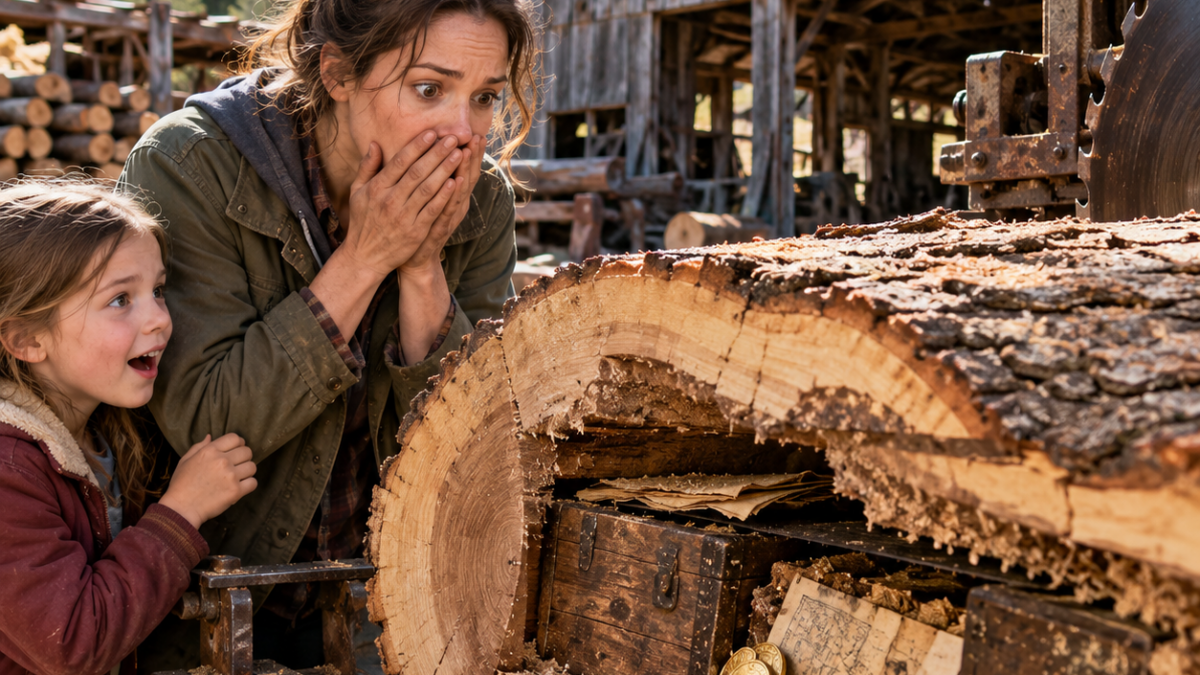
I kept the flashlight fixed on the brass.
For several seconds, neither of us moved.
The saw shed had been deafening only moments earlier, but now the silence felt heavier than the machine noise had.
I crouched closer.
The object wasn’t random scrap that the tree had grown around.
I had seen enough yard logs to recognize that kind of damage. Nails leave staining. Fence wire distorts growth. Bullets bury themselves in irregular pockets.
This was different.
The opening around the metal was clean.
Too clean.
Amos touched the edge of the cut with one finger.
“See that?”
“What?”
“The wood around it.”
I leaned closer.
There was no natural healing around the cavity.
No years of distorted growth.
Someone had cut into the log after it was already down.
“Can we get it out?”
“Without ruining whatever’s inside?”
“That’s what I’m hoping.”
Amos looked at me.
“You’re assuming there’s something inside.”
I stared at the brass.
“So are you.”
He didn’t argue.
It took nearly an hour.
We backed the log away from the blade, worked carefully with chisels and a small hand saw, and finally freed a tube about twelve inches long.
Copper and brass.
Both ends capped.
The seams had been sealed with hardened pitch.
Amos held it in his hands like it might explode.
“Someone went to a hell of a lot of trouble.”
“Why hide something in a log?”
“Better question.”
He looked toward the silent bandmill.
“Why leave that particular log on the carriage?”
We took the tube into the office.
There was almost nowhere clean to set it.
Molly and I had swept the floor the previous weekend, but the room still smelled like old mouse nests, fir dust, and twenty years of damp paper.
I put the tube on the desk.
Amos found a small vise.
We softened the pitch around one end and worked the cap loose.
My hands were shaking by the time it finally turned.
Amos noticed.
“Nervous?”
“I just spent almost everything I have on this place.”
“Fair.”
“If there’s a note inside saying the building is radioactive, I’m going home.”
He smiled.
“Probably not.”
I pulled the cap free.
No gold.
No cash.
No jewelry.
I admit there was a tiny part of me that felt disappointed.
Instead, several folded pieces of paper slid onto the desk along with a small flat key.
The papers were brittle and yellowed at the edges.
Four looked like pages torn from an old tally book.
Columns of handwritten numbers.
Species codes.
Diameters.
Scale estimates.
Brand marks.
Another sheet was graph paper with a rough map drawn on it.
A road.
A body of water.
Survey markers.
A hatched area near one side.
The final piece was folded twice.
I opened it carefully.
Two lines.
That was all.
Cold Water owns what lies in North Basin.
If a Kingsley asks for the mill, do not sell.
I read it again.
Then a third time.
Amos stood behind me.
“Kingsley?”
“Yes.”
“Let me see.”
I handed him the paper.
His jaw tightened.
“You know North Basin?”
“I’ve heard the name.”
“It’s northwest of here.”
“How far?”
“Couple miles.”
“What’s there?”
“Not much anymore.”
He sat down slowly.
“It used to be part of the old log transport system. Holding reservoir. They’d deck timber there, float it, move it down when they needed it.”
“Who owns it?”
Amos looked at me.
“I think Kingsley does now.”
That was the moment the room changed.
Until then, the tube could have been a relic.
An old feud.
A dead man’s paranoia.
But the second Amos said Kingsley, I remembered Preston standing in my yard.
Thirty thousand dollars.
For a property he had just called worthless.
Then sitting in his SUV staring at the saw shed before leaving.
“Don’t tell anyone,” I said.
Amos looked offended.
“I’ve kept things quiet longer than you’ve been alive.”
“I’m serious.”
“So am I.”
I placed everything in the shallow metal drawer of the office safe.
The safe barely deserved the name. It was more like a heavy locking cabinet.
Still, it was better than leaving the papers on the desk.
Then, because reality is rude enough to continue no matter what you discover inside a log, I went back outside.
The kiln still leaked.
The edger still needed a belt.
And my checking account had no sympathy for mysteries.
Preston Kingsley arrived that afternoon.
That timing bothered me immediately.
His black SUV rolled into the yard just before four.
He stepped out wearing the same calm expression he had worn the first day.
I wiped sawdust from my hands.
“What can I do for you?”
“I’ve been thinking about our conversation.”
“Have you?”
“I was too quick with you.”
That was almost funny.
He looked around the yard.
I had cleared brush from the road, replaced several roof panels, cleaned enough equipment to determine what could still be saved, and made exactly zero dollars.
Preston put his hands into his coat pockets.
“I’d like to make you a serious offer.”
“For what?”
“Cold Water.”
“How serious?”
“One hundred twenty-five thousand.”
I felt something cold move through my stomach.
Three weeks earlier, he had told me the place would ruin me.
He had offered thirty thousand.
Now he was offering nearly three times what I paid.
Nothing about the property justified that increase.
The mill still wasn’t producing.
The kiln was still down.
The buildings still needed work.
The only meaningful thing that had changed had happened that morning.
I had cut the first log.
And found the tube.
I kept my face still.
“I’m not selling.”
He studied me.
“You should think about it.”
“I just did.”
“One hundred twenty-five thousand is a significant return for three weeks.”
“So you think the property is worth that now?”
“I think consolidation makes sense for us.”
“Us?”
“Kingsley.”
“Funny. You didn’t mention consolidation when you offered thirty.”
Something flickered behind his eyes.
Then it vanished.
“I was trying to protect you from an expensive mistake.”
“And now?”
“Now I’m making a business offer.”
I nodded.
“No.”
He looked past me toward the saw shed.
“Two weeks.”
“What?”
“I’ll leave the offer open two weeks.”
People do not put deadlines on assets they believe are worthless.
I smiled slightly.
“That’s generous.”
He didn’t smile back.
When the SUV disappeared down the haul road, Amos stepped out of the saw shed.
He had heard everything.
“One hundred twenty-five?”
“Yes.”
“Thirty before?”
“Yes.”
He wiped his hands on a rag.
“In thirty-one years, I never saw a Kingsley overpay for anything.”
“That’s what I was thinking.”
Amos glanced toward the office.
“He knows.”
“Knows what?”
“I don’t know yet.”
“That’s not comforting.”
“He knows there’s something tied to this mill.”
I stared down the road where Preston had disappeared.
His offer had not made me feel richer.
It had made me feel watched.
The map was the easiest clue to pursue.
North Basin still existed.
Naomi Keller at the county courthouse explained that to me four days later.
Naomi was fifty-two and had worked land records for nineteen years.
She had the rare personality of someone who genuinely enjoyed finding things other people had failed to find.
I brought her copies of the tally pages and the hand-drawn map.
I kept the original note at the mill.
“North Basin,” she said, looking over the map. “Haven’t heard anyone ask about that in years.”
“You know where it is?”
“Sure.”
“Who owns it?”
Her eyes moved toward me.
“Kingsley Timber controls most of that block.”
“Most?”
“Depends what exactly you mean by owns.”
I almost laughed.
“That sounds promising.”
“In land records, complicated is promising.”
Four days later, she called.
“Clara, you need to come here.”
Her tone made me leave the mill immediately.
When I arrived, she had a photocopy waiting on the counter.
Cold Water Milling Company.
Kingsley Timber Corporation.
The agreement looked painfully ordinary.
No dramatic language.
No warnings.
No secret clauses.
Kingsley had owed Cold Water money for custom sawing.
A lot of money.
Instead of paying cash, they had transferred title to timber already cut and stored at North Basin.
Cold Water took ownership of the logs in place.
The contract referred to mill brands and an attached tally schedule.
I pulled the four pages from my folder.
Naomi looked from the photocopy to the handwritten columns.
“Those?”
“I think so.”
We began comparing entries.
Species.
Scale.
Numbers.
Brand marks.
At the bottom of the final page, one number had been circled twice.
Four hundred seventeen logs.
Mostly old-growth Douglas fir.
Some western red cedar.
Naomi sat back.
“That’s not a few leftovers.”
“No.”
“How old is this timber?”
“Cut before 1987.”
“No, I mean how old were the trees?”
I thought about the log we had opened.
Twenty-two growth rings to the inch.
“I don’t know yet.”
Amos had one answer.
“Potentially very old.”
We were standing in the saw shed when I told him about the agreement.
He rubbed his jaw.
“Old-growth fir can sit underwater a long time.”
“Without rotting?”
“Depends on conditions.”
“North Basin?”
“Cold water. Silt. Low oxygen.”
He shrugged.
“Could be rotten. Could be perfect.”
“What would perfect mean?”
He looked at me.
“Material nobody can legally replace.”
That was not an exaggeration.
Old-growth Douglas fir from trees several centuries old has grain structure that modern plantation timber simply cannot reproduce.
Wide, stable boards.
Tight rings.
Exceptional strength.
Instrument wood.
Restoration stock.
High-end furniture material.
There is a market for it precisely because new supply does not exist in the same form.
“How much could 417 logs be worth?”
Amos shook his head.
“Wrong question.”
“What’s the right one?”
“How many still exist?”
That was the first problem.
The second was worse.
North Basin sat inside a large block controlled by Kingsley Timber.
Not just the water.
The road.
The gate.
The surrounding land.
Every practical route to the basin crossed Kingsley property.
I could own 417 logs on paper and still be unable to reach a single one.
Owning something you cannot access is a very specific kind of poverty.
I hired an attorney before doing anything else.
Her name was Rachel Levin.
She specialized in land-use and commercial disputes.
The first thing she told me was exactly what I needed to hear.
“Do not go out there.”
“I wasn’t planning to.”
“Good.”
“I thought about it.”
“That’s why I said it.”
She studied the 1987 agreement.
“There appears to be an historic inspection right connected to the timber.”
“Can we use it?”
“Maybe.”
“Maybe?”
“Inspection and recovery are different rights.”
“So I can look but not touch.”
“Until we know more, yes.”
She pointed at me.
“And you will do it properly.”
“I’m getting the feeling you don’t trust my judgment.”
“I trust your judgment enough to know that curiosity makes smart people stupid.”
Fair.
In October, I attended a county business association meeting.
I wanted to ask publicly about the historic easement.
There were maybe forty people in the room.
Contractors.
Bankers.
Suppliers.
People who had known each other for twenty years.
I wore the only jacket I owned that did not smell faintly of sawdust.
When the chair opened the floor, I stood.
“I’m looking for clarification on an old access right connected to Cold Water Milling and North Basin.”
Before the chair could respond, Preston spoke.
He was sitting near the front.
“Clara.”
His voice carried easily.
“Buying an old saw doesn’t make you a person in the timber business.”
A few people laughed.
Not many.
Enough.
Preston leaned back.
“You’re reading paperwork nearly forty years old and imagining you’ve found a fortune. People do that all the time with abandoned industrial property.”
I could feel everyone waiting.
They expected anger.
Or embarrassment.
I looked directly at him.
“If the paperwork is worthless, why do you want my mill so badly?”
Nobody laughed.
Preston’s face stayed calm.
But one hand tightened around the pen he was holding.
“Regional consolidation.”
“That explains thirty thousand?”
He didn’t answer directly.
The chair cleared his throat and moved the meeting along.
I sat.
For the rest of the evening, I noticed several people looking at Preston differently.
Not dramatically.
Just thinking.
That mattered.
The November rain changed everything.
Five inches in four days.
North Basin rose.
Then, when the storm passed, it drew back.
A section of the eastern bank shifted enough to expose material that had been buried under silt for years.
Rachel confirmed in writing that our inspection right allowed a survey visit.
I sent formal notice to Kingsley.
Then I hired an independent forest consultant from Eugene named Dale Whitcomb.
Dale had no relationship with either of us.
That mattered almost as much as his expertise.
We entered North Basin on a Tuesday morning.
Daylight.
Cameras.
Documents.
No drama.
Preston was not there.
A Kingsley land manager met us at the gate and watched everything we did.
Near the exposed bank, Dale stopped.
A log butt protruded from gray mud.
Thirty-four inches across.
The exterior looked almost petrified.
Dale scraped the end grain with a hand adze.
A quarter inch down, the gray disappeared.
Dark honey-colored wood emerged.
He stopped scraping.
I crouched beside him.
“That good?”
He looked at me.
“It’s ridiculous.”
Then he found the brand.
Struck into the end grain.
C W.
Under it:
I pulled out copies of the tally pages.
My finger moved down the handwritten column.
CW 117.
Douglas fir.
Diameter matched.
Scale estimate matched.
Dale said nothing for almost a minute.
Then he sealed a core sample.
When the lab results came back, I read them three times.
Sound to within roughly two inches of the surface.
Average growth rings: twenty-six per inch.
Estimated tree age when felled: approaching four hundred years.
Dale’s written conclusion was dry.
Material of this quality was effectively unavailable from any modern commercial harvest in North America.
I sent photographs and analysis to a high-end furniture maker in North Carolina I knew from my previous job.
Their buyer called me at six in the morning Oregon time.
“Clara.”
“Yes?”
“Where did you get this?”
“Oregon.”
“I can see that.”
He sounded almost annoyed.
“How much?”
“I don’t know yet.”
“No, how much exists?”
“Potentially hundreds of logs.”
Silence.
Then he quoted a price per thousand board feet.
I wrote it down.
Looked at the number.
Put the phone on the desk.
Walked outside.
Molly was eating cereal at our small rental house before school.
She looked through the kitchen window when I came back in.
“Mom?”
I sat down.
“What happened?”
I slid the paper toward her.
She stared.
“What is that?”
“A possible lumber price.”
“For what?”
“The logs.”
She looked again.
“Is that good?”
I laughed.
“It might be.”
“Like college good?”
“Molly.”
“What?”
“Don’t spend imaginary money.”
She smiled.
“So yes.”
I reached across the table and took the paper back.
“Possibly.”
The buyer called again later.
“We don’t want a truckload.”
“What do you want?”
“A supply.”
That sentence changed the scale of the situation.
I had not found treasure.
Not in the storybook sense.
No chest.
No gold.
No secret diamonds.
I had found inventory.
Documented, forgotten, rare inventory.
And if Cold Water’s ownership survived legal scrutiny, then the $46,000 sawmill came with a raw-material position worth vastly more than I had paid.
That was when Preston stopped laughing.
And when the pressure began.
Nothing dramatic happened.
No broken windows.
No anonymous threats.
No men appearing at night.
What happened was quieter.
My parts supplier in Roseburg suddenly required payment in advance.
“New policy,” the salesman said.
“For everybody?”
A pause.
“For your account.”
A trucking company canceled a scheduled pickup two hours before arrival.
“When can you reschedule?”
“Six weeks.”
“You’re serious?”
“Sorry, Clara.”
A lumber broker I had known for years cornered me at a trade show.
He looked miserable.
“I shouldn’t tell you this.”
“Then don’t.”
“Kingsley is one of our biggest accounts.”
I waited.
“We can’t afford to irritate Preston.”
“So this is him.”
He looked away.
“I didn’t say that.”
“You didn’t have to.”
That night, I sat at my kitchen table after Molly went to bed.
Same table where I had done arithmetic for years.
Savings.
Rent.
Insurance.
School expenses.
Now I did new arithmetic.
Parts in advance.
Canceled transport.
Attorney fees.
Survey costs.
Mill repairs.
The numbers were ugly.
For the first time since buying Cold Water, I seriously wondered whether Preston could simply squeeze until I let go.
He came to the mill in December.
I was kneeling beside the bandmill pressing a new bearing onto the outboard shaft.
Grease up to my elbows.
Fir dust in my hair.
Preston stood in the doorway wearing a camel-colored coat.
He watched me for a moment.
“You’re repairing that yourself?”
“Yes.”
“Because you can’t afford a mechanic.”
“Because Amos taught me how.”
He smiled.
“I run a company with more than eight hundred employees.”
“Congratulations.”
“Four hundred pieces of rolling stock.”
“Sounds expensive.”
“A credit line larger than the assessed value of everything on this road.”
I wiped my hands.
“Is there a point coming?”
His smile disappeared.
“Do you honestly believe this is a competition?”
“No.”
That surprised him.
I stood.
“I’m trying to run my mill.”
He placed a folder on the workbench.
Purchase agreement.
Cold Water Sawmill.
Acreage.
Equipment.
Rights.
Claims.
Successor interests.
Everything.
Price:
$650,000.
I stopped breathing for a second.
I wish I could say I immediately laughed and pushed it back.
I didn’t.
I was broke.
Not metaphorically.
Actually broke.
Six hundred fifty thousand dollars would have erased every debt.
Paid for Molly’s education.
Bought us a house.
Given me more financial security than my mother ever had.
My hands left grease prints on the paper.
Preston saw the hesitation.
He softened his voice.
“This is the smart decision.”
I looked at page one again.
“It’s a lot of money.”
“Yes.”
“You think Cold Water is worth six hundred fifty thousand now?”
“I think this resolves everyone’s uncertainty.”
“Everyone?”
“You. Me. Investors. Suppliers.”
There it was.
Investors.
I looked up.
He realized he had said too much.
Only slightly.
But enough.
I closed the folder.
“I need you to leave.”
His face hardened.
“Don’t confuse stubbornness with courage.”
“I’m not.”
“You have a daughter.”
That hit exactly where he intended.
My voice changed.
“Don’t talk about Molly.”
“I’m saying you have responsibilities.”
“I know what I have.”
“You could secure her future today.”
I stared at him.
For a moment, I wanted the money.
Wanted it so badly I could almost feel the relief.
Then I remembered the note.
If a Kingsley asks for the mill, do not sell.
Someone had bored a hole into a log.
Hidden a brass tube.
Sealed it.
Placed that log on the carriage.
Then walked away from an entire company.
That person had known something I still didn’t know.
I slid the folder back.
“No.”
For the first time since meeting Preston, the polish cracked.
His voice became very quiet.
“You have no idea what you’re standing in the middle of.”
“Then maybe you should stop trying so hard to buy it before I find out.”
He picked up the folder.
This time, he didn’t say the offer would stay open.
Two weeks later, we found the safe.
Amos and I were replacing electrical service beneath the office floor.
He pulled up six old planks near the filing cabinets.
Then stopped.
“What?”
He pointed down.
Concrete pad.
Steel cabinet.
About the size of a microwave.
A safe had been installed beneath the floor.
Not hidden behind a secret wall.
Just placed there.
Then floored over.
The small key from the brass tube fit.
My hands shook as I turned it.
Inside was a fireproof envelope.
No money.
By then, I had stopped hoping for any.
The first document was the original 1987 agreement.
Actual signatures.
Notary seal.
Attached survey description.
Then plat maps.
The full North Basin timber deck outlined.
Dates.
Marks.
And a complete tally book.
Sixty-one pages.
The four pages from the brass tube had been samples.
The last document was a seven-page letter.
Signed by Silas Roark.
The final owner of Cold Water Milling Company.
Everyone in the valley remembered Silas as a failure.
Old man who couldn’t modernize.
Couldn’t compete.
Closed his gate.
Lost his mill.
The letter told a different story.
Cold Water had been profitable for thirty-four consecutive years.
Tax records Naomi later found supported it.
A huge part of that success came from custom sawing for Kingsley Timber.
Kingsley’s high-volume mills handled standard material.
Specialty logs went to Cold Water.
Then came North Basin.
Kingsley owed money.
They settled with timber.
Years later, they wanted it back.
Cheap.
Silas refused.
Three times.
Within eleven months, Kingsley moved almost all of its custom sawing elsewhere.
Cold Water lost roughly sixty percent of its revenue in one year.
Silas wrote:
I was not beaten by a better mill. I was starved by a bigger customer.
I stopped reading.
Amos stood across the office.
He had known Silas.
His face looked older than it had ten minutes earlier.
“You knew?”
“No.”
“Nothing?”
“I knew Kingsley pulled work.”
“Did you know why?”
“No.”
He looked toward the letter.
“Silas never told anybody.”
Cold Water laid off workers.
Men Silas had hired young.
He tried replacing the volume.
Other timber companies refused.
Many depended on Kingsley for contracts.
Three years later, Cold Water closed.
Silas had realized something before he chained the gate.
The timber might remain in North Basin indefinitely.
But paper disappears.
Original agreements get lost.
Offices get emptied.
Records get destroyed.
He had seen companies lose disputes because they could no longer prove what they owned.
So he copied everything.
Stored originals below the floor.
Then faced one final problem.
How do you tell a future owner the safe exists without telling anyone else?
A note gets thrown away.
A letter gets lost.
A lawyer stops being paid.
Silas chose a log.
An old-growth Douglas fir he had been saving.
He bored into it.
Inserted the brass tube.
Sealed it.
Plugged the cavity using matching wood.
Then placed the log on the carriage.
His final paragraph made me sit down.
If Cold Water ever lives again, it will be because someone makes this saw turn after everyone else decided it was dead. If that person exists, the first thing they will cut is the log already waiting on the carriage.
I covered my mouth.
Silas had predicted me twenty years before I arrived.
Not me specifically.
Someone like me.
Someone foolish enough to buy what everybody else called scrap.
Someone stubborn enough to repair the machine.
Someone who would make the first cut.
The log had never been waiting to be found.
It had been waiting to be cut.
Kingsley’s lawyers responded in January.
They didn’t deny the agreement existed.
They attacked everything around it.
Age.
Abandonment.
Identification.
Possession.
They claimed decades without recovery had extinguished any practical interest.
They argued that old brand marks could not reliably identify specific timber.
They argued that logs submerged for decades might legally have become part of the land.
They argued the tally attachment had never been properly recorded.
That last argument almost worked.
Then Naomi found the microfilm.
Buried in an old county recording index.
A filed copy of the same 1987 agreement.
Stamped.
Dated.
Recorded.
By Kingsley Timber itself.
They had filed it because their lenders at the time required documentation of the settlement.
I drove to the courthouse after Naomi called.
She set the copy in front of me.
I read the filing stamp.
Then started laughing.
Naomi smiled.
“You all right?”
“They recorded the document they’re now claiming is unreliable.”
“That appears to be the situation.”
Rachel loved it.
Not emotionally.
Lawyers have a particular kind of joy when somebody’s old paperwork destroys their current argument.
“This is excellent.”
“That’s the most excited I’ve ever heard you.”
“Don’t get used to it.”
The recorded copy referenced the attached tally.
The original safe copy contained the complete tally.
Now we needed physical matches.
Dale spent six weeks surveying under the inspection right.
Thirty-one log ends documented.
Nineteen with legible Cold Water brands.
Every one of those nineteen appeared in the tally book.
Diameters matched within reasonable tolerance.
Species matched.
Brand numbers matched.
Coordinates.
Photos.
Samples.
Chain of custody.
We built the least romantic treasure hunt imaginable.
Folders.
Spreadsheets.
Survey stakes.
Legal letters.
That was when I finally understood what Preston actually wanted.
It was not the sawmill.
It was not the twenty-seven acres.
It was not the kiln.
It was not the old freight spur.
Kingsley Timber and Development had spent years assembling a massive North Basin project.
Timber harvest.
Land development.
Outside investment.
Financing.
The biggest project the family had attempted in decades.
And financing required clean title.
The Cold Water agreement created a third-party property interest sitting directly inside the project footprint.
Four hundred seventeen logs were not just valuable timber.
They were a title defect.
A lender does not like unresolved ownership disputes.
Investors like them even less.
Preston’s offers suddenly made perfect sense.
Thirty thousand when he believed I knew nothing.
One hundred twenty-five thousand when he suspected I had found something.
Six hundred fifty thousand when he knew I had documentation.
Every offer had measured his exposure.
Not my mill’s value.
Mediation happened in March.
Bad carpet.
Windowless conference room.
Coffee nobody drank.
Preston sat across from me with two attorneys.
He looked completely comfortable.
That was his strength.
He could make domination sound like concern.
He told the mediator I had been a warehouse employee.
Technically true.
He said I had stumbled into old paperwork.
True.
He said consultants and lawyers had encouraged me to inflate ordinary documents into a fortune.
That part was designed to make me sound foolish without calling me foolish.
The mediator looked at me.
“Ms. Hensley?”
I didn’t give a speech.
I placed three things on the table.
Original notarized 1987 agreement.
County-recorded microfilm copy filed by Kingsley.
Dale’s survey report showing nineteen branded physical logs matching the tally.
Then I said, “That’s our position.”
Less than four minutes.
Preston looked at the documents.
For the first time, he didn’t interrupt.
The legal fight continued nine more weeks.
Scope.
Recovery standards.
Identification.
Environmental controls.
Access.
Some logs were impossible to verify.
Some had degraded.
Some might never be found.
There was no magical ruling awarding me hundreds of perfect logs overnight.
What we got was better.
Kingsley acknowledged Cold Water’s ownership of timber verifiably identified under the 1987 agreement.
A verification process was established.
A recovery window.
Access procedures.
Environmental conditions.
The right existed.
And it belonged to Cold Water.
After the final session, Preston caught me in the parking lot.
“Congratulations.”
I stopped beside my truck.
He looked tired.
Not defeated.
Just tired.
“You’ve won ownership of logs lying in mud.”
I said nothing.
“Now go make money from them.”
Then he walked away.
I hated that he was right.
Recovery was expensive.
Specialized equipment.
Rigging.
Environmental compliance.
Contractors.
Cleaning.
Metal detection.
Oversized handling.
Forty years of silt destroys blades.
Traditional economics favored massive recovery.
Hundreds of logs at once.
High volume.
Large mills.
Distribution networks.
I had none of that.
I had one bandmill.
A rebuilt kiln.
Amos.
A checking account that regularly dropped below four digits.
And a daughter who would need college money soon.
One evening, Molly sat across from me in the mill office.
I had spreadsheets spread everywhere.
“You look terrible,” she said.
“Thanks.”
“You’re welcome.”
She picked up one sheet.
“What happens if you can’t afford to recover them?”
“Then Preston wins without legally owning them.”
“Can you sell the rights?”
“Yes.”
“To who?”
“Probably Kingsley.”
She lowered the paper.
“So we did all this just to end up selling?”
I leaned back.
“That’s what I’m trying to avoid.”
Molly looked toward the saw shed.
“What do your old customers buy?”
“What?”
“At the furniture company.”
“Lumber.”
“No.”
I frowned.
She rolled her eyes.
“What kind?”
“Depends.”
“Do they buy train cars?”
“No.”
“Truckloads?”
“Sometimes.”
“What did that North Carolina guy say?”
I stared at her.
We don’t want a truckload.
We want a supply.
Molly smiled slowly.
“There.”
“What?”
“You keep talking like you have to beat Kingsley at being Kingsley.”
I sat very still.
She continued.
“You don’t.”
That was the breakthrough.
Kingsley’s business depended on scale.
Volume.
Throughput.
Consistency.
Cold Water could be the opposite.
Reclaimed old-growth timber was not a commodity.
Nobody ordering a custom guitar wanted ten truckloads.
A furniture maker might need eleven extraordinary boards.
A historic chapel might need eight matching beams.
An instrument builder might buy cedar one flitch at a time.
We did not need to recover 417 logs.
We needed to recover the right six.
So we went small deliberately.
A local contractor helped us work the exposed basin margins.
Six to ten logs per batch.
Borrowed excavator.
Careful rigging.
No heroic engineering.
Each log was washed before entering the yard.
Metal detected.
Measured.
Branded.
Matched to the tally.
Then we planned each cut individually.
Quarter-sawn where stability mattered.
Full-width slabs where figure justified it.
Vertical grain for instrument stock.
Slow drying.
Six to nine weeks in the kiln.
Sometimes longer.
The first recovered fir log reached Cold Water on a rainy April morning.
Amos stood beside it.
“You ready?”
“No.”
“Good.”
“That helpful?”
“No.”
We rolled it onto the carriage.
The old bandmill started.
That sound had become part of my life.
Low.
Rising.
Steady.
The first board opened dark honey.
Tight grain.
Perfect.
Amos ran his hand across it.
“Silas would’ve liked that.”
I swallowed.
“Think so?”
“He would’ve complained about your feed rate.”
I laughed.
“Better.”
We sold provenance with the wood.
Every board carried documentation.
Cold Water brand number.
Tally reference.
Estimated ring count.
Recovery location.
Wood species.
Furniture makers loved it.
Historic restoration shops loved it more.
The North Carolina company bought everything we could provide in certain widths.
A timber framer in Vermont ordered fir for a chapel restoration.
A luthier bought cedar for guitar soundboards.
Months later, he mailed me a photograph of the finished instrument.
I taped it to the office wall.
Cold Water finished the first full year in the black.
Not rich.
Not transformed into an empire.
Profitable.
That mattered more.
I hired four people.
Two had fathers who once worked at Cold Water.
Amos became maintenance adviser.
He complained about the title.
Then about the salary.
Then accepted both.
The kiln ran.
The saw ran.
Trucks started coming up the haul road again.
For the first time in nearly twenty years, the valley heard the bandmill.
Molly came out most Saturdays.
She learned the office first.
Then inventory.
Then enough grading to argue with me.
One afternoon, I caught her running a moisture meter across a stack.
“That one’s not ready,” she said.
“I know.”
“Then why is there a shipping tag?”
I looked.
She was right.
I removed it.
Molly grinned.
“Warehouse employee.”
“Careful.”
One year and four months after Preston first stood at my gate laughing, his SUV returned.
This time there were two customer trucks in the yard.
Five employees working.
Stacks of tagged reclaimed timber in the storage barn.
He had to wait nearly ten minutes because I was finishing a cut.
I knew he was waiting.
I did not hurry.
That was petty.
I enjoyed it.
When the blade stopped, I walked to the workbench.
Preston was polite.
He always was.
“You built something impressive.”
“Thank you.”
“I mean that.”
“I know.”
He looked around.
Then placed a folder on the same bench where he had placed the $650,000 offer.
I opened it.
$2.4 million.
Cold Water.
Acreage.
Equipment.
Customer contracts.
Remaining timber interest.
Everything.
My chest tightened.
Two point four million dollars.
Real money.
Life-changing money.
Preston spoke carefully.
“This is your chance to walk away from the table while you’re ahead.”
I kept reading.
“Markets turn.”
I said nothing.
“Small businesses fail.”
Still nothing.
“You have a daughter to think about.”
I looked up.
He immediately raised one hand.
“I’m not threatening you.”
“I know.”
“I’m saying security matters.”
He wasn’t wrong.
That was what made the offer dangerous.
If he had insulted me, refusal would have been easy.
Instead, he offered exactly what I had spent my entire adult life wanting.
Security.
Molly’s education.
A house.
Retirement.
No more arithmetic at the kitchen table.
I looked through the office window.
The first board from the original log hung on the wall.
Above it sat the brass tube.
Silas had not hidden money inside that tube.
He had hidden proof.
Not because proof was glamorous.
Because sometimes proof is the only thing separating truth from whatever the larger company says happened.
Preston waited.
I closed the folder.
Pushed it back.
“I’m not selling.”
He looked at me for several seconds.
“This is more than generous.”
“I know.”
“Then why?”
I had rehearsed speeches for this moment.
Cruel ones.
Funny ones.
Things about thirty thousand dollars.
Things about warehouse employees.
Things about men who confuse size with intelligence.
Standing there, I didn’t want any of them.
“I didn’t buy Cold Water to sell it to the man who told me it was worthless.”
That was all.
Preston’s face changed slightly.
He had no response because the words were his own history handed back to him.
He closed the folder.
“Fair enough.”
Then he said something about rain coming the following week.
We shook hands.
He walked outside.
The black SUV went down the haul road.
I watched until it disappeared.
Then I went back to the saw.
Pulled the start lever.
The sixteen-foot blade came up to speed.
The sound filled the building.
Molly turned eighteen that winter.
On one Saturday afternoon, she stood in the office looking at the original board mounted on the wall.
Seventeen inches wide.
Dark honey.
Tight grain.
Above it, the brass tube rested on two small brackets.
“You ever think about selling now?” she asked.
“The mill?”
“Yeah.”
“No.”
“Even for more?”
I looked at her.
“You trying to get rid of me?”
“I’m going to college.”
“Eventually.”
She smiled.
Then looked at the tube.
“It’s weird.”
“What?”
“If that log had been outside, it would’ve rotted.”
“Probably.”
“If someone had cleaned the mill before you bought it, they might’ve thrown it away.”
“Maybe.”
“If you never got the saw working…”
“I know.”
She touched the wall beneath the board.
“Then none of this happens.”
I looked through the window toward the saw shed.
Cold Water was never a treasure story.
That was the thing people misunderstood.
The valuable thing had not been the brass tube.
Not even the timber.
The valuable thing was that someone had left proof where only work could reach it.
Dozens of people had toured that property over twenty years.
Scrap buyers.
Developers.
Investors.
Contractors.
They saw rust.
Rot.
Liability.
Nobody started the saw.
Silas had understood something about people.
The person willing to restore the machine was the person most likely to care what happened to the mill.
So he built the message for that person.
I happened to be her.
Amos died three years later.
Quietly.
At home.
Seventy years old.
By then, Cold Water had seven employees.
When we held a small gathering at the mill after his funeral, half the valley came.
Men who had worked beside him decades earlier stood inside the saw shed telling stories.
Molly came home from college.
Naomi brought food.
Rachel came even though she claimed lawyers were not social creatures.
On the workbench, I placed Amos’s old grease-stained wrench.
Preston arrived late.
Alone.
He stood near the door.
After most people left, he walked over to me.
“Good man.”
“Yes.”
“He worked for Silas a long time.”
“Thirty-one years.”
Preston looked toward the original bandmill.
“My father hated that machine.”
I stared at him.
“Why?”
“Because Cold Water could do jobs our mills couldn’t.”
That admission surprised me.
He continued.
“My father thought every business problem could be solved by owning more capacity.”
“Sounds familiar.”
He smiled faintly.
“I learned from him.”
We stood quietly.
Then Preston said, “For what it’s worth, I didn’t know about the tube.”
“I figured.”
“I knew there were documents missing.”
“How?”
“My father spent years trying to find them.”
That was new.
I turned.
“Your father knew Silas had originals?”
“He suspected.”
“And you?”
“When North Basin development started, our attorneys found references in old internal files. Nobody knew where Cold Water’s originals were.”
“So you tried to buy the mill.”
“Yes.”
“Before anyone could look.”
“Yes.”
His honesty almost irritated me more than denial would have.
“Thirty thousand dollars.”
He looked uncomfortable.
“I thought you didn’t know.”
“That makes it better?”
“No.”
“Good.”
He glanced toward Amos’s wrench.
“My father would’ve done the same thing.”
I said nothing.
“That isn’t an excuse.”
“No.”
He looked at me.
“I’ve spent a lot of my life assuming being bigger meant being safer.”
“And?”
“It means you have bigger things to lose.”
That might have been the closest Preston ever came to apologizing.
I accepted it.
Cold Water never became Kingsley.
That was the point.
We stayed small.
Specialized.
Profitable.
We recovered timber slowly.
Not all 417 logs.
Some had degraded.
Some could never be reached economically.
Some disappeared beneath silt and water beyond practical recovery.
That was fine.
We treated them like inventory, not legend.
Molly eventually joined the business after college.
Not because I asked.
I deliberately didn’t.
She spent two years working elsewhere first.
Then one Monday morning she walked into the office carrying coffee.
“What are you doing here?”
“Applying for a job.”
“No.”
She stared.
“No?”
“You’re my daughter.”
“I noticed.”
“I’m not hiring you because you’re my daughter.”
“Great.”
She placed a résumé on the desk.
“Hire me because I know your inventory system better than the guy you interviewed Friday.”
I stared at her.
“How do you know about him?”
“Small valley.”
I picked up the résumé.
She had more qualifications than I expected.
I tried not to smile.
“Starting wage is terrible.”
“I’ve seen payroll.”
“Then you know.”
“Do I get dental?”
“No.”
“Abusive workplace.”
“Probably.”
She got the job.
Years after I bought Cold Water, people still occasionally asked about the first log.
Journalists loved that part.
Woman buys abandoned sawmill.
Cuts mysterious log.
Finds secret.
That is the clean version.
Real life was dirtier.
The secret did not solve anything.
It created problems.
Legal bills.
Pressure.
Fear.
Months when I thought I had made the worst decision of my life.
The tube gave me a chance.
Work did the rest.
Proof mattered.
Patience mattered.
Naomi’s microfilm mattered.
Dale’s survey mattered.
Rachel’s insistence that I follow every access rule mattered.
Amos teaching me the machine mattered.
Molly seeing the business problem differently mattered.
That is why the brass tube still hangs above the original board.
Not as a trophy.
As a reminder.
One rainy afternoon, years later, I stood alone in the saw shed after everyone left.
The bandmill was quiet.
Drops hit the metal roof.
The first log was long gone except for the board on the office wall.
I ran my hand across the carriage.
Same steel Silas had touched.
Same place he had set that Douglas fir before walking away.
For years, everyone said he failed.
I no longer believed that.
He lost his company.
That was true.
But before losing it, he made one final decision that prevented someone else from losing the truth.
He could not save Cold Water for himself.
So he saved the evidence for whoever came next.
There is something almost unbearably human about that.
He never knew whether anyone would find it.
Never knew whether the mill would reopen.
Never knew my name.
He simply trusted that someday, somebody might look at the rust and see unfinished work instead of failure.
I did.
Not because I was unusually brave.
I was scared most of the time.
Not because I had money.
I almost didn’t.
Not because I knew exactly what I was doing.
I didn’t.
I bought Cold Water because I had spent eleven years watching small customers get ignored by big companies and believed there was room for somebody willing to say yes.
Everything else came afterward.
Preston once told me $46,000 would be the most expensive tuition I ever paid.
He was partly right.
Cold Water taught me more than any school could have.
It taught me what leverage looks like when you don’t recognize it yet.
It taught me that power often speaks politely.
It taught me that the person offering to rescue you may be the person most frightened of what happens if you don’t need rescuing.
It taught me to document everything.
And it taught me something about abandoned things.
Sometimes they are abandoned because they are worthless.
Sometimes they are abandoned because the person holding them was forced to stop.
Those are not the same thing.
One evening, Molly and I were closing the mill when a truck stopped near the office.
A young man got out.
Maybe twenty-five.
He ran a small woodworking shop two towns over.
He had a specialty order.
Only eighty board feet.
Nobody else wanted to bother.
He looked embarrassed even asking.
“Too small?”
I smiled.
“No.”
He looked surprised.
“Really?”
“Bring me your cut list.”
That was the business I had wanted from the beginning.
Before North Basin.
Before Preston.
Before the brass tube.
The kind of mill willing to do work too small for everyone else.
Molly watched the truck leave.
“You know he probably spends almost nothing compared to the big accounts.”
“I know.”
“Still taking it?”
“Yes.”
She smiled.
“Good.”
I locked the office.
Through the window, the original board caught the last afternoon light.
Dark honey.
Above it, the brass tube.
For twenty years, both had sat inside a building everyone dismissed as dead.
All they needed was somebody willing to turn the machine back on.
And every time I pull that start lever and hear the blade rise into its steady note, I still think about the first day Preston stood in my yard and told me I had bought a pile of rust.
Maybe I had.
But rust was only what he could see from the outside.
He never bothered to make the first cut.
I did.
The strange thing about finding something valuable is that the first emotion is not always excitement.
Sometimes it is fear.
That was what I felt after Preston drove away with his $125,000 offer still hanging in the air.
I stood in the mill yard watching the dust settle behind his SUV, and for the first time since buying Cold Water, I wondered whether I had stepped into something that had nothing to do with lumber.
Amos came out of the saw shed carrying a greasy rag.
“He knows something,” he said.
I turned toward him.
“You keep saying that.”
“Because he does.”
“What?”
Amos looked toward the office where I had locked the brass tube and papers.
“That’s what we need to find out before he does.”
I barely slept that night.
Molly was doing homework at our kitchen table when I got home. She looked up from a chemistry book and immediately knew something was wrong.
“What happened?”
“Nothing.”
She gave me the look only a sixteen-year-old daughter can give when she knows her mother is lying badly.
“Mom.”
I put my keys down.
“A man offered me a lot of money for the mill.”
“The rich guy?”
“Preston Kingsley.”
“How much?”
“One hundred twenty-five thousand.”
Her eyes widened.
“You paid forty-six.”
“I know.”
“So that’s good.”
“Maybe.”
She frowned.
“That doesn’t sound like your voice when something is good.”
I sat across from her.
Three weeks earlier, I had been worried about whether the dry kiln could be repaired before winter. Now I was trying to explain why somebody offering me almost three times my purchase price scared me more than the leaking roof.
“He told me the place was worthless,” I said.
“So?”
“People don’t triple their offer for something worthless unless they know something you don’t.”
Molly closed her book.
“Do you know something now?”
I thought about the brass tube.
The map.
The tally pages.
The handwritten warning.
If a Kingsley asks for the mill, do not sell.
“Not enough.”
She studied me.
“Are we in trouble?”
That question hurt.
Molly had been asking versions of it since she was little.
Are we going to be okay?
Can we afford this?
Are we moving again?
Do I need to stop dance lessons?
Could we fix the truck?
Every decision I made had always been measured against one thing: would my daughter still have a roof if I failed?
I reached across the table.
“We’re okay.”
“Promise?”
I hesitated half a second too long.
Molly noticed.
So did I.
“I promise I’m going to be careful.”
That was more honest.
The next morning, I called the county courthouse.
That was how I met Naomi Keller.
Naomi had worked land records for almost two decades and possessed the kind of patience usually found in librarians, judges, and people who spend their lives correcting other people’s mistakes.
I brought her copies of the papers.
Not the originals.
By then I had become suspicious enough to understand the value of keeping originals close.
She studied the hand-drawn map.
“North Basin.”
“You know it?”
“Everyone my age who grew up here knows it.”
“What is it?”
“Old log reservoir.”
She pulled a county map from a cabinet.
“Timber used to come down from the upper country. They stored it there until the mills were ready.”
“Who owns it?”
Naomi traced a boundary with one finger.
“Kingsley controls almost everything around it now.”
There was that name again.
“Can you find anything connecting Cold Water to it?”
She looked at the tally pages.
“Probably.”
“How long?”
Naomi smiled.
“If you ask a records clerk that question, the answer automatically doubles.”
Four days later, she called me.
“Come in.”
That was all she said.
I left Amos working on the edger and drove straight to the courthouse.
Naomi had a photocopy on the counter.
The document was dated 1987.
Cold Water Milling Company.
Kingsley Timber Corporation.
The language was boring enough that I almost missed how important it was.
Kingsley had owed Cold Water money for custom sawing.
Instead of paying cash, they had transferred ownership of timber stored at North Basin.
The agreement referenced a tally schedule.
Brand numbers.
Species.
Scale.
I opened the folder containing the four pages from the brass tube.
Naomi moved beside me.
We compared the first line.
Match.
Second.
Match.
Third.
Match.
By the bottom of the fourth page, my hands were shaking.
Circled twice in pencil was a number.
“Four hundred seventeen logs,” Naomi said.
I stared at the page.
“Could they still be there?”
“Logs?”
“Yes.”
“After almost forty years?”
“I don’t know.”
That became the next question.
Amos did.
Or at least he knew enough to make the question dangerous.
“Cold water,” he said. “Low oxygen. Mud. Depends how deep.”
“Meaning?”
“Meaning some might be mush.”
“And some?”
He shrugged.
“Could be almost perfect.”
I laughed because the alternative was panic.
“Four hundred seventeen perfect old-growth logs sitting in mud?”
“I didn’t say perfect.”
“How old would they be?”
“The trees?”
“Yes.”
“Some of the timber Kingsley was cutting in those years came from stands three, four hundred years old.”
I stopped.
Amos noticed.
“That matter?”
“It matters if they’re sound.”
We both knew why.
Old-growth Douglas fir and western red cedar are not ordinary lumber.
Not anymore.
Modern forestry can produce excellent wood.
But extremely tight-grained, massive old-growth stock from trees several centuries old cannot simply be reordered from a supplier.
The trees that produced it largely no longer enter commercial harvest.
If enough of those North Basin logs still existed, they were not scrap.
They were rare material.
Then Amos gave me the bad news.
“Whoever owns North Basin controls the road.”
“Kingsley.”
“Exactly.”
Owning timber you cannot reach is a frustrating kind of wealth.
I hired an attorney before doing anything else.
Rachel Levin read the agreement and then looked at me over the top of her glasses.
“You are not going onto Kingsley property.”
“I know.”
“No, you’re curious. Curious people say they know things right before they make my job harder.”
I smiled.
“Fine.”
“There is an inspection easement.”
My smile disappeared.
“What does that mean?”
“It may mean Cold Water has a right to inspect the timber.”
“May?”
“Old agreements are messy.”
“Can we test it?”
“Yes.”
“Can we recover anything?”
“Not yet.”
That distinction kept me out of trouble later.
At the time it felt painfully slow.
I wanted answers.
Rachel wanted documents.
It turned out documents were more powerful.
In October, I attended a county business association meeting.
Preston was there.
Of course he was.
I asked publicly about historic industrial easements connected to North Basin.
Before the meeting chair could answer, Preston leaned toward his microphone.
“Clara.”
Every head turned.
“Buying an old saw doesn’t make you part of the timber industry.”
A few people laughed.
My face went hot.
He continued.
“You found paperwork from the eighties and now you think you discovered buried treasure.”
More laughter.
“People buy abandoned property every year and convince themselves the previous owner left something valuable behind. Most of them learn an expensive lesson.”
I could have shouted.
Instead, I asked the question that had been sitting in my mind since his second offer.
“If the paperwork means nothing, why are you trying so hard to buy my mill?”
The room went silent.
Preston’s expression remained calm.
But his fingers tightened around the pen in front of him.
“Strategic consolidation.”
“That wasn’t what you called it when you offered me thirty thousand.”
Someone near the back coughed.
Preston looked toward the chair.
The discussion moved on.
I sat down.
I did not win anything that evening.
But I watched three people look at Preston differently.
Sometimes doubt is enough.
November brought rain.
Days of it.
North Basin rose and then fell.
When the shoreline shifted, an old section of bank was exposed.
Rachel reviewed the easement again.
We sent formal notice.
I hired Dale Whitcomb, an independent forest consultant from Eugene.
The morning we went in, I carried copies of every document we had.
A Kingsley land manager met us at the gate.
He was polite but cold.
“Stay within the inspection area.”
Rachel had drilled the same instruction into me.
“We will.”
The basin looked unimpressive.
Gray water.
Mud.
A few dead branches.
Nothing that suggested millions of dollars or decades of legal history.
Then Dale stopped beside the eastern bank.
A log end protruded from the mud.
He scraped the gray surface.
A quarter inch down, the wood turned dark gold.
Dale stopped breathing for a second.
“That good?” I asked.
He looked at me.
“That’s very good.”
Then he found the brand.
CW.
My pulse jumped.
I opened the tally copies.
CW 117.
Douglas fir.
Diameter matched.
Scale matched.
I ran my finger across a pencil line written almost forty years earlier.
For the first time, the papers and the physical world touched.
Dale took a core sample.
The laboratory results came back two weeks later.
The log was sound.
Growth rings averaged twenty-six per inch.
The tree had been close to four centuries old when it was cut.
I called an old customer in North Carolina.
High-end furniture.
Custom commissions.
I sent photographs.
The buyer called at six in the morning.
“Clara, where did you get this?”
“Long story.”
“How much exists?”
“Possibly hundreds of logs.”
There was silence.
Then he quoted a price.
I wrote it down twice because the first time I thought I had misunderstood.
“We don’t need one shipment,” he said.
“What do you need?”
“A supply.”
After we hung up, I stood outside my kitchen while the sun came up.
For nine years, I had saved money ten dollars here, fifty dollars there.
Skipped vacations.
Drove a truck past two hundred thousand miles.
Cut my own hair.
Now one piece of paper contained a number I had never imagined applying to lumber I might actually own.
That should have made me happy.
Instead, it frightened me.
Because suddenly Preston’s interest made sense.
Not completely.
But enough.
Then the pressure started.
A supplier who had given me thirty-day terms changed to payment in advance.
A trucking company canceled.
A broker I knew refused a deal he had already agreed to.
Every explanation sounded reasonable by itself.
Together they formed a pattern.
Preston came back in December.
I was repairing the bandmill.
Grease on my hands.
Dust in my hair.
He stood in the doorway and watched.
“You’re doing your own bearing work?”
“Yes.”
“Because you can’t afford a mechanic.”
“Because I can do it.”
He walked closer.
“I employ eight hundred people.”
I kept working.
“I own four hundred pieces of rolling stock.”
“Sounds busy.”
His voice sharpened.
“My company has more available credit than the assessed value of every property on this road.”
I stopped.
“Is this going somewhere?”
He put a folder on the workbench.
$650,000.
My mouth went dry.
Not because I was impressed.
Because I wanted it.
That part matters.
People like to tell stories where the hero sees money and immediately chooses principle.
Real life is harder.
Six hundred fifty thousand dollars would have changed everything.
Molly could go to college without debt.
I could buy a house.
Pay every bill.
Sleep at night without calculating whether the checking account would survive another broken motor.
Preston saw me reading.
“You can end this today.”
I looked at the purchase agreement.
Buried inside was a clause transferring all rights and claims associated with Cold Water and its predecessors.
North Basin.
That was what he wanted.
“You’re not buying the mill.”
He smiled.
“I’m buying the business.”
“You’re buying a problem.”
His eyes hardened.
“You have no idea what you’re standing in.”
“Then tell me.”
He didn’t.
I thought about Molly.
I thought about security.
Then I thought about the note.
If a Kingsley asks for the mill, do not sell.
Someone had gone to extraordinary trouble to preserve that warning.
I closed the folder.
“No.”
Preston stared.
“That’s your answer?”
“Yes.”
“You’re making a mistake.”
“Maybe.”
He picked up the folder.
“This offer does not stay open.”
“Okay.”
For the first time, he left angry.
Two weeks later, Amos found the safe beneath the office floor.
The key from the tube opened it.
Inside were the original agreement.
The complete tally book.
Plat maps.
And a seven-page letter from Silas Roark.
I read it at the desk.
Then read it again.
Silas had not run Cold Water into the ground.
Kingsley had been his largest customer.
Cold Water remained profitable for decades.
Then Kingsley tried to buy back the North Basin timber cheaply.
Silas refused.
Kingsley moved most of its custom work elsewhere.
Cold Water lost sixty percent of its revenue.
Other timber companies avoided Silas because they relied on Kingsley too.
Within three years, the mill closed.
One line in the letter stayed with me.
I was not beaten by a better mill. I was starved by a bigger customer.
Amos sat silently.
“Did you know?”
“No.”
“He never told you?”
“No.”
His eyes stayed on the letter.
“Silas wasn’t a talker.”
The rest explained the brass tube.
Silas understood that paperwork could disappear.
So he hid originals beneath the floor.
Then he needed a way to guide some future owner to them.
He could not trust a note.
Or a desk drawer.
Or an attorney who might not be around twenty years later.
He trusted the machine.
He placed the message inside a log.
Then left the log on the saw carriage.
He knew that anyone who truly brought Cold Water back would eventually make the cut.
I sat there holding the letter.
Silas had never known me.
Never known Molly.
Never known whether anyone would even buy the place.
But he believed someday someone might look at the mill and see something besides scrap.
The legal battle began in January.
Kingsley attacked the agreement.
Too old.
Abandoned.
Unenforceable.
Poor identification.
Then Naomi found the county microfilm.
A recorded copy of the same agreement.
Filed by Kingsley themselves.
Their old lenders had required it.
Rachel called me from her office.
“They recorded the agreement they now claim is unreliable.”
I laughed.
“That good?”
“Very.”
Dale expanded the survey.
Thirty-one log ends.
Nineteen readable Cold Water brands.
All nineteen matched the tally.
The evidence became harder to deny.
Then we learned what Preston had really been protecting.
Kingsley had spent years assembling a major North Basin development and timber project.
Outside investors.
Large financing package.
Clean title required.
Cold Water’s ownership interest was not merely inconvenient.
It was a defect sitting directly inside the project footprint.
Preston had never cared about my sawmill.
He cared about making that legal problem disappear before I understood it existed.
At mediation, he tried one final time to make me look small.
“Ms. Hensley was a warehouse employee,” he told the mediator.
I almost smiled.
Technically true.
“She stumbled into documents she does not understand.”
I said nothing.
When it was my turn, I placed three items on the table.
The notarized agreement.
The county’s recorded copy.
The independent survey matching physical logs to the tally.
“That’s our position,” I said.
Then I sat down.
No speech.
No shouting.
Preston stared at the papers.
Nine weeks later, we reached settlement.
Not all 417 logs were confirmed.
Some were degraded.
Some missing.
Some inaccessible.
But Cold Water’s ownership of verifiable timber was acknowledged.
Access procedures were established.
The right was real.
Mine.
Afterward, Preston stopped beside my truck.
“Congratulations.”
I waited.
“You own logs lying in mud.”
He gave me a thin smile.
“Now figure out how to make money.”
I hated him for being right.
For about three days.
Then Molly solved the problem.
She sat in the mill office while I stared at recovery estimates.
“You keep trying to do this like Kingsley.”
I looked up.
“What?”
“Big equipment. Hundreds of logs. Huge contracts.”
“That’s how timber works.”
“That’s how his company works.”
I stared at her.
“What did your furniture customers buy?”
I understood before she finished.
Small quantities.
Specific widths.
Rare grain.
Custom orders.
We did not need hundreds of logs.
We needed the right logs.
So we recovered six.
Then eight.
Then ten.
Slowly.
Cheaply.
Carefully.
Every piece carried provenance.
Brand number.
Tally record.
Ring count.
History.
A furniture maker bought wide fir.
A guitar builder bought cedar.
A timber framer bought restoration beams.
The kiln ran six to nine weeks per load.
We did not hurry wood that had waited forty years.
At the end of the first year, Cold Water made a profit.
A real one.
I hired four people.
Amos joined the payroll.
He complained his salary was too high.
I told him to quit.
He refused.
The bandmill ran every weekday.
The sound returned to the valley.
One year and four months after Preston first laughed at me, he came back.
Two customer trucks were waiting outside.
Five people worked the yard.
Stacks of numbered reclaimed lumber filled the storage barn.
I made Preston wait until I finished the cut.
Petty?
Absolutely.
Worth it?
Also absolutely.
He placed another folder on my workbench.
$2.4 million.
I looked at the number for a long time.
He spoke quietly.
“Take the win.”
I looked at him.
“Markets turn.”
“I know.”
“Small companies fail.”
“I know.”
“You have Molly to think about.”
This time, I did not get angry.
Because I knew he was right about one thing.
The offer was security.
I looked through the office window.
The first board from Silas’s log hung on the wall.
Above it rested the brass tube.
Then I closed the folder.
“I’m not selling.”
Preston sighed.
“Why?”
“I didn’t buy Cold Water so I could sell it to the man who told me it was worthless.”
He said nothing.
There was nothing left to say.
He took the folder.
Walked out.
His SUV disappeared down the haul road.
I returned to the saw.
Pulled the lever.
The blade rose into its familiar hum.
Molly turned eighteen that winter.
She stood in front of the original board one Saturday and looked at the brass tube above it.
“Funny,” she said.
“What?”
“All these people walked past that log.”
“Yes.”
“And nobody cut it.”
“No.”
She smiled.
“Good thing you’re stubborn.”
“I prefer persistent.”
“Same thing with better marketing.”
I laughed.
Years later, that tube is still on the office wall.
Not because it was treasure.
It wasn’t.
It was proof.
Proof left inside the one object that could only be opened by someone willing to make an abandoned machine work again.
Silas never left me a fortune.
He left me a chance.
I still had to rebuild the mill.
Fight for the records.
Survive the pressure.
Find customers.
Recover the timber.
Learn how to turn legal ownership into an actual business.
That was the part nobody sees when they hear the story.
The first cut did not make me successful.
It only opened the door.
I still had to walk through it.
And every morning when I start that old bandmill and hear the blade climb into its steady note, I remember the day Preston Kingsley stood outside my gate and laughed at what I had bought.
He saw rust.
He saw broken siding.
He saw a woman without enough money.
He saw a mill that had failed.
What he never understood was that some things only look dead because nobody has tried hard enough to start them again.
I did.
And once that blade began moving, everything that had been buried for twenty years finally had a way back into the light.
[END OF STORY]




