FULL STORY: Fake HOA Cops Handcuffed My Captain’s Wife at My Barbecue—They Had No Idea 19 Real Officers Were Watching
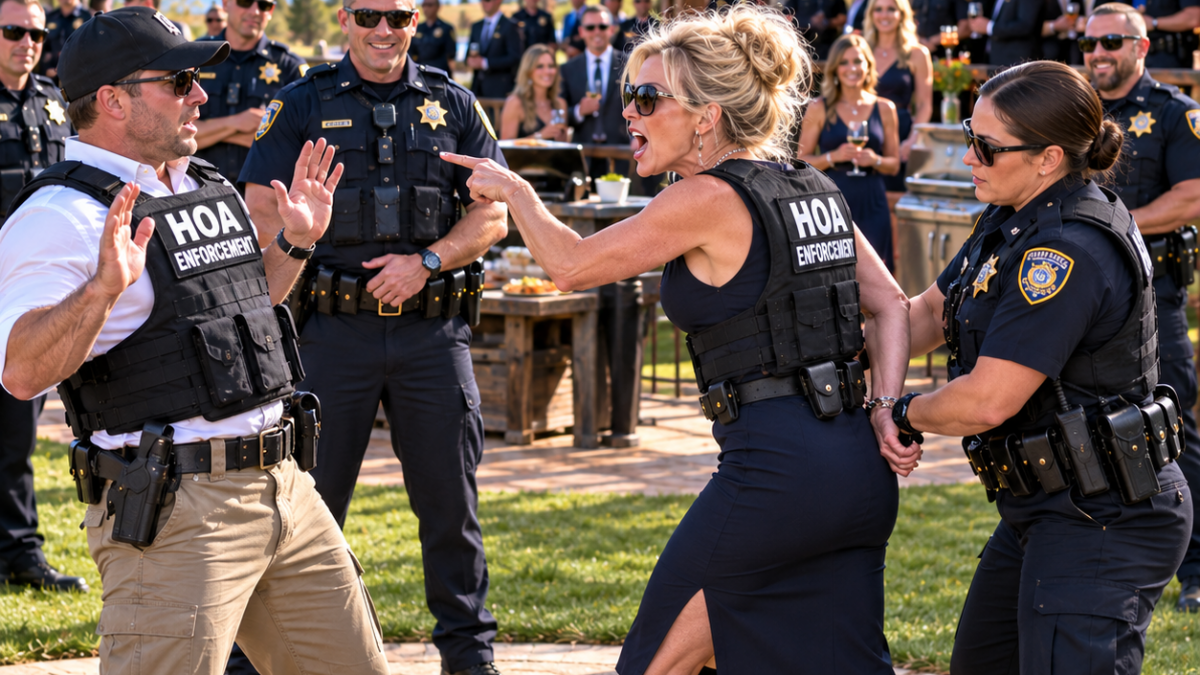
PART 2
Captain Hayes stepped out of the kitchen doorway slowly.
Robert Hayes had spent thirty-five years in law enforcement, and he had the kind of command presence you cannot buy from a uniform supplier.
He was sixty-one, wearing khaki shorts, sandals, and a Hawaiian shirt covered in blue flowers.
Nash looked at him and saw an older man holding a beer.
I looked at him and saw a captain who had walked into armed barricades, officer shootings, riots, funerals, and more midnight calls than I could count.
Hayes placed his beer on a side table.
“Son.”
His voice wasn’t loud.
It didn’t need to be.
“I’m going to give you exactly one opportunity to remove those handcuffs from my wife.”
Nash turned.
His grip remained on Mrs. Hayes’s upper arm.
“Sir, step back.”
Hayes didn’t.
“She is being detained for obstruction.”
“By whom?”
“Community Security.”
“That wasn’t my question.”
Nash’s face tightened.
Hayes reached into his pocket.
Slowly.
Deliberately.
He opened a leather wallet.
The gold shield inside caught the living-room light.
“Captain Robert Hayes, Phoenix Police Department.”
The younger man, Cole, stopped writing.
Nash’s eyes moved from the badge to Hayes’s face.
Then across the room.
Lieutenant Carolyn Wright.
Detective Patrick O’Brien.
Officer Maria Santos.
Three retired detectives.
Patrol supervisors.
Off-duty officers.
Spouses who had heard enough police stories at dinner tables to know exactly what was happening.
For the first time since I opened the door, Nash looked uncertain.
Only for a second.
Then ego rushed in to save him.
“This is private HOA enforcement,” he said. “Your department has no authority to interfere with association rules.”
Hayes stared at him.
“You put handcuffs on my wife.”
“She failed to comply with a lawful order.”
“What law?”
Nash opened his mouth.
Nothing came out.
Hayes took one step closer.
“Take them off.”
Cole whispered, “Derek.”
So now we had a first name.
Derek Nash.
Nash glared at him.
“Quiet.”
Mrs. Hayes finally spoke.
Her voice was calm.
“You’re hurting my wrist.”
That did something to Hayes.
Not outwardly.
I had known him sixteen years.
I saw it in his jaw.
He could have put Nash on the floor in two seconds.
Half the room could have.
That was exactly why nobody did.
A room full of police officers tackling a private security employee inside another officer’s home could become the only video anyone ever saw.
Nash would become the victim.
The HOA would call it retaliation.
Every defense attorney would ask why nineteen trained officers needed force against one unarmed man.
So Hayes held still.
I stepped forward.
“Nash.”
He looked at me.
“Remove the cuffs.”
Maybe it was my tone.
Maybe it was Hayes’s badge.
Maybe Nash had finally counted the eyes in the room.
He unlocked Mrs. Hayes.
Red marks circled her wrists.
Hayes immediately took her hands.
“Are you okay?”
“I’m fine.”
She wasn’t looking at her husband.
She was looking at Nash.
He straightened his shirt.
“Consider this a warning.”
I almost laughed.
He had unlawfully restrained a police captain’s wife in front of nineteen law-enforcement witnesses and thought he was leaving us with a warning.
“This gathering remains in violation,” he continued. “All vehicles must be moved within thirty minutes or they will be cited and towed. The homeowner will receive fines totaling at least five thousand dollars.”
Carolyn asked:
“Five thousand for what?”
Nash looked at her.
“You’ll receive the itemization.”
“You don’t even know my name.”
“I don’t need your name.”
“That’s convenient.”
Cole shifted near the door.
He wanted out.
Nash did not.
People like Derek Nash are dangerous partly because they mistake retreat for humiliation.
He needed the last word more than he needed good judgment.
He pointed at me.
“The board will hear about your lack of cooperation.”
“Good.”
“This is not over.”
“I agree.”
He smiled.
He thought that was bravado.
It wasn’t.
They walked out.
Nobody stopped them.
Through the front window, I watched Nash and Cole climb into the white SUV.
Then the roof lights came on.
Red.
Blue.
Alternating.
Captain Hayes stood beside me.
“You see that?”
“Yep.”
“Civilian light bar?”
“Yep.”
“Interesting.”
“That’s one word.”
Mrs. Hayes came over holding an ice pack Maria had wrapped in a towel.
Her wrists were swelling slightly.
“You let them leave.”
Hayes looked at me.
It wasn’t criticism.
A question.
“For now.”
He studied me.
Then smiled.
“How many recordings?”
Maria answered from behind us.
“My body cam.”
Carolyn held up her phone.
“Audio and video.”
O’Brien:
“I got the last ninety seconds.”
A retired sergeant near the kitchen raised his phone.
“Whole handcuffing.”
Another officer:
“Driveway camera?”
I nodded.
“Front door, curb, and street.”
Hayes looked toward the disappearing light bar.
“Good.”
Mrs. Hayes rubbed her wrist.
Then she looked at me.
“How far are you going to let this go?”
The room quieted.
That was the question.
Not:
Do we have enough to arrest Nash?
We did.
Not:
Did a crime happen?
Everyone in that room understood we had just watched conduct serious enough to demand investigation.
The question was whether Nash was the problem or evidence of a larger one.
I had lived in Oak Ridge Estates only eight months.
I had seen the white “Community Security” SUV before.
Never paid attention.
I had assumed it was the HOA’s answer to package theft and teenagers speeding through stop signs.
Now I remembered something.
My next-door neighbor.
Kayla Young.
Sixty-seven.
Widowed.
About two months earlier, she had mentioned men from security knocking on her door after ten at night because her porch light was “too bright.”
I had laughed sympathetically.
HOA nonsense.
That’s what I called it.
She had said:
“They made me sign something.”
I should have asked what.
I didn’t.
I thought I understood the category.
Overbearing HOA.
Petty rule.
Annoying security.
Move on.
Now I wondered how many people in Oak Ridge had stories I had placed inside that same harmless box.
Captain Hayes must have seen the thought on my face.
“What?”
“My neighbor.”
I told them about Kayla.
Carolyn folded her arms.
“One incident?”
“Don’t know.”
O’Brien walked to the window.
He had spent twenty-eight years in fraud and organized-theft investigations before retiring.
He loved patterns.
Sometimes too much.
“Who runs the security company?”
“HOA.”
“That wasn’t my question.”
I smiled.
He pointed at me.
“See? Captain’s rubbing off on all of us.”
Maria sat beside Mrs. Hayes.
“What if Nash does this tomorrow?”
That was the moral problem.
If we moved immediately, Nash and Cole could be arrested before they put another person in handcuffs.
If we waited, we might identify who hired them, funded them, trained them, and benefited from the intimidation.
Hayes said:
“We can have a marked unit pick them up tonight.”
Nobody answered.
He looked at me.
“Your house. Your incident. Your call as the complainant.”
“I don’t want one rogue security guy.”
“Neither do I.”
Mrs. Hayes looked at us.
“What do you want?”
“The system that told him he could do it.”
She nodded.
That was the answer she wanted.
Carolyn said:
“Then we do this correctly.”
Not as angry cops.
As witnesses.
We froze the barbecue.
Not literally.
Food remained on the grill.
Music stopped.
People gathered in the living room.
Maria downloaded her body-camera video to a secure evidence copy.
Carolyn emailed herself the phone recording and created a second backup.
I saved my doorbell and driveway footage.
O’Brien wrote down every name present.
Not because we were building some secret police operation out of my dining room.
Because the first thing any prosecutor would ask was:
Who saw what?
When?
From where?
Captain Hayes’s wife photographed her wrists.
A nurse in the group measured the marks.
Time.
Date.
No embellishment.
No one posted anything online.
That mattered.
The fastest way to contaminate twenty witnesses is to let everyone spend the night arguing publicly about what they saw.
Hayes told them:
“Do not coordinate statements. Do not post. Do not discuss details with neighbors beyond what is necessary for safety. If investigators contact you, tell your own version.”
Then he looked at me.
“You still want to wait?”
“I want twenty-four hours.”
“Douglas.”
“If Kayla says this has happened before, we stop treating tonight as an isolated incident.”
Mrs. Hayes spoke from the couch.
“And if she says it hasn’t?”
“Then we turn over everything and Nash gets dealt with immediately.”
She nodded.
“Fair.”
The barbecue ended around midnight.
Nobody cared about dessert.
Hayes and his wife were the last to leave.
At the door, he stopped.
“You know what bothers me?”
“The cuffs?”
“Obviously.”
He looked down the street.
“He didn’t improvise.”
I knew exactly what he meant.
Nash’s words had been too smooth.
Obstruction of duty.
Lawful orders.
Detained.
Full enforcement powers.
Escalate to real law enforcement.
Not a confused security guard overstepping once.
A script.
“You think he’s done it before.”
“I think nobody becomes that comfortable on their first night.”
I slept badly.
At 8:52 the next morning, I was standing on Kayla Young’s porch.
I waited until nine to knock.
She opened wearing a blue bathrobe, coffee in one hand.
Her expression changed the moment she saw me.
“Douglas.”
“Morning.”
“Something wrong?”
“Can we talk?”
She studied my face.
Then stepped aside.
Her house was immaculate.
Small porcelain birds on a shelf.
Family photographs.
A crocheted blanket folded perfectly across the sofa.
She sat in an armchair.
I took the couch.
“What happened?”
I told her.
Not every investigative thought.
Just facts.
Nash.
Cole.
Uniforms.
Handcuffs.
Mrs. Hayes.
Kayla went completely still.
“What?”
“Do you know Derek Nash?”
Her fingers tightened around the coffee cup.
That was enough.
“How many times has he been here?”
She stared toward the front window.
“Does this stay between us?”
“I won’t use anything without your permission unless someone is in immediate danger.”
“Are you asking as a police officer?”
That question hurt.
She had known I was a cop since I moved in.
She had never asked me for help.
“As your neighbor first.”
She nodded.
“It started with my mailbox.”
Six inches too tall.
She fixed it.
Then a ceramic birdbath that supposedly violated front-yard decoration rules.
She moved it.
Then her porch light.
Then her friend’s car parking overnight.
Then noise.
“What noise?”
“My television.”
“How loud?”
“I don’t know.”
She smiled bitterly.
“I’m sixty-seven, Douglas. I usually fall asleep during the ten o’clock news.”
Then came the visits.
After dark.
Nash.
Sometimes Cole.
Sometimes another man.
Uniforms.
Radios.
Forms.
“They’d stand close.”
“How close?”
“Too close.”
“Did they enter?”
“Once.”
“Invited?”
She hesitated.
“I stepped backward.”
“That isn’t necessarily an invitation.”
“I didn’t know how to tell them no.”
“What did they say?”
“That refusal to cooperate could affect my standing with the HOA.”
“What standing?”
“I don’t know.”
“Any threats?”
“Not exactly.”
She went to a filing cabinet.
Returned with a manila folder.
Seven forms.
The moment I saw them, my stomach tightened.
They were designed to resemble municipal citations.
Boxes.
Codes.
Violation numbers.
Official-looking header.
OAK RIDGE COMMUNITY ENFORCEMENT DIVISION.
Not security.
Enforcement Division.
That difference mattered.
One included a line:
FAILURE TO COMPLY MAY RESULT IN ESCALATED CIVIL OR CRIMINAL REFERRAL.
“What criminal referral?”
Kayla shook her head.
“I never asked.”
“Why?”
She looked embarrassed.
“Because they had badges.”
I sat back.
There it was.
That was the entire business model.
Not actual legal authority.
The appearance of it.
“When did this start?”
“Almost three years ago.”
“Why you?”
“I don’t know.”
Then she remembered something.
“Victoria.”
“Victoria who?”
“Ashford.”
HOA president.
I knew the name from newsletters.
Elegant woman.
Cream blazers.
Quarterly messages about “protecting property values” and “preserving Oak Ridge character.”
“What about her?”
“She called me before the visits got bad.”
“When?”
“Maybe three years ago.”
“What did she want?”
“She asked if I was happy here.”
“That’s it?”
“She said she knew investors who were interested in buying in Oak Ridge.”
“You told her no?”
“Yes.”
“What happened afterward?”
Kayla looked at the seven forms between us.
“You tell me.”
I did not.
Because correlation was not proof.
But it was a direction.
“Will you give a formal statement?”
Fear crossed her face.
Immediately.
“What happens if I do?”
“I don’t know yet.”
“Will Nash know?”
“Eventually, maybe.”
“What about Victoria?”
“Same.”
Kayla looked toward her front door.
“I’ve spent three years waiting for that SUV.”
I let the silence sit.
“If I don’t say anything…”
Her voice trailed off.
“He might keep doing it.”
“Yes.”
“To somebody else.”
“Yes.”
She nodded.
“I’ll talk.”
That was the first.
The Martinez family lived four houses down.
Luis and Ana.
Young.
Toddler.
Moved in eight months earlier.
Same month I did.
They had received a citation for music at six in the evening.
“Was it loud?”
Luis asked.
I smiled.
“I wasn’t there.”
“No.”
He leaned forward.
“I’m asking because after they came, I stopped trusting myself.”
That sentence stayed with me.
Ana brought the citation.
Same fake municipal style.
Different violation number.
Nash’s signature.
Luis’s hand trembled while holding it.
“They said if we refused to sign, police could be called.”
“Did they say they were police?”
“No.”
“Did they clearly say they weren’t?”
Luis thought.
“No.”
That mattered too.
They did not necessarily have to announce “we are police” if every other element was designed to make a resident infer it.
Dark uniforms.
Badges.
Handcuffs.
Radios.
Emergency lights.
Language.
Forms resembling citations.
A performance of authority.
Mr. Stewart lived near the end of the block.
Seventy.
Retired.
Vietnam veteran.
Ohio-born.
He invited me into his garage because he said the house was messy.
It wasn’t.
His story made me angry enough that I had to stop taking notes for a moment.
Nash had cited him over an overgrown hedge.
Mr. Stewart challenged the fine.
Not aggressively.
Asked for the specific HOA rule.
Nash leaned close and said:
“You know, people start asking too many questions, sometimes other agencies become interested. Immigration has been active lately.”
Mr. Stewart stared at him.
“I’m from Cleveland.”
Nash smiled.
“That’s what everybody says.”
Mr. Stewart went inside.
Came back with his birth certificate.
Nash laughed.
“Relax. Nobody accused you of anything.”
Then left.
Mr. Stewart kept the birth certificate in the same drawer as the citation.
For three years.
“I know it’s ridiculous.”
“No.”
“I was born here.”
“I know.”
“My father served in Korea.”
“I know.”
“I shouldn’t have to prove—”
His voice broke.
I closed my notebook.
“You don’t.”
He looked away.
“Then why did I feel like I did?”
I didn’t have a good answer.
By noon, I had spoken with eight households.
Five had stories.
Every one involved either newer residents, minority residents, older residents living alone, or some combination.
Long-term families who fit the neighborhood’s old social core?
Almost nothing.
I sat in my unmarked personal car—not department property—at the end of the block and stared at the neighborhood.
Perfect lawns.
Palm trees.
Stucco homes.
Matching stone mailbox pillars.
Everything marketed as safe.
Safe for whom?
I called Captain Hayes.
“I have five.”
“Five what?”
“Households with similar stories.”
Silence.
“Documented?”
“Forms.”
“Same security?”
“Yes.”
“Nash?”
“Mostly.”
“Any handcuffs?”
“Not yet.”
“Threats?”
“Yes.”
“Pattern?”
“Looks like one.”
Hayes exhaled.
“Then we hand it over.”
That mattered.
We did not launch our own rogue neighborhood investigation because half our friends were officers.
Hayes contacted the appropriate investigative unit and county prosecutor’s office.
I became a victim-witness.
So did his wife.
The other officers became witnesses.
That boundary was important.
O’Brien could access publicly available corporation records and HOA filings as a resident helping me understand the association’s finances, but anything requiring police databases, subpoenas, or warrants went through assigned investigators.
Carolyn checked public state licensing records.
Maria organized copies of video she personally possessed.
No shortcuts.
No badges used to bully records out of people.
No favors.
If this was going to end with Nash accusing police of targeting him, our process needed to survive the accusation.
The licensing search was ugly.
Derek Nash had applied for a private security credential four years earlier.
Denied.
The public-facing record did not disclose everything, but the underlying licensing file later obtained by investigators showed he had failed suitability requirements.
Randy Cole had never been licensed.
Neither man had authority resembling what they projected.
Yet Oak Ridge paid heavily for them.
HOA budget:
About $300,000 annually under “community protection and enforcement.”
Much higher than similar local associations with comparable size.
Where did the money go?
Company:
Oak Ridge Protection Services LLC.
Not Oak Ridge Estates.
Protection Services.
Private contractor.
O’Brien found the registration.
Owner:
Martin Ashford.
Brother of Victoria Ashford’s husband.
I stared at the screen.
“Family.”
“Family,” O’Brien said.
“Could be legitimate.”
“Could.”
“Competitive bidding?”
“Can’t find it in public HOA summaries.”
“Board vote?”
“Need records.”
The assigned investigators would get them.
Three days after the barbecue, Victoria Ashford came to my door.
Dinner had just ended.
I was rinsing a plate when the bell rang.
Cream blazer.
Pearl earrings.
Silver Mercedes at the curb.
She smiled.
“Mr. Baker.”
“Mrs. Ashford.”
“I hope I’m not interrupting.”
“You are.”
The smile held.
“I’ll be brief.”
I did not invite her in.
She looked past me anyway.
“I wanted to personally apologize for the misunderstanding involving our community security team.”
“What misunderstanding?”
“Things became unnecessarily tense.”
“Your security chief handcuffed a guest inside my house.”
“I’m aware.”
“For asking if he was a police officer.”
“I understand Derek can sometimes be overzealous.”
“Overzealous is sending an extra warning letter.”
She paused.
“I agree mistakes were made.”
“Which mistakes?”
That was not the conversation she wanted.
She had come for closure, not questions.
“I’m here because I would prefer to resolve this privately.”
“What does that mean?”
“No fines from the gathering.”
I almost laughed.
“You’re forgiving the fines?”
“Yes.”
“Fines based on what?”
Her eyes sharpened.
“We don’t need to become adversarial.”
“You came to my house.”
“I came to make peace.”
“By offering not to collect money you may not have had a lawful basis to demand.”
Victoria’s warmth faded half a degree.
“Mr. Baker, I’ve learned you are a police officer.”
There it was.
She had done her research.
“Yes.”
“I have tremendous respect for law enforcement.”
“Good.”
“And I’m sure you understand how unfortunate it would be if a neighborhood misunderstanding turned into a public spectacle.”
I said nothing.
Silence invites people to fill it.
Victoria did.
“I’ve lived here fifteen years.”
Still nothing.
“I have relationships with the board, local council, business leaders.”
Nothing.
“Situations become complicated when people insist on escalating them unnecessarily.”
The words were soft.
Reasonable.
Almost maternal.
That is how real intimidation often sounds.
Not:
I will destroy you.
More like:
Wouldn’t it be a shame if this became difficult?
A floorboard creaked behind me.
Captain Hayes stepped into view.
Civilian clothes.
No badge displayed.
Victoria’s expression changed.
Barely.
Hayes smiled politely.
“Mrs. Ashford.”
“Captain.”
“I don’t believe we’ve officially met.”
“I’m familiar with who you are.”
“I imagine.”
He rested one hand on the back of a chair.
“I’m the husband of the woman Derek Nash handcuffed.”
“Yes.”
“I apologize for that.”
“To me?”
Victoria paused.
“Of course to your wife.”
“She’d probably prefer hearing it herself.”
“I would be happy to—”
“Another time.”
Hayes’s tone stayed pleasant.
“I have a question.”
“Certainly.”
“How long have Nash and Cole worked for Oak Ridge?”
“Several years.”
“Licensed?”
Victoria’s pause answered before her mouth did.
“I assume so.”
“Why?”
“The company assured us.”
“Which company?”
“Oak Ridge Protection Services.”
“Your brother-in-law’s company.”
Her smile disappeared.
“My husband’s brother operates a legitimate business.”
“Perhaps.”
“Captain, I came here in good faith.”
“So did we.”
Hayes stepped beside me.
“State records don’t show valid security licensing for either man.”
“I wasn’t aware.”
“We also have residents describing similar visits.”
She looked at me.
“How many?”
I didn’t answer.
Hayes said:
“Enough.”
Victoria’s posture became rigid.
“I don’t know what residents have told you, but these people sometimes misunderstand enforcement.”
“People?”
I asked.
“Residents.”
“You said these people.”
“I meant residents.”
I let that sit.
Then:
“One of your employees suggested immigration authorities might question a seventy-year-old Ohio-born homeowner after he disputed a hedge citation.”
Victoria’s face gave me nothing.
“Another elderly resident stopped inviting friends over after nighttime visits.”
Nothing.
“A young family was told police might be involved if they refused to sign a citation for music at six in the evening.”
Nothing.
“And several of these residents received calls afterward asking whether they wanted to sell.”
There.
Small.
Her eyes flickered.
Not surprise.
Calculation.
I didn’t accuse her.
I didn’t need to.
Victoria smoothed one sleeve.
“Mr. Baker, you have lived here eight months.”
“Yes.”
“I have spent fifteen years helping build this community.”
“Okay.”
“You don’t yet understand its history.”
“Then explain it.”
“Neighborhoods like Oak Ridge remain desirable because standards are protected.”
“By fake cops?”
Her jaw tightened.
“That characterization is inflammatory.”
“Then what would you call two unlicensed men carrying handcuffs and badges, running red-and-blue lights, and telling residents they’re being detained?”
She looked at Hayes.
“This conversation is no longer productive.”
“It never was,” he said.
Victoria turned toward the Mercedes.
At the end of the walkway, she stopped.
“Mr. Baker.”
I waited.
“You seem like a practical man.”
“Usually.”
“Practical people understand that every conflict has a cost.”
She smiled.
“Think carefully about how much cost you want to create.”
Then she left.
Hayes stood beside me until her taillights disappeared.
“She’s scared.”
“Yes.”
“Scared people make mistakes.”
“Also destroy evidence.”
He nodded.
“Which means we move.”
Two weeks after Victoria’s visit, the evidence file was thick enough that the county prosecutor stopped calling it an HOA dispute.
Twelve victim statements.
Seven sets of fake citation forms.
Video from my barbecue.
Audio.
Doorbell footage.
Documentation of the illegal-looking emergency lights.
Licensing records.
HOA budget records.
Corporate ownership.
Witnesses describing post-enforcement sales pressure.
Assigned investigators—not me—obtained the deeper financial records.
They found the first clean connection.
Oak Ridge Protection Services received extraordinary payments from the HOA.
The company belonged to Victoria’s brother-in-law.
Its operating expenses were tiny compared with the amount received.
Nash and Cole were paid as contractors.
No meaningful training records.
No lawful enforcement authority.
No credible oversight program.
Then warrants were approved.
The arrests happened Tuesday morning.
I stayed away.
That was deliberate.
I wanted no photograph of me standing behind the arrest team.
No revenge pose.
No story that Detective Douglas Baker used his department to crush an HOA employee who embarrassed him.
O’Brien texted:
NASH IN CUSTODY.
Two minutes later:
COLE TOO.
Nash opened his door in sweatpants.
Apparently annoyed someone had awakened him.
Then he saw real badges.
O’Brien said his face changed in stages.
Confusion.
Recognition.
Silence.
For once, Derek Nash had nothing to say.
Randy Cole reacted differently.
He cried.
Not later.
Immediately.
He told investigators he had only followed Nash’s instructions.
Then he started talking.
By lunch, Cole had confirmed the detail we needed most.
Victoria knew.
According to Cole, she personally approved their hiring.
She knew they lacked the proper licensing.
She reviewed enforcement reports.
Nash met with her after resident visits.
And there was a list.
Not digital.
Paper.
Kept in Victoria’s HOA office.
Residents requiring “encouragement.”
A search warrant found it.
Names.
Addresses.
Demographic notes.
Move-in dates.
Violation history.
Property values.
Contact status.
Sale potential.
Every person on the list was a minority resident, recent arrival, elderly person living alone, vocal board critic, or some combination.
Kayla Young’s name was there.
Beside it:
WIDOW — LOW RESISTANCE / PROPERTY HIGH DEMAND.
I saw the photocopy later through the proper case process.
Those five words made me feel sick.
Low resistance.
Kayla had spent three years believing she was weak because she became afraid.
Victoria had turned that fear into a category.
Mr. Stewart:
OLDER / CONFRONTATIONAL / QUESTIONING AUTHORITY.
The Martinez family:
NEW OWNERS / FINANCIAL PRESSURE POSSIBLE.
Another resident:
DIVORCE PENDING.
Another:
OUT OF STATE FAMILY.
Another:
BUSINESS TROUBLE.
This wasn’t community enforcement.
It was vulnerability mapping.
And the money made the motive uglier.
Three homeowners who sold after extended “security” pressure had accepted below-market offers.
Property records traced the buyers to an investment group connected to Victoria’s husband.
Security pressure.
Fear.
Sale.
Discounted house.
Investment company buys.
Renovates.
Resells.
Profit.
When the prosecutor saw the full picture, she called Captain Hayes and me into her office.
Rachel Morrison.
Eighteen years prosecuting everything from fraud to violent crime.
She had the habit of tapping her pen against her thumb while thinking.
She stopped halfway through the financial summary.
“This is not an HOA dispute.”
“I agree.”
“This is not even primarily a private-security case.”
Hayes leaned back.
“What do you see?”
“An enterprise using intimidation and fraudulent authority to produce financial benefit.”
She closed the folder.
“We’re referring part of this to the state attorney general.”
“Racketeering?” Hayes asked.
“Potentially.”
She held up a hand.
“Potentially. I’m not charging a word because it sounds dramatic.”
Good prosecutor.
“What can you prove now?” I asked.
“Impersonation-related conduct. Unlawful restraint. Fraud theories. Witness intimidation issues. Licensing violations. Conspiracy depending on corroboration.”
“And Victoria?”
“Not arrested yet.”
I frowned.
“Why?”
“Because I like cases more than headlines.”
Fair.
“Cole?”
“Cooperating.”
“Nash?”
“Not.”
“Shocking.”
Rachel looked at me.
“And you are going to do something difficult.”
“What?”
“Nothing.”
“I’m excellent at nothing.”
Hayes laughed.
She did not.
“No interviews. No neighbor canvassing. No confronting Victoria. No discussing evidence.”
“I understand.”
“This is now an active criminal investigation.”
“I understand.”
“You’re emotionally invested.”
“Obviously.”
“Which is why you stay outside it.”
That was harder than she knew.
Police officers are terrible victims.
We know just enough to imagine every next step.
We know how cases can fail.
We know what evidence should exist.
We know delays.
We know defense tactics.
And we hate being forced to trust someone else with the wheel.
But Rachel was right.
My job was to be a witness.
Victoria was arrested twelve days later.
Search teams had completed the financial link.
Emails connected her directly to Nash.
Not vague.
Not merely “keep standards high.”
Specific.
One message:
YOUNG STILL REFUSING. INCREASE CONTACT. EVENING VISITS WORK BETTER.
Another:
MARTINEZ NEW / DON’T LET THEM GET COMFORTABLE.
Then:
STEWART QUESTIONING CITATIONS. REMIND HIM WE CAN REFER OUTSIDE AGENCIES IF NECESSARY.
Her defense would later argue those messages referred to lawful HOA enforcement.
Maybe a jury could have believed that in isolation.
But the list.
Fake forms.
Unlicensed guards.
Handcuffs.
Financial relationships.
Discounted home purchases.
Patterns matter because context changes language.
Victoria answered her door in a silk robe.
The same woman who had warned me about “cost” now faced a warrant.
She called her lawyer before saying much.
Smartest decision she made in the entire story.
Oak Ridge exploded.
Not literally.
Socially.
By noon, residents stood on sidewalks comparing stories.
People who had spent years believing they were individually targeted learned they had been part of a system.
Kayla came to my driveway.
No makeup.
Hair tied back.
She looked exhausted.
“They arrested her.”
“Yes.”
“I saw.”
“You okay?”
She stared at me.
Then:
“I thought I was crazy.”
“You weren’t.”
“For three years.”
“I know.”
“I thought maybe I was difficult.”
“You weren’t.”
“I thought maybe everyone got those visits.”
“They didn’t.”
Tears came.
She looked embarrassed.
I handed her a tissue from my truck.
“I stopped having my sister stay over.”
I said nothing.
“I thought her car would cause problems.”
She wiped her face.
“I stopped sitting on the porch after dark.”
Nothing.
“I changed my light three times.”
I felt my own eyes burn.
“I hated my own house.”
That was the crime no statute captured cleanly.
Victoria had not merely extracted money.
She had changed how people felt inside their homes.
Property ownership means very little if someone can train you to be afraid of your own front door.
More residents came forward after the arrests.
Patricia Chan.
She had criticized a special assessment at an HOA meeting.
Security showed up the next night.
Marcus Webb.
Retired firefighter.
Cited over an American flag supposedly exceeding size standards.
The Nguyen family.
Monthly visits for almost a year until they hired counsel.
A single mother named Rachel Finley who was repeatedly questioned about “unauthorized adult occupants” whenever her brother stayed overnight to help with her children.
Different details.
Same architecture.
Identify.
Pressure.
Document the target.
Create fear.
Offer a path of least resistance.
Sometimes that path was compliance.
Sometimes silence.
Sometimes sale.
The preliminary hearing happened months later.
Maricopa County Superior Court.
Department Twelve.
Fluorescent lights.
Hard benches.
The least dramatic room imaginable.
That is where dramatic stories usually end up.
I sat third row.
Kayla beside Mr. Stewart.
Martinez family two seats down.
Patricia Chan.
Marcus Webb.
Captain Hayes and his wife sat across the aisle.
Mrs. Hayes’s wrists had healed months earlier.
The memory had not.
Victoria entered in navy.
Perfect posture.
Expensive attorney.
She did not look at the gallery.
Nash sat separately.
Public defender.
His fake badge was gone.
His shoulders seemed smaller without it.
Cole was not there.
His case had been severed after cooperation.
Judge Diane Daniels entered at nine.
Gray hair pulled back.
Reading glasses.
No wasted ceremony.
Charges were summarized.
Impersonation-related offenses.
Unlawful restraint.
Conspiracy to commit fraud.
Witness intimidation.
Other financial allegations under separate review.
Rachel Morrison stood.
“Your Honor, the state would like to begin with video from June fourteenth.”
My living room appeared on the courtroom screen.
I had watched the footage dozens of times.
Still different there.
Nash at the door.
Dark uniform.
Badge.
Mrs. Hayes.
Her question.
“You aren’t real cops, are you?”
Then the movement.
Wrist.
Cuff.
Click.
“Ma’am, you are being detained for obstruction of duty.”
Someone in the gallery inhaled.
Kayla covered her mouth.
The video continued.
Captain Hayes showing his badge.
Nash refusing to immediately yield.
Threatening fines.
The SUV lights.
Rachel paused.
“Your Honor, this incident was not isolated.”
She held up a clear evidence sleeve.
Inside:
The list.
The courtroom changed.
Not visibly much.
But everyone understood that single sheet of paper meant the case had moved beyond one arrogant security guard.
“Seized pursuant to warrant from Mrs. Ashford’s office.”
Victoria remained still.
“Residents designated for what internal communications call encouragement visits.”
Her attorney stood.
“Objection to characterization.”
Judge Daniels:
“Sustained as to characterization. Counsel, describe the document.”
Rachel nodded.
She did.
Names.
Addresses.
Notes.
Categories.
Then:
“Every individual listed was either a minority resident, recent arrival, elderly resident living alone, outspoken board critic, or some combination.”
Defense objected again.
Foundation.
Relevance.
Judge Daniels allowed enough for the hearing’s limited purpose.
Rachel moved to the financial records.
Oak Ridge Protection Services.
Victoria’s brother-in-law.
Payments.
House sales.
Investment group associated with Victoria’s husband.
Then emails.
EVENING VISITS WORK BETTER.
DON’T LET THEM GET COMFORTABLE.
The defense did what good defense attorneys do.
They attacked meaning.
HOA rules legitimately required enforcement.
Security uniforms were clearly labeled “Community Security.”
Nash never verbally claimed to be Phoenix police.
The light bar, counsel argued, was intended for visibility.
Mrs. Hayes was briefly restrained during a tense disagreement, not formally arrested.
Victoria delegated security operations and did not control every field decision.
The family financial ties were lawful business relationships.
Discounted home sales had independent market explanations.
Some of those points were not absurd.
That is important.
Cases are rarely:
Good people say truth.
Bad person says nonsense.
The defense had arguments.
The evidence simply had more weight.
Rachel called an investigator who described the licensing records.
Neither Nash nor Cole possessed valid credentials required for the work they were performing.
The fake citation format was compared with official municipal forms.
Similar enough to confuse residents.
Different enough to avoid directly copying one agency.
Then Mrs. Hayes testified.
Calm.
Thirty years as an ER nurse made courtrooms less intimidating than emergency rooms.
“What did Mr. Nash tell you?”
“That I was being detained.”
“Did you believe you were free to leave?”
“No.”
“Why?”
“He had both my wrists in handcuffs.”
“Did you consent?”
“No.”
“Did you threaten him?”
“No.”
“What did you do immediately before the restraint?”
“I asked if he was a real police officer.”
Defense counsel approached.
“You knew your husband was a police captain.”
“Yes.”
“You knew the room contained officers.”
“Yes.”
“So you personally were not afraid of Mr. Nash, were you?”
Mrs. Hayes considered.
“Not for myself.”
“Then you weren’t intimidated.”
“I didn’t say that.”
“What frightened you?”
She looked toward Kayla.
“What he might do at a house where nobody knew better.”
The gallery went silent.
That answer became the center of everything for me.
Nash’s mistake was not that he picked the wrong party because cops were there.
His mistake was believing what he did was acceptable anywhere.
If my barbecue had been filled with teachers, nurses, mechanics, widows, retirees, young parents—would he have behaved differently?
Probably not.
That was the point.
Judge Daniels found sufficient probable cause for the principal charges to proceed.
Bail:
Nash, $150,000.
Victoria, $200,000.
Passport surrendered.
No witness contact.
Travel restrictions.
The judge looked directly at Victoria.
“Mrs. Ashford, any attempt to contact or influence witnesses, directly or indirectly, will have consequences for your release status. Do you understand?”
“Yes, Your Honor.”
Barely audible.
The hearing ended.
Victoria had to walk past the gallery.
Past Kayla.
Past Mr. Stewart.
Past Luis and Ana Martinez.
Past Patricia.
Past people her list had reduced to variables.
Nobody shouted.
Nobody insulted her.
Nobody celebrated.
They watched.
That silence had more dignity than anything I could have imagined.
For years, Victoria’s system survived because victims believed silence meant isolation.
Now silence meant witnesses.
The security program dissolved within a week of her arrest.
Oak Ridge terminated the contract.
The white SUV was impounded as part of the case, later forfeited and sold.
The uniforms disappeared.
The fake citation forms stopped.
For the first month, residents still jumped when unfamiliar vehicles slowed in front of their homes.
Kayla told me she checked her window at night automatically.
“So do I,” I admitted.
“You?”
“Occupational habit.”
“That doesn’t count.”
“Fair.”
She started sitting on her porch again.
At first ten minutes.
Then thirty.
Then reading there in the evenings.
That might sound small.
It wasn’t.
Recovery often looks boring from outside.
A porch light.
Friends visiting.
Music at six p.m.
A flag.
A sister’s car staying overnight.
Normal things become victories after someone made them dangerous.
Victoria’s attorneys fought.
Motions.
Challenges to searches.
Arguments about financial connections.
Attempts to exclude the list.
Attempts to separate Nash’s conduct from board policy.
Months passed.
People got tired.
That is another truth about justice.
Abusers are not the only people who benefit from delay.
The system itself exhausts everyone.
Witnesses move.
Memories soften.
Jobs get busy.
Families need attention.
The original outrage fades.
Victoria’s defense team understood time.
So did Rachel Morrison.
She kept the case narrow where it needed to be.
Not every bad HOA decision became criminal.
Not every aggressive citation proved conspiracy.
Not every resident complaint became a count.
The prosecution used the strongest evidence.
Video.
Handcuffs.
Unlicensed operation.
The list.
Direct emails.
Financial links.
Sale patterns where documentation supported them.
Cole’s testimony.
That discipline mattered.
Three weeks before trial, Victoria pleaded guilty.
Not to every allegation prosecutors had considered.
To a negotiated group of charges that established what mattered:
She had knowingly supported and benefited from an unlawful intimidation operation.
She stood before Judge Daniels.
No cream blazer.
No pearls.
Plain navy suit.
She read from a prepared statement.
“I failed residents who trusted me.”
Kayla sat two rows ahead.
Victoria continued.
“I allowed concerns about property standards and neighborhood stability to become justification for methods that were wrong.”
Mr. Stewart shifted.
She said:
“I accept responsibility.”
I watched her face.
Was it sincere?
I don’t know.
People always ask that after sentencing.
Did she mean it?
Was she sorry?
Did prison scare him?
Did probation humble her?
I’ve been a cop too long to pretend I can see inside someone’s mind because their voice cracks.
Behavior is evidence.
Emotion is interpretation.
Victoria received five years of probation.
Two hundred hours of community service.
Restitution totaling $75,000 divided among qualifying victims whose financial losses were proven.
Lifetime prohibition from serving on an HOA board in Arizona under the agreement and related orders.
No prison.
Some residents were furious.
Kayla wasn’t.
We stood outside court.
A reporter asked what she thought.
She declined.
Later, walking to the parking lot, I asked privately.
“You okay with the sentence?”
“No.”
I waited.
Then she smiled faintly.
“But I don’t know what sentence would give me three years back.”
Exactly.
“Do you wish she went to prison?”
“Part of me.”
“And the other part?”
“Wants to go home and sit on my porch.”
That was Kayla.
Derek Nash refused a plea.
He believed the state could not convince a jury that he impersonated peace-officer authority because his shoulder patches technically said Community Security.
He believed Mrs. Hayes was briefly restrained for safety.
He believed the HOA had delegated enforcement power broad enough to justify his conduct.
He believed the videos would show confidence, not criminal intent.
The jury watched them.
Four hours of deliberation.
Guilty.
Six counts related to impersonating peace-officer authority.
Three unlawful-restraint counts tied to documented incidents.
Other lesser findings.
Eighteen months in state prison.
Three years of probation afterward.
When sentence was imposed, Nash stared at Judge Daniels with the same expression I had seen in my doorway.
Disbelief that somebody else’s authority could outrank his own.
Randy Cole cooperated from the beginning.
Probation.
Community service.
Testimony.
He moved out of state.
Warehouse job, according to someone who heard from him later.
I hoped he changed.
Hope does not require confidence.
Oak Ridge held emergency elections two months after the arrests.
I refused to run.
People asked.
A lot.
“Douglas, you should be president.”
Absolutely not.
I had spent twenty-two years around institutions.
The last thing Oak Ridge needed was replacing one overly powerful authority figure with a police officer whose friends filled half the board meetings.
Kayla ran.
That surprised everyone except me.
Her campaign speech lasted three minutes.
“I don’t want anyone else afraid to turn on their porch light.”
That was essentially the whole platform.
She won seventy-three percent.
Luis Martinez joined the architectural committee.
Mr. Stewart began attending every meeting.
Not because he loved meetings.
He hated them.
But he said:
“If they ever talk about immigration again, I’m bringing my Ohio birth certificate and charging admission.”
The new board made changes.
Real security company.
Licensed personnel.
Clearly marked uniforms intentionally unlike police.
No handcuffs for routine HOA interactions.
No red-and-blue emergency-style lighting.
Third-party complaint hotline.
Public financial reports.
Vendor conflicts disclosed.
Board-member family contracts prohibited without transparent competitive review.
Security could observe and report.
Not pretend to arrest people.
HOA violations returned to what HOA violations should have been.
Letters.
Hearings.
Appeals.
Annoying conversations about trash cans.
Beautifully boring.
Some residents argued we should eliminate security entirely.
Others worried about car break-ins.
They compromised.
Healthy governance is often disappointing to people who want total victory.
That is a compliment.
Six months after the night Nash arrived, I held another barbecue.
Same backyard.
Same grill.
Same hickory smoke.
I almost canceled.
The first barbecue had become a crime scene in my memory.
Every time I imagined people gathering near the patio, I saw Mrs. Hayes’s wrists.
Captain Hayes told me:
“That’s exactly why you host it.”
So I did.
Twenty-eight invitations.
More people showed.
Not just cops.
Kayla.
Martinez family.
Mr. Stewart.
Patricia Chan.
The Nguyens.
Neighbors who had never been friends before Victoria’s downfall.
Carolyn Wright was telling another impossible story near the grill.
O’Brien was correcting every detail.
Maria Santos arranged dessert like history was repeating itself.
Captain Hayes and his wife sat beneath the patio umbrella.
I walked over.
Mrs. Hayes raised her wrists.
“No cuffs.”
“Good policy.”
Hayes handed me a beer.
“You did all right.”
“With burgers?”
“Case.”
“I didn’t build the case.”
“You opened the door.”
“Literally.”
He laughed.
Then Mrs. Hayes said:
“Do you remember what I asked you?”
“How far I’d let it go.”
“And?”
“Far enough.”
She shook her head.
“No.”
“What?”
“Far enough that somebody finally listened.”
That was better.
Around sunset, Mr. Stewart came to the grill.
He watched me flip burgers.
“You burn mine?”
“Medium.”
“I asked well done.”
“That’s a crime.”
“You’re off duty.”
“Still have standards.”
He smiled.
Then became quiet.
“Thank you.”
I stopped.
“For?”
“Believing us.”
Not saving us.
Not arresting Victoria.
Believing us.
I handed him a burger.
“Grab a seat.”
Sometimes there isn’t a better answer.
The party went late.
At one point, Kayla stood near my fence talking to Patricia and Mrs. Nguyen.
Three women who had lived within a few blocks of one another for years and barely spoken.
Now they were planning a neighborhood watch.
A real one.
Not uniforms.
Not badges.
People checking on elderly residents during heat waves.
Collecting packages.
Watching houses when families traveled.
Calling actual police when actual police were needed.
That was what community security should have meant all along.
I stood back and watched.
The deepest damage Victoria caused was not financial.
Not even the fake enforcement.
She trained residents to see one another as potential violations.
Strange car.
Report it.
Guest staying late.
Report it.
Different family.
Watch them.
Question them.
New resident.
Make sure they understand the rules.
Fear loves categories.
Neighbor is harder.
Neighbor has a name.
A kid.
A sick parent.
A favorite team.
A terrible lawn.
A grill recipe.
Victoria’s system depended on distance.
The new Oak Ridge began closing it.
Not perfectly.
There were still arguments.
Kayla’s first board meeting nearly ended in civil war over recycling bins.
Mr. Stewart called the architectural committee “the paint police” at least four times.
Luis threatened to resign because someone submitted a thirty-page complaint about a basketball hoop.
I attended occasionally.
Mostly for entertainment.
One night, a resident stood and said:
“Why do we even need rules?”
Kayla answered:
“Because the last board taught us what happens when rules live only in one person’s head.”
Good answer.
Written rules.
Limited authority.
Appeals.
Records.
Transparency.
Those are not glamorous words.
They are what keep a community from depending on whether the person in charge is decent.
That lesson followed me back to work.
At the department, we used the Oak Ridge incident in a training session.
Not the sensational part.
Not:
Fake cop handcuffs captain’s wife at police barbecue.
The ethical part.
What do off-duty officers do when they become witnesses?
How do we avoid contaminating testimony?
When do we act immediately?
When do we preserve evidence?
How do we prevent personal anger from turning legitimate enforcement into retaliation?
One young officer asked:
“Why didn’t you arrest Nash that night?”
I gave the full answer.
“We had immediate safety under control. Mrs. Hayes was released. We had identities. We had recordings. We knew where the suspects worked.”
“So you wanted the bigger case.”
“Yes.”
“Would you make the same decision again?”
That was harder.
“I don’t know.”
He looked surprised.
“Why?”
“Because every hour we waited carried risk.”
“That he’d hurt someone else.”
“Yes.”
“Did he?”
“Not that we know.”
“But he could have.”
“Yes.”
“So how do you decide?”
“You weigh immediate danger against investigative need.”
“That’s vague.”
“Real policing usually is.”
I paused.
“And if Mrs. Hayes had remained restrained, if Nash had threatened violence, if we believed another resident faced immediate danger, we would’ve acted immediately.”
The recruit nodded.
“Complete justice versus fast justice.”
I recognized the phrase from conversations after the incident.
“Don’t romanticize complete justice.”
“Why?”
“Because cases are never complete.”
We caught Nash.
Cole.
Victoria.
We exposed the financial operation.
But did we repair every person?
No.
Did every family who sold get their home back?
No.
Could we prove every ugly thing residents believed Victoria had done?
No.
Justice had boundaries.
That mattered.
One of the families pressured into selling moved to Nevada.
They accepted restitution but did not return.
Another marriage had ended during the harassment years.
Money did not repair it.
Kayla lost three years of feeling safe.
Nobody could issue those back.
Mr. Stewart still kept his birth certificate near the old citation.
I asked why once.
“Habit.”
“Want to throw the citation away?”
“No.”
“Why?”
He looked at it.
“Because one day my grandson will ask why I’m annoying about rights.”
Fair.
Oak Ridge Protection Services dissolved.
Victoria’s brother-in-law claimed he had delegated daily operations and had not understood the tactics.
Investigators scrutinized him.
Some financial penalties followed through civil and administrative processes.
Not every person connected to the company went to prison.
That disappointed residents who wanted the whole family punished.
Evidence has limits.
I learned long ago:
If you turn every connection into guilt, you become what you’re fighting.
Victoria’s husband’s investment group became part of civil litigation involving some home sales.
Settlements followed.
Confidential in portions.
Not all families recovered the difference they believed they lost.
The criminal case established the intimidation operation.
The civil system handled the money more slowly.
Years, not months.
Life moved on while lawyers argued.
Captain Hayes retired two years later.
His retirement party was at my house.
He insisted.
“No community security?”
“Kayla said she’d patrol personally.”
“Terrifying.”
Mrs. Hayes wore a bracelet over the wrist Nash had cuffed.
I noticed because memory does that.
Hayes found me near the grill.
“You staying in Oak Ridge?”
“For now.”
“Why?”
“You think I should leave?”
“No.”
He looked around.
“I’d understand.”
I considered.
The house had once felt contaminated by what happened.
Then neighbors filled it.
New memories layered over old.
“Leaving would feel like giving Victoria too much ownership of the story.”
Hayes nodded.
“Be careful with that.”
“What?”
“Staying out of spite.”
He was right.
Again.
“I stay because I like the place now.”
“That’s better.”
“And Kayla brings pie.”
“Much better.”
Mrs. Hayes joined us.
“You two discussing feelings?”
Hayes immediately said:
“No.”
I said:
“Yes.”
She smiled.
“Robert hates those.”
“Thirty-five years of command.”
“He still can’t tell me when his knee hurts.”
Hayes walked away.
We laughed.
Then she became serious.
“I’ve thought about Nash.”
“So have I.”
“I don’t hate him anymore.”
That surprised me.
“Why?”
“I don’t know.”
She rubbed her wrist unconsciously.
“Maybe because hating him keeps my hands in those cuffs.”
I said nothing.
“He hurt people.”
“Yes.”
“He deserved consequences.”
“Yes.”
“But I don’t want to spend retirement imagining him in prison.”
I looked toward Hayes.
“That sounds healthy.”
“Don’t tell Robert. He’ll think therapy works.”
“It does.”
“He hates when I’m right.”
Everyone did.
A year after Nash got out, I heard he was working construction.
No uniform.
No badge.
No authority.
I never contacted him.
He never contacted me.
Good.
Randy Cole wrote Mrs. Hayes an apology.
She showed it to me.
Three pages.
He said he had taken the Oak Ridge job because Nash made it sound exciting.
Authority.
Respect.
Uniform.
He admitted he liked how residents looked at them differently.
Then it became normal.
Night visits.
Threats.
Forms.
He told himself nobody was being hurt because most people complied.
That line bothered me.
Nobody was being hurt because most people complied.
That is how coercive systems justify themselves.
Resistance becomes the only visible moment of conflict, so the resistor gets blamed for creating the conflict.
If Kayla signed the form quietly, no problem.
If Mr. Stewart challenged it, he was difficult.
If Mrs. Hayes asked whether Nash was real police, she became obstruction.
The person refusing intimidation is recast as the troublemaker.
Cole wrote:
“I understand now that people were calm because they were afraid.”
Mrs. Hayes asked what I thought.
“I think he learned something.”
“You believe him?”
“Maybe.”
“Good enough?”
“For what?”
“Forgiveness.”
“Not my department.”
She smiled.
“Cop answer.”
“Correct.”
Kayla served two terms on the board.
Then stepped down.
Voluntarily.
That became important.
Residents wanted her to stay.
She refused.
“Term limits matter only when people you like follow them.”
Another good answer.
She had changed from a woman afraid to turn on her porch light into someone who could tell seventy angry homeowners that their favorite board president was leaving because no one should become permanent.
I told her:
“You’re different.”
“No.”
“Yes.”
She thought.
“Maybe I’m the person I was before they scared me.”
Better.
The Martinez family had a second child.
Their house became the loudest on the block.
Music.
Kids.
Birthday parties.
Nobody cited them at six p.m.
Mr. Stewart put up a larger American flag.
Within HOA guidelines.
He measured it himself.
Then invited me over to verify.
“I’m not the flag police.”
“You started this.”
“I absolutely did not.”
He laughed.
Patricia Chan joined the finance committee.
Perfect person for it.
Every dollar became public online.
Vendor ownership.
Contracts.
Bids.
Reserves.
Residents complained that the reports were too detailed.
Patricia responded:
“Then don’t read them. They’re still going online.”
Transparency is rarely exciting after scandal.
That is why it needs to become habit rather than reaction.
Three years after the original barbecue, Oak Ridge held a neighborhood festival.
Not police.
Not HOA-only.
Everybody.
Bounce house.
Food trucks.
Local fire department.
Licensed private security wore gray polos with SECURITY printed in huge letters.
No badges.
No cuffs visible.
No light bars.
The security supervisor approached me.
“Detective Baker?”
“Douglas.”
He smiled.
“I’ve heard the story.”
“Unfortunately.”
“We use it in training.”
“Oh God.”
“Mostly as what not to do.”
“Better.”
He pointed toward his staff.
“Our first slide says: YOU ARE NOT POLICE.”
I laughed.
“Good slide.”
“Our second says: IF YOU EVER HANDCUFF A CAPTAIN’S WIFE AT A PARTY FULL OF COPS, UPDATE YOUR RESUME.”
I stared at him.
“You made that up.”
“Maybe.”
That was the first time I could laugh freely about the night.
Not nervous laughter.
Not courtroom relief.
Actual humor.
Enough time had passed.
Later, I saw Mrs. Hayes dancing with her granddaughter near the music stage.
Her wrist had no mark.
The memory did.
Memories do not need to disappear to stop hurting.
They simply move farther from the center.
I retired after twenty-seven years.
Five years after Nash knocked on my door.
My last week, Maria Santos brought the old body-camera clip into the squad room.
“Retirement gift.”
“No.”
She froze the frame.
Nash handcuffing Mrs. Hayes.
My face visible behind him.
“You look angry.”
“I was.”
“You look constipated.”
“Delete that.”
“Evidence.”
“Case closed.”
“Historical record.”
Captain Hayes, already retired, had come for cake.
He looked at the screen.
“Best barbecue ever.”
His wife hit his arm.
“Robert.”
“What? Memorable.”
She looked at me.
“You hosting retirement dinner?”
“No.”
Everyone groaned.
Kayla eventually convinced me.
My retirement party happened in the same backyard.
Of course.
This time, the doorbell rang halfway through dinner.
Every old cop at the table went silent.
Then someone laughed.
I opened the door.
Teenage delivery driver.
Pizza.
I had forgotten O’Brien ordered extra.
The kid looked past me at thirty people staring.
“Uh…”
I started laughing.
Couldn’t stop.
“Wrong house?” he asked.
“No.”
I took the pizzas.
“Long story.”
After everyone left, I sat alone on the patio.
Oak Ridge was quiet.
Streetlights.
Cicadas.
Sprinklers.
Nothing dramatic.
I thought about Victoria.
Derek Nash.
Randy Cole.
All the time we spent calling the operation a machine.
That metaphor helped when we were investigating.
Machines have parts.
Money.
People.
Procedures.
Orders.
But communities are not machines.
They are relationships.
That is why Victoria’s control worked.
She exploited relationships.
Who belonged.
Who was new.
Who was alone.
Who could be pressured.
Who had money problems.
Who could be isolated.
Then our case succeeded for the opposite reason.
People connected.
Kayla spoke.
The Martinez family spoke.
Mr. Stewart spoke.
Patricia.
Nguyens.
Mrs. Hayes.
Cole eventually.
Officers documented what they saw.
Prosecutors traced the money.
Residents compared stories.
No single hero.
That is the version I prefer.
People still tell it differently.
“Fake HOA cops crashed a police party.”
That sounds great.
“Guy handcuffed a captain’s wife in front of nineteen cops.”
Even better.
“HOA Karen hired fake cops and got destroyed.”
Viral.
Simple.
But the part that matters happened the next morning in Kayla Young’s living room.
A sixty-seven-year-old woman opened a filing cabinet.
Took out seven fake citations.
And finally believed somebody would listen.
That was where Victoria’s system actually began to fall.
Not when Nash saw Captain Hayes’s badge.
Not when investigators arrested him.
Not when Judge Daniels set bail.
When one frightened neighbor realized:
I am not crazy.
I am not alone.
What happened to me counts.
I spent twenty-seven years wearing a badge.
You learn something uncomfortable in that time.
Real authority is easy to imitate visually.
Uniform.
Badge shape.
Radio.
Car lights.
Confident voice.
Most people comply because civilization depends on reasonable compliance with legitimate authority.
That trust is valuable.
Which is why impersonating it is so destructive.
Nash borrowed the appearance of authority.
Victoria monetized the fear it created.
But the difference between real authority and fake authority is not just who has the shinier badge.
It is accountability.
Real police can be questioned.
Complaints can be filed.
Evidence can be reviewed.
Courts can reject actions.
Officers have defined powers and limits.
At least that is how the system is supposed to work, and when it fails, the answer is more accountability, not less.
Nash’s “authority” had no meaningful limits because the entire point was that residents didn’t know the boundaries.
Ask:
Who are you?
He said Community Security.
Ask:
What law?
He changed the subject.
Ask:
What happens if I refuse?
Fines.
Towing.
Police.
Immigration.
Whatever frightened the person standing in front of him.
That isn’t enforcement.
That is theater backed by fear.
I kept one of the fake citation forms.
Not as a trophy.
Training material.
Eventually I framed it beside a copy of Oak Ridge’s new complaint policy.
Old versus new.
The fake citation looked more impressive.
Official boxes.
Bold header.
Violation numbers.
Threatening language.
The new policy looked boring.
Plain text.
Appeal rights.
Contact numbers.
Limits of security authority.
Procedures.
Boring won.
That may be the best ending I know.
Oak Ridge did not become perfect.
There were still obnoxious residents.
Petty disputes.
Parking arguments.
Board politics.
One legendary six-month war over whether desert landscaping included artificial turf.
Kayla called me after I retired.
“Come to the meeting.”
“No.”
“We need a neutral voice.”
“I’m retired.”
“You live here.”
“I have plans.”
“What plans?”
“Not HOA meeting.”
She hung up on me.
Healthy community.
Victoria Ashford eventually completed probation.
I heard she moved from Arizona afterward.
No idea where.
I did not look.
At some point, justice requires allowing the convicted person’s life to stop being part of yours.
Derek Nash finished his sentence.
Same.
Randy Cole completed probation.
Same.
They had consequences.
My job was not to keep sentencing them privately forever.
I cared more about Kayla’s porch light.
It stayed on.
Every night.
Warm yellow.
Sometimes I walked past during evening exercise.
She would wave.
Friends’ cars often sat in her driveway.
Her sister visited again.
One Christmas, she decorated the porch with so many lights it probably could have been seen from space.
I stopped.
“You know these are excessive.”
She stared at me.
“Write me a citation.”
I laughed until my side hurt.
Mr. Stewart died at seventy-six.
Heart condition.
His grandson asked me to speak at the memorial.
I declined at first.
Then agreed.
I told one story.
Not about immigration threats.
Not about Nash.
About the time Stewart spent two hours helping me repair a sprinkler line because I had no idea what I was doing.
His grandson laughed.
Afterward he handed me an envelope.
Inside:
The old fake citation.
And a copy of Mr. Stewart’s birth certificate.
A note:
Douglas — Grandpa said you’d know what these mean.
I did.
I gave the birth certificate back to the family.
Kept the citation with permission.
Another piece of evidence that became history.
The Oak Ridge case changed my relationship with the word “community.”
Before, I thought community was geography.
Same streets.
Same HOA.
Same entrance sign.
Same trash day.
Victoria thought community was conformity.
Same standards.
Same appearance.
Same kind of people.
Kayla taught me community is recognition.
I see you.
You tell me something happened.
I believe it deserves to be heard.
Even before I know whether every detail can be proven.
That distinction matters.
Believing someone deserves to be heard is not the same as assuming every allegation is true.
It means taking the person seriously enough to investigate.
That was what Kayla had been denied.
She did not need me to instantly arrest anyone.
She needed someone not to shrug and say:
HOA nonsense.
I had done exactly that months earlier.
That still bothers me.
When she first mentioned the nighttime visit, I could have asked one question.
“What did they make you sign?”
I didn’t.
Maybe nothing would have changed.
Maybe everything would have.
Regret loves impossible alternate timelines.
I apologized years later.
We were sitting on her porch.
“I should’ve listened the first time.”
She shrugged.
“You didn’t know.”
“I’m a cop.”
“You’re also a man.”
“Insulting.”
“Accurate.”
“I dismissed you.”
“You thought it was an HOA complaint.”
“Yes.”
“It was.”
“More than that.”
“We both know now.”
She poured lemonade.
“Douglas, if I spent my life angry at every person who didn’t understand something before they understood it, I’d have to stop speaking to myself.”
That was Kayla.
I asked:
“When did you become wise?”
“After I became president and discovered homeowners are insane.”
Fair.
Years later, when people asked about the barbecue, I stopped telling them about the dramatic moment first.
I started with the doorbell.
Because that is how bad systems usually enter your life.
Not with explosions.
Doorbell.
Letter.
Uniform.
Clipboard.
Somebody saying:
Sir, we have authority.
The most important question is often the simplest.
From where?
Legitimate authority can usually answer.
Nash couldn’t.
Victoria hoped nobody would ask long enough to follow the money.
She almost succeeded.
For three years, she did.
Then she sent Nash and Cole to the wrong house.
That phrase always gets the laugh.
“The wrong house.”
A barbecue full of cops.
But I don’t like it anymore.
Because it suggests what Nash did would somehow have been less serious at the right house.
There is no right house for fake authority.
No right widow.
No right immigrant family.
No right newcomer.
No right elderly man.
No right resident to frighten until they sell.
My house was only different because the witnesses knew what they were seeing.
After everything ended, that became the goal:
Make sure ordinary residents knew too.
The new board distributed a one-page notice annually.
WHAT OAK RIDGE SECURITY CAN AND CANNOT DO.
Observe common areas.
Contact homeowners regarding association concerns.
Call police for criminal matters.
Document violations authorized by contract.
They cannot:
Claim to be law enforcement.
Detain residents except under narrow circumstances allowed by ordinary law.
Demand identification without legal basis.
Enter homes without consent.
Threaten immigration or criminal action to compel HOA compliance.
Use police-style emergency equipment unlawfully.
Simple.
If that page had existed three years earlier, maybe Kayla would have closed her door.
Maybe Mr. Stewart would have laughed.
Maybe Luis would have refused to sign.
Information does not eliminate abuse.
It raises the cost.
That is what transparency does.
The final barbecue I hosted before selling the house happened ten years after Nash first rang the bell.
Yes.
I eventually sold.
Not because Oak Ridge chased me out.
Because retirement changed things.
My sister lived near Flagstaff.
I wanted cooler summers.
Kayla accused me of treason.
“You fixed the neighborhood then abandon us.”
“I’m moving two hours away.”
“Traitor.”
The buyers were a young couple.
Black husband.
Filipina wife.
Two children.
At closing, they asked about the HOA.
I gave them the current documents.
Then said:
“Read them.”
The husband laughed.
“Bad?”
“Better than most.”
“Why the warning?”
“Because nobody should rely on somebody else’s summary of rules attached to their home.”
He nodded.
Good sign.
I did not tell them the entire Nash story.
They already knew.
Their realtor had.
Apparently my house was locally famous.
Great.
The final barbecue included everyone.
Hayes.
Mrs. Hayes.
Carolyn.
Maria.
O’Brien.
Kayla.
Luis and Ana.
Their kids, much older.
Patricia.
Nguyens.
Mr. Stewart’s grandson.
Former colleagues.
New neighbors.
Fifty people.
The grill was too small.
Perfect.
At sunset, Mrs. Hayes raised a drink.
“To Douglas.”
I groaned.
“No speeches.”
She ignored me.
“For letting a man handcuff me in his living room.”
Everyone laughed.
Hayes shouted:
“I told you we should’ve arrested him immediately.”
She continued.
“And for being stubborn enough to make it useful.”
I shook my head.
Then Kayla spoke.
“No.”
The yard quieted.
“To all of us.”
She lifted her glass.
“For finally talking.”
That was better.
Everyone drank.
Later, after the crowd thinned, I stood alone near the front door.
Same threshold.
Ten years earlier, two men had stood there in fake uniforms.
One thought a plastic badge could make his words law.
The other carried a clipboard recording names of people they believed could be pressured.
Now the porch light was warm.
Cars lined the street.
Nobody photographed plates.
Nobody demanded identification.
Nobody asked who belonged.
I thought about Nash saying:
“This is not over.”
He had been right.
Just not in the way he meant.
It continued through Kayla.
Through court.
Through new rules.
Through training.
Through every resident who learned to ask:
Who gave you that authority?
Through every board member who understood that leadership is temporary.
Through every financial report Patricia posted even when nobody read it.
Through the Martinez children growing up in a house where music at six p.m. was just music.
Through Mr. Stewart’s grandson keeping the story of why his grandfather once stored a birth certificate beside an HOA citation.
Through Captain Hayes’s wife eventually being able to laugh about the cuffs.
Nash thought the night was about his authority.
It became a lesson in its limits.
Victoria thought Oak Ridge belonged to people who fit her idea of the neighborhood.
It became a place where the people she tried to isolate ended up running the meetings.
And me?
I thought I was hosting a barbecue.
Instead, I learned that twenty-two years wearing a real badge had not automatically made me good at recognizing fear when it appeared quietly next door.
Kayla taught me that.
So did Luis.
Mr. Stewart.
Mrs. Hayes.
The badge matters.
The law matters.
Evidence matters.
But listening comes first.
I closed the front door one last time before moving.
The new owners would get the keys the following morning.
On the kitchen counter, I left the HOA documents.
The security-rights notice.
Vendor disclosures.
Meeting calendar.
And one note.
Read everything. Ask questions. This is your home.
No dramatic explanation.
No warning about fake cops.
They had enough information.
Outside, Kayla’s porch light glowed across the lawn.
I walked over.
She was sitting in her usual chair.
“You done?”
“House is empty.”
“You crying?”
“No.”
“You look like you’re crying.”
“Arizona dust.”
“At night?”
“Very aggressive dust.”
She handed me lemonade.
We sat quietly.
After a while, she said:
“You know what I remember about the first time you came over?”
“My charm.”
“You looked guilty.”
“Why?”
“Because you remembered I’d told you about security months earlier.”
I laughed.
“You knew?”
“Immediately.”
“Why didn’t you say it?”
“You were finally listening.”
That sentence stayed with me.
Finally listening.
That was the entire story.
Not nineteen cops.
Not fake badges.
Not the courtroom.
Not Victoria.
A neighborhood changed because people finally listened to one another.
I finished the lemonade.
Stood.
Kayla hugged me.
“Don’t become a stranger.”
“I’ll visit.”
“People say that.”
“I’m a retired cop. We love surveillance.”
She laughed.
I walked back across the lawn.
The Oak Ridge entrance sign stood at the end of the street.
No COMMUNITY SECURITY PATROL beneath it anymore.
Just:
OAK RIDGE ESTATES.
Nothing else.
That felt right.
A neighborhood should not need to announce how protected it is.
You should feel it in smaller ways.
The widow who turns on her porch light without fear.
The family playing music during dinner.
The old man questioning a fine without wondering whether someone will threaten his citizenship.
The newcomer reading the rules and knowing they apply equally.
The board member showing residents where their money goes.
The real police called when actual police are needed.
The fake ones gone.
Ten years earlier, Derek Nash walked into my barbecue wearing a costume of authority and handcuffed the wrong woman in front of the wrong crowd.
That made the story famous.
But what ended his operation was not that he picked the wrong house.
It was that, for the first time, the people watching knew exactly what he was doing—and instead of looking away, they documented it.
Then the neighbors he had frightened found one another.
Then the money trail surfaced.
Then Victoria’s list came out.
Then silence stopped protecting the people in power.
That was when everything changed.
The badge on Nash’s chest was fake.
The fear he created wasn’t.
And when Oak Ridge finally understood the difference, his entire little kingdom came apart.


